14823. Brooklyn Bank (Brooklyn, NY)

Bank Information

Episode Type
Run β†’ Suspension β†’ Closure
Bank Type
state
Start Date
January 1, 1907*
Location
Brooklyn, New York (40.660, -73.951)

Metadata

Model
gpt-5-mini
Short Digest
d8a2605c

Response Measures

Full suspension, Books examined

Other: Clearing House examination and stopping of clearing for the Brooklyn Bank precipitated the closure; articles tie this to the 1907 episode involving Oriental Bank and Jones.

Description

Contemporary accounts say the Clearing House stopped clearing for the Brooklyn Bank, publicity produced a run in January 1907, and the bank 'closed their doors.' No reopening is described; closure appears permanent in these excerpts. Bank type not specified in articles. Dates referenced to January 1907.

Events (2)

1. January 1, 1907* Run
Cause
Local Banks
Cause Details
Clearing House ordered correspondent/clearing relations stopped for the Brooklyn banks; publicity of being cut off produced a depositor run.
Measures
Sought loans from the Clearing House (received $2,800,000); Jones converted assets to cash and paid depositors on demand.
Newspaper Excerpt
The publicity caused a run on my bank.
Source
newspapers
2. January 1, 1907* Suspension
Cause
Local Banks
Cause Details
Clearing House stopped clearing for the bank after demanding higher balances; as a result the bank closed its doors (suspended).
Newspaper Excerpt
the Brooklyn Bank and the Borough Bank promptly closed their doors.
Source
newspapers

Newspaper Articles (3)

Article from New-York Tribune, June 8, 1912

Click image to open full size in new tab

Article Text

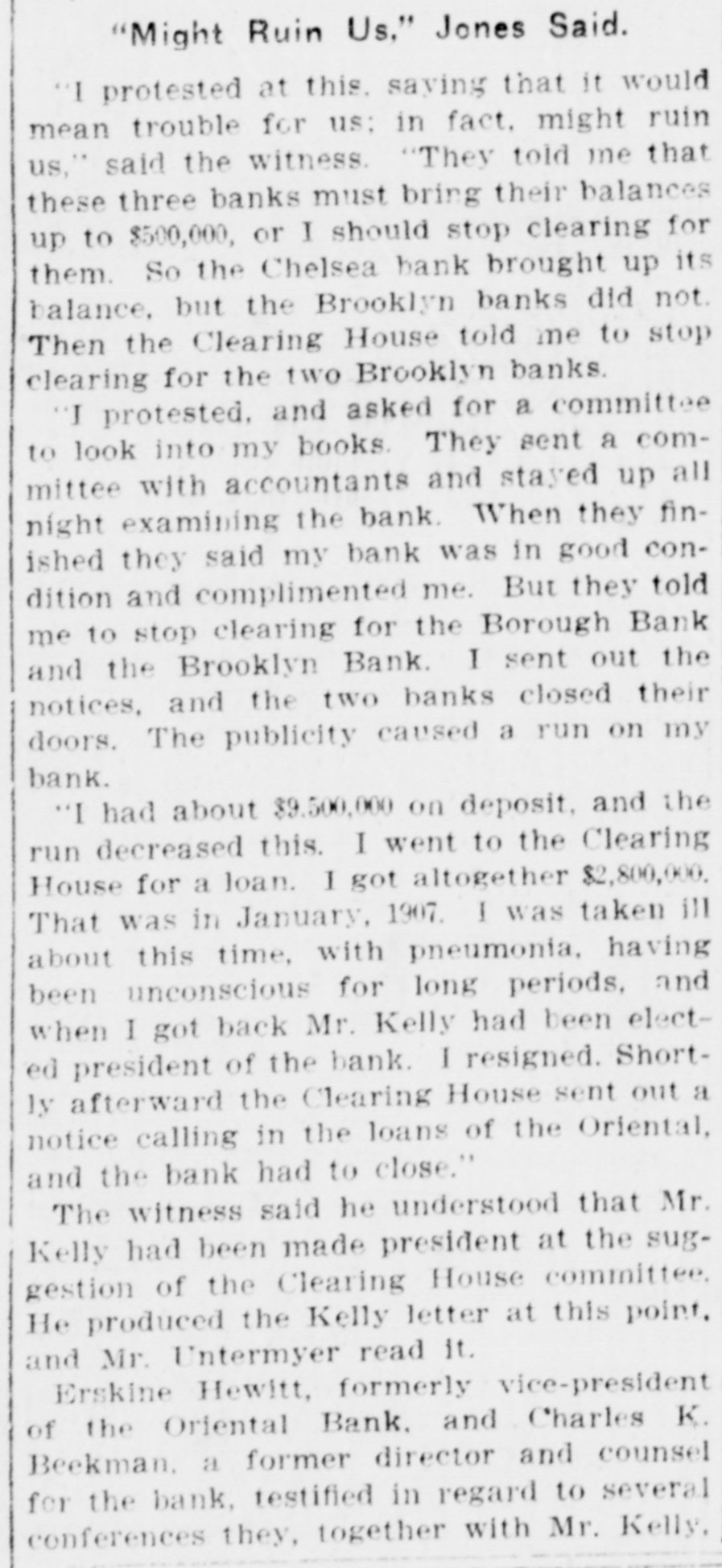
"Might Ruin Us," Jones Said. "I protested at this. saying that it would mean trouble for us; in fact, might ruin us," said the witness. "They told me that these three banks must bring their balances up to $500,000, or I should stop clearing for them. So the Chelsea bank brought up its balance, but the Brooklyn banks did not. Then the Clearing House told me to stop clearing for the two Brooklyn banks. "I protested. and asked for a committee to look into my books. They sent a committee with accountants and stayed up all night examining the bank. When they finished they said my bank was in good condition and complimented me. But they told me to stop clearing for the Borough Bank and the Brooklyn Bank. I sent out the notices, and the two banks closed their doors. The publicity caused a run on my bank. "I had about $9,500,000 on deposit, and the run decreased this. I went to the Clearing House for a loan. I got altogether $2,800,000. That was in January, 1907. I was taken ill about this time, with pneumonia, having been unconscious for long periods, and when I got back Mr. Kelly had been elected president of the bank. I resigned. Shortly afterward the Clearing House sent out a notice calling in the loans of the Oriental, and the bank had to close." The witness said he understood that Mr. Kelly had been made president at the suggestion of the Clearing House committee. He produced the Kelly letter at this point. and Mr. Untermyer read it. Erskine Hewitt, formerly vice-president of the Oriental Bank. and Charles K. Beekman. a former director and counsel for the bank, testified in regard to several conferences they, together with Mr. Kelly,
Article from Meade County News, April 17, 1913

Click image to open full size in new tab

Article Text

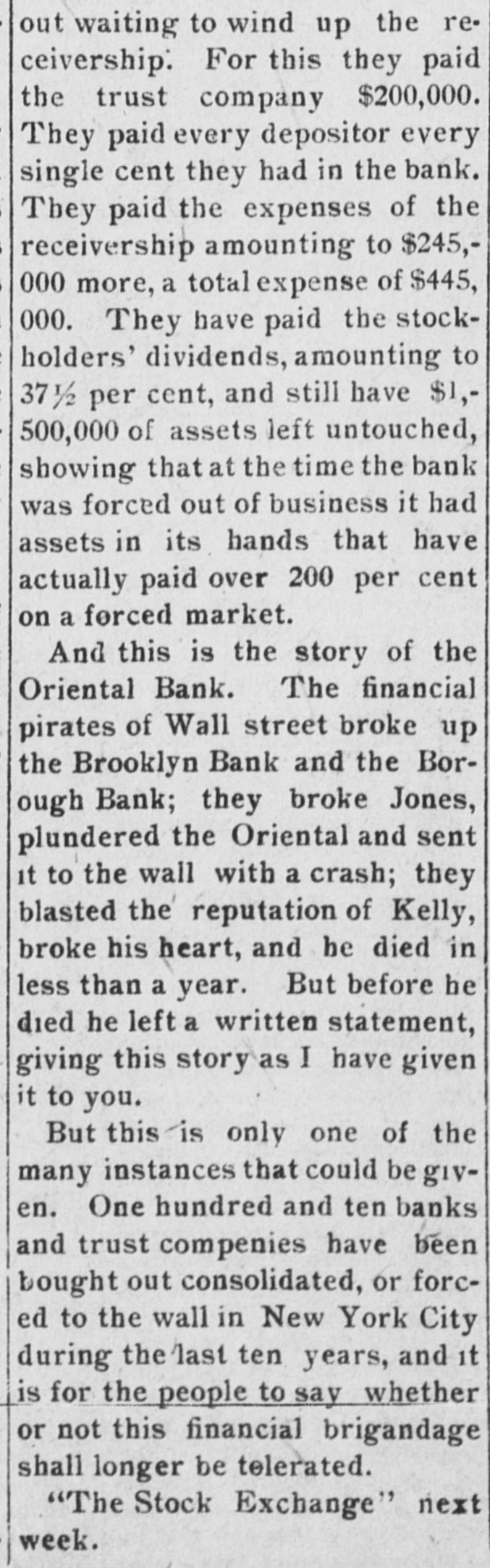
out waiting to wind up the receivership: For this they paid the trust company $200,000. They paid every depositor every single cent they had in the bank. They paid the expenses of the receivership amounting to $245,000 more, a total expense of $445, 000. They have paid the stockholders' dividends, amounting to 37 1/2 per cent, and still have $1,500,000 of assets left untouched, showing that at the time the bank was forced out of business it had assets in its hands that have actually paid over 200 per cent on a forced market. And this is the story of the Oriental Bank. The financial pirates of Wall street broke up the Brooklyn Bank and the Borough Bank; they broke Jones, plundered the Oriental and sent it to the wall with a crash; they blasted the reputation of Kelly, broke his heart, and he died in less than a year. But before he died he left a written statement, giving this story as I have given it to you. But this is only one of the many instances that could be given. One hundred and ten banks and trust compenies have been bought out consolidated, or forced to the wall in New York City during the last ten years, and it is for the people to say whether or not this financial brigandage shall longer be telerated. "The Stock Exchange" next week.


Article from Barton County Democrat, April 25, 1913

Click image to open full size in new tab

Article Text

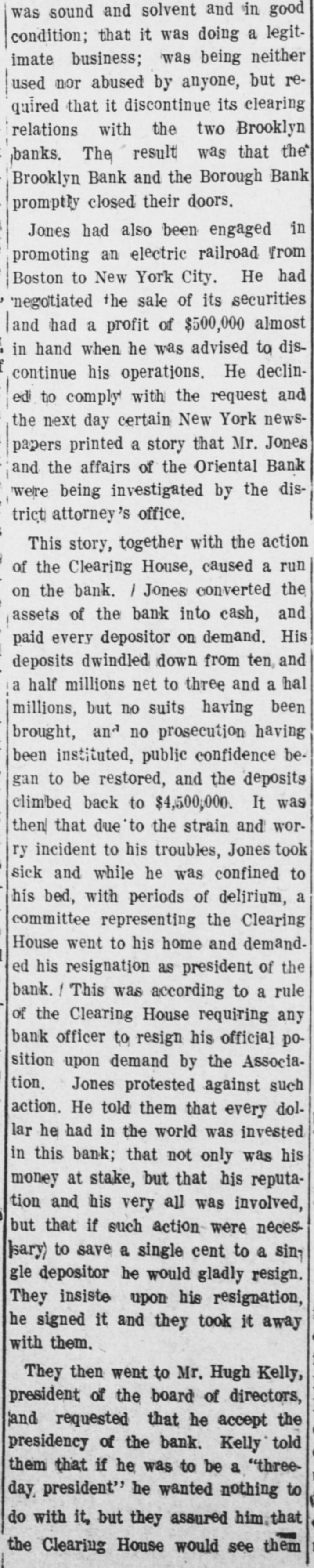
was sound and solvent and in good condition; that it was doing a legitimate business; was being neither used nor abused by anyone, but required that it discontinue its clearing relations with the two Brooklyn banks. The result was that the Brooklyn Bank and the Borough Bank promptly closed their doors. Jones had also been engaged in promoting an electric railroad from Boston to New York City. He had negotiated the sale of its securities and had a profit of $500,000 almost in hand when he was advised to discontinue his operations. He declinedi to comply with the request and the next day certain New York newspapers printed a story that Mr. Jones and the affairs of the Oriental Bank were being investigated by the district attorney's office. This story, together with the action of the Clearing House, caused a run on the bank. / Jones converted the assets of the bank into cash, and paid every depositor on demand. His deposits dwindled down from ten, and a half millions net to three and a hal millions, but no suits having been brought, and no prosecution having been instituted, public confidence began to be restored, and the deposits climbed back to $4,500,000. It was then that due to the strain and worry incident to his troubles, Jones took sick and while he was confined to his bed, with periods of delirium, a committee representing the Clearing House went to his home and demanded his resignation as president of the bank. / This was according to a rule of the Clearing House requiring any bank officer to resign his official position upon demand by the Association. Jones protested against such action. He told them that every dollar he had in the world was invested in this bank; that not only was his money at stake, but that his reputation and his very all was involved, but that if such action were necesIsary) to save a single cent to a sin₇ gle depositor he would gladly resign. They insiste upon his resignation, he signed it and they took it away with them. They then went to Mr. Hugh Kelly, president of the board of directors, and requested that he accept the presidency of the bank. Kelly told them that if he was to be a "threeday president'' he wanted nothing to do with it, but they assured him. that the Clearing House would see them