1481. Townsend Savings Bank (New Haven, CT)

Bank Information

Episode Type
Suspension โ†’ Closure
Bank Type
savings bank
Start Date
February 27, 1883
Location
New Haven, Connecticut (41.308, -72.928)

Metadata

Model
gpt-5-mini
Short Digest
c229b639671dfd0c

Response Measures

None

Description

The articles consistently describe the Townsend Savings Bank of New Haven as bankrupt and in the hands of a receiver (State Attorney Doolittle). There is no description of a depositor run or of temporary suspension with later reopening. The bank's affairs were being wound up, receivers sold securities, and litigation/injunctions accompanied the winding upโ€”i.e., a permanent closure with a receiver. I infer 'state' bank from the name 'Savings Bank' and Connecticut context. Dates corrected/standardized from newspaper publication dates where appropriate.

Events (7)

1. February 27, 1883 Other
Newspaper Excerpt
Could a volunteer committee of men depositors be appointed by the depositors of Townsend's bank to distribute the money now on hand?... EIGHT HUNDRED DOLLAR AND Two THOUSAND DOLLAR DEPOSITORS.
Source
newspapers
2. February 28, 1883 Receivership
Newspaper Excerpt
Receiver Doolittle, of the bankrupt Townsend Savings Bank, received a communication... Receiver Doolittle, of the bankrupt Townsend Savings Bank, New Haven, Conn., received a communication ... threatening him with death if he did not pay a dividend of at least 10 per cent.
Source
newspapers
3. March 21, 1883 Other
Newspaper Excerpt
Judge David Peck granted an injunction upon the petition of Emily M. Dwight to restrain the receivers of the Townsend Savings bank from removing a safe... Attorney Doolittle appeared ... and had this temporary injunction dissolved. The receivers will now dispose of the safe.
Source
newspapers
4. September 4, 1883 Other
Newspaper Excerpt
State Attorney Doolittle, receiver for the Townsend Savings Bank, has received a telegram stating that the action of the Credit Mobilier vs. the Union Pacific... Mr. Doolittle caused the case to be instituted in the interest of the Townsend Savings Bank.
Source
newspapers
5. January 11, 1884 Other
Newspaper Excerpt
State Attorney Doolittle, receiver of the Townsend Savings Bank, says he has not wound up the affairs in consequence of the injunction, but for which he could have declared a dividend of two per cent... The principal assets are Western railroad stock, also the stock in the Credit Mobilier Co.
Source
newspapers
6. December 16, 1884 Other
Newspaper Excerpt
The State commission on the affairs of the Townsend Savings bank have voted to hold a public hearing in New Haven, Dec. 16, at 11 a. m. The receivers have been requested to appear and be heard.
Source
newspapers
7. February 1, 1886 Other
Newspaper Excerpt
The remaining securities of the Townsend Savings Bank, face value $489,466 were sold at auction to-day and brought $434,40; $33,062.75 of Selma, Rome and Dalton Railroad stock sold for $5; one judgment against J. M. Ryder for over $200,000 sold for $200.
Source
newspapers

Newspaper Articles (11)

Article from Morning Journal and Courier, February 27, 1883

Click image to open full size in new tab

Article Text

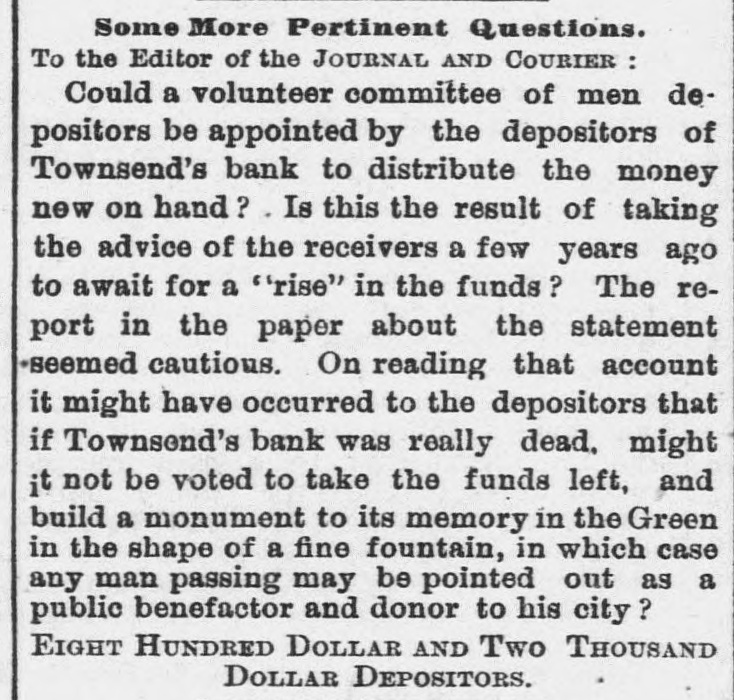
Some More Pertinent Questions. To the Editor of the JOURNAL AND COURIER : Could a volunteer committee of men depositors be appointed by the depositors of Townsend's bank to distribute the money new on hand ? Is this the result of taking the advice of the receivers a few years ago to await for a "rise" in the funds ? The report in the paper about the statement seemed cautious. On reading that account it might have occurred to the depositors that if Townsend's bank was really dead. might it not be voted to take the funds left, and build a monument to its memory in the Green in the shape of a fine fountain, in which case any man passing may be pointed out as a public benefactor and donor to his city ? EIGHT HUNDRED DOLLAR AND Two THOUSAND DOLLAR DEPOSITORS.


Article from New-York Tribune, March 1, 1883

Click image to open full size in new tab

Article Text

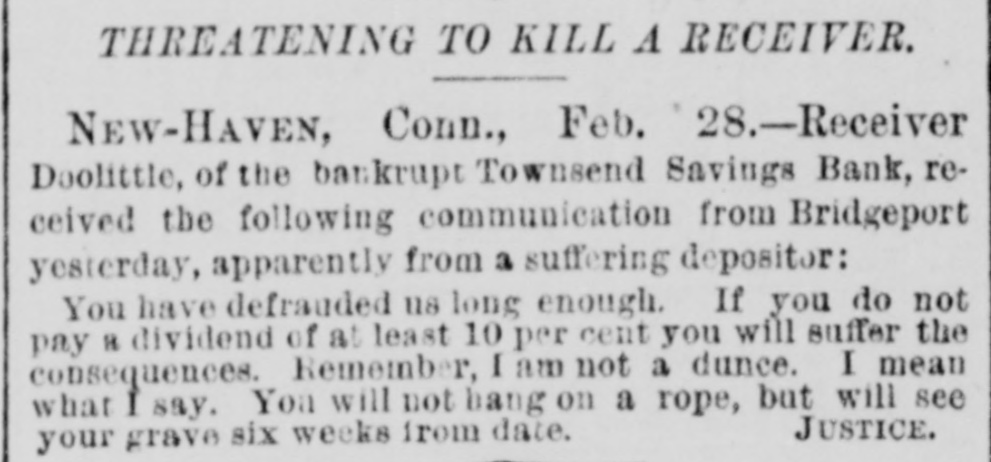
THREATENING TO KILL A RECEIVER. NEW-HAVEN, Conn., Feb. 28.-Receiver Doolittle, of the bankrupt Townsend Savings Bank, received the following communication from Bridgeport yesterday, apparently from a suffering depositor: You have defrauded us long enough. If you do not pay a dividend of at least 10 per cent you will suffer the consequences. Remember, I am not a dunce. I mean what I say. Yoa will not bang on a rope, but will see JUSTICE. your grave six weeks from date.


Article from The Indianapolis Journal, March 2, 1883

Click image to open full size in new tab

Article Text

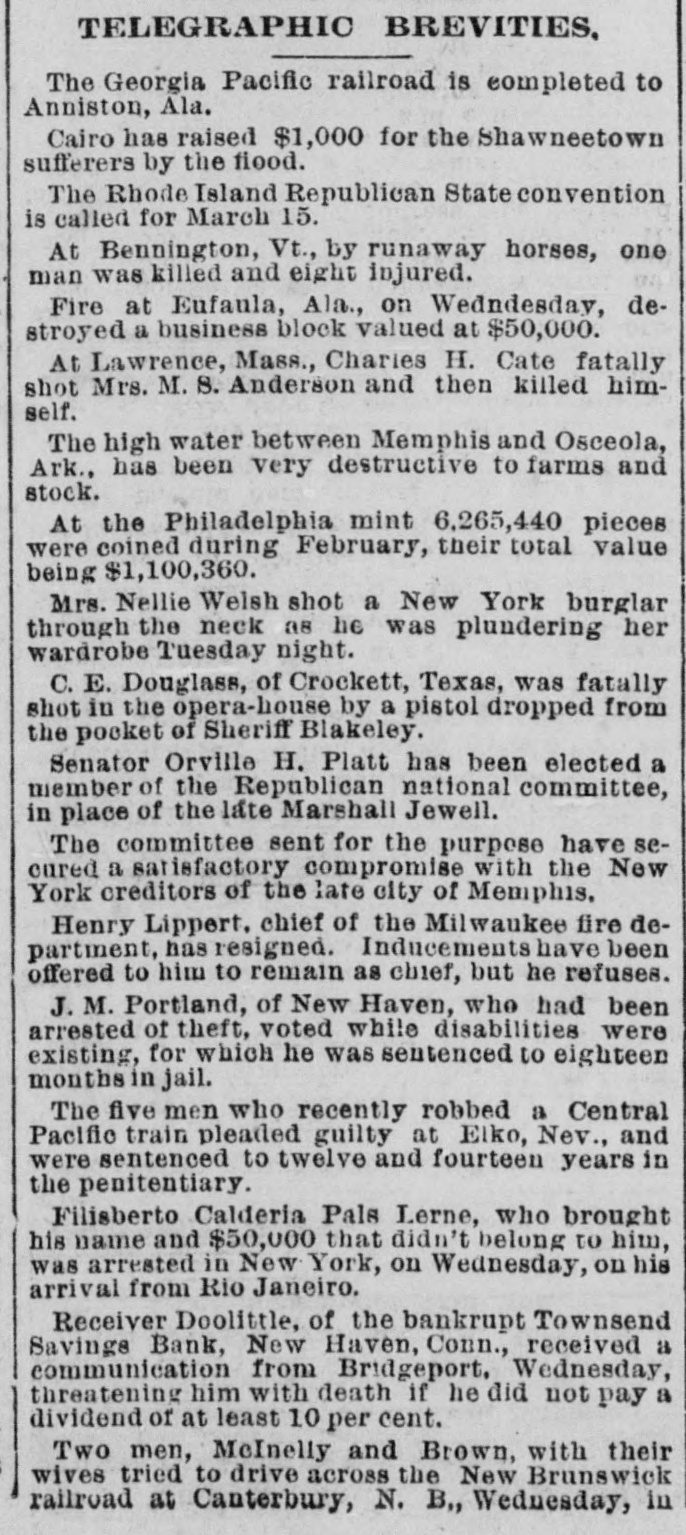
TELEGRAPHIC BREVITIES, The Georgia Pacific railroad is completed to Anniston, Ala. Cairo has raised $1,000 for the Shawneetown sufferers by the flood. The Rhode Island Republican State convention is called for March 15. At Bennington, Vt., by runaway horses, one man was killed and eight injured. Fire at Eufaula, Ala., on Wedndesday, destroyed a business block valued at $50,000. At Lawrence, Mass., Charies H. Cate fatally shot Mrs. M. S. Anderson and then killed himself. The high water between Memphis and Osceola, Ark., has been very destructive to farms and stock. At the Philadelphia mint 6,265,440 pieces were coined during February, their total value being $1,100,360. Mrs. Nellie Welsh shot a New York burglar through the neck as he was plundering her wardrobe Tuesday night. C. E. Douglass, of Crockett, Texas, was fatally shot in the opera-house by a pistol dropped from the pocket of Sheriff Blakeley. Senator Orville H. Platt has been elected a member of the Republican national committee, in place of the late Marshall Jewell. The committee sent for the purpose have secured a satisfactory compromise with the New York creditors of the late city of Memphis, Henry Lippert. chief of the Milwaukee fire department, has resigned. Inducements have been offered to him to remain as chief, but he refuses. J. M. Portland, of New Haven, who had been arrested of theft, voted while disabilities were existing, for which he was sentenced to eighteen months in jail. The five men who recently robbed a Central Pacific train pleaded guilty at Elko, Nev., and were sentenced to twelve and fourteen years in the penitentiary. Filisberto Calderia Pale Lerne, who brought his name and $50,000 that didn't belong to him, was arrested in New York, on Wednesday, on his arrival from Rio Janeiro. Receiver Doolittle, of the bankrupt Townsend Savings Bank, New Haven, Conn., received a communication from Bridgeport, Wednesday, threatening him with death if he did not pay a dividend of at least 10 per cent. Two men, McInelly and Brown, with their wives tried to drive across the New Brunswick railroad at Canterbury, N. B,, Wednesday, in


Article from Morning Journal and Courier, March 21, 1883

Click image to open full size in new tab

Article Text

The Court Record. Superior Court - Civil Side - Judge Beardsley. This court came in yesterday morning at 10 o'clock. The first case heard was the divorce suit of Ida M. Amesbury, of Norwich, VS. Marvin H. Amesbury, of this city. The petitioner related the story of her wrongs to the court. She stated that her husband, when she lived with him, often beat her in a cruel manner and that he had long lived in adultery with a woman whom he now calls his housekeeper. Several witnesses corroborated Mrs. Amesbury's testimony in regard to the ill treat ment. There was no defense introduced, and when the testimony was concluded Judge Beardsley very promptly granted a divorce on the ground of adultery and intolerable cruelty. The custody of the female child, which was spirited away from Norwich by the father while the mother was in this city, was given to the mother absolutely. Lawyer Hull, who appeared for Amesbury, stated that an agreement had been made between wife and husband that each should have possession of the child half of the time. Mr. Hull wanted such an order issued by the court. Judge Beardsley refused to do so, adding that it was very evident from the testimony that the mother was the proper custodian of the child. If the two wished to make any agreement between themselves afterward they could. Simeon E. Baldwin, counsel for the Hartford and Harlem railroad. company, and Mr. Isbell of Milford, in their injunction suits against the New York and Connecticut Air Line railroad company, made a motion that the defendants in the latter suit a file answer. more specific As alleged by Mr. Isbell, the proposed road will pass through his farm located at Milford, to his great disadvantage. Mr. Baldwin wanted the defendants to either admit or deny in their answer whether they passed through Isbell's, and if they did what portion of it. In reply Mr. Beach, who appeared for the proposed Air Line road, said that he supposed the road would pass through the property referred to, but he could not tell whether it belonged to Isbell or not; it was for the petitioner to prove that the property was his. Upon an agreement that at the coming hearing the map of the proposed lay out of the road would be produced in court the motion was dropped. The hearing on its merits of the motion for a temporary injunction to restrain the New York and Connecticut Air Line road from proceeding further in the matter of securing an approval of the layout of their road by the railroad commissioners had been set down for to-day. On account of several pressing engagements of Mr. Baldwin at Hartford in railroad hearings there, he asked for a further postponement. Judge Beardsley assigned the hearing for next week Tues. day at 10 o'clock. In 1878 the late Judge David Peck granted an injunction upon the petition of Emily M. Dwight to restrain the receivers of the Townsend Savings bank from removing a safe or portable vault located in the building occupied by the bank. Attorney Doolittle appeared before Judge Beardsley in the Superior court yesterday forenoon and had this temporary injunction dissolved, a measure which has been agreed to by the petitioner. The receivers will now dispose of the safe. Court of Common Pleas-Judge Torrance. This court came in yesterday morning at 10 o'clock. The case of G. W. Bronson vs. Burton E. Gorham was on trial. It is an action to re1 cover a horse attached by Sheriff Higgins for Gorham in a suit against G. P. Bronson & Son. Arguments were made yesterday foree noon on a non suit. Bronson claimed he n bought the horse of his father and kept it in his father's barn. Gorham alleges that there 3 was no actual change in the possession of the property. i Court adjourned until this morning at 10 o'clock. City Court-Ciiminal Side-Judge Studley. William Kennedy, passing counterfeit money, to March 22. Patrick McCue, breach of peace, $7 fine, $6.18 costs. Patrick Reardon, William J. Timms, same, to March 21. e Michael Pender, breach of peace, $10 fine, $6.97 costs, both appealed. Moses Murphy, violation of Sunday law, to March 24. Henry Leyerzaph, violation of liquor law, to 24. Patrick March McCue, to injury property, judgment suspended. Frederick Hesse, Theodore Hesse, John Muleahey, Timothy Mule cahey, John McQueeney, injury to public property, to April 24. Patrick F. Delaney, breach of the peace against Patrick O. Connelly, $5 fine, $5.39 costs. John J. Conway, a violating liquor law, to March 24. Court Notes.
Article from Morning Journal and Courier, March 28, 1883

Click image to open full size in new tab

Article Text

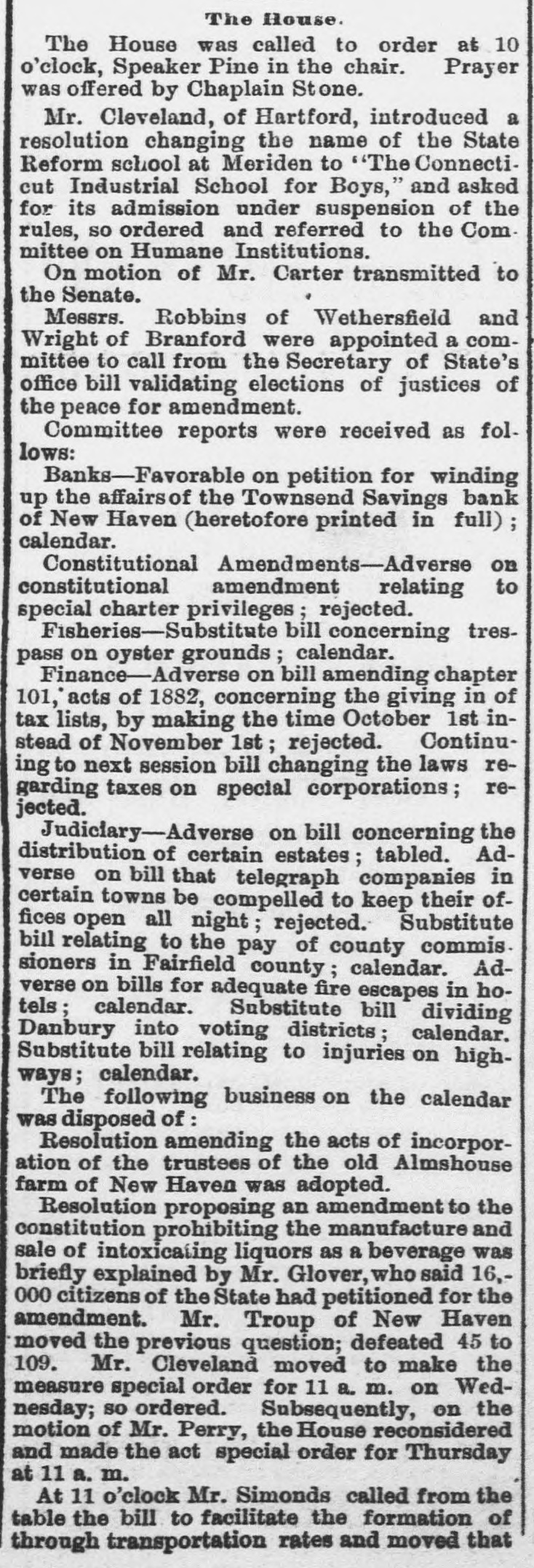
The House. The House was called to order at 10 o'clock, Speaker Pine in the chair. Prayer was offered by Chaplain Stone. Mr. Cleveland, of Hartford, introduced a resolution changing the name of the State Reform school at Meriden to "The Connecticut Industrial School for Boys," and asked for its admission under suspension of the rules, so ordered and referred to the Com. mittee on Humane Institutions. On motion of Mr. Carter transmitted to the Senate. Messrs. Robbins of Wethersfield and Wright of Branford were appointed a committee to call from the Secretary of State's office bill validating elections of justices of the peace for amendment. Committee reports were received as follows: Banks-Favorable on petition for winding up the affairs of the Townsend Savings bank of New Haven (heretofore printed in full) calendar. Constitutional Amendments-Adverse on constitutional amendment relating to special charter privileges rejected. Fisheries-Substitute bill concerning trespass on oyster grounds; calendar. Finance-Adverse on bill amending chapter 101, acts of 1882, concerning the giving in of tax lists, by making the time October 1st instead of November 1st; rejected. Continuing to next session bill changing the laws regarding taxes on special corporations; rejected. Judiciary-Adverse on bill concerning the distribution of certain estates; tabled. Adverse on bill that telegraph companies in certain towns be compelled to keep their offices open all night; rejected. Substitute bill relating to the pay of county commis. sioners in Fairfield county; calendar. Adverse on bills for adequate fire escapes in hotels; calendar. Substitute bill dividing Danbury into voting districts; calendar. Substitute bill relating to injuries on highways; calendar. The following business on the calendar was disposed of Resolution amending the acts of incorporation of the trustees of the old Almshouse farm of New Haven was adopted. Resolution proposing an amendment to the constitution prohibiting the manufacture and sale of intoxicating liquors as a beverage was briefly explained by Mr. Glover, who said 16,000 citizens of the State had petitioned for the amendment. Mr. Troup of New Haven moved the previous question; defeated 45 to 109. Mr. Cleveland moved to make the measure special order for 11 a. m. on Wednesday; so ordered. Subsequently, on the motion of Mr. Perry, the House reconsidered and made the act special order for Thursday at 11 a. m. At 11 o'clock Mr. Simonds called from the table the bill to facilitate the formation of through transportation rates and moved that


Article from New-York Tribune, September 5, 1883

Click image to open full size in new tab

Article Text

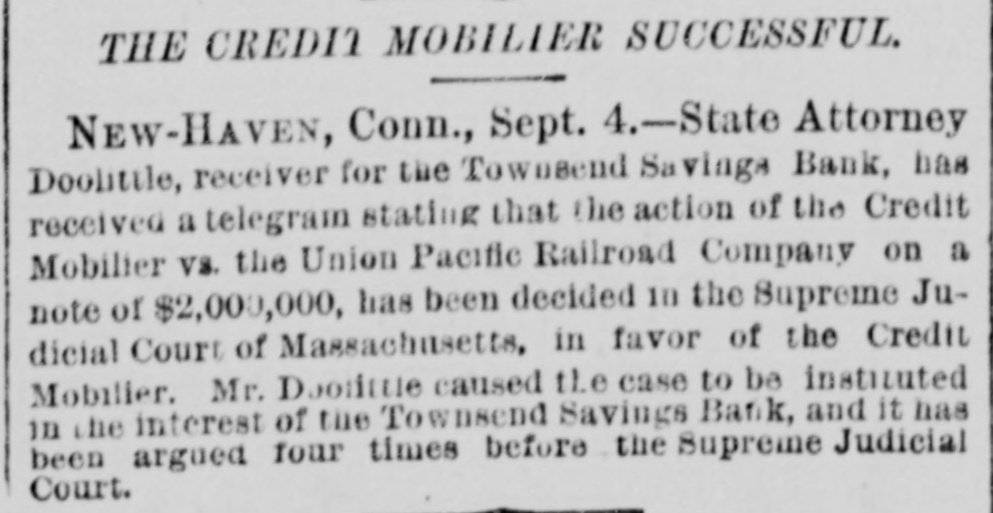
THE CREDIT MOBILIER SUCCESSFUL. New-HAVEN, Conn., Sept. 4.-State Attorney Doolittle, receiver for the Townsend Sa vinga Bank, has received a telegram stating that the action of the Credit Mobilier vs. the Union Pacific Railroad Company on a note of $2,000,000, has been decided 10 the Supreme Judicial Court of Massachusetts, in favor of the Credit Mobilier. Mr. Doofittle caused the case to be instituted in the interest of the Townsend Savings Bank, and it has been argued four times before the Supreme Judicial Court.


Article from St. Johnsbury Caledonian, September 14, 1883

Click image to open full size in new tab

Article Text

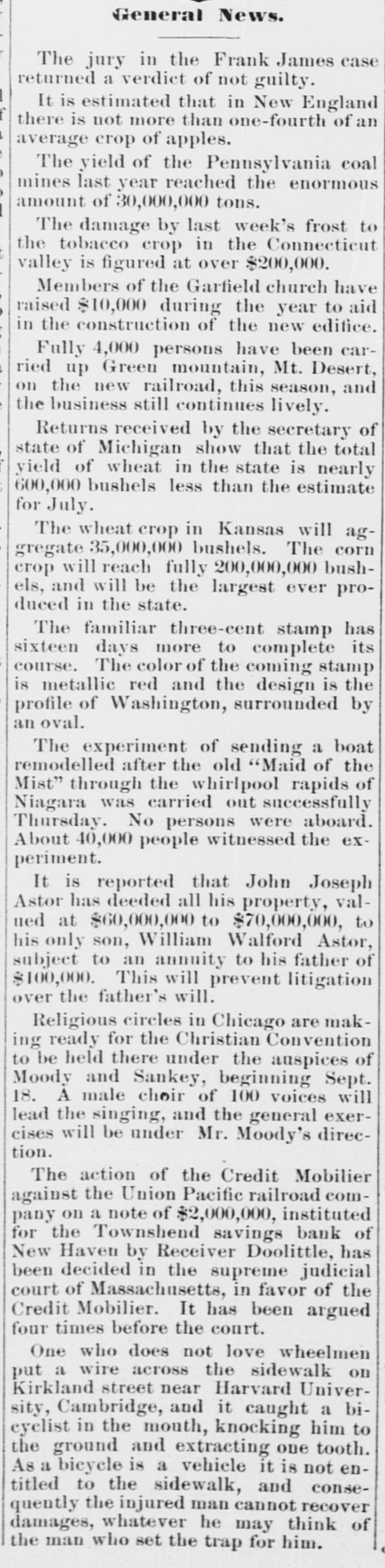
General News. The jury in the Frank James case returned a verdict of not guilty. It is estimated that in New England there is not more than one-fourth of an average crop of apples. The yield of the Pennsylvania coal mines last year reached the enormous amount of 30,000,000 tons. The damage by last week's frost to the tobacco crop in the Connecticut valley is figured at over $200,000. Members of the Garfield church have raised $10,000 during the year to aid in the construction of the new edifice. Fully 4,000 persons have been carried up Green mountain, Mt. Desert, on the new railroad, this season, and the business still continues lively. Returns received by the secretary of state of Michigan show that the total yield of wheat in the state is nearly 600,000 bushels less than the estimate for July. The wheat crop in Kansas will aggregate 35,000,000 bushels. The corn crop will reach fully 200,000,000 bushels, and will be the largest ever produced in the state. The familiar three-cent stamp has sixteen days more to complete its course. The color of the coming stamp is metallic red and the design is the profile of Washington, surrounded by an oval. The experiment of sending a boat remodelled after the old "Maid of the Mist" through the whirlpool rapids of Niagara was carried out successfully Thursday. No persons were aboard. About 40,000 people witnessed the experiment. It is reported that John Joseph Astor has deeded all his property, valued at $60,000,000 to $70,000,000, to his only son, William Walford Astor, subject to an annuity to his father of $100,000. This will prevent litigation over the father's will. Religious circles in Chicago are making ready for the Christian Convention to be held there under the auspices of Moody and Sankey, beginning Sept. 18. A male choir of 100 voices will lead the singing, and the general exercises will be under Mr. Moody's direction. The action of the Credit Mobilier against the Union Pacific railroad company on a note of $2,000,000, instituted for the Townshend savings bank of New Haven by Receiver Doolittle, has been decided in the supreme judicial court of Massachusetts, in favor of the Credit Mobilier. It has been argued four times before the court. One who does not love wheelmen put a wire across the sidewalk on Kirkland street near Harvard University, Cambridge, and it caught a bicyclist in the mouth, knocking him to the ground and extracting one tooth. As a bicycle is a vehicle it is not entitled to the sidewalk, and consequently the injured man cannot recover damages, whatever he may think of the man who set the trap for him.


Article from Daily Kennebec Journal, January 12, 1884

Click image to open full size in new tab

Article Text

TOWNSEND SAVINGS bank. The Receiver Says the [Affairs of the Banks Has Not Been Wound Up. NEW Haven, Conn.. Jan. 11. State Attorney Doolittle, receiver of the Townsend Savings Bank, says he has not wound up the affairs in consequence of the injunction, but for which he could have declared a dividend of two per cent. by waiting till certain matters are settled he can probably do eight or ten per cent. better. The injunction has been prayed out by John W. Alling, reciting that he is owner of a claim of $30,000 against the bank. Its principle assets are Western railroad stock, also the stock in the Credit Mobilier Co. The latter has a heavy suit against the Union Pacific Railroad, and the value of the bank's assets depend upon the result of the suit. For this reason and because the action of the legislature directing the affairs of the bank to be wound up, is claimed to be unconstitutional because it involved usurpation of powers lodged in the judiciary. A temporary injunction is asked.


Article from Morning Journal and Courier, December 4, 1884

Click image to open full size in new tab

Article Text

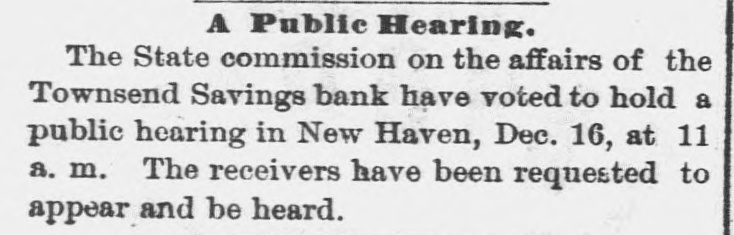
A Public Hearing. The State commission on the affairs of the Townsend Savings bank have voted to hold a public hearing in New Haven, Dec. 16, at 11 a. m. The receivers have been requested to appear and be heard.


Article from New-York Tribune, February 2, 1886

Click image to open full size in new tab

Article Text

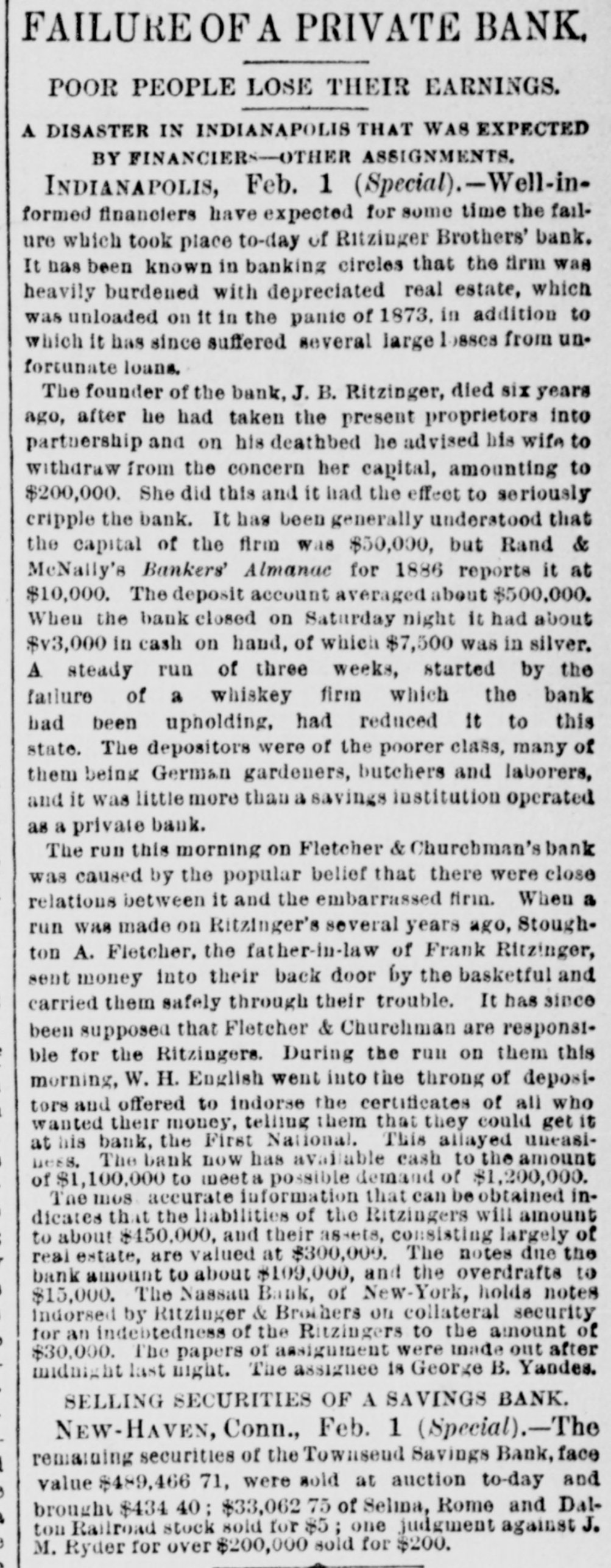
FAILURE OF A PRIVATE BANK. POOR PEOPLE LOSE THEIR EARNINGS. A DISASTER IN INDIANAPOLIS THAT WAS EXPECTED BY FINANCIERSOTHER ASSIGNMENTS. INDIANAPOLIS, Feb. 1 (Special).-Well-informed financiers have expected for some time the failure which took place to-day of Ritzinger Brothers' bank. It has been known in banking circles that the firm was heavily burdened with depreciated real estate, which was unloaded on it in the panic of 1873, in addition to which it has since suffered several large losses from unfortunate loans. The founder of the bank, J. B. Ritzinger, died six years ago, after he had taken the present proprietors into partnership and on his deathbed he advised his wife to withdraw from the concern her capital, amounting to $200,000. She did this and it had the effect to seriously cripple the bank. It has been generally understood that the capital of the firm was $50,000, but Rand & McNally's Bankers' Almanac for 1886 reports it at $10,000. The deposit account averaged about $500,000. When the bank closed on Saturday night it had about $v3,000 in cash on hand, of which $7,500 was in silver. A steady run of three weeks, started by the failure of a whiskey firm which the bank had been upholding, had reduced it to this state. The depositors were of the poorer class, many of them being German gardeners, butchers and laborers, and it was little more than a savings institution operated as a private bank. The run this morning on Fletcher & Churchman's bank was caused by the popular belief that there were close relations between it and the embarrassed firm. When a run was made on Ritzinger's several years ago, Stoughton A. Fletcher, the father-in-law of Frank Ritzinger, sent money into their back door by the basketful and carried them safely through their trouble. It has since been supposed that Fletcher & Churchman are responsible for the Ritzingers. During the run on them this morning, W. H. English went into the throng of depositors and offered to indorse the certificates of all who wanted their money, telling them that they could get it at his bank, the First National. This allayed uneasiness. The bank now has available cash to the amount of $1,100,000 to meeta possible demand of $1,200,000. The mos accurate information that can be obtained indicates that the liabilities of the Ritzingers will amount to about $450,000, and their assets, consisting largely of real estate, are valued at $300,000. The notes due the bank amount to about $109,000, and the overdrafts to $15,000. The Nassau Bank, of New-York, holds notes indorsed by Ritzinger & Brothers on collateral security for an indebtedness of the Ritzingers to the amount of $30,000. The papers of assignment were made out after midnight last night. The assignee 18 George B. Yandes. SELLING SECURITIES OF A SAVINGS BANK. New-HAVEN, Conn., Feb. 1 (Special).-The remaining securities of the Townsend Savings Bank, face value $489,466 were sold at auction to-day and brought $434 40; $33,062 75 of Selma, Rome and Dalton Railroad stock sold for $5; one judgment against J. M. Ryder for over $200,000 sold for $200.


Article from Morning Journal and Courier, October 23, 1889

Click image to open full size in new tab

Article Text

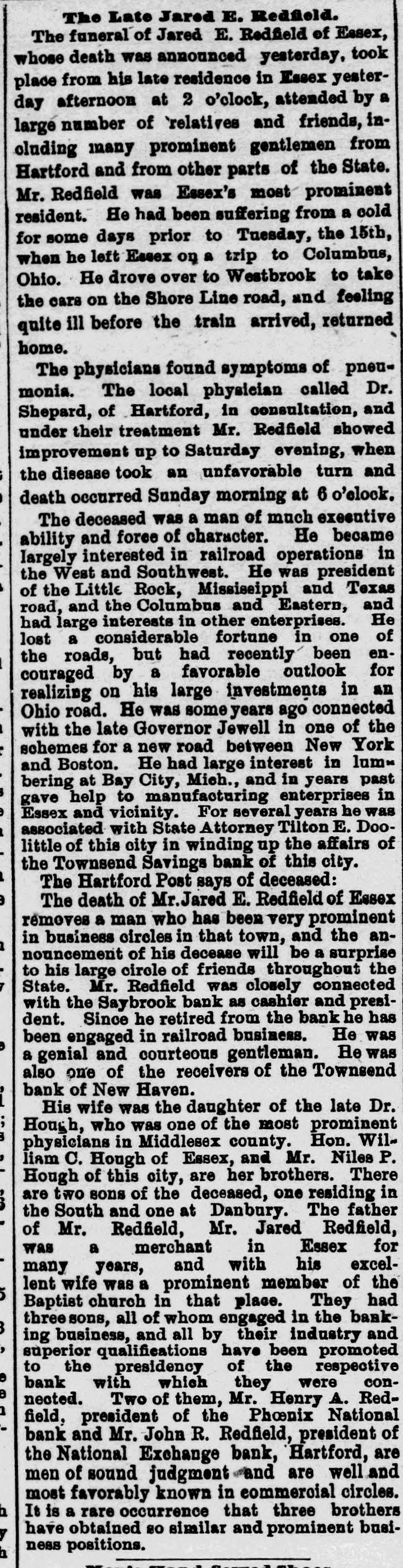
# The Late Jared E. Redfield. The funeral of Jared E. Redfield of Essex, whose death was announced yesterday, took place from his late residence in Essex yesterday afternoon at 2 o'clock, attended by a large number of 'relatives and friends, including many prominent gentlemen from Hartford and from other parts of the State. Mr. Redfield was Essex's most prominent resident. He had been suffering from a cold for some days prior to Tuesday, the 15th, when he left Essex on a trip to Columbus, Ohio. He drove over to Westbrook to take the cars on the Shore Line road, and feeling quite ill before the train arrived, returned home. The physicians found symptoms of pneumonia. The local physician called Dr. Shepard, of Hartford, in consultation, and under their treatment Mr. Redfield showed improvement up to Saturday evening, when the disease took an unfavorable turn and death occurred Sunday morning at 6 o'clock. The deceased was a man of much executive ability and force of character. He became largely interested in railroad operations in the West and Southwest. He was president of the Little Rock, Mississippi and Texas road, and the Columbus and Eastern, and had large interests in other enterprises. He lost a considerable fortune in one of the roads, but had recently been encouraged by a favorable outlook for realizing on his large investments in an Ohio road. He was some years ago connected with the late Governor Jewell in one of the schemes for a new road between New York and Boston. He had large interest in lumbering at Bay City, Mich., and in years past gave help to manufacturing enterprises in Essex and vicinity. For several years he was associated with State Attorney Tilton E. Doolittle of this city in winding up the affairs of the Townsend Savings bank of this city. The Hartford Post says of deceased: The death of Mr. Jared E. Redfield of Essex removes a man who has been very prominent in business circles in that town, and the announcement of his decease will be a surprise to his large circle of friends throughout the State. Mr. Redfield was closely connected with the Saybrook bank as cashier and president. Since he retired from the bank he has been engaged in railroad business. He was a genial and courteous gentleman. He was also one of the receivers of the Townsend bank of New Haven. His wife was the daughter of the late Dr. Hough, who was one of the most prominent physicians in Middlesex county. Hon. William C. Hough of Essex, and Mr. Niles P. Hough of this city, are her brothers. There are two sons of the deceased, one residing in the South and one at Danbury. The father of Mr. Redfield, Mr. Jared Redfield, was a merchant in Essex for many years, and with his excellent wife was a prominent member of the Baptist church in that place. They had three sons, all of whom engaged in the banking business, and all by their industry and superior qualifications have been promoted to the presidency of the respective bank with which they were connected. Two of them, Mr. Henry A. Redfield, president of the Phoenix National bank and Mr. John R. Redfield, president of the National Exchange bank, Hartford, are men of sound judgment and are well and most favorably known in commercial circles. It is a rare occurrence that three brothers have obtained so similar and prominent business positions.