National Trust Company (New York, NY)

Episode Information

Episode Type
Suspension β†’ Closure
Start Date
May 4, 1879
Location
New York, New York (40.714, -74.006)
Bank Type
private

Metadata

Notes

The articles consistently discuss the company's receivership and court settlement of receiver's fees; no run is reported.

Events (3)

1. May 4, 1879 Other
Newspaper Excerpt
Mr. Best took him to the office of his counsel Mr. Smythe ... On May 4, 1878, to do it. (article refers to transfers May 4, 1878)
Source
newspapers
2. December 30, 1882 Other
Newspaper Excerpt
Justice Lawrence ... made an order directing William J. Best, as receiver of the National Trust Company of New-York, to show cause on January 2, 1883, why the amount of his fees should not be settled by the Court.
Source
newspapers
3. * Receivership
Newspaper Excerpt
The Senate Insurance Committee investigated the National Trust Company receivership.
Source
newspapers

Newspaper Articles (10)

Article from New-York Tribune, September 17, 1882

Click image to open full size in new tab

Article Text

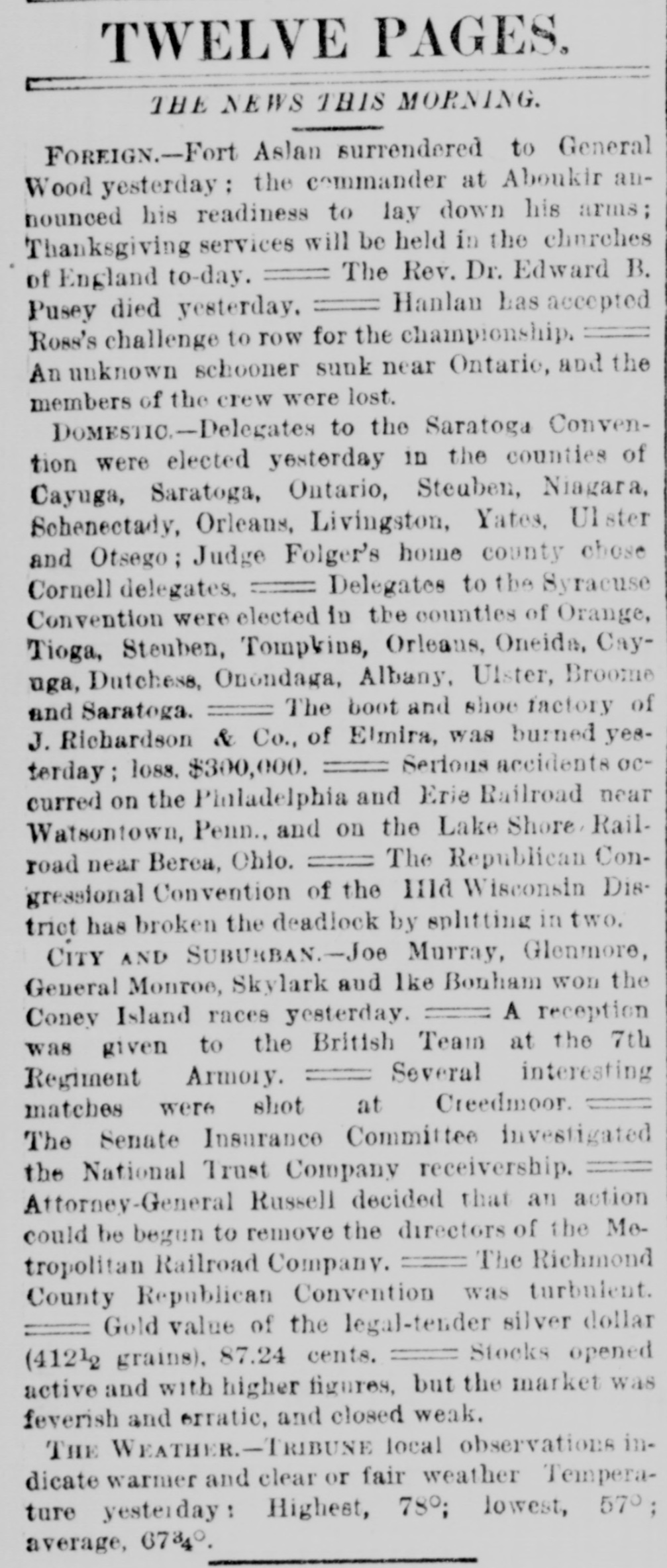
TWELVE PAGES.

THE NEWS THIS MORNING.

FOREIGN.-Fort Aslan surrendered to General Wood yesterday: the commander at Aboukir announced his readiness to lay down his arms; Thanksgiving services will be held in the churches of England to-day. The Rev. Dr. Edward B. Pusey died yesterday. Hanlan has accepted Ross's challenge to row for the championship. An unknown schooner sunk near Ontario, and the members of the crew were lost.

DOMESTIC.-Delegates to the Saratoga Convention were elected yesterday in the counties of Cayuga, Saratoga, Ontario, Steuben, Niagara, Schenectady, Orleans, Livingston, Yates, Ulster and Otsego; Judge Folger's home county chose Cornell delegates. Delegates to the Syracuse Convention were elected in the counties of Orange, Tioga, Steuben, Tompkins, Orleans, Oneida, Cayuga, Dutchess, Onondaga, Albany, Ulster, Broome and Saratoga. The boot and shoe factory of J. Richardson & Co., of Elmira, was burned yesterday; loss, $300,000. Serious accidents occurred on the Philadelphia and Erie Railroad near Watsontown, Penn., and on the Lake Shore Railroad near Berea, Ohio. The Republican Congressional Convention of the IIId Wisconsin District has broken the deadlock by splitting in two.

CITY AND SUBURBAN.-Joe Murray, Glenmore, General Monroe, Skylark and Ike Bonham won the Coney Island races yesterday. A reception was given to the British Team at the 7th Regiment Armory. Several interesting matches were shot at Creedmoor. The Senate Insurance Committee investigated the National Trust Company receivership. Attorney-General Russell decided that an action could be begun to remove the directors of the Metropolitan Railroad Company. The Richmond County Republican Convention was turbulent. Gold value of the legal-tender silver dollar (412Β½ grains), 87.24 cents. Stocks opened active and with higher figures, but the market was feverish and erratic, and closed weak.

THE WEATHER.-TRIBUNE local observations indicate warmer and clear or fair weather Temperature yesterday: Highest, 78Β°; lowest, 57Β°; average, 67ΒΎΒ°.


Article from New-York Tribune, September 18, 1882

Click image to open full size in new tab

Article Text

THE SUNDAY TRIBUNE.

Leading features of interest in the various de- partments of THE SUNDAY TRIBUNE of yesterday were as follows: Egypt. Further details of Arabi's defeat; rejoicings in England. Foreign News. Political and personal topics in Lon- don; Japan and Corea; wrecks at sea. Politics. Congressman W. A. Wood's candidacy for Governor; election of delegates to Saratoga and Syra- cuse; politics in other States. Stockaolders. Opinion on the rights of stockholders, by Attorney-General Russell, in the Metropolitan Ele- vated Railroad case. Receiver Best.-Official investigation into the man- agement of the National Trust Company. Saturday at Sheepshead.-A good day's racing on the Coney Island course. Obituary. Sketch of the career of the late Edward Bouverie Pusey, D. D. Creedmoor.-Interesting matches Saturday; recep- tion of the British team by the 7th Regiment. Local Miscellany. General Sporting News. Henry George's Appeal to the President. Broadway Note Book. The personal notes and notions of a Broadway lounger on men and things and the country round, Rural Life of England. Captain Mayne Reid on Eng- lish emigrants to the United States and the British colonies. Pacific Coast Topics. -Notes on business, politics and social matters in California. New Publications.-Review, with interesting extracts, of Miss Kate Field's Life of Fechter. A Ramble in England. William Winter on the foot- prints of history on famous fieids. Charles Reade. Some account of his practical philan- thropy. Sir Garnet Wolseley.-Archibald Forbes's account of the great General's life and achievements. A Close Shave. One View of the Russian Jews. Dying Words of the Great Home Interests. Science for the People. Religious Intelligence. A Glimpse of Cairo. Egyptian Ghosts. Curiosities of Evidence. Foreign Ideas About Americans. Bismarck's Esthetic Tastes. News topics of the day were thus summarized:

FOREIGN. Fort Aslan surrendered to General Wood on Saturday; the commander at Aboukir announced his readiness to lay down his arms; Thanksgiving services were to be held in the churches of England yesterday. Dr. Edward B. Pusey died on Saturday. The Rev. Hanlan has accepted Ross's challenge to row for the championship. An unknown schooner sunk near Ontrio, and, the members of the crew were lost,

DOMESTIC.-Delegates to the Saratoga Conven- tion were elected on Saturday in the counties of Cayuga, Saratoga, Ontario, Steuben, Niagara, Schenectady, Oricans, Livingston, Yates, Ulster and Otsego; Judge Folger's home county chose Cornell delegates. Delegates to the Syracuse Convention were elected in the counties of Orange Tioga, Steuben, Tompkins, Orleans, Oneida, Cay- uga, Dutchess, Onondaga, Albany, Ulster, Broome and Saratoga. The boot and shoe factory of J. Richardson & Co., of Elmira, was burned on Saturday; loss, $300,000. Serious accidents oc- curred on the Philadelphia and Erie Railroad near Watsontown, Penn., and on the Lake Shore Rail- road near Berea, Ohio. The Republican Con- gressional Convention of the IIld Wisconsin Dis- trict has broken the deadlock by splitting in two.

CITY AND SUBURBAN.-Joe Murray, Glenmore, General Monroe, Skylark and Ike Bonham won the Coney Island races saturday. A reception was given to the British Team at the 7th Regiment Armory. Several interesting matches were shot at Creedmoor. The Senate Insurance Committee investigated the National Trust Company receivership. Attorney-General Russell decided that an action could be begun to remove the directors of the Me- tropolitan Kailroad Company. The Richmond County Republican Convention was turoulent. Gold value of the legal-tender silver dollar (412Β½ grains), 87.24 cents. Stocks opened active and with higher figures, but the market was feverish and erratic, and closed weak.

Copies of the paper may still be obtained at the office of THE TRIBUNE or by mail. Price, 5 cents.


Article from New-York Tribune, September 19, 1882

Click image to open full size in new tab

Article Text

ESTIMATES OF A RECEIVER.

MR. BEST AND THE NATIONAL TRUST. AN EFFORT TO PROVE COLLUSION BETWEEN HIM AND THE DIRECTORS-TESTIMONY OF STOCK- HOLDERS.

The State Senate Committee on Insurance con- tinued its investigation of William J. Best's re- ceivership of the National Trust Company yester- day afternoon. The chairman of the committee, John J. Kiernan, and Senators Russell, Koch and Nelson were present. The meeting was held in Senator Russell's office, at No. 52 William-st. William O. McDowell, one of the leaders of the stockholders who have protested against the receivership, John C. Cruik- shank, formerly secretary of the National Trust Company, and Thomas W. Shannon, one of its stockholders, were the witnesses examined. The testimony taken was directed to proving collusion between Mr. Best and certain of the trustees in a plan to depreciate the assets of the company, so as to show an impairment of the capital, and then secure a sale of the company's securities at ruinous figures to some of the trustees.

Mr. McDowell testified in answer to questions by Mr. Ecclesine, counsel for Mr. Kiernan, that he had been a stockholder of the National Trust Company for some time before it was put in the hands of a receiver. There was a meeting of the stockholders on January 7, 1879, in pursuance of a call issued from ten to thirty days previously for the purpose of discussing the desirability of taking the company out of the hands of the Court. Just before the meeting he had found that certain trustees of the company had diligently obtained proxies from the stockholders for the purpose of voting them. They had met with Mr. Best and had issued a circular soliciting votes; J. L. Lowery was one of the trustees whom he remembered as connected with the matter. Mr. Lowery was pres- ent, as were also Mr. Constant and Mr. Moore, al- though the latter did not vote any proxies; Mr. Lowery voted 593 proxies. At the meeting the following resolutions were offered:

Resolved, That a committee of be elected by this meeting to examine into the present condition of the National Trust Company and into the causes that have brought this about, and to report to an adjourned meeting (to be called by them) their recommendations as to the future of this company.

Resolved, That we hereby request the directors, officials and receiver to assist this committee in per- forming their duty under these resolutions.

Resolved, That until this committee can report, they are hereby constituted an advisory committee, repre- senting the stockholders, and the receiver and directors are requested not to take any action affecting the com- pany excepting with their approval.

Mr. Best and his counsel, Mr. Smythe, continued Mr. McDowell, were present and took part in the discussion. Mr. Smythe opposed the plan proposed in the resolutions on the ground that they cast an imputation on the receiver. It was finally tabled by a small majority, Mr. Lowery voting all his prox- ies against it. Among the trustees who voted against it were Messrs, Lowery, Moore, Cornell (by proxy), F. W. and J. Hames, Carter, Constant, Fellows and Haight.

John C. Cruikshank testified that he was secre- tary of the National Trust Company in 1877. In December, 1876, the bank had been examined by Messrs. Lamb and Reid, and in December, 1877, by Mr. Best. In compliance with Mr. Ecclesine's re- quest the witness submitted an exhibit showing the difference in the market values of the securities held by the company, as estimated by Lamb and Reid and Best. The showing was as follows:


Article from New-York Tribune, September 29, 1882

Click image to open full size in new tab

Article Text

MR. BESTS RECEIVERSHIP. THE SENATE COMMITTEE'S INQUIRY. THE RECEIVER REPRESENTED BY COUNSEL-SCOPE OF THE COMMITTEE'S WORK-DR. RUPPANER'S TESTIMONY. William J. Best appeared yesterday before the State Senate Committee who at investigating his receivership of the National Trust Company, with F. N. Bangs as counsel. The lawyer, in giving notice of his retention in the case, stated that as he understood the matter from the newspaper reports of the testimony taken thus far the committee were directing their quiry mainly to two points: What were the circumstances connected with the appointment of Mr. Best as receiver, and what has been Mr. Best's conduct as receiver since his appointment. He submitted that the necessity of the appointment was a question outside the province of the committee, as it had been passed upon by the Court. He asked that he be enlightened by the committee as to their authority for proceeding as they had been doing. Senator Russell referred Mr. Bangs to the Senate resolution printed on the subpenas served by the Bergeant-at-Arm Mr. Bangs read the resolution as follows : Resolved. That the subject (reports of gross wrongs and injustice on the part of receivers the and is hereby referred to the standing Committee on Insurance, and that they have power to send for persons and papers whose duty it shall be to investigate ctransactions and proceedings of receivers appointed by order of the Courts, of all such insolvent corporations as are yet unsettled, and which have been closed within five years last past, in all cases where complaint is made by creditors or stockholders, and to report the result of such examination to the Legislature with such recommendations as the committee may deem proper. Under this resolution Mr. Bangs claimed that the committee could only inquire into complaints made by creditors or stockholders of the National Trust Company against Mr. Best, and he asked who were the complainauts and what were the charges. Mr. Best, he said, was willing to be investigated and was indeed proud of his administration of the National Trust Company but he was entitled to know what he had to defend himself against. Chairman Kiernan assured Mr. Bangs that his inquiries should have proper consideration from the committee at a special meeting, and that he should have an answer; but he declined to interrupt the course of investigation that had been pursued. Dr. Anthony Ruppaner was then called as a witness, and the examination was begun by Senator Russell. A few moments later Mr. Ecclesine, who had been condueting the examinations previously for the chairman (as Mr. Kiernan's ividual counsel and with the consent of the committee), came into the room and took part in the proceedings. Mr. Bangs again objected. He wanted to know whom Mr. Ecclesine represented, and, being told, said there was no wartant for such a committee to have counsel. If. however, Mr. Ecclesine represented the accuser or accusers of Mr. Best, the latter was entitled to hear all communications between the committee and the counsel. Mr. Eccl sine denied that any accusation had been made and pointed that the limitation to inquiries where complaints had been made by creditors OF stockholders referred only to cases that had been closed within five years last past. Mr. Kiernan added that the committee before beginning their work had secured an opinion from the Attorney- General as to ein functions. and agreed to permit Mr. Bangs to examine it. The examination then proceeded Interruptions. Dr. Ruppaner said that herwas the holder of 100 shares of stock in the National Trust Company. and had been a trustee or about year before the company went into the hands of Mr. Best. He attended nearly all of the meetings of the trustees and of the committee of three appointed about a month before the concern was closed. the assets and securities on hand. The committee found that on President Mangam's valuation there was at that time H surplus of assets over liabilities of about it 30,000. Helind had a sufficient confidence in the company to place with it trust fund of $37,000. After the suspension he was anxious to transfer the trust to the United States Trust Company Mr. Best said the transfer should be made but it took him till May 4. 1878, to do it. He had paid the company one-half of one cent that is $185accepting the trust. and a commission on the interest collected. He thought he should be entitled to receive his property back again without cost and Mr. Best encouraged him the opinion. On May 1. however. Mr. Best took him. o the office of his counsel Mr. Saythe who there told him he could have life fund back again only on payment to Mr. Best of 8500 The demurred but Mr Smothe told him if ne didn't like it he could sue and he would defend the case. Dr. Ruppaner then drew a check for $500 under protest. and suggested that the amount of commission be left to the decision of John A. Stewart. president of the United States Trust Company. They went to him together and Mr. Stewart said that the usual commission for accepting a trust was one-half of one per cent. Dr. Ruppaner drew a new check to Best as receiver for $185 and the $500 check was destroyed. The fund was then transferred to the United States Trust Company and the same commission paid in there. Mr. Bangs cross-examined Dr. Ruppaner at great length and pressed for the basis of his knowledge his banking affairs and the value of stocks. and also for complaints against Mr. Best's receivership. Dr. Ruppaner replied that personally he had no grie against Mr. Best : he considered however, that the ceivership had been avery lone and very expensive one. and that the stockholders had been frequently deceived by Mr. Best as to the amount of dividends they were to receive and the time of their payment. He also said find fault that 1. as a st kholder, with others was never given notice of the sale of the securities that were to be sold. I should have had the same privilege that smaller stockholders than myself had. of buying some of the securities cover my losses. Mr. Lowry bought some and so did Mr. Moore, whois dead. It was he that told me that he had in this manner covered his losses. I called on Mr. Best reapon he offered If me some that he had not been able to dispose of. notice had been given to the kholde Tamsure the securities would have brought better prices. The expenses have eaten 111 so much that now I see little prospect of the stockholders getting anything. Why do you consider the receivership expensive Bangs asked Mr. thought 11." replied Dr. Ruppaner, "a pretti expensive business when I was asked to pay Mr. Best $500 for walking from the National Trust Company down to the United States Trust Company. The witness denied that with surplus of only $30,000 as found by the committee a shrinkage of one and one half per cent would necessarily make the company in solvent. It would depend on eire comstances. Atradjourned meeting of the Insurance Committee was it held at the Metropolitan Hotel yesterday alternoon. had been announced that the committee would investigate the receivership of the Eric Railway: but none, of the witnesses being present. the examination was deferred until after the investigation of the National Trust Company has been concluded. Resolutions were adopted appointing a sub committee of Senators Kiernan, Koch and Lord, with full power to designate the companies now in the hands of receivers which shall be examined with the date and place for each examination. There was also a resolution adopted which approved the procedings of the committee as fur as they related to the National Trust Company, the in quiry as to which will be resumed at 10:30 a. 111. to day THE


Article from New-York Tribune, October 22, 1882

Click image to open full size in new tab

Article Text

HE DECLARES THAT D

R. MANGAM WAS THE MAN WHO WRECKED THE NATIONAL TRUST COMPANY. The State Senate Insurance Committee yesterday resumed the investigation into the National Trust Company receivership in room No. 38 of the Federal Building. Mr. Cruikshank, formerly cashier of the company, and Mr, Mangam were recalled and examined briefly, after which Mr. Best, the receiver, was questioned by Mr. Ecclesine, the committee's counsel, and by his own lawyer, Mr. Bangs. In reply to Mr. Ecclesine he stated that he had received no compensation since August, 1879, and had made no application, though the papers in his last accounting were now in the hands of the referee. What amount of available funds have you now in your possession 1" Mr. Ecclesine asked. Mr. Best was about to answer when Mr. Bangs interposed, saying that he would advise the witness not to answer the question, inasmuch as the Senate had transeended their power in attempting to constitute a court. With that," he added, "I will leave the witness to do as he pleases." renew the question," said Mr. Ecclesine. Mr. Best-I think in the neighborhood of $113,000 OF $114,000. What assets remain unrealized 1" Mr. Best went through the list of claims held by him as receiver which are in litigation, and gave the status of each case. and told the history of the assets which he considered worthless. After each item he was required to tell whether he had pursued the principals where the securities were insufficient, and to give his reasons for not doing 80. Mr. Bangs interrupted the examination at one point to say that under his advice it was Mr. Best's settled purpose not to appear before the committee in any of their investigations into other receiverships held by him until he had tested the constitutionality of the Senate's action in sending out its members as a court. Mr. Ecclesine wanted to know if Mr. Best had anything more to do in the case than to realize on the HILrealized assets of the trust company, Mr. Best replied that he had not, but was unable to say how long the pending ligitations would last. At their end he would close up the company's affairs in less than forty-eight hours. He had on deposit in the United States Trust Company the sum of $109,819 89, a large part of which, however, was in the form of special deposits for which certificates were in court. as security in pending suits. He did not think it advisable to distribute the balance among the stockholders. as the dividend would be very small and the cost of the distribution large. To Mr. Bangs Mr. Best stated that the report made by D. R. Mangam on December 7, 1877, to the trustees, showing a balance in favor of the company of $30.000, was fair and he pointed out and explained the alleged over-estimates. One item was $53,000 of interest on entirely fletitious loans: the others were excessive valuations of securities, to prove the real market value of which at the time he submitted a mass of correspondence relating to bids and sales. 'One of the witnesses before the committee, Charles E. Orvis," said Mr. Bangs, "in his testimony said that the National Trust Company had been wrecked, implying that the company was to be regarded as a ship. Now, Mr. Best, when you took charge of that ship was she afloat or on the rocks !" Mr. Best-She was badly wrecked, and had been for several years. How was her rigging. tackle and apparel?" In a bad condition. " How was the manifest of her cargo I" It was false." To what extent had there been a falsification of the manifest There was an excessive valuation of $700,000." a Then do you consider that you were a wrecker or salvor think that I got more out of it than anybody else could have done." You brought into port what was left of the wreck, did you not 1" "Idid." Or course not with the masts all in and the rigging perfect, but as you found her. Now what do you think of Mr. Orvis's remark-was it true or false 1" "It was a falsehood." In view of all that you have heard and learned, who would you say it was that wrecked the ship, have her cargo overboard, and made up the false manifest "I would say that D. R. Mangam was the man." The committee will meet again to-morrow at 3 p. m., when they hope to conclude the examination of with neeses in this case.


Article from New-York Tribune, October 28, 1882

Click image to open full size in new tab

Article Text

THE NATIONAL TRUST INVESTIGATION.

The State Senate Committee on Insurance concluded the hearing of testimony in the investigation of W. J. Best's receivership of the National Trust Company yesterday, and adjourned until after the election. John A. Stewart was the last witness called. He testified that he was president of the United States Trust Company, and that Mr. Best had on deposit in that company the assets held by him as receiver of the National Trust Company. "There are are two accounts," said Mr. Stewart; "one is in the name of W. J. Best, Receiver National Trust Company. To the credit of that account there is on deposit the sum of $46,846 45. Another account is in the name of the Superior Court: The People of the State of New-York against the National Trust Company. It amounts to $62,973 44. It is subject only to the orders of the Court. At first there was only one account, but upon Mr. Best's last accounting on August 7, 1879, the Court directed that the sum of $87,172 19 be placed to the credit of the action with a title as given. From that sum enough has been paid on orders of the Court to reduce the amount to $62,973 44, which draws 3 per cent interest."

The committee adjourned until Thursday, November 9, at 2 p. m. Mr. Kiernan, the chairman, said yesterday that the next investigation would be into the receivership of the Security Life Insurance Company. He added that he had been requested by prominent Wall Street men to investigate the administration of the receiver of the Manufacturers and Builders' Bank.


Article from New-York Tribune, December 30, 1882

Click image to open full size in new tab

Article Text

THE COURTS.

RECEIVER BEST'S FEES.

Justice Lawrence, in the Supreme Court, Chambers, yesterday made an order directing William J. Best, as receiver of the National Trust Company of New-York, to show cause on January 2, 1883, why the amount of his fees should not be settled by the Court. The order was made on the petition of the Attorney-General, which recites that about one year after the appointment of Mr. Best as receiver a referee was appointed to pass his accounts. Mr. Best set up a claim before the referee for $36,766 73, and the claim was allowed by him. The Attorney-General thought that the fees then allowed to Mr. Best were excessive and began proceedings to have them reduced to the statutory fees to executors for similar services, namely, to $17,521 42. The Court fixed Mr. Best's fees at this amount. The Attorney-General asserts that it has since been discovered that Mr. Best had previously received $52,039 29. The object of the order to show cause granted yesterday is to have the Court pass upon the right of Mr. Best to receive this last named sum. It is also stated in the petition that all the creditors of the company have been paid off and that there remains a surplus of about $300,000 to be divided among the shareholders. Claims of creditors to the amount of $1,734,642 44 have been paid.


Article from New-York Tribune, January 24, 1883

Click image to open full size in new tab

Article Text

RECEIVER BEST'S BIG FEES.

The argument on the motion recently made by the Attorney-General for an order resettling the order by which William J. Best was allowed about $88,000 for his services during thirteen months as receiver of the National Trust Company, was had yesterday before Justice Barrett in the Supreme Court, Chambers. Deputy Attorney General Keeler appeared for the motion and Francis N. Bangs for Mr. Best. The order propose to be resettled was made by Justice Donohue, and Mr. Bangs maintained that Justice Donohue knew what he was doing when he made the order and must be considered to have thought Mr. Best entitled to receive $88,000 for what he did. Justice Barrett said he would not review Justice Donohue's action. The order must either be resettled before Justice Donohue or an appeal from it must be taken to the General Term. It is not known which course the Attorney-General will pursue.


Article from Staunton Vindicator, March 30, 1883

Click image to open full size in new tab

Article Text

A MAN who is lucky enough to be appointed receiver of an insolvent insurance company in New York has a right to consider that he has struck a bonanza. A report made to the Legislature Monday shows how the receivers and the lawyers gather in the funds that ought to go to the policy-holders. Wm. J. Best for instance was charged with the duty of winding up the affairs of the National Trust Company, and he and the eminent counsel employed tucked away nearly $125 000 in their pockets. But he was modest in comparison with Henry R. Pierson, who has been receiver for twenty bankrupt corporations, and absorbed $1 800 000, has failed to account for $535,703, and has paid out to creditors $11,551.957. In one instance he charged $55,612 for paying a dividend of $3.169 A Mr. James D. Fish paid a dividend of $284,394, and turned in a bill of 594,596 for doing it. There are many other fat jobs shown up in the report, but these are enough to illustrate the misfortunes of policy holders who fall into the hands of receivers under the New York law.


Article from The Farmer and Mechanic, April 15, 1885

Click image to open full size in new tab

Article Text

Mr. W. J. Best, of unenviable railroad fame in North Carolina, has added further to his questionable laurels. He was appointed receiver of the National Trust Company of New York, and has brought the stockholders to grief. Out of the assets he has pocketed $125,000 as commissions and fees, and left only about $90,000 for the unlucky stockholders, which they are now attempting to recover.β€”Exchange.

And yet it is scarcely three years since the Farmer and Mechanic was denounced all over the State, because we denounced the gift of a seven-million dollar State railroad to this same Bill Jay! We were held up to the public gaze as an enemy of the Democratic Party; and there are men who yet believe that we were hostile to it; because we felt too proud to deny such slurs in view of all we have suffered in behalf our party. But time's whirligig brings all things to them that wait.