National Trust Company (New York, NY)

Episode Information

Episode UID
1479944390936
Episode Type
Run → Suspension → Closure
Bank Type
trust
Bank ID
147994439 hash
Start Date
December 5, 1877
Location
New York, New York (40.714, -74.006)

Metadata

Model
gpt-5-mini (chosen from majority vote of a three-model LLM ensemble)
Short Digest
6cfc5771dc1a0f68

Response Measures

None

Description

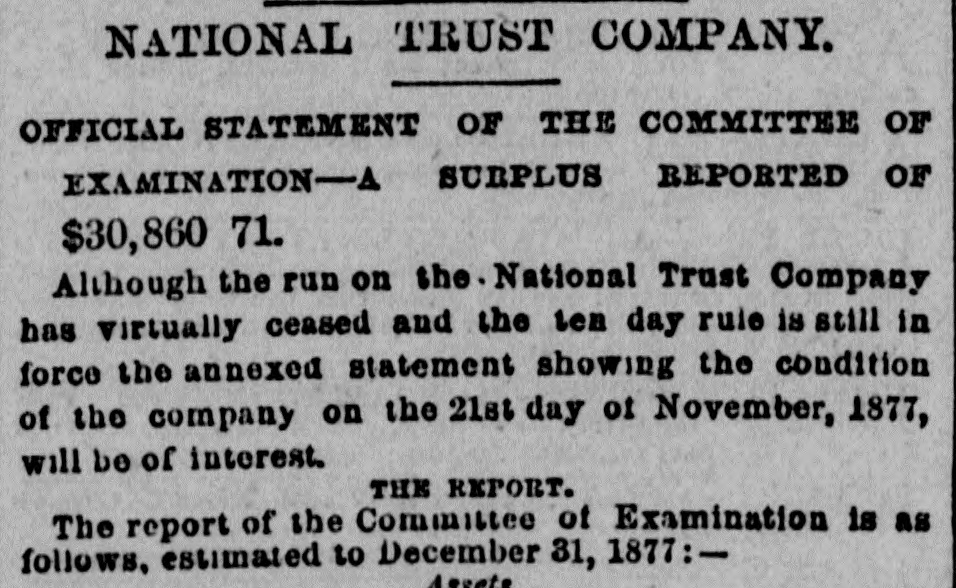
Ten-day rule enforced Dec 5 to stem withdrawals; receiver appointed Dec 15.

Events (3)

1. December 5, 1877 Run
Cause
Rumor Or Misinformation
Cause Details
Malicious reports and rumors circulating about the company's character prompted depositors to withdraw funds.
Measures
Posted notice enforcing the ten days' notice provision; paying small sums to depositors truly in need while restricting larger withdrawals.
Newspaper Excerpt
The posting of a notice this morning requiring ten days' notice followed signs of a run.
Source
newspapers
2. December 5, 1877 Suspension
Cause
Rumor Or Misinformation
Cause Details
Enforcement of the charter's ten-day notice for withdrawals was recommended by the special bank examiner to avoid a damaging run.
Newspaper Excerpt
In consequence of malicious reports... we hereby give notice that we require the ten days' notice under which all deposits are made.
Source
newspapers
3. December 15, 1877 Receivership
Newspaper Excerpt
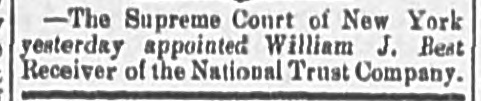
The Supreme Court of New York yesterday appointed William J. Best Receiver of the National Trust Company.
Source
newspapers

Newspaper Articles (22)

Article from Daily Press and Dakotaian, December 5, 1877

Click image to open full size in new tab

Article Text

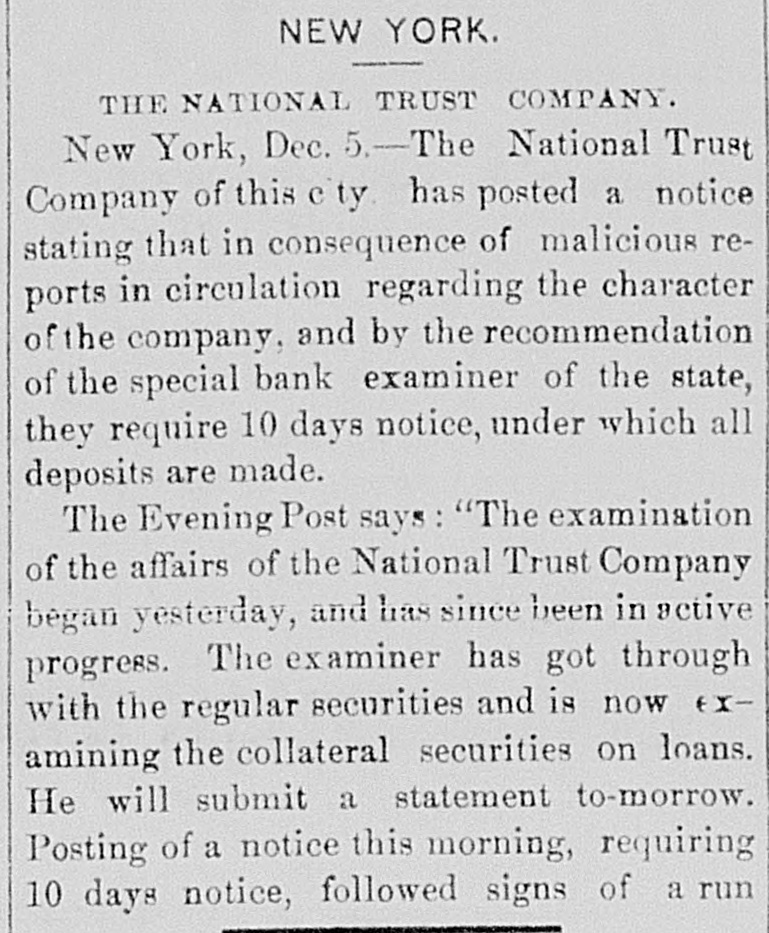
NEW YORK. THE NATIONAL TRUST COMPANY. New York, Dec. 5.-The National Trust Company of this city has posted a notice stating that in consequence of malicious reports in circulation regarding the character of the company, and by the recommendation of the special bank examiner of the state, they require 10 days notice, under which all deposits are made. The Evening Post says : "The examination of the affairs of the National Trust Company began yesterday, and has since been in active progress. The examiner has got through with the regular securities and is now EXamining the collateral securities on loans. He will submit a statement to-morrow. Posting of a notice this morning, requiring 10 days notice, followed signs of a run


Article from The Rock Island Argus, December 5, 1877

Click image to open full size in new tab

Article Text

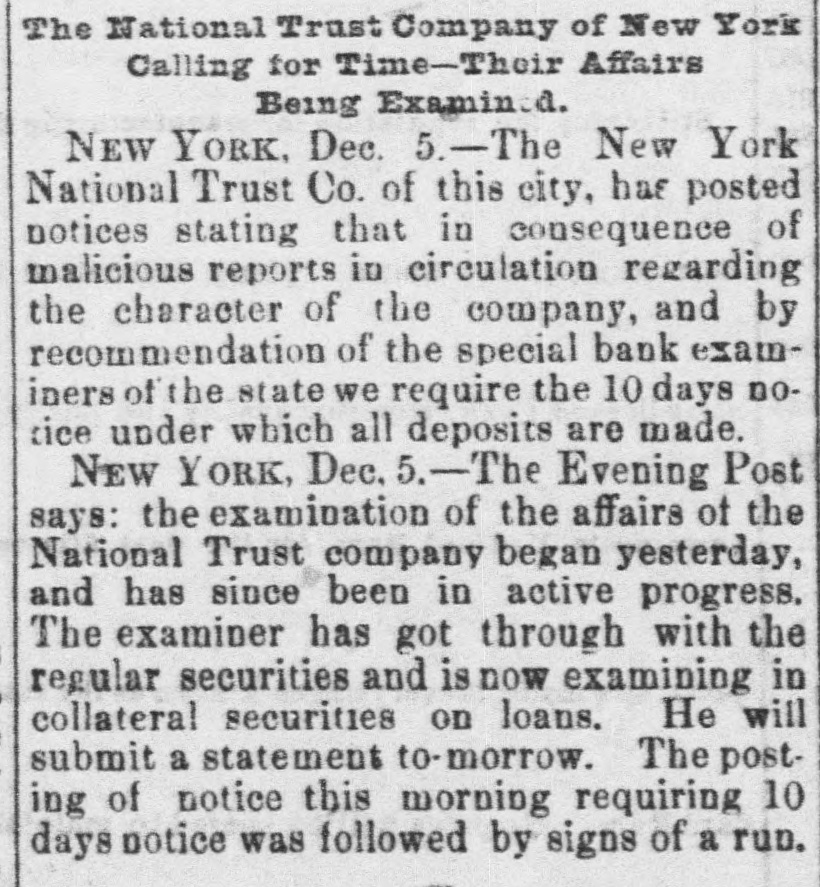
The National Trust Company of New York Calling for Time-Their Affairs Being Examined. NEW YORK, Dec. ..The New York National Trust Co. of this city, has posted notices stating that in consequence of malicious reports in circulation regarding the character of the company, and by recommendation of the special bank examiners of the state we require the 10 days notice under which all deposits are made. NEW YORK, Dec. 5.-The Evening Post says: the examination of the affairs of the National Trust company began yesterday, and has since been in active progress. The examiner has got through with the regular securities and is now examining in collateral securities on loans. He will submit a statement to-morrow. The posting of notice this morning requiring 10 days notice was followed by signs of a run.


Article from The Cheyenne Daily Leader, December 6, 1877

Click image to open full size in new tab

Article Text

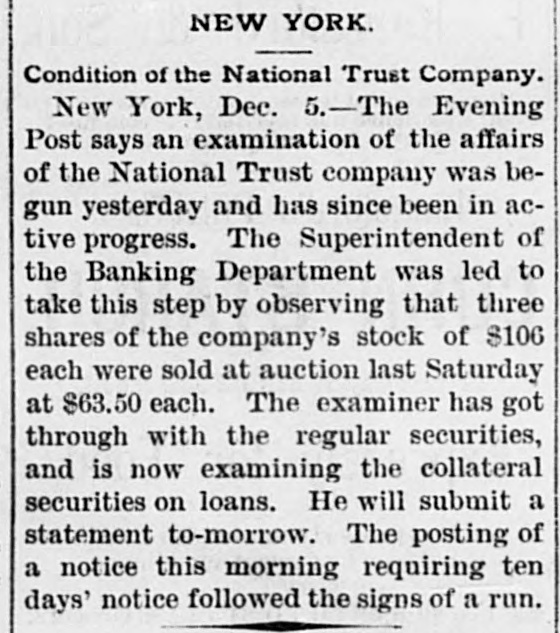
NEW YORK. Condition of the National Trust Company. New York, Dec. 5.-The Evening Post says an examination of the affairs of the National Trust company was begun yesterday and has since been in active progress. The Superintendent of the Banking Department was led to take this step by observing that three shares of the company's stock of $106 each were sold at auction last Saturday at $63.50 each. The examiner has got through with the regular securities, and is now examining the collateral securities on loans. He will submit a statement to-morrow. The posting of a notice this morning requiring ten days' notice followed the signs of a run.


Article from The Wheeling Daily Intelligencer, December 6, 1877

Click image to open full size in new tab

Article Text

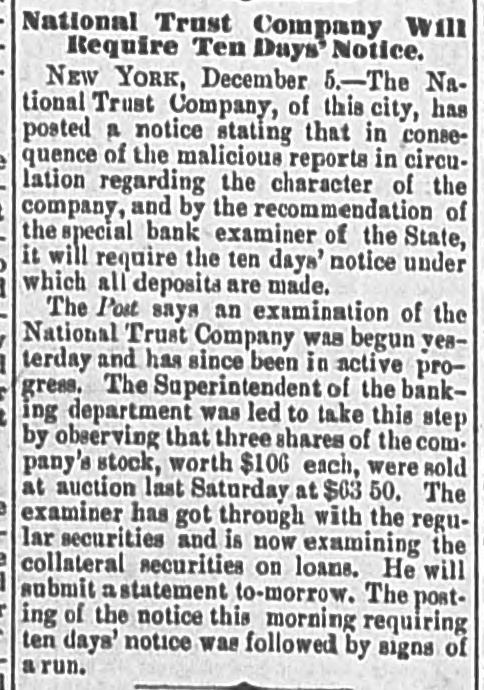
National Trust Company will Require Ten Days' Notice. NEW YORK, December -The National Trust Company, of this city, has posted a notice stating that in consequence of the malicious reports in circulation regarding the character of the company, and by the recommendation of the special bank examiner of the State, it will require the ten days' notice under which all deposits are made. The Post says an examination of the National Trust Company was begun veaterday and has since been in active progress. The Superintendent of the banking department was led to take this step by observing that three shares of the com. pany's stock, worth $106 each, were sold at auction last Saturday at $03 50. The examiner has got through with the regular securities and is now examining the collateral securities on loans. He will submit statement to-morrow. The posting of the notice this morning requiring ten days' notice was followed by signs of run.


Article from New-York Tribune, December 6, 1877

Click image to open full size in new tab

Article Text

REQUIRING TEN DAYS' NOTICE. NATIONAL TRUST COMPANY'S ACTION. PAYING MONEY TO DEPOSITORS REALLY IN NEED OF IT-PRESIDENT MANGAM AND EXAMINER BEST SAY THERE IS NO CAUSE FOR ALARM. Soon after the doors of the National Trust Company were opened yesterday morning, a notice was posted in front of the paying teller's desk, stating that, In consequence of the malicious reports in circulation regarding the character of this company. and by the recommendation of Mr. Best, the special bank examiner of the State, we hereby give notice that we require the ten days' not ce under which all deposits are made." To this was attached the indorsement of Mr. Best. the special bank examiner. commending the action of the president in requiring the notice. The notice was only partially observed, however. President Mangam said it was the desire of the officers to accommodate their depositors as fully as might be advisable under the circumstances. and if persons were really in need of the funds, it was the intention to supply them. This discrimination led to charges of favoritism during the day, and in more than one instance the depositors were loud in their denunciation of the action of the managers. There was an unusual number of depositors in the office of the company throughout the day, but at no time could it be said that there was a run." Mr. Best's report will probably be read Saturday. It is reported that the examination of the company at the present was brought about by the fact that the Superintendent of the Bank Department noticed in the stock reports that three shares of the company's stock, $100 each, were sold at auction last Saturday at 631₂, President Mangam said to a TRIBUNE reporter, about the hour of closing the bank, yesterday afternoon, that the amounts paid out during the day exceeded the deposits received by about $325,000. He was unable to give exact figures but said that the deposits for the day had been about $75,000. "The rumors about the company are entirely false," said he, and although we shall sustain a temporary loss in business, we shall soon be all right again." No bank in the city, Mr. Mangam said, could stand a protracted FUB in these times without taking advantage of the ten days' notice allowed by itscharter for the payment of large amounts. The turning of securities into ready money could not be effected quickly enough to meet all demands, if money were to be p id out by millions at short no ice. In taking advantage of a short delay, the company Was only following the example of other solvent institutions under like enrcumstances. Under no circumstances," said he, can our depositors suffer the loss of a dollar. We have $1,000,000 in good securities, a capital of $1,000,000, and our stockholders are liable for an additional $1,000,000, under the law. No receiver will be asked for or a; pointed, and we certainly shall not go into tiquidation." Mr. Best declined to make any extended statement. He said taat be had discovered no cause thus far for alarm: and that, to avoid an unnecessary, and possibly disastrous run on the available funds of the company, he had pursued the same course as in the case of the Union Dime Savings Bank, and approved the enforcement of the ten days provision of the charter. He was busy with the entire clerical force, he added, in making a thorough examination of the company's affairs, which was his regular annual investigation, and he hoped to be able to submit a final report in a few days. " Meanwhile," he says, " there is no apparent cause for aların or excitement."


Article from The Sun, December 6, 1877

Click image to open full size in new tab

Article Text

THE TEN-DAY RULE. NATIONAL TRUST COMP DOING ITS BEST FOR DEPOSITORS. are Satisfied with President Mangam's Action-Some Accommodated, and the Outof-Town Business Men Attended To. unusually large throng had gathered the office of the National Trust Company at Broadway. at 10 A. M. yest. rday. Rumors of company's insolvency. which had been cirin Wall street the day previous, had evhad a disquieting effect, which the hasy-issued circular of the President had failed remove. The paying teller's window was open, and for two hours the payments made as rapidly as possible. The deposembraced all classes. some withdrawing as as $10,000 and $20,000, and others only a hundreds. At noon $400,000 had been paid The officers held a consultation. and it decided. in order "to allay the panic," that ten-day rule" should be enforced. Special Examiner Best. who has been investigatthe company's accounts. approved of this cision. and the following notice was accordposted in a conspicuous place on the telwindow: THE DE POSITORS OF THE NATIONAL TRUST COMPANY: In sequence of the malicious reports in circulation re: the character of this company. and by the rec. mendation of Mr. Best, the Special Bank Examiner of State. we hereby give notice that we require the ten notice under which all deposits are made. D R MANGAM, President cordially endorse the action of President Mangam in quiring the notice of ten days referred to above. WILLIAM J. BEST. Special Examiner, &c. About forty persons were in the office at the and the appearance of the notice caused grumbling. Charges were made that the had specially favored certain individuin the matter of withdrawing their deposits, no proof of this was furnished. After the excitement the feeling quieted down. the neral expression being that the officers had the best thing for the depositors, under circumstances. A gentleman who had $2,000 depositsaid to a SUN reporter, Well, they re deome to my money as long as they keep it Another said: It's all right. They done what the Union Dime people did, and hough it's a little hard on some of us. it's the thing for the depositors altogether." Notwithstanding the notice. the teller continto certify checks and pay out small sums, however, on orders from the President, Darius R. Mangam, who sat in a handsome in the southenstern corner of the main supported by two of the trustees. Messrs. arbell and Temple. Mr. Mangam is a pleasantitured gentleman. 50 or 55 years of age: tall.


Article from The New York Herald, December 6, 1877

Click image to open full size in new tab

Article Text

THE NATIONAL TRUST. A RUN STARTED YESTERDAY MORNING-THE TEN DAYS' RULE ENFORCED. The affairs of the National Trust Company continued to attract attention yesterday in consequence of the action taken by the president in enforcing the ten days' law. The rumors of the day previous started a run us the beginning of business in the morning Before the company's offices opened a crowd of anxious depositors was gathered ready to withdraw their deposits on the very first opportunity. When the doors opeued they rushed to the paying teller's window, and for a time quite a little flutter of excitement was noticeable. The line of depositors increased, and the anxious inqairies of the new arrivals perplexed the otllciais. Everybody was told that everything was all right, but no one appeared willing to accept the assurance until he had obtained possession of the amount of his funds on deposit. It was very clear that if this sort of thing should continue the run would prove a serious one, so in about an hour after the offices opened the following notice of the enforce. ment of the teu days' rule was posted at the paying teller's window:To THE DEPOSITORS or THE NATIONAL TRUST COMPANY:In consequence of the malicious reports in circulation regarding the character of the company, and by the recom. mendation of Mr. Best, special bank examiner of the State. we hereby give notice that we require the ten days' notice under which all deposits are made. D. R. MANGAM. President. I cordially indorse the action of President Mangam in requiring the notice ot sen days referred to above. WILLIAM G. BEST, Special Examiner. This effectually ended the run for the time being, some of those present contenting themselves with a compliance with the rule, others seeking explanations from the officials and grumbling over the aspect of alfairs. Mr. Best is going on slowly with his examination, aided by several assistants. His statement to Superintendent Lamb, of the Banking Department, will probably be ready to-day. His examination began Tuesday morning, having received his instructions late on Monday night from Superintendent Lamb. The latter was led to take this step at the present time by observing in the stock reports that three shares of the company's stock, 106 each, were sold at auction last Saturday at 631/2 Mr. Best has already completed his examination of the government bonds and other securities forming the principal assets and is DOW looking into the nature and value of the collaterals held as security for call loans. While Wall street awaits his report it continues to busy itself with examinations of the assets mentioned in the last report made, and it 18 claimed the examinations made show that if the company still holds the securities in question its capital is impaired to some extent. MR. MANGAM'S STATEMENT. Mr. Mangam, in conversation with a HERALD roporter, said yesterday afternoon, after business hours, and while holding a slip of the day's business 10 his hand, that the present amount due depositors is $2,206,000. The capital of the company is $1,000,000, and the stockholders are liable for $1,000,000 more. But, he said, easide from our investments in government bonds and other securities, we have $1,729,000 in call loans, secured by good and sufficient collateral." It was asked whether the company still holds the government bonds described in their last report and which have depreciated somewhat since. Mr. Mangam replied that they hold all of those, except such as have been called. The sewing machine stock mentioned yesterday, amounting 60 $10,000, he could not value. is was taken to secure a deut. The Mis. sour Pacific Railway Company's bonds and stock, he still contends, are worth quite what IS claimed. During the ten years the company has existed Mr. Mangam said it has earned and paid $800,000 in dividends, and only six months ago reduced its semi-annual dividend from tour to three per cent. No one need have any apprehensions, he said, that all will not be found right. The capital, he added, is wholly unimpaired, and the company to-day can pay $2 for every $1 they owe.


Article from The Interior Journal, December 7, 1877

Click image to open full size in new tab

Article Text

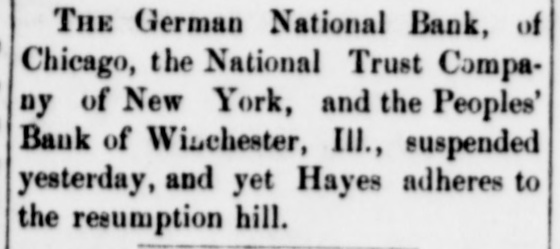
THE German National Bank, of Chicago, the National Trust Company of New York, and the Peoples' Bank of Winchester, III., suspended yesterday, and yet Hayes adheres to the resumption hill.


Article from The New York Herald, December 10, 1877

Click image to open full size in new tab

Article Text

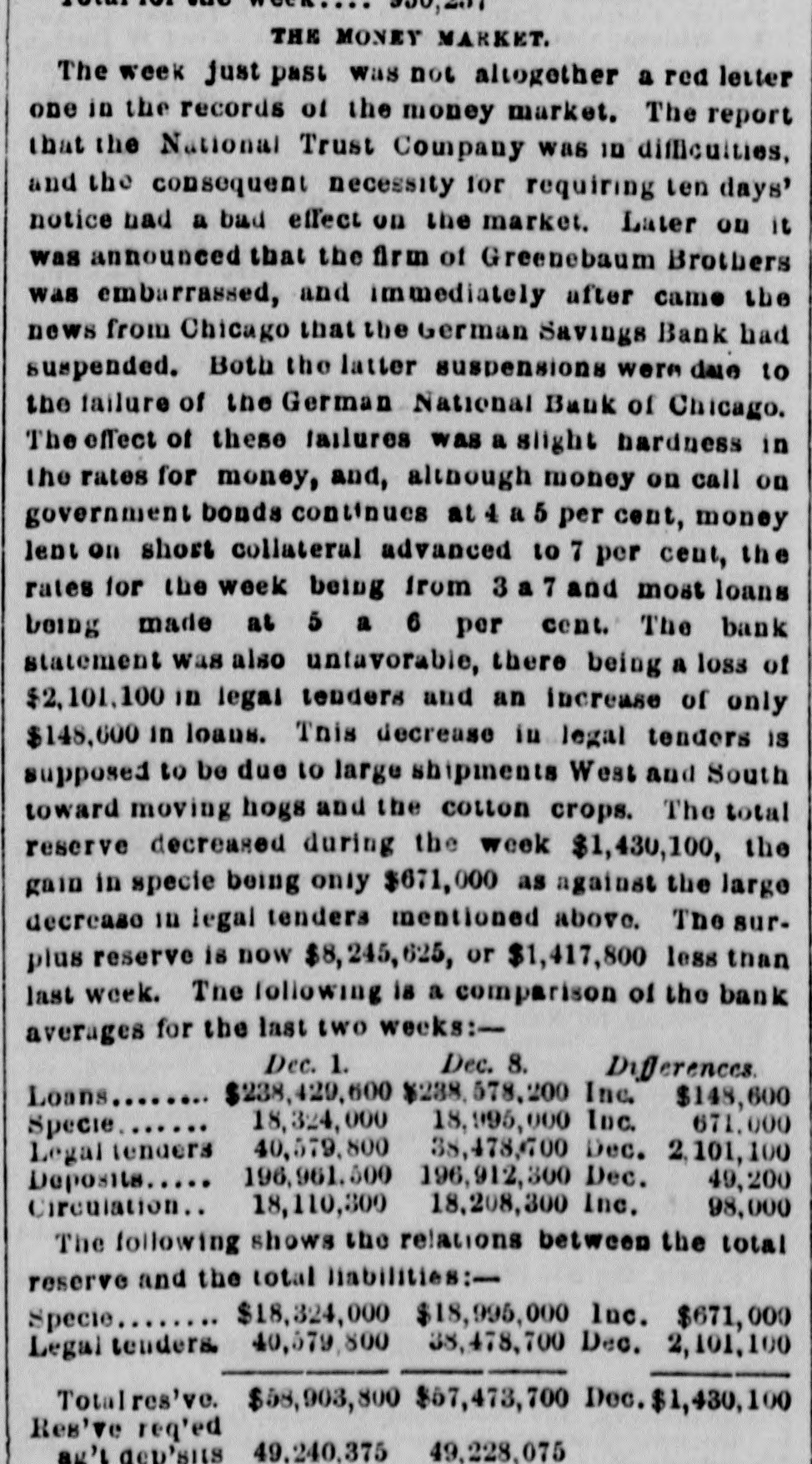
THE MONEY MARKET. The week just past was not altogether a red letter one in the records of the money market. The report that the National Trust Company was in difficulties, and the consequent necessity for requiring ten days' notice had a bad effect on the market. Later on it was announced that the firm of Greenebaum Brothers was embarrassed, and immediately after came the news from Chicago that the German Savings Bank had suspended. Both the latter suspensions were date to the failure of the German National Bank of Chicago. The effect of these failures was a slight hardness in the rates for money, and, although money on call on government bonds continues at 4 a 5 per cent, money lent on short collateral advanced to 7 per cent, the rates for the week being from 3 a 7 and most loans being made at 5 a 6 per cent. The bank statement was also unfavorable, there being a loss of $2,101,100 in legal tenders and an increase of only $148,600 in loans. This decrease in legal tenders is supposed to be due to large shipments West and South toward moving hogs and the cotton crops. The total reserve decreased during the week $1,430,100, the gain in specie being only $671,000 as against the large decrease in legal tenders mentioned above. The surplus reserve is now $8,245,625, or $1,417,800 less than last week. The following is a comparison of the bank averages for the last two weeks:Dec. 8. Dec. 1. Differences. Loans $238,429,600 $238. 578,200 Inc. $148,600 18,324,000 18,995,000 Inc. 671,000 Specie 40,579,800 38,478,700 Dec. 2,101,100 Legal tenders 196,961,500 196,912,300 Dec. 49,200 Deposits 18,208,300 Inc. Circulation. 18,110,300 98,000 The following shows the relations between the total reserve and the total liabilities:$18,324,000 $18,995,000 Inc. $671,000 Specie 40,579,800 38,478,700 Dec. 2,101,100 Legal tenders. Totalres've. $58,903,800 $67,473,700 Dec. $1,430,100 Res've req'ed 49,228,075 49.240.375


Article from The Wheeling Daily Intelligencer, December 15, 1877

Click image to open full size in new tab

Article Text

-The - Supreme Conrt of New York yesterday appointed William J. Best Receiver of the National Trust Company.


Article from The Sun, December 16, 1877

Click image to open full size in new tab

Article Text

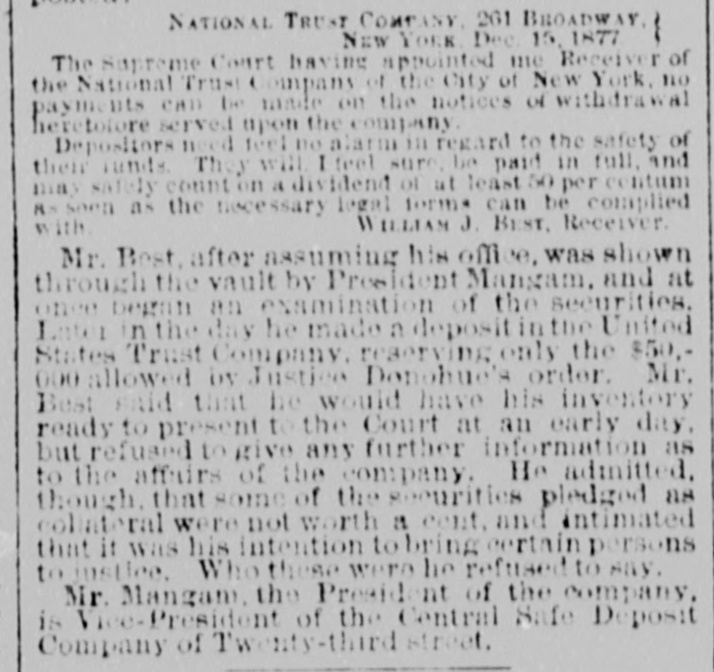
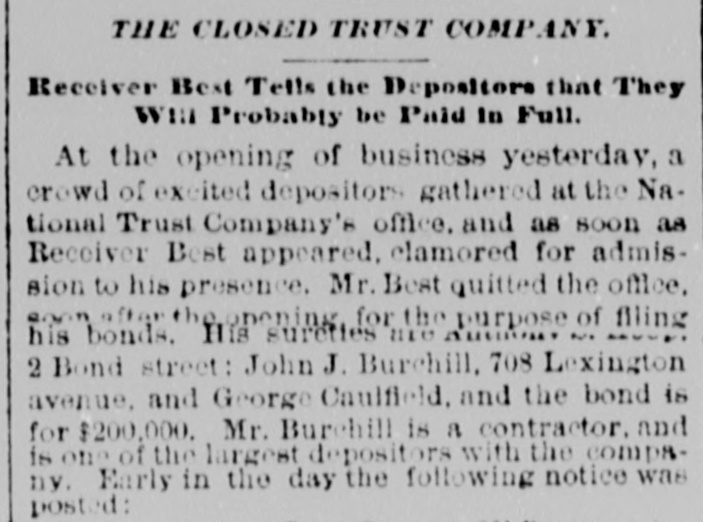
THE CLOSED TRUST COMPANY. Receiver Best Tells the Depositors that They WIN Probably be Paid In Full. At the opening of business yesterday, a crowd of excited depositors gathered at the Na. tional Trust Company's office. and as soon as Receiver Best appeared, clamored for admission to his presence. Mr. Best quitted the office. soon after the opening, for the purpose of filing his bonds. His surettes are Author 2 Bond street: John J. Burchill, 708 Lexington avenue, and George Caulfield, and the bond is for $200,000. Mr. Burchill is a contractor. and is one of the largest depositors with the company. Early in the day the following notice was posted:


Article from The Morning Herald, December 18, 1877

Click image to open full size in new tab

Article Text

THE HERALD. 15. 1877 Delaw 71mington. HERALD NOTES. 00 The Texas-Pacific Railroad was probably supported by the House. The Oriental Savings Bank of Grand, / treet, New York, has exploded. Servia formally declares, war and her croops are on the way to the front. The National Trust Company, of New York, has gone to ruin. Deficit, $700,000. Mr. Ryland has withdrawn from the Benatorial contest in California. Mr. Dalane's health is somewhat im proved. He purposes spending the winter Cannes. Samuel Tyler, the Senior Professor in the Law Department of Columbia University, Washington, died at Georgetown, Saturday. Dr. Ninian Pinkney, a retired medical director, United States Navy, after brief illness, died Saturday at his home in Easton, Talbot county, Md. Europe expended for telegraphic messages last year $14,400,000. The military telegraph line around the Texas frontier to E1 Paso and up to Misula, New Mexico, has been completed. The crush 10 hear Moody and Sankey was so great in Providence that a horse car was crowded off the track, and clothing was ruined. The City of Peking, on ber last voyage, brought 100 packages of silk worm egge from Japan to San Francisco, consigned to a firm in Italy. The Congregational Church, of Walcott decided that the use of wine at the communion table tends to promote intemperance. Water is hereafter to be used. Oh! By the new route from Portpatrick to p Stranraer, new passage 'twixt the England and Scotland, is but twenty-two miles, and Belfast is within nine hours of Glasgow. President Sherman Broadwell, of the decayed Claimmont Savings Bank, is in jail for perjury in concealing fraud. It 18 rumored that Thomas H. Whitman the murdered Staten Island merchant, has turned up at home, not half 80 dead 88 he was. Dom Pedro's visit has already come to th good. Tbe Brazilian government has voted B a yearly subsidy of $100,000, during ten years, for a line of steamers to the United States. 10 Davenport, Iowa, is where the last clerical at escapade took place. A nice minister raised on borrowed what cash money he could forged checks, and then vamosed the ranch SO Of forty<three varieties of apples tested 13 by M. Truelle, of the Chemical Society of American found Paris, contain the red the genette was th to largest amount of sugar. TI A Scotchman has that alcoholic everybody who drinks proposed liquore should be compelled to take out a license. This, at $5 ahead a year would raise a very pretty revenue. re citizens of Nevada ro Leading want the boundary line of California and Nevada fixed at the summit of the Sierras so that in their State can have Surprise and Honey Lake valleys. of no th A woman fifty-nine years old, with her at in La having son, arrived walked Grange, Oregon, recently, !hither from her home in he pl Indiana. She carried a pack weighing 75 pounds. CO J to The London Gardeners' Chrontile says that a bunch of grapes from Lady Charles ille's, Klogs county, Ireland, 21 feet pounds and 5 ounces in is E inte beheavies weight. long ver grown wart in " HII in I. fewer Three when Phosburgh la n sudde 14 d 1 way show e: de " water poured in " the K1 c.r 1-dr distance. of dis su blocks, ell. hat they T m severay so fast and nearly drowned pl of The Bank of Russia 14 supper of 10 bold for 40 met differ reserve of $125,000,000 to be the outhed only as a last resource; but now be in osinnations are thrown out that this grea se um Is not really there. of du Bellef In the existence of a subterranean pli ake near Newburyport, Maes. led to the par etc inking of a well. Clear water was found de de depth of fifty feet, lu such quantities Be hat there is a talk of supplying the city dr ith it. of K oth A committee of country schoolboys visit sol Edwin Booth, in Utica, for the purpose ke f him to act in their Ph was to in T heir engaging idea appear themselves exhibition. Hamlet,' with Mr. Booth in the title role


Article from New-York Tribune, December 18, 1877

Click image to open full size in new tab

Article Text

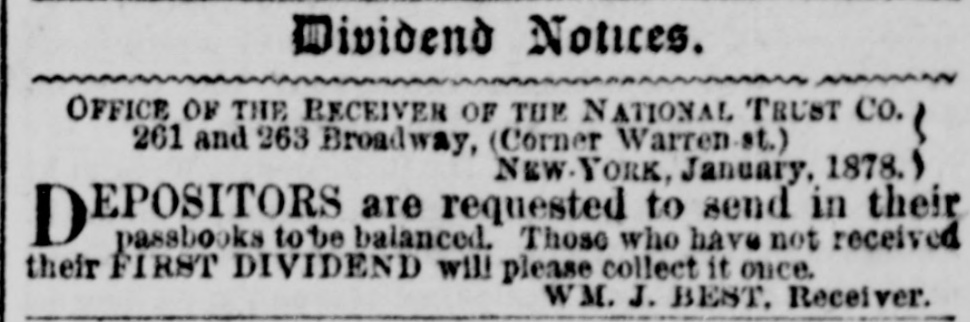
EXAMINING THE ACCOUNTS. PRESIDENT MANGAM ASSISTING THE RECEIVER-INQUIRIES OF DEPOSITORS-STATEMENT OF A TRUSTEE. President Mangam was assisting Mr. Best yesterday, in his work of going over the accounts, and examining the investments of the National Trust Company. The following notice was posted conspicuously Depositors are requested to present their pass-books to be balanced. This must precede the payment of a dividend. Employés are not allowed to furnish information in regard to the affairs of the company. Representatives of the press will therefore please come directly to me. and I will give them everything of interest, the publication of which would not injure the interests of the stockholders and depositors. WILLIAM J. BEST, Receiver. Last Wednesday the officers of the company were served with a notice from the Banking Department, saying that from the statements made by the Examiner, and from the exhibit of transactions on the part of the officers, the solvency of the company was a matter of serious question, and directing them from that time to discontinue receiving deposits. Mr. Best is confident that be can have the affairs of the company settled within a month. In regard to the statement that efforts might be made to remove him from his position as receiver, Mr. Best said that the first step in that direction would have to be taken by the Bank Department, with which he .18 connected. All the depositors who called at the office yesterday were received by Mr. Best in a pleasant manner, and he conversed with them and answered their questions while attending to his other work. All were anxious to know when they would get their money, and whether or not they would lose anything. Mr. Best explained that be could not pay out & cent until he had authority from the court to do so, and that be expected to obtain such authority in & few days. Mr. Best said that all deposits that were received after December 5, would be held as special deposits. Of the forged bonds of the Buffalo and Erie Railroad, in which Roberts and Gleason were implicated, the company at one time held $30,000. This amount had been reduced to $12,000, for which the company had attached property valued at $18,000. President Mangam's attention was called to the strictures, which were made upon him by one of the trustees, but he said that he wished to make no comments. An indignant trustee yesterday wished to explain. He said: a In November, & committee was appointed to sce if all the assets in a list prepared by the president were really in the hands of the company. This we did. We reported that all the assets in Mr. Mancam's list actually werein the possession of the company. We did not attempt to say that they were worth their face, nor were we expected to do 80. When the excitement came, certain members of the Executive Consmittee published the report 88 if it had declared the securities to be worth their face. Naturally, when Mr. Best's report was made It indirectly accused that committee of deceit. No receiver should have been appointed. The committee, consisting of Judge Allan and Mr. Lowery, was relected only to confer with Mr. Lamb of the Bank Department, to see if any unfriendly feeling existed in the repartment against the Trust Company. They applied for a Receiver, and the next day all we could do was to ratify their action-


Article from The New Orleans Daily Democrat, December 22, 1877

Click image to open full size in new tab

Article Text

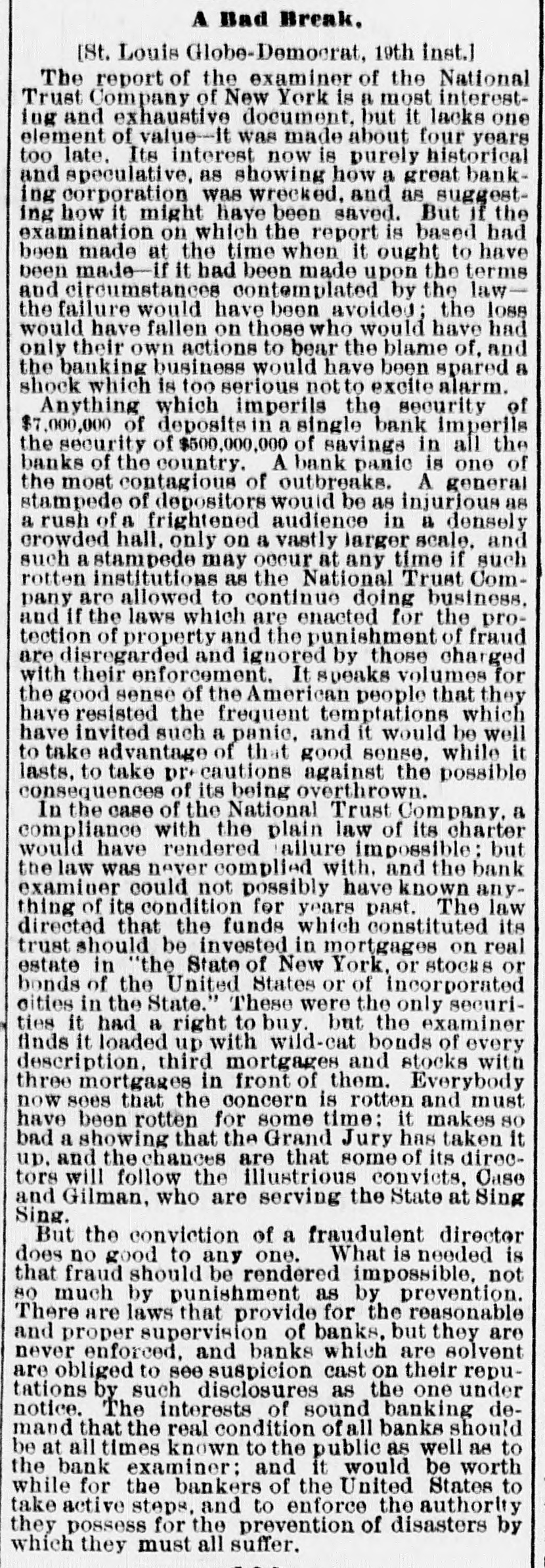
A Bad Break, [St. Louis Globe-Democrat, 19th inst.] The report of the examiner of the National Trust Company of New York is a most interesting and exhaustive document, but it lacks one element of value-It was made about four years too late. Its interest now is purely historical and speculative, as showing how a great banking corporation was wrecked, and as suggesting how it might have been saved. But if the examination on which the report is based had been made at the time when it ought to have been made-if it had been made upon the terms and circumstances contemplated by the lawthe failure would have been avoided; the loss would have fallen on those who would have had only their own actions to bear the blame of, and the banking business would have been spared a shock which is too serious not to excite alarm. Anything which imperils the security of $7,000,000 of deposits in a single bank imperils the security of $500,000,000 of savings in all the banks of the country. A bank panic is one of the most contagious of outbreaks. A general stampede of depositors would be as injurious as a rush of a frightened audience in a densely crowded hall, only on a vastly larger scale. and such a stampede may occur at any time if such rotten institutions as the National Trust Company are allowed to continue doing business. and if the laws which are enacted for the protection of property and the punishment of fraud are disregarded and ignored by those charged with their enforcement. It speaks volumes for the good sense of the American people that they have resisted the frequent temptations which have invited such a panic, and it would be well to take advantage of that good sense, while it lasts, to take pr+ cautions against the possible consequences of its being overthrown. In the case of the National Trust Company. a compliance with the plain law of its charter would have rendered ailure impossible: but the law was never complied with. and the bank examiner could not possibly have known anything of its condition for years past. The law directed that the funds which constituted its trust should be invested in mortgages on real estate in "the State of New York, or stocks or bonds of the United States or of incorporated cities in the State." These were the only securities it had a right to buy. but the examiner finds it loaded up with wild-cat bonds of every description. third mortgages and stocks with three mortgages in front of them. Everybody now sees that the concern is rotten and must have been rotten for some time: it makes so bad a showing that the Grand Jury has taken it up. and the chances are that some of its directors will follow the illustrious convicts, Case and Gilman, who are serving the State at Sing Sing. But the conviction of a fraudulent director does no good to any one. What is needed is that fraud should be rendered impossible, not 80 much by punishment as by prevention. There are laws that provide for the reasonable and proper supervision of banks, but they are never enforced, and banks which are solvent are obliged to see suspicion cast on their reputations by such disclosures as the one under notice. The interests of sound banking demand that the real condition of all banks should be at all times known to the public as well as to the bank examiner: and it would be worth while for the bankers of the United States to take active steps, and to enforce the authority they possess for the prevention of disasters by which they must all suffer.


Article from The New York Herald, December 27, 1877

Click image to open full size in new tab

Article Text

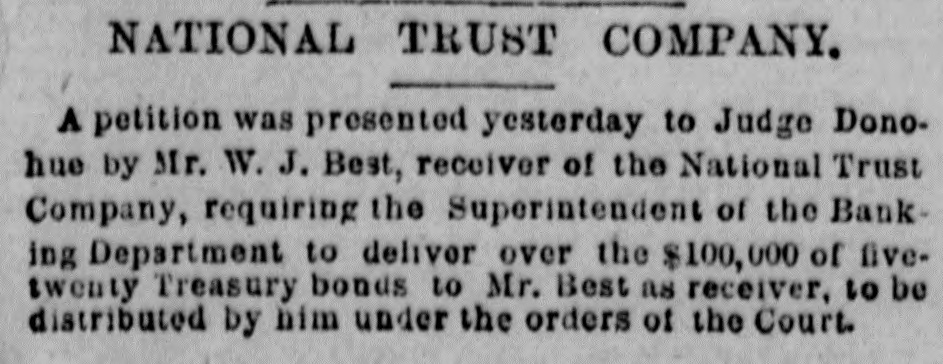
NATIONAL TRUST COMPANY. A petition was presented yesterday to Judge Donohue by Mr. W. J. Best, receiver of the National Trust Company, requiring the Superintendent of the Bank ing Department to deliver over the $100,000 of fivetwenty Treasury bonds to Mr. Best as receiver, to be distributed by him under the orders of the Court.


Article from New-York Tribune, January 5, 1878

Click image to open full size in new tab

Article Text

NEW-YORK CITY. Mayor Ely has vetoed the resolution of the Aldermen changing the name of the "Boulevard." The number of letters dispatched from the New York Post Office, in open mails for foreign countries, during 1877, was 7,410,608. James Douglass, jr., of Phœnixville, Penn., will lecture this evening at Cooper Union, in the free course, on "Egyptian Architecture and Obelisks." In consequence of a blockade at the New-York slip, several of the Fulton ferry boats landed their passengers at the Wall Street ferry, yesterday morning. Philip Schloppe, who was struck on the head with a metal scale by Frederick Feist, a fellow workman, died, it is found, from pyemia, and not from a fractured skull. The Aldermen yesterday asked the Corporation Counsel for an opinion as to the extent of the liabilities of the city for money paid to the Excise Commissioners for licenses. The American Free Church, of which the Rev. C. P. McCarthy is pastor, will hold its services to-morrow and hereafter at Trenor's New Hall, Broadway and Thirty-second-st. The Coroner's examination in the case of Joseph Heil, the truckman who died in the Eldridge Street Police Station, Thursday night, shows that death was the result of a debauch. Curious effect of the Excise law: Street musicians and beggars have suffered severely from the closing of the saloons, as nearly all their money was derived from frequenters of such places. No time has yet been set for the payment of the first dividend by the receiver of the National Trust Company. It is understood that Mr. Mangam, the president of the company, is very ill at his home in this city. The residence of Samuel Flatt, at No. 167 East Sixtieth-st., was entered by burglars early Thursday morning, and robbed of jewelry valued at $694. The thieves effected an entrance through a second-story window. The standing committee of the Diocese of New-York, on Thursday, gave their canonical consent to the consecration of the Rev. Dr. Eccleston, Bishop-elect of West Virginia, and of the Rev. Dr. Seymour, Bishop-elect of Springfield, Ill. Drivers of trucks and carriages on Third-ave. yesterday betrayed an apparent desire to go as near the Elevated Railroad excavations as possible without falling in. Failure in these attempts caused a blockade of cars several times during the day. The Union Ferry Company, of Brooklyn, carried during the year 1877, between forty-four and forty-five million passengers, a number probably not exceeded by anyone company in the world. No lives were lost; there was no serious accident, and only one person met with bodily harm. The bridge in the Central Park, at Seventy-seventh-st. and Eighth-ave., was erected for President Grant to walk from the Park to lay the corner-stone of the American Museum of Natural History. The same bridge was used by President Hayes last month when he formally opened the institution. The Board of Police, yesterday, transferred Roundsman Brush from the Thirty-third to the Ninth Precinct. The resignations of Detective Kindelon, of the Twenty-first, and Patrolman Darwin, of the same precinct, were accepted. Detective Doyle, of the Sixteenth Precinct, was transferred to detective duty in the First Precinct. The Aldermen have decided that no more rent shall be paid for the 8th Regiment's quarters in Twenty-third-st., and Mayor Ely has vetoed the resolution assigning the regiment to a new armory in Ninth-ave., on the ground that the premises there are unfit for an armory. So the 8th Regiment appears to be between two stools just now. The cigar-makers held a secret and noisy meeting yesterday, but refused to tell what was its object. Some of the strikers went to work yesterday for A. Pollack, at Second-street and Avenue B. Over a hundred of the strikers gathered in front of the factory last evening, while the men were working. They hooted the men and shouted defiance to their employers. The "magical entertainment" at Chickering Hall, on Thursday next, for the benefit of St. Anne's Church for Deaf Mutes, is by a gentleman, Edgar S. Allien, who never performs in public except for charitable objects; and there are few professional magicians who equal him. He performs the Indian box trick and the Hindoo basket mystery-considered among the most difficult of feats in magic-and also exposes "spiritual manifestations." At the meeting of the Wine and Spirit Traders' Association, yesterday, a committee was appointed to urge upon the Legislature a repeal of the present Excise law. The offer of a lawyer to bring an action showing that the law of 1857 was unconstitutional, was declined. A member stated that the association's object was to prevent the passage of laws that would affect injuriously the liquor trade; its political action would be to defeat all candidates whose views were known to be antagonistic to the liquor interest. The managers of the American Bible Society on Thursday appropriated $250 to the American Baptist Missionary Union for Bible work in India, and presented books to the Presbyterian Board of Foreign Missions, the American Board, the Methodist Missionary Society, the American Tract Society, the Seamen's Friend Society, and to various auxiliary societies, district superintendents and other individuals-the total value of these grants being nearly $9,000. The receipts for December, amounted to $17,490, and during the same time 76,482 copies of Scriptures were issued. The programme of the fancy dress ball of Société Française de L'Amitié, to be given at the Academy, on Monday night, promises the overture to Masaniello by 100 musicians; a march by "a whole battalion of pretty young ladies," (of course it is safe to say so, as they will appear with their masks on); a carnival procession by 300 masks; a "lifelike representation of a Fontalochleau hunting party during the Court of Napoleon III," and at midnight, a ballet by Mademoiselle Ausis Letourneur and "fifteen exquisitely pretty coryphées." The tone of the programme suggests that the Christain name of the last mentioned danseuse has been unwarrantably abbreviated. BROOKLYN. Justice Walsh yesterday sent to the Inebriate Home, for six months, Christopher Wrinkle, a police officer, who was put upon the pension list, two years ago, after receiving a severe sunstroke. Admirers of the front of the Academy of Design, in Brooklyn, who have been puzzled by the block of rough stone in the tympanum of the doorway, will be glad to know that it will probably soon give place to a fine bas relief as soon as funds shall have accumulated for the purpose. The subject will be Michel Angelo after old age had bereft him of his sight, seated among the sculptors, as was his wont, to feel of their work and judge it by the sense of touch. The funeral of Daniel T. Willetts, a wealthy and well-known citizen, will take place this afternoon at No. 80 Columbia-heights. He was born of Quaker parents, in New-York, in 1815, and on reaching his majority he entered into the firm of Willetts & Co., Water-st., New-York, which had been founded and made successful by his father. For two years his mental vigor has been leaving him, and in September last, on the death of his daughter, he became insane. Ithamar Dubois, the proprietor of a furnishing store at No. 328 Fulton-st., recently discovered that he had been robbed of goods worth several hundred dollars. Suspecting that Charles Buchanan, one of his clerks, was the thief, detectives were put on the case, and they succeeded in finding at pawnbrokers' shops goods valued at $350, which Buchanan had pawned. The young man was arrested and confessed his guilt. When brought before Justice Walsh he was discharged, Mr. Dubois not wishing to appear against him. A little before midnight on Thursday evening, Elizabeth Moore of No. 291½ Furman-st., discovered that two men were in a bed-room in her house and ransacking the bureau. She quietly shut the door and


Article from Spirit of the Age, January 9, 1878

Click image to open full size in new tab

Article Text

# The News. GENERAL NEWS. -The people of New York city are at the mercy of 300 steam boilers. -The Government of Newfoundland has given notice that the power-ful siren trumpet recently placed at Cape St. Francis will be operated dur-ing each minute of the continuance of thick weather or snow storms. -The referees, Judges Emmett, Tappan and Lawson, in the suit brought against Dennis & Belden for defrauding the State of New York by means of canal contracts, have agreed upon a verdict by which the defend-ants are to pay the State nearly $400,000. -George P. Lathrop is writing a novel, the scene of which is laid in New Hampshire, to be published in the spring. -The best quality Connecticut to-bacco has been selling tor 25 to 28 cents. The 75 crop is better than any succeeding crop and brings the best prices. The '76 crop is consider-ed, on the whole, a little better than that of '77, the latter being consider-ably streaked with white veins. -At York, Eng., recently, a pedes-trian named P. McCarthy walked 400 miles in five days. -The people of Chicago did not marry as much last year as in 1876, the number of weddings being only 4482, a falling off of 191. -Mr. A H. Stephens breakfasts at half past 5 in the morning it is said; he never eats butter, and he especially likes broiled chickens. -Senator Cameron is congratulat-ed. He sparked the Widow Oliver 41 nights, squoze her hand 194 times, kissed her 2041 times, and only had to pay $1000.-[Detroit Free Press. -Ex-Mayor O'Neil of Jersey City is being tried for malteasance in office in signing warrants for $400,000 for work done for which there was no contract. -None but married men are com-missioned for the New York Supreme bench. -Valuable deposits of fire clay and cement, the only one in the province of New Brunswick, have been discov-ered on the line of the Albert Rail-way, at Currieville. The clay can be produced at a cost of $2 a ton, while the imported costs $4,50. A manu-factory is about to be established at that point to work up both deposits. -A Louisiana planter killed 1960 snipes on the wing in six days. -Spurgeon suffers tortures from gout. -Oakey Hall has settled down to the practice of the law in New York. -There are 8119 newspapers in the United States, of which 749 are daily. -It is stated that the Roman Cath-olic interest in Mexico are anxious for the annexation of that country to the United States. -There were 100 tailures and as-signments in New York city in De-cember, with aggregate liabilities of nearly $8,000,000. -The Russians have crossed the Balkans through Schipka Pass and have defeated the Turks in another desperate engagement. -The debt of New York city is $118,000,000. -Booth's Theatre in New York was closed Tuesday, the proprietors refusing to allow the play "Sula" to be again represented there, it being ex cerably low. -It is stated that Turkey is ready to open direct negotiations with Rus-sia. The reason why this step has not yet been taken is the impossibil-ity of ascertaining Russia's conditions of peace. -The official report of the receivers of the defunct National Trust Com-pany of New York shows a long con-tinued system of duplicity and fraud by the officers of the concern. -The Chief Clerk of the Indian Bureau has been dismissed by Secre-tary Schurz, and a report of the condi-tion of that Department makes dam-aging revelations. -Heavy snow-storms are reported in Pennsylvania, in the Western States and the Canadas. -Lord Roseberry is to marry Han-nah, the only daughter of Baron Rothschild. -It is stated that Turkey has asked Russia for an armistice. -Siam is making ready for war with China.


Article from The New York Herald, February 22, 1878

Click image to open full size in new tab

Article Text

DEFUNCT CORPORATIONS. NATIONAL TRUST COMPANY LITIGATIONSGOOD NEWS FOR THE GUARDIAN MUTUAL LIFE-EXPENSE OF WINDING UP THE soCIETY LIFE AND ANNUITY COMPANY. Mr. William J. Best, Receiver of the National Trust Company, submitted yesterday to Judge Dononue, in Supreme Court, Chambers, a petition for leave to prosecute aud defend various suits in which the National Trust Company is either or He detendant. states that plaintiff be considers that the protection of the rights and interesis of the creditors and stockholders of the cor. poration render it necessary that the Court should give permission to respectively prosecute and deleud such suits. He then specifies seven suits, as follows:Superior Court-Martin D. Hancox against the New York Company. to recover $600, the value of 512 shares of the capital stock of the New York and Troy Steamboat Company. alleged to have been pledged in December, 1871. with the defendants as collateral security for loan. Superior Court-John D. Morris and others. assignees. to recover $3,590, with interest from June 26, 1875, for an alleged deposit of money with the New York Company. Supreme Court-John D Grady. to recover $27,000. the value of certain United States bonds alleged to have been converted to its own use by the defendants. Supreme Court-Valentine L. Levy, individually and as receiver of the New Jersey and New York Raliway Company, to perpetually eujoin the New York Company from selling or disposing of 100 bonds of 1,000 each of the New Jersey and New York Railway Company. except a transfer of such bonds be made upon a sale of the claim ot the defendants REBINSE the New Jersey Railway Com. pany, and in connection with such sale. Kaparior CourtNational Trust Company Andrew is Roberts and others to recover $30,000. with interest from July 5, 1873, moneys alleged to have been fraudulently received by the defendants from plaintiffs upon a deposit and pledge of certain counterfeit bonds of the Buffaio and rie Railroad Company. Supreme CourtThe Davis Sewing Machine Company. of Watertown, N. Y., against William J. Best, as receiver of the New York Company. to recover possession or the value of certain coupon promissory notes (commonly called bonds) of the Davis Sewing Machine Company of $1,000 each, which came into the possession ot the receiver of the New York Company. and which. it is alleged. he refused to deliver to plaintiffs upon demand. United States Circuit Court. District of Indiana William King et al. against the Obio and Mississippi Railroad Company et al., bill in equity. praying for the appointment 01 receiver and for the foreclosure and sale of certain mortgaged premises and other relier. The bill appears to have been pending before the appointment of Mr. Best as receiver. and a bill also appears to have been filed in which the receiver is made is party pursuant to an order of that Court of January 5 last. requiring him to appear and plead. answer or demur, which WAS served on him subsequent to his appointment as receiver. The New York Company at the time of the appointment of the receiver held as collateral security for a call loan of $100,000 certain of the bonds in said bill mentioned to the amount of $400,000. Judge Donobue granted the permission asked for. The probability is that these suits will be as once prosecuted or defended, as the case may be, by Mr. Frederick Smythe, counsel for Mr. Best. GUARDIAN MUTUAL LIFE. Some time ago a suit was brought by Henry R. Pierson. receiver of the Guardian Mutual Life Insurance Company, against the Atlantic National Bank


Article from The New York Herald, March 5, 1878

Click image to open full size in new tab

Article Text

deare which allegations Messrs. venue to Kings county Walsh and on Eckerson opposed. Judge Lawrence nied. reserved his decision. DECISIONS. SUPREME COURT--CHAMBERS. By Judge Lawrence. The Mayor, &c.; Stern vs. The Louguran Mayor, Flynn vs. National Bank vs Duryee; vs. &c Chutham vs. The Mayor. &C Sage vs. The Connolly; Mayor, &c. Spields Reilly vs. Mulvibill The Mayor, The &c. Mayor, McGout- &c. The Mayor, &c.; The Mayor, glo va. Tne Mayor. &c.: McGuire vs. Smith vs. The Mayor, &c. Tares The Mayor, & &c. Powers Whaley VS. vs. The Mayor, &c.- Granted. In the Lewis VB. matter Varney. of Price. Order Order granted. granted denying mo. swear to number sion. McCloskey vs. Lewis,- of material In this witnesses, case both which parties is is will that not need. they perfectly clear to the Court that the defendant's If the plaintiff will will stipulate testify that the plaintiff fifty-four witnesses county at the time think was resident of Genesee that this motion of the inquisition I do The not case will resolve itself into ought to be granted. residence mainly and with that admis- here a question of can just as well try the case is as sion in the Genesee defendant county. on shese grounds the motion demied, but without By costs. Judge Donohue. Life InsurPopular Attorney General in the Vs. matter American of McCormack; in the ance Company third street Granted. vs. Bertins matter of Seven Vanderhoof; Hapgood V3. Jarvis Orders granted. of Maurice; Winter vs. White; Bram hall In the ve. matter Murray; Van Brunt vs. Kendall--Motions denied. Steliz VR. Green -Motion granted. Murray Bramhall vs. Graham vs. Graham, Motion Taxation denied, affirmed. without costs. of receiver Trust The National Company In the matter of the appointment Motion of a granted. Memorandum. SUPREME COURT SPECIAL TERM. By Judge Van Brunt. to place motion Ruck vs. Lang calendar -Order dented, denying with costs. cause on the day Judge Lawrence. Swift et al. vs. By Tross of al.-Order settled and signed. Halstead vs. Seaman prefer to hear will counsel do so any in the proposed amet dmeat and may be day regard (at to Chambers) during this week that agreed upon SUPERIOR COURT GENERAL TERM. Freedman. By Cnief Justice Curtis and Judges Sedgwick and New Boston Coal Mining Company VS. Packard costs. and The another Judgment affirmed, with Opinion by Judge Gilbert Sedgwick Elevated Railroad Company Judgment Cheever vs. affirmed, with costs. Opinion by Judge Freedman Chief Justice Curtisana Judge Freedman and order By et.al. VS. Kirwid Judgment Justic Curtis. vs. White et Kingsbury costs. Opinion by Chief with affirmed, with Orders affirmed, with Roberts opinion by Chief Justic Curtis. affirmed, costs. vs. Smith et -Judgment Kilmer Opinion by Chief Justice Curtis. of costs. Dolsen vs. Abendroth. - much judgment payment Van from other than that directing the with costs. to plaintiff appealed of $10 cost of motion reversed Opinion by Chief Justice Curtis. SUPERIOR COULT-SPECIAL TERM. By Judge Sedgwick. VS. Douglas.-Urdored that hereby the plain- dis missed. tifl's Eppelsheimer complaint in this action be and is By Judge Sanford. al. vs. The German American with Bank $10 Jeselson Maxwell vs. et Frank et all. -Motions denied, costs vs. Jenny. Motion denied, without Motion costs. Maguire Masterson vs. John H. of $20 Mary $10 costs; alimony at the rate and coun per week granted, with allowed to plaintiff pendente lite, sel fee of $200. Opinion. Judge Freedman. Hawes et al. By vs. Strauss.-Within amendments allowed. Paper Company vs. Moore et Moore al.-Order and discontinuing Manchester action as to defendants Evans. Squire -Reference ordered. Squire vs. Telegraph Company vs. Harrington Gould Western Union et al.; Bonfield vs. Richards vd. Gould VS. Ward; Mills Vd. et al.; Gould; Gould Transit Grant, Jr., vs. Gill; Jones vs. Panama Gould; Thatcher VS. Long et al. vs Russell Company; Pentz vs. Lehmeir; Boseel Vs. Neville; Clarks vs. Mose; Fleischbauer Drexier vs. Rutter; vs. Regolman Orders granted. COMMON PLEAS -GENERAL TERM. By Chief Justice C. P. Daly, Hoesen and Judges J. F. Daly and Curnen vs. The Mayor, Van &c.-Judgment affirmed, with recosts. Opinion by Judge Robinson. Order of Special Term HyDes vs. McDermott disbursements Opinion by C. versed, Judges Van with Hoesen costs and and Larremore. Chief Justice P. Daly dissenting. others VS. Burchell Judgment affirmed, James and Opinion by Judge Larremore. Judgment reversed; to w 1th Seaman costs. vs. The Mayor, abide &c.- the event. Opinion of new trial ordered; costs Chief Justice Daly dissenting. City by Judge vs. Robinson, The American Institute of trial the ordered New Smith York. Judgment Opinion reversed by new Judge Robinson. costs Gratton 10 abide vs. the event Weeks.-00 rder reversed, with costs. by Judge Robinson. Life Insurance Com. affirmed. -Judment Opiaton Dilleber VS. The Kinckerbe Opinion by Chief Justice Daly, pany Judge Robinson disse Life LIDK Insurance Company. Heart vs. Metropolitan Opinion by Judge Robinson. deJudgment vs. firmed. Thurber.- -Motion for reargument Brown Opinion by Judge Robinson nied. King vs. McCann. _reargument ordered. COMMON PLEASE CHAMBERS. McAllister vs. Jex By and Judge another. Robinson. Judgment for defendants. with costs. Judge Van Hoesen. Kaepler VE. The By Hildise Bund -Mandamus denied. See opinion. Eclectic Order signed. Musters vs. Deerco signed. Masters Keller vs. vs Electic Schwarizler Judgment for plaintiff VS. Memorandum. By Judge Larremore Gould; Gould Dowle vs. Gould; List; Marsion Van vs. Kirk vs. New York Reade; Jackson VE. Company Mercantile Journal Margaritta Application granted; comRooney vs. w thin twenty days. In plaint the must matter be served of Otterson.-Leave 10 advertise granted. Monson vs. Littlell.-Application for judgment granted. Martin, &c.-J Judgment for plaintiff, extra allowance Styles vs. of two and a hait -Boud per approved. cent. Milvan vs. Houghton. Action dismissed, with costs. to Roberts vs. Hoffman Application for leave marshal' with In the matter boud, of Curry. no costs; granted. sustained, sue Jerome plain tiff vs. Corney to serve - Demurrer an amended trial reply fee. within leave ten days to on payment of -Section $10 costs 812 and of the Code re Bentley Vs. Palmer. joint and several in form. quires the undertaking to be Memorandum for cousel New York Lite Meyer vs. Flandrau.- Insurance See Company vs. Riss.-Ap plication granted vs. Robertson.-Report confirmed and di vorce Robertson granted to plaintiff. granted, with leave for to apply judgment Borland vs. Clark. -Application without further notice. of re the 812 Code Section form Tibel the vs. undertaking Van SauD. to be joint 812 and of several the Code quires the Simonsou v3. Reiss 10 Section bejoint had deveral in-1orm. quires the undertaking By Judge J.F. Daly. stembach.-Order In the matter of the accounting MARINE gettled. COURT-SPECIAL TERM-CHAMBERS v.s. By Judge 1cAdam. Alwood; Godwin vs. Syms Leiber vs Funton vs. Donnelly Tyler Motious granted Smith; vs. Marril -Order settled. notice of gettle. Evans ys. Bouneville. Serve Derrerus. meal Farr vs. Ballable dismissed. attachment ordered. Jacobs vs. O'Dea vs. Tine.-Notion denied.


Article from Daily Press and Dakotaian, January 7, 1879

Click image to open full size in new tab

Article Text

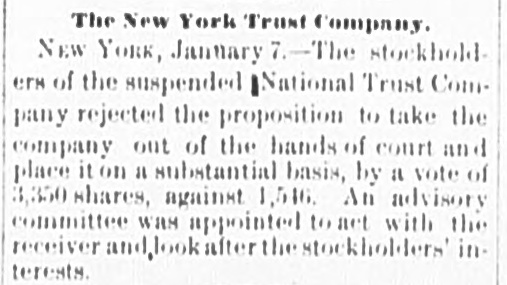
TELEGRAPHIC BREVITIES NEW YORK CUSTOM HOUSE APPOINTMENTS. New York, Jan. 7.-A Washington telegram says Senator Spencer states positively that the committee on commerce will make an adverse report upon the New York custom house nominations. He is equally certain that they will be rejected. He believes Senator Conkling is going to be consulted both in committee and in the senate. HER FEET TROUBLE HER. New York, Jan. 7.-Madame Anderson completed at noon the 2,080th quarter miles. Her feet gave her trouble this morning. ARRIVED. New York, Jar.7.-Over due steamehip Snavi, from Hamburg, arrived this morning. Furious gales and heavy seas prolonged the voyage. COLLEGE ROWING MATCH. Boston, Jan. 7.-Oxford university has informed Harvard of her inability to row as late as August 1st. As Harvard will not row earlier; it is likely there will be no race. Since Oxford's letter was received some members of Harvard have withdrawn, and a new crew will train for the race with Yale in the summer. MORE STRIKING. Pottsville, Jan. 7.-The minera-in the Cameron colliery, at Shamokin, struck today against o reduction of wages. THE NATIONAL TRUST COMPANY New York, Jan. 7.-The stockholders of the suspended national trust company rejected the proposition to take the company out of the bands of the court and place it on a substantial basis, by a vote of 2,350 abaves against 1,546. An advisory commimine to act with the receiv er andwook A1 1000 reholders inter A TALK WITH San Francisco, Jan. 7.-A extrespondent at Takima City has interviewed the Spokane Chief Moses, recently captured and hold prisoner at the reservation. Moses disclaims any hostility to the whites and gives a plaueible account of his actions immediate ly preceding his capture. Strong inducements have been offered the chief to remain on the reservation and induce all his peoto join. A number have already done so, and it is believed when Moses understands the impossibility of obtaining the reeeryation he hasasked for he At all events the chief will be detained till his future residence is determined. PENNSYLVANIA LEGISLATURE. Harrisburg, Jan. 7.-The Peonsylvania legislature organized to-day. The house elected H. M. Long, republican, speaker.


Article from The Rock Island Argus, January 7, 1879

Click image to open full size in new tab

Article Text

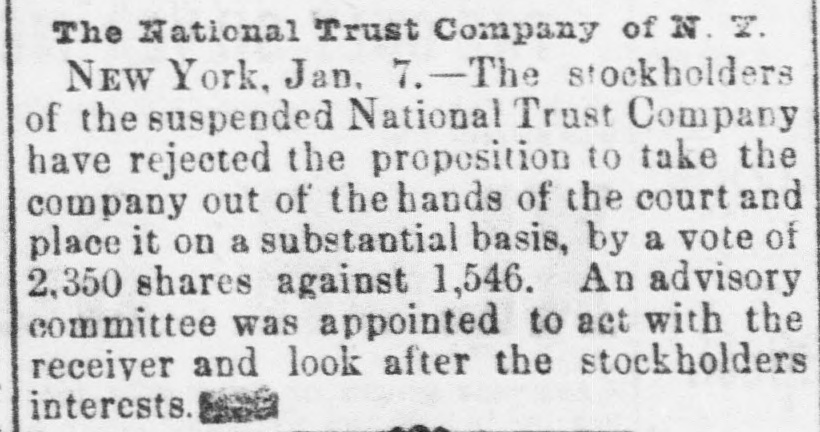
The National Trust Company of N. V. NEW York, Jan. 7.-The stockholders of the suspended National Trust Company have rejected the proposition to take the company out of the hands of the court and place it on a substantial basis, by a vote of 2,350 shares against 1,546. An advisory committee was appointed to act with the receiver and look after the stockholders interests.


Article from The New York Herald, January 7, 1879

Click image to open full size in new tab

Article Text

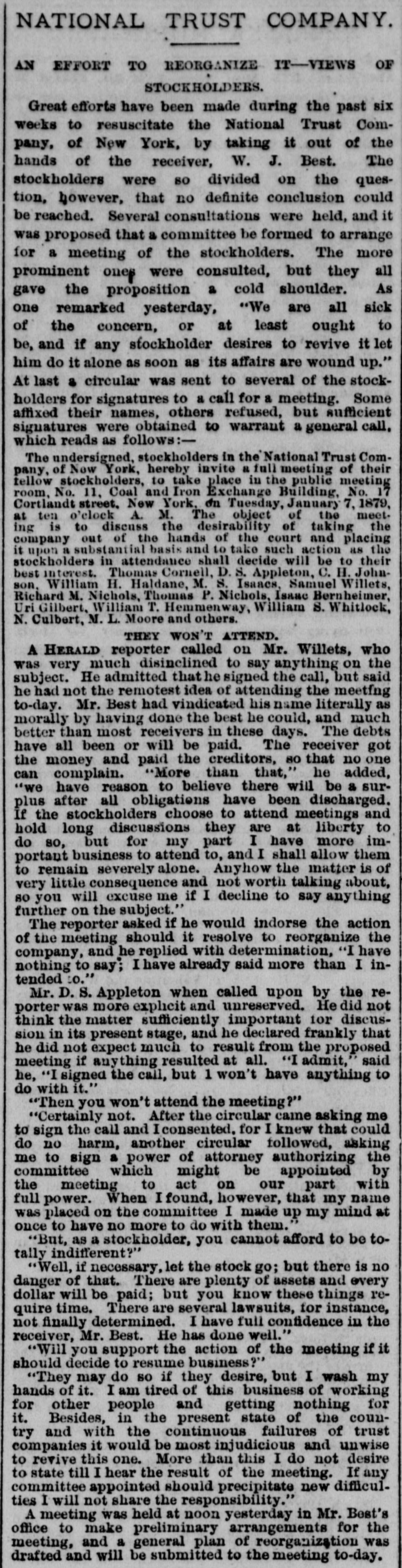
NATIONA TRUST AN EFFORT TO REORGANIZE IT-VIEWS OF STOCKHOLDERS. Great efforts have been made during the past six weeks to resuscitate the National Trust Company, of New York, by taking it out of the hands of the receiver, W. J. Best. The stockholders were so divided on the question, however, that no definite conclusion could be reached. Several consultations were held, and it was proposed that a committee be formed to arrange for a meeting of the stockholders. The more prominent ones were consulted, but they all gave the proposition a cold shoulder. As one remarked yesterday, "We are all sick of the concern, or at least ought to be, and if any stockholder desires to revive it let him do it alone as soon as its affairs are wound up." At last a circular was sent to several of the stockholders for signatures to a call for a meeting. Some affixed their names, others refused, but sufficient signatures were obtained to warrant a general call. which reads as follows:The undersigned, stockholders in the National Trust Company, of Now York, hereby invite a full meeting of their fellow stockholders, to take place in the public meeting room, No. 11, Coal and Iron Exchange Building, No. 17 Cortlandt street. New York, on Tuesday, January 7, 1879, at ten o'clock A. M. The object of the meeting is to discuss the desirability of taking the company out of the hands of the court and placing it upon a substantial basis and to take such action as the stockholders in attendance shall decide will be to their best interest. Thomas Cornell, D. S. Appleton, C. H. Johnson. William H. Haldane, M. S. Isaacs, Samuel Willets, Richard M. Nichols, Thomas P. Nichols, Isaac Bernheimer, Uri Gilbert, William T. Hemmenway, William S. Whitlock, N. Culbert, M. L. Moore and others. THEY WON'T ATTEND. A HERALD reporter called on Mr. Willets, who was very much disinclined to say anything on the subject. He admitted that he signed the call, but said he had not the remotest idea of attending the meeting to-day. Mr. Best had vindicated his name literally as morally by having done the best he could, and much better than most receivers in these days. The debts have all been or will be paid. The receiver got the money and paid the creditors, 80 that no one can complain. "More than that," he added, "we have reason to believe there will be a surplus after all obligations have been discharged. If the stockholders choose to attend meetings and hold long discussions they are at liberty to do so, but for my part I have more important business to attend to, and I shall allow them to remain severely alone. Anyhow the matter is of very little consequence and not worth talking about, so you will excuse me if I decline to say any thing further on the subject.' The reporter asked if he would indorse the action of the meeting should it resolve to reorganize the company, and he replied with determination, "I have nothing to say; I have already said more than I intended to." Mr. D. S. Appleton when called upon by the reporter was more explicit and unreserved. He did not think the matter sufficiently important for discussion in its present stage, and he declared frankly that he did not expect much to result from the proposed meeting if anything resulted at all. "Iadmit," said he, "Isigned the call, but 1 won't have anything to do with it.' "Then you won't attend the meeting?" "Certainly not. After the circular came asking me to sign the call and Iconsented. for I knew that could do no harm, another circular followed, asking me to sign a power of attorney authorizing the committee which might be appointed by the meeting to act on our part with full power. When Ifound, however, that my name was placed on the committee I made up my mind at once to have no more to do with them. But, as a stockholder, you cannot afford to be totally indifferent?' "Well, if necessary, let the stock go; but there is no danger of that. There are plenty of assets and every dollar will be paid; but you know these things require time. There are several lawsuits, for instance, not finally determined. I have full confidence in the receiver, Mr. Best. He has done well." Will you support the action of the meeting if it should decide to resume business?' "They may do so if they desire, but I wash my hands of it. I am tired of this business of working for other people and getting nothing for it. Besides, in the present state of the country and with the continuous failures of trust companies it would be most injudicious and unwise to revive this one. More than this I do not desire to state till I hear the result of the meeting. If any committee appointed should precipitate new difficulties I will not share the responsibility." A meeting was held at noon yesterday in Mr. Best's office to make preliminary arrangements for the meeting, and a general plan of reorganization was drafted and will be submitted to the meeting to-day.