14742. Commercial Bank (Troy, NY)

Bank Information

Episode Type
Suspension โ†’ Closure
Bank Type
state
Start Date
February 23, 1863
Location
Troy, New York (42.728, -73.692)

Metadata

Model
gpt-5-mini
Short Digest
8064d8dc6dc7cf3a

Response Measures

None

Description

Articles indicate the Commercial Bank of Troy was 'closing up its business' (1863) and paying a dividend in gold; no run is described. A later (1885) article recounts the bank being put in liquidation and paying depositors in legal-tender notes. This is consistent with a suspension/closure (voluntary liquidation) rather than a depositor run.

Events (2)

1. February 23, 1863 Suspension
Cause
Voluntary Liquidation
Cause Details
Article states the bank is 'closing up its business' and paying a dividend โ€” indicates voluntary winding up/liquidation rather than a regulatory seizure or run.
Newspaper Excerpt
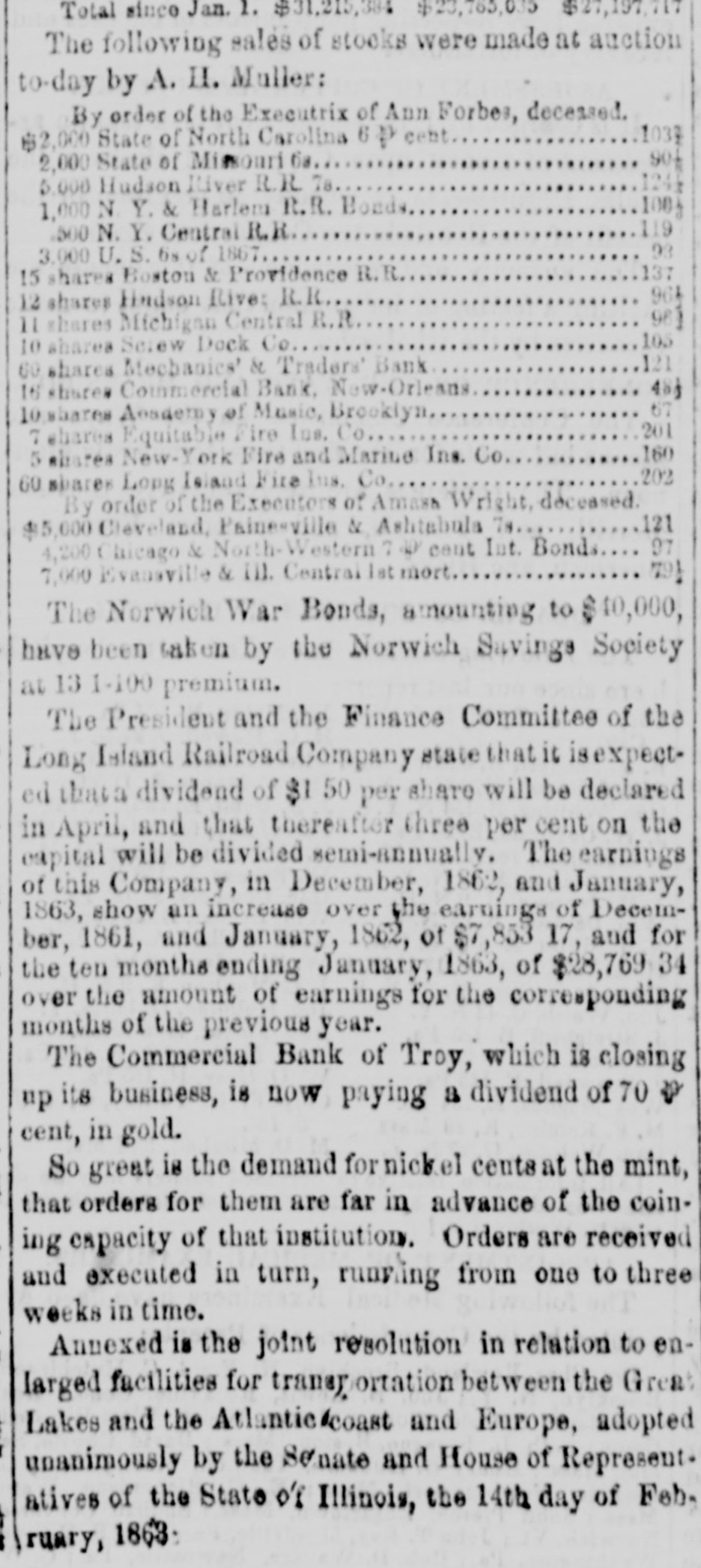
The Commercial Bank of Troy, which is closing up its business, is now paying a dividend of 70 v cent, in gold.
Source
newspapers
2. April 4, 1885 Other
Newspaper Excerpt
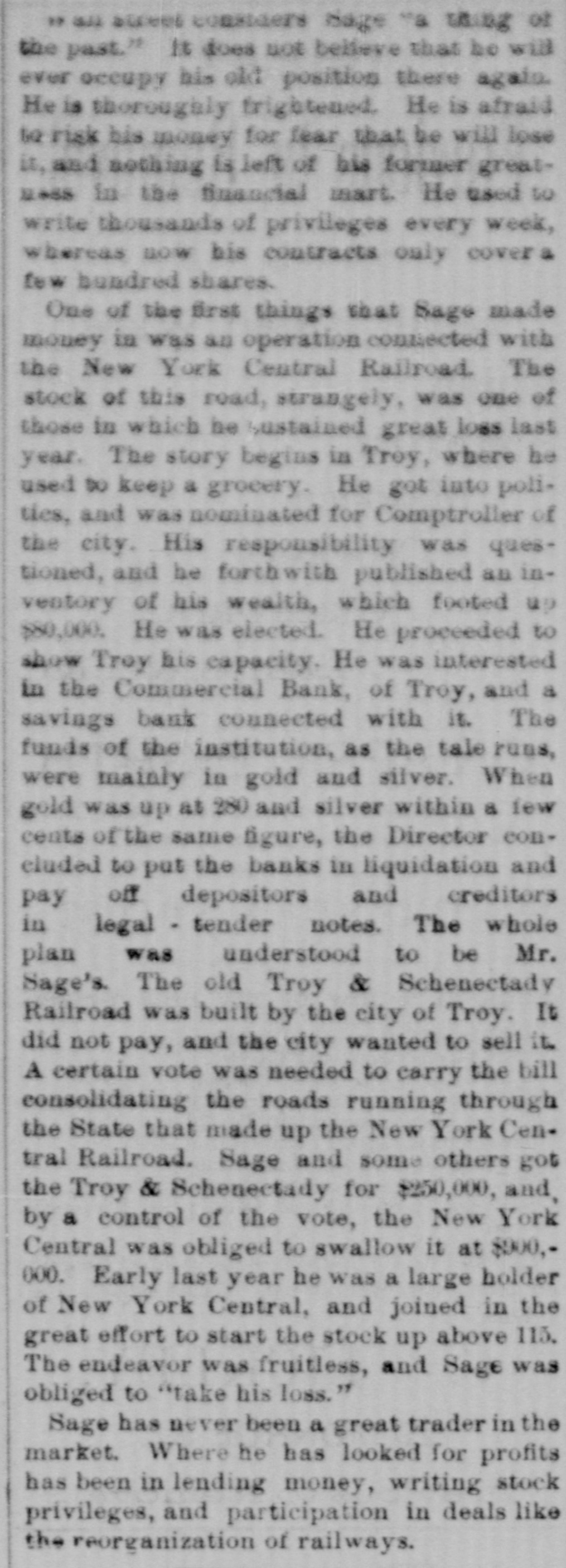
He was interested in the Commercial Bank, of Troy, and a savings bank connected with it. The funds of the institution, as the tale runs, were mainly in gold and silver. When gold was up ... the Director concluded to put the banks in liquidation and pay off depositors and creditors in legal - tender notes. The whole plan was understood to be Mr. Sage's.
Source
newspapers

Newspaper Articles (2)

Article from New-York Daily Tribune, February 23, 1863

Click image to open full size in new tab

Article Text

Total since Jan. 1. $31,215,384 $23,765,035 The following sales of stocks were made at auction to-day by A. H. Muller: By order of the Executrix of Ann Forbes, deceased. 1032 $2,000 State of North Carolina 6 p cent 90t 2,000 State of Missouri 6a 1241 5,000 Hudson River R.R. 78 1001 1,000 N Y. & Harlem R.R. Bonds 119 500 N. Y. Central R.R 93 3,000 U.S. 6s of 1867 137 15 shares Boston & Providence R. 964 12 shares Hudson Rive: R.R 981 11 shares Michigan Central R.R 105 10 shares Screw Dock Co 121 60 shares Mechanics' & Traders' Bank 481 16 share# Commercial Bank, New-Orleans 67 10 shares Academy of Music, Brooklyn 201 7 shares Equitable Fire Ins. Co 160 5 shares New-York Fire and Marine Ins. Co 202 60 sbares Lopy Island Fire Ins. Co By order of the Executors of Amasa Wright, deceased. 121 $5,000 Cleveland, Paine-ville & Ashtabula 7s 97 4,200 Chicago & North-Western 7 - cent Int. Bonds 791 7,000 Evanaville & III. Central lat mort The Norwich War Bonds, amounting to $40,000, have been taken by the Norwich Savings Society at 13 1-100 premium. The President and the Finance Committee of the Long Island Railroad Company state that it isexpected thata dividend of $1.50 per share will be declared in April, and that thereafter three per cent on the capital will be divided semi-annually. The earnings of this Company, in December, 1862, and January, 1863, show an increase over the earnings of December, 1861, and January, 1862, of $7,853 17, and for the ten months ending January, 1863, of $28,769 34 over the amount of earnings for the corresponding months of the previous year. The Commercial Bank of Troy, which is closing up its business, is now paying a dividend of 70 v cent, in gold. So great is the demand for nickel centsat the mint, that orders for them are far in advance of the coining espacity of that institution. Orders are received and executed in turn, running from one to three weeks in time. Annexed is the joint resolution in relation to enlarged facilities for transy ortation between the Great Lakes and the Atlantic coast and Europe, adopted unanimously by the Senate and House of Representatives of the State o's Illinois, the 14th day of Feb. ruary, 1863:

Article from Grand Rapids Morning Telegram, April 4, 1885

Click image to open full size in new tab

Article Text

** - access considers dage "a using of the past." it does DOE believe that be will ever occupy his old position there again. He is thoroughly frightened. He is afraid to risk his money for fear that be will lose it, and nothing is left of bis former greatMASS in the financial mart. He used to write thousands of privileges every week, whereas now bis contracts only cover a few hundred shares. One of the first things that Sage made money in was an operation connected with the New York Central Railroad The stock of this road, strangely, was one of those in which be ^ustained great loss last year. The story begins in Troy, where he used to keep a grocery. He got into polities, and was nominated for Comptroller of the city. His responsibility was questioned, and he forthwith published an inventory of his wealth, which footed up $80,000. He was elected. He proceeded to show Troy his capacity. He was interested in the Commercial Bank, of Troy, and a savings bank connected with it. The funds of the institution, as the tale runs, were mainly in gold and silver. When gold was up at 280 and silver within a few cents of the same figure, the Director coneluded to put the banks in liquidation and pay off depositors and creditors in legal - tender notes. The whole plan was understood to be Mr. Sage's. The old Troy & Schenectady Railroad was built by the city of Troy. It did not pay, and the city wanted to sell it. A certain vote was needed to carry the bill consolidating the roads running through the State that made up the New York Cen. tral Railroad. Sage and some others got the Troy & Schenectady for $250,000, and, by a control of the vote, the New York Central was obliged to swallow it at $000,000. Early last year he was a large holder of New York Central, and joined in the great effort to start the stock up above 113. The endeavor was fruitless, and Sage was obliged to "take his loss." Sage has never been a great trader in the market. Where he has looked for profits has been in lending money, writing stock privileges, and participation in deals like the reorganization of railways.