14720. Mechanics & Farmers Bank (Albany, NY)

Bank Information

Episode Type
Suspension → Reopening
Bank Type
state
Start Date
October 14, 1857
Location
Albany, New York (42.653, -73.756)

Metadata

Model
gpt-5-mini
Short Digest
c43cd9bb

Response Measures

None

Description

Articles (Sept–Oct 1857) describe strain on the Mechanics & Farmers' Bank and record that the Albany banks collectively suspended specie payments on Oct 14, 1857 in response to the wider suspension by New York and other cities during the Panic of 1857. No explicit run is described in these items, and no definitive permanent closure or receivership is mentioned; the clearing-house statement resolves to return to specie payments as soon as practicable, implying a temporary suspension.

Events (1)

1. October 14, 1857 Suspension
Cause
Macro News
Cause Details
General suspension of specie payments in New York and other cities amid the financial crisis of 1857; Albany banks collectively suspended to protect debtors and avoid forcing specie settlements.
Newspaper Excerpt
Resolved, That the general suspension of the New York banks imposes upon the banks of this city the necessity of a suspension of specie payments.
Source
newspapers

Newspaper Articles (2)

Article from New-York Daily Tribune, September 22, 1857

Click image to open full size in new tab

Article Text

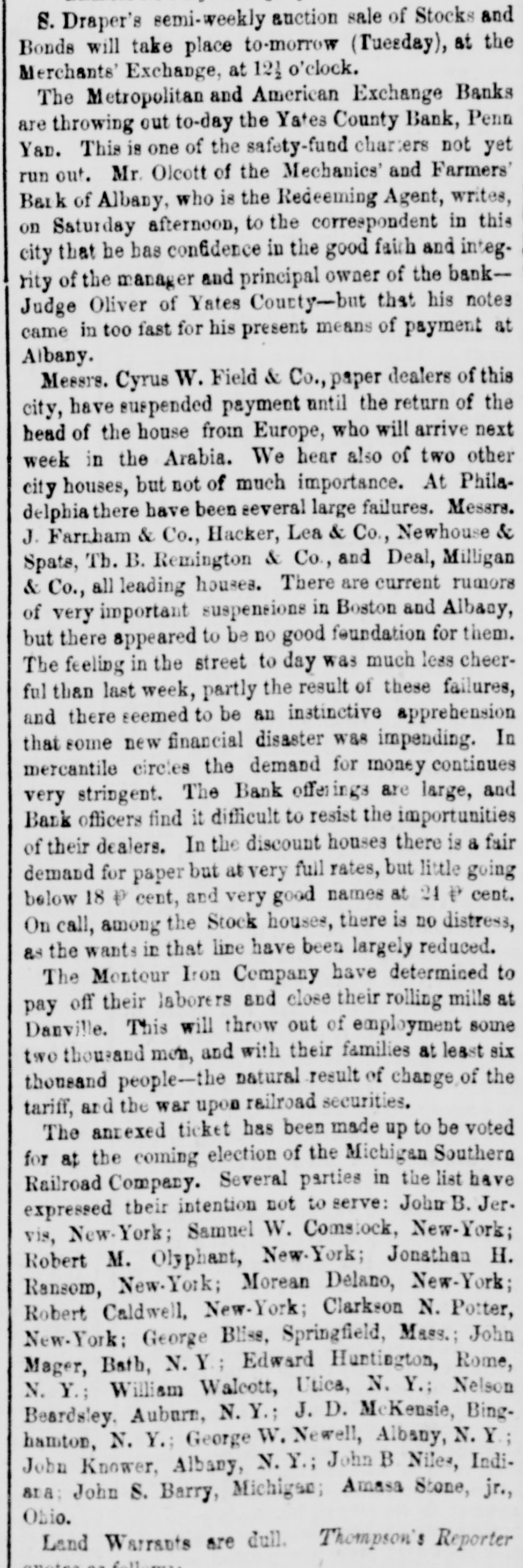
S. Draper's semi-weekly auction sale of Stocks and Bonds will take place to-morrow (Tuesday), at the Merchants' Exchange, at 12, o'clock. The Metropolitan and American Exchange Banks are throwing out to-day the Yates County Bank, Penn Yan. This is one of the safety-fund charters not yet run out. Mr. Olcott of the Mechanics' and Farmers' Bark of Albany, who is the Redeeming Agent, writes, on Saturday afternoon, to the correspondent in this city that he has confidence in the good faith and integrity of the manager and principal owner of the bankJudge Oliver of Yates County-but that his notes came in too fast for his present means of payment at Albany. Messrs. Cyrus W. Field & Co., paper dealers of this city, have suspended payment until the return of the head of the house from Europe, who will arrive next week in the Arabia. We hear also of two other city houses, but not of much importance. At Philadelphia there have been several large failures. Messrs. J. Farnham & Co., Hacker, Lea & Co., Newhouse & Spats, Tb. B. Remington & Co., and Deal, Milligan & Co., all leading houses. There are current rumors of very important suspensions in Boston and Albany, but there appeared to be no good foundation for them. The feeling in the street to day was much less cheerful than last week, partly the result of these failures, and there seemed to be an instinctive apprehension that some new financial disaster was impending. In mercantile circles the demand for money continues very stringent. The Bank offerings are large, and Bank officers find it difficult to resist the importunities of their dealers. In the discount houses there is a fair demand for paper but at very full rates, but little going below 18 P cent, and very good names at 24 ₱ cent. On call, among the Stock houses, there is no distress, as the wants in that line have been largely reduced. The Monteur Iron Company have determined to pay off their laborers and close their rolling mills at Danville. This will throw out of employment some two thousand men, and with their families at least six thousand people-the natural result of change of the tariff, and the war upon railroad securities. The annexed ticket has been made up to be voted for at the coming election of the Michigan Southern Railroad Company. Several parties in the list have expressed their intention not to serve: John B. Jer. vis, New-York; Samuel W. Comstock, New-York; Robert M. Olyphant, New.York; Jonathan H. Ransom, New.York; Morean Delano, New-York; Robert Caldwell, New-York; Clarkson N. Potter, New-York: George Bliss, Springfield, Mass.; John Mager, Bath, N. Y.; Edward Huntington, Rome, N. Y.; William Walcott, Utica, N. Y.; Nelson Beardsley, Auburn, N. Y.; J. D. McKensie, Binghamton, N. Y.; George W. Newell, Albany, N. Y.; John Knower, Albany, N. Y.; John B Niles, Indi808: John S. Barry, Michigan; Amasa Stone, jr., Obio. Land Warrants are dull. Thompson's Reporter

Article from The New York Herald, October 16, 1857

Click image to open full size in new tab

Article Text

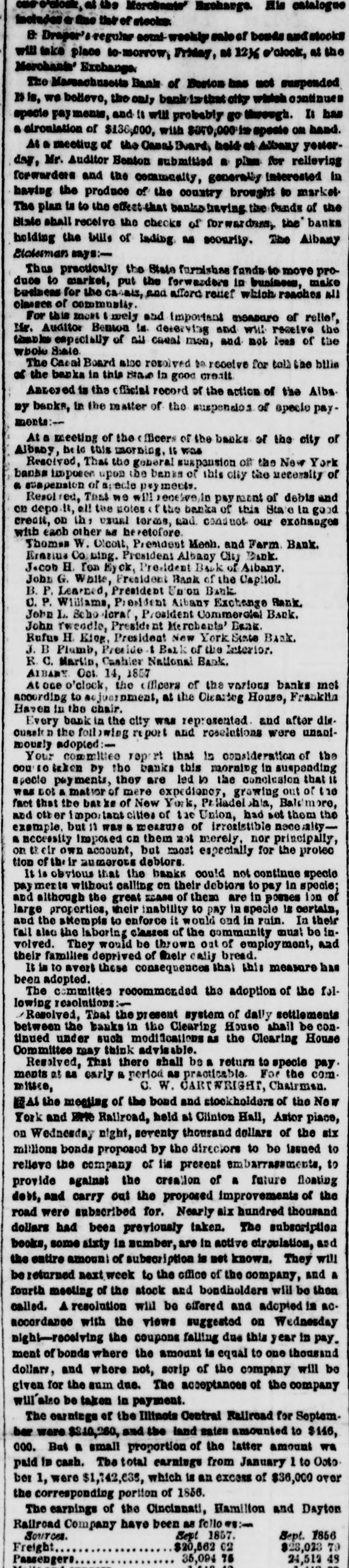
S. Draper's regular semi-weekly sale of bonds and stocks will take place to-morrow, Friday, at 12½ o'clock, at the Merchants' Exchange. The Massachusetts Bank of Boston has not suspended. It is, we believe, the only bank in that city which continues specie payments, and it will probably go through. It has a circulation of $136,000, with $370,000 in specie on hand. At a meeting of the Canal Board, held at Albany yesterday, Mr. Auditor Benton submitted a plan for relieving forwarders and the community, generally interested in having the produce of the country brought to market. The plan is to the effect that banks having the funds of the State shall receive the checks of forwarders, the banks holding the bills of lading as security. The Albany Statesman says:— Thus practically the State furnishes funds to move produce to market, put the forwarders in business, make business for the canals, and afford relief which reaches all classes of community. For this most timely and important measure of relief, Mr. Auditor Benton is deserving and will receive the thanks especially of all canal men, and not less of the whole State. The Canal Board also resolved to receive for tolls the bills of the banks in this State in good credit. Annexed is the official record of the action of the Albany banks, in the matter of the suspension of specie payments:— At a meeting of the officers of the banks of the city of Albany, held this morning, it was Resolved, That the general suspension of the New York banks imposes upon the banks of this city the necessity of a suspension of specie payments. Resolved, That we will receive, in payment of debts and on deposit, all the notes of the banks of this State in good credit, on the usual terms, and conduct our exchanges with each other as heretofore. Thomas W. Olcott, President Mech. and Farm. Bank. Erastus Corning, President Albany City Bank. Jacob H. Ten Eyck, President Bank of Albany. John G. White, President Bank of the Capitol. B. P. Learned, President Union Bank. U. P. Williams, President Albany Exchange Bank. John L. Schoolcraft, President Commercial Bank. John Tweddle, President Merchants' Bank. Rufus H. King, President New York State Bank. J. B. Plumb, President Bank of the Interior. R. C. Martin, Cashier National Bank. ALBANY, Oct. 14, 1857 At one o'clock, the officers of the various banks met according to adjournment, at the Clearing House, Franklin Haven in the chair. Every bank in the city was represented, and after discussion the following report and resolutions were unanimously adopted:— Your committee report that in consideration of the course taken by the banks this morning in suspending specie payments, they are led to the conclusion that it was not a matter of mere expediency, growing out of the fact that the banks of New York, Philadelphia, Baltimore, and other important cities of the Union, had set them the example, but it was a measure of irresistible necessity—a necessity imposed on them not merely, nor principally, on their own account, but most especially for the protection of their numerous debtors. It is obvious that the banks could not continue specie payments without calling on their debtors to pay in specie; and although the great mass of them are in possession of large properties, their inability to pay in specie is certain, and the attempts to enforce it would end in ruin. In their fall also the laboring classes of the community must be involved. They would be thrown out of employment, and their families deprived of their daily bread. It is to avert these consequences that this measure has been adopted. The committee recommended the adoption of the following resolutions:— Resolved, That the present system of daily settlements between the banks in the Clearing House shall be continued under such modifications as the Clearing House Committee may think advisable. Resolved, That there shall be a return to specie payments as early a period as practicable. For the committee, C. W. CARTWRIGHT, Chairman. At the meeting of the bond and stockholders of the New York and Erie Railroad, held at Clinton Hall, Astor place, on Wednesday night, seventy thousand dollars of the six millions bonds proposed by the directors to be issued to relieve the company of its present embarrassments, to provide against the creation of a future floating debt, and carry out the proposed improvements of the road were subscribed for. Nearly six hundred thousand dollars had been previously taken. The subscription books, some sixty in number, are in active circulation, and the entire amount of subscription is not known. They will be returned next week to the office of the company, and a fourth meeting of the stock and bondholders will be then called. A resolution will be offered and adopted in accordance with the views suggested on Wednesday night—receiving the coupons falling due this year in payment of bonds where the amount is equal to one thousand dollars, and where not, scrip of the company will be given for the sum due. The acceptances of the company will also be taken in payment. The earnings of the Illinois Central Railroad for September were $310,260, and the land sales amounted to $146,000. But a small proportion of the latter amount was paid in cash. The total earnings from January 1 to October 1, were $1,742,635, which is an excess of $36,000 over the corresponding portion of 1856. The earnings of the Cincinnati, Hamilton and Dayton Railroad Company have been as follows: Sources. Sept 1857. Sept. 1856 Freight $20,662 02 $28,023 79 Passengers. 35,094 76 24,513 49