14703. Commercial National Bank (Saratoga Springs, NY)

Bank Information

Episode Type
Run โ†’ Suspension โ†’ Closure
Bank Type
national
Bank ID
1227
Charter Number
1227
Start Date
December 13, 1878
Location
Saratoga Springs, New York (43.083, -73.785)

Metadata

Model
gpt-5-mini
Short Digest
0e54a52925ff17ed

Response Measures

Accommodated withdrawals, Capital injected, Full suspension, Books examined

Receivership Details

Depositor recovery rate
100.0%
Date receivership started
1879-02-11
Date receivership terminated
1881-01-17
OCC cause of failure
Losses
Share of assets assessed as good
40.4%
Share of assets assessed as doubtful
50.8%
Share of assets assessed as worthless
8.8%

Description

Newspapers report depositors swarming into the Commercial National Bank after the run on the First National Bank, leading officers to suspend payments on Dec 13, 1878. Although directors initially hoped to resume, examinations in Feb 1879 required heavy assessments and the bank never successfully reopened; a receiver (Linus M. Price) later wound up the Commercial National Bank's affairs (by 1880). Cause of the run/suspension is contagion from the First National Bank failure (local_banks). OCR errors in articles were corrected (e.g., 'suspond' -> 'suspend', 'examinor' -> 'examiner').

Events (7)

1. June 6, 1865 Chartered
Source
historical_nic
2. December 13, 1878 Run
Cause
Local Banks
Cause Details
Run began on the First National Bank; when that bank closed depositors rushed the Commercial National Bank triggering heavy withdrawals.
Measures
Officers decided to suspend payments rather than meet the drain.
Newspaper Excerpt
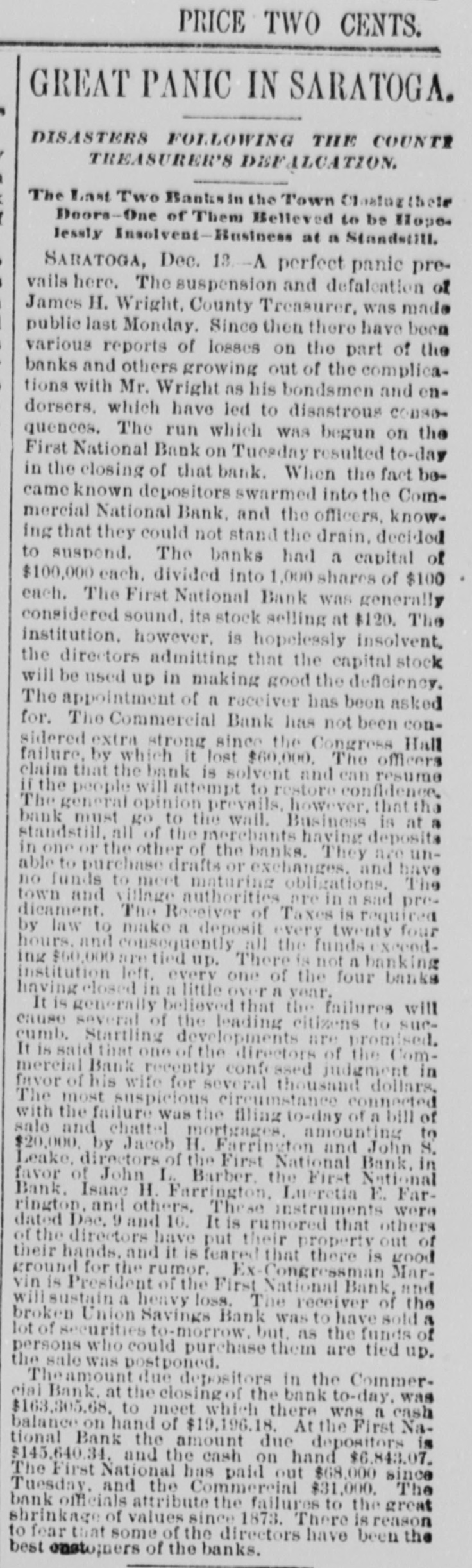
When the fact became known depositors swarmed into the Commercial National Bank
Source
newspapers
3. December 13, 1878 Suspension
Cause
Local Banks
Cause Details
Suspension was a direct response to heavy withdrawals triggered by the First National Bank's closing and the resulting local panic.
Newspaper Excerpt
the officers, knowing that they could not stand the drain, decided to suspond.
Source
newspapers
4. February 11, 1879 Receivership
Source
historical_nic
5. February 12, 1879 Other
Newspaper Excerpt
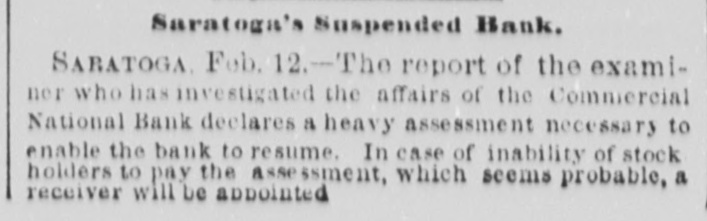
The report of the examiner ... declares a heavy assessment necessary to enable the bank to resume. In case of inability of stock holders to pay the assessment ... a receiver will be appointed (Feb. 12, 1879).
Source
newspapers
6. July 9, 1879 Other
Newspaper Excerpt
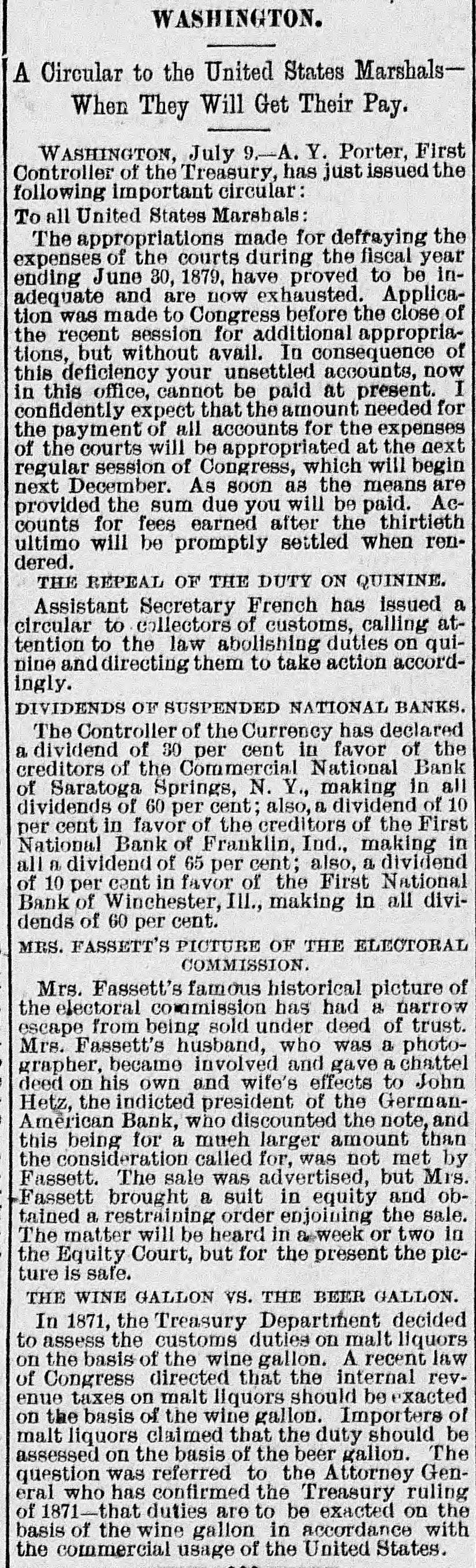
The Controller of the Currency has declared a dividend of 30 per cent in favor of the creditors of the Commercial National Bank of Saratoga Springs, N. Y., making in all dividends of 60 per cent; (July 9, 1879).
Source
newspapers
7. June 25, 1880 Receivership
Newspaper Excerpt
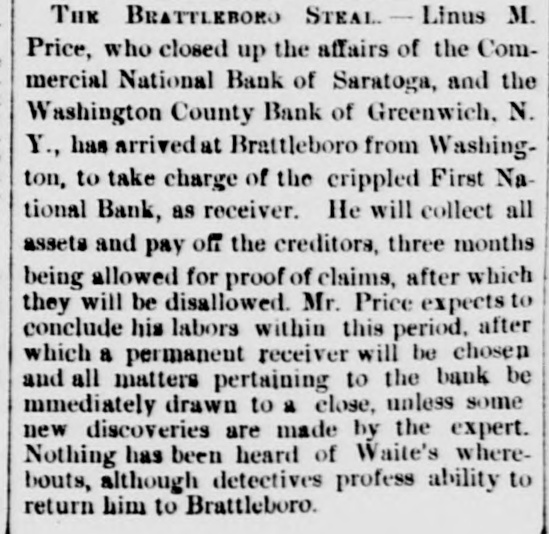
Linus M. Price, who closed up the affairs of the Commercial National Bank of Saratoga, ... has arrived at Brattleboro ... to take charge of the crippled First National Bank, as receiver. He will collect all assets and pay off the creditors. (June 25, 1880).
Source
newspapers

Newspaper Articles (7)

Article from The Sun, December 14, 1878

Click image to open full size in new tab

Article Text

e GREAT PANIC IN SARATOGA. DISASTERS FOLLOWING THE COUNTR TREASURER'S DEF ALCATION. The Last Two Banks: the Town Doors-One of Them Believed to be Hope. lessly Insolvent-Business at a Standstill. SARATOGA, Dec. 13 A perfect panic prevails here. The suspension and defalcation of James H. Wright, County Treasurer, was made public last Monday. Since then there have been various reports of losses on the part of the banks and others growing out of the complications with Mr. Wright as his bondsmen and endorsers. which have led to disastrous consequences. The run which was begun on the First National Bank on Tuesday resulted to-day in the closing of that bank. When the fact became known depositors swarmed into the Commercial National Bank, and the officers. knowing that they could not stand the drain. decided to suspond. The banks had a capital of $100,000 each, divided into 1,000 shares of $100 each. The First National Bank was generally considered sound. its stock selling at $120. The institution. however, is hopelessly insolvent, the directors admitting that the capital stock will be used up in making good the deficiency. The appointment of a receiver has been asked for. The Commercial Bank has not been considered extra strong since the Congress Hall failure, by which it lost $60,000. The officers claim that the bank is solvent and can resume if the people will attempt to restore confidence. The general opinion prevails. however, that the bank must go to the wall. Business is at a standstill, all of the merchants having deposits in one or the other of the banks. They are unable to purchase drafts or exchanges. and have no funds to meet maturing obligations. The town and village authorities are in a sad predicament. The Receiver of Taxes is required by law to make a deposit every twenty four hours. and consequently all the funds exceeding aretied up. There is not a banking institution left. every one of the four banks having closed in a little over a year. It is generally believed that the failures will cause several of the leading citizens to suecumb. Startling developments are promised. It is said that one of the directors of the Commereial Bank recently confo ssed judgement in favor of his wife for several thousand dollars. The most suspicious circumstance connected with the failure was the filing to-day of a bill of sale and chattel mortgages. amounting to $20,000. by Jacob H. Farrington and John S. Leake, directors of the First National Bank, in favor of John L. Barber, the First National Bank. Isane H. Farrington, Luteretia E. Farrington. and others. These instruments were dated Dec. 9 and 10. It is rumored that others of the directors have put their property out of their hands, and it is feared that there is good ground for the rumor. Ex-Congressman Marvin is President of the First National Bank, and will sustain a heavy loss. The receiver of the broken Union Savings Bank was to have sold a lot of securities to-morrow. but, as the funds of persons who could purchase them are tied up. the sale was postponed. Theamount due depositors in the Commercial Bank. at the closing of the bank to-day. was $163,305.68. to meet which there was a cash balance on hand of $19,196.18. At the First National Bank the amount due depositors is $145,640.34. and the cash on hand $6,843.07. The First National has paid out $68,000 since Tuesday, and the Commercial $31,000. The bank officials attribute the failures to the great shrinkage of values since 1873. There is reason to fear that some of the directors have been the best onsto;ners of the banks.
Article from The New York Herald, December 15, 1878

Click image to open full size in new tab

Article Text

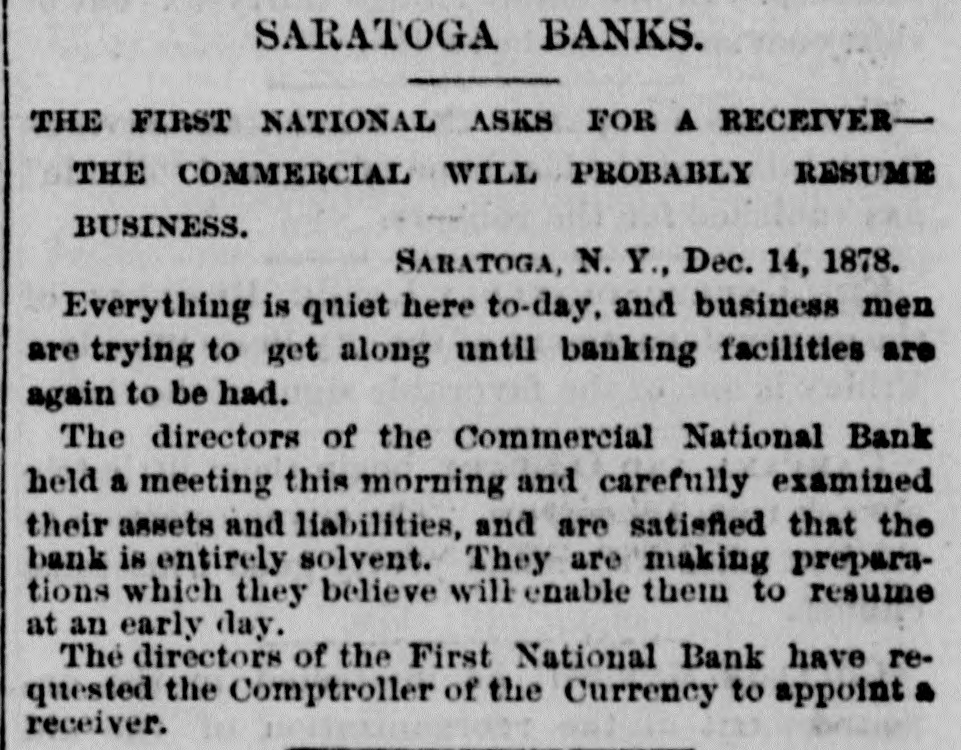
SARATOGA BANKS. THE FIRST NATIONAL ASKS FOR A RECEIVERTHE COMMERCIAL WILL PROBABLY RESUME BUSINESS. SARATOGA, N. Y., Dec. 14, 1878. Everything is quiet here to-day. and business men are trying to get along until banking facilities are again to be had. The directors of the Commercial National Bank held a meeting this morning and carefully examined their assets and liabilities, and are satisfied that the bank is entirely solvent. They are making preparations which they believe will enable them to resume at an early day. The directors of the First National Bank have requested the Comptroller of the Currency to appoint receiver.


Article from The Sun, February 13, 1879

Click image to open full size in new tab

Article Text

Saratoga's Suspended Bank. SABATOGA. Feb. 12.-The report of the examinor who has investigated the affairs of the Commercial National Bank declares a heavy assessment necessary to enable the bank to resume. In case of inability of stock holders to pay the assessment, which seems probable, a receiver will be appointed


Article from The New Orleans Daily Democrat, July 10, 1879

Click image to open full size in new tab

Article Text

WASHINGTON. A Circular to the United States MarshalsWhen They Will Get Their Pay. WASHINGTON, July 9.-A. Y. Porter, First Controller of the Treasury, has just issued the following important circular: To all United States Marshals: The appropriations made for defraying the expenses of the courts during the fiscal year ending June 30, 1879, have proved to be inadequate and are now exhausted. Application was made to Congress before the close of the recent session for additional appropriations, but without avail. In consequence of this deficiency your unsettled accounts, now in this office, cannot be paid at present. I confidently expect that the amount needed for the payment of all accounts for the expenses of the courts will be appropriated at the next regular session of Congress, which will begin next December. As soon as the means are provided the sum due you will be paid. Accounts for fees earned after the thirtieth ultimo will be promptly settled when rendered. THE REPEAL OF THE DUTY ON QUININE. Assistant Secretary French has issued a circular to collectors of customs, calling attention to the law abolishing duties on quinine and directing them to take action accordingly. DIVIDENDS OF SUSPENDED NATIONAL BANKS. The Controller of the Currency has declared a dividend of 30 per cent in favor of the creditors of the Commercial National Bank of Saratoga Springs, N. Y., making in all dividends of 60 per cent; also, a dividend of 10 per cent in favor of the creditors of the First National Bank of Franklin, Ind., making in all a dividend of 65 per cent; also, a dividend of 10 per cent in favor of the First National Bank of Winchester, Ill., making in all dividends of 60 per cent. MRS. FASSETT'S PICTURE OF THE ELECTORAL COMMISSION. Mrs. Fassett's famous historical picture of the electoral commission has had a narrow escape from being sold under deed of trust. Mrs. Fassett's husband, who was a photographer, becamo involved and gave a chattel deed on his own and wife's effects to John Hetz, the indicted president of the GermanAmerican Bank, who discounted the note, and this being for a mueh larger amount than the consideration called for, was not met by Fassett. The sale was advertised, but Mrs. Fassett brought a suit in equity and obtained a restraining order enjoining the sale. The matter will be heard in a week or two in the Equity Court, but for the present the picture is safe. THE WINE GALLON vs. THE BEER GALLON. In 1871, the Treasury Department decided to assess the customs duties on malt liquors on the basis of the wine gallon. A recent law of Congress directed that the internal revenue taxes on malt liquors should be exacted on the basis of the wine gallon. Importers of malt liquors claimed that the duty should be assessed on the basis of the beer gallon. The question was referred to the Attorney General who has confirmed the Treasury ruling of 1871-that duties are to be exacted on the basis of the wine gallon in accordance with the commercial usage of the United States.


Article from Daily Globe, January 6, 1880

Click image to open full size in new tab

Article Text

CASUALTIES AND CRIMES. FALL OF A BREWERY. SYRACUSE, Jan. 5.-The fifth floor of one section of the Greenway Brewing company, an immense building, gave way this morning and in its falling carried down all the other floors. A man on the upper floor and another on the lower floor were injured but not seriously. Seven thousand bushels of corn and wheat, 175 bales of hops, and about five thousand bushels of Canada malt and two thousand bushels of malt dust were precipitated into Onondaga creek and much was washed away. The lossis about $200,000. The upper floor has heretofore carried double the weight which broke it down. CHICAGO THIEVES SENTENCED. CHICAGO, Jan. 5.-Judge Blodgett of the United States court, to-day sentenced John W. Gregg to two years imprisonment in jail and a fine of $1,218 for embezzlement in the postoffice. William Spalding, custom house clerk, was also sentenced to pay a fine of $1,648 for embezzlement. STEAMBOAT EXPLOSION. PENSACOLA, Fla., Jan. 5.-The steamer Fisher, the mail boat between Pensacola and Freeport, exploded, killing Capt. Watson and one other and mortally scalding the engineer. THE RAIL JUGGERNAUT. CHICAGO, Jan. 5.-The terribly mutilated body of Jas. Boyers, the young messenger for a grain firm in the city, was found scattered along the track of the Illinois Central railroad this forenoon. Although frightfully crushed, bruised and mangled life wasn't entirely extinct when he was found, but be died during the day. It is supposed he attempted to jump from the train. A MOLLIE SURRENDERS. POTTSVILLE, Pa., Jan. 5.-Edward Curley, a Mollie Maguire of Columbia county, charged with the murder of Joe Gunning, an old man in Centralia, July 26th, 1876, returned to Centralia yesterday and surrendered to the authorities and was committed to Bloomsburg jail. Curley is expected to turn State's evidence and expose the participants in a number of murders committed in the vicinity of Centralia, the scene of many tragedies during the reign of the Mollie Maguires. At Curley's hearing yesterday, Michael Brogan, who recently married a daughter of Gunning, attempted to shoot him. The town is very much agitated. DEFAULTING F. F. V. RICHMOND, Va., Jan. 5.-An investigation into the accounts of N. C. Taliferro, retiring general agent and storekeeper of the penitentiary, brought to light a shortage of $15,000 to $20,000. Taliferro acknowledges the shortage, but says it will be made good by his sureties. He says he does not know how to account for it, except from the fact that he was engaged in a commission business as well as being agent of the penitentiary, and that the affairs of both concerns became mixed. He claims to have outstanding assets sufficient to cover the deficiency. BLACK HILLS SHOOTING. DEADWOOD, Jan. 5.-A man named Joe Coburn, aged about 25, lately employed in constructing the military telegraph line, entered the restaurant of Wm. Woolsey, Fountain City, a few miles from Deadwood, this evening, and renewed an old quarrel by refusing to pay a bill. Coburn drew a revolver first, but Woolsey firing, the ball entered Coburn's breast. He lies in a dying condition. It is believed his home is in Michigan. Woolsey is under in arrest. JAIL BREAK. COLUMBUS, O., Jan. 5.-The prisoners confined in the Franklin county jail made a break for liberty at 5 o'clock this evening, just after the new sheriff had assumed charge, and nine escaped through the entrance door. James Herrell alias Kerr, indicted for murder in the first degree, and J. W. Doge, for cutting with intent to wound, are among the missing. RUN OVER AND KILLED. CINCINNATI, Jan. 5.-Moritz B. Mann, nearly 70 years old, was knocked down by a team tonight while crossing the street near his residence, and his skull was crushed by the wheels passing over it. Deceased has been for a long time bookkeeper for the firm of J. & L. Seasongood. The driver was arrested on the charge of manslaughter. BOILER EXPLOSION. BALTIMORE, Jan. 5.-The boiler exploded tonight in the rolling mill of Coates Bros. at Locust Point, by which the mill was considerably wrecked and a number of employes seriously injured. The boiler was elevated some eight or ten feet from the floor of the mill and its fragments passed out through the north and west sides and end of the building. The day men had just gone off and the night force had gone to work. Geo. Wirt, Jos. Vickers and Chas. Thomas were seriously hurt and scalded, but none fatally injured. Jos. Morgan, Geo. Geister, John Williams, Z. Jackson, Jas. Kinney, William Walton, Geo. Bell and Chas. Disney, all employes in the mill, were badly scalded and some of them received injuries from flying splinters. The dome of the boiler was thrown 150 yards. The roofs of several small dwelling houses immediately west of the mill were damaged. Loss $10,000. EMBEZZLEMENT AND PERJURY. SARATOGA, Jan. 5.-Stephen H. Richards cashier of the Commercial National bank, which failed Dec. 13, 1879, was arrested this afternoon charged with embezzling funds of the bank; also with perjury in swearing to reports to the comptroller of the currency. He gave bail. Hough Indicted for Forgery. NEW VORK Ten


Article from New-York Tribune, May 22, 1880

Click image to open full size in new tab

Article Text

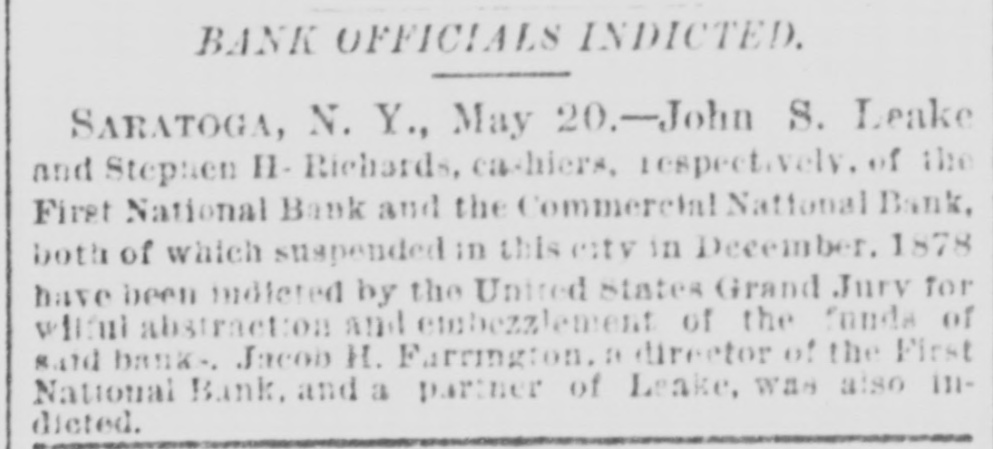
BANK OFFICIALS INDICTED. SARATOGA, N. Y., May 20.-John S. Leake and Stephen H- Richards, cashiers, respectively, of the First National Bank and the Commercial National Bank, both of which suspended in this city in December. 1878 have been indicted by the United States Grand Jury for within abstraction and embezzlement of the funds of said banks. Jacob H. Farrington. a director of the First National Bank, and a partner of Leake, was also 111dieted.


Article from Burlington Weekly Free Press, June 25, 1880

Click image to open full size in new tab

Article Text

THE BRATTLEBORO STEAL - Linus M. Price, who closed up the affairs of the Commercial National Bank of Saratoga, and the Washington County Bank of Greenwich, N. Y., has arrivedat Brattleboro from Washington, to take charge of the crippled First National Bank, as receiver. He will collect all assets and pay off the creditors, three months being allowed for proof of claims, after which they will be disallowed. Mr. Price expects to conclude his labors within this period, after which a permanent receiver will be chosen and all matters pertaining to the bank be mmediately drawn to a close, unless some new discoveries are made by the expert. Nothing has been heard of Waite's wherebouts, although detectives profess ability to return him to Brattleboro.