14685. Fort Stanwix National Bank (Rome, NY)

Bank Information

Episode Type
Suspension โ†’ Closure
Bank Type
national
Bank ID
1410
Charter Number
1410
Start Date
January 1, 1896*
Location
Rome, New York (43.227, -75.492)

Metadata

Model
gpt-5-mini
Short Digest
7ca8ebb629ad1faf

Response Measures

None

Receivership Details

Depositor recovery rate
72.2%
Date receivership started
1896-02-08
Date receivership terminated
1906-03-15
OCC cause of failure
Fraud
Share of assets assessed as good
33.6%
Share of assets assessed as doubtful
14.7%
Share of assets assessed as worthless
51.7%

Description

Articles describe insolvency caused by bad loans and a large embezzlement by Cashier George Barnard, the bank's suspension (not a depositor run) in Jan. 1896, appointment of a receiver, and later receiver actions (30% dividend). No clear bank run on Fort Stanwix is reported; the bank was placed in the hands of a receiver and did not resume as an open going bank.

Events (4)

1. July 8, 1865 Chartered
Source
historical_nic
2. January 1, 1896* Suspension
Cause
Bank Specific Adverse Info
Cause Details
Bank found insolvent after discovery of large bad paper (J. Winslow Jones drafts, other worthless paper) and alleged embezzlement/defalcation by Cashier George Barnard; led to suspension of payments.
Newspaper Excerpt
the suspension of the Fort Stanwix National bank, of Rome, N. Y., in January, 1896
Source
newspapers
3. February 1, 1896* Receivership
Newspaper Excerpt
Controller Eckels has directed the receiver of the Fort Stanwix National Bank, at Rome, N. Y., to declare and pay a dividend of 30 per cent to the creditors of the bank. ...Bank Examiner Van Vranken, who has been appointed temporary receiver, has thrown out of the bank all paper he does not know to be O. K., including paper partly due. (Feb. articles). Also: Controller ... decided that it will be necessary to place the Fort Stanwix national bank, of Rome, N. Y., in the hands of a receiver (Marietta, Feb. 7 telegraph). (Note: receiver appointed in Feb. 1896.),
Source
newspapers
4. February 8, 1896 Receivership
Source
historical_nic

Newspaper Articles (20)

Article from Birmingham State Herald, February 4, 1896

Click image to open full size in new tab

Article Text

A Bank in Trouble. Rome, N. Y., Feb. 3.-It has been learned that the Fort Stanwix National bank has been carrying paper to the amount of $60,000 or more for the Jones Canning company of Baltimore, upon which It has been unable to realize, and that the note which Cashier Barnard left exonerating Bookkeeper Sillenebeck and taking all the blame on himself refers to this. There is also said to be in the bank paper of the late firm of R. M. Bingham & Co. representing $36,000, on which all but about $10,000 has been paid, but nothing credited. There are also notes of the late D. B. Prince to the amount of $10,000, which cannot be realized upon. Mr. Barnard was the assignee of the estate of the late George Clarke, the great land owner, and there is more or less of this paper in the bank. All these things, together with the miscellaneous papers, which are worthless, or nearly so, will, it is believed, wipe out the entire surplus and undivided profits. amounting to $170,000. The stockholders of the bank are quite positive that the institution will be able to pay dollar for dollar. The Rome Savings bank this afternoon resumed business. It was prepared for a run, but none was made. The name of the Baltimore company is the J. Winslow Jones Packing company. It is stated that this company has $60.000 of drafts on the Fort Stanwix bank. In Dun's report for January. 1896. the Jones company is given no rating. It is stated that several years ago Jones traveled through this section purchasing the output of canning factories, and through the acquaintance thus formed the company established credit at the bank.


Article from The Morning News, February 4, 1896

Click image to open full size in new tab

Article Text

ROME'S BROKEN BANK. The Entire Surplus and Undivided Profits of $170,000 Wiped Out. Rome: N. Y., Feb. 3.-It has been learned that the Fort Stanwix National Bank has been carrying paper to the amount of $60,000 or more for the Jones Canning Company of Baltimore, upon which it has been unable to realize, and that the note which Cashier Barnard left exonerating Bookkeeper Sillenbeck, and taking all the blame on himself refers to this. There is also said to be in the bank paper of the late firm of R. M. Bingham & Co., representing $36,000 on which all but about $10,000 has been paid, but nothing credited. There are also notes of the late D. B. Prince to the amount of $10,000 which cannot be realized upon. Mr. Barnard was the assignee of the estate of the late George Clarke, the great land owner, and there is more or less of this paper in the bank. All these things, together with the mis, cellaneous papers, which are worthless on nearly so, will, it is believed, wipe out the entire surplus and undivided profits. amounting to $170,000. The stockholders of the bank are quite positive that the institution will be able to pay depositors dollar for dollar. The Rome Savings Bank this afternoon resumed business. It was prepared for a run, but none was made. The name of the Baltimore company 1st the J. Winslow Jones Packing Company. It is stated that this company has $60,000 of drafts in the Fort Stanwix bank. In Dun's report for January, 1896, the Jones company is given no rating. It is said that several years ago Mr. Jones traveled through this section purchasing the output of canning factories, and through the acquaintance thus formed the company established a credit at the bank.


Article from The Evening Times, February 4, 1896

Click image to open full size in new tab

Article Text

ROTTEN TO THE CORE. Condition of the Looted Fort Stanwix Bank Very Bad. Rome, N. Y., Feb. 4.-The condition of the Fort Stanwix National Bank proves to be very bad. The examination has shown the bank to be rotten to the core. Although Bank Examiner Van Vranken will say nothing. it is N. ared on good authority that the bank is Invoir 4 to the extent of nearly, if not quite, 84 900. or this am 1th " is said that there is $200,000 in the shape of drafts of the J. Winslow Jones Packing Company of Baltimore and other concerns associated with it, $100,000 of miscellaneous bad paper, and $75,000 defalcation by Cashier Barmind. Thisamount willswamp the bank and throw it into the hands of a receiver. The capital stock is $150,000 and the surplus $170,000 more. Therefore if the bank is to pay its depositors 100 cents on the dollar the stockholders must be assessed. The people of Rome have so long looked upon Cashier Barnard as the model of all that was upright and honest thatthey could not believe that he was a defaulter.


Article from New-York Tribune, February 5, 1896

Click image to open full size in new tab

Article Text

THE FORT STANWIX BANK SCANDAL. STOCKHOLDERS LIKELY TO BE ASSESSED-THE DOWNFALL OF THE CASHIER Rome, N. Y., Feb. -The condition of the Fort Stanwix National Bank proves to be very bad. The examination has shown the bank to be rotten to the core. Although Bank Examiner Van Vranken will say nothing, it is stated on good authority that the bank is involved to the extent of nearly If not quite $375,000. Of this amount, it is said that $200,000 is In the shape of drafts of the J. Winslow Jones Packing Company, of Baltimore, and other concerns associated with it; $100,000 of miscellaneous bad paper, and $75,000 of a defalcation by Cashier Barnard. This amount will swamp the bank and throw it into the hands of a receiver The capital stock is $130,000 and the surplus $170,000 more: therefore, If the bank is to pay its depositors 100 cents on the dollar the stockholders must be assessed. The people of Rome have so long looked upon Mr. Barnard as the model of all that was upright and honest that they could not believe he was a defaulter. But the conviction that this is the case is now slowly forcing itself upon them. In what way he used the money which he is alleged to have taken is not explained, but there are intimations that he had of late been speculating, in the hope of being able to make up for losses to the bank through mismanagement.


Article from The Evening Herald, February 5, 1896

Click image to open full size in new tab

Article Text

cure habitual constipaHood's Pills tion. Price 25 cents. NEVER TOOK A VACATION. Teantime Cashier Barnard Was Regularly Robbing the Bank. ROME, N. Y., Feb. 5.-The examination of the Fort Stanwix National bank shows it to be rotten to the core. It is now stated on good authority that the bank is involved to the extent of nearly, if not quite, $400,000. This amount includes a $75,000 defalcation by Cashier Barnard, who recently committed suicide. This amount will swamp the bank and throw it into the hands of a receiver. Barnard had not taken a vacation for the past thirty years, and the reason for this is found in the belief that he did not desire any one but himself to handle his accounts. So far as the habits of the man are concerned during the many years he resided in this city it has always been thought that he indulged in no extravagances and no speculations, and it is a matter of wonder what he has done with the money. It is stated that the capital stock of $150,000, the surplus of $30,000 and the undivided profits of $140,000 will be practically wiped out before the investigation is finished, and also that an assessment will be levied to pay the depositors dollar for dollar. One of the directors of the bank declared today that he would not be surprised if the shortage amounted to $500,000, and asserted that Barnard's personal shortage might reach $100,000. Barnard's high social position has given increased interest in the affairs of the bank. He was an ex mayor of the city, and for years had been a vestryman of Zion Episcopal church.


Article from Omaha Daily Bee, February 5, 1896

Click image to open full size in new tab

Article Text

BARNARD HAD SWAMPED THE BANK Not Only a Defaulter, but Had Mismanaged Its Affairs. NEW YORK, Feb. 4.-A special dispatch from Rome, N. Y., to the Evening Post says: The condition of the Fort Stanwix National bank proves to be very bad. It is stated on good authority that the bank is involved to the extent of nearly $400,000. Of this amount it is said there are $200,000 in drafts of the J. Winslow Jones Packing company of Baltimore and other concerns associated with it, $100,000 of miscellaneous bad paper and a $75,000 defalcation by Cashier Barnard. This amount will swamp the bank and throw it into the hands of a receiver. The capital stock is $150,000 and the surplus and undivided profits $170,000 more, DO the stockholders must be assessed. It is alleged that lately Cashier Barnard had been speculating in stocks in the hope of being able to make up for losses to the bank through mismanagement. ROME, N. Y., Feb. 4.-There was great excitement among the citizens when it was learned today from an authoritative source that the shortage in the fort Stanwix National bank amounts up to the present time to $375,000, and that Hon. George Barnard, who, before his suicide last Saturday, was the trusted cashier, ex-mayor and vestryman of Zion Episcopal chruch, would be found in debt personally nearly $75,000. Bank Examiner Van Franklin will not yet go into the details of the bank affairs, nor will he either affirm or deny anything in that connection. A complete examination has not been made, and the shortage, as learned today, has been estimated after a partial examination. One of the directors of the bank told the Assoclated press man that he would not be surprised if the shortage amounted to $500,000, and declared Barnard's personal shortage might reach $100,000. Barnard had not taken a vacation for thirty years, and after today's disclosures the reason for this is found in the belief that he did not desire any one but himself to handle his acounts. So far as the habits of the man are concerned, during the many years he has resided in this city it has always been thought that he indulged in no extravagances and no speculations. The overdrafts of the J. W. Jones Canning company of Baltimore and others amount to $200,000, it is said, but who the others are cannot be learned. President Uttley telegraphed today that he will be here on Friday and the directors desire nothing to be done until his return. An effort will then be made to get together enough money to warrant the bank's going into voluntary liquidation.


Article from The Ely Miner, February 5, 1896

Click image to open full size in new tab

Article Text

ranging in the convict camps near Rusk, Tex., and several deaths had occurred. The lumber storehouse of R. C. Pingree & Co. was burned at Lewiston, Me., the loss being $150,000. At Colville, Wash., Adolph Niese and his wife were sentenced to 20 years in the penitentiary for beating their tenyear-old son to death. Shortly after the prisoners were placed in jail they committed suicide with a razor. William Trout, a barber of Maysville, Ky., has fasted 52 days except that he drinks buttermilk. The Union Trust company of Pittsburgh, Pa., went into the hands of a receiver with liabilities of $130,000. Belva A. Lockwood was disbarred from practicing as an attorney or agent before the pension bureau in Washington because of alleged irregularities. The national board of trade in session at Washington declared that legal tender notes should be retired from circulation. During a wedding at the residence of Albert H. Baker near Sandusky, O. the floor gave way and 75 persons fell into the cellar. Mrs. H. N. Norton was fatally injured, and others were badly hurt. The supreme court of Indiana decided that gerrymanders for legislative purposes are unconstitutional. Johnny Morris and Bennie Armit were drowned while walking across the Calumet river on the ice at Hammond, Ind. Richard L. Brown, wholesale grocer at Richmond, Va., failed for $100,000. Dr. Alfred L. Kennedy, one of the most distinguished chemists in this country, was burned to death in his office in Philadelphia while experimenting. The war ship Helena was launched at Newport News, Va. Verne W. Jaynes, one of the proprietors of the Daily Capitol at Pierre, S. D., committed suicide by swallowing morphine. Madeline Messner, of Gibsonburg, O., a patient at the insane asylum in Toledo, O., committed suicide by hanging herself with her hair. The South Carolina legislature reelected Associate Justice Pope to the supreme bench for eight years. Gus Thomas, the notorious Hardin county moonshiner and murderer, was captured and placed in jail at Savanna, Tenn. Thomas has murdered three revenue officers. Six persons were killed and nearly a score injured, some of them fatally, by the explosion of a boiler at the works of the Hollidaysburg (Pa.) Iron and Nail company. George Krout, the Wells-Fargo express agent at Colorado Springs, Col., confessed that he stole the express packages containing $35,000, and said his father was innocent. The stables on the Narragansett park grounds at Providence, R. 1., were burned and 14 valuable trotting horses perished in the flames. Two brothers, Charles and Edward Shepard, aged 19 and 17 years, respectively, broke through the ice at Chester, Pa., and were drowned. Dr. W. H. Furness, aged 96, the oldest and most prominent Unitarian divine in the country, died at his home in Philadelphia. Harvey Page, his W ife and two young sons, aged three years and three months, were burned to death in their home in Marengo township, near Marshall, Mich. The exchanges at the leading clearing houses in the United States during the week ended on the 31st ult. ag. gregated 890,980,970, against 979,967,447 the previous week. The decrease, compared with the corresponding week in 1895, was 5.6. Charles Asimus, a hunchback, was hanged at Kalama, Wash., for the murder of James Greenwood last September. In an interview with Senator Jones (Nev) Secretary Olney said that the United States government was doing all that could be done to protect the in terests of Hammond and other Amer cans in the Transvaal. The monthly statement of the government receipts and expenditures for January show the aggregate receipts to be $29,237,670 and the expenditures $32,696,830, leaving the deficit for the month about $3,459,160 and for the seven months of the present fiscal year about $18,853,867. Cashier George Barnard, of the Fort Stanwix national bank at Rome, N. Y., killed himself, and the bank was closed pending an examination of its affairs. The boiler in the stave-mill on William Morrison's farm near Freeport, ()., exploded, killing William Laporte, William Kiefer and Roy Vesey.
Article from Marietta Daily Leader, February 7, 1896

Click image to open full size in new tab

Article Text

CONDENSED NEWS Gathered From All Parts of the Country by Telegraph. Notice was received by the heads of departments in the Santa Fe shops at Argentine, Kan., notifying them of a cut of 10 per cent. in salaries. The British government has received a dispatch stating that the British have won two victories over the slave traders in Central Africa and that 14 Arab chiefs have been taken prisoners. The housesmiths and structural iron workers in session at Pittsburgh Wednesday have formed a national organization to be known as "The Bridge Builders and Structural Iron Workers of America." Assemblyman Robbins' resolution providing for an investigation of the alleged coal trust by the attorney general, was passed by the New York assembly Thursday morning by a vote of ayes 90, nays 42. The secretary of the interior Wednesday decided upon May 1 next as the date of the opening of the agricultural lands of the Red Lake Indians in Minnesota, which embraces about 800,000 acres, and will be sold at $1.25 per acre. Controller Eckels has decided that it will be necessary to place the Fort Stanwix national bank, of Rome, N. Y., in the hands of a receiver, but one will not be appointed until the controller has thoroughly digested the examiner's report. The treasury department Wednesday issued a statement of the withdrawals of gold from January 6 to February 5, 1896. From this it appears that the total amount withdrawn for export aggregated $8,904.133; 'not for export, $7,349,545. Total, $16,253,678. Wednesday morning the State bank, of Maurice, Sionx county, Ia.. posted on its doors a notice that it had suspended payment, but that depositors would be paid in full. The cause was extensive investments in real estate amounting to $20,000 and slow collections. Secretary of Agriculture Morton has a letter from Assistant Secretary Shumway, of the Bay State Agricultural society, of Boston, advising him of the adoption of resolutions by that society approving the secretary's action in stopping the distribution of seeds. Fred H. Bruns. of Lyon county, Ia., a naturalized citizen of the United States, who returned to Germany on a visit, complains that he is being held for service in the German army. Congressman Perkins will bring the matter to the attention of the state department. Robert Schilling has challenged Mrs. Helen M. Gouger to meet him in debate on the question of "prohibition," he taking the Milwaukee end of the argument. Mrs. Gouger has accepted and the pair will meet at Lincoln hall in Millwaukee, Wis., on the evening of February 12.


Article from Wheeling Register, February 8, 1896

Click image to open full size in new tab

Article Text

GO DOWN WITH THE BANK. | Concerns in Which J. WInslow Jones Was Interested in a Receiver's Hands. Baltimore, Md., February 7.-A petition was filed here to-day asking that the receivers be appointed for the following concerns: The J. Winslow Jones Packing Company, $150,000; the Highland Packing Company, $10,000; the Patuxent Canning Company, $10,000; all in corporated in West Virginia and the Riverton Live Stock Company, $25,000, incorporated in Maine. Allegations of insolvency are made and admitted in the pleadings. It is understood that the trouble grows out of the failure of the Fort Stanwix National Bank, in Rome, N. Y., in which J. Winslow Jones, the head of the concerns above mentioned, was desply involved.


Article from The Herald, February 10, 1896

Click image to open full size in new tab

Article Text

THE STANWIX BANK Will Pay Every Dollar of Its indebtedness. President Utley Talks ROME, N. Y., Feb. 9. - -The Associated Press correspondent had an interview tonight with President Utley in regard to the Fort Stanwix national bank. President Utley said up to the present nothing has been found on the books of the bank to show that Cashier Barnard appropriated funds to his personal use, but he added that the cashier had exceeded his anthoritv. He stated that Bank Examiner Van Vrankin, who has been appointed temporary receiver, has thrown out of the bank ali paper he does not know to be all right, including paper partly due. The notes to the amount of about $205,000 of the J. Winslow Jones Canning company of Baltimore have been rejected, as well as about $40,000 of notes of the Loveland Canning company of Taberg, N. Y. In connection with the latter, President Utley said the stock of the Loveland factory is mortgaged by the bank and that at the present market value it would sell for more than the amount due thus securing the bank in full. In the Jones company notes, several shares of stock are held by the bank as security which he thought would make good the greater part named in the notes. Barnard had never informed him, he stated, of the extensive transactions of that company and others. President Utley said in his opinion there was no cause for the appointment of a receiver. He claimed that if the directors had been allowed to settle the bank's affairs, that they would have raised the necessary $250.000 or $350,000 or so. He would not. however, have guaranteed to raise the $600,000 required by the government in order to allow the bank to go into voluntary liquidation. In regard to the payment of liabilities, Mr. Utley declared every depositor will get dollar for dollar. The president of the Stanwix National bank is a millionaire and the bank was his pride. He had been its teller for thirty years. and owns at this time $60,000 of the $100,000 capital stock.


Article from Evening Journal, February 10, 1896

Click image to open full size in new tab

Article Text

FORT STANWIX BANK. President Utley Makes a Statement Regarding Its Affairs. ROME, N. Y., Feb. 10.-President Utley, in an interview in regard to the Fort Stanwix bank affairs, said that up to the present nothing had been found on the books of the bank to show that Cashier Barnard had in any way appropriated funds to his personal use, but he added that the cashier had performed illegal acts and had exceeded his authority greatly. He stated that Bank Examiner Van Vranken, who has been appointed temporary receiver, has thrown out of the bank all paper he does not know to be O. K., including paper partly due. The notes to the amount of about $200,000 of the J. Winslow Jones Canning company of Baltimore have been rejected, as well as about $40,000 of notes of the Loveland Canning company of Taberg, Oneida county. In connection with the latter, President Utley said that the stock of the Loveland factory is mortgaged by the bank, and that at the present market value it would sell for more than the amount due, thus securing the bank in full. On the Jones company notes several assignments of stock by the bank are held as security, which, he thought, would make good the greater portion of the amount named in the notes. Barnard had never informed him, he stated, of the extensive transactions of that company, and others who should have known the state of affairs had remained silent. President Utley said, in his opinion, there was no cause for the appointment of a receiver, for, he added, if the directors had been allowed to settle the bank's affairs they would have raised the necessary $250,000 or $850,000 to do so. He would not, however, have guaranteed to raise the $600,000 required by the government in order to allow the bank to go into voluntary liquidation. In regard to the payment of liabilities President Utley declared that every depositor would get dollar for dollar, but that it would be some time before all the payments were made. The president of the Fort Stanwix National bank is a millionaire, and the bank was his pride. He had been its teller for 30 years and owns at the present time $60,000 of the $150,000 capital stock.


Article from Vermont Phล“nix, March 13, 1896

Click image to open full size in new tab

Article Text

The receivers of the Dime Savings bank of Willimantic, Conn., report that the claims amount to $685,000, and the assets to $420,000. Daniel A. Walton of Seabrook, N. H., was attacked a few days ago by two large eagles, but he escaped by running into his house. Thieves entered the residence of Gen. Geo. S. Field in Buffalo, N. Y., on Friday evening, and stole jewelry and money to the value of between $6000 and $7000. It is thought that the total shortage in the Fort Stanwix national bank at Rome, N. Y., is $400,000, and that the loss to depositors will be 15 per cent. The London Athletic club will issue a challenge to the New York Athletic club to send an American team to compete in international sports at London July 16. Chas. Desloury, 25, attempted to board a moving freight train at Mittineague, Mass., Sunday night, and fell under the wheels. Both legs and one arm were cut off and his skull fractured. Philip J. A. Harper, the retired senior member of the firm of Harper Bros., publishers of New York, died Friday at Hempstead, L. I. He was a son of one of the three original founders of the great publishing house. The body of an old man chopped to pieces and that of a 10 days-old child with its skull crushed were found in a barrel in an alley at Chicago Sunday by a rag picker. The bodies were sent to the Hyde Park morgue and the mystery is being inestigated. Mrs. V. Kurtz, who died at South Danville, N. Y., recently. was a Christian scientist, and in January she claimed to have had a vision directing her to fast. She fasted 20 days and she said she had been directed to fast 20 days more. She did so, but after the expiration of the fast failed steadily in strength. One of the reforms which the Republicans have voted to introduce in New Jersey is to give the clerk of chancery and clerk of the supreme court an annual salary of $6000 each. Heretofore these offices have been under the fee system, and the clerk of chancery has received $30,000 to $40,000 a year, and the clerk of the supreme court a larger sum. Stephen Powell, one of the wealthiest men on Long Island, was murdered Saturday night in front of his hon e at Hampstead. He was knocked down with some instrument which crushed his skull. The motive was probably robbery, as he was known to carry large sums of money, but the robbers overlooked $200 which he had in one pocket. Three negroes are under arrest charged with the crime. The Kennebec river from Swan Island, near Richmond, to Iceboro, a distance of five miles, is a mass of ice, logs, lumber and wieckage of houses and bridges. There are over 15,000,000 feet of lumber in the jam. The mass is packed solidly, and in places is piled up 20 feet high. Should rain follow or anchor ice collect sufficiently to block the passage of water great damage would be caused. The appellate division of the supreme court at New York gave a decision Friday affirming the order of the lower court, which gave a decision in favor of Laidlaw and against Russell Sage for $4,000 damages and costs, amounting to about $3000. The case grows out of a bomb explosion in Sage's ffice, Laidlaw's claim being that Sage had shielded himself behind him (Laidlaw) and so prevented his escape.


Article from New-York Tribune, April 12, 1896

Click image to open full size in new tab

Article Text

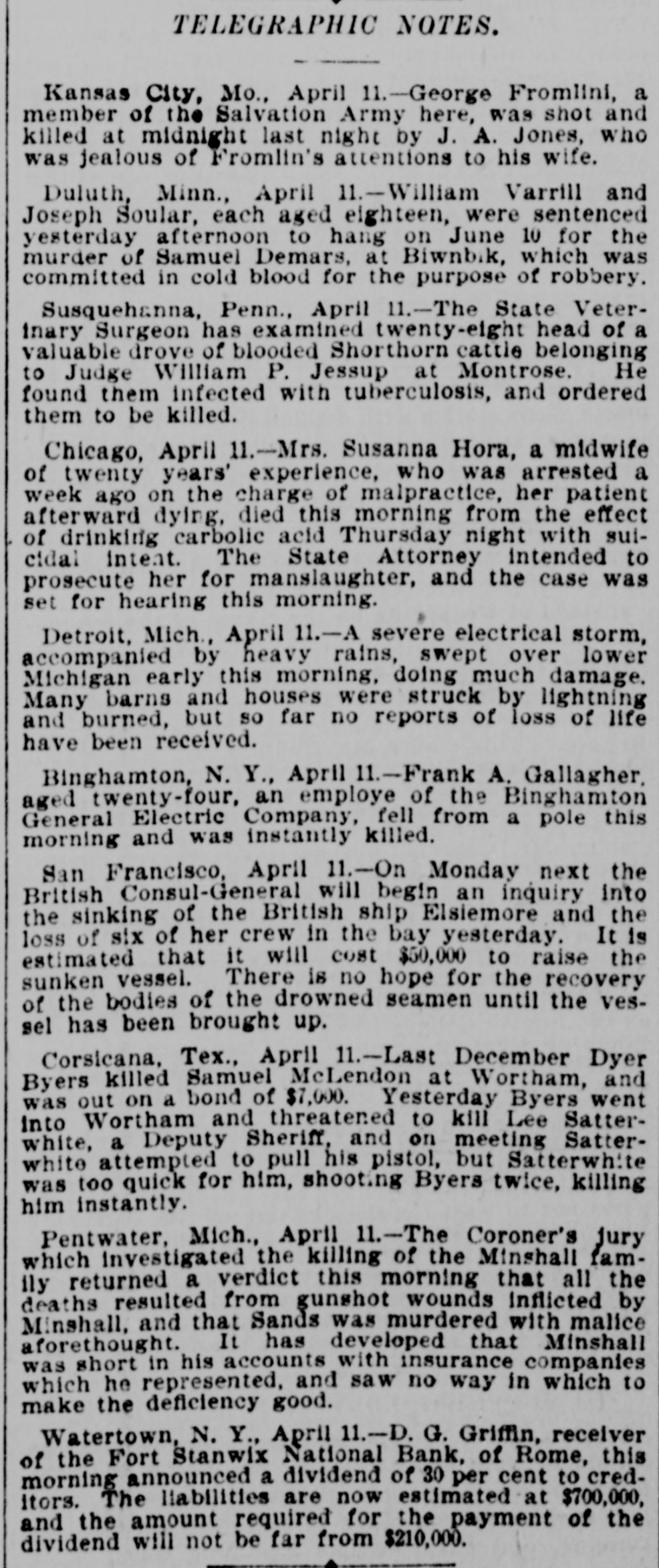
TELEGRAPHIC NOTES. Kansas City, Mo., April 11.-George Fromlini, a member of the Salvation Army here, was shot and killed at midnight last night by J. A. Jones, who was jealous of Fromlin's attentions to his wife. Duluth, Minn., April 11.-William Varrill and Joseph Soular, each aged eighteen, were sentenced yesterday afternoon to hang on June 10 for the murder of Samuel Demars, at Biwnbik, which was committed in cold blood for the purpose of robbery. Susquehanna, Penn., April 11.-The State Veterinary Surgeon has examined twenty-eight head of a valuable drove of blooded Shorthorn cattle belonging to Judge William P. Jessup at Montrose. He found them infected with tuberculosis, and ordered them to be killed. Chicago, April 11.-Mrs. Susanna Hora, a midwife of twenty years' experience, who was arrested a week ago on the charge of malpractice, her patient afterward dying, died this morning from the effect of drinking carbolic acid Thursday night with suicidal intent. The State Attorney intended to prosecute her for manslaughter, and the case was set for hearing this morning. Detroit, Mich. April 11.-A severe electrical storm, accompanied by heavy rains, swept over lower Michigan early this morning, doing much damage. Many barns and houses were struck by lightning and burned, but so far no reports of loss of life have been received. Binghamton, N. Y., April 11.-Frank A. Gallagher, aged twenty-four, an employe of the Binghamton General Electric Company, fell from a pole this morning and was instantly killed. San Francisco, April 11.-On Monday next the British Consul-General will begin an inquiry into the sinking of the British ship Elsiemore and the loss of six of her crew in the bay yesterday. It is estimated that it will cost $50,000 to raise the sunken vessel. There is no hope for the recovery of the bodies of the drowned seamen until the vessel has been brought up. Corsicana, Tex., April 11.-Last December Dyer Byers killed Samuel McLendon at Wortham, and was out on a bond of $7,000. Yesterday Byers went into Wortham and threatened to kill Lee Satterwhite, a Deputy Sheriff, and on meeting Satterwhite attempted to pull his pistol, but Satterwhite was too quick for him, shooting Byers twice, killing him instantly. Pentwater, Mich., April 11.-The Coroner's jury which investigated the killing of the Minshall family returned a verdict this morning that all the deaths resulted from gunshot wounds Inflicted by Minshall, and that Sands was murdered with malice aforethought. It has developed that Minshall was short in his accounts with insurance companies which he represented, and saw no way in which to make the deficiency good. Watertown, N. Y., April 11.-D. G. Griffin, receiver of the Fort Stanwix National Bank, of Rome, this morning announced a dividend of 30 per cent to creditors. The liabilities are now estimated at $700,000, and the amount required for the payment of the dividend will not be far from $210,000.


Article from The Morning Times, April 12, 1896

Click image to open full size in new tab

Article Text

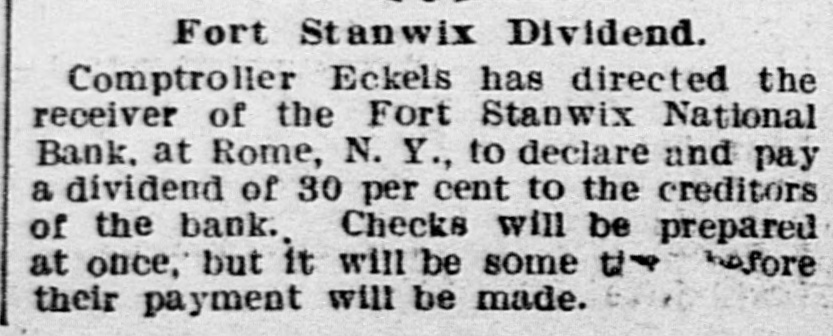
Fort Stanwix Dividend. Comptroller Eckels has directed the receiver of the Fort Stanwix National Bank. at Rome, N. Y., to declare and pay a dividend of 30 per cent to the creditors of the bank. Checks will be prepared at once, but it will be some the **fore their payment will be made.


Article from The Evening Herald, May 21, 1897

Click image to open full size in new tab

Article Text

Charged with Atding an Linbezz.er. Baltimore, May 21.-The suspension of the Fort Stanwix National bank, of Rome, N. Y., in January, 1896, and the suicide of George Barnard, the cashier, was recalled yesterday when George Louis Shaw, a woodenware dealer of this city, was arrested on the charge of having aided and abetted Cashier Barnard to embezzle or misappropriate $32,000 of the funds of the bank. Shaw was held in $15,000 bail to appear before the United States district court for the Northern district of New York, which sits at Rochester.


Article from The Wilmington Daily Republican, May 21, 1897

Click image to open full size in new tab

Article Text

Charged With Aiding an Embezzler. Baltimore, May 21.-The suspension of the Fort Stanwix National bank, of Rome, N. Y., in January, 1896, and the suicide of George Barnard, the cashier, was recalled yesterday when George Louis Shaw, a woodenware dealer of this city, was arrested on the charge of having aided and abetted Cashier Barnard to embezzle or misappropriate $32,000 of the funds of the bank. Shaw was held in $15,000 bail to appear before the United States district court for the Northern district of New York, which cits at Rochester.


Article from Evening Journal, May 21, 1897

Click image to open full size in new tab

Article Text

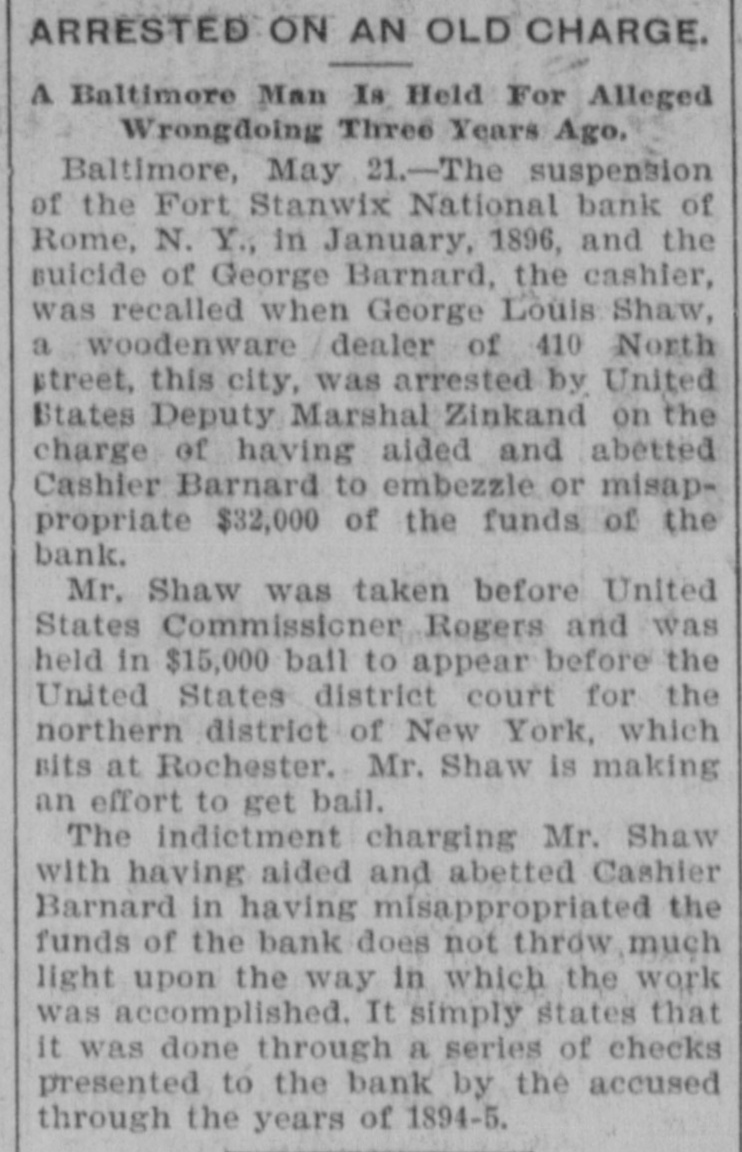
ARRESTED ON AN OLD CHARGE. A Baltimore Man Is Held For Alleged Wrongdoing Three Years Ago. Baltimore, May 21. The suspension of the Fort Stanwix National bank of Rome, N. Y., in January, 1896, and the suicide of George Barnard, the cashier, was recalled when George Louis Shaw, a woodenware dealer of 410 North street, this city, was arrested by United States Deputy Marshal Zinkand on the charge of having aided and abetted Cashier Barnard to embezzle or misappropriate $32,000 of the funds of the bank. Mr. Shaw was taken before United States Commissioner Rogers and was held in $15,000 ball to appear before the United States district court for the northern district of New York, which Bits at Rochester. Mr. Shaw is making an effort to get bail. The indictment charging Mr. Shaw with having aided and abetted Cashier Barnard in having misappropriated the funds of the bank does not throw much light upon the way in which the work was accomplished. It simply states that it was done through a series of checks presented to the bank by the accused through the years of 1894-5.


Article from New-York Tribune, May 21, 1897

Click image to open full size in new tab

Article Text

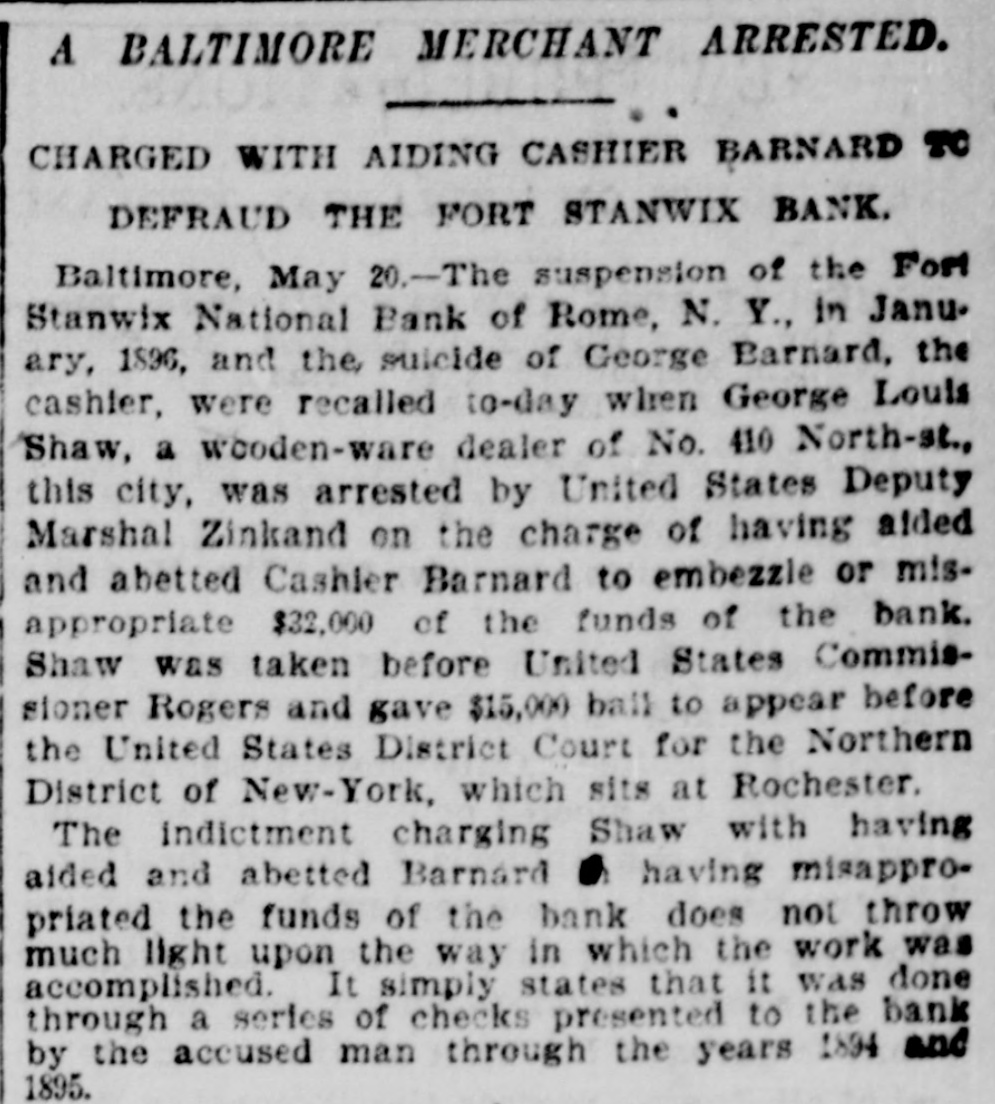
A BALTIMORE MERCHANT ARRESTED. CHARGED WITH AIDING CASHIER BARNARD TO DEFRAUD THE FORT STANWIX BANK. Baltimore, May 20.-The suspension of the Fort Stanwix National Bank of Rome, N. Y., in January, 1896, and the, suicide of George Barnard, the cashier, were recalled to-day when George Louis Shaw, a wooden-ware dealer of No. 410 North-st., this city, was arrested by United States Deputy Marshal Zinkand on the charge of having aided and abetted Cashier Barnard to embezzle or misappropriate $32,000 of the funds of the bank. Shaw was taken before United States Commissioner Rogers and gave $15,000 ball to appear before the United States District Court for the Northern District of New-York, which sits at Rochester. The indictment charging Shaw with having aided and abetted Barnard having misappropriated the funds of the bank does not throw much light upon the way in which the work was accomplished. It simply states that it was done through a series of checks presented to the bank by the accused man through the years 1894 and 1895.


Article from The Sun, May 22, 1897

Click image to open full size in new tab

Article Text

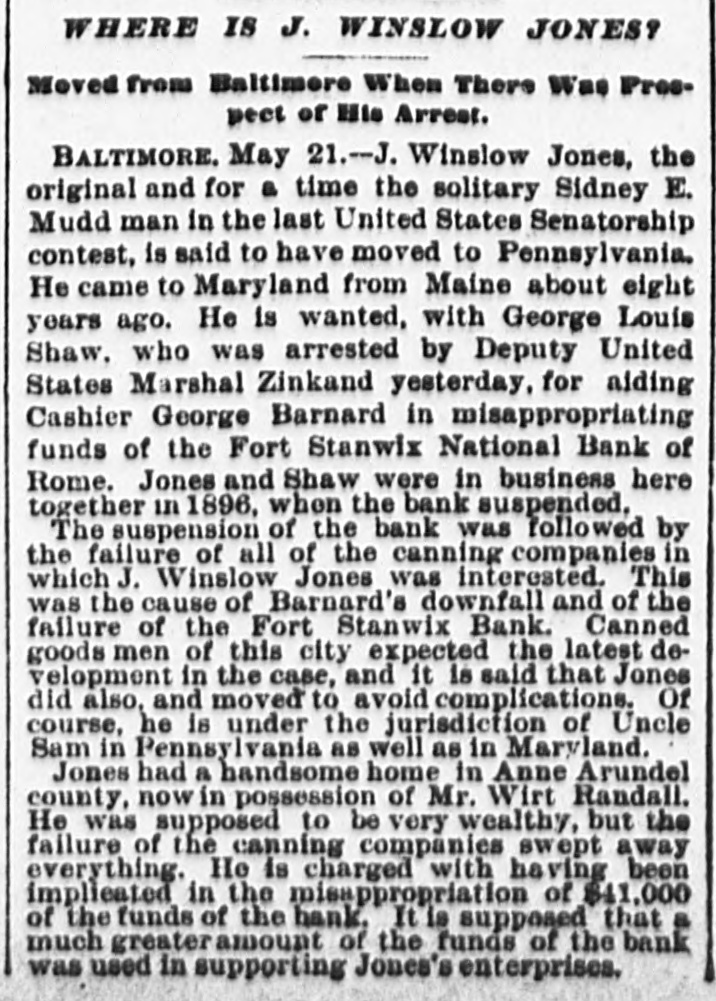
WHERE IS J. WINSLOW JONES? Moved from Baltimere When There Was Prospeet of His Arrest. BALTIMORE. May 21.-J. Winslow Jones, the original and for a time the solitary Sidney E. Mudd man in the last United States Senatorship contest, is said to have moved to Pennsylvania. He came to Maryland from Maine about eight years ago. He is wanted, with George Louis Shaw. who was arrested by Deputy United States Marshal Zinkand yesterday, for aiding Cashier George Barnard in misappropriating funds of the Fort Stanwix National Bank of Rome. Jones and Shaw were in business here together in 1896, when the bank suspended. The suspension of the bank was followed by the failure of all of the canning companies in which J. Winslow Jones was interested. This was the cause of Barnard's downfall and of the failure of the Fort Stanwix Bank. Canned goods men of this city expected the latest development in the case, and it is said that Jones did also, and moved to avoid complications. Of course, he is under the jurisdiction of Uncle Sam in Pennsylvania as well as in Maryland. Jones had a handsome home in Anne Arundel county, now in possession of Mr. Wirt Randall. He was supposed to be very wealthy, but the failure of the canning companies swept away everything. He is charged with having been implicated in the misappropriation of $41,000 of the funds of the hank. It is supposed that a much greater amount of the funds of the bank was used in supporting Jones's enterprises.


Article from The Portland Daily Press, May 24, 1897

Click image to open full size in new tab

Article Text

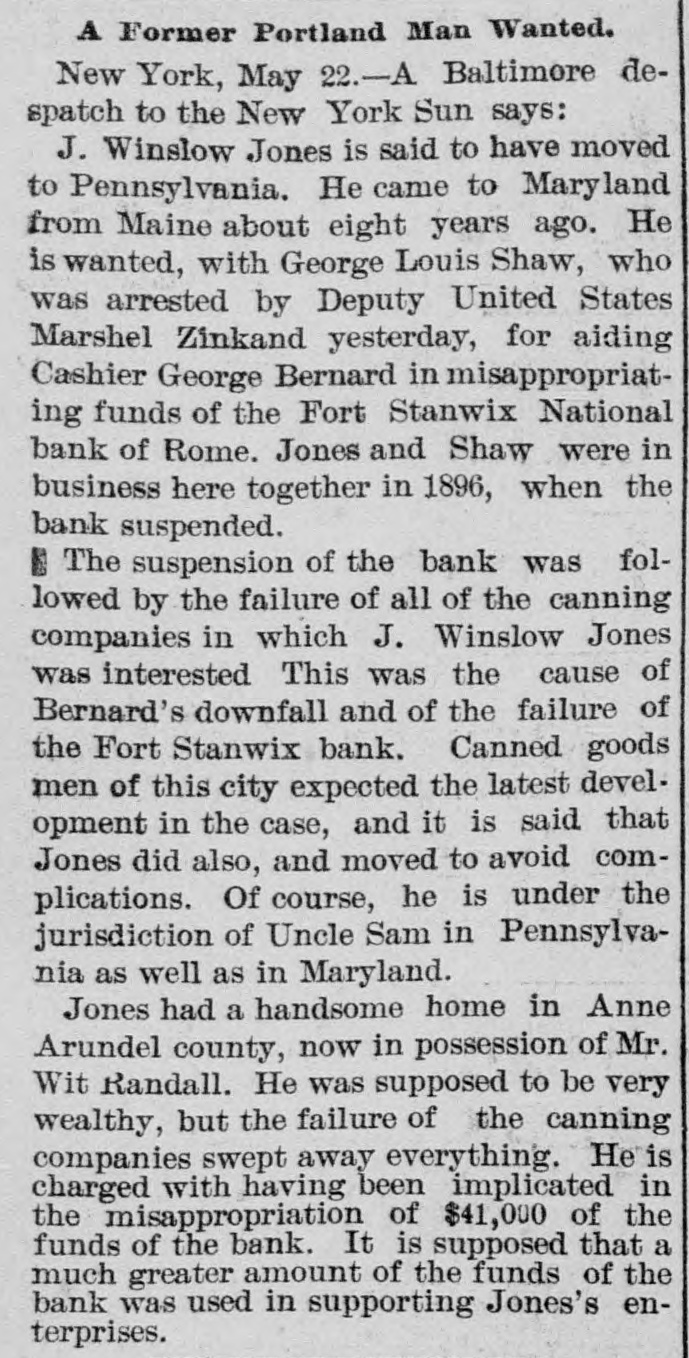
A Former Portland Man Wanted. New York, May 22.-A Baltimore despatch to the New York Sun says: J. Winslow Jones is said to have moved to Pennsylvania. He came to Maryland from Maine about eight years ago. He is wanted, with George Louis Shaw, who was arrested by Deputy United States Marshel Zinkand yesterday, for aiding Cashier George Bernard in misappropriating funds of the Fort Stanwix National bank of Rome. Jones and Shaw were in business here together in 1896, when the bank suspended. The suspension of the bank was followed by the failure of all of the canning companies in which J. Winslow Jones was interested This was the cause of Bernard's downfall and of the failure of the Fort Stanwix bank. Canned goods men of this city expected the latest development in the case, and it is said that Jones did also, and moved to avoid complications. Of course, he is under the jurisdiction of Uncle Sam in Pennsylvania as well as in Maryland. Jones had a handsome home in Anne Arundel county, now in possession of Mr. Wit Randall. He was supposed to be very wealthy, but the failure of the canning companies swept away everything. He is charged with having been implicated in the misappropriation of $41,000 of the funds of the bank. It is supposed that a much greater amount of the funds of the bank was used in supporting Jones's enterprises.