14606. Commercial Bank (Oswego, NY)

Bank Information

Episode Type
Run โ†’ Suspension โ†’ Closure
Bank Type
state
Start Date
December 20, 1841
Location
Oswego, New York (43.455, -76.510)

Metadata

Model
gpt-5-mini
Short Digest
1121b957e7ea0b54

Response Measures

None

Description

Newspaper accounts describe a December 1841 run on the Commercial Bank (Oswego) that briefly subsided with the bank paying its own paper, followed by the appointment of a receiver by January 1842 and ultimate winding up of the bank (receivership and Comptroller action in 1845). The bank was a Safety Fund (state) bank. Cause of the run/suspension is bank-specific weakness/insolvency rather than a discrete misinformation event.

Events (4)

1. December 20, 1841 Run
Cause
Bank Specific Adverse Info
Cause Details
Press reports state the Commercial Bank was known to be weak/failed, producing heavy withdrawals that drained specie; bank later resumed paying its own paper.
Measures
Resumed paying out its own paper after the run; circulation largely taken up.
Newspaper Excerpt
The Oswego Herald states that in consequence of the failure of the Commercial Bank of that place, there had been an active run on the Oswego Bank. After draining a large amount of specie the excitement had subsided, and the stem in regard to its solvency had passed away. Nearly all the circulation was taken up, but the Bank had commenced paying out its own paper again.
Source
newspapers
2. January 27, 1842 Suspension
Cause
Government Action
Cause Details
A receiver was appointed (court/government insolvency process) indicating suspension/closure and formal receivership proceedings.
Newspaper Excerpt
Thes. Beekman, Esq. has been appointed Receiver for the Commercial Bank of Oswego.
Source
newspapers
3. September 12, 1842 Receivership
Newspaper Excerpt
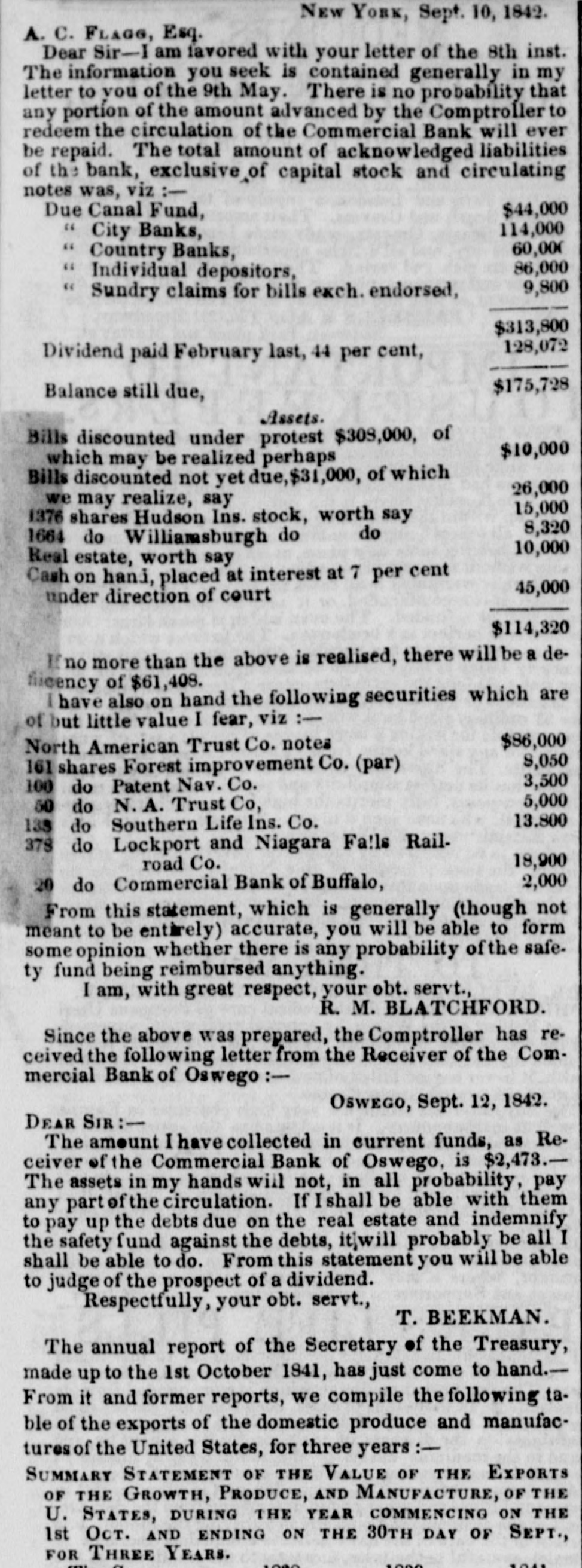
OSWEGO, Sept. 12, 1842. DEAR SIR:The amount have collected in current funds, as Receiver of the Commercial Bank of Oswego, is $2,473. The assets in my hands will not, in all probability, pay any part of the circulation. ... Respectfully, your obt. servt., T. BEEKMAN. (Newspaper letter quoting receiver.)The Comptroller has received a letter from the receiver of the Commercial Bank of Oswego, in which he states he has collected $2,473 and the assets will be insufficient to pay any part of the circulation. (Southport Telegraph, 1842-10-05.)The assets of the Bank of Oswego are believed to be sufficient to pay all the debts of that Bank, and none of the circulating notes of the Bank of Oswego have been redeemed by the Comptroller. (Comptroller notices 1845).
Source
newspapers
4. June 6, 1845 Other
Newspaper Excerpt
COMPTROLLER ... hereby gives notice, that he will redeem at par, the outstanding circulating bills of the Commercial Bank of Oswego ... The assets of the Bank of Oswego are believed to be sufficient to pay all the debts of that Bank, and none of the circulating notes of the Bank of Oswego have been redeemed by the Comptroller. The names and residences of the Receivers of the several Banks are as follows: Commercial Bank of Oswego, T. Beekman, Kinderhook. ... A. C. FLAGG, Comptroller (notice dated June 6, 1845). (multiple June 1845 notices).
Source
newspapers

Newspaper Articles (13)

Article from New-York Tribune, December 10, 1841

Click image to open full size in new tab

Article Text

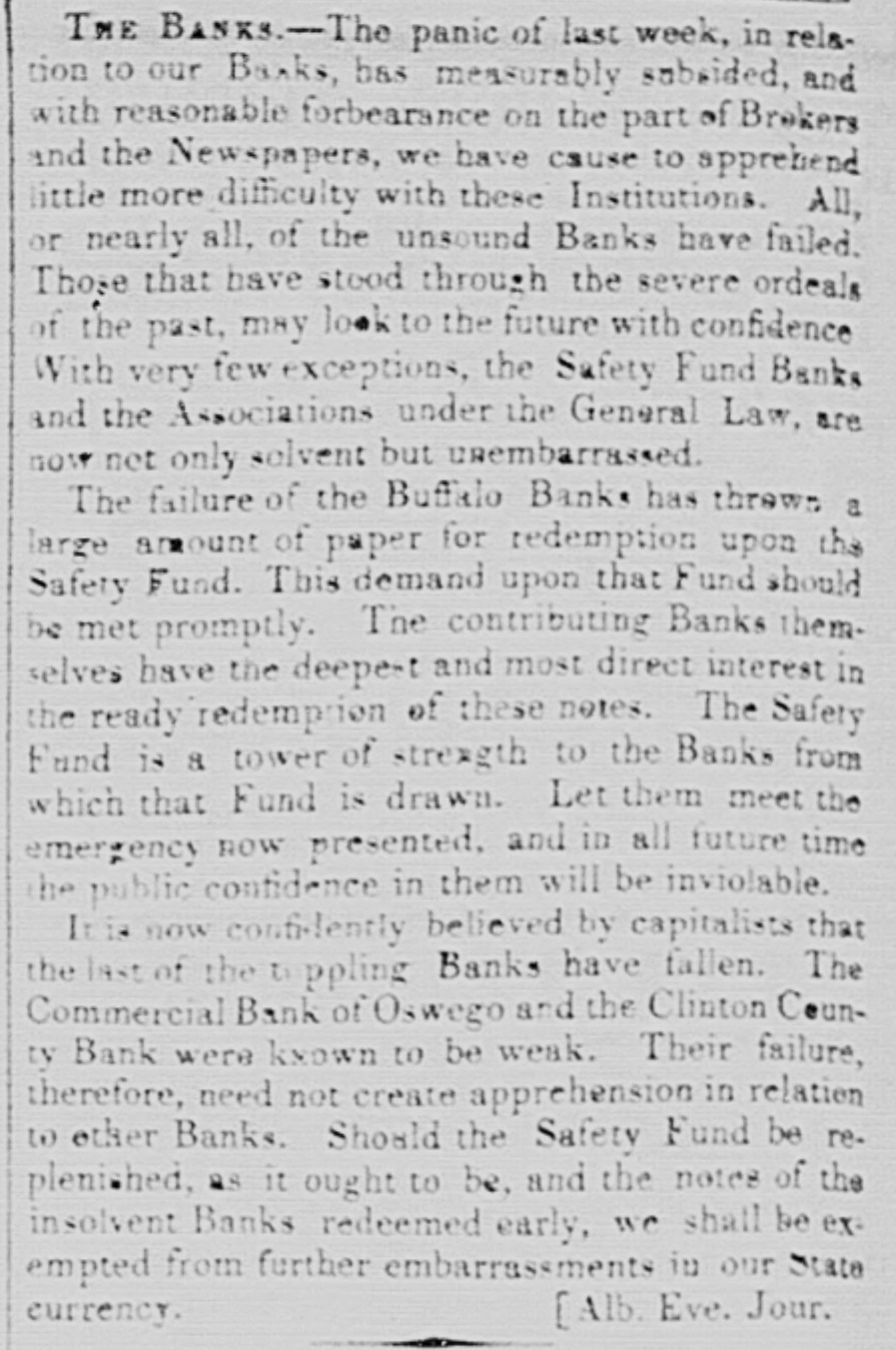
THE BANKS.- The panic of last week, in rels. tion to our Banks, has measurably subsided, and with reasonable forbearance on the part of Brokers and the Newspapers, we have cause to apprehend little more difficulty with these Institutions. All, or nearly all, of the unsound Banks have failed. Those that have stood through the severe ordeals of the past, may look to the future with confidence With very few exceptions, the Safety Fund Banks and the Associations under the General Law, are now net only solvent but unembarrassed. The failure of the Buffalo Bank has threws a large amount of paper for redemption upon the Safety Fund. This demand upon that Fund should be met promptly. The contributing Banks them. selves have the deepe-t and most direct interest in the ready redemprien of these notes. The Safety Fund is a tower of strength to the Banks from which that Fund is drawn. Let them meet the emergency ROW presented. and in all future time the public confidence in them will be inviolable. It is now confidently believed by capitalists that the last of the is ppling Banks have fallen. The Commercial Bank of Oswego and the Clinton County Bank were known to be weak. Their failure, therefore, need not create apprehension in relation to other Banks. Should the Safety Fund be replenished, as it ought to be, and the notes of the insolvent Banks redeemed early, we shall be exempted from further embarrassments in our State currency. [Alb. Eve. Jour.


Article from New-York Tribune, December 20, 1841

Click image to open full size in new tab

Article Text

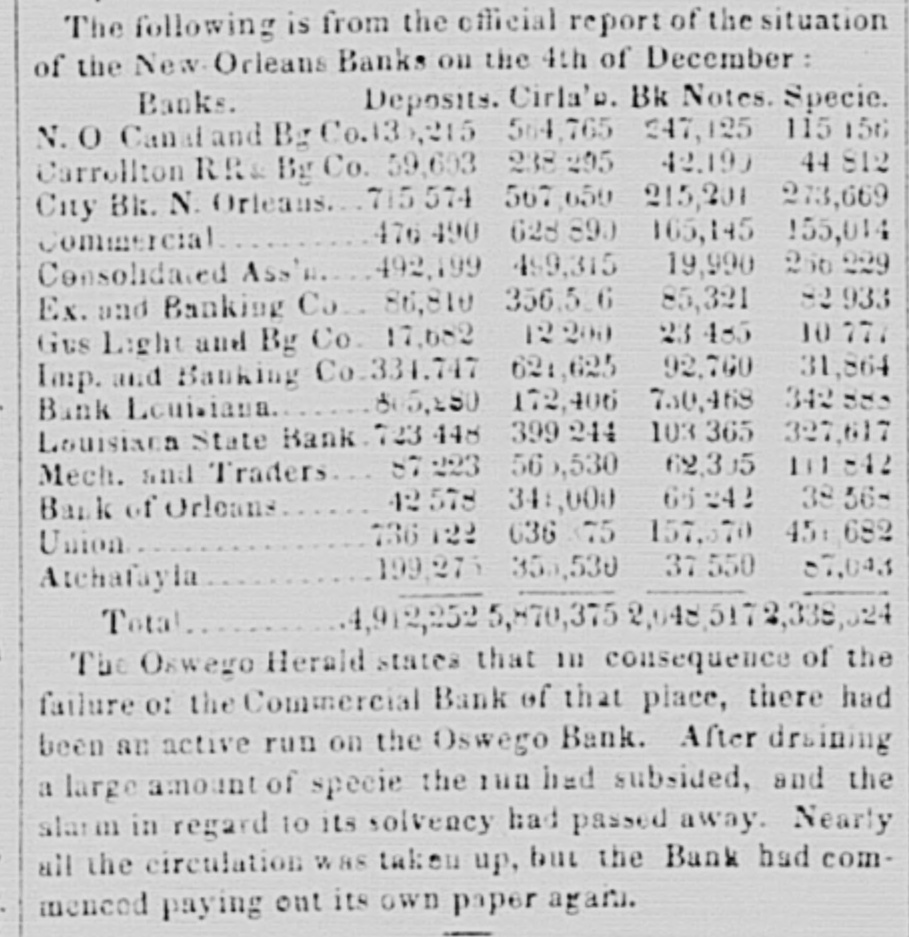
The following is from the official report of the situation of the New Orleans Banks on the 4th of December: Banks. Deposits. Cirla's. Bk Notes. Specie. N. O Canal and Bg Co.13x215 564,765 247,125 115156 238295 44 812 42.190 Carrellton RR Bg Co. 59,653 273,669 215,201 City Bk. N. Orleaus. 715 574 567,650 628 890 476.490 155,014 165,145 Commercial 266 229 499,315 19,990 492,199 Consolidated Ass's 82 933 356.5.6 85,321 86,810 Ex. and Banking C5 10 777 23 485 12:200 17,682 Gus Light and Bg Co 31,864 92,700 621,625 Imp. and Banking Co.331.747 342 585 750,468 172,406 805,830 Bank Louisiana 103 365 399 244 327,617 723 448 Louisiata State Bank 111 542 62,305 565,530 87 223 Mech. and Traders 38.365 65242 12578 341,000 Bank of Orleans 157,370 45.682 736722 636 75 Union 37 550 57,043 355,530 199,275 Atchafayia Total 4,912,2525,870,375 2,048,5172,336,24 The Oswego Herald states that 111 consequence of the failure o: the Commercial Bank of that place, there had been an active run on the Oswego Bank. After draining a large amount of specie the 11111 had subsided, and the starm in regard 10 its solvency had passed away. Nearly all the circulation was taken up, but the Bank had commenced paying out its own paper again.


Article from The New York Herald, January 19, 1842

Click image to open full size in new tab

Article Text

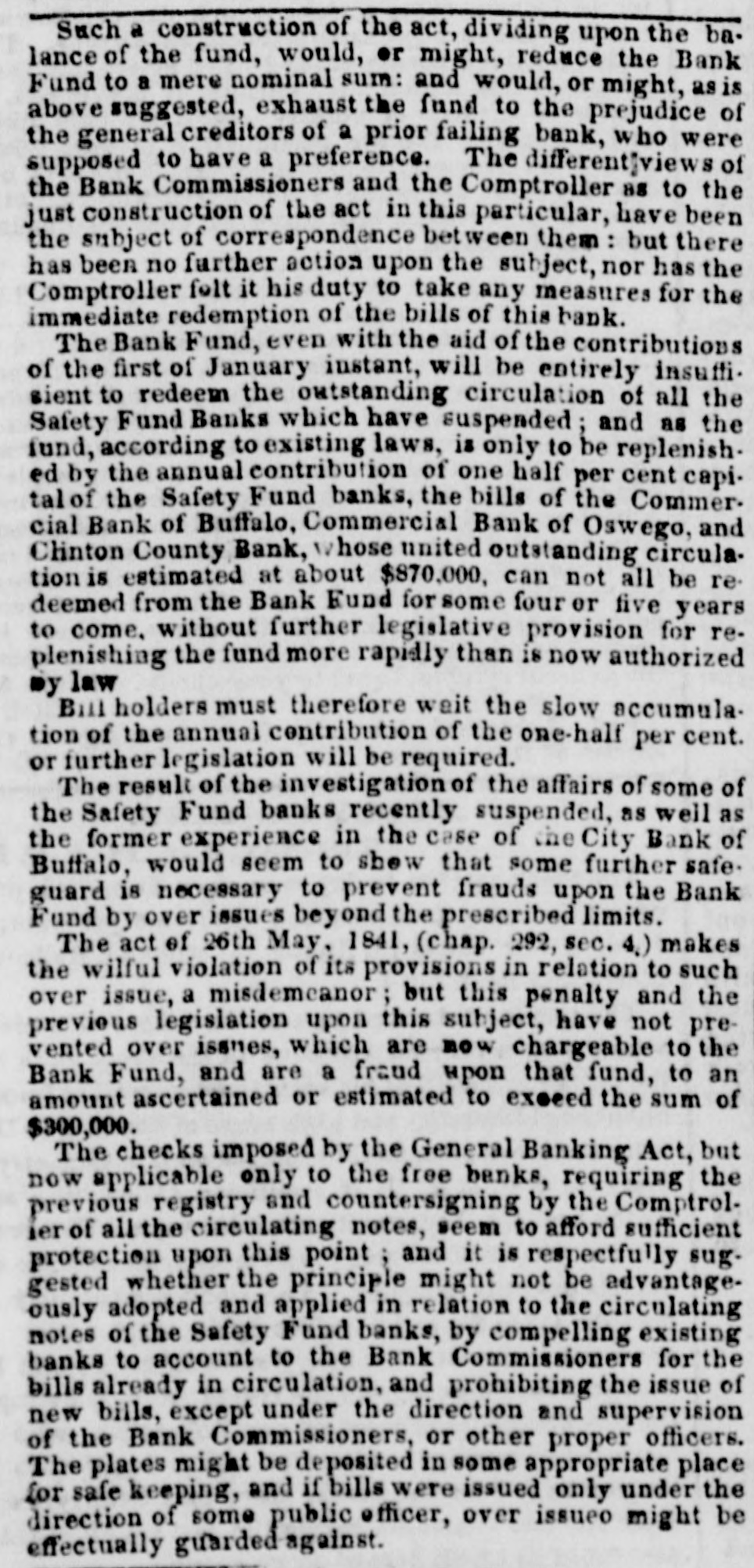
Such a construction of the act, dividing upon the balance of the fund, would, or might, reduce the Bank Fund to a mere nominal sum: and would, or might, as is above suggested, exhaust the fund to the prejudice of the general creditors of a prior failing bank, who were supposed to have a preference. The different views of the Bank Commissioners and the Comptroller as to the just construction of the act in this particular, have been the subject of correspondence between them: but there has been no further action upon the subject, nor has the Comptroller felt it his duty to take any measures for the immediate redemption of the bills of this bank. The Bank Fund, even with the aid of the contributions of the first of January instant, will be entirely insufficient to redeem the outstanding circulation of all the Safety Fund Banks which have suspended; and as the fund, according to existing laws, is only to be replenished by the annual contribution of one half per cent capital of the Safety Fund banks, the bills of the Commercial Bank of Buffalo, Commercial Bank of Oswego, and Clinton County Bank, whose united outstanding circulation is estimated at about $870.000, can not all be redeemed from the Bank Fund for some four or five years to come, without further legislative provision for replenishing the fund more rapidly than is now authorized by law Bill holders must therefore wait the slow accumulation of the annual contribution of the one-half per cent. or further legislation will be required. The result of the investigation of the affairs of some of the Safety Fund banks recently suspended, as well as the former experience in the case of the City Bank of Buffalo, would seem to show that some further safeguard is necessary to prevent frauds upon the Bank Fund by over issues beyond the prescribed limits. The act of 26th May, 1841, (chap. 292, sec. 4.) makes the wilful violation of its provisions in relation to such over issue, a misdemeanor; but this penalty and the previous legislation upon this subject, have not prevented over issues, which are now chargeable to the Bank Fund, and are a fraud upon that fund, to an amount ascertained or estimated to exceed the sum of $300,000. The checks imposed by the General Banking Act, but now applicable only to the free banks, requiring the previous registry and countersigning by the Comptroller of all the circulating notes, seem to afford sufficient protection upon this point; and it is respectfully suggested whether the principle might not be advantageously adopted and applied in relation to the circulating notes of the Safety Fund banks, by compelling existing banks to account to the Bank Commissioners for the bills already in circulation, and prohibiting the issue of new bills, except under the direction and supervision of the Bank Commissioners, or other proper officers. The plates might be deposited in some appropriate place for safe keeping, and if bills were issued only under the direction of some public officer, over issueo might be effectually guarded against.


Article from The New York Herald, January 27, 1842

Click image to open full size in new tab

Article Text

MONEY MARKET. Wednesday, Jan. 36--6 P. M. The markets generally have resumed the appearances they presented before the arrival of the late news. Cotton, which at first was buoyant, is again dall, and hold. ers are disposed to sell at the rates current last week; stocks bave renewed their downward tendency. There is nothing in the late news to warrant the hope of any speedy improvement in affairs. The appointment of Lord Ashburton is looked upon as an evidence of the determination of Great Britain to maintain peace if it can be done on her own terms, and not otherwise. In the leading political journals of London the Measage of the President is sneered at as "the conciliatory talk" of the "Peace-loving President," and hopes's are indulged that the Americans will not be so unreasonable as to resist the 'supervision of England as the Marine police of the world." From the present state of affairs, the shade which the political relations between the two countries throw over the financial world seems to have deepened, and the market was heavy to-day. Indiana 6 par cent bonds fell I per cent; Harlem 1; Canton ร ; New York 5's, 1 per cent; do 6's, improved 14 per cent; Ohio 6's, 2 per cent. Thes. Beekman, Esq. has been appointed Receiver for the Commerciai Bank of Oswego. The Clinton County Bank, Safety Fund, which recently revived, is going to attempt to stagger on.The redemption of its notes are resumed at the Mechanics' and Farmers' Bank, Albany. The Michigan Suspension Act of last year has been repealed. Since the opening of the Reading Railroad, 200 tons of coal have been received in Philadelphia, by that chan. nel. The supply of coal is constantly inereasing from other sources, and for the coming year prices must exceedingly low. The Morris Canal is about to be put in active operation; through it 100,000 tons of coal, in 2500 boats, it is estimated will arrive annually at Jersey City; and the Lehigh Company advertise to deliver at $41 per ton, as soon as the navigation opens. This is cents per ton less than it costs to mine the Lackawana The great canal coal monopoly is about to be broken up, and the opportunity is a favoroble one for the imposition of the tax upon coal to pay the State debts by the Penneylvania Legislkture, which we suggested some time ago. Since then a bill to tax coal 25 cents' per ton, has been introduced into the Legislature. This would yield $300,000. It is to be hoped that the interest will be punctually met on the 1st proximo. The London Times, after copying the late letter of the State Trea. surer on the subject, remarks as follows:The assurance thus given that the interest due on 1st February will be punctually paid cannot fail to tran quilise the fears of the English creditors of the State of Pennsylvania; and the explanation which the above let ter also affords of the cause of the further requisition upon the banks shows that, instead of looking with alarm upon that step, they should feel greater confidence from it, as it has been adopted solely for their benefit, to guard against any contingencies. A large amount of Union Bank of Florida post notes, endorsed by citizens of Florida, due in this city, on the 1st inst. have been protested for non-payment. The following are the leading features of the Bank of Kentucky and Branches, Jan. 1812, and Jan. 18:1. BINE KENTUCKY BRANCHEA.


Article from The New York Herald, September 4, 1842

Click image to open full size in new tab

Article Text

MONEY MARKET. Saturday, Sept. 3.-6 P. M. Stocks improved to-day. All kinds went up a peg or two above previously quoted rates There is a much be'. ter feeling in the street. New York State 5}'s improved 1; New York Seven Per Cents. Kentucky declined 1; Indiana improved 1; Illinois ; Deleware and Hudson 1. James Van Nostrand has been elected President of the Merchant's Exchange Bank. There has been an improvement in domestic exchanges. The restoration of confidence is having its effect. We take the following in relation to the safety fund from the last Albany Argus: We are glad to understand that the present condition of this fund promises something better than the statement by the Comptroller, published in the Argus on the 18th of July last, led us then to anticipate. The holders of the bills of the broken banks may now look for an earlier redemption than the facts as they existed six weeks ago promised. Then but fourteen banks, and those of small capitals, had commuted or availed themselves of the law which permits the anticipation of their yearly contributions of the half of one per cent. on their capitals, in broken bank notes at par. But now twenty-two banks have come forward and voluntarily paid into the treasury over $200,000, and others of large capitals are preparing, we are informed, to avail themselves of the law to its fullest extent, and pay in at once for the whole six years. This judicious and commendable movement on the part of the banks is already being beneficially felt, and will be the means of reinstating confidence in the Safety Fund system. The $200,000 taken from the market was mostly held in small sums, and by individuals who were greatly in need of relief; what remains unredeemed is principally in large masses, and in the hands of those who can afford, and who expect to wait for the replenishment of the fund. Consequently there is not much paper in the market, and what little there is, is fast disappearing. The comptroller's statement above referred to, startled us at the time with the fact that of the $1,069,143 48, the amount of the fund on the 1st of April, $918,949, had been consumed in the redemption of the notes of four banks only, leaving the entire circulation of five banks, amounting to $1,111,447, unredeemed, exclusive of $30,000 of the notes of the Bank of Buffalo, said to be illegally issued. But upon investigation it is fo nd that the fund will get material relief in the amount to be repaid by the Commercial Bank of New York [$131,731] and in the large amount of available assets of some of the other suspended banks-the La Fayette, the Clinton, the Watervliet, the Lewis County, and the Commercial Bank of Oswege, whose aggregate cir ulation is supposed to be about $700,000, will not probably be ultimately a charge upon the fund. This morning we received fifteen days later advices from Europe. We look upon the news as being very important in a commercial point of view. It is to be seen, on reference to our columns, that the distress-the starving condition of the people in the manufacturing districts-has led to serious and disastrous riots, These, of course, caused some agitation in the Lonton money market for a time, although at the latest accounts, affairs appeared'more favorable. Thedisorganised state of the districts, and the con. sequent suspension of business, were expected to affect the cotton market, and lead to a decline; but contrary to expectation there sprung up a very fair demand, and an improvement in prices took place. The market closed with firmness, and a speedy settlement of affairs would unquestionably be followed by an extensive demand for cotton at better prices. Annexed is the weekly average of the circulation of the United Kingdom, according to the returns as made up to the 23d July, 1842, in comparison with the returns previously made to June 25, 1842. 1019 1019


Article from The New York Herald, September 16, 1842

Click image to open full size in new tab

Article Text

NEW YORK, Sept. 10, 1842. A. C. FLAGG, Esq. Dear Sir-I am favored with your letter of the 8th inst. The information you seek is contained generally in my letter to you of the 9th May. There is no probability that any portion of the amount advanced by the Comptroller to redeem the circulation of the Commercial Bank will ever be repaid. The total amount of acknowledged liabilities of the bank, exclusive of capital stock and circulating notes was, viz :$44,000 Due Canal Fund, " 114,000 City Banks, " 60,000 Country Banks, " 86,000 Individual depositors, " 9,800 Sundry claims for bills ekch. endorsed, $313,800 128,072 Dividend paid February last, 44 per cent, $175,728 Balance still due, Assets. Bills discounted under protest $309,000, of $10,000 which may be realized perhaps Bills discounted not yet due, $31,000, of which 26,000 we may realize, say 15,000 1376 shares Hudson Ins. stock, worth say 8,320 do 1664 do Williamsburgh do 10,000 Real estate, worth say Cash on hani, placed at interest at 7 per cent 45,000 under direction of court $114,320 If no more than the above is realised, there will be a deflicency of $61,408. I have also on hand the following securities which are of but little value I fear, viz :$86,000 North American Trust Co. notes 8,050 161 shares Forest improvement Co. (par) 3,500 100 do Patent Nav. Co. 5,000 50 do N. A. Trust Co, 13.800 133 do Southern Life Ins. Co. 378 do Lockport and Niagara Fails Rail18,900 road Co. 2,000 20 do Commercial Bank of Buffalo, From this statement, which is generally (though not meant to be entirely) accurate, you will be able to form some opinion whether there is any probability of the safe. ty fund being reimbursed anything. I am, with great respect, your obt. servt., R. M. BLATCHFORD. Since the above was prepared, the Comptroller has received the following letter from the Receiver of the Commercial Bank of Oswego :OSWEGO, Sept. 12, 1842. DEAR SIR:The amount have collected in current funds, as Receiver of the Commercial Bank of Oswego, is $2,473.The assets in my hands will not, in all probability, pay any part of the circulation. If Ishall be able with them to pay up the debts due on the real estate and indemnify the safety fund against the debts, it]will probably be all I shall be able to do. From this statement you will be able to judge of the prospect of a dividend. Respectfully, your obt. servt., T. BEEKMAN. The annual report of the Secretary of the Treasury, made up to the 1st October 1841, has just come to hand.From it and former reports, we compile the following table of the exports of the domestic produce and manufactures of the United States, for three years :SUMMARY STATEMENT OF THE VALUE OF THE EXPORTS OF THE GROWTH, PRODUCE, AND MANUFACTURE, OF THE U. STATES, DURING THE YEAR COMMENCING ON THE 1st OCT. AND ENDING ON THE 30TH DAY OF SEPT., FOR THREE YEARS. 1000 1999 1011


Article from Southport Telegraph, October 5, 1842

Click image to open full size in new tab

Article Text

The Comptroller of New York has received a letter from the receiver of the Commercial Bank of Oswego, in which he states he has collected $2,473 and the assets will be to pay any part of the circuation.


Article from The New York Herald, June 10, 1845

Click image to open full size in new tab

Article Text

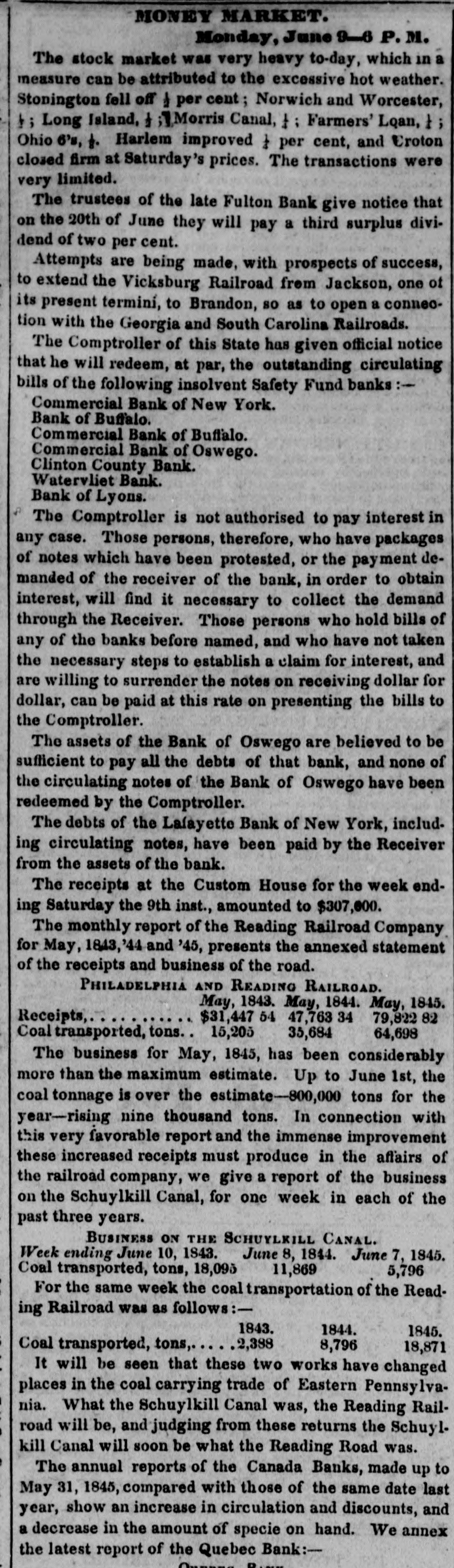
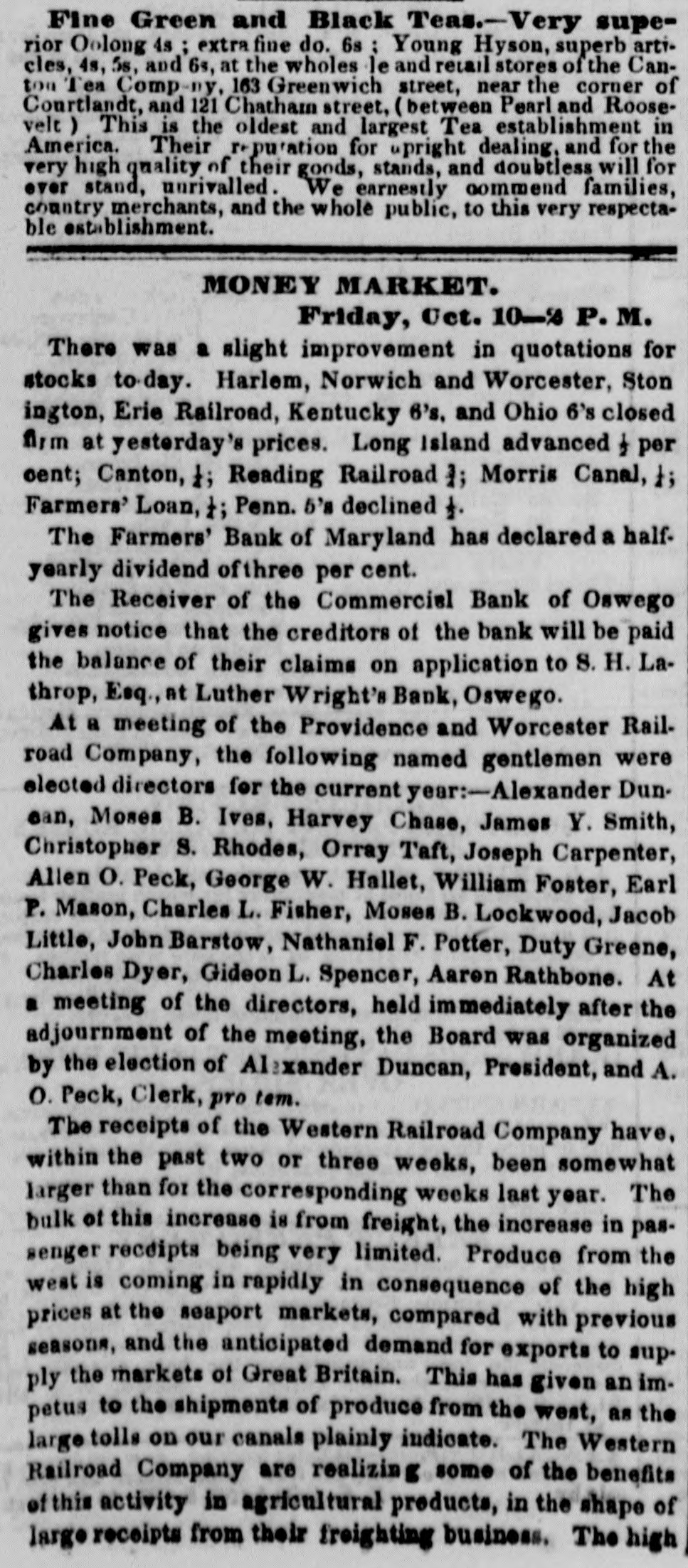
MONEY MARKET. Monday, June 9-6 P.M. The stock market was very heavy to-day, which in a measure can be attributed to the excessive hot weather. Stonington fell off 1 per cent; Norwich and Worcester, 1; Long Island, I Morris Canal, 1; Farmers' Lqan, Ohio 6's, 1. Harlem improved 1 per cent, and Eroton closed firm at Saturday's prices. The transactions were very limited. The trustees of the late Fulton Bank give notice that on the 20th of June they will pay a third surplus dividend of two per cent. Attempts are being made, with prospects of success, to extend the Vicksburg Railroad from Jackson, one of its present termini, to Brandon, so as to open a conneotion with the Georgia and South Carolina Railroads. The Comptroller of this State has given official notice that he will redeem, at par, the outstanding circulating bills of the following insolvent Safety Fund banks:Commercial Bank of New York. Bank of Buffalo. Commercial Bank of Buffalo. Commercial Bank of Oswego. Clinton County Bank. Watervliet Bank. Bank of Lyons. The Comptroller is not authorised to pay interest in any case. Those persons, therefore, who have packages of notes which have been protested, or the payment demanded of the receiver of the bank, in order to obtain interest, will find it necessary to collect the demand through the Receiver. Those persons who hold bills of any of the banks before named, and who have not taken the necessary steps to establish a claim for interest, and are willing to surrender the notes on receiving dollar for dollar, can be paid at this rate on presenting the bills to the Comptroller. The assets of the Bank of Oswego are believed to be sufficient to pay all the debts of that bank, and none of the circulating notes of the Bank of Oswego have been redeemed by the Comptroller. The debts of the Lafayette Bank of New York, includ. ing circulating notes, have been paid by the Receiver from the assets of the bank. The receipts at the Custom House for the week ending Saturday the 9th inst., amounted to $307,000. The monthly report of the Reading Railroad Company for May, 1843,44 and '45, presents the annexed statement of the receipts and business of the road. PHILADELPHIA AND READING RAILROAD. May, 1843. May, 1844. May, 1845. Receipts $31,447 47,763 34 79,822 82 15,205 Coal transported, tons. 35,684 64,698 The business for May, 1845, has been considerably more than the maximum estimate. Up to June 1st, the coal tonnage is over the estimate-800,000 tons for the year-rising nine thousand tons. In connection with this very favorable report and the immense improvement these increased receipts must produce in the affairs of the railroad company, we give a report of the business on the Schuylkill Canal, for one week in each of the past three years. BUSINESS ON THE SCHUYLKILL CANAL. Week ending June 10, 1843. June 8, 1844. June 7, 1845. Coal transported, tons, 18,095 11,869 5,796 For the same week the coal transportation of the Reading Railroad was as follows:1843. 1844. 1845. 2,388 Coal transported, tons, 8,796 18,871 It will be seen that these two works have changed places in the coal carrying trade of Eastern Pennsylvania. What the Schuylkill Canal was, the Reading Railroad will be, and judging from these returns the Schuyl. kill Canal will soon be what the Reading Road was. The annual reports of the Canada Banks, made up to May 31, 1845, compared with those of the same date last year, show an increase in circulation and discounts, and a decrease in the amount of specie on hand. We annex the latest report of the Quebec Bank:-


Article from The New York Herald, June 11, 1845

Click image to open full size in new tab

Article Text

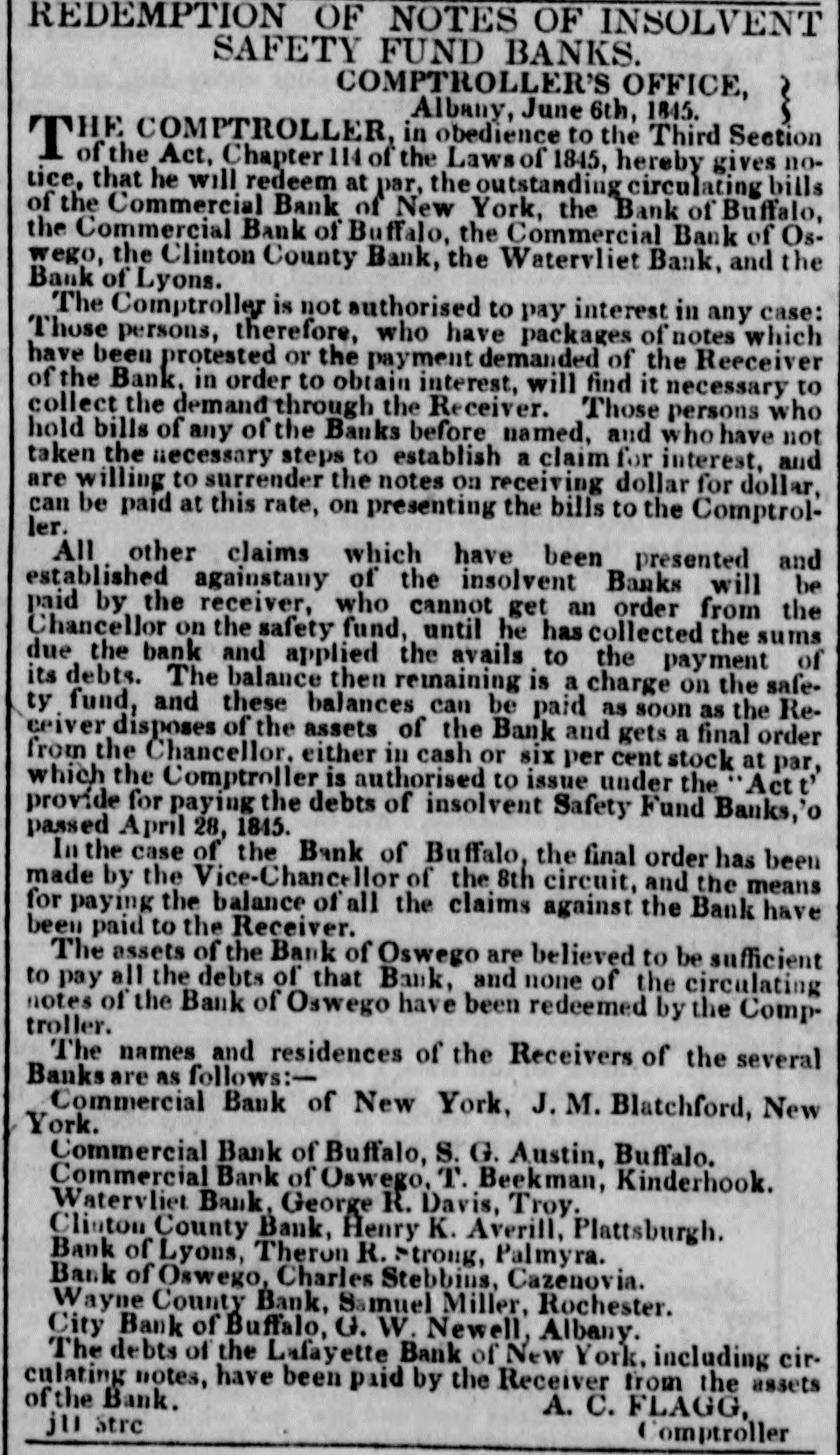
REDEMPTION OF NOTES OF INSOLVENT SAFETY FUND BANKS. COMPTROLLER'S OFFICE, Albany, June 6th, 1845. COMPTROLLER, in obedience to the Third Section THE of the Act, Chapter 114 of the Laws of 1845, hereby gives notice, that he will redeem at par, the outstanding circulating bills of the Commercial Bank of New York, the Bank of Buffalo, the Commercial Bank of Buffalo, the Commercial Bank of Oswego, the Clinton County Bank, the Watervliet Bank, and the Bank of Lyons. The Comptroller is not authorised to pay interest in any case: Those persons, therefore, who have packages of notes which have been protested or the payment demanded of the Reeceiver of the Bank. in order to obtain interest, will find it necessary to collect the demand through the Receiver. Those persons who hold bills of any of the Banks before named, and who have not taken the necessary steps to establish a claim for interest, and are willing to surrender the notes on receiving dollar for dollar, can be paid at this rate, on presenting the bills to the Comptroller. All other claims which have been presented and established againstany of the insolvent Banks will be paid by the receiver, who cannot get an order from the Chancellor on the safety fund, until he has collected the sums due the bank and applied the avails to the payment of its debts. The balance then remaining is a charge on the safety fund, and these balances can be paid as soon as the Receiver disposes of the assets of the Bank and gets a final order from the Chancellor. either in cash or six per cent stock at par, which the Comptroller is authorised to issue under the 'Act t' provide for paying the debts of insolvent Safety Fund Banks,'o passed April 28, 1845. In the case of the Bank of Buffalo, the final order has been made by the Vice-Chancellor of the 8th circuit, and the means for paying the balance of all the claims against the Bank have been paid to the Receiver. The assets of the Bank of Oswego are believed to be sufficient to pay all the debts of that Bank, and none of the circulating notes of the Bank of Oswego have been redeemed by the Comptroller. The names and residences of the Receivers of the several Banks are as follows:Commercial Bank of New York, J. M. Blatchford, New York. Commercial Bank of Buffalo, S. G. Austin, Buffalo. Commercial Bank of Oswego, T. Beekman, Kinderhook. Watervliet Bank, George R. Davis, Troy. Clipton County Bank, Henry K. Averill, Plattsburgh. Bank of Lyons, Theron R. >trong, Palmyra. Bank of Oswego, Charles Stebbins, Cazenovia. Wayne County Bank, Samuel Miller, Rochester. City Bank of Buffalo, G. W. Newell, Albany. The debts of the Lafayette Bank of New York, including circulating notes, have been paid by the Receiver from the assets of the Bank. A. C. FLAGG, jll Stre Comptroller


Article from The New York Herald, June 12, 1845

Click image to open full size in new tab

Article Text

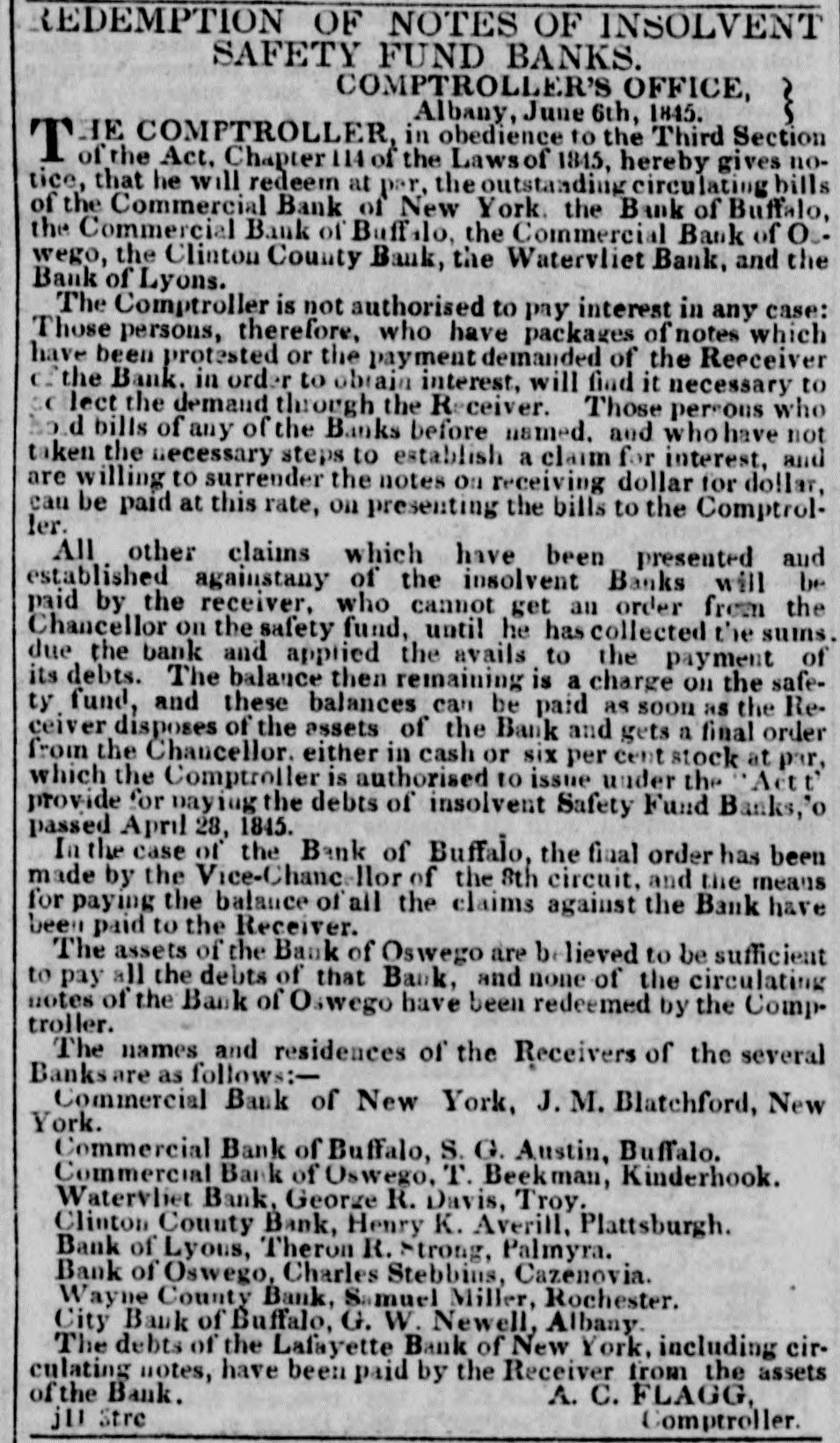
REDEMPTION OF NOTES OF INSOLVENT SAFETY FUND BANKS. COMPTROLLER'S OFFICE, Albany, June 6th, 1845. T HE COMPTROLLER, in obedience to the Third Section of the Act, Chapter 114 of the Laws of 1845, hereby gives notice, that he will redeem at par, the outstanding circulating bills of the Commercial Bank of New York. the Bank of Buffalo, the Commercial Bank of Buffalo, the Commercial Bank of O.wego, the Clinton County Bank, the Watervliet Bank, and the Bank of Lyons. The Comptroller is not authorised to pay interest in any case: Those persons, therefore, who have packages of notes which have been protested or the payment demanded of the Reeceiver the Bank. in ord to obtain interest, will find it necessary to lect the demand through the R ceiver. Those persons who hold bills of any of the Banks before named. and who have not taken the necessary steps to establish a claim for interest, and are willing to surrender the notes on receiving dollar for dollar, can be paid at this rate, on presenting the bills to the Comptroller. All other claims which have been presented and established againstany of the insolvent Banks will be paid by the receiver, who cannot get an order from the Chancellor on the safety fund, until he has collected the sums. due the bank and applied the avails to the payment of its debts. The balance then remaining is a charge on the safety fund, and these balances can be paid as soon as the Receiver disposes of the assets of the Bank and gets a final order from the Chancellor. either in cash or six per cent stock at par, which the Comptroller is authorised to issue under the Act t' provide for paying the debts of insolvent Safety Fund Banks,'o passed April 28, 1845. In the case of the Bank of Buffalo, the final order has been made by the Vice-Chane-llor of the 8th circuit, and the means for paying the balance of all the claims against the Bank have been paid to the Receiver. The assets of the Bank of Oswego are b lieved to be sufficient to pay all the debts of that Bank, and none of the circulating notes of the Bank of Os wego have been redeemed by the Comptroller. The names and residences of the Receivers of the several Banks are as follows:Commercial Bank of New York, J. M. Blatchford, New York. Commercial Bank of Buffalo, S. G. Austin, Buffalo. Commercial Bank of Oswego, T. Beekman, Kinderhook. Watervliet Bank, Georze R. Davis, Troy. Clinton County Bank, Henry K. Averill, Plattsburgh. Bank of Lyous, Theron R. Strong, Palmyra. Bank of Oswego, Charles Stebbins, Cazenovia. Wayne County Bank, Samuel Miller, Rochester. City Bank of Buffalo, G. W. Newell, Albany. The debts of the Lafayette Bank of New York, including circulating notes, have been paid by the Receiver from the assets of the Bank. A. C. FLAGG, jll Stre Comptroller.


Article from New-York Daily Tribune, June 13, 1845

Click image to open full size in new tab

Article Text

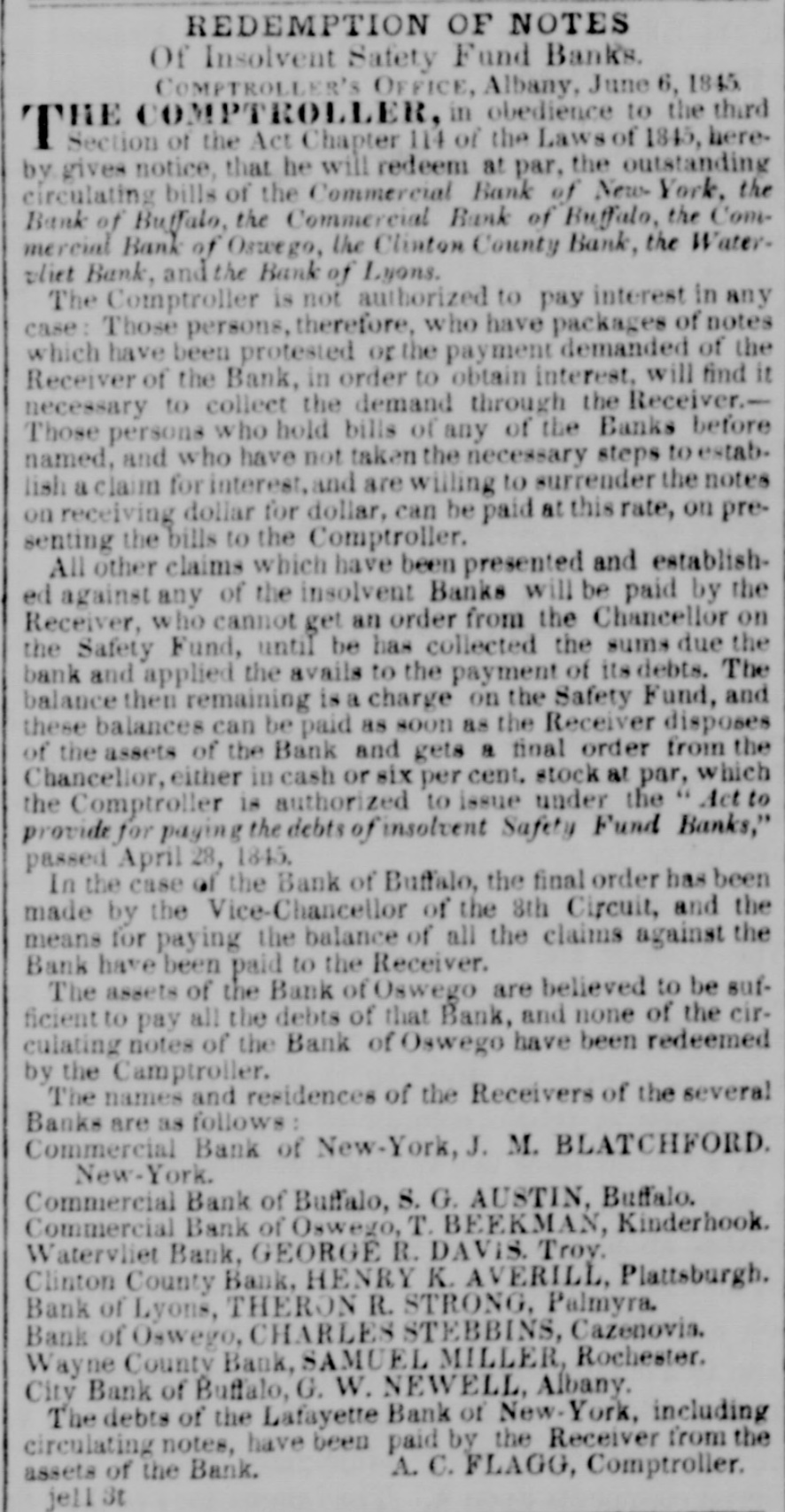
REDEMPTION OF NOTES Of Insolvent Safety Fund Banks. COMPTROLLER'S OFFICE, Albany, June 6, 1845 THE COMPTROLLER, in obedience to the third Section of the Act Chapter 114 of the Laws of 1845, here. by gives notice, that he will redeem at par, the outstanding circulating bills of the Commercial Bank of New York, the Bank of Buffalo, the Commercial Bank of Buffalo, the Commercial Bank of Oswego, the Clinton County Bank, the Watervliet Bank, andth Bank of Lyons. The Comptroller is not authorized to pay interest in any case: Those persons, therefore, who have packages of notes which have been protested or the payment demanded of the Receiver of the Bank, in order to obtain interest, will find it necessary to collect the demand through the Receiver.Those persons who hold bills of any of the Banks before named, and who have not taken the necessary steps to estab. lish a claim for interest, and are willing to surrender the notes on receiving dollar for dollar, can be paid at this rate, on presenting the bills to the Comptroller. All other claims which have been presented and established against any of the insolvent Banks will be paid by the Receiver, who cannot get an order from the Chancellor on the Safety Fund, until be has collected the sums due the bank and applied the avails to the payment of its debts. The balance then remaining is a charge on the Safety Fund, and these balances can be paid as soon as the Receiver disposes of the assets of the Bank and gets a final order from the Chancellor, either in cash or six per cent. stock at par, which the Comptroller is authorized to issue under the " Act to provide for paying the debts of insolvent Safety Fund Banks," passed April 28, 1845. In the case of the Bank of Buffalo, the final order has been made by the Vice-Chancellor of the 8th Circuit, and the means for paying the balance of all the claims against the Bank have been paid to the Receiver. The assets of the Bank of Oswego are believed to be sufficient to pay all the debts of that Bank, and none of the circulating notes of the Bank of Oswego have been redeemed by the Camptroller. The names and residences of the Receivers of the several Banks are as follows: Commercial Bank of New-York, J. M. BLATCHFORD New-York. Commercial Bank of Buffalo, S. G. AUSTIN, Buffalo. Commercial Bank of Oswego, T. BEEKMAN, Kinderhook. Watervliet Bank, GEORGE R. DAVIS. Troy. Clinton County Bank, HENRY K. AVERILL, Plattsburgh. Bank of Lyons, THERON R. STRONG, Palmyra. Bank of Oswego, CHARLES STEBBINS, Cazenovia. Wayne County Bank, SAMUEL MILLER, Rochester. City Bank of Buffalo, G. W. NEWELL, Albany. The debts of the Lafayette Bank of New-York, including circulating notes, have been paid by the Receiver from the A. C. FLAGG, Comptroller. assets of the Bank. jell St


Article from The New York Herald, June 14, 1845

Click image to open full size in new tab

Article Text

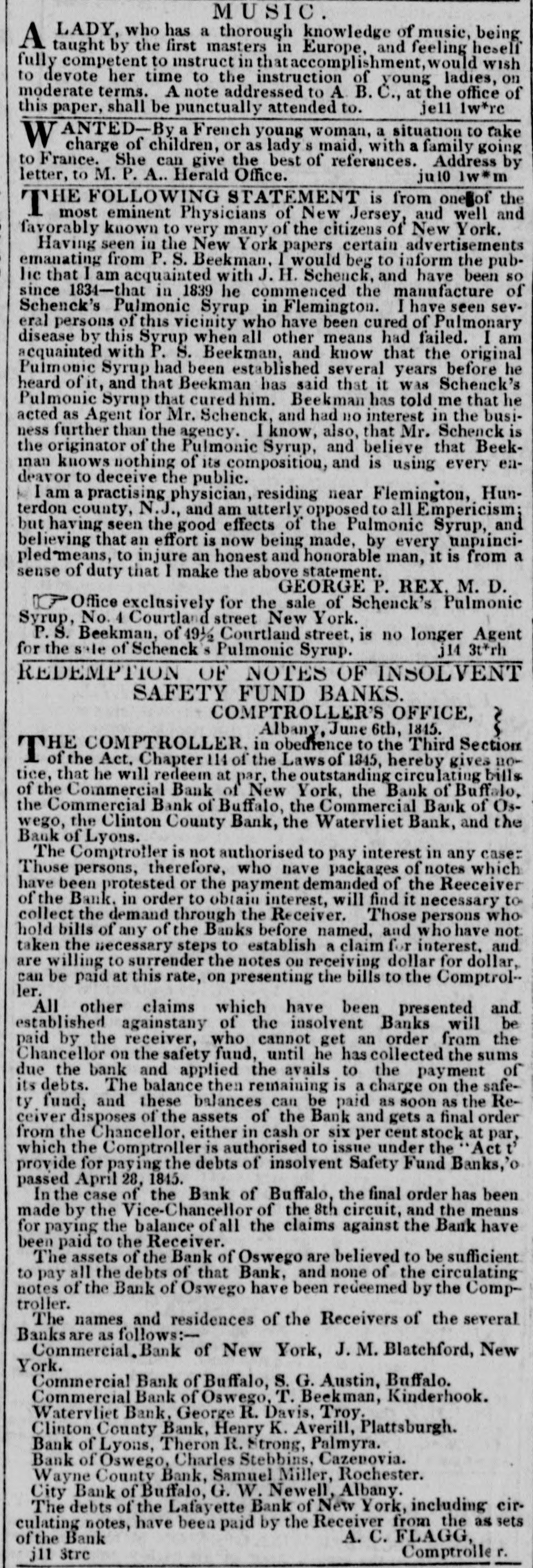
MUSIC. LADY, who has a thorough knowledge of music, being A taught by the first masters in Europe, and feeling heself fully competent to instruct in thataccomplishment, would wish to devote her time to the instruction of young ladies, on moderate terms. A note addressed to A B. C., at the office of jell 1w*re this paper, shall be punctually attended to. ANTED-By a French young woman, a situation to take W charge of children, or as lady S maid, with a family going to France. She can give the best of references. Address by letter, to M. P. A.. Herald Office. ju10 lw*m FOLLOWING STATEMENT is from one lof the THE most eminent Physicians of New Jersey, and well and favorably known to very many of the citizens of New York. Having seen in the New York papers certain advertisements emanating from P. S. Beekman, I would beg to inform the public that I am acquainted with J. H. Scheuck, and have been so since 1834-that in 1839 he commenced the manufacture of Schenck's Pulmonic Syrup in Flemington. I have seen several persons of this vicinity who have been cured of Pulmonary disease by this Syrup when all other means had failed. I am acquainted with P. S. Beekman, and know that the original Pulmonic Syrup had been established several years before he heard of it, and that Beekman has said that it was Schenck's Pulmonic Syrup that cured him. Beekman has told me that he acted as Agent for Mr. Schenck, and had no interest in the business further than the agency. I know, also, that Mr. Schenck is the originator of the Pulmonic Syrup, and believe that Beekinan knows nothing of its composition, and is using every eadeavor to deceive the public. I am a practising physician, residing near Flemington, Hunterdon county, N.J., and am utterly opposed to all Empericism; but having seen the good effects of the Pulmonic Syrup, and believing that an effort is now being made, by every unpiincipled means, to injure an honest and honorable man, it is from a sense of duty that I make the above statement. GEORGE P. REX. M. D. Office exclusively for the sale of Schenck's Pulmonic Syrup, No. 4 Courtla d street New York. P.S. Beekman, of 491/2 Courtland street, is no longer Agent j14 3t*rh for the sale of Schenck Pulmonic Syrup. REDEMPTION OF NOTES OF INSOLVENT SAFETY FUND BANKS. COMPTROLLER'S OFFICE, Albany, June 6th, 1845. THE COMPTROLLER. in obedience to the Third Section of the Act. Chapter 114 of the Laws of 1345, hereby gives notice, that he will redeem at par, the outstanding circulating bills of the Commercial Bank of New York, the Bank of Buffalo, the Commercial Bank of Buffalo, the Commercial Bank of Oswego, the Clinton County Bank, the Watervliet Bank, and the Bauk of Lyons. The Comptroller is not authorised to pay interest in any case: Those persons, therefore, who have packages of notes which have been protested or the payment demanded of the Reeceiver of the Bank. in order to obtain interest, will find it necessary to collect the demand through the Receiver. Those persons who hold bills of any of the Banks before named. and who have not taken the necessary steps to establish a claim for interest. and are willing to surrender the notes on receiving dollar for dollar, can be paid at this rate, on presenting the bills to the Comptroller. All other claims which have been presented and established againstany of the insolvent Banks will be paid by the receiver, who cannot get an order from the Chancellor on the safety fund, until he has collected the sums due the bank and applied the avails to the payment of its debts. The balance then remaining is a charge on the safety fund, and these balances can be paid as soon as the Receiver disposes of the assets of the Bank and gets a final order from the Chancellor. either in cash or six per cent stock at par, which the Comptroller is authorised to issue under the Act t provide for paying the debts of insolvent Safety Fund Banks,'o passed April 28, 1845. In the case of the Bank of Buffalo, the final order has been made by the Vice-Chancellor of the 8th circuit, and the means for paying the balance of all the claims against the Bank have been paid to the Receiver. The assets of the Bank of Oswego are believed to be sufficient to pay all the debts of that Bank, and none of the circulating notes of the Bank of Oswego have been redeemed by the Comptroller. The names and residences of the Receivers of the several Banks: are as follows:Commercial. Bank of New York, J. M. Blatchford, New York. Commercial Bank of Buffalo, S. G. Austin, Buffalo. Commercial Bank of Oswego, T. Beekman, Kinderhook. Watervliet Bank, George R. Davis, Troy, Clinton County Bank, Henry K. Averill, Plattsburgh. Bank of Lyons, Theron R. Strong, Palmyra. Bank of Oswego, Charles Stebbins, Cazepovia. Wayne County Bank, Samuel Miller, Rochester. City Bank of Buffalo, G. W. Newell, Albany. The debts of the Lafayette Bank of New York, including circulating notes, have been paid by the Receiver from the as sets A. C. FLAGG, of the Bank Comptrolle j11 Stre
Article from The New York Herald, October 11, 1845

Click image to open full size in new tab

Article Text

Fine Green and Black Teas.-Very superior Oolong 4s : extra fine do. 6s : Young Hyson, superb articles, 4s, 5s, and 6s, at the wholes le and retail stores of the Cantoo Tea Comp-ny, 163 Greenwich street, near the corner of Courtlandt, and 121 Chatham street, (between Pearl and Roosevelt ) This is the oldest and largest Tea establishment in America. Their repuration for upright dealing, and for the very high quality of their goods, stands, and doubtless will for ever stand, unrivalled. We earnestly commend families, country merchants, and the whole public, to this very respectable establishment. MONEY MARKET. Friday, Oct. 10m's P. M. There was a slight improvement in quotations for stocks today. Harlem, Norwich and Worcester, Ston ington, Erie Railroad, Kentucky 6's. and Ohio 6's closed firm at yesterday's prices. Long Island advanced 1 per cent; Canton, 1; Reading Railroad 1; Morris Canal, 1; Farmers' Loan, t; Penn. 5's declined 1. The Farmers' Bank of Maryland has declared a halfyearly dividend ofthree per cent. The Receiver of the Commercial Bank of Oswego gives notice that the creditors of the bank will be paid the balance of their claims on application to S. H. Lathrop, Esq., at Luther Wright's Bank, Oswego. At a meeting of the Providence and Worcester Railroad Company, the following named gentlemen were elected directors for the current year:-Alexander Duncan, Moses B. Ives, Harvey Chase, James Y. Smith, Christopher S. Rhodes, Orray Taft, Joseph Carpenter, Allen O. Peck, George W. Hallet, William Foster, Earl P. Mason, Charles L. Fisher, Moses B. Lockwood, Jacob Little, John Barstow, Nathaniel F. Potter, Duty Greene, Charles Dyer, Gideon L. Spencer, Aaron Rathbone. At a meeting of the directors, held immediately after the adjournment of the meeting, the Board was organized by the election of Alexander Duncan, President, and A. O. Peck, Clerk, pro tem. The receipts of the Western Railroad Company have, within the past two or three weeks, been somewhat larger than for the corresponding weeks last year. The bulk of this increase is from freight, the increase in passenger receipts being very limited. Produce from the west is coming in rapidly in consequence of the high prices at the seaport markets, compared with previous seasons, and the anticipated demand for exports to supply the markets of Great Britain. This has given an impetus to the shipments of produce from the west, as the large tolls on our canals plainly indicate. The Western Railroad Company are realizin some of the benefits of this activity in agricultural products, in the shape of large receipts from their freighting business. The high