Click image to open full size in new tab
Article Text
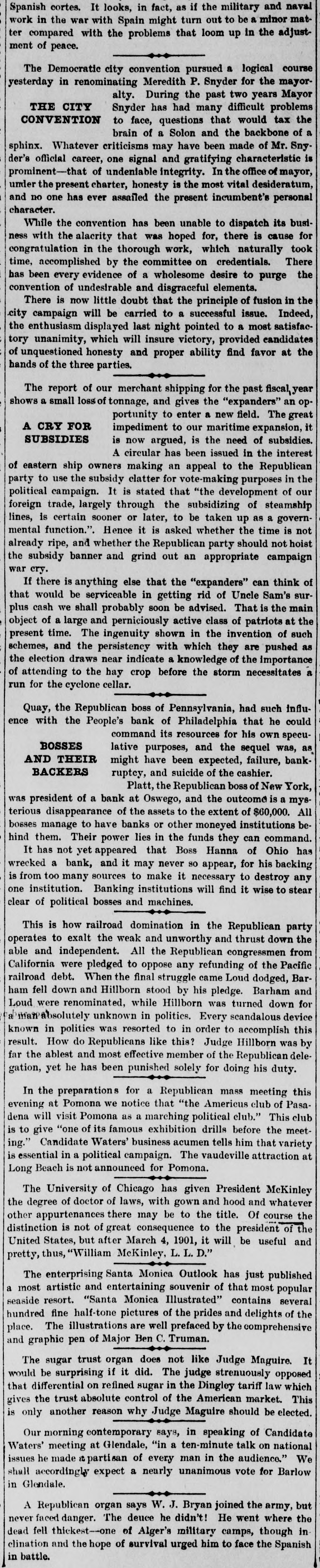
Spanish cortes. It looks, in fact, as if the military and naval work in the war with Spain might turn out to be a minor matter compared with the problems that loom up in the adjustment of peace. The Democratic city convention pursued a logical course yesterday in renominating Meredith P. Snyder for the mayoralty. During the past two years Mayor THE CITY Snyder has had many difficult problems CONVENTION to face, questions that would tax the brain of a Solon and the backbone of a sphinx. Whatever criticisms may have been made of Mr. Snyder's official career, one signal and gratifying characteristic is prominent-that of undeniable integrity. In the office of mayor, under the present charter, honesty is the most vital desideratum, and no one has ever assailed the present incumbent's personal character. While the convention has been unable to dispatch its business with the alacrity that was hoped for, there is cause for congratulation in the thorough work, which naturally took time, accomplished by the committee on credentials. There has been every evidence of a wholesome desire to purge the convention of undesirable and disgraceful elements. There is now little doubt that the principle of fusion in the city campaign will be carried to a successful issue. Indeed, the enthusiasm displayed last night pointed to a most satisfactory unanimity, which will insure victory, provided candidates of unquestioned honesty and proper ability find favor at the hands of the three parties. The report of our merchant shipping for the past fiscal, year shows a small loss of tonnage, and gives the "expanders" an opportunity to enter a new field. The great A CRY FOR impediment to our maritime expansion, it SUBSIDIES is now argued, is the need of subsidies. A circular has been issued in the interest of eastern ship owners making an appeal to the Republican party to use the subsidy clatter for vote-making purposes in the political campaign. It is stated that "the development of our foreign trade, largely through the subsidizing of steamship lines, is certain sooner or later, to be taken up as a governmental function.". Hence it is asked whether the time is not already ripe, and whether the Republican party should not hoist the subsidy banner and grind out an appropriate campaign war cry. If there is anything else that the "expanders" can think of that would be serviceable in getting rid of Uncle Sam's surplus cash we shall probably soon be advised. That is the main object of a large and perniciously active class of patriots at the present time. The ingenuity shown in the invention of such as schemes, and the persistency with which they are pushed the election draws near indicate a knowledge of the importance of attending to the hay crop before the storm necessitates a run for the cyclone cellar. Quay, the Republican boss of Pennsylvania, had such infiuence with the People's bank of Philadelphia that he could command its resources for his own specuBOSSES lative purposes, and the sequel was, as AND THEIR might have been expected, failure, bankBACKERS ruptcy, and suicide of the cashier. Platt, the Republican boss of New York, was president of a bank at Oswego, and the outcome is a mysterious disappearance of the assets to the extent of $60,000. All bosses manage to have banks or other moneyed institutions behind them. Their power lies in the funds they can command. It has not yet appeared that Boss Hanna of Ohio has wrecked a bank, and it may never so appear, for his backing is from too many sources to make it necessary to destroy any one institution. Banking institutions will find it wise to stear clear of political bosses and machines. This is how railroad domination in the Republican party operates to exalt the weak and unworthy and thrust down the able and independent. All the Republican congressmen from California were pledged to oppose any refunding of the Pacific railroad debt. When the final struggle came Loud dodged, Barham fell down and Hillborn stood by his pledge. Barham and Loud were renominated, while Hillborn was turned down for Piman'absolutely unknown in politics. Every scandalous device known in politics was resorted to in order to accomplish this result. How do Republicans like this? Judge Hillborn was by far the ablest and most effective member of the Republican delegation, yet he has been punished solely for doing his duty. we In the preparations for a Republican mass meeting this evening at Pomona we notice that "the Americus club of Pasadena will visit Pomona as a marching political club." This club is to give "one of its famous exhibition drills before the meeting." Candidate Waters' business acumen tells him that variety is essential in a political campaign. The vaudeville attraction at Long Beach is not announced for Pomona. The University of Chicago has given President McKinley the degree of doctor of laws, with gown and hood and whatever other appurtenances there may be to the title. Of course the distinction is not of great consequence to the president of the United States, but after March 4, 1901, it will be useful and pretty, thus, "William McKinley, L. L. D." The enterprising Santa Monica Outlook has just published a most artistic and entertaining souvenir of that most popular seaside resort. "Santa Monica Illustrated" contains several hundred fine half-tone pictures of the prides and delights of the place. The illustrations are well prefaced by the comprehensive and graphic pen of Major Ben C. Truman. The sugar trust organ does not like Judge Maguire. It would be surprising if it did. The judge strenuously opposed that differential on refined sugar in the Dingley tariff law which gives the trust absolute control of the American market. This is only another reason why Judge Maguire should be elected. Our morning contemporary says, in speaking of Candidate Waters' meeting at Glendale, "in a ten-minute talk on national issues he made is partisan of every man in the audience." We shall accordingly expect a nearly unanimous vote for Barlow in Glendale. w A Republican organ says W. J. Bryan joined the army, but never faced danger. The deuce he didn't! He went where the dead fell thickest-one of Alger's military camps, though in clination and the hope of survival urged him to face the Spanish in battle.