John G. Stewart (Coshocton, OH)

Episode Information

Episode UID
1454397491021
Episode Type
Run โ†’ Suspension โ†’ Closure
Bank Type
private
Bank ID
145439749 hash
Start Date
January 31, 1885
Location
Coshocton, Ohio (40.272, -81.860)

Metadata

Model
gpt-5-mini (chosen from majority vote of a three-model LLM ensemble)
Short Digest
a9815cb3b2f96abd

Response Measures

None

Description

Assignment to R. M. Voorhees indicates failure/closure rather than temporary suspension.

Events (3)

1. January 31, 1885 Receivership
Newspaper Excerpt
made an assignment to R. M. Voorhees to-day.
Source
newspapers
2. January 31, 1885 Run
Cause
Bank Specific Adverse Info
Cause Details
Illness and possible death of the banker triggered depositor panic and heavy withdrawals.
Newspaper Excerpt
Mr. Stewart's illness and possible death caused a run on the bank, which it had not the currency to meet.
Source
newspapers
3. January 31, 1885 Suspension
Cause
Bank Specific Adverse Info
Cause Details
Assignment (bank failure) followed the run; bank lacked currency to meet withdrawals.
Newspaper Excerpt
made an assignment to R. M. Voorhees to-day.
Source
newspapers

Newspaper Articles (9)

Article from Savannah Morning News, February 1, 1885

Click image to open full size in new tab

Article Text

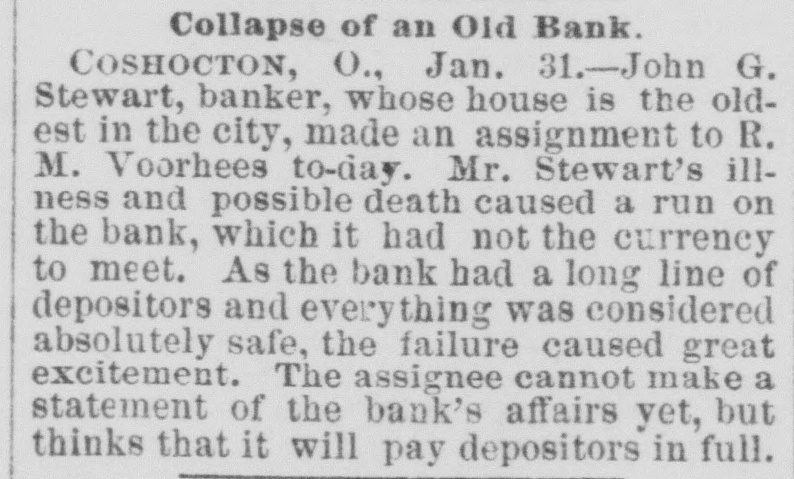
Collapse of an Old Bank. COSHOCTON, O., Jan. 31.-John G. Stewart, banker, whose house is the oldest in the city, made an assignment to R. M. Voorhees to-day. Mr. Stewart's illness and possible death caused a run on the bank, which it had not the currency to meet. As the bank had a long line of depositors and everything was considered absolutely safe, the failure caused great excitement. The assignee cannot make a statement of the bank's affairs yet, but thinks that it will pay depositors in full.


Article from The Indianapolis Sentinel, February 1, 1885

Click image to open full size in new tab

Article Text

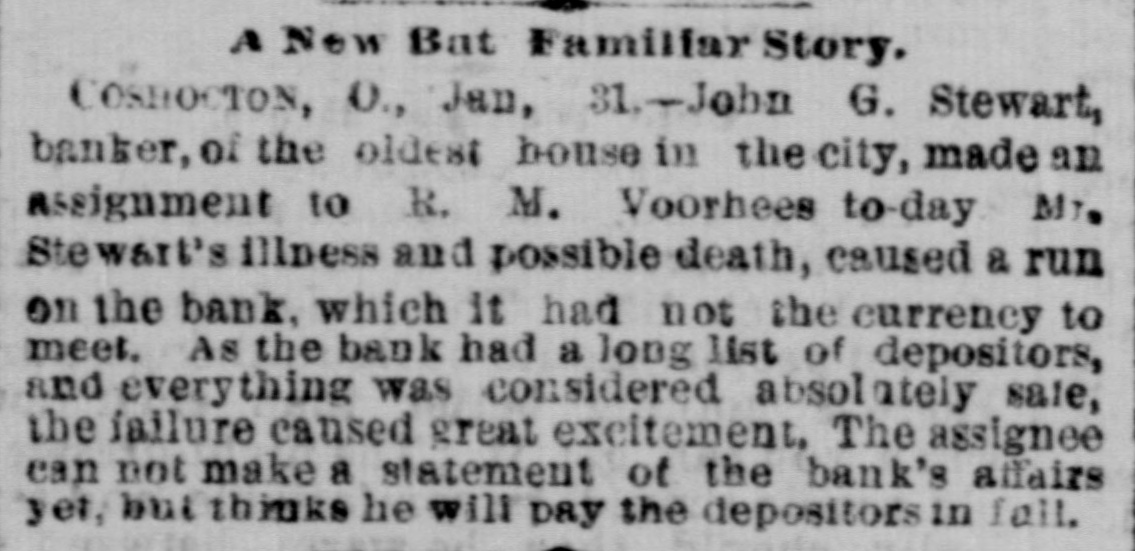
A New Bat Familiar Story. COSHOCTON, 0., Jun, 31.-John G. Stewart, banker, of the oldest house in the city, made an assignment to R. M. Voorhees to-day Mr. Stewart's illness and possible death, caused a run on the bank. which it had not the currency to meet. As the bank had a long list of depositors, and everything was considered absolately sale, the failure caused great excitement. The assignee can not make a statement of the bank's affairs yet, but thinks he will DAY the depositors in fail.


Article from Wheeling Sunday Register, February 1, 1885

Click image to open full size in new tab

Article Text

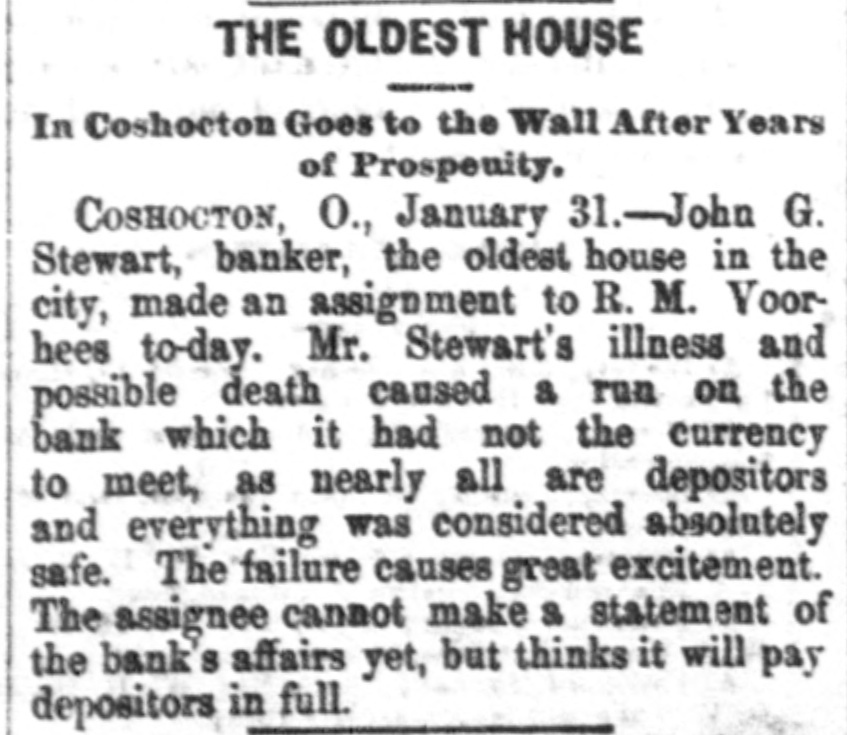
THE OLDEST HOUSE In Coshocton Goes to the Wall After Years of Prospenity. COSHOCTON, 0., January 31.-John G. Stewart, banker, the oldest house in the city, made an assignment to R. M. Voorhees to-day. Mr. Stewart's illness and possible death caused a run on the bank which it had not the currency to meet, as nearly all are depositors and everything was considered absolutely safe. The failure causes great excitement. The assignee cannot make a statement of the bank's S affairs yet, but thinks it will pay depositors in full.


Article from The Indianapolis Journal, February 1, 1885

Click image to open full size in new tab

Article Text

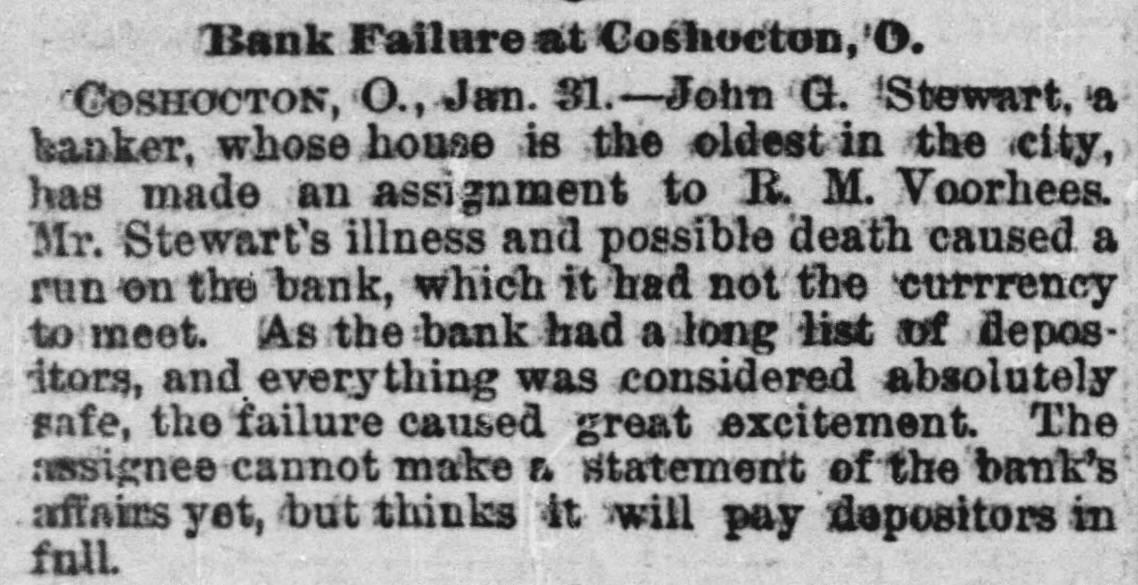
Bank Failure at Coshocton, O. COSHOCTON, O., Jan. 31.-John G. Stewart, a banker, whose house is the oldest in the city, has made an assignment to R. M. Voorhees. Mr. Stewart's illness and possible death caused a run on the bank, which it had not the currrency to meet. As the bank had a long list of depositors, and everything was considered absolutely safe, the failure caused great excitement. The assignee cannot make & statement of the bank's affairs yet, but thinks it will pay depositors in full.


Article from Richmond Dispatch, February 1, 1885

Click image to open full size in new tab

Article Text

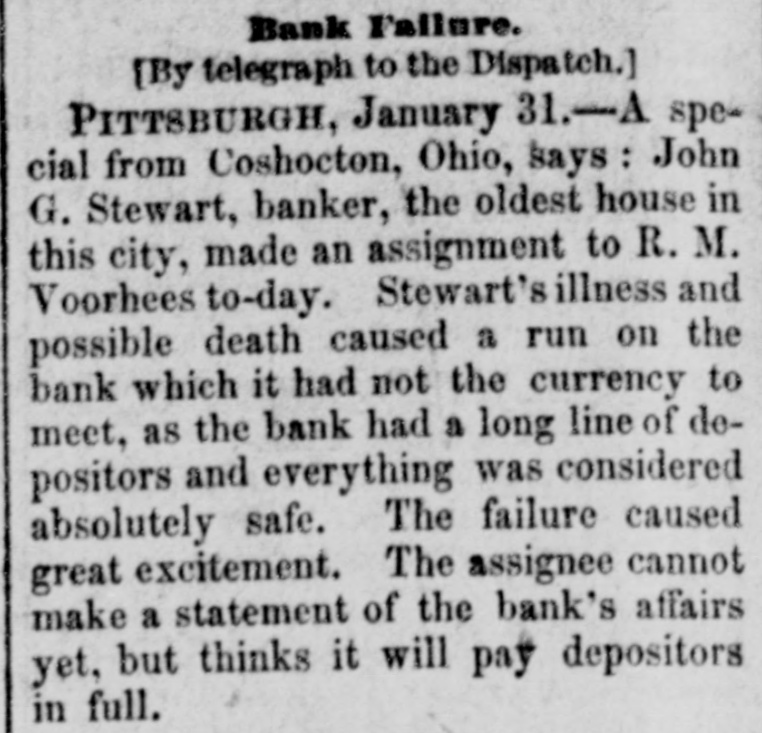
Bank Failure. [By telegraph to the Dispatch.] PITTSBURGH, January 31.-A special from Coshocton, Ohio, says : John G. Stewart, banker, the oldest house in this city, made an assignment to R. M. Voorhees to-day. Stewart's illness and possible death caused a run on the bank which it had not the currency to meet, as the bank had a long line of depositors and everything was considered absolutely safe. The failure caused great excitement. The assignee cannot make a statement of the bank's affairs yet, but thinks it will pay depositors in full.


Article from St. Paul Daily Globe, February 1, 1885

Click image to open full size in new tab

Article Text

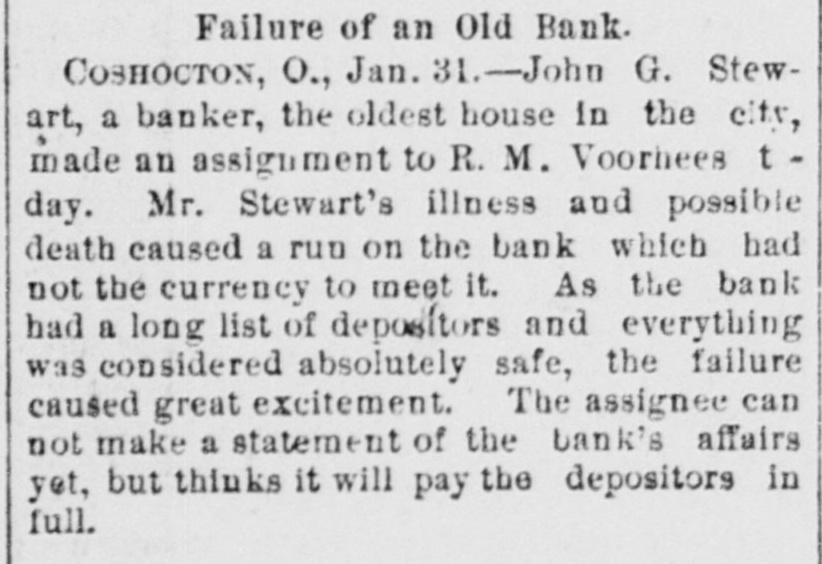
Failure of an Old Bank. COSHOCTON, o., Jan. 31.-John G. Stewart, a banker, the oldest house in the city, made an assignment to R. M. Voorhees t day. Mr. Stewart's illness and possible death caused a run on the bank which had not the currency to meet it. As the bank had a long list of depositors and everything was considered absolutely safe, the failure caused great excitement. The assignee can not make a statement of the bank's affairs yet, but thinks it will pay the depositors in full.


Article from The Wheeling Daily Intelligencer, February 2, 1885

Click image to open full size in new tab

Article Text

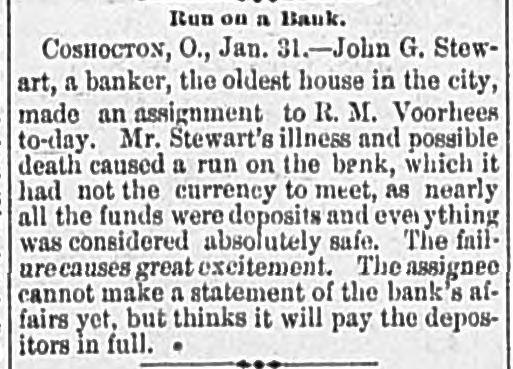
Run on a Bauk. COSHOCTON, O., Jan. 31.-John G. Stewart, a banker, the oldest house in the city, made an assignment to R. M. Voorhees to-day. Mr. Stewart's illness and possible death caused a run on the benk, which it had not the currency to meet, as nearly all the funds were deposits and ever ything was considered absolutely safe. The failurecauses great excitement. The assignee cannot make n statement of the bank's affairs yet, but thinks it will pay the depositors in full.


Article from The Indianapolis Sentinel, February 2, 1885

Click image to open full size in new tab

Article Text

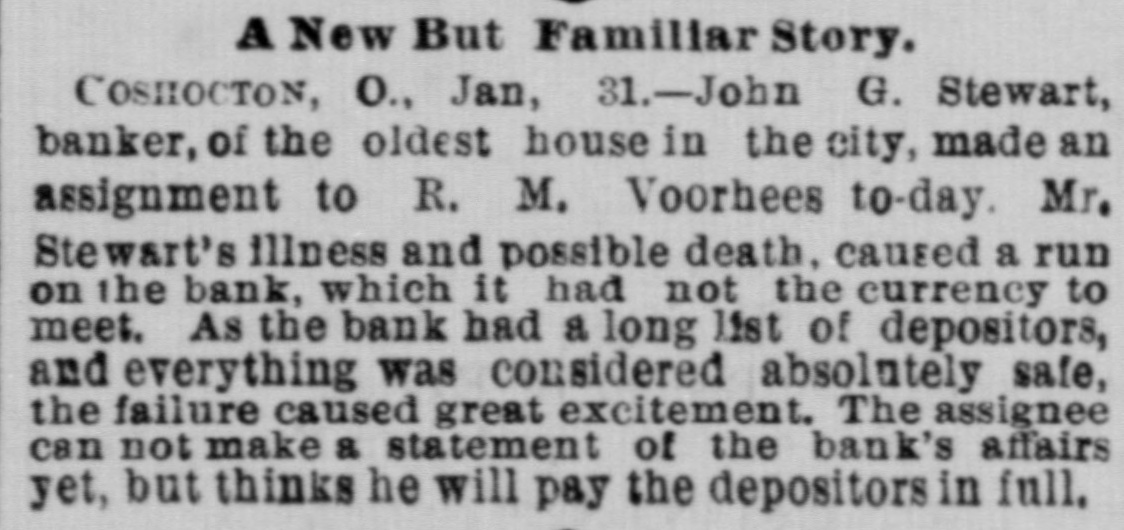
A New But Familiar Story. COSHOCTON, 0., Jan, 31.-John G. Stewart, banker, of the oldest house in the city, made an assignment to R. M. Voorhees to-day. Mr. Stewart's illness and possible death, caused a run on the bank, which it had not the currency to meet. As the bank had a long list of depositors, and everything was considered absolutely safe, the failure caused great excitement. The assignee can not make & statement of the bank's affairs yet, but thinks he will pay the depositors in full.


Article from The Kimball Graphic, February 13, 1885

Click image to open full size in new tab

Article Text

John G. Stewart, banker, Coshocton, Ohio, has assigned. Rev. R. Heber Newton denies that he endorses Ingersoll. C. K. Ingham has been nominated for postmaster of Afton, Iowa. The coinage of the mints during January was $4,642,187, of which $2,385,200 were standard dollars. Canon King, professor of theology in the University of Oxford, has accepted the bishopric of Lincoln. Annie M. Knapp of Philadelphia committed suicide, rather than marry the suitor selected by her mother. Mrs. John Tucker, aged twenty-two, has been arrested at Mayville, Ky., on a charge of killing her husband, aged sixty. The Mormon temple at Salt Lake will yet require more than four years for its completion, and will cost $3,000,000. J. C. Briggs, a prominent farmer of Colby, Wis., committed suicide-caused by ill health and financial despondency. William Leonard, a native of Wexford county, Ireland, died at the Providence hospital, Seattle, Wash. Ter., aged 106 years. Ezra Bostwick of Union City, Mich., has donated a 640 acre farm, valued at $30,000, to Albion college, for a chair of astronomy. Mrs. Leaman, of Doland, Dak., left her little boy alone in the house and returned to find him so badly burned that he died soon after. At Durand, Wis., the body of Mrs. Catenhausen was found in her cellar. Her husband confessed the deed, and hanged himself in jail. Frank M. Duffy, the postal clerk arrested at Winnipeg on a charge of mail robbery, has been released for lack of evidence to convict. The property of the La Crosse Gas company was sold to W. W. Woodbury of Minneapolis; consideration private, but probably $100,000. Three disastrous explosions of natural gas occurred in three adjoining houses. A score of people were injured, some of them fatally. O. C. Hanson, aged thirty-four, and his wife, aged thirty-three were found dead in their bed at Racine, Wis., having been suffocated by coal gas. Charles E. Hill of Syracuse, N. Y., who died in Japan last October, leaving $1,500,000, received a divorce three days before his death, and Mrs. Hill will fight for his ducats. Joseph Kaufmann of Dubuque, who had been slowly starving to death from a paralyzed stomach, died recently. It is a remarkable case and has puzzled the medical fraternity. At Vincennes, Ind., Adolph Graphenstein shot Henry Bussman three times, and supposing that he was dead, robbed him of $150 and covered his body with snow. Bussman recovered. The municipal authorities of Paris have decided to raise a loan of $40,000,000 for the completion of long-projected public improvements which will furnish work for thousands of the unemployed. Gen. James Chestnut, United States senator from South Carolina at the time the state seceded from the Union, and afterward member of the Montgomery congress, died at Camden, S. C., aged seventy years. The schedules of John J. Cisco & Son, New York, shows debts and liabilities to be $2,987,000; nominal assets, $3,264,000, and actual assets will be largely increased by the realization of the true value of the securities. Mr. Cannon, controller of the currency, says the contraction of national bank circulation is less than was anticipated, owing largely to the absence of bond calls. The banks generally desire to continue their charters. Postoffices discontinued: Iowa-Bailey, Hancock county, mail to Aldrich. Postmasters Commissioned-William T. Bycroft, Goodle, Dak.; J. W. Henton, Hot Springs, Dak.; Annie E. Henry, West Grove, Iowa. Julius Yattow, one of the deputy United States marshals in Chicago tried on the charge of murder, for having killed a man on the day of the recent national election, was acquitted before a state petit jury, he having acted in self-defense. Truth reminds the shriekers against America in the dynamite matter that Lord Palmerston was turned out of office for venturing to try and strengthen the English law when Orsini threw his bombs at Napoleon, believed to have been made in England. Rev. Mr. Lough, assistant chaplain to the imperial troops on the British North American station has been convicted of drunkenness and indecent assault upon the wife of Sergeant Talbot, a member of his congregation. He was fined $50 or three months in jail at Halifax.