14476. Third National Bank (New York, NY)

Bank Information

Episode Type
Suspension โ†’ Closure
Bank Type
national
Bank ID
87
Charter Number
87
Start Date
November 27, 1879
Location
New York, New York (40.714, -74.006)

Metadata

Model
gpt-5-mini
Short Digest
53bee1889bf666a3

Response Measures

None

Description

Articles (Nov 1879 and Jun 1880) describe troubles at the Third National Bank of New York: an 1879 stockholder/voting dispute that likely leads to placement in a receiver's hands, and a June 1880 report that the bank 'failed to honor its draft' and suspended. There is no clear description of a depositor run; the June 1880 piece reports suspension, false statement of surplus, and the cashier's departure. The sequence indicates suspension followed by likely receivership/closure.

Events (5)

1. September 21, 1863 Chartered
Source
historical_nic
2. November 27, 1879 Other
Newspaper Excerpt
The matter has been submitted to eminent counsel ... The Comptroller of the Currency will uphold Mr. Hardenbergh ... promises his interference with the scheme of voluntary liquidation ... The bank will in all probability be placed in the hands of a receiver.
Source
newspapers
3. June 25, 1880 Suspension
Cause
Bank Specific Adverse Info
Cause Details
Failed to honor a draft for lack of funds; prior statement (April) allegedly showed $62,000 surplus which is said to have been false; cashier sailed for Europe before suspension.
Newspaper Excerpt
The Third National of New York failed to honor its draft for lack of funds to protect it, hence the suspension.
Source
newspapers
4. May 20, 1897 Voluntary Liquidation
Source
historical_nic
5. * Receivership
Newspaper Excerpt
Under the stipulations of the National Banking Act ... The bank will in all probability be placed in the hands of a receiver.
Source
newspapers

Newspaper Articles (2)

Article from The New York Herald, November 27, 1879

Click image to open full size in new tab

Article Text

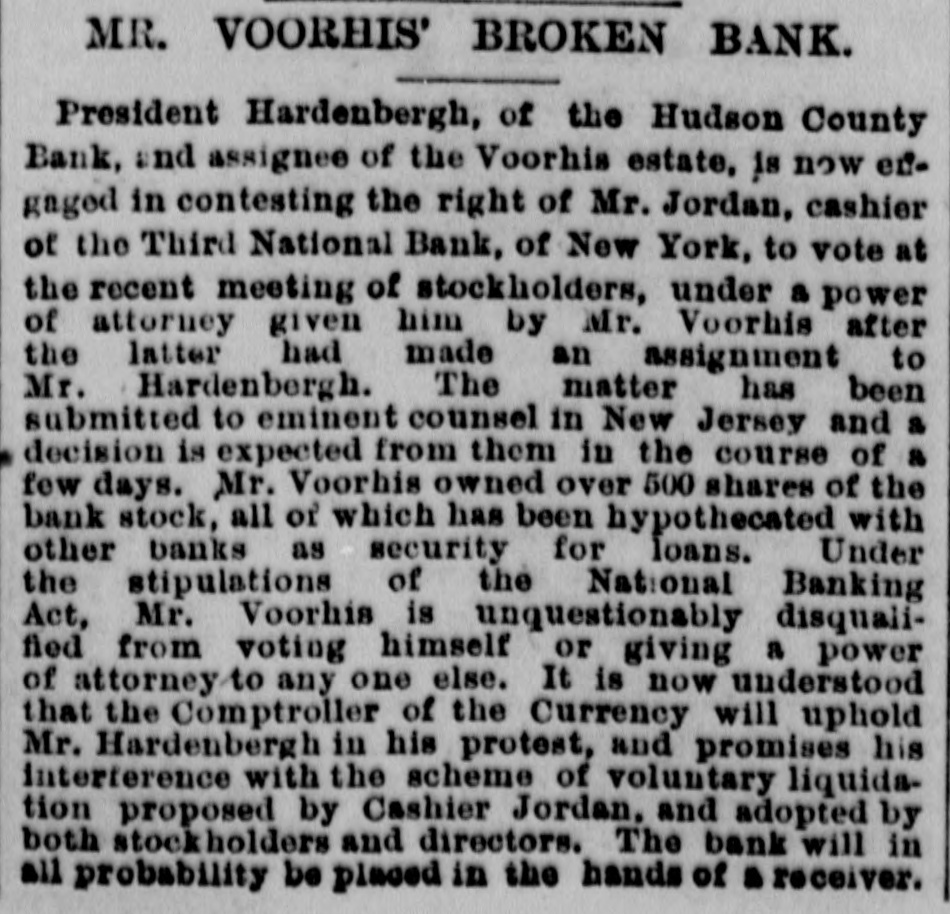
MR. VOORHIS' BROKEN BANK. President Hardenbergh, of the Hudson County Bank, and assignee of the Voorhis estate, is now erfgaged in contesting the right of Mr. Jordan, cashier of the Third National Bank, of New York, to vote at the recent meeting of stockholders, under a power of attorney given him by Mr. Voorhis after the latter had made an assignment to Mr. Hardenbergh. The matter has been submitted to eminent counsel in New Jersey and a decision is expected from them in the course of a few days. Mr. Voorhis owned over 500 shares of the bank stock, all or which has been hypothecated with other banks as security for loans. Under the stipulations of the National Banking Act, Mr. Voorhis is unquestionably disqualified from voting himself or giving a power of attorney to any one else. It is now understood that the Comptroller of the Currency will uphold Mr. Hardenbergh in his protest, and promises his interference with the scheme of voluntary liquidation proposed by Cashier Jordan, and adopted by both stockholders and directors. The bank will in all probability be placed in the hands of a receiver.

Article from Public Ledger, June 25, 1880

Click image to open full size in new tab

Article Text

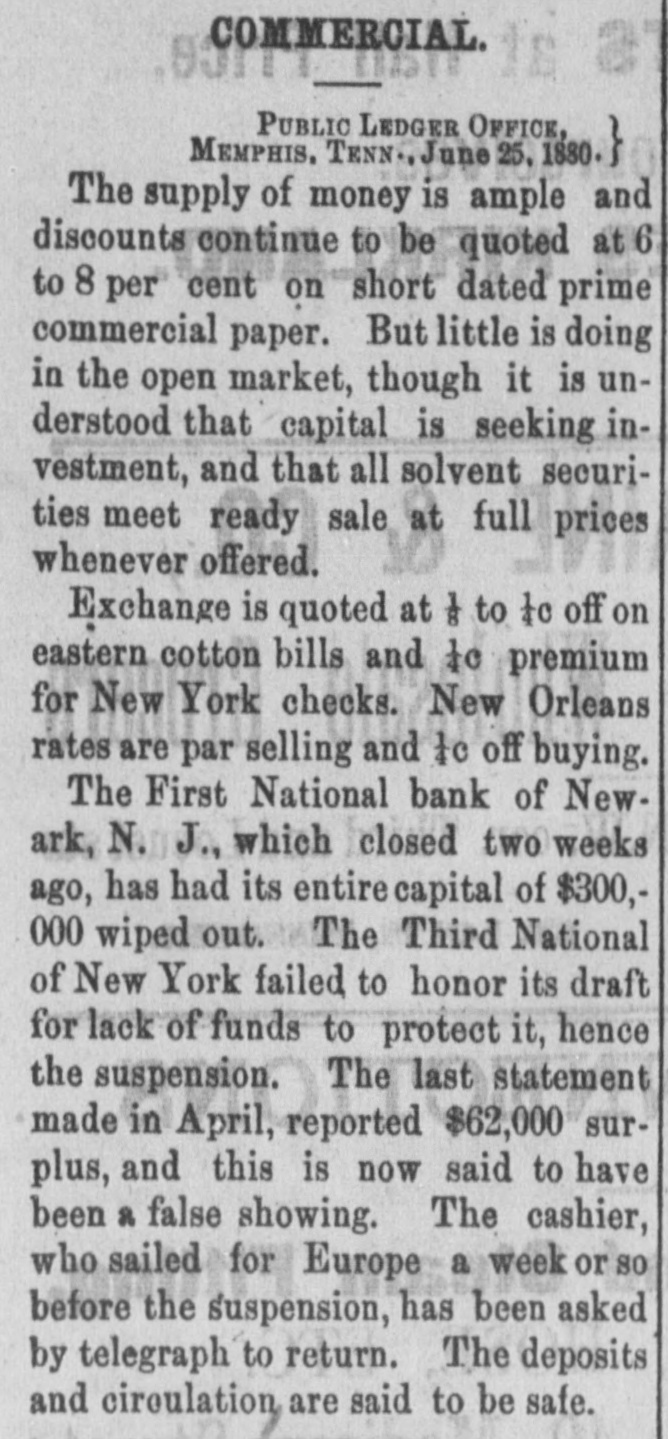
PUBLIC LEDGER OFFICE, MEMPHIS. TENN. June 25, 1880. } The supply of money is ample and discounts continue to be quoted at 6 to 8 per cent on short dated prime commercial paper. But little is doing in the open market, though it is understood that capital is seeking investment, and that all solvent securities meet ready sale at full prices whenever offered. Exchange is quoted at 1 to 10 off on eastern cotton bills and 10 premium for New York checks. New Orleans rates are par selling and lc off buying. The First National bank of Newark, N. J., which closed two weeks ago, has had its entire capital of $300,000 wiped out. The Third National of New York failed to honor its draft for lack of funds to protect it, hence the suspension. The last statement made in April, reported $62,000 surplus, and this is now said to have been a false showing. The cashier, who sailed for Europe a week or so before the suspension, has been asked by telegraph to return. The deposits and ciroulation are said to be safe.