14457. Stuyvesant Bank (New York, NY)

Bank Information

Episode Type
Run β†’ Suspension β†’ Closure
Bank Type
state
Start Date
October 12, 1871
Location
New York, New York (40.714, -74.006)

Metadata

Model
gpt-5-mini
Short Digest
b2cbdf8408ef400b

Response Measures

None

Description

Contemporary articles report heavy withdrawals and crowding (a 'run') that, together with the Manufacturers' and Merchants' Bank refusing to redeem for Stuyvesant and the constricted money market after the Chicago fire, forced the Stuyvesant Bank to suspend in mid‑October 1871. A receiver was appointed immediately; the bank was wound up and later placed in bankruptcy/assignee proceedings, i.e., it did not reopen. Dates cleaned/derived from publication dates (e.g., suspension reported Oct 13, 1871 as having occurred 'yesterday').

Events (5)

1. October 12, 1871 Run
Cause
Correspondent
Cause Details
Large withdrawals and panic were triggered when the Manufacturers' and Merchants' Bank refused to redeem the Stuyvesant's checks; the Chicago fire and tight money market aggravated withdrawals.
Measures
Bank attempted to obtain a redeeming bank; officers and stockholders sought capital; ultimately receiver appointed and payments suspended.
Newspaper Excerpt
Outside the entrance ... the people, who wanted to know what the news was. It will be a lively day to-morrow at the Stuyvesant Bank. ... a small crowd had collected on the sidewalk in front of the entrance on Broadway, and besieged the door long before it was thrown open.
Source
newspapers
2. October 12, 1871 Suspension
Cause
Correspondent
Cause Details
Suspension immediately followed refusal of the Manufacturers' and Merchants' Bank to redeem for Stuyvesant amid a tightened money market after the Chicago fire.
Newspaper Excerpt
The Stuyvesant bank, 744 Broadway, suspended payment yesterday. The Stuyvesant is a State bank...
Source
newspapers
3. October 13, 1871 Receivership
Newspaper Excerpt
A receiver has been appointed. MR. O. H. B. ARCHER ... has been appointed receiver, and took charge of the books and assets yesterday.
Source
newspapers
4. December 23, 1871 Other
Newspaper Excerpt
The proceedings in bankruptcy were begun on Dec. 23, 1871. (Bankruptcy adjudication / creditors' proceedings began.)
Source
newspapers
5. March 21, 1872 Other
Newspaper Excerpt
Judge Blatchford appoints John H. Platt as Assignee (trustee/assignee in bankruptcy) of the Stuyvesant Bank.
Source
newspapers

Newspaper Articles (25)

Article from Evening Star, October 13, 1871

Click image to open full size in new tab

Article Text

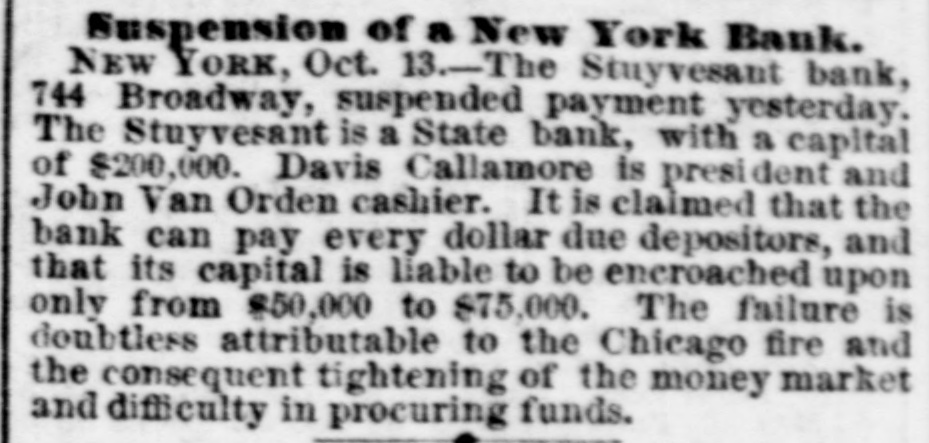
Suspension of a New York Bank. NEW YORK, Oct. 13.-The Stuyvesant bank, 744 Broadway, suspended payment yesterday. The Stuyvesant is a State bank, with a capital of $200,000. Davis Callamore is president and John Van Orden cashier. It is claimed that the bank can pay every dollar due depositors, and that its capital is liable to be encroached upon only from $50,000 to $75,000. The failure is doubtless attributable to the Chicago fire and the consequent tightening of the money market and difficulty in procuring funds.


Article from The New York Herald, October 13, 1871

Click image to open full size in new tab

Article Text

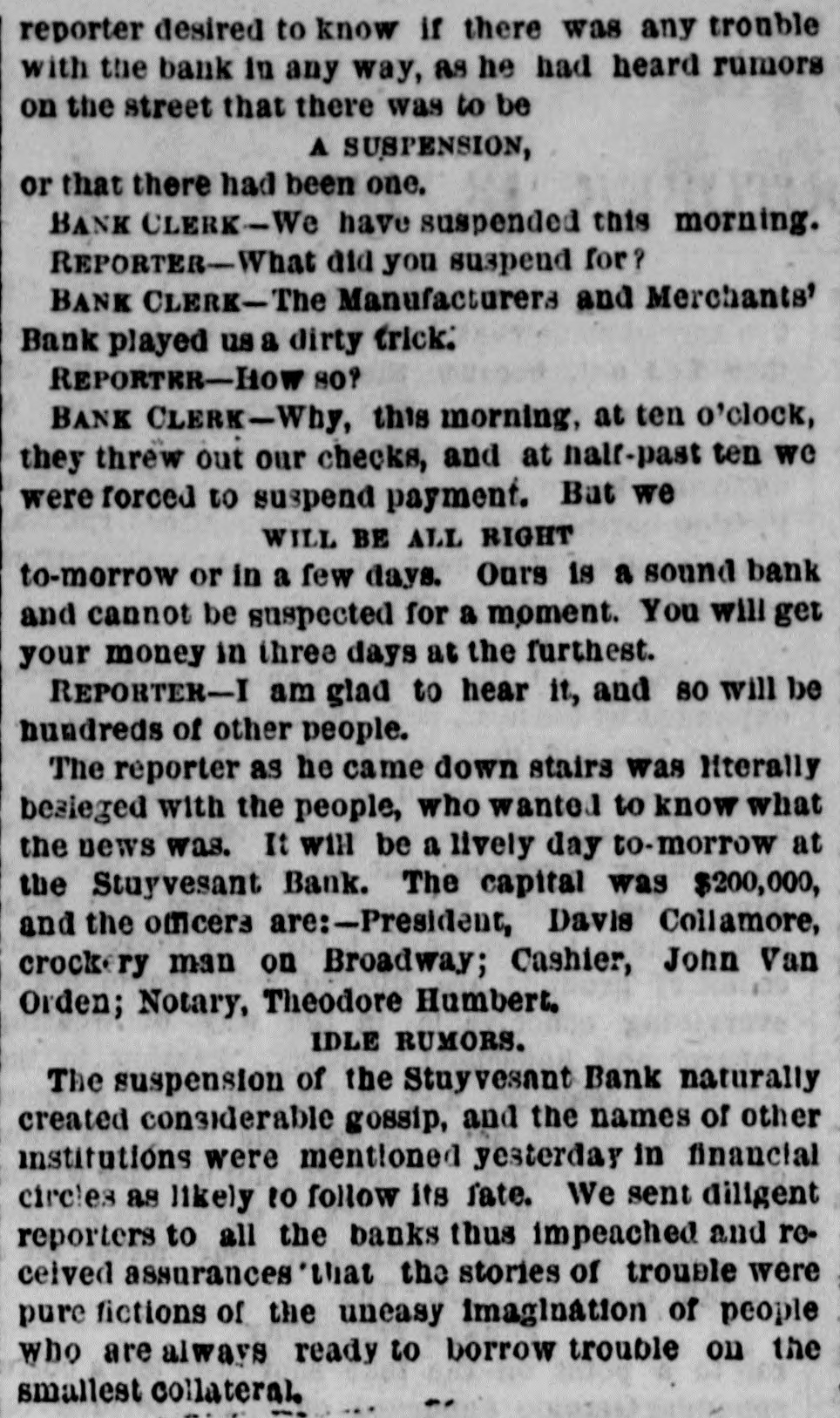
reporter desired to know if there was any trouble with the bank in any way, as he had heard rumors on the street that there was to be A SUSPENSION, or that there had been one. BANK CLERK-We have suspended this morning. REPORTER-What did you suspend for? BANK CLERK- - The Manufacturera and Merchants' Bank played us a dirty trick: REPORTER-ILOW so? BANK CLERK-Why, this morning, at ten o'clock, they threw out our checks, and at half-past ten we were forced to suspend payment. Bat we WILL BE ALL RIGHT to-morrow or in a few days. Ours is a sound bank and cannot be suspected for a moment. You will get your money in three days at the furthest. REPORTER-I am glad to hear it, and 80 will be hundreds of other people. The reporter as he came down stairs was literally besieged with the people, who wanted to know what the news was. It will be a lively day to-morrow at the Stuyvesant Bank. The capital was $200,000, and the officers are:-President, Davis Collamore, crockery man on Broadway; Cashier, John Van Orden; Notary, Theodore Humbert. IDLE RUMORS. The suspension of the Stuyvesant Bank naturally created considerable gossip, and the names of other institutions were mentioned yesterday in financial circles as likely 10 follow its late. We sent diligent reporters to all the banks thus impeached and received assurances'that the stories of trouble were pure fictions of the uneasy imagination of people who are always ready to borrow trouble on the smallest collateral.


Article from The New York Herald, October 13, 1871

Click image to open full size in new tab

Article Text

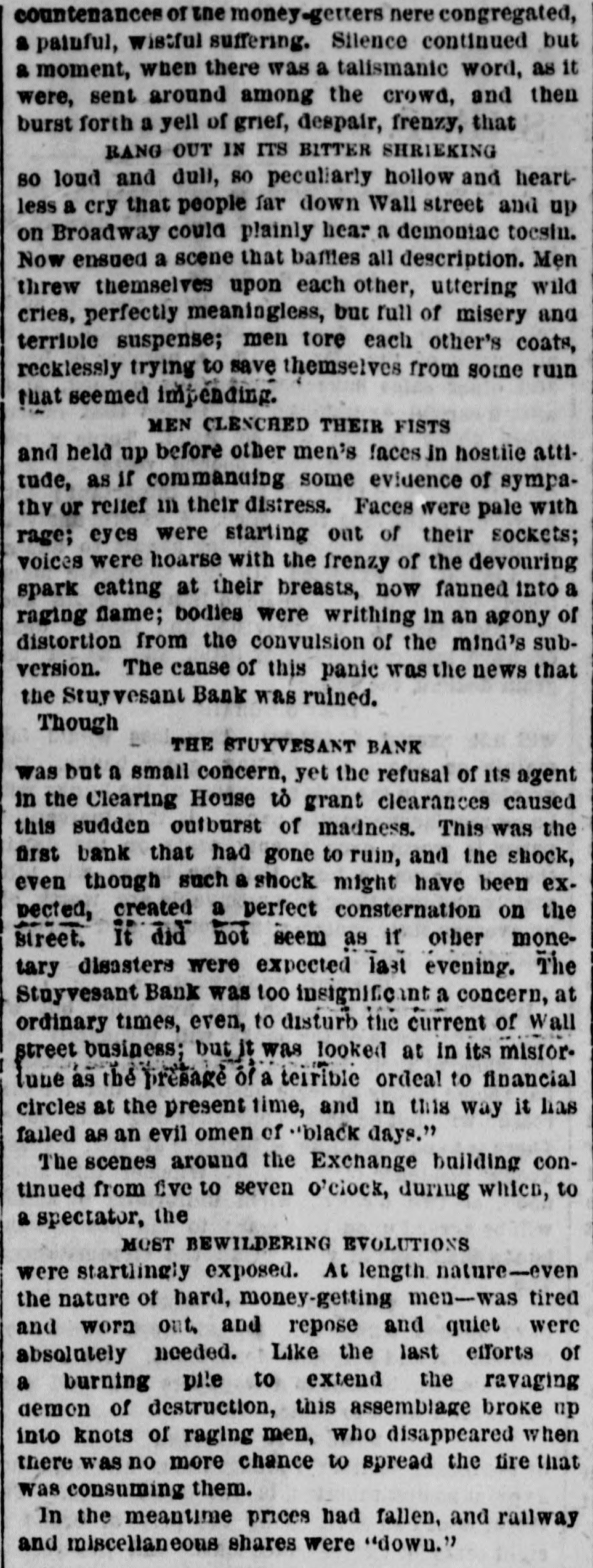
countenances or the money-getters nere congregated, a painful, wistful suffering. Silence continued but a moment, when there was a talismanic word, as it were, sent around among the crowd, and then burst forth a yell of grief, despair, frenzy, that RANG OUT IN ITS BITTER SHRIEKING BO loud and dull, so peculiarly hollow and heartless a cry that people far down Wall street and up on Broadway could plainly hear a demoniac tocsin. Now ensued a scene that bames all description. Men threw themselves upon each other, uttering wild cries, perfectly meaningless, but full of misery and terriole suspense; men tore each other's coats, recklessly trying to save themselves from some ruin that seemed impending. MEN CLENCRED THEIR FISTS and held up before other men's faces in hostile att1tude, as If commanding some evidence of sympathy or relief 111 their distress. Faces were pale with rage; eyes were starting out of their sockets; voices were hoarse with the frenzy of the devouring spark eating at their breasts, now fauned into a raging flame; bodies were writhing in an agony of distortion from the convulsion of the mind's subversion. The cause of this panic was the news that the Sturvesant Bank was ruined. Though THE STUYVESANT BANK was but a small concern, yet the refusal of its agent in the Clearing House to grant clearances caused this sudden outburst of madness. This was the first bank that had gone to ruin, and the shock, even though such a shock might have been expected, created a perfect consternation on the street. It did not seem as if other monetary disasters were expected last evening. The Stuyvesant Bank was too insignificant a concern, at ordinary times, even, to disturb the current of Wall street business; but it was looked at in its misforlune as the presage of a terrible ordea! to financial circles at the present time, and in this way it has failed as an evil omen of "black days." The scenes around the Exchange building continued from five to seven o'clock, during which, to a spectator, the MOST BEWILDERING EVOLUTIONS were startlingly exposed. At length nature-even the nature ot hard, money-getting men-was tired and worn out. and repose and quiet were absolutely needed. Like the last efforts of a burning pile to extend the ravaging aemon of destruction, this assemblage broke up into knots of raging men, who disappeared when there was no more chance to spread the fire that was consuming them. In the meantime prices had fallen, and railway and miscellaneous shares were "down."


Article from The Daily State Journal, October 13, 1871

Click image to open full size in new tab

Article Text

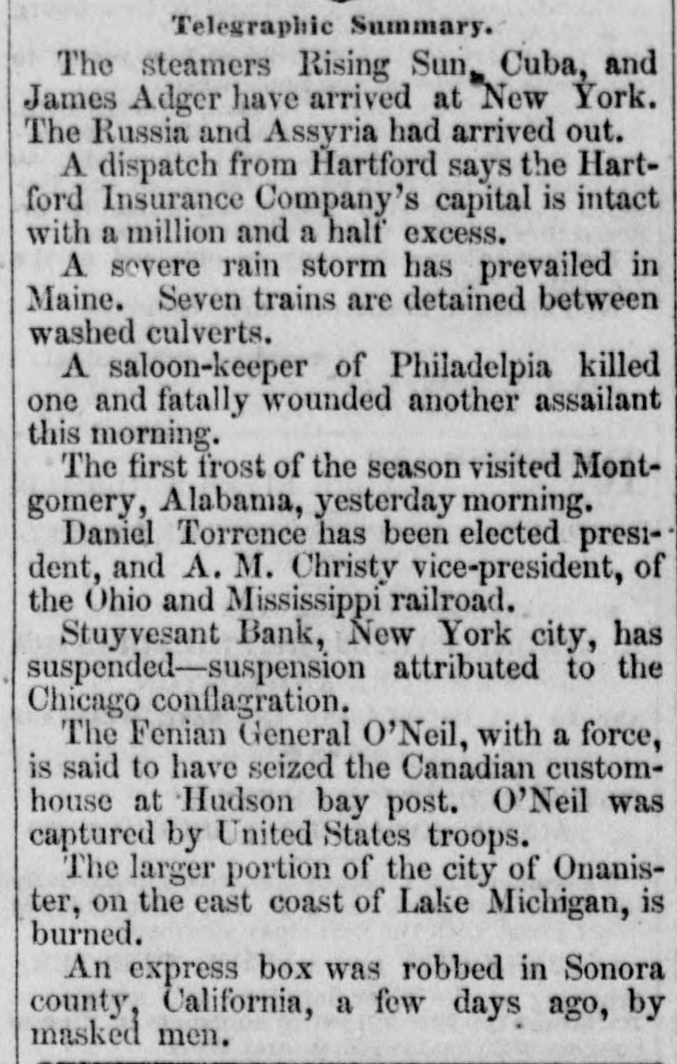
Telegraphic Summary. The steamers Rising Sun Cuba, and James Adger have arrived at New York. The Russia and Assyria had arrived out. A dispatch from Hartford says the Hartford Insurance Company's capital is intact with a million and a half excess. A sovere rain storm has prevailed in Maine. Seven trains are detained between washed culverts. A saloon-keeper of Philadelpia killed one and fatally wounded another assailant this morning. The first frost of the season visited Montgomery, Alabama, yesterday morning. Daniel Torrence has been elected president, and A. M. Christy vice-president, of the Ohio and Mississippi railroad. Stuyvesant Bank, New York city, has suspended-suspension attributed to the Chicago conflagration. The Fenian General O'Neil, with a force, is said to have seized the Canadian customhouse at Hudson bay post. O'Neil was captured by United States troops. The larger portion of the city of Onanister, on the east coast of Lake Michigan, is burned. An express box was robbed in Sonora county, California, a few days ago, by masked men.


Article from New-York Tribune, October 14, 1871

Click image to open full size in new tab

Article Text

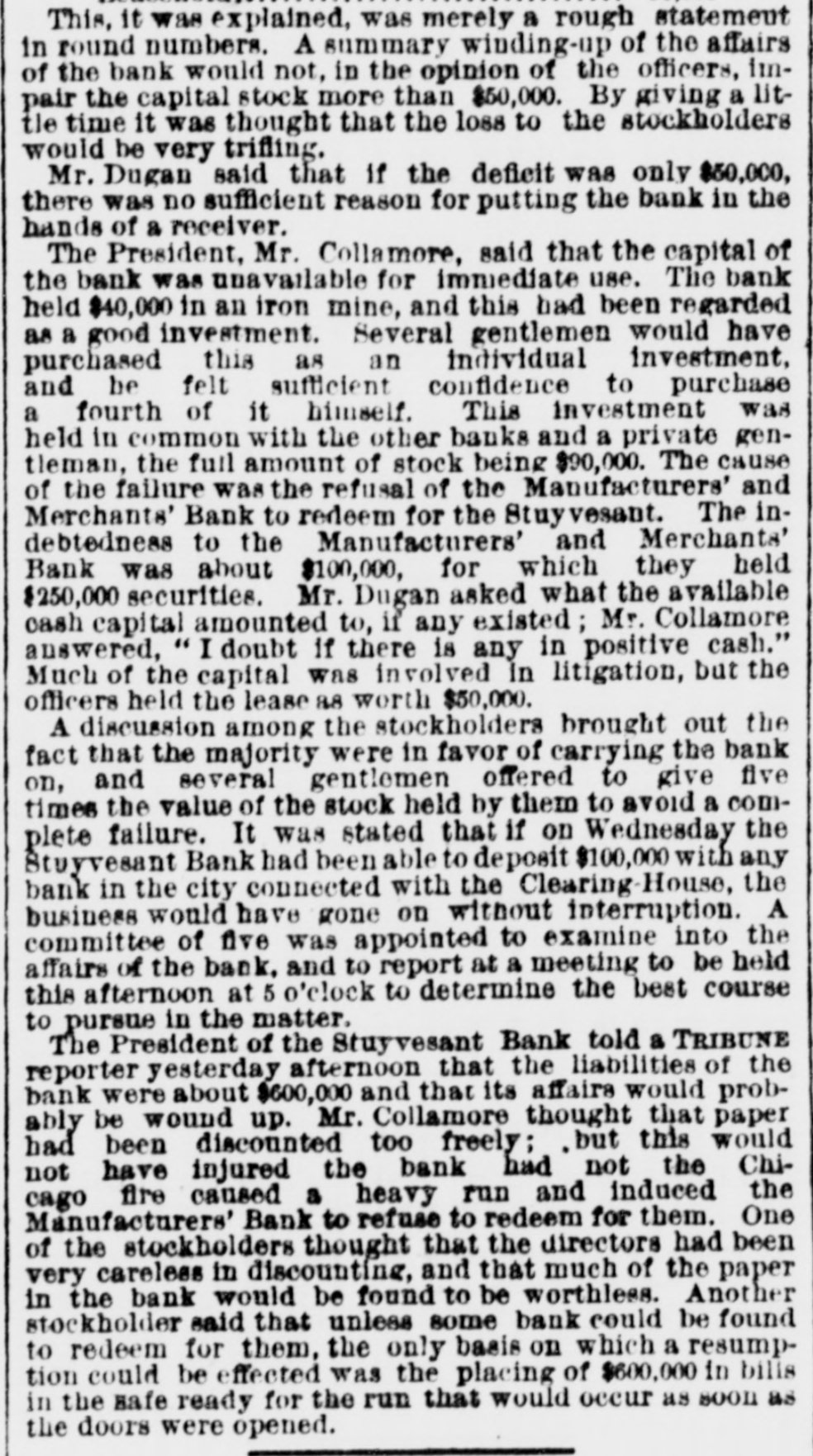
This, it was explained, was merely a rough statement in round numbers. A summary winding-up of the affairs of the bank would not, in the opinion of the officers, impair the capital stock more than $50,000. By giving a little time it was thought that the loss to the stockholders would be very trifing. Mr. Dugan said that If the deficit was only $50,000, there was no sufficient reason for putting the bank in the hands of a receiver. The President, Mr. Collamore, said that the capital of the bank was unavailable for immediate use. The bank held $40,000 in an iron mine, and this bad been regarded as a good investment. Several gentlemen would have purchased this as an individual investment, and be felt sufficient confidence to purchase a fourth of it himself. This investment was held in common with the other banks and a private gentleman, the full amount of stock being $90,000. The cause of the failure was the refusal of the Manufacturers' and Merchants' Bank to redeem for the Stuyvesant. The indebtedness to the Manufacturers' and Merchants' Bank was about $100,000, for which they held $250,000 securities. Mr. Dugan asked what the available cash capital amounted to, if any existed; Mr. Collamore answered, doubt if there is any in positive cash." Much of the capital was involved In litigation, but the officers held the lease 88 worth $50,000. A discussion among the stockholders brought out the fact that the majority were in favor of carrying the bank on, and several gentlemen offered to give five times the value of the stock held by them to avoid a complete failure. It was stated that if on Wednesday the Stuyvesant Bank had been able to deposit $100,000 with any bank in the city connected with the Clearing-House, the business would have gone on without interruption. A committee of five was appointed to examine into the affairs of the bank. and to report at a meeting to be held this afternoon at 5 o'clock to determine the best course to pursue in the matter. The President of the Stuyvesant Bank told a TRIBUNE reporter yesterday afternoon that the liabilities of the bank were about $600,000 and that its affairs would probably be wound up. Mr. Collamore thought that paper had been discounted too freely; ,but this would not have injured the bank had not the Chicago fire caused a heavy run and induced the Manufacturers' Bank to refuse to redeem for them. One of the stockholders thought that the directors had been very careless in discounting, and that much of the paper in the bank would be found to be worthless. Another stockholder said that unless some bank could be found to redeem for them, the only basis on which a resumption could be effected was the placing of $600,000 in bills in the safe ready for the run that would occur as soon as the doors were opened.


Article from The New York Herald, October 14, 1871

Click image to open full size in new tab

Article Text

STUYVESANT BANK TROUBLE The Bank Ruined, But Will Pay Its Debts. A RECEIVER APPOINTED. MEETING OF THE STOCKHOLDERS, de , the trouble which has resulted in the suspension or the Stuyvesant Bank, reported yesterday, can now be pretty clearly explained. It is gratifying t note that none of the facts which have becor ae known can in any way impeach THE HONESTY OF ITS MANAGEMENT The President, Mr. Davis Collamore, d'scussed very freely yesterday with visitors the/dimoulty into which the Institution had fallen, and refused no desired information. A represents.tive of the HERALD had with him the following CO d'aversation:"Good morning, Mr. Collamore. Like a good many other people who, I suppose, have seen you no-day, I have come upon an inquisitive errand." "About the bank, of course'l/ (with a pleasant smalley. "I would like to ask one OF two questions which should, in all fairness, be asked or you arst." "I am very willing, sir, to/enlighten you as much - posstole." "What 18 the immediate cause of this trouble "DISCOUNTING TOO FREELY." "Is there no more remove cause 199 "No, sir." "Of what character has been the business of the bank "Strictly legitimate." "It has never indulged in any speculation p? "No, sir. It has never speculated in gold or stock to a dollar's worth since I was chosen President, which was three years ago. we have built up SOMETHING OF A REPUTATION, The bank owns a valuable sen years lease of this building (at the corner of Astor place and Broad. way), and in fitting it up has spent forty or nity thousand dollars." "Have the officers ever borrowed from the do 1 posited funds p" "The failure of the bank cannot be attributed to the officers. They have not used its money. The cashier may have borrowed sums at some past time, but he does not now owe the bank a cent. As to anyself, my account shows a balance in my favor." Will you pay your depositors 999 "There is no doubt of it. THE MERCHANTS AND MANUFACTURERS BANK holds about $250,000 of notes which are maturing in our lavor." "Will the bank be continued " "Idonot think It can DC. At any other time this difficulty would not have crushed us; but just now you know the money market Is very close." "How will its affairs be wound up?" "A receiver has been appointed, and he will colsect the assets, paying the creditors as last as possible." A generous confidence in the integrity of the omCORN has led to many expressions of SYMPATHY AND GOOD FEELING from those who have entrusted the bank with large sums of money. Some of the depositors came to the President yesterday and offered to place further deposts in the hands of the cashier, expressing them. selves in the following manner:" you can go on, we will stay with you." The bank, though not of such venerable standing as some others, has inspired confidence by its strict adherence to LEGITIMATE AND UNSPECULATIVE BUSINESS. The action of the Merchants and Manufacturers' Bank on Wednesday, in withdrawing its support, was very sudden and unexpected. It is even said that no notification was sent out in advance. If this is true, the event must certainly be viewed as " DIRTY TRICK. The Merchants and Manufacturers' Bank held the securities of the Stayvesant to the amount of over balf a million of dollars. This would seem to be sufficient to obviate all suspicion of insecurity especially when it is remembered that the half a million 18 double the amount risked in the redemp uon of exchanges But the Merchants and Manufacturera' Bank thought otherwise; and, by its basty action, has succeeded in placing the Stuy vesani IN QUANDARY, which will undoubtedly result in its permanent stoppage. The trouble might have been tidea over had the money market been in its normal condition But the demolition of Chicago by the Fire-Fiend and the conseq uent panic among business men rendered it impossible to raise any borrowed support, and under these circumstance the stoppage was compelled by the inability to continue exchanges. The bank for some time has been DISCOUNTING VERY HEAVILY. and holds a large amount of paper which bas not yes matured. It has drawn too near its margin of deposit, and its lack of funds became SERIOUS DIFFICULTY when the depositors, grown anxious through the excitement produced by the Chicago calamity, began withdrawing During Wednesday the bank was forced to refuse the large cnecks presented various other banking institutions, but continued to pay the demands of smaller and poorer depositors. MR. O. H.B. ARCHER, director of the Erie Railway Company, and form President of this bank. has been appointed receiver, and took charge of the books and assets vesterday. From what be already knows of the affairs of the bank be expresses confidence in the full payment of all its creditors, and after this payment 1 is thought there will be a large sum remaining in the bank. Among the poorer depositors yesterday there MAIN R was MORE EXCITEMENT than among those whose risk is greater. but who comprehend more fully the condition of affairs. Early in the morning a small crowd bad collected on the sidewalk in front of the entrance on Broadway, and besieged the door long before it was thrown open. There was some depression, Blight vestiges of anger and much anxiety. The throng, however, showed itself to be witha: quite TOLERANT AND CHARITABLE although very earnest in the discussion of facts and possibilities. Later in the day, when it became cog. mizant of the real suspension of payment, it dis solved itself away in a very quiet and orderly manner. ANXIOUS INDIVIDUALS, of course, continued to walk up to the ontlook of the paying teller, with bank books. but only to receive THE QUIRTUS OF THEIR HOPES. A few of the principal creditors loltered about exchanging ideas and absorbing all the information that by any means leaked out. The reporter or the HERALD con versed with one of them, who informed Dim that many of the depositors were "cattle men, and on this premise further remarked that " was the drovers WHO DROVE THE BANK. " they having drawn very heavily on their accounts. This gentleman evinced a little alarm and said that be had just been offered 2.000 for $3,000 which was in the hands of the bank. and he was damned ar hewasn't a notion take it." He asked the reporter for advice, and that individual did as much as bis conscience would permit to reassure him, which was not much MEETING OP THE STOCKHOLDERS.


Article from Nashville Union and American, October 15, 1871

Click image to open full size in new tab

Article Text

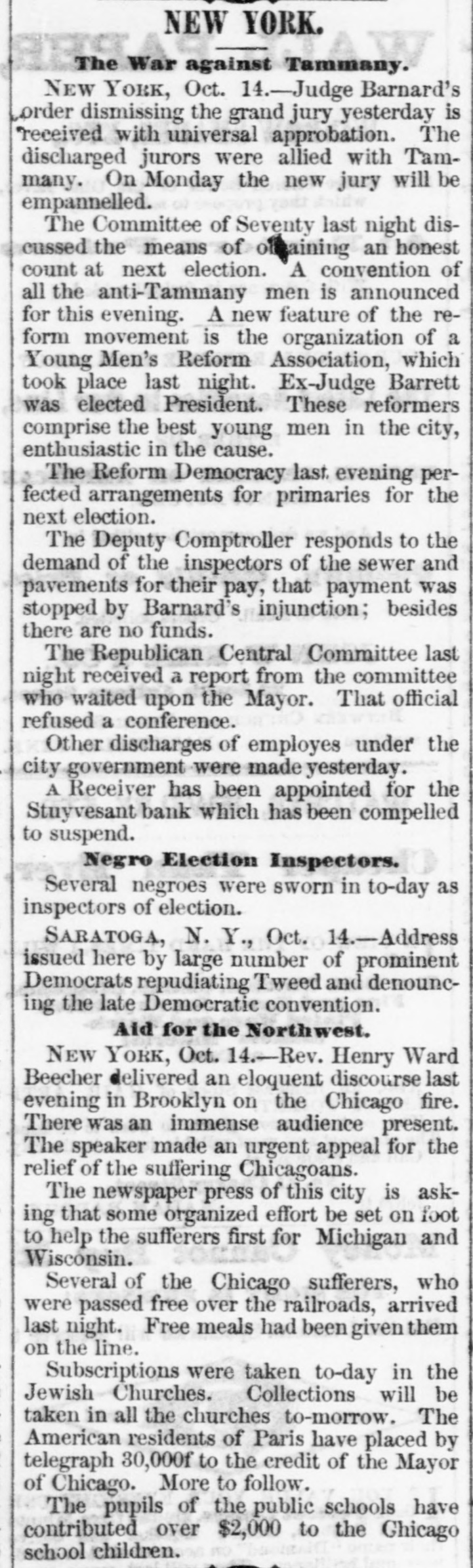
NEW YORK. The War against Tammany. NEW YORK, Oct. 14.-Judge Barnard's order dismissing the grand jury yesterday is "received with universal approbation. The discharged jurors were allied with Tammany. On Monday the new jury will be empannelled. The Committee of Seventy last night discussed the means of oftaining an honest count at next election. A convention of all the anti-Tammany men is announced for this evening. A new feature of the reform movement is the organization of a Young Men's Reform Association, which took place last night. Ex-Judge Barrett was elected President. These reformers comprise the best young men in the city, enthusiastic in the cause. The Reform Democracy last evening perfected arrangements for primaries for the next election. The Deputy Comptroller responds to the demand of the inspectors of the sewer and pavements for their pay, that payment was stopped by Barnard's injunction; besides there are no funds. The Republican Central Committee last night received a report from the committee who waited upon the Mayor. That official refused a conference. Other discharges of employes under the city government were made yesterday. A Receiver has been appointed for the Stuyvesant bank which has been compelled to suspend. Negro Election Inspectors. Several negroes were sworn in to-day as inspectors of election. SARATOGA, N. Y., Oct. 14.-Address issued here by large number of prominent Democrats repudiating Tweed and denouncing the late Democratic convention. Aid for the Northwest. NEW YORK, Oct. 14.-Rev. Henry Ward Beecher delivered an eloquent discourse last evening in Brooklyn on the Chicago fire. There was an immense audience present. The speaker made an urgent appeal for the relief of the suffering Chicagoans. The newspaper press of this city is asking that some organized effort be set on foot to help the sufferers first for Michigan and Wisconsin. Several of the Chicago sufferers, who were passed free over the railroads, arrived last night. Free meals had been given them on the line. Subscriptions were taken to-day in the Jewish Churches. Collections will be taken in all the churches to-morrow. The American residents of Paris have placed by telegraph 30,000f to the credit of the Mayor of Chicago. More to follow. The pupils of the public schools have contributed over $2,000 to the Ghicago school children.


Article from The New York Herald, October 15, 1871

Click image to open full size in new tab

Article Text

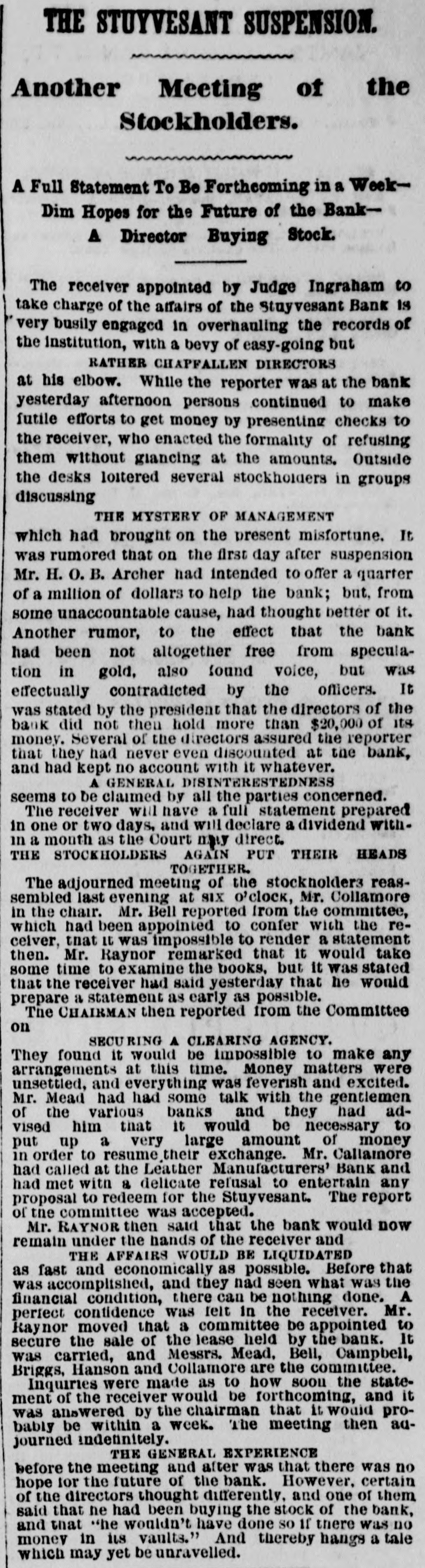
THE STUYVESANT SUSPENSION. the of Another Meeting Stockholders. A Full Statement To Be Forthcoming in a WeekDim Hopes for the Future of the BankA Director Buying Stock. The receiver appointed by Judge Ingraham to take charge of the affairs of the Stuyvesant Bank is very busily engaged in overhauling the records of the institution, with a bevy of easy-going but RATHER CHAPFALLEN DIRECTORS at his elbow. While the reporter was at the bank yesterday afternoon persons continued to make futile efforts to get money by presenting checks to the receiver, who enacted the formality of refusing them without giancing at the amounts. Outside the desks lottered several stockholders in groups discussing THE MYSTERY OF MANAGEMENT which had brought on the present misfortune. It was rumored that on the first day after suspension Mr. H. O. B. Archer had intended to offer a quarter of a million of dollars to help the bank; but, from some unaccountable cause, had thought better or it. Another rumor, to the effect that the bank had been not altogether free from speculation in gold, also found voice, but was effectually contradicted by the officers. It was stated by the president that the directors of the bank did not then hold more than $20,000 of its money. Several of the directors assured the reporter that they had never even discounted at the bank, and had kept no account with it whatever. A GENERAL DISINTERESTEDNESS seems to be claimed by all the parties concerned. The receiver will have a full statement prepared in one or two days, and will declare a dividend within a month as the Court may direct. THE STOCKHOLDERS AGAIN PUT THEIR HEADS TOGETHER. The adjourned meeting of the stockholders reassembled last evening at SIX o'clock, Mr. Collamore in the chair. Mr. Bell reported from the committee, which had been appointed to confer wich the receiver, that it was impossible to render a statement then. Mr. Raynor remarked that it would take some time to examine the books, but it was stated that the receiver had said yesterday that he would prepare a statement as early as possible. The CHAIRMAN then reported from the Committee on SECURING A CLEARING AGENCY. They found it would be impossible to make any arrangements at this time. Money matters were unsettled, and everything was feverish and excited. Mr. Mead had had some talk with the gentlemen of the various banks and they had advised him that it would be necessary to put up a very large amount of money in order to resume their exchange. Mr. Callamore had called at the Leather Manufacturers' Bank and had met with a delicate refusal to entertain any proposal to redeem for the Stuyvesant. The report of the committee was accepted. Mr. RAYNOR then said that the bank would now remain under the hands of the receiver and THE AFFAIRS WOULD BE LIQUIDATED as fast and economically as possible. Before that was accomplished, and they nad seen what was the financial condition, there can be nothing done. A perfect confidence was felt in the receiver. Mr. Raynor moved that a committee be appointed to secure the sale of the lease held by the bank. It was carried, and Messrs. Mead. Bell, Campbell, Briggs, Hanson and Collamore are the committee. Inquiries were made as to how soon the statement of the receiver would be forthcoming, and it was answered by the chairman that it would probably be within a week. The meeting then adjourned indefinitely. THE GENERAL EXPERIENCE before the meeting and after was that there was no hope for the future of the bank. However, certain of the directors thought differently, and one of them said that ne had been buying the stock of the bank, and that "he wouldn't have done SO If there was no money in its vaults." And thereby hangs a tale which may yet be unravelled.


Article from New-York Tribune, October 16, 1871

Click image to open full size in new tab

Article Text

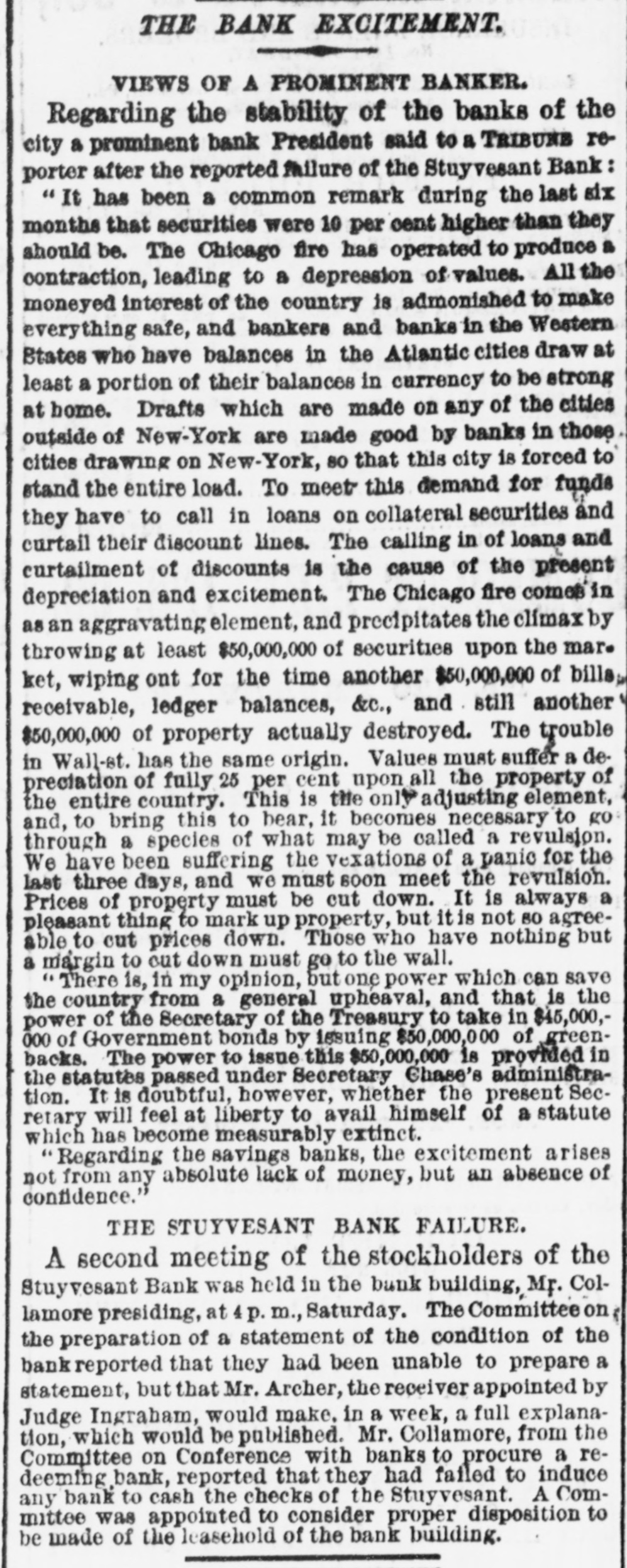
THE BANK EXCITEMENT. VIEWS OF A PROMINENT BANKER. Regarding the stability of the banks of the city a prominent bank President said to a TRIBUNE reporter after the reported failure of the Stuyvesant Bank " It has been a common remark during the last six months that securities were 10 per cent higher than they should be. The Chicago fire has operated to produce a contraction, leading to a depression of values. All the moneyed interest of the country is admonished to make everything safe, and bankers and banks in the Western States who have balances in the Atlantic cities draw at least a portion of their balances in currency to be strong at home. Drafts which are made on any of the cities outside of New-York are made good by banks in those cities drawing on New-York, 80 that this city is forced to stand the entire load. To meet this demand for funds they have to call in loans on collateral securities and curtail their discount lines. The calling in of loans and curtailment of discounts is the cause of the present depreciation and excitement. The Chicago fire comet in as an aggravating element, and precipitates the climax by throwing at least $50,000,000 of securities upon the mar. ket, wiping ont for the time another $50,000,000 of bills receivable, ledger balances, &c., and still another $50,000,000 of property actually destroyed. The trouble in Wall-et. has the same origin. Values must suffer a depreciation of fully 25 per cent upon all the property of the entire country. This is the only adjusting element, and, to bring this to bear, it becomes necessary to go through a species of what may be called a revulsion. We have been suffering the vexations of a panic for the last three days, and we must soon meet the revulsion. Prices of property must be cut down. It is always a pleasant thing to mark up property, but it is not 80 agreeable to cut prices down. Those who have nothing but a margin to out down must go to the wall. There 18, in my opinion, but one power which can save the country from a general upheaval, and that is the power of the Secretary of the Treasury to take in $45,000,000 of Government bonds by issuing $50,000,000 of greenbacks. The power to issue this $50,000,000 is provided in the statutes passed under Secretary Chase's administration. It is doubtful, however, whether the present Secretary will feel at liberty to avail himself of a statute which has become measurably extinct. Regarding the savings banks, the excitement arises not from any absolute lack of money, but an absence of confidence." THE STUYVESANT BANK FAILURE. A second meeting of the stockholders of the Stuyvesant Bank was held in the bank building, Mr. Collamore presiding, at 4 p. m., Saturday. The Committee on the preparation of a statement of the condition of the bank reported that they had been unable to prepare a statement, but that Mr. Archer, the receiver appointed by Judge Ingrabam, would make. in a week, a full explanation, which would be published. Mr. Collamore, from the Committee on Conference with banks to procure a redeeming bank, reported that they had failed to induce any bank to cash the checks of the Stuyvesant. A Committee was appointed to consider proper disposition to be made of the leasehold of the bank building.


Article from Public Ledger, October 24, 1871

Click image to open full size in new tab

Article Text

FINANCIAL PERIL. Causes of the Bank Excitement in New York. From the New York Tribune.] Regarding the stability of the banks of the city, a prominet bank president said to a Tribune reporter after the reported failure of the Stuyvesant bank: "It has been a common remark during the last six months that securities were ten per cent. higher than they should be. The Chicago fire has operated to produce a contraction, leading to a depression of values. All the moneyed interest of the country is admonished to make everything safe, and banks and bankers in the Western States who have balances in the Atlantic cities draw at least a portion of their balances in currency, to be strong at home. Drafts which are made on any of the cities outside of New York are made good by banks in those cities drawing the entire loan. To meet this demand for funds they have to call in loans on collateral securities and curtail their discount lines. The calling in of loans and curtailment of discounts is the cause of the present depreciation and excitement. OThe Chicago fire comes in as an aggravating element, and precipitates the climax by throwing at least $50,000,000 of securities upon the market, wiping out for the time another $50,000,000 of bills receivable, ledger balances, etc., and still another $50,000,000 of property actually destroyed. The trouble in Wall street has the same origin. Values must suffer a depreciation of fully twenty-five per cent. upon all the property of the entire country. This is the only adjusting element, and, to bring this to bear, it becomes necessary to go through a species of what may be called a revulsion. We have been suffering the vexations of a panic for the last three days, and we must soon meet the revulsion. Prices of property must be cut down. It is always a pleasant thing to mark up property, but it is not so agreeable to cut prices down. Those who have nothing but a margin to cut down must go to the wall. "There is, in my opinion, but one power which can save the country from a general upheaval, and that is the power of the Secretary of the Treasury to take in $45,000,000 of Government bonds by issuing $50,000,000 of greenbacks. The power to issue this $50,000,000 is provided in the statutes passed under Seeretary Chase's administration. It is doubtful, however, whether the present Secretary will feel at liberty to avail himself of a statute which has become measurably extinct. Regarding the Savings banks, the excitement arises not from any absolute lack of money, but an absence of confidence.


Article from Alexandria Gazette, December 6, 1871

Click image to open full size in new tab

Article Text

From New York. NEW YORK, Dec. 6.-The safe of the clerk of Middlesex county. New Jersey, was blown open at New Brunswick and valuable papers, but no money. stolen. The prisoner who froze to death in the Police station. Monday night. was Azet P. Newkirk. formeriv a lawver of Wisconsin. and late an agent of Van Amburg's menagerie. At the meeting of the Regul ir Republicau Central countiene. last night. it resolution was adopted that no more propositions of affiliation be made to the Greely wing At the annual meeting of the Methodists. at Syracuse yesterday, ati animated debate upon the Bible in the public schools took place, in which the determination was evinced that its being read should continue and a resolution was passed. unanimously urging upon the Legislature the passage of a law forbidding the use of public monies for sustaining sectarian schools and institutions. The failure of the Stuyvesant Bank promises to be a bad one. The receiver states that there were only 853 in the vaults when it suspended, and evidence shows $100,000 loaned to parties not responsible It is stated that the Bar Asseciation have articles of impeachment against Judge Cardoze, formed for immediate legislative action.


Article from New-York Tribune, December 6, 1871

Click image to open full size in new tab

Article Text

so WallNo. elected the followi officers: President-Capt Dunean. March and 8. V. WLIN Mecretary and Treasure M thewa. Executive Committee WITH 8. Booth, Removed Dwight and W.I. This bank will go into active operation as soon as new building of the Seatnen's Association is finished, the which will be about the 1st of January next. loestion will be favorable to its success, for it will be and directly among the mailors' boarding-houses, dry-tocks, ship-yand It will have the hearty cooperation of the Paymentor Department of the U. Navy-Yard. There 18 no other savings bank in the Seventh Ward, and there CAR be but little donbt that its very la boring population will gladty avail the insolves of the advantages it will offer them. THE STUYVESANT BANK FAILURE-ONLY 558 IN 118 VAULTS WHEN IT SUSPENDED. A turbalent meeting of the depositors of the pended vesant Bank was held last evening at the Mundair How 111 the chair. It appear that the amount of cash 111 the valus at the time of the suspension was only $53, and that the total Habill ie, $500,000. The liabilities to the Manufacturer," and Merchants' Bank were $71,000. Fifty thousand dollars have be 11 paid to Mr. Arch the Receive I'. The Com mittee appointed a: the previous meeting to love ligate the condition of the bank reported their inability to present a dear statement. The Merchants' and Manufacturers' Bank held a large surplus of collate which PRINT not be examined. Until Feb. 1, 1872 would be to Pender fall report. The Come is bone. Hatalie words be paid a targe recurrant of their deposits the President for 11 electing the (1) serve. Th building now made valuable 1. to down ou are nomin will be deposito with the Unit must Company. When the and en read, Mr. Gillespie, a demanded 101 how the depositor lay upon the them who had DISEASED money The rishier had stated that -100,000 in the vanits of the bank when it suspended. The Receiver on the contra said there was only 853 One of 11 stockholders and directors was a large bor rower, and had given security. and all the SEO khold had reveds inidend recently.to which they had not been entided. He wanted these men to come forward and explain their conduct. and that the matter should be immediately taken man the course A Here discussion followed. nd serious disturbance Mr. Rayner, fishier of the Merchants and Measfacturers Bank. expelled, as being a debtor o! the enjyvesant and an advocate of its cashier, Van Orten. Ultimately, Dr. Win. inelle and Wm. Giller DE were against Committee and the maching was and great disorder, until MADE BY THE GI ARDIN SIVINGS BANK DEPOSITORS ennounced in Tax TRISUNE a few making by the Office of the as ii, affairs Brennen, Commission :** of Charities Correction. visited various depositors and induced them rements to take less than the amounts representing that many of the heaviest creditors of the bank had agreed to do the same thing. H also tated, as a that argument with many of the b depositor that In lead himself placed $3,391 which longo to his children, in the bank and that he intended abaption my right to this money. in order to help the bank our of his troubles. The majority of the persons bad pie ed their money ia the Guard Hau Saving Bank 1001 people, and, when they were assured that 1. could obtain a les. sum more readily, the end ascritten part of their earnings. Delect live Dolan of the Sixth Preduct had deposited $193, and with the accrued interest the amount due him was 6503. Owing to the representations of Mr. Brennan he signed an agreement to receive $50 less. Mr. MeNa. mara of No. 4 Baxter-st. on a deposit not $1,900, was induced to take $300 less. Assistant Alderman Lysaght surrendered his claim to $1,000 out of a depos of 8.000. Oill, a policy-dealer, agreed to take $500 less than the $1,000 to his The Daniel Meehan Club, an which meets of Bayard had SIDE to its ry and agree through its Treasurer and Secret 10 850 less. Solomon Cohen of No. 6 Basic middle it b. Her arrangement them man, of his followdepositors, by securing the promise of the Trustees to give $900 for $1,000. John Byron or No. 21 Moll-st. had $400 to his credit and agreed to take $350. Michael Drammy from 8650 the W all $101. Jacob Cohen of No. 166 Caatham st., for adeposit tonceepts Ross Thompson. from it de posit of 8275, threw ett 895. Jones OR a deposit of 83,930. suggest to take ..... only $1,960. and vowed that unless he I've lived 11 at date me would prosecut 111+ truste and Per imbur... the widow, for whom he depo ii. out of His ova pocket.


Article from The Manitowoc Pilot, December 14, 1871

Click image to open full size in new tab

Article Text

of horses who, with all their doubtless enjoy infinitely more of the solid combite of existence than their unfortunate driver. But such is life. Rascals enjoy the rosewood and velvet while intelligent worth too often "walks the earth with bleeding feet." The weather has become intensely cold, and in twenty-four hours every skating rink and park in these latitudes will blossom into its fantastic winter display of circling forms and flirtations on ice. The water begins to stick in the half-frozen pipos like the amens in Macbeth's throat, and the public fountains are covered with the frosty beard of the dying year. Thanksgiving, for the first time, was celebrated as a national anniversary, and the people, having their bone to pick with the annual turkey, picked it clean. Millions of the patron saint were martyrized. The stores were closed; business was hid under a bushel, and the few wayfarers on the streets, hurrying homewards, looking as if they were taking a lingering meal with their on defunct gobblings. The unfortunates in the Public Institutions were treated to an extra dinner; and hilarity generally drifted from its moorings, and for the nonce travel around loose. The theatres are in full blast, and present unusual attractions; Nilsson, Capoul, Wachtel in opera; Edwin Booth in Hamlet; John E. Owens in Solon Shingle. Aime in Opera Bouffe; Sothern as Lord Dundreary, besides a dozen lesser lights are drawing fine audiences. The partial panic resulting from the suspension of the Bowling Green, the Guardian, and Stuyvesant Banks has abated. All of the institutions making a better showing than anticipated. and the depositors are reassured and hopeful. It is thought that pecuniary complications with some of the disgraced public officials may have had something to do with the "run" which compelled the banks to close their doors. The Mace-Cobura prize fight is regarded here in the unchristian parlance of the natives as a "put up job and disgust at the results extends even to the virtuous swells of the Upper Tendom. Why Coburn, the party of the first part, did not, with his "left duke" propound such a proposition on the knowledge-box of Mace, as to secure for that distinguished gladiator an obituary notice while in the zenith of his fame; and why Jem Mace, as a party of the second part, and true type of the muscular missionary, did not plump one bunch of fives" into the bread basket and with the other assault the of the aforesaid Coburn, in such a righteous manner, as to call for a first-class funeral, are questions which disturb this religious community. They don't understand the ways of Providence. Ten Japanese princes are at one of the New York hotals. They are minus pigland tails and to oriental drapery; in manners are evidently gentlemen by nature, and in speech, gentlemen by culture. Their command of English, especially when under sail among the vowels, is admirable in view of the fact that they learned it in their own country, but when they strike an archipelof our consonants ago Anglo-Saxon much they get lawfully wrecked, and act very as if they had a very severe attack of diptheria, or a piece of beef in their throats. Three cannibals are also en route-Fejee Islanders who have been dieting on the broiled elergymen. New York is in doubt S how to ovate them, and Delmonico is in despair at the prospect of being ordered to I serve up some of his boned friends-the PERSONNE. politicians.


Article from The New York Herald, January 3, 1872

Click image to open full size in new tab

Article Text

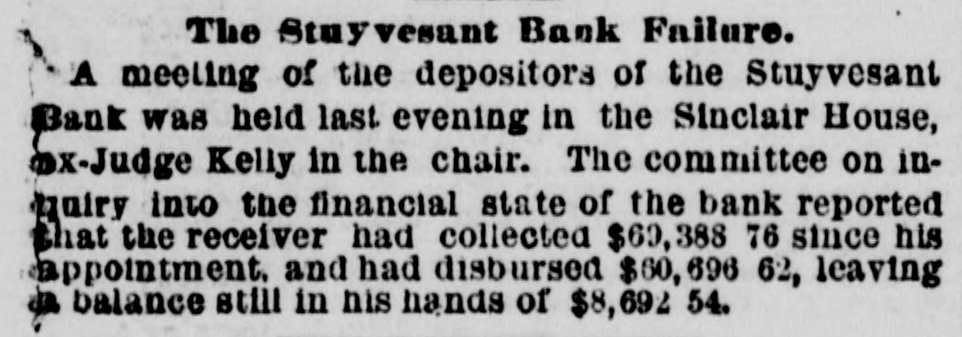
The Stuyvesant Bank Failure. A meeting of the depositors of the Stuyvesant Bank was held last evening in the Sinclair House, ox-Judge Kelly in the chair. The committee on inquiry into the financial state of the bank reported that the receiver had collected $69,388 76 since his appointment. and had disbursed $50,696 62, leaving balance still in his hands of $8,692 54.


Article from The New York Herald, February 6, 1872

Click image to open full size in new tab

Article Text

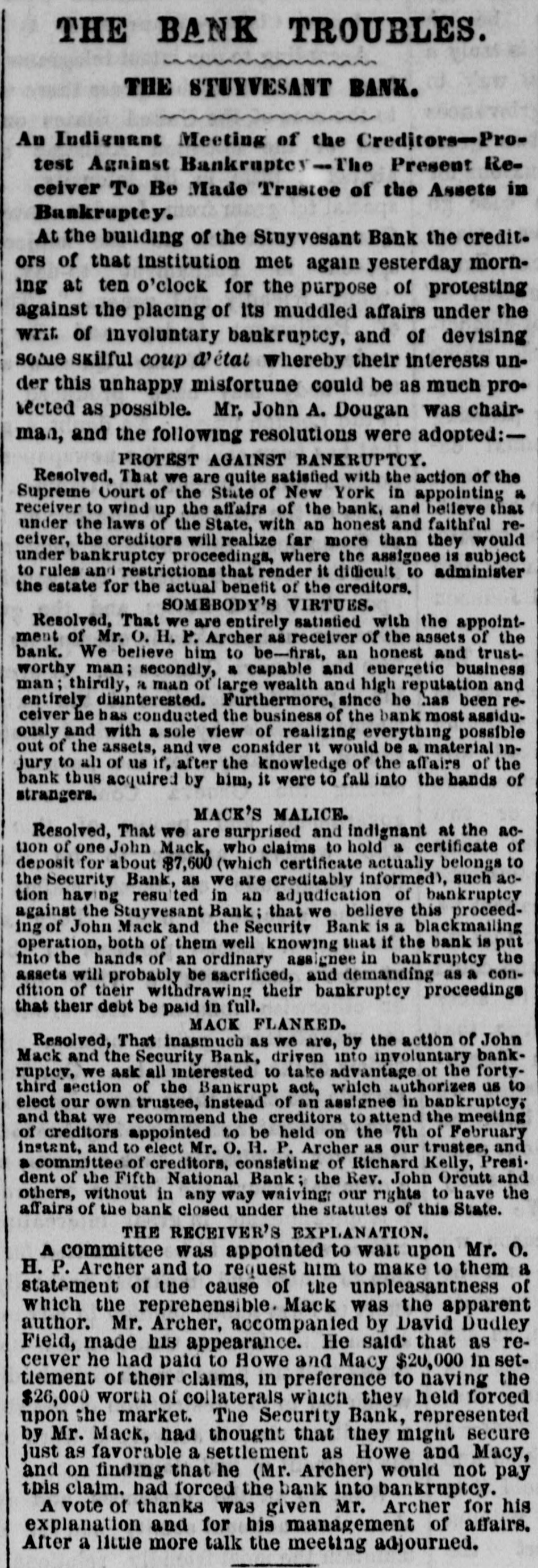
THE BANK TROUBLES. THE STUYVESANT BANK. An Indignant Meeting of the Creditors-Protest Against Bankruptey The Present Receiver To Be Made Trustee of the Assets in Bankruptcy. At the bunding of the Stuyvesant Bank the credit. ors of that institution met again yesterday morning at ten o'clock for the purpose of protesting against the placing of its muddled affairs under the writ of involuntary bankruptcy, and of devising softe skilful coup d'Γ©tat whereby their interests under this unhappy misfortune could be as much prorected as possible. Mr. John A. Dougan was chairman, and the following resolutions were adopted:PROTEST AGAINST BANKRUPTCY. Resolved, That we are quite satisfied with the action of the Supreme Court of the State of New York in appointing a receiver to wind up the affairs of the bank, and believe that under the laws of the State, with an honest and faithful receiver, the creditors will realize far more than they would under bankruptcy proceedings, where the assignee 18 subject to rules and restrictions that render it didicult to administer the estate for the actual benefit of the creditors. SOMEBODY'S VIRTUES. Resolved, That we are entirely satisfied with the appointment of Mr. O. H. P. Archer as receiver of the assets of the bank. We believe him to be-first, an honest and trustworthy man; secondly, a capable and euergetic business man; thirdly, a man of large wealth and high reputation and entirely disinterested. Furthermore, since he has been receiver he has conducted the business of the bank most assiduously and with a sole view of realizing everything possible out of the assets, and we consider it would be a material injury to all of us if, after the knowledge of the affairs of the bank thus acquired by him, it were to fall into the hands of strangers. MACK'S MALICE. Resolved, That we are surprised and indignant at the action of one John Mack, who claims to hold a certificate of deposit for about $7,600 (which certificate actually belongs to the Security Bank, as we are creditably informed), such action having resulted in an adjudication of bankruptcy against the Stuyvesant Bank: that we believe this proceeding of John Mack and the Security Bank is a blackmailing operation, both of them well knowing that if the bank is put into the hands of an ordinary assignee in bankruptcy the assets will probably be sacrificed, and demanding as a condition of their withdrawing their bankruptcy proceedings that their debt be paid in full. MACK FLANKED. Resolved, That inasmuch as we are, by the action of John Mack and the Security Bank, driven into involuntary bankruptcy, we ask all interested to take advantage ot the fortythird section of the Bankrupt act, which authorizes us to elect our own trustee, instead of an assignee in bankruptcy, and that we recommend the creditors to attend the meeting of creditors appointed to be held on the 7th of February instant, and to elect Mr. O. H. P. Archer as our trustee, and a committee of creditors, consisting of Richard Kelly, President of the Fifth National Bank; the Rev. John Orcutt and others, without in any way waiving our rights to have the affairs of the bank closed under the statutes of this State. THE RECEIVER'S EXPLANATION. A committee was appointed to wait upon Mr. O. H. P. Arcner and to request him to make to them a statement of the cause of the unpleasantness of which the reprenensible. Mack was the apparent author. Mr. Archer, accompanied by David Dudley Field, made his appearance. He said. that as receiver he had pata to Howe and Macy $20,000 in settlement of their claims, in preference to naving the $26,000 worth of collaterals which they held forced upon the market. The Security Bank, represented by Mr. Mack, nad thought that they might secure just as favorable a settlement as Howe and Macy, and on finding that he (Mr. Archer) would not pay this claim. had forced the bank into bankruptcy. A vote of thanks was given Mr. Archer for his explanation and for his management of affairs. After a little more talk the meeting adjourned.


Article from New-York Tribune, February 6, 1872

Click image to open full size in new tab

Article Text

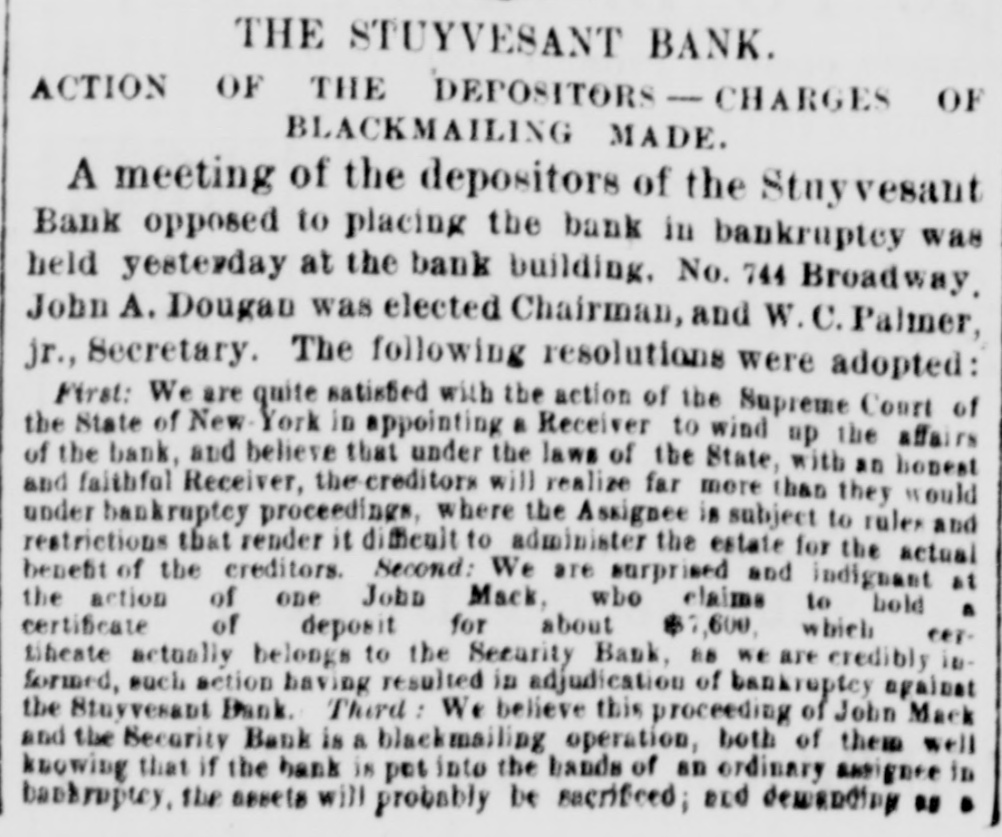
THE STUYVESANT BANK. ACTION OF THE DEPOSITORS - CHARGES OF BLACKMAILING MADE. A meeting of the depositors of the Stuyvesant Bank opposed to placing the bank in bankruptcy was held yesterday at the bank building. No. 744 Broadway John A. Dougan was elected Chairman, and W. C. Palmer, jr., Secretary. The following resolutions were adopted: First: We are quite satisfied with the action of the Supreme Court of the State of New York in appointing a Receiver to wind up the affairs of the bank, and believe that under the laws of the State, with an honest and faithful Receiver, the creditors will realize far more than they would under bankruptcy proceedings, where the Assignee is subject to rules and restrictions that render it difficult to administer the estate for the actual benefit of the creditors. Second: We are surprised and indignant at the action of one Jobo Mack, who claims to bold a certificate of deposit for about $1,600 which cer. tiheate actually belongs to the Security Bank, as WE are credibly informed, such action having resulted in adjudication of bankruptcy against the Stuyvesant Bank Third We believe this proceeding of John Mack and the Security Bank is a blackmailing operation, both of them well knowing that if the bank is pet into the bands of an ordinary assignee in backruptey, the assets will probably be sucrificed and demanding as .


Article from New-York Tribune, February 8, 1872

Click image to open full size in new tab

Article Text

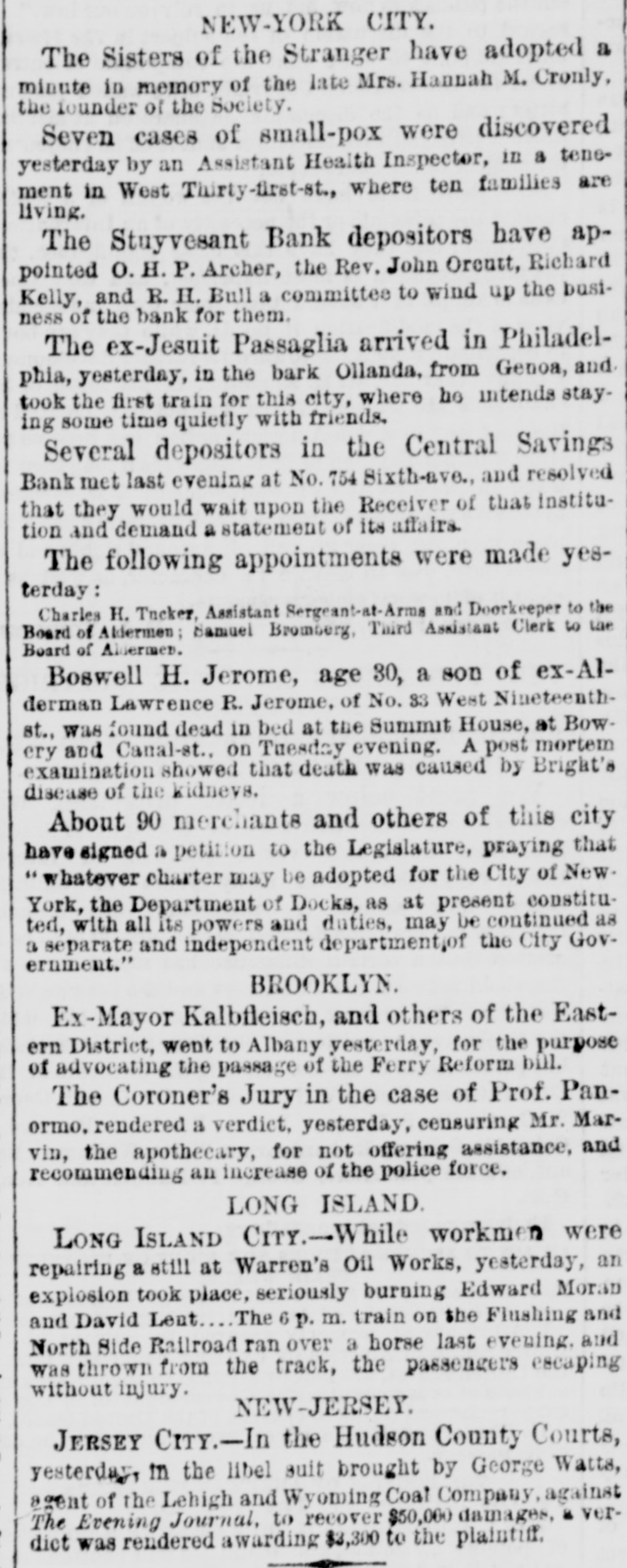
NEW-YORK CITY. The Sisters of the Stranger have adopted a minute in memory of the late Mrs. Hannah M. Cronly, the founder of the Society. Seven cases of small-pox were discovered yesterday by an Assistant Health Inspector, in a tenement in West Thirty-first-st., where ten families are living. The Stuyvesant Bank depositors have appointed O.H.P.Archer, the Rev. John Orcutt, Richard Kelly, and R. H. Bull a committee to wind up the business of the bank for them. The ex-Jesuit Passaglia arrived in Philadelphia, yesterday, in the bark Ollanda, from Genoa, and took the first train for this city, where he intends staying some time quietly with friends. Several depositors in the Central Savings Bank met last evening at No. 754 Sixth-ave., and resolved that they would wait upon the Receiver of that institution and demand a statement of its affairs. The following appointments were made yesterday: Charles H. Tucker, Assistant Sergeant-at-Arms and Doorkeeper to the Board of Aldermen; Samuel Bromberg, Third Assistant Clerk to the Board of Alternet. Boswell H. Jerome, age 30, a son of ex-Alderman Lawrence P.. Jerome, of No. 33 West Nineteenthst., was found dead in bed at the Summit House, at Bowery and Canal-st., on Tuesday evening. A post mortem examination showed that death was caused by Bright's disease of the kidneys. About 90 merchants and others of this city have signed a petition to the Legislature, praying that whatever charter may be adopted for the City of New. York, the Department of Docks, as at present constituted, with all its powers and duties, may be continued as a separate and independent department of the City Government." BROOKLYN. Ex-Mayor Kalbfleisch, and others of the Eastern District, went to Albany yesterday, for the purpose of advocating the passage of the Ferry Reform bill. The Coroner's Jury in the case of Prof. Panormo. rendered a verdict, yesterday, censuring Mr. Marvin, the apothecary, for not offering assistance, and recommending an increase of the police force. LONG ISLAND LONG ISLAND CITY.-While workmen were repairing a still at Warren's Oil Works, yesterday, an explosion took place, seriously burning Edward Moran David Leut The 6 p. m. train on the Flushing and and North Side Railroad ran over a horse last evening. and was thrown from the track, the passengers escaping without injury. NEW-JERSEY. JERSEY CITY.-In the Hudson County Courts, yesterday in the libel suit brought by George Watts, agent of the Lehigh and Wyoming Coal Company, against The Evening Journal, to recover $50,000 damages, a verdiet was rendered awarding $3,300 to the plaintiff.


Article from The New York Herald, February 14, 1872

Click image to open full size in new tab

Article Text

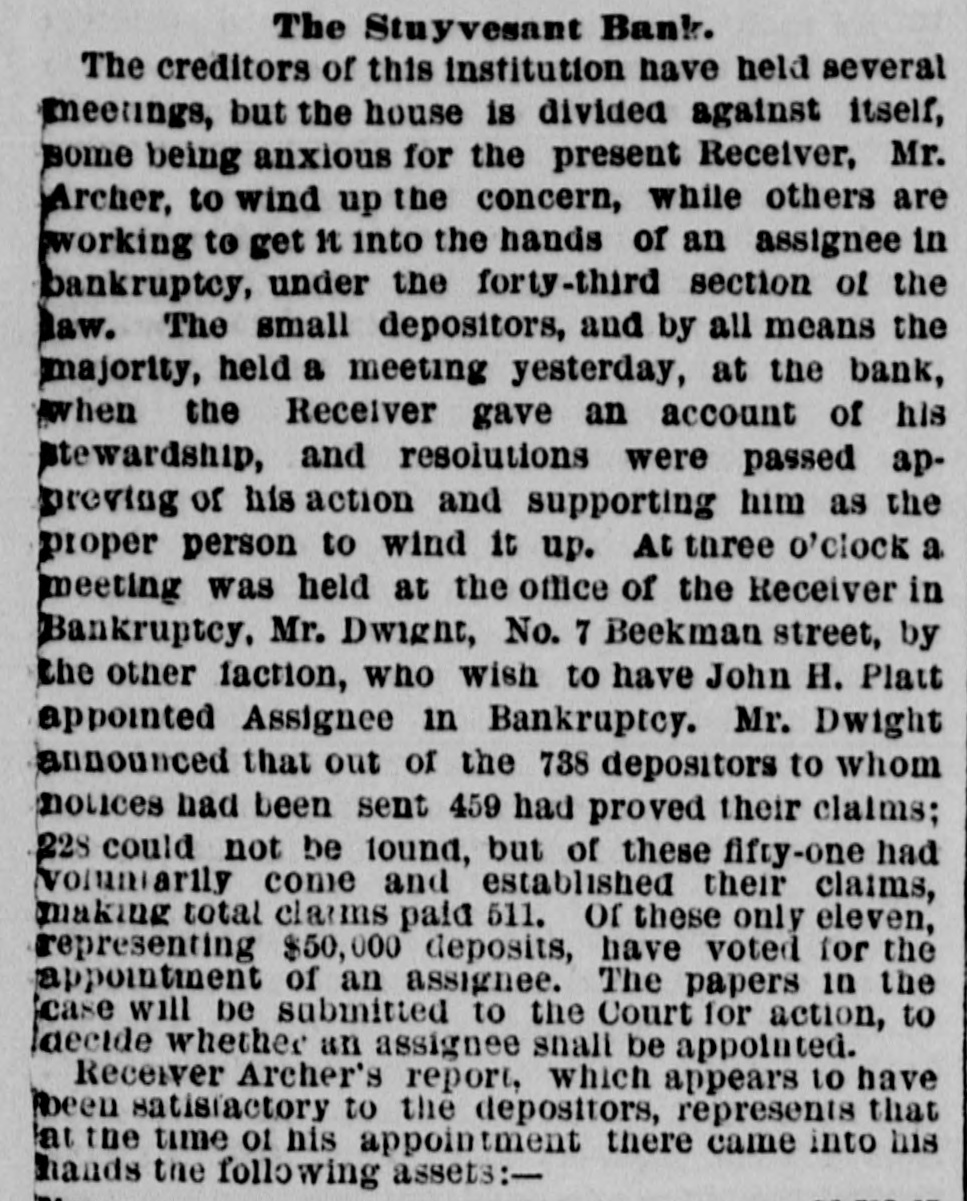
The Stuyvesant Bank. The creditors of this institution have held several meetings, but the house is divided against itself, Bome being anxious for the present Receiver, Mr. Archer, to wind up the concern, while others are working to get n into the hands or an assignee in bankruptcy, under the forty-third section of the law. The small depositors, and by all means the majority, held a meeting yesterday, at the bank, when the Receiver gave an account of his stewardship, and resolutions were passed appreving or his action and supporting him as the proper person to wind it up. At three o'clock a meeting was held at the office of the Receiver in Bankruptcy, Mr. Dwight, No. 7 Beekman street, by the other faction, who wish to have John H. Platt appointed Assignee in Bankruptcy. Mr. Dwight announced that out of the 738 depositors to whom notices had been sent 459 had proved their claims; 228 could not be tound, but of these fifty-one had voluniarily come and established their claims, making total claims paid 511. or these only eleven, representing $50,000 deposits, have voted for the appointment of an assignee. The papers in the case will be submitted to the Court for action, to laecide whether an assignee snall be appointed. Receiver Archer's report, which appears to have Roeen satisfactory to the depositors, represents that at the time of his appointment there came into his hands the following assets:-


Article from New-York Tribune, March 21, 1872

Click image to open full size in new tab

Article Text

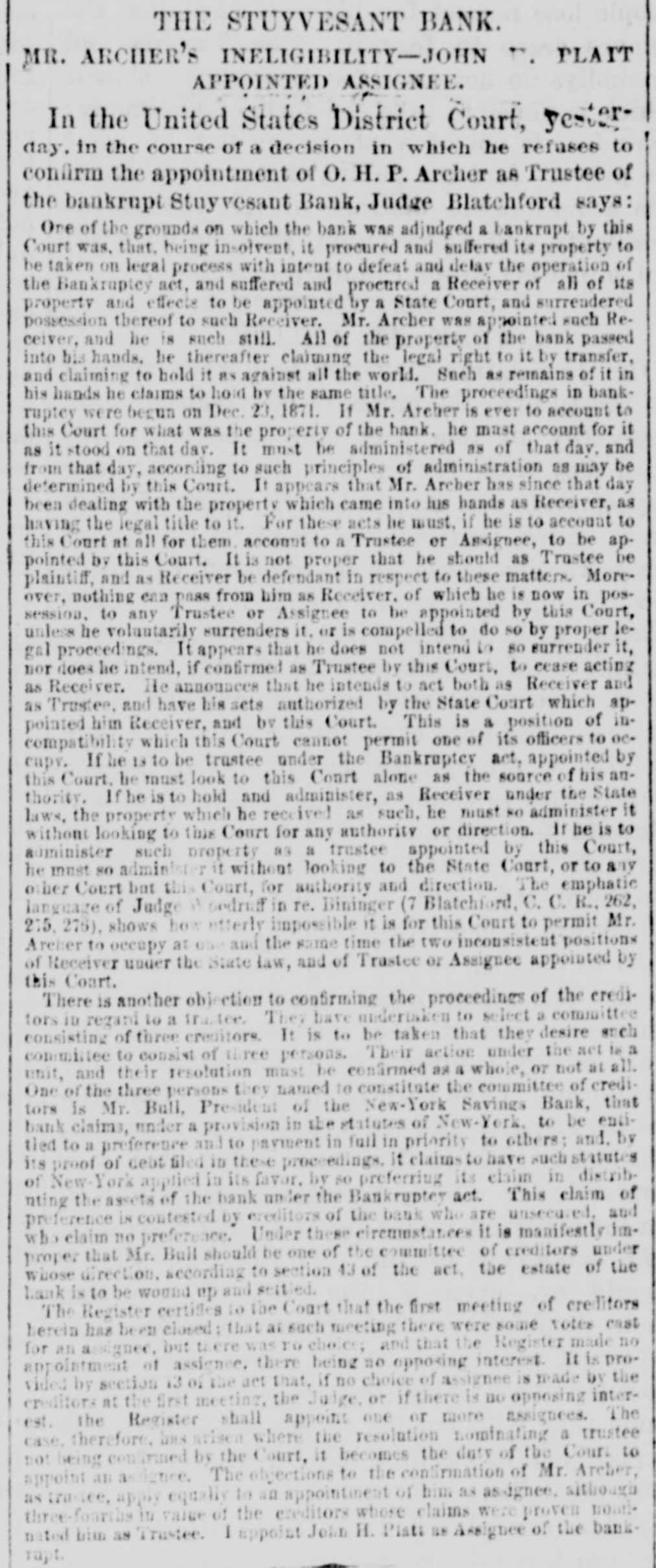
THE STUYVESANT BANK. PLAIT MR. ARCHER'S INELIGIBILITY-JOHN APPOINTED ASSIGNEE. In the United States District Court, yes day. in the course of a decision in which he refuses to confirm the appointment of O. H. P. Archer as Trustee of the bankrupt Stuy vesant Bank, Judge Blatchford says: One of the grounds on which the bank was adjudged a bankrapt by this Court was. that. being insolvent. it procured and suffered its property to be taken on legal process with intent to defeat and delay the operation of the Bankraptey act, and suffered and procured a Receiver of all of its property and effects to be appointed by a State Court, and surrendered possession thereof to such Receiver. Mr. Archer was appointed such Receiver, and he is such still. All of the property of the bank passed into his hands. he thereafter claiming the legal right to it by transfer, and claiming to hold it as against all the world. Such as remains of it in his hands he claims to hold by the same title. The proceedings in bank ruptey were begun on Dec. 23, 1871. If Mr. Areber is ever to account to this Court for what was the property of the bank. he mast account for it as it stood on that dav. It must be administered as of that day, and from that day, according to such principles of administration as may be determined by this Court. It appears that Mr. Areber has since that day been dealing with the property which came into lus hands as Receiver, as having the legal title to it. For these acts he must. if be is to account to this Court at all for them account to a Trustee or Assignee, to be appointed by this Court. It is not proper that he should as Trustee be plaintiff, and as Receiver be defendant in respect to these matters. Moreover, nothing eaa pass from him as Receiver. of which he is now in possessioa, to any Trustee or Assignee to be appointed by this Court, unless he voluntarily surrenders it. or is compelled to do so by proper legal proceedings. It appears that he does not intend to 80 surrender it, nor does he intend, if confirmed as Trustee by this Court, to cease acting as Receiver. He announces that he intends to act both as Receiver and as Trustee. and have his sets authorized by the State Court which appoiated him Receiver, and by this Court. This is a position of incompatibility which this Court cannot permit one of its officers to occopy. If he 13 to be trustee under the Bankruptey act, appointed by this Court. he must look to this Court alone as the source of his anthority. If he is to hold and administer, as Receiver under the State laws, the property which he received as such. he must so administer it without looking to this Court for any authority or direction. If be is to administer such property as a trustee appointed by this Court, he must so admin it without looking to the State Court, or to any other Court but this Court, for authority and direction. The emphatic language of Judge ondriff in re. Bininger (7 Blatchford, C. C. R., 262, 215. 276). shows how utterly impossible it is for this Court to permit Mr. Areher to occupy at one and the same time the two inconsistent positions of Receiver under the State law, and of Trastee or Assignee appointed by this Coart. There is another objection to confirming the proceedings of the creditors in regard to a They have undertaken to select a committee consisting of three creditors. It is to be taken that they desire such committee to consist of three persons. Their action under the act is a unit, and their resolution must be confirmed as a whole, or not at all. One of the three persons they named to constitute the committee of creditors is Mr. Bull, President of the New-York Savings Bank, that bank claims, under a provision in the statutes of New-York to be entitied to a preference and to pavment in full in priority to others: and, by its proof of debt filed in these proceedings. it claims to have such tatutes of New-York applied in its favor, by so preferring its claim in distribof uting the assets of the bank under the Bankruptey act. This claim preference is contested by creditors of the bank who are unsecured. and who claim no preference. Under these circumstances it is manifestly improper that Mr. Bull should be one of the committee of creditors under whose direction. according to section 43 of the act. the estate of the bank is to be wound up and settled. The Register certifies to the Court that the first meeting of creditors hereia has been closed: that at such meeting there were some voter east for an assignee. but there was TO choice; and that the Register made no appointment of assignee. there being no opposing interest it is provideo by section 13 01 the act that, if no choice of assignee is made by the creditors at the first meeting. the Judge. or if there is no opposing interest. the Register shall appoint one or more assignees. The case, therefore, has arisen where the resolution nominating a trustee not being confirmed by the Court, it becomes the duty of the Court to appoint an signce. The objections to the confirmation of Mr. Archer, as apply equally to an appointment of him as assignee. aithough three-fourths in rate of the creditors whose claims were proven nome nated bim as Trustee. I appoint John H. Plata as Assignee of the bank rapt.


Article from The Portland Daily Press, December 23, 1872

Click image to open full size in new tab

Article Text

ertions of the firemen the fire was confined to the church. The roof fell in at half-past ten o'clock and soon after the cupola, containing a bell weighing 2000 pounds. The tabernacle was erected in 1870 at a cost of $75,000, and being built of corrugated iron was regarded as fire proof. Loss $95,000; insurance $45,000. # Various Matters. One policeman was dangerously and two others badly wounded, while suppressing a riot in a ball room on Ninth avenue this morning. Several arrests were made. The steamer storehouse on the Hamburg dock at Hoboken was robbed last night of four cases of silks and one case of foreign illustrated papers. Their value was over $19,000. The settlement of Jay Gould with the Erie railway was consummated to-day. Amongst the property reverting to the company are the Grand Opera House, in which Fisk's widow was interested, and other buildings on the same street. A citizens' indignation meeting at Saratoga resolved that the advertised cock fight with attendant roughs from New York and Troy, shall not take place in Saratoga. The deaths of the week were 527. N. B. Duryea, murdered by Simmons, was buried at Greenwood to-day with Masonic honors. Arrived, steamships Adriatic and Canada, from Liverpool. Four members of the Louisiana citizens' committee to-day held interviews with some members of Congress here, seeking advice. Count Armin of the German legation sailed for Europe to-day. All testimony in the case of Dr. Irish, charged with poisoning E. O. Anderson, was concluded to-day. The case will be summed up Monday. The Mount Clair branch of the Midland railroad has been completed to Jersey City, at an expense of $4,000,000. Two hundred and thirty of the destitute Italians that recently arrived here, left yesterday for Richmond, Va., to work on railroads in that State. The German Democratic General Committee last night reaffirmed the principles of the Cincinnati platform, and took steps to re-organize on its principles. Six professional nines are announced to be in the base ball field next season. The Receiver of the Stuyvesant Bank makes the statement that the amount of assets are $668,115, and the liabilities $627,440. The Portsmouth has sailed for the South Pacific on an exploring expedition. While the vessel was being towed by the Catalpa yesterday, the latter burst her steam pipes. Nobody hurt.


Article from New-York Tribune, March 12, 1873

Click image to open full size in new tab

Article Text

WEDNESDAY. MARCH 12. 1873. REAL ESTATE Situations Wanted--Itlales. New-York Taeslay, March 11, 1873. PLAIN GARDENER or FARMER-By an American man, single, aged 26 years; understands all branches of Notwithstanding the unpleasant weather the Exfarming, stock, keeping machines in order: also. plain gardening. Best references. Apply at 138 West Eleventh-st. corner Sixth ave change was quite numerously attended this morning, and the following public sales were made: W ANTED-A situation as GARDENER by By Muller, Wilkins & Co., the four story brick store and lot, 23.5 an industrious and intelligent young German man. Gentleman's place preferred. City reference can he given. front, rear irregular by about 60.4, located on the northerly side of WaterK. ST., P. O. Box 144, Astoria. st., 133 feet easterly from Coenties-slip, for $14,300 to Wm. King. and the two-story and attie briek house and lot, 25x45x116, located on the ANTED-By an energetic and reliable southerly side of Amity-st., 50 feet weaterly from Sullivan-st., for $15,000 W young man a POSITION as AGENT to go to the Vienna Exhibito I. Blackwell. tion ilbest of references given. Address No. 912 E-st., Washington, D. C. The same firm also sold by order of Walter Carter, executor, the 4. story brick store and dwelling house and lot, 24.23.62.2 (there is a 3W ANTED-A SITUATION as GARDENER story brick extension on rear), located on the south-easterly corner of by a single man who thoroughly understands his business. Address Sixth-ave. and Twenty-eighth-et., known as No. 461, for $44,000, to 8. J. C., 163 East Seventy-eighth-st. Rich; and the 4-story brown stone similar parcel, located next adjoining on the south, to the same purchaser," for $37,100. Also, to the same purchaser, the 3-story brick, high-stoop house and lot. 14.9x49.3, located Situations (Danted--females on the southerly side of Twenty-eighth-st., adjoining the rear of the above mentioned corner parcel, for $11,525, and the next westerly adjoining similar parrel, for $13,100, to Lewis Bradford. LADY wishes the position of COPYIST in By Richard V. Harnett, one lot, 25x98.9, located on the northerly A an office, insurance preferred. Address, or can be seen Friday or gide of Thirty-third-st., 375 feet westerly from Tenth-ave., for $6,000, Saturday afternoon, from 2 to 5, E. T. L., Ladies' Christian Association, to M. N. White. 64 Irving place. By Dingee, Porter & Co., acting by legal order. under the direction of Robert Cochran. referee the several brick buildings and sheds and lot, PLEASANT and refined young LADY, 24.11 x186, located on the easterly side of the Bowery. 150 feet northA good writer for the press. Her own mistress, with no family. Aderly from Rivington- known as No. 227, for $51,500, to John W. Mills. dress C. FREDERICKS, 174 Chrystie. the holder of a mortgage on the property. The most important sale of the day and, as was evident, the one atNUMBER of German SERVANTS contracting the most attention was made by Jos. McGuire, who sold the A stantly found at the German Bureau, 127 Norfolk-st. between M. HILD. seven lots, each 25.24x75, located on the easterly side of the Boulevard, Rivington and Stanton-sts. commencing on the north-easterly corner of One-hundred-and-ninth-st., YOUNG WOMAN desires a situation as together with the two lots adjoining on the rear, fronting on the street, each 25x an average of about 153 feet. The whole plot was sold together A WET NURSE; good references can be furnished. Call or address for $70,000 to Jos. Wangler. The price obtained for this plot is looked MISS CHARLES, 174 Hamilton-ave., Brooklyn. L. I. and can only be partially all of the money S NURSERY GOVERNESS, Governess, upon that the as very terms low. of sale require purchase accounted for by to undoubt- be the paid fact on or before the 1st of April. Had the terms been more easy, A' Companion, or Teacher in a school. Address Miss B., Box 243, Orange, N. J. edly a much larger price would have been realized. The legal sales noted to be made by this same auctioneer, under the direction of Wm. H. YOUNG person who is quick at figures to Leonard, referee. were both adjourned. Due notice will be given when A assist in making out cash, &.C. Address Y. z., Post-Office, they are to take place. Station E. V. K. Stevenson,jr put up the three-story. high-stoop brick house and lot. 20x50x92. located and known as No. 45 East Eighteenth-st. HAMBERMAID AND WAITRESS.which was knocked down for $25,000 to Horace B. Rush. WANTED-By : young woman a SITUATION, in a boarding-house A. J. Bleecker Son & Co. adjourned until the 1st prox. the legal sale preferred; has first-class recommendations. Call at 1,221 Third-ave., Top noted to be made under the direction of John Pyne, referee. property loFloor. cated on northerly side of Twenty-first-st., 235.4 feet westerly from Ninth-ave. OUSEKEEPER or GOVERNESS.-A young The following sales are annonticed for Wednesday, March 12: H German lady, good musician, who speaks also French and English, By James M. Miller, legal sale, under the direction of Wm. H. Leondersires SITUATION as Governess or Governess and Housekeeper in a ard, referee, one lof. 15x100.10 together with the building thereon, logentleman's family; highest recommendation from present situation, cated on the southerly side of Oue-hundred-and-thirteenth-st., 200 feet where she has been for two years; very kind and experienced with invaeasterly from Tenth-# lids. Address Tribune Office. Trustees sale of house and lot, 20.9x100, located on the northerly side of Twelfth-st 318 feet 11 inches easterly from Sixth-ave. and three lots, ADIES desiring to employ good first-class 75x93.9, located on the southerly side of Twenty-fourth-st. commencing I colored HELP will please call on 81 feet inches easterly from First-ave.; and two houses and lots, CHARLES L. SANDERS (Successor to John P. Randolph), 53.4x55:95, located on the easterly side of First-ave 71 feet 94 inches No. 75 Fourth-ave. (cor. Tenth-st.) in basement. southerly from One-hundred-and-thirteenth-st. as YOUNG WOMAN By D. M. Seaman, the three-story brown-stone house and lot, 18.9x 100.5, located on the southerly side of Forty-seventh st., 437 feet 6 inches SEAMSTRESS-A Seamstress; has no objection to see to growing children. Can be easterly from Seventh-are seen at her present employer's, 221 Second-ave. By E. H. Ludlow & Co., the lease on the premises located and known ITUATION WANTED-By a respectable as No. 744 Broadway. south easterly corper of Astor place, by order of John H. Platt. receiver of the Stayvesant Bank. S young American woman, as NURSE and PLAIN SEAMSTRESS; best city reference. Call at 376 East Eighth-st. Legal sale under the direction of Wm. Blaikie, referee, the lots, 51x100, located on the westerly side of Third-ave., 51 feet 2 inches northerly from Seventy-sixth-st. and the lots, 51.4x102.2, adjoining the above WANTED.-Any lady or party desirous of obtaining a young lady of culture and refinement as companion on the rear fronting on the street. On the premises there are buildings while traveling abroad the coming season, can correspond with such by used as a planing mill addressing Lock Box 854, Worcester, Mass. Best of references By Jas. C. Eadie, a number of parcels of property located on South given and required. Ninth-st. South Fourth and Fourth-sts. The Church property. north. west corner of Fourth and South Third-sts., and other parcels, all located in Brooklyn, L.L. By Joseph McGuire, legal sale under the direction of Henry Nicoll, Occon Steamers. referee. The buildings and lot, 25x37.6, located on the westerly side of Allen-st. known as No. 199, being between Stanton and Houston-sta By Jere. Johnson, jr., to be sold at the salesrooms Nos. 399 and 401 RAFTS ON IRELAND. Fulton-st Brooklyn, the nine stores and dwellings located and known as TAPSCOTT'S EMIGRATION and FOREIGN EXCHANGE Nos. 223 225. 227, 316, 328, 330, 332, 485, 510, and 860 Atlantic-ave., OFFICE 86 South-st.-Draft from Β£1 upward, available in all parts of Brooklyn, L. I. Great Britain and Ireland, and passage tickets by steamships and sailing By A. J. Bleecker. Son & Co., legal sale under the direction of Philo packets issued at lowest rates by T. Ruggles. referee, house and lot, 24.4jx100, located and known as No. TAPSCOTT. BROS. & Co., 86 South-st New-York. 254 Madison-ave. LOR ST. THOMAS.and BRAZIL.
Article from New-York Tribune, March 22, 1873

Click image to open full size in new tab

Article Text

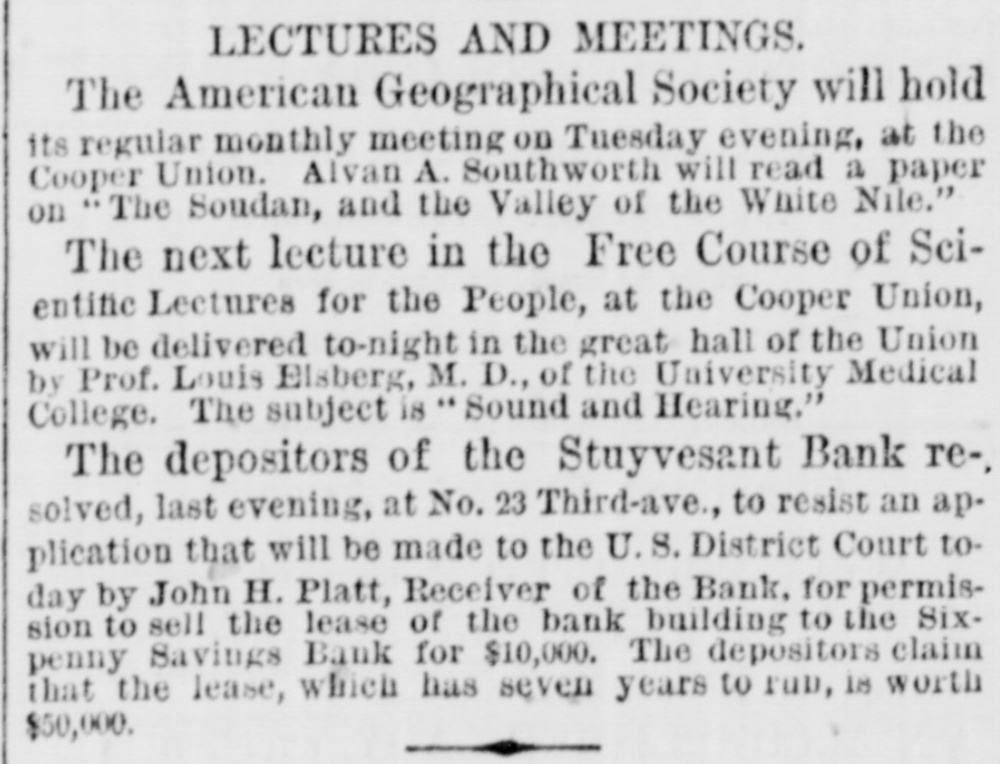
LECTURES AND MEETINGS. The American Geographical Society will hold its regular monthly meeting on Tuesday evening, at the Cooper Union. Alvan A. Southworth will read a paper on "The Soudan, and the Valley of the White Nile." The next lecture in the Free Course of Scientific Lectures for the People, at the Cooper Union, will be delivered to-night in the great hall of the Union by Prof. Louis Elsberg, M. D., of the University Medical College. The subject is "Sound and Hearing." The depositors of the Stuyvesant Bank re-, solved, last evening, at No. 23 Third-ave., to resist an application that will be made to the U.S. District Court today by John H. Platt, Receiver of the Bank, for permission to sell the lease of the bank building to the Sixpenny Savings Bank for $10,000. The depositors claim that the lease, which has seven years to run, 18 worth $50,000.


Article from The New York Herald, June 18, 1874

Click image to open full size in new tab

Article Text

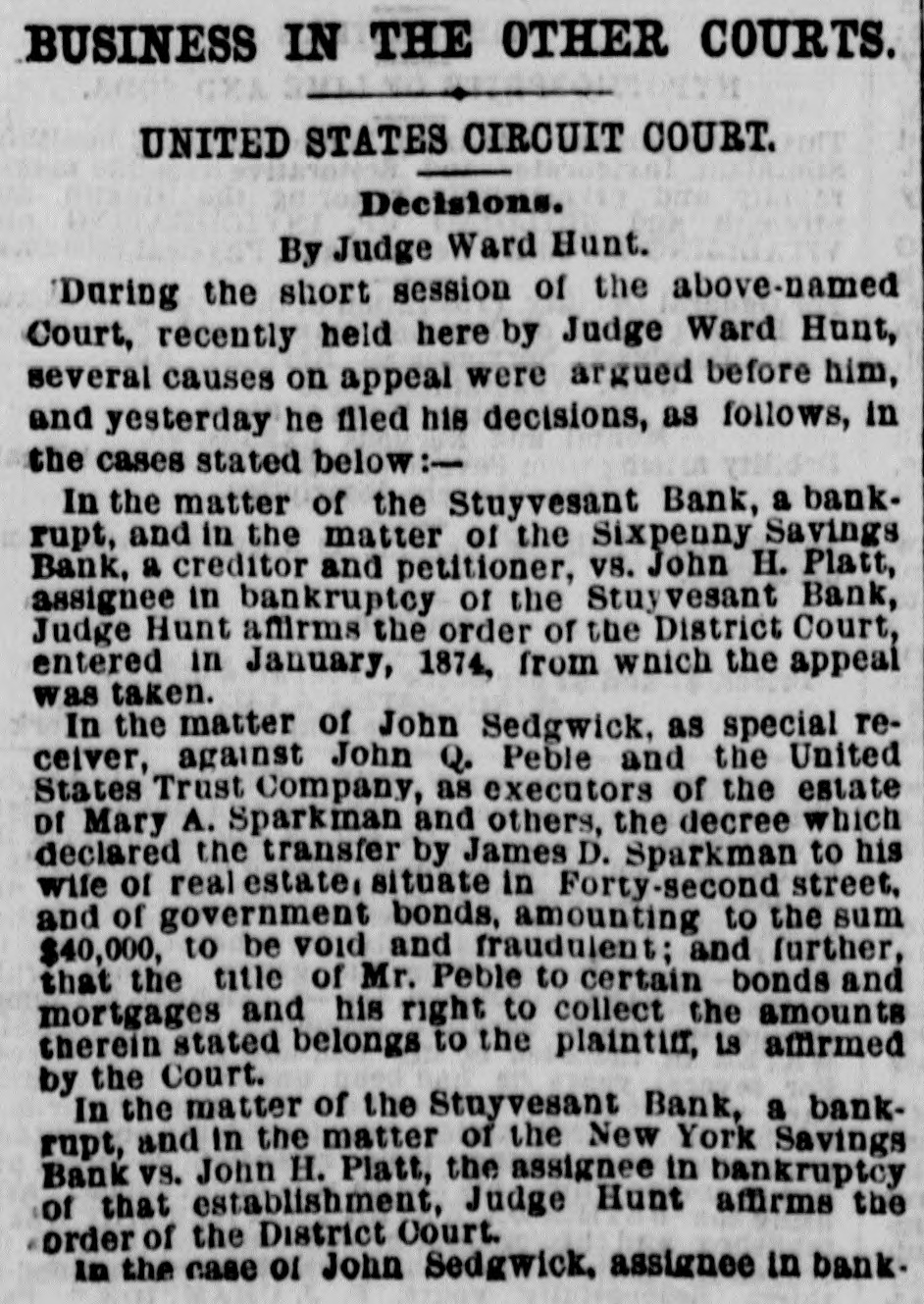
BUSINESS IN THE OTHER COURTS. UNITED STATES CIRCUIT COURT. Decisions. By Judge Ward Hunt. During the short session of the above-named Court, recently held here by Judge Ward Hunt, several causes on appeal were argued before him, and yesterday he filed his decisions, as follows, in the cases stated below:In the matter of the Stuyvesant Bank, a bankrupt, and in the matter of the Sixpenny Savings Bank, a creditor and petitioner, vs. John H. Platt, assignee in bankruptcy of the Stuyvesant Bank, Judge Hunt affirms the order of the District Court, entered in January, 1874, from which the appeal was taken. In the matter of John Sedgwick, as special receiver, against John Q. Peble and the United States Trust Company, as executors of the estate of Mary A. Sparkman and others, the decree which declared the transfer by James D. Sparkman to his wife of real estate, situate in Forty-second street, and of government bonds, amounting to the sum $40,000, to be void and fraudulent; and further, that the title of Mr. Peble to certain bonds and mortgages and his right to collect the amounts therein stated belongs to the plaintiff, is affirmed by the Court. In the matter of the Stuyvesant Bank, a bankrupt, and in the matter of the New York Savings Bank vs. John H. Platt, the assignee in bankruptcy of that establishment, Judge Hunt affirms the order of the District Court. in the case 01 John Sedgwick, assignee in bank-


Article from The New York Herald, November 13, 1874

Click image to open full size in new tab

Article Text

# BENNETT BUILDING. BENNETT BUILDING. DIRECTORY. Rooms BASEMENT. 1-Lawrence & Co., Bankers. 2-The "Republic" Newspaper. 3-H. D. Dumont, Stationer. 4-G. W. Smith, Law Books. 5-M. Lynch, Wines. 6-A. B. Davenport, Hatter. 7-Baum & Friedman, Tailors. SECOND STORY. 1-McMahon & Morse, Lawyers. 2-W. H. O'Dwyer, Lawyer. 3-A. Buckingham, Lawyer. 4-C. T. Pinckney, Lawyer. 5-C. J. Guiteau, Lawyer. 6-Campbell & Palmer, Lawyers. 7-Meade & Rockwell, Lawyers. 8-Northwestern Life Insurance Company. L. S. Benedict, Agent. 10 Chamber of Life Insurance. 11 Charlton T. Lewis, secretary. 12-McCarthy & Chalmers, Lawyers. 13-Cook & Nassau, Lawyers. 14-H. B. Ferguson, Lawyer. 15-M. W. Weld, Lawyer. International Collection Association. THIRD STORY. 1 Judge Sutherland. 2 P. M. Scott, Lawyer. 3 Fettritch & Cardwell, Lawyers. 4 J. S. Hanson, Lawyer. 5 Sheridan, Bonynge, Cochran and McEwen, Steno-graphers 6 Elisha Bloomer, Real Estate. G. H. Cook, Real Estate. 7-Briggs & Fellows. Lawyers. 8 J. B. Aitken. Lawyer. 9 W. C. Traphagen, Lawyer. Q. Matthews, Lawyer. W. H. Ryan. Lawyer. R. T. Gardener, Lawyer. L. O. Wilson, Lawyer. W. Durack, Lawyer. 10-Wilkinson & Peters. Trustees of Estate of White. 11 Harrison & Strong. Lawyers. 13 A E. Woodruff, Lawyer. 14-W. R. Bergholz, Civil Engineer. Pelham and Portchester Railroad Company. FOURTH STORY. 1-Thornton & Earle, Lawyers. 2 Edgar Ketchum, Register in Bankruptcy. 3 Edgar Ketchum, Jr., Lawyer. 4 Henry Wehle. Lawyer. 5 S. Sultan. Lawyer. C. Goldzier, Lawyer. M. F. Elter, Lawyer. C. A. Lane, Lawyer. H. Fuehrer, Lawyer. 6-E. B. Mack. L. H. Crail Monet & Co. 7-Haskins & Crook, Lawyers. M. Butzel, Lawyer. G. H. Badeau, Lawyer. 8-Crary, Weller & Schenck, Lawyers. T. O'Brien, Lawyer. 9-C. H. Williams, Lawyer. 10-J. D. Reymert, Lawyer. T Reymert, Lawyer. A. Reymert, Lawyer. 11-C. H. Glover. Lawyer. 12 Lockwood & Crosby, Lawyers. 14 S. Buhler, Lawyer. FIFTH STORY. 1-L. Skidmore. Lawyer. 2-Stuyvesant Bank Receiver. 3 Wakeman & Latting, Lawyers. 4 T. B. Wakeman. Lawyer. 5 F. S. Winchester. Lawyer. 6 John D. Clute, Lawyer. 7-Fitch & Fitch, Lawyers. G. Fuller, Lawyer. 8-Hascail & Stetson. Lawyers. E. G. Stedman, Lawyer. 9-Society for Reformation of Juvenile Delinquents. 10-S. H. Steele, Lawyer. W. H. King, Lawyer. J. A. Lydecker, Real Estate. C. E. Lydecker, Real Estate. 11-J. P. & J. A. Reed, Lawyers. 12-Byrne, Everett & Co., Lawyers. 13 Walsh, Halbert and Eckerson, Lawyers. SIXTH STORY. 1-John Townshend, Lawyer. A. Nicholson. 2-Henderson Benedict, Lawyer. R. Logan. 3-G. W. Carpenter. Lawyer. 4 Otis T. Hall, Lawyer. 5 G. P. Webster, Lawyer. D. R. Lyday, Lawyer. Jefferson Clark, Lawyer. 6 John L. Knight 7 Janitor. 8 Hodges & Meeker, Lawyers. 9 R. S. Burr. Lawyer. John Crompton, Accountant. Smith & Dean, City Surveyors. 10 G. W. Van Siclen, Lawyer. 11 T. H. Baldwin, Lawyer. 12 Charles D. Barrow, Lawyer. 13 Henry A. Gildersleeve, Lawyer. 14 G. R. Carrington, Lawyer. U. W. Tompkins, Lawyer. T. H. Milner. Lawyer. Two passenger elevators running all the time.


Article from The New York Herald, September 3, 1875

Click image to open full size in new tab

Article Text

# BENNETT BUILDING. A FEW MORE OFFICES TO LET. DIRECTORY. BASEMENT. 1-Lawrence & Co., Bankers, 2-J. N. Sayre, Gentlemen's Furnishing. 3-G. W. Smith, Law Books. 4-Thomas M. Lynch, Wines. Edwin L. Irion, Cigars. 5-A. B. Davenport, Hatter. 6-Baum & Friedman, Tailors. FIRST STORY. Unlet. Very eligible for Banking and Insurance. SECOND STORY. 1-McMahon & Morse, Lawyers. 2-W. H. O'Dwyer, Lawyer John Pyne, Lawyer. Ross & Kenny. Real Estate. Phillips & Croft, Real Estate. 3-J. Herrick Henry, Lawyer. 4-J. E. Ludden, Lawyer. 6-Northwestern Life Insurance Company L. S. Benedict, Agent. 7-Homer A. Nelson, Lawyer. Brastus Cooke, Lawyer. Francis B. Mckewan, Lawyer. William G. Cooke, Lawyer. Nathaniel S. Smith, Lawyer. 8-Albert M. Card, Lawyer. John Fowler, Jr., Lawyer. 9-Chamber of Life Insurance. 10-Carlton T. Lewis, Secretary. 12-McCarthy & Chalmers, Lawyers 13-Cook & Nassau, Lawyers. H. B. Ferguson, Lawyer. J. M. Cavanaugh, Lawyer. 14-M. W. Weld, Lawyer. International Collection Association. S. G. Derrickson, Lawyer. THIRD STORY. 1 Judge Sutherland. 2 F. M. Scott, Lawyer. 3-Fettritch & Cardwell, Lawyers. J. S. Hanson, Lawyer. 4-E. H. Benn, Lawyer. Dudley L. James, Lawyer. E. D. James, Lawyer. 5-Sheridan & Bonynge, Stenographers. 6-Elisha Bloomer, Real Estate. G. H. Cook, Real Estate. 7-Briggs & Fellows, Lawyers. J. B. Aitken, Lawyer. 8-W. C. Traphagen, Lawyer. C. Matthews, Lawyer. W. H. Ryan, Lawyer. E. T. Gardner, Lawyer. L. O. Wilson, Lawyer. W. Durack, Lawyer. 9-Francis Vose. 10-Wilkinson & Peters, Trustees of Estate of White. 11-Harrison & Strong, Lawyers. 12-John Cotter, Stenographer. 13-A. E. Woodruff, Lawyer. 14-W. R. Bergholz, Civil Engineer. Pelbam and Portchester Railroad Company. FOURTH STORY. 1-Thornton & Earle, Lawyers. 2-Edgar Ketcham, Register in Bankruptcy. 3-Edgar Ketchum, Jr., Lawyer. 4-Henry Wehle, Lawyer. S. Sultan, Lawyer. H. Fuehrer, Lawyer. 5-Russian American Manufacturing Company, D. T. Gard- ner, President. 6-Harmen B. Whitbeck, Lawyer. 7-Haskins & Crook, Lawyers. Purroy & Butzel, Lawyers. G. H. Badeau, Lawyer. 8-Crary, Weller & Schenck, Lawyers. T. O'Brien, Lawyer. 9-C. H. Williams, Lawyer. 10-Chauncey Shaffer, Lawyer, William C. Reddy, Lawyer. 11-C. H. Glover, Lawyer Fred. W. Kenny. Attorney and Counsello: 13-Leerwood & Crosby, Lawyers. 14-S. Buhler, Lawyer. FIFTH STORY. 1-L. Skidmore, Lawyer. John D. Clute. 2-Stuyvesant Bank Receiver. 3-Wakeman & Latting, Lawyers. 4-T. B. Wakeman, Lawyer. 5-J. B. Roe, Lawyer. 6-International Publishing Company. Jules Berr. 7-Fitch & Fitch, Lawyers. G. Fuller, Lawyer. J. M. Fisk, Lawyer, 8-Hascall & Stetson, Lawyers. E. G. Stedman, Lawyer. 9-Society for Reformation of Juvenile Delinquents. 10-S. H. Steele, Lawyer. W. H. King, Lawyer. 11-J. P. & J. A. Reed, Lawyers. 12-Byrne, Everett & Co., Lawyers. 13-Walsh, Halbert & Eckerson, Lawyers, SIXTH STORY. 1-John Townshend, Lawyer. A. Nicholson. Wm. Coventry. H. Waddell, General Assignee in Bank- ruptcy, act of Congress of 1841. 2-R. Logan, Scotch Granite Monuments, &c. 3-G. W. Carpenter, Lawyer. 4-Otis T. Hall, Lawyer. 5-G. P. Webster, Lawyer. Jefferson Clark, Lawyer. 6-John L. Knight. 7-Janitor. 8-M F. Eller, Lawyer. 9-C. A. Lane, Lawyer. Smith & Dean, City Surveyors. 10-G. W. Van Siclen, Lawyer. 11-T. H. Baldwin, Lawyer. 12-Charles D. Barrow, Lawyer. Fenton Rockwell, Lawyer. J. A. Lydecker, Real Estate. C. E. Lydecker, Lawyer. 13-Henry A. Gildersleeve, Lawyer. 14-G. R. Carrington, Lawyer. U. W. Tompkins, Lawyer. T. H. Milner, Lawyer. Two passenger elevators running all the time.