14449. State Bank (New York, NY)

Bank Information

Episode Type
Run Only
Bank Type
state
Start Date
January 12, 1905
Location
New York, New York (40.714, -74.006)

Metadata

Model
gpt-5-mini
Short Digest
91380b1b5f78a66a

Response Measures

None

Description

Multiple January 1905 newspaper reports describe a large run on the State Bank at 376 Grand Street (New York East Side). The bank met withdrawals, brought large quantities of silver from the Sub-Treasury, refused immediate redeposits, enlisted extra paying tellers and police, and remained open; no suspension or closure is reported.

Events (1)

1. January 12, 1905 Run
Cause
Rumor Or Misinformation
Cause Details
Depositors misinterpreted a long line and people making deposits as evidence the bank was failing; panic/misinformation among East Side depositors (also mention of arrest of a small private banker fueling fears in some accounts).
Measures
Drew large sums (bags of silver) from the Sub-Treasury and other banks; paid out in specie; added extra paying tellers; refused immediate redeposits; called police/emergency detail for crowd control.
Newspaper Excerpt
Three policemen and two women were injured in a run on the State Bank on Grand Street; the bank paid out specie and took $440,000 in deposits while paying out about $55,000.
Source
newspapers

Newspaper Articles (11)

Article from The Fargo Forum and Daily Republican, January 12, 1905

Click image to open full size in new tab

Article Text

RUN ON NEW YORK BANK State POLICEMEN AND DEPOSITORS INJURED IN THE CRU It Was a Senseless Rush and Caused Great Excitement on the East SideDepositors Carried Away Loads of Silver. New York, Jan. 12.-Three policemen and two Hebrew women were injured in a run on the State Bank on Grand Street, in the heart of the business section of the east side. The run was attended by some sensational incidents. The 5,000 persons crowded about the bank became so insistent that they broke down an iron railing around a light well in front of the building and it was only by desperate clubbing on th part of the police that the excited and unruly mob was prevented from forcing many of its number into the well. The policemen and women were hurt at tha point. The emergency police detail o the Delancey Street station was finally called out, and policemen were stationed at intervals of five or six feet for two blocks on either side of the bank. The cause of the run was as extraordinary as the frenzied condition of the crowd. Yesterday there was a rush of depositors to get their money into the bank i time to begin to draw interest at once and the long line of waiting depositors convinced the excitable Hebrews that something was wrong with the institution. Five hundred persons waited in front of the building all last night and their number quickly swelled to 5,000 when the bank opened today, though not all of the number were depositors. The bank which has deposits of $10, 500,000, and a cash reserve of $4,000,000 and which, Cashier A. A. Vorhis said, earned 224 per cent profits last year, sent down street for money early today and $250,000 was brought by the wagon load, largely in specie. At the sight of money the people waiting only became more impatient to get at it. The bank officials paid depositors off as fast as the operation could be conducted. In all, the bank paid out today $55,000 and received in deposits $440,000. Remarkable scenes attended the paying off within the bank. The officers paid off in specie and small bills and some of the depositors were fairly overwhelmed by the amount of currency passed to them when they passed in their books. Immediately upon 'getting their modey into their hands and becoming

Article from The Roswell Daily Record, January 12, 1905

Click image to open full size in new tab

Article Text

The Celebrated Selz Shoes, a full line at Gits' New Store. RUN ON NEW YORK BANK. Rush of Depositors to Put Money in Mistaken for People Wanting Their Money. New York, Jan. 12.Throughout a freezing rain last night scores of depositors waited at the doors of the State bank on Grand street to head the line when the run on that bank was resumed today. For two days the frenzied Hebrews from the East side have been engaged in a rush for their money for no other apparent reason than that they saw a rush of depositors to put money in the bank and mistook them for people wanting their money. Cashier A. L. Vorhis said today that the bank had ample funds to meet every demand for money, no matter how long the rush might last.


Article from Alexandria Gazette, January 12, 1905

Click image to open full size in new tab

Article Text

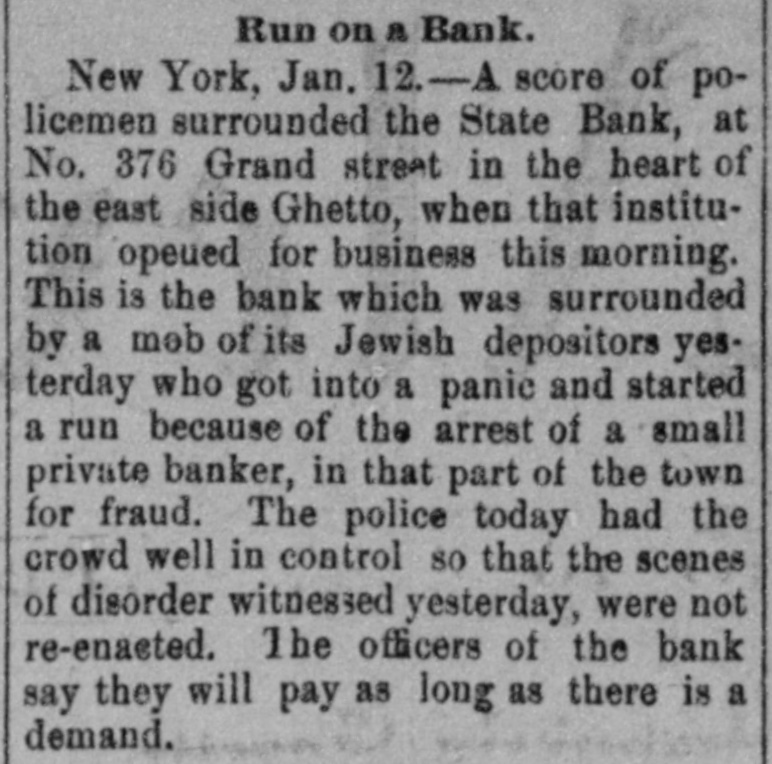
Run on a Bank. New York, Jan. 12.-A score of policemen surrounded the State Bank, at No. 376 Grand street in the heart of the east side Ghetto, when that institution opeued for business this morning. This is the bank which was surrounded by a mob of its Jewish depositors yesterday who got into a panie and started a run because of the arrest of a small private banker, in that part of the town for fraud. The police today had the crowd well in control so that the scenes of disorder witnessed yesterday, were not re-enacted. The officers of the bank say they will pay as long as there is a demand.


Article from Evening Journal, January 12, 1905

Click image to open full size in new tab

Article Text

Tiff WORLD'S NEWS THE WAR. he Emperors of Russia and Japan T granted the Kaiser's request that he be permitted to confer decorations on Generals Nogi and Stoessel. The rearguard of the Russian Baltic fleet entered the Suez Canal bound for Madagascar. The main squadron is believed to be off the island of St. Marie, south of Madagascar. Two hundred Russian reservists were shot down by troops at Warsaw durIng rioting. Admiral Doubassoff denied having stated that peace between Japan and Russia was near. CONGRESS. In the Cenate Mr. Newlands spoke in favor of his resolutions looking to control of the railroads. The House considered the army appropriation bill and passed an amendment to cut off full pay of retired officers in State service. Democrats charged that this action was aimed at General Miles. WASHINGTON. The President has announced that he will withdraw the arbitration treaties if they are emasculated by the Senate. The President announced his intention to call an early extra session of the Fifty-ninth Congress to consider the freight rate question if a bill is not passed at the present session. He will leave the tariff to the judgment of the House. In the Smoot hearing evidence was heard in support of the Mormons. FOREIGN. Richard Croker's action in bidding against King Edward's agent at Newmarket auction declared cause for interdiction by jockey club. The army of Morocco deserted the Sultan, while Southern tribes proclaimed Sultan's brother their ruler. Survivors of foundered American dredge Texas, adrift at sea. had chosen one of the party to be killed for food when succor arrived. Twenty were drowned. Thirteen reached Waterford, Ireland. Natives on upper Congo were reported to have revolted, storming the American and Catholic missionary stations and murdering white 'settlers. MISCELLANEOUS. The Chief of Police of Colorado Springs traced the alleged Cutler Mountain murderer to Detroit. Chicago Alderman instituted suit to compel City Council to expunge vote of censure. A Chicago man murdered his wife and two infant children and is in a dying condition from self-inflicted wounds. W. J. Bryan appealed to higher court in Bennett will case. John Matthews, an actor, who was held as the suspected accomplice of Booth in the assassination of President Lincoln, died in New York. Evidence was heard in the Blair insurance case in New York. The suit of John R. Platt against Hannah Elias was postponed until today. Five thousand people participated in a run on the State Bank, on the East Side, New York. Three policemen and two women were injured. The run was caused by rumors arising from the long line of depositors there on Tuesday. Insurance companies in South were declared to be canceling policies in locallites where surplus crop was being burned. Frank Raisinger was convicted of wife murder at Bridgeton, and was sentenced to be hanged February 15. A. O. Whitaker, a student of the military academy at Asheville, N. C., hanged himself because he was homesick. John Holland was acquitted of the murder of Lawyer Albert Constable, in the Cecil Court at Elkton. Frank P. Flint was elected a United States Senator from California, to succeed Thomas R. Bard. Referee in bankruptcy in New York recommended that discharge from bankruptcy be refused D. Leroy Dresser. Jewelry worth $23,000 stolen from a daughter-in-law of Bishop Potter's wife was found buried in Harlem. Venezuela expressed satisfaction at the reference of the asphalt cases to Attorney General Moody.


Article from The Sun, January 12, 1905

Click image to open full size in new tab

Article Text

to Carry Loads of Bullion Away Fron the State Bank. in Grand Street-On Takes Her Waist Off and Makes Money Sack of the Sleeve-Old Mer Kiss Polfeemen's Hands to Ge Through the Cordon-Stout Iron Rall ing Bent in the Rushes-Only $65,000 Paid Out and More Than $400,000 Paid In by the Unafraid-The Rut WIII Keep Up To-day. but the With drawers Mayn't Put Their Cash Back The storm which gathered about the State Bank in Grand street on Tuesday afternoon burst with full fury upon that institution yesterday morning When the bank threw open its doors at 9 o'clock. RI hour earlier than the usual time. more than A thousand excited depositors were gathered in front of it, and all day long there was a fight to prevent the bank trance from being rushed. When the bank opened twenty-five policemen were around it ready to deal with strenuous conditions. but it was not until three had been hurt by being squeezed against the area railing, that the police got the mob in hand. Sergt. Kenney of the Delancey street station was so badly hurt that he had to be relieved from duty for the day. In the mad rush on the bank there was a narrow escape from a more serious accident. The iron railing against which the three policemen were squeezed gave way at one end and the stone curbing in which it was set was warped several inches out of plumb Had the rail wholly given way the policemen and thirty or forty men and women would have been piled in a heap in the area below The bank officials had realized what they had to face and were prepared for it. They had drawn $400.000 from the Sub- Treasury, $75,000 of which was in silver dollars. They had an extra force of paying tellers with stacks of bags of silver piled around them and all payments up to $500 were made in these ponderous coins. Above $500 the payments were about two thirds in silver and one-third in one dollar bills Payments continued for an hour after the bank doors were closed to fresh relays of panic-stricken depositors and about 009'1$ 01 98 more sums u! 000 99$ was put out. Something like a ton and a balf in silver went over the bank counters CASH INCOMING AND OUTGOING. The bank would not let those who withdrew their accounts redeposit them. "Take your money go away and don't come back gain." was what the institution's line of action meant translated into words. and it was rigidly adhered to not vithstanding the tearful reaties of many who. having seen and touched their savings were content and wanted to put them back in the bank's safe keeping Meantime the bank was doing a roaring business on the incoming side of the account. The first deposit was made by Harry Fishel. The amount was $23,750. In a few minutes there came another deposit of more than $6,000. Thus the swelling tide of income kept up until at the close of business $440,000 had been deposited as against about $65,000 withdrawn. In addition there came by telephone and letter offers of assistance from, all told, more than fifty banks and individuals in the city Among the specific offers of cash was one of $1,000,000 from the Citizens' National Bank, another of $300,000 from a Brooklyn bank and others by the dozens "for any amount needed But the State Bank needed no help. It sent down its $10,000 yellow-back bills to he Sub-Treasury and brought back in exchange bags of silver by the truckload for depositors The bags were dumped into the steadily grinding hopper in the basement where the run was being met and then ground out into the grists for which the bankbooks called. "It's only a question of physical endurance on the part of our tellers. said Manager Arnold Kohn, "we did think of getting a force from our Brownsville branch and keeping up the payments until 9 o'clock in the evening But that is unnecessary. We will open an hour earlier and keep open an hour later to-morrow and till the run ends. 1 suppose, though, that this rush will keep up into next week. and its effects will probably be felt fortwo or three weeks We've had five runs in all and we know these volatile East Side people horoughly HOW SUCH BUNS ARE BRED. aue 10 ou no ind aseq M. kind." said President Oscar L. Richard. *Our experience is that it is worse than useless Tell hese people anything and it only arouses their isuspicion the more. The only thing that talks to them is money "The most trifling cause is sufficient to start a run here In 1895 a man fell in an epileptic fit on the front stoop. Of course A crowd gathered The sight of the crowd sprung the idea in somebody's mind that the bank was in trouble. and in no time we had A run on our hands It kept up for days. "In 1893 a Yiddish newspaper that circulates here printed one day the headline: Neh. State Bank Fails," and below it an account of the failure of the Nebraska Viddish


Article from Daily Press, January 12, 1905

Click image to open full size in new tab

Article Text

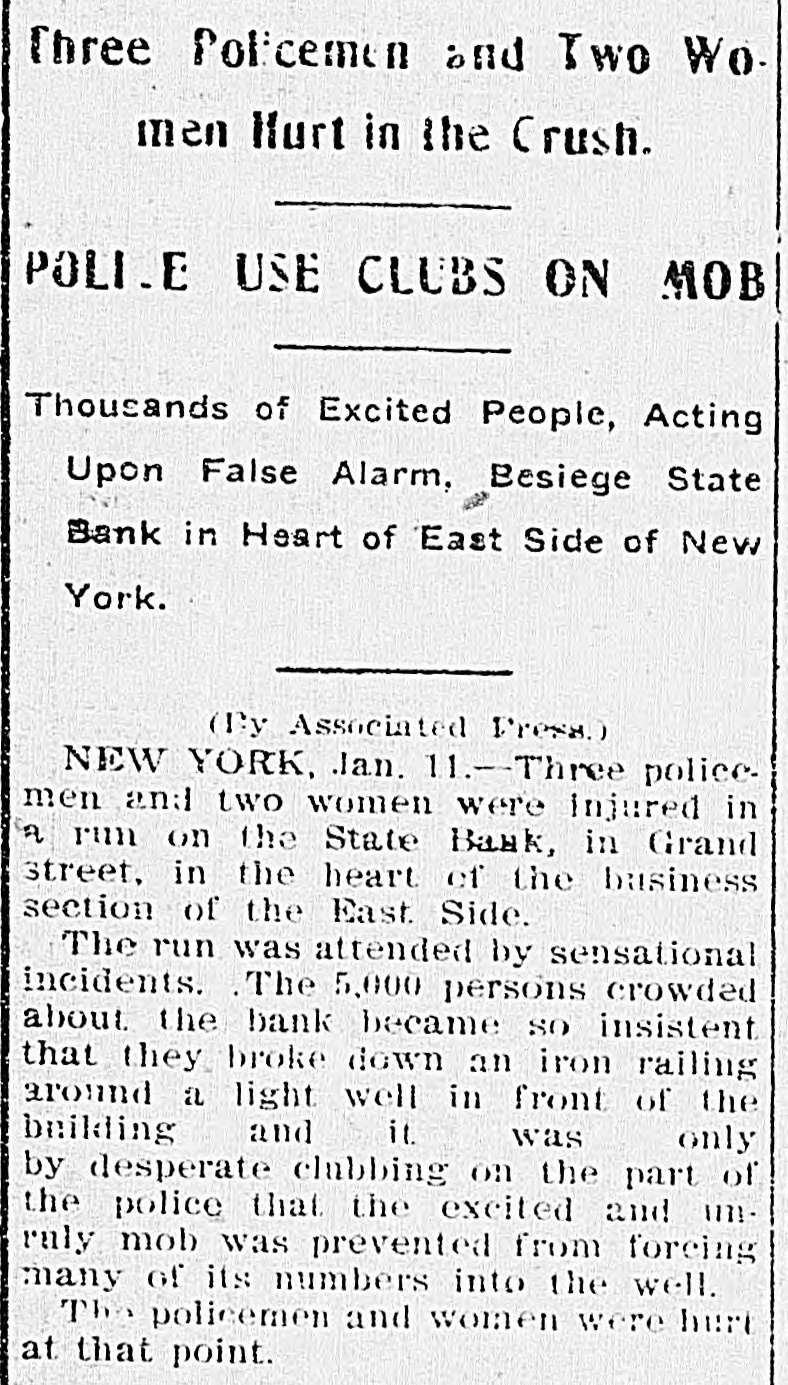
Three Policemen and Two Wo. men Hurt in the Crush. POLI.1 USE CLUBS ON MOB Thousands of Excited People, Acting Upon False Alarm, Besiege State Bank in Heart of East Side of New York. (Ty Associated Press.) NEW YORK, Jan. 11.-Three policemen and two women were Injured in a run on the State Bank, in Grand street, in the heart of the business section of the East Side. The run was attended by sensational incidents. The 5,000 persons crowded about the bank became SO insistent that they broke down an iron railing around a light well in front of the building and it. was only by desperate clubbing on the part of the police that the excited and 1111ruly mob was prevented from foreing many of its numbers into the well. The policemen and women were hurt at that point.


Article from The Topeka State Journal, January 12, 1905

Click image to open full size in new tab

Article Text

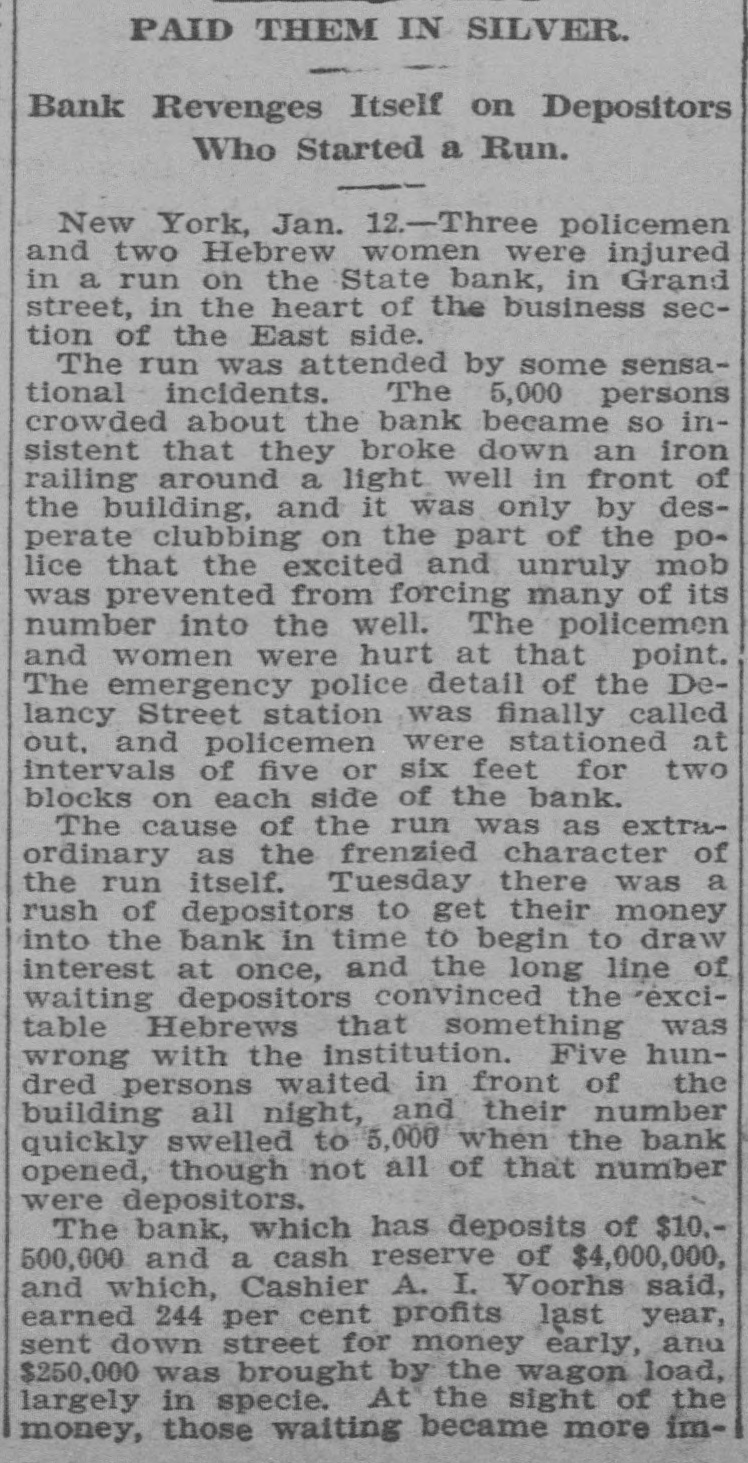
PAID THEM IN SILVER. Bank Revenges Itself on Depositors Who Started a Run. New York, Jan. 12.-Three policemen and two Hebrew women were injured in a run on the State bank, in Grand street, in the heart of the business section of the East side. The run was attended by some sensational incidents. The 5,000 persons crowded about the bank became so insistent that they broke down an iron railing around a light well in front of the building, and it was only by desperate clubbing on the part of the police that the excited and unruly mob was prevented from forcing many of its number into the well. The policemen and women were hurt at that point. The emergency police detail of the Delancy Street station was finally called out, and policemen were stationed at intervals of five or six feet for two blocks on each side of the bank. The cause of the run was as extraordinary as the frenzied character of the run itself. Tuesday there was a rush of depositors to get their money into the bank in time to begin to draw interest at once, and the long line of waiting depositors convinced the excitable Hebrews that something was wrong with the institution. Five hundred persons waited in front of the building all night, and their number quickly swelled to 5,000 when the bank opened, though not all of that number were depositors. The bank, which has deposits of $10.500,000 and a cash reserve of $4,000,000, and which, Cashier A. I. Voorhs said, earned 244 per cent profits last year, sent down street for money early, anu $250,000 was brought by the wagon load, largely in specie. At the sight of the money, those waiting became more im-


Article from Yorkville Enquirer, January 13, 1905

Click image to open full size in new tab

Article Text

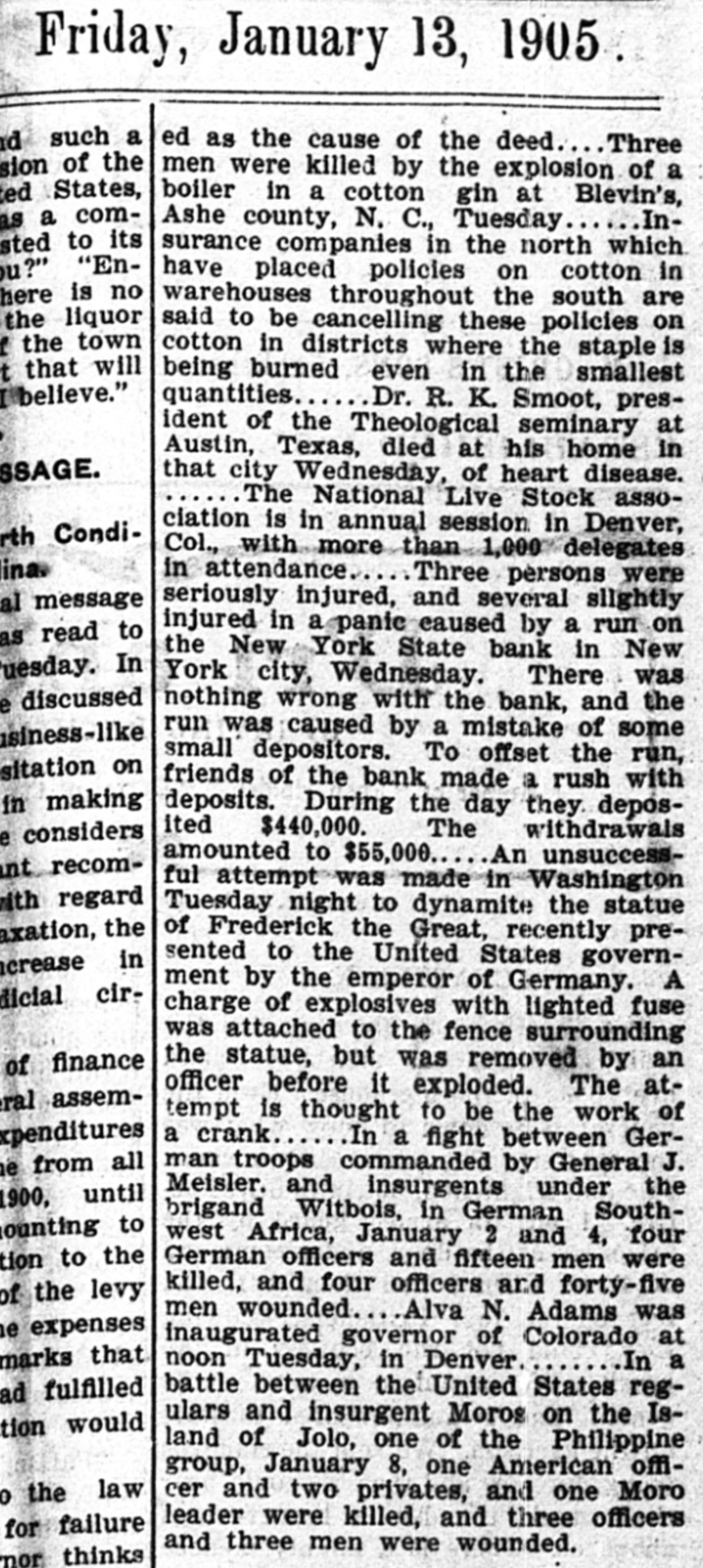
Friday, January 13, 1905. a such ed as the cause of the deed Three the of men were killed by the explosion of a States, boiler in a cotton gin at Blevin's, coma InAshe county, N. C., Tuesday its to surance companies in the north which "Enhave placed policies on cotton in no is warehouses throughout the south are liquor the said to be cancelling these policies on town the cotton in districts where the staple is will that being burned even in the smallest quantities believe." Dr. R. K. Smoot, president of the Theological seminary at Austin, Texas, died at his home in that city Wednesday, of heart disease. SSAGE. The National Live Stock association is in annual session. in Denver, CondiCol., with more than 1,000 delegates in attendance Three persons were message seriously injured, and several slightly injured in a panic caused by a run on to read the New York State bank in New In uesday. York city, Wednesday. There was discussed nothing wrong with the bank, and the run was caused by a mistake of some isiness-like small depositors. To offset the run, sitation on friends of the bank made a rush with making in deposits. During the day they deposited $440,000. The withdrawals considers amounted to $55,000 An unsuccessrecomful attempt was made in Washington regard Tuesday night to dynamite the statue the of Frederick the Great, recently preaxation, sented to the United States governin crease ment by the emperor of Germany. A circharge of explosives with lighted fuse was attached to the fence surrounding the statue, but was removed by an finance of officer before it exploded. The atassemtempt is thought to be the work of a crank In a fight between Gerxpenditures all from man troops commanded by General J. Meisler. and insurgents under the 1900, until brigand Witbois, in German Southounting to west Africa, January 2 and 4, four the to German officers and fifteen men were killed, and four officers and forty-five of the levy men wounded Alva N. Adams was expenses inaugurated governor of Colorado at marks that noon Tuesday, in Denver In a battle between the United States regfulfilled ulars and insurgent Moros on the Iswould land of Jolo, one of the Philippine group, January 8, one American offilaw cer and two privates, and one Moro the leader were killed, and three officers failure for and three men were wounded. thinks


Article from New-York Tribune, January 13, 1905

Click image to open full size in new tab

Article Text

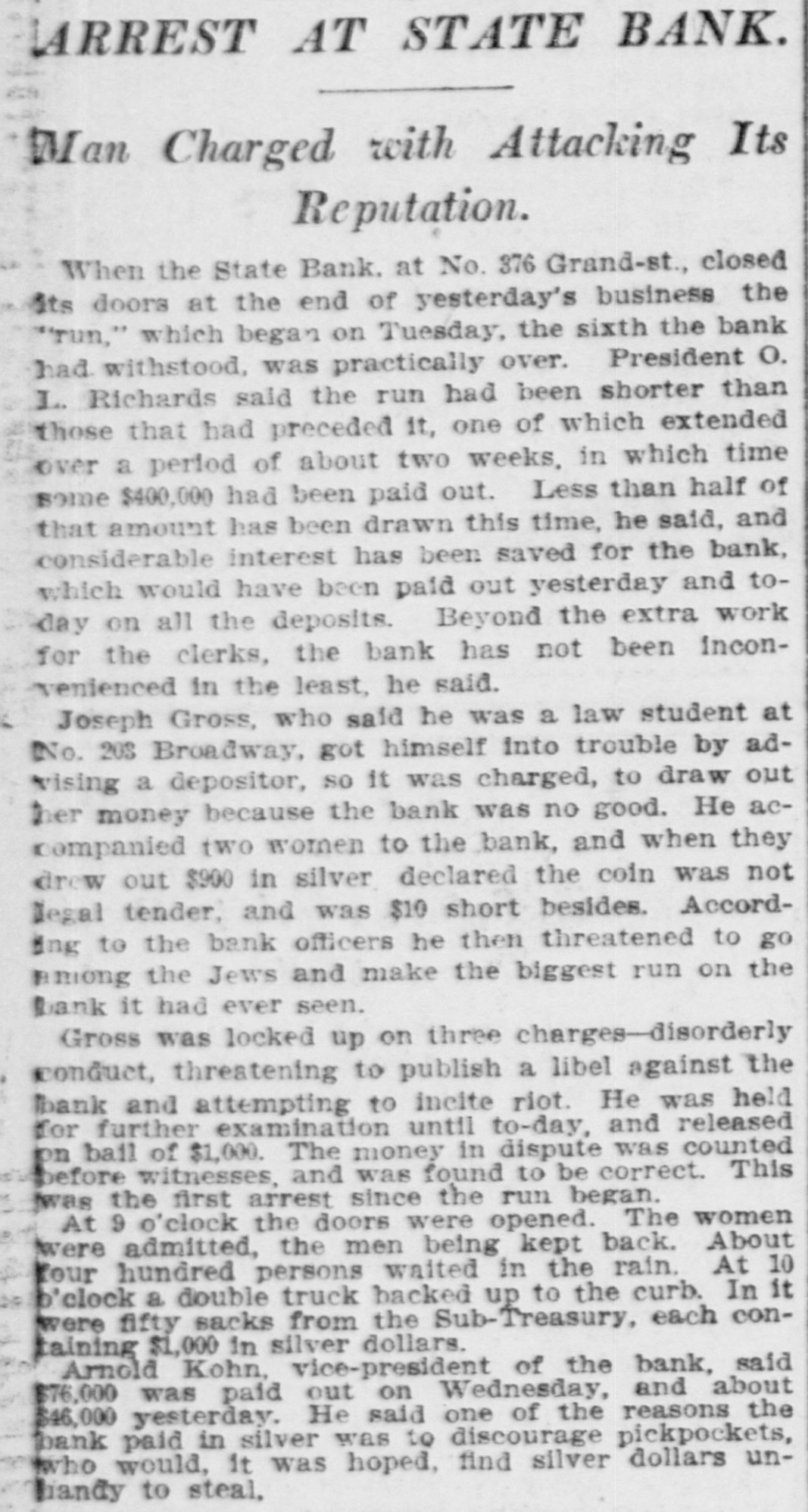
ARREST AT STATE BANK. Man Charged with Attacking Its Reputation. When the State Bank. at No. 376 Grand-st., closed its doors at the end of yesterday's business the "run," which began on Tuesday, the sixth the bank had withstood, was practically over. President O. 1.. Richards said the run had been shorter than those that had preceded it, one of which extended over a period of about two weeks, in which time some $400,000 had been paid out. Less than half of that amount has been drawn this time, he said, and considerable interest has been saved for the bank, which would have been paid out yesterday and today on all the deposits. Beyond the extra work for the clerks, the bank has not been inconvenienced in the least, he said. Joseph Gross, who said he was a law student at No. 203 Broadway, got himself into trouble by advising a depositor, so it was charged, to draw out her money because the bank was no good. He accompanied two women to the bank, and when they drew out $900 in silver declared the coin was not legal tender, and was $10 short besides. According to the bank officers he then threatened to go aniong the Jews and make the biggest run on the bank it had ever seen. Gross was locked up on three charges-disorderly conduct, threatening to publish a libel against the bank and attempting to incite riot. He was held for further examination until to-day, and released on bail of $1,000. The money in dispute was counted before witnesses, and was found to be correct. This was the first arrest since the run began. At 9 o'clock the doors were opened. The women were admitted, the men being kept back. About four hundred persons waited in the rain. At 10 b'clock a double truck backed up to the curb. In it were fifty sacks from the Sub-Treasury, each containing $1,000 in silver dollars. Arnold Kohn, vice-president of the bank, said $76,000 was paid out on Wednesday, and about $46,000 yesterday. He said one of the reasons the bank paid in silver was to discourage pickpockets, who would, it was hoped, find silver dollars unhandy to steal,


Article from Bisbee Daily Review, January 14, 1905

Click image to open full size in new tab

Article Text

EXTRAORDINARY RUN ON BANK IN GREAT CRUSH MEN AND WOMEN AR INJURED IN NEW YORK. R n Was Due to Unusual Line of Peo. ple Before State Bank Awaiting Turn to Make Deposits-Depositors Took Another View of Cause. New York, Jan. .13.-Three policemen and two Hebrew women were inured in a run on the State bank in Grand street in the heart of the business section of the east side, today. The run was attended by some sensational incidents. The 5,000 persons crowded about the bank became 30 insistent that they broke down an iron railing around the light shaft in front of the building. and it was only by desperate clubbing on the part of the police that the excited and unruly mob was prevented from forcing many of its number into the well. The cause of the run was as extraordinary as the frenzied character of the run. Yesterday there was 2 rush of depositors to get their money into the bank in time to begin to draw interest at once, and a' long line of waiting depositors convinced the excitable Hebrews that something was wrong with the bank. Five hundred persons waited in front of the building all night and their number quickly swelled to 5,000 when the bank opened today, although not all of that number were depositors. The bank tided over the run without difficulty.


Article from The Times Dispatch, January 15, 1905

Click image to open full size in new tab

Article Text

# COL. BRANCH AN ATHLETE # AS WELL AS FINANCIER Colonel James R. Branch, of the American Bankers' Association, smiled softly at the intimation that the run on the State Bank was due in part to the activity of the association in enforcing the banking laws against sundry questionable money collecting enterprises on the East Side. He could not see the connection, yet the colonel is a man who can see around a corner with the best of them. Since his hand has been at the lever the association has done yeoman's service in the monetary world. All the detective agencies in town are feared less than this well organized concern by the "crooks" and "shovers of the queer," whose infernal ingenuity makes paying tellers prematurely gray. The percentage of successful fraud at the expense of banking institutions falls annually under the strict espionage of the association and its relentless pursuit of offenders. There is nothing in the visage of Colonel Branch, however, that suggests the implacable sleuth he is known to be. He seems the incarnation of the spirit of forgiveness. His countenance radiates benignty. The beholder is reminded of the "reflected sunshine" of the latest importations in wall paper. Children cry for him, and beggars approach him confidently. It is understood that his perennial sweetness of temper is due to his daily use of the gymnasium of the New York Athletic Club. Gloves, foils, dumb-bells, the swimming tank or the wrestling mat - it is all the same to Colonel Branch. Not even his famous scrap with "Dick" Sheldon, when, in a moment of indiscretion, he threw his best limb out of joint, could prevent him from mastering all the points of American jiu-jitsu. Grave, too, he is, as well as gentle, and there are occasions when the only Southron in town who can match his aspect of wisdom is the wisest looking man since Brougham, General Roger A. Pryor.-New York Commercial,