14420. Sherman Bank (New York, NY)

Bank Information

Episode Type
Run → Suspension → Closure
Bank Type
state
Start Date
April 21, 1894
Location
New York, New York (40.714, -74.006)

Metadata

Model
gpt-5-mini
Short Digest
4f5466b63cf2439e

Response Measures

None

Description

Multiple articles (April 21–26, 1894) report a run on the Sherman Bank precipitated by clearing-house/clearing-agent difficulties (Central/United States National refusal), after which directors supplied funds and the bank paid depositors and continued business. Later (July 21–24, 1894) the bank's directors voted voluntary liquidation and to close; liquidation proceedings continued into 1895. Sequence: run in April contributed to decision to go into voluntary liquidation in July, i.e., run → suspension/closure (voluntary liquidation).

Events (4)

1. April 21, 1894 Run
Cause
Correspondent
Cause Details
Run was triggered when the Central/United States National Bank (clearing-house agent) refused to continue clearing/extend a longer-time account for the Sherman Bank, producing depositor alarm and withdrawals.
Measures
Directors raised funds (joint note discounted for $65,000), kept the bank open past legal closing hour until 3pm, paid withdrawals in full, temporarily halted taking new deposits pending State examination.
Newspaper Excerpt
There was a run on the Sherman Bank today ... caused by the Central Bank refusing a longer time account as clearing house agent for the Sherman Bank.
Source
newspapers
2. April 22, 1894 Other
Newspaper Excerpt
Superintendent Preston made an official announcement that the bank was solvent and that the Central National Bank would act as the Sherman's clearing agent ... Notice to depositors: Unfounded rumors concerning this bank caused a refusal of clearing privileges ... A rigid and very searching examination having established its solvency, clearing privileges have been restored, and this bank now notifies its customers of its resumption of business.
Source
newspapers
3. July 21, 1894 Suspension
Cause
Voluntary Liquidation
Cause Details
Directors and majority of stockholders decided to cease business and voluntarily liquidate the bank due to reduced business and earlier run/settled losses; notice issued to depositors and stockholders to withdraw; bank to be wound up.
Newspaper Excerpt
The Sherman Bank has gone into voluntary liquidation. This step ... is undoubtedly due to the setback the bank received last April, when it suffered heavy runs ...
Source
newspapers
4. June 13, 1895 Other
Newspaper Excerpt
John E. Ward has been appointed referee in the matter of the voluntary dissolution of the Sherman Bank ... petition of the directors states nominal assets ... claims against the bank about $4,800.
Source
newspapers

Newspaper Articles (21)

Article from New-York Tribune, October 7, 1893

Click image to open full size in new tab

Article Text

WAITING FOR AN OFFER. THE TRANSFER OF THE MADISON SQUARE BANK NOT YET COMPLETED. COUNSEL FOR THE RECEIVERS HAVE LEARNED NOTHING DEFINITE ABOUT IT-SHERMAN BANK DIRECTORS AGREE WITH THEIR PRESIDENT. The news of the absorption of the Madison Square Bank by the Sherman Bank, which was announced exclusively in The Tribune yesterday morning, caused much surprise and comment in business and banking circles, the more SO because the arrangements therefor had been made with so much secrecy that scarcely any one except those directly concerned had a suspicion that the troubles of the Madison Square Bank would be ended in that way. The idea of absorbing the business and assets and assuming the obligations of the Madison Square Bank originated with A. N. Howell, president of the Sherman Bank. The arrangements have not all been completed yet, but it is probable that they will be finished in a few days. The directors of the Sherman Bank took formal action on the subject at a meeting yesterday, and fully concurred in the proposition of Mr. Howell, and authorized him to proceed with final arrangements. Mr. Howell yesterday said to a Tribune reporter who called upon him at his office in the bank, Eighteenth-st. and Broadway, "I have received further satisfactory assurances to-day from the Madison Square Bank people, and the absorption of that bank by the Sherman Bank will take place before long. The receivers in charge of the affairs of the Madison Square Bank have courteously offered to allow me to examine the assets of the bank. I shall make a thorough personal investigation. You may be sure that the Sherman Bank will not undertake anything without careful and accurate knowledge. but I believe are that the affairs of the Madison Square in such a shape that we can safely take charge of them. "I hope it will be distinctly understood that this union of the two banks is not a consolidation, the merging of two banks and two managements in one. The Madison Square Bank is to go out of existence, while we take its business and its assets, and assume its Habilities. There will be no change in the management or in the Board of Directors of the Sherman Bank, and no additions to the board. The capital will probably be increased from $200,000 to $500,000." Mr. Howell has the choice of locations. either that at present occupied by the Sherman Bank. or the rooms of the Madison Square Bank. The directors of the Sherman Bank are William J. Arkell, Jacob D. Butler, William Crawford, George C. Flint. Louis C. Fuller, George B. Jaques, George P. Johnson, Ewen McIntyre, John McLoughlin, Ludwig Nissen. Henry D. Northrop, George P. Sheldon, William R. Smith, Benjamin B. Van Derveer. Mr. Untermyer, of Guggenheimer & Untermyer, counsel for Messrs. O'Brien and Cannon, receivers of the Madison Square Bank, said: "The receivers have not received any definite plan by which the proposed transfer of assets and assumption of liabilities of the bank can be carried out by the Sherman Bank. There has been some unofficial, irresponsible discussion of the subject, but nothing has yet been done looking toward a definite agreement. There is no truth in the statement that the transaction will be consummated next week as reported, except that if next week or at any other time any responsible person 0" corporation should come to the receivers of the Madison Square Bank and give them enough money to pay depositors and offer to assume the liabilities and take care of the stockholders, the receivers would feel very much relieved and would lose no time in accepting such an offer. In the mean time the receivers are making a very thorough investigation of the peculiar methods by which the directors and officers of the Madison Square Bank managed to borrow for their own purposes almost the entire assets of the bank, and I have no doubt the officers and directors will use every effort to get rid of the Madison Square Bank creditors and stockholders, as, from the revelations that have come to my knowledge recently. It would be very much to their advantage to do so without delay."
Article from Pine Bluff Daily Graphic, April 21, 1894

Click image to open full size in new tab

Article Text

A LARGE RUN Will Cause the Sherman Bank to Go Into Voluntary Liquidation. Special Dispatch to the GRAPHIC. NEW YORK, April 21.-There was a large run on the Sherman Bank this morning, and, in all probability, it will go into voluntary liquidation.


Article from The Providence News, April 21, 1894

Click image to open full size in new tab

Article Text

RUN ON SHERMAN BANK. By The Associated Press. NEW YORK, April 21.-There was a run on the Sherman Bank today, caused by the Central Bank refusing a longer time account as clearing house agent for the Sherman Bank. When noontime, which is the hour for closing on Saturday, arrived, there was a long line of depositors waiting to get their money. Cashier Northrop came out into the corridor and said: "Although the law does not compel us to keep open after 12, we will nevertheless remain open for business today until 3 o'clock in order to allow everybody a chance to be paid. I have it on the authority of the State banking department that every one will be paid in full. If you stay here until 3 o'clock you will get your money." It is thought that the bank will pull through.


Article from The Sun, April 21, 1894

Click image to open full size in new tab

Article Text

According to the foregoing statement the bank at that time had lost $50,000 of its former surplus of $100,000, and the surplus on that day, nominally $50,000 as reported, was actually only about $25,000 after deducting from the surplus and undivided profits the account for furniture and fixtures $21,261.53, and current expenses $7.100.32. Ex-President Howell explained this yesterday by saying that in his short career he was compelled to charge off $50,000 from the surplus fund in bad debts. It was further ascertained that the Clearing House Committee, on its visit to the bank on Thursday, marked off $60,000 lost on loans made on bad commercial paper. Yet Cashler Northrop declared that the bank was solvent. There was a good deal of curiosity to ascertain to whom these bad loans were made. Henry D. Northrop, cashier of the Sherman Bank, said that the bank was perfectly sound. The only reason for wishing to change the bank's clearing house, he said, was that the bank wished to have the $130,000 now in the Central National transferred to the United States National in order that the State Bank Superintendent might count that sum in the bank's reserve. As the Central National would not permit the Superintendent to examine its affairs, the $130,000 could not now be counted in the reserve. At the close of a day spent at the bank State Bank Examiner Judson said: "All I can say positively is that the depositors of the bank will be paid in full. My examination of the character and value of the assets is not completed, nor do I expect to be able to complete it to-morrow, as Saturday is a short day. The trouble with the bank lies in a lot of paper which it acquired during the adminis-tration of President Satterlee. "It is a comparatively new bank, having been started only in 1892, and in the first desire to do business it got loaded up with bad paper. The department has known this for some time, and three or four months ago it insisted upon having $50,000 of past due paper charged up to profit and loss, and the rest was to be charged off gradually. That reduced the bank's surplus on its last showing to $50,000, Whether the capital is impaired or not I cannot yet say." The bank was open for business all day yesterday, and it was understood from Mr. Judson that it would be open to-day. There was something of a run upon it, and it lost by payments to depositors about $30.000 during the day.


Article from The Herald, April 22, 1894

Click image to open full size in new tab

Article Text

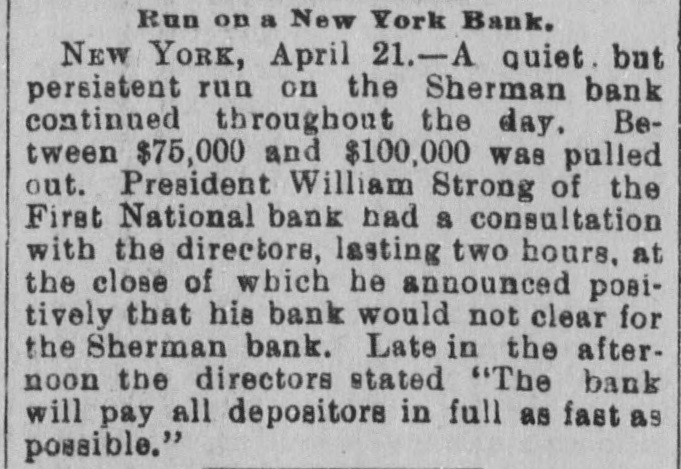
Run on a New York Bank. NEW YORK, April 21.-A quiet. but persistent run on the Sherman bank continued throughout the day. Between $75,000 and $100,000 was pulled out. President William Strong of the First National bank had a consultation with the directors, lasting two hours. at the close of which he announced positively that his bank would not clear for the Sherman bank. Late in the afternoon the directors stated "The bank will pay all depositors in full as fast as possible."


Article from The Sun, April 22, 1894

Click image to open full size in new tab

Article Text

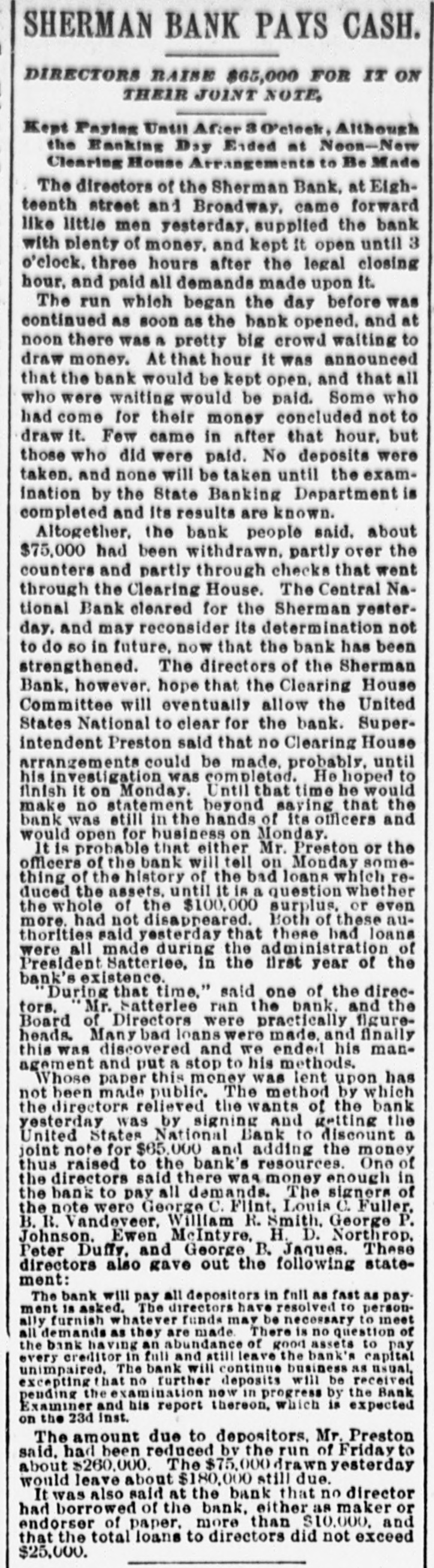
SHERMAN BANK PAYS CASH. DIRECTORS RAISE $65,000 FOR IT ON THEIR JOINT NOTE, Kept Paying Until After 3 O'clock, Although the Backing Day Ended at Noon-New Clearing House Arrangements to Be Made The directors of the Sherman Bank. at Eighteenth street and Broadway. came forward like little men yesterday. supplied the bank with plenty of money. and kept It open until 3 o'clock. three hours after the legal closing hour, and paid all demands made upon it. The run which began the day before was continued as soon as the bank opened. and at noon there was a pretty big crowd waiting to draw money. At that hour it was announced that the bank would be kept open, and that all who were waiting would be paid. Some who had come for their money concluded not to draw it. Few came in after that hour. but those who did were paid. No deposits were taken. and none will be taken until the examInation by the State Banking Department is completed and its results are known. Altogether. the bank people said. about $75,000 had been withdrawn. partly over the counters and partly through checks that went through the Clearing House. The Central National Bank cleared for the Sherman yesterday. and may reconsider its determination not to do so in future. now that the bank has been strengthened. The directors of the Sherman Bank, however. hope that the Clearing House Committee will eventually allow the United States National to clear for the bank. Superintendent Preston said that no Clearing House arranzements could be made. probably. until his investigation was completed. He hoped to finish it on Monday. Until that time he would make no statement beyond saving that the bank was still in the hands of its officers and would open for business on Monday. It is probable that either Mr. Preston or the officers of the bank will tell on Monday something of the history of the bad loans which reduced the assets. until it is a question whether the whole of the $100,000 surplus, or even more. had not disappeared. Both of these authorities said yesterday that these had loans were all made during the administration of President Satteriee, in the first year of the bank's existence. During that time." said one of the directors. Mr. Fatterlee ran the bank. and the Board of Directors were practically figureheads. Many bad loans were made, and finally this was discovered and we ended his management and put a stop to his methods. Whose paper this money was lent upon has not been made public. The method by which the directors relieved the wants of the bank yesterday was by signing and getting the United States National Bank to discount a joint note for $65.000 and adding the money thus raised to the bank's resources. One of the directors said there was money enough in the bank to Day all demands. The signers of the note were George C. Flint. Louis C. Fuller. B. R. Vandeveer, William R. Smith. George P. Johnson. Ewen McIntyre. H. D. Northrop. Peter Duffy. and George B. Jaques. These directors also gave out the following statement: The bank will pay all depositors in full as fast as payment is asked. The directors have resolved to personally furnish whatever funds may be necessary to meet all demands as they are made There is no question of the bank having an abundance of good assets to pay every creditor in full and still leave the bank's capital unimpaired. The bank will continue business as usual, excepting that no further deposits will be received pending the examination now in progress by the Bank Examiner and his report thereon, which is expected on the 23d inst. The amount due to depositors, Mr. Preston said, had been reduced by the run of Friday to about $260,000. The $75,000 drawn yesterday would leave about $180,000 still due. It was also said at the bank that no director had borrowed of the bank, either as maker or endorser of paper. more than $10.000. and that the total loans to directors did not exceed $25,000.


Article from New-York Tribune, April 25, 1894

Click image to open full size in new tab

Article Text

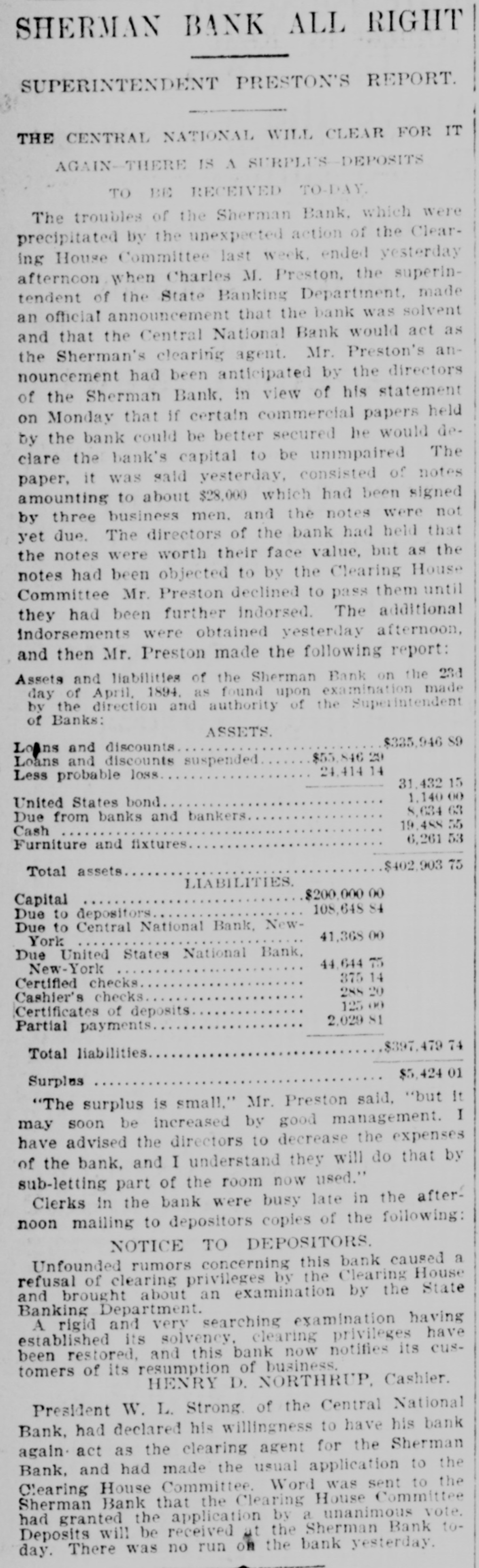
SHERMAN BANK ALL RIGHT SUPERINTENDENT PRESTON'S REPORT. THE CENTRAL NATIONAL WILL CLEAR FOR IT AGAIN-THERE IS A SURPLUS DEPOSITS TO BE RECEIVED TO-DAY. The troubles of the Sherman Bank, which were precipitated by the unexpected action of the Clearing House Committee last week, ended yesterday afternoon when Charles M. Preston, the superintendent of the State Banking Department, made an official announcement that the bank was solvent and that the Central National Bank would act as the Sherman's clearing agent. Mr. Preston's announcement had been anticipated by the directors of the Sherman Bank, in view of his statement on Monday that if certain commercial papers held by the bank could be better secured he would declare the bank's capital to be unimpaired The paper, it was said yesterday, consisted of notes amounting to about $28,000 which had been signed by three business men. and the notes were not yet due. The directors of the bank had held that the notes were worth their face value, but as the notes had been objected to by the Clearing House Committee Mr. Preston declined to pass them until they had been further indorsed. The additional indorsements were obtained yesterday afternoon, and then Mr. Preston made the following report: Assets and liabilities of the Sherman Bank on the 28d day of April, 1894. as found upon examination made by the direction and authority of the Superintendent of Banks: ASSETS. $335,946 S9 Loins and discounts $55,846.29 29 Loans and discounts suspended 24,414.14 Less probable loss 31,432 1,140.00 United States bond 8,634 Due from banks and bankers 19,488 Cash 6,261 53 Furniture and fixtures $402,903 75 Total assets LIABILITIES. $200,000.0 Capital 108,648 84 Due to depositors Due to Central National Bank, New41,368.00 York Due United States National Bank, 44,644 75 New-York 375 14 Certified checks 288 20 Cashier's checks 125.00 Certificates of deposits 2,029 81 Partial payments $397,479.74 Total liabilities $5,424.01 Surplus "The surplus is small," Mr. Preston said, "but It may soon be increased by good management. I have advised the directors to decrease the expenses of the bank, and I understand they will do that by sub-letting part of the room now used." Clerks in the bank were busy late in the afternoon mailing to depositors copies of the following: NOTICE TO DEPOSITORS. Unfounded rumors concerning this bank caused a refusal of clearing privileges by the Clearing House and brought about an examination by the State Banking Department. A rigid and very searching examination having established its solvency, clearing privileges have been restored, and this bank now notifies its customers of its resumption of business. HENRY D. NORTHRUP, Cashier. President W. L. Strong. of the Central National Bank, had declared his willingness to have his bank again. act as the clearing agent for the Sherman Bank, and had made the usual application to the Clearing House Committee. Word was sent to the Sherman Bank that the Clearing House Committee had granted the application by a unanimous vote. Deposits will be received at the Sherman Bank today. There was no run OR the bank yesterday.


Article from The Evening World, April 26, 1894

Click image to open full size in new tab

Article Text

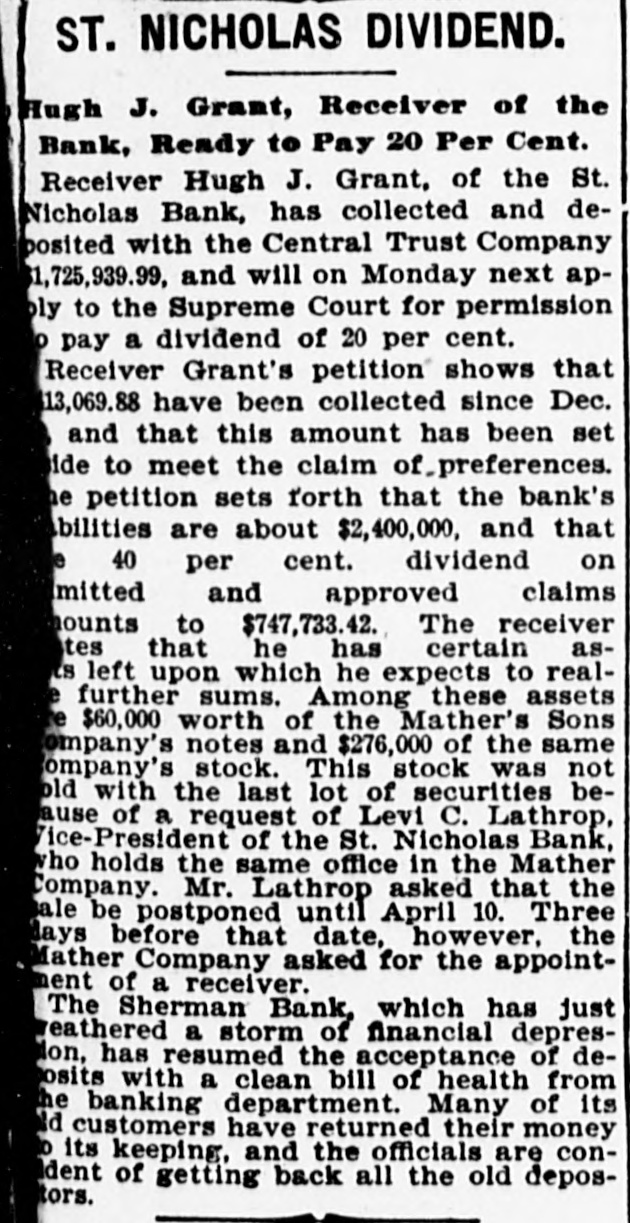
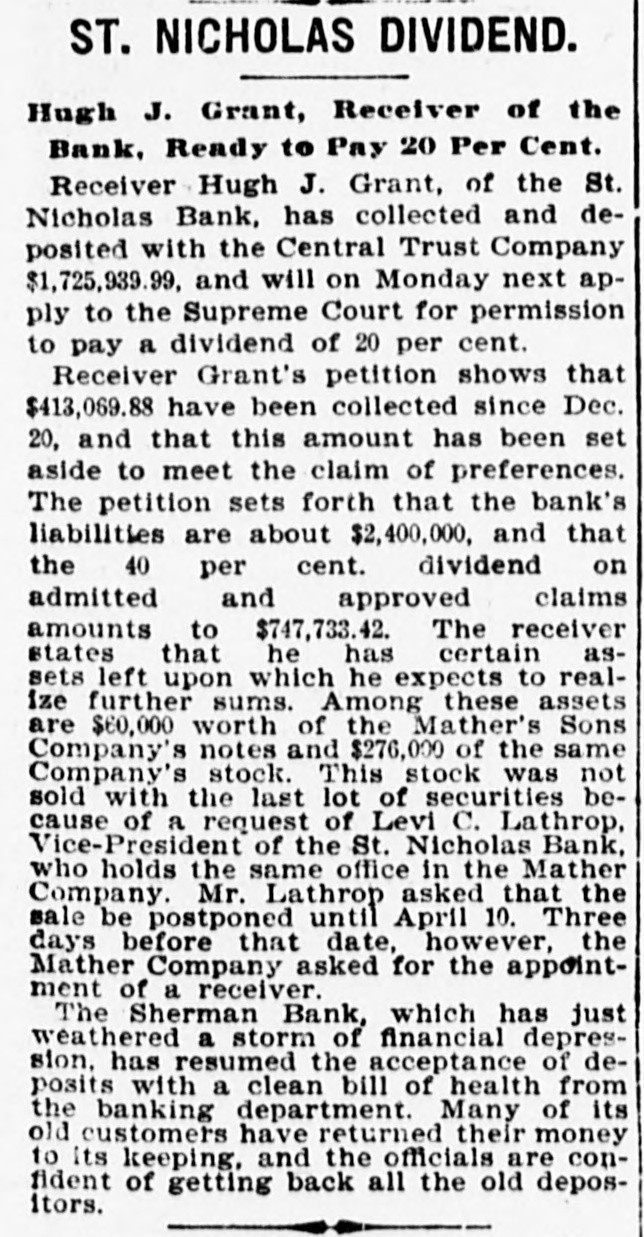
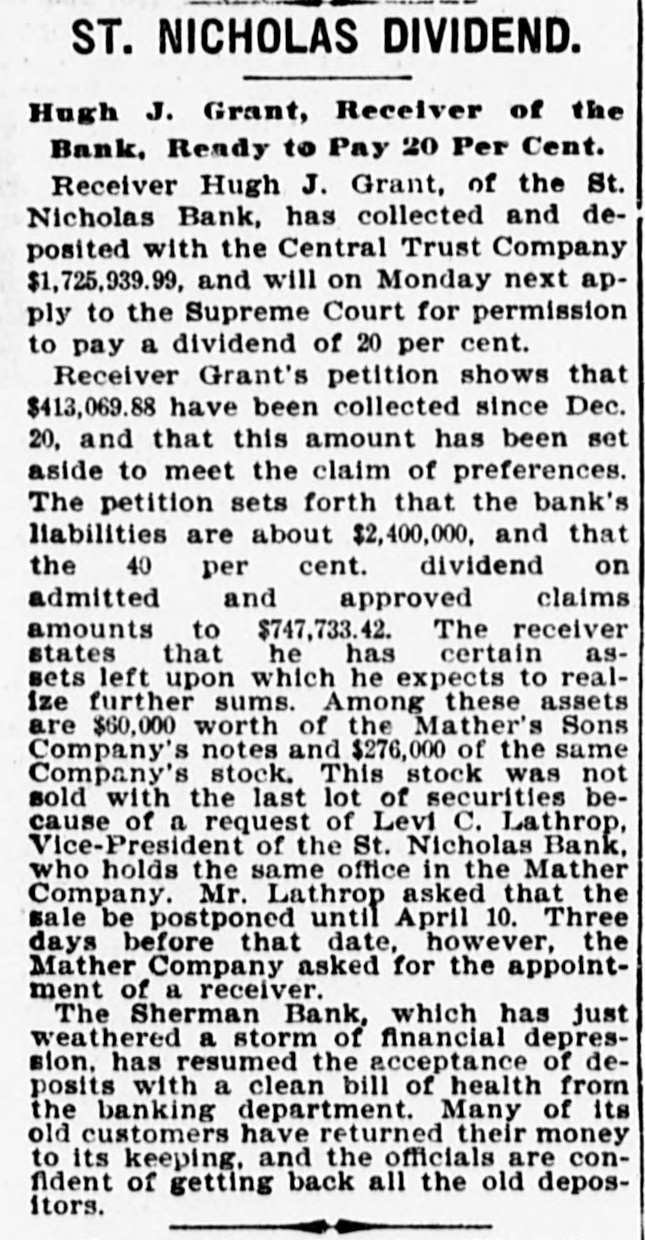
ST. NICHOLAS DIVIDEND. Hugh J. Grant, Receiver of the Bank, Ready to Pay 20 Per Cent. Receiver Hugh J. Grant, of the St. Nicholas Bank, has collected and deposited with the Central Trust Company $1,725,939.99, and will on Monday next apply to the Supreme Court for permission to pay a dividend of 20 per cent. Receiver Grant's petition shows that $413,069.88 have been collected since Dec. 20, and that this amount has been set aside to meet the claim of preferences. The petition sets forth that the bank's liabilities are about $2,400,000, and that the 40 per cent. dividend on admitted and approved claims amounts to $747,733.42. The receiver states that he has certain assets left upon which he expects to realize further sums. Among these assets are $60,000 worth of the Mather's Sons Company's notes and $276,000 of the same Company's stock. This stock was not sold with the last lot of securities because of a request of Levi C. Lathrop, Vice-President of the St. Nicholas Bank, who holds the same office in the Mather Company. Mr. Lathrop asked that the sale be postponed until April 10. Three days before that date, however, the Mather Company asked for the appointment of a receiver. The Sherman Bank, which has just weathered a storm of financial depression, has resumed the acceptance of deposits with a clean bill of health from the banking department. Many of its old customers have returned their money to its keeping, and the officials are confident of getting back all the old depositors.


Article from The Evening World, April 26, 1894

Click image to open full size in new tab

Article Text

ST. NICHOLAS DIVIDEND. Hugh J. Grant, Receiver of the Bank, Ready to Pay 20 Per Cent. Receiver Hugh J. Grant, of the St. Nicholas Bank, has collected and deposited with the Central Trust Company $1,725,939.99, and will on Monday next apbly to the Supreme Court for permission pay a dividend of 20 per cent. Receiver Grant's petition shows that 13,069.88 have been collected since Dec. and that this amount has been set ide to meet the claim of preferences. e petition sets forth that the bank's bilities are about $2,400,000, and that e 40 per cent. dividend on mitted and approved claims ounts to $747,733.42. The receiver tes that he has certain asis left upon which he expects to realfurther sums. Among these assets e $60,000 worth of the Mather's Sons ompany's notes and $276,000 of the same ompany's stock. This stock was not old with the last lot of securities beause of a request of Levi C. Lathrop, 7ice-President of the St. Nicholas Bank, who holds the same office in the Mather Company. Mr. Lathrop asked that the ale be postponed until April 10. Three ays before that date, however, the Mather Company asked for the appointnent of a receiver. The Sherman Bank, which has just eathered a storm of financial depreslon, has resumed the acceptance of deosits with a clean bill of health from he banking department. Many of its Id customers have returned their money D its keeping, and the officials are condent of getting back all the old depostors.


Article from The Evening World, April 26, 1894

Click image to open full size in new tab

Article Text

ST. NICHOLAS DIVIDEND. Hugh J. Grant, Receiver of the Bank, Ready to Pay 20 Per Cent. Receiver Hugh J. Grant, of the St. Nicholas Bank, has collected and deposited with the Central Trust Company $1,725,939.99, and will on Monday next apply to the Supreme Court for permission to pay a dividend of 20 per cent. Receiver Grant's petition shows that $413,069.88 have been collected since Dec. 20, and that this amount has been set aside to meet the claim of preferences. The petition sets forth that the bank's liabilities are about $2,400,000, and that the 40 per cent. dividend on admitted and approved claims amounts to $747,733.42. The receiver states that he has certain assets left upon which he expects to real1ze further sums. Among these assets are $60,000 worth of the Mather's Sons Company's notes and $276,000 of the same Company's stock. This stock was not sold with the last lot of securities because of a request of Levi C. Lathrop, Vice-President of the St. Nicholas Bank, who holds the same office in the Mather Company. Mr. Lathrop asked that the sale be postponed until April 10. Three days before that date, however, the Mather Company asked for the appointment of a receiver. The Sherman Bank, which has just weathered a storm of financial depression, has resumed the acceptance of deposits with a clean bill of health from the banking department. Many of its old customers have returned their money to Its keeping, and the officials are confident of getting back all the old depositors.


Article from The Evening World, April 26, 1894

Click image to open full size in new tab

Article Text

ST. NICHOLAS DIVIDEND. Hugh J. Grant, Receiver of the Bank, Ready to Pay 20 Per Cent. Receiver Hugh J. Grant, of the St. Nicholas Bank, has collected and deposited with the Central Trust Company $1,725,939.99, and will on Monday next apply to the Supreme Court for permission to pay a dividend of 20 per cent. Receiver Grant's petition shows that $413,069.88 have been collected since Dec. 20, and that this amount has been set aside to meet the claim of preferences. The petition sets forth that the bank's liabilities are about $2,400,000, and that the 40 per cent. dividend on admitted and approved claims amounts to $747,733.42. The receiver states that he has certain assets left upon which he expects to realize further sums. Among these assets are $60,000 worth of the Mather's Sons Company's notes and $276,000 of the same Company's stock. This stock was not sold with the last lot of securities because of a request of Levi C. Lathrop, Vice-President of the St. Nicholas Bank, who holds the same office in the Mather Company. Mr. Lathrop asked that the sale be postponed until April 10. Three days before that date, however, the Mather Company asked for the appointment of a receiver. The Sherman Bank, which has just weathered a storm of financial depression, has resumed the acceptance of deposits with a clean bill of health from the banking department. Many of its old customers have returned their money to its keeping, and the officials are confident of getting back all the old depositors.


Article from The Morning Call, July 22, 1894

Click image to open full size in new tab

Article Text

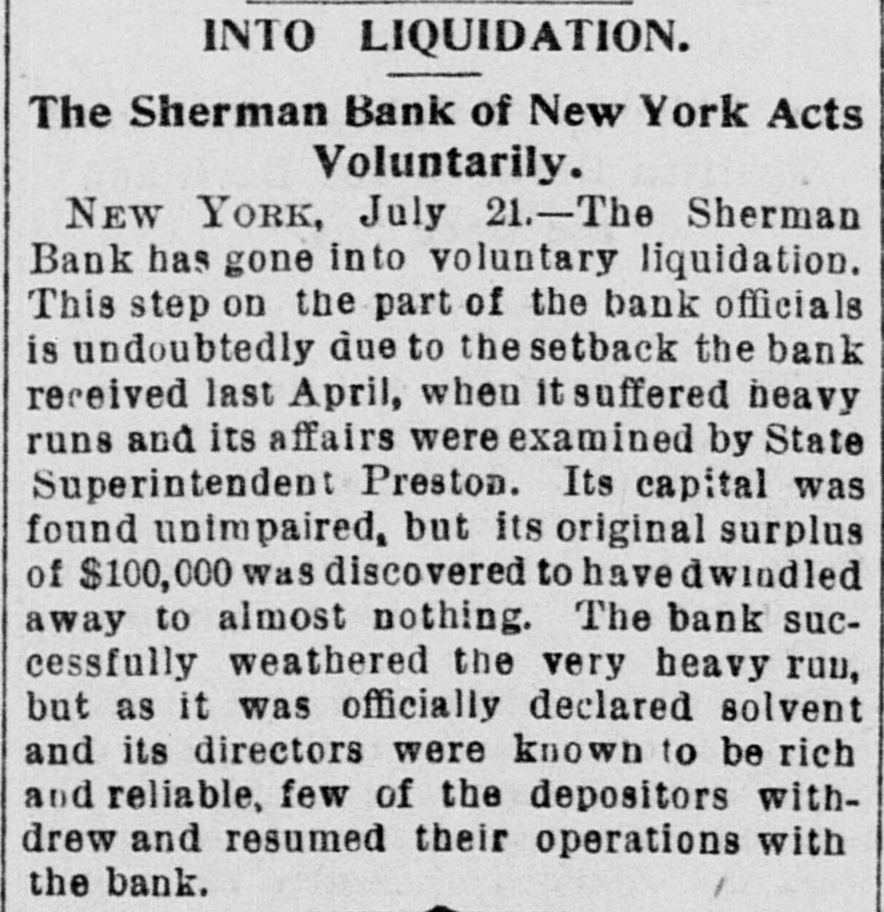
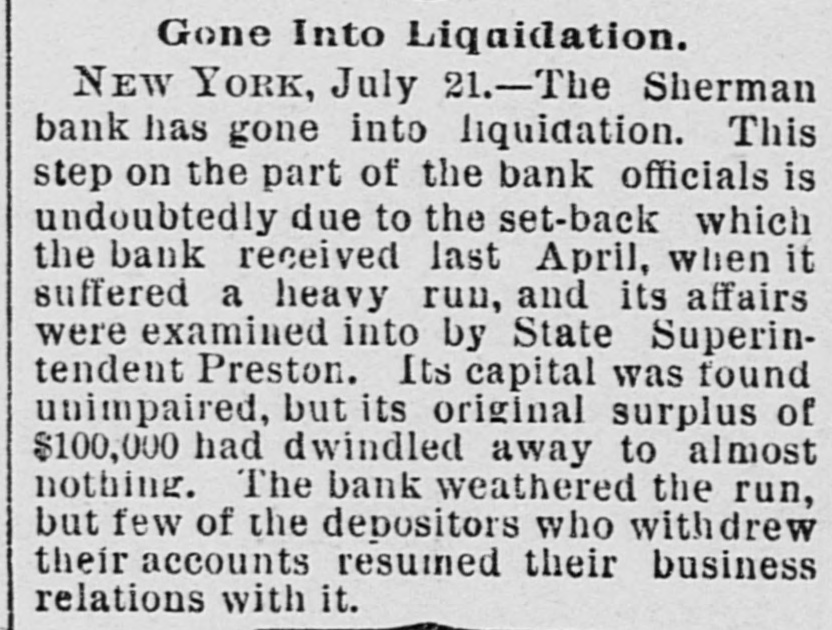
INTO LIQUIDATION. The Sherman Bank of New York Acts Voluntarily. NEW YORK, July 21.-The Sherman Bank has gone into voluntary liquidation. This step on the part of the bank officials is undoubtedly due to the setback the bank received last April, when it suffered heavy runs and its affairs were examined by State Superintendent Preston. Its capital was found unimpaired, but its original surplus of $100,000 was discovered to have dwindled away to almost nothing. The bank successfully weathered the very heavy run, but as it was officially declared solvent and its directors were known to be rich and reliable, few of the depositors withdrew and resumed their operations with the bank.


Article from St. Paul Daily Globe, July 22, 1894

Click image to open full size in new tab

Article Text

Gone Into Liquidation. NEW YORK, July 21.-The Sherman bank has gone into liquidation. This step on the part of the bank officials is undoubtedly due to the set-back which the bank received last April, when it suffered a heavy run, and its affairs were examined into by State Superintendent Preston. Its capital was found unimpaired, but its original surplus of $100,000 had dwindled away to almost nothing. The bank weathered the run, but few of the depositors who withdrew their accounts resumed their business relations with it.


Article from New-York Tribune, July 24, 1894

Click image to open full size in new tab

Article Text

TO CLOSE THE SHERMAN BANK. IT IS GOING INTO VOLUNTARY LIQUIDA TION. DEPOSITORS AND STOCKHOLDERS WILL PAID IN FULL-HISTORY OF THE INSTITUTION. The ground floor of the building No. 874 Broadway is to let. It is now occupied by the Sherman Bank, which was organized in 1892 with a paid-up capital of $200,000 and a cash surplus of $100,000. Business has become steadily ess since last April, when, in consequence of a combination of circumstances, a run was made on the bank which for a time threat. ened Its existence. The shrinkage in business since then, and the generally depressed state of affairs, caused the d/rectors to give notice on last Tuesday that no more accounts would be opened, and depositors were requested to withdraw any balance which might be due them, the majority of the stockholders meanwhile having decided that the bank should go into voluntary liquidation. D. R. Satteriee was the first president of the bank, and was succeeded by Charles E. Bulkeley, who, after a few months' service, was succeeded by Eugene N Howell. James H. Parker, president of the United States National Bank. was a director of the Sherman Bank. but resigned, together with two other members of the board. when Mr. Howell became president, and his bank. which had been the Clearing House agent for the Sherman Bank from its start. refused longer to clear for it. This step on the part of the United States Bank caused much comment The Central National Bank succeeded the United States National as the Sherman Bank clearing agent, Another change in the presidency of the bank took place in April, when Louis C. Fuller succeeded Mr. Howell, and the Board of Directors was changed. The statements of the bank show that it had over six hundred depositors, and that in March, 1894, its deposits amounted to $401,375, an increase of $102.961 over September, 1893. In April the United States Bank made application to become the clearing agent once more for the Sherman Bank, whereupon an investigation was ordered, which took place April 18, and resulted in the United States Bank's request being granted. Two days after this there was a run on the bank. which though it was not serious, injured the bank. The Central Bank, which had always been friendly to the Sherman. then (without intent. the Sherman people say) caused the bank which was in trouble additional worry by Issuing a circular announcing that the bank would cease to redeem checks or drafts drawn or made payable to the Sherman Bank. That was on April 20, and the next day came another and more serious run on the bank. in a single day-April 21-the deposits shrank from over $300,000 to $100,000. But other banks came to the assistance of the Sherman. President Strong, of the Central Bank, sent up $15,000 to help it along. Several of the rich directors personally guaranteed the deposits, and the run was speedily checked. Mr. Judson. State Bank Examiner. reported that the bank's original surplus was nearly wiped out, but that the bank's capital was not impaired. He declared also that the bank was solvent and could borrow money. He criticised the management of the first president, under whose administration worthless loans had been made. and he cut down the bank's furniture inventory from $21,000 to $6,000. The cashier, Henry D. Northrop, was seen at the bank yesterday. He said: We are simply going out of business-something which many concerns would like to do If they could. We are doing It slowly and without any fuss. Mr. Northrop also confirmed the following statement made by him yesterday: Our expenses are large, our deposits are running & down and business has been poor. Although number of substantial business men have said that they would come in with us in the fall, the dlrectors thought that it would be wiser to pay our depositors and pay off the stockholders. The deposits are in small amounts. for the most part, and most of them are private accounts We did a regular banking business. We lent to some of the depositors of the Madison Square Bank 50 per cent of their accounts, taking an assignment of the whole as collateral. Of this money we have recelved about 50 per cent. The whole amount was $10,000. For several days we have been refusing deposits, and as fast as depositors have come in we have been asking them to close their accounts We have all the money necessary to pay our depositors, either in our own vaults or on deposit with our redeeming agents. It will take a long time to close up. We still have about $115,000 of deposits, and paid out to-day $17,000 Many of our depositors were unwilling to withdraw their money and in no instance has there been any anxiety on the part of depositors. The following notice was issued yesterday: A meeting of the stockholders of the Sherman Bank for the purpose of devising means to protect will their interests in the liquidation of said bank be held at the Holland House, Thirtieth-st and Tuesday July 31. 1894, at


Article from Fort Worth Gazette, July 24, 1894

Click image to open full size in new tab

Article Text

FINANCIAL. New York, July 22.-President Butcher says in an interview that the financial condition of Southern cotton oil is perfectly sound. We do not owe a dollar, and have a good fund in the bank. We did not make any money last year, but neither did any other cotton oil company. We did not propose paying any dividend out of surplus fund. Dissatisfaction over no dividend have had something to do with declines. Prospects for the present year are encouraging. We look for a big crop of cotton seed, which means low prices, in consequence of which we expect to do a large business. We deal almost entirely in low priced oils." The Chicago Gas Fidelity certificates 1 1-2 per cent are payable today. The Sherman bank of New York has gone into voluntary liquidation. Stockholders are requested to withdraw deposits. The amount involved in the Atchison rebate matter is about seven million dollars. dating from last re-organization. Full report will be presented Tuesday. An officer of the United States Rubber company says that the company earned last year about 1$ per cent on the common stock, after providing for all prior charges, and that the common stock is likely to ge dividends in 1895. He says the quotations on the stock exchange and nominal effort to buy any considerable amount of preferred stock would put the price to par. The rubber men who took stock in payment for properties are holding with every confidence in high prices. A broker who has large orders in D. C. F. stock says there is continued selling of D. C. F. from the West. There is much less confidence out there apparently in the stability of the company than there is here, and the confidence here Is mighty small. The rumor of Saturday of the sale of more bonds was vigorously denied by those who have close touch with the president. The company has $2,500.00 in escrow to secure the payment of rebate monies, but it is stated that they are not sufficient fully to secure the amount of rebates now outstanding, and this gives rise to a fear that the company may be called on for more margin and cannot respond. President Greenhut assures his friends that nothing at all is the matter in fact with the company, and that the only trouble is in Wall street, and the company can take care of itself from a trade standpoint. It is said the decline in D. C. F. started by Kohn & Co. on Saturday would not have been 80 great had the market been normal. It is considered probable that that house sold less than a thousand shares. Bears on D. C. F. say they sell the stock on exactly the same argument they buy sugar-that there will be no tariff bill. No tariff bill for whisky means no Increase in the tax, and will be badly complicated. London, July 23, 2 p. m.-C. O., 1-8 lower; L. S., unchanged: St. P., 1-4 lower; L. N., 1-8 lower; Erie, 1-8 higher; U. P., 1-8 down: N. P., preferred, unchanged; Atchinson, unchanged: Reading. 1-8 up. London July 23.-Bar silver up 1-16 to 28 11-16d. The effect of the Atchison disclosures in London has been the cause of a decline in the bonds. Atchinson 4s are quoted equal to 71 3-8, and Atchinson 2nds equal to 22 1-8, The rest of the market has not been affected, chieffly because there is very little doing. The earnings for the month of June of the N. W. decreased $472,200. Baring Magoun takes $500,000 gold. Stocks opened feverish and irregular with some pressure to sell D. C. F. and Atchinson bonds. There was a lively whirl in sugar and the room shorts were squeezed. The pool brokers also bid up the price, and the argument was advanced that 11 the senate bill is not accepted there will be an effort to postpone all legislation this congress. The railroad list was neglected, although the Cammack brokers were inclined to renew their attacks against Missouri Pacific. Chicago Gas was barely steady, but at any concession the Benediet brokers bought while traders were inclined to take outstanding shorts. London sold some


Article from The Washington Bee, August 11, 1894

Click image to open full size in new tab

Article Text

Gov. Tillman is determined to force his dispensary system on South Carolina August 1. President Zelaya lays the disturbances on the Mosquito coast to drunken English sailors. "Gen." Coxey and Dr. McGlynn were the speakers at the People's party picnic at Ridgewood, L. I. Secretary Carlisle has adopted a design for $1 silver certificates made by Will H. Low, the New York artist. Mrs. T. F. Meagher, of Louisville, Ky., shot and killed her father, who was beating and kicking his wife to death. A man giving his name as Timothy Burke seized little Lucy Magrino in Second avenue, New York, and ran, but was captured. J. P. Haas hanged himself at Indianapolis in the cottage he had built for his fiancee when he learned that she had wedded another. Bishop Michaud and other prominent churchmen officiated at the opening of the second week of the Catholic Summer School at Plattsburg, N. Y. The Sherman Bank of New York, though it overcame its recent troubles, has decided to quit, owing to poor business. All depositors will be paid in full. Secretary Gresham has instructed our Minister to Japan to offer to the Japanese Government the good offices of the United States Government in the Corean dispute. There was a great rush of people to Europe, caused by the cut in steerage rates to $10 from New York. Several steamers sold tickets to more people than they could carry. The Rev. C. C. Reynolds, of Victory, N. Y., has sued the Rev. James Thomb for libel based on articles in a newspaper charging Reynolds with insulting his congregation. Followers of Debs say he will organize all American labor into two unions, preside at a monster convention January 15, 1895, and inaugurate a strike May 1, 1895, for pre-panic wages. A. G. Renshaw, a British capitalist, has commenced a suit in the United States District Court at San Francisco to recover $245,000 as compensation for the fraudulent sale of the Bird's Nest Group of the Alaska mines. A man upon whose person was found a bankbook bearing the name Joseph Kennv was sunstruck in New York Saturday afternoon. Though he has never regained consciousness and his temperature rose too high for the thermometer to measure, he is still alive. Thomas Walsh invaded the dining hall of the Banquet Club, New York, shot to pieces the halo of an image of St. Patrick and cleaned out the place. His friend John F. Dunphy, who did not like the clubmen, was fined in Essex Market Police Court as the instigator.


Article from The Washington Bee, August 18, 1894

Click image to open full size in new tab

Article Text

Gov. Tillman is determined to force his dispensary system on South Carolina August 1. President Zelaya lays the disturbances on the Mosquito coast to drunken English sailors. "Gen." Coxey and Dr. McGlynn were the speakers at the People's party picnic at Ridgewood, L. I. Secretary Carlisle has adopted a design for $1 silver certificates made by Will H. Low, the New York artist. Mrs. T. F. Meagher, of Louisville, Ky., shot and killed her father, who was beating and kicking his wife to death. A man giving his name as Timothy Burke seized little Lucy Magrino in Second avenue, New York, and ran, but was captured. J. P. Haas hanged himself at Indianapolis in the cottage he had built for his fiancee when he learned that she had wedded another. Bishop Michaud and other prominent churchmen officiated at the opening of the second week of the Catholic Summer School at Plattsburg, N. Y. The Sherman Bank of New York, though it overcame its recent troubles, has decided to quit, owing to poor business. All depositors will be paid in full. Secretary Gresham has instructed our Minister to Japan to offer to the Japanese Government the good offices of the United States Government in the Corean dispute. There was a great rush of people to Europe, caused by the cut in steerage rates to $10 from New York. Several steamers sold tickets to more people than they could carry. The Rev. C. C. Reynolds, of Victory, N. Y., has sued the Rev. James Thomb for libel based on articles in a newspaper charging Reynolds with insulting his congregation. Followers of Debs say he will organize all American labor into two unions, preside at a monster convention January 15, 1895, and inaugurate a strike May 1, 1895, for pre-panic wages. A. G. Renshaw, a British capitalist, has commenced a suit in the United States District Court at San Francisco to recover $245,000 as compensation for the fraudulent sale of the Bird's Nest Group of the Alaska mines. A man upon whose person was found a bankbook bearing the name Joseph Kennv was sunstruck in New York Saturday afternoon. Though he has never regained consciousness and his temperature rose too high for the thermometer to measure, he is still alive. Thomas Walsh invaded the dining hall of the Banquet Club, New York, shot to pieces the halo of an image of St. Patrick and cleaned out the place. His friend John F. Dunphy, who did not like the clubmen, was fined in Essex Market Police Court as the instigator.


Article from The Washington Bee, September 1, 1894

Click image to open full size in new tab

Article Text

Gov. Tillman is determined to force his dispensary system on South Carolina August 1. President Zelaya lays the disturbances on the Mosquito coast to drunken English sailors. "Gen." Coxey and Dr. McGlynn were the speakers at the People's party picnic at Ridgewood, L. I. Secretary Carlisle has adopted a design for $1 silver certificates made by Will H. Low, the New York artist. Mrs. T. F. Meagher, of Louisville, Ky., shot and killed her father, who was beating and kicking his wife to death. A man giving his name as Timothy Burke seized little Lucy Magrino in Second avenue, New York, and ran, but was captured. J. P. Haas hanged himself at Indianapolis in the cottage he had built for his fiancee when he learned that she had wedded another. Bishop Michaud and other prominent churchmen officiated at the opening of the second week of the Catholic Summer School at Plattsburg, N. Y. The Sherman Bank of New York, though it overcame its recent troubles, has decided to quit, owing to poor business. All depositors will be paid in full. Secretary Gresham has instructed our Minister to Japan to offer to the Japanese Government the good offices of the United States Government in the Corean dispute. There was a great rush of people to Europe, caused by the cut in steerage rates to $10 from New York. Several steamers sold tickets to more people than they could carry. The Rev. C. C. Reynolds, of Victory, N. Y.. has sued the Rev. James Thomb for libel based on articles in a newspaper charging Reynolds with insulting his congregation. Followers of Debs say he will organize all American labor into two unions, preside at a monster convention January 15, 1895, and inaugurate a strike May 1, 1895, for pre-panic wages. A. G. Renshaw, a British capitalist, has commenced a suit in the United States District Court at San Francisco to recover $245,000 as compensation for the fraudulent sale of the Bird's Nest Group of the Alaska mines. A man upon whose person was found a bankbook bearing the name Joseph Kenny was sunstruck in New York Saturday afternoon. Though he has never regained consciousness and his temperature rose too high for the thermometer to measure, he is still alive. Thomas Walsh invaded the dining hall of the Banquet Club, New York, shot to pieces the halo of an image of St. Patrick and cleaned out the place. His friend John F. Dunphy, who did not like the clubmen, was fined in Essex Market Police Court as the instigator.


Article from New-York Tribune, March 9, 1895

Click image to open full size in new tab

Article Text

No. 113 Fulton NEW-YORK CITY. A monthly meeting of the Ohio Society will be held at Morello's, No I West Twenty-ninth-st., on Monday at 6:30 p. m. Dinner will precede the business of the evening. Rescue mission workers and friends of rescue missions of New-York. Brooklyn and their vicinity are invited to a rally in the chapel of the Industrial Christian Alliance, No 170 Bleecker-st. this evening from R to 12 o'clock. A special musical programme is promised. The second annual reception of the New-York Academy of Sciences. with which there will be an exhibit of recent progress in science. is set for next Wednesday evening in the galleries of the American Fine Arts Society, West Fifty-seventh-st. The Rev. Dr. D. J Burrill, at the request of the Woman's National Sabbath Alliance. will preach in the Marble Collegiate Church, Fifth-ave and Twenty-ninth-st., to-morrow at 11 a. m., on "The Responsibility of the Women of America in Proserving the American Sabbath." The Rev. Dr. Newland Maynard will deliver an illustrated and historical lecture, on "India and Its People." next Monday afternoon. at the home of Mrs. George Lewis Gillespie, No. 49 East Fiftythird-st. A special meeting in the Interests of the Sabbath and in opposition to the opening of saloons on Sunday will be held in the Scotch Presbyterian Church Ninety-sixth-st. and Central Park West, to-morrow evening at 8 o'clock. John E. Parsons, the Rev. W. W. Atterbury and the pastor. Dr. Wylle, will speak. Young men and Good Government clubs especially are invited The Rev. C. H. Mead. of Hornellsville. N. Y., will deliver an address before the American Temperance Union at Chickering Hall to-morrow afternoon at 3 o'clock: subject. "Wanted- a Man." The Silver Lake Quartet and others will furnish muste. Controller Fitch yesterday sold at public auction a five years' lease of the old Harlem Market Square, at Gne-hundred-and-twenty-frst-st. and Sylvan Place. to the present holder of the lease, Bryan G Hughes. at a yearly rental of $8,325. The Rev. Stephen S. Craig. of Oakville, Ont. will deliver an address under the auspices of the Manhattan Single Tax Club at Chickering Hall to-morrow evening at 8 o'clock. on the subject "The Sin of the Church." Mr. Craig is an eloquent speaker and one of the leading Presbyterian divines of Canada. The 111th anniversary dinner of the Friendly Sons of St. Patrick will be held at Delmonico's on March 18. Dr. Emil Holub, an African explorer, will describe the customs and war methods of the Matabele tribes to morrow evening at the New-York Turn Verein, No. 66 East Fourth-st. A smoking concert will be given this evening by the Phoenix Republican Club, No. 61 East Eighty sixth-st. The Ninth Ward Ploneer Corps on Wednesday night adopted resolutions indorsing Mayor Strong's appointments and especially that of William Brookfield Todd B. Hall, chief of the detective force of Balti more, will address young men at Association Hall Twenty-third-st. and Fourth-ave. to-morrow at + p. m. L. Mandelbaum and S. Michelbacher two mem hers of the Cotton Exchange, were suspended yes terday for one week for fighting on the floor of the Exchange. Collector Kilbreth has received instructions from Washington to secure new quarters for the Nava Office. The present office of the Naval Officer is " the Phelps Building. opposite the Custom House, 1: Exchange Place. There has been some trouble this year in regard to the lease, and it has been decide to get quarters elsewhere. The new Standard National Bank will, it is said occupy the old quarters of the defunct Sherma Bank, at No. 874 Broadway, and it will no doub secure as depositors many of the clients of the Sherman Bank. and the Federal Bank, which I in process of liquidation. There is some talk of :


Article from New-York Tribune, June 13, 1895

Click image to open full size in new tab

Article Text

LOCAL BUSINESS COMPLICATIONS. Deputy-Sheriff Dunphy has received executions aggregating $5,045 against Henry C. Shannon, formerly manager of the Langham Hotel, at Fifth-ave. and Fifty-second-st., in favor of the following: Albertype Company, $695; Ella A. Taylor, $1,372; Hester A. Shannon, $1,681; Robert H. Shannon, $1,297. Nothing has yet been found to levy upon, as Mr. Shannon said that he had no personal property which can be levied upon. The executions are on personal matters of Mr. Shannon, and not in connection with the hotel business. John E. Ward has been appointed referee in the matter of the voluntary dissolution of the Sherman Bank, and the order to show cause has been set down for September 20. The petition of the directors states that the nominal assets are $137,595, consisting of cash, $18,917; United States bonds, $12,300, and the balance are bills receivable, demand loans and office furniture. There are claims against the bank for about $4,800. Deputy-Sheriff Carraher has received an attachment for $20,948 against the Springdale Paper Company, of Westfield, Mass., in favor of Castle & Gottheil, for balance claimed to be due for rags and paper-makers' supplies sold to the company between April 25, 1894, and January 23, 1895. George A. Morrison, receiver of the Liberty Insurance Company, in voluntary dissolution, has obtained an order of the Court to pay a second dividend of $50,000 to the stockholders, $150,000 having been paid on the first dividend.


Article from New-York Tribune, October 11, 1895

Click image to open full size in new tab

Article Text

TE COURTS. TURN IN THE SHERMAN BANK'S AFFAIRS. A SYNDICATE OF STOCKHOLDERS PROPOSES TO CONTINUE THE BUSINESS. The question of the appointment of a receiver for the Sherman Bank, an application for the voluntary dissolution of which is now pending in the Supreme Court, came up before John E. Ward. referee, at No. 50 Wall-st., yesterday. The hearing was adjourned without action on motion of Charles E. Hotchkiss, of the law firm of Davies, Stone & Auerbach, who represent the Board of Directors of the bank. Mr. Hotchkiss asked for the adjournment for the purpose of allowing time for the completion of an arrangement whereby all the stock will be purchased by a syndicate of stockholders, who will continue the business of the bank. Mr. Satteriee, the former president, pointed out that winding up the bank's affairs that way would be preferable to long and desultory proceedings before a referec, and later under a receiver. Mr. Satterlee, as the largest individual stockholder. and Vanderpoel, Gordon & Cumming. representing a majority of the stockholders, said they were in favor of such a proposition if matters could be amicably so arranged, and a fair price could be realized for the stock. The next meeting was get down for November 12, when. if the sale has not been arranged, the referee will proceed forthwith.