Article Text
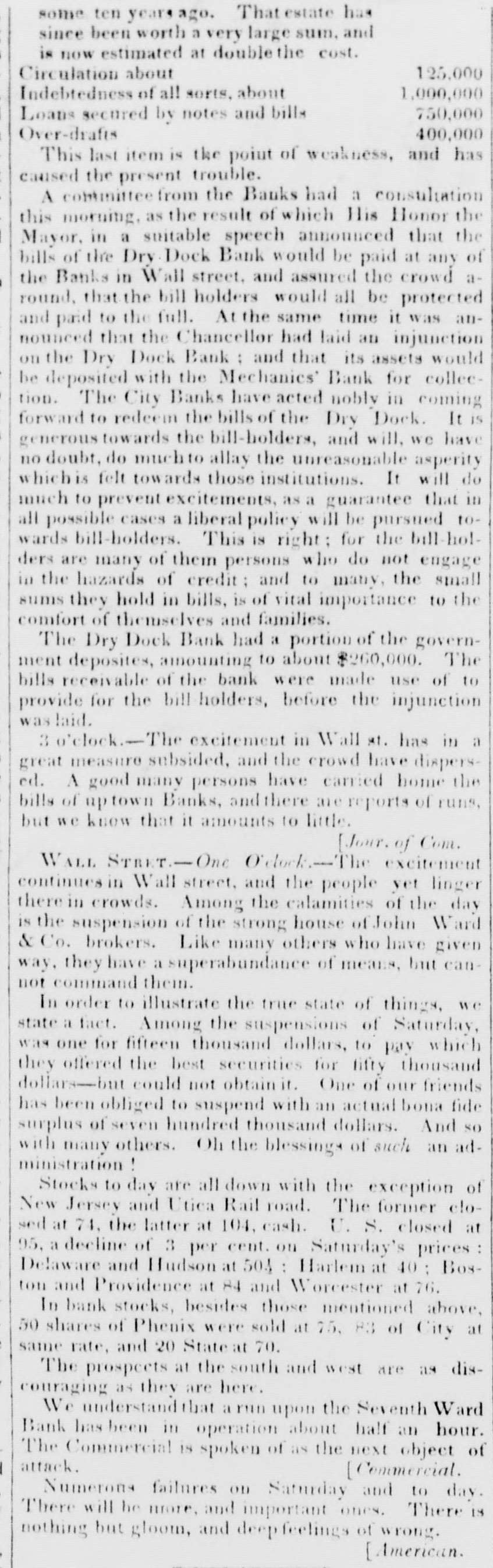
now estimated at COST Circulation about 125,000 1.000,000 Indebtedness of all sorts, about 750,000 Loans secured by notes and bills Over-drafts 400,000 This last item is the point of weakness, and has caused the present trouble. A committee from the Banks had a consultation this morning, as the result of which His Honor the Mayor. in a suitable speech announced that the bills of the Dry Dock Bank would be paid at any of the Banks in Wall street, and assured the crowd around. that the bill holders would all be protected and paid to the full. At the same time it was announced that the Chancellor had laid an injunction on the Dry Dock Bank : and that its assets would be deposited with the Mechanics' Bank for collection. The City Banks have acted nobly in coming forward to redeem the bills of the Dry Dock. It is generous towards the bill-holders, and will, we have doubt, do muchto allay the unreasonable asperity which is felt towards those institutions. It will do much to prevent excitements, as a guarantee that in all possible cases a liberal policy will be pursued towards bill-holders. This is right for the bill-holders are many of them persons who do not engage in the hazards of credit; and to many, the small sums they hold in bills, is of vital importance to the comfort of themselves and families. The Dry Dock Bank had a portion of the government deposites, amounting to about $260,000. The bills receivable of the bank were made use of to provide for the bill holders, before the injunction was laid. 3 o'clock.-The excitement in Wall st. has in a great measure subsided, and the crowd have dispersed. A good many persons have carried home the bills of uptown Banks, and there are reports of runs, but we know that it amounts to little. [Jour. of Com. WALL STRET-One O'dock.--The excitement continues in Wall street, and the people yet linger there in crowds. Among the calamities of the day is the suspension of the strong house of John Ward Co. brokers. Like many others who have given way, they have a superabundance of means, but cannot command them. In order to illustrate the true state of things, we state a fact. Among the suspensions of Saturday, was one for fifteen thousand dollars, to pay which they offered the best securities for fifty thousand dollars-but could not obtain it. One of our friends has been obliged to suspend with an actual bona fide surplus of seven hundred thousand dollars. And so with many others. Oh the blessings of such an administration : Stocks to day are all down with the exception of New Jersey and Utica Rail road. The former closed at 74, the latter at 104, cash. U. S. closed at 95, a decline of 3 per cent. ou Saturday's prices Delaware and Hudson at 504 : Harlem at 40 : Boston and Providence at 84 and Worcester at 76. In bank stocks, besides those mentioned above, 50 shares of Phenix were sold at 75, 83 of City at same rate, and 20 State at 70. The prospects at the south and west are as discouraging as they are here. We understand that a run upon the Seventh Ward Bank has been in operation about half an hour. The Commercial is spoken of as the next object of attack. [Commercial. Numerons failures on Saturday and to day. There will he more. and important ones. There 18 nothing but gloom, and deepfeelings of wrong. [American.