Accommodated withdrawals, Capital injected, Full suspension, Books examined
Receivership Details
Date receivership started
1901-06-27
Date receivership terminated
1901-11-12
OCC cause of failure
Excessive lending
Description
Newspaper series describes a small depositor run (June 26, 1901), the bank's suspension/closing June 27, 1901 with receiver Forest Raynor appointed, and later reorganization and government approval to reopen (plans in Sept 1901; Comptroller cleared it and receiver discharged by Nov 12, 1901). Cause was bank-specific: large doubtful loan(s) to Henry Marquand & Co. producing a heavy clearing-house debit balance. OCR minor errors corrected (e.g., receiver name appears as Raynor/Rayner; I use Forest Raynor as reported in multiple pieces).
Events (8)
1.April 11, 1865Chartered
Source
historical_nic
2.June 26, 1901Run
Cause
Bank Specific Adverse Info
Cause Details
Heavy withdrawals sparked by news of the bank's embarrassment tied to large doubtful exposures (loans) to Henry Marquand & Co.; clearing house debit.
Measures
Payments made rapidly to waiting customers; offers of financial assistance; directors/stockholders convened and provided means; large cash advance by General Samuel Thomas/Edwin Gould reported.
Newspaper Excerpt
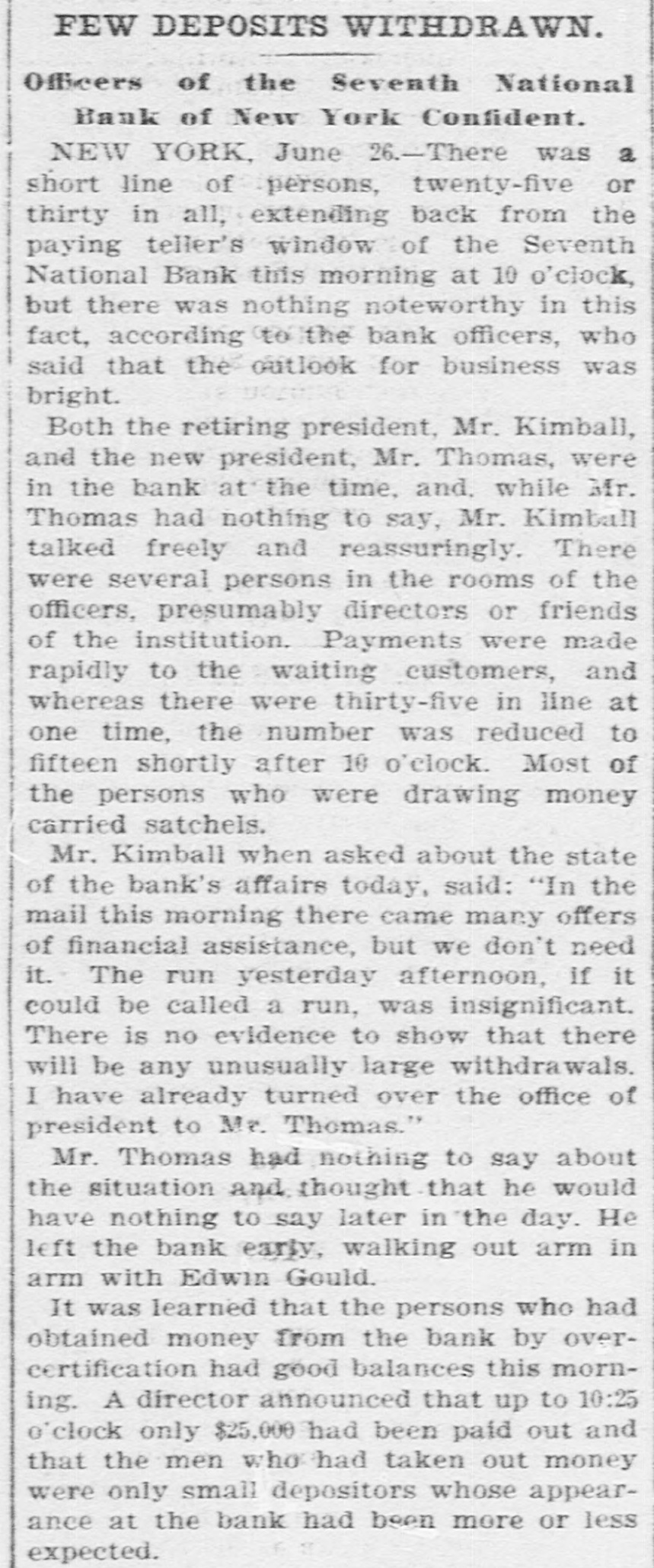
There was a short line of persons, twenty-five or thirty in all, extending back from the paying teller's window ... the run yesterday afternoon, if it could be called a run, was insignificant.
Source
newspapers
3.June 27, 1901Receivership
Source
historical_nic
4.June 27, 1901Suspension
Cause
Bank Specific Adverse Info
Cause Details
Clearing house returns showed a heavy debit balance (reported $644,108.95 to $938,000 in various reports) and large loan exposure to Marquand & Co. with doubtful collateral; Comptroller took charge and receiver appointed.
Newspaper Excerpt
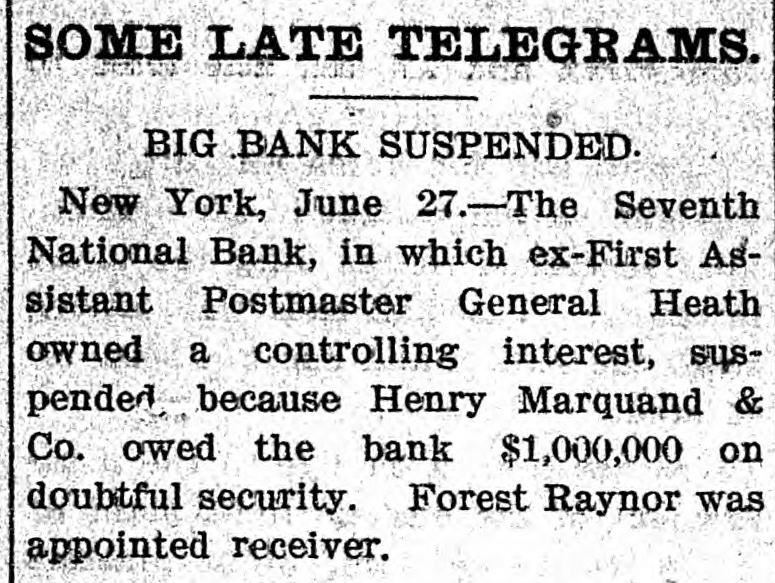
The Seventh National Bank ... suspended because Henry Marquand & Co. owed the bank $1,000,000 on doubtful security. Forest Raynor was appointed receiver.
Source
newspapers
5.July 25, 1901Other
Newspaper Excerpt
Directors decide on a plan for the reorganization of the defunct Seventh National bank ... increase capital stock ... plan for reorganization being prepared while federal grand jury investigates the affairs of the bank . . . . (used to indicate restructuring activity prior to reopening.)
Source
newspapers
6.November 12, 1901Reopening
Newspaper Excerpt
Comptroller of the Currency Ridgley has notified the New York clearinghouse that the condition of the reorganized Seventh National bank was satisfactory to the government ... it could pay all its obligations and reopen ... the receiver had been discharged.
Source
newspapers
7.November 12, 1901Restored To Solvency
Source
historical_nic
8.April 9, 1903Voluntary Liquidation
Source
historical_nic
Newspaper Articles (23)
1.January 17, 1900The Abbeville Press and BannerAbbeville, SC
Click image to open full size in new tab
Article Text
A WALL STREET PANIC. Securities Drop Many Points and Two Failures Are Announced. BANKSCOME TO MARKET'S RELIEF The Stock Exchange Experiences One of the Worst Days in Its History-Treasury Offers a Plan of Relief-Proffered Loans of $11,000,000 Aid the Stringent Money Market-Millions Lost. NEW YORK CITY (Special).-Much the worst panic that Wall street has seen since the memorable crash of 1893, commonly known as the "Cordage Smash," came upon the Street Monday, and when the day was over market values had declined millions upon millions of dollars, men who but a few hours before had counted their money by the thousands were ruined, and gloom was everywhere. In many respects, indeed, it was probably the worst singleday panic the Street had ever known. Recorded transactions on the Stock Exchange reached the enormous total of 1,531,150 shares. On the exchanges of other cities there were also crashes and abnormally heavy trading. From various cities throughout the country came reports of disastrous speculative losses, both in local and in New York stocks. Money was lent on call as high as 186 per cent. per annum, and there was a meeting of bank presidents, followed by offers to lend $10,000,000 to stem the tide of liquidation. The Produce Exchange Trust Company, B concern with more than $5,000,000 capital and surplus, closed its doors, and there were false rumors that one other trust company and half a dozen banks had suspended payment. It did happen that the Seventh National Bank served notice on the Clearing House banks that after twenty-four hours it would cease to act as Clearing House agent for the International Bank and Trust Company. That company deposited city bonds with the bank to protect its checks and its secretary announced that it was absolutely solvent. The Stock Exchange firm of Henry Allen & Co. collapsed with estimated liabilities of more than $1,000,000. There was a violent collapse in values on the Stock Exchange. where prices of shares dropped from $8 to $21, the declines of $2 to $9 a share between sales being a frequent happening. Late in the. afternoon the presidents of the larger banks met at the Clearing House to adopt measures to relieve the situation, but it was not until the bankers had offered to lend millions of dollars at six per cent. that the backbone of the panic was broken. Meantime the actual and contingent losses were enormous. Trust company stockholders had $5,000,000 tied up, while depositors' money, to the sum of from $2,000,000 to $3,000,000, had been locked up. A brokerage firm had failed with liabilities of more than $1,000,000, while securities worth several times that sum were involved. And the loss to holders of securities, when the slump In the market prices is considered, had mounted up into many more millions. The crash was purely speculative in its character-similar to the Grant & Ward failure in 1884. On Monday the failures were comparatively few, and none of the. Clearing House banks or big investment houses in Wall street was threatened. In fact, the break from the high interest rates came when J. P. Morgan & Co. dumped $1,000,000 into the Stock Exchange and lent it at six per cent., although the firm might have got 100 per cent. The panic in money was provoked by the failure of the trust company when the tension in the money markets was great, for fear the foreign markets might be upset by news from the Transvaal. Already speculators had been crippled, and the fear that more bubbles would burst threw them into panic. The investment and conservative trading element of the street took it as a matter of course. They had expected a speculative whirl of some sort. It happened that the bears won because P. weak spot in a local financial institution had been uncovered.
2.June 26, 1901The Evening TimesWashington, DC
Click image to open full size in new tab
Article Text
FEW DEPOSITS WITHDRAWN. Officers of the Seventh National Bank of New York Confident. NEW YORK, June 26.-There was a short line of persons, twenty-five or thirty in all, extending back from the paying teller's window of the Seventh National Bank this morning at 10 o'clock, but there was nothing noteworthy in this fact, according to the bank officers, who said that the outlook for business was bright. Both the retiring president, Mr. Kimball, and the new president, Mr. Thomas, were in the bank at the time. and, while Mr. Thomas had nothing to say, Mr. Kimball talked freely and reassuringly. There were several persons in the rooms of the officers, presumably directors or friends of the institution. Payments were made rapidly to the waiting customers, and whereas there were thirty-five in line at one time, the number was reduced to fifteen shortly after 10 o'clock. Most of the persons who were drawing money carried satchels. Mr. Kimball when asked about the state of the bank's affairs today, said: "In the mail this morning there came many offers of financial assistance, but we don't need it. The run yesterday afternoon, if it could be called a run, was insignificant. There is no evidence to show that there will be any unusually large withdrawals. I have already turned over the office of president to Mr. Thomas." Mr. Thomas had nothing to say about the situation and thought that he would have nothing to say later in the day. He left the bank early, walking out arm in arm with Edwin Gould. It was learned that the persons who had obtained money from the bank by overcertification had good balances this morning. A director announced that up to 10:25 o'clock only $25.000 had been paid out and that the men who had taken out money were only small depositors whose appearance at the bank had been more or less expected.
3.June 27, 1901Bismarck Daily TribuneBismarck, ND
Click image to open full size in new tab
Article Text
SOME LATE TELEGRAMS. 20020 BIG BANK SUSPENDED. New York, June 27.-The Seventh National Bank, in which ex-First Assistant Postmaster General Heath owned a controlling interest, suspended because Henry Marquand & Co. owed the bank $1,000,000 on doubtful security. Forest Raynor was appointed receiver.
4.June 27, 1901Missouri Valley TimesMissouri Valley, IA
Click image to open full size in new tab
Article Text
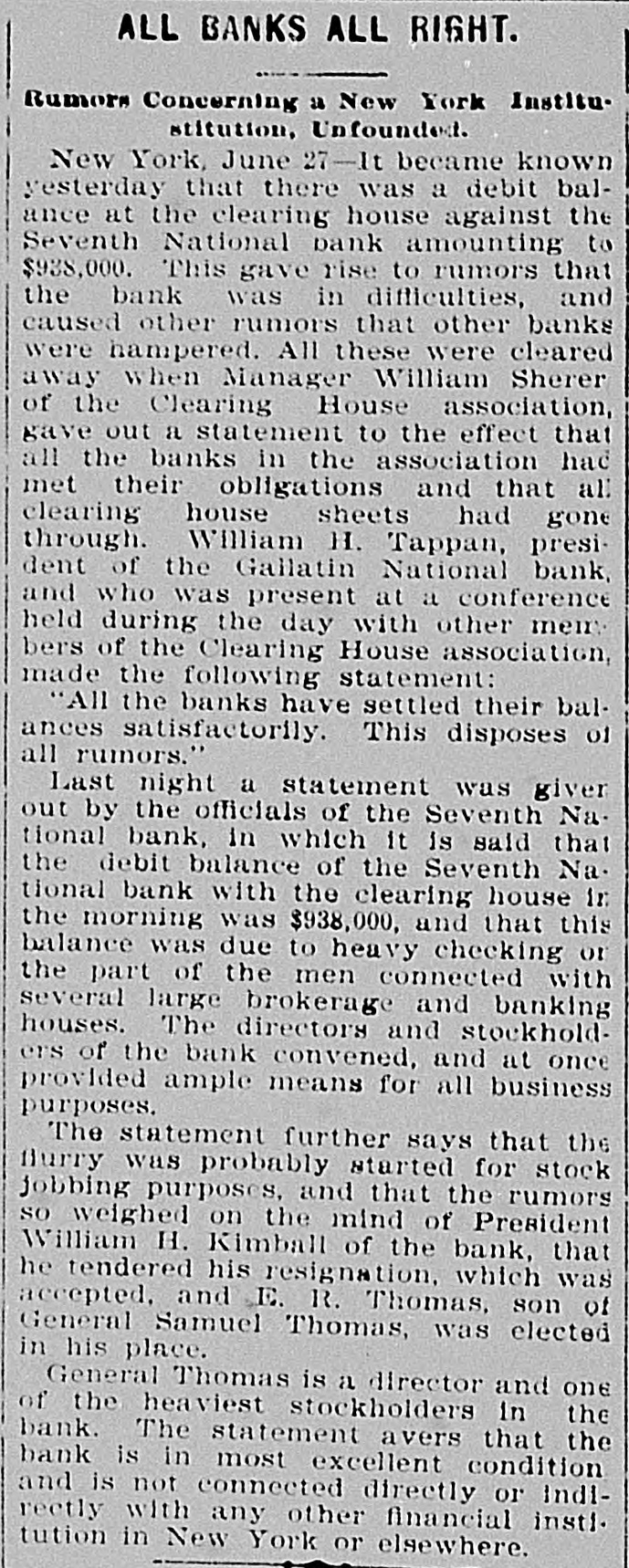
ALL BANKS ALL RIGHT. Rumors Concerning a New York Institustitution, Unfounded. New York, June 27-It became known yesterday that there was a debit balance at the clearing house against the Seventh National bank amounting to $938,000. This gave rise to rumors that the bank was in difficulties, and caused other rumors that other banks were hampered. All these were cleared away when Manager William Sherer of the Clearing House association, gave out a statement to the effect that all the banks in the association hac met their obligations and that all clearing house sheets had gone through. William H. Tappan, president of the Gallatin National bank, and who was present at a conference held during the day with other mem. bers of the Clearing House association, made the following statement: "All the banks have settled their balances satisfactorily. This disposes of all rumors." Last night a statement was giver out by the officials of the Seventh National bank, in which it is said that the debit balance of the Seventh Na. tional bank with the clearing house in the morning was $938,000, and that this balance was due to heavy checking or the part of the men connected with several large brokerage and banking houses. The directors and stockholders of the bank convened, and at once provided ample means for all business purposes. The statement further says that the Hurry was probably started for stock jobbing purposes, and that the rumors so weighed on the mind of President William H. Kimball of the bank, that he tendered his resignation, which was accepted, and E. R. Thomas, son of General Samuel Thomas, was elected in his place. General Thomas is a director and one of the heaviest stockholders in the bank. The statement avers that the bank is in most excellent condition and is not connected directly or Indirectly with any other financial instltution in New York or elsewhere.
5.June 28, 1901The Indianapolis JournalIndianapolis, IN
Click image to open full size in new tab
Article Text
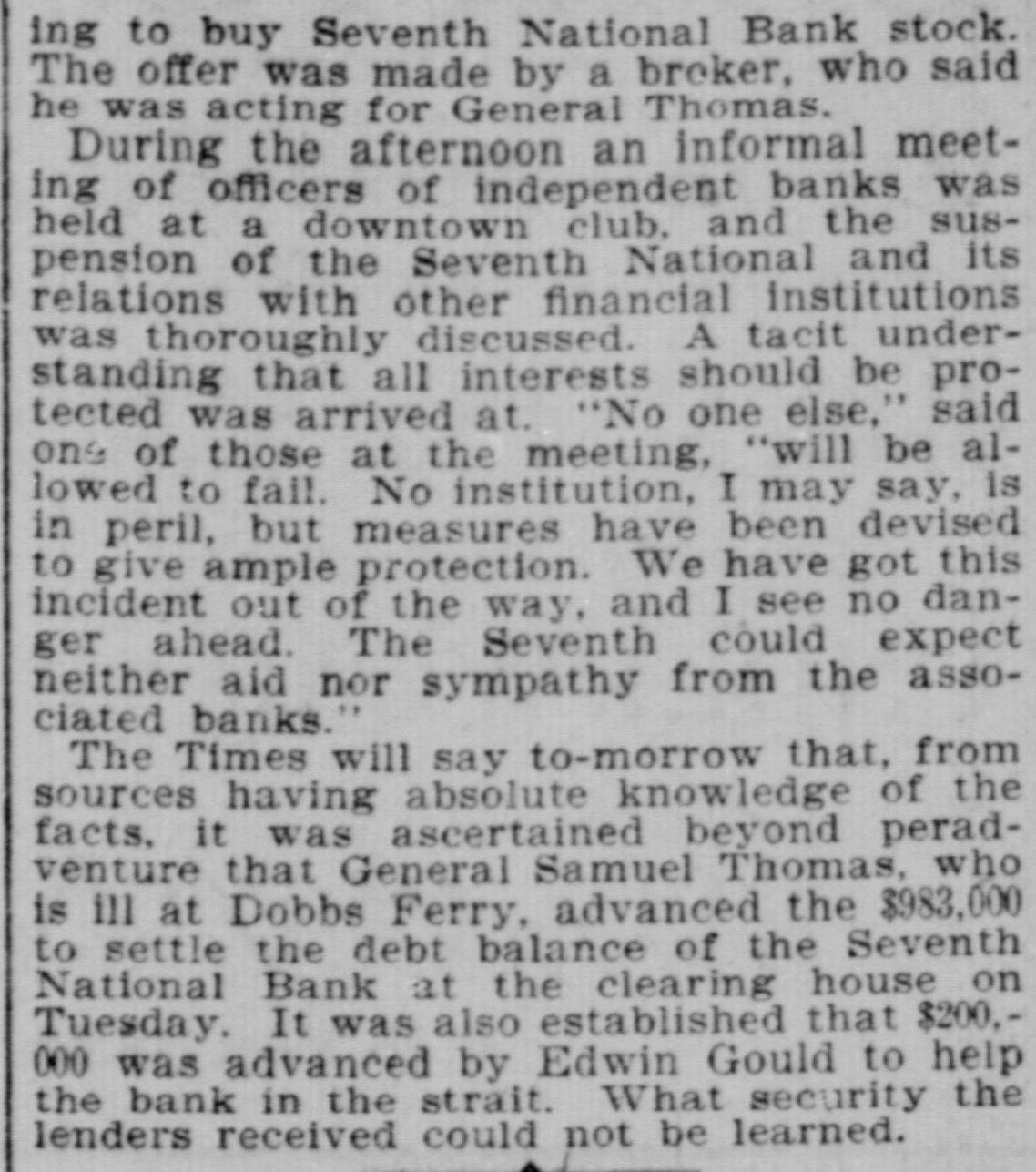
ing to buy Seventh National Bank stock. The offer was made by a broker, who said he was acting for General Thomas. During the afternoon an informal meeting of officers of independent banks was held at a downtown club. and the suspension of the Seventh National and its relations with other financial institutions was thoroughly discussed. A tacit understanding that all interests should be protected was arrived at. "No one else," said one of those at the meeting, "will be allowed to fall. No institution, I may say, is in peril, but measures have been devised to give ample protection. We have got this incident out of the way, and I see no danger ahead. The Seventh could expect neither aid nor sympathy from the associated banks." The Times will say to-morrow that, from sources having absolute knowledge of the facts. it was ascertained beyond peradventure that General Samuel Thomas, who is ill at Dobbs Ferry, advanced the $983,000 to settle the debt balance of the Seventh National Bank at the clearing house on Tuesday. It was also established that $200.000 was advanced by Edwin Gould to help the bank in the strait. What security the lenders received could not be learned.
6.June 28, 1901The Montgomery AdvertiserMontgomery, AL
Click image to open full size in new tab
Article Text
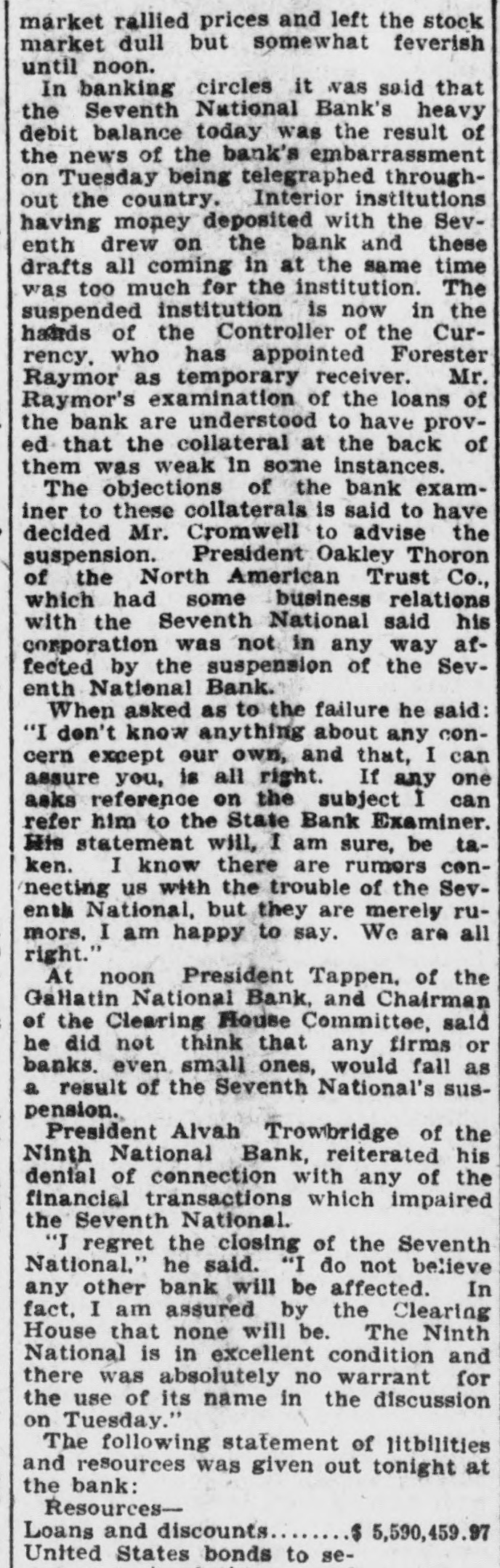
market rallied prices and left the stock market dull but somewhat feverish until noon. In banking circles it was said that the Seventh National Bank's heavy debit balance today was the result of the news of the bank's embarrassment on Tuesday being telegraphed throughout the country. Interior institutions having money deposited with the Seventh drew on the bank and these drafts all coming in at the same time was too much for the institution. The suspended institution is now in the hands of the Controller of the Currency, who has appointed Forester Raymor as temporary receiver. Mr. Raymor's examination of the loans of the bank are understood to have proved that the collateral at the back of them was weak in some instances. The objections of the bank examiner to these collaterals is said to have decided Mr. Cromwell to advise the suspension. President Oakley Thoron of the North American Trust Co., which had some business relations with the Seventh National said his corporation was not in any way affected by the suspension of the Seventh National Bank. When asked as to the failure he said: "I don't know anything about any concern except our own, and that, I can assure you, is all right. If any one asks reference on the subject I can refer him to the State Bank Examiner. His statement will, I am sure, be taken. I know there are rumors conneeting us with the trouble of the Seventh National, but they are merely rumors, I am happy to say. We are all right.' At noon President Tappen. of the Gallatin National Bank, and Chairman of the Clearing House Committee, said he did not think that any firms or banks. even small ones, would fall as a result of the Seventh National's suspension. President Alvah Trowbridge of the Ninth National Bank, reiterated his dental of connection with any of the financial transactions which impaired the Seventh National. "I regret the closing of the Seventh National," he said. "I do not believe any other bank will be affected. In fact, I am assured by the Clearing House that none will be. The Ninth National is in excellent condition and there was absolutely no warrant for the use of its name in the discussion on Tuesday." The following statement of litbilities and resources was given out tonight at the bank: ResourcesLoans and discounts $ 5,590,459.97 United States bonds to se-
7.June 28, 1901The Madison Daily LeaderMadison, SD
Click image to open full size in new tab
Article Text
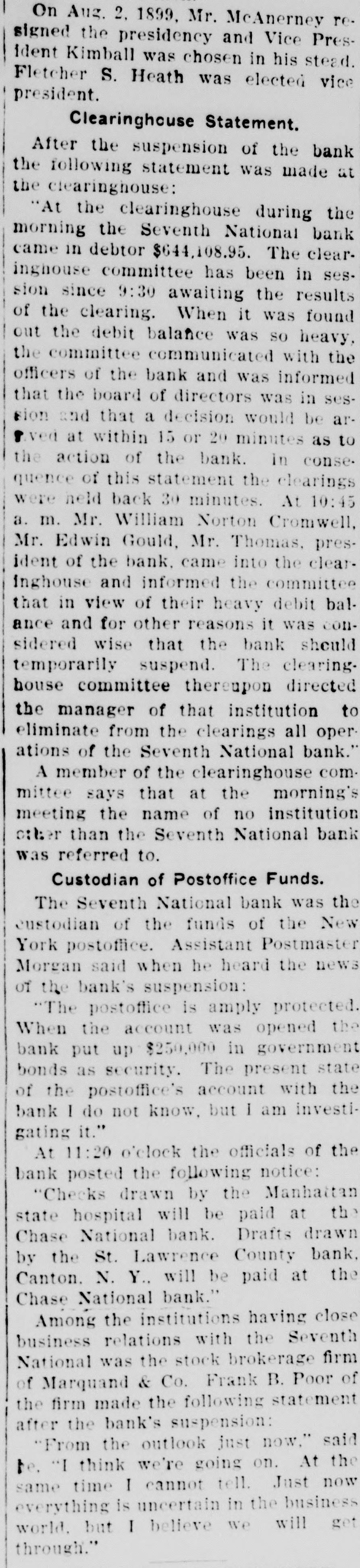
On Aug. 2. 1899, Mr. McAnerney resigned the presidency and Vice President Kimball was chosen in his stead. Fletcher S. Heath was elected vice president. Clearinghouse Statement. After the suspension of the bank the following statement was made at the clearinghouse: "At the clearinghouse during the morning the Seventh National bank came in debtor $644,108.95. The clearinghouse committee has been in ses. sion since 9:30 awaiting the results of the clearing. When it was found out the debit balance was so heavy, the committee communicated with the officers of the bank and was informed that the board of directors was in session and that a decision would be arlived at within 15 or 20 minutes as to the action of the bank. in conse. quence of this statement the clearings were held back 30 minutes. At 10:45 a. m. Mr. William Norton Cromwell, Mr. Edwin Gould, Mr. Thomas, president of the bank. came into the clearinghouse and informed the committee that in view of their heavy debit balance and for other reasons it was considered wise that the bank should temporarily suspend. The clearing. house committee thereupon directed the manager of that institution to eliminate from the clearings all operations of the Seventh National bank." A member of the clearinghouse committee says that at the morning's meeting the name of no institution other than the Seventh National bank was referred to. Custodian of Postoffice Funds. The Seventh National bank was the custodian of the funds of the New York postoffice. Assistant Postmaster Morgan said when he heard the news of the bank's suspension: "The postoffice is amply protected. When the account was opened the bank put up $250,000 in government bonds as security. The present state of the postoffice's account with the bank I do not know. but I am investigating it." At 11:20 o'clock the officials of the bank posted the following notice: "Checks drawn by the Manhattan state hospital will be paid at th Chase National bank. Drafts drawn by the St. Lawrence County bank. Canton. N. Y.. will be paid at the Chase National bank." Among the institutions having close business relations with the Seventh National was the stock brokerage firm of Marquand & Co. Frank B. Poor of the firm made the following statement after the bank's suspension: "From the outlook just now." said be. "I think we're going on. At the same time I cannot tell. Just now everything is uncertain in the business world. but I believe we will get through."
8.June 28, 1901The Iola RegisterIola, KS
Click image to open full size in new tab
Article Text
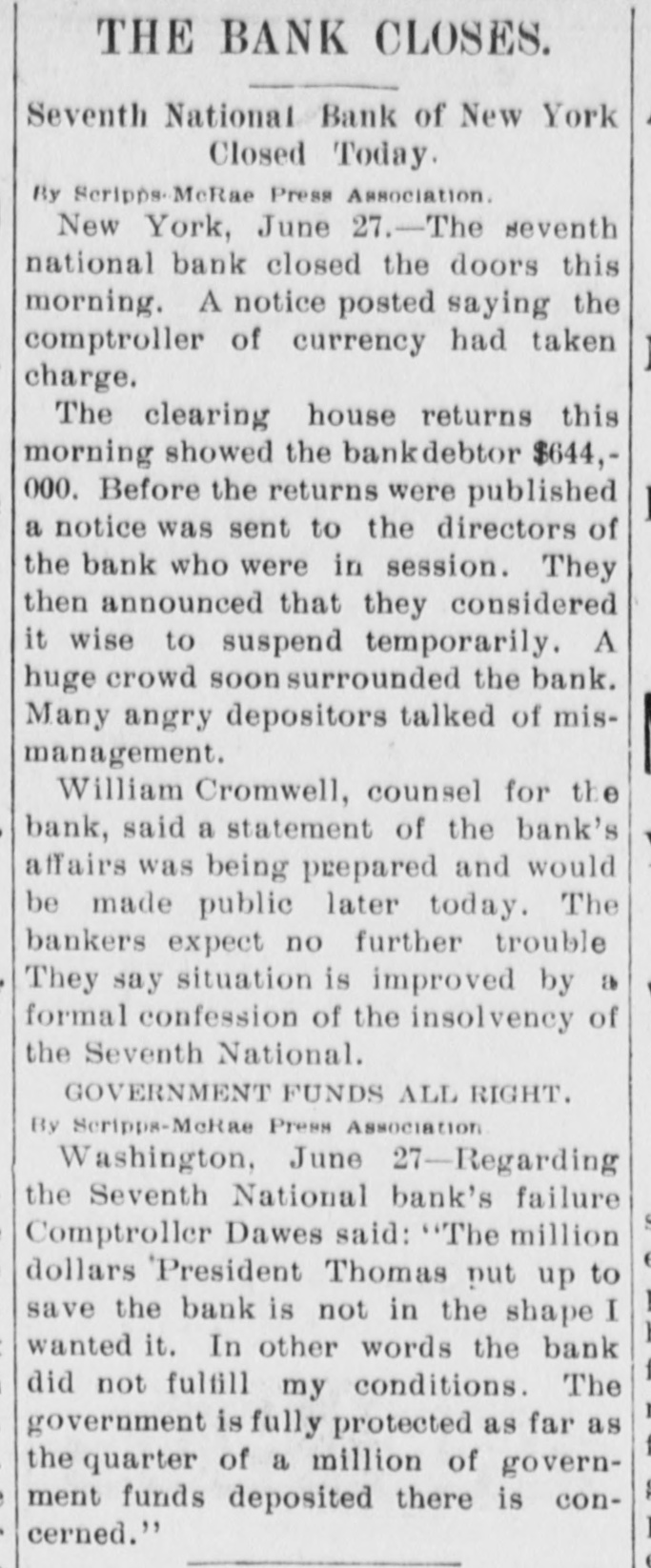
THE BANK CLOSES. Seventh National Bank of New York Closed Today. By Scripps-McRae Press Association New York, June 27.-The seventh national bank closed the doors this morning. A notice posted saying the comptroller of currency had taken charge. The clearing house returns this morning showed the bankdebtor $644,000. Before the returns were published a notice was sent to the directors of the bank who were in session. They then announced that they considered it wise to suspend temporarily. A huge crowd soonsurrounded the bank. Many angry depositors talked of mismanagement. William Cromwell, counsel for the bank, said a statement of the bank's affairs was being prepared and would be made public later today. The bankers expect no further trouble They say situation is improved by a formal confession of the insolvency of the Seventh National. GOVERNMENT FUNDS ALL RIGHT. By Scripps-McRae Press Association Washington, June 27-Regarding the Seventh National bank's failure Comptroller Dawes said: "The million dollars President Thomas put up to save the bank is not in the shape I wanted it. In other words the bank did not fulfill my conditions. The government is fully protected as far as the quarter of a million of government funds deposited there is concerned."
9.June 30, 1901The St. Louis RepublicSaint Louis, MO
Click image to open full size in new tab
Article Text
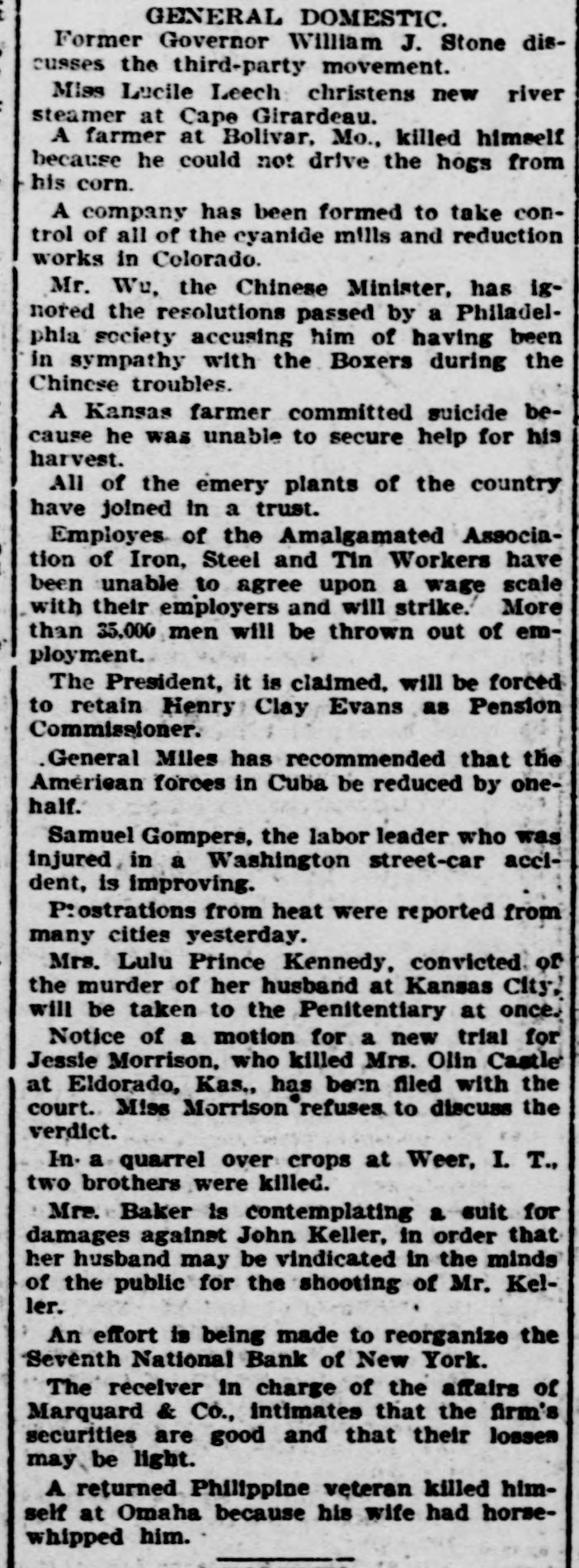
GENERAL DOMESTIC. Former Governor William J. Stone discusses the third-party movement. Miss Lucile Leech christens new river steamer at Cape Girardeau. A farmer at Bolivar, Mo., killed himself because he could not drive the hogs from his corn. A company has been formed to take control of all of the cyanide mills and reduction works in Colorado. Mr. Wu, the Chinese Minister, has ignored the resolutions passed by a Philadelphia society accusing him of having been in sympathy with the Boxers during the Chinese troubles. A Kansas farmer committed suicide because he was unable to secure help for his harvest. All of the emery plants of the country have joined in a trust. Employes of the Amalgamated Association of Iron, Steel and Tin Workers have been unable to agree upon a wage scale with their employers and will strike. More than 35,000 men will be thrown out of employment. The President, it is claimed, will be forced to retain Henry Clay Evans as Pension Commissioner. General Miles has recommended that the American forces in Cuba be reduced by onehalf. Samuel Gompers, the labor leader who was injured in a Washington street-car accident, is improving. P:ostrations from heat were reported from many cities yesterday. Mrs. Lulu Prince Kennedy, convicted of the murder of her husband at Kansas City, will be taken to the Penitentiary at once. Notice of a motion for a new trial for Jessie Morrison, who killed Mrs. Olin Castle at Eldorado, Kas., has been filed with the court. Miss Morrison refuses. to discuss the verdict. In. a quarrel over crops at Weer, I. T., two brothers were killed. Mrs. Baker is contemplating a suit for damages against John Keller, in order that her husband may be vindicated in the minds of the public for the shooting of Mr. Keller. An effort is being made to reorganize the Seventh National Bank of New York. The receiver in charge of the affairs of Marquard & Co., intimates that the firm's securities are good and that their losses may be light. A returned Philippine veteran killed himself at Omaha because his wife had horsewhipped him.
10.July 4, 1901Eagle River ReviewEagle River, WI
Click image to open full size in new tab
Article Text
PERRY HEATH. The directors met and decided that this condition could not be fulfilled, and a notice of suspension was at once posted on the door.
Only two days previous $983,000 in cash was paid into the bank in one lump by Gen. Samuel Thomas, to enable it to meet a sudden demand on it, and incidentally to secure the presidency for his son, E. R. Thomas, but that was not enough to save it.
Thursday, after a slight run, the directors found they would have to meet checks to the amount of $644,000, which were in the clearing house, and this helped them to their conclusion to close the doors at once, although they said they could have paid the debit balance. The desire not to be in the position of accepting deposits in a bank that might be insolvent also hastened their action.
The bank's failure hardly made a ripple in all street. There was a short flurry on the stock exchange, with quick recovery. Rumors that other banks were involved were quickly put at rest. The closed institution is the one popularly known as Perry Heath's bank, that politician and his brother being among its directors.
The failure of the firm of Henry Marquand & Co., bankers and brokers, the name of which has been connected with the embarrassment of the Seventh National Bank, was announced on the stock exchange Friday.
11.July 10, 1901The Indianapolis JournalIndianapolis, IN
Click image to open full size in new tab
Article Text
PROBABLY WILL RESUME SEVENTH NATIONAL BANK MAY BE REOPENED FOR BUSINESS. Fred S. Heath Said to Be Confident All the Money Required Has Been Promised. Special to the Indianapolis Journal. WASHINGTON, July 9.-Private advices received here from New York through Fred S. Heath, of Muncie, contain assurances that the Seventh National Bank will surely resume; that the money to pay the depositors in full has been promised, and that the $1,600,000 loan to Marquand & Co., which led to the bank's suspension, will be taken off the bank's hands. These things accomplished there appears to be nothing in the way of the bank resuming business at an early date. W. G. Nicholas says in the New York Telegraph: "The three Heath brothers-Fletcher S., Perry S. and Fred-may decide to concentrate their resources and reorganize the Seventh National Bank and build it up as a distinctively family institution. Strong friends have given them assurances that they can have all the help they may want should they conclude to remain in metropolitan banking. The brothers can mass about $2,000,000, and as a matter of family pride they are likely to decide to make a stand in New York to re-establish themselves and regain the position and prestige lost through their connection with the collapsed bank. It now is well known in the inner councils of Wall-street banking circles that President Kimball was responsible for the bad loans that resulted in the closing of the bank. Fletcher Heath had no idea of the fix the bank was in until the Saturday before the failure, and the time was too short for him to raise the money for salvation. If the Heaths and their friends reorganize the Seventh National Bank it will be with a capital of not less than $1,000,000 and a surplus of $500,000 additional, thus starting off with large increased resources. Another party is also anxious to reorganize the bank, and at the meeting of directors and important stockholders on Tuesday of this week definite steps will be taken toward the upbuilding." Gen. Henry L. Burnett. United States district attorney at New York. was in consultation on Tuesday with W. S. Ball, his assistant, who was designated to examine into the affairs of the Seventh National Bank. Subsequently General Burnett said: "I do not care to say at this time whether anything has been discovered by Captain Ball of a criminal character in the manipulation of the affairs of the Seventh National Bank. Nothing will be done until the investigation is completed."
12.July 16, 1901New-York TribuneNew York, NY
Click image to open full size in new tab
Article Text
EXPERT ON SEVENTH'S BOOKS. GENERAL BURNETT HAS DIRECTED HIM TO FIND OUT WHETHER THE BANK VIOLATED THE STATUTES. William Hardt, of Philadelphia, bank examiner and expert accountant in the employ of the government, reported yesterday at the office of General Henry L. Burnett, the United States District Attorney, and was assigned to aid in the examination of the books of the wrecked Seventh National Bank. General Burnett said the expert would ascertain and report to him if there was any violation of the United States statutes in the management of the bank previous to the failure. "If he reports such violations, I will take action accord+ Ingly," General Burnett said. Several of the depositors of the bank have become restive on account of the long delay in making a report of the bank's assets and liabilities. Moses Oppenheimer, an auditor of the Finance Department, who is a depositor in the bank, said yesterday that the bank really was insolvent the day It could not meet its obligations at the Clearing House without the aid of capitalists, and he wanted to know what securities of the bank were turned over on account of the $1,000,000 lent to the bank. Apparently the bankrupt firm of Henry Marquand & Co. owes the bank $1,600,000. Mr. Oppenheimer said, and he wants to know who was responsible for engineering such a loan on securities that were not marketable, Frank Sullivan Smith, the assignee for Henry Marquand & Co., said yesterday that he had not reached a point in his investigation where he could make a statement about the assets and liabilities of the firm. William Nelson Cromwell, the special counsel for the Seventh National Bank, met several of the directors in his office, at No. 49 Wallst., yesterday. and there was further discussion of plans for reorganizing the bank, but late in the afternoon Mr. Cromwell said there was no announcement to make. Apparently the directors have failed to agree on plans.
13.July 17, 1901The Guthrie Daily LeaderGuthrie, OK
Click image to open full size in new tab
Article Text
Why is not Regent Rankin of the Edmond Normal investigated?
It was not a serious failure—that of the Seventh national bank in New York; only a temporary embarrassment. Still, on the strength of the temporary receiver's report, Controller Dawes has ordered a full assessment of the stock, and then it is doubtful if the depositors get more than 80 per cent of their money. Banking on political pull did not prove a great success in this case at least
14.July 26, 1901The St. Louis RepublicSaint Louis, MO
Click image to open full size in new tab
Article Text
LOCAL AND SUBURBAN.
Fire in the N. O. Nelson Manufacturing Company's building causes a loss of $3,500.
Plans have been drawn for a mercantile building, to be erected on the northeast corner of Seventh and Locust streets, to cost $10.000.
The drought has so affected the crops of fruits and vegetables that dealers are asking prohibitive prices for inferior stocks.
Mayor Wells appoints three hydraulic engineers to examine the water-supply system.
The present drought recalls to many the visitation of 1854, with its accompaniment of Asiatic cholera, which carried off hundreds and marked a memorable era in Missouri history.
A maximum temperature of 99 degrees was recorded in St. Louis yesterday, and the hot weather is believed to be at an end.
Photographers plan a special building for an art display at the World's Fair.
A hitch has arisen in the selection of a Director General of the World's Fair, owing to the unwillingness of St. Louisans to assume the responsibilities of the position.
A decrease in the temperature of St. Louis is predicted.
Actors engage in a real fire-fighting scene near Delmar Garden.
The Fresh Air Mission requests the Transit Company not to require physicians' certificates from children riding to parks,
GENERAL DOMESTIC.
Sol Temple, member of a once noted outlaw band, has been arrested at Leavenworth for planning to rob saloons.
Compromise is hinted in the St. Joseph post office fight. If the reported deal is accomplished, Major Bittinger may be made Consul General to Old Mexico.
St. Joseph negroes refuse to bury the body of one of their race whom they believed to have been possessed of withcraft.
Action of the Wool Trust in ordering a marked reduction in prices will, it is feared by Republicans, result in the reopening of the tariff discussion.
During the last ten years nine officers have been killed and twenty wounded in hunting down alleged moonshiners.
Missouri troops take part in a sham battle at Camp Dockery.
Secret Service officer arrests Charles Benjamin at Bloomington. He offered, it is alleged, $2,500 to be permitted to escape. He fought his captor.
The damage to the Brooklyn bridge by the breaking of suspension rods is much more serious than was at first reported.
The eleventh annual convention of the Baptist Young People's Union met in Chicago yesterday.
William Forman, a member of the Illinois National Guard, committed suicide at Camp Lincoln yesterday by drinking carbolio acid.
Mrs. Alva E. Briggs was killed in a runaway near Jerseyville, Ill.
The Indian Commission has fixed dates and places for further enrollment of the Cherokees.
The directors of the defunct Seventh National Bank of New York City are making an effort to reorganise.
Jefferson Davis's physician denies that his patient is critically ill.
15.July 26, 1901The Indianapolis JournalIndianapolis, IN
Click image to open full size in new tab
Article Text
Directors of the Defanet New York stitution Decide to Raise the Amount to $2,500,000. INQUIRY BY GRAND DIRECTORS CHARGED WITH MAKING UNTRUTHFUL REPORTS. Bill of Complaint Also Filed in half of Cleveland Bank 'wns B JOJ NEW YORK, July 25.-With the federa grand jury in session investigating thel affairs, the board of directors of the enth National Bank met to-day and cided on a plan for the reorganization the defunct bank. The capital stock is be increased from $700,000 to $2,500,000, the additional issue of $2,000,000 in stock be sold at $130 per share, with first purchas privilege to the present stockholders. cash proceeds of the assessment on existing stock and the sale of new will, it is claimed, pay all present obliga tions and completely restore solvency. isting stockholders are to be required pay the assessment ordered by the troller of the currency. Edward R. Thomas Edwin Gould, William Nelson Cromwel and Frank Ray, William H. Taylor Edmund K. Stalle have been constituted committee of subscribers with plenar power to carry out the plan. They are receive subscriptions and represent stockholders in all matters relating to bank and receivers. The present director and officers are required to tender thei resignations, and a majority under the subscription will elect their successors The plan is made binding upon all scribers when 90 per cent. of the stock subscribed and 90 per cent. of the assess ment is paid. A subscription form embody ing the main features of the plan of ganization was also drawn up and proved. A substantial amount of the stock has already been subscribed. United States District Attorney Henry Burnet says the plan to reorganize Seventh National Bank will not affect investigation by the federal grand William E. D. Stokes, who is a stockholde of the Seventh National Bank, has take out summonses in the Supreme against the directors of the*bank Presider Thomas and Receiver Raynor. The plaint charges the directors with makin reports to the stockholders to the that the capital of the bank was unim paired, when, as a matter of fact, it already insolvent. It further charges tha the directors "utterly failed and neglecte to perform their official duties," and they "suffered and permitted the account of said bank to be kept in an inaccurat manner, which failed to show the character of its affairs."
16.July 26, 1901The Salt Lake HeraldSalt Lake City, UT
Click image to open full size in new tab
Article Text
DECIDE ON PLAN TO REORGANIZE BANK Arrange to Restore Seventh National to Solvency. New York, July 25.-With the federal grand jury in session on the investigation of their affairs, the board of directors of the Seventh National bank met today and decided upon a plan for the reorganization of the defunct bank. The capital stock is to be increased from $500,000 to $2,500,000 and the additional issue of $2,000,000 in stock will be sold at $130 per share, with first purchase privilege to the present stockholders. The cash proceeds of the assessment on the existing stock and the sale of new stock will, it is claimed, pay all present obligations and completely restore solvency. Existing stockholders are to be required to pay the assessment ordered by the comptroller of the currency. Edward R. Thomas, Edwin Gould, William Nelson Cromwell, Frank Ray, William H. Taylor and Edmund K. Stasle have been constituted a committee of subscribers with plenary power to carry out the plan. They are to receive subscriptions and represent the stockholders in all matters relating to the bank and receivership. The present directors and officers are required to tender their resig: ations and a majority under the new subscription will elect their successors. The plan is made binding upon all subscribers when 90 per cent of the new stock is subscribed and 80 per cent of the assessment is paid. A subscription form embodying the main features of plan of reorganization was also drawn up and approved. A substantial amount of new stock has already been subscribed. United States District Attorney Henry L. Burnett says the plan to reorganize the Seventh National bank will not affect the investigation by the federal grand jury. Complaint Against Directors. William E. D. Stokes, who is a stockholder of the Seventh National bank, has taken out summons in the supreme court against the directors of the bank, President Thomas and Receiver Raynor. The complaint charged the directors with making reports to the stockholders to the effect that the capital of the bank was unimpaired, when as a matter of fact it was already insolvent. It further charges that the directors "utterly failed and neglected to perform their official duties": that they "suffered and permitted the accounts of said bank to be kept in an inaccurate manner, which failed to show the true character of its affairs." In the complaint the directors are further charged with having employed incompetent persons as officers of the bank, "who were unable to properly and efficiently discharge their duties, all of which was well known to the directors." After having further charged them with having given loans to insolvent persons and corporations, without adequate and valid securities, the complaint goes on: "That said directors defendants SO negligently and carelessly conducted the said bank and the business and affairs therof, and the entire capital and surplus and much of the property and effects thereof have been lost and stock of the said bank rendered worthless and the stockholders thereof rendered liable for a large sum of money on account of the debts of said bank remaining unpaid." The plaintiff then demanded judgment for the total amount of his loss as a stockholder of the bank, and the cost of the suit.
17.July 26, 1901Deseret Evening NewsSalt Lake City, UT
Click image to open full size in new tab
Article Text
SEVENTH NATIONAL BANK. While Federal Grand Jury Investigates, Directors Decide to Recognize. W. E. D. Stokes, a Stockholder, Lodges a Complaint Against Directorate. New York, July 25.-With the federal grand jury in session on the investigation of their affairs, the board of directors of the Seventh National bank met today and decided upon a plan for the reorganization of the defunct bank. The capital stock is to be increased from $500,000 to $2,500,000 and the additional issue of $2,000,000 in stock will be sold at $1.30 per share, with first purchase privilege to the present stockholders. The cash proceeds of the assessment on the existing stock and the sale of new stock will, it is claimed, pay all present obligations and completely restore solvency. Existing stockholders are to be required to pay the assessment ordered by the comptroller of the currency. Edward R. Thomas, Edwin Gould, William Nelson Cromwell, Frank Ray, William H. Taylor and Edmund K. Stasle have been constituted a committee of subscribers with plenary power to carry out the plan. They are to receive subscriptions and represent the stockholders in all matters relating to the bank and receivership. The present directors and officers are required to tender their resignations and a majority under the new subscription will elect their successors. The plan is made binding upon all subscribers when 9 per cent of the new stock is subscribed and 90 per cent of the assessment is paid. A subscription form embodying the main features of plan of reorganization was also drawn up and approved. A substantial amount of new stock has already been subscribed. United States District Attorney Henry L. Burnett says the plan to reorganize the Seventh National bank will not affect the investigation by the federal grand jury. William E. D. Stokes, who is a stockholder of the Seventh National bank, has taken out summons in the supreme court against the directors of the bank, President Thomas and Receiver Raynor. The complaint charged the directors with making reports to the stockholders to the effect that the capital of the bank was unimpaired, when as a matter of fact.it was already insolvent. It further charges that the directors "utterly failed and neglected to perform their official duties:" that they "suffered and permitted the accounts of said bank to be kept in an inaccurate manner, which failed to show the true character of its affairs." In the complaint the directors are further charged with having employed incompetent persons as officers of the bank, "who were unable to properly and efficiently discharge their duties, all of which was well known to the directors." After having further charged them with having given loans to insolvent persons and corporations, without adequate and valid securities, the complaint goes on: "That said directors defendants so negligently and carelessly conducted the said bank and the business and affairs thereof, and the entire capital and surplus and much of the property and effects thereof have been lost and stock of the said bank rendered worthless and the stockholders thereof rendered liable for a large sum of money on account of the debts of said bank remaining unpaid." The plaintiff then demanded judgment for the total amount of his loss as a stockholder of the bank, and the cost of the suit.
18.July 29, 1901The Jersey City NewsJersey City, NJ
Click image to open full size in new tab
Article Text
RECEIVER TAYLOR PERMANENT. Hackensack Land Co. Case in Chancery Court Today S. Taylor of Hackensack, temporary receiver of the Hackensack Land Company, was made permanent receiver this morning by Vice Chancellor Stevenson. The company was started by F. B. Poor of the firm of Marquand & Co., which caused the failure of the Seventh National Bank in New York City. The liabilities of the company are $418,000 and the assets $412,000, consisting of land in Hackensack.
19.September 14, 1901The Washington TimesWashington, DC
Click image to open full size in new tab
Article Text
TO REHABILITATE A BANK. New Yorkers Suggest a Plan for the Seventh National Institution. William Nelson Cromwell, E. K. Stallo, Edwin Gould, W. H. Taylor, Vice President of the Bowling Green Trust Company, New York City; R. W. James, President of the American National Bank, Kansas City, Mo.; and Forest Rayner, receiver, of New York, waited on Thomas P. Kane, Deputy Comptroller of the Treasury, yesterday, and submitted plans for the rehabilitation of the suspended Seventh National Bank of New York City. The above named gentlemen represented the stockholders of the institution, and submitted a plan whereby the bank is to resume business with a capital stock of $1,500,000 and liquidate all obligations of the suspended bank. Before the propositions of the committee can be carried out, they will have to receive the approval of Comptroller Dawes, who left for Buffalo yesterday morning, on learning of the President's critical relapse.
20.September 21, 1901The Evening TimesWashington, DC
Click image to open full size in new tab
Article Text
TO REORGANIZE THE BANK. Permission for the Defunet Seventh National Bank to Resume. The Comptroller of the Currency today approved the plan for the réorganization of the failed Seventh National Bank of New York. Comptroller Dawes issued the following statement "Mr. William Nelson Cromwell, counsel for the reorganization committee of the Seventh National Bank of New York, accompanied by Mr. E. K. Stallo and Mr. Forrest Raynor. receiver of the Seventh National Bank. called at the office of Comptroller Dawes today and submitted to the Comptroller a plan for the readjustment of the affairs of the Seventh National Bank under authority of which the depositors of the bank will be paid in full with interest as quickly as the legal requirements in the case of reorganized banks can be complied with, which will be but a few weeks. One million seven hundred and twenty-five thousand dollars in cash has been subscribed, over $1,500,000 of which has already been paid into the hands of the committee "The reorganization committee has presented two alternative plans for reorganization, both of which have been approved by the Comptroller. The decision as to the one which shall be followed will be determined by the committee within the next week. One plan provides for the reorganization of the present bank under a new name with an increased capital of not less than $1,500,000. The other plan provides for the practical accomplishment of the same end through the reorganization of a new bank which will purchase, with the approval of the United States Court, the assets of the Seventh National Bank at a figure which will enable it to pay its liabilities in full. "In order to earry out the first plan. which is the one preferred by the committee, one or two minor adjustments, now in progress with stockholders, will have to be made before it can be effective: but the second plan has been agreed to if such adjustments are not made, in order to make certain the payment of depositors in full. "The Comptroller expresses his appreciation of the successful endeavors of Mr. Cromwell and the others connected with the re-organization of the bank. The motives which have led to the assumption of the losses incurred by the Seventh National Bank by those connected with the bank and the large additional investment made necessary by the re-organization are most commendable and indicate a high appreciation of the obligations of the national bank directorship. The bank when re-organized under either of these plans will have on deposit when it opens its doors a sufficient amount in cash to pay all depositors and other creditors in full and leave an unimpaired capital of upward of $1,500,000."
21.September 22, 1901The Washington TimesWashington, DC
Click image to open full size in new tab
Article Text
TWO REORGANIZATION PLANS. Comptroller Dawes Tells Status of Seventh National Bank Affairs. A plan for the reorganization of the Seventh National Bank, New York, was submitted yesterday to the Comptroller of the Currency. Regarding the proposition of the committee which waited on Mr. Dawes, the latter yesterday issued the following statement: "Mr. William Nelson Cromwell, counsel for the reorganization committee of the Seventh National Bank of New York, accompanied by Mr. E. K. Stallo and Mr. Forrest Raynor, receiver of the Seventh National Bank, called at the office of Comptroller Dawes today and submitted to the Comptroller a plan for the readjustment of the affairs of the Seventh National Bank, under authority of which the depositors of the bank will be paid in full with: interest as quickly as the legal requirements in the case of reorganized banks can be complied with, which will be but a few weeks. One million seven hundred and twenty-five thousand dollars in cash has been subscribed, over $1,500,000 of which has already been paid into the hands of the committee. "The reorganization committee has presented two alternative plans for reorganization, both of which have been approved by the Comptroller. The decision as to the one which shall be followed will be determined by the committee within the next week. One plan provides for the reorganization of the present bank under a new name with an increased capital of not less than $1,500,000. The other plan provides for the practical accomplishment of the same end through the reorganization of a new bank, which will purchase, with the approval of the United States Court, the assets of the Seventh National Bank at a figure which will enable it to pay its liabilities in full. "In order to carry out the first plan, which is the one preferred by the committee, one or two minor adjustments, now in progress with stockholders, will have to be made before It can be effective; but the second plan has been agreed to if such adjustments are not made, in order to make certain the payment of depositors in full. "The Comptroller expresses his appreciation of the successful endeavors of Mr. Cromwell and the others connected with he reorganization of the bank. The motives which have led to the assumption of the losses incurred by the Seventh Nadonal Bank by those connected with the bank and the large additional investment made necessary by the reorganization are most commendable and indicate a high appreciation of the obligations of he national bank directorship. The bank when reorganized under either of these plans will have on deposit when it opens its doors a sufficient amount in cash to pay all depositors and other creditors in full and leave an unimpaired capital of upward of $1,500,000."
Again Ready for Business. New York, Nov. 12.-Comptroller of the Currency Ridgley has notified the New York clearinghouse that the condition of the reorganized Seventh National bank was satisfactory to the government; that its affairs were in the condition where it could pay all its obligations and reopen with promising prospects and that the receiver had been discharged.
23.November 13, 1901Daily Kennebec JournalAugusta, ME
Click image to open full size in new tab
Article Text
Arbuckle Bros. and Howell, Son & Co., have reduced all grades of refined sugar 10 points. The Nicaraguan Presidential election has passed off peacefully. Gen. Santos Zelaya has been re-elected President by a large vote. Edward M. Shepard, the defeated Democratic candidate for mayor of New York, City. certified to the seeretary of state at Albany, Tuesday, that his expenses during the late campaign were $3309. The Seventh National Bank of New York, which was closed. last June, was reopened. Tuesday. with Edwin Gould is its president. The bank had a balince at the clearing house. Tuesday, of about $1,900,000. Matthies Grogan. an old and wellknown resident. was run into and instantly killed by the Boston train atriving at Fall River at 8 A. M. Tues. day. while he was walking on the track near the station. The Mayo Woolen Co., now owners of the Wheeler mill at Millbury, Mass. are putting in a new equipment of machinery and will start the mill on full time at an early date. The plant has been idle for some years and will now give employment to about 100 hands. Fancy woolen goods of medium grades will be made. Robbers blew the vault of the bank 11 Trenton, N. J., early Tuesday and stole the post office box containing S40C The robbers escaped on a hand car. While officers and citizens were later examining the shattered vault an unexploded charge of nitro-glycerine went off and six men were injured. two being badly burned. After a year's fight the Chicago city council has passed an ordinance requiring the Illinois Central. Lake Shore & Michigan Southern. Pittsburg. Fort Wayne & Chicago. Pennsylvania Niekel Plate and Baltimore & Ohio to elevate their tracks immediately. The measure provides for the elevation of 16 miles of tracks within six years at an estimated cost of $2,000,000. The fire which. fed by great quantities of oil and varnish. burned out the insides of the big granite block at Broad and Franklin streets Boston. early Tuesday. caused a loss estimated it from $100,000 to $150,000. This caleulation includes damage done to nearby structures. some of which were badly scorched and to property in them which suffered from smoke and water. The S. H. Howe Shoe Co. announces that it will make a transfer at once of all its shipping business from Boston to Mariboro. The firm has also decided to increase the working capital of the company from $200,000 to $500.000. The transfer of the shipping interests will mean that all the products of the firm will hereafter be shipped directly from Marlboro instead of going through Boston. Another special town meeting was held in Groveland, Mass.. Monday evening. when after a 71/2 hours' session. it was voted to build a new $12.900 two-room grammar school. The town meeting. Monday evening. was the third held to decide the issue. the ;reveland village residents favoring a four-room grammar school and the South Groveland people fighting for a new high school The body of a man who was killed by . train at the Prison Point crossing of he Boston & Maine railroad in Charlestown. Mass.. Monday night. vas identified. Tuesday, by the badge of the Bo: ton Elevated Mutual Associaion found on it as that of Fred F. Wisher of 1279 Massachusetts avenue. He was conductor 7436 Elevated He Arlington. of the Boston and Railway No. Co. was 1 years of age single. I A share in a fortune of $1,500,000 is of Mrs. Charies A. Ware Mass. to 1 been which Marlboro, oming have to according received by the notices woman. The bequest is the will of Mrs. Vare's uncle. Mr. Brown. who died in f Philadelphia a month ago. As near as Irs. Ware can determine there are : about 25 heirs and she has estimated , that her share will amount to somehing between $50,000 and $75,000. by fire. water. ; at about $50,000. was caused. estimated Damage smoke and : Tuesday forenoon. by a fire which broke out on the stage of the Winsted