14403. Second National Bank (New York, NY)

Bank Information

Episode Type
Run Only
Bank Type
national
Bank ID
62
Charter Number
2668
Start Date
May 13, 1884
Location
New York, New York (40.714, -74.006)

Metadata

Model
gpt-5-mini
Short Digest
4a3e6da6a4543a42

Response Measures

Accommodated withdrawals, Borrowed from banks or large institutions, Public signal of financial health, Capital injected, Books examined

Description

Contemporary articles (May 13–16, 1884) report a run/heavy withdrawals on the Second National triggered by revelations/rumors of John C. Eno's defalcation. Directors declared losses made good (Amos R. Eno and others covered deficits), the president resigned, and the bank opened and paid checks β€” the run abated and the bank continued operations. No evidence in these articles that the bank formally suspended payments or was closed permanently.

Events (4)

1. August 13, 1863 Chartered
Source
historical_nic
2. April 29, 1882 Chartered
Source
historical_nic
3. May 13, 1884 Run
Cause
Bank Specific Adverse Info
Cause Details
Defalcation/speculative losses by President John C. Eno (embezzlement/misconduct) revealed or rumored, leading depositors to withdraw funds.
Measures
Board met and announced losses made good; Amos R. Eno and other private parties covered deficits; president John C. Eno resigned and James A. Trowbridge installed; bank opened and paid checks to calm depositors.
Newspaper Excerpt
The principal rumor ... affected the credit of the Second National Bank ... John C. Eno had been speculating ... involved the Second National to the amount of $2,000,000 ... Amos R. Eno came to the rescue
Source
newspapers
4. December 31, 1921 Voluntary Liquidation
Source
historical_nic

Newspaper Articles (24)

Article from Daily Kennebec Journal, May 14, 1884

Click image to open full size in new tab

Article Text

Another Bank Failure Rumored. NEW YORK, May 13. The World of today says that the principal rumor in the street yesterday was one affecting the credit of the Second National Bank of which John C. Eno is president. Eno is a son of Amos R. Eno, the principal owner of the Fifth Avenue hotel, who is estimated to be several times a millionoire. The rumors came from the lips of careful and conserva. tive men. They were to the effect that John C. Eno had been speculating heavily on long side of the market, and had met with severe losses in the heavy decline of the past few days. It is stated that he has involved the Second National Bank to the amount of 2,000,000, and the bank would have been obliged to suspend had not Amos Eno come to the reseue, and made up the amount of his son's losses.


Article from Savannah Morning News, May 14, 1884

Click image to open full size in new tab

Article Text

WARD'S VILLANY. Col. Fred. Grant Classes His Family as Fools and Denounces Ward. NEW YORK, May 13.-Col. Frederick Grant said to-day, in an interview with a reporter: "When I first came to this city from Chicago I had about $57,000. I was introduced to Mr. Ward, and after a short acquaintance he asked me to join him in a speculative venture which turned out to be successful. Atter that he proposed a partnership, and eventually my brother and myself entered into a partnership agreement. It was represented that Ward & Fish were worth $250,000 each. Ward had charge of the books and safe of the firm, and in fact everything was intrusted to him by the other members of the firm." Col. Grant closed with this remark: "I admit that I have been a fool; so has my father, the General, and my brother, and there is nothing too strong to say against Ward at this moment." NEW YORK, May 13.-The Tribune of Wednesday will say: "The Directors of the Marine Bank held an informal meeting Tuesday morning, but did not remain in the bank afterward as on previous days since the failure. President Fish was at the bank for a short time only and was accompanied by Col. Fellows. A rumor that he was in custody was circulated but was contradicted positively by his son. ALMOST ANOTHER CRASH. The World of Wednesday will say: 'The stock commission house of A. Dycett & Co., at No. 80 Broadway, drew checks on the Continental National Bank, Tuesday, to the amount of about $700,000. During the day the bank refused to certify some of these checks, to the amount of about $200,000. and this fact, in connection with circumstances which led to it, involving the names of John C. Eno, and the Second National Bank, caused some excitement in banking and Stock Exchange circles. The recent disclosures about over certification of checks have made banks cautious. Thus yesterday the Continental declined to assume any risks for Dyett & Co., who have been old and heavy depositors. It has been stated that Mr. Eno had involved the Second National to the amount of $2,000,000, and that the bank would have been obliged to suspend had not Amos R. Eno come to the rescue and made up to the bank the amount of his son's losses. Dyett and Morton, of the firm of Dyett & Co., said that they would be all right to-day. They said they had deposited $960,000 worth of securities with the bank. To-day they will deposit the necessary cash and checks will be paid. They declined to make any statement in regard to Mr. Eno whatever. Mr. Eno made a sweeping denial of all reports." Late to-night it was made known that President Eno, of the Second National Bank, has resigned. The directors announce that all losses have been made good, that the capital is intact, and that the bank is prepared to meet its obligations on demand.


Article from The Indianapolis Journal, May 14, 1884

Click image to open full size in new tab

Article Text

ALMOST ANOTHER SMASH. Close Call fora Bank President and the Stockbroking Firm of A. Dyett & Co. NEW York, May 13.-The World to-morrow will publish the following: "The stock commission house of A. Dyett & Co., No. 80 Broadway, yesterday drew checks on the Continental National Bank to amount of $700,000. During the day the bank refused to certify some of these checks to the amount of about $200,000, and this fact, in connection with circumstances which led to it, involving the names of John C. Eno and the Second National Bank, caused some excitement in banking and Stock Exchange circles. Recent disclosures about overcertification of checks have made banks cautious, thus yesterday the Continental Bank declined to assume any risk for A. Dyett & Co., who have been old and heavy depositors. "The principal rumor on the street yesterday was one which affected the credit of the Second National Bank, No. 190, Fifth avenue, and of which John C. Eno is president. Mr. Eno is a son of Amos R. Eno. the principal owner of the Fifth Avenue Hotel, who is estimated to be several times a millionaire, his money being chiefly invested in real estate up town. It has been stated that Eno had involved the Second National to the amount of $2,000,000, and that the bank would have been obliged to suspend had not Amos R. Eno come to the rescue and made up to the bank the amount of his son's losses. The report that the bank was in trouble was denied early in the afternoon, but when it became known that the firm of A. Dyett & Co. was in trouble it was remembered that Jno. C. Eno was one of the principal customers of the firm, and this gave rise to further speculation as to the extent Eno had become involved in the rapidly declining stock market. At the office of A. Dyett & Co., in the basement of No. 80 Broadway. there was an anxious throng of creditors all afternoon. Late in the day Dyett returned from the bank At first, members of the firm. Arthur Dyett and A. R. L. Norton, declined to make any statement, but finally they were pursuaded. They will be all right to-day. They said they had deposited $950,000 worth of securities with the bank. To-day they will deposite the necessary cash and the checks will be paid. They declined to make any statement in regard to Eno whatever. This gentleman was at the office of Dyett & Co. up to 6:30 last evening. He was also in the adjoining office of Goff & Randall, through whom he is believed to have carried on some of his operations. Mr. Eno made a sweeping denial of all reports." The board of directors of the Second National Bank held a meeting to-night at the bank. After several hours' session the following announce ment was made: The board of directors of the Second National Bank take pleasure in informing the public that whatever loss has been incurred has been made good, that the capital is intact. and the bank prepared to meet its obligations on demand. O. D. ROBERTS, Cashier. It is also learned that John C. Eno, the president, has resigned, and James A. Trowbridge appointed in his stead.


Article from The Portland Daily Press, May 14, 1884

Click image to open full size in new tab

Article Text

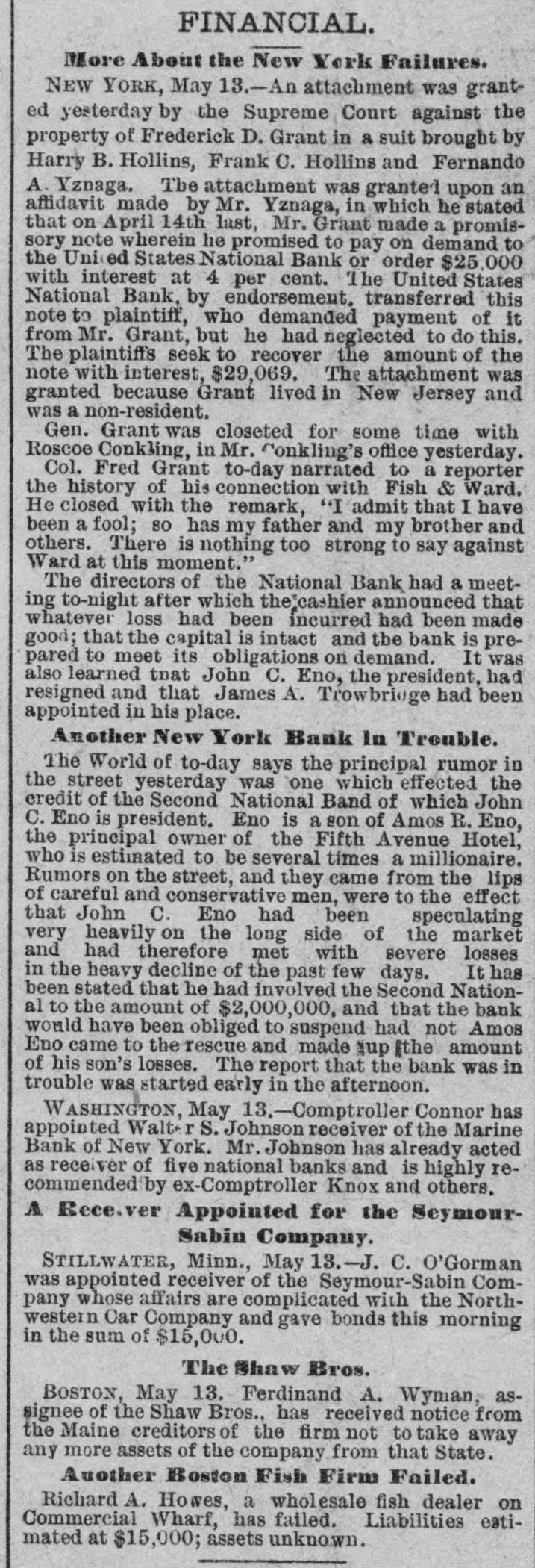
FINANCIAL. More About the New York Failures. NEW YORK, May 13.-An attachment was granted yesterday by the Supreme Court against the property of Frederick D. Grant in a suit brought by Harry B. Hollins, Frank C. Hollins and Fernando A. Yznaga. The attachment was granted upon an affidavit made by Mr. Yznaga, in which he stated that on April 14th last, Mr. Grant made a promissory note wherein he promised to pay on demand to the United States National Bank or order $25,000 with interest at 4 per cent. The United States National Bank, by endorsement, transferred this note to plaintiff, who demanded payment of it from Mr. Grant, but he had neglected to do this. The plaintiffs seek to recover the amount of the note with interest, $29,069. The attachment was granted because Grant lived in New Jersey and was a non-resident. Gen. Grant was closeted for some time with Roscoe Conkling, in Mr. Conkling's office yesterday. Col. Fred Grant to-day narrated to a reporter the history of his connection with Fish & Ward. He closed with the remark, "I admit that I have been a fool; 80 has my father and my brother and others. There is nothing too strong to say against Ward at this moment." The directors of the National Bank had a meeting to-night after which the cashier announced that whatever loss had been incurred had been made good; that the capital is intact and the bank is prepared to meet its obligations on demand. It was also learned tnat John C. Eno, the president, had resigned and that James A. Trowbridge had been appointed in his place. Another New York Bank In Trouble. The World of to-day says the principal rumor in the street yesterday was one which effected the credit of the Second National Band of which John C. Eno is president. Eno is a son of Amos R. Eno, the principal owner of the Fifth Avenue Hotel, who is estimated to be several times a millionaire. Rumors on the street, and they came from the lips of careful and conservative men, were to the effect that John C. Eno had been speculating very heavily on the long side of the market and had therefore met with severe losses in the heavy decline of the past few days. It has been stated that he had involved the Second National to the amount of $2,000,000, and that the bank would have been obliged to suspend had not Amos Eno came to the rescue and made jup #the amount of his son's losses. The report that the bank was in trouble was started early in the afternoon. WASHINGTON, May 13.-Comptroller Connor has appointed Walte S. Johnson receiver of the Marine Bank of New York. Mr. Johnson has already acted as receiver of five national banks and is highly recommended'by ex-Comptroller Knox and others. A Receiver Appointed for the SeymourSabin Company. STILLWATER, Minn., May 13.-J. C. O'Gorman was appointed receiver of the Seymour-Sabin Company whose affairs are complicated with the Northwestern Car Company and gave bonds this morning in the sum of $15,000. The Shaw Bros. BOSTON, May 13. Ferdinand A. Wyman, assignee of the Shaw Bros., has received notice from the Maine creditors of the firm not to take away any more assets of the company from that State. Auother Boston Fish Firm Failed. Richard A. Howes, a wholesale fish dealer on Commercial Wharf, has failed. Liabilities estimated at $15,000; assets unknown.


Article from Lancaster Daily Intelligencer, May 14, 1884

Click image to open full size in new tab

Article Text

GATHERED FROM ALL DIRECTIONS A Pastsdelphie maiden Lady 'e Strange Pets An Eloping Family- items From Various sources unt which has been audited in As Philadelphia see orphans' court by Judge the Hanna showed an unusual devotion to ets by Rebecca F. Lockwood, au elderly maiden lady. who died about lived year ago leaving about $1,200. She secluded for years in a little frame house in West Philadelphia, and her only companious were seven dogs of various breeds, a big greyhound, Harry, being he favorite. The income of trust estate the woman support, and sometimes remittances were irregular and conse quently the larder suffered to some dogs extent but, come weal or wor, the ere always well taken care of -even at the sacrifice of comfort by their benefao tor The dog Harry had been twice his to Florida for the bene of taken health, but he finally died in the West Philadelphia house. ilis mistress was onsolable. She kept his body in the house tw weeks, and then the neighbore to began for to complain. They the eatened put the board of health on the place, which succeeded in causing the animal baried After this, fearing the inter. ference of the neighbors with the survivdogs, Miss Lockwood gar hered aboarding her ing pets about her and departed for the house on South street. In the estab animals had free lishment, the but ou South street they had be content with the freedom of the to on shelter taken the After the death of their they Lombard mistress The street. hpase boarding claimed from the estate 846 for of owner. their the board of the dogs, in addition to The 3 board for wed these ms and the remainder nurses, the fund was used in paying phy and funeral exp uses Mortally W bunded His Father Thomas Bradshaw, 56 years of age, shot and mortally outded by hisson Mass. Walter,at their home The son early Tuesday the that father said age lived time from for some he family and contributed nothing back to Recently support the Tuesday morning with them from father awakened his The money some mother and the by the man That Etopes of Pottsville, Schr George She daughter New of Castle, Mrs herself man, Westp that Russian had her been She them being with with absconded der that sent the The cation of of the W Mr. attracted had not learned by his runaway ife. A at Dr. the into directly with tube elastic through ment. She had been suffering tumor the throat, which had so choke up the cosophagus which of Her been give hopes, her be that may from the Erisf Items From all sources American fish culture associate The their thirteenth annual the Washington national museum buil Tuesday Mr. Wallace, the United States minister Turkey has left Constantinople on to months leave of absence in America The comptroller of the currency, at consultation with the president, appoint Walter S. Johnson to be the receiver the Marine bank of New York. 10 the House of Commons Tuesday night, Sir Michael Hicks Beach 8 motion rejected by a vote of 303 275. The Parnellites voted with the m nority. A small quantity of state fell from of the Junction railroad tunnel An Pittsburg, roof Tuesday morning, killing tonio Dobic and Seth Brown Joseph Knight a driver bose, was killed Tuesday by the fall of a hoisting carriage in the Nottinghain mine at Piymouth, Pennsylvania The twentieth anniversary of the boar church extension of the Methodist Tues of Episcopal church, was celebrated day evening in the Philadelphia Academy of music. About $51,000 wastcontributed Miller, during the evening Rev. J G. of Lincoln, Nebraska, subscribed $20,000 shot Tuesday afternoon Charles Sisco Robert Campbell twice through the breast being t in Baltimore. Sisco then fled, and, fired with his three revolvers the 8 pursued, the crowd, two shots taking effect in white, head and arm of Christian Kramer, two in the breast and abdomen and James Johnson, colored. It was not after Sisco had discharged all three The weapons that he was captured crowd then beat him in a horrible manner 11 fracturing his skull. The injuries II Campbell, Johnson, Kramer and Sisco are considered fatal. WALL STREET GREATLY EXCITED. many Rumors and stocks Heavy Decides There was great excitement in Wal street yesterday, especially in the stocks. closing and there was rush to sell Heavy hours, declines occurred in Western other Union Pacific, St. Paul and but stocks. Union, No failures were announced, the Continental bank refused to certify Many more checks for one firm. any reports were in circulation concerning al firms, railroads and banks, but nearly The of them were without foundation. held d directors of the Second National bank loss meeting and announced that any been which the bank had suffered had made good, and that the bank would go
Article from Daily Republican, May 14, 1884

Click image to open full size in new tab

Article Text

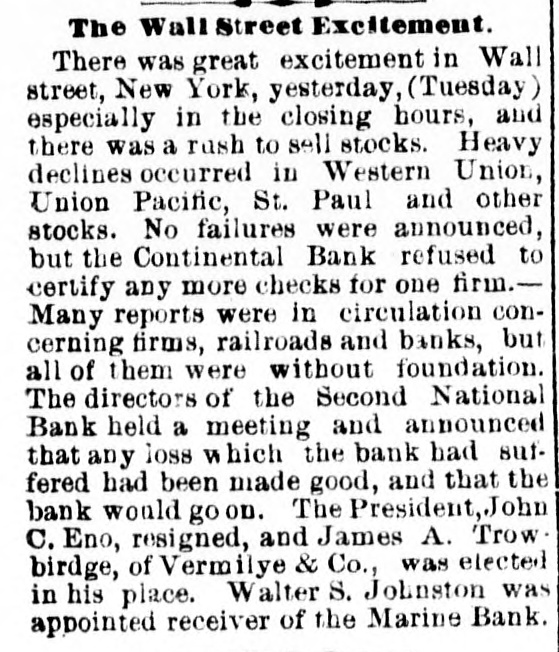
The Wall Street Excitement. There was great excitement in Wall street, New York, yesterday, (Tuesday) especially in the closing hours, and there was a rush to sell stocks. Heavy declines occurred in Western Union, Union Pacific, St. Paul and other stocks. No failures were announced, but the Continental Bank refused to certify any more checks for one firm.Many reports were in circulation concerning firms, railroads and banks, but all of them were without foundation. The directors of the Second National Bank held a meeting and announced that any loss which the bank had suffered had been made good, and that the bank would go OD. The President, John C. Eno, resigned, and James A. Trow birdge, of Vermilye & Co., was elected in his place. Walter S. Johnston was appointed receiver of the Marine Bank.

Article from St. Paul Daily Globe, May 15, 1884

Click image to open full size in new tab

Article Text

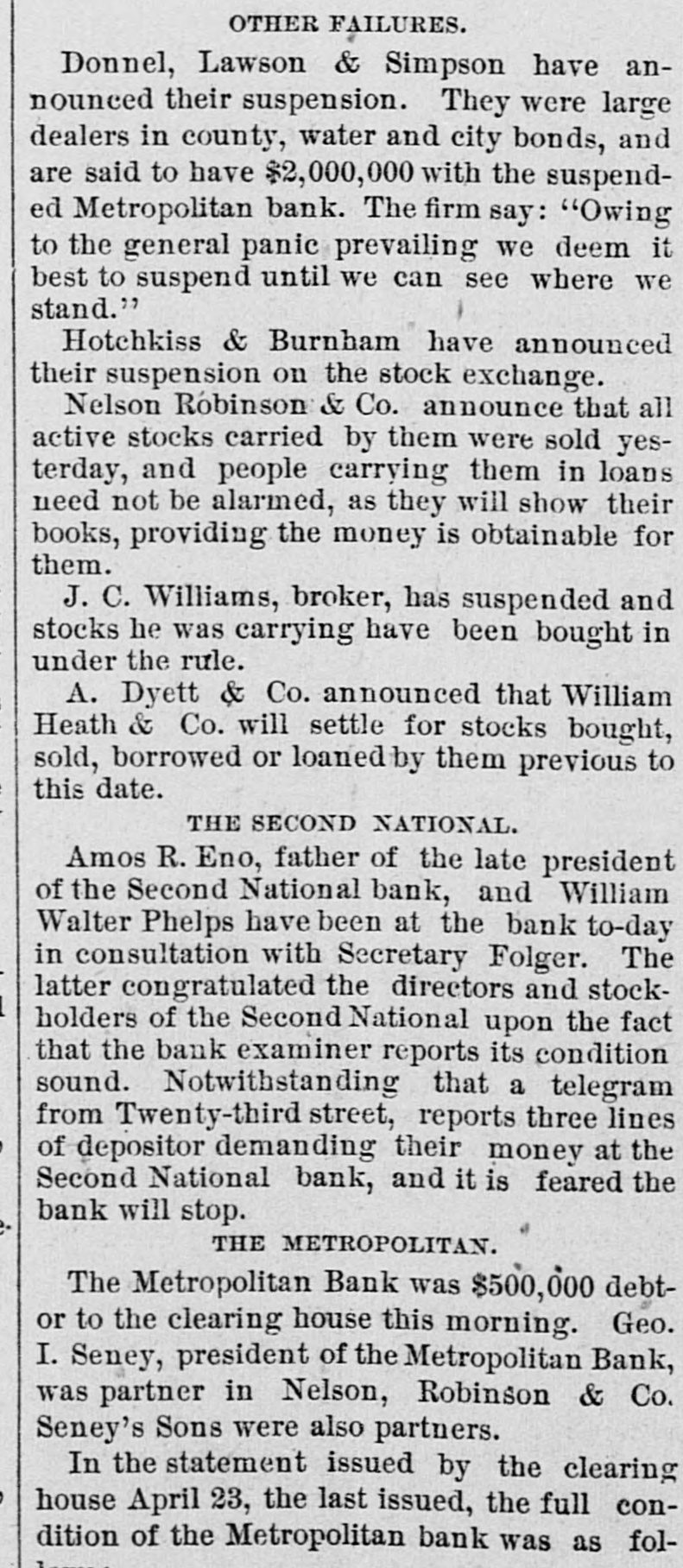
OTHER FAILURES. Donnel, Lawson & Simpson have announced their suspension. They were large dealers in county, water and city bonds, and are said to have $2,000,000 with the suspended Metropolitan bank. The firm say: "Owing to the general panic prevailing we deem it best to suspend until we can see where we stand." Hotchkiss & Burnham have announced their suspension on the stock exchange. Nelson Robinson & Co. announce that all active stocks carried by them were sold yesterday, and people carrying them in loans need not be alarmed, as they will show their books, providing the money is obtainable for them. J. C. Williams, broker, has suspended and stocks he was carrying have been bought in under the rule. A. Dyett & Co. announced that William Heath & Co. will settle for stocks bought, sold, borrowed or loaned by them previous to this date. THE SECOND NATIONAL. Amos R. Eno, father of the late president of the Second National bank, and William Walter Phelps have been at the bank to-day in consultation with Secretary Folger. The latter congratulated the directors and stockholders of the Second National upon the fact that the bank examiner reports its condition sound. Notwithstanding that a telegram from Twenty-third street, reports three lines of depositor demanding their money at the Second National bank, and it is feared the bank will stop. THE METROPOLITAN. The Metropolitan Bank was $500,000 debtor to the clearing house this morning. Geo. I. Seney, president of the Metropolitan Bank, was partner in Nelson, Robinson & Co. Seney's Sons were also partners. In the statement issued by the clearing house April 23, the last issued, the full condition of the Metropolitan bank was as fol-


Article from Alexandria Gazette, May 15, 1884

Click image to open full size in new tab

Article Text

THE WALL STREET PANIC. Wall street was in a condition of panic from 9 o'clock yesterday morning until long after business hours. Values at the Stock Exchange were entirely demoralized the Metropolitan Bank, of New York, and the Atlantic Bank, of Brooklyn, were forced to close their doors, and on the Stock Exchange were announced the failures of the following banking and brokerage houses : Hatch & Foote, Hotchkiss, Burnham & Co., Donnell, Lawson & Simpson, Nelson, Robinson & Co., O. M. Bogart & Co., J. C. Williams and Goff & Randall. The clearinghouse association in the afternoon decided that the bankers would work together for general support, as in 1873; and the Secretary of the Treasury ordered the prepayment without rebate of $10,000,000 3 percent. bonds called for June 20th. These ac tions tended greatly to allay the feeling of alarm, and there was an easier feeling at the close. Money loaned at as high a rate as 3 per cent. per diem bonus in addition to legal interest. The decline in the stock market was from 5 to 12 per cent. The committee appointed by the clearing house reported a decision to sustain the Metropolitan Bank. The bank will resume business to-day. The trouble with some of the banks is that they have not been doing a strictly conservative business for some months. In order to earn dividends which could not be gained by loaning money at the low rate of interest prevailing in strictly first-class securities, they have taken questionable securities as collaterals on which higher in terest could be charged. The fall in the stock market has forced the banks to carry firms to whom they have made loans in order to get the money which they first advanced back, and now in some instances they find themselves loaded up with unmarketable securities. The immediate cause of the panic among the stockbrokers and the alarm of the banks was caused by the Marine Bank failure. They commenced to call in their loans ; brokers took them as fast as possible, expecting to get loans elsewhere. They found this impossible, and there was nothing to do but to sell gradually. This broke down the market, making matters worse with each fractional appreciation in values until the banks practically threw out all but giltedged securities. The final blow came in three ways. The defalcation in the Second National Bank destroyed all confidence. The refusal of the banks to certify checks in advance of deposits, as is their usual custom for brokers' business. Heretofore it has been the practice of brokers who desired to draw beyond their deposits to deposit securities to protect the temporary loan represented by their own draft checks. Yesterday the banks shut down on this kind of business. They demand money, not secur ities. The consequence was that when business opened that morning the brokers had nothing to do but to sell for cash. Those who held plenty of securities but DO cash, and could not sell what they had, bad nothing to do but to suspend. This is the real cause which precipitated the panic which began with the opening of the Stock Exchange. As soon as the exchange opened several of the trust companies and twolarge life insurance companies sent out notices calling in their loans. Jay Gould, it is said, found difficulty in securing some renewals: He was seen coming out of the United States Trust Company with a carpet bag, which, it is said, was full of securities, and which he afwards succeeded in placing. He has been largely short of stocks, and to-day steadied the market by purchasing some fifty thousand shares of stock to cover his short contracts. Other bears followed his example, and thus steadied the market and prevented any such serious decline as that which followed the failure of Jay Cooke in 1873. The panic began soon after the business of the street opened. The brokers and speculators were at first unwilling to believe the report of the failure of the Metropolitan Bank. They rushed from the Stock Exchange to the bank, and then hurried back to the Stock Exchange. When they learned that the story was true, they were prepared for any news. Rumors were soon afloat that other banks had closed


Article from The Rock Island Argus, May 15, 1884

Click image to open full size in new tab

Article Text

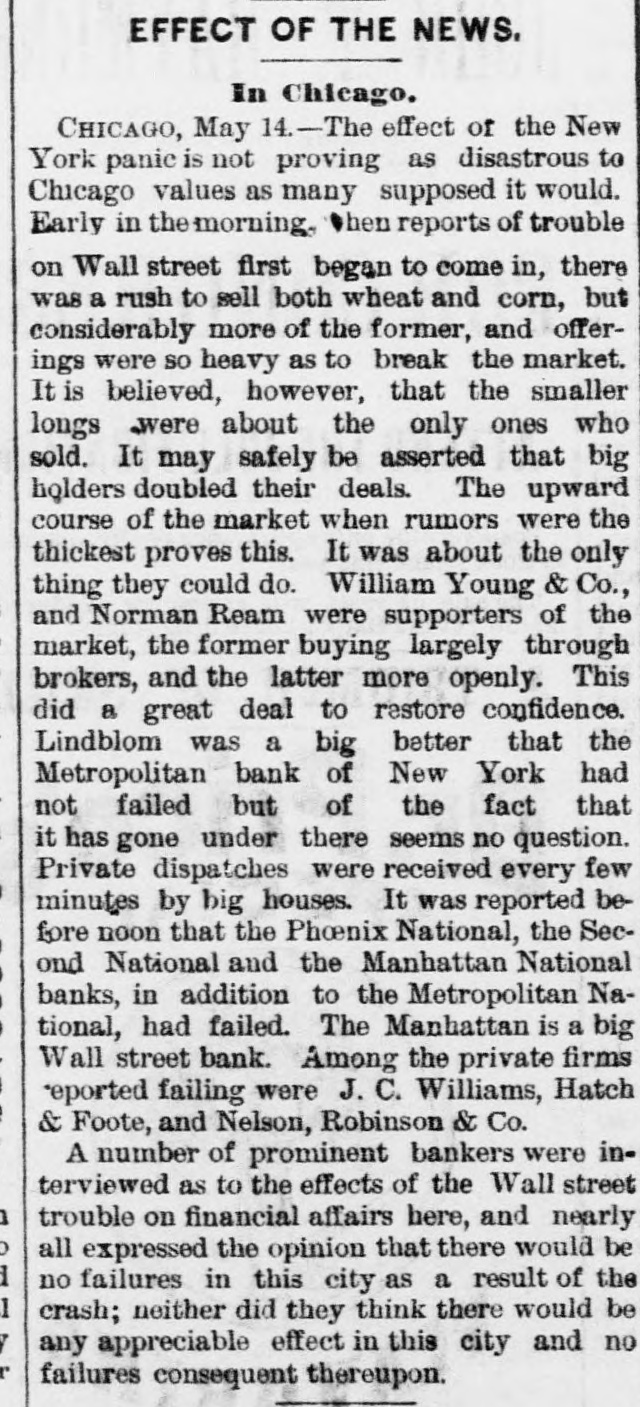
EFFECT OF THE NEWS. In Chicago. CHICAGO, May 14.-The effect of the New York panic is not proving as disastrous to Chicago values as many supposed it would. Early in the morning, then reports of trouble on Wall street first began to come in, there was a rush to sell both wheat and corn, but considerably more of the former, and offerings were so heavy as to break the market. It is believed, however, that the smaller longs were about the only ones who sold. It may safely be asserted that big holders doubled their deals. The upward course of the market when rumors were the thickest proves this. It was about the only thing they could do. William Young & Co., and Norman Ream were supporters of the market, the former buying largely through brokers, and the latter more openly. This did a great deal to restore confidence. Lindblom was a big better that the Metropolitan bank of New York had not failed but of the fact that it has gone under there seems no question. Private dispatches were received every few minutes by big houses. It was reported before noon that the Phoenix National, the Second National and the Manhattan National banks, in addition to the Metropolitan National, had failed. The Manhattan is a big Wall street bank. Among the private firms reported failing were J. C. Williams, Hatch & Foote, and Nelson, Robinson & Co. A number of prominent bankers were interviewed as to the effects of the Wall street trouble on financial affairs here, and nearly all expressed the opinion that there would be no failures in this city as a result of the 1 crash; neither did they think there would be any appreciable effect in this city and no failures consequent thereupon.


Article from Fort Worth Daily Gazette, May 15, 1884

Click image to open full size in new tab

Article Text

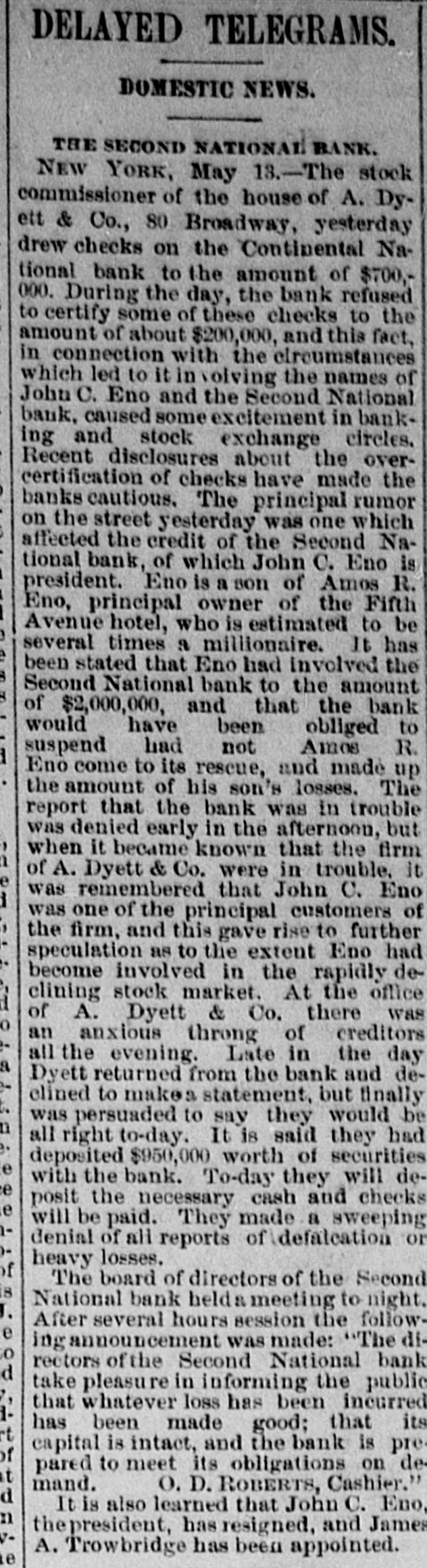
DELAYED TELEGRAMS. DOMESTIC NEWS. THE SECOND NATIONAL BANK. NEW YORK, May 13.-The stock commissioner of the house of A. Dyett & Co., 80 Broadway, yesterday drew checks on the Continental National bank to the amount of $700,000. During the day, the bank refused to certify some of these checks to the amount of about $200,000, and this fact, in connection with the circumstances which led to it in volving the names of John C. Eno and the Second National bank, caused some excitement in banking and stock exchange circles. Recent disclosures about the overcertification of checks have made the banks cautious. The principal rumor on the street yesterday was one which affected the credit of the Second National bank, of which John C. Eno is president. Eno is a son of Amos R. Eno, principal owner of the Fifth Avenue hotel, who is estimated to be several times a millionaire. It has been stated that Eno had involved the Second National bank to the amount of $2,000,000, and that the bank would have been obliged to suspend had not Amos R. Eno come to its rescue, and madè up the amount of his son's losses. The report that the bank was in trouble was denied early in the afternoon, but when it became known that the firm of A. Dyett & Co. were in trouble. it was remembered that John C. Eno was one of the principal customers of the firm, and this gave rise to further speculation as to the extent Eno had become involved in the rapidly declining stock market. At the office of A. Dyett & Co. there was an anxious throng of creditors all the evening. Late in the day Dyett returned from the bank and declined to makes statement, but finally was persuaded to say they would be all right to-day. It is said they had deposited $950,000 worth of securities with the bank. To-day they will deposit the necessary cash and checks will be paid. They made a sweeping denial of all reports of defalcation or heavy losses. The board of directors of the Second 8 National bank helda meeting to night. After several hours session the followe ing announcement was made: "The di0 rectors of the Second National bank d take pleasure in informing the public that whatever loss has been incurred has


Article from The Indianapolis Journal, May 16, 1884

Click image to open full size in new tab

Article Text

THE OTHER SUSPENDED FIRMS. Hotchkiss & Burnham Expect to ResumeAffairs of Bogart & Co. NEW YORK, May 15.-From the New York Tribune: Mr. Hotchkiss, of the firm of Hotchkiss, Burnham & Co., said that they hoped to resume to-morrow, although he could not say positively that they would be able to do so at so early a date; that they would resume was only a question of time. They were hard at work straightening out their affairs, and had got sufficiently far to prove that they could pay every dollar they owed. Mr. Hotchkiss added that many of their customers had taken up their stocks or largely added to their margins, while others were yet to be heard from. Previous to Wednesday, the firm had reduced their indebtedness more than $1,000,000. The trouble was, they could not borrow on certain St curities. The banking offices of O. M. Bogart & Co. remained closed, with the exception of a small opening through each of the iron doors. ExTax Commissioner Wheeler, the assignee, began his examination into the condition of the firm's affairs, but late in the afternoon he was not able to give any information as to the resources or liabilities. He said: "I have been busy looking over the books, collecting securities and collaterals of customers deposited with the firm and locking them up in the safe. I have not yet had time to begin the inventory, but I hope to be able to give some definite information within two or three days." Orlando M. Bogart, senior member of the firm, was at the office throughout the day. He greeted everybody with much cheerfulness. It was learned that O. M. Bogart & Co. held $400,000 in trust funds, of H, L. Horton, who died in Kalamazoo, Mich., about a year ago. Examiner Seriba discontinued his official work at the Marine Bank, and transferred the books, keys, etc., to the receiver, Walter S. Johnson. The settlement of balances at the clearing house between the associated banks was accomMetropolitan plished without trouble. The Bank received an issue of about $2,000,000 of loan certificates, and the Second National Bank applied for $600,000; the total amount issued to five banks was $4,000,000. Wm. A. Camp, manager of the clearing-house, spoke encouragingly of the situation. With regard to the particulars of the failure of Fisk & Hatch, he said: "I am certain it can in no way affect the banks. This is the time for the banks to pursue a liberal policy, and not hesitate to lend money on good collateral." The loan committee will meet to-morrow for the purpose of scrutinizing the securities on which further issues of loan certificates may be desired. The Second National Bank opened its doors and began to pay checks this morning a short time before the usual hour by President Trowbridge's order, so that all apprehension might be removed from the minds of the half dozen depositors who had come to draw out money. During the forenoon rather a larger number of persons than usnal filed up to the paying teller's desk, and by 11 o'clock the number of those waiting their turn was 210. Shortly after noon the number was reduced to five, and the run was finally broken. During the day there were many deposits, the total of these being larger than the amount paid out. Little information could be had regarding the extent or direction of Jno. C. Eno's operations. The names of half a dozen brokers were mentioned as having done business with him, but several deny it. President Seney, of the Metropolitan Bank, resigned, it is understood, upon the advice of the investigating committee of the clearinghouse, upon the ground that his name was connected in the public mind with speculative railroad enterprises. The new president was formerly vice-president of the bank, but has not been engaged in active business for several years. He is wealthy, and has a high reputation. The assignee of A. W. Dimoek & Co. says the liabilities are large, but he expects the firm to resume soon.


Article from Daily Republican, May 16, 1884

Click image to open full size in new tab

Article Text

The Great Crash. B r Matters were quieter in Wall street f yesterday and the general outlook was 0 improved, though there was a set back I late in the day. The Metropolitan Bank e was found to be solvent by the Examiner, and its doors were re-opened at noon. George I. Seney resigned the e Presidency of the Bank and Henry L. Jacques was chosen his successor. The failure of A. W. Dimock & Co. was announced in the morning, the firm making an assignment. A. W. Di8 mock is President of the Bankers and y Merchants' Telegraph Company, and a O large shareholder in the Company, but O it was said that his failure would not involve the Company in any way. The run upon the Second National Bank ceased, but runs were make upon several of the savings banks both in New York city and Brooklyn, and the Atlantic Bank, in the latter city, remained closed. A rude shock was given to the growing feeling of security in New York by the annonneement shortly before 3 o'clock in the afternoon of the failure of Fisk & Hatch, one of the largest and best known houses on the street. One of the partners, A. S. Hatch, is President of the Stock Ex. change. The Tuna Valley Bank, at Bradford, Penna., suspended yesterday. It was a correspondent of the Metropolitan Bank in New York. The officers of the Bank promise to pay the depositors in full, and it is believed that the embarrassment is only temporary. F. A. Hawley & Co., bankers and brokers, of Boston, failed yesterday. Their liabilities are stated by the firm at $150,000. They say their suspension is due to a failure to ascertain just where they stand." Later in the day Mr. Hawley told a reporter that their failure was a bad one, and they did not expect to resume. The "Dr. S. A. Richmond Medicine Company," in St. Joseph, Missouri, failed on Wednesday "for $150,000, with no assets."


Article from The Daily Enterprise, May 16, 1884

Click image to open full size in new tab

Article Text

THE ECHOES OF THE PANIC. Failures In Different Parts of the Country and a Few More in New York. A. W. Dimick & Co., brokers, of New York, suspended yesterday, but produced little effect on the market. Fisk & Hatch, a very heavy firm of brokers. regarded as among the staunchest on the street also. suspended; Fisk was president of the stock exchange; their suspension produced a marked decline in prices. At noon yesterday the Metropolitan bank resumed payment and thereby produced a very favorable impression on business. The Second National bank has been completely secured from its difficulties by depositors who brought in large amounts of ready money to the relief of the bank. The low prices of stocks and the immense prices charged for cash loans attracted foreign dealers. and their New York agents received orders to buy securities or draw for any amount of cash. This had a highly beneficial effect and made a firmer market. Donnell, Lawson & Simpson's correspondents in various parts of the west have been made safe during their sus pension by other firms agreeing to pay outstanding drafts on them and it does not appear that there will be any inconvenience among western banks from their suspension. Prices of leading stocks closed slightly higher last evening than on Wednesday evening, and it is the universal feeling that the worst is over. Wm. H. I Sweeney, a Nassau street (New York) banker made an assignment. The 1 amount is not large, but may embarass t other small firms in the neighborhood. There was a run on the Irish Emigrant Savings bank, but it produced 4 no effect. In Chicago the Union bank has susc pended payment, but may have reN sumed with the resumption of the b Metropolitan of New York. In Bost ton F. A. Hawley & Co., brokers, t have failed hopelessly; liabilities $500,000. Hill, Hanwood & Co., brop kers of the same city, have also failed a with comparatively small liabilities. n At Kansas City two banksn the Kansas City and Armour'sb are in trouble but will pull through. i At St. Joseph. the S. A. Richmond Medical company failed without any d seemingly good reason. At Pittsburg a here was a wild panic on the oil ext change yesterday which produced dein reciation in prices and enormous C ales. San Francisco and St. Louis al re both interested but not involved n the present crisis.


Article from New-York Tribune, May 16, 1884

Click image to open full size in new tab

Article Text

QUIET AT THE SECOND NATIONAL. MORE MONEY PUT IN THAN TAKEN OUT-JOHN C. ENO'S OPERATIONS. The Second National Bank opened its doors and began to pay checks yesterday morning, a short time before the usual hour. This was done by President Trowbridge's order, SO that all apprehension might be removed from the minds of the half dozen depositors who had come to draw out money. During the forenoon a rather larger number of persons than usual filed up to the paying-telier's desk. By 11 o'clock the number of those waiting their turn was twenty-one; shortly after noon it was reduced to five. The run was finally broken. The bank officers and clerks were in excellent spirits. President Trowbridge remained uptown until 1 o'clock, when he betook himself to the less restful region of Wall Street. During! the day there were many deposits, the total of these being larger than that of the amounts paid out. President Trowbridge said: The bank has now resumed its normal condition. I have been so busy with the work attendant on getting the bank into a secure position that I have had no time to think of anything else. Thus my information regarding John C. Eno's defalcation is derived entirely from what I was told by Amos R. Emo, his father. It is a thing to be deeply deplored, but in the present condition of business affairs I think It advisable to wait a few days before making any positive statements regarding it. Henry A. Hurlbut, one of the directors, said It is a mystery to me, and I imagine to all the directors, how the young man continued to appropriate the bank's funds. I first was introduced to him at the meeting at which he was elected president. I voted for him against my better judgment, not from any doubts as to his honor, for no family stand higher than his in the community, but on account of his youth. However, the Second National is not a bank requiring an expert financier at its head, for its business is simple and straightforward. When I saw how earnest and apparently devoted to the bank's interest young Eno was, [became satisfied. The news of Tuesday came to me like a thunder-clap, and I find that he has been carrying on his operations for years without arousing suspicion; I cannot say I am afraid there is no chance of his liabilities on the street being settled. When we had the bank examined, not long ago, the young man succeeded in deceiving the examiner (who is now dead) in some way, and we supposed everything was all right. He told us that a large amount of the securities was in the Safe Deposit vaults down town, and we believed him. How in the world he managed to get away with so much money I cannot imagine, but he did it. When the bank was formed I was the president; then Mr. Trowbridge, father of James A. Trowbridge, was president, and now James A. Trowbridge is our president. There is nothing whatever the matter with that bank. We have the finest class OI customers in the city, our stock is worth 250, and we paid 114 per cent dividend in one year. Young Eno had a nice position there. We paid him $10,000, and he could have been as well fixed as any man in the city, but he has thrown away everything by his own acts. I don't suppose he will suffer, for his father will take care of him, but he has a wife and three children and it will be a sad blow for them. Strange what some men will do-very strange. Our deposits amount to $4,500,000, and we are as prosperous a bank as any in New-York. Little information could be obtained regarding the extent or the direction of John C. Eno's operations. The names of half a dozen brokers were mentioned as having done business with him, but several denied this. H. L. Horton said: I have never done any business of any sort for Mr. Eno." Wickham & Halstead, by one of the firm, said D "Mr. Eno has done no business with us since May or June of last year, and that was unimportant.' Charles C. Goffe, of Goffe & Randle, said: We have had no word as yet from Mr. Eno, and do not know where he is. He has had dealings with us for the last three years, but of what nature and to what extent I prefer not to speak." A. Dyett, of Dyett & Co., said: Mr. Eno has dealt with us to a large extent, and though his account is closed we prefer not to break the confidence of an old customer." Mr. Decker, of Decker, Howell & Co., said: "The slight business Mr. Eno did through us was of


Article from Arizona Weekly Citizen, May 17, 1884

Click image to open full size in new tab

Article Text

Condensed Telegrams. 'incinnati grand jury hae found fif. ou. indictments growing out of the recent riots. Payson has introduced a bill in Conto restrict the ownership of real gress estate in the Territories to American citizens. An indictment has been found against T.C. Campbell, a C neinnati lawyer who defended William Bowen, the murderer of Kirk. The charge is bribery. He gave bail in the sum of $1,000. H. L. Wells, a witness for the defense in the Hill-Sharon case, who contessed to having sworn falsely, has been arrested for perjury. The California Legislature adjourns sine die at Tuesday noon. The Anti-Monopolist national convention was opened Wednesday at Boston. It is probable that Benjamin F. Butler will be nominated for President. The Grand Lodge O. F., of Cali fornia, began its thirty-second session in San Francisco on Tuesday, with Grand Master W. W. Morrow in the chair. Charles M. Bayard, stock broker of Philadelphia, has failed. Liabilities not stated. The Atlantic bank, of Brooklyn, N. Y., closed its doors on Wednesday. The New Jersey Democratic State Convention met on Wednesday and was presided over by Senator McPherson, who counseled harmony and laying aside all small issues. Don Fernando Pacheco, aged 60; weight 425 lbs., died at Martinez, Cal., Monday. The following New York banks have closed their doors: Manhattan National, Metropolitan National, Phenix National and Second National. Francisco bankers believe the will no New San York panic except have to stiffen effect upon the Pacific coast rates somewhat. They maintain that the country is in condit on to stand a much greater shock than this. For several days past the passenger rates from Denver to the Missouri have been in a very unsettled condition, but not until Tuesday has a cut been openly declared. The agents of the Burlington, Missouri, Union Pacific, Atchison, Topeka & Santa Fe announce a cut unprecedented in the history of Western roads, viz: $5 to Kansas City; $8.50 to St. Louis: $14.50 to Chicago, and $28 to are in New York. They easteru fact selling point tickets from any principal for Kansas City at the same rate as to as the eastern But the result as Roads are free to that pro named. passengers rate. point Kansas carrying roads issued is City. through refused above a cir- Pool commissioner Daniels has cular ordering the restoration of rates to take effect on the 15th instant. This order however will surely be ignored. Capt. Monroe of the steamer City of Rome, stated that on April 23, while passing six sailing vessels, almost becalmed, within two or three miles of each other, a full rigged ship was observed two or three miles away, displaying signals which as interpreted by me, meat "ship wrecked crew safe," but no signal was or if was not seen, nor was displayed urgency displayed, the name or nationality of the ship given. Had the signal of distress or urgency been seen it would have had immediate attention as the day was calm. Signal dropping is difficult to make out, but it would have been easy for the vessul to have put out a boat which could have been intercepted by the City of Rome, but not until after his arrival at Liverpool, and hearing that a State line steamer was overdue that the incident became connected in his mind with the indistinct signal, when he at once reported his conjecture. "I certainly," he be the last man said, "would to render neglect the duty of every seaman to as sistance to any one in distrees at sea, having on more than one occasion been indebted to others for the preservation of my OWD life." The first and fourth officers on watch, on duty at the time of eignaling, certify their adherence to Munroe's statement.


Article from The Semi-Weekly Miner, May 17, 1884

Click image to open full size in new tab

Article Text

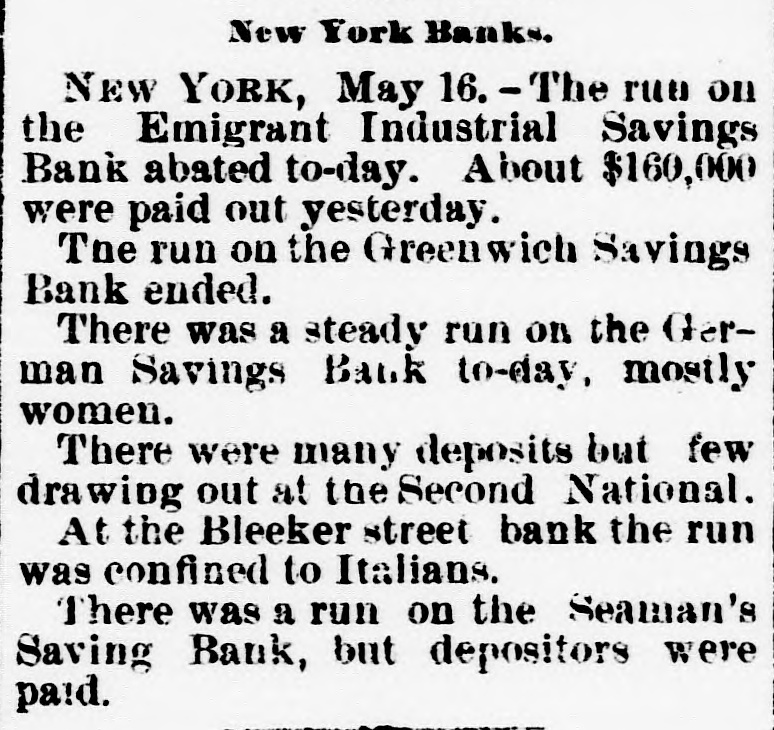
New York Banks. NEW YORK, May 16. - The run on the Emigrant Industrial Savings Bank abated to-day. About $160,000 were paid out yesterday. The run on the Greenwich Savings Bank ended. There was a steady run on the German Savings Bank to-day, mostly women. There were many deposits but few drawing out at the Second National. At the Bleeker street bank the run was confined to Italians. There was a run on the Seaman's Saving Bank, but depositors were paid.


Article from The Sedalia Weekly Bazoo, May 20, 1884

Click image to open full size in new tab

Article Text

upon?" No. sir, nothing of that kind has been or will be done now. We shall not make an assignment unless satisfied we cannot go on or settle our business satisfactorily without it." "What are your liabilities?" "We cannot tell exactly, in the neighborhood of $3,000,000." How much are your assets worth?" "They will be more than that. We shall pav every dollar, I now think." "Is there any truth in the rumor that Sen y unloaded Cleveland, Youngstown and Pittsburg bonds on you?" "Not a word of truth. President Seney has unloaded nothing on us at any time." "What has been the character of your securities? "They have been such as would commend themselves to the conservative judgment. The greatest shrinkage in their value has been in some railroad bonds upon which we made advances." "Cleveland, Youngstown & Pittsburg?" "These and some others." "How much was your deposit in the Metropolitan?" "It was a good deal larger than we could have wished Can you not resume now that the Metropolitan has done so? That is what we are trying to find out ; we shall know to-morrow. It is understood that you have been offered $200,000 to help you out Yes, S. B. Elkins offered that but that would have been a drop in the bucket; we were offered several hundred thousand dollars by cable, but We must see where we stand first. An attache of the firm told the reporter that matters had gone SO far that resumption would be impossible; the $200,000 offered by S. B. Elkins was made in good faith, and may lead to the re-establishment of the concern under a new name. The members of the firm are MISSOURIANS. Robert W. Donnell, the head of the concern, was formerly a merchant of St. Joseph, where he is a large stockholder in in the Savings' bank. He is also a partner in the banking firm of Donnell, Clark & Larabie, of Deer Lodge, Montana, the second member of which is a millionaire. Lawson and Donnell married sisters. The former was a lawyer at Boonville, Mo. He is a member of the Union League and Manhattan Club Simpson lives in Orange, N. J. He formerly resided in Kansas City. THE LOANS OF THE HOUSE were all passed upon by him. The banking house was besieged all day with messengers and clerks copying notices and persons calling to have signatures identitied. Hotehkiss, of the firm of HOTCHKISS, BURNAM & COMPANY say that they would resume. It was only a question of time. They were hard at work straightening out their affairs and had get sufficiently far to prove they could pay overy dollar they owed the office of O. M. Bogart & company remained cleared. Yesterday the assignee began to his examination into the condition of affairs. but late in the afternoon he was not able to give any information settlements of balances at the clearing house between associated banks were accomplished without trouble. The Metropolitan bank received an issue of about $2,000,000 on loan certificates. The Second National bank applied for $6,000,000, the total amount issued to five banks is $5,000,000. Wm. A. Camp, MANVGER OF THE CLEARING HOUSE spoke encouragingly of the situation. With regard to particulars of the failure of Fisk & Hatch he said "I am certain it can in no way affect the banks." The Second National bank opened its doors and began to pay checks yesterday morning. During the day there were many deposits, the total of these being larger than that paid out. The assignee of A. W. Dimmick & C., says their liabilities are large but he expected the firm to resume. Soon after 2 o'clock the feeling was general that the day would pass WITHOUT ANY FURTHER DISASTERS, and when at 2:40 it was announced that Fisk & Aateh were unable to meet their obligations. there was great surprise and much sorrow. No explanation of the failure was given. "The firm bas suspended payment," was the answer given to the avalanche of questions. For more than an hour Nassau street in front of the banking house was almost impassible. Fisk & Hatch handed th following notice to an Associated Press representatives. TO OUR DEPOSITORS. and other creditors. It is with great sorrow we are obliged to announce to you our suspension, which has been brought about by a combination of circumstances, the long continued decline in the market price of securities, even the very best, accompanied by a general weakening of confidence in financial matters, together with a heavy drainage of deposits, are the principal causes of our unfortunate position. We can only request those having claims against us to extend to us such consideration and indulgence as we may need and it may be in their power to grant. FISK & HATCH. [Signed.] WM. LUMMIS, who has become acting president of the Stock Exchange through "the failure of Fisk & Hatch, said the failure will have much less effect in the street than is gen.


Article from The Valley Virginian, May 22, 1884

Click image to open full size in new tab

Article Text

ednesday last. The N.Y. of the Baltimore American ves a graphic review of wha 00 follows He at last. The panic so many times averted took Wall, street this morning, hat have seemed days confu Idest excitement and dreadfu saster reigned supreme. The hange was pandemonium e banks were besieged all depositors, and the streetsT. New, Exchange Place ith wild thousands until ame impossible. Among the Wall street were to be ladies, some of whom n other motives than curiosity of the disasters spread rapidity. Private carriages d servants, from the up-town ent flying through the streets stood outside the doors of arious banking houses. The E, nearly all the banks sion or present in their buildfor any emergency. The doors * Exchange were guarded and the visitors' galeries were No one was admitted to cept members, clerks and This was done because the iv.ored to gain admittance r the capacity of the building de really began before the Stock pened. The rumors of yester d to the defalcation of John lent of the Second National confirmed last night, and were it this morning. Last night the directors of the Second ink took place at the house of 1. Phelps, a stockholder. The e Amos R. Eno, Henry Isaac N. Phelps, Wm. Walter : Darling, of the Fifth Avenue ison Phelps Stokes, and Mr. W To cover the deficit no, father of John C. Eno, and rs each contributed a certain what proportion is not certainIt is thought though, and not denied by the directors, that R. Eno furnished the greater son was president. Mr. Trowelected president, and the bank virtually settled. This ni order to accommodate the as expected, the bank opened ck. mmediately a stream of dred people began to pour in. n being ladies. vere greatly complicated in this y the fact that A. Dyett & Co., of the speculating president of National, had last evening 1 to suspend, the Continental ng to certify their checks. se things became known there rush to the Stock Exchange e outlying offices and before rmal opening, in spite of the anic stricken crowd began is overboard. It was but a few fore the failure was announced Robinson & Co., and but a few ore when Goffe & Randall 1. Almost immΓ©diately they "Β°00 a Bosert W O sq pape he old and highly respected atch & Foote. The condition as fearful. Upon the top of ea thunderclap the announcehe Metropolitan National Bank ts doors. At one time it seemed the Exchange would have to business suspended, but very dois 01 you St alarm would have been intenhis been done. Black Friday the panie of 1873 were already prominent in the memories of ket opened 1 to 6 per cent it closed yesterday, and : prices there was a continuous al decline until 11 o'clock. minutes after H call there reaction of 1 to 2 per cent., eclined again, and on the t of the failure of the Metro ional Bank ran into a panicky or three-quarters of an hour at which time the lowest prices nade, showing a decline of from cent., as compared with 08:21 07 du pur cold & tell recovery of 1/2 to 34 per cent. n with Northwestern, Missou Union Pacific, St. Paul, Lacka e Shore, and Northern Pacific ENES AT THE BANKS. le there were as exciting scene


Article from Weekly Chillicothe Crisis, May 22, 1884

Click image to open full size in new tab

Article Text

Second was was In the Wall rious from rushto and one lower, points dropped of a at rate within speed. frightful were the few minutes on the O. nounced M. and Foote Boger Hatch of and Co., N. and Goff Next came Williams.co., Robinson of Na the the failure of with capital 1. 000, Seney of the the road, is Georgiate Nickle the Ohio and whose Central to are roads East believed run combeen have heavy the bank National Second menced that found soon where been bad elected J. James A of deprowhridge the that president: by his Eno had promptly bank and paid By the sound. of institution Wall street room foot by ten for occupied an ex many being them crowd. to happened im the be Polfordered for call bonds... eited ladies. in New Secretary York and of the of last easing by the the monetary the mediate in the 1 pe currence were change an of of nonneed or simpson Donnell. in panic. cent as diem. the Burnhapato bank State Atlantic of of capital Brooklyn The 000 events doors. closed the Paul preferred morning and Pullmar common Cen Northwester stock par. knocked to tral Union points. Michiganitic forced to to 49. The 39 Union Western tal shares 630,000 in "transactions the Penn The markets tet petroleum down were cities gylvania Jul but little points. recovery shower wheat in Chicago of cents from deeline of but the most highest M. was Charles Bayard. in stock phia. broker suspend Philadelp ed In block large Boston of and Atch bonds Central Alexican on the son were market of to five seve from causing an points: Louisville an nine stock points. other Nashvilleging American showed decrease or value. individu Chicago to by the seems have affected the Time citing simpson. Donnell, Lawson of The house Lawson New Donneyork special simpson. the by was down failure with the which bank, The house carried wl of Robert Donnell, a mi composed be over worth wl reported M M. le Lawsonem George manage in of ers lion was dollars. in Europeanly firm the of ban that years ago. is now who was Chick Wall street son for 111 hundred of Information son. for Northeffed in firm among about we ern agen fiscal w bankbankers. of for They enjoy Kansas. in the extent er The policy western to No the been has at discourage stre and York avoid be th wall in Simpson on out stock money on lend and mon to the western bankers. in d speculation: the firm no rule who to course, were wh principal we kn the failed. be be dema that there ed general nonder upon corresp to be fair and for th to and favor none at to see who once suspend as at we are What your nd ab that say they liabilitiesPare cc, You may IIIof this firm priva distu the ntof llly $3,000,000. The disastor carries to the area. financial The ramin Illine Iowa, ance bankers into a their new business into Kans the Nebraskit, Colorado. and tl urtions Missouri. Texas. more extensive York has territories Arkansus. are other New bankers eit omfrom any and the westerbasiness their it an red Many to this do firm or of with the ba will are proba of not the hear jou ore Their wholly national 80 remote bank that suspensitive they for the seve fi days.rate but several aggregate he be the the Texas proably jest have of been carry losers. of the the result large balances in land the tivity speculati is in said bank are Tex... Benham, of $50,000. h the however of have One a balance banks involved. and it condition will dep lied iles upon one the numer in small failurine largely small of the balances. each the local whether over the It is fir the ork that feeting will :opple the west. upon of the at adidase and company Railroad end ma loan than more is tropolitan Metropoo. crippled it credit been at over the $1,000,000.


Article from The Daily Dispatch, May 23, 1884

Click image to open full size in new tab

Article Text

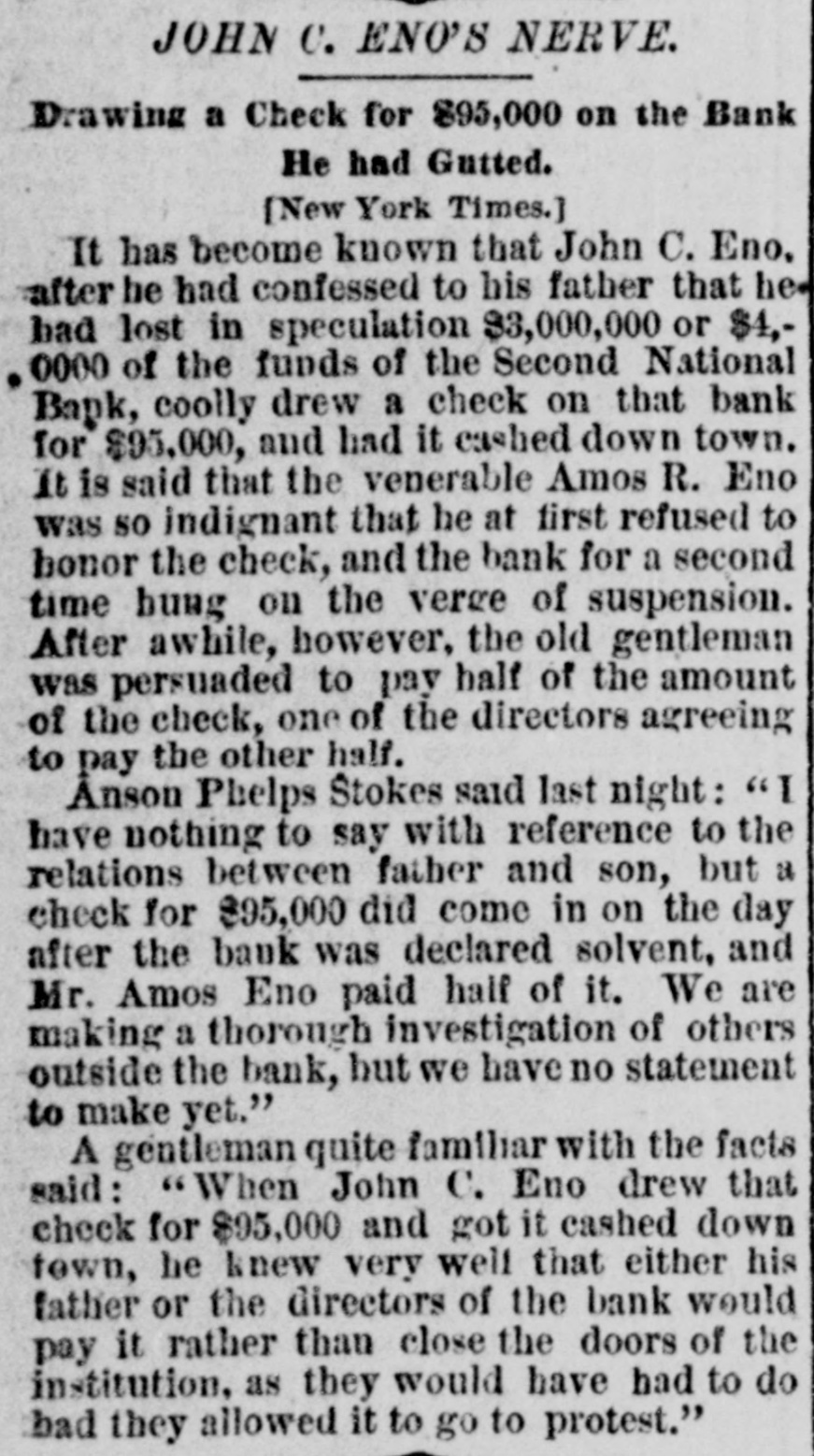
JOHN C. ENO'S NERVE. Drawing a Check for $95,000 on the Bank He had Gutted. [New York Times.] It has become known that John C. Eno. after he had confessed to his father that hehad lost in speculation $3,000,000 or $4,0000 of the funds of the Second National Bank, coolly drew a check on that bank for $95,000, and had it cashed down town. It is said that the venerable Amos R. Eno was so indignant that he at first refused to honor the check, and the bank for a second time bung on the verge of suspension. After awhile, however, the old gentleman was persuaded to pay half of the amount of the check, one of the directors agreeing to pay the other half. Anson Phelps Stokes said last night: have nothing to say with reference to the relations between father and son, but a check for $95,000 did come in on the day after the bank was declared solvent, and Mr. Amos Eno paid half of it. We are making a thorough investigation of others outside the bank, but we have no statement to make yet." A gentleman quite familiar with the facts said: "When John C. Eno drew that check for $95,000 and got it cashed down town, he knew very well that either his father or the directors of the bank would pay it rather than close the doors of the institution, as they would have had to do bad they allowed it to go to protest."


Article from The Weekly Elko Independent, May 25, 1884

Click image to open full size in new tab

Article Text

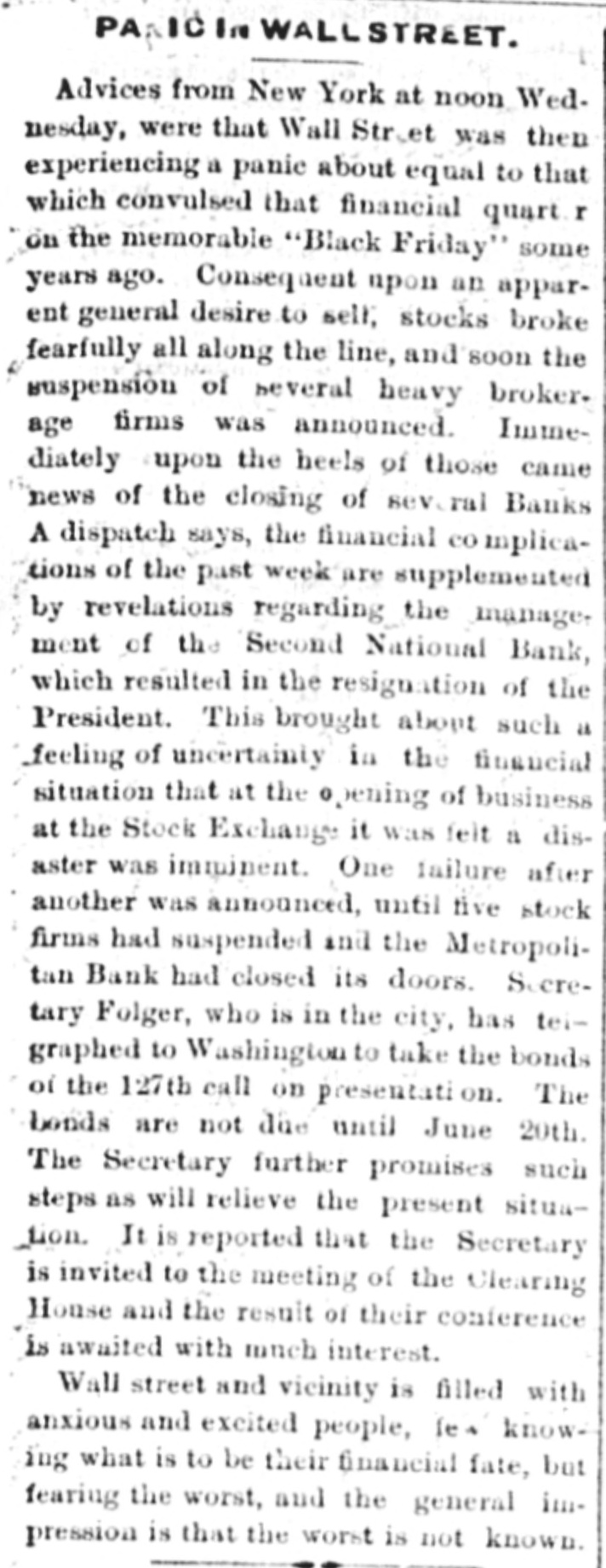
In WALLSTREET. Advices from New York at noon Wednesday, were that Wall Street was then experiencing a panic about equal to that which convulsed that financial quart r on the memorable "Black Friday" some years ago. Consequent upon an apparent general desire to self, stocks broke fearfully all along the line, and soon the suspension of several heavy broker. age firms was announced Immediately upon the heels of those came news of the closing of sev ral Banks A dispatch says, the financial co implications of the past week are supplemented by revelations regarding the manage ment of the Second National Bank, which resulted in the resignation of the President. This brought about such a .feeling of uncertainly in the financial situation that at the o, pening of business at the Stock Exchange it was felt a disaster was imminent One failure after another was announced, until five stock firms had suspended and the Metropolitan Bank had closed its doors. Steretary Folger, who is in the city, has teigraphed to Washington to take the bonds of the 127th call on presentation. The bonds are not due until June 20th. The Secretary further promises such steps as will relieve the present situaLion. It is reported that the Secretary is invited to the meeting of the Clearing House and the result of their conference is awaited with much interest. Wall street and vicinity is filled with anxious and excited people, le . knowing what is to be their financial fate, but fearing the worst, and the general in pression is that the worst is not known.


Article from The Portland Daily Press, June 2, 1884

Click image to open full size in new tab

Article Text

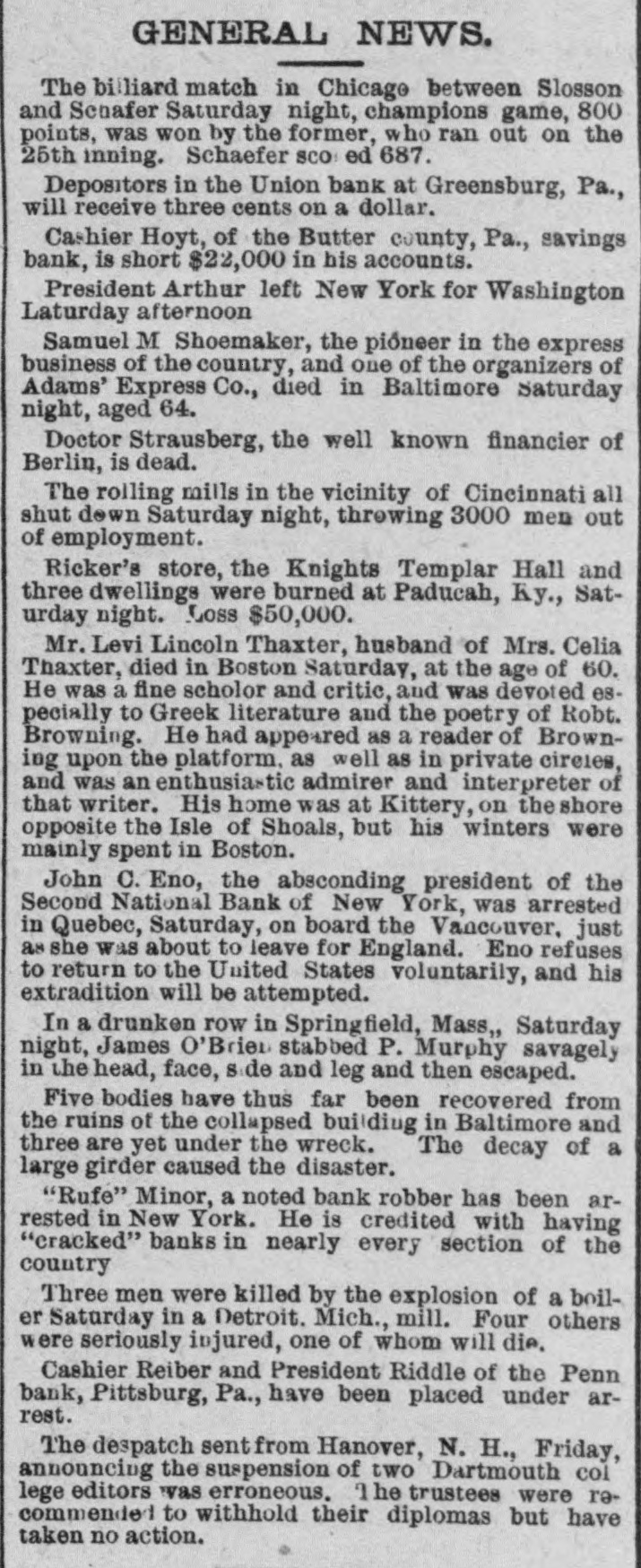
GENERAL NEWS. The billiard match in Chicago between Slosson and Senafer Saturday night, champions game, 800 points, was won by the former, who ran out on the 25th inning. Schaefer SCO ed 687. Depositors in the Union bank at Greensburg, Pa., will receive three cents on a dollar. Cashier Hoyt, of the Butter county, Pa., savings bank, is short $22,000 in his accounts. President Arthur left New York for Washington Laturday afternoon Samuel M Shoemaker, the pioneer in the express business of the country, and one of the organizers of Adams' Express Co., died in Baltimore Saturday night, aged 64. Doctor Strausberg, the well known financier of Berlin, is dead. The rolling mills in the vicinity of Cincinnati all shut down Saturday night, throwing 3000 men out of employment. Ricker's store, the Knights Templar Hall and three dwellings were burned at Paducah, Ky., Saturday night. Loss $50,000. Mr. Levi Lincoln Thaxter, husband of Mrs. Celia Thaxter, died in Boston Saturday, at the age of 60. He was a fine scholor and critic, and was devoted especially to Greek literature and the poetry of Robt. Browning. He had appeared as a reader of Browning upon the platform, as well as in private circies, and was an enthusiastic admirer and interpreter of that writer. His home was at Kittery, on the shore opposite the Isle of Shoals, but his winters were mainly spent in Boston. John C. Eno, the absconding president of the Second National Bank of New York, was arrested in Quebec, Saturday, on board the Vancouver, just as she was about to leave for England. Eno refuses to return to the United States voluntarily, and his extradition will be attempted. In a drunken row in Springfield, Mass, Saturday night, James O'Brien stabbed P. Murphy savagely in the head, face, 8 de and leg and then escaped. Five bodies have thus far been recovered from the ruins of the collapsed buildiug in Baltimore and three are yet under the wreck. The decay of a large girder caused the disaster. "Rufe" Minor, a noted bank robber has been arrested in New York. He is credited with having "cracked" banks in nearly every section of the country Three men were killed by the explosion of a boiler Saturday in a Detroit. Mich., mill. Four others were seriously injured, one of whom will die. Cashier Reiber and President Riddle of the Penn bank, Pittsburg, Pa., have been placed under arrest. The despatch sentfrom Hanover, N. H., Friday, announcing the suspension of two Dartmouth col lege editors was erroneous. 1 he trustees were recommended to withhold their diplomas but have taken no action.


Article from Fort Worth Daily Gazette, June 17, 1884

Click image to open full size in new tab

Article Text

/ port prepared Gebate for was the over and the The of the court. forgensation.] a of order. chair If said he the senator was o different make he way. should had any make them in accusation not Mr. answer Beck that. (sotto voce): I woul not Mr. uttered in Ingalls: debate guage that susceptible reply to make The would Mr. The Chair: Ingalls: I supposed he is out Mr. Mr. of Brown Ingalls : order. I have addressed senator the from chair. Kansa lieve. the floor I had The the chaic floor, but agreed that Mr. of er the chair ther that in THE to the remarks opinio ceed in order." Mr. referred to Ingalls said the mode of by He was a amount thug of asleep who and courage required waited then that about until was his the exhibite had called moved the language to stabbed the official record attention of be debates. expunged which Mr. consideration Gorman objected to the went over till to-morrow. and Mr. Brown said he had intended ter say something in reply, did not would was wish be to it to go heard butas the ence not the him be drawn over. fact that the matter was Mr. offered Butler called up his the some days resolutio examination B sq committee of the senate. Mr. committee on Morrill moved finance. to refer to said Mr. if Blair favored the resolution now the comptroller of banks long. had withheld bis activity Mr. Vest said the Marine National National Metropolitan National and failed banks of New Suppanous deposits Tith Ausu swindled millions. People had out of these millions. inquired what the comptroller of rency banks had been doing while the statems their dn Surind were ments operations and making false ment under officiais. the eyes of the Mr. Butler referred to the recent bank alcation of $100,000 in a Clevelar had discovered soon after the been examined by the ment examiner. He inquired how gover long defalcation could, as reported, had done period his of duty. time if the examin Mr. Morrill said no mode could effected by an investigation. Mr. Plumb said he had heard of one bank failure in New Yor namely, the Marine National. president of that bank had been tion dicted by the grand jury on applic of the district attorney. Metropolitan had closed its doors twenty-nine hours, but the Secon all. National had not closed its doors Mr. Vest said the reason why Second National had not closed because one man to save his family hon or had paid out of his priva purse $3 000,000. Mr. Sherman did not believe good could come of an investigati by a committee. Such a committe a crowd working in around, public would with be reporters helpless


Article from The Wellington Enterprise, August 13, 1884

Click image to open full size in new tab

Article Text

# How She Saved the Interest. [N. Y. Cor. Chicago Tribune.] Woman's vanity is at times her protector. I am told how one lady saved her interest on her deposit in the Second National Bank at the time of the brief run on it a month ago. She drew a check and went with her brother to the bank, he carrying the check. In the crowd they became separated, and when the brother reached the paying-teller the drawer of the check was some distance away. The paying-teller made some inquiries of the presenter of the check, probably to gain time, and among other things asked him to describe the lady whom he claimed had given him the check. He did so, and the teller doubtless to gain more time, turned to the clerk who keeps such records and asked for the booked description of Mrs. β€”. It happened that the lady at this moment was very near the clerk and heard him read the book's records of her gifts of person: "Fat brunette, about forty, with gray bangs and a wart on her nose." In a rage she rushed to her brother and indignantly drew him away, declaring she "would not deal with such nasty bank officers." The check was not paid, and her interest goes on uninterruptedly, as the run amounted to nothing. Eno's defalcation being made good, her vanity saved her considerable interest.