14375. Produce Exchange Trust Company (New York, NY)

Bank Information

Episode Type
Run β†’ Suspension β†’ Reopening
Bank Type
trust
Start Date
December 18, 1899
Location
New York, New York (40.714, -74.006)

Metadata

Model
gpt-5-mini
Short Digest
cff0a5b61e9e993f

Response Measures

None

Description

Multiple articles report heavy withdrawals/a run and the company's suspension in mid-December 1899 (Dec 18) due to inability to convert securities and large ill-advised loans tied up in industrial trusts and syndicate loans. The company was reorganized under Edwin Gould and Gen. Samuel Thomas and reopened Jan 10, 1900. Some reports list Dec 18 as the suspension date; a few mention Dec 19 β€” I use Dec 18 as primary because several dispatches cite Dec 18. OCR errors corrected (e.g., 'Produce Exchange Trust company' occasionally mis-OCRed as 'Product' or 'Produce Exchange Trust company of this city').

Events (5)

1. December 18, 1899 Other
Newspaper Excerpt
News reports describe a broader market panic triggered by the company's failure, with call money rates spiking and clearing-house loans offered to stabilize the market.
Source
newspapers
2. December 18, 1899 Run
Cause
Bank Specific Adverse Info
Cause Details
Large illiquid loans and heavy underwriting of industrial trust securities left assets difficult to convert; depositors withdrew funds leading to a run.
Measures
Directors appointed a special committee; attempts at private financings (Edwin Gould offered advances); Clearing House and other banks later provided liquidity to the market.
Newspaper Excerpt
During the past few weeks there has been a heavy withdrawal of deposits, developing almost into a run.
Source
newspapers
3. December 18, 1899 Suspension
Cause
Bank Specific Adverse Info
Cause Details
Inability to convert securities into cash to meet a sudden abnormal demand; tied-up syndicate loans and underwritings on industrial trusts strained liquidity.
Newspaper Excerpt
Posted notice: The board of directors ... has deemed it to the best interests of its depositors and stockholders to suspend payments, pending a readjustment of its affairs.
Source
newspapers
4. December 28, 1899 Other
Newspaper Excerpt
Edwin Gould and Gen. Samuel Thomas assume charge and agree to advance necessary funds for reorganization; new management named and capital reorganized.
Source
newspapers
5. January 10, 1900 Reopening
Newspaper Excerpt
The Produce Exchange Trust Company ... resumed business to-day. The company has been entirely reorganized ... Edwin Gould was elected president and Gen. Samuel Thomas ... vice-president.
Source
newspapers

Newspaper Articles (22)

Article from The Representative, September 28, 1899

Click image to open full size in new tab

Article Text

# ON THE BRINK. The government already has over $80,000,000 deposited in national banks, the largest sum for many months, and has left little undone to ease financial conditions in Wall street. The great expansion in bank loans, the heavy decrease in reserves, the high prices at which securities are quoted and the overextended condition of many specu-lators and cliques are responsible for the belief entertained by some of the most ex-perienced observers that the market is in a dangerous position.-Financial News Item. Have any of the Populist papers reported financial conditions any worse than this? Eighty millions borrowed from the govern-ment without interest and still the banks are on the ragged edge of despair, with less than $2,500,000 of surplus funds on hand-reserve constantly decreasing, although loans are being called in wherever possible. Suppose the government should call for that $80,000,000. What then will become of our boasted financial prosperity? The above clipping is proof positive that we have not money enough to expand our business any further, we cannot even keep it where it is without serious danger of universal collapse. Speculation has been compelled to call a halt on acount of the growing scarcity of money in New York. Stocks and securities of all kinds are declining. Grain also is going down, wheat is only worth 50 cents in Nebraska, although the world's crop of wheat is 200,000,000 bushels short. A few years ago present conditions would have made every bushel of good wheat in the West worth a dollar. Republican farmers that support the gold standard are paying dear for their patriotism when they sell their products at half price on account of present financial conditions and pay double for those necessaries that are controlled by the trusts fostered by their party. The Non-Conformist. The New York bankers are now im-porting gold at a loss, -one firm brought $5,000,000 in one shipment the other day, and the printing presses of the treasury department in Washington are pouring out paper money by the mil-lions. A desperate struggle is going on to make the gold blanket stretch long enough to cover the cold toes of the world. We are on the brink. The collapse may come at any time. Special to the St. Paul Dispatch. WASHINGTON. Sept. 18.-New York bankers are in financial straits and it is another case of chickens coming home to rost. For a long time the asacciated clearing house of New York has been charging Western bankers for collecting checks. The Western bankers some few weeks ago made a protest and requested that the vast amount of exchange in the form of com-mercial checks be credited up at face value, without deducting collection charges. The New York banks would not consent to this. As a result millions of money deposited to the credit of Western people has been with-drawn. In fact, the surplus reserve is about exhausted, for in addition to large withdrawals of account, vast sums are being sent West to move crops. Another reason for the New York money famine is that millions have been absorbed in floating so many new trusts. Conservative financiers here who have been watching business conditions say that in due course of time the money market and the compet-itive rush for business will settle the trus question more effectively than gatherings like the one recently held in Chicago. The Produce Exchange Trust Co., of New York, has already broken the cast iron rules of the consolidated banks, and gave notice today that it would withdraw from the Clearing House association.
Article from El Paso Daily Herald, December 18, 1899

Click image to open full size in new tab

Article Text

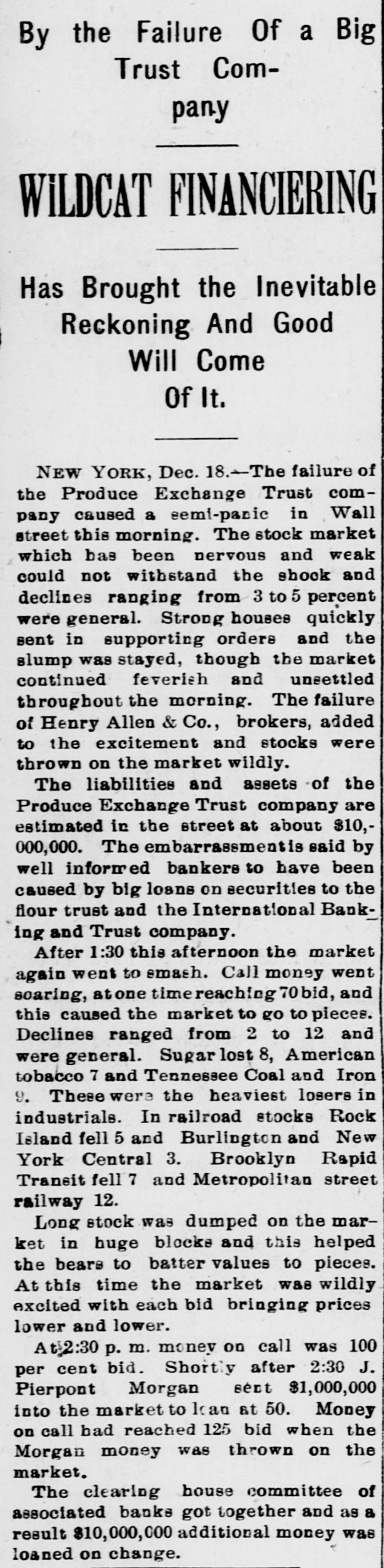
By the Failure Of a Big Trust Company WILDCAT FINANCIERING Has Brought the Inevitable Reckoning And Good Will Come Of It. NEW YORK, Dec. 18.-The failure of the Produce Exchange Trust company caused a eemi-panic in Wall street this morning. The stock market which has been nervous and weak could not withstand the shock and declines ranging from 3 to 5 percent were general. Strong houses quickly sent in supporting orders and the slump was stayed, though the market continued feverish and unsettled throughout the morning. The failure of Henry Allen & Co., brokers, added to the excitement and stocks were thrown on the market wildly. The liabilities and assets of the Produce Exchange Trust company are estimated in the street at about $10,000,000. The embarrassmentis said by well informed bankers to have been caused by big loans on securities to the flour trust and the International Banking and Trust company. After 1:30 this afternoon the market again went to emash. Call money went soaring, atone time reaching 70bid, and this caused the market to go to pieces. Declines ranged from 2 to 12 and were general. Sugar lost 8, American tobacco 7 and Tennessee Coal and Iron 9. These were the heaviest losers in industrials. In railroad stocks Rock Island fell 5 and Burlington and New York Central 3. Brooklyn Rapid Transit fell 7 and Metropolitan street railway 12. Long stock was dumped on the market in huge blocks and this helped the bears to batter values to pieces. At this time the market was wildly excited with each bid bringing prices lower and lower. At 2:30 p. m. money on call was 100 per cent bid. Shortly after 2:30 J. Pierpont Morgan sent $1,000,000 into the market to loan at 50. Money on call had reached 125 bid when the Morgan money was thrown on the market. The clearing house committee of associated banks got together and as a result $10,000,000 additional money was loaned on change.


Article from Deseret Evening News, December 18, 1899

Click image to open full size in new tab

Article Text

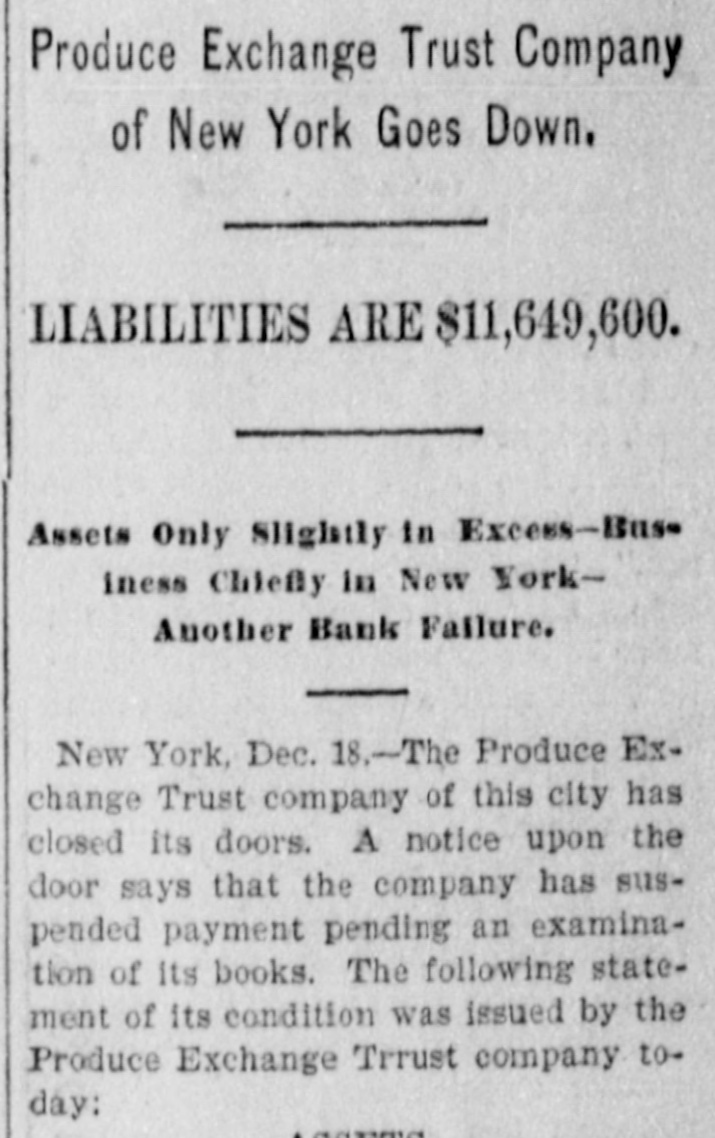
Produce Exchange Trust Company of New York Goes Down. LIABILITIES ARE $11,649,600. Assets Only Slightly in Excess-Business Chiefly in New YorkAnother Bank Failure. New York, Dec. 18.-The Produce Exchange Trust company of this city has closed its doors. A notice upon the door says that the company has suspended payment pending an examination of its books. The following statement of its condition was issued by the Produce Exchange Trrust company today:


Article from The Portland Daily Press, December 19, 1899

Click image to open full size in new tab

Article Text

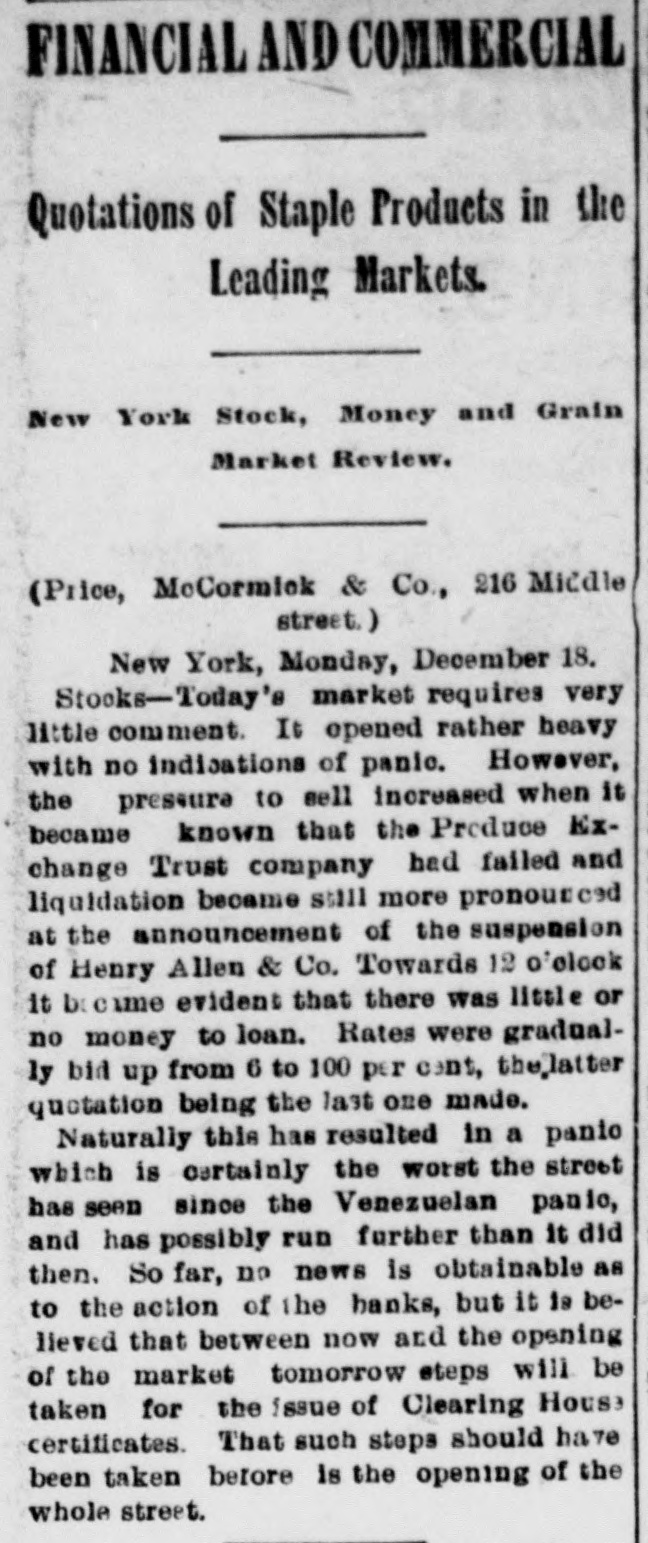
FINANCIAL AND COMMERCIAL Quotations of Staple Products in the Leading Markets. New York Stock, Money and Grain Market Review. (Price, McCormick & Co., 216 Middle street.) New York, Monday, December 18. Stocks-Today's market requires very little comment. It opened rather heavy with no indications of panic. However, the pressure to sell increased when it became known that the Produce Exchange Trust company had failed and liquidation became still more pronounced at the announcement of the suspension of Henry Allen & Co. Towards 12 o'elook it became evident that there was little or no money to loan. Rates were gradually bid up from 6 to 100 per cent, the latter quotation being the last one made. Naturally this has resulted in a panio which is certainly the worst the street has seen since the Venezuelan panic, and has possibly run further than it did then. So far, no news is obtainable as to the action of the hanks, but it is believed that between now and the opening of the market tomorrow eteps will be taken for the issue of Clearing House certificates. That such steps should have been taken before is the opening of the whole street.


Article from The Seattle Post-Intelligencer, December 19, 1899

Click image to open full size in new tab

Article Text

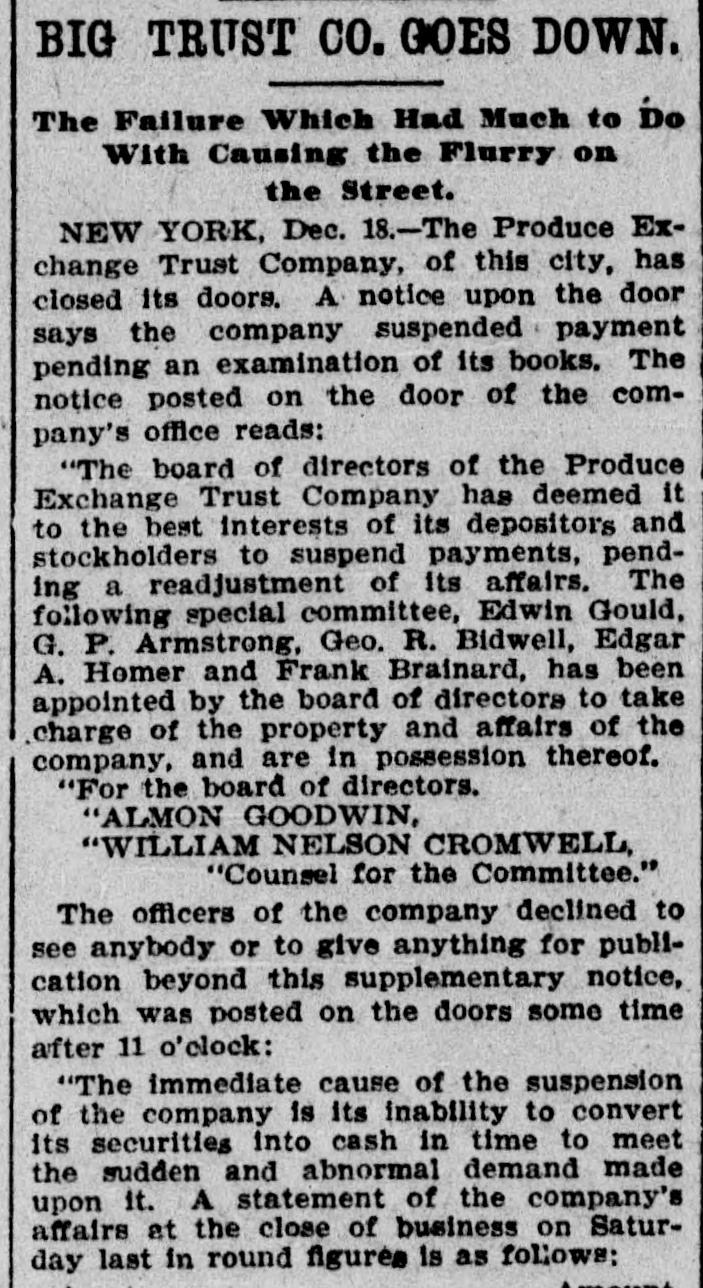
BIG TRUST CO. GOES DOWN. The Failure Which Had Much to Do With Causing the Flurry on the Street. NEW YORK, Dec. 18.-The Produce Exchange Trust Company, of this city, has closed its doors. A notice upon the door says the company suspended payment pending an examination of its books. The notice posted on the door of the company's office reads: "The board of directors of the Produce Exchange Trust Company has deemed it to the best interests of its depositors and stockholders to suspend payments, pending a readjustment of its affairs. The following special committee, Edwin Gould, G. P. Armstrong, Geo. R. Bidwell, Edgar A. Homer and Frank Brainard, has been appointed by the board of directors to take charge of the property and affairs of the company, and are in possession thereof. "For the board of directors. "ALMON GOODWIN, "WILLIAM NELSON CROMWELL "Counsel for the Committee." The officers of the company declined to see anybody or to give anything for publication beyond this supplementary notice, which was posted on the doors some time after 11 o'clock: "The immediate cause of the suspension of the company is its inability to convert its securities into cash in time to meet the sudden and abnormal demand made upon it. A statement of the company's affairs at the close of business on Saturday last in round figures Is as follows:


Article from Virginian-Pilot, December 19, 1899

Click image to open full size in new tab

Article Text

Panic Conditions Precipitated by an Imperative Need of Money. CONTRACTION IN VALUES Clearlug House Banks Forced Rates Down to Six Por Cent, Checked the Decline and Drove the Bears to Cover-The Produce Exchange Trust Company Falls-Assigns ments in Boston and Baltimore. (By Telegraph to Virginian-Pilot.) New York, Dec. 18.-Panic conditions devepoled on the stock exchange this afternoon with the imperative need of money developed by the violent contraction in values. Stocks were being thrown over without the slightest regard to the price they would bring and at distressing sacrifice of values. No end to the helplessness of the situation seemed in sight, when, in the last half hour of the market some $10,000,000 was offered on the stock exchange by the concerted action of the Clearing House banks to force the rate arbitrarily down to six per cent. without regard to the distracted bidding at higher rates which was being done by other brokers for distressed operators. The collapse in the money rate checked the decline and drove the bears to cover. The recoveries produced by their urgent bidding were almost as violent as the declines had been, but the losses were by no means entirely retrieved. Large offerings of stocks continued at the rally, and at some point of the list prices broke anew before the close, making the closing exceedingly irregular and unsettled. The excitement continued to the end, with a sentiment looking forward anxiously for the developments of another day. The seriousness of the crisis has called forth the best efforts of powerful and conservative financial interests, who are busy concerting measures to tide over the money difficulties, which beset the stock market. and which, by reason of their extent and the importance of the interests involved, threaten to affect the country's business interests, unless obstacles are opposed. CROP OF WILD RUMORS. So far as actual news was concerned to-day there was a suspension by n newly organized trust company and by a firm of bankers and brokers, who have figured as traders in stocks to an extent of some importance. Neither event in itself would have been sufficient to precipitate a crisis. But they were supplemented with a whole crop of wild and incoherent rumors, which spared no interest, however powerful, long established and hitherto free from suspicion It may have been. One would think, from the tone of some of the gossip that was flying about by telephone, telegraph and by messenger boy or by whispers and even by shoutings in the lobbies of the Stock Exchange, that the whole financial fabric had been undermined and was about to tumble in ruins. Yet the day closed with two failures above mentioned, as the sum total of disaster, 60 far as admitted insolvency was concerned. The reason for the widespread effect upon sentiment of the trust companies' suspension was that it was one of a large number


Article from Wheeling Register, December 19, 1899

Click image to open full size in new tab

Article Text

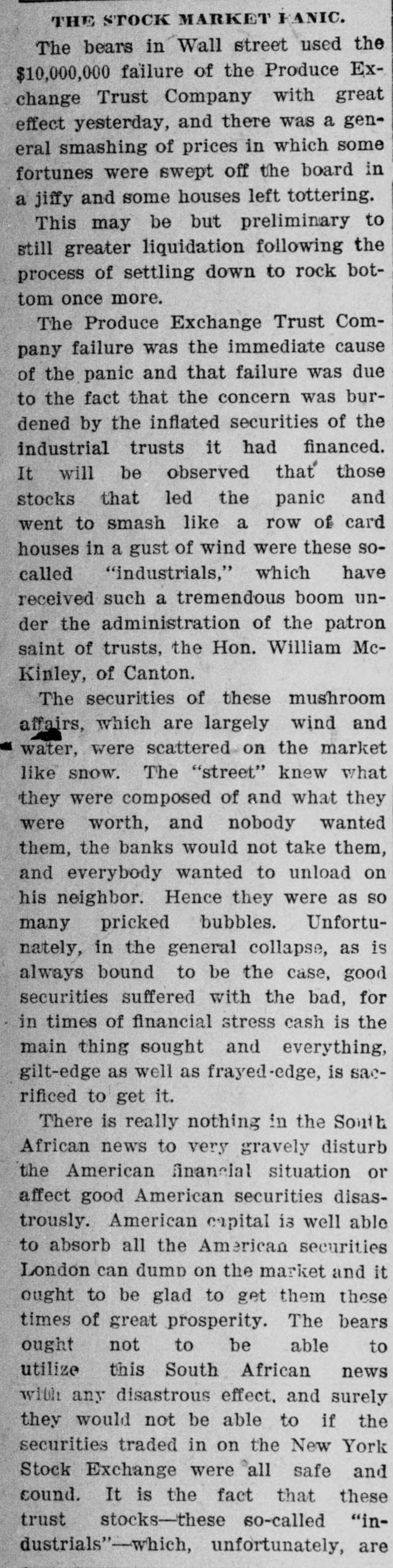
THE STOCK MARKET FANIC. The bears in Wall street used the $10,000,000 failure of the Produce Exchange Trust Company with great effect yesterday, and there was a general smashing of prices in which some fortunes were swept off the board in a jiffy and some houses left tottering. This may be but preliminary to still greater liquidation following the process of settling down to rock bottom once more. The Produce Exchange Trust Company failure was the immediate cause of the panic and that failure was due to the fact that the concern was burdened by the inflated securities of the industrial trusts it had financed. It will be observed that those stocks that led the panic and went to smash like a row of card houses in a gust of wind were these socalled "industrials," which have received such a tremendous boom under the administration of the patron saint of trusts, the Hon. William McKinley, of Canton. The securities of these mushroom affairs, which are largely wind and water, were scattered on the market like snow. The "street" knew what they were composed of and what they were worth, and nobody wanted them, the banks would not take them, and everybody wanted to unload on his neighbor. Hence they were as SO many pricked bubbles. Unfortunately, in the general collapse, as is always bound to be the case, good securities suffered with the bad, for in times of financial stress cash is the main thing sought and everything, gilt-edge as well as frayed-edge, is sacrificed to get it. There is really nothing in the South African news to very gravely disturb the American financial situation or affect good American securities disastrously. American capital is well able to absorb all the American securities London can dump on the market and it ought to be glad to get them these times of great prosperity. The bears ought not to be able to utilize this South African news with any disastrous effect. and surely they would not be able to if the securities traded in on the New York Stock Exchange were all safe and cound. It is the fact that these trust stocks-these so-called "industrials"-which, unfortunately, are


Article from The Saint Paul Globe, December 19, 1899

Click image to open full size in new tab

Article Text

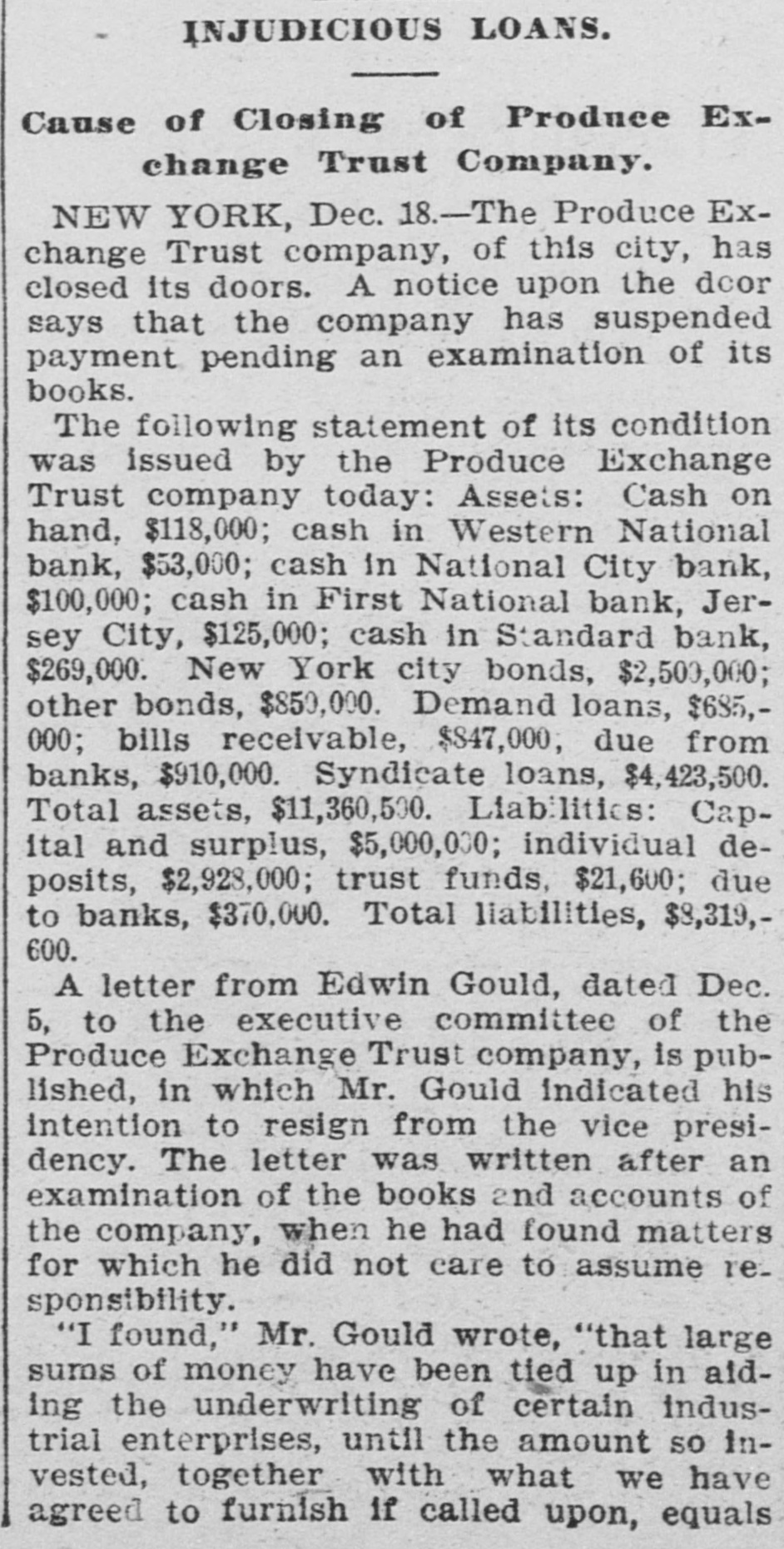
INJUDICIOUS LOANS. Cause of Closing of Produce Exchange Trust Company. NEW YORK, Dec. 18.-The Produce Exchange Trust company, of this city, has closed its doors. A notice upon the door says that the company has suspended payment pending an examination of its books. The following statement of its condition was issued by the Produce Exchange Trust company today: Assets: Cash on hand, $118,000; cash in Western National bank, $53,000; cash in National City bank, $100,000; cash in First National bank, Jersey City, $125,000; cash in Standard bank, $269,000. New York city bonds, $2,500,000; other bonds, $850,000. Demand loans, $685,000; bills receivable, $847,000, due from banks, $910,000. Syndicate loans, $4,423,500. Total assets, $11,360,500. Liabilities: Capital and surplus, $5,000,000; individual deposits, $2,928,000; trust funds, $21,600; due to banks, $370.000. Total liabilities, $8,319,600. A letter from Edwin Gould, dated Dec. 5, to the executive committee of the Produce Exchange Trust company, is published, in which Mr. Gould indicated his intention to resign from the vice presidency. The letter was written after an examination of the books and accounts of the company, when he had found matters for which he did not care to assume responsibility. "I found," Mr. Gould wrote, "that large sums of money have been tied up in aiding the underwriting of certain industrial enterprises, until the amount so invested, together with what we have agreed to furnish if called upon, equals


Article from New-York Tribune, December 19, 1899

Click image to open full size in new tab

Article Text

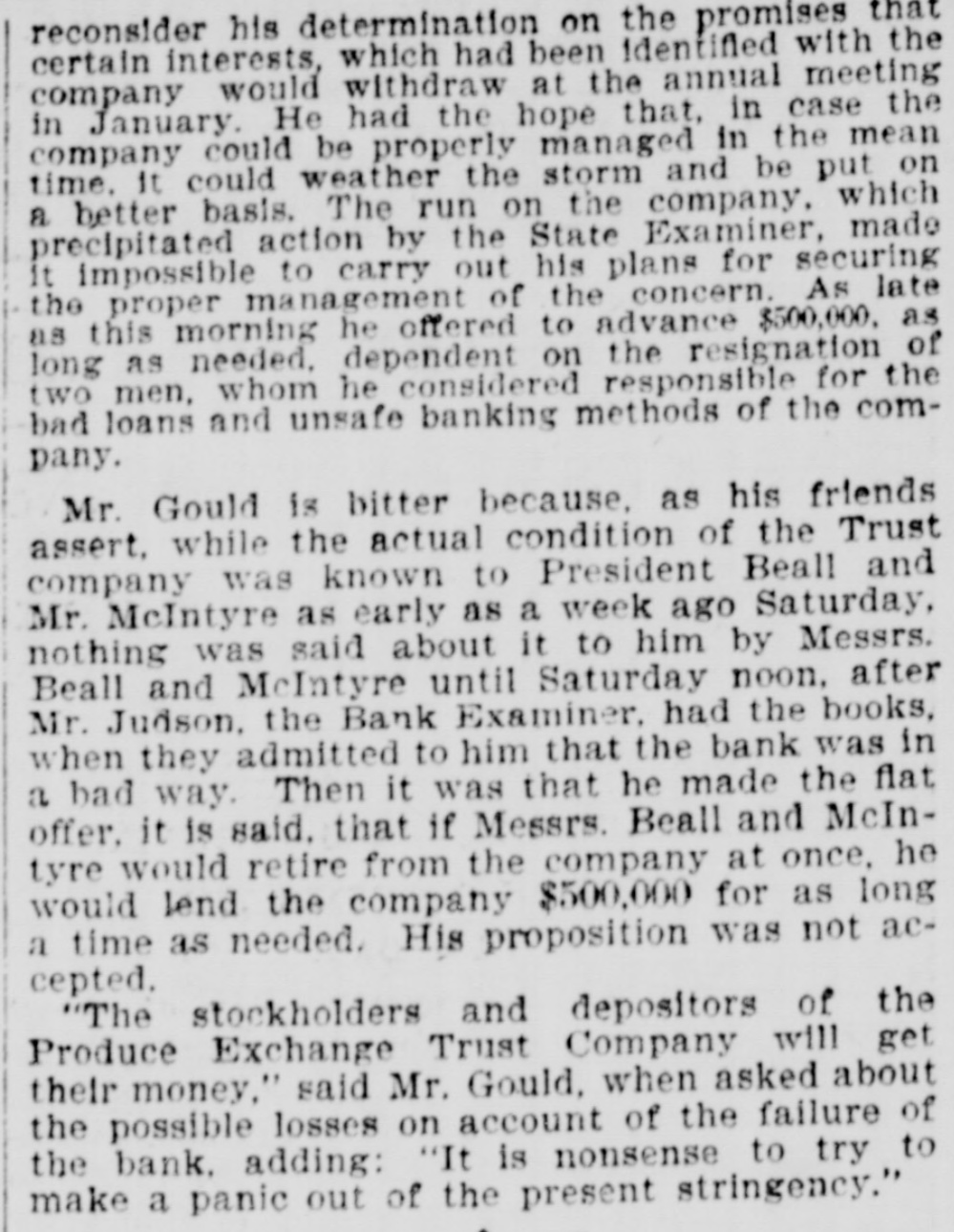
reconsider his determination on the promises that certain interests, which had been identified with the company would withdraw at the annual meeting in January. He had the hope that, in case the company could be properly managed in the mean time. It could weather the storm and be put on a better basis. The run on the company, which precipitated action by the State Examiner, made It impossible to carry out his plans for securing the proper management of the concern. As late as this morning he offered to advance $500,000. as long as needed. dependent on the resignation of two men, whom he considered responsible for the bad loans and unsafe banking methods of the company. Mr. Gould is bitter because, as his friends assert, while the actual condition of the Trust company was known to President Beall and Mr. McIntyre as early as a week ago Saturday, nothing was said about it to him by Messrs. Beall and McIntyre until Saturday noon, after Mr. Judson, the Bank Examiner. had the books, when they admitted to him that the bank was in a bad way. Then it was that he made the flat offer. it is said. that if Messrs. Beall and McIntyre would retire from the company at once, he would lend the company $500,000 for as long a time as needed. His proposition was not accepted. "The stockholders and depositors of the Produce Exchange Trust Company will get their money." said Mr. Gould, when asked about the possible losses on account of the failure of the bank. adding: "It is nonsense to try to make a panic out of the present stringency."


Article from The Salt Lake Herald, December 19, 1899

Click image to open full size in new tab

Article Text

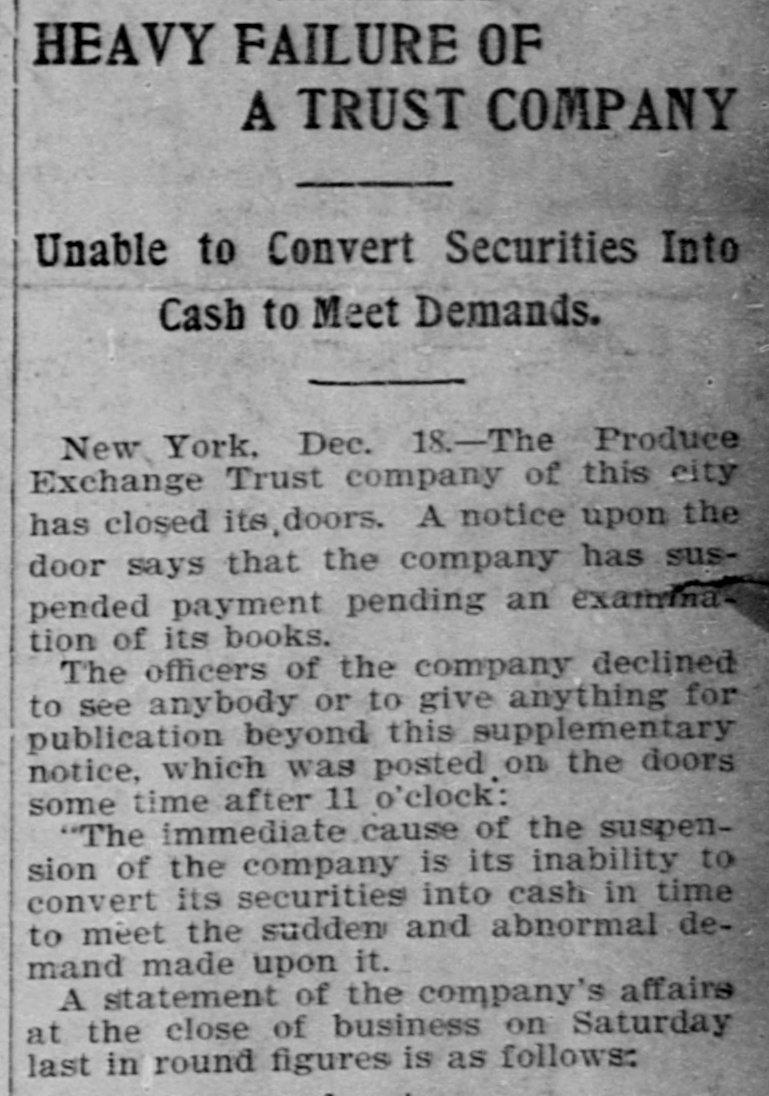
HEAVY FAILURE OF A TRUST COMPANY Unable to Convert Securities Into Cash to Meet Demands. New York, Dec. 18.-The Produce Exchange Trust company of this city has closed its, doors. A notice upon the door says that the company has suspended payment pending an examination of its books. The officers of the company declined to see anybody or to give anything for publication beyond this supplementary notice, which was posted on the doors some time after 11 o'clock: "The immediate cause of the suspension of the company is its inability to convert its securities into cash in time to meet the sudden and abnormal demand made upon it. A statement of the company's affairs at the close of business on Saturday last in round figures is as follows:


Article from Daily Kennebec Journal, December 19, 1899

Click image to open full size in new tab

Article Text

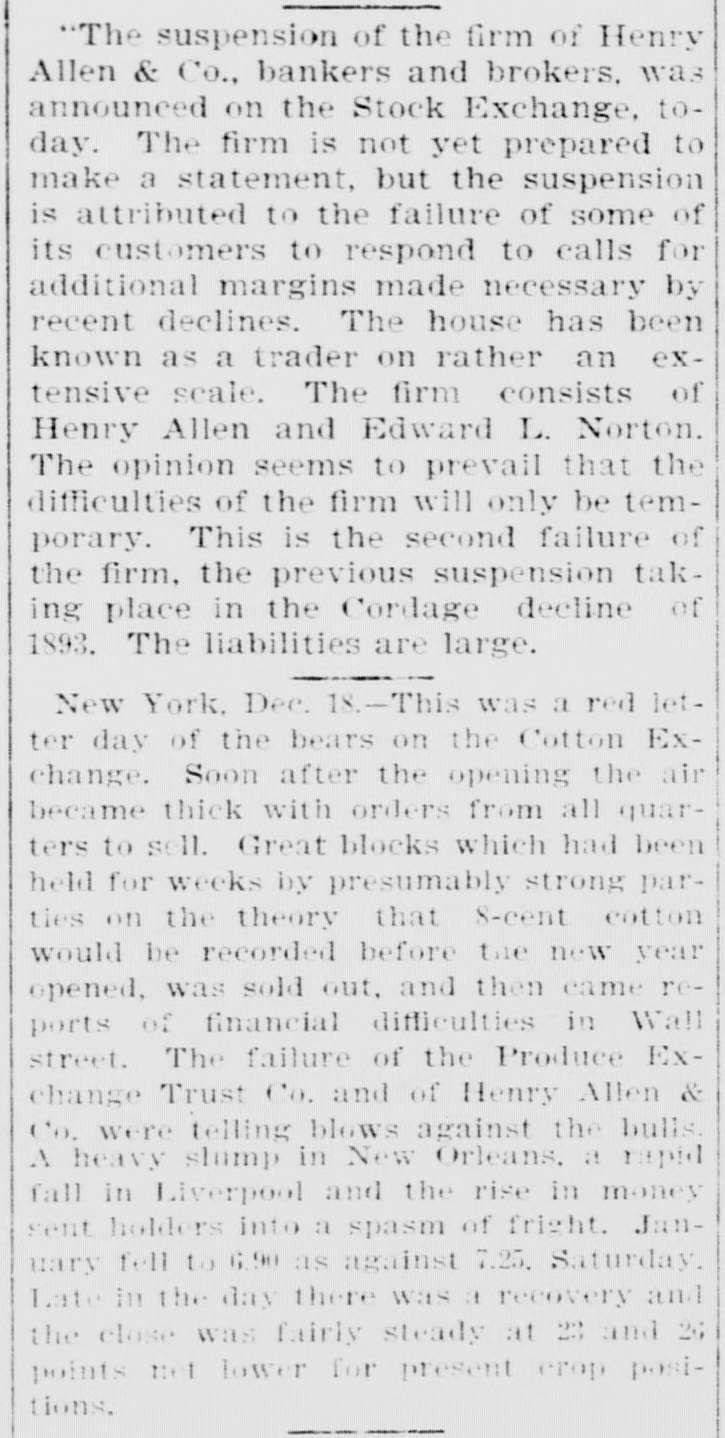
"The suspension of the firm of Henry Allen & Co., bankers and brokers, was announced on the Stock Exchange, today. The firm is not yet prepared to make a statement, but the suspension is attributed to the failure of some of its customers to respond to calls for additional margins made necessary by recent declines. The house has been known as a trader on rather an extensive scale. The firm consists of Henry Allen and Edward L. Norton. The opinion seems to prevail that the difficulties of the firm will only be temporary. This is the second failure of the firm, the previous suspension taking place in the Cordage decline of 1893. The liabilities are large. New York. Dec. 18.-This was a red letter day of the bears on the Cotton Exchange. Soon after the opening the air became thick with orders from all quarters to sell. Great blocks which had been held for weeks by presumably strong parties on the theory that 8-cent cotton would be recorded before the new year opened, was sold out, and then came reports of financial difficulties in Wall street. The failure of the Produce Exchange Trust Co. and of Henry Allen & Co. were telling blows against the bulls. A heavy slump in New Orleans, a rapid fall in Liverpool and the rise in money sent holders into a spasm of fright. January fell to 6.90 as against 7.25. Saturday. Late in the day there was :1 recovery and the close was fairly steady at 23 and 26 points net lower for present crop positions.


Article from The Madison Daily Leader, December 20, 1899

Click image to open full size in new tab

Article Text

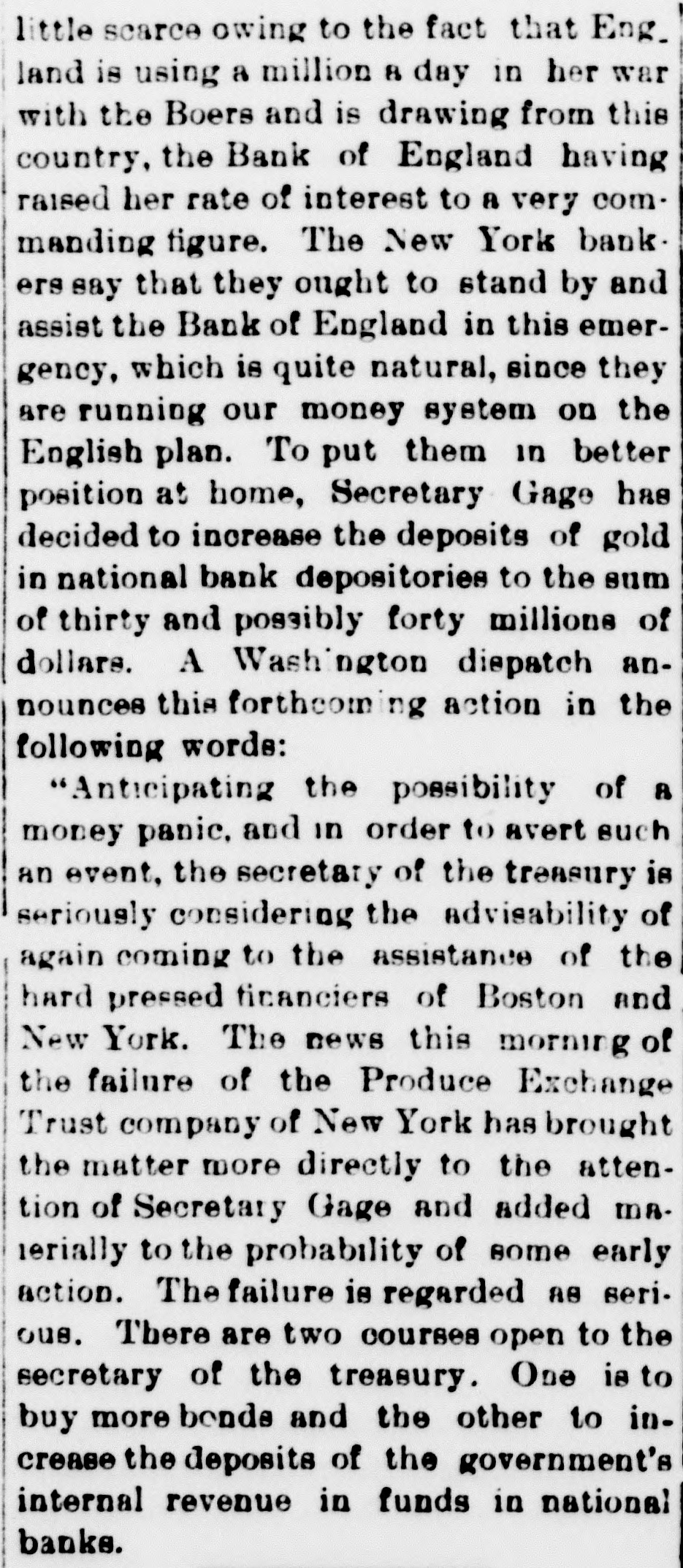
little scarce owing to the fact that Eng. land is using a million 8 day in her war with the Boers and is drawing from this country, the Bank of England having raised her rate of interest to a very commanding figure. The New York bank. ers say that they ought to stand by and assist the Bank of England in this emergency, which is quite natural, since they are running our money system on the English plan. To put them in better position at home, Secretary Gage has decided to increase the deposits of gold in national bank depositories to the sum of thirty and possibly forty millions of dollars. A Washington dispatch announces this forthcoming action in the following words: "Anticipating the possibility of a money panic, and in order to avert such an event, the secretary of the treasury is seriously considering the advisability of again coming to the assistance of the hard pressed financiers of Boston and New York. The news this morning of the failure of the Produce Exchange Trust company of New York has brought the matter more directly to the attention of Secretary Gage and added materially to the probability of some early action. The failure is regarded AS serious. There are two courses open to the secretary of the treasury. One is to buy more bonds and the other to increase the deposits of the government's internal revenue in funds in national banks.


Article from The News & Observer, December 21, 1899

Click image to open full size in new tab

Article Text

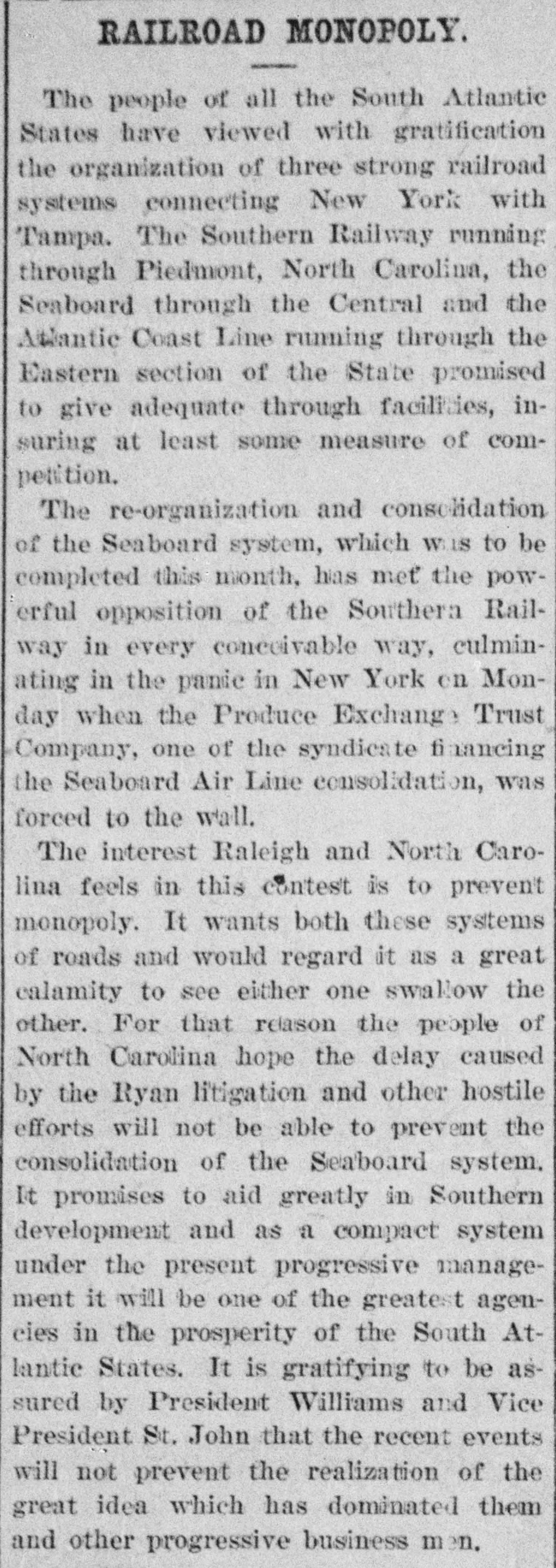
RAILROAD MONOPOLY. The people of all the South Atlantic States have viewed with gratification the organization of three strong railroad systems connecting New York with Tampa. The Southern Railway running through Piedmont, North Carolina, the Seaboard through the Central and the Atlantic Coast Line running through the Eastern section of the State promised to give adequate through facilities, insuring at least some measure of competition. The re-organization and consolidation of the Seaboard system, which W.I.S to be completed this month, has meΕ₯ the powerful opposition of the Southern Railway in every conceivable way, culminating in the panie in New York on Monday when the Produce Exchange Trust Company, one of the syndicate financing the Seaboard Air Line consolidation, was forced to the wall. The interest Raleigh and North Carolina feels in this contest is to prevent monopoly. It wants both these systems of roads and would regard it as a great calamity to see either one swallow the other. For that relason the people of North Carolina hope the delay caused by the Ryan litigation and other hostile efforts will not be able to prevent the consolidation of the Seaboard system. It promises to aid greatly in Southern development and as a compact system under the present progressive management it will be one of the greatest agencies in the prosperity of the South Atlantic States. It is gratifying to be assured by President Williams and Vice President St. John that the recent events will not prevent the realization of the great idea which has dominated them and other progressive business men.


Article from The Democratic Advocate, December 23, 1899

Click image to open full size in new tab

Article Text

WALL STREET EXCITED. Call Money Commanded 186 Per Cent-Beltimore Firms Go Under, &c. Monday, December 18, will long be remembered in Wall street, New York, as on that day the record in stock selling was the next highest ever known. The New York correspondent of the Philadelphia Ledger at the close of business Monday says: One bad failure was announced. that of the Product Exchange Trust Company, and one suspension, that of Henry Allen & Co. Loanable money was withdrawn from the Stock Exchange. Bids for loans advanced as high as 186 per cent. without attracting offers Loans were called right and left. Securities were thrown on the market in large blocks Prices broke with a violence, such as was witnessed only on the days of the Baring and 1893 panics and the memorable Venezuelan slump. At half-past 2 the situation looked grave, indeed, and Wall street men looked each other in the face anxiously and asked "When will this thing end At this point relief came, and the course of the panie was checked. J. Pierpont Morgan is generally credited with having initiated the relief measures. Besides throw. ing on the market a large sum of his own money, he called the attention of F. B. Tappen, the veteran President of the Gallatin National Bank and member of the Clearing House Committee. to the advisability of the banks taking steps to relieve the strain. Calling to his assistance J. Edward Simmons, President of the Fourth National Bank. ho was associated with him on the famous Loan Committee of 1891, Mr. Tappen, with his accustomed energy. undertook the task. The two bankers immediately called & meeting of bank Presidents In ten minutes about a dozen of the Presidents were is session, and it was instantly resolved to offer $8,000,000 to $10,000,000 in loans in the Stock Exchange. Nine banks agreed to form a pool. with a million dollars each, for this purpose. Mr. Frothingham, the well known loan broker, was intrusted with the mission of placing this money on the market. At twenty minutes to 3 be began to offer loans, starting at so per cent. and reducing the rate rapidly to6. The closing rate was 8 per cent. This action had the desired effect of checking the demoralization in the market, and prices closed generally with considerable recovery from the lowest quotations. Some of the Losses. An idea of the severity of losses may be gained from a few specifications. Thus, American Tobacco fell all extreme 21Β½, Metropolitan 20%, People's Gas 14, Sugar 1236, Continental Tobacco 113/6, Tennessee Coal 17, Manhattan 9 and Leather preferred 9% all in the list of Industrials. In the railroad list such stocks as New York Central, Great Northern preferred, Rock Island, Southern Pacific, the Union Pacifics, the Northern Pacifics, Atchison preferred, and, in fact, the most prominent and active railroad stocks in the whole list showed losses all the way from 4 to 9 points. The rallies, with the final offerings of the money rate down to 6 per cent., ran from S to 10 points. The day's transactions ran up to a total of nearly 1,650,000 shares, which is the record for & day's business. The excitement was intense all day. Seems to be a Bad Failure. The failure of the Produce Exchange Trust Company appears to be & bad one, although Thomas A. McIntrye, who has been its most active promoter. says that he is confident it can pay dollar for dollar, and that without much delay. But the statement made by Edwin Gould, the Vice President of the company, is not reassuring. Mr. Gould says that since his election as Vice President, on September 20, he made an examination, and found matters in connection with the concern for which he did not care to assume responsibility. He has found that large sums of money have been tied up in aiding the underwriting of certain industrial enterprises, until the amount so invested, together with what the company has agreed to furnish if called upon, equals nearly, if not quite, the combined amounts of the capital and surplus. This was written by Mr Gould to the Executive Committee on December 5. He said in addition that he felt that the condition of the company was such as to render the mangement subject to criticism unless radical changes were made. During the past few weeks there has been a heavy withdrawal of deposits, developing almost into a run. The company is one of the newer concerns, but had several well known persons connected with it. Its first President was Dr. James H. Parker, formerly President of the United States Bank, and a man of standing in the Street. He resigned last January because of dissatisfaction with its management. He objected to a concern having $1,000,000 capital loaning to one syndicate $3,000,000. After he left and as late as July, the capital was increased to $5,000,000. President Nash, of the Corn Exchange Bank, also resigned. and the death of A. T. Pouch, of Brooklyn, deprived the company of another powerful Director. Mr. Gould was only recently brought in-


Article from The Seattle Post-Intelligencer, December 28, 1899

Click image to open full size in new tab

Article Text

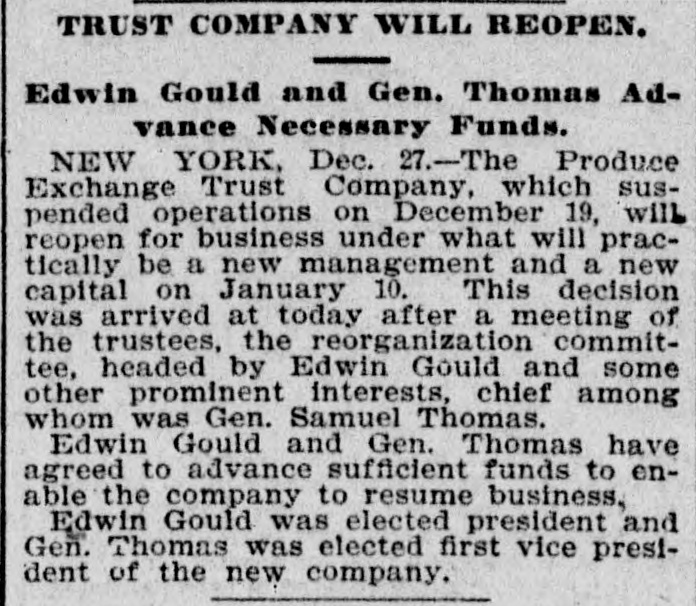
TRUST COMPANY WILL REOPEN. Edwin Gould and Gen. Thomas Advance Necessary Funds. NEW YORK, Dec. 27.-The Produce Exchange Trust Company, which suspended operations on December 19, will reopen for business under what will practically be a new management and a new capital on January 10. This decision was arrived at today after a meeting of the trustees, the reorganization committee, headed by Edwin Gould and some other prominent interests, chief among whom was Gen. Samuel Thomas. Edwin Gould and Gen. Thomas have agreed to advance sufficient funds to enable the company to resume business, Edwin Gould was elected president and Gen. Thomas was elected first vice president of the new company.


Article from The Fulton County News, December 28, 1899

Click image to open full size in new tab

Article Text

THE NEWS. James Dunne Taylor, of New York, come mitted suicide at tue Grafton Hotel, Washington. He cut his throat with a razor while temporarily Insane from illness. Comptroller Tracewell decided the claim of Swift & Co. for beef furnished to the army at Ponce to be just. Judge Parnell, in Raleigh, N. C., refused to grant an injunction to prevent the consolidation of the various lines of the Seaboard Air Line, and immediately after the consolidation was effected. The Eastern Furniture Manufacturers' Association met in Philadelphia, and decide d to advance prices ten per cent. on certain lines. Dr. Edward H. Williams, senior partner of the Baldwin Locomotive Works, Puiladelphia, died at Santa Barbara, Cal. Adjutant General Case, of Michigan, refused to comply with Governor Pingree's demand for his resignation. A seven-story apartment house, owned by Morris Mandelstein, in New York, was destroyed by fire. John Branch fell into a vat containing boiling water at the Shotwell Tannery, in Manchester, Virginia. F. M. Etheridge, a prominet lawyer at Dallas. Texas, killed Edwin O. Harrell, another lawyer. A strike began at the Park and Oxford collieries, near Scranton, Pa. Chairman Mark A. Hanna, of the National Committee, has Issued the formal call for the assembling of the National Republican Convention in Philadelphia on June 19th. Senator Hoar introduced a resolution defluing his interpretation of the American policy in reference to the Spanish Islands now under American dominion. Leading officers of the army have united In an appeal for funds with which to lift the mortgage on the home of the late General Lawton, in California. Chairman Burton, of House River and Harbor Committee, announces that there will be no river and harbor bill at this session of Congress. The Secretary of Agriculture has ordered quarantine against cattle affected with Southern fever. The President sent to the Senate the treaty negotiated by the powers at The Hague last summer. Mrs. Sanderson testified in her own defense in Marshall, Mich., denying the story that she fed ground glass to her husband. The main building of Buchtel College, in Akron, O., including all the laboratories, was destroyed by fire. The yellow fever hospital at Santiago was destroyed by a fire that was probably of incendiary origin. Samuel Gempers was unanimously reelected president of the American Federation of Labor. M.J. Meagher, an elephant trainer, was killed by an elephant at Sellersville, Ohio. President H. C. Simmons, of Fargo College, dropped dead in Fargo, N. D. The Masonic Temple in Richmond, Va., 8 handsome building, will, it is said, have to besold for debt. The Grand Lodge will likely become the purchaser. Dr. James L. Angell said that but for the Monroe Doctrine the European powers would be dividing up South America as they are partitioning China. The steamer City of Kansas was burned to the water's edge while lying at her wharf at New Madrid, Mo. The passengers had a narrow escape. The Federation of Labor decided to return to the system of assessing all members of trades unions for the purpose of aiding strikers. Dr. S. M. Jenkins, accused of malpractice, was killed in court by Hugh Wheat, the brother of an alleged victim. Fowllowing the news of the failure of the New York Produce Exchange Trust Company in New York, there was a wild panie on the New York Stock Exchange, money going up to 125 per cent. until the clearing-house came to the relief of the situation by lending ten millions at six per cent. The Pennsylvania Railroad's plan for pensioning aged employes will be put in effect January 1, 1900. There will be 950 employes retired and pensioned on that date. The committee of the National Republican Committee was well pleased with the Auditorium in Philadelphia, where the Republican Convention will be held. Henry Weller pleaded guilty of murder in the second degree in Somerset, Pa. The Broadway National Bank, of Boston, was so involved in the failure of the John P. Squire Company that it was obliged to close its doors. and the bank examiner was appointed receiver. There was a bad railroad wreck on the Northern Pacific near Lewiston, Idabo, in which two engineers were killed and other members of the train crews fatally injured. Mrs. Alice Throe morton was arrested in Richmond on the charge. preferred by her cousin. Mrs. Hill, of forgery. Mrs. Jacob Hendrickson, of Woodbury, N.J., received a letter from her sailor husband, whom she had mourned us dead. At Mooretield, W. Va., Lemuel Kohne was sentenced to life imprisonment for the murder of John Sager. Unrequieted love led Joseph Rinker, of Charleston, W. Va., to commit suicide at Middletown, Va. The debate in the House of Represe tatives on the Currency bill closed with dramatic incidents. Some of the Democrats themselves objected to unanimous consent to substitute a sixteen-to-que measure for the bill proposed y the Democrats. The Senate Committee on Privileges and Elections heard arguments for and against the seating of Senator Quay, of Pennsytvania. Fire caused n loss of $8,000 at the Washington Industrial Home School, on the Tennallytown road. No insurance. William Euclid Young, a member of the New York Stock Exchange, who was expelled, sued for $ 200,000 damages. Waleback barge No. 115, with a crew of nine men, went down in the storm on Lake Superior. Three small children of Samuel Reynolds, of Nicholasville, Ky., were burned to death. Mrs. Mary Smith, an aged widow, was burned to death at her home, near Hanover, Pa. Former Congressman James Nelson Pidcook died atbis home. in White House


Article from Rock Island Argus, December 28, 1899

Click image to open full size in new tab

Article Text

Will Reopen Jan. 10. New York. Dec. 28.-The Produce Exchange Trust company. which suspended on Dec. 19. will reopen for business under what will practically be new capital on Jan. 10 next,


Article from The News & Observer, December 29, 1899

Click image to open full size in new tab

Article Text

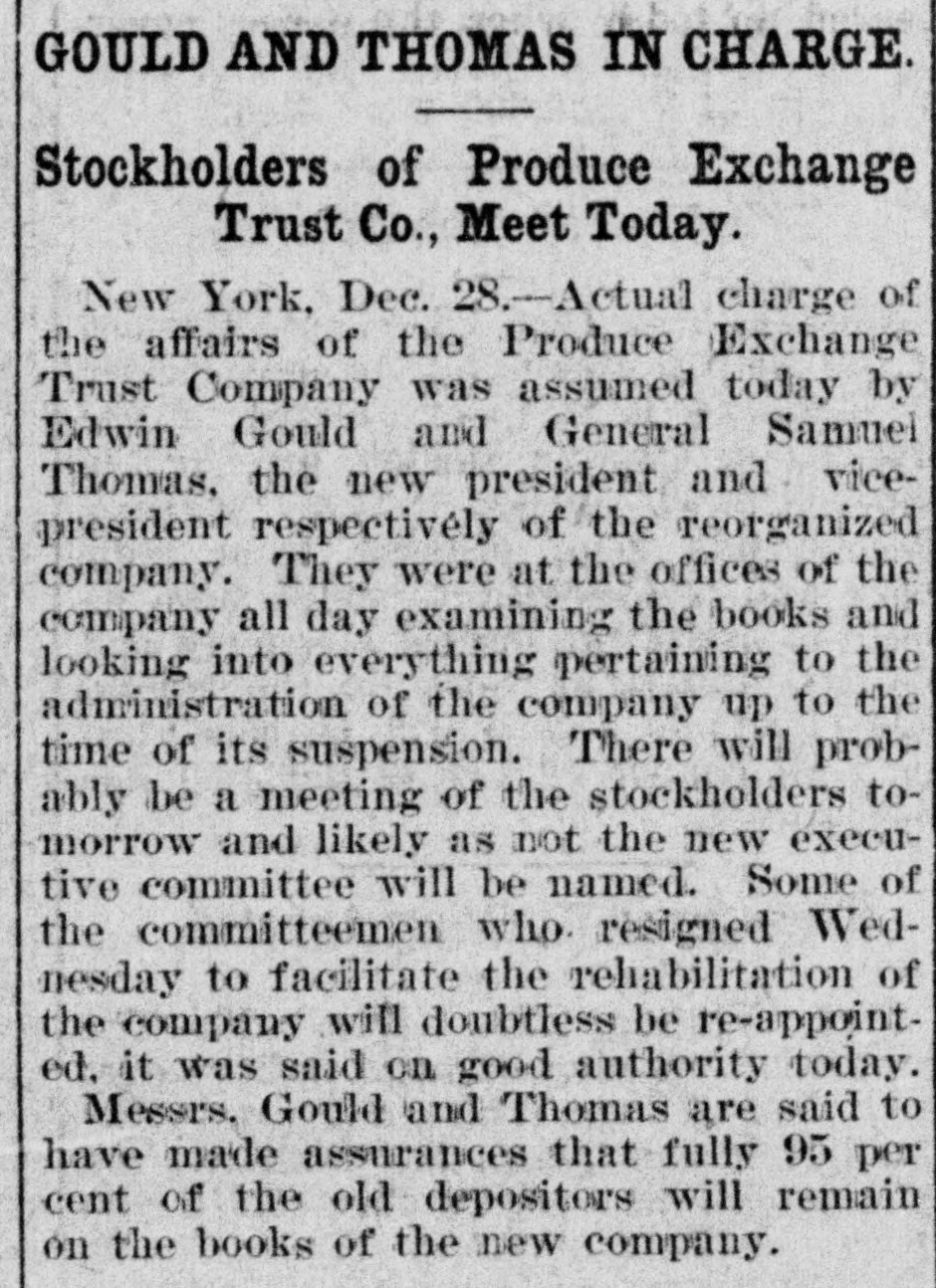
# GOULD AND THOMAS IN CHARGE. Stockholders of Produce Exchange Trust Co., Meet Today. New York, Dec. 28.-Actual charge of the affairs of the Produce Exchange Trust Company was assumed today by Edwin Gould and General Samuel Thomas, the new president and vice- president respectively of the reorganized company. They were at the offices of the company all day examining the books and looking into everything pertaining to the administration of the company up to the time of its suspension. There will prob- ably be a meeting of the stockholders to- morrow and likely as not the new execu- tive committee will be named. Some of the committeemen who resigned Wed- nesday to facilitate the rehabilitation of the company will doubtless be re-appoint- ed, it was said on good authority today. Messrs. Gould and Thomas are said to have made assurances that fully 95 per cent of the old depositors will remain on the books of the new company.


Article from Richmond Dispatch, December 29, 1899

Click image to open full size in new tab

Article Text

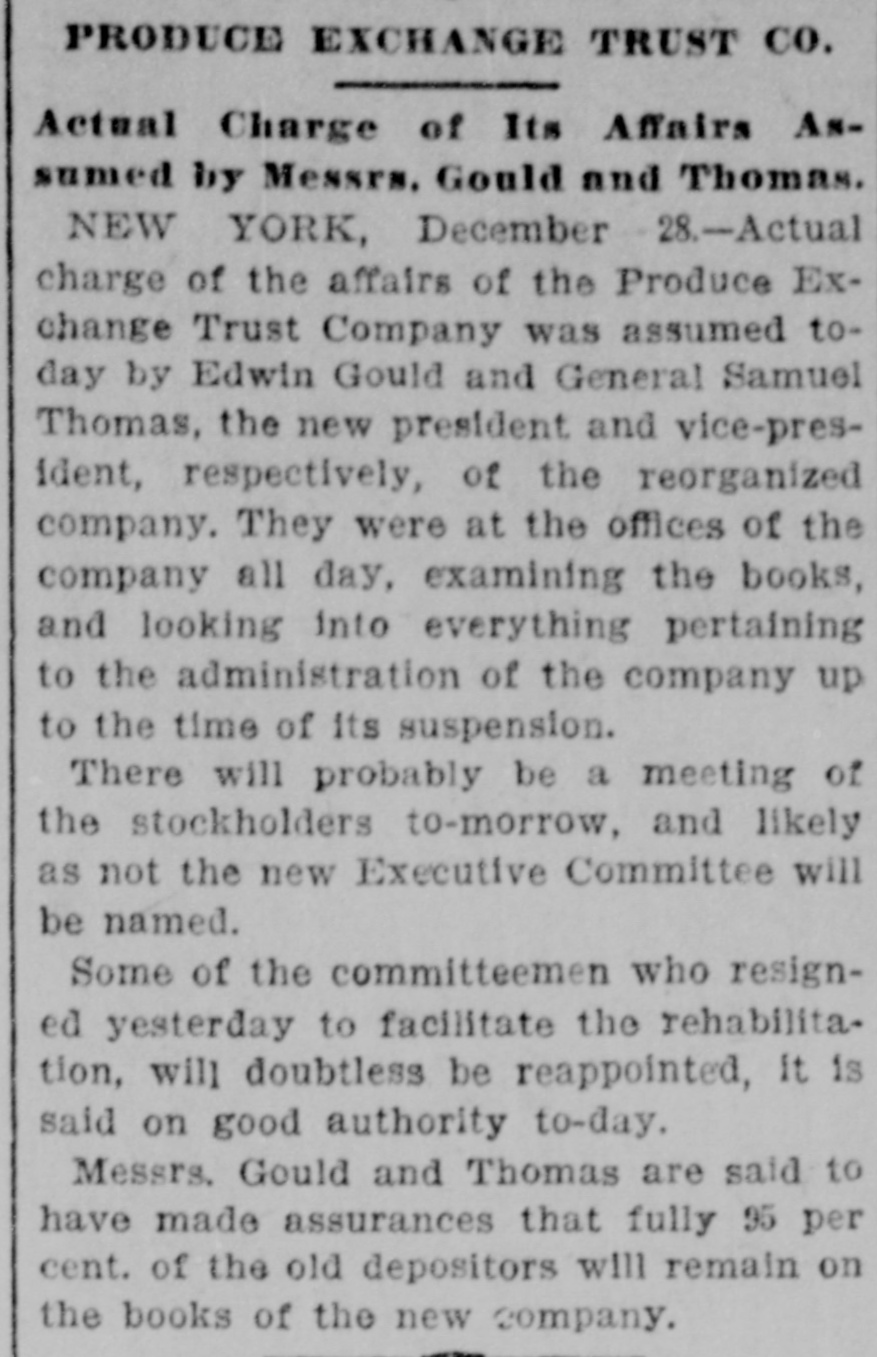
PRODUCE EXCHANGE TRUST CO. Actual Charge of Its Affairs Assumed by Messrs. Gould and Thomas. NEW YORK, December 28.-Actual charge of the affairs of the Produce Exchange Trust Company was assumed today by Edwin Gould and General Samuel Thomas, the new president and vice-president, respectively, of the reorganized company. They were at the offices of the company all day, examining the books, and looking into everything pertaining to the administration of the company up to the time of its suspension. There will probably be a meeting of the stockholders to-morrow, and likely as not the new Executive Committee will be named. Some of the committeemen who resigned yesterday to facilitate the rehabilitation, will doubtless be reappointed, It is said on good authority to-day. Messrs. Gould and Thomas are said to have made assurances that fully 95 per cent. of the old depositors will remain on the books of the new company.


Article from The News & Observer, December 30, 1899

Click image to open full size in new tab

Article Text

BALTIMOREANS PLEASED. New York Produce Exchange Trust and Seaboard Air Line. (Baltimore Sun.) Mr. J. William Middendorf and Mr. H. Irvine Keyser, the Baltimore directors in the New York Produce Exchange Trust Company, have returned from a meeting of the board held in New York on Wednesday. At this meeting it was decided to resume business, and the company will be prepared to pay its depositors on January 10. Mr. Edwin Gould was elected president to succeed Mr. J. Turner Beall, who retired, and Gem. Samuel Thomas was made vice-president. Mr. Middendorf said that the results of the meeting were entirely satisfactory and the relations of the company with the Seaboard Air Line consolidation will be continued in the same cordial way. President John Skelton Williams, of the Seaboard Air Line, who is also a director in the trust company, is also pleased with the action taken. Speaking of the recent development in Seaboard Air Line and Produce Exchange Trust Company matters, Mr. Wiliiams said: "The enemies of the Seaboard Air Line consolidation have tried to embarrass us by proving a connection between it and the suspension of the Produce Exchange Trust Company. The Seaboard plans have been quite independent of any developments that could arise or have arisen by reason of the trust company's suspension. My interest (im) the Produce Exchange Trust Company which led me to come here to attend the meeting yesterday, was because of my large personal interests as a shareholder, not because it had any relation to the status of the Seaboard consolidation." Asked regarding the recent statements of Thomas F. Ryan, Mr. Williams said: "The dispatch addressed to me he gave to the newspapers, but never sent it to me. What he says is misleading. and in due time I shall answer him. The various protests he is filling at our meetings' will accomplish nothing, for the consolidation plans have now got beyond the stage of legal protests."


Article from The Morning News, January 11, 1900

Click image to open full size in new tab

Article Text

Trust Company Opens Doors. New York, Jan. 10.-The Produce Exchange Trust Company, which suspended on Dec. 18, resumed business to-day, The company has been entirely reorganized, the old officers, including President T. A. Beall, and Vice President T. A. McIntyre, having all resigned. The places of Messrs. Beall and McIntyre are taken, by Edwin Gould and Gen. Samuel Thomas, respectively,


Article from The News & Observer, January 11, 1900

Click image to open full size in new tab

Article Text

Produce Trust Company Reopens New York, Jan. 10.-The Produce Exchange Trust Company which suspended on December 18th, resumed business today. The company has been entirely re-organized, the old officers, including President T. A. Beall, and Vice President T. A. McIntyre having all resigned. The places of Messrs. Beall and McIntyre are taken by Edwin Gould and General Thomas, respectively.