14373. Washington National Bank (Washington, NJ)

Bank Information

Episode Type
Suspension → Closure
Bank Type
national
Bank ID
5121
Charter Number
5121
Start Date
November 16, 1911
Location
Washington, New Jersey (40.759, -74.983)

Metadata

Model
gpt-5-mini
Short Digest
17ce3304

Response Measures

None

Receivership Details

Depositor recovery rate
66.3%
Date receivership started
1911-11-17
Date receivership terminated
1915-12-31
OCC cause of failure
Excessive lending
Share of assets assessed as good
29.7%
Share of assets assessed as doubtful
57.3%
Share of assets assessed as worthless
13.0%

Description

The bank suspended payment on November 16, 1911 and a federal receiver was appointed. Subsequent reporting documents embezzlement by President Robert M. Petty, his indictment and conviction; the bank remained in receivership and suits followed, indicating permanent closure rather than a reopening.

Events (7)

1. May 16, 1898 Chartered
Source
historical_nic
2. November 16, 1911 Suspension
Cause
Bank Specific Adverse Info
Cause Details
Bank suspended after discovery of misapplication/embezzlement of funds by its president Robert M. Petty; liabilities exceeded $286,000.
Newspaper Excerpt
The bank suspended payment on November 16, 1911, with liabilities declared to exceed $286,000.
Source
newspapers
3. November 17, 1911 Receivership
Source
historical_nic
4. November 18, 1911 Receivership
Newspaper Excerpt
The Comptroller of the Currency received word yesterday of the failure of the Washington National Bank of Washington, N. J. Examiner Richard Goodhart was in charge of the institution temporarily until the arrival of Milton C. Elliott who has been appointed receiver.
Source
newspapers
5. March 7, 1912 Other
Newspaper Excerpt
Through her attorneys ... Mrs. Myrtle A. Burdette has filed a bill in Chancery against Robert M. Petty, president of the insolvent Washington National Bank, and Philip Tillinghast, receiver of the institution. She seeks to recover a mortgage for $2,000 ... Receiver Tillinghast declared that money had been obtained on many notes on which there are no indorsements.
Source
newspapers
6. April 30, 1912 Other
Newspaper Excerpt
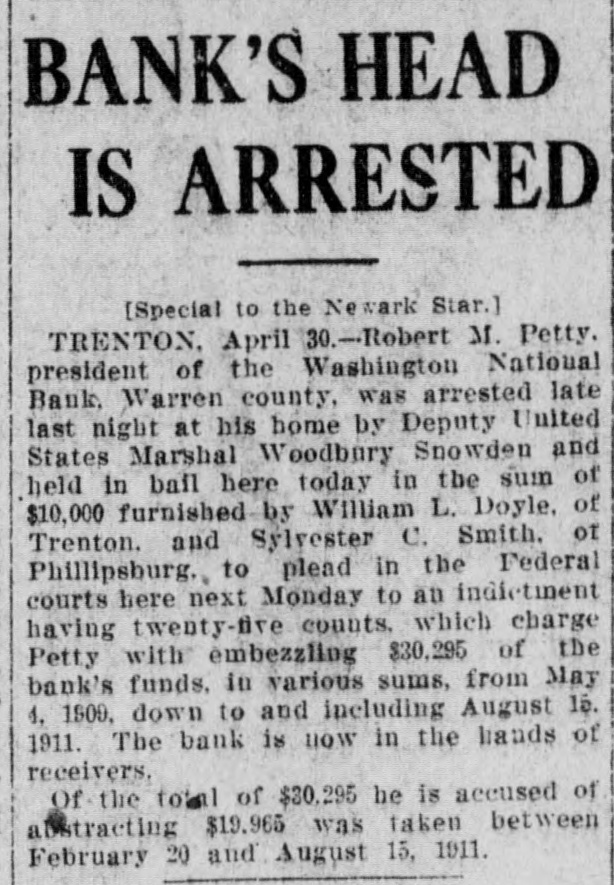
Robert M. Petty, president of the Washington National Bank ... was arrested ... on indictment having twenty-five counts which charge Petty with embezzling $30,295 of the bank's funds ... The bank is now in the hands of receivers.
Source
newspapers
7. May 26, 1913 Other
Newspaper Excerpt
Receiver Philip Tillinghast, of the Washington (N. J.) National Bank, brought suit in the United States District Court today for $133,000 against the directors, charging gross negligence ... in the management of the institution.
Source
newspapers

Newspaper Articles (7)

Article from The Washington Herald, November 18, 1911

Click image to open full size in new tab

Article Text

Bank Supervision Analyzed. Comptroller Murray has made an analysis of the reports received from the State bank supervisors, showing the cost of adfinistration of the banking departments of the various States, and has compared it with the cost of national bank examination and administration. The cost to the taxpayers of the various States for supervising the banks operated under State charters, amounts in the aggregate to nearly $286,000 annually, while the supervision of banks in the national system is without direct cost to the taxpayers of the country. Every expense connected with the supervision of national banks is paid by the banks. The cost of State bank supervision in forty-one States of the Union, aggregates $1,008,000. Reimbursements by the banks by means of fees for examination, and other special assessments to the extent of $722,000, leaves a deficiency of $286,000, to be met by the taxpayers of the States for administering their banking laws. In the forty-one States reporting there were 12,648 State banks, savings banks, and loan and trust companies, with assets of $10,427,000,000, under State supervision. For the same period there were 7,277 national banking associations, with aggregate assets of $10,383,000,000. The Comptroller recently requested the superintendents of the banking departments of the different States to furnish information showing the cost of administration of their departments, including the examination of State banks. A reply was received from every State having a banking department or an officer charged with the supervision of banks. Statements received from forty-one States show the aggregate cost of bank supervision for these States to be $1,008,374 for the last fiscal year. The number of banks under State supervision, excluding all private banks, was 12,648, with aggregate resources of approximately $10,427,000,000. The number of examinations of State banks made during the fiscal year numbered 22,001. The cost of examinations alone, for the States in question, was $697,220, or 67 cents for each $1,000 of assets. For the same period there were 7,277 national banks in operation, with assets aggregating $10,383, 000,000, the cost of examination of which was $492,269, or 47 cents per $1,000 of assets. Examiners in the States from which reports have been receivel, number 224. The average salary or compensation paid examiners in these States will approximate $2,300, exclusive of expenses. Traveling expenses for each examiner averages about $800 per annum. The average compensation for each national bank examiner, paid in fees, is $4,356 per annum, out of which all his expenses such as traveling, hotels, clerical hire, &c., must be paid. From the data obtained, it appears that during the fiscal year, 22,001 examinations of State banks were made at a cost of $31.69 for each examination. The avercost of examination of each national banking association is $41.10, but th eamount of assets handled by a national bank examiner, is about double the average for each State bank examiner. National Bank Fails. The Comptroller of the Currency received word yesterday of the failure of the Washington National Bank of Washington, N. J. Examiner Richard Goodhart was in charge of the institution temporarily until the arrival of Milton C. Elliott who has been appointed receiver. The bank had a capitalization of $50,000. Its resources on September 1 were approximately $400,000. Comptroller Murray refuses to divulge the reason for the insolvency, preferring to await the report of the receiver. Plan Bank Clerks' Banquet. At a meeting of the committee on arrangements for the annual dinner of the Washington Chapter, American Institute of Banking, in the chapter rooms, 1214 F street, last night, February 10 was selected as the date for the affair, which will be given at the Raleigh Hotel. The following chairmen of subcommittees were appointed: Seating, C. C. Eckloff; music, W. H. Childs, and printing, A. S. Carter. Refuses Merchants' Request. The Capital Traction Company yesterday refused the request of a committee of the Retail Merchants' Association of the Chamber of Commerce that the company permit the placarding of their cars with "early shopping" signs between now and Christmas. The refusal came after the Washington Railway and Electric Company had granted the request of the subcommittee, composed of A. D. Prince and M. A. Leese. Mr. Carll, general manager of the company, stated that his company desired to limit the advertising on the fronts of its cars to baseball and football games. Will Redeem Bonds. Postmaster General Hitchcock, as chairman of the board of trustees of the postal savings system, yesterday authorized the statement that postal savings bonds offered for sale by persons compelled to relinquish their investment will be purchased by the government at par. The Postmaster General stated that no depositor would endanger his principal by exchanging certificates of deposit for postal savings bonds. Under the postal savings act the board of trustees is authorized to withdraw at any time 30 per cent of all postal savings funds on deposit in banks and post-offices for investment in bonds or other securities of the United States. It is under this authority that postal savings bonds will be purchased from the holders. New Provident Officers. New officers and directors were elected at a special meeting of the stockholders the Provident Savings Bank vester-
Article from The Washington Herald, November 18, 1911

Click image to open full size in new tab

Article Text

National Bank Fails. The Comptroller of the Currency received word yesterday of the failure of the Washington National Bank of Washington, N. J. Examiner Richard Goodhart was in charge of the institution temporarily until the arrival of Milton C. Elliott who has been appointed receiver. The bank had a capitalization of $50,000. Its resources on September 1 were approximately $400,000. Comptroller Murray refuses to divulge the reason for the insolvency, preferring to await the report of the receiver.


Article from Newark Evening Star and Newark Advertiser, March 7, 1912

Click image to open full size in new tab

Article Text

SUES INSOLVENT BANK'S PRESIDENT Mrs. Burdette Wants Mortgage She Says She Gave Wash= ington (N. J.) Bank. WASHINGTON, N. J., March 7.Through her attorneys, Payne & McCall, of Newark, Mrs. Myrtle A. Burdette has filed a bill in Chancery against Robert M. Petty, president of the insolvent Washington National Bank, and Philip Tillinghast, receiver of the institution. She seeks to recover a mortgage for $2,000 which she alleges she gave Petty under date of February 6, 1911. The mortgage is on a property located in Rockaway, Morris county. Another echo of the bank failure was heard today when Receiver Tillinghast declared that money had been obtained on many notes on which there are no indorsements. There are also some notes bearing Petty's signature.


Article from Newark Evening Star and Newark Advertiser, April 30, 1912

Click image to open full size in new tab

Article Text

BANK'S HEAD IS ARRESTED [Special to the Newark Star.) TRENTON, April 30. -Robert M. Petty. president of the Washington National Bank, Warren county, was arrested late last night at his home by Deputy United States Marshal Woodbury Snowden and held in ball here today in the sun of $10,000 furnished by William L. Doyle, of Trenton. and Sylyester C. Smith. of Phillipsburg., to plead in the Federal courts here next Monday to all indictment having twenty-tive counts. which charge Petty with embezzling $30,295 of the bank's funds. in various sums, from May 4. 1909, down to and including August 16. 1911. The bank is now in the hands of receivers. Of the total of $30.295 he is accused of abstracting $19,965 was taken between February 20 and August 15, 1911.


Article from The Guthrie Daily Leader, May 4, 1912

Click image to open full size in new tab

Article Text

# ANOTHER BANK # PRESIDENT IS # FOUND SHORT Trenton, N. J., May 4-Robert M. Petty, president of the Washington National bank at Washington, this state, indicted by the federal grand jury for misapplying 30,295 of the funds of the institution, was arrested last night by Deputy Marshal Snowden, of the department of justice. He was arraigned here today before Federal Commissioner Cranmer and released in $10,000 bail. Twenty-five counts were found against Petty, each naming a specified sum. The alleged speculations started on May 4, 1909, and were continued, it is claimed, until August 15, 1911. The Washington bank is now in the hands of a receiver. Petty has served Washington as mayor and is now said to be a candidate for the postmastership of the place.


Article from Newark Evening Star and Newark Advertiser, April 18, 1913

Click image to open full size in new tab

Article Text

250-YEAR TERM MAY BE SENTENCE GIVEN R. M. PETTY . Is President of Defunct Bank Found Guilty on Twenty= five Counts. EACH CHARGE CARRIES MAXIMUM OF 10 YEARS Court May "Bunch" Indictments and Impose Minimum of Five Years. "Guilty!" That was the verdict returned by the jury last night after deliberating for six hours and 28 minutes on the fate of Robert M. Petty, former bank president and railroad magnate of Washington, charged with misapplication of bank funds. Twenty-five times Federal Court Clerk Benjamin Havens, of Trenton, asked Foreman Frank E. Davenport for the jury's verdict, once for each count in the indictment. Twenty-five times Foreman Frank E. Davenport answered "Guilty! Each reply was like a knife thrust to the prisoner. He sat crouched up in a heap in a front chair in the court-room, after the verdict, disappointment written in every feature. The maximum penalty for the crime of which he was found guilty is ten ofyears' imprisonment for each fense. a Thus, if Judge Relstab takes notion to impose the maximum penalty, Petty will be sentenced to 250 years in the new Atlanta penitentiary. The minimum penalty is five years. In passing sentence on the prisoner it is probable that the indictment will be considered as a whole and not by the individual counts. Looked Like Disagreement. in When the jury did not return five hours it began to look like a disagreement. Each moment after that counted for the prisoner, his friends told him. when He was hoping for the best the jury filed in. With a throbbing heart he listened to *preliminary questions from Clerk Havens, who received the jury in the absence of Judge Relstab. "What is your verdict on the first count?" asked the clerk. There was a moment's pause. Deep silence pervaded the court. Every eye was fixed or. Foreman Davenport. His face was expressionless He opened his mouth convulsively, almost mechanically, it seemed, and just breathed the word "Guilty!" A deep sigh was heard from Petty His huge form seemed fo quiver from head to foot. His adopted son was at his side and tried to comfort him. Clerk Havens repeated the question 25 times. At each answer Petty's head sank lower and lower on his breast. It was all over. The end had come, but not as he had expected. There was not even a recommendation of mercy from the jury. It was a great victory for Assistant United States District Attorney Walter H. Bacon. Totters to Clerk's Desk. After the jury had been dismissed with the instructions to report on up April 29, Petty dragged himself to Clerk Haven's desk. He asked when an appeal could be made and when sentence would be imposed. . In a sympathetic tone the clerk told Petty that he could not appeal the case until October in Philadelphia. Attorney Sylvester Smith, Petty's counsel. had arranged with Attorney Bacon to have Petty sentenced on April 28. This arrangement was made shortly after the jury had filed out. Petty was taken to the Essex County jail by Deputy United States Marshal Louis G. Beekman. pending his sentence to the Federal penitentiary at Atlanta, Ga. Petty was arrested on April 29, 1912. on a charge of misapplication of the funds of the Washington National Bank, of which he was president. The specific complaint charged him with appropriating $30,295 of the funds of the Northampton, Easton and Washington Traction Company and applying the amount to his credit in his own bank. Had Been Under $10,000 Ball. ar After his arrest. Petty was raigned before United States Commissioner George T. Cramer at Trenton and released in $10,000 bail, furnished by Attorney Smith, his counsel. and William L. Doyle. Petty, the Government claimed in the first 11 counts against him, transferred from the traction company's account to his own account in his bank $11,300 without authority him The other 14 counts charged with selling 24 traction company bonds to the bank for $18,995, title the bonds being in the company's name. Petty was president of the traction company and was also one of its incorporators: He was also inter ested in the Washington Piano Company, Oxford Iron and Steel Company and the Warren County Tidings. The bank suspended payment on November 16, 1911, with liabilities declared to exceed $286,000. Philip Tillinghast was appointed United States receiver or the bank. CAPTURE MEN AS THEY TRV PLODE BOMB


Article from Newark Evening Star and Newark Advertiser, May 26, 1913

Click image to open full size in new tab

Article Text

LOOTED WASHINGTON BANK RECEIVER STARTS SUIT [From a Staff Correspondent.] TRENTON. N. J., May 26.-Receiver Philip Tillinghast, of the Washington (N. J.) National Bank, brought suit in the United States District Court today for $133,000 against the directors, charging gross negligence on their part in their dealings with Robert M. Petty in the management of the institution.