Bankers Capital Corporation (New York, NY)

Episode Information

Episode UID
1434734791559
Episode Type
Suspension โ†’ Closure
Bank Type
trust
Bank ID
143473479 hash
Start Date
November 4, 1929
Location
New York, New York (40.714, -74.006)

Metadata

Model
gpt-5-mini (chosen from majority vote of a three-model LLM ensemble)
Short Digest
615cff2a7fac8216

Response Measures

None

Events (3)

1. November 4, 1929 Suspension
Cause
Government Action
Cause Details
Petition for receivership filed in federal court leading to receivership proceedings.
Newspaper Excerpt
The collapse of security prices last week was the reason given in a petition for a receivership filed in Federal Court yesterday against the Bankers' Capital Corporation, a Wall Street investment trust company.
Source
newspapers
2. November 16, 1929 Other
Newspaper Excerpt
The Irving Trust Co., receivers, announced yesterday that examination of the corporation's books revealed a deficit of more than $600,000.
Source
newspapers
3. November 17, 1929 Other
Newspaper Excerpt
United States Attorney Charles H. Tuttle announced he would go before the grand jury ... in his investigation of the defunct Bankers' Capital Corporation and its affiliated concerns.
Source
newspapers

Newspaper Articles (6)

Article from Evening Star, November 5, 1929

Click image to open full size in new tab

Article Text

TRADING IN STOCK MARKET CURTAILED Operators Consider Yesterday's Session Normal After Hysterical Selling Orgy. By"the Associated Press. NEW YORK, November 5.-The stock market was closed today because of the election,after an isolated session in which prices showed a net decline of 2 to 17 points on a turnover of 6,202,930 shares. The rally which was expected when the market opened yesterday after a two-day selling holiday failed to develop and in its place appeared selling pressure, which was the dominant note throughout an orderly session. The volume of trade and range of prices was regarded by operators as normal, contrasted with behavior of the market last week, when after a wild selling stampede on Tuesday in which 16,140,030 shares were dumped, the market came back sharply in a 3-hour session Thursday with gains up to 36 points and a total of 7,149,390 shares. Curtailed Sessions. For the first day since October 24, the beginning of the big slump. the ticker was able to keep close to the market. It closed 30 minutes after the last sale. Curtailed sessions from 10 a.m. to 1 p.m. tomorrow, Thursday and Friday, with complete suspension of business Saturday, has been ordered by the board of governors of the Stock Exchange and officials of the Curb Exchange in a further effort to permit brokerage houses to catch up with the bookkeeping entailed by the tremendous volume of trade last week. It was found that the two-day holiday over the week end had not afforded sufficient time for overworked staffs to complete their tasks. The collapse of security prices last week was the reason given in a petition for a receivership filed in Federal Court yesterday against the Bankers' Capital Corporation, a Wall Street investment trust company. Two brokerage houses were suspended by the Curb Exchange last week for failure to meet their obligations as a result of the decline in security prices. Reasons Given for Drop. Various reasons were ascribed to the sag in prices, which contradicted forecasts of an advancing market, predicted largely on statements that a large volume of buying orders had accumulated over the week end, and on favorable financial news. The sale of stock bought for supparting purposes Auring the decline, profit taking by traders who bought for a turn when prices were falling, selling by shorts who expected the best prices at the opening, and the closing out of weak margin accounts were some of the factors mentioned to explain the downward trend.

Article from The Bismarck Tribune, November 5, 1929

Click image to open full size in new tab

Article Text

STOCK PRICES SHOW NET DECLINE OF 2 TO 17 POINTS PER SHARE Selling Pressure Dominant Note in a Market Expected to Show Good Rally New York. Nov. 5.-(P)-The stock market was closed today because of the election after an isolated session in which prices showed a net decline of 2 to 17 points on a turnover of 6,202,930 shares. The rally which was expected when the market opened yesterday after a two-day selling holiday failed to develop and in its place appeared selling pressure which was the dominant note throughout an orderly session. The volume of trade and range of prices was regarded by operators as normal contrasted with behavior of the market last week, when after a wild selling stampede on Tuesday in which 16,140,030 shares were dumped, the market came back sharply in a three-hour session Thursday with gains up to 36 points and a total of 7,149,390 shares. For the first day since Oct. 24, the beginning of the big slump, the ticker was able to keep close to the market. It closed 30 minutes after the last sale. Curtailed sessions from 10 a. m. to 1 p. m. tomorrow, Thursday and Friday, with complete suspension of business Saturday has been ordered by the board of governors of the stock exchange and officials of the curb exchange in a further effort to permit brokerage houses to catch up with the bookkeeping entailed by the tremendous volume of trade last week. The collapse of Security prices last week was the reason given in a petition for a receivership filed in federal court yesterday against the Bankers' Capital corporation. a Wall street investment trust company. Various reasons were ascribed to the sag in prices. The sale of stock bought for supporting purposes during the decline: profit taking by traders who bought for a turn when prices were falling: selling by shorts who expected the best prices at the opening, and the closing out of weak margin accounts were some of the factors mentioned to explain the downward trend


Article from New Britain Herald, November 5, 1929

Click image to open full size in new tab

Article Text

MARKET RESTS AS ELECTIONS ARE ON (Continued From First Page) utes after the last sale. Curtailed sessions from 10 a. 111. to 1 p. m. tomorrow. Thursday and Friday with complete suspension of business Saturday has been ordered by the board of governors of the stock exchange and officials of the curb exchange in a further effort to permit brokerage houses to catch up with the bookkeeping entailed by the tremendous volume of trade last week It was found that the two-day holiday over the weekend had not afforded sufficient time for overworked staffs to complete their tasks. Bankers Capital in Trouble The collapse of security prices last week was the reason given in a petition for a receivership filed in federal court yesterday against the Bankers' Capital corporation, a Wall street investment trust company. Two brokerage houses were suspended by the curb exchange last week for failure to meet their obligations as a result of the decline in security prices. Various reasons were ascribed to the sag in prices which contradicted forecasts of an advancing market. predicted largely on statements that a large volume of buying orders had accumulated over the week-end, and on favorable financial news. The sale of stock bought for supporting purposes during the decline; profit-taking by traders who bought for a turn when prices were falling: selling by shorts who expected the best prices at the opening. and the closing out of weak margin accounts were some of the factors mentioned to explain the downward trend.

Article from The Indianapolis Times, November 7, 1929

Click image to open full size in new tab

Article Text

FAILURES FEW ON WALL ST., DESPITE CRASH Recent Stocks Tumble Has but Little Effect on Business Conditions. By United Press NEW YORK, Nov. 7.-Financial and commercial failures have been absent largely following the recent record break in stock values as contrasted with developments following other notable Wall Street collapses. Failure of only three small financial institutions can be attributed directly to the record break in prices. In the 1873 crash, there were seventy failures of brokerage institutions and an unlimited number of commercial failures. In the 1893 panic, thirteen stock exchange houses and more than 15,000 commercial institutions closed their doors. The 1907 panic left a number of concerns defunct and hastened the formation of the federal reserve system, which has been given credit for lessening similar credit difficulties in the past years. Recent Drop On Exchange The recent drop on the Stock Exchange has had comparatively little effect on general business or credit conditions, a remarkable development in view of the effect that past stock exchange crises have had on business conditions. The only concrete evidence of distress has been the failure of two small New York Curb Exchange houses, Lonch & Co. and J. J. Bell & Co. while the Bankers' Capital Corporation, an investment trust, went into the hands of receivers. There have been no failures or New York Stock Exchange houses. The recent break in prices has been attributed only to overspeculation in stocks, while earlier breaks resulted from greatly strained credit conditions. In 1907, call money rose to 125 per cent and was scarce at that figure as many banks suspended payments. There also were numerous stock exchange failures, a necessary adjunct to panic conditions. Worst Break In History The collapse of 1907 was accompanied, like that of 1893, by hoarding of money throughout the country, as a result of which bank reserves were reduced to unworkable proportions. Such is not the situation at the present time. # The worst collapse in the country's history was the one of 1873, which reached its climax with the memorable "Black Friday." That had been gathering for more than five years, but the first rumbling was not felt until April, 1873. The stock market moved uneasily and four failures occurred. On April 26, the Atlantic bank failed, but speculation continued. The collapse of the Gould and Fiske Gold corner, which also involved President Grant, caused chaos. In addition to the seventy stock exchange and numerous bank failures, business suffered for many years.


Article from Evening Star, November 17, 1929

Click image to open full size in new tab

Article Text

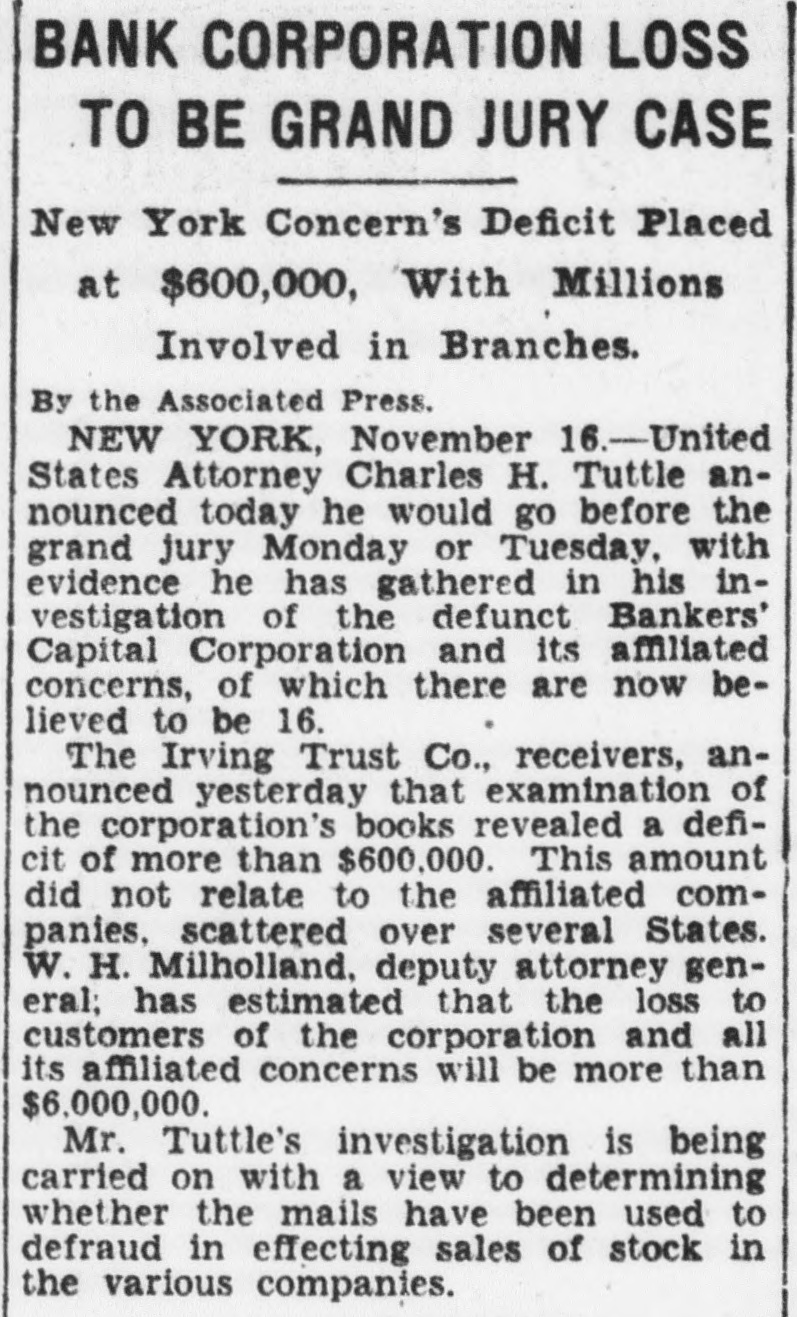
BANK CORPORATION LOSS TO BE GRAND JURY CASE New York Concern's Deficit Placed at $600,000, With Millions Involved in Branches. By the Associated Press. NEW YORK, November 16.-United States Attorney Charles H. Tuttle announced today he would go before the grand jury Monday or Tuesday, with evidence he has gathered in his investigation of the defunct Bankers' Capital Corporation and its affiliated concerns, of which there are now believed to be 16. The Irving Trust Co., receivers, announced yesterday that examination of the corporation's books revealed a deficit of more than $600,000. This amount did not relate to the affiliated companies, scattered over several States. W. H. Milholland, deputy attorney general; has estimated that the loss to customers of the corporation and all its affiliated concerns will be more than $6,000,000. Mr. Tuttle's investigation is being carried on with a view to determining whether the mails have been used to defraud in effecting sales of stock in the various companies.


Article from Evening Star, November 17, 1929

Click image to open full size in new tab

Article Text

Co., receivers, announced yesterday. This amount does not relate to the other 12 companies affiliated with the defunct New York concern. W. H. Milholland, deputy attorney general, has estimated that loss to customers of all 13 of the "circle companies" will amount to between $6,000,000 and $10,000,000. Milholland is investigating the Bankers' Capital Corporation for fraud and stock security sales for the State Bureau of Securities. Col. D. W. MacCormack, chief of the receivership department of the Irving Trust Co., disclosed that the chief assets of the Bankers' Capital Corporation consists of $1,850,592 in the form of call loans placed with related companies. Its chief liability is $2,429,374, owed to