14346. Ocean Bank (New York, NY)

Bank Information

Episode Type
Suspension โ†’ Closure
Bank Type
state
Start Date
June 1, 1869*
Location
New York, New York (40.714, -74.006)

Metadata

Model
gpt-5-mini
Short Digest
0cc5be4160abc536

Response Measures

None

Description

Articles (1875 and later) refer to the Ocean Bank of New York as a broken or failed institution with a receiver (Theodore N. Davis/Receiver of the Ocean Bank). They describe a major burglary in June 1869 and extensive internal defalcations by officers/directors that left the bank in the hands of a receiver. There is no description of a depositor run in these items; instead the bank is already in receivership and treated as failed. Dates: robbery occurred June 1869 (explicit in articles); receiver and civil suits reported in 1875. Bank type not specified in the texts, so set to unknown.

Events (3)

1. June 1, 1869* Other
Newspaper Excerpt
the burglars obtained $450,000 ... taken from the bank by burglars in June, 1869
Source
newspapers
2. October 22, 1875 Receivership
Newspaper Excerpt
civil suit brought by Sam. C. Archer against Theodore Davis, receiver of the Ocean Bank ... to recover $10,000 in United States bonds in the bank when robbed in 1869
Source
newspapers
3. * Suspension
Cause
Bank Specific Adverse Info
Cause Details
Large burglary in June 1869 (โ‰ˆ$450,000) combined with alleged internal malfeasance/defalcation by officers and directors (discounting fictitious securities) leading to insolvency and receivership.
Newspaper Excerpt
Receiver of the broken Ocean Bank, of New York, to recover the value of $10,000 of United States bonds ... Theodore N. Davis, receiver of the Ocean Bank
Source
newspapers

Newspaper Articles (9)

Article from The Cincinnati Daily Star, October 22, 1875

Click image to open full size in new tab

Article Text

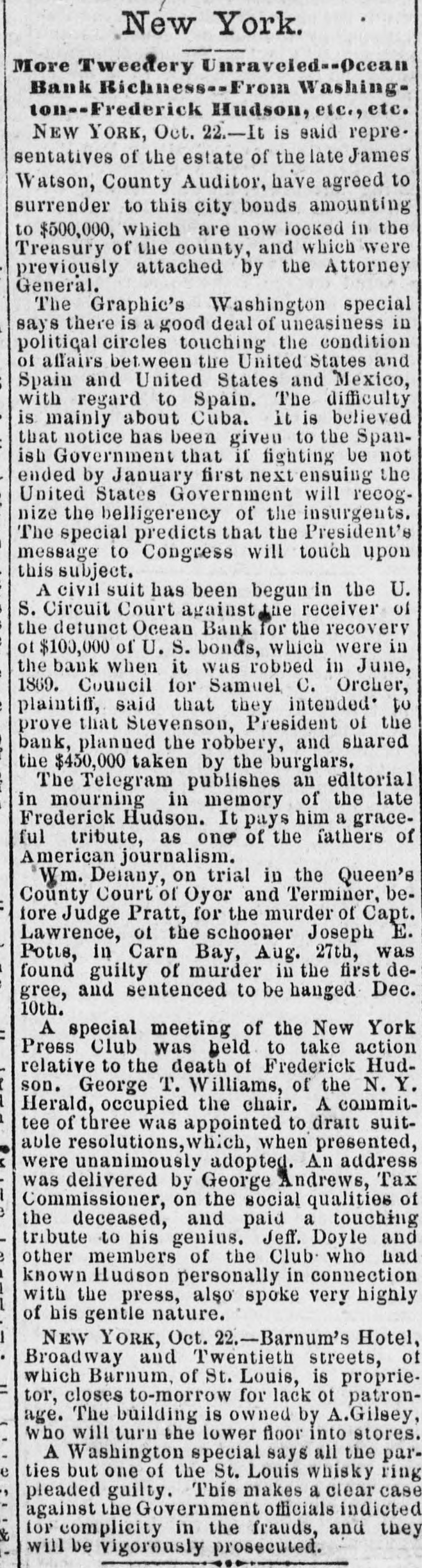
New York. More Tweedery Unraveled--Oceam Bank Richness.-From Washington--Frederick Hudson, etc., etc. NEW YORK, Oct. 22.-It is said representatives of the estate of the late James Watson, County Auditor, have agreed to surrender to this city bonds amounting to $500,000, which are now looked in the Treasury of the county, and which were previously attached by the Attorney General. The Graphic's Washington special says there is a good deal of uneasiness in political circles touching the condition of affairs between the United States and and United States Spain and Mexico, with regard to Spain. The difficulty is mainly about Cuba. it is believed that notice has been given to the Spanish Government that if fighting be not ended by January first next ensuing the United States Government will recognize the belligerency of the insurgents. The special predicts that the President's message to Congress will touch upon this subject. A civil suit has been begun in the U. S. Circuit Court against the receiver of the detunct Ocean Bank for the recovery ot $100,000 of U. S. bonds, which were in the bank when it was robbed in June, 1869. Council for Samuel C. Orcher, plaintiff, said that they intended* to prove that Stevenson, President of the bank, planned the robbery, and shared the $430,000 taken by the burglars. The Telegram publishes an editorial in mourning in memory of the late Frederick Hudson. It pays him a graceful tribute, as one of the fathers of American journalism. Wm. Delany, on trial in the Queen's County Court of Oyer and Terminer, before Judge Pratt, for the murder of Capt. of the schooner Lawrence, Carn Joseph 27th, E. Potts, in Bay, Aug. was found guilty of murder in the first degree, and sentenced to be hanged Dec. 10th. A special meeting of the New York Press Club was held to take action relative to the death of Frederick Hudson. George T. Williams, of the N. Y. Herald, occupied the chair. A committee of three was appointed to drait suitable resolutions, which, when presented, were unanimously adopted. An address was delivered by George Andrews, Tax Commissioner, on the social qualities of the deceased, and paid a touching tribute to his genius. Jeff. Doyle and other members of the Club who had known Hudson personally in connection with the press, also spoke very highly of his gentle nature. NEW YORK, Oct. 2.-Barnum's Hotel, Broadway and Twentieth streets, of which Barnum, of St. Louis, is proprietor, closes to-morrow for lack of patronage. The building is owned by A.Gilsey, who will turn the lower floor into stores. A Washington special says all the pare ties but one of the St. Louis whisky ring pleaded guilty. This makes a clear case against the Government officials indicted for complicity in the frauds, and they & will be vigorously prosecuted.

Article from The Rutland Daily Globe, October 22, 1875

Click image to open full size in new tab

Article Text

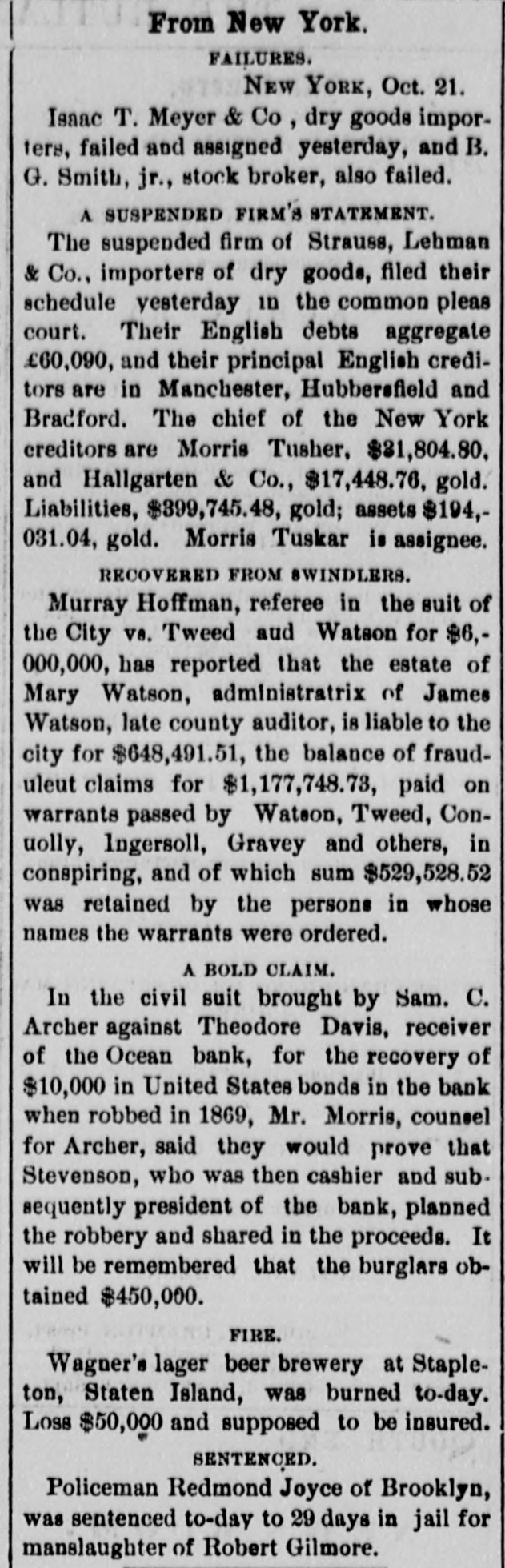
From New York. FAILURES. NEW YORK, Oct. 21. Isaac T. Meyer & Co, dry goods importers, failed and assigned yesterday, and B. G. Smith, jr., stock broker, also failed. A SUSPENDED FIRM'S STATEMENT. The suspended firm of Strauss, Lehman & Co., importers of dry goods, filed their schedule yesterday in the common pleas court. Their English debts aggregate ยฃ60,090, and their principal English creditors are in Manchester, Hubbersfield and Bradford. The chief of the New York creditors are Morris Tusher, $31,804.80, and Hallgarten & Co., $17,448.76, gold. Liabilities, $399,745.48, gold; assets $194,031.04, gold. Morris Tuskar is assignee. RECOVERED FROM SWINDLERS. Murray Hoffman, referee in the suit of the City vs. Tweed aud Watson for $6,000,000, has reported that the estate of Mary Watson, administratrix of James Watson, late county auditor, is liable to the city for $648,491.51, the balance of frauduleut claims for $1,177,748.73, paid on warrants passed by Watson, Tweed, Conuolly, Ingersoll, Gravey and others, in conspiring, and of which sum $529,528.52 was retained by the persons in whose names the warrants were ordered. A BOLD CLAIM. In the civil suit brought by Sam. C. Archer against Theodore Davis, receiver of the Ocean bank, for the recovery of $10,000 in United States bonds in the bank when robbed in 1869, Mr. Morris, counsel for Archer, said they would prove that Stevenson, who was then cashier and subsequently president of the bank, planned the robbery and shared in the proceeds. It will be remembered that the burglars obtained $450,000. FIRE. Wagner's lager beer brewery at Stapleton, Staten Island, was burned to-day. Loss $50,000 and supposed to be insured. SENTENCED. Policeman Redmond Joyce of Brooklyn, was sentenced to-day to 29 days in jail for manslaughter of Robert Gilmore.


Article from Eureka Daily Sentinel, October 23, 1875

Click image to open full size in new tab

Article Text

EASTERN DISPATCHES. By Overland Telegraph. [SPECIAL TO THE DAILY SENTINEL.] A Horrible Murder Discovered in Denver, Col. DENVER, Col., Oct. 21. A most atrocious murder was unearthed here to day. A small tene ment house in the eastern portion of the city which had recently been VRcated by some Italian musicians was visited by a policeman to detect the cause of a stench that appeared to issue from it. He discovered in the cellar of the builing the dead and putrid bodies of an old man and three boys, all Italians. The bodies bear the ghastly marks of the knife. The throats of all had been cut. The murderers are believed to be Italians. Intense indignation prevails and detectives are out in all directions searching for the murderers. Death of a Distinguished Kentuckfan. LOUISVILLE, KY., Oct. 21. A special from Paris, Ky., says that Hon. R. T. Davis, eldest son of late Senator Garrett Davis, and the most prominent member of the Bourbon county bar, was found dead in his bed this morning. Death is supposed to have been caused by an overdose of chloral. which he had been in the habit of using as an antidote for pain. Mr. Davis was President of the Northern Bank of Kentucky, and was deservedly held as one of the first citizens of the county and State, Waylaid and Shot. MEMPHIS, Tenn., Oct. 21. Henry L. Ballard, formerly of Texas. residing near Marion, Ark., while riding with a lady yesterday afternoon near his place, was waylaid and shot by a man named Andrews, the charge taking effect in the neck and face and knocking him off his horse. Alter falling Ballard asked Andrews to raise him into a sitting posture, which he did. Fributes to the Memory of Fred'k Hudson-Serious Charge Against a Bank Receiver. NEW YORK. Oct. 21. All theevening papers publish glowing tributes to the memory of the late Fred'k Hudson. In the civil suit brought by Samuel C. Archer against Theodore Davis, Receiver of the Ocean Bank, for the recovery of $10,000 in United States bonds, in the bank when robbed in 1869, Mr. Morrison, counsel for Archer, said they would prove that Stevenson, then Cashier and afteward President of the bank, planned the robbery and shared in the proceeds. It will be remembered that the burglars obtained about $450,000. Mail Matters in the South and Southwest. WASHINGTON, Oct. 21. Postmaster General Jewell had a long coversation to-day with Col. Thos. A. Scott, who came here at his request to arrange for giving the department all possible facilities on the railroads controlled by the latter in the South and Southwest. with a view to still greater dispatch in the distribution and connection of mails there. Col. Scott acquiesed in Gen. Jewell's suggestion and promised to extend all facilities that may be desired. Fatal Shooting. SCRANTON, Pa., Oct. 22. E. L. Hicks, son of Major Hicks, a highly respectable citizen of W yoming, surrendered himself to the police last evening, stating that on the previous evening he shot ArchibaldAncerson.for several years engineer at the Diamond mine. It appears the parties met at Trip's Ravin, a lonely spot, and Hicks, mistaking Anderson for a desperado, and without the exchange of a word, fired at him, inflicting a wound from which he died yesterday. New York Items. NEW YORK, Oct. 22. Wm. Delaney, convicted of the murder of Capt. Lawrence on board a schooner in the sound, was sentenced to be hanged December 10. Barnum's Hotel, at Broadway and Twentieth streets, will be closed tomorrow under circumstances considered equivalent to suspension of business by the present proprietors. The failure of Joseph W. Duryee, lumber merchant, is announced. Assets and liabilities not stated. Commissioners representing the city of Mobile, Ala., are endeavoring to effect arrangements by which their city debt may become less burdensome. They state that the people wish to pay their creditors every dollar they can, but the city if held for her present obligations is hopelessly insolvent and can never pay. The Supplementary Book Fair opened yesterday at Clinton Hall, under the auspices of the American Book Trade Association. About forty publishing houses were represented. In the suit of the city against the estate of the late Jas. Watson, who was the former ring County Auditor, judgment has been given for the recovery of $648,491, as a part of the alleged six


Article from The Daily Gazette, October 27, 1875

Click image to open full size in new tab

Article Text

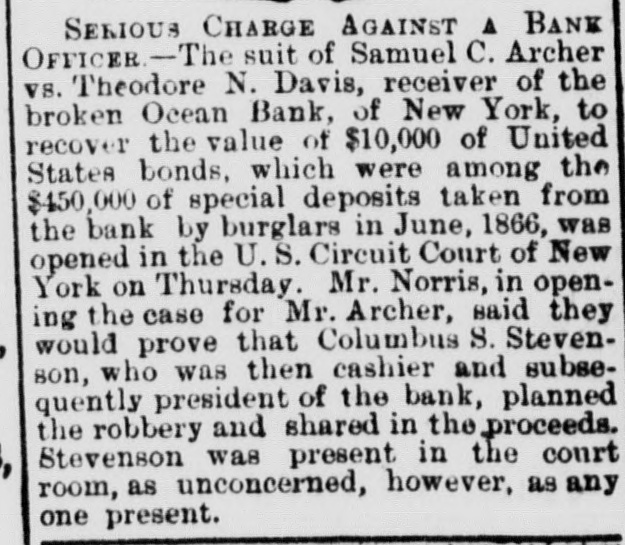
SERIOUS CHARGE AGAINST A BANK OFFICER - The suit of Samuel C. Archer VS. Theodore N. Davis, receiver of the broken Ocean Bank, of New York, to recover the value of $10,000 of United States bonds, which were among the $450,000 of special deposits taken from the bank by burglars in June, 1866, was opened in the U.S. Circuit Court of New York on Thursday. Mr. Norris, in opening the case for Mr. Archer, said they would prove that Columbus S. Stevenson, who was then cashier and subsequently president of the bank, planned the robbery and shared in the proceeds. Stevenson was present in the court room, as unconcerned, however, as any one present.


Article from The Albany Register, October 29, 1875

Click image to open full size in new tab

Article Text

The murderers are believed to be Ital. ians. Intense indignation prevails and detectives are out in all directions searching for the murderers. NEW YORK, Oct. 21.- the civil suit brought by Sam C. Arches, against Theodore Davis, receiver of the Ocean Bank, for the recovery of $10,000 U. S. bonds, in the bauk when it was robbed in 1869. Mr. Morris, counsel for Archer, said they would prove that Steven. son, then dashier, and afterwards president of the bank, planned the robbery and shared in the proceeds. It will be remembered the burglars obtained about $450,000. B.G. Smith, Jr., stock brocker, has given notice the stock exchange of his liability to meet his engagemenos. Strauss, Leman & Co., importer's of dry goods, who assigned, have filed their schedule. The whole liabilities are $399,645, gold, and the assets, $177,031, alsc gold. Sixty-seven thousand pounds are due in England; 65,000 florins to German banks, and $57,000 gold in this city. TROY, N. Y., Oct. 21.-The house of Rankin & Co., wool dealers, have suspended payment. Liabilities are $140, 000. They have cash assets sufficient so pay sixty cents on the dollar, and ex. pect to resume. MEMPHIS, Oct. 21.-A petition in bankruptcy was filed to-day in the U. S. district court by Carroll & Karr, at torneys, representing New York creditors against J. Wiggins &Co, hatters and furriers, Main street. Liabilities about $40.000. A similar petition was filed against J. D. Williams, clothier, of Maine street, by creditors. In he suit of Joseph E. Schmidt & Co., tobacco merchants, against Fetee, the sheriff has seized several thousand dollars' worth of tobacco and other chandise at Fettee's house. It is alleged that Fettee has fraudulently purchased about a hundred thousand dollars worth of goods on credit in several different cities, and the suit of Schmidt & Co. against him is to recover payment of certain promiscry notes given by him for tobacco. Los ANGELES, Oct. 21.-This mor ning the regular down Wilmington train started from the depot of the Southern Pacific railroad on schedule time of 10:15. When about three miles from the city, an axile broke. It was not discovered for about a quarter of mile. The train consisted of two passenger coaches and a section of freight cars. The break occurred in the freight car. Five freight cars were wrecked, and three platform and two box. wrecking car was at once sent to the scene of the disaster. The train was put in trim and moved off without any interruption. No one was injured and the damage tritling. Gov. Pacheco has appointed Chief Justice Wallace a member of the board of regents of the university of California, vice Sachs, resigned. Gov. Pacheco has named J. B. Erringer of San Fran cisco, and Wallace and David Delsenheld of San Diego, as members of the delegation from California to the nation al railroad cenvention to be held in St. Louis Nov. 25th, for the purpose considering the construction of the Paci fic railroad throught the states and terri tories of the southwest. The state entitled to three more delegates who yet appointed. The trial of Johnny Tuers, negro minstrel, indicted for the killing James Dowling, in the Snug saloon, on Washington street, about three years ago, was commenced this morning in the 15th district court. A mortgage as security for motiey loaned on prommissory notes, has been recorded from William Sharon to Odd Fellows'Savings Bank for $600,000 ou the Cosmopolitan Hotel and other neighboring property. SAN FRANCISCO, Oct. -The case of M.H. DeYoung, of the Chronicle, charged with libeling Rev. O. P. Fitz came the court this afternoon. gerald, peared for the Judge up prosecution in Leander police and Quint Alex ap. Campbell for the detense. The papers not yet having been transferred from the county court the case was continued for hearing by consent until Saturday Fitzgerald nor DeYoung were present Body of an Unknown Female Found. DETROIT, 22.-The body of a female was found on the beach near Grand Ha ven, this morning. The body IS suppos ed to be that of either the daughter niece of Captain Scott, of the propeller Equinox, which was lost during th heavy gale six weeks ago. The body a badly bloated, the hair all off the head, cloth gaiters on, calico wrapper striped stockings and skirt. The body had a life preserver on, but no marks proving that it belonged to the propell. er Equinox. The clerk of the propell ct er say: that both ladies had life preservers on when the propeller went down Fatally Poisoned. ST. LOUIS. Oct. 22 A special from cMacon, Mo., says Dr. B.F. Sherman and Samuel Parker went to Bevie's to day. While there they visited Dr. m Shanks' drug store. After leaving the store they had not proceeded ten rods d when Parker tell on the street in con vulsions. In five minutes Dr. Sherman us was similaly affected, and in twenty A minutes both were dead It is supposed rthey were poisened. en Vermillion, Ohio, Destroyed by Fire. ed


Article from The Interior Journal, October 29, 1875

Click image to open full size in new tab

Article Text

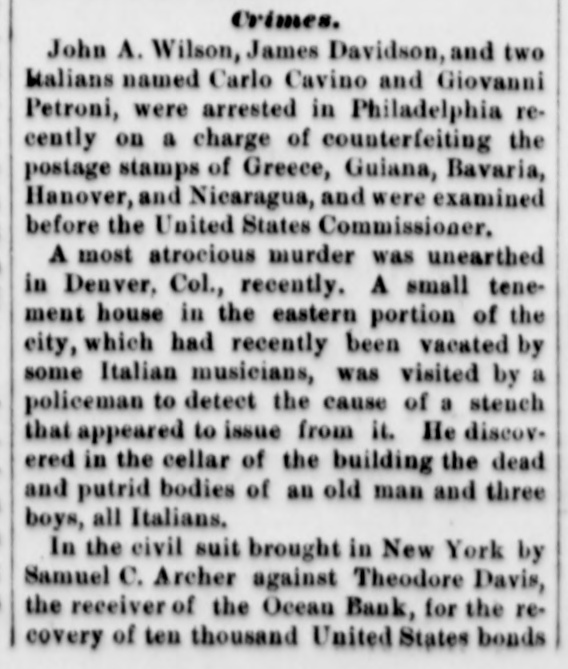
Crimes. John A. Wilson, James Davidson, and two Italians named Carlo Cavino and Giovanni Petroni, were arrested in Philadelphia recently on a charge of counterfeiting the postage stamps of Greece, Guiana, Bavaria, Hanover, and Niearagua, and were examined before the United States Commissioner. A most atrocious murder was unearthed in Denver, Col., recently. A small tenement house in the eastern portion of the city, which had recently been vacated by some Italian musicians, was visited by a policeman to detect the cause of a stench that appeared to issue from it. He discovered in the cellar of the building the dead and putrid bodies of an old man and three boys, all Italians. In the civil suit brought in New York by Samuel c. Archer against Theodore Davis, the receiver of the Ocean Bank, for the recovery of ten thousand United States bonds


Article from The New York Herald, May 27, 1877

Click image to open full size in new tab

Article Text

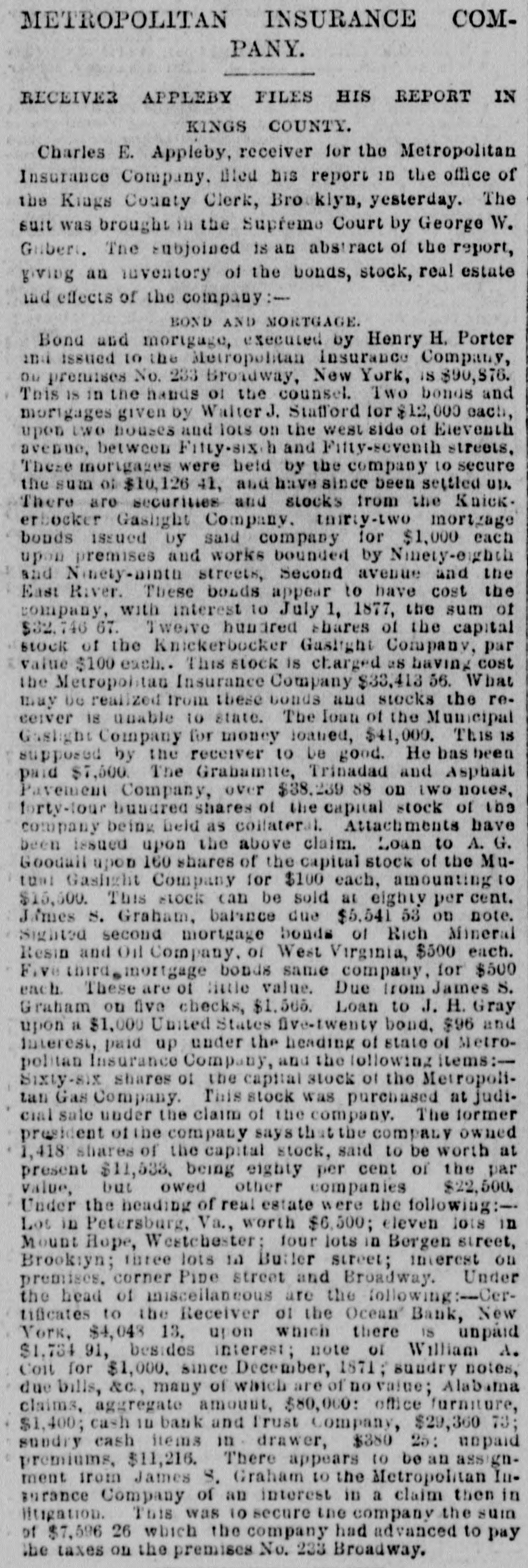
# METROPOLITAN INSURANCE COMPANY. RECEIVER APPLEBY FILES HIS REPORT IN KINGS COUNTY. Charles E. Appleby, receiver for the Metropolitan Insurance Company, filed his report in the office of the Kings County Clerk, Brooklyn, yesterday. The suit was brought in the Supreme Court by George W. Guibert. The subjoined is an abstract of the report, giving an inventory of the bonds, stock, real estate and effects of the company:- BOND AND MORTGAGE. Bond and mortgage, executed by Henry H. Porter and issued to the Metropolitan Insurance Company, on premises No. 233 Broadway, New York, is $90,876. This is in the hands of the counsel. Two bonds and mortgages given by Walter J. Stafford for $12,000 each, upon two houses and lots on the west side of Eleventh avenue, between Fitty-sixth and Fitty-seventh streets, These mortgages were held by the company to secure the sum of $10,126 41, and have since been settled up. There are securities and stocks from the Knickerbocker Gaslight Company, thirty-two mortgage bonds issued by said company for $1,000 each upon premises and works bounded by Ninety-eighth and Ninety-ninth streets, Second avenue and the East River. These bonds appear to have cost the company, with interest to July 1, 1877, the sum of $32.746 67. Twelve hundred shares of the capital stock of the Knickerbocker Gaslight Company, par value $100 each. This stock is charged as having cost the Metropolitan Insurance Company $33,413 56. What may be realized from these bonds and stocks the re-ceiver is unable to state. The loan of the Municipal Gaslight Company for money loaned, $41,000. This is supposed by the receiver to be good. He has been paid $7,500. The Grahamite, Trinidad and Asphalt Pavement Company, over $38.239 88 on two notes, forty-four hundred shares of the capital stock of the company being held as collateral. Attachments have been issued upon the above claim. Loan to A. G. Goodall upon 160 shares of the capital stock of the Mutual Gaslight Company for $100 each, amounting to $15,500. This stock can be sold at eighty per cent. James S. Graham, balance due $5.541 53 on note. Sighted second mortgage bonds of Rich Mineral Resin and Oil Company, of West Virginia, $500 each. Five third mortgage bonds same company, for $500 each. These are of little value. Due from James S. Graham on five checks, $1.505. Loan to J. H. Gray upon a $1,000 United States five-twenty bond, $96 and interest, paid up under the heading of state of Metropolitan Insurance Company, and the following items:- Sixty-six shares of the capital stock of the Metropolitan Gas Company. This stock was purchased at judicial sale under the claim of the company. The former president of the company says that the company owned 1,418 shares of the capital stock, said to be worth at present $11,533, being eighty per cent of the par value, but owed other companies $22,500. Under the heading of real estate were the following:- Lot in Petersburg, Va., worth $6,500; eleven lots in Mount Hope, Westchester; four lots in Bergen street, Brooklyn; three lots in Butler street; interest on premises, corner Pine street and Broadway. Under the head of miscellaneous are the following:- Certificates to the Receiver of the Ocean Bank, New York, $4,043 13, upon which there is unpaid $1,734 91, besides interest; note of William A. Colt for $1,000, since December, 1871; sundry notes, due bills, &c., many of which are of no value; Alabama claims, aggregate amount, $80,000: office furniture, $1,400; cash in bank and Trust Company, $29,360 73; sundry cash items in drawer, $380 25: unpaid premiums, $11,216. There appears to be an assignment from James S. Graham to the Metropolitan Insurance Company of an interest in a claim then in litigation. This was to secure the company the sum of $7,596 26 which the company had advanced to pay the taxes on the premises No. 233 Broadway.


Article from The Dallas Daily Herald, November 20, 1881

Click image to open full size in new tab

Article Text

# BANKS THAT WERE ROBBED. Wholesale Plunder of Money Institutions by Cashiers, Directors and Burglars-No Punishment-Hundreds of Thousands Gone Beyond Recall The New York correspondent of the Hart- ford Times sends to his paper an interesting account of the many bank swindles and de- falcations which have occurred in this city. After writing of the overdraft which Bald- win, the defaulting cashier of the suspen- ded Mechanics' National Bank of Newark, claims to have granted Nugent, the corres- pondent says: Business men when extremely short use every effort to obtain the privilege of over- draft, which when granted generally leads to ruin. I well remember the instance of Paying Teller MeGutcheon of the Ocean Bank, who yielded to such an appeal and certified a check for a friend. The appeal was continued, and in hope of obtaining the money thus wrongfully lent other fa- vors were granted. At last the amount be- came so large that the teller became the slave of his former friend and was obliged to keep up the accommodation until the in- evitable explosion took place. The bank lost $90,000 and the teller was ruined. The Grocers' Bank was robbed by its pay- ing teller, George Clark. No punishment could be inflicted. The Tradesman's Bank was robbed by one of its clerks of $40,000. The criminal was shattered by dissipation and died in the hospital. The Fourth Na- tional Bank also occupied a place in the list, the loss being about $30,000. The paying tel- ler of the American Exchange Bank wound up his career by robbing the bank of $90,000. The City Bank is one of the best managed of these institutions, its president being Moses Taylor, whose fame as a financier is widely extended. Yet in this admirable concern the heaviest defalcation ever known in this city took place. The cul- prit's name was Leverich. He came of high family, and showed his dignity by the extent of his peculation, which was more than $400,000. It was admitted that noth- ing could be done, and there the matter ended. Paying Teller Ellis, of the Park National Bank, robbed the latter of $61,000 with equal impunity. One instance of a bank clerk's punish- ment for peculation, is found in the case of the Fulton Bank. The note clerk, who was the son of the cashier, spent $60,000 of bank funds. The thief actually got four years in State prison. One of the most curious bank defalcations of the day occurred in the Gallatin National Bank. A leading em- ploye had for a long time used the bank funds for the purchase of "business paper." He was an expert judge of credit, and found the traffic very profitable. One day, how- ever, his account was found short. He at once admitted the fact, and turned out a quantity of "gilt-edged" to balance the discrepancy. The Artisans' Bank was robbed by its di- rectors, and so was the Ocean Bank. The latter had suffered severely from depreda- tions of its paying teller, and was after- wards "cracked" by burglars. It might have survived, but the directors concluded to finish the work, and this they did in a very effectual manner. Their method was to discount loans on fictitious securities, such as paper railroad bonds, and the result was, that in the hands of a receiver, the stock was only worth ten per cent. Such was the history of a bank whose capital was entirely paid in, the amount being a half million. The Grocers' Bank was robbed in the same manner, and the shareholders found themselves the victims of sharp prac- tice on the part of those to whom they had committed their interests. Having referred to a case of punishment among defaulting clerks, I may add to it the sole instance of penalty inflicted on a dishonest cashier. This was found in the Atlantic Bank. The entire capital of this institution ($300,000) was swamped by its cashier (Taintor), who was deeply engaged in stock speculation. He dabbled in Pacific Mail till all was gone and then the doors were closed. The outraged stockholders succeeded in placing the thief under a four years' sentence in the penitentiary. As an additional illustration of the loose method of banking in this city, it may be added that ten savings banks have failed within a few years. The term "failed" is used conven- tionally. The correct statement is that they have been robbed by their officers and three millions of the earnings of the have in this manner been wasted. For this atrocious series of crimes no penalty has been inflicted, nor indeed has any arrest been made.


Article from Grant County Herald, December 1, 1881

Click image to open full size in new tab

Article Text

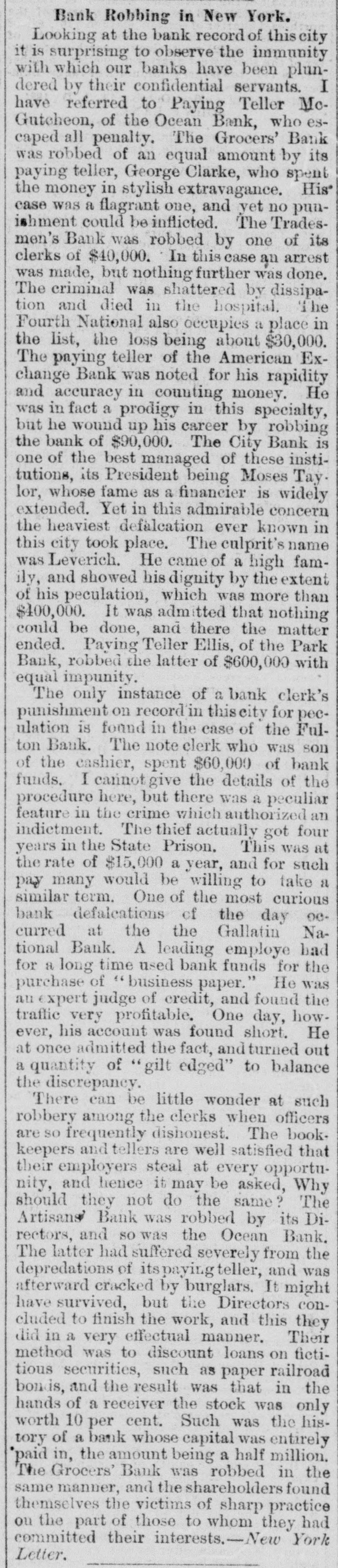
# Bank Robbing in New York. Looking at the bank record of this city it is surprising to observe the immunity with which our banks have been plundered by their confidential servants. I have referred to Paying Teller McGutcheon, of the Ocean Bank, who escaped all penalty. The Grocers' Bank was robbed of an equal amount by its paying teller, George Clarke, who spent the money in stylish extravagance. His case was a flagrant one, and yet no punishment could be inflicted. The Tradesmen's Bank was robbed by one of its clerks of $40,000. In this case an arrest was made, but nothing further was done. The criminal was shattered by dissipation and died in the hospital. The Fourth National also occupies a place in the list, the loss being about $30,000. The paying teller of the American Exchange Bank was noted for his rapidity and accuracy in counting money. He was in fact a prodigy in this specialty, but he wound up his career by robbing the bank of $90,000. The City Bank is one of the best managed of these institutions, its President being Moses Taylor, whose fame as a financier is widely extended. Yet in this admirable concern the heaviest defalcation ever known in this city took place. The culprit's name was Leverich. He came of a high family, and showed his dignity by the extent of his peculation, which was more than $400,000. It was admitted that nothing could be done, and there the matter ended. Paying Teller Ellis, of the Park Bank, robbed the latter of $600,000 with equal impunity. The only instance of a bank clerk's punishment on record in this city for peculation is found in the case of the Fulton Bank. The note clerk who was son of the cashier, spent $60,000 of bank funds. I cannot give the details of the procedure here, but there was a peculiar feature in the crime which authorized an indictment. The thief actually got four years in the State Prison, This was at the rate of $15,000 a year, and for such pay many would be willing to take a similar term. One of the most curious bank defalcations of the day occurred at the Gallatin National Bank. A leading employe had for a long time used bank funds for the purchase of "business paper." He was an expert judge of credit, and found the traffic very profitable. One day, however, his account was found short. He at once admitted the fact, and turned out a quantity of "gilt edged" to balance the discrepancy. There can be little wonder at such robbery among the clerks when officers are so frequently dishonest. The bookkeepers and tellers are well satisfied that their employers steal at every opportunity, and hence it may be asked, Why should they not do the same? The Artisans' Bank was robbed by its Directors, and so was the Ocean Bank. The latter had suffered severely from the depredations of its paying teller, and was afterward cracked by burglars. It might have survived, but the Directors concluded to finish the work, and this they did in a very effectual manner. Their method was to discount loans on fictitious securities, such as paper railroad bonds, and the result was that in the hands of a receiver the stock was only worth 10 per cent. Such was the history of a bank whose capital was entirely paid in, the amount being a half million. The Grocers' Bank was robbed in the same manner, and the shareholders found themselves the victims of sharp practice on the part of those to whom they had committed their interests. - New York Letter.