14331. North River Bank (New York, NY)

Bank Information

Episode Type
Run → Suspension → Closure
Bank Type
state
Start Date
November 12, 1890
Location
New York, New York (40.714, -74.006)

Metadata

Model
gpt-5-mini
Short Digest
3e618125c804959e

Response Measures

None

Description

Contemporary articles report a quiet but steady run after the bank was named as a defaulter at the Clearing House; the bank exhausted ready money and suspended Nov 12, 1890 with the state bank examiner taking charge. Attempts to reopen via depositor 'sign-offs' failed and a motion for a receiver proceeded; a receiver/order concerning receivership was reported Nov 18, 1890. Classed as run → suspension → closure (receivership). OCR errors in some articles corrected (e.g., 'snspended' -> 'suspended').

Events (5)

1. November 12, 1890 Run
Cause
Local Banks
Cause Details
Named as a defaulter at the Clearing House and tight money; depositors began a quiet but steady run.
Measures
Applied to the Clearing House for a loan; clearing-house committee was preparing to examine condition; bank examiner took charge.
Newspaper Excerpt
On account of the mention of the North River Bank as one of the defaulters at the Clearing-house yesterday, the depositors started a quiet, but steady run on it this morning.
Source
newspapers
2. November 12, 1890 Suspension
Cause
Local Banks
Cause Details
Exhaustion of ready money due to withdrawals triggered by clearing-house mention and tight money; bank examiner ordered closure and took charge.
Newspaper Excerpt
This bank has suspended temporarily. ... The doors were locked, and the Bank Examiner had taken charge of the bank.
Source
newspapers
3. November 13, 1890 Other
Newspaper Excerpt
The bank did not open this morning. The cashier stated ... they could not resume business for several days. The bank examiner said a statement of the bank's affairs would be ready at noon. ... directors sought depositors' signatures to leave deposits 90 days to permit reopening attempts (depositors signed off $800,000). (paraphrase of multiple reports).
Source
newspapers
4. November 18, 1890 Receivership
Newspaper Excerpt
Judge O'Brien issued an order requiring that it be shown forthwith why a receiver should not be appointed pending the suit which the attorney general has brought to dissolve the North River bank. A temporary injunction was also assured restraining the bank officials from interfering with its affairs. At the conclusion of the arguments the judge reserved his decision.
Source
newspapers
5. May 4, 1891 Other
Newspaper Excerpt
Edward E. Gedney, president of North River Bank, and Cashier Frank Ingersoll were placed under arrest ... charged with falsifying the quarterly report of the bank made September 27, 1890.
Source
newspapers

Newspaper Articles (23)

Article from Sacramento Daily Record-Union, November 13, 1890

Click image to open full size in new tab

Article Text

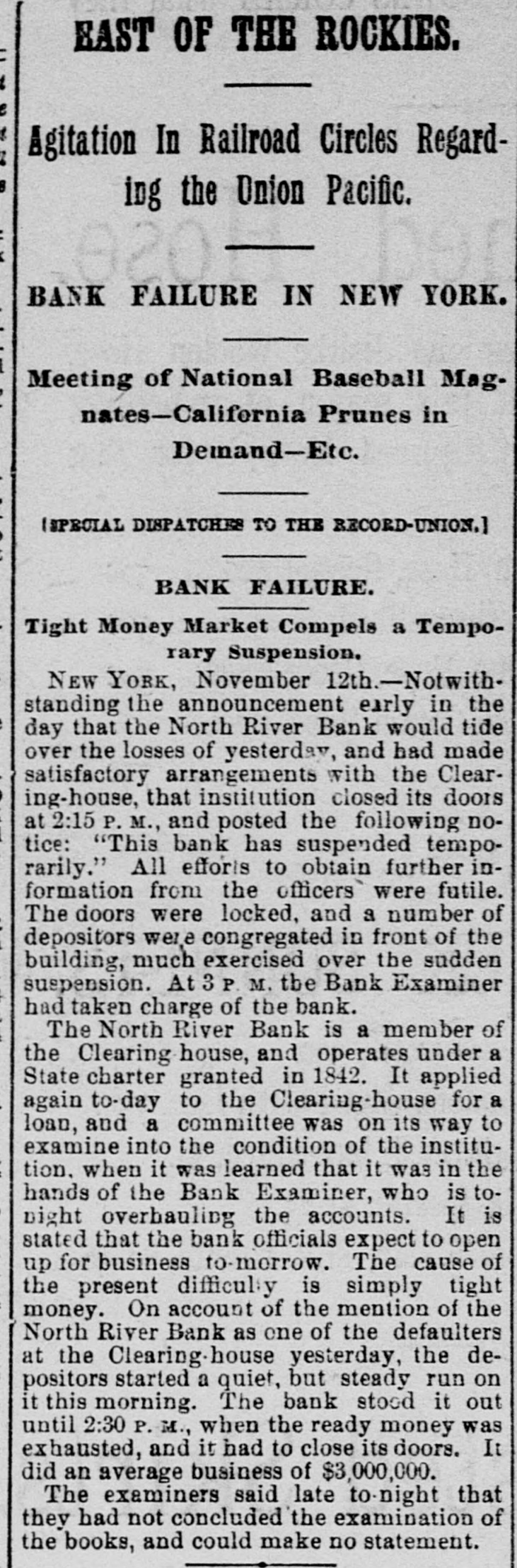
EAST OF THE ROCKIES. Agitation In Railroad Circles Regarding the Union Pacific. BANK FAILURE IN NEW YORK. Meeting of National Baseball Magnates-California Prunes in Demand-Etc. (SPECIAL DISPATCHES TO THE RECORD-UNION.] BANK FAILURE. Tight Money Market Compels a Temporary Suspension. NEW YORK, November 12th.-Notwithstanding the announcement early in the day that the North River Bank would tide over the losses of yesterday, and had made satisfactory arrangements with the Clearing-house, that institution closed its doors at 2:15 P. M., and posted the following notice: "This bank has suspended temporarily." All efforts to obtain further information from the officers were futile. The doors were locked, and a number of depositors were congregated in front of the building, much exercised over the sudden suspension. At 3 P M. the Bank Examiner had taken charge of the bank. The North River Bank is a member of the Clearing house, and operates under a State charter granted in 1842. It applied again to-day to the Clearing-house for a loan, and a committee was on its way to examine into the condition of the institution. when it was learned that it was in the hands of the Bank Examiner, who is tonight overbauling the accounts. It is stated that the bank officials expect to open up for business to-merrow. The cause of the present difficulty is simply tight money. On account of the mention of the North River Bank as one of the defaulters at the Clearing-house yesterday, the depositors started a quiet, but steady run on it this morning. The bank stood it out until 2:30 P. M., when the ready money was exhausted, and it had to close its doors. It did an average business of $3,000,000. The examiners said late to-night that they had not concluded the examination of the books, and could make no statement.


Article from The Helena Independent, November 13, 1890

Click image to open full size in new tab

Article Text

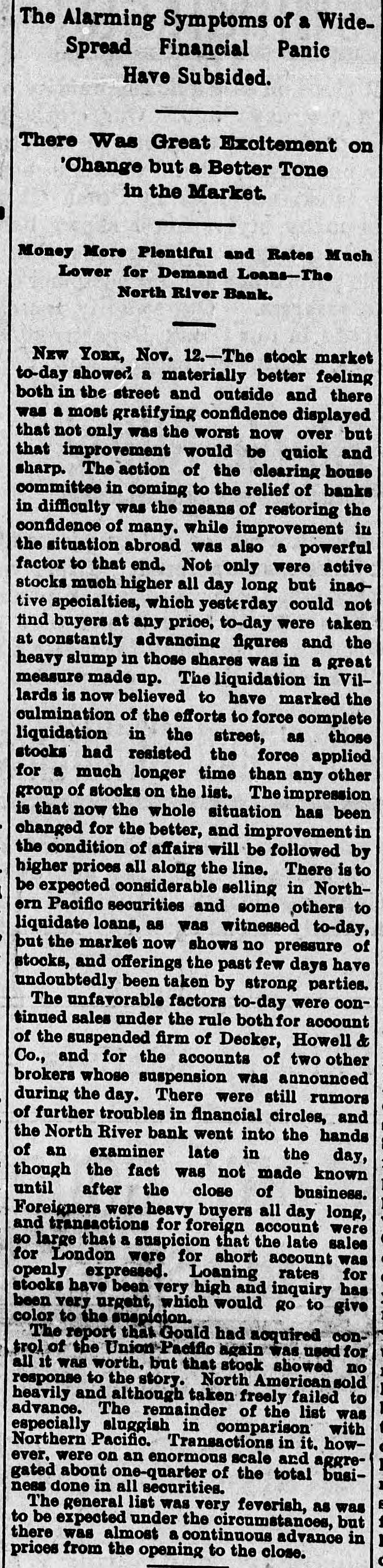
The Alarming Symptoms of a WideSpread Financial Panic Have Subsided. There Was Great Excitement on 'Change but a Better Tone in the Market. Money More Plentiful and Rates Much Lower for Demand Loans-The North River Bank. NEW YORK, Nov. 12.-The stock market to-day showed a materially better feeling both in the street and outside and there was a most gratifying confidence displayed that not only was the worst now over but that improvement would be quick and sharp. The action of the clearing house committee in coming to the relief of banks in difficulty was the means of restoring the confidence of many. while improvement in the situation abroad was also a powerful factor to that end. Not only were active stocks much higher all day long but inao tive specialties, which yesterday could not find buyers at any price, to-day were taken at constantly advancing figures and the heavy slump in those shares was in a great measure made up. The liquidation in Villards is now believed to have marked the culmination of the efforts to force complete liquidation in the street, as those stocks had resisted the force applied for a much longer time than any other group of stocks on the list. The impression is that now the whole situation has been changed for the better, and improvement in the condition of affairs will be followed by higher prices all along the line. There is to be expected considerable selling in Northern Pacific securities and some ,others to liquidate loans, as was witnessed to-day, but the market now shows no pressure of stocks, and offerings the past few days have undoubtedly been taken by strong parties. The unfavorable factors to-day were continued sales under the rule both for account of the suspended firm of Decker, Howell & Co., and for the accounts of two other brokers whose suspension was announced during the day. There were still rumors of further troubles in financial circles, and the North River bank went into the hands of an examiner late in the day, though the fact was not made known until after the close of business. Foreigners were heavy buyers all day long, and transactions for foreign account were so large that a suspicion that the late sales for London were for short account was openly expressed. Loaning rates for stocks have been very high and inquiry has been very urgent, which would go to give color to the suspicion. The report that Gould had acquired control of the nion-Pacific again was used for all it was worth. but that stock showed no response to the story. North American sold heavily and although taken freely failed to advance. The remainder of the list was especially sluggish in comparison with Northern Pacific. Transactions in it. however. were on an enormous scale and aggregated about one-quarter of the total business done in all securities. The general list was very feverish, as was to be expected under the circumstances, but there was almost a continuous advance in I prices from the opening to the close.


Article from The Seattle Post-Intelligencer, November 13, 1890

Click image to open full size in new tab

Article Text

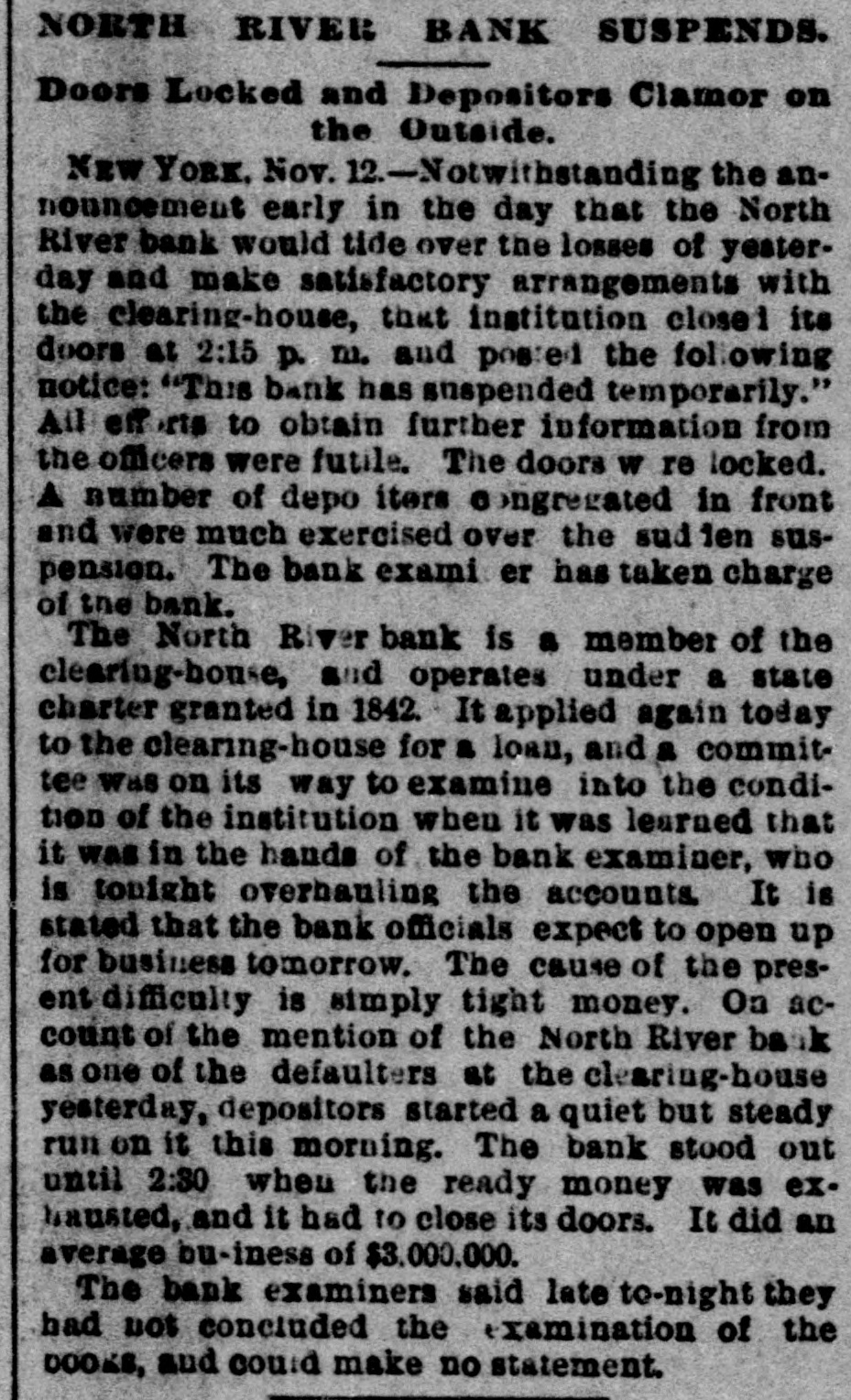
NORTH RIVER SUSPENDS. BANK Doors Locked and Depositors Clamor on the Outside. New YORK. Nov. 12.-Notwithstanding the announcement early in the day that the North River bank would tide over the losses of yesterday and make satisfactory arrangements with the clearing-house, that institution close its doors at 2:15 p. m. and possed the following notice: "This bank has snspended temporarily." All efficial to obtain further information from the officers were futile. The doors w re locked. A number of depo iters o ngregated in front and were much exercised over the sud ien suspension. The bank exami er has taken charge of the bank. The North River bank is a member of the clearing-bouse, and operates under a state charter granted in 1842. It applied again today to the clearing-house for a loan, and a committee was on its way to examine into the condition of the institution when it was learned that it was in the hands of the bank examiner, who is tonight overbauling the accounts It is stated that the bank officials expect to open up for business tomorrow. The cause of the present difficulty is simply tight money. On account of the mention of the North River bank as one of the defaulters at the clearing-house yesterday, depositors started a quiet but steady run on it this morning. The bank stood out until 2:30 when the ready money was exmusted, and it had to close its doors. It did an average bu-iness of $3.000.000. The bank examiners said late to-night they had not concluded the examination of the books, and could make no statement.


Article from Wheeling Register, November 13, 1890

Click image to open full size in new tab

Article Text

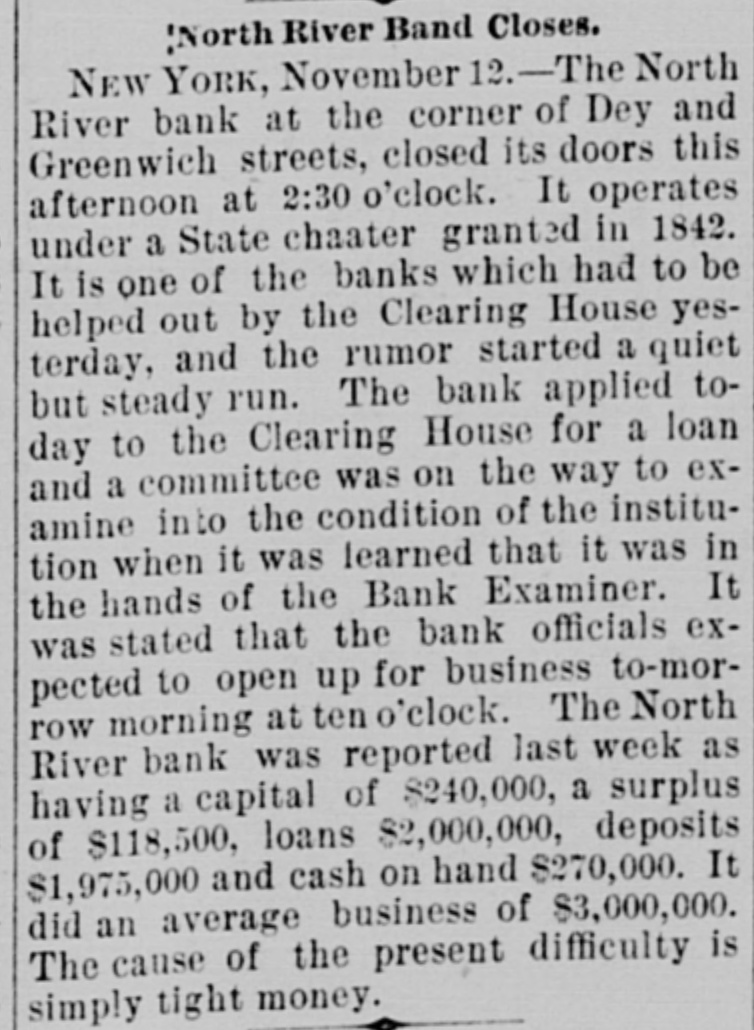
North River Band Closes. NEW YORK, November 12.-The North River bank at the corner of Dey and Greenwich streets, closed its doors this afternoon at 2:30 o'clock. It operates under a State chaater granted in 1842. It is one of the banks which had to be helped out by the Clearing House yesterday, and the rumor started a quiet but steady run. The bank applied today to the Clearing House for a loan and a committee was on the way to examine into the condition of the institution when it was learned that it was in the hands of the Bank Examiner. It was stated that the bank officials expected to open up for business to-morrow morning at ten o'clock. The North River bank was reported last week as having a capital of $240,000, a surplus of $118,500, loans $2,000,000, deposits $1,975,000 and cash on hand $270,000. It did an average business of $3,000,000. The cause of the present difficulty is simply tight money.


Article from St. Paul Daily Globe, November 13, 1890

Click image to open full size in new tab

Article Text

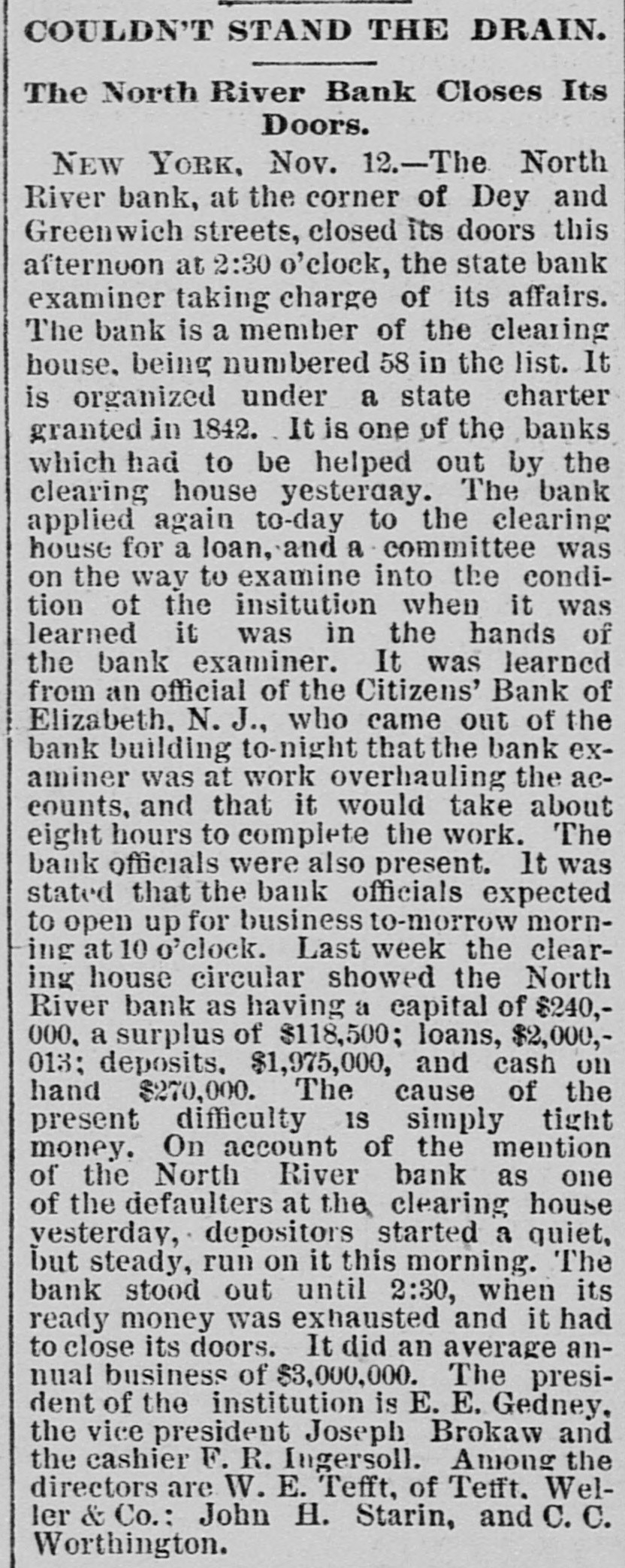
COULDN'T STAND THE DRAIN. The North River Bank Closes Its Doors. NEW York, Nov. 12.-The North River bank, at the corner of Dey and Greenwich streets, closed its doors this afternoon at 2:30 o'clock, the state bank examiner taking charge of its affairs. The bank is a member of the clearing house, being numbered 58 in the list. It is organized under a state charter granted in 1842. It is one of the banks which had to be helped out by the clearing house yesterday. The bank applied again to-day to the clearing house for a loan, and a committee was on the way to examine into the condition of the insitution when it was learned it was in the hands of the bank examiner. It was learned from an official of the Citizens' Bank of Elizabeth, N. J., who came out of the bank building to-night that the bank examiner was at work overhauling the accounts, and that it would take about eight hours to complete the work. The bank officials were also present. It was stated that the bank officials expected to open up for business to-morrow morning at 10 o'clock. Last week the clearing house circular showed the North River bank as having a capital of $240,000, a surplus of $118,500; loans, $2,000,013; deposits. $1,975,000, and cash on hand $270,000. The cause of the present difficulty IS simply tight money. On account of the mention of the North River bank as one of the defaulters at the clearing house vesterday, depositors started a quiet, but steady, run on it this morning. The bank stood out until 2:30, when its ready money was exhausted and it had to close its doors. It did an average annual business of $3,000,000. The president of the institution is E. E. Gedney. the vice president Joseph Brokaw and the cashier F. R. Ingersoll. Among the directors are W. E. Tefft, of Tefft. Weller & Co.: John H. Starin, and C.C. Worthington.


Article from The Morning Call, November 13, 1890

Click image to open full size in new tab

Article Text

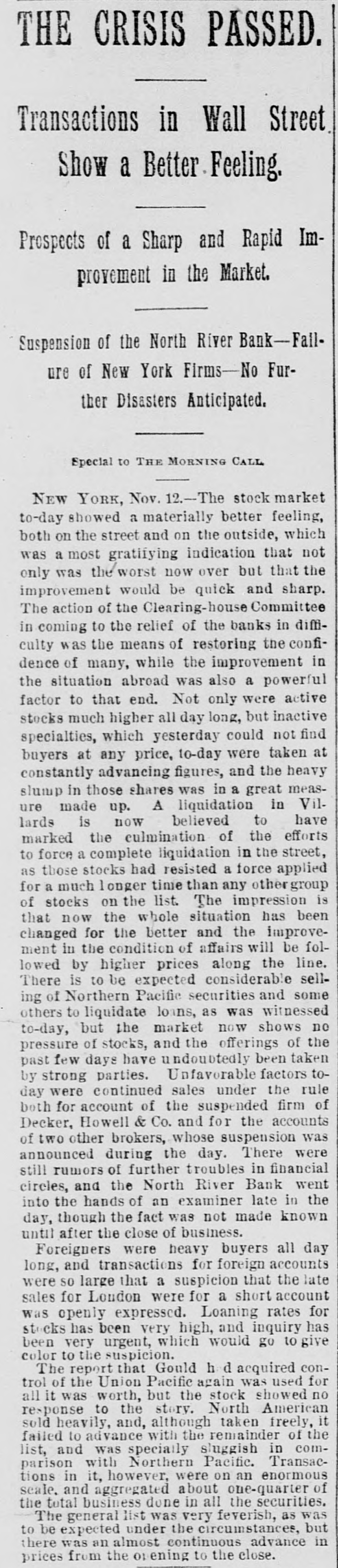
THE CRISIS PASSED. Transactions in Wall Street Show a Better Feeling. Prospects of a Sharp and Rapid Improvement in the Market. Suspension of the North River Bank-Failare of New York Firms-No Further Disasters Anticipated. Special to THE MORNING CALL NEW YORK, Nov. 12.-The stock market to-day showed a materially better feeling, both on the street and on the outside, which was a most gratifying indication that not only was the worst now over but that the improvement would be quick and sharp. The action of the Clearing-house Committee in coming to the relief of the banks in difficulty was the means of restoring the confidence of many, while the improvement in the situation abroad was also a powerful factor to that end. Not only were active stocks much higher all day long, but inactive specialties, which yesterday could not find buyers at any price, 10-day were taken at constantly advancing figures, and the heavy slump in those shares was in a great measure made up. A liquidation in Villards is now believed to have marked the culmination of the efforts to force a complete liquidation in the street, as tbose stocks had resisted a force applied for a much longer time than any other group of stocks on the list. The impression is that now the whole situation has been changed for the better and the improvement in the condition of affairs will be followed by higher prices along the line. There is to be expected considerable selling of Northern Pacific securities and some others to liquidate loans, as was witnessed to-day, but the market now shows no pressure of stocks, and the offerings of the past few days have undoubtedly been taken by strong parties. Unfavorable factors today were continued sales under the rule both for account of the suspended firm of Decker, Howell & Co. and for the accounts of two other brokers, whose suspension was announced during the day. There were still rumors of further troubles in financial circles, and the North River Bank went into the hands of an examiner late in the day, though the fact was not made known until after the close of business. Foreigners were heavy buyers all day long, and transactions for foreign accounts were so large that a suspicion that the late sales for London were for a short account was openly expressed. Loaning rates for stocks has been very high, and inquiry has been very urgent, which would go to give color to the suspicion. The report that Gould h d acquired control of the Union Pacific again was used for all it was worth, but the stock showed no response to the story. North American sold heavily, and, although taken freely, it failed to advance with the remainder of the list, and was specially sluggish in comparison with Northern Pacific. Transactions in it, however, were on an enormous scale. and aggregated about one-quarter of the total business done in all the securities. The general list was very feverish, as was to be expected under the circumstances, but there was an almost continuous advance in prices from the ovening to the close.


Article from Telegram-Herald, November 13, 1890

Click image to open full size in new tab

Article Text

A CRISIS. Panic in the Stock Market on Wall Street , Several Big Firms Fail Decker, How el & Co. 6 Liabilities Eatimated at $10,000,000. BUIN IN WALL STREET New York Nov. 18-The darkest market eloud which overbung the stock and the atmosphere will burst Tuesday ep. Mr. Heary now doubtless clear respected Villard's brokers, the old and Decker, Howell & Co., were firm of involvsuspend. after seriously forced to of the Wall street banks An enermous ing one liquidation in the Villard North -Northern Pacific and stocks- -preceded and followed the American announcement of suspension. formal and was in progress when the marker closed Transactions is Northern Pacific closed preaggregated 84,000 and it farred net fall of 11% of North Amerion a can over 95,000 shares were dealt in. It closed 134 above the lowest but Pacific shows net decline of 83/6 Northern common was less active, but is down % per cent. This and the two failures that pre- the ceded it, the embarrassment of Bank of North America, and the potent measures adopted by the clearing-house banks Tuesday afternoon to relieve the banks and the community of the strain caused by the scarcity of money made dramatic chain of incidents. While real failures were taking place on the Stock Exchange a lot of fictitious ones were being proclaimed th roughout who Wall street by rumor-mongers quoted the names of suspicious banksas being unable to maintain their credit. as The current sensationalism. so far the banks were concerned. had much Yet more invention than fact in it. there was undeniable apprehension in banking circles. Bankers would not mitthis freely, but early in the day there conferences among representa- the ware tives of clearing-house banks, and banks of the New York Clearing House Association determined to provide and against ever possible misfortune exigency by pledging their associated I credit in behalf of every bank in the association. The associated banks of New York have available assets of $95,000,000. Against this it was voted to issue clearing-house certificates in such volumes as the situation might suggest or the require. As a measure of `relief bankers who resolved upon it are confident that it will at once be effectual. There is almost universal agreement among leading New York bankers that the money market's receat range and intightness came through artificial fluences. Funds have been locked up, taken out of ordinary business channels, to kept out of reach--all in order carry forward the bear campaign of depression, apprehension and quotation smashing The provisions of clearing house certificates -unlimited, if need be, up to $93,000,000 will, of course, put to rout all these manipulative schemes. HEAVY FAILURES. It was just after 2:13 o'clock p. m. that the failure of Decker, Howell & Co., of 44 Broadway. was announced on the Stock Exchange W. Nelson Cromwell, the assignee for the firm, made the following statement concerning its affairs late in the afternoon: The liabilities are about $:0,000 000 and the assets at the present market price largely almost exceed that sum. The liabilities are due entirely to banks and bankers on loans secured made of business and are well of cause in course the suspension was the inThe of the firm to borrow the necessary ability cash required in the day's busi amoun of were very large ness. The firm's transactions necessary to borrow several millions it being The firm had abundant collateral daily. for lac% of security but the inability day to make available that caused the in matter of absolute crash. It was simply get money on the best securiti owing ability to to the extraordinary money stringency now prevailing. Joseph H Decker, the senior member of the firm, said: 'Our failure due to the simple fact that we could not get the money to carry on our business We had ample assets, but could not realizo on them. The distress which not has been caused by our failure is local. it is world wide. The firm of Decker, Howell & Co. was one of the most prominenton the Stock Exchange It was identified not only the with the Villard stock but with Standard Oil interests as well. and also carried the accounts of the bigges stocl operating firm in Chicago At the begin firm ning of the present year the claimed to be worth $400,000 in cash. The suspension of C. M. Whitney & Co. was announced at 11 o'clock in the forenoon. The suspension of Whitney & Co. by sales under the rule for their account was of 1,200 shares of Columbus & Hocking Valley and Iron Company shares stock 18% to 151/1 1,400 at Toledo, Ann Arbor & North Michigan at from 26 to 1536 500 shares Texas & Pacific 100 shares Michigan Central. 100 shares Missouri Pacific and 200 shares St Paul common In many cases Hocking Coal and Iron was dealt in to some extent at 2414 to 3136 and Toiedo, Ann Arbor & North Michigan at from 8714 to 403 80 that the less on the 2,600 shares of these two stocks is from 16 to 18 points since May, or say an aggre of gate of possibly $40,000,000. This itself does not indicate a failure of any considerable importance. though it not known yet what other securities they are interested in or whether the whole liabilities will be sufficient to cripple any other tradera HELPING BANKS OUT OF TROUBLE Art the close of the market it earned that three banks which were members of the New York Clear House Association had difficulty in set tling the claims of the other banks against them. There was a bal ance against the Bank of North America of $1 400,000. which it was unable to settle The other banks were the North River and the Mechanics and Traders' During the day the Me chanics and Traders' Rank made


Article from Spokane Falls Review, November 13, 1890

Click image to open full size in new tab

Article Text

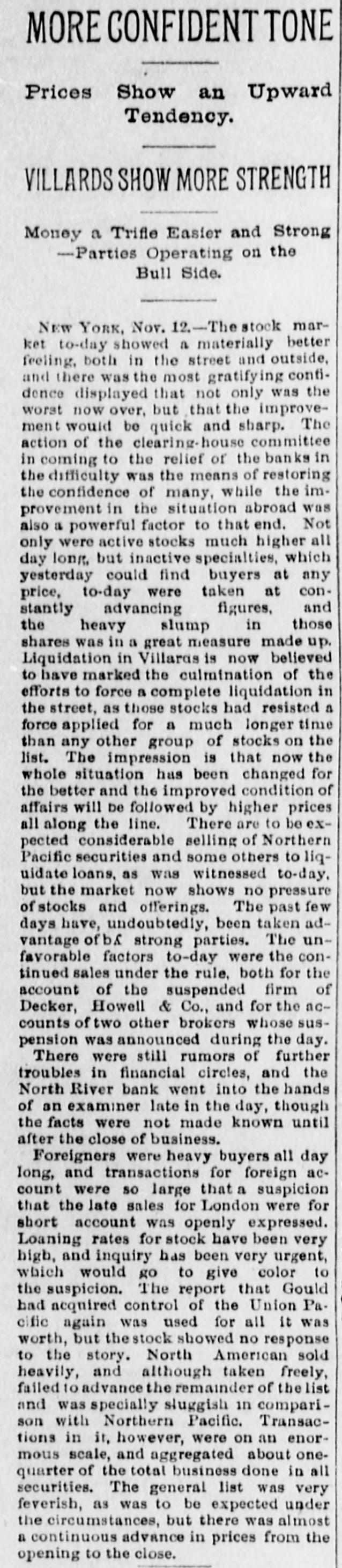
MORE CONFIDENT TONE Prices Show an Upward Tendency. VILLARDS SHOW MORE STRENGTH Money a Trifle Easier and Strong -Parties Operating on the Bull Side. NEW YORK, Nov. 12.-The stock market to-day showed a materially better feeling, both in the street and outside, and there was the most gratifying confidence displayed that not only was the worst now over, but that the improvement would be quick and sharp. The action of the clearing-house committee in coming to the relief of the banks in the difficulty was the means of restoring the confidence of many, while the improvement in the situation abroad was also a powerful factor to that end. Not only were active stocks much higher all day long, but inactive specialties, which yesterday could find buyers at any price, to-day were taken at constantly advancing figures, and the heavy slump in those shares was in a great measure made up. Liquidation in Villards is now believed to have marked the culmination of the efforts to force a complete liquidation in the street, as those stocks had resisted a force applied for a much longer time than any other group of stocks on the list. The impression is that now the whole situation has been changed for the better and the improved condition of affairs will be followed by higher prices all along the line. There are to be expected considerable selling of Northern Pacific securities and some others to liquidate loans, as was witnessed to-day, but the market now shows no pressure of stocks and offerings. The past few days have, undoubtedly, been taken advantage of b& strong parties. The unfavorable factors to-day were the continued sales under the rule, both for the account of the suspended firm of Decker, Howell & Co., and for the accounts of two other brokers whose suspension was announced during the day. There were still rumors of further troubles in financial circles, and the North River bank went into the hands of an examiner late in the day, though the facts were not made known until after the close of business. Foreigners were heavy buyers all day long, and transactions for foreign account were so large that a suspicion that the late sales for London were for short account was openly expressed. Loaning rates for stock have been very high, and inquiry has been very urgent, which would go to give color to the suspicion. The report that Gould had acquired control of the Union Pacific again was used for all it was worth, but the stock showed no response to the story. North American sold heavily, and although taken freely, failed to advance the remainder of the list and was specially sluggish in comparison with Northern Pacific. Transactions in it, however, were on an enormous scale, and aggregated about onequarter of the total business done in all securities. The general list was very feverish, as was to be expected under the circumstances, but there was almost a continuous advance in prices from the


Article from The Portland Daily Press, November 14, 1890

Click image to open full size in new tab

Article Text

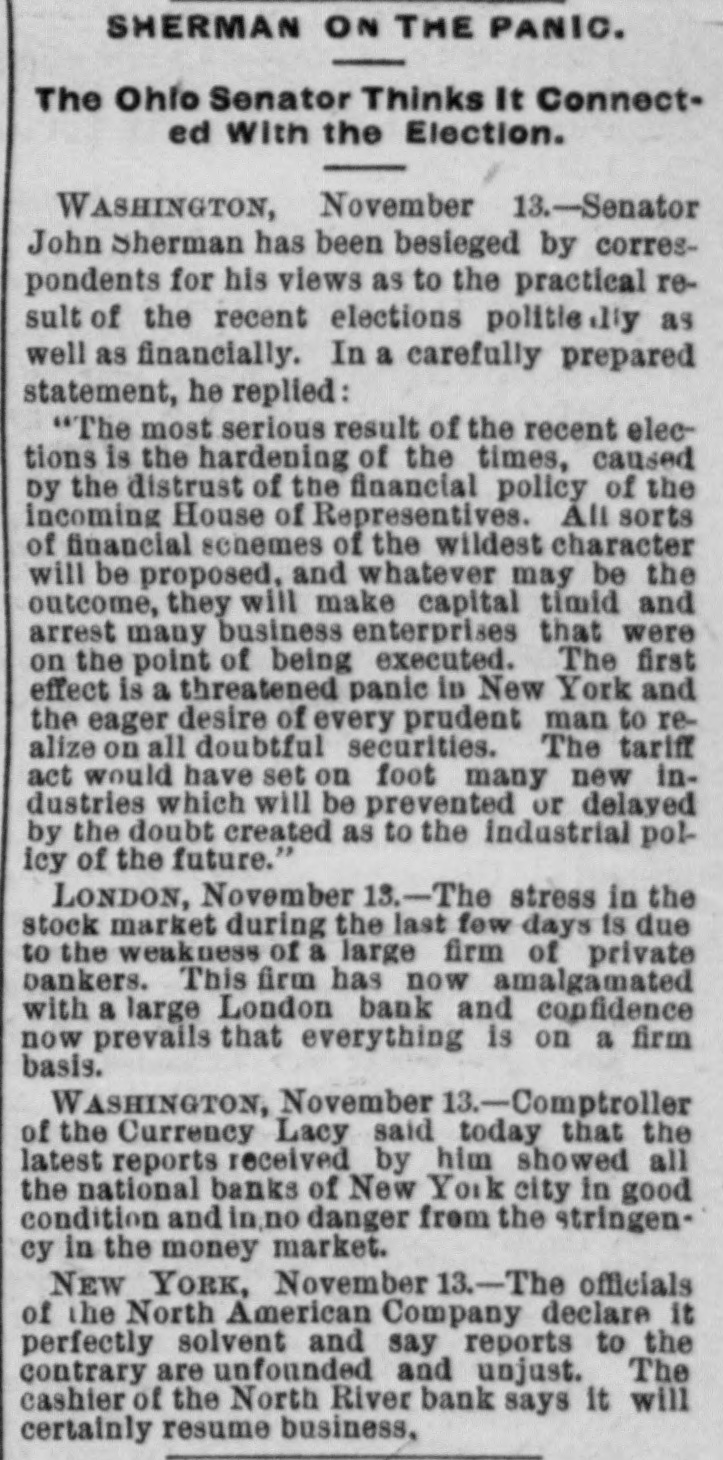
SHERMAN ON THE PANIC. The Ohio Senator Thinks It Connected With the Election. WASHINGTON, November 13.-Senator John Sherman has been besieged by correspondents for his views as to the practical result of the recent elections politie diy as well as financially. In a carefully prepared statement, he replied: "The most serious result of the recent elections is the hardening of the times, caused by the distrust of the financial policy of the incoming House of Representives. All sorts of financial schemes of the wildest character will be proposed, and whatever may be the outcome, they will make capital timid and arrest many business enterprises that were on the point of being executed. The first effect is a threatened panic in New York and the eager desire of every prudent man to realize on all doubtful securities. The tariff act would have set on foot many new industries which will be prevented or delayed by the doubt created as to the industrial policy of the future." LONDON, November 13.-The stress in the stock market during the last few days is due to the weakness of a large firm of private bankers. This firm has now amalgamated with a large London bank and confidence now prevails that everything is on a firm basis. WASHINGTON, November Comptroller of the Currency Lacy said today that the latest reports received by him showed all the national banks of New York city in good condition and in, no danger from the stringency in the money market. NEW YORK, November 13.-The officials of the North American Company declare it perfectly solvent and say reports to the contrary are unfounded and unjust. The cashier of the North River bank says it will certainly resume business.


Article from Los Angeles Herald, November 14, 1890

Click image to open full size in new tab

Article Text

THE NORTH RIVER BANK. Early Prices for Stocks Depressed on Account of Its Suspension. NEW YORK, Nov. 13.-The Post says: Early prices for stocks, both in London and in this market, were lower, the effect of the suspension of the North River bank, yesterday, together with the understanding that its losses would require it to be wound up. Later, when it became known that the fortnightly settlements in London had been completed without failure, and the Bank of England rate remained unchanged, there was a general recovery, and by 11:30 nearly every stock on the list, except North American, was up to last night's prices, and many above, notably Northern Pacific preferred, Western Union, Rock Island and Northwestern. The North River bank did not open this morning. The cashier stated that although the bank officials felt sure they would pull through all right, they could not resume business for several days. The bank examiner said a statement of the bank's affairs would be ready at noon. At the clearing house it was learned that a large contractor was debtor to the extent of $500,000. Six or seven other contractors are also debtors to the bank for large amounts. The collatterals for the security of the loans are said to be claims against the city.


Article from Rock Island Daily Argus, November 14, 1890

Click image to open full size in new tab

Article Text

ABBREVIATED TELEGRAMS. Adams Express company will nottransport lottery tickets hereafter. Fire at Syracuse, N. Y., Thursday destroyed property to the value of $75,000. The Farmers' and Merchants' National bank of Hickman, Ky., capital $50,000, has been authorized to begin business. Daniel S. Appleton, head of the publishing firm of D. Appleton & Co., died at his home in New York Thursday morning. Dr. H. M. Dexter, editor of The Congregationalist, died at his residence in Bedford, Mass, at 6:30 Thursday morning. Michael Cudahy has withdrawn from the firm of P. D. Armour & Co., in Cbtcago, and bought out the property of the firm in Omaha. An 11-year-old boy robbed Mrs. Zeigenfuss, of Bridgeport, Conn., Wednesday evening of her pocketbook. He was arrested later. The North River bank of New York city, was still suspended Thursday, and the bank examiners were busy looking over its books all day. Breadstuff exports from the United States during October aggregated in value $8,343,703 against $11,559,569 in October, 1889. Exports of the principal articles of provisions during October were valued at $11,340,574 against $9,904,010 in October, 1889.


Article from Evening Star, November 14, 1890

Click image to open full size in new tab

Article Text

THEY WILL NOT LOSE. Depositors in the North River Bank Will All Be Paid. NEW YORK, Nov. 14.-Cashier Ingersoll of the suspended North River Bank said this morning that the depositors would receive every dollar they put into the bank. The only ones who would lose anything. be affirmed, would be the stockholders. It was only possible for the bank to resume, be declared, if the directors put up the necessary money. Mr. Ingersoll denies the truth of the statement that the bank officials had closed the bank of their own volition on Wednesday afternoon. This was not done until after the arrival of Assistant Bank Examiner Cahill, and although he would not directly say so, Mr. Ingersoll strongly intimated that Mr. Cahill had ordered the bank closed before he had made a sufficient examination of the books to warrant such a proceeding. A motion for the appointment of a receiver of the North River Bank was to be argued today before Judge O'Brien in the supreme court, but Deputy Attorney General Post stated that efforts were being made to place the bank on its feet, and the matter went over till Monday next by consent.


Article from The Sun, November 17, 1890

Click image to open full size in new tab

Article Text

$800,000 SIGNED OFF. Sunday Work to Get the North River Bank Ready to Reopon. The directors of the North River Bank and many of the depositors who have signed the agreement not to draw their deposits for ninety days if the bank is opened. spent yesterday circulating lists to get more signatures to the agreement. Last night Lawyer Jones, who is the bank's counsel, said that they had succeeded very well considering that it was Sunday. They had got the signatures of depositors representing $200,000 in the bank. and that brought the amount signed off up to $800,000. leaving only $200,000 to make the amount required. This. Lawyer Jones thought, would be signed for to-day. The lists which the depositors sign contain a stipulation that the bank is to be opened to-morrow morning. If it is not opened then the agreement will be void. The directors will have to do some hustling to-day. They have not decided yet what policy to pursue to raise the additional $750,000 that will be required to meet the demands of the depositors. who will not sign off. The talk of increasing the capital stock to $500,000 is only talk yet. The Clearing House will not loan on the securities the bank holds. and some one must be found who will. But some of the loans have matured. and there is a good deal of cash on hand. The directors will hold a meeting early this morning at the bank. The application of the Apgar estate, which owns one-quarter of the stock of the bank, for the appointment of a receiver will be apposed by the bank officials and by Superintendent Preston when it comes up for argument before Justice O'Brien in the Supreme Court to-day, and it will probably be laid over until Wednesday.


Article from Telegram-Herald, November 18, 1890

Click image to open full size in new tab

Article Text

MAY OPEN TODAY. The Affairs of the North River Bank, of New York. NEW York, Nov. 17.-The directors of the North River Bank, and many of the depositors who have signed the agreement not to draw their deposits for 90 days, if the bank is opened, spent yesterday circulating lists to get more signatures to the agreement. They got the signatures of depositors representing $200,000 in the bank, and that brings the amount up to $800,000, leaving only $200,000 to make the amount required. The amount will probably be signed today. The lists which the depositors sign contain a stipulation that the bank is to be opened tomorrow morning. If it 18 not opened then, the agreement will be void. The directors have not yet decided what course to pursue to raise the additional $750,000 that will be required to meet the demands of the depositors who will not sign off. The clearing house will not loan on the securities the bank holds, and some one must be found who will. The application of the Apgar estate which owns one quarter of the stock of the bank, forappointment of a receiver, will be opposed by the bank officials and by Supt. Preston when it comes up for argument in the Supreme Court today.


Article from New-York Tribune, November 18, 1890

Click image to open full size in new tab

Article Text

held yesterday, but though many of the directors were at the bank building, no meeting was held. There was therefore no formal action taken for the further relief of the distressed institution. The fact that neither the directors nor stockholders seemed disposed to make up the large amount of money that must be had if the bank resumes, led Mr. Preston to the unfavorable conclusion which he announced last evening. Unless some heroic action is taken to-day the North River Bank will go into the hands of a receiver. All the officers of the bank, with Bank Examiners Preston and Cahill, were on hand at the bank building at a comparatively early hour yesterday morning. Between the hours of 9 a. m. and 11 a. m. at least fifty depositors entered the deserted banking-rooms for the purpose of signing the circular, and for a time a hopeful feeling prevailed. The president, Edward E. Gedney, maintained his policy of silence, as did most of the directors. The cashier, F. R. Ingersoll, estimated that the amount guaranteed to be left on deposit for ninety days had reached $800,000, and thought that the remainder could be secured within twenty-four hours. This was the highest estimate given, however, others being placed at a considerably lower figure. Mr. Ingersoll said that the amount of money needed in addition to the $1,000,000 of deposits was $750,000, the bank having already $250,000 in available cash. He said that a meeting of the directors would be held during the day, at which methods of securing the needed money would be acted upon. But in this Mr. Ingersoll proved to be mistaken. Several of the directors met informally at the bank. but left early in the afternoon with clouded faces. The Bank Examiner. C. M. Preston, was the last to leave the building. When he did so, he freely expressed his opinion that the institution must pass into the hands of a receiver. He admitted also that there had been a shrinkage in the supposed value of the assets, and that, instead of a nominal surplus of $23,000, the bank's statement would show a deficit of probably $100,000. This fact was brought out by the closer examination of the bank's collateral which Mr. Preston has been enabled to make since his first report. When the motion made on behalf of the Apgar estate for the appointment of a receiver for the North River Bank came up before Judge O'Brien in Supreme Court, Chambers, yesterday morning, it was said that negotiations were still pending for the re-establishment of the bank, and an adjournment until this morning was asked for. Deputy Attorney-General Post appeared for the Attorney-General and for Mr. Preston. Mr. Post argued that as the assets of the bank were in the possession of the estate an adjournment would not be detrimental to its interests. Ex-Judge Fancher, who appeared for the stockholders, expressed the opinion that a settlement of the bank affairs was a long way off, but said he would consent to the adjournment, with the stipulation that there should be no other application for a receiver pending the adjournment. Mr. Post objected to the stipulation on the grounds that he could not so bind the AttorneyGeneral or Superintendent Preston. Judge O'Brien. however, said he thought the stipulation was fair and granted the adjourament. Other depositors were represented by attorneys, among them being Abbott Brothers, of No. 71 Broadway, who gave notice that they would apply for the appointment of a receiver to-day. Who the receiver will be, in case an appointment is made, is not yet known. Mr. Preston sald that there were several men under consideration. James D. Hall, a liquor dealer at Dey and Greenwich sts., who is a heavy depositor in the bank, said yesterday that the depositors who signed the circular issued on Friday were asked to another designating a certain man for the receivership. sign The name of the maa could not be learned. A rumor gained credence yesterday noon that John H. Starin had offered to furnish a large portion of the money needed by the bank. Mr. Starin expressed impatience at the many rumors concerning his connection with the bank. He kept a small handed deposit there, $25,000, trouble the in the cashier and here." bank's saying, on his the behalf, Since check "I day understand then but before on Mr. the has the Starin Mercantile not you suspension made has are been in Bank the a active little offer for credited to him by rumor.


Article from The Helena Independent, November 19, 1890

Click image to open full size in new tab

Article Text

The Broken Bank. NEW YORK, Nov. 18.-Judge O'Brien issued an order requiring that it be shown forthwith why a receiver should not be appointed pending the suit which the attorney general has brought to dissolve the North River bank. A temporary injunotion was also assured restraining the bank officials from interfering with its affairs. At the conclusion of the arguments the judge reserved his decision.


Article from Perrysburg Journal, November 22, 1890

Click image to open full size in new tab

Article Text

deaths reColony 19, from which twenty-tere lays the immediate report upon Jc. sulted. responsi bility The of the section accident master, who F. Welch, the gang of workmen seph charge of the track jack that was The was that in the using accident the power on report the train also the brake have not as of the extend THE have decided to claims in was caused Kansas leaders that great organization as it Farmers' should by establish- Alliance branch, been. the scope of assessment their life insurance similarly to ing an conducted Workmen. which the Ancient is to Order be of is United imminent cars in Nefamine of to on account Union braska A FUEL coal from of the lack points in Pacific the transport in Wyoming towns to are entirely dependent mines former State. on the Many Union Pacific coal Worth, for real an fuel. W. F. SOMERVILLE, estate, of Fort stocks and asthe on signment Tex., bonds who valued owns at $500,000, 15th. His made liabilities are $200,000. 15th West Superior, Mich., on the Hilda AT Rosa Morrison, were and a boy, name while in vessel. three drowned Berg, children, Hugitt of slip unknown, witness- facing the launch lockout a in all took the place hat on A GENERAL in Danbury, Conn., disagreement be17th Hat and the Hat sociation tories the tween the owing Fur to a Manufacturers' Trimmers' people. Union. As- reThe lockout affects at 10,000 Colfax, Wash., 11% IN a M. foot Gray race ran 125 world's yards record. in cently, breaking the New York State been says River seconds, THE Banking it has North Superintendent definitely bank decided of that the business, the directors would not resume raise the funds reAT Fort Wayne, Parker, Ind., who Tom some at time ago the over the funds compelled quired. not and Edward being Ind., able to postmaster hand to McCulloch revolver, Heller's of Corners, the office at the sentenced point of to a four years were on the 17th prison. each THE in explosion the State of & a Bro. boiler at in Mertztown, the stove and works of Trexler killed three men was injured eight Pa., on the 17th others. The foundry stock York, badly THE wrecked. firm of Randall & assigned Weirum, on the The brokers of New $431,510 preferences. Wall with was a decided surprise to Supreme Court of the of failure street. 17th. judgment United goods the THE has affirmed the that all States lower court which decided were dutiable as 35 35 at worsteds known as at diagonals 24 cents and per not pound as woolens and cent. ad percent. cents ad valorem. per pound and 35 per southNEAR valorem. KYLE, Tex., on the on 17th the Interna- a bound passenger Northern train railroad was tional & Great engine hauling the into pay run into by an coach was broken were kindling car. The wood. rear Thirty killed. persons injured, but no has one secured a controlling Topeka & JAY GOULD the Atchison, secured interest in Last May he Fe stock, as Santa Fe road. of the Santa one-fourth been since that offered at low will of Robert Ray York on least and ing figures. THE in all probate that was time in he New has Hamilton child, gather- enough was the my 17th. filed fo" He bequeaths to annuity "the of $1,200 other be paid in " Several her natural but Eva adopted ing to are daughter, made, monthly life. an installments them. Hamilton dur- be- is quests not mentioned among Court of the United renTHE Supreme Blatchford, through Justice to the effect decision on through own States, dered a injured the partly 17th from his rethat negligence person is not debarred covering damages. standard silver dollars ended THE issue of during the week issue during was from November the the mints th corresponding was $757,97 week The of last year $313,965. national convention of Union the AT the Christian Temperance the Ga., on the re-election in Women's Atlanta, resulted the in 17th, follows: election Miss of C. of officers officers as Mrs. the old Willard, president; Buell, recording Miss Pugh, State Department Moussa all tary; Mary Frances E. THE A. E. corresponding Woodbridge, treasurer. secretary; has informa- secre- Bey, Mrs. the notorious American that outrages on in that quarter engaged have so has he the Department, the of banished to missionaries tion whose the attention where reported lived summarily long of Turkey has interior of Arabia. length been The sentence been convention of A STATE be held at Alliance carried will out. purpose Harrisburg, the of Farmers' organ- dele- Pa., 26, for the electing November State Alliance and Alliance convention izing a National Decemgates to to be the held at Ocala, Fla., ber ON 2. the engine of the 17th a freight the Kansas train City, of plunged six Wyan- cars a bridge through and dotte an & Northwestern near railway Kansas City,


Article from Fisherman & Farmer, November 28, 1890

Click image to open full size in new tab

Article Text

WALL STREET PANIC. A Flurry in Stocks and the Suspen sion of Three Firms. The growing scarcity of money at the financial center, New York City, culminated in the inability of three banks to make good their debit balances at the Clearing House in the morning. It was a day of wild excitement in Stock Exchange and financial circles. Decker, Howell & Co., C. C. Whitney & Co., and David Richmond suspended, the first named with liabilities of $10,000,000. The Bank of North America, the North River Bank and the Mechanics and Traders' Bank were unable to make good their balances at the Clearing House and the associated banks had to come to their relief and advance $1,300,000. Clearing House certificates will be issued and a bank panic prevented. It was also announced that the firm of Narr & Friend, at Philadelphia, one of the members of which belongs to the New York Stock Exchange, had failed, and the failure of John T. Walker, Son & Co., merchants and importers, at No. 81 Pine street, New York City, was also made public, but their suspension was only indirectly connected with the tight money market in Wall street. This monetary stringency is due to two causes-first, the exigencies of London, brought about by over-speculation in almost every part of the world in general, but in the Argentine Republic in particular; and secondly, to the almost unprecedented activity of trade in this country, which has drawn funds away from the Eastern centres. The present disturbance is a repetition of the two preceding ones. In the great depression of 1873 the first to go were the Northern Pacific stocks, which were then controled by Jay Gould, who went down in the wreck. The Northern Pacific stocks led on the decline of 1884, and buried in their ruins Henry Villard, who was the master spirit in them. The action of the Clearing House in voting to issue loan certificates to the Bank of North America and all other banks connected with it that might require assistance, went far toward relieving the panicky feeling in the market. Some idea of the great loss sustained in Wall street is afforded when it is said that twenty-three stocks showed, up to the time of the panic, a total shrinkage in value since November 1 of about $100,000,000. The associated banks of New York City have available assets of $95,000,000. Against this it was voted to issue Clearing House certificates in such volume as the situation might suggest or require.


Article from The Roanoke Times, May 5, 1891

Click image to open full size in new tab

Article Text

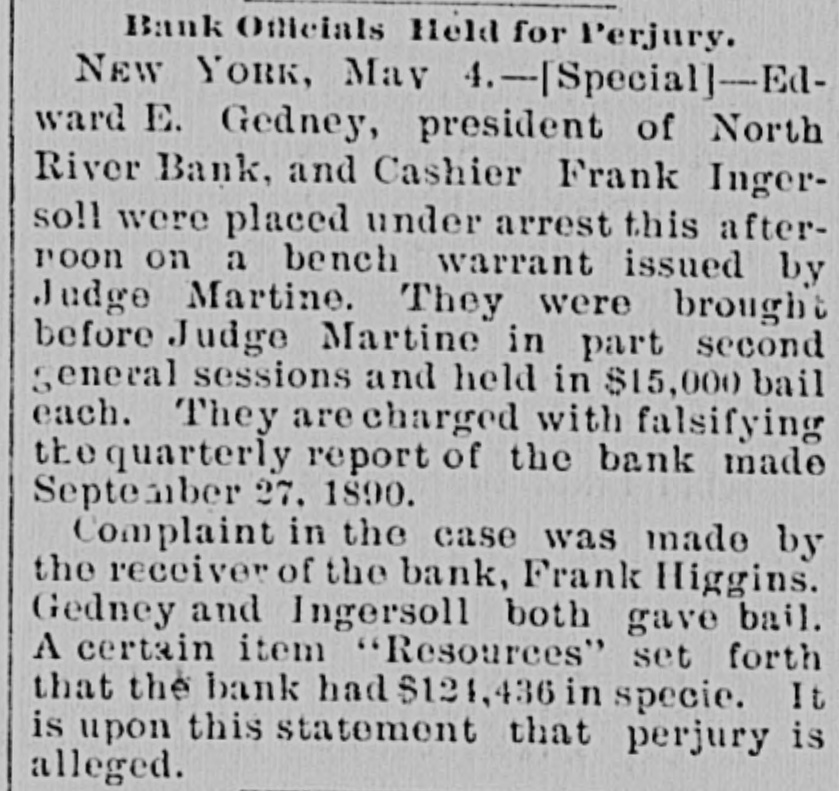
# Bank Officials Held for Perjury. NEW YORK, May 4.-[Special]-Edward E. Gedney, president of North River Bank, and Cashier Frank Ingersoll were placed under arrest this afternoon on a bench warrant issued by Judge Martine. They were brought before Judge Martine in part second general sessions and held in $15,000 bail each. They are charged with falsifying the quarterly report of the bank made September 27, 1890. Complaint in the case was made by the receiver of the bank, Frank Higgins. Gedney and Ingersoll both gave bail. A certain item "Resources" set forth that the bank had $124,436 in specie. It is upon this statement that perjury is alleged.


Article from Rock Island Daily Argus, May 5, 1891

Click image to open full size in new tab

Article Text

ABBREVIATED TELEGRAMS. Jesse H. Lippincott, lessee of the American Graphiphone company, of New York, has assigned. Congressman Allen, of Mississippi, says that in his opinion Crisp of Ge orgia will be speaker of the next house. Herman Stephonski and bis wife lost their lives in a burning building in Rochester, N. Y., Monday morning. The French government will investigate the May day shooting at Fourmies by which several civilians lost their lives. About 1,700 cigarmakers at Chicago quit work Monday. Some of the employers have already acceded to the demands of their employes. An attempted rebellion in Bolivia, South America, was suppressed. a conspiracy to assassinate the president being accidentally discovered. The "writing telegraph" was tested at New York Sunday, and several signatures were received by telegraph from Pittsburg. The test was a pronounced success. Monday the treasury purchased 326,000 ounces of silver at from $0.995 to $0.997 per ounce. Census Superintendent Porter was at Chicago Monday. He said the statistics of population would be completed within a year, or two years quicker than that of 1880. Alden J. Blethen and Thomas Lowrey have purchased The Minneapolis Tribune. Ex-Senator Pierce will remain as editor. Algernon Sartoris, who married Gen. Grant's daughter Nellie, registered at the Richelieu hotel, Chicago, from London Monday. He was going west to look at his stock ranch. Rains have quenched the New Jersey forest fires. There was a severe frost in Minnesota and Dakota Saturday night, and it is feared that small fruits are damaged. The president and cashier of the New York North River bank, now in the hands of a receiver, have been indicted for falsifying an official stat ement of the bank's condition. Another collision between the coke workers and the guard of deputies occurred at Uniontown Sunday night. One of the strikers was killed and another mortally wounded. A move is on foot at Philadelphia to organize an Italo-American league, the object of which, principally, will be to make American citizens of all Italians landing on the shores of the United States. Dispatches from Transvaal, South Africa, report that 20,000 Boers are on the point of invading Mashonaland or Manicaland, and the authorities of Transvaal are unable to fulfill their premises to prevent any further encroachment on British territory.


Article from Fort Worth Gazette, May 5, 1891

Click image to open full size in new tab

Article Text

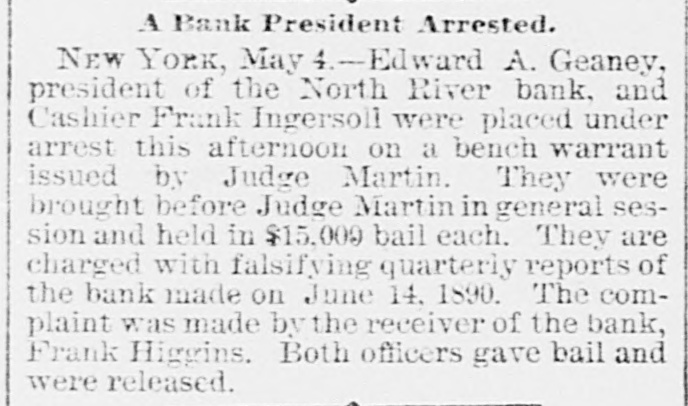
# A Bank President Arrested. NEW YORK, May 4.-Edward A. Geaney, president of the North River bank, and Cashier Frank Ingersoll were placed under arrest this afternoon on a bench warrant issued by Judge Martin. They were brought before Judge Martin in general session and held in $15,000 bail each. They are charged with falsifying quarterly reports of the bank made on June 14, 1890. The complaint was made by the receiver of the bank, Frank Higgins. Both officers gave bail and were released.


Article from Iowa County Democrat, May 15, 1891

Click image to open full size in new tab

Article Text

CRIMINAL. ALFRED TOWNLEY, a gambler. was shot and killed by his wife in the jai! of Austin, near Chicago. AT Logansport, Ind., Saturday, Martin Griner killed Anna Keyster. his mistress, and afterward committed suicide. CASHIER J. K. BRANTLY. of the St. Louis Iron Mountain & Southern is alleged to be $20,000 short in his accounts. MRS. CONN ELLY, aged 110 years, committed suicide at Hazelton, Pa., rather than be sent to the alms house. AN express car attached to a train on the Santa Fe road, near Guthrie, O.T., was boarded by robbers Saturday, but the presence of mind of the messenger saved all but $500 of the treasure. DANIEL FRIED, proprietor of a dime museum in Brooklyn, N. Y., shot himself three times Wednesday morning and died almost instantly. STRIKING quarrymen near St. Louis Tuesday drove the negroes who had taken their places away from two quarries and carried off all the tools. COLONEL DORSES, who eloped with Mrs. Massey from Douglasvile, Ga., is a defaalter, having carried away nearly $30, 000 of trust money in his flight. PRESIDENT E. E. GEDNEY and Cashier F. R. Ingersoll of the defunct North River bank of New York were arrested Monday for perjury in connection with the bank's affairs. PRESIDENT MARSH and Cashier Lawrence of the suspended Keystone National bank at Philadelphia are charged with conspiring with the late President Lucas in looting the bank of $1,000,000 CHARLES J. DICKSON, a Pueblo crank, has been arrested at New York for threatening to kill Juy Gould unless the latter COAtributed $5,000,000 to a mythical organization he called "Christ's followers.' FRIDAY evening strikers at Waveland, Ind., after they had t'ed up the road for back pay due them, stoned a passenger train, overpowered the crew and seriously injured a traveling man from Crawfordsville, Ind. He was badly cut about the head. FRIDAY night at 11 o'clock Solomon Etaw set fire to Mr. B. B. Bennett's residence in Weston, W. Va. Bennett extinguished the fire. An hour later Etaw returned and shot Bennett dead in his bedchamber. Etaw is under arrest. ANDREW A. MEYER, treasurer, and R. P. Walker, a director of the Eastern Investment company of Boston, were arrested for making alleged fradulent representations about the concern.


Article from New-York Tribune, January 12, 1893

Click image to open full size in new tab

Article Text

# JOHN HUNTINGTON DEAD. DYING IN LONDON WHILE ON HIS WAY TO AMERICA. ONE OF THE FIRST MEN TO MAKE A FORTUNE FROM THE STANDARD OIL COMPANY-THE, ALLEGED FORGERIES OF HIS NAME ON DAVID R. PAIGE'S NOTES. Cleveland, Jan. 11. The cable brought the in- telligence this morning that John Huntington died on Tuesday in London. He had entirely recovered from the stomach trouble for the relief of which he went to drink of the waters of Carlsbad, and had left Dresden and was in London on his way home. There he was taken with a severe cold which resulted in inflammation of the lungs. Mrs. Huntington is accompanied by Mrs. Morgan, of this city. She will start for home with the body as soon as the necessary arrangements can be made. A little less than two years ago his son Arthur G., aged twenty-five, was killed by being run over by a train at Amherst, Ohio. The children living are William R. Huntington, Mrs. A. C. Hurd, Mrs. E. A. Merritt, of Cleve- land, and Mrs. J. P. Smith, of Chicago. To the home-coming of Mr. Huntington was attached more than usual significance, as it was expected that he would give his attention to the Paige defalcation troubles and throw much addi- tional light upon them. Mr. Huntington was born in Preston, Lancashire, England, March 8, 1832. His father was Hugh Huntington, a pro- fessor of mathematics at Ormskirk, Lancashire, and later founder of Trinity School, Preston. Mr. Huntington emigrated to America when he was twenty-two years old, landing here August 10, 1854, and came direct to Cleveland, where he has ever since made his home. The discovery of petroleum in Pennsylvania in 1859 at- tracted his attention, and he entered the business of refining oil with Clark, Payne & Co., in December, 1863. The Standard Oil Company was formed by the con- solidation of the firm of Clark, Payne & Co. with several others. On March 8, 1889, Mr. Huntington celebrated the fifty-seventh anni- versary of his birth by founding a trust fund for the benefit of the charitable institutions of Cleveland. He set aside $200,000 of the stock of the Cleveland Stone Company, of which he was the president. It is expected that his will will give considerable more to charity and art His home on Prospect-st. contains one of the filest art collections in the State. The death of John Huntington recalls the prominent part the signatures of Mr. Huntington played in the tangled affairs of the firm of Paige, Carey & Co., the aqueduct contractors and wreckers of the North River Bank. The alleged forgeries of the name of John Huntington as indorsements on Paige's notes at any rate resulted in making David R. Paige, who formerly occupied expensive apartments in Park-ave. In this city, a fugitive from justice. Joseph Paige, who was cashier of a bank in or near Cleveland, was found guilty of swindling the bank, and was sent to the penitentiary. David Paige at the present time is said to be in the Argentine Republic, while his brother is serving out his sentence in prison. Several stories are told about the Huntington for- geries which are said to amount to $400,000. When the loose methods of Paige, Carey & Co., became known, Mr. Paige's representative who was found at the Broadway offices of the firm, said that the indorse- ments which were questioned were genuine, and that they had been obtained from Mr. Huntington by Mr. Paige when abroad. He also said that he had obtained two successive renewals of the paper. When he was asked where Mr. Paige could be found he said that he had probably gone to Europe to see Mr. Huntington for the purpose of settling the matter of the notes. It was learned afterward, however, that Mr. Paige, instead of going to see Mr. Huntington, had gone in the opposite direction. Mr. Huntington as soon as he heard about the $400,000 worth of paper which he was alleged to have indorsed, cabled to his represent- atives in Cleveland that he had not indorsed any notes for a large amount for years. The result was a panic in Cleveland, as the forged paper had been widely distributed there. John Huntington's signa- ture was as good as gold in Cleveland as it was known that his estate was worth at least $3,000,000, if not $5,000,000. He was one of the men who first made a fortune in the Standard Oil Company, and who re- tired from business six or seven years ago. In the summer he lived in Carlsbad, and in the winter in Southern France. Mr. Paige had transacted much business for Mr. Huntington in Cleveland, and as he was related to him by marriage, besides being at the head of a large firm of contractors in New-York, no surprise was expressed in Cleveland when notes amounting to hundreds of thousands of dollars in- dorsed by Mr. Huntington were placed on the Cleve- land market by Mr. Paige. Future developments, in addition to the denial from Mr. Huntington, showed that the signatures had been forged with the idea that Mr. Huntington, who was then seriously ill abroad, would not recover, and the forger hoped that the bogus signatures would not be discovered before Mr. Huntington's death, and that their genuineness would never be questioned. Things turned out differ- ently, though. In addition to the Cleveland losers, the creditors of the old North River Bank, which for so long a time has been in the hands of a receiver, may be victims, as several hundred thousand dollars of the forged paper is part of the assets of the bank- rupt bank, of which David R. Paige was a director when it failed. The receiver's attorneys hold that the Huntington signatures on Paige's notes are genuine.