14305. Rahway Savings Institution (Rahway, NJ)

Bank Information

Episode Type
Suspension → Closure
Bank Type
savings bank
Start Date
February 22, 1878
Location
Rahway, New Jersey (40.608, -74.278)

Metadata

Model
gpt-5-mini
Short Digest
4f510689

Response Measures

None

Description

Articles (Feb–Apr 1878) report the Rahway Savings Institution became embarrassed, applied to the Chancellor for court protection, was enjoined and put under a special examiner. There is no explicit description of a depositor run (crowds/withdrawal panics), but the bank stopped payments and sought court supervision; no reopening is reported in the provided articles, so classified as suspension leading to closure/receivership. OCR corrected minor punctuation; bank name as 'Rahway Savings Institution' (appears consistently).

Events (2)

1. February 22, 1878 Other
Newspaper Excerpt
THE Rahway, New Jersey, Savings Bank is said to be embarrassed, and will apply to the Chancellor for an order to suspend business. Its liabilities are $709,209, and its assets, at their face value, $753,856,
Source
newspapers
2. April 27, 1878 Suspension
Cause
Government Action
Cause Details
Managers applied for court supervision and injunction to restrain payments after depositors brought suits and heavy demands; court enjoined payments and appointed an examiner
Newspaper Excerpt
Application was made to Chancellor Runyon ... for an order to carry on the business under his supervision ... Chancellor Runyon issued an injunction ... and appointed William Silas Whitehead special master, to examine the condition of the bank
Source
newspapers

Newspaper Articles (5)

Article from The Daily Gazette, February 22, 1878

Click image to open full size in new tab

Article Text

THE Rahway, New Jersey, Savings Bank is said to be embarrassed, and will apply to the Chancellor for an order to suspend business. Its liabilities are $709,209, and its assets, at their face value, $753,856,


Article from The Sun, February 23, 1878

Click image to open full size in new tab

Article Text

A new definition of the word surplus is required for the benefit of some of the managers of savings banks. In the cases of the Rahway and Plainfield savings banks that recently stopped. the January reports showed a fair surplus. In ordinary language this would indicate that a bank had enough assets to pay its debts and something over. But the surplus meant something that existed chiefly in the imagination, and could not be found even by the most assiduous receiver.


Article from New-York Tribune, April 27, 1878

Click image to open full size in new tab

Article Text

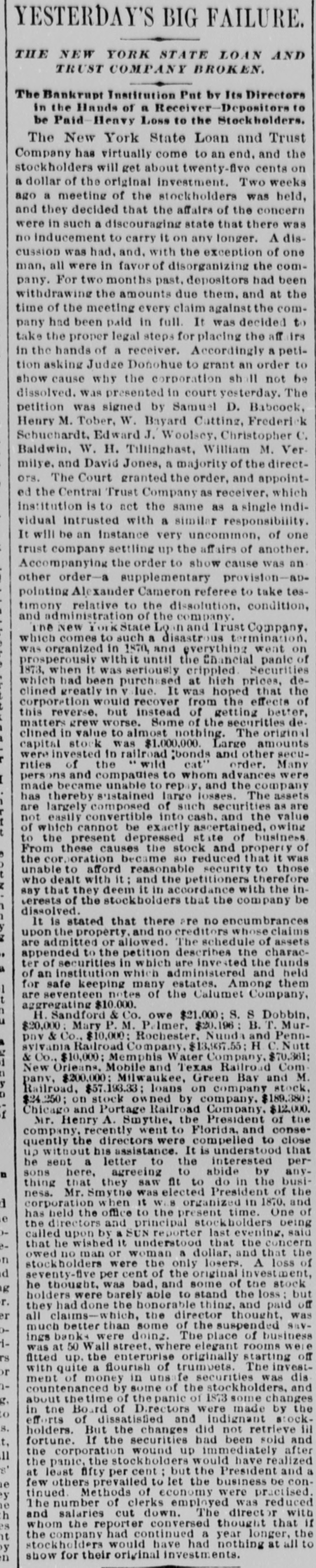
CRIPPLED NEW-JERSEY SAVINGS BANKS. EMBARRASSMENTS OF INSTITUTIONS IN RAHWAY, PLAINFIELD AND HUDSON CITY. Application was made to Chancellor Runyon by ex-Senator Stone, counsel of the Rahway Savings Institution, in Rahway, N. J., on Thursday evening, for an order to carry on the business under his supervision, as provided for by an act of the late Legislature. The petition sets forth that there was due to depositors on January 1, 1877, $798,535 81, and on January 1. 1878, $709,209 48, and that between the latter date and April 1 the demands of depositors were 80 constant that, although $200,000 had been paid, leaving $496,236 10, there still remained unpaid demands, of which the sixty days' notice had been given, of more than $75,000. The petition further sets forth that during the SIX months ended January 1. 1878, after paying $2,780 95 for taxes and expenses, and $16,581 63 in a dividend, there still remained a profit of $9,655 01, and although a loss of $3,200 occurred by shrinkage* of Government bonds, there yet remained a net profit of $6,455 01. The bank recently disposed of its manicipal bonds at par among the depositors, and it was expected that there would be no more trouble, but five of the depositors, a few days ago, brought suits on their deposit books. The petition further sets forth that paying the five depositors who have begun suits would be an invitation for others to sue the bank, and would work an injustice to others. Therefore a majority of the managers applied to the Chancellor to enjoin the suits and protect the depositors. Chancellor Runyon issued an injunction on Thursday evening, and appointed William Silas Whitehead special master, to examine the condition of the bank and report to the court as soon as practicable. Appended to the petition were schedules exhibiting the condition of the bank on January 1, 1877, and January 1, 1878. and also on April 1, 1878. The last statement shows the following:


Article from The New York Herald, April 27, 1878

Click image to open full size in new tab

Article Text

THE RAHWAY SAVINGS INSTITUTION. The Rahway Savings Institution, which has for some time past been shaking and shivering in the financial gale, has followed the example of the suspended Newark savings banks and applied to the Chancellor of New Jersey for permission to carry on business under his authority and protection. The immediate cause of this, as alleged, is that some of the depositors were making a desperate effort to overreach others, and through legal process to compel the bank to pay them individual moneys. Accordingly the Chancellor has granted an injunction, as prayed for, restraining the bank from making any payments not specified by the Court. William Silas Whitehead was appointed a special examiner to inquire into and fuily examine the condition of the bank, his report to be submitted to the Court as early as possible. The petition of the managers set forth that on January 1, 1877, there was due to depositors $798,535 81; on January 1, 1878. $709,209 48, and that between that date and April 1 succeeding the demands of a large numoor of depositors were so constant that altbough over $200,000 were paid to them during that time, leaving due $496,236 10, there still remained unpaid demands wherein sixty days' notice had been given of over $75,000. The managers further show that during the SIX months ending the first day of last January, after paying $2,778 95 for expenses and taxes and a dividend of over $16,500, there still remained a profit of nearly $50,000. Despite a shrinkage in the price of government bonds, causing a loss of $3,200, there was still a net protit 01 $6,455 01. Aspended to the petition was a schedule, showing the financial condition of the institution on April 1, as follows:$227,525 Bonds and mortgages 47,250 Real ostate 11,275 Hazlewood Cemetery bonds 13,920 Rahway Gastight Company stock 188,237 Rahway water bonds 2,200 Rahway improvement bonds Loans on collaterols 9,000 Cash 22,573 Dues from rents and other sources 1,172 Total $523,753 496,236 Due depositors. Surplus $27,517


Article from The Portland Daily Press, April 29, 1878

Click image to open full size in new tab

Article Text

# MINOR TELEGRAMS. Gen. Grant arrived in Milan Saturday. Ex-Congressman Vance has arrived in Cincinnati. He is undoubtedly insane. Work will be resumed in the mines of Schuylkill valley today. The Rahway, N. J. Savings Bank has been enjoined and an official examination ordered. Eight thousand Spanish troops will be sent to Cuba in the autumn. There is a case of genuine leprosy in the Baltimore city hospital. There was a run on the Providence savings banks Saturday. The strike of cotton spinners at Preston, Eng., has ended, but the weavers, winders and warpers still hold out. The Presidential party returned to Washington Saturday, after a tour of inspection through the Lehigh and Schuyikill valleys. Harris Piersons, a farmer between 70 and 80 years, living in Lyme, N. H., hung himself in his barn Saturday. He was insane. At least 2000 persons have been thrown out of employment by the stopping of the Border City and Sagamore mills. Hughes, on Saturday night, concluded his walk against O'Leary's time, having accomplished only 409 miles. Emma Bethel has been arrested for poisoning Rickieith Bishop and wife of Berlin, N. J., for whom she was housekeeper, and has confessed. In Honolulu the first rain of any consequence for 18 months has fallen, removing the fears of a water famine in the city. Heavy rains have caused floods in the vicinity of Melbourne, Australia. Considerable damage is reported. In South Australia a general rain has fallen. One hundred thousand foreigners are now in Paris. The prices of living have advanced. The exhibition will not be in fuil trim until June. The amount of U. S. notes retired during the month, in consequence of the issues of national bank notes, will be about $1,200,000, which will be replaced by silver. Five steamships sailed from New York Saturday for Europe, taking nearly 500 cabin passengers and large cargoes of miscellaneous produce. It is rumored that arrangements have been made in San Francisco to fit out vessels under the Russian flag to prey upon the English commerce in the Pacific. Some excitement prevails in Manchaster, N H., on account of the presence of small pox. A Lumber of persons sick with that disease have been sent to the pest house. A Brownville special says a party of 8 or 10 adherents of Lerdo has left there for Banco ranch, where there is a force of 200 men waiting an opportunity to cross into Mexico. Father Cuddihy, a Catholic priest of Milford, Mass., denounced the Ancient Order of Hibernians in the severest terms from his pulpit yesterday. The report of the House committee on foreign affairs, accompanying the bill for reopening the question of the Venezuelan awards, says the whole proceedings of the former commission wera tainted with fraud. The Mrs. R. B. Hayes Temperance Society of Washington, has discarded its name because Mrs. Hayes countenanced the use of claret punch at the dinner on the steamer in Delaware Bay. L'eut. Baldwin has been ordered to Poplar Creek, Dakota, to receive the surrender of a large number of Indians, which is expected. The Indians are out of food, hence their willingness to surrender. 9000 workmen are engaged in the Champ de Mars preparing for the Paris Exposition. The engine for driving the American machinery will be in position today. The locomotive from Philadelphia weighs two tons more than any other in the exhibitiou. An aged couple, August and Hannah Geisler, living near Youngsville, N. Y., were found horribly mutilated and dead in their house Friday morning. They had lived apart for some time, and it is thought he killed her by cutting her throat and then shot himself. Mr. Hendricks intimates that legal proceedings will result from the Florida revelations, not for the purpose of ousting the President but for the punishment of those criminals, as he styles them, whose crimes resulted in Mr. Hayes being counted in. The national executive committee of the Socialist Labor party publish a declaration denying that any section of their party in Chicago or elsewhere are under military drill. The organization, is purely political and no arms have been purchased or distributed to aby branch. The delegation of Southern Congressmen, consisting of Senators Gordon, Morgan and Jones, and Representatives Carlisle, Ellis, Yeates, Whitthorne, Clark, Hooker, Young, Money and Goode, who were invited to Boston by the Commercial Club, arrived a 9 o'clock Satarday morning and were escorted to their hotel by the club's committee. Mr. Beecher said, Friday night, in reference to a statement that he was to sue Tilton and Moulton for blackmail, that he had seen no documents, papers or witnesses on the subject, but he had heard that such papers had been spoken of to Mr. Shearman. Personally he knew nothing as to their value or what use might be made of them. James Baine, the cashier of the Salem National Bank of Indianapolis, is missing. He left a note saying that he was financially disgraced and ruined by speculation in Wall street. He had a fortune of his own. It remains to be ascertained if the bank's money has been used. On oper ing the safe some $200,000 in money and bonds were found.