14288. New Amsterdam National Bank (New York, NY)

Bank Information

Episode Type
Run β†’ Suspension β†’ Unsure
Bank Type
national
Bank ID
5783
Charter Number
5783
Start Date
October 23, 1907
Location
New York, New York (40.714, -74.006)

Metadata

Model
gpt-5-mini
Short Digest
8445fe7e8b8ba5f4

Response Measures

Borrowed from banks or large institutions, Capital injected, Full suspension, Books examined

Receivership Details

Depositor recovery rate
100.0%
Date receivership started
1908-01-30
Date receivership terminated
1909-04-14
OCC cause of failure
Losses
Share of assets assessed as good
54.9%
Share of assets assessed as doubtful
40.6%
Share of assets assessed as worthless
4.5%

Description

Articles describe heavy withdrawals/debits and Clearing House aid in Oct 1907 (panic), followed by the Comptroller ordering the bank closed and examiners/receiver taking charge on Jan 30, 1908. Receivers (Charles A. Hanna initially; J. H. Edwards later) administered affairs and plans for reopening/reorganization were discussed, but no clear article confirms full resumption of normal operationsβ€”hence 'unsure'. OCR minor fixes: 'Ridgely' corrected from 'Ridgeby' in one OCR line.

Events (6)

1. April 18, 1901 Chartered
Source
historical_nic
2. October 23, 1907 Run
Cause
Local Banks
Cause Details
Runs and loss of confidence spread after the collapse/ distress of other institutions in the Morse-Heinze-Thomas chain (Knickerbocker and National Bank of North America), producing heavy withdrawals and debit balance at the Clearing House.
Measures
Clearing House assistance extended; New Amsterdam had clearing-house advances noted and was helped by associated banks.
Newspaper Excerpt
the New Amsterdam National Bank $341,000 (debit) ... heavy withdrawals
Source
newspapers
3. January 30, 1908 Receivership
Source
historical_nic
4. January 30, 1908 Receivership
Newspaper Excerpt
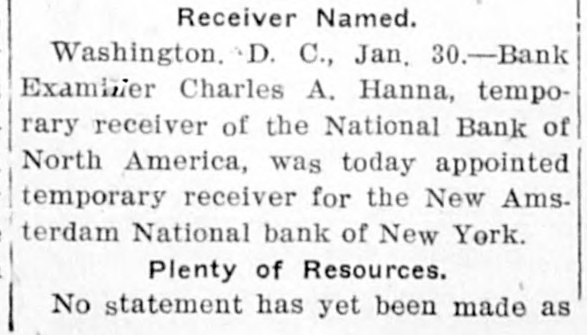
Bank Examiner Charles A. Hanna ... was today appointed temporary receiver for the New Amsterdam National bank of New York. ... Charles A. Hanna, receiver of the National Bank of North America, and of the New Amsterdam National bank ... has announced that he would be ready, beginning today, to have depositors prove their claims.
Source
newspapers
5. January 30, 1908 Suspension
Cause
Government Action
Cause Details
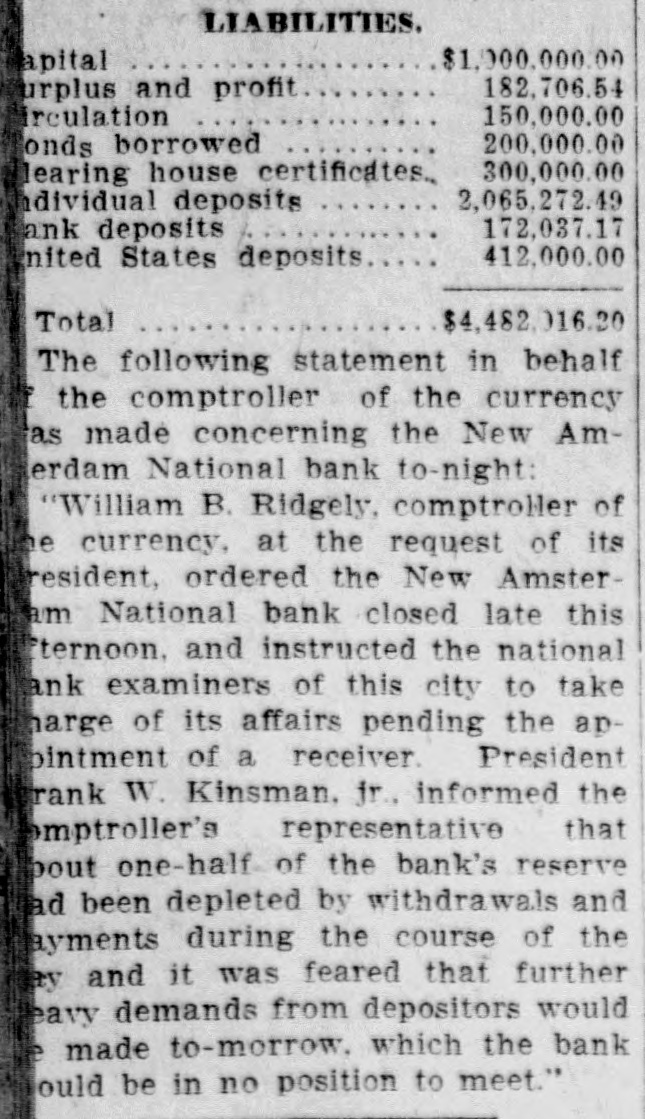
Comptroller of the Currency ordered the bank closed and directed examiners to take charge because roughly half the reserve had been depleted by withdrawals and further heavy demands were feared.
Newspaper Excerpt
William B. Ridgely, comptroller of the currency, at the request of its president, ordered the New Amsterdam National bank closed late this afternoon, and instructed the national bank examiners of this city to take charge of its affairs pending the appointment of a receiver.
Source
newspapers
6. March 16, 1908 Other
Newspaper Excerpt
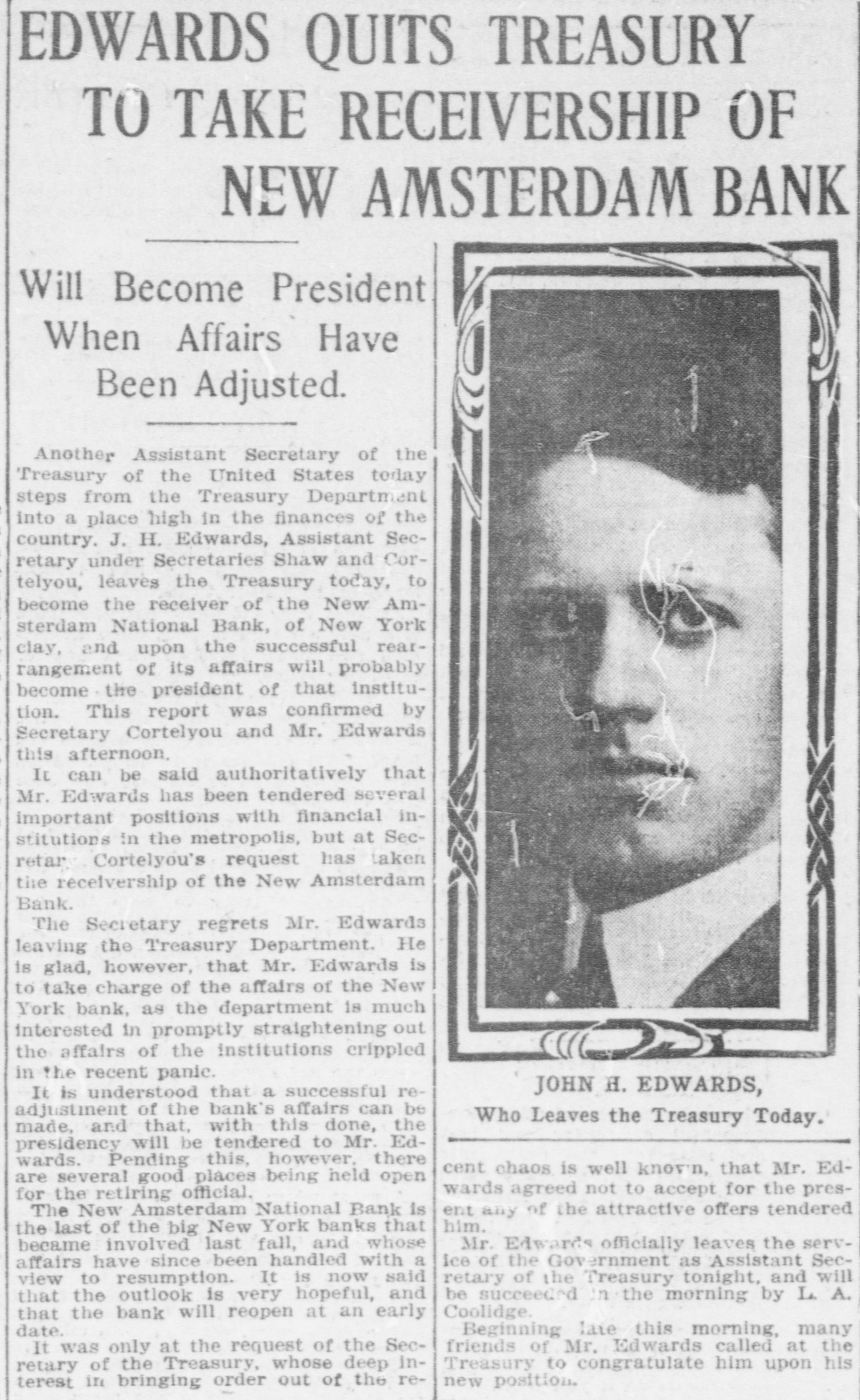
EDWARDS QUITS TREASURY TO TAKE RECEIVERSHIP OF NEW AMSTERDAM BANK ... J. H. Edwards ... leaves the Treasury ... to become the receiver of the New Amsterdam National Bank ... and upon the successful rearrangement of its affairs will probably become the president ... It is now said that the outlook is very hopeful, and that the bank will reopen at an early date.
Source
newspapers

Newspaper Articles (25)

Article from The Evening Star and Newark Advertiser, October 21, 1907

Click image to open full size in new tab

Article Text

New York Clearing House Again Assists Mercantile National. ATMOSPHERE IS CLEARED Retirement of Heinzes, Morse and Thomas From Official Connection With Chain of Financial Institutions Restores Confidence, NEW YORK, Oct. 21.-Everyone interested in Wall Street and the financial affairs in the city in general felt much easier over the banking situatien by reason of the Clearing House announcement that aid would be extended to the Morse-Heinze-Thomas banks if assistance were required. When the United Copper corner collapsed last week and was followed by the retirement of F. Augustus Heinze from the presidency of the Mercantile National Bank disquieting rumors were circulated as to the standing not only of that bank, but as to the stability of the institutions controlled by Charles W. Morse and E. R. Thomas, who were associated with Heinze in the Mercantile. These rumors rapidly spread throughout the downtown district, and they had considerable to do with the crumbling away of stock exchange prices last week. The action of the Clearing House, however, following the retirement of Morse, Thomas and Heinze from their New York banks, cleared the financial atmosphere considerably, and sentiment in and around the Stock Exchange was more cheerful today than for some weeks. The Clearing House committee was again in session this morning to deal with the developments which might arise in the banking situation. Manager Sherer, of the Clearing House, said that institution had the situation under control, that all the undesirable elements had been eliminated, and for this reason there would begin a new era in banking in New York. It was officially denied that it would be necessary to issue Clearing House certificates in order to secure support for the banks which have been under criticism. The Mercantile National Bank today owed the Clearing House on balance $1,900,000. The National Bank of North America owed the Clearing House $850,000 on balance. These sums were unexpectedly large and indicated that I heavy withdrawals were being made from these two banks. The sum owed by the Mechanics and Traders' National Bank was $430,000 and that owed by the New Amsterdam National Bank $200,000. The Clearing House Committee decided at the meeting today to assume the responsibility for the Mercantile National Bank's large debit balance. This is the third consecutive day on which the associated banks have gone to the assistance of the Mercantile. Seth M. Milliken, the newly elected president of the Mercantile National Bank, said today that, counting out the Heinze-Morse loans, the assets of the bank are one dollar and forty cents for every dollar of liability, and that o the loans in question are of value. Besides choosing new officers for the as Heinze-Morse-Thomas banks and announeing that each and every one was in a solvent condition, a most important step has been taken here. This is the pledging of a fund of $10,000,000 by a score of individual banks to render such assistance as the Clearing House committee may think necessary. The meeting at which this was done was the most notable gathering of bankers that any occasion in recent years has brought together. The deposits of the

Article from Evening Star, October 23, 1907

Click image to open full size in new tab

Article Text

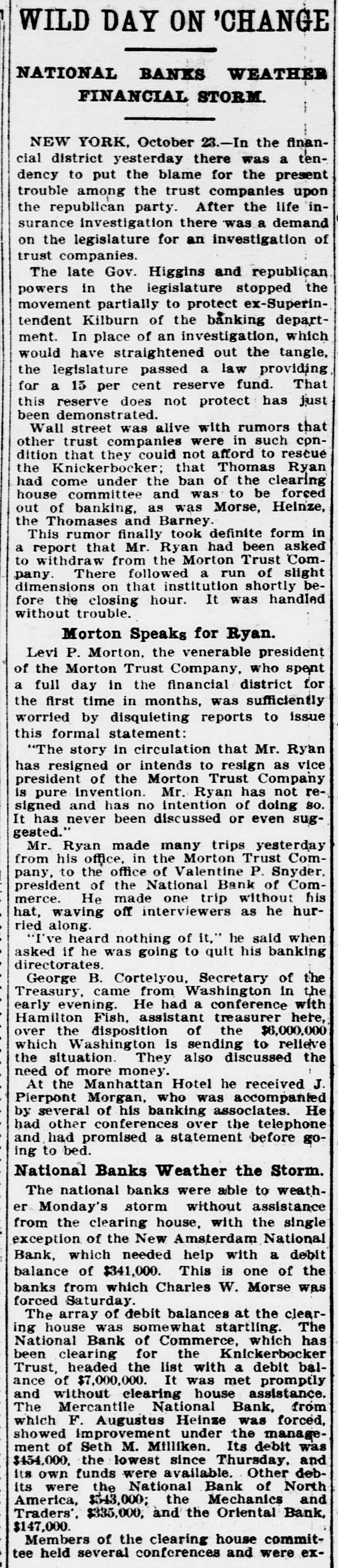
WILD DAY ON 'CHANGE NATIONAL BANKS WEATHER FINANCIAL STORM. NEW YORK, October 23.-In the financial district yesterday there was a tendency to put the blame for the present trouble among the trust companies upon the republican party. After the life insurance investigation there was a demand on the legislature for an investigation of trust companies. The late Gov. Higgins and republican powers in the legislature stopped the movement partially to protect ex-Superintendent Kilburn of the banking department. In place of an investigation, which would have straightened out the tangle, the legislature passed a law providing for a 15 per cent reserve fund. That this reserve does not protect has just been demonstrated. Wall street was alive with rumors that other trust companies were in such condition that they could not afford to rescue the Knickerbocker: that Thomas Ryan had come under the ban of the clearing house committee and was to be forced out of banking, as was Morse, Heinze, the Thomases and Barney. This rumor finally took definite form in a report that Mr. Ryan had been asked to withdraw from the Morton Trust Company. There followed a run of slight dimensions on that institution shortly before the closing hour. It was handled without trouble. Morton Speaks for Ryan. Levi P. Morton, the venerable president of the Morton Trust Company, who spent a full day in the financial district for the first time in months, was sufficiently worried by disquieting reports to issue this formal statement: "The story in circulation that Mr. Ryan has resigned or intends to resign as vice president of the Morton Trust Company is pure invention. Mr. Ryan has not resigned and has no intention of doing so. It has never been discussed or even suggested." Mr. Ryan made many trips yesterday from his office, in the Morton Trust Company, to the office of Valentine P. Snyder, president of the National Bank of Commerce. He made one trip without his hat, waving off interviewers as he hurried along. "I've heard nothing of it," he said when asked if he was going to quit his banking directorates. George B. Cortelyou, Secretary of the Treasury, came from Washington in the early evening. He had a conference with Hamilton Fish, assistant treasurer here, over the disposition of the $6,000,000 which Washington is sending to relieve the situation. They also discussed the need of more money. At the Manhattan Hotel he received J. Pierpont Morgan, who was accompanied by several of his banking associates. He had other conferences over the telephone and had promised a statement before going to bed. National Banks Weather the Storm. The national banks were able to weather Monday's storm without assistance from the clearing house, with the single exception of the New Amsterdam National Bank, which needed help with a debit balance of $341,000. This is one of the banks from which Charles W. Morse was forced Saturday. The array of debit balances at the clearing house was somewhat startling. The National Bank of Commerce, which has been clearing for the Knickerbocker Trust, headed the list with a debit balance of $7,000,000. It was met promptly and without clearing house assistance. The Mercantile National Bank, from which F. Augustus Heinze was forced, showed improvement under the management of Seth M. Milliken. Its debit was $454,000, the lowest since Thursday, and its own funds were available. Other debits were the National Bank of North America, $543,000; the Mechanics and Traders', $335,000; and the Oriental Bank, $147,000. Members of the clearing house committee held several conferences and were ex-


Article from The Barre Daily Times, October 23, 1907

Click image to open full size in new tab

Article Text

Trust Company of America Besieged Today CLAIMS IT IS COMPETENT The Knickerbocker Trust Company, Which Suspended Payment Yesterday Is Now in the Hands of the State Banking Department, New York, Oct. 23.-The state bank ing department has taken charge of the Knickerboeker Trust company, and it was officially stated that the bank would not open for business this morning. In spite of it, hundreds of people congregated about the doors, and the police reserves have been called out to control them. The Trust company of America opened with its counters stacked with enormous piles of money, prepared for a run. Before nine o'clock a double line of depositors was waiting for the open ing. The company claims it has money enough on hand to meet all demands There was the same condition at the Colonial branch of the company. The Knickerbocker Trust company, the storm center yesterday, paid out cash to depositors at the rate of $44,444 a minute for three hours and then closed its doors. At a meeting of the directors of the Hudson Trust company held yesterday, the resignation of Orlando F. Thomas as president was formally accepted, and E. R. Chapman was selected as head of the institution in his place. Other Banks Wouldn't Help. President Higgins, the new president of the Knickerbocker. when asked if the other trust company presidents were reluctant to help out his bank, replied: Reluctant is no name for it. They seemed to feel that they ought to hold on to all the money they had. One of them said to me: We might have help ed you out. but here you have closed your doors. You mean that you don't want to ride a dead horse, I said, 'but I wish you to distinctly understand that the Knickerbocker is not a dead horse, and what are you going to do about it Mr. Higgins would not say what was answered Bauks That Were Helped. The clearing house committee went into session shortly after ten o'clock yesterday and announced the following debit balances of bank: Mercantile National bank, $454,000; National Bank of North America, $543. 000: National Bank of New Amsterdam. $340,000; the Mechanics' and Traders' National bank, $335,000; the National Bank of Commerce, $7,000,000. It was sofficially announced that the clearing house committee had rendered assistance yesterday to the Mercantile National bank, the National Bank of North America and the National Bank of New Am sterdam. It was stated that the large debit balance of the National Bank of o Commerce represented the clearances of the Knickerbocker Trust company. Cortelyou's Coming Gave Strength. V Secretary of the Treasury Cortelyou o teached New York from Washington at e 9:30 last night. He was met at Jerby Hamilton Fish, assistant il United States treaurer, and the two the u were in earnest conversation during ferry trip to New York. Upon reaching A this city they went at once to the Hotel Manhattan, where several bankers later k presented to the secretary the various phases of local financial conditions. h Secretary Cortelyou is here to thor oughly look into the financial situation, for si which he has had under observation R ,several weeks. He has come with no of ideas of how much money to relieve the h P and will preconceived be required relief situation the matter of treasury meas he will be determined by what to ures learns. He will do all that he can relieve the present stress. Secretary of the Treasury George B. made the before one o'clock this shortly Cortelyou following morning: statement leaving "I repeat what I stated before for no P this afternoon if at other Washington reason than to emphasize the It titude of the treasury department in every will use its facilities to assist interests way legitimate business and thor and proper its action will be prompt at tr ough national banks of New York condition City in 'The in an exceptionally strong to be te are general situation here looked seems after U The in hand, and is being men, fil well many strong and influential in the ed by those whose recent action public it such as house received emphatic similar ha clearing The movement for trust com ne approval. of action among the and far of concert should have a helpful the day panies effect. I shall spend at the B con reaching tomorrow sub-treasury. made from a th statement was situation el This on the local banking between Γ©e ference the Hotel Manhattan Geo al held at Cortelyou, J. P. Morgan, Frank A th Secretary Perkins, George F. Baker, and J. G. fr W Vanderlip, James Stillman Cannon. ha pa and TND GREAT DEPIL


Article from The Salt Lake Herald, October 24, 1907

Click image to open full size in new tab

Article Text

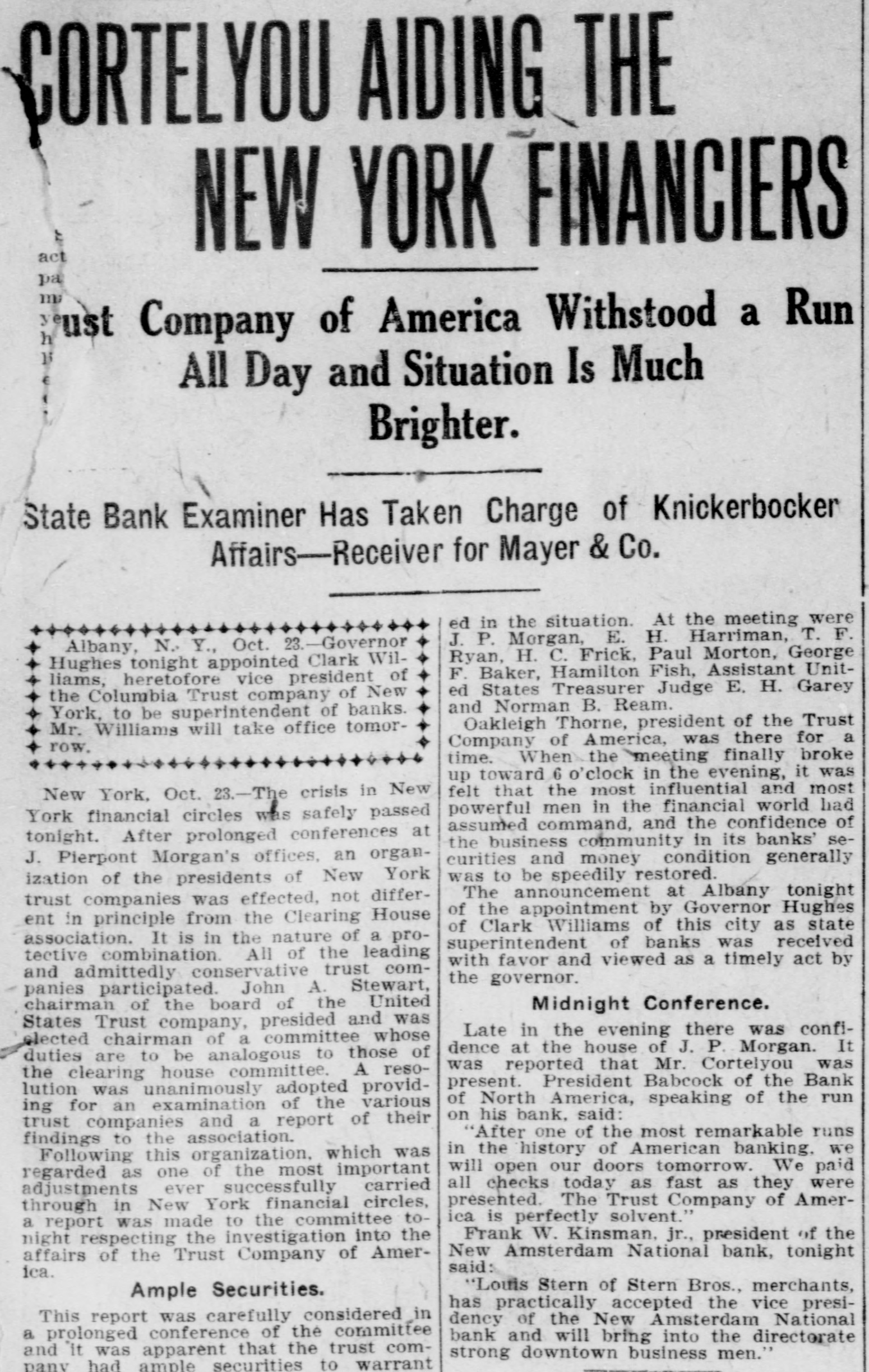
CORTELYOU AIDING THE NEW YORK FINANCIERS act mi ust Company of America Withstood a Run h All Day and Situation Is Much Brighter. State Bank Examiner Has Taken Charge of Knickerbocker Affairs-Receiver for Mayer & Co. ed in the situation. At the meeting were J. P. Morgan, E. H. Harriman, T. F. Albany, N. Y., Oct. 23.-Governor Ryan, H. C. Frick, Paul Morton, George Hughes tonight appointed Clark WilF. Baker, Hamilton Fish, Assistant Unitliams, heretofore vice president of ed States Treasurer Judge E. H. Garey the Columbia Trust company of New and Norman B. Ream. York, to be superintendent of banks. Oakleigh Thorne, president of the Trust Mr. Williams will take office tomorCompany of America, was there for a row. time. When the meeting finally broke up toward 6 o'clock in the evening, it was felt that the most influential and most New York, Oct. 23.-The crisis in New powerful men in the financial world had York financial circles was safely passed assumed command, and the confidence of tonight. After prolonged conferences at the business community in its banks' seJ. Pierpont Morgan's offices, an organcurities and money condition generally was to be speedily restored. ization of the presidents of New York The announcement at Albany tonight trust companies was effected, not differof the appointment by Governor Hughes ent in principle from the Clearing House of Clark Williams of this city as state association. It is in the nature of a prosuperintendent of banks was received tective combination. All of the leading with favor and viewed as a timely act by and admittedly conservative trust comthe governor. panies participated. John A. Stewart, chairman of the board of the United Midnight Conference. States Trust company, presided and was Late in the evening there was confielected chairman of a committee whose dence at the house of J. P. Morgan. It duties are to be analogous to those of was reported that Mr. Cortelyou was the clearing house committee. A resopresent. President Babcock of the Bank lution was unanimously adopted providof North America, speaking of the run ing for an examination of the various on his bank, said: trust companies and a report of their "After one of the most remarkable runs findings to the association. in the history of American banking, we Following this organization, which was will open our doors tomorrow. We paid regarded as one of the most important all checks today as fast as they were adjustments ever successfully carried presented. The Trust Company of Amerthrough in New York financial circles, ica is perfectly solvent." a report was made to the committee toFrank W. Kinsman. jr., president of the night respecting the investigation into the New Amsterdam National bank, tonight affairs of the Trust Company of Amersaid: ica. "Louis Stern of Stern Bros., merchants, Ample Securities. has practically accepted the vice presiThis report was carefully considered in dency of the New Amsterdam National a prolonged conference of the committee bank and will bring into the directorate and it was apparent that the trust comstrong downtown business men." panv had ample securities to warrant


Article from The Morning Journal-Courier, January 30, 1908

Click image to open full size in new tab

Article Text

LIABILITIES. $1,000,000.00 apital 182.706.54 urplus and profit Ireulation 150,000.00 200,000.00 onds borrowed 300,000.00 learing house certificates. 2,065,272.49 dividual deposits 172,037.17 ank deposits 412,000.00 nited States deposits Total $4,482,016.20 The following statement in behalf i the comptroller of the currency as made concerning the New Amerdam National bank to-night: "William B. Ridgely, comptroller of e currency, at the request of its resident, ordered the New Amsteram National bank closed late this ternoon. and instructed the national ank examiners of this city to take large of its affairs pending the apointment of a receiver. President rank W. Kinsman. jr., informed the emptroller's representative that bout one-half of the bank's reserve ad been depleted by withdrawals and ayments during the course of the ty and it was feared that further eavy demands from depositors would made to-morrow. which the bank e ould be in no position to meet."


Article from The Laramie Republican, January 30, 1908

Click image to open full size in new tab

Article Text

Receiver Named. Washington. D. C., Jan. 30.-Bank Examiler Charles A. Hanna, temporary receiver of the National Bank of North America, was today appointed temporary receiver for the New Amsterdam National bank of New York. Plenty of Resources. No statement has yet been made as


Article from Daily Kennebec Journal, January 31, 1908

Click image to open full size in new tab

Article Text

company explained that the reduction was made owing to the financial condition of the country which had caused the factory to run on shorter time. The men affected are those who have been working on a 40-hour a week schedule since the Draper plant reduced the hours of labor several weeks ago. Officials of the Illinois Steel Co. announced that Plate Mills No. 1 and 2 at Chicago will resume operations next Monday and furnish employment for 1500 men. The mills were closed two weeks ago for repairs. Mrs. Catherine Cummings, who was injured in an electric car collision at Westport Wednesday night, it was reported at Fall River City hospital Thursday, was improving, and considered in a fair way to recovery. William H. Meutsch, a carriage maker. at 419 Armitage avenue, Chicago, shot and killed one of his daughters, five years old, and fatally wounded his two other little children Thursday. The exact cause of the tragedy is not known. but according to the police Meutsch recently quarreled with his wife because of the children. Nine miners met sudden death Thursday in the New River colliery known to miners as the Lower Boone mine. near Hawks' Nest, W. Va. An explosion partially wrecked the mine. About 25 men were in the mine at the time. Those who escaped suffered only slight injuries. The Lower Boone mine is the property of the Boone Coal and Coke Co. It is a small one. The cause of the explosion has not been definitely ascertained. A bill providing for the merger of the West End Street Railroad with the Boston Elevated. which has for a long time held the former road under lease, was before the Massachusetts legislative committee on street railways Thursday for its public hearing. President Bancroft of the Elevated told the committee that the bill was mainly devised to do away with the great and unnecessary expense of keeping the financial accounts of the two roads separate. Bank examiners Thursday took active charge of the affairs of the New Amsterdam National Bank and the Mechanics and Traders Bank, a state institution, both of which closed their doors Wednesday in New York City. Both of these banks were included in the chain of banks controlled by Charles W. Morse, F. Augustus Heinze, and E. R. Thomas, and after the closing of the National Bank of North America, a few days ago, there had been practically what amounted to runs by depositors upon them. A serious conflict appears to be impending between Russia and AustriaHungary over the Austrian plans for the establishment of direct railroad connections between Vienna, Saloniki and Athens, as announced a few days ago by Baron Von Aeheenthal, the Austro-Hungarian minister of foreign affairs, in his annual statement before the foreign affairs committee of the Hungarian delegation. This is regarded at St. Petersburg as likely to upset the whole Balkan situation and rupture the concert of powers on which the continuance of reform work in Macedonia depends. At a meeting Thursday at Providence, R. I., of the board of directors of the United Iluminating Co., which controls gas and electric light companies in Maine and Vermont, M. Curtis Fletcher, president of the concern, resigned and H. Dudley Hart was elected in his place. Ruth L Howe, one of the director, who also has been acting as secretary and treasurer of the corporation, also resigned. These resignations came as the result of a meeting of the stockholders of the corporation in Providence last Monday when charges of mismanagement were made. The concern controls gas and electric lighting companies In


Article from The Sun, January 31, 1908

Click image to open full size in new tab

Article Text

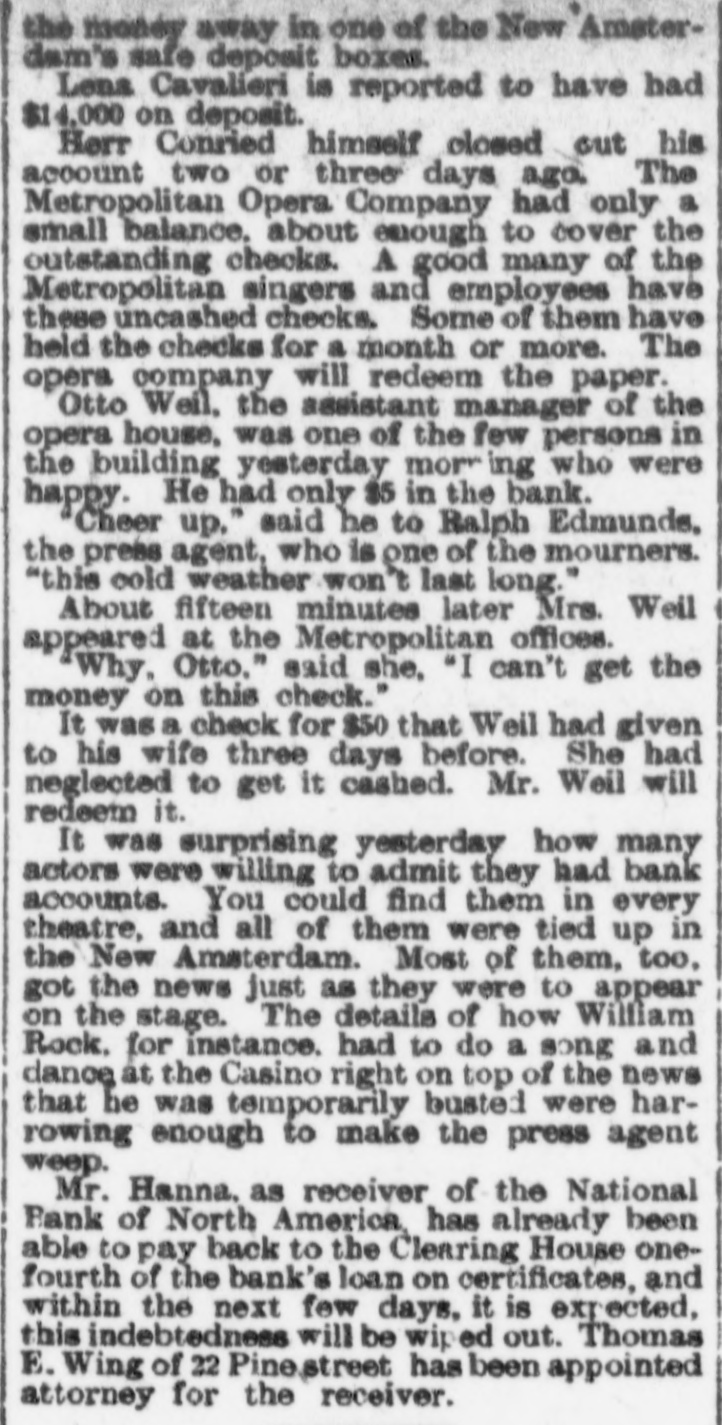
the money away in one of the New Amsterdam's safe deposit boxes. Lena Cavalieri is reported to have had $14,000 on deposit. Herr Conried himself closed cut his account two or three days ago. The Metropolitan Opera Company had only a small balance. about enough to cover the outstanding checks. A good many of the Metropolitan singers and employees have these uncashed checks. Some of them have held the checks for a month or more. The opera company will redeem the paper. Otto Weil, the assistant manager of the opera house, was one of the few persons in the building yesterday morn ing who were happy. He had only $5 in the bank. Cheer up." said he to Ralph Edmunds, the press agent, who is one of the mourners. "this cold weather won't last long." About fifteen minutes later Mrs. Weil appeared at the Metropolitan offices. "Why, Otto." said she, "I can't get the money on this check." It was a check for $50 that Weil had given to his wife three days before. She had neglected to get it cashed. Mr. Weil will redeem it. It was surprising yesterday how many actors were willing to admit they had bank accounts. You could find them in every theatre, and all of them were tied up in the New Amsterdam. Most of them, too, got the news just as they were to appear on the stage. The details of how William Rock. for instance. had to do a song and dance at the Casino right on top of the news that he was temporarily busted were harrowing enough to make the press agent weep. Mr. Hanna. as receiver of the National Bank of North America. has already been able to pay back to the Clearing House onefourth of the bank's loan on certificates, and within the next few days, it is expected, this indebtedness will be wiped out. Thomas E. Wing of 22 Pinestreet has been appointed attorney for the receiver.


Article from New-York Tribune, February 1, 1908

Click image to open full size in new tab

Article Text

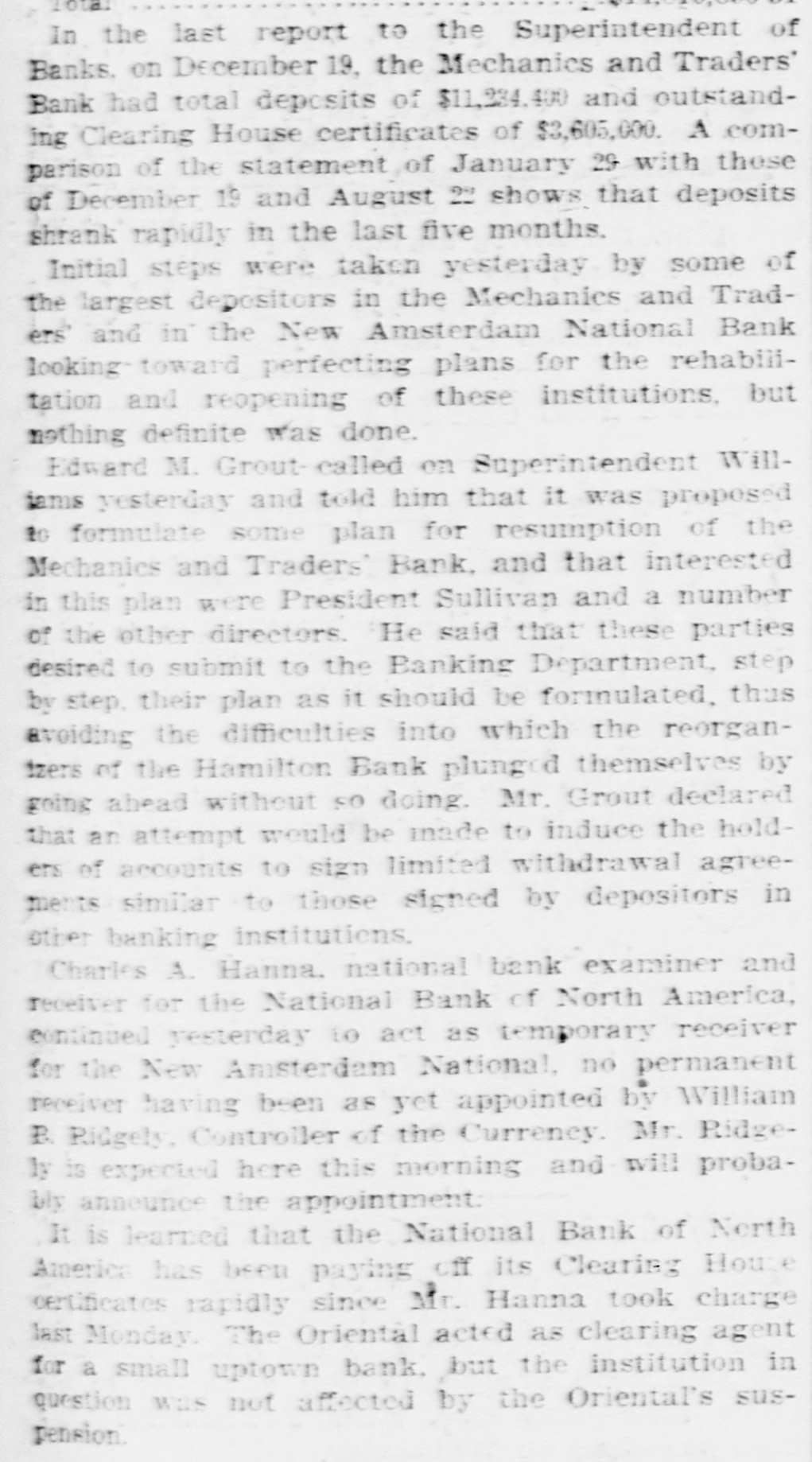
TOTAL In the last report to the Superintendent of Banks on December 19, the Mechanics and Traders' Bank had total deposits of $11,234,400 and outstanding Clearing House certificates of $3,605,000. A comparison of the statement of January 29 with these of December 19 and August 2 shows that deposits shrank rapidly in the last five months. Initial steps were taken yesterday by some of the largest depositors in the Mechanics and Traders' and in the New Amsterdam National Bank looking-toward perfecting plans for the rehabilitation and reopening of these institutions, but nothing definite was done. Edward M. Grout-called on Superintendent Williams yesterday and told him that it was proposed to formulate some plan for resumption of the Mechanics and Traders' Bank. and that interested in this plan were President Sullivan and a number of the other directors. He said that these parties desired to submit to the Banking Department, step by step. their plan as it should be formulated, thus avoiding the difficulties into which the reorganizers of the Hamilton Bank plunged themselves by going ahead without so doing. Mr. Grout declared that an attempt would be made to induce the holders of accounts to sign limited withdrawal agreements similar to those signed by depositors in other banking institutions, Charles A. Hanna. national bank examiner and receiver for the National Bank of North America, continued yesterday to act as temporary receiver for the New Amsterdam National, no permanent receiver having been as yet appointed by William B. Ridgely, Controller of the Currency. Mr. Ridgeby is expected here this morning and will probably announce the appointment. It is learned that the National Bank of North America has been paying off its Clearing House certificates rapidly since Mr. Hanna took charge last Monday. The Oriental acted as clearing agent for a small uptown bank. but the institution in question was not affected by the Oriental's suspension


Article from The Lamar Register, February 5, 1908

Click image to open full size in new tab

Article Text

The Standard Oil company has acquired a monopoly of the oil business in South Africa. After withstanding a run for one day the Oriental bank at New York failed to open its doors. The South Carolina legislature has killed the state-wide prohibition bill. The operating vice-presidents of a large number of railroads held a con ference with President Roosevelt for the purpose of securing delay in the enforcement of certain laws about to become operative. They were referred to the interstate commerce commis sion. The act of congress of June 1, 1898, prohibiting railroad companies from discriminating against members of labor organizations in the matter of employment has been declared unconstitutional by the United States supreme court. The Pittsburg, Pa., stock exchange has opened for business after having been closed three months on account of the financial flurry. With the swearing in of George P. Wetmore as senator from Rhode Island the membership of the senate is increased to 92 for the first time in the history of the country. The recent argument of District Attorney Jerome in the Thaw case was in decided contrast to that of the former trial. Instead of abuse for the defendant and his wife, he had only kind words for young Mrs. Thaw and denounced Stanford White in unmeasured terms. The Oriental bank at New York successfully withstood a run of depositors who were frightened by the failure of the New Amsterdam and Mechanic and Traders' banks. At a recent auction sale in London American buyers succeeded in getting the flag of the American man-of-war Chesapeake and the "Balaclava Bugle," two or the most valuable relics offered. The Carnegie Hero Fund commission has donated $25,000 to the widows and children of 250 victims of the Jacob's Creek (Pa.) mine disaster. The Oklahoma house has passed a measure prohibiting the smoking of cigarettes in the state. The taking of testimony in the government's suit to dissolve the tobacco trust, has been transferred from New York to Louisville, Ky. The warehouse of Henry Coburn & Co., in Indianapolis, was recently destroyed by fire. The loss on building and contents aggregated $1,000,000. James Short, an old settler of Lyon county, Kan., and a civil war veteran, committed suicide at Emporia recently. The 17th annual banquet of the Kansas Day club was held at Topeka as usual. S. J. Haskins, of Olathe, was chosen president for next year. The new reciprocity agreement between France and the United States was recently signed at Washington by Secretary Root and Ambassador Jusserand. The taking of evidence in the Thaw case was brought to a sudden end when District Attorney Jerome refused to put witnesses on the stand to rebut the testimony of alienists for the defense. The supreme court of Ohio has declared the state primary law to be valid. Two thousand delegates attended the 20th annual convention of the Southwestern Lumbermen's association recently held in Kansas City. t At Newton, Kan., a fire in the business district destroyed six stores cause ing a loss of $150,000. a Coal operators in the Oklahoma field have so far refused to grant an increase in wages to miners and unless such action is taken before April 1 a strike of 10,000 will result. The Northern Pacific Railroad company has been fined $100 at Helena, Mont., for violating the 16-hour law a by compelling a crew to work 23 consecutive hours. The case will be appealed to test the law. The New Amsterdam bank and the Mechanics' and Traders' bank of New


Article from The Mena Weekly Star, February 6, 1908

Click image to open full size in new tab

Article Text

YORK EXCITED AGAIN Closing of Two Banks Causes Small Flurry Among Depositors in Other Institutions. THE ORIENTAL BANK WITHSTANDS A RUN When the New Amsterdam National and Mechanics' and Traders' Failed to Open, Depositors in Other Banks Became Scared and Began to With draw Their Money.


Article from The Brandon News, February 6, 1908

Click image to open full size in new tab

Article Text

Effect is Small. Memphis, Tenn.-Announcement of the suspension of two banking institutions in New York had little effect in financial circles there. The fact that both institutions were known to have been carried by the clearing house banks through the serious panic times was generally known, and their failure to keep on their feet after they were put on their feet is no surprise. Bank examiners took active charge of the affairs of the New Amsterdam National bank and the Mechanics and Traders' bank, a state institution. Both of these banks were included in the Morse-Heinz chain of banks, and after the closing of the National Bank of North America a few days ago there had been what practically amounted to runs upon them. Both of them were still unable to take up their allotment of the certificates which the clearing house issued during the stringency beginning in October, and when the renewed drain upon their resources began, the clearing house authorities declined to further extend their credit.


Article from Twice-A-Week Plain Dealer, February 7, 1908

Click image to open full size in new tab

Article Text

America, the New Amsterdam bank and the Mechanics and Traders'. The Morse-Heinze-Thomas connection with these banks had weakened public confidence, and it was feared that runs would be made which the institutions could not meet. Therefore as a safeguard they were placed in the hands of the federal banking authorities. All are said to be solvent, and it was expected that depositors would be paid in full and that the banks would be able to resume business in a short time. After withstanding a run on the previous day and fearing a continuance, the directors of the Oriental bank decided to close its doors and turn the bank over to the state banking officials. The reason for this action was the disclosure at the clearing house of a debit balance of $939,000. # Steel Trust's Big Earnings. Despite the unfavorable showing of the last quarter of the year, the records of the steel trust show that its profits for 1907 were $160,984,477, which is over $6,000,000 in excess of the previous high water mark, reached in 1906. The October earnings, immediately preceding the financial and industrial disturbance, were the largest in the history of the corporation. The directors have declared dividends for the last quarter of the year of 1ΒΌ per cent on the preferred and one-half of 1 per cent on the common stock. The first five years of the profit sharing plan of the trust have nearly closed, and it is reported in Wall street that those of its employees who have continuously held the preferred stock purchased when the plan was first announced in 1903 will receive an extra dividend of 65.4 per cent. # McCurdy Laughs at Suits. Richard A. McCurdy, former president of the Mutual Life Insurance company, who has spent two years in Europe, recently returned to his home in Morristown, N. J. When asked about the suits for the restitution of several million dollars which the management of his old company had brought against him he laughed and said: "I have lawyers, and they will take care of the suits. They are not worth talking about. I am seventy-three years old. The real question is, Which will last the longer, the suits or myself?" # Pittsburg Exchange Opens. The Pittsburg Stock Exchange, closed since Oct. 23 last, opened for business Jan. 27. There was a tendency on the part of the brokers to withhold sales, and only 271Β½ shares changed hands. The reopening of the exchange has already restored confidence to a notable degree. # Morse Lines Ask Receivership. In order to prevent various creditors from applying for a receivership on their own account the controlling interests and the bondholders' committee of the Consolidated Steamship lines, the Charles W. Morse $120,000,000 combine, have applied for a receiver for the Consolidated and the two weakest of its subsidiary lines, the Metropolitan and Eastern Steamship companies. These proceedings do not affect the Mallory, Clyde, New York and Porto Rico and New York and Cuba lines, which are also subsidiaries of the Consolidated. # Morgan Takes More Bonds. The New York city officials have decided to sell $50,000,000 in bonds, having arranged with J. Pierpont Morgan for the underwriting of the issue. It is expected that these bonds will be put on the market in a few days. Their proceeds will be used in carrying out needed public improvements.


Article from The White Pine News, March 4, 1908

Click image to open full size in new tab

Article Text

RECEIVE CLAIMS ON BANKS. NEW YORK, March 3.-Charles A. Hanna, receiver of the National Bank of North America, and of the New Amsterdam National bank, the two largest institutions in the old Morse chain, has announced that he would be ready, beginning today, to have depositors prove their cleams. The New Amsterdam hopes to be able to reopen, with the Morse influence absolutely eliminated, and the opinion has been expressed on excellent authority that depositors in the Bank of North America will be paid in full.


Article from New-York Tribune, March 4, 1908

Click image to open full size in new tab

Article Text

ness to the bank. which amounts to over $243,000. and for which the receiver has already brought suit. Mr. Morse, on the other hand. is apparently sparring for wind, in the hope that he may be able to devise a plan whereby his collateral will not have to be sacrificed at present market prices. John F. Carroll, who is a director of the suspended New Amsterdam National Bank, also visited Mr. Hanna, in company with ex-Justice Augustus Van Wyck, and the three men were in consultation for a long time. It will be recalled that in the days of Mr. Morse's prosperity his two closest friends were Messrs. Carroll and Van Wyck, and the three men were constantly seen together. William F. Havemeyer, the president of the bank. came in while Mr. Hanna was closeted with Messrs. Carroll and Van Wyck, but did not join in the conference. Mr. Hanna. it is understood, places no great confidence in the ability of Mr. Morse to raise sufficient money to pay off the depositors, and thus have the assets of the bank turned over to the stockholders for liquidation as and when the latter may see fit. The plan, as proposed by Mr. Morse, is probably legal, but the receiver intends to see to it that every depositor is paid in full before he turns the bank back to the stockholders.


Article from The Washington Times, March 16, 1908

Click image to open full size in new tab

Article Text

EDWARDS QUITS TREASURY TO TAKE RECEIVERSHIP OF NEW AMSTERDAM BANK Will Become President When Affairs Have Been Adjusted. Another Assistant Secretary of the Treasury of the United States today steps from the Treasury Department into a place high in the finances of the country. J. H. Edwards, Assistant Secretary under Secretaries Shaw and Cortelyou, leaves the Treasury today, to become the receiver of the New Amsterdam National Bank, of New York clay, and upon the successful rearrangement of its affairs will probably become the president of that institution. This report was confirmed by Secretary Cortelyou and Mr. Edwards this afternoon. It can be said authoritatively that Mr. Edwards has been tendered several important positions with financial institutions in the metropolis, but at Secretar Cortelyou's request has taken the receivership of the New Amsterdam Bank. The Secretary regrets Mr. Edwards leaving the Treasury Department. He is glad, however, that Mr. Edwards is to take charge of the affairs of the New York bank, as the department is much interested in promptly straightening out the affairs of the institutions crippled in the recent panic. JOHN H. EDWARDS, It is understood that a successful readjustment of the bank's affairs can be Who Leaves the Treasury Today. made, and that, with this done, the presidency will be tendered to Mr. Edwards. Pending this, however. there cent chaos is well known, that Mr. Edare several good places being held open wards agreed not to accept for the presfor the retiring official. The New Amsterdam National Bank is ent any of the attractive offers tendered him. the last of the big New York banks that became involved last fall, and whose Mr. Edwards officially leaves the servIce of the Government as Assistant Secaffairs have since been handled with a view to resumption. It is now said retary of the Treasury tonight, and will that the outlook is very hopeful, and be succeeded in the morning by L. A. Coolidge. that the bank will reopen at an early date. Beginning late this morning, many friends of Mr. Edwards called at the It was only at the request of the SecTreasury to congratulate him upon his retary of the Treasury, whose deep innew position. terest in bringing order out of the re-


Article from The Washington Herald, March 17, 1908

Click image to open full size in new tab

Article Text

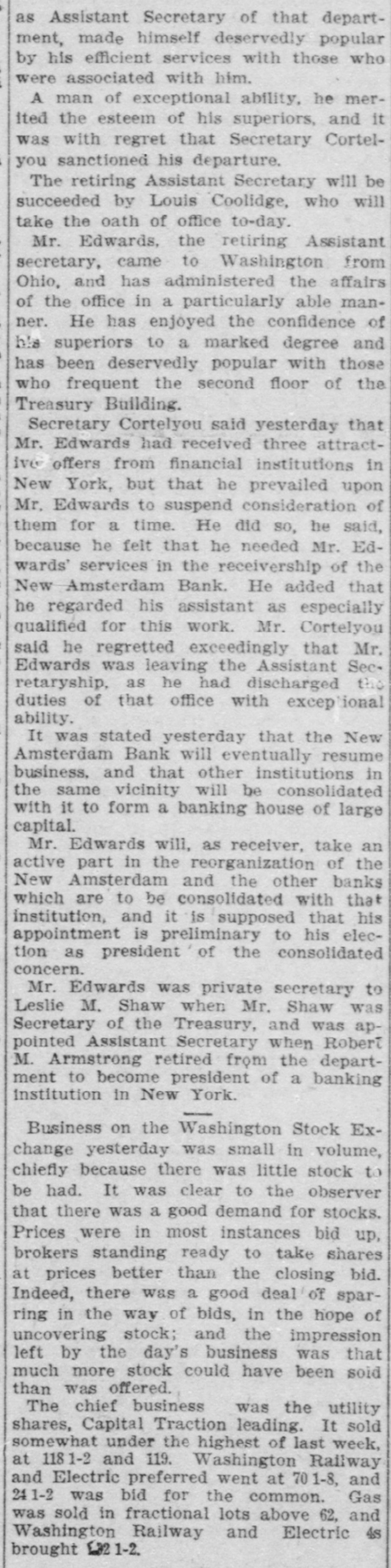
as Assistant Secretary of that department, made himself deservedly popular by his efficient services with those who were associated with him. A man of exceptional ability. he merited the esteem of his superiors, and it was with regret that Secretary Cortelyou sanctioned his departure. The retiring Assistant Secretary will be succeeded by Louis Coolidge, who will take the oath of office to-day. Mr. Edwards, the retiring Assistant secretary, came to Washington from Ohio, and has administered the affairs of the office in a particularly able manner. He has enjoyed the confidence of bla superiors to a marked degree and has been deservedly popular with those who frequent the second floor of the Treasury Building. Secretary Cortelyou said yesterday that Mr. Edwards had received three attractivo offers from financial institutions in New York, but that he prevailed upon Mr. Edwards to suspend consideration of them for a time. He did so, he said, because he felt that he needed Mr. Edwards' services in the receivership of the New Amsterdam Bank. He added that he regarded his assistant as especially qualified for this work. Mr. Cortelyou said he regretted exceedingly that Mr. Edwards was leaving the Assistant Sec. retaryship, as he had discharged the duties of that office with excep ional ability. It was stated yesterday that the New Amsterdam Bank will eventually resume business. and that other institutions in the same vicinity will be consolidated with it to form a banking house of large capital. Mr. Edwards will, as receiver, take an active part in the reorganization of the New Amsterdam and the other banks which are to be consolidated with that institution, and it is supposed that his appointment is preliminary to his election as president of the consolidated concern. Mr. Edwards was private secretary to Leslie M. Shaw when Mr. Shaw was Secretary of the Treasury, and was appointed Assistant Secretary when Robert M. Armstrong retired from the department to become president of a banking institution in New York. Business on the Washington Stock Exchange yesterday was small in volume, chiefly because there was little stock to be had. It was clear to the observer that there was a good demand for stocks. Prices were in most instances bid up, brokers standing ready to take shares at prices better than the closing bid. Indeed, there was a good deal of sparring in the way of bids, in the hope of uncovering stock; and the impression left by the day's business was that much more stock could have been soid than was offered. The chief business was the utility shares, Capital Traction leading. It sold somewhat under the highest of last week, at 118 1-2 and 119. Washington Railway and Electric preferred went at 70 1-8, and 24 1-2 was bid for the common. Gas was sold in fractional lots above 62, and Washington Railway and Electric 4s brought L321-2.


Article from Daily Kennebec Journal, March 17, 1908

Click image to open full size in new tab

Article Text

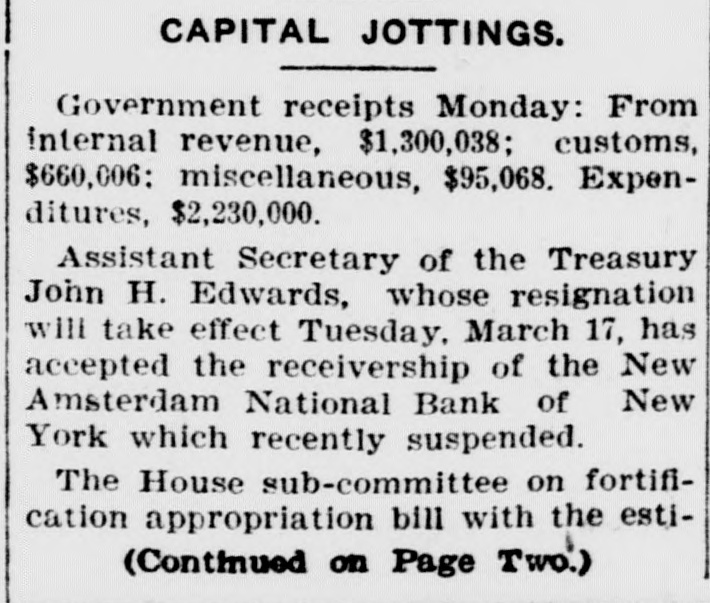
CAPITAL JOTTINGS. Government receipts Monday: From internal revenue, $1,300,038; customs, $660,006: miscellaneous, $95,068. Expenditures, $2,230,000. Assistant Secretary of the Treasury John H. Edwards, whose resignation will take effect Tuesday. March 17, has accepted the receivership of the New Amsterdam National Bank of New York which recently suspended. The House sub-committee on fortification appropriation bill with the esti(Continued on Page Two.)


Article from The Paducah Evening Sun, March 17, 1908

Click image to open full size in new tab

Article Text

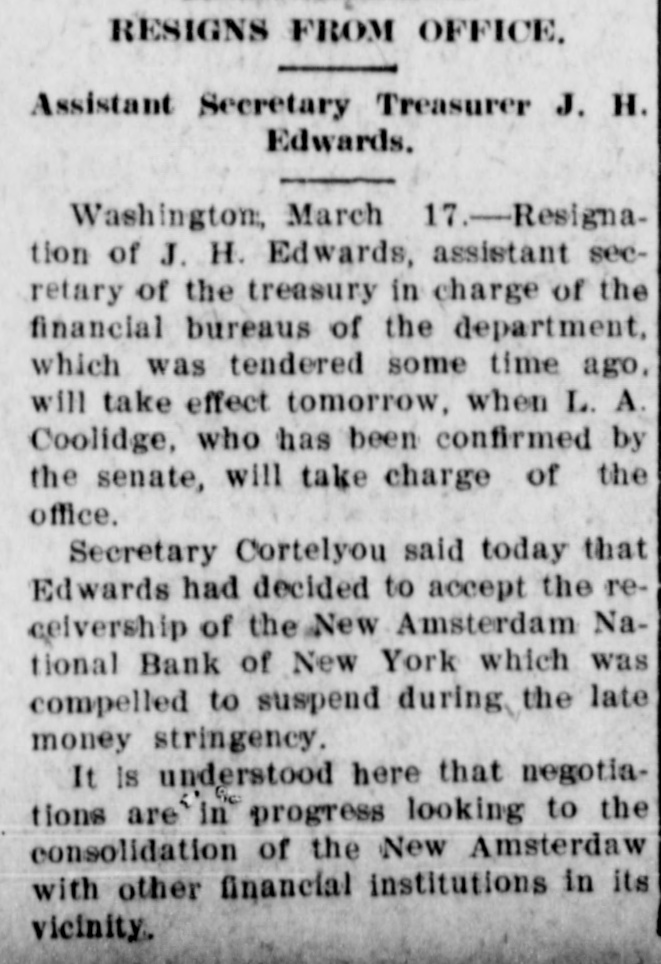
RESIGNS FROM OFFICE. Assistant Secretary Treasurer J. H. Edwards. Washington, March 17.-Resignation of J. H. Edwards, assistant secretary of the treasury in charge of the financial bureaus of the department, which was tendered some time ago, will take effect tomorrow, when L. A. Coolidge, who has been confirmed by the senate, will take charge of the office. Secretary Cortelyou said today that Edwards had decided to accept the receivership of the New Amsterdam National Bank of New York which was compelled to suspend during the late money stringency. It is understood here that negotiations are in progress looking to the consolidation of the New Amsterdaw with other financial institutions in its vicinity.


Article from The Garland Globe, March 28, 1908

Click image to open full size in new tab

Article Text

NEWS SUMMARY Mrs. Frederic Schoff of Philadelphia has been re-elected president of the National Mothers' congress. In an amateur boxing tournament in Philadelphia, Willie Robinson, 19 years, was killed while boxing with Charles Wolf, same age. The senate has accepted the amendment ot the legislative bill increasing the salaries of surveyors general from $2,000 to $3,000. The steamer Pomona, which plys between San Francisco and Eureka, was wrecked near Fort Ross on March 17. All her passengers were saved. Three men were killed and four injured, two fatally, by the blowing up of one of ten wheel houses of the United States Powder company at Coalmont, Ind. An unknown negro shot and mortally wounded Baxter and Rufus Burns at Burns, Miss. Both are relatives of United States Senator McLaurin of Mississippi. Senator B. R. Tillman of South Carolina, is dangerously ill at his home at Trenton, S. C., suffering with a return of the disease which affected his health three years ago. Assistant Secretary of the Treasury J. P. Edwards, whose resignation was accepted last week, has accepted the receivership of the New Amsterdam National bank of New York, which recently suspended. Mrs. Mabel Woodham Neelley, of Kalamazoo, Mich., whose two-year-old son Walter died last December from pneumonia while under treatment by two mental healers, was last week rearrested and charged with manslaughter. Walter R. Day, secretary of state of Kentucky under the Republican re gime of Governor Taylor in 1900, has been sentenced to serve one year in the penitentiary for forging the name of his uncle, Floyd Day, to a check for $5,000. The bubonic plague in Ecuador is increasing and the sanitary condition of Guayaquil and other towns is causing great alarm. There are fifty-one cases of the plague in the Lazaretto, besides several cases of smallpox and yellow fever, As the result of an unsuccessful attempt to assassinate Federal Judge Lira, of the northern district of Chihuahua by firing two shots at him through a door, four alleged plotters are held in jail in Juarez on a charge of conspiracy to murder. Frank Kito, a Japanese cook, fired five bullets into the body of Mrs. Lizzie Hulse of New York City, who had spurned his love. Kito then drank carbolic acid and died. Mrs. Hulse will recover. Both had been employed in a restaurant. The fortifications bill, carrying a total apropriation of $8,210,611 instead of the $38,443,945 asked for by the war department, has been reported to the house committee on appropriations by Chairman Smith of the subcommittee on fortifications. Under pressure exerted by the Transvaal government, which is entitled to 60 per cent of the company's output, the Premier Diamond Mining company has refinitely refused to renew Ms agreement with the diamond syndicate, and will market its own output. Two men were killed and five persons seriously injured when an excursion train on the International & Great Northern railway bearing a party of homeseekers from Kansas and Oklahoma en route to Las Paltenas, Mexico, was wrecked at Pearsall, Texas. In the arrest of Fanny Ritchie and Harry McCuen at Denison Texas, the mystery of a wholesale murder in Oklahoma City last August, involving


Article from New-York Tribune, April 15, 1908

Click image to open full size in new tab

Article Text

OUT OF CLEARING HOUSE. Suspended Banks Formally Expelled-May Be Readmitted. It was learned yesterday that at a recent meeting of the Clearing House Association formal action was taken terminating the membership in the association of the National Bank of North America, the New Amsterdam National Bank, the Oriental Bank, the Mechanics and Traders' Bank and the First National Bank of Brooklyn. These five hanks suspended payment during or after the panic last fall. To date only one-the First National Bank of Brooklyn-has resumed business. The action recently taken by the Clearing House was merely formal, as membership in the Clearing House automatically terminates when a bank suspends payment. The banks named above will never be able to get back the original numbers which they held in the Clearing House, but any or all of them on the resumption of business may be readmitted to the association if the committee on admission sees ftt. In such case, however, they will have to take new numbers at the foot of the list. of the five banks which forfeited membership two, the Oriental and the National of North AmeriC8, will probably go out of existence after the assets are liquidated. Plans are under way for the reopening of the New Amsterdam National and the Mechanics and Traders'. The National Bank of North America has an interest in the Clearing House Building Association, but this interest will be sold to the association, as provided by the rules.


Article from New-York Tribune, July 26, 1908

Click image to open full size in new tab

Article Text

MR. MORSE OPTIMISTIC. Financier Says He'll Soon Take the Public Into His Confidence. Charles W. Morse, when seen yesterday in the National Bank of North America, where he had been in consultation with Charles A. Hanna, the receiver, said that his plan to pay off all the bank's depositors and then have the bank's assets turned over to the stockholders was making excellent headway. Mr. Morse said that depositors representing hundreds of thousands of dollars had already availed themselves of his offer to pay the full amount of all claims. In regard to his plans for paying off the depositors of the New Amsterdam National Bank, and then taking over the assets of that institution, Mr. Morse said that he was not quite ready as yet to take the public into his confidence, but added that he expected to have some important announcements to make along that line in the near future. Asked concerning the activities of the Morse Securities Company, which was incorporated in Bath, Me., some time ago, to buy and sell stocks. bonds and other securities, Mr. Morse said he had nothing new to divulge just at present. Mr. Morse expressed himself as optimistic on the general financial situation. Asked how much further he thought the present rise in the stock and bond market was likely to go. he said: "The pendulum always swings too far, you know. Last fall it swung much too low. Now it may swing too far the other way." Mr. Morse seemed to be in better health and spirits than at any time since last October, when he resigned from all the banking institutions with which he was connected.


Article from Daily Kennebec Journal, July 27, 1908

Click image to open full size in new tab

Article Text

To Take Public Into His Confidence, Morse Says. Will Soon Give Out Plans For Bank of North America. Optimistic as to Financial Situation -Health Is Good. New York, July 26.-Charles W. Morse, when seen yesterday in the National Bank of North America, where he had been in consultation with Charles A. Hanna, the receiver, said that his plan to pay off all the bank's depositors and then have the bank's assets turned over to the stockholders was making excellent headway. Mr. Morse said that depositors representing hundreds of thousands of dollars had already availed themselves of his offer to pay the full amount of all claims. In regard to his plans for paying off the depositors of the New Amsterdam National Bank. and then taking over the assets of that institution, Mr. Morse said that he was not quite ready as yet to take the public into his confidence, but added that he expected to have some important arnouncements to make along that line in the near future. Asked concerning the activities of the Morse Securities Co., which was incorporated in Bath, Me., some time ago, to buy and sell stocks, bonds and other securities, Mr. Morse said he had nothing new to divulge just at present. Mr. Morse expressed himself as optimistic on the general financial situation. Asked how much further he thought the present rise in the stock and bond market was likely to go, he said: "The pen.


Article from The Detroit Times, September 16, 1908

Click image to open full size in new tab

Article Text

CHAS. W. MORSE IS ON HIS FEET ONCE MORE AFTER FIGHT UNPARALLELED IN HISTORY, FORMER ICE AND STEAMSHIP KING WILL PAY HIS BANK DEPOSITORS. NEW YORK, Sept. 16.-Chas. W. Morse, former ice and steamship king, is on his feet again. Depositors in his two banks will be paid in full and there will be money left for the stockholders. The receivers, who have apparently bitterly antagonized Morse, give to him all the credit, and he modestly passes it on to a few loyal friends. They advanced money that enabled him to pay off depositors and protect his securities till the panic was over. So, to the amazement of Morgan and Rockefeller and the other owners of the resources of the American republic, the little wizard from Maine is up again. He is just a bit groggy, but is on his feet. Fight Without Parallel. His fight is without parallel in financial history. His winning the first battle is arranging for the paying off of every depositor in the National Bank of North America and the New Amsterdam National bank is only the opening of his great campaign to regain his former position as an industrial monarch. When Mr. Morse was caught in the crushers below Fulton-st. and was driven from his high position in the seats of the mighty, betting was 100 to 1 that he was exterminated. This big financier would meet that big financier and in mock sympathy remark, "Too bad about Morse, but he is done for." Then came the lull in the storm, and when the sun rose next morning these same big financiers were found to be counting-one a railroad that had washed into his port, another a great ore bed that had dropped from


Article from Perrysburg Journal, January 8, 1909

Click image to open full size in new tab

Article Text

Texas saving bank, placed in receiver's hands. 18-John R. Walsh, president Chicago National bank and several railroads, convicted of misappropriating institution's funds. 21-Capital State Bank, Boise, Idaho, suspended. 22-Traders and Mechanics' Bank, Pittsburg, Pa., closed doors. 25-N: ional Bank of North America, New Yor: closed for liquidation, by order of government. 29-New Amsterdam National bank, capital $1,000,000. and Mechanics and Traders' bank, both of New York, taken in charge by comptroller of currency. 31-Oriental Bank of New York closed doors, following run. Feb. 13-W. B. Ridgely, comptroller of currency, accepted presidency of reorganized National Bank of Commerce, Kansas City, Mo. 26-International and Great Northern Railroad Co., a Gould line, placed in receivers' hands. 27-Financiers E. R. Thomas and O. F. Thomas indicted on charge of mismanagement of funds of Provident Savings Life Assurance society. Mar. 13-John R. Walsh denied new trial; sentenced to five years in federal prison. 16-People's National bank, Aspin, Col., closed. Apr: 1-Pike County Bank and Trust Co., Macomb City, Miss., placed in receiver's hands. 21-Bank of Wauseon, Wauseon, O., closed doors. 24-T. A. McIntyre & Co., with houses in many cities, failed for $1,000,000. May 8-Euclid Avenue Trust Co., Cleveland, O., assigned. 14-Reserve Trust Co., and American Savings bank, Cleveland, O., closed their doors. 28-G. W. MacMillen & Co., Pittsburg, Pa., stockbrokers, failed; liabilities, $1,800,000. Jun. 3-Kosciusko Company bank, Warsaw, Ind., closed by state auditor. 23-Citizens' bank, Dover, Ky., closed doors. Jul. 14-National Deposit bank, Philadelphia, Pa., closed by comptroller of currency. 17-Farmers and Merchants' Banking Co., Cleveland, O., failed. 22-Standard Oil $29,240,000 flue decision unanimously reversed by United States court of appeals at Chicago. Aug. 6-First National bank, Belle Plaine, Minn., closed by order comptroller of currency: bank was insolvent: President J. G. Lund committed suicide. 25-A. O. Brown & Co., one of largest New York brokerage firms, failed; liabilities over $1,000,000. Sep. 10-A. Booth & Co., largest fish house in country, forced into receiver's hands. Oct. 16-Union National bank, Sommerville, Pa., closed by government. Nov. 5-Charles W. Morse and Alfred H. Curtis, great financiers, found guilty of misapplication of funds and falsifying books of National Bank of America, New York. 6-C. W. Morse sentenced to 15 years; Curtis given liberty on suspended sentence. 23-Eldred bank of Eldred, Pa., suspended; capital stock, $100,000. Dec. 7-National exchange bank at Springfield, Mo., closed; excitement caused by effort of W. O. Oldham, cashier of State Savings bank, to shoot President H. B. McDaniel, of Union National bank. 11-Springport, Mich., State Savings bank closed by bank examiner. 16-Somersworth, N. H., First National bank closed, following discovery of shortage of $85,000. 23-Thomas F. Ryan announced retirement from finance. 26-Henry W. Poor, New York broker, assigned for creditors.