14232. Peoples Bank (Passaic, NJ)

Bank Information

Episode Type
Suspension → Reopening
Bank Type
state
Start Date
March 1, 1933*
Location
Passaic, New Jersey (40.857, -74.128)

Metadata

Model
gpt-5-mini
Short Digest
7f81296c

Response Measures

None

Description

Articles (Jul–Aug 1933) describe Peoples Bank being closed in March 1933 and discuss long-term deposit seepage driven largely by rumor/press attacks. The coverage explicitly says there were no dramatic runs with crowds. One article also states the bank reopened under restrictions on 1933-03-16. Thus this is a suspension with a reopening; no run event recorded in these articles. OCR errors in some articles corrected (e.g., fragmented lines and missing days).

Events (3)

1. March 1, 1933* Suspension
Cause
Rumor Or Misinformation
Cause Details
Persistent campaign of rumors, telephone messages and attacks in the local paper (Sunday Eagle) that drained deposits over ~15 months and led to closure/suspension in March 1933.
Newspaper Excerpt
the Peoples closed on March
Source
newspapers
2. March 16, 1933 Reopening
Newspaper Excerpt
Since March 16, 1933, when the bank reopened under restrictions, Drukker had drawn no salary and the salary other officers and employes have been on half pay.
Source
newspapers
3. * Other
Newspaper Excerpt
For fifteen months, the deposits in the bank were drained away by almost continuous withdrawals... There were no runs, with crowds clamoring at the bank's doors for as other banks have had in recent troublous years.
Source
newspapers

Newspaper Articles (5)

Article from The Herald-News, July 25, 1933

Click image to open full size in new tab

Article Text

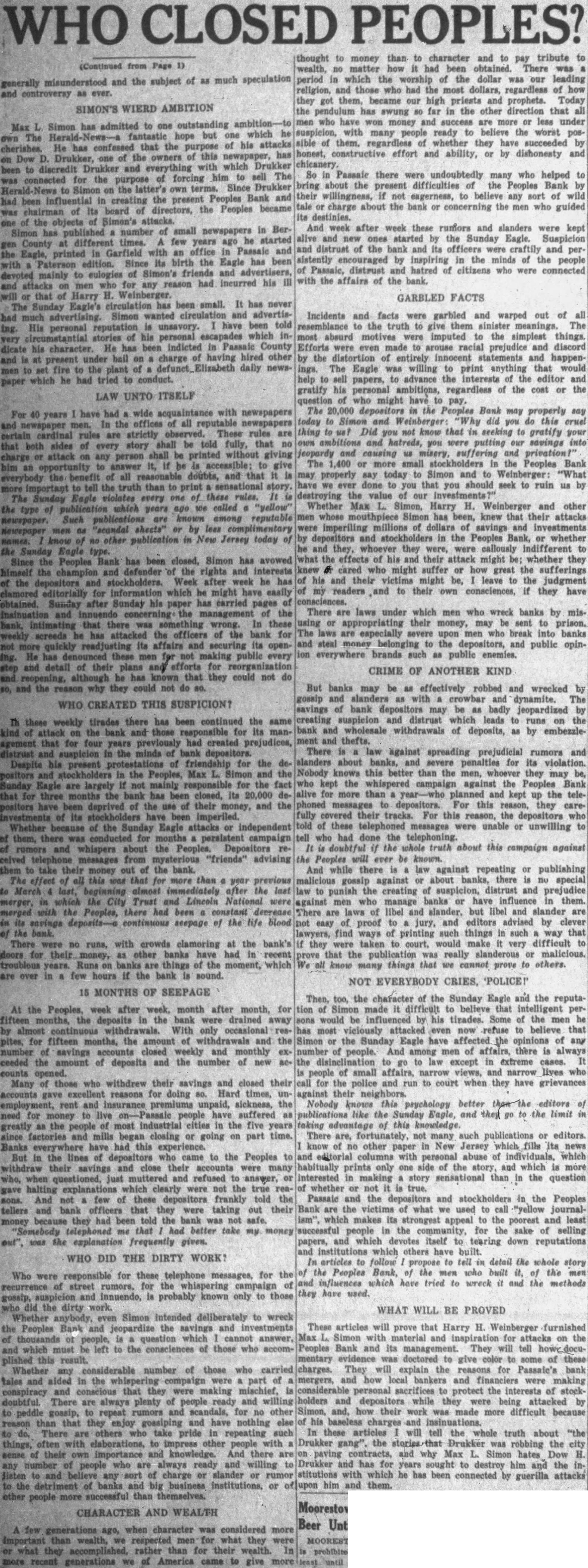
WHO CLOSED PEOPLES? (Continued from Page generally misunderstood and the subject of as much speculation and controversy as ever. SIMON'S WIERD AMBITION Max L. Simon has admitted to one outstanding own The fantastic hope but one which cherishes. He has confessed that the purpose of his attacks on Dow D. Drukker, one of the owners of this newspaper, has been to discredit Drukker and everything with which Drukker was connected for the purpose of forcing him to sell The to Simon on the latter's own terms. Since Drukker had been influential in creating the present Peoples Bank and was chairman of Its board of directors, the Peoples became one of the objects of Simon's attacks. Simon has published number of small newspapers in Bergen County at different times. A few years ago he started the Eagle, printed in Garfield with an office in Passaic and with Paterson edition. Since its birth the Eagle has been devoted mainly to eulogies of Simon's friends and advertisers, for had incurred his and attacks on men who any reason will or that of Harry H. Weinberger. The Sunday Eagle's circulation has been small. It has never much advertising. Simon wanted circulation and advertisIng. His personal reputation is unsavory. have been told very circumstantial stories of his personal escapades which indicate his character. He has been indicted in Passaic County and is at present under bail on charge of having hired other men to set fire to the plant of Elizabeth daily newspaper which he had tried to conduct. LAW UNTO ITSELF For 40 years have had wide acquaintance with newspapers and newspaper men. In the offices of all reputable newspapers certain cardinal rules are strictly observed. These rules are that both sides of every story shall be told fully, that no charge or attack on any person shall be printed without giving him an opportunity to answer it, If he is accessible; to give everybody the benefit of all reasonable doubts, and that It is more important to tell the truth than to print sensational story. The Sunday Eagle violates every one of these rules. It the type of publication which years age too called a "yellow" Such publications are known among reputable newspaper men as "scandal sheets" or by leas complimentary names. know of no other publication in New Jersey today of the Sunday Eagle type. Since the Peoples Bank has been closed. Simon has avowed himself the champion and defender of the rights and interests of the depositors and stockholders. Week after week he has elamored editorially for information which he might have easily obtained. Sunday after Sunday his paper has carried pages of Insinuation and innuendo concerning the management of the bank, intimating that there was something wrong. In these weekly screeds he has attacked the officers of the bank for not more quickly readjusting its affairs and securing its openIng. He has denounced these men for not making public every step and detail of their plans and efforts for reorganization reopening, although he has known that they could not do so, and the reason why they could not do 80, WHO CREATED THIS SUSPICION? Th these weekly tirades there has been continued the same kind of attack on the bank and those responsible for its management that for four years previously had created prejudices, distrust and suspicion in the minds of bank depositors. Despite his present protestations of friendship for the depositors and stockholders in the Peoples, Max L. Simon and the Sunday Eagle are largely If not mainly responsible for the fact that for three months the bank has been closed, its 20,000 depositors have been deprived of the use of their money, and the Investments of its stockholders have been imperiled. Whether because of the Sunday Eagle attacks or independent them, there was conducted for months persistent campaign of rumors and whispers about the Peoples. Depositors celved telephone messages from mysterious "friends" advising them to take their money out of the bank. The effect of all this was that for more than year previous to March last, beginning almost immediately after the last merger, in which the City Trust and Lincoln National were morged with the Peoples, there had been constant decrease in its savings deposits-a continuous seepage of the life blood of the bank. There were no runs, with crowds clamoring at the bank's doors for as other banks have had in recent troublous years. Runs on banks are things of the moment, which are over in few hours if the bank is sound. 15 MONTHS OF SEEPAGE At the Peoples, week after week, month after month, for fifteen months, the deposits in the bank were drained away by almost continuous withdrawals. With only occasional pites, for fifteen months, the amount of withdrawals and the number of savings accounts closed weekly and monthly exceeded the amount of deposits and the number of new counts opened. Many of those who withdrew their savings and closed their Accounts gave excellent reasons for doing so. Hard times, unemployment, rent and insurance premiums unpaid, sickness, the need for money to live on-Passaic people have suffered as greatly as the people of most industrial cities in the five years since factories and mills began closing or going on part time. Banks everywhere have had this experience. But in the lines of depositors who came to the Peoples to withdraw their savings and close their accounts were many who, when questioned, just muttered and refused to answer, or gave halting explanations which clearly were not the true reasons. And not few of these depositors frankly told the tellers and bank officers that they were taking out their money because they had been told the bank was not safe. "Somebody telephoned me that had better take my money was the explanation frequently given. WHO DID THE DIRTY WORK? Who were responsible for these telephone messages, for the recurrence of street rumors, for the whispering campaign of gossip, suspicion and innuendo, is probably known only to those who did the dirty work. Whether anybody, even Simon intended deliberately to wreck the Peoples Bank and jeopardize the savings and investments of thousands of people, is a question which cannot answer, and which must be left to the consciences of those who accomplished this result. Whether any considerable number of those who carried tales and aided in the whispering compaign were part of conspiracy and conscious that they were making mischief, is doubtful. There are always plenty of people ready and willing to peddle gossip, to repeat rumors and scandals, for no other reason than that they enjoy gossiping and have nothing else to There are others who take pride in repeating such things, often with elaborations, to impress other people with sense of their own importance and knowledge. And there are any number of people who are always ready and willing to disten to and believe any sort of charge or slander or rumor to the detriment of banks and big business institutions, or other people more successful than themselves. CHARACTER AND WEALTH few generations ago, when character was considered more Important than wealth, we respected for what they were or what they accomplished, rather than for their wealth. In more recent generations we of America came to give more thought to money than to character and to pay tribute wealth, no matter how it had been obtained. There was period in which the worship of the dollar was our leading religion, and those who had the most dollars, regardless of how they got them, became our high priests and prophets. Today the pendulum has swung so far in the other direction that all men who have won money and success are more or less under suspicion, with many people ready to believe the worst possible of them. regardless of whether they have succeeded by honest, constructive effort and ability, or by dishonesty and chicanery. So in Passaic there were undoubtedly many who helped bring about the present difficulties of the Peoples Bank by their willingness, if not eagerness, to believe any sort of wild tale or charge about the bank or concerning the men who guided its destinies. And week after week these rumors and slanders were kept alive and new ones started by the Sunday Eagle. Suspicion and distrust of the bank and its officers were craftily and persistently encouraged by inspiring in the minds of the people of Passaic, distrust and hatred of citizens who were connected with the affairs of the bank. GARBLED FACTS Incidents and facts were garbled and warped out of all resemblance to the truth to give them sinister meanings. The most absurd motives were imputed to the simplest things. Efforts were even made to arouse racial prejudice and discord by the distortion of entirely innocent statements and happenings. The Eagle was willing to print anything that would help to sell papers, to advance the interests of the editor and gratify his personal ambitions, regardless of the cost or the question of who might have to pay, The 20,000 depositors in the Peoples Bank may properly say today to Simon and Weinberger: did you do this orue! thing to us? Did you not know that in seeking to gratify your own ambitions and hatreds, you were putting our savings into jeopardy and causing us misery, suffering and privation? The 1,400 or more small stockholders the Peoples Bank may properly say today to Simon and to Weinberger: "What have we ever done to you that you should seek to ruin us by destroying the value of our Investments' Whether Max L. Simon, Harry H. Weinberger and other men whose mouthpiece Simon has been, knew that their attacks were imperiling millions of dollars of savings and investments depositors and stockholders in the Peoples Bank, or whether he and they, whoever they were, were callously indifferent what the effects of his and their attack might be: whether they knew a cared who might suffer or how great the sufferings his and their victims might be, leave to the judgment my readers and to their own consciences, if they have consciences. There are laws under which men who wreck banks by misusing or appropriating their money, may be sent to prison. The laws are especially severe upon men who break into banks and steal money belonging to the depositors, and public opinion everywhere brands such as public enemies. CRIME OF ANOTHER KIND But banks may be as effectively robbed and wrecked by gossip and slanders as with crowbar and dynamite. The savings of bank depositors may be as badly jeopardized by creating suspicion and distrust which leads to runs on the bank and wholesale withdrawals of deposits, as by embezzlement and thefts. There is law against spreading prejudicial rumors and slanders about banks, and severe penalties for its violation. Nobody knows this better than the men, whoever they may be, who kept the whispered campaign against the Peoples Bank alive for more than a planned and kept up the telephoned messages to depositors. For this reason, they carefully covered their tracks. For this reason, the depositors who told of these telephoned messages were unable or unwilling to tell who had done the telephoning. It is doubtful if the whole truth about this campaign against the Peoples will ever be known. And while there is law against repeating or publishing malicious gossip against or about banks, there is no special law to punish the creating of suspicion, distrust and prejudice against men who manage banks or have influence in them. There are laws of libel and slander, but libel and slander are not easy of proof to jury, and editors advised by clever lawyers, find ways of printing such things in such way that if they were taken to court, would make It very difficult to prove that the publication was really slanderous or malicious. We all know many things that we cannot prove to others. NOT EVERYBODY CRIES. 'POLICE' Then, too, the character of the Sunday Eagle and the reputation of Simon made it difficult to believe that intelligent persons would be by his tirades. Some of the men he has most viciously attacked even now refuse to believe that Simon or the Sunday Eagle have affected the opinions of any number of people. And among men of affairs, there is always the disinclination to go to law except in extreme cases. people of small affairs, narrow views, and narrow lives who for the police and run to court when they have grievances against their neighbors. Nobody knows this psychology better editors publications like the Sunday Eagle, and they go to the limit in taking advantage of this knowledge. There are, fortunately, not many such publications or editors. know of no other paper in New Jersey which fills its news and editorial columns with personal abuse of individuals. which habitually prints only one side of the and which is more interested in making story sensational than the question whether or not it is true. Passaic and the depositors and stockholders in the Peoples Bank are the victims of what we used to call "yellow journalism", which makes its strongest appeal to the poorest and least successful people in the community, for the sake of selling papers, and which devotes itself to tearing down reputations and institutions which others have built. In articles to follow propose to tell in detail the whole story the Peoples Bank, of the men who built it, of the men and influences which have tried to wreck it and the methods they have used. WHAT WILL BE PROVED These articles will prove that Harry H. Weinberger furnished Max Simon with material and inspiration for attacks on the Peoples Bank and its management. They will tell howe documentary evidence was doctored to give color to some of these charges. They will explain the reasons for Passaic's bank mergers, and how local bankers and financiers were making considerable personal sacrifices to protect the interests of stockholders and depositors while they were being attacked Simon, and, how their work was made more difficult because of his baseless charges and insinuations. In these articles will tell the whole truth about "the Drukker gang". the Drukker was robbing the city paving contracts, and why Max L. Simon hates Dow Drukker and has for years sought to destroy him and the institutions with which he has been connected by guerilla attacks him and them.
Article from The Herald-News, August 2, 1933

Click image to open full size in new tab

Article Text

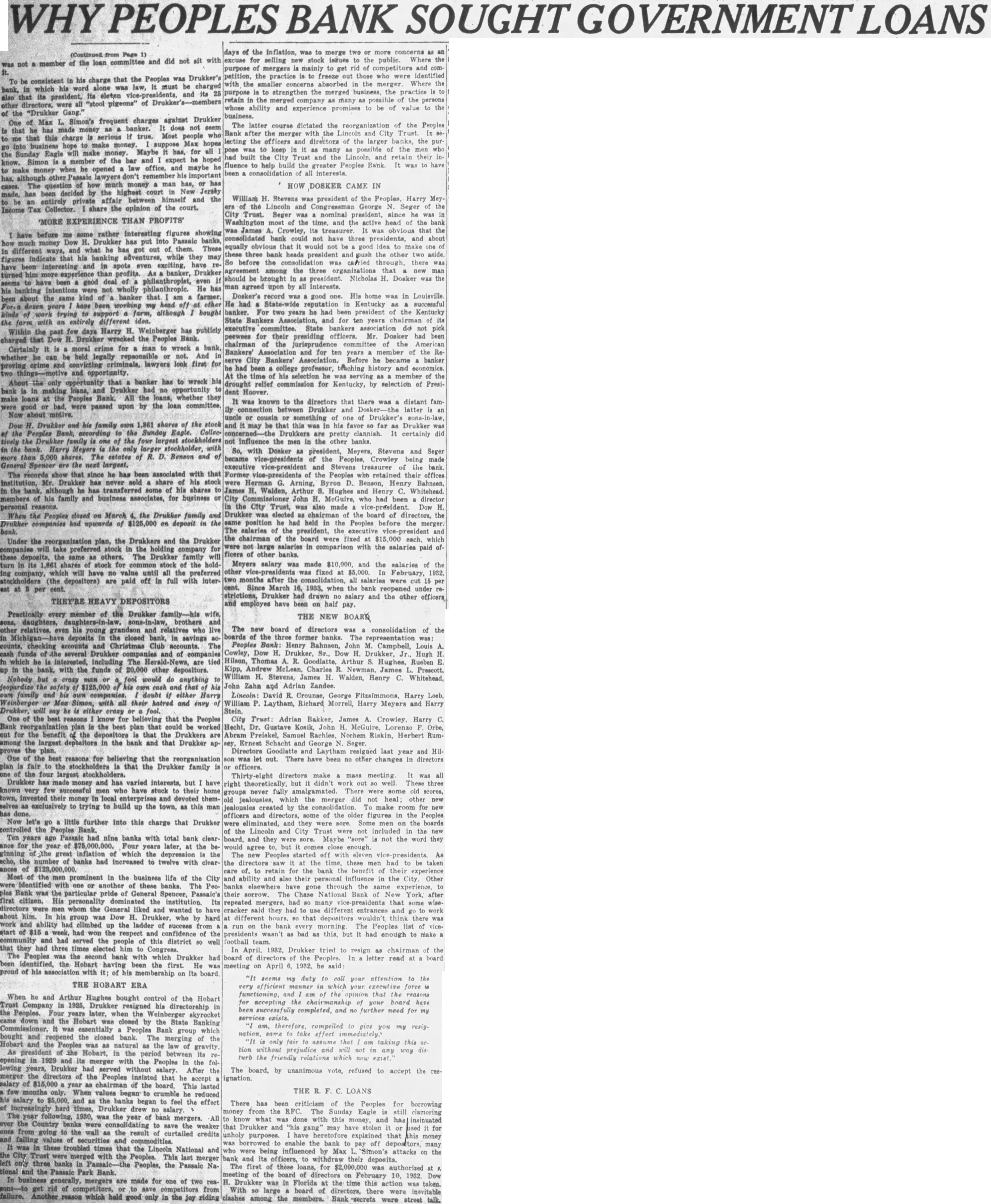
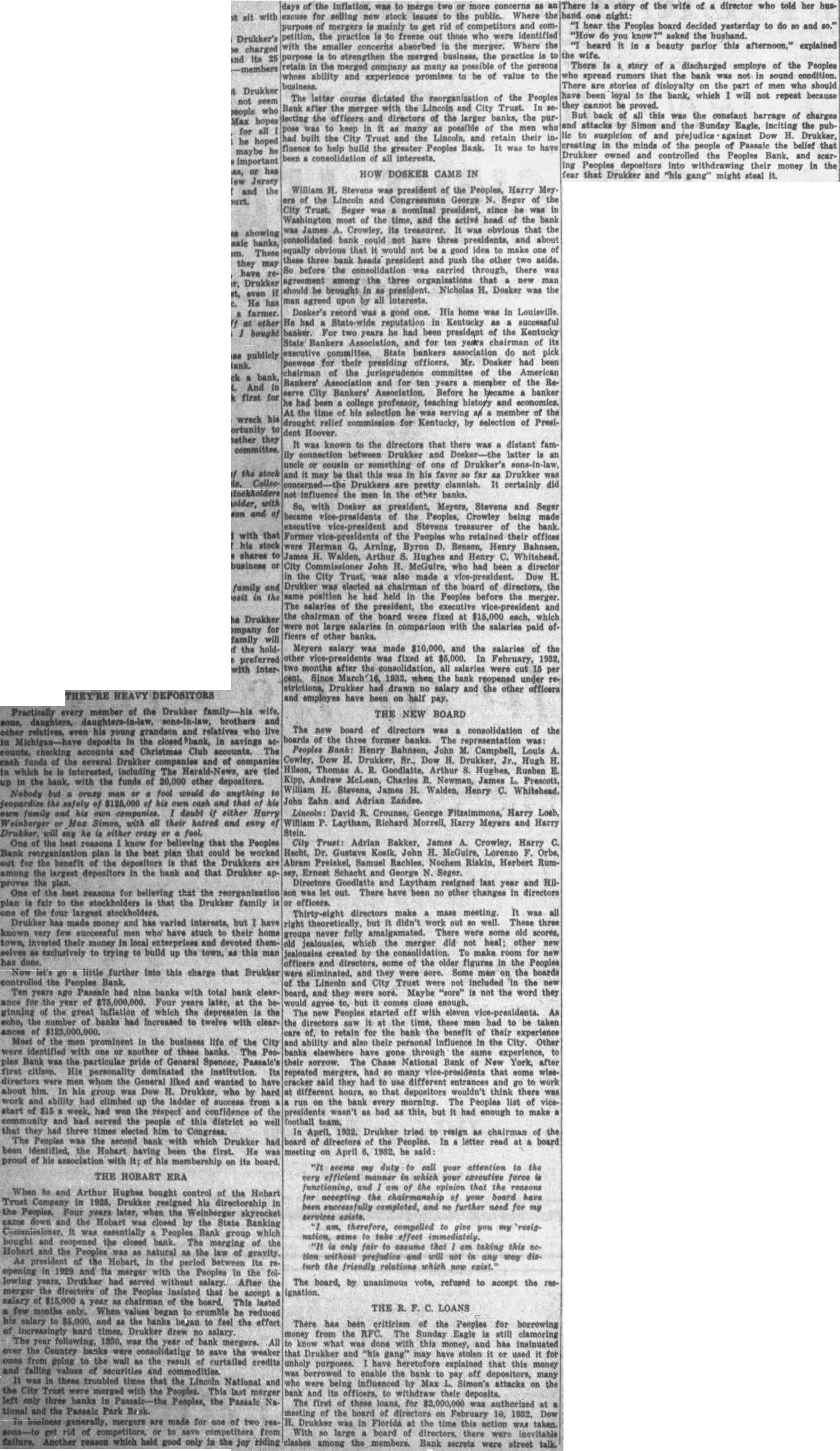
and did not sit with of the loan committee member Peoples was Drukker's his charge that the be consistent in alone law, must be charged which his word was bank, in and its its its eleten also that president, all "stool pigeons" of other directors, were of the "Drukker Gang." against Drukker Max Simon's frequent charges One of banker. does seem that he has made money true. Most people who that this charge serious into business hope to make money. Maybe suppose has, Max for hopes all Eagle will make money. the Sunday the bar and expect he hoped Simon member of know. law office, and maybe he make when he opened has, although money other lawyers remember important cases. The question of how much money man New has, Jersey has by the highest court in made, has been decided affair between himself and the entirely private Income Tax Collector. share the opinion of the court. EXPERIENCE THAN PROFITS' 'MORE rather interesting figures showing before me some how much money Dow H. Drukker has put into Passaic banks, what he has out of them. These in ways, and got his adventures, while they may figures indicate that banking and in exciting, have have interesting spots turned than profits. banker, Drukker been good deal philanthropist, even seems have not wholly philanthropic. He has his banking were kind banker that am farmer. been about the same have been working head other dozen years my to support farm, although bought work trying with entirely different idea. the an Within the past few days Harry H. Weinberger has publicly charged that Dow Drukker wrecked the Peoples Bank. moral crime for man to wreck bank, Certainly held or not. And whether he can be legally proving crime and criminals, lawyers look first for two and opportunity. that banker has to wreck his About the only opportunity bank in loans, Drukker had no opportunity make loans at the Peoples Bank. All the loans, whether they were good or bad, were passed upon by the loan committee, Now about Dow Drukker and his family own 1,861 shares of the stock the Bank, according the Sunday Eagle. CollecPeoples tively the Drukker family is one of the four stockholders bank. Harry Meyers the only larger stockholder, with more than 5,000 shares. The estates of R. Benson and General Spencer are the next The records show that since he has been associated with that institution, Drukker has never sold share of his stock the bank. although he has transferred some of his shares members of his family and business associates, for business personal reasons. the Peoples closed on March the Drukker family and Drukker companies had upwards of $125,000 on deposit in the bank. Under the reorganization plan, the Drukkers and the Drukker take preferred stock in the holding company for these deposits, the same others. The Drukker family will turn in its 1,861 shares of stock for common stock of the holding which will have no value until all the preferred company, stockholders (the depositors) are paid off in full with interest at per cent. HEAVY Practically every member of the Drukker sons, daughters, brothers and other relatives, even his young grandson and relatives who live deposits in the closed bank, in savings counts, checking accounts and Christmas Club accounts. The cash funds several Drukker and of companies in which he is including The Herald-News, are tied up in the bank, with the funds of 20,000 other depositors. Nobody but crazy man or would do anything the safety cash and that his own own family and his own companies. doubt either Harry with all their hatred and envy Drukker, will either crazy fool. One of the best reasons know for believing that the Peoples Bank reorganization plan the best plan that could be worked for the benefit the depositors is that the Drukkers are among the largest depositors in the bank and that Drukker proves the plan. One of the best reasons for believing that the reorganisation plan fair to the stockholders is that the Drukker family of the four largest stockholders. Drukker made money and has varied interests, but have known very few successful men who have stuck their home town, invested their money in local enterprises and devoted themselves as exclusively to trying to build up the town, as this man Now let's go little further into this charge that Drukker controlled the Peoples Bank. Ten years ago Passaic had nine banks with total bank clearance for the year of Four years later, at the ginning great inflation of which the depression the echo, number of banks had increased to twelve with clearances $123,000,000. Most of the men prominent in the business life of the City were identified with one or another of these banks. The ples Bank was particular pride of General Spencer, Passaic's first citizen. His personality dominated the institution. Its directors men whom the General and wanted to have about him. In his Dow H. group was Drukker, who by hard work and ability had climbed the ladder up of success from start $15 week, had won the respect confidence of the community and had served the people of district 80 well that they had three times elected him to Congress. The Peoples was the second bank with which Drukker had been identified, the Hobart having been the first. He was proud of his association with it; of his membership on its board. THE HOBART ERA When he and Arthur Hughes bought control of the Hobart Trust Company in 1925, Drukker resigned his the Peoples. Four years later, when the Weinberger skyrocket came down and the Hobart was closed by the State Banking Commissioner, Peoples group which bought reopened the closed bank. The merging of the Hobart and Peoples was as natural as the law of gravity. As president of the Hobart, in the period between its opening in 1929 and its merger with the Peoples in the following years, Drukker served without salary. After the merger directors of the Peoples insisted that he accept salary $15,000 year as of the board. This lasted few months only. When values began to crumble he reduced salary to $5,000, and as the banks began to feel the effect hard times, Drukker drew salary. The year following, 1930, was the year of bank mergers. All over the Country banks were consolidating to save weaker from going to the wall as the result of curtailed credits and falling values of securities and commodities. in these troubled times that the Lincoln National and City Trust were merged with the Peoples. This last merger three banks in Peoples, the Passaic tional and the Passaic Park Bank. business generally, mergers are made for one of two get rid of competitors, or to save competitors from failure. reason which held good only in the joy days of the inflation, was to merge two more concerns excuse for selling stock issues to the public. Where the purpose of mergers mainly to get rid of competitors and competition, the practice to freeze out those who were the smaller concerns absorbed the Where the merger. purpose is to strengthen merged business, the retain in the merged company as many as possible of the persons whose ability and experience promises be of value the business. The latter course dictated the reorganization of the Peoples Bank after the merger with the Lincoln and City Trust. In lecting the officers and directors of the larger banks, the purwas to keep in as many possible of the men built the City Trust and the their fluence to help build the greater Peoples Bank. was have been consolidation of all HOW CAME IN William H. Stevens was president of the Peoples, Harry of the Lincoln and Congressman George Seger of the City Trust. Seger nominal president, since he Washington most of the time, and the active head of the bank James Crowley, its treasurer. obvious that the consolidated bank not have three presidents, and about equally obvious that it would be good idea to make of these three bank heads president and push the other two aside. So before the consolidation carried there agreement among the three organizations that new man should be brought in as president. Nicholas H. Dosker the man agreed upon by all interests. Dosker's record was good one. His home was in Louisville He had State-wide reputation in Kentucky as successful banker. For two years he had been president of the Kentucky State Bankers Association, and for ten years of its executive committee. State bankers association do not pick for their presiding Mr. Dosker had been peewees chairman of the jurisprudence committee of the American Bankers' and for ten years of the serve City Bankers' Association. Before he became banker he had been college professor, teaching history economics. the time of his selection he serving as member of the drought relief commission for Kentucky, by selection of President Hoover. It was known to the directors that there was distant famconnection between Drukker and latter an uncle cousin or something of one of Drukker's and it may be that this was his favor 50 far as Drukker Drukkers are pretty clannish. It certainly did Influence the men in the other banks. So, with Dosker as president, Meyers, Stevens and Seger became vice-presidents of the Peoples, Crowley being made executive vice-president and Stevens treasurer of the bank. Former of the Peoples retained their offices were Herman Arning, Byron D. Benson, Henry Bahnsen, James H. Walden, Arthur S. Hughes and Henry C. Whitehead. City Commissioner John H. McGuire, had director the City Trust, was also made Dow Drukker was elected as chairman of the board of directors, the same position he had held in the Peoples before the merger. The salaries of the president, the executive and the chairman of the board fixed at $15,000 were which were not large salaries in comparison with the salaries paid ficers of other banks. salary made $10,000, the salaries of the other was fixed at $5,000. In February, 1932, two months after the all salaries cut were per cent. Since March 16, 1933, when the bank reopened under restrictions, Drukker had drawn no and the salary other officers and employes have been on half pay. THE NEW The new board of directors was consolidation of the boards of the three former banks. The representation was: Peoples Bank: Henry Bahnsen, John M. Campbell, Louis Cowley, Dow H. Drukker, Sr., Dow H. Drukker, Hugh Thomas Goodlatte. Arthur Hughes, Rueben Kipp, Andrew McLean, Charles Newman, James Prescott, H. Stevens, James H. Walden, Henry C. Whitehead, John Zahn and Adrian Zandee. Lincoln: David R. Crounse, George Fitzsimmons, Harry Loeb, William Richard Morrell, Harry Meyers and Harry Stein. City Trust: Adrian Bakker, James Crowley, Harry Hecht, Dr. Gustave Kosik, John H. McGuire, Lorenzo Orbe, Abram Preiskel, Samuel Rachles, Nochem Riskin, Herbert RumErnest Schacht and George Seger. Directors Goodlatte and Laytham resigned last year and Hilson was let out. There have been no other changes in directors officers. directors make mass meeting. was all right but didn't work out well. These three groups never fully amalgamated. There were some old scores, jealousies, which the merger did not heal; other new jealousies created by the To make room for new officers and directors, some of the older figures in the Peoples were eliminated, and they were sore. Some men the boards the Lincoln City Trust were not included in the new and they were sore. Maybe "sore" not the word they would agree but comes close enough. The new Peoples started off with eleven As the directors the time, these men had to be taken care of, retain for the bank the benefit of their experience and ability and also their personal influence in the City. Other banks elsewhere gone through the same their sorrow. The Chase National Bank of New York, after repeated had 80 many vice-presidents that some wisecracker said they had to use different entrances and work different that depositors wouldn't think there was run on the bank every The Peoples list of vicepresidents wasn't as bad as this, but it had enough to make football team. In April, Drukker tried to resign as chairman of the board of directors of Peoples. In letter read board meeting on April 1932, he said: seems call your attention to the my very efficient manner in which your executive force functioning, am of the opinion that reasons for accepting the chairmanship of your board have been completed, no further need for my services exists. therefore, compelled give my resignation, same to take immediately." only fair assume that am taking this tion without and will any way turb the friendly relations which The board, by unanimous vote, refused to the accept ignation. THE LOANS There has been criticism of the Peoples for borrowing money from RFC. The Sunday Eagle still clamoring know what was done with this and has insinuated that Drukker and "his gang" have stolen for may or unholy purposes. have heretofore explained that this money borrowed to enable bank off depositors, many were being by Max Simon's attacks the bank and its officers, to withdraw their deposits. The first of these loans, for $2,000,000 authorized meeting the board of directors on February 10, 1932. Dow Drukker in Florida at the time this action was taken. With large board directors, there were inevitable among the members. Bank street were


Article from The Herald-News, August 2, 1933

Click image to open full size in new tab

Article Text

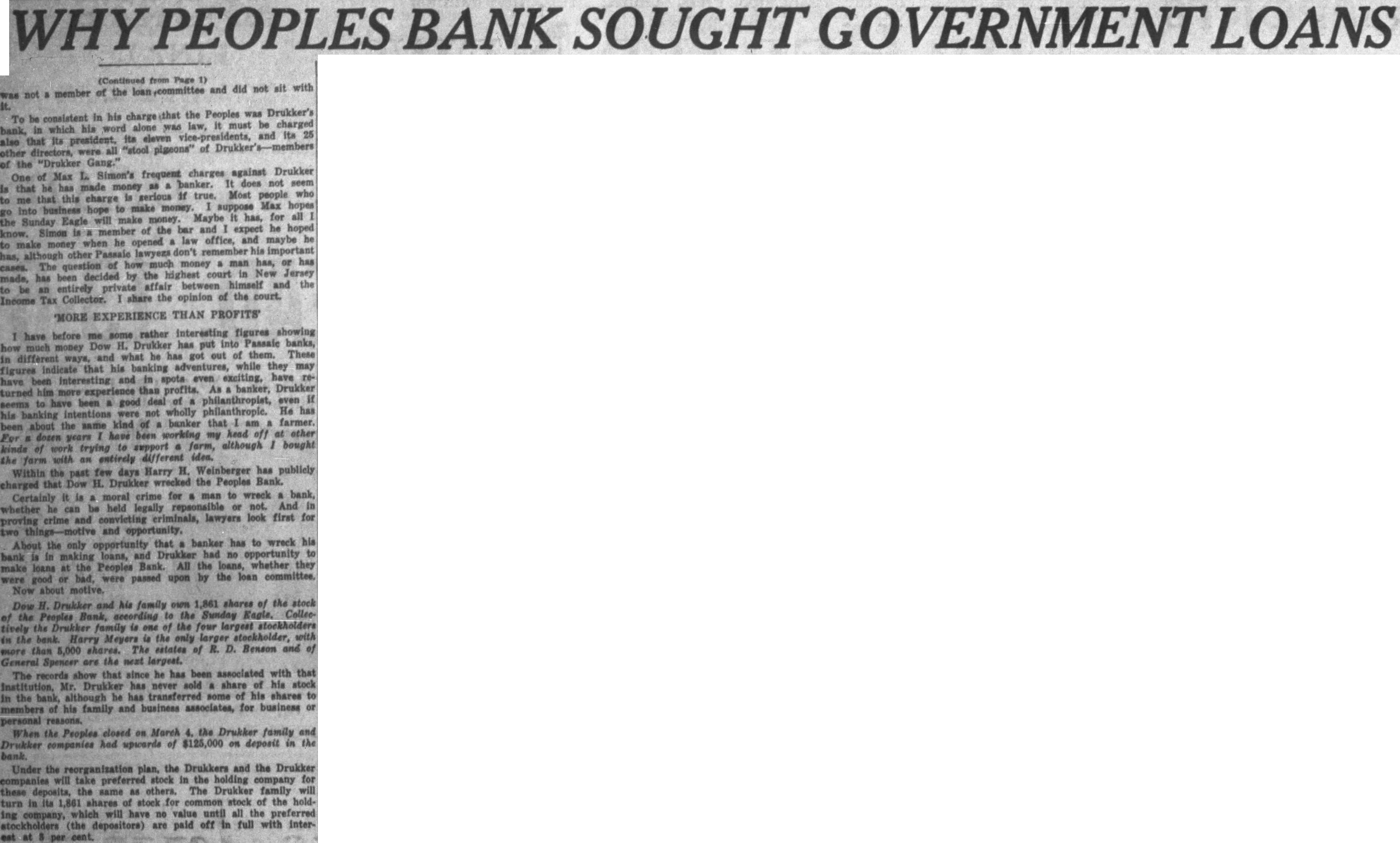
BANK SOUGHT GOVERNMENT and did not sit with member the Peoples was Drukker's the consistent in his must be charged word alone law, which his bank, and its eleven also that president, of other directors, the "Drukker Drukker charges against Max Simon's frequent One banker. does seem that has made money Most people who serious true. me that this charge Max make money. suppose into has, for all money. Maybe Eagle make the Sunday and expect he hoped of the bar Simon member know. law office, and maybe when he opened make although money other Passale lawyers important cases. The of much money in New has, Jersey has the court has been decided by made, himself and the private affair entirely Income be Tax Collector. share the opinion of the court. EXPERIENCE THAN 'MORE interesting figures showing before me rather have into banks, Dow H. Drukker put how much money he out of them. These and what ways, adventures, while they may indicate that his banking figures exciting, have interesting and in have As banker, Drukker than profits. turned him even have been good seems philanthropic. He has were not wholly banking of banker that am farmer. the same kind been about working head other have been my dozen years to farm, although bought kinds of work trying support different idea. farm with an entirely Within the past few days Harry Weinberger has publicly charged Dow H. Drukker wrecked the Peoples Bank. Certainly moral crime for man to wreck bank, repsonsible or not. And whether he can held legally lawyers look first for proving crime and opportunity. banker has to wreck his About the only opportunity Drukker had no opportunity bank making loans, Bank. All the loans, whether they make loans the Peoples were good bad, were passed upon by the committee. Now about motive. Dow Drukker and his family own 1,861 shares of the stock Bank, according the Sunday the Peoples tively the Drukker family one of the four largest stockholders the larger with the bank. Harry Meyers only shares. The estates of Benson and than General Spencer are the next largest. The records show that since he has been associated with that Drukker has never sold share of his stock Mr. he has transferred some of his shares the bank, although members of his family and business associates, for business personal reasons. the Peoples closed March the Drukker family and had upwards of $125,000 on deposit in the Drukker companies bank. Under the reorganization plan, the Drukkers and the Drukker will take preferred stock the holding company for these deposits, the same others. The Drukker family will turn in 1,861 shares of stock for common stock of the holdwhich have no value until all the preferred ing company, (the depositors) are paid in full with


Article from The Herald-News, August 2, 1933

Click image to open full size in new tab

Article Text

HEAVY Practically every member of the Drukker wife, sons, daughters, sons-in-law, brothers other relatives, grandson who live young in deposits in savings accounts Christmas Club accounts. The counts, cash funds of the several Drukker and of companies which interested, including The Herald-News, are tied up in the bank, with the funds 20,000 other depositors. Nobody man would do anything crazy jeopardize the safety of $125,000 his own cash and that of his family and own companies. doubt either Harry Moz Simon, with all their hatred and envy Drukker, will soy he either crazy One of the best reasons know for believing that the Peoples Bank plan the best plan that could be worked out for the benefit of the depositors that the Drukkers are among the largest depositors in the bank and that Drukker proves the plan, One of the best reasons for believing that the reorganization plan fair the stockholders that the Drukker family the four largest stockholders. Drukker has made money and has varied interests, but have known very few successful men who have stuck to their home town, invested their money in local and devoted themselves as exclusively to trying to build up the town, this man done. Now let's go little further into this charge that Drukker controlled the Peoples Bank. Ten years ago Passaic had nine banks with total bank clearance for the year of $75,000,000. Four years later, at the ginning of the great inflation which the depression the echo, the number of banks had increased to twelve with clearances of $123,000,000. Most of the men prominent in the business life of the City identified with one or another of these banks. The ples Bank the particular pride General Spencer, Passaic's first citizen. His personality dominated institution. Its directors were men whom General liked and wanted to about him. In his group was Dow Drukker, who by hard work ability climbed up the ladder of success from start week, had won the respect and confidence of community and had served the people of district well so that they had three times elected him to Congress. The Peoples was the second bank with which Drukker had been identified, the Hobart been the first. He was proud of his association with it; of his membership on its board. THE HOBART ERA When he and Arthur Hughes bought control of the Hobart Trust Company in 1925, Drukker resigned his directorship Four years when the Weinberger skyrocket down and the Hobart closed by the State Banking was essentially Peoples Bank group which bought reopened the closed bank. The merging of the Hobart the Peoples natural law gravity. As president of Hobart, the period its opening 1929 and its with the in the merger Peoples lowing years, Drukker had served without salary. After the merger the directors the Peoples insisted that he accept salary $15,000 year as chairman of the board. lasted few months only. When began crumble reduced salary to $5,000, and as the banks to feel the effect of hard times, Drukker salary. The year following, 1930, the year of bank mergers. the Country banks were consolidating save weaker that from going to the wall the result curtailed credits and falling values of securities and commodities. these troubled times that the Lincoln National and the City Trust were merged with Peoples. This last merger left only three banks in Peoples, the Passaic Na The tional and the Passaic Park business mergers made for one of two of competitors, competitors from failure. Another reason which held good only the joy days the inflation, to merge more concerns excuse for selling stock issues to the public. Where of mainly to get rid of competitors and compurpose mergers the freeze out those who were identified petition, practice with the smaller concerns absorbed the merger. Where the to strengthen merged business, the practice purpose retain the merged possible of the persons company as many whose and experience promises to be of value to the ability business. The latter course dictated the reorganization of the Peoples Bank after merger Lincoln and City Trust. In lecting the officers directors of the larger banks, the purto keep as many possible of the men who the City Trust and the Lincoln, retain their influence to help build the greater Peoples Bank. It was to consolidation of all interests. HOW DOSKER CAME IN William Stevens was president of the Peoples, Harry Mey. of the Lincoln and Congressman George Seger of the Trust. Seger was nominal president, since he was Washington of the time, and the activé head of the bank James Crowley, its treasurer. was obvious that the consolidated bank have three presidents, and about equally that would not be good idea to make one of these three bank heads president and push the other two aside. before the consolidation carried through, there was agreement among three organizations that new man should be brought president, Nicholas Dosker was the agreed upon all interests. Dosker's record was good one. His home was in had State-wide reputation in Kentucky successful banker. For two he had been president the Kentucky years State Bankers Association, and for ten years chairman of its executive committee. State bankers association do not pick peewees for their presiding officers. Mr. Dosker had been chairman of the committee of the American Bankers' Association and for ten years member of the Reserve City Bankers' Association. Before he became banker had been college professor, teaching history and economics. the time of his selection he was member of the drought relief commission for Kentucky, by selection of President Hoover. was known to the directors that there was distant famconnection Drukker latter uncle or cousin or something of one of Drukker's it may be that this was in his favor so far Drukker was Drukkers are pretty clannish. It certainly did influence the men in the other banks. So, with Dosker as president, Meyers, Stevens and Seger became of Peoples, Crowley being made executive vice-president Stevens treasurer the bank. Former of the Peoples their offices Herman Arning, Byron Benson, Henry Bahnsen, James H. Arthur Hughes and Henry C. Whitehead. City John McGuire, had been director the City Trust, was also made vice-president. Dow Drukker was elected as chairman of the board of directors, the same position he had held in the Peoples before the merger. The salaries of the president, the executive and the chairman of the board were fixed at $15,000 each, which were not large salaries in comparison with the salaries paid ficers of other banks. Meyers salary made $10,000, and the salaries of the other fixed at $5,000. In February, 1932, two months after the consolidation, all salaries were cut per Since 1933, when the bank reopened under strictions, Drukker had drawn no salary and the other officers and employes have been on half pay. THE NEW BOARD The new board of directors was consolidation of the boards three former banks. The representation was: Peoples Bank: Henry Bahnsen, John M. Campbell, Louis Cowley, Dow Drukker, Dow H. Drukker, Hugh Thomas Goodlatte, Arthur Hughes, Rueben Kipp, Andrew McLean, Charles Newman, James Prescott, H. Stevens, James H. Walden, Henry C. Whitehead, John Zahn and Adrian Zandee. Lincoln: David Crounse, George Fitzsimmons, Harry Loeb, William Laytham, Richard Morrell, Harry Meyers and Harry Stein. City Trust: Adrian James Harry Hecht, Dr. Gustave Kosik, John McGuire, Lorenzo Orbe, Abram Preiskel, Samuel Rachles, Nochem Riskin, Herbert RumErnest Schacht and George Seger. Directors Goodlatte resigned last year and was let out. There have been no other changes in directors officers. directors make mass meeting. was all theoretically, but didn't work out 80 well. These three fully amalgamated. There were some old scores, groups never jealousies, which the merger did heal; other new jealousies by the To make for new officers directors, some of the figures in the Peoples eliminated, and they were sore. Some men the boards the and City Trust were not included the new board, and they were sore. Maybe "sore" not the word they would agree to, but comes close enough. The new Peoples started off with eleven the directors saw at the time, these men had to be taken to retain for the bank the benefit of their experience ability and also their personal influence in the City. Other banks elsewhere have through the same their sorrow. The Chase National Bank New York, after repeated mergers, 80 many that some wisecracker said they had to use different entrances and go to work different hours, so that depositors wouldn't think there was run on the bank every morning. The Peoples list of vicewasn't as bad as this, but It had enough to make football team. In April, 1932, Drukker tried to resign as chairman of the board of directors of the Peoples. In letter read board meeting on April he said: seems my duty to call your attention to the very efficient manner in which your executive force functioning, and am of the opinion that the reasons accepting the chairmanship of your board have been completed, and further need for my services exists. therefore, compelled to give you my 'resignation, take effect immediately. only fair to assume that taking this and will in any way turb the friendly relations which The board, by unanimous vote, refused to accept the ignation. LOANS There has been of the Peoples for borrowing money from the RFC. The Sunday Eagle still clamoring know what was done with this money, has insinuated and gang" may have stolen or used for unholy purposes. have heretofore explained that this money to enable the to pay off depositors, many were being influenced Max Simon's attacks on the bank and its officers, to withdraw their deposits. first of these loans, for $2,000,000 authorized meeting of the board of directors on February Dow Drukker was in Florida the time this action was taken. With large board directors, there were inevitable among the members. Bank were street There story the wife of director who told her band one night: hear the Peoples board decided yesterday to do and do you asked the husband. heard in beauty parior this afternoon," explained the wife. There is story of discharged employe of the Peoples who spread rumors that the bank was not in sound condition. There stories of disloyalty on the part of men who should have been loyal the bank, which will not repeat because they cannot be proved. But back of all this was the constant barrage of charges attacks by Simon Sunday Eagle, inciting the lie to suspicion of and prejudice Dow H. Drukker, creating in the minds of the people of Passaic the belief that Drukker owned and controlled Peoples Bank, and scaring Peoples depositors into their money in the fear that Drukker and gang" might steal


Article from Passaic Sunday Eagle, August 13, 1933

Click image to open full size in new tab

Article Text

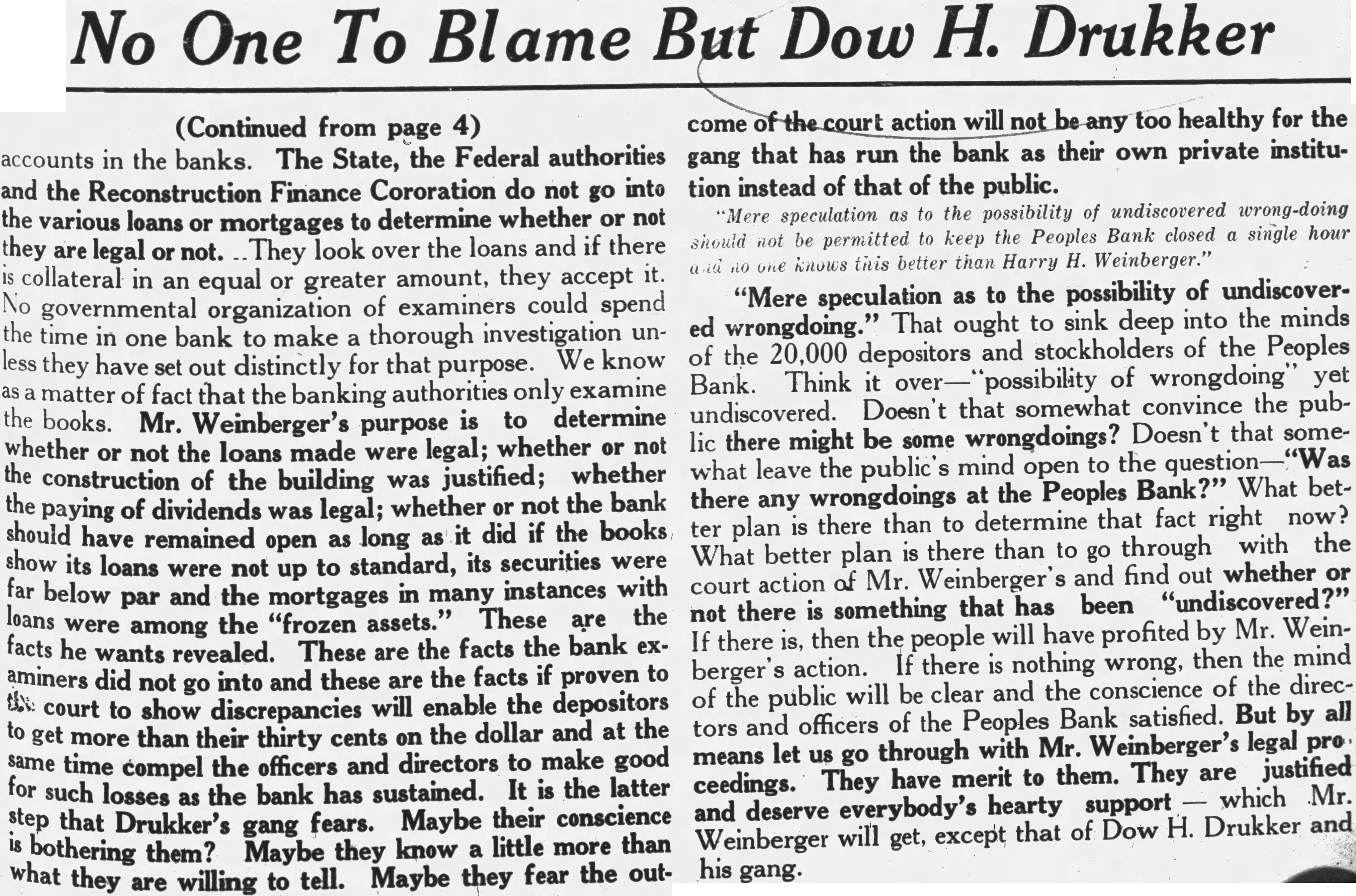
No One To Blame But Dow H. Drukker (Continued from page 4) accounts in the banks. The State, the Federal authorities and the Reconstruction Finance Cororation do not go into the various loans or mortgages to determine whether or not they are legal or not. They look over the loans and if there is collateral in an equal or greater amount, they accept it. No governmental organization of examiners could spend the time in one bank to make a thorough investigation unless they have set out distinctly for that purpose. We know as a matter of fact that the banking authorities only examine the books. Mr. Weinberger's purpose is to determine whether or not the loans made were legal; whether or not the construction of the building was justified; whether the paying of dividends was legal; whether or not the bank should have remained open as long as it did if the books show its loans were not up to standard, its securities were far below par and the mortgages in many instances with loans were among the "frozen assets." These are the facts he wants revealed. These are the facts the bank examiners did not go into and these are the facts if proven to the court to show discrepancies will enable the depositors to get more than their thirty cents on the dollar and at the same time compel the officers and directors to make good for such losses as the bank has sustained. It is the latter step that Drukker's gang fears. Maybe their conscience is bothering them? Maybe they know a little more than what they are willing to tell. Maybe they fear the out- come of the court action will not be any too healthy for the gang that has run the bank as their own private institution instead of that of the public. "Mere speculation as to the possibility of undiscovered wrong-doing should not be permitted to keep the Peoples Bank closed a single hour and no one knows this better than Harry H. Weinberger." "Mere speculation as to the possibility of undiscovered wrongdoing." That ought to sink deep into the minds of the 20,000 depositors and stockholders of the Peoples Bank. Think it over-"possibility of wrongdoing" yet undiscovered. Doesn't that somewhat convince the public there might be some wrongdoings? Doesn't that somewhat leave the public's mind open to the question-"Was there any wrongdoings at the Peoples Bank?" What better plan is there than to determine that fact right now? What better plan is there than to go through with the court action of Mr. Weinberger's and find out whether or not there is something that has been "undiscovered?" If there is, then the people will have profited by Mr. Weinberger's action. If there is nothing wrong, then the mind of the public will be clear and the conscience of the directors and officers of the Peoples Bank satisfied. But by all means let us go through with Mr. Weinberger's legal pro ceedings. They have merit to them. They are justified and deserve everybody's hearty support - which Mr. Weinberger will get, except that of Dow H. Drukker and his gang.