14222. Mutual Benefit Savings Bank (New York, NY)

Bank Information

Episode Type
Run โ†’ Suspension โ†’ Closure
Bank Type
savings bank
Start Date
November 27, 1875
Location
New York, New York (40.714, -74.006)

Metadata

Model
gpt-5-mini
Short Digest
4ff18b658e9a79d6

Response Measures

None

Description

Articles describe depositors' uneasiness and a tendency to run in late Nov. 1875; trustees imposed the 60-day rule (effectively a suspension) and soon decided to liquidate. A receiver (W. F. Aldrich/Aidrich) was appointed; the bank remained in receivership and closed, with partial dividends paid later (25% in May 1876). Although an announcement of reopening to pay a 25% dividend appears (1876-02-01), the institution did not resume normal operations and remained in receivership/closed. OCR variants of 'Aldrich'/'Aidrich' and minor name spellings corrected where obvious.

Events (6)

1. November 27, 1875 Run
Cause
Macro News
Cause Details
General stringency and recent failures of other savings banks produced anxious depositors and a tendency to runs; officers anticipated a run.
Measures
Resolved to enforce the 60 days' notice rule for withdrawals and to decline to receive further deposits.
Newspaper Excerpt
The Mutual Benefit Savings Bank demands 60 days notice today.
Source
newspapers
2. November 29, 1875 Suspension
Cause
Bank Specific Adverse Info
Cause Details
Reported deficiency in assets (examiner found about $22,000 deficiency) and inability to make money in stringency of times, prompting trustees to enforce 60-day rule and suspend business.
Newspaper Excerpt
On Saturday the Mutual Benefit Savings Bank in Tryon-row virtually suspended. ... resolved to enforce the rule requiring 60 days' notice of withdrawals ... and to decline to receive any more deposits for the present.
Source
newspapers
3. December 4, 1875 Receivership
Newspaper Excerpt
The officers of the Mutual Benefit Savings Bank have decided to go into liquidation. ... Isaac V. French ... appointed receiver ... (other articles note W. F. Aldrich appointed receiver).
Source
newspapers
4. February 1, 1876 Reopening
Newspaper Excerpt
The Mutual Benefit Savings Bank, which suspended several months ago, will be reopened to-day, at ten o'clock. All depositors who choose to present their claims will be paid a dividend of twenty-five per cent
Source
newspapers
5. May 16, 1876 Other
Newspaper Excerpt
DIVIDEND NOTICE. - A dividend of 25 percent. will be paid to the depositors of the Mutual Benefit Savings Bank, on demand, at the office of the Receiver. MAY 16, 1876. W. F. ALDRICH, Receiver.
Source
newspapers
6. December 21, 1877 Other
Newspaper Excerpt
There will be no dividend paid by the Receiver of the Mutual Benefit Savings Bank this month ... The bank has now been closed one year.
Source
newspapers

Newspaper Articles (21)

Article from The Portland Daily Press, November 29, 1875

Click image to open full size in new tab

Article Text

NEW YORK. Caved Banks. NEW YORK, Nov. 27.-Wm. A. Butler, the receiver, has assumed duties at the Manafacturers and Builders Bank, The Mutual Benefit Savings Bank demands 60 days notice today. There is an unimportant run on the Germania Savings Bank. Geo. W. Reed, Bank Examiner. is examining the affairs of the Security Bauk. A receiver is to be appointed for the People's Savings Bank. Plymouth Church and the Congregational Council. NEW YORK, Nov. 23.-Rev. Dr. Buddington of Brooklyn, said yesterday in regard to the proposed mutual council to be called by Mrs. Moulton and Plymouth cburch that no point could be considered by the council other than those submitted in a letter missive. If the church and Mrs. Moulton could agree upon th e raising of any scandal issue the matter would be inquired into by the council. There was no possi bility of a mutual council if the parties could net agree upon the questions to be submitted, Rev. Dr. Scadder said he did not see how the scandal matter could be bronght up in any ecclesiastical body. Rev. C. H. Eveest said he did not see how that body could touch Mr. Beecher as it was a question of discipline which rested entirely with Plymouth church.


Article from New-York Tribune, November 29, 1875

Click image to open full size in new tab

Article Text

LOCAL MISCELLANY. THE BANK SUSPENSIONS. DONOTTION OF THE MUTUAL BENEFIT SAVINGS BANK -A DEFICIENCY CONFESSED-BUSINESS SUSPENDED-REPORT ON THE SECURITY BANKOTHER INSTITUTIONS. The suspensions among some of the smaller savings banks of this city do not apparently affect the larger and older institutions. No general "run" has taken place, although in one or two banks a number of depositors have closed their accounts. The feeling appears to be one of anxiety rather than of actual alarm. It is said on all sides that the heavier bauks are very unlikely to show any weakness, and that a panic is improbable. On Saturday the Mutual Benefit Savings Bank in Tryonrow virtually suspended. A meeting of the bank officers was held, at which it was resolved to enforce the rule requiring 60 days' notice of withdrawals by depositors, and to decline to receive any more deposits for the present. Charles K. Graham, the president, stated yesterday that the cause of the suspension was the stringency of the times, which made it impossible for the bank to make money. The recent failures had produced an uneasy feeling among depositors, and in anticipation of a run it was thought best to adopt the 60 days' rule in order to save the securities. There was & deficiency of assets, as compared with the liabilities. How much the deficiency was, Mr. Graham declined to state. It is said to be-according to the recent examination by Mr. Reed-about $22,000, besides some $12,000 of assets estimated over cost. Mr. Graham said that the bank was sound, nevertheless, and would be able to pay its depositors in full. The suspension was merely a precautionary measure. A tendency to & run had been shown last Friday, and numerous depositors had given the 60 days' notice of withdrawal. The number of depositors was about 2,800, and many of them had large accounts. The trustees in 1873 gave bonds to make up a deficiency of about $9,000. Mr. Graham did not know whether they would do the same now. He thought that to-day the banks generally would adopt the 60 days' notice rule. According to the report of the Mutual Benefit Bank, on Jan. 1, 1875, its assets and liabilities balanced at the round amount of $436,000 each. The amount of depositsnow is about $430,000. The German Up-town Savings Bank adopted the 60 days' notice rule on Friday. This bank is said by its officers to be in a perfectly sound condition. The assets are claimed to exceed the liabilities by $25,000. The bank has 5,000 depositors, of whom persons representing about $5,000 have given notice of withdrawal. D. D. T. Marshall, President of the Security Savings Bank, stated last evening(that G. W. Reed, the Examiner, had completed his examination of that bank, and made the following report:


Article from New-York Tribune, November 29, 1875

Click image to open full size in new tab

Article Text

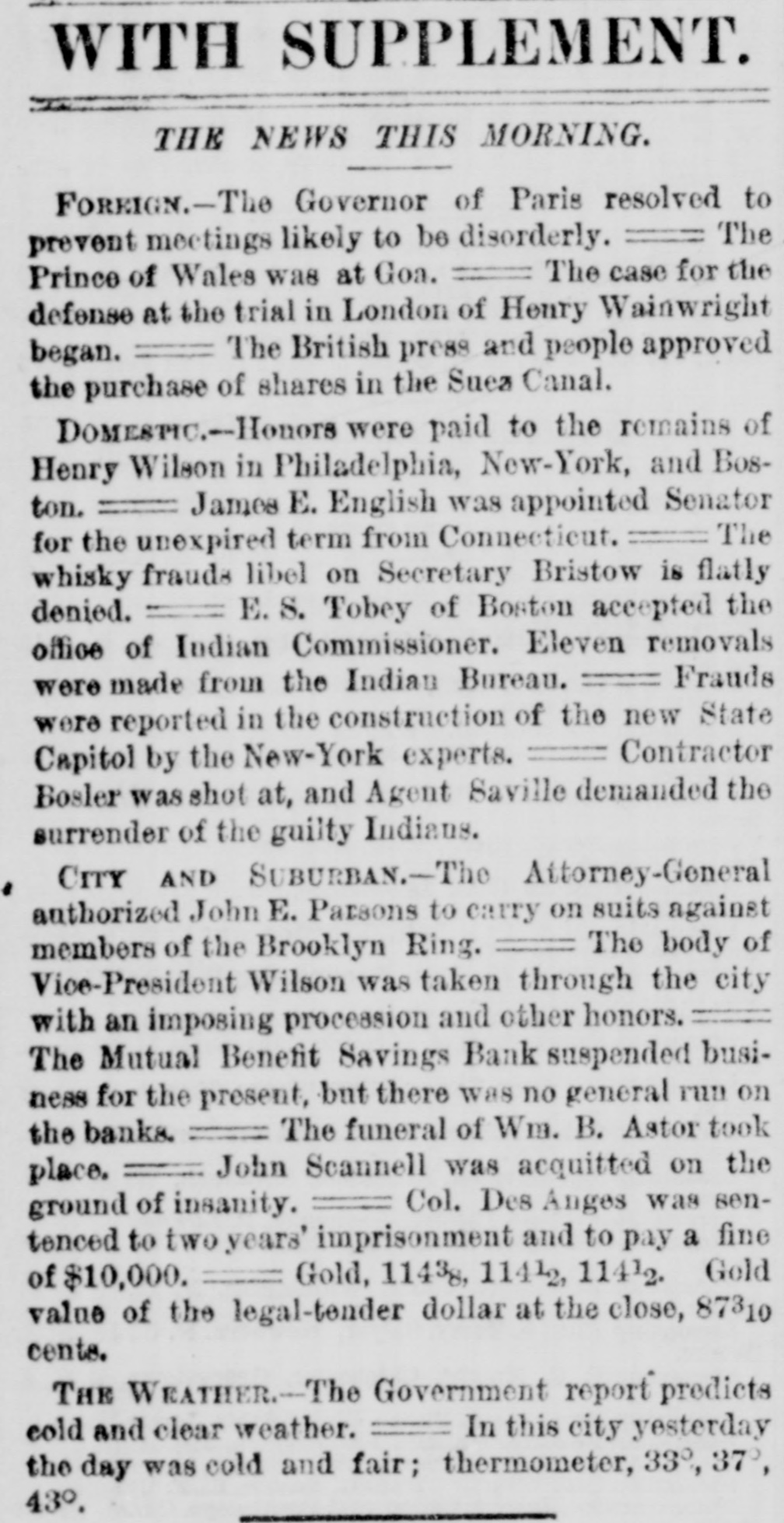
WITH SUPPLEMENT. THE NEWS THIS MORNING. FOREIGN.-The - Governor of Paris resolved to The prevent meetings likely to be disorderly. The case for the Prince of Wales was at Goa. defense at the trial in London of Henry Wainwright The British press and people approved began. the purchase of shares in the Suez Canal. DOMESTIC.-Honors were paid to the remains of Henry Wilson in Philadelphia, New-York, and BosJames E. English was appointed Senator ton. The for the unexpired term from Connecticut. whisky frauds libel on Secretary Bristow is flatly denied. - E. S. Tobey of Boston accepted the office of Indian Commissioner. Eleven removals Frauds were made from the Indian Bureau. were reported in the construction of the new State Contractor Capitol by the New-York experts. Bosler was shot at, and Agent Saville demanded the surrender of the guilty Indians. CITY AND SUBURBAN.-The Attorney-General authorized John E. Parsons to carry on suits against The body of members of the Brooklyn Ring. Vice-President Wilson was taken through the city with an imposing procession and other honors. The Mutual Benefit Savings Bank suspended business for the present, but there was no general run on The funeral of Wm. B. Astor took the banks. John Scannell was acquitted on the place. Col. Des Anges was senground of insanity. tenced to two years' imprisonment and to pay a fine Gold, 1143g, 11412, 11412. Gold of $10,000. value of the legal-tender dollar at the close, 87310 cents. THE WEATHER. - The Government report predicts cold and clear weather. In this city yesterday the day was cold and fair; thermometer, 33ยฐ, 37, 43ยฐ.


Article from New-York Tribune, December 2, 1875

Click image to open full size in new tab

Article Text

THE SAVINGS BANKS. sOLVENCY OF THE MECHANICS AND TRADERS' SAVINGS INSTITUTION - CLEAR SURPLUS OF $50,000-OTHER BANKS. A number of the depositors of the Mechantes and Traders' Savings Institution, at No. 283 Bowery, applied for their money yesterday. The banking rooms were crowded and the payments were made slowly, and after a careful examination and comparison of the pass-books with the ledger accounts of the bank. Some of the trustees were present endeavoring to reason with the frightened depositors, and to convince them of the solvency of the institution. To & reporter of THE TRIBUNE were shown the books and accounts of the bank, with a statement of the market value of the assets. A. T. Conklin, the President, and Henry C. Fisher, the Secretary, declared that the bank was perfectly safe, and could pay dollar for dollar of liabilities without any difficulty. Mr. Conklin stated that the bank wasexamined on April 1, 1874, by theState bank examiners, who reported a surplus of $82,333 18* The bank property was appraised by appraisers em. ployed by the Bank Department, and was put down to its lowest market value. The market value of the stocks, bonds, and other securities was obtained by the examiners after consultation with leading brokers in Wall-st. The annual report, Jan. 1,1875, said Mr. Conklin, was an honest and true statement of the bank's condition. It showed a large surplus over liabilities, and was in every particular corroot. A8 to the item of suspense account, bankruptcy claim, worth $20,000," that claim was well known by the trustees to be good beyond all question, and would yield, principal and interest, at least $25,000 in a few months. The lawsuit pending in relation to it was merely to determine which of two very rich men was liable to the bank for the full amount. The total market value of the stocks and bonds owned by the bank at the present time was largely in excess of the figures reported by the bank examiners. A profit of $20,000 had been made last year on the sale of Government securities a few days before the examination, which did not appear in the figures of the examiners. This sum alone met all the charges of salaries, taxes, and incidental expenses. Salaries had been reduced $5,000 last year, and a considerable reduction made in advertising, stationery, &c. In every way, Mr. Conklin continued. the bank had economized and sought to merit the confidence of its customers and the public. After deducting this suspense account of $20,000, and making due allowance for any unexpected shrinkage, the bank had a clear surplus of at least $50,000. The trustees had decided to enforce the 60 days' rule in extreme cases, but would pay small amounts and pressing claims without delay. This action had been taken in order to protect depositors in the payment of interest due them at the end of this month. Mr. Conklin said, in conclusion that there had been a want of harmony in the Board of Direction some time ago, and the attack on the bank might have originated from that cause. The Mutual Benefit and the Security Savings Banks continued open yesterday, without transacting any business. The Security, it is understood, will resume in two or three days. A receiver for the People's Savings Bank had not arrived at the bank yesterday afternoon, but it is not doubted that an appointment was made yesterday.


Article from The Sun, December 2, 1875

Click image to open full size in new tab

Article Text

THE END OF THE FRIGHT. Yesterday in those of the Savings Banks that have Stood R Run. The run on the North River Savings Bank, at 478 Eighth avenue, and on the Franklin, at 658 Eighth avenue, ceased entirely yesterday, the depositors being apparently satisfied with the assurance in THE SUN that the banks named could pay dollar for dollar. At the Mechanics' and Traders' Savings Bank. 283 Bowery, a number of depositors assembled in the morning, seemingly anxious to get their money. There was also a line of persons who wished to deposit money. The clerks seemed more accustomed to their work than on Tuesday, and paid rapidly and promptly. Toward evening the demand for money diminished. and a number went away expressing confidence in the institution. The President, Mr. A. ฮ“. Conklin, said : ** The statement of last year does not apply to the bank now. The suspense account of $39,127 07 represented money in litigation, which h is been recovered, and is now an asset. The judgment secured by real estate. $5,178 48. is against a man who is very wealthy, and is entirely good. Our stocks and bonds were placed at the lowest m rket value, and we can get more for them now. We hold no town bonds. Our bonds are all State, city, and county. As for our real estate, we have been offered $147,619.27 for the site, but in our report we put it at only the cost. $126,646.77. We have a genuine surplus of $80,000, for, unlike some other banks. our de: 08118 have increased this year instead of decreasing." Mr. Conklin added that the bank had met with some losses during the Presidency of a former trustee, which had been fully repaired. The bank. he said, would not require any sixty days' notice. but would pay everybody that called. He had received offers from other banks to take up all his securities. He added, Although I don't like a run. I would rather have it now than pay interest in January." The trustees of the Mutual Benefit Savings Bank have been discussing whether they will put in enough money to start the bank again. They will probably resolve to do SO.


Article from New-York Tribune, December 4, 1875

Click image to open full size in new tab

Article Text

SAVINGS BANKS. The trustees of the Mutual Benefit Savings Bank, in Tryon-row, after their meeting last Saturday, when they resolved to require the 60 days' notice for the withdrawal of deposits, and to receive no more deposits, communicated their action to Superintendent Ellis of the Banking Department, at the same time requesting that he would allow them one week in which to decide whether the bank should resume or go into liquidation. This was given. In the interval It is stated that vexations suits have been commenced, and after much deliberation it was concluded to be the best policy to go into liquidation. The deficiency reported by Mr. Reid, the bank examiner, amounts to $22,700 (which is about 5 per cent on the amount of deposits), about $9,000 of which is for interest due depositors since July 1, 1875. Isaac V. French, a lawyer in Willfam-st., has been appointed receiver of the People'sand Central Park Savings Banks. The total amount of their liabilities will not exceed $250,000. Mr. French will enter upon the discharge of his duties this morning. He is a young man, but is said to have had considerable experience in banking matters.


Article from Chicago Daily Tribune, December 4, 1875

Click image to open full size in new tab

Article Text

FINANCIAL. NEW YORK, Dec. 3.-The suspension of the varnish house of Adolphus U. Mandel, No. 257 Pearl street, is announced. The officers of the Mutual Benefit Savings Bank have decided to go into liquidation. The depositors will receive 05 cents ou the dollar.


Article from New-York Tribune, December 9, 1875

Click image to open full size in new tab

Article Text

LOCAL MISCELLANY. THE SAVINGS BANKS. NO MORK BANKS TO BE CLOSED-THE TROUBLES BELIEVED TO BE OVER-RECEIVERS FOR THE GERMAN UP-TOWN AND MUTUAL BENEFIT INSTITUTIONS. Since the failure of the German Up-town Savings Bank on Monday there has been little excitement among savings bank depositors, and no runs on any of the stronger banks have taken place. It has been remarked that the excitement from the first has been almost contined to the banks on Third-ave. Nearly all of the recent failures have been in some way ascribed to that of the Third Avenue Savings Bank. Bank Superintendent Eills said yesterday to a TRIBUNE reporter that he thought the trouble was now over* There were no other banks in difficulty, but one or two small banks might have to make their standing good by giving trustees' bonds. Mr. Ellis thought that no other bank would be closed unless some unexpected disclosures should be made. He had sent Bank Examiner Reed to the German Up-town Bank, and Mr. Read had reported that he found, according to the accounts he had examined, a surplus, instead of a deficiency, of several thousand dollars. Based on this report Mr. Ellis's opinion was that the bank might be able to pay dollar for dollar. The President, Mr. Clausen, had however told him that he did not think the bank wouldbe able to pay more than 90 cents on a dollar. Mr. Clausen believed until recently that the bank had a surplus of $25,000. He had taken the report of the Finance Committee as correct, but on making an examination himself he discovered a deficiency of $40,000. Mr. Ellis said that some of the mortgages held by this bank might be of doubtful value, and might cause the deficiency. The Mutual Benefit Bank, he said, never would have resumed, notwithstanding the reports to that effect. He thought it might pay 90 cents on a dollar to its depositors. The Security Bank would go on and be a strong, sound bank again. Judge Davis yesterday, in Supreme Court, Chambers, appointed Herman Uhi, receiver of the German Uptown Savings Bank. The order is made in the suit of John Martin Maut-a depositor to the extent of $2,300against the bank. and the plaintiff's complaint sets out that while the deposits are $838,000, the assets, as stated to him by the bank officers, will not exceed $800,000. and this statement is probably subject to a considerable depreciation below the value of the assets as fixed by the bank officers. He, therefore, charges that the bank is insolvent, and asks an injunction and receiver, in the ordinary form. The answer of the bank is a simple ad mission of the truth of the complaint. Judge Davis, in his order appointing Mr. UM receiver, fixes his bonds at $150,000. and gives him the ordinary powers of receivers, but adds several special restrictions, the chief being that the receiver shall at once make an inventory, and file it with the County Clerk, and thereafter file monthly reports of the funds in his hands; that he shall turn over all the funds in his bands in excess at any time of $25,000, to the New-York Life Insurance and Trust Company, and that every 40 days he shall make a dividend out of the funds in his hands, or show cause to the Court for his failure to do so. Edward M. Shepard appeared for the plaintiff; Man & Parsons for the defendant. Mr. Uhl 18 a member of Gov. Tilden's staff. An order made by Judge Donohue in Supreme Court, Special Term, wasentered yesterday, reducing the bonds of the receiver of the Mutual Benefit Savings Bank from $200,000 to $75,000. W. F. Aidrich, a lawyer, of No. 84 Broadway, has been appointed receiver of this bank. 8. H. Hurd, the new receiver of the Third Avenue Bavings Bank, was at that Institution yesterday, but did not begin his examination of its accounts. A slight run has taken place on the Harlem Savings Bank without, it is said, producing any serious effect. A large number of anxious depositora called at the German Up-town Bank yesterday, but no money was paid out to them. The Security Bank paid out a few hundred dollars in sums of $5 and $10 to each applicant. To-day the officers expect to pay 121g per cent on all deposits withdrawn. There was no excitement, and the larger depositors express entire confidence in the bank, and refuse to touch their money.
Article from The New York Herald, December 15, 1875

Click image to open full size in new tab

Article Text

MEETING OF DEPOSITORS OF THE MUTUAL BENEFIT SAVINGS BANK-AN EXPERT AND COUNSEL TO BE APPOINTED. An adjourned meeting of the depositors of the Mutual Benefit Savings Bank was held yesterday afternoon, at No. 21 Park row, to hear the report of a committee appointed at a previous meeting to ascertain certain information relative to the condition of the bank. Dr. W. Phillips presided, and there was a numerous attendance of indignant depositors. The committee consisted of Messrs. G. A. Norman, J. W. Thompson, F. Hollander and J. Van Doren. Its report set forth that its members had waited on Mr. Aldrich, the receiver, at the bank, and presented the wishes of the depositors in relation to having an expert accountant appointed to make an examination of the actual condition of affairs. This permission to have the accountant Mr. Aldrich declined to grant at present. He said also that he could give no positive assurance as to the time when the dividend would be paid, nor the time when he could give to depositors the state of the assets now in his possession. The report further stated that the committee was satisfied from the interview with the receiver that all was not in a strictly healthy condition, and that the appointment of an expert by the depositors is the only way in which they can obtain any information as to the true condition of the bank's assets. The reading of this report provoked considerable discussion. It was finally moved that an expert accountant and counsel be appointed on behalf of the depositors to examine the assets of the bank, to protect the interests of said depositors of said institution. This resolution, after some debate, in the course of which several depositors gave vent to their indignation, was adopted. On motion, Dr. Phillips and Mr. Edward Ives were added to the committee, the members of which were requested to confer with bank experts and counsel in order to ascertain the rights of depositors under the law and report at the next meeting, which was set down for Friday next.


Article from The New York Herald, December 18, 1875

Click image to open full size in new tab

Article Text

MUTUAL BENEFIT SAVINGS BANK. A meeting of about eighty depositors of the Mutual Benefit Savings Bank was held yesterday afternoon at No. 291 Bowery. Dr. George Philips acted as Chair. man and J. E. Van Doran as Secretary. Mr. Van Doran read a report of the Executive Committee and showed the necessity of raising a fund to prosecute both civilly and criminally, if necessary, the bank trustees. For this purpose it was proposed that depositors should subscribe one per cent of the amounts of their several claims to secure counsel Sixty depositors, representing $60,000. had signed this agreement. The committee recommend Mr. Sharp as receiver in place of Mr. Aldrich. The committee had not received the permission of Mr. Aldrich to examine the securities in his hands, but presented the hat given by the Bank Examiner at his last examination. The result of that examination was the discovery of a deficiency of $22,000. About $15,000 have been withdrawn from the bank by depositors since this statement was prepared. The Exective Committee was empowered to demand from the Court an increase in the receiver's bonds to $250,000, and an order for the inspection of the bank accounts by an expert


Article from The New York Herald, December 25, 1875

Click image to open full size in new tab

Article Text

HOW THE MUTUAL BENEFIT SAVINGS BANK DID BUSINESS. To THR EDITOR OF THE HERALD:It is to be hoped that Governor Tildon will, as you recommended in your issue of December 10, investigate the broken savings banks. The blow falls very hard on many depositors who have, year after year, put a portion of their earnings into those banks, with the belief that should sickness come they would have the wherewith to keep out of the hospital, and that in old age they would not be a burden on their children or frier ds. People in a small way of business too often deposit their profits and then draw when they desire to replenish their scanty stock, and many such are now entirely broken up. And such breaking up means more than financial loss. It too often means a moral breaking down. Why should men and women be industrious and economical, so that they may not become at any time a burden on the community, if the banks they trust are allowed thus to defraud them? Why should they not spend their money as they go along for such things as please their senses or tastes and let each coming day care for Itself? I have no desire to be harsh, although losing my all of ready money by the recent crash. 1 do not think that the officers were designedly Grobbers of the poor," but it is beyond question that they have been careless and reckless in their management of the moneys of the poor. The cloud of financial trouble which now envelops the land began to gather two years ago, and such prudent men as bank directors ought to have foreseen the storm and takon in sail. Better have lowered the rate of interest allowed on deposits than have jeopardized the principal. And now it is but fair to demand that the entire personal property and incomes of every official connected with any shaky, crippled or fallen bank should be at once secured and held for the payment of the poor men and women who put their faith in the prudence and honesty of these bank directors and officers. Nor should the State Superintendent of Banks, Mr. Ellis, be excused from blame until he has seen that at least this justice is done. But it is to be feared that there has been even more than reckless speculation and a want of judgment in the management of those banks. Inquiry would not be amiss as to whether the everyday details of savings bank business are attended to with care and precision. My meaning will be best illustrated by an account of individual experience. I opened my account with the Mutual Benefit Savings Bank on April 1, 1870, with a deposit of $75. Since then I have made, according to my pass book, fifty deposits and fifty-four withdrawals of money. After the first six months, perhaps a little earlier, I left my pass book constantly in the care of the bank, having perfect confidence in its officers and it being more convenient; but, whenever I made a deposit or a withdrawal, I was very particular before I left the bank to see that the amount either for or against me was properly entered on it. I made all my deposits and withdrawals of money personally, with the exception of two or perhaps three checks. I made my last deposit on October 11, 1875, at which time I had my balance in the bank rockoned by the teller from the pass book. I made no withdrawal of money and gave no check to any one after that date. A few days alter the suspension of the bank, on December 2. I think, I went to the bank and asked for my pass book. The teller commenced figuring in it. I asked what was my balance; he named a sum nearly $100 less than he had told me in October. [ asked for an explanation of the difference between the two statements. Ho said that two entries had been found against me on their journal which had not been put at the proper time on my pass book, and he then and there entered thein on it, one for $50, dated January 4, 1873, and the other for $20 80, dated May 8, 1874. The smaller sum I recognized as having been paid on a check which I had given for rent. I asked if the admission of those two entries against me would make my pass book and their journal agree. I was answered that there was $50 in my favor entered on my pass book, of which their journal gave no record. Now here, in my own caso, according to that statement, were three instances of neglect in the performance of duty-namely, two omissions to make the proper entry in my pass book, which was in their custody and daily in a pigeonhole close at hand, and one failure to enter a sum to my credit on their journal. I make this statement, not with any feeling of enmity against any officers of the bank. from whom [ have always received great courtesy, but that other depositors who have left pass books at the bank may exaining their books, and I sincerely hope that none may find any reason to think that his account has not been SIX HUNDRED. accurately kept.


Article from New-York Tribune, January 12, 1876

Click image to open full size in new tab

Article Text

New-York Daily Cribune. FOUNDED BY HORACE GREELEY. WEDNESDAY, JANUARY 12, 1876. THE NEWS THIS MORNING. FOREIGN.-Cardinal Ledochowski was soon to be released unconditionally. There were prospects of harmony being restored in the French MinI Seven of the crew of the Lennie, istry. charged with mutiny, were acquitted; two were detained for trial. The Prince of Wales arrived at Delhi. DOMESTIC.-In Congress, Senators Cooper and Morton and others spoke in memory of Andrew Johnson: several enlogies were also delivered in the House; Mr. Hill of Georgia made a long and remarkable speech in the House defending Jefferson Davis and the Confederacy from the responsibility of Andersonville, charging it on the Federal Government; Mr. Blaine showed that Mr. Hill proposed in the Confederate Congress to put every captured In the State LegislaUnion soldier to death. ture the Senate Committees were announced; prison investigation was set on foot in the === Auditor Thayer has resigned. Assembly. In the Landis case, a jury was obtained with diffiGen. Gordon Granger and the Hon. culty. John Wilson, ex-Commissioner of the Land Office, The jury in the trial of George D. are dead. Lord disagroed, and were discharged. The American Dairymen's Association met at Rome for a few days' session. CITY AND SUBURBAN.-Notice - of demurrer was served by Mr. Beecher's counsel in Mr. Moulton's mit. Gen. Butler has been retained by Mr. MoulThe Aldermanic Committee on Gen. Porton. ter's nomination decided to report against confirmation. === A cigar-maker in East Twenty-eighth-st. killed an assistant foreman of a fire company and The Bar Association then committed suicide. recommended the consolidation of the Supreme Court, Superior Court, and Court of Common Pleas. ==== Sound steamers were much delayed by the Depositors of the Mutual Benefit Savings gale. Bank are working for Receiver Aldrich's removal. Gold 113, 1127g, 1127g. Gold value of the legal-tender dollar at the close 88610 cents. THE WEATHER.-The Government report predicts cold weather and snow. In this city yesterday, the day was cold and windy. Thermometer, 21ยฐ, 23ยฐ, 19ยฐ.


Article from The New York Herald, January 23, 1876

Click image to open full size in new tab

Article Text

THE COURTS. The Receivership of the Mutual Benefit Savings Bank. Unsuccessful Effort to Remove the Receiver. Liability for Possession of Counterfeit Money. An effort is being made to remove Mr. Aldrich from his position as receiver of the Mutual Benefit Savings Bank. A motion to this effect was made yesterday before Judge Donohue, of the Supreme Court, the moving parties being an executive committee appointed at a meeting of the depositors. It was urged for the motion that Mr. Aldrich has been grossly negligent in conducting the affairs of the bank; that he is an incompetent officer; that he refused to allow an expert to examine the books for no other reason, as is alleged, than to protect the officers and trustees of the institution; that he examined, in 1873, several banks, and, among others, the Third Avenue Savings Bank, all of which have failed; that his report of the condition of the last named institution was incorrect in many particulars, and that he is, in fact, unfit to hold the position. On behalf of Mr. Aldrich it was contended in reply that there are other creditors beside the depositors; that the plaintiffs do not represent all the depositors, and that two of the men appointed on the examining committee disaprove altogether of the proceeding. He denies that he was appointed at the instance of the trustees, but says he knows his appointment met the approval of the Bank Department. He denies as broadly as the charge was made that his reports of the other banks were incorrect; that as to the report of the Third Avenue Bank, he was selected as one of the examiners, not on account of his knowledge of figures, but for his legal advice as to the validity of titles and agreements, and that in a great measure he had to rely on the judgment of his associates as to the accounts. He denies all the charges in the complaint and says he is continually in receipt or communications approving of his course, and when he has paid the first dividend, to meet the most pressing wants of depositors, he will have an examination by an expert, and is perfectly willing that the Court should appoint such expert. After hearing the argument Judge Donohue promptly rendered his decision denying the motion.


Article from The New York Herald, February 1, 1876

Click image to open full size in new tab

Article Text

MUTUAL BENEFIT SAVINGS BANK The Mutual Benefit Savings Bank, which suspended several months ago, will be reopened to-day, at ten o'clock. All depositors who choose to present their claims will be paid a dividend of twenty. five per cent


Article from The Sun, May 16, 1876

Click image to open full size in new tab

Article Text

Banks. Sabings FRANKLIN SAVINGS BANK, corner 42d st. av. Open daily 10 A M. to 3 P. M. and Monday and Saturday evenings from 6 to 8 o'clock. Interest begins the first of every month. JAB E. SMITH, Sec. JAS. F. CHAMBERLAIN, Pres. IXPENNY HAVINGS BANK. Broadway and S Astor place. Established 1853. Bank open daily from 10 A. M. to 8 P. M. Five cents to $5,000 received. Dibidends. D IVIDEND NOTICE. - A dividend of 25 percent. will be paid to the depositors of the Mutual Beneft Savings Bank, on demand, at the office of the Receiver. 1 Centre al., Stasts Zeitung Building. MAY 16, 1876. W. F. ALDRICH, Receiver.


Article from The Sun, August 13, 1876

Click image to open full size in new tab

Article Text

oraon for the Family-strangers under the Tall Tower. They were on a Fulton ferry boat, father. mother. and daughter - he in shirt sleeves, white trousers. and prunella gaiters, about seventy years of age; the mother in black bombazine, no bustle, and very warm; the daughter pale, sallow, and chewing gum. What's that, pa?' "That, oh, that's what they call a yach." "What's them towers for? "Them's for the suspension bridge. It's to be made of iron. They kin hoist It up when tallmasted vessels go under. The bridge will be 1,500 feet long, about half as long as they are at Niagara." The party rode up in a Fifth avenue stage, the slowest known mode of locomotion, thereby having ample time to observe the sights. That," said the sun-burned pa and guide, as he pointed at St. Paul's Chur that is a celebrated Baptist church. where Nickfield preached. All them tombstones was raised for British soldiers. They buried 'em just where they fell, and the British Government put up the stones afterward. The architect died and the plan was lost. 80 it's doubtful if any of the stones are properly placed. And this, said be. continuing, "is Astor's fur house. You can see the dags flying on the store. What's this. pa?" She referred to the Post Office. don't know whether that's the Museum or the Hippodrome. I rather guess its the Hippodrome. Yes, I know it is. You see the Italian musician at the door. That's him with the muste crank. This is where Moody and Sankey had their meetings. and that little shed in the rear is where they baptized the converted souls. Isupposethis Central Park isn't it. papa?' They were then passing the City Hall. Yes, dear. Yes, that's the Central Park. It's right in the middle of the city. The steeple is supposed to be directly over the heart of the town. They always pull up the flags when the Mayor goes out of town or if any of the Aldermen ate. don't know why three sides of the City Hall are marbie and one side free stone. Do you know. sir Stranger I believe it was because the rear of the building was 90 trup-town. they thought noonewould ever care to goround The handsome building just above it is one of our treasures. Its the new County Court House. We call it the house that Bill built. Bill who? Bill built-that is. William erected it.' Oh. Thank you. Daughter, that dirty old house is the house that Bill built. It doesn't look as though it had come to stay. Oh, there! look. mother: there's where Stewart made his fortune. Yes, that's his store. There's where he sold his store clothes." Is his store closed No. no. BAY that's where he sold his store clothes. But it was closed when he died.' "Is he then dead?' Very dead. Then they left the stage and walked down Chambers street and up Centre. That's one of the glories of the country my dear,' said the old man he slung his coatov er his other arm. and pointed at the vacant office of the Mutual Benefit Savings Bank. Isit. pa Yes. That is it was before it closed up. I don't know how it happened. but the money went out fasterthan it went in. Sothey appointed receiver. Butit open in the basement." Yes. They sell beer there. The basements are generally open when the banks are shut up. On, pa, what a tall tower. what a very tall tower. What is it?" That's it. What's it? You said it. What is it. That's just what it 1s. That's the celebrated highest tower in New York. Go up into it any day. and see a Reid shaken by the wind. That's the great temperance organ. That's the great-hello! Why see here mother let's go into dear Horace's saloon and take a bite. They enter. Zwei lager, two brandy smashes, one stein. one plate tomato soup, three lagers. and one pony brandy, were the salutations as the rural party stepped foot over the threshold. Waiter-Take seats blease. What shall I get, three lagers? All right. Papa-Three what? No. sir. Bring three pieces of pie and a cup of tea. Stranger- day, sir. You're a stranger I see. Come down stairs and see the pictures. Let the ladies remain. They go down. Presently the old man rushes back. His evel wild. his DATE dishevelled. his umbrella firmly classed. Come out of this place. Mother, daughter. come. Where are we? Where am And out they flv. followed by the watter's cheery cry. Zwei lager and a sgooner of Rhine wine. quig!"


Article from The New York Herald, December 21, 1876

Click image to open full size in new tab

Article Text

MUTUAL BENEFIT SAVINGS BANK. There will be no dividend paid by the Receiver of the Mutual Benefit Savings Bank this month, although it was generally expected by the depositors that such would be the case. The Receiver, Mr. Aldrich, is the old cashier of the bank, and one of the clerks sit by the side of the bank ledgers all day in a back room of No. 73 Broadway. The salaries of the bank employรฉs are tous continued in winding up its affairs. The bank has now been closed one year.


Article from The New York Herald, April 28, 1877

Click image to open full size in new tab

Article Text

BOTTOMLESS MONEY BOXES. LOST PLEIADS OF OUR SAVINGS BANK SYSTEMNEW MATTERS FOR THE ELLIS INVESTIGATING COMMITTEE-HOW TO PREVENT FRAUDS. It is claimed by many influential merchants and others who have been interviewed on the subject that the present investigation of the official course pursued by Superintendent Ellis will clearly show that his neglect of duty has caused much of the suffering resulting from recent failures of savings banks. It is also contended that, in addition to the banking institu. tions named in Governor Robinson's late message to the investigating committee, there are other corporations whose cases have not been cited. but which furnish new prima facie evidence against the Bank Superintendent. Among these may be cited the Loaners' Bank of New York. About November, 1875, the Bank Superintendent was asked for a report upon the condition of this establishment, but it appeared that, the bank never having been examined, Mr. Eltis could furnish no information about its status. At the same time a lawyer wrote to the Superintendent asking to have the Loaners' Bank examined, but no examination took place, and the institution failed in May, 1876. A gentleman acquainted with its affairs says:"Its operations were worse than those of a low class pawnshop." The community lost $500,000 by the failure, much 01 which, it is claimed, might have been saved had the Banking Department held the corporation to strict account when required to do so. ANOTHER STARTLING CASE. In relation to the New York State Loan and Trust Company responsible parties state that about March, 1875, Mr. Ell's was officially informed by Mr. George W. Reid, examiner, and Mr. William T. Aidrich and others, that the capital stock had suffered an impairment equal to at least twenty per cent. It was the Bank Superintendent's duty to have caused this deneit to be made good, or to have closed the doors of the company under instructions from the Attorney General. No steps were taken by Mr. Exis and the concern was allowed to remain in the hands of the same parties until January 29, 1876, when the impairment of the capital amounted 10 about ninety per cent, and the trustees voluntarily relinquished the remaining ten conts on the dollar to a receiver. The loss 10 the public was about nine hundred thousand dollars. The wretched condition of this company was known to all persons familiar with us general operations at the time. By the statute of 1874 the superintendence of trust companies chartered by the State was placed under the charge of Mr. Ellis, and the condition of this concern was or should have been well known to him. A FRIGHTFUL LIST OF LOSSES. In conversation with Mr. John Mack, of No. 365 Fifth avenue, that gentleman gave the following estimates of the losses suffered by depositors 10 the suspended savings banks, and says that he believes the greater part of the immense sums which are given below migot have been saved if Bank Superintendent Eths bad properly discharged his important duties:$150,000 Abingdon Square Bank 1,730,000 Bona Street Savings Bank 500,000 German Savings Bank, Morrisanta 2,000,000 Mechanics and Traders' Savings Bank 450,000 Mutual Benefit Savings Bank 750,000 New Amsterdam Savings Bank 200,000 People's Savings Bank 400,000 Security Savings Bank 1,440,000 Third Avenue Savings Bank. 120,000 Traders' Savings Bank 1,000,000 Bank of Lainsburg 1,000,000 New York State Loan and Trust Company Loaner's Rauk 500,000 500,000 Security Bank Manufacturers and Builders' Bank. 460,000 Total $11,200,000 HOW TO PREVENT FRAUDS


Article from New-York Tribune, December 26, 1877

Click image to open full size in new tab

Article Text

CRY FROM A LOSER BY A BROKEN BANK. To the Editor of The Tribune: SIR: I am a bookkeeper, and out of my seanty salary managed, with close economy, to save a couple of hundred dollars, which I from time to time deposited in the Mutual Benefit Savings Bank, it being recommended to me as being a safe though not a very large concern, and being convenient to my place of business. This bank is now in the hands of a receiver, who has paid two dividends thus far, amounting to 50 per cent. the last one being paid in May, 1876. The bank suspended payment in November, 1875. Now, do you not think that, if the receiver was to try really hard, be might pay the depositors another dividend, even though it should be a small one, at or soon after the beginning of the new year! I understand he has funds enough on hand at present to pay a dividend of 10 or 15 per cent, but wishes to realize on securities and real estate which are among the assets of the bank. so as to be able to pay a larger and final dividend to the depositors. I, in common with many others just now, am in actual need of every dollar I can obtain. Can you not nsk Mr. Aldrich, the receiver, to hurry up with a dividend? New-York, Dec. 15, 1877. A SAVINGS BANK VICTIM.


Article from The Sun, November 9, 1878

Click image to open full size in new tab

Article Text

# THREE OUNCES OF LAUDANUM. Lawrence Jerome's Friend, Disappointed by Defeat. Takes Poison. Edward K. Aldrich, a son of Receiver Aldrich of the Mutual Benefit Savings Bank. swallowed three ounces of laudanum, while his father lay at the point of death in the next room, in the boarding house at 43 West Twenty-second street, on Thursday even- ing. Physicians were summoned and every- thing done to resuscitate the dying man, but without avail. He died a few minutes before 12 o'clock. His father was unconscious at the time, and the news of the suicide has been kept from him. Mr. Aldrich occupied a fourth-story bedroom and his invalid father lay in a double room adjoining. For the past few daja Mr. Aldrich had appeared somewhat dispirited, but his friends attributed it to temporary causes and thought that it would soon pass off. He had been working hard for Lawrence Jerome in the campaign for election to Congress, and was reported to have wagered large amounts on Mr. Jerome's success. The result of the election depressed him greatly, and to drown his sorrows he took to drinking. On Thurs- day evening he went home partly intoxicated and entered his room, leaving the door ajar. His sister, Mrs. Green, happening to pass by about two hours afterward, flung a book through the door to rouse him, and called playfully," Ed, what's the matter?" Mr. Aldrich was lying on the bed, breathing heavily, but he roused himself sufficiently to make a confused answer, and his sister passed on. Shortly after 11 o'clock the lodgers in the upper stories were roused by heavy breathing, as if a person was choking, in Mr. Aldrich's room. His brother and his brother-in-law tried to open the door, but found it locked. They pounded and knocked for several minutes, but without arousing the sleeper within. Then they climbed upon the balustrade of the staircase, and through the half open ventilator saw Mr. Aldrien lying on the bed. The door waB forced open, and the brothers entered. Three long ounce bottles, bearing the imprint." Me- Munn's Elixir," on the bureau, told the story. Dr. W. A. Carradine and Dr. Ailen were sum- moned. While on his way Dr. Carradine aroused the clerk in the drug store at Twenty- second street and Sixth avenue and got a pow- erful emetie, two tumblerfuls of which he forced down the dying man's throat. He then tried to induce artificial respiration, but with- out success, the patient dying within ten min- utes after his arrival. So great was the strain upon the brother that he fainted four times. He had been watching the bedside of his father. The brothers proposed removing the body to a lower story, for fear the preparations for the funeral would be overheard by the father. Dr. Carradine advised against this, on the ground that the dead man was too heavy to carry with- out arousing those in the adjoining rooms, and it was accordingly kept there until morning. On the bureau, besides the three bottles of poi- son, were a cigar, half smoked, and the dregs of a glass of beer. Deputy Coroner Goldschmidt thought that the dead man was accustomed to taking the elixir as an anodrue to quiet pain, Dr. Carradine also thought that Mr. Aldrich must have used the elixir in large quantities, because such an enormous overdos would not have remained in his stomach. There was enough opium in the three bottles to kill half a dozen men. Mr. Aldrich had a law office at 71 Broadway. He was 32 years of age, of stout and robust pro- portions, and gifted with a genial disposition. His practice as a lawyer was not extensive, and for some time past he had been assisting his father in settling the affairs of the Mutual Benefit Savings Bank. A rumor was afloat yes- terday that his death was attributable to finan- cial troubles in connection with the bank, but inquiry failed to sustain it. The body is to be taken to Palmyra, N. Y., for interment.


Article from The Cincinnati Daily Star, March 3, 1879

Click image to open full size in new tab

Article Text

GOTHAM GLEANINGS News, Notes and Dashes in and About the Metropolis. National Associated Press to the Star. BAYARD TAYLOR'S DIRGE. NEW YORK, March 3.-Nearly five hundred Germans, members of twenty-three German singing societies. who are to sing at the funeral of Bayard Taylor, met last vening and rehearsed the parts of the Mirge. It is anticipated that the chorus will number a thousand singers at the funeral, and that every German society in the city will be represented. The singers meet again next Sunday for a final rehearsal. MR. FULTON ARRAIGNS THE BAPTISTS. Rev. Fulton yesterday arraigned the Baptist clergy for a lack of bravery in the pulpit. MBS. DYSON'S RETURN. Mrs. Dyson, on whose evidence Peace was hanged at Leeds, England, last Tuesday, came home yesterday. BANK BOOKS MISSING. The Mutual Benefit Savings Bank of this city closed its doors November 27th, 1875. At the time of its suspension it had four thousand depositors, to whom it owed about $450,000. Bad management and a shrinkage in values caused its failure. Now it is discovered that the books strangely disappeared after the death of the receiver (Aldrich). It is the opinion of the depositors that some of the officers and some of the trustees of the suspended bank are implicated in the fraud. Gen. Charles Graham was President of the bank when it passed into the hands of the receiver. KNOW HOW IT IS THEMSELVES. A considerable number of minstrel men have been joining temperance societies lately, and some of the noted ones are now announced as lecturers in the ranks. The other day Cool Burgess joined the Croton water army, and told of his experience, and yesterday James Sutherland, widely known as Senator Bob Hart, the burlesque temperance orator of minstrel shows, joined the ranks of the converted. He knew how it was himself, and said he had been won to the Temperance Union while attending a meeting three weeks ago. More to be heard from. THE INSURANCE MUDDLE. The Sun says since the management of our insurance affairs was wrested from the Comptroller's Department in 1860, to gratify the greed of unscrupulous partisans, the consequences have been disgraceful and disastrous. Policy holders have been swindled out of millions of money. The law creating the Insurance Department ought to be repealed, and its business restored to the Comptroller's office.