14217. Murray Hill Bank (New York, NY)

Bank Information

Episode Type
Suspension → Closure
Bank Type
state
Start Date
August 11, 1896
Location
New York, New York (40.714, -74.006)

Metadata

Model
gpt-5-mini
Short Digest
b78df953fc501985

Response Measures

None

Description

The Murray Hill Bank (a state bank) was ordered closed/suspended by the NY Superintendent of Banking on Aug 11, 1896 due to impaired assets (large real-estate loans, behind legal reserve). There is no clear contemporaneous description of a depositor run; the bank was taken into custody and later placed in receivership and dissolved, so classify as suspension leading to closure/receivership.

Events (2)

1. August 11, 1896 Suspension
Cause
Bank Specific Adverse Info
Cause Details
Compelled to suspend because it had taken a large amount of real estate as security for loans, was behind in its legal reserve and lacked sufficient cash to continue operations.
Newspaper Excerpt
This bank is closed pending an examination of the condition of its affairs.
Source
newspapers
2. January 9, 1897 Receivership
Newspaper Excerpt
final order January 9, 1897 ... appointed Trask and O'Brien receivers of the Murray Hill Bank; the referee found the bank insolvent and reported it should be dissolved by a final order.
Source
newspapers

Newspaper Articles (23)

Article from The Wilmington Daily Republican, August 11, 1896

Click image to open full size in new tab

Article Text

Bank Failed. NEW YORK, Aug. 11.-The Murray Hill bank at No. 760 Third avenue, New York, one of the oldest state banks in the city, closed its doors this morning. It has deposits of about $1,250 00 which it is believed will be paid in full. It is understood the bank was compelled to suspend because it had to take a great deal of real estate for loans made to customers.


Article from The Indianapolis Journal, August 12, 1896

Click image to open full size in new tab

Article Text

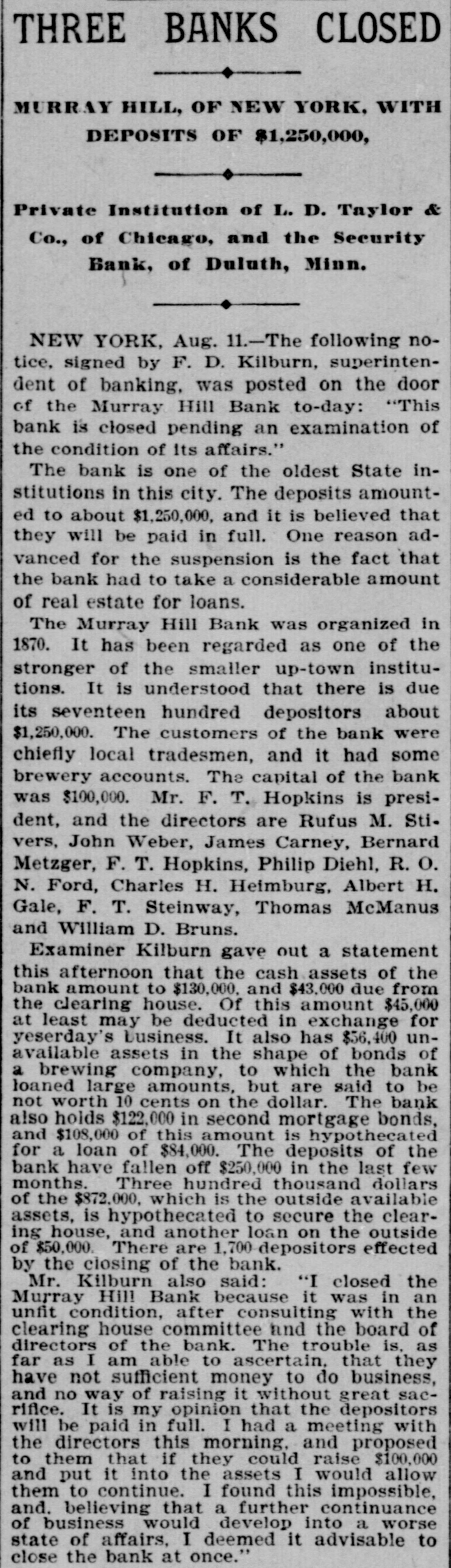
THREE BANKS CLOSED MURRAY HILL, OF NEW YORK, WITH DEPOSITS OF $1,250,000, Private Institution of L. D. Taylor & Co., of Chicago, and the Security Bank, of Duluth, Minn. NEW YORK, Aug. 11.-The following notice, signed by F. D. Kilburn, superintendent of banking, was posted on the door of the Murray Hill Bank to-day: "This bank is closed pending an examination of the condition of Its affairs." The bank is one of the oldest State institutions in this city. The deposits amounted to about $1,250,000, and it is believed that they will be paid in full. One reason advanced for the suspension is the fact that the bank had to take a considerable amount of real estate for loans. The Murray Hill Bank was organized in 1870. It has been regarded as one of the stronger of the smaller up-town institutions. It is understood that there is due its seventeen hundred depositors about $1,250,000. The customers of the bank were chiefly local tradesmen, and it had some brewery accounts. The capital of the bank was $100,000. Mr. F. T. Hopkins is president, and the directors are Rufus M. Stivers, John Weber, James Carney, Bernard Metzger, F. T. Hopkins, Philip Diehl, R. O. N. Ford, Charles H. Heimburg, Albert H. Gale, F. T. Steinway, Thomas McManus and William D. Bruns. Examiner Kilburn gave out a statement this afternoon that the cash assets of the bank amount to $130,000. and $43,000 due from the clearing house. Of this amount $45,000 at least may be deducted in exchange for yeserday's business. It also has $56,400 unavailable assets in the shape of bonds of a brewing company, to which the bank loaned large amounts, but are said to be not worth 10 cents on the dollar. The bank also holds $122,000 in second mortgage bonds, and $108,000 of this amount is hypothecated for a loan of $84,000. The deposits of the bank have fallen off $250,000 in the last few months. Three hundred thousand dollars of the $872,000, which is the outside available assets, is hypothecated to secure the clearing house, and another loan on the outside of $50,000. There are 1,700 depositors effected by the closing of the bank. Mr. Kilburn also said: "I closed the Murray Hill Bank because it was in an unfit condition, after consulting with the clearing house committee and the board of directors of the bank. The trouble is, as far as I am able to ascertain, that they have not sufficient money to do business, and no way of raising it without great sacrifice. It is my opinion that the depositors will be paid in full. I had a meeting with the directors this morning, and proposed to them that if they could raise $100,000 and put it into the assets I would allow them to continue. I found this impossible, and. believing that a further continuance of business would develop into a worse state of affairs, I deemed it advisable to close the bank at once."


Article from The Morning News, August 12, 1896

Click image to open full size in new tab

Article Text

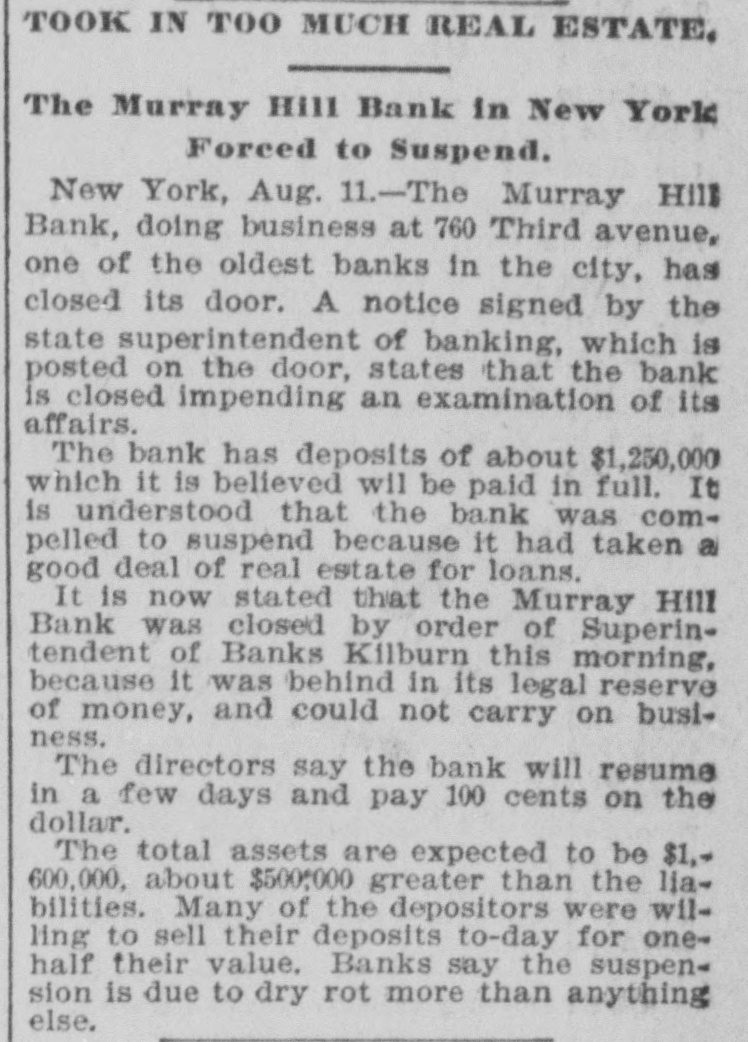
TOOK IN TOO MUCH REAL ESTATE. The Murray Hill Bank in New York Forced to Suspend. New York, Aug. 11.-The Murray Hill Bank, doing business at 760 Third avenue, one of the oldest banks in the city, has closed its door. A notice signed by the state superintendent of banking, which is posted on the door, states that the bank is closed impending an examination of its affairs. The bank has deposits of about $1,250,000 which it is believed wil be paid in full. It is understood that the bank was compelled to suspend because it had taken ai good deal of real estate for loans. It is now stated that the Murray Hill Bank was closed by order of Superintendent of Banks Kilburn this morning, because it was behind in its legal reserve of money, and could not carry on business. The directors say the bank will resume in a few days and pay 100 cents on the dollar. The total assets are expected to be $1,600,000, about $500,000 greater than the liabilities. Many of the depositors were willing to sell their deposits to-day for onehalf their value. Banks say the suspension is due to dry rot more than anything else.


Article from The Roanoke Daily Times, August 12, 1896

Click image to open full size in new tab

Article Text

IN THE WORLD OF FINANCE NEW YORK STOCKS. New York, August 11.- The course of the stock market to-day clearly reflected the intervention of aggressive bull leadership, and at the close of business was much more cheerful than for some time past. The theory was borne out by the failure of the determined efforts made by the bears to emphasize several unfavorable developments, including the suspension of the Murray Hill Bank, a disappointing exhibit by the St. Paul for the first week, a recurrence of stiff money rates and unsatisfactory Government/crop statistics. London was inclined to the bull side owing to the smoothness with which the fortnightly settlement was progressing in the American department, and further weakness in the exchange market offset the comparatively high rates for money. The closing was at the highest prices of the day.


Article from The Wichita Daily Eagle, August 12, 1896

Click image to open full size in new tab

Article Text

BANK DOORS ARE CLOSED One of New York's Solid Institutions Suecumbs to Real Estate Security. New York, Aug. 11.-The following notice signed by F. D. Kilburn, superintendent of banking, was posted on the door of the Murray Hill bank today: "This bank is closed, pending an investigation of the condition of its affairs." The bank is one of the oldest state institutions in this city. The deposits amount to albout $1,250,000, and it is believed that they will be paid in full. One reason advanced for the suspension is the fact that the bank had to take a considerable amount of real estate for loans. The Murray Hill bank was organized in 1870. It has been regarded as one of the strongest of the smaller up-town institutions. It is understood there is due its depositors about $1,250,000. The customers of the bank were cheifly local tradesmen and it had some brewery accounts. The capital of the bank was $100,000. Mr. F. T. Hopkins is president, and the directors are Rufus M. Stiver, John Weier, James Carney, Bernard Metzger, F. Hopkins and Phillip Diehl. Examiner Kilburn gave out a statement this afternoon that the cash assets of the bank amountel to $130,000, and $34,000 due from the clearing house. Of this amount $45,000 at least may be deducted in exchange for yesterday's business. It also has $56,400 unavailable assets in the shape of bonds of a brewing company to which the bank loaned large amounts but which are said to be not worth 10 cents on the dollar. The bank has sold $122,000 in second mortgage bonds and $108,000 of this amount is hypothecated for a loan of $84,000. The deposits of the bank have fallen off $250,000 in the last few months. Three hundred thousand dollars of the $872,000 which is outside available assets is hypothecated to secure large houses and another loan on the outside of $50,000. There are 1,254 depositors affected by the closing of the bank. Mr. Kilburn also said: "I closed the Murray Hill bank because it was in an unfit condition, after consulting with the clearing house committee and the board of directors of the bank. The trouble is, as far as I am able to ascertain, that they have not sufficient money to do business and no way of raising it without great sacrifice. It is my opinion that the depositors will be paid in full. "I had a meeting with the directors this morning and proposed to them that if they could raise $100,000 and put it into the assets, I would allow them to continue. I found this impossible and believing that a further continuance of business would develop into a worse state of affairs, I deemed it advisable to close the bank at once." Duluth, Minn., Aug. 11.-The Security Bank of Duluth, capital $100,000. one of the leading banks of the city, closed its doors this morning. Heavy withdrawals of deposits and impossibility of making speedy collections is given as the cause. M. D. Kenyon, state examiner, is in charge. The bank's deposits are in the neighborhood of $300,000. Chicago, Aug. 11.-The private bank of L. D. Taylor & Co., successors to North & Taylor, 959 West Madison street, was closed today. By order of the court the Equitable Trust company was made receiver. The assets are $150,000; liabilities about $100,000. Dallas, Tex., Aug. 11.-Hetherington and Nelson, dealers in machinery supplies, filed a deed of trust yesterday; liabilities $34,430.


Article from The San Francisco Call, August 12, 1896

Click image to open full size in new tab

Article Text

SEVERAL BANK FAILURES Peculiar Condition of the Money Market Causes Suspensions. Depositors Will Be Paid in Full When Securities Can Be Realized On. NEW YORK, N. Y., Aug. 11.-The Murray Hill Bank, doing business on Third avenue, one of the oldest State banks in the city, has closed its doors. A notice states that the bank was closed pending an examination of its affairs. The bank has deposits of $1,250,000, which it is believed will be paid in full. It is understood that the bank WAS compelled to suspend because it had to take a good deal of real estate for loans. BOSTON, Mass., Aug. 11.-W. H. Tre worky, wholesale dealer, has made an assignment for the benefit of his creditors. No statement of assets and liabilities has yet been prepared, but it is understood that the liabilities are in the neighborhood of $200,000. DULUTH, MINN., Aug. 11.-The Security Bank of Duluth, one of the largest banks in the State, closed its doors this morning. A notice was posted on the door, saying: "Heavy and unlooked for withdrawais of deposits, and the impossibility of making speedy collections compelled us to close our doors." The last statement of the bank deposits on July 22 was $329,324. The officials say that they expect to pay depositors in full. The failure caused considerable excitement, and other failures are feared. CHICAGO, ILL., Aug. 11.-North & Taylor, private bankers, who did business at 959 West Madison street, suspended today. The banks depositors are working men and the total amount of their savings is placed at $100,000. The firm had a capital of $50,000. Charles A. North and Luis D. Taylor, the partners, have been in business for several years. They were compelled to discontinue because of the extraordinary condition of the money market and inability to realize on securities. Depositors are promised full payment. The Equitable Trust Company was appointed receiver.


Article from The Providence News, August 13, 1896

Click image to open full size in new tab

Article Text

TELEGRAPHIC BREVITIES. Herr Otto Lilienthal, the "Flying Man," was killed near Berlin. Thirty postoffices of the country show a gain in receipts over July, 1895. Great Britain has claimed and seized a rich section of Alaskan territory. An electric railway it to be built between New York and Philadelphia. The Turkish government refuses to make any concessions to the Cretans. It appears not impossible that the Murray Hill bank may resume business. Barbarities of Japanese troops toward the inhabitants of Formosa are reported. There is a strong sentiment apparent in Cuba for annexation to the United States. The gold withdrawals yesterday were $167,300, leaving the gold reserve $106,794,954. The Burlington road is to establish a daily newspaper, printed and published on their trains. The sultan has conferred upon Miss Clara Barton the emblem of the second class of the Order of Chofakat. The suspension of F. A. Phillips of the New York Consolidated Exchange has been announced. The failure is of minor importance. Present indications are that Li Hung Chang will visit President Cleveland, if he sees him at all, at Gray Gables, or in that vicinity.


Article from The Austin Weekly Statesman, August 13, 1896

Click image to open full size in new tab

Article Text

STOCKS AND BONDS. New York, Aug. 11.-The course of the stock market today clearly reflected the intervention of aggressive bull leadership and the temper at the close of business was much more cheerful than for some time past. This theory was borne out by the failure of the demand efforts made by the bears to emphasize several unfavorable developments, including the susbension of the Murray Hill bank. a disappointing exhibit in the St. Paul earnings for the first week, a recurrence of stiff money rates and unsatisfactory government crop reports. London was inclined to the bull side, owing to the smoothness with which the fortnightly settlement was progressing in the American department and further weakness in the exchange market, offset the comparatively higher rates for money. Confidence in an early amicable arrangement™ as to the rates between the southern roads was also expressed. A feature of the operations was again the execution of numerous small investment orders and in addition to the pool support the market was strengthened by heavy covering purchases by some of the bear leaders, who appreciate the change in the speculative conditions and turned abruptly. Business was on a fairly large scale, with Sugar and St. Paul leading, and was well distributed. The market opened strong and higher under the improved London prices and moderately extensive purchases by arbitrage houses. The gains extended to sharp fractions, but the tendency towards improvement was soon checked by a vigorous drive by the bears on the announcement of the suspension of the Murray Hill bank. For a time this contingent retained the advantage and offered stocks freely. In the resultant decline. Northwestern dropped 2 5-8 per cent; Manhattan 1 7-8 per cent and Sugar 1 1-2 per cent. The depression was helped by realizations, but at the low point a new and powerful element in the speculation became evident and all offerings were quickly absorbed. The extreme rally extended to 3 1-2 per sent in Sugar, the stock touching 100 3-4. Northwestern and Chicago Gas rose 4


Article from The San Francisco Call, August 14, 1896

Click image to open full size in new tab

Article Text

bond of $200,000. The liabilities of the firm are $517,000 and the nominal assets $819,000. They are controlling stockholders in the Olympic Cycle Manufacturing Company. NEW YORK, N. Y., Aug. I3.-A corps of clerks and officials is busy on the books of the closed Murray Hill Bank. Superintendent of Banks Kilburn said that his report would not be ready for two days yet, and if in the meantime the bank should raise the stipulated $100,000 he would permit it to resume business. Victor Freund, a director of the bank, has offered to contribute $50,000, provided the bank officials raise the remaining $50,000. INDIANAPOLIS, IND., Aug. 13.-Special Judge Hammond of the Circuit Court appointed P. C. Tresier receiver of the Union National Bank and Loan Association. The association was one of the largest in the State, having assests of over $500,000.


Article from New-York Tribune, August 14, 1896

Click image to open full size in new tab

Article Text

FOURTEEN PAGES. THE NEWS THIS MORNING. FOREIGN.-The House of Lords agreed to the House of Commons reamendments of the Irish Land bill, and the measure will now beValkyrie III has reached the come a law. Sir John Millais, the painter, other side. president of the Royal Academy, died in LonDr. Nansen, the Arctic explorer, ardon. rived at Vordöe, one of the islands of Norway; he had reached 85 degrees 14 minutes north latitude. DOMESTIC.-Major McKinley addressed a visiting delegation of old soldiers on the disappearance of sectionalism from this country, Congressman Galusha A. Grow spoke on silver in Towanda, Penn. The Pennsylvania State Democratic Committee met at Harrisburg, accepted the resignation of Chairman Wright, and voted to reconvene the Conrention. Hovey and Hobart won the Eastern championship in lawn tennis doubles at Cooper defeated Bald Narragansett Pier. in the two-mile National championship bicycle race at Louisville. CITY AND SUBURBAN.-There was a general feeling of relief among. business men over the failure of W. J. Bryan's speech on Wednesday evening; the stock market was strong; a reception by Mr. and Mrs. Bryan at the Windsor was attended by a small number of persons, and the Democratic managers were reported to be The weather was thoroughly disheartened. cooler, and the record of deaths and prostrations from the heat was not so large as on WednesThe Board of Estimate appropriated day. The sus$5,000 for free ice for the poor. pension of the jewelry house of S. F. Myers & Co., and proceedings for its dissolution were A said to be due to the silver agitation. plan for the reorganization of the Murray Hill Bank was adopted by the directors and stockholders and approved at a meeting of depositors. "The New-York Times" was sold in a formal proceeding. The Brooklyn baseball team defeated the Baltimore nine, and were deStocks feated by them. at Eastern Park. were strong and higher. THE WEATHER.-Forecast for to-day: Cooler: probably severe local thunderstorms, followed by clearing weather. Temperature yesterday: Highest, 94 degrees; lowest, 80; average, 86%.


Article from New-York Tribune, August 20, 1896

Click image to open full size in new tab

Article Text

FUTURE OF THE MURRAY HILL BANK. EFFORTS TO RAISE THE FUNDS NECESSARY UNDER THE REORGANIZATION PLAN. The officers and directors of the Murray Hill Bank, after the ratification of the plan submitted to a mass-meeting of the depositors Tuesday evening, were yesterday busily engaged in looking for the $100,000 cash which they are pledged, according to the plan, to raise. For an insolvent bank to raise that amount is not the work of a moment, and patience on the part of all concerned will be required. President Hopkins, Mr. Smith, the receiving teller, and Samuel Untemyer, counsel for the bank, were all hopeful of the ultimate outcome of their efforts. Mr. Kilburn, Superintendent of Banking, believes the bank can be rehabilitated. He is not pressing the matter of a receivership, and can delay doing so as long as he sees a possibility of the bank's securing the $100,000 cash necessary to resume. The plan which has been ratified by the depositors and stockholders is being sent out to all of them for signatures. President Hopkins is conservative in his statements, and was unwilling to say yesterday just when he thought the bank would resume, if he and the directors succeeded in their work. Asked if it would be within a month he said: "Oh, it has got to be sooner than that." No more definite statement could be gotten from him. The bank is now in charge of the bank examiner, who is still at work on the assets and liabilities, a revised list of which will probably be ready by the end of the week. President Hopkins said that after the settlement of the Clearing House exchanges, on his rough estimate, the assets exceeded the liabilities to depositors by $200,000.


Article from The United Opinion, August 21, 1896

Click image to open full size in new tab

Article Text

THE WEEK'S NEWS. THURSDAY, AUG. 13. Bryan and Sewall notification meeting in New York-Many prostrations and deaths from heat reported—-House of commons supported government on Irish land bill amendments-Betting ? to I against Bryan in New YorkNew E :;land silver Democrats hope to Indnce Bryan to make spee in Massachusetts and Connecticut — San Francisco banks reluctant to receive deposits of silver-Mail carrier killed by train at Hyde Park, Mass--------------------- Streets n laid out in 7500 acres of woodland in Dorchester, nominated for superintendent of public instruction in Michigan declared ineligible-publicans of western Vermont opened their campaign at Rutland-Youthful at would-be train wrecker caught New Canaan, Conn-Jake Kilrain matched to fight Frank Slavin---Herr Otto Lilienthal, the "Flying Man," killed near Berkin-Electric railway to be built between New York and Philadelphia-Thirty postoffices of the country show a gain in receipts over July, 1895-It appears not impossible that the Murray Hill bank may resume business-Great Britain claimed and seized rich section of Alaskan territorya Barbarities of Japanese troops toward the inhabitants of Formosa reported -Strong sentiment apparent in Cuba for annexation to the United States Purlington road to establish a daily newspaper, printed and published on their trains— S. Sanborn & Co., shoe manufacturers, Lynn, Mass., failed, with estimated liabilities of $75,000-Turkish government refuses to make any concessions to the Cretans—J. F. Ober, Boston architect, died suddenly a Sultan conferred upon Miss Clara Barton the emblem of the second class of the Order of the Chofakat—Clifford Hale, aged 15, drowned at Newburyport, Mass --James A. Hagley, aged 16, killed on the Consolidated road at Hyde Park, Mass-The Neal Morse company of Boston, dealers in woolens, assigned. No figures given out. FRIDAY, AUG. 14. Cool wave brought relief to suffering New Yorkers-Reception at New York by Mr. and Mrs. Bryan very slimly attended-Dr. Nansen, the explorer, arrived at Vardoe, off Finmark, on his return trip-Irish land bill will become a law, as amended-Colonel A. C. Drinkwater of Braintree, Mass., is a candidate for congressional honors— Whitehead of Cambridge, Mass., won the senior singles at the Saratoga regatta -Griffo, the pugilist, sent to prison for a year for assault-Tom Butler, Nat Butler and Cooper won chief races of the L A. W. meet-Maine gold standard Democrats issue a call for a mass convention-John Teague drowned while bathing in Lowell, Mass— Two West Point cadets dismissed for hazing-Mary Foster, the missing Lancaster (Mass.) girl, found in Fitchburg-Further ourtailment probable in Fall River (Mass.) mills-Two jewelry failures in New York-Italian minister ordered to Washington to investigate reported lynching in New Orleans Vest makers' strike in New York to be called off - Withdrawal from Knights of Labor of Window Glass Workers' association of the United States Big labor demonstration in Lynn, Mass. Parade of locked-out lasters of Thomas G Plant Shoe company Manhanset House, Shelter island, damaged $200,000 by fire-Death of exSenator Gibson of Chicopee, Mass— Field Marshal Yamagata has returned to Japan-Three dynamiters to be released from an English prison-Patrick C. Keely, the famous architect, died in Brooklyn-Cuban junta negotiating for the purchase of a fast ocean tug-Edward J. Howard of Bocton arrested at Portland, Me., on a charge of forgery -Yaqui Indians attacked the Mexicans on the southern Arizona boundary line-Eastern railroads must reduce freight rates if they would ho'd the western grain traffic-Mercer county, N. J., failed to dispose of its bonds, which are not, in terms, payable in gold -Rev. Edward J. Sheridan, pastor of St. Mary's church, Taunton, Mass., for a quarter of a century, is dead-Sir John Everett Millais, president of the Royal academy, died in London. SATURDAY, AUG. 15. Bryan's friends complain that he is being too much managed-Probability that McKinley will take the stump himself-Republican national committee to distribute 1,000,000 copies of Blaine's anti-silver speech Niagara Falls special train collided with a handcar near Falls Village, Conn.; section foreman killed-John Mueller, a New Jersey farmer, thought to have been murdered by his wife-President objects to hazing at the military academy at West Point-Deaths caused by the excessive heat in New York are estimated at nearly 1000-Push cart venders of stale fruit and vegetables raided by New York police-Four men shot, 11v in labor affray at Cleve-
Article from New-York Tribune, August 21, 1896

Click image to open full size in new tab

Article Text

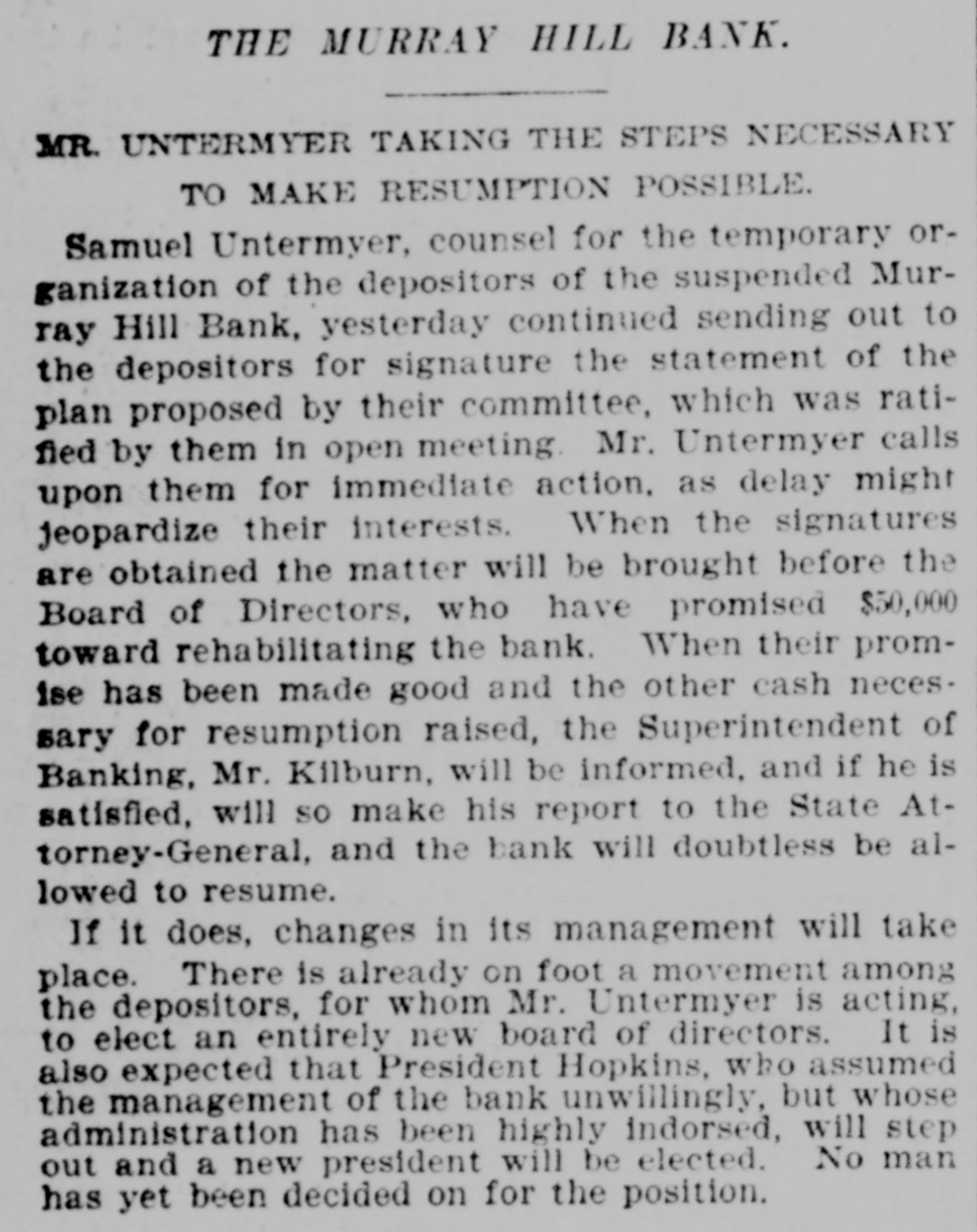
THE MURRAY HILL BANK. MR. UNTERMYER TAKING THE STEPS NECESSARY TO MAKE RESUMPTION POSSIBLE. Samuel Untermyer, counsel for the temporary organization of the depositors of the suspended Murray Hill Bank, yesterday continued sending out to the depositors for signature the statement of the plan proposed by their committee, which was ratified by them in open meeting. Mr. Untermyer calls upon them for immediate action. as delay might jeopardize their interests. When the signatures are obtained the matter will be brought before the Board of Directors, who have promised $50,000 toward rehabilitating the bank. When their promise has been made good and the other cash necessary for resumption raised, the Superintendent of Banking, Mr. Kilburn, will be informed, and if he is satisfied, will so make his report to the State Attorney-General, and the bank will doubtless be allowed to resume. If it does, changes in its management will take place. There is already on foot a movement among the depositors, for whom Mr. Untermyer is acting, to elect an entirely new board of directors. It is also expected that President Hopkins, who assumed the management of the bank unwillingly, but whose administration has been highly indorsed, will step out and a new president will be elected. No man has yet been decided on for the position.


Article from New-York Tribune, August 22, 1896

Click image to open full size in new tab

Article Text

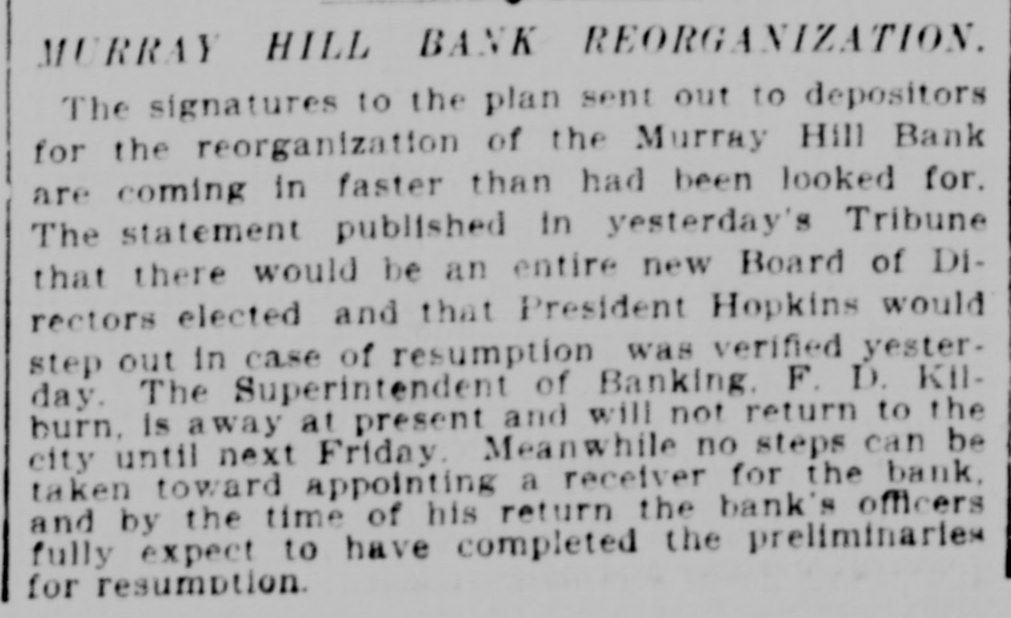
MURRAY HILL BANK REORGANIZATION. The signatures to the plan sent out to depositors for the reorganization of the Murray Hill Bank are coming in faster than had been looked for. The statement published in yesterday's Tribune that there would be an entire new Board of Directors elected and that President Hopkins would step out In case of resumption was verified yesterday. The Superintendent of Banking. F. D. Kilburn, is away at present and will not return to the city until next Friday. Meanwhile no steps can be taken toward appointing a receiver for the bank, and by the time of his return the bank's officers fully expect to have completed the preliminaries for resumption.


Article from New-York Tribune, October 11, 1896

Click image to open full size in new tab

Article Text

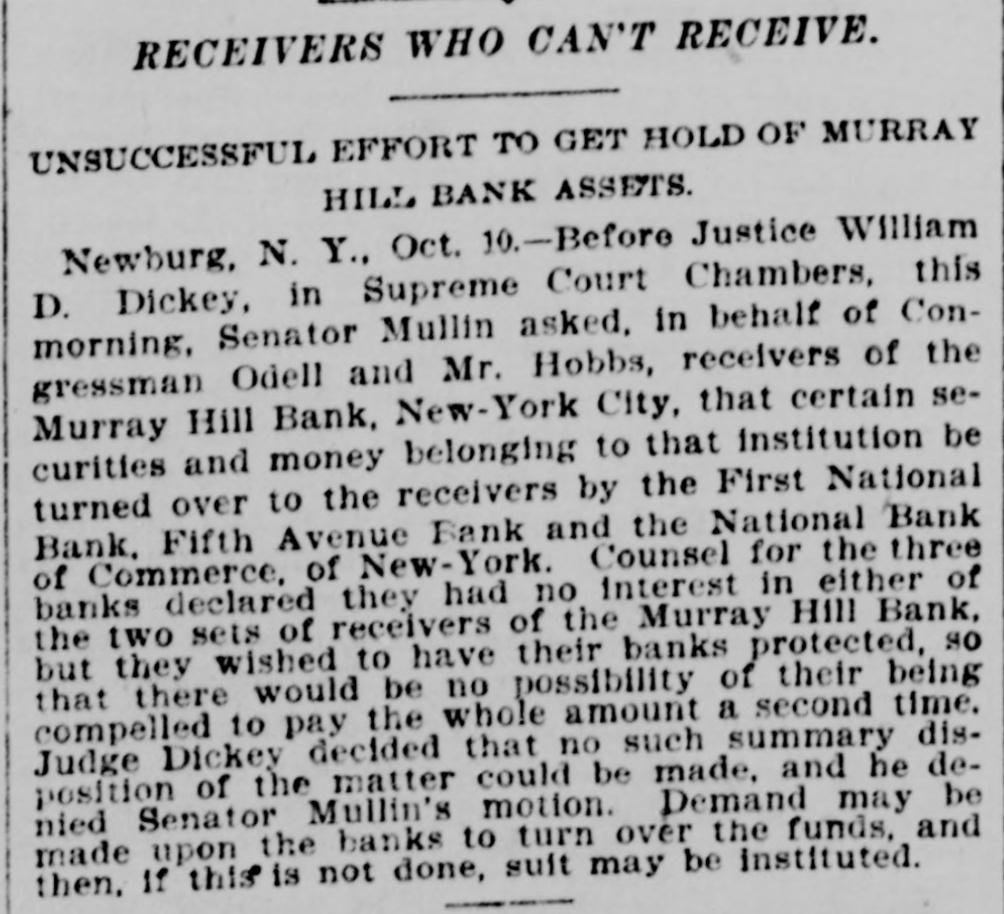
RECEIVERS WHO CAN'T RECEIVE. UNSUCCESSFUL EFFORT TO GET HOLD OF MURRAY HILL BANK ASSETS. Newburg, N. Y., Oct. 10.-Before Justice William D. Dickey, in Supreme Court Chambers, this morning, Senator Mullin asked, in behalf of Congressman Odell and Mr. Hobbs, receivers of the Murray Hill Bank, New-York City, that certain securities and money belonging to that institution be turned over to the receivers by the First National Bank, Fifth Avenue Bank and the National Bank of Commerce, of New-York. - Counsel for the three banks declared they had no interest in either of the two sets of receivers of the Murray Hill Bank, but they wished to have their banks protected, so that there would be no possibility of their being compelled to pay the whole amount a second time. Judge Dickey decided that no such summary disposition of the matter could be made, and he denied Senator Mullin's motion. Demand may be made upon the banks to turn over the funds, and then, If this is not done, suit may be instituted.


Article from New-York Tribune, November 21, 1896

Click image to open full size in new tab

Article Text

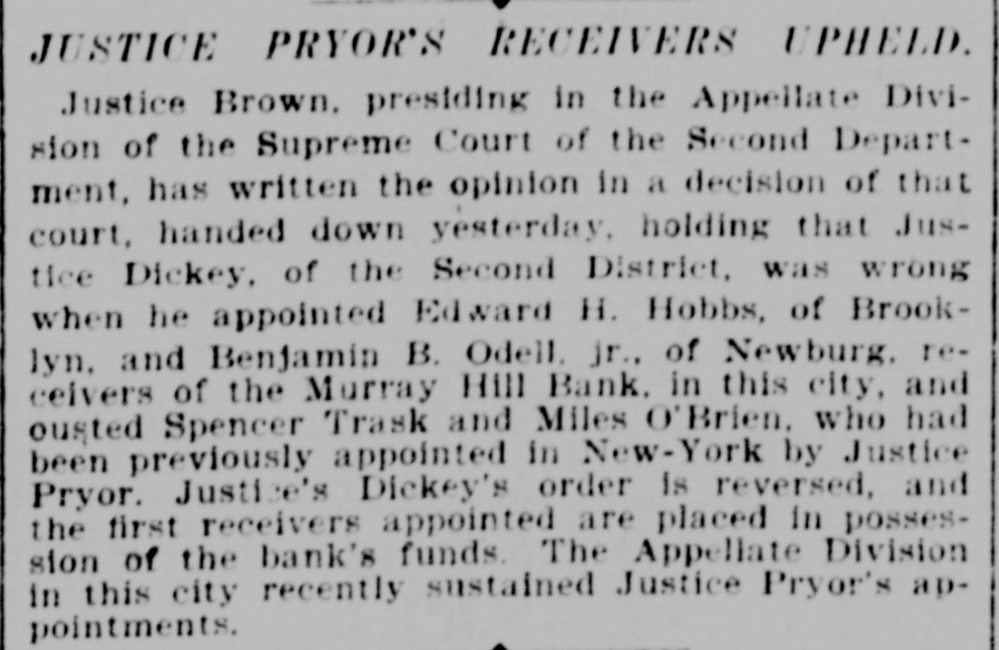
JUSTICE PRYOR'S RECEIVERS UPHELD. Justice Brown. presiding in the Appellate Division of the Supreme Court of the Second Department, has written the opinion in a decision of that court, handed down yesterday, holding that Justice Dickey, of the Second District, was wrong when he appointed Edward H. Hobbs, of Brooklyn. and Benjamin B. Odell. jr., of Newburg, receivers of the Murray Hill Bank. in this city, and ousted Spencer Trask and Miles O'Brien. who had been previously appointed in New-York by Justice Pryor. Justice's Dickey's order is reversed, and the first receivers appointed are placed in possession of the bank's funds. The Appellate Division in this city recently sustained Justice Pryor's appointments.


Article from New-York Tribune, January 16, 1897

Click image to open full size in new tab

Article Text

LEGAL INTELLIGENCE. PROCEEDINGS IN LOCAL COURTS. Mr. Hotchkiss, representing 83 per cent of the depositors of the Murray Hill Bank. asked Justice Beach, in the Supreme Court yesterday, to appoint a referee in place of the present receivers, Messrs. Trask and O'Brien. It was alleged that the depositors wanted to reopen the bank, and that the assets could be more economically administered by a referee than by receivers. Deputy Attorney-General Kisselburg asked until Tuesday to look into the case, and an adjournment was taken to that date.


Article from New-York Tribune, June 9, 1897

Click image to open full size in new tab

Article Text

OTHER IMPORTANT DECISIONS. THE MURRAY HILL BANK RECEIVERS-BROOKLYN CIVIL SERVICE CASE. Albany, June 8.-The Court of Appeals has decided with the Attorney-General in the matter of the dissolution of the Murray Hill Bank. The appeal was made by Spencer Trask and Miles M. O'Brien as receivers of the Murray Hill Bank, appointed by a final order January 9, 1897, and by a committee of the depositors representing about $500,000 of claims, from an order of the Appellate Division of the Supreme Sourt reversing the final order of Justice Andrews, which directed the dissolution of the Murray Hill Bank and appointed Trask and O'Brien permanent receivers, and denied the application of AttorneyGeneral Hancock to dismiss this proceeding. The Murray Hill Bank was closed on August 11, 1896, by order of the Bank Superintendent, who also directed the Attorney-General to institute proceedings necessary to wind up its affairs. He requested Mr. Hancock to defer the beginning of proceedings for a reasonable time, to give the directors time to restore the impairment of about $260,000. It was contended that this delay was not asked for in good faith, as it appears that shortly after the doors of the bank were closed the president and various directors consulted with the bank's attorney, James McGregor Smith, and began the present proceeding. The Attorney-General and Bank Superintendent held that these voluntary proceedings could not be instituted for a dissolution of the corporation and for an administration of its affaiars, for the reason that the Superintendent of Banks had taken possession of the bank. The Appellate Division, First Department, decided against the Attorney-General and sustained these proceedings. Another action was begun in the Second Department, and an order appointing Edward H. Hobbs, of Brooklyn, and Benjamin B. Odell, jr., of Newburg, receivers. The Appellate Division of the Second Department reversed the order, and an order directing them to pay over the assets to Spencer Trask was also reversed by the Appellate Division of First Department. The various contentions were also brought before a referee, who found the bank insolvent. and reported that it should be dissolved by a final order in such proceedings. The report of the referee was confirmed on January 19, 1897, by Judge Andrews, whose decision was reversed by the Appellate Division, First Department, but which is now sustained by the Court of Appeals. A decision was handed down dismissing the motion made to reopen the Brooklyn Civil Service case, in the decision of which Judge Haight wrote the prevailing opinion, making more open the confidential non-competitive class. The original suit was dismissed by the Court of Appeals on April 20, after having been sustained by both the Supreme Court of this department and the Appellate Division. Justice Haight's opinion was concurred in by Justices Bartlett, Martin and Vann. Two dissenting opinions were handed down at the same time, one by Justice Gray, Chief Justice Andrews concurring, and another by Justice O'Brien. The motion to reopen was asked for by Edward M. Shepard, J. Warren Greene and Henry Yonge, counsel for the plaintiffs. The Court dismissed the complaint of Martha Keery against John F. Dimon, executor of the will of Stephen C. Dimon, who died in New-York City on January 12. 1893, leaving personal property of the value of $25,000 and'a seventh interest in the property bounded by Third and Fourth and Lewis sts. and the East River, the value of which is placed at about $500,000. Dimon was an eccentric bachelor. For eight years he had lived in the furnished-room house kept by Mrs. Keery, at No. 117 West Fortyseventh-st. For several years prior to his death he had not been on friendly terms with his relatives. and it is stated that he declared that none of them would receive a dollar of his fortune. Mrs. Keery averred that he made a will in her favor about September, 1884. She declares that she saw the will and that Mr. Dimon told her to read it carefully. as he intended that she should have all of his property. After his death Mrs. Keery secured permission from the Court for an inspection of the contents of boxes in the Mercantile Safe Deposit Company and the American Safe Deposit Company, but no will could be found. She said that the will had been lost or destroyed by accident or design. A decision of absolute judgment was rendered in favor of Clifford Wharton and the National Tube Company against Adam S. Matheson and another as receivers of the American Tube and Iron Company.


Article from New-York Tribune, July 18, 1897

Click image to open full size in new tab

Article Text

MURRAY HILL BANK SUIT. DEPOSITORS DEMAND THE MONEY PAID IN ON THE DAY OF THE FAILURE. Newburg, N. Y., July 17.-The Murray Hill Bank case came before Judge W. D. Dickey this morning on a hearing in the suit of John Stapleton against Edward H. Hobbs and Congressman B. B. Odell, jr., receivers. The action is brought to compel the receivers to turn over the deposits made at the bank on the last day it did business. The assertion is made that the president and the directors were aware that the bank was insolvent, and that their acceptance of the deposits was fraudulent. Former President Hopkins was the only important witness. He testified that the failure of the bank was due to its operations in real estate. He said he had opposed such large Investments in real estate, but had been outvoted by the directors. He was questioned in regard to loans. and he told of many cases in which loans had been lost. having been made on real estate which had greatly depreciated in value. The Court reserved decision. The amount involved is $107,000.


Article from New-York Tribune, October 5, 1897

Click image to open full size in new tab

Article Text

LOCAL BUSINESS COMPLICATIONS. Gustav Goldmann. dealer in provisions, sausages, etc., at No. 314 East Houston-st., is in financial difficulties. and has transferred his business, accounts and store property to relatives for various considerations. Goldmann is one of the largest sausage manufacturers in this city. Horwitz & Hershfield, his attorneys, said yesterday that his liabilities were about $20,000. Asked If the Luetgert murder trial in Chicago had had any effect on his trade. they said that his business had fallen off greatly, but he was probably not aware that the Chicago case had anything to do with it. The attorneys said they thought that some settlement would be arranged with the creditors to put Mr. Goldmann on his feet again. Benjamin B. Odell. jr., and Edward H. Hobbs, receivers of the Murray Hill Bank. entered judgments yesterday against Siegmund T. Meyer & Son for $14.483; Robert B. Lynd, $8,698, and Francis Doran, $7,697. all on notes which the receivers found among the assets of the bank. Schedules of Davidson Brothers, wholesale dealers in leaf tobacco at No. 143 Water-st., who made an assignment last August, were filed yesterday, showing direct Habilities $69,801. contingent liabilities as indorsers on notes. $36,635; nominal assets, $87,421; actual assets. $26,935. Shedules of the Commercial Union Cigar and Cigarette Company, of No. 517 East Seventy-firstst., show liabilities $42.957: nominal assets, $13,183: actual assets $5,955. The company was owned by Davidson Brothers.


Article from New-York Tribune, July 26, 1898

Click image to open full size in new tab

Article Text

Justice Bischoff of the Supreme Court has appointed Joseph Kaufmann receiver in supplementary proceedings for Carl Stark & Sons, dealers in wines and liquors at No. 142 Seventh-st., on the application of Carl Schoeppy & Co., judgment creditors, for $2,980. The receivership is chiefly to get possession of sixteen casks of wine consigned to the firm by the plaintiffs, which is in a storage warehouse and stands In the name of Carl Stark & Sons. The receiver was appointed on the application of Goldfogle, Cohn & Lind. Deficiency judgment for $18,030 was docketed yesterday against Ellen J. Potts and Charles F. Hunt in favor of Ellas Kempner. Judgments were entered yesterday against William Noble, of the Hotel Grenoble, for $3,600 as Indorser on notes of Thomas W. Ball, and against William Noble and Charles Noble for $7,210 on three notes made by Charles Noble and indorsed by William Noble, all in favor of Benjamin B. Odell and Edward Hobbs as receivers of the Murray Hill Bank. A confession of judgment was filed here yesterday against Jacob and Katie Voltz. who kept a liquor saloon in Brooklyn. for $5,112 in favor of the John Kress Brewing Company. Otto and Oscar T. Sommer. druggists, of No. 803 Second-ave. confessed judgment yesterday for $4,115 in favor of Caroline Sommer for money which she lent to them on January 13 last to establish them in business. The store was purchased then from Frederick Kronsberg, It was said, for $5,650.


Article from New-York Tribune, December 4, 1898

Click image to open full size in new tab

Article Text

# A PETITION IN BANKRUPTCY. Thomas Graham, architect, of No. 1,238 Madison-ave., has filed a voluntary petition in bankruptcy with liabilities $36,439 and no avaliable assets. There are sixty-six creditors, nineteen of whom have their claims in judgment, the largest judgment being for $14.235, in favor of B. B. Odell, jr., and Edward H. Hobbs, as receivers of the Murray Hill Bank on discounted notes. Mr. Graham was formerly for many years engaged in building opera-tions.


Article from New-York Tribune, December 4, 1898

Click image to open full size in new tab

Article Text

No. 23. In all these Masonic bodies he takes a lively interest, and is held in the highest esteem by the members. His business is that of banking. He is at present employed as paying teller of the Colonial Trust Company, at Broadway and Ann-st. For many years he held a responsible position in the Murray Hill Bank, where he displayed remarkable ability and was held in the highest esteem by the officers and directors of this bank, and when the financial difficulties arose by which this institution was forced to the wall he fought off single-handed the contemplated receivership, and, calling a meeting of all the depositors, of over eighteen hundred more than two-thirds were present, and 90 per cent of the money value sustained him. So firmly were they convinced of his ability and his stern integrity that they all signed to continue business in charge of Bro. Smith, but the courts ruled otherwise, and receivers were appointed, and while he had fought them off, still they begged him to remain and assist them in the affairs of the liquidation, knowing his skill and ability would be of great value to them and all interested parties, and he remained with them for over one year, to the entire satisfaction of the receivers as well as the depositors. The brother is a member of New-York Council, Royal Arcanum, member of the Legion of Honor, and was for many years a member of Chelsea Section, Sons of Temperance, and successfully assisted in bringing renown and prosperity to this organization. About one hundred of these graduated into Masonry, and many of them were called to the East of their several lodges. Bro. Smith is happily married, and has a bright and pleasant future before him.