Multiple articles (dated May 14–16, 1884) report a run/heavy withdrawals on the Metropolitan Bank of New York that led the bank to suspend payments on May 14, 1884. Directors attribute the trouble to depositors frightened by attacks on President George I. Seney and by general market distrust; the bank stopped payments/closed doors and then resumed operations by May 16 after Clearing House support and examination. I mark bank type as unknown because the name gives no clear charter type in the texts provided.
Events (3)
1.May 14, 1884Run
Cause
Bank Specific Adverse Info
Cause Details
Depositors became frightened by attacks on president George I. Seney and related reports of failures, prompting heavy withdrawals and panic.
Measures
Paying teller shut window; iron doors closed; bank ceased certifying/paying checks and stopped payments to stem withdrawals.
Newspaper Excerpt
Up to 11:30 o'clock the Metropolitan Bank promptly honored all checks presented to them, when the people became panicstricken ... a run was threatened.
Source
newspapers
2.May 14, 1884Suspension
Cause
Bank Specific Adverse Info
Cause Details
Suspension was ordered after rapid withdrawals and loss of depositor confidence tied to attacks on the bank's president and related market turmoil; directors said suspension was necessary as depositors withdrew funds nationwide and market distrust prevailed.
Newspaper Excerpt
the paying-teller shut his window ... announced that the Metropolitan bank had suspended payment as a matter of necessity and precaution.
Source
newspapers
3.May 16, 1884Reopening
Newspaper Excerpt
There much better feeling ... the resumption of the Metropolitan bank also had a favorable effect ... the resumption of the Metropolitan Bank restores confidence. Business was going on as before the temporary suspension; examiner reported the institution 'Doing nicely.'
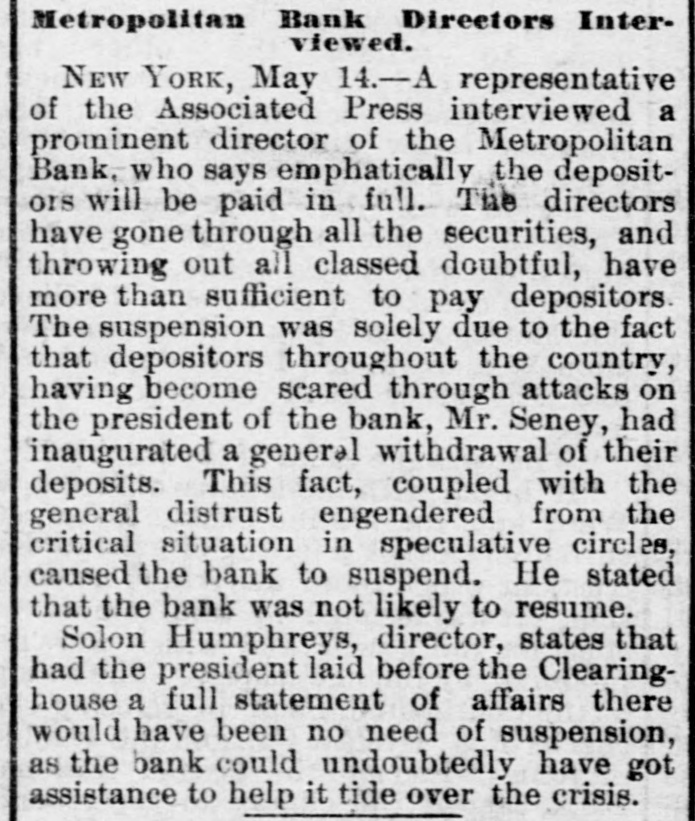
Metropolitan Bank Directors Interviewed. NEW YORK, May 14.-A representative of the Associated Press interviewed a prominent director of the Metropolitan Bank, who says emphatically the depositors will be paid in full. The directors have gone through all the securities, and throwing out all classed doubtful, have more than sufficient to pay depositors. The suspension was solely due to the fact that depositors throughout the country, having become scared through attacks on the president of the bank, Mr. Seney, had inaugurated a general withdrawal of their deposits. This fact, coupled with the general distrust engendered from the critical situation in speculative circles, caused the bank to suspend. He stated that the bank was not likely to resume. Solon Humphreys, director, states that had the president laid before the Clearinghouse a full statement of affairs there would have been no need of suspension, as the bank could undoubtedly have got assistance to help it tide over the crisis.
WILD CONFUSION. At 12:15 o'clock Wall street was a mass of people from Trinity church to the customhouse. Both the sidewalks and carwere impassable. At the doors of the were masses riageway suspended disconsolate bank faces gazed of humanity. Many at the closed doors. Among the crowd were seen several well-dressed ladies, some present from motives other than curiosity. The news of the disaster seemed to spread with lightning rapidity, and private carriages with liveried servants from up-town were flying through the streets, and many stood outside the doors of banks and bankinghouses. The directors of nearly all the banks were either in session or present in the buildings for any The were the change emergency. guarded doors by of policemen, the Stock Exvisitors' galleries were cleared, and no one was admitted to the building. AT THE CLEARINGHOUSE. The bank presiden's immediately met at the Clearinghouse, and it is stated on the best authority that the banks will stand by each other as they did in 1873. The meeting adjourned after adopting the following: Resolved, That in view of the present crisis, the banks of this association, for the purpose of sustaining each other and the business community, have resolved to rebanks (members of the association) bills or other be said are offered ceive receivable. by committee, depositing securities, who banks author- to ized to such loan certificates interest of 6 annum, not excess 75 per to cent. issue per bearing in at bills the rate of the securities or ble case States and said be per cent. deposited, bonds, of except certificates in of shall receiva- United received in settlement of balances at the Clearinghouse. The following gentlemen comprise the committee: F. D. Tappen, George S. Coe, J. D. Vermilyear, George E. Williams, W. A. Wall and Ward H. Harkins. NOTICES OF PAYMENT. The following notices were posted on the Bank Metropolitan door: "Checks the on may predrawn the by Metropolitan Maverick Bank Bank of be Boston sented to the First National Bank for payment. All drafts drawn by the First National Bank of Utica on the Metropolitan Bank may be presented to the First National Bank for payment." Additional notices posted at the Metropolitan Bank say: "The drafts of Holmes & Son, of Pittsburg, will be paid by the Bank of America; the drafts of the Flour Bank and Marshall, Field & Co., of the City Chicago, by Bank of Commerce; the drafts of the Bank of Attica, Buffalo, by the Hanover Bank.' SECRETARY FOLGER'S ACTION. Secretary Folger was at the sub-treasury all the morning, and said he would do everything in his power to relieve the present financial situation. He immeto diately the bonds telegraphed under the Washington 127th call to take up on presentation, the bonds not being due until June. Mr. Folger says the break is due to reckless speculation by a few men, and he will a do everything in his power to prevent stringency. He stated: "There is plenty of money in the country, and I do not anticipate any extensive panic. The situation is not as weak as the people suppose, and I shall do everything in my power to restore confidence." THE EXCITEMENT ABATING. Toward the close the excitement, to a great extent, abated, and the stock market closed comparatively firm, on the reports that the banks had agreed to stand by each other. LAST CLEARINGHOUSE STATEMENT OF THE METROPOLITAN. In a statement issued by the Clearinghouse April 24th, the last issued, is a full condition of the Metropolitan Bank, as follows: Capital, $3,000,000; net profits, $1,498,600; circulation, $304,900; due banks, $5,815,000; due depositors, $3,912,300; unpaid dividends, $51,000; total, $14,815,900; certified checks, $957,100. THE SECOND NATIONAL SAFE. The Clearinghouse received the following from National Bank Examiner Scriba to-day: "After investigation of the Second National Bank, I find it absolutely sound." BOGART'S FAILURE. The Commercial Advertiser says: The firm of O. M. Bogart & Co. has long been known as one of the most important
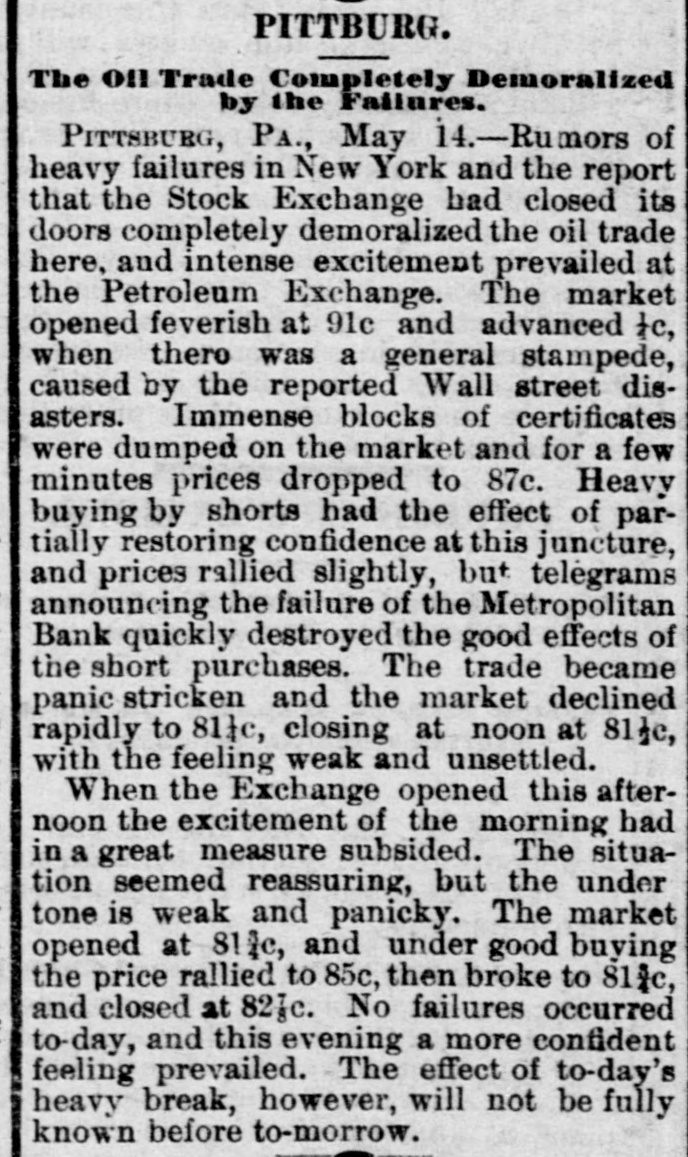
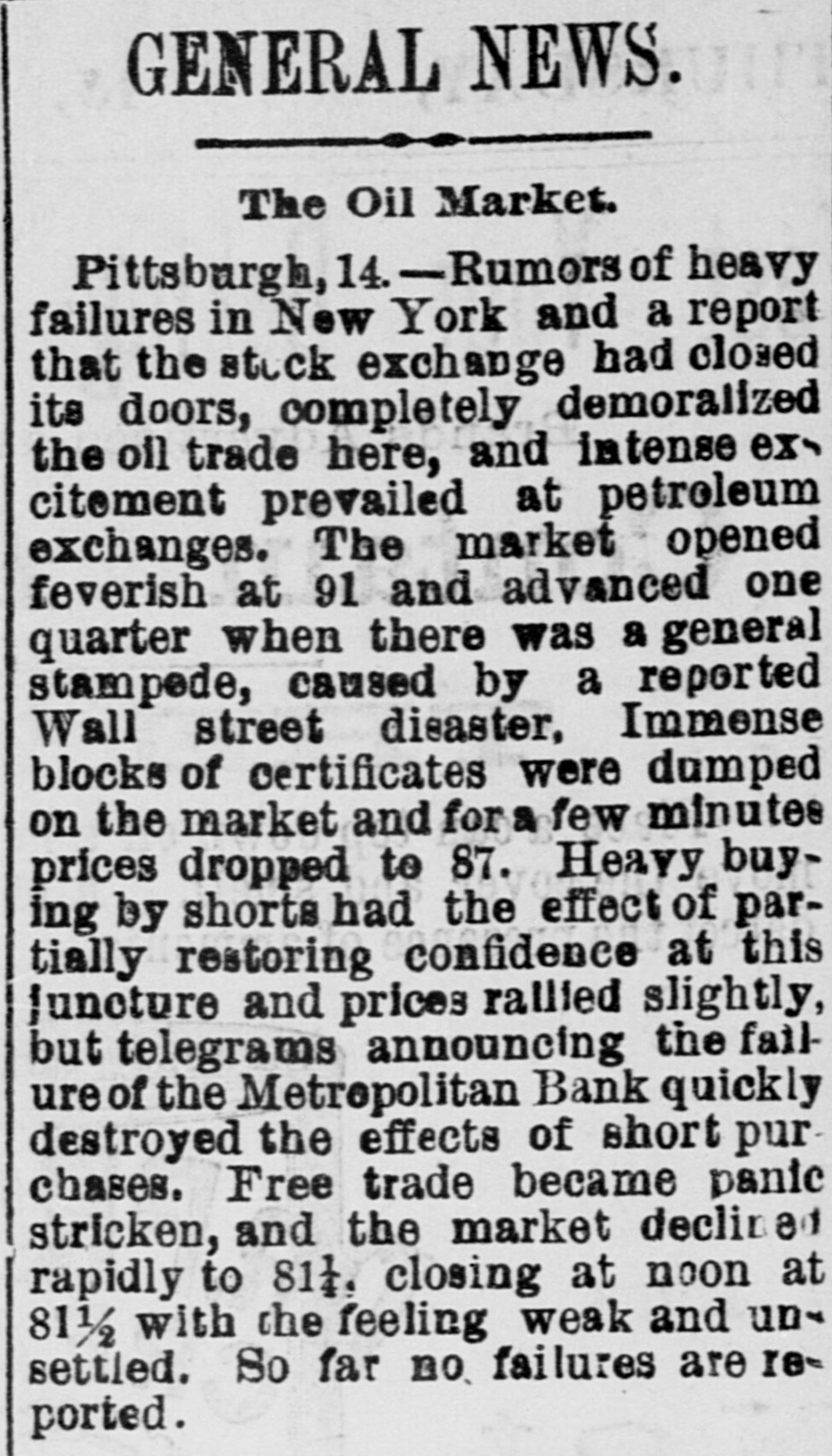
PITTBURG. The on Trade Completely Demoralized by the Failures. PITTSBURG, PA., May 14.-Rumors of heavy failures in New York and the report that the Stock Exchange had closed its doors completely demoralized the oil trade here, and intense excitement prevailed at the Petroleum Exchange. The market opened feverish at 91c and advanced tc, when there was a general stampede, caused by the reported Wall street disasters. Immense blocks of certificates were dumped on the market and for a few minutes prices dropped to 87c. Heavy buying by shorts had the effect of partially restoring confidence at this juncture, and prices rallied slightly, but telégrams announcing the failure of the Metropolitan Bank quickly destroyed the good effects of the short purchases. The trade became panic stricken and the market declined rapidly to 811c, closing at noon at 81 1c, with the feeling weak and unsettled. When the Exchange opened this afternoon the excitement of the morning had in a great measure subsided. The situation seemed reassuring, but the under tone is weak and panicky. The market opened at 814c, and under good buying the price rallied to 85c, then broke to 811c, and closed at 821c. No failures occurred to-day, and this evening a more confident feeling prevailed. The effect of to-day's heavy break, however, will not be fully known before to-morrow.
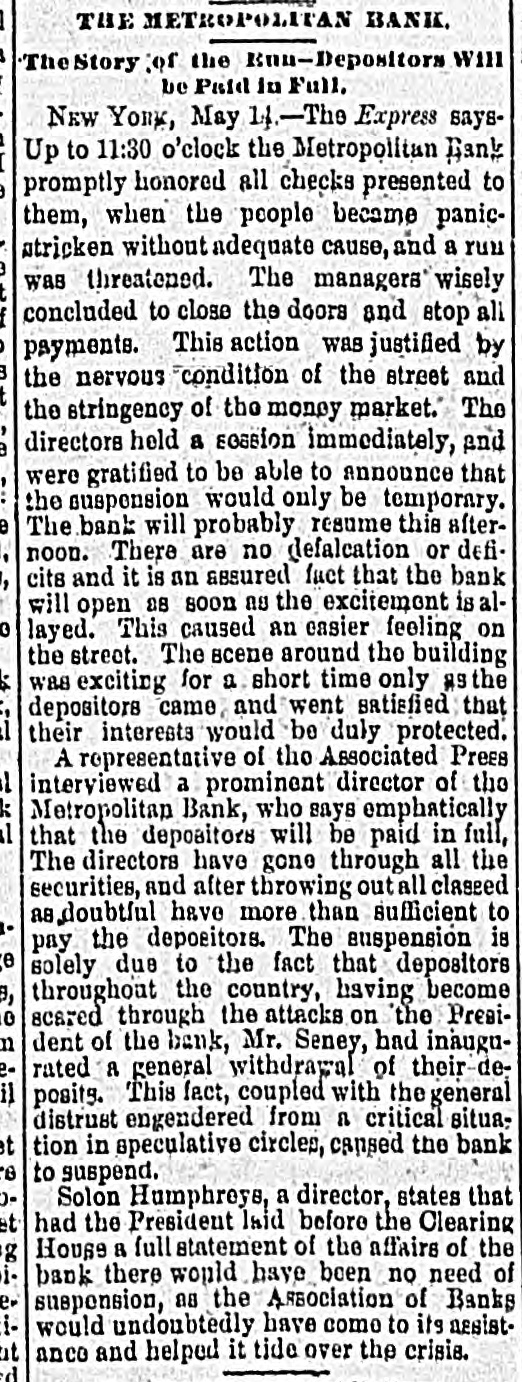
THE BANK. TheStory of the Rou-Depositors will be Paid in Full. NEW Your, May 14.-The Express saysUp to 11:30 o'clock the Metropolitan Bank promptly honored all checks presented to them, when the people became panicstricken without adequate cause, and a run was threatened. The managers wisely concluded to close the doors and stop all payments. This action was justified by the nervous condition of the street and the stringency of the money market. The directors held a session immediately, and were gratified to be able to announce that the suspension would only be temporary. The bank will probably resume this afternoon. There are no defalcation or deficits and it is an assured fact that the bank will open as soon as the excitement is allayed. This caused an easier feeling on the street. The scene around the building was exciting for a short time only as the depositors came, and went satisfied that their interests would be duly protected. A representative of the Associated Prees interviewed a prominent director of the Metropolitan Bank, who says emphatically that the depositors will be paid in full, The directors have gone through all the securities, and after throwing out all classed as.doubtful have more than sufficient to pay the depositors. The suspensión is to solely due to the fact that depositors throughout the country, having become 8, 0 scared through the attacks on the President of the bank, Mr. Seney, had inaugurated A general withdrayal of their-deposits. This fact, coupled with the general distrust engendered from a critical situation in speculative circles, cansed the bank to suspend. Solon Humphreys, a director, states that had the President laid before the Clearing HOUSE a full statement of the affairs of the bank there would have been no need of e. suspension, 88 the Association of Banks would undoubtedly have como to its assistat ance and helped it tide over the crisis.
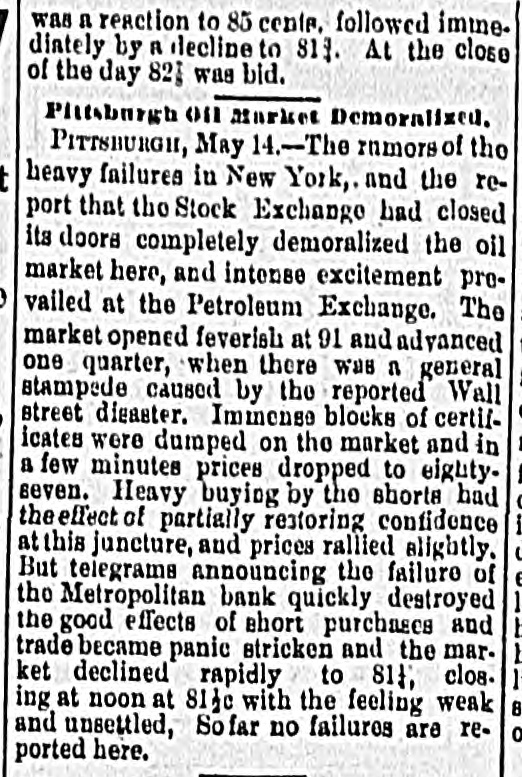
was a reaction to 85 cente. followed imme. diately by R decline to 813. At the close of the day 82g was bid. Pittsburgh on Market Demoralized. PITTSBURGH, May 14.-The rumors of the heavy failures in New York,. and the report that the Stock Exchange had closed its doors completely demoralized the oil market here, and intense excitement provailed at the Petroleum Exchange. The market opened feverish at 91 and advanced one quarter, when there was n general stampede caused by the reported Wall street dieaster. Immense blocks of certificates were dumped on the market and in a few minutes prices dropped to eighty. seven. Heavy buying by the shorts had the effect of partially restoring confidence at this juncture, and prices rallied alightly. But telegrams announcing the failure of the Metropolitan bank quickly destroyed the good effects of ehort purchases and trade became panic stricken and the mar. ket declined rapidly to 81}; clos. ing at noon at 811c with the feeling weak and unsettled, Sofar no failures are reported here.
6.May 15, 1884St. Paul Daily GlobeSaint Paul, MN
Click image to open full size in new tab
Article Text
TROUBLED TIMES A Smash Among the Wall Street Gamblers. The Metropolitan Suspends Owing to Too Much Seney in Stocks. Number of Brokers Succumb to the Maelstrom of Scant Margins. A Panic That Hurts No One but the Gamblers and their Prey. A General Tumble in all Kinds of Stocks, the Good Bad and the Bad Worse. How the News Struck the Country-What St. Paul Bankers Say. No Alarm Felt Relative to any General Financial Crash in the Country. The New York Banks Will Stand Together and Prevsnt Any More Failures. THE DAY IN WALL STREET. NEW YORK, May 14., Noon.-Sine the famous "Black Friday," and the failure of Jay Cooke, in 1873, Wall street has seen no such shaking up as is now in process. There was a general feeling of nervousness in financial circles when business closed yesterday, and a night's rest did not seem to have allayed the feeling. Men came down with an evident feeling that some disaster was pending, and when the stock exchange opened there was a wild rush of the brokers to sell. It was evident that the brokers prepared to unload the holdings of their customers without waiting for matters to get any worse. and as the result they made matters worse and many margins were wiped out in a short time which might have been sufficient to carry the stocks they represented in safety had It not been for the wild rush. At a few minutes past eleyen it was announced that the Metropolitan bank, one of the oldest institutions in the city, George I. Seney, president, had failed. This was followed by the announcement that O.M. Bogart Co., stock brokers, had assigned to John Wheeler. In a few minutes more it was announced that the Phoenix bank refused to certify the checks of Hatch & Foote, stock brokers. The only daylight up to this hour-noonis the following from the National Bank examiner which was read on the stock exchange and clearing house: "After investigation of the Second National bank I find it absolutely sound." A meeting of the Clearing House associa tion has been called for 1:30 p. m. THE STREET SCENE. 2 p. m.-When the report of the failure of the Metropolitan bank was circulated, it created considerable excitement. At half past twelve Wall street was a mass of people from Trinity church to the custom house. Both sidewalks and carriage ways are impassable. At the door the suspended houses the masses of humanity are denser and many disconsolate faces gaze at the closed doors. Among the crowd are seen several well dressed ladies, some present from interested motives, and others from curiosity. The news of the disasters seemed to have spread with lightning rapidity. Private carriages and liveried servants from up town are flying the streets. Many now stand outside the doors of banks and banking houses. The directors of nearly all the banks are either in session or present in the buildings ready for an emergency. The doors of the stock exchange are guarded by policemen and visitors in the galleries are being cleared out and no one is admitted to the building except clerks and messengers because the crowd endeavoring to gain admittance is too great for the capacity of the building. Secretary Folger has been at the sub treasury all morning. He was visited by almost all the prominent financiers in Wall street. He expresses the determination to use all the power of the government, to prevent a panic, and will act promptly to the utmost of his authority. As a step in this direction he telegraphed to Washington ordering the immediate payment one seventh necessary, he $10, says, of he call the will for order bonds, hundred another and, and if call for twenty000,000. He has been invited to attend the meeting of the clearing house now in session.
7.May 15, 1884New-York TribuneNew York, NY
Click image to open full size in new tab
Article Text
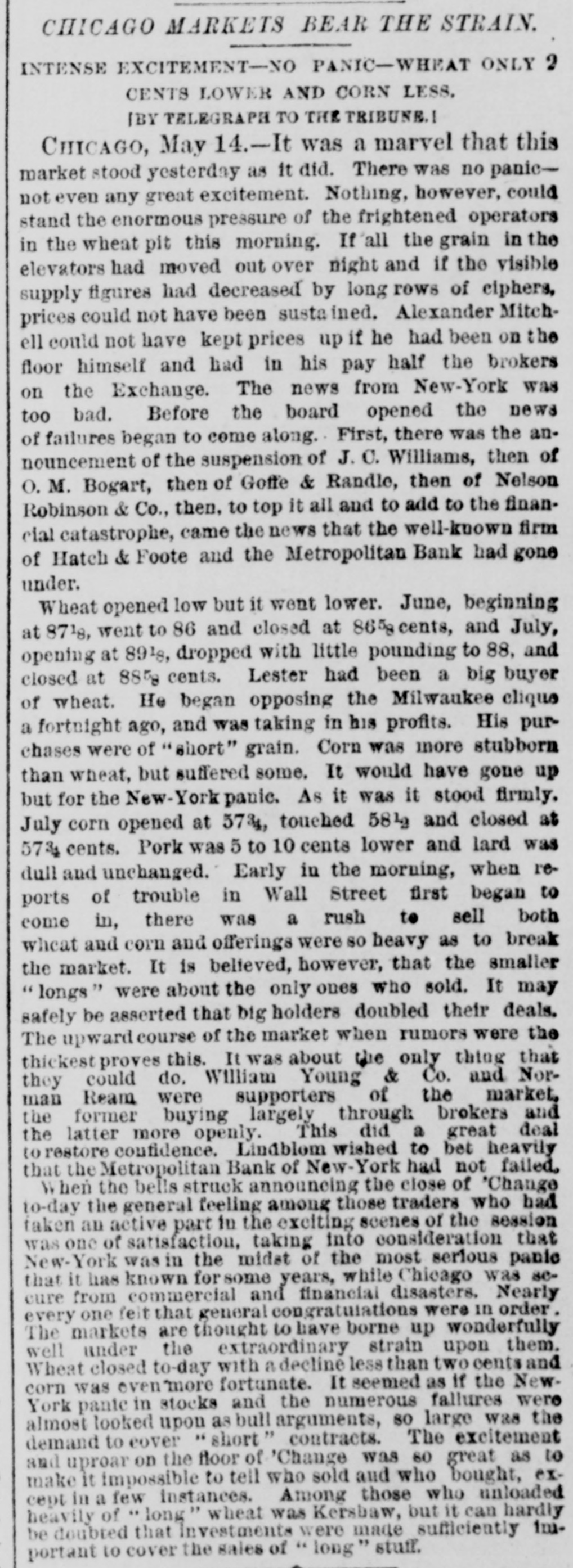
CHICAGO MARKETS BEAR THE STRAIN. INTENSE EXCITEMENT-NO PANIC-WHEAT ONLY 2 CENTS LOWER AND CORN LESS. [BY TELEGRAPH TO THE TRIBUNE.1 CHICAGO, May 14.-It was a marvel that this market stood yesterday as It did. There was no panicnot even any great excitement. Nothing, however, could stand the enormous pressure of the frightened operators in the wheat pit this morning. If all the grain in the elevators had moved out over night and if the visible supply figures had decreased by long rows of ciphers, prices could not have been susta ined. Alexander Mitchell could not have kept prices up if he had been on the floor himself and had in his pay half the brokers on the Exchange. The news from New-York was too bad. Before the board opened the news of failures began to come along. First, there was the announcement of the suspension of J.C. Williams, then of O. M. Bogart, then of Goffe & Randle, then of Nelson Robinson & Co., then, to top it all and to add to the financial catastrophe, came the news that the well-known firm of Hatch & Foote and the Metropolitan Bank had gone under. Wheat opened low but it went lower. June, beginning at 8718, went to 86 and closed at 865g cents, and July, opening at 8918, dropped with little pounding to 88, and closed at 885g cents. Lester had been a big buyer of wheat. He began opposing the Milwaukee clique a fortnight ago, and was taking in his profits. His purchases were of "short" grain. Corn was more stubborn than wheat, but suffered some. It would have gone up but for the New-York panie. As it was it stood firmly. July corn opened at 57%, touched 5812 and closed at 574 cents. Pork was 5 to 10 cents lower and lard was dull and unchanged. Early in the morning, when reports of trouble in Wall Street first began to come in, there was a rush to sell both wheat and corn and offerings were so heavy as to break the market. It is believed, however, that the smaller "longs" were about the only ones who sold. It may safely be asserted that big holders doubled their deals. The upward course of the market when rumors were the thickest proves this. It was about the only thing that they could do. William Young & Co. and Norman Ream were supporters of the market, the former buying largely through brokers and the latter more openly. This did a great deal to restore confidence. Lindblom wished to bet heavily that the Metropolitan Bank of New-York had not failed, hen the bells struck announcing the close of Change to-day the general feeling among those traders who had taken an active part in the exciting scenes of the session was one of satisfaction, taking into consideration that New-York was in the midst of the most serious panie that it has known for some years, while Chicago was secure from commercial and financial disasters. Nearly every one felt that general congratuiations were in order. The markets are thought to have borne up wonderfully well under the extraordinary strain upon them. Wheat closed to-day with a decline less than two cents and corn was even more fortunate. It seemed as If the NewYork pante in stocks and the numerous fallures were almost looked upon as bull arguments, 80 large was the demand to cover short" contracts. The excitement and uproar on the floor of 'Change was 80 great as to make it impossible to tell who sold and who bought, except in a few instances. Among those who unloaded heavily of long" wheat was Kersbaw, but it can hardly be doubted that Investments were made sufficiently important to cover the sales of " long" stuff.
8.May 15, 1884Weekly Chillicothe CrisisChillicothe, MO
Click image to open full size in new tab
Article Text
WALL STREET COMPLETELY DEMORALIZED. Eight Big Failures Reported To-day. THE METROPOLITAN BANK AND DONNELL LAWSON AND HATCH & FOOT. Flight of Robinson, the Son-in-Law of George I. Seney. THE CLEARING HOUSE APPOINTS A COMMITTEE OF FIVE BANKERS TO STEM THE TIDE. Shrinkage of Nearly $62-000,000 in Stocks in Thirty Hours. The Seney Syndicate Involved Secretary Folger Comes to the Relief of the Banks Wall Street & Mass of Excited Humanity - A Dark Financial Day. Such are the headlines of the last evening's Post-Disputch Among the firms that suspended yesterday was that of Donnell. Lawsen & Simpson.
9.May 15, 1884Savannah Morning NewsSavannah, GA
Click image to open full size in new tab
Article Text
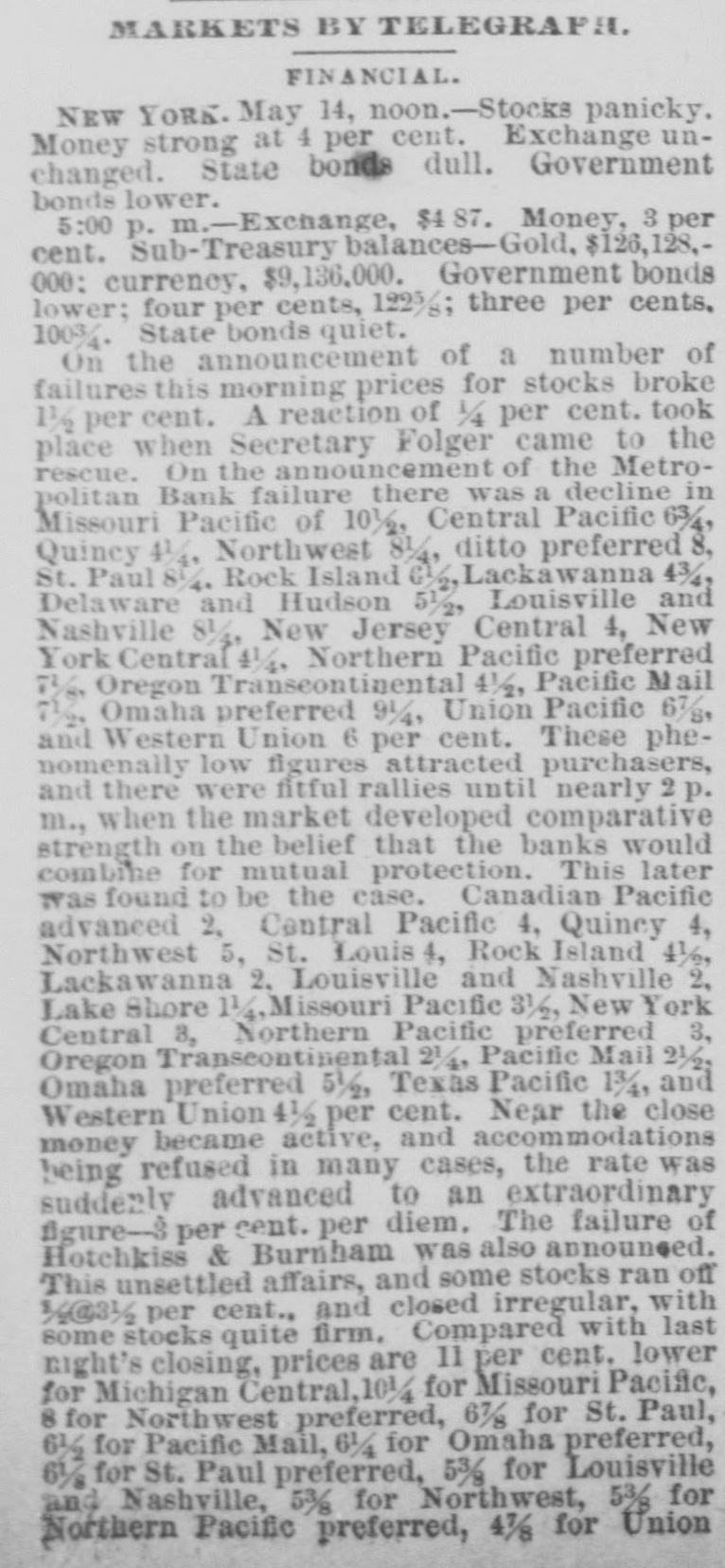
MARKETS BY TELEGRAPH. FINANCIAL. NEW YORK. May 14, noon.-Stocks panicky. Money strong at 4 per cent. Exchange unchanged. State bonds dull. Government bonds lower. 5:00 p. m.-Exchange, $487. Money, 3 per cent. Sub-Treasury balances-Gold, $126,128,000: currency, $9,136,000. Government bonds lower; four per cents, 122%; three per cents. 1003/4. State bonds quiet. On the announcement of a number of failures this morning prices for stocks broke 1½ per cent. A reaction of 1/4 per cent. took place when Secretary Folger came to the rescue. On the announcement of the Metropolitan Bank failure there was a decline in Missouri Pacific of 10½, Central Pacific 63/4, Quincy 414, Northwest 8½ ditto preferred 8, St. Paul 8½ Rock Island 6½, Lackawanna 43/4, Delaware and Hudson 51/29 Louisville and Nashville 8½ New Jersey Central 4, New York Central 41/4, Northern Pacific preferred 71/8, Oregon Transeontinental 4½ Pacific Mail 7½ Omaha preferred 91/4, Union Pacific 67/8, and Western Union 6 per cent. These phenomenally low figures attracted purchasers, and there were fitful rallies until nearly 2 p. m., when the market developed comparative strength on the belief that the banks would combine for mutual protection. This later was found to be the case. Canadian Pacific advanced 2, Central Pacific 4, Quincy 4, Northwest 5, St. Louis 4, Rock Island 41/2, Lackawanna 2. Louisville and Nashville 2, Lake Shore 11/4, Missouri Pacific 3½ New York Central 3, Northern Pacific preferred 3, Oregon Transcontinental 21/4, Pacific Mail 21/22 Omaha preferred 5½ Texas Pacific 13/4, and Western Union 4½ per cent. Near the close money became active, and accommodations being refused in many cases, the rate was suddenly advanced to an extraordinary figure-3 per cent. per diem, The failure of Hotchkiss & Burnham was also announced. This unsettled affairs, and some stocks ran off 1/2@3½ per cent., and closed irregular, with some stocks quite firm, Compared with last night's closing, prices are 11 per cent. lower for Michigan Central, for Missouri Pacific, 8 for Northwest preferred, 67/8 for St. Paul, 6½ for Pacific Mail, 6½ for Omaha preferred, 6½ for St. Paul preferred, 53/g for Louisville and Nashville, 53/8 for Northwest, 53/8 for Northern Pacific preferred, 47/8 for Union
10.May 15, 1884The Dallas Daily HeraldDallas, TX
Click image to open full size in new tab
Article Text
Scriba's Telegrams. WASHINGTON, May 14.-The comptroller of the currency early this morning telegraphed Bank Examiner Scriba, in New York. to go to the Second National bank and investigate the rumors of trouble, and received in reply the following telegram from Scriba, "A run on the Second National bank has secured guarantees for all deficiencies, and money will be supplied the bank until the run ceases. Capital is intact, with & small surplus. Particulars by mail." The comptroller subsequently received a telegram from Scriba, saying: "The Metropolitan bank has closed doors; 1 have taken charge and await further instructione." The comptroller instructed Scriba to remain in charge.
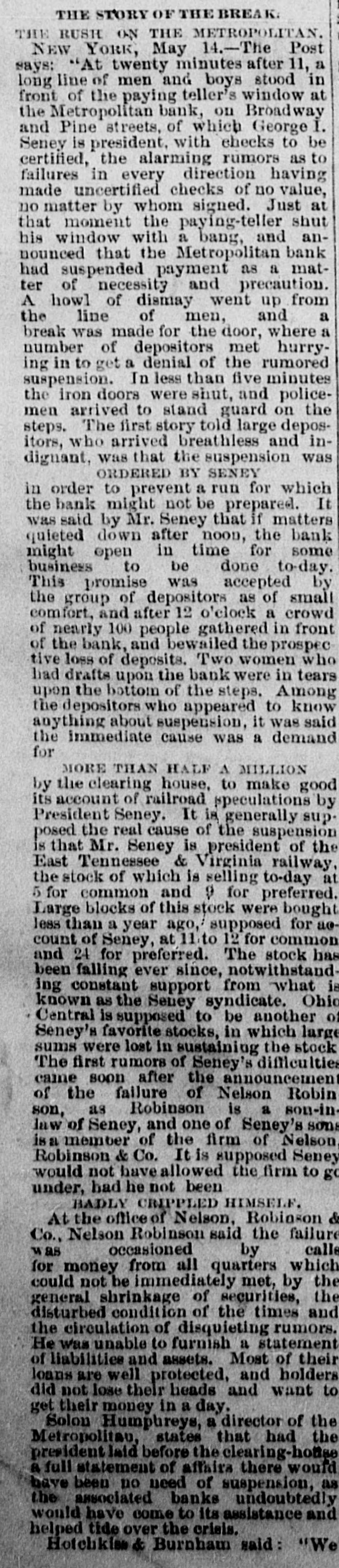
THE STORY OF the BREA THE RUSH ON THE METROPOLITAN. NEW YORK, May 14.-The Post says: "At twenty minutes after 11, a long line of men and boys stood in front of the paying teller's window at the Metropolitan bank, on Broadway and Pine streets, of which George I. Seney is president, with checks to be certified, the alarming rumors as to failures in every direction having made uncertified checks of no value, no matter by whom signed. Just at that moment the paying-teller shut his window with a bang, and announced that the Metropolitan bank had suspended payment as a matter of necessity and precaution. A howl of dismay went up from the line of men, and a break was made for the door, where a number of depositors met hurrying in to get a denial of the rumored suspension. In less than five minutes the iron doors were shut, and policemen arrived to stand guard on the steps. The first story told large depositors, who arrived breathless and indignant, was that the suspension was ORDERED BY SENEY in order to prevent a run for which the bank might not be prepared. It was said by Mr. Seney that if matters quieted down after noon, the bank might open in time for some business to be done to-day. This promise was accepted by the group of depositors as of small comfort, and after 12 o'clock a crowd of nearly 100 people gathered in front of the bank, and bewailed the prospec tive loss of deposits. Two women who had drafts upon the bank were in tears upon the bottom of the steps. Among the depositors who appeared to know anything about suspension, it was said the immediate cause was a demand for MORE THAN HALF A MILLION by the clearing house, to make good its account of railroad speculations by President Seney. It is generally supposed the real cause of the suspension is that Mr. Seney is president of the East Tennessee & Virginia railway, the stock of which is selling to-day at 5 for common and 9 for preferred. Large blocks of this stock were bought less than a year ago, supposed for aocount of Seney, at 11.to 12 for common and 24 for preferred. The stock has been falling ever since, notwithstanding constant support from what is known as the Seney syndicate. Ohio Central is supposed to be another of Seney's favorite stocks, in which large sums were lost in sustaining the stock The first rumors of Seney's difficulties came soon after the announcement of the failure of Nelson Robin son, as Robinson is a son-inlaw of Seney, and one of Seney's sons is a member of the firm of Nelson Robinson & Co. It is supposed Seney would not have allowed the firm to go under, had he not been BADLY CRIPPLED HIMSELF. At the office of Nelson, Robinson & Co., Nelson Robinson said the failure was occasioned by calls for money from all quarters which could not be immediately met, by the general shrinkage of securities, the disturbed condition of the times and the circulation of disquieting rumors. He was unable to furnish a statement of liabilities and assets. Most of their loans are well protected, and holders did not lose their heads and want to get their money in a day. Solon Humpbreys, a director of the Metropolitau, states that had the president laid before the clearing-house a full statement of affairs there would have been no need of suspension, as the associated banks undoubtedly would have come to its assistance and helped tide over the crisis. Hotehkiss & Burnham said: "We
12.May 15, 1884The Salt Lake HeraldSalt Lake City, UT
Click image to open full size in new tab
Article Text
GENERAL NEWS. The Oil Market. Pittsburgh, 14.-Rumors of heavy failures in New York and a report that the stock exchange had closed its doors, completely demoralized the oil trade here, and intense excitement prevailed at petroleum exchanges. The market opened feverish at 91 and advanced one quarter when there was a general stampede, caused by a reported Wall street disaster, Immense blocks of certificates were dumped on the market and for a few minutes prices dropped to 87. Heavy buying by shorts had the effect of partially restoring confidence at this Juncture and prices railied slightly, but telegrams announcing the failureofthe Metropolitan Bank quickly destroyed the effects of short purchases. Free trade became panic stricken, and the market declin ad rapidly to 811, closing at noon at 811/2 with the feeling weak and unsettled. So far no. failures are re ported.
13.May 16, 1884Savannah Morning NewsSavannah, GA
Click image to open full size in new tab
Article Text
At the opening of the Produce Exchange prices fell off and wild rumors of failures were started. Subsequently the market regained what it had lost only to decline, however, on the announcement of further failures in Wall street. The closing was slightly lower than on Wednesday. There was talk at the Exchange of abolishing calls, as has already been done in Chicago. It was the general opinion that this would be done Immediately. THE COTTOCE EXCHANGE. At the Cotton Exchange the market opened firmer, prices being firmer than at Wednesday's close. There was little business done. When the news of thefailure of Fisk & Hatch reached the Exchange the market broke somewhat at the close, May had tallen off 12 points and June 4 points. Some of the others had fallen off one point and others none at all. There were no failures afeither exchange. BOSTON'S BREAKS. NEW YORK, May 15, 11:30 A. M.-A patch from Boston reports the supension of F.A. Hawley & Co., a firm which, although not heavy dealers, were regarded as of good standing. Messrs. Hotchkiss & Burnham are engaged in the work of balancing their accounts and expect to be able to resume business to-morrow morning. BOSTON, May 15, 2 PC M.-Hill, Stanwood & Co., brokers, and Boston correspondents of Goff, Randall & Co., of New York, have suspended. Their liabilities will probably not reach $10,000. The failure is not considered of any significance. It is now said that the deposit account of F. A. Hawley & Co., at the time of their suspension, amounted to $250,000, and that their total liabilities are $500,000- There are rumors that the firm has been speculating, but nothing authentic is yet known. HAWLEY & CO'S FAILURE. BOSTON, May 15, 11 P. M.-H. A. Mandell has been appointed assignee of all the property, accounts and business of F.A Hawley & Co., without preferences. Mr. Hawley, in an interview this afternoon, acknowledged that his failure is a very bad one in that almost everything is gone, and that resumption is impossible. He says that his affairs are somewhat mixed, and it will require several days before any statement of a definite character can be obtained. His liabilities, he believes, will not exceed $150,000. BRADFORD'S EXCITEMENT. BRADFORD, PA., May 15.-The Tuna Valley Bank did not open its doors this morning. It was the correspondent of the Metropolitan Bank of New York, and when the announcement was made of the suspension of that bank it was thought best to suspend temporarily. It is thought that the bank will resume in a few days. A promise has been made to the depositors that they will be paid in full. There was a run on other banks to-day, but all demands were met promptly and the excitement was over by noon. A QUINCY BANK CLOSES. CHICAGO, May 15. A Quincy, III., dispatch says: "The Union Bank of this city failed to open its doors this morning. When the Marine Bank of New York failed, the Union transferred its account to the Metropolitan, and the closing of that bank yesterday IS given as the cause for the suspension. BONDS NOT RUSHED IN FOR REDEMPTION. WASHINGTON, May 15.-Up to noon today but $10,000 of the $10,000,000 worth of bonds called by the Treasury on the 127th call had been presented for redemption. ENGLISH SPECULATORS NOT ALARMED. LONDON, May 15, 10 P. M.-An agent of the Associated Press called upon leading bankers having important American connections with a view to learning their opinions concerning the panic yesterday in Wall street. The feeling generally expressed was one of confidence that the panic should be considered merely a local occurrence. They were positive that it would occasion no failures in London, either inside or outside of the Stock Exchange. The general soundness of the financial situation here is evinced in the fact that there have not been rumors of large failures. The remarkable decline of American securities the last during few days has attracted a new class of investors into the market, who are stimulated also by the cheapness of money in England, Germany and France. One prominent banker said that it was amazing how little real stock was being sold here, but he said the bear sales were immense. The market shows a strong disposition to respond to anything favorable from America. The participation of bank officials in fraudulent schemes was censured. This one thing had done more than anything else to weaken public confidence. TRAVELERS IN ENGLAND ANXIOUS. LONDON, May 15, 7 P. M.-The failures in New York have caused great anxiety and excitement among the Americans residing here and having business connections or interests in the United States. The anxiety is particularly painful among travelers, and many of these have decided suddenly to terminate their trips and to return to America.
14.May 16, 1884The Dallas Daily HeraldDallas, TX
Click image to open full size in new tab
Article Text
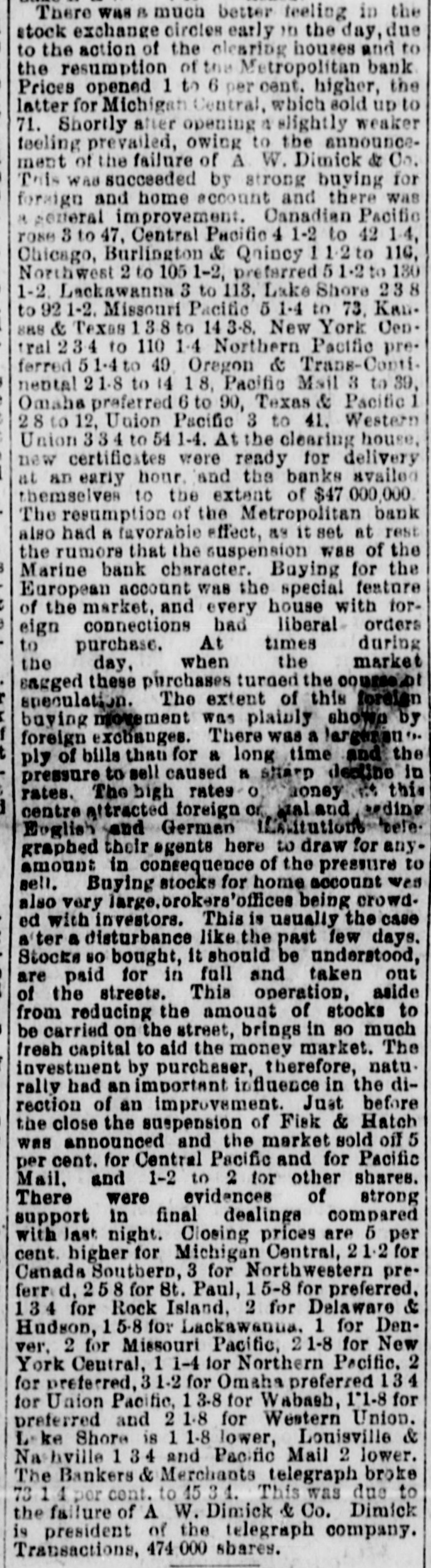
There much better teeling in the stock exchange circles early in the day, due to the action of the clearing houses and to the resumption of the Metropolitan bank Prices opened 1 to per cent. higher, the latter for Michigan Central, which sold up to 71. Shortly after opening a slightly weaker teeling prevailed, owing to the announcement of the failure of A W. Dimick & Co. Tats was succeeded by strong buying for foreign and home account and there was seneral improvement. Canadian Pacific rose 3 to 47, Central Pacific 4 1-2 to 42 1.4, Chicago, Burlington & Qniney 112 to 116, Northwest 2 to 105 1-2, preferred 51-2 to 130 1-2 Lackawanna 3 to 113. Lake Shore 238 to 21-2. Missouri Pacific 5 1-4 to 73. Kan. 888 & Texas 138 to 14 3-8, New York Cen234 to 110 1-4 Northern Pacific preferred 51-4 49 Oregon & Trans-Continental 21-8 to 14 18, Pacific Msil 3 to 39, Omaha preferred 6 to 90, Texas & Pacific 1 28 to 12, Union Pacific 3 to 41. Western Union 334 to 54 1-4. At the clearing house, new certificates were ready for delivery at an early hour. and the banks availed themselves to the extent of $47 000,000 The resumption of the Metropolitan bank also had a favorable effect, as it set at rest the rumors that the suspension WAB of the Marine bank character. Buying for the European account was the special feature of the market. and every house with foreign connections had liberal orders to purchase. At times during the when market the day. sagged these purchases turned the course.or speculation. The extent of this foreign buying movement was plainly shown by foreign exchanges. There was a largenen ply of bills than for a long time and the pressure to sell caused a sharp desline in rates. The high rates O aoney << this centre attracted foreign or al and ording Eoglish and German Institutions Delegraphed their agents here to draw for anyamount in consequence of the pressure to sell. Buying stocks for home account wes also very large. brokers' offices being crowd. ed with investors. This is usually the case a ter a disturbance like the past few days. Stocks so bought, it should be understood, are paid for in full and taken out of the streets. This operation, aside from reducing the amount of stocks to be carried on the street, brings in 80 much fresh capital to aid the money market. The investment by purchaser, therefore, natu. rally had an important influence in the direction of an improvement. Just before the close the suspension of Fisk & Hatch was announced and the market sold off 5 per cent. for Central Pacific and for Pacific Mail. and 1-2 to 2 for other shares. There were evidences of strong support in final dealings compared with last night. Closing prices are 5 per cent. higher for Michigan Central, 212 for Canada Southern, 3 for Northwestern preferr d, 258 for St. Paul, 15-8 for preferred, 134 for Rock Island, 2 for Delaware & Hudson, 15-8 for Lackawanna. 1 for Denver. 2 for Missouri Pacific, 21-8 for New York Central. 1 1-4 for Northern Pacific. 2 for preferred, 3 1-2 for Omaha preferred 134 for Union Pacific, 1 3-8 for Wabash, 1*1-8 for preferred and 2 1.8 for Western Union. L ke Shore is 1 1-8 lower, Louisville & Na hville 134 and Pacific Mail 2 lower. The Bankers & Merchants telegraph broke 73 14 por cont. to 15 34. This was due to the failure of A W. Dimick & Co. Dimick is president of the telegraph company. Transactions, 474 000 shares.
15.May 16, 1884St. Paul Daily GlobeSaint Paul, MN
Click image to open full size in new tab
Article Text
TRANQUILITY, Was, by Comparison, the Presiding Genius of Wall. Street Yesterday. The Resumption of the Metropolitan Bank Restores. Confidence, Failure of Fisk & Hatch Mars the Harmony of the Occasion. Clearing up Matters From the Wreck of the Panic. Cheering Reports From the Country at Large Mixed With a Few Failures. A Globe Reporter Interviews H. L. Horton on the Situation.
16.May 16, 1884The Daily DispatchRichmond, VA
Click image to open full size in new tab
Article Text
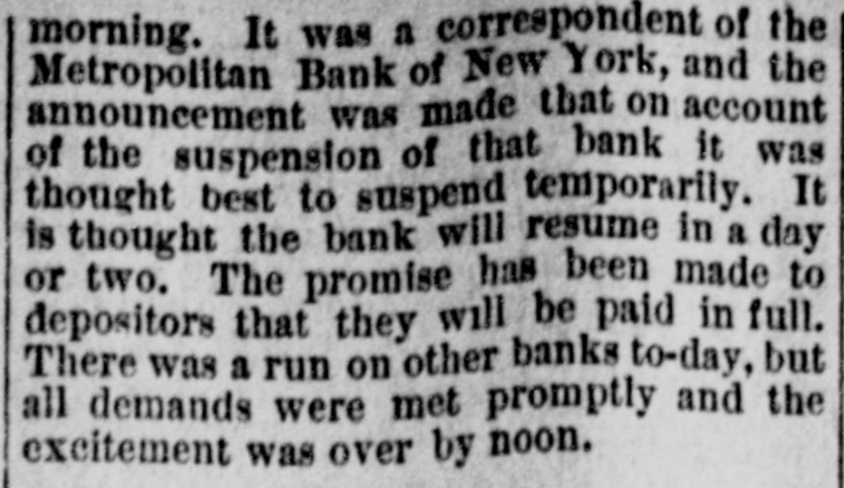
morning. It was a correspondent of the
Metropolitan Bank of New York, and the
announcement was made that on account
of the suspension of that bank it was
thought best to suspend temporarily. It
is thought the bank will resume in a day
or two. The promise has been made to
depositors that they will be paid in full.
There was a run on other banks to-day, but
all demands were met promptly and the
excitement was over by noon.
17.May 17, 1884Sacramento Daily Record-UnionSacramento, CA
Click image to open full size in new tab
Article Text
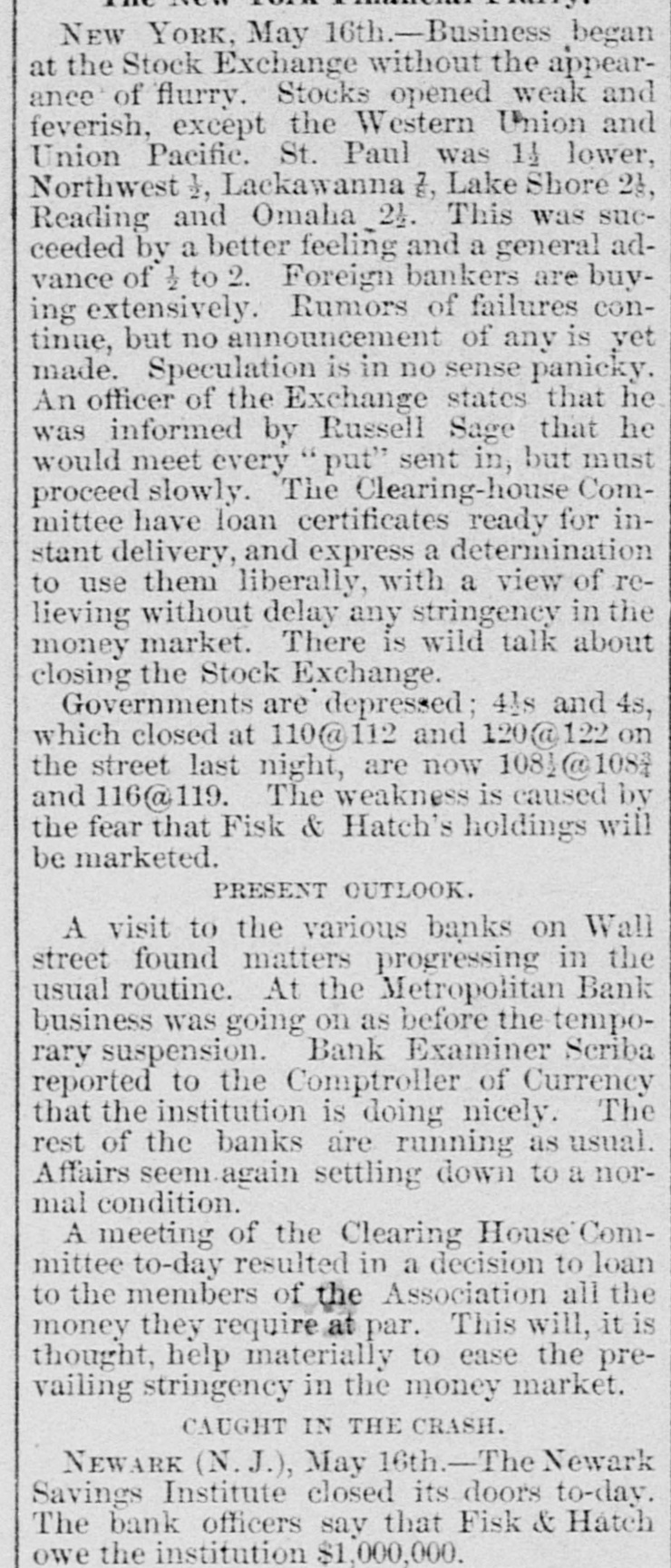
NEW York, May 16th.-Business began at the Stock Exchange without the appearance of flurry. Stocks opened weak and feverish, except the Western Union and Union Pacific. St. Paul was 11 lower, Northwest 1, Lackawanna Z, Lake Shore 2, Reading and Omaha 24. This was succeeded by a better feeling and a general advance of 1/2 to 2. Foreign bankers are buying extensively. Rumors of failures continue, but no announcement of any is yet made. Speculation is in no sense panicky. An officer of the Exchange states that he was informed by Russell Sage that he would meet every "put" sent in, but must proceed slowly. The Clearing-house Committee have loan certificates ready for instant delivery, and express a determination to use them liberally, with a view of relieving without delay any stringency in the money market. There is wild talk about closing the Stock Exchange. Governments are depressed ; 41s and 4s, which closed at 110@112 and 120@122 on the street last night, are now 1081@108} and 116@119. The weakness is caused by the fear that Fisk & Hatch's holdings will be marketed. PRESENT OUTLOOK. A visit to the various banks on Wall street found matters progressing in the usual routine. At the Metropolitan Bank business was going on as before the temporary suspension. Bank Examiner Scriba reported to the Comptroller of Currency that the institution is doing nicely. The rest of the banks are running as usual. Affairs seem again settling down to a normal condition. A meeting of the Clearing House Committee to-day resulted in a decision to loan to the members of the Association all the money they require at par. This will, it is thought, help materially to ease the prevailing stringency in the money market. CAUGHT IN THE CRASH. NEWARK (N.J.), May 16th.-The Newark Savings Institute closed its doors to-day. The bank officers say that Fisk & Hatch owe the institution $1,000,000.
18.May 17, 1884The Democratic LeaderCheyenne, WY
Click image to open full size in new tab
Article Text
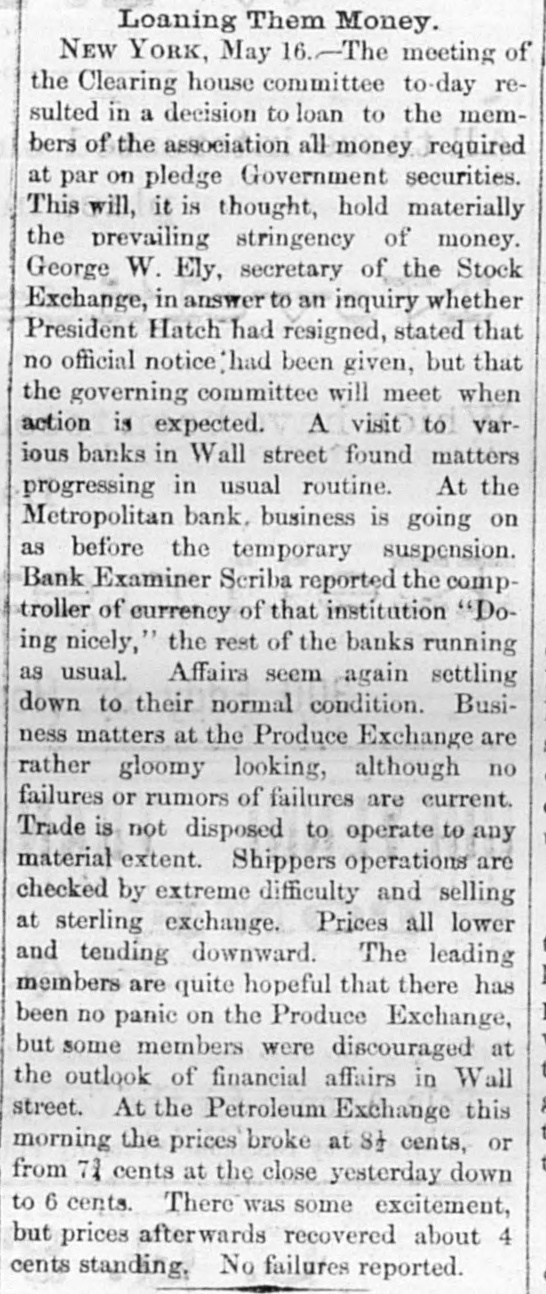
Loaning Them Money. NEW YORK, May 16.-The meeting of the Clearing house committee to-day resulted in a decision to loan to the members of the association all money required at par on pledge Government securities. This will, it is thought, hold materially the prevailing stringency of money. George W. Ely, secretary of the Stock Exchange, in answer to an inquiry whether President Hatch had resigned, stated that no official notice had been given, but that the governing committee will meet when action is expected. A visit to various banks in Wall street found matters progressing in usual routine. At the Metropolitan bank. business is going on as before the temporary suspension. Bank Examiner Scriba reported the comptroller of currency of that institution "Doing nicely," the rest of the banks running as usual. Affairs seem again settling down to their normal condition. Business matters at the Produce Exchange are rather gloomy looking, although no failures or rumors of failures are current. Trade is not disposed to operate to any material extent. Shippers operations are checked by extreme difficulty and selling at sterling exchange. Prices all lower and tending downward. The leading members are quite hopeful that there has been no panic on the Produce Exchange, but some members were discouraged at the outlook of financial affairs in Wall street. At the Petroleum Exchange this morning the prices broke at 81 cents, or from 7% cents at the close yesterday down to 6 cents. There was some excitement, but prices afterwards recovered about 4 cents standing, No failures reported.
19.May 17, 1884St. Paul Daily GlobeSaint Paul, MN
Click image to open full size in new tab
Article Text
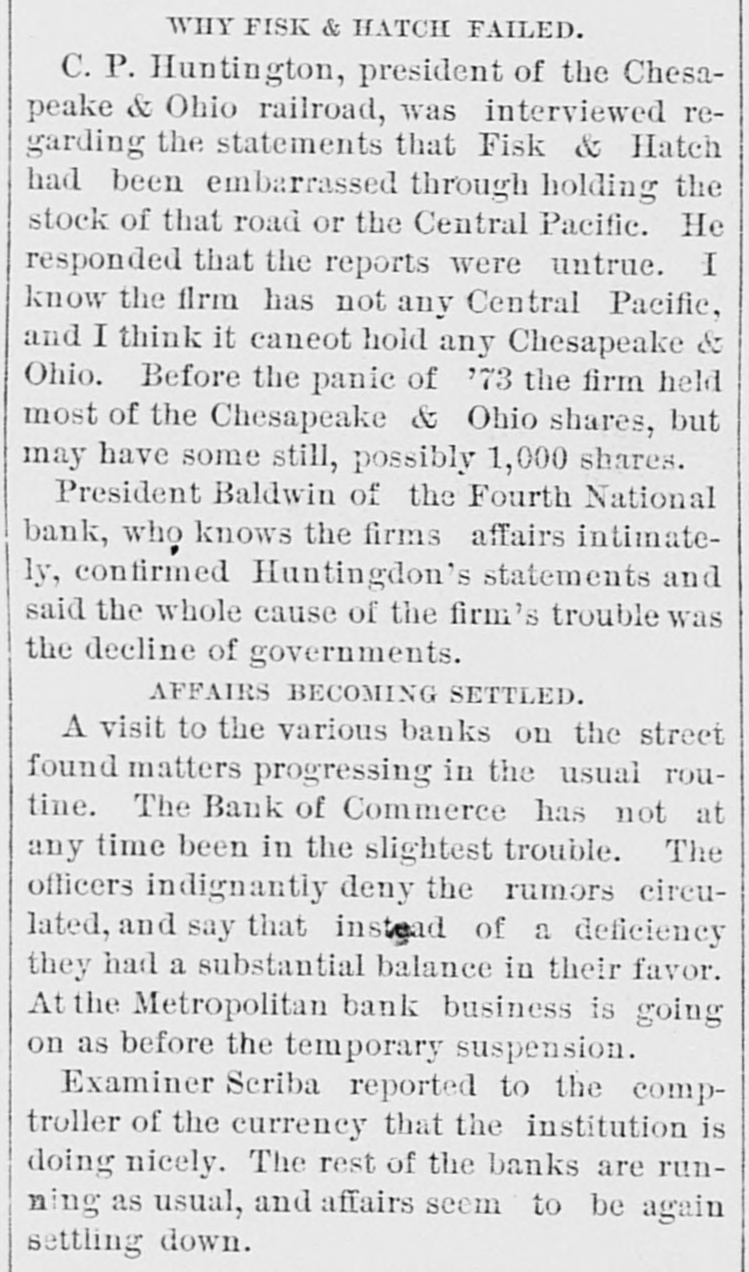
WHY FISK & HATCH FAILED. C. P. Huntington, president of the Chesapeake & Ohio railroad, was interviewed regarding the statements that Fisk & Hatch had been embarrassed through holding the stock of that road or the Central Pacific. He responded that the reports were untrue. I know the flrm has not any Central Pacific, and I think it caneot hold any Chesapeake & Ohio. Before the panic of '73 the firm held most of the Chesapeake & Ohio shares, but may have some still, possibly 1,000 shares. President Baldwin of the Fourth National bank, who knows the firms affairs intimately, confirmed Huntingdon's statements and said the whole cause of the firm's trouble was the decline of governments. AFFAIRS BECOMING SETTLED. A visit to the various banks on the street found matters progressing in the usual routine. The Bank of Commerce has not at any time been in the slightest trouble. The officers indignantly deny the rumors circulated, and say that instead of a deficiency they had a substantial balance in their favor. At the Metropolitan bank business is going on as before the temporary suspension. Examiner Scriba reported to the comptroller of the currency that the institution is doing nicely. The rest of the banks are running as usual, and affairs seem to be again settling down.
20.May 17, 1884The State JournalHarrisburg, PA
Click image to open full size in new tab
Article Text
THE BULLS AND THE BEARS. THE FORMER SEEMINGLY RECOVERING THEIR GROUND. Another Day of Excitement and Turmoil in the New York Stock Exchange-The Metropolitan Bank Paying OutAnxious Americans in LondonFisk & Hatch Suspend-&c.
21.May 18, 1884New-York TribuneNew York, NY
Click image to open full size in new tab
Article Text
OF THE METROPOLITAN'S EX-PRESIDENTCONFIDENCE IN SAVINGS BANKS. the Metropolitan Bank, so far as outward aparances went, affairs seemed to be restored to normal condition. There were no indications excitement either within or without the bank. Jaques. the new president, was at the desk all day courteously answered all questions. There have such a multitude of inquiries in the last two that the performance of this good-natured has taxed his lungs beyond their capacity, his voice has now sunk to a whisper. Cheerily, ough hoarsely, he said to a TRIBUNE reporter everything was working smoothly, and that outlook was brighter than he had anticipated. of course," he said, "our deposits are being rethe necessities of our country banks quiring them to get currency. But are not indebted to the Clearing House to any like the extent that we expected. We have all calls upon us SO far. Mr. Seney, the late esident, was in the bank all day setting his afin order. His health has not suffered despite recent strain upon his energies." From a direcit was learned that the bank is indebted to the House only $600,000, the expectation bethat the indebtedness would amount to ,600,000. On all sides great indignation was exat the published statement that the bank pected soon to go into liquidation. " Nothing of kind is contemplated or expected," said all the chorus. in icials Pwo deeds by which George I. Seney and Phebe Seney, his wife, convey property to the MetroBank and Henry L. Jaques, its new presiwere filed yesterday in Kings County. Both dated May 15. The first deed-to the bank-is a consideration of $175,000, and comprises Mr. house at No. 4 Montague Terrace. He it less than a year age from the Rockwell The second deed-to Mr. Jaques-conveys Seney's former home in Remsen-st. for $80,suit has been brought in the Kings County premo Court by John Eaton against the Tuna Bank, of Bradford, Penn., the Metropolitan of New-York, and Whitney & Wheeler, bankof Bradford, doing business as the Tuna Valley It is alleged in the complaint that the Tuna Bank secured deposits of the funds of the of Bradford asspecial trust, and gave indemnity in $100,000. They have since become inwith $50,000 of the city money in their session. They have on deposit in the tropolitan Bank $25,000. Justice Prait terday issued an order enjoining t e MetropoliBank from paying any drafts or checks on & Wheeler or the l'una Valley Bank, apFreling H. Smith temporary receiver, and defendants to show cause why the orders not be continued. Later the suit was distinued. eceiver Walter S. Johnston was seen at the Bank yesterday afternoon, and said that ne not made any investigation into the assets of bank yet, but had given his whole attention to settling of the affairs which had arisen since bank closed its doors. "1 hope," said he, "to to give a complete statement of the liabiliin the course of the next three weeks. I am in a condition to state anything as to the prosfrom my own knowledge, but I am told that depositors will undoubtedly be paid in full." epositors avoided savings bauks yesterday, exwhen they had money to deposit, and when had it was handed over to the recei 1g teller an alacrity that must have been encouraging of the hanks. Whatever feeling of
22.May 28, 1884The Salt Lake HeraldSalt Lake City, UT
Click image to open full size in new tab
Article Text
Miscellaneous. New York, 27.-J. E. Simmons, of the firm of Grant & Co., was nominated for president ofthe stock exchange. At a meeting of the Metropolitan Bank directors this morning, the president stated the deposits had diminished about $9,000,000 since the suspension, but shows no further diminution this week. Many letters were received from former depositors leading to the belief that they will again become depositors. Some new accounts were opened. Washington, 27.-Mrs. U. S. Grant has sold the house in Cor> coran street which was in her name, to John R. McLean, editor of the Cincinnati Enquirer, for $6,500.
23.August 2, 1884Savannah Morning NewsSavannah, GA
Click image to open full size in new tab
Article Text
# GEORGF I. SENEY TO-DAY.
Unjust Stories About the Ex-Millionaire's Style of Living.
Some of the papers, says the New York Commercial Advertiser, have devoted themselves of late to describing the luxury in which Mr. George I. Seney is now living. An intimate friend of Mr. Seney's said this morning: "Any such stories are altogether unjust and unfair. At the time of the Metropolitan Bank's suspension, Mr. Seney gave up all his property, although he was not legally bound to do so. Even his admirable collection of paintings was placed at the disposal of the bank. The paintings have not been sold, as they were held against an emergency. If they were to be disposed of, they would of course bring in a large sum. Possibly at some future time Mr. Seney may himself buy them back. But as for luxurious residences, and all that, Mr. Seney is living quietly out of town, at the house of a relative. His household is anything but expensive, and he does not even keep a horse. He is in the city occasionally, but does no business. This ought to dispose of the foolish and unfounded charges of extravagance that have been raked up against him.
24.October 22, 1884Delta ChiefDelta, CO
Click image to open full size in new tab
Article Text
COLORADO CONDENSED. Aspen is to have a $50,000 hotel. Greeley now has two artesian wells. A creamery is to be erected at Littleton. t Denver is again troubled with footpads. An Artesian well is to be sunk at g Evans. Hay is worth from $30 to ($50 a ton in Aspen. There are 173 pupils enrolled in_the Erie schools. b Our exchanges are almost wholly given up to politics. is Denver is already agitating for an exposition next year. There are now about 300 children attending Salida schools. This bright fall weather is favorable for the mining interests. are Elk and other game reported very plentiful in Conejoe Park. The Presbyterian church at Golden was damaged by fire last week. The G. A. R. reunion at Celorado Springs was not very largely attended. young in Golden attemptTwo to lovers ed commit suicide by taking laudanum. It IS said that the contract has been let for building a railroad from Montrose to Ouray. Salida College will open in the Presbyterian church November 6th with six profeesors. Daniel O'Leary, the pedestrian, walked 200 miles in less than 51 hours in Denver last week. The Band of Hope,at Trinidad is in a growing condition, with over one hundred members. Fanny Davenport scored an immense success at the Tabor Grand last week both art. istically and financially. The Chinese in fresh numbers are invading The French that many are in the Chinese European Tonquin. officers report army. The death of General Benjamin A1vord, U.S.A., retired, is announced. He was retired in 1876 after forty-six years of service. Jas. Gillespie and Henry Lewis have been arrested in Leadville for the murder of Samuel Baldwin at the Daisy mine on the 13th. The accountant who has been examining the books of the late city clerk of Denver, reports that he has found a deficit of over $7,000. The Liquor Dealer's Association of Arapahoe county have met and endorsed ticket made up of certain nominees of both parties. Eleven weeks of drouth in Southern Alabama and vicinity has caused much inconvenience and some suffering for want of water. The Directors of the Metropolitan New York, ask ational the stockholders Bank, of permission of to put the bank into liquidation. the Lord of Earl Spencer, Lieutenant Ireland, is reported to be anxious to resign. It is said that the Duke of Connaught will succeed him. The Democratic majority in West Virginia, with only four counties to hear from, is 2,850. These our counties will probably add 1,200 to it. Two sons of Mr. Joseph Fast, of and ten years Trinidad, alone aged nine respectively, came and safely from Austria to their father in Trinidad. a ranchman near D.P. Payne, living was assassinated Matt a sheep herder. The Perkinson, Deer Trail, foully murderer by was placed in jail in Denver. has been made a An application for the Works for receiver Harrison Wire St Louis. It is believed that their liabilities will exceed their assets by $400,000. The body of Mrs. Anna Madison was found in Kentucky, her in her throat home Covington, was with cut. Her husband arrested, but he asserts his innocence. General Sickles, Commissioner of the World's Fair, makes an appeal to the people of the aid in the exhibit to New which State he has for collected transporting Orleans. Judge The reported committee appointed they by Elliott that have found the books of the City Auditor and City Treasurer, of Denver, were being kept In proper form. A man was arrested some days ago at Dr. he Identified as Ex-Governor Detroit has been for swindling Rev. Rexford,and Moses of South Carolina. He is wanted in Cambridge, Massachusetts. Judge Carpenter, in A case at Boulder, that it is criminal for or to in state or county has decided either officers deal county state warrants, on his own account or acting merely as the agent of others. The Chief of Police of St. Petersburg re-ordered the proprietors of all hotels