14176. Merchants Bank (New York, NY)

Bank Information

Episode Type
Suspension β†’ Closure
Bank Type
state
Start Date
July 31, 1843
Location
New York, New York (40.714, -74.006)

Metadata

Model
gpt-5-mini
Short Digest
fa8656b974ef97cf

Response Measures

None

Description

Articles describe historical suspensions of specie payments at the Merchants Bank (anecdotes dated later) and legal proceedings naming John J. (John I.) Palmer as special receiver and trustees seeking to wind up the institution (1843). No explicit contemporary β€˜run’ is described; the bank was placed in receivership and trust proceedings for winding up, consistent with suspension leading to closure/receivership.

Events (3)

1. July 31, 1843 Receivership
Newspaper Excerpt
John I. Palmer, President of the Merchants Bank, who has been appointed a special receiver. ... The trustees ask for full powers to foreclose the bonds and mortgages, and wind up the affairs of the institution, but they are opposed by the general receiver.
Source
newspapers
2. September 22, 1846 Other
Newspaper Excerpt
These bonds and mortgages are now in the hands of John J. Palmer, Esq., the President of the Merchant's Bank, and Abijah Mann Jr., Esq, as special receivers (appointed by the Chancellor) to hold the same and the proceeds thereof pending the controversy between Leavitt the general receiver, and Blatchford, Graham, Noyes, Talmage, Yates and Murray, trustees under the trust.
Source
newspapers
3. * Suspension
Cause Details
Articles refer to historical 'suspensions of specie payments' but give no specific trigger (general suspension of specie payments).
Newspaper Excerpt
During one of the suspensions of specie payment in his day, Mr. R. was on a visit to New York
Source
newspapers

Newspaper Articles (6)

Article from New-York Daily Tribune, July 31, 1843

Click image to open full size in new tab

Article Text

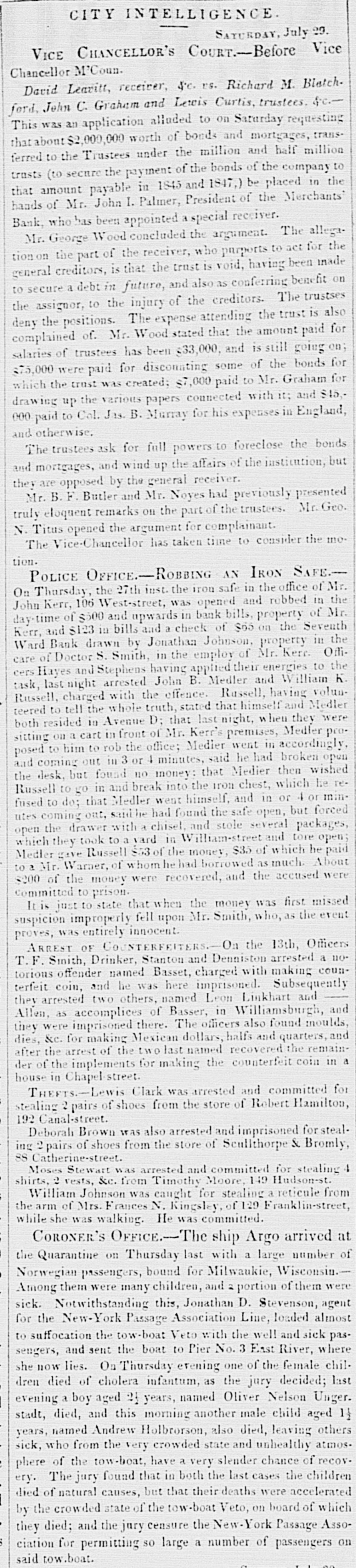
e Curtis, trustees. &c.This was an application alluded to on Saturday requesting that about $2,000,000 worth of bonds and mortgages, transferred to the Trustees under the million and half million trusts (to secure the payment of the bonds of the company to that amount payable in 1845 and 1847,) be placed in the hands of Mr. John I. Palmer, President of the Merchants Bank, who has been appointed a special receiver. Mr. George Wood concluded the argument. The allegation on the part of the receiver, who purports to act for the general creditors, is that the trust is void, having been made to secure a debt in future, and also as conferring benefit on the assigner, to the injury of the creditors. The trustses deny the positions. The expense attending the trust is also complained of. Mr. Wood stated that the amount paid for salaries of trustees has been $33,000. and is still going on; $75,000 were paid for discounting some of the bonds for which the trust was created: $7,000 paid to Mr. Graham for drawing up the various papers connected with it; and $45,000 paid to Col. Jas. B. Murray for his expenses in England, and otherwise. The trustees ask for full powers to foreclose the bonds and mortgages, and wind up the affairs of the institution, but they are opposed by the general receiver. Mr. B.F. Butler and Mr. Noyes had previously presented truly eloquent remarks on the part of the trustees. Mr. Geo. N. Titus opened the argument for complainant. The Vice-Chancellor has taken time to consider the motion. POLICE OFFICE.-ROBBING AN IRON SAFE.On Thursday, the 27th inst. the iron safe in the office of Mr. was and upwards in bank bills, of Mr. John day-time Kerr, of 106 $500 West-street, and opened property rebbed in the Kerr, and $123 in bills and a check of $65 on the Seventh Ward Bank drawn by Jonathan Johnson, property in the care of Doctor S. Smith, in the employ of Mr. Kerr. Officers Hayes and Stephens having applied their energies to the task, last night arrested John B. Medler and William h. Russell, charged with the offence. Rassell, having volunteered to tell the whole truth, stated that himself and Medler both resided 10 Avenue D: that last night, when they were sitting on a cart in front of Mr. Kerr's premises, Medler pco. posed to him to rob the office; Medier went in accordingly, and coming out in 3 or 1 minutes, said he had broken open the desk, but found no money: that Medier then wished Russell to go in and break into the iron chest, which he refused to do; that Medler went himself, and in or it or mincoming out. said had found the safe open, but forced open the drawer with a chisel. and stole several packages, which they took to a vard in William-street and tore open; Medler gave Russell $53 of the money, $35 of which he paid to a Mr. Warner, of whom ehad borrowed as much. About $200 of the money were recovered, and the accused were committed to prison. It is just to state that when the money was first missed suspicion improperly fell upon Mr. Smith, who, as the event proves, was entirely innocent. ARREST OF COUNTERFEITERS.-O1 the 13th, Officers T.F. Smith, Drinker, Stanton and Denniston arrested a notorious offender named Basset, charged with making counterfeit coin, and he was here imprisoned. Subsequently they arrested two others, named Leon Linkhart and Allen, as accomplices of Basser, in Williamsburgh, and they were imprisoned there. The officers also found moulds, dies, &c. for making Mexican dollars, halfs and quarters, and after the arrest of the two last named recovered the remaina der of the implements for making the counterfeit coin in house in Chapel street. THEFTS.-Lewis Clark was arrested and committed for stealing 2 pairs of shoes from the store of Robert Hamilton, 192 Canal-street Deborah Brown was also arrested and imprisoned for steal. ing 2 pairs of shoes from the store of Scullthorpe & Bromly, 88 Catherine-street. Moses Stewart was arrested and committed for stealing 4 shirts, 2 vests, &c. from Timothy Moore, 149 Hudson-st. William Johnson was caught for stealing a reticule from the arm of Mrs. Frances N. Kingsley, of 129 Franklin-street, while she was walking. He was committed. CORONER'S OFFICE.--The ship Argo arrived at the Quarantine on Thursday last with a large number of Norwegian passengers, bound for Milwaukie, Wisconsin.Among them were many children, and 2 portion of them this, Jonathan D. sick. for the Notwithstanding New-York Stevenson, agent were Passage Association Line, loaded almost to suffocation the tow-boat Veto with the well and sick sent the boat to Pier No. 3 East where she sengers, lies. and River, pasnow On Thursday evening one of the female chil. dren died of cholera infantum, as the jury decided; last evening a 21 years, named Oliver Nelson this morning another male child stadt, died, boy and aged aged Unger. 1 } years, named Andrew Holbrorson, also died, leaving others sick, who from the very crowded state and unhealthy atmos. phere of the tow-boat, have a very slender chance of recovery. The jury found that in both the last cases the children died of natural causes, but that their deaths were accelerated by the crowded state of the tow-boat Veto, on board of which they died: and the inry

Article from The Kalida Venture, February 26, 1846

Click image to open full size in new tab

Article Text

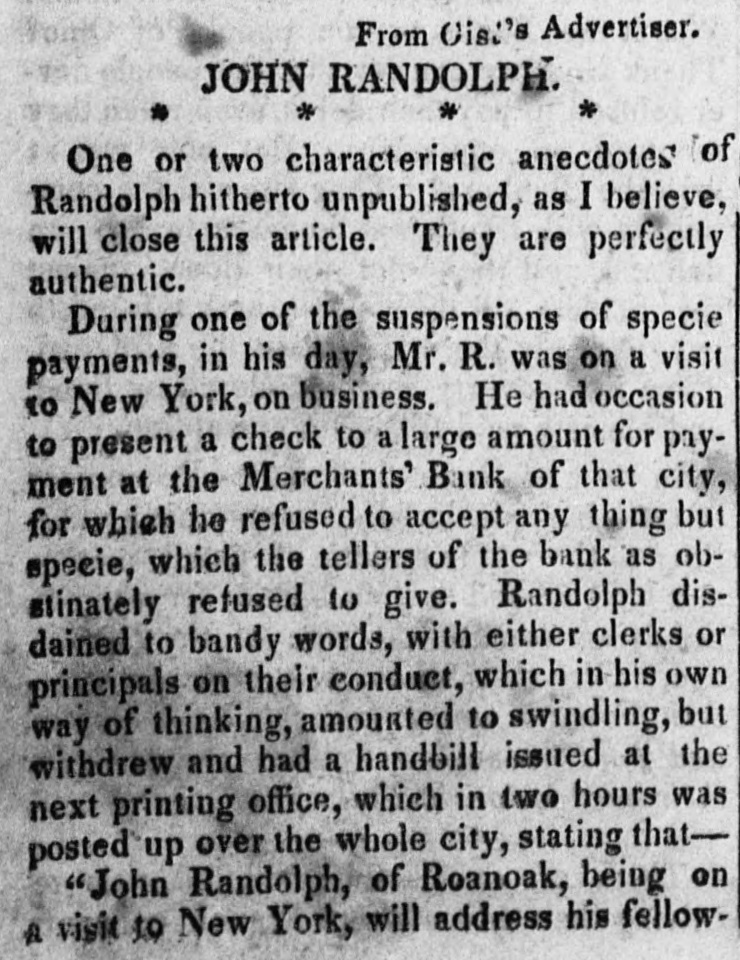
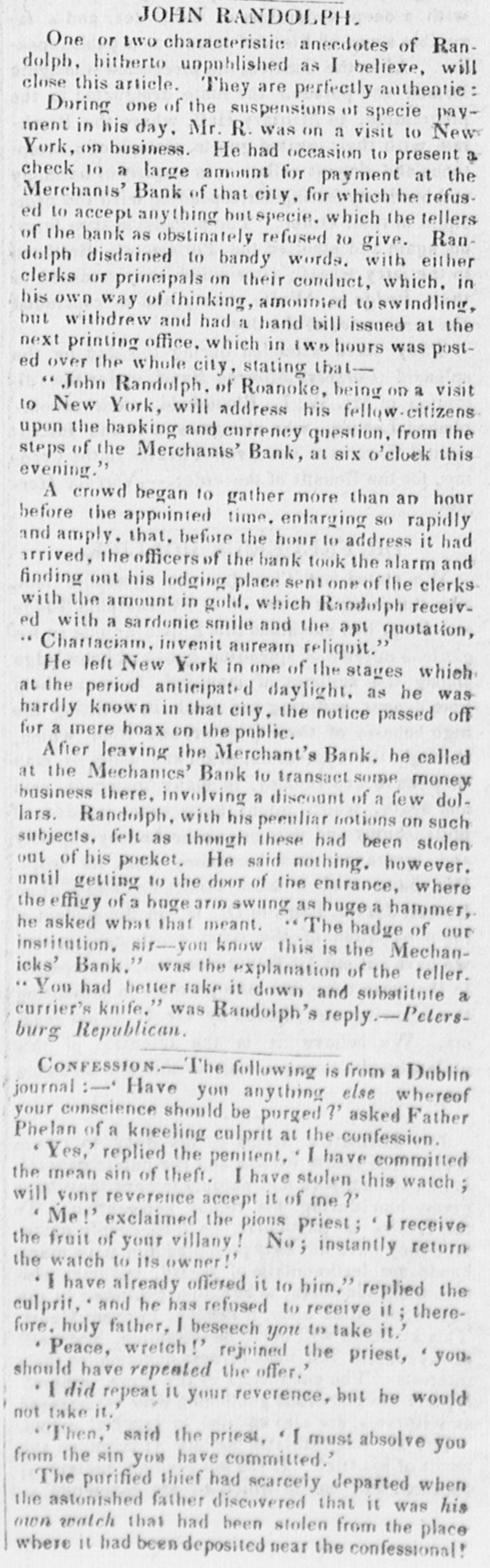
From Cist's Advertiser. # JOHN RANDOLPH. One or two characteristic anecdotes of Randolph hitherto unpublished, as I believe, will close this article. They are perfectly authentic. During one of the suspensions of specie payments, in his day, Mr. R. was on a visit to New York, on business. He had occasion to present a check to a large amount for payment at the Merchants' Bank of that city, for which he refused to accept any thing but specie, which the tellers of the bank as obstinately refused to give. Randolph disdained to bandy words, with either clerks or principals on their conduct, which in his own way of thinking, amounted to swindling, but withdrew and had a handbill issued at the next printing office, which in two hours was posted up over the whole city, stating thatβ€”"John Randolph, of Roanoak, being on a visit to New York, will address his fellow-


Article from The New Era, April 28, 1846

Click image to open full size in new tab

Article Text

# JOHN RANDOLPH. One or two characteristic anecdotes of Randolph, hitherto unpublished as I believe, will close this article. They are perfectly authentie: During one of the suspensions of specie payment in his day, Mr. R. was on a visit to New York, on business. He had occasion to present a check to a large amount for payment at the Merchants' Bank of that city, for which he refused to accept anything but specie, which the tellers of the bank as obstinately refused to give. Randolph disdained to bandy words, with either clerks or principals on their conduct, which, in his own way of thinking, amounted to swindling, but withdrew and had a hand bill issued at the next printing office, which in two hours was posted over the whole city, stating that- "John Randolph, of Roanoke, being on a visit to New York, will address his fellow-citizens upon the banking and currency question, from the steps of the Merchants' Bank, at six o'clock this evening." A crowd began to gather more than an hour before the appointed time, enlarging so rapidly and amply, that, before the hour to address it had arrived, the officers of the bank took the alarm and finding out his lodging place sent one of the clerks with the amount in gold, which Randolph received with a sardonie smile and the apt quotation, "Chartaciam, invenit auream reliquit."" He left New York in one of the stages which at the period anticipated daylight, as he was hardly known in that city, the notice passed off for a mere hoax on the public. After leaving the Merchant's Bank, he called at the Mechanics' Bank to transact some money business there, involving a discount of a few dollars. Randolph, with his peculiar notions on such subjects, felt as though these had been stolen out of his pocket. He said nothing, however, until getting to the door of the entrance, where the effigy of a huge arm swung as huge a hammer, he asked what that meant. "The badge of our institution, sir-you know this is the Mechanics' Bank." was the explanation of the teller. "You had better take it down and substitute a currier's knife." was Randolph's reply.-Petersburg Republican. CONFESSION. -The following is from a Dublin journal:- Have you anything else whereof your conscience should be purged?' asked Father Phelan of a kneeling culprit at the confession. 'Yes,' replied the penitent, I have committed the mean sin of theft. I have stolen this watch; will your reverence accept it of me?' 'Me!' exclaimed the pious priest; 'I receive the fruit of your villany! No; instantly retorn the watch to its owner!" β€’ I have already offered it to him," replied the culprit, and he has refused to receive it; therefore, holy father, I beseech you to take it." β€’ Peace, wretch!" rejoined the priest, you should have repeated the offer." *I did repeat it your reverence, but he would not take it." Then,' said the priest, 'I must absolve you from the sin you have committed." The purified thief had scarcely departed when the astonished father discovered that it was his own watch that had been stolen from the place where it had been deposited near the confessional!


Article from Edgefield Advertiser, May 13, 1846

Click image to open full size in new tab

Article Text

# JOHN RANDOLPH. One or two characteristic anecdotes of Randolph, hitherto unpublished as I believe, will close this article. They are perfectly authentic: During one of the suspensions of specie payment in his day, Mr. R. was on a visit to New York, on business. He had occasion to present a check to a large amount for payment at the Merchant's Bank of that city, for which he refused to accept anything but specie. Randolph disdained to bandy words, with either clerks or principals on their conduct, which, in his own way of thinking, amounted to swindling, but withdrew and had a hand bill issued at the next printing office, which in two hours was posted over the whole city, stating that- "John Randolph, of Roanoke, being on a visit to New York, will address his fellow-citizens upon the banking and currency question, from the steps of the Merchants' Bank, at six o'clock this evening." A crowd began to gather more than an hour before the apointed time, enlarging so rapidly and amply, that, before the hour to address it had arrived, the officers of the bank took the alarm and finding out his lodging place sent one of the clerks with the amount in gold, which Randolph received with a sarconic smile and the ant quotation, "Chartaciam, invenit auream relinquit." He left New York in one of the stages, which at the period anticipated daylight, as he was hardly known in that city, th notice passed off for a mere hoax on the public. After leaving the Merchant's Bank, he called at the Mechanics' Bank to transact some money business there, involving a discount of a few dollars. Randolph, with his peculiar notions on such subjects, felt as though these had been stolen out of his pocket. He said nothing, however, until getting to the door of the entrance, where the effigy of a huge arm swung a huge hammer, he asked what that meant. "The badge of our institution, sir-you know this is the Mechanics' Bank," was the explanation of the teller. "You had better take it down and substitute a currier's knife," was Randolph's reply- _Petersburg Republican._ # Railroad Incident. A young fellow travelling in one of the counties in England, found that the only passenger in a first class car was a beautiful young lady, with whom he was quite smitten, and to whom he made himself very agreeable during the trial. Not being able to ascertain her name, he presumed to steal a kiss; and when the car arrived at Birmingham she gave the gentleman in charge of the police, and made a complaint against him for the assault.-Precisely the thing he wanted. He learned her name and address-paid the fine-adopted means to be introduced-plead his suit, and was finally accepted by the lady, after a courtship commencing in a manner so very singular. The Hereford Times vouches for the truth of this anecdote. Marble. A vein of very fine porphyritic marble, between thirty and forty


Article from The New York Herald, September 22, 1846

Click image to open full size in new tab

Article Text

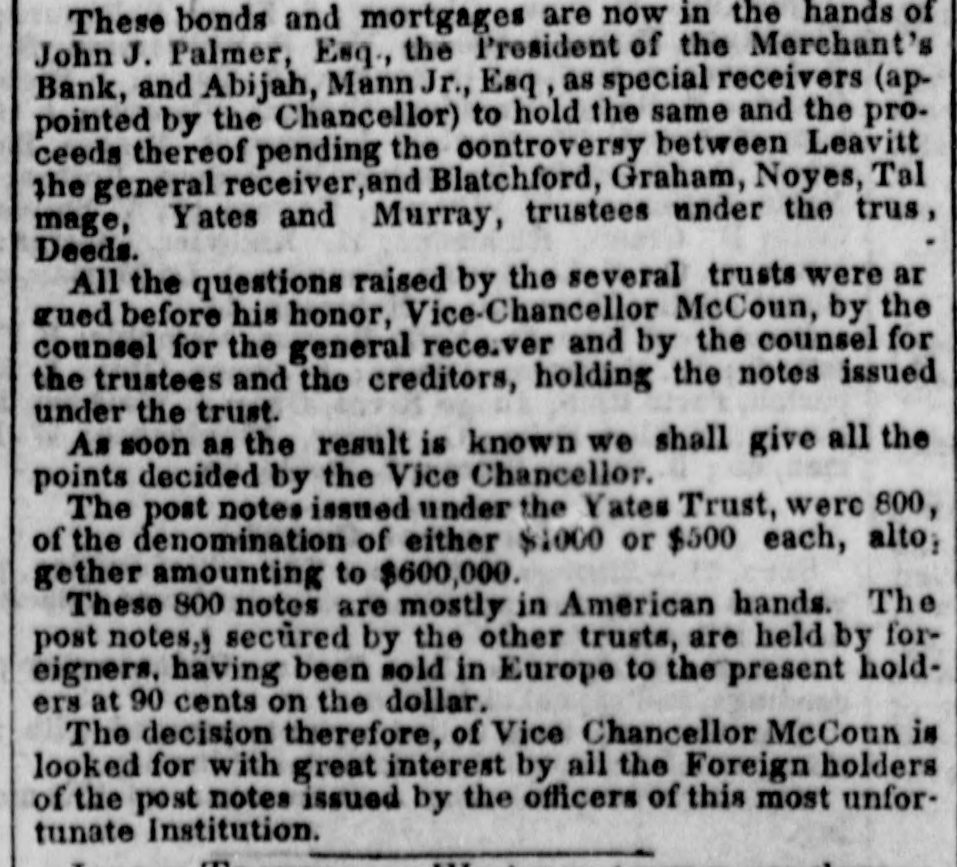
These bonds and mortgages are now in the hands of John J. Palmer, Esq., the President of the Merchant's Bank, and Abijah, Mann Jr., Esq, as special receivers (appointed by the Chancellor) to hold the same and the proceeds thereof pending the controversy between Leavitt the general receiver, and Blatchford, Graham, Noyes, Tal mage, Yates and Murray, trustees under the trus, Deeds. All the questions raised by the several trusts were ar gued before his honor, Vice-Chancellor McCoun, by the counsel for the general rece.ver and by the counsel for the trustees and the creditors, holding the notes issued under the trust. As soon as the result is known we shall give all the points decided by the Vice Chancellor. The post notes issued under the Yates Trust, were 800, of the denomination of either $1000 or $500 each, alto, gether amounting to $600,000. These 800 notes are mostly in American hands. The post notes, secured by the other trusts, are held by foreigners, having been sold in Europe to the present holders at 90 cents on the dollar. The decision therefore, of Vice Chancellor McCoun is looked for with great interest by all the Foreign holders of the post notes issued by the officers of this most unfortunate Institution.


Article from Iowa Capitol Reporter, May 16, 1849

Click image to open full size in new tab

Article Text

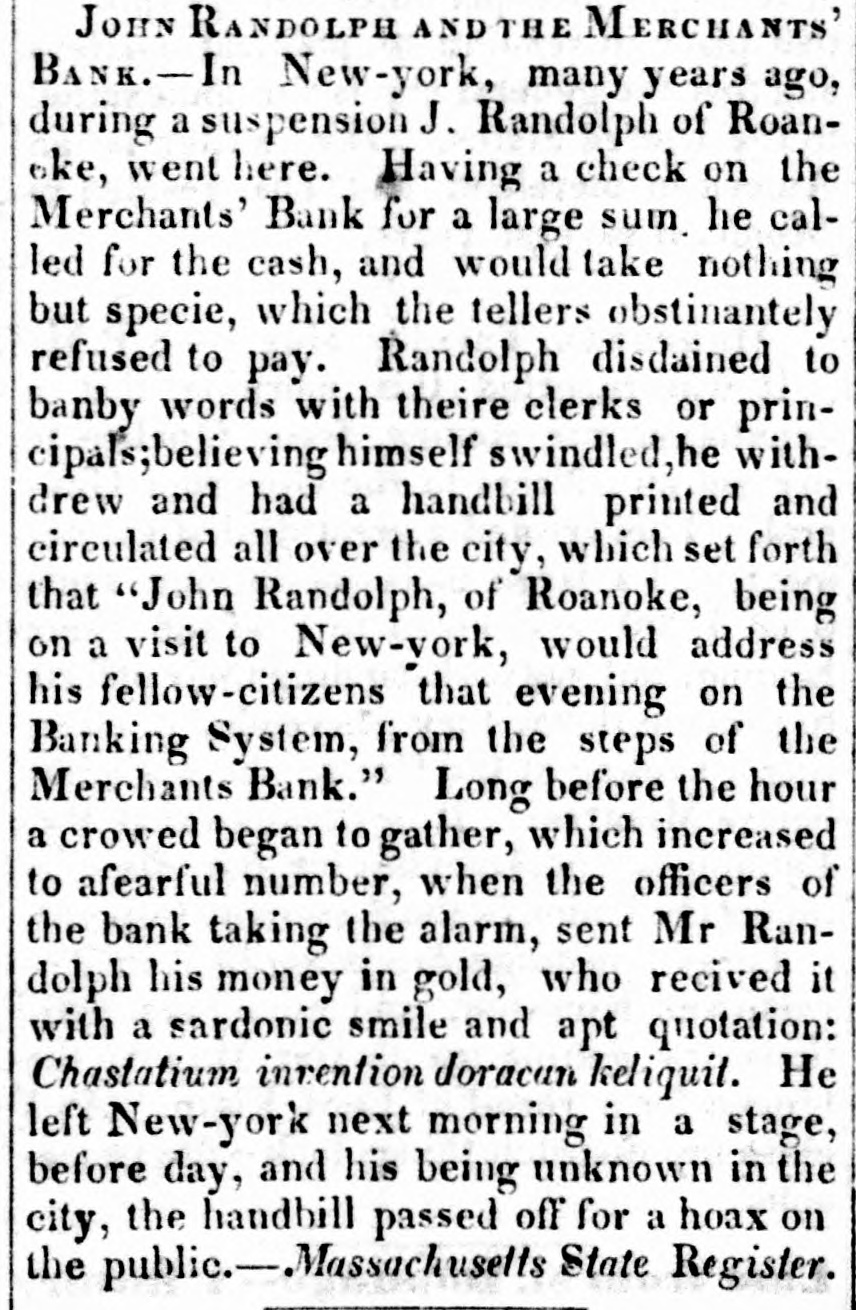
JOHN RANDOLPH AND THE MERCHANTS' BANK.- - In New-york, many years ago, during a suspension J. Randolph of Roanoke, went here. Having a check on the Merchants' Bank for a large sum he called for the cash, and would take nothing but specie, which the tellers obstinantely refused to pay. Randolph disdained to banby words with theire clerks or principals;believing himself swindled, he withdrew and had a handbill printed and circulated all over the city, which set forth that "John Randolph, of Roanoke, being on a visit to New-york, would address his fellow-citizens that evening on the Banking System, from the steps of the Merchants Bank." Long before the hour a crowed began to gather, which increased to afearful number, when the officers of the bank taking the alarm, sent Mr Randolph his money in gold, who recived it with a sardonic smile and apt quotation: Chastatium inrention doracan keliquit. He left New-york next morning in a stage, before day, and his being unknown in the city, the handbill passed off for a hoax on the public.-Masuchusetts State Register.