14133. Market Savings Bank (New York, NY)

Bank Information

Episode Type
Run → Suspension → Closure
Bank Type
savings bank
Start Date
January 20, 1872
Location
New York, New York (40.714, -74.006)

Metadata

Model
gpt-5-mini
Short Digest
018545b5b1409c3f

Response Measures

None

Description

Contemporary articles (Jan 20–22, 1872) report heavy withdrawals/crowds (a run) followed by the bank closing and a receiver being appointed. The failure was caused by large defalcations by Secretary Henry R. Conklin (misuse/abstracting of Tennessee bonds and bogus investments); the receiver and courts wound up the institution and it did not resume normal operations. Dates derived from newspaper dates and in-text statements.

Events (4)

1. January 20, 1872 Run
Cause
Bank Specific Adverse Info
Cause Details
Depositors withdrew after rumors and revelations that the secretary (Conklin) had abstracted/used bank securities and lost large sums (Tennessee bonds, bogus investments).
Measures
None reported beyond examiners/bank officers remaining on site; later appointment of a receiver.
Newspaper Excerpt
Yesterday afternoon a rumor was current in Wall Street that a run had taken place...a heavy run had taken place.
Source
newspapers
2. January 21, 1872 Receivership
Newspaper Excerpt
Judge Barnard appointed Mr. James Dennis ... as receiver, and at ten o'clock this morning Mr. Dennis took charge of all the effects of the bank.
Source
newspapers
3. January 21, 1872 Suspension
Cause
Bank Specific Adverse Info
Cause Details
The bank closed after discovery that a correspondent/official (the secretary) had misapplied about $120,000–$125,000 in Tennessee bonds and other defalcations; inability of a Wall Street house (Heiser & Co. / Broad St. firm) to pay a draft for $119–120,000 exacerbated the failure of trust funds held by the bank was cited as immediate trigger in some reports (but overall underlying cause was secretary's fraud).
Newspaper Excerpt
The Market Savings bank closed this morning and its receiver was appointed...Judge Barnard appointed Mr. James Dennis, also a trustee, as receiver.
Source
newspapers
4. January 22, 1872 Other
Newspaper Excerpt
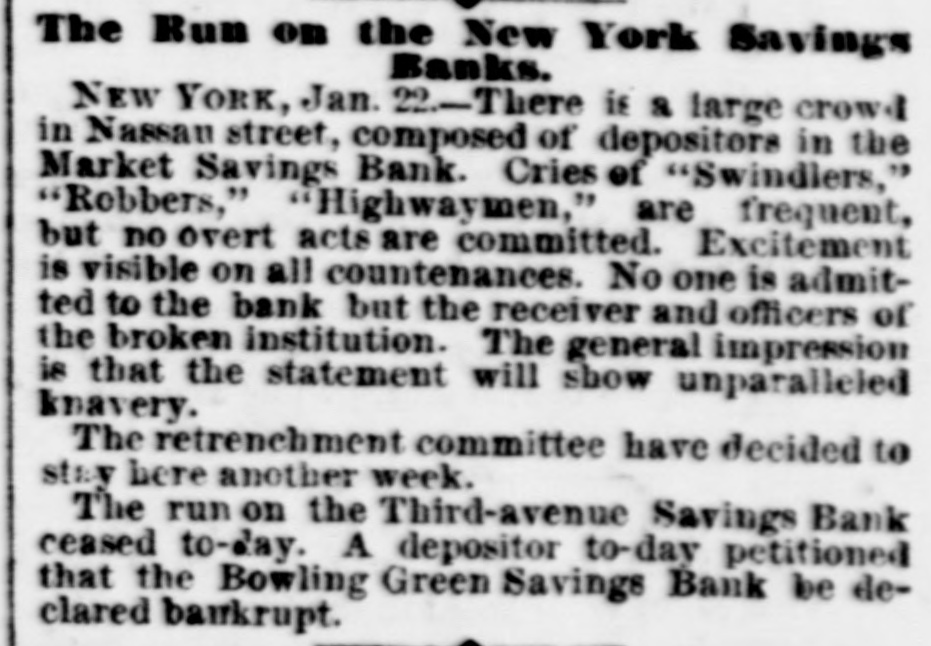
There is a large crowd in Nassau street, composed of depositors in the Market Savings Bank...No one is admitted to the bank but the receiver and officers of the broken institution.
Source
newspapers

Newspaper Articles (23)

Article from Alexandria Gazette, January 20, 1872

Click image to open full size in new tab

Article Text

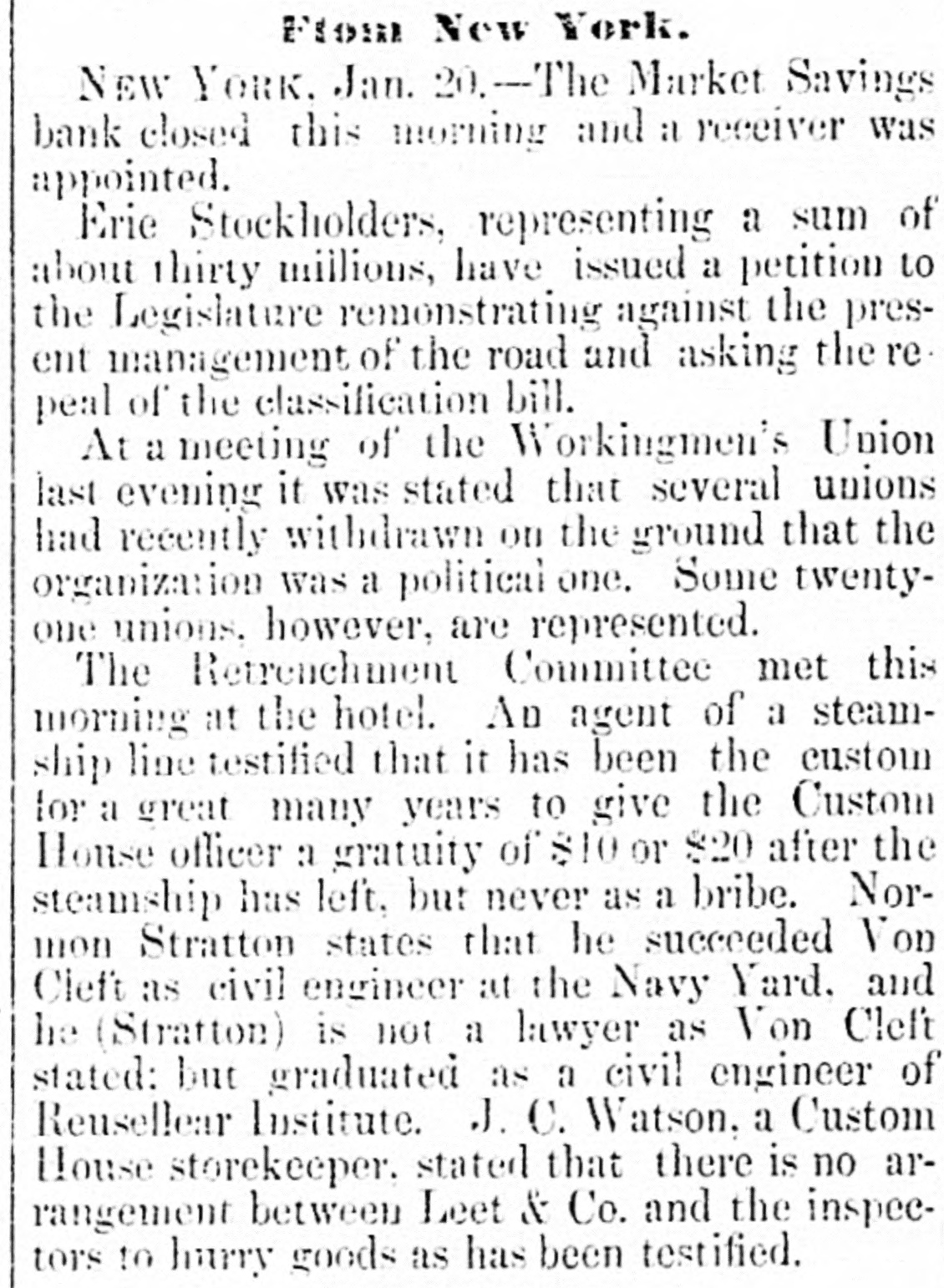
From New York. NEW YORK. Jan. 20. --The Market Savings bank closed this morning and it receiver was appointed. Erie Stockholders, representing a sum of about thirty millions, have issued a petition to the Legislature remonstrating against the present management of the road and asking the re peal of the classification bill. At a meeting of the Workingmen's Union last evening it was stated that several unions had recently withdrawn on the ground that the organization was a political one. Some twentyone unions. however, are represented. The Retrenchment Committee met this morning at the hotel. An agent of a steamship line testified that it has been the custour for a great many years to give the Custom House officer a gratuity of 810 or $20 after the steamship has left. but never as a bribe. Normon Stratton states that he succeeded Von Cleft as civil engineer at the Navy Yard. and he (Stratton) is not a lawyer as Von Cleft stated: but graduated as a civil engineer of Reusellear Institute. J.C. Watson. a Custom House storekeeper. stated that there is no arrangement between Leet & Co. and the inspeetors to harry goods as has been testified.


Article from The New York Herald, January 20, 1872

Click image to open full size in new tab

Article Text

THE MARKET SAVINGS BANK. Rumored Embarrnssment of the InstitutionThe Albany Bank Examiners Making an Investigation. Yesterday afternoon a rumor was current in Wall Street that a run had taken place on a savings bank, and a HERALD reporter, on making inquiries at the office of a prominent broker, ascertained that the Market Savings Bank, which occupies the second story of No. 82 Nassau street, was said to have failed, and a heavy run had taken place. It was late in the afternoon, however, before the affair was sufficiently ventilated to cause any crowd, and at three o'clock only six people were present, most of whom were receiving their semi-annual interest. On calling after three the reporter found the doors of the institution closed, but after a vigorous knocking a youth behind a lighted cigar appeared and demanded the visitor's business. On ascertaining its nature he called out, "Mr. Goddard, will you admit a HERALD reporter p" Mr. Goddard, one of the Vice Presidents, answered in the affirmative, and, winding his way around the long glass partitioned counter, confronted the scribe and appeared QUITE ASTONISHED when informed that a rumor prevailed in Wall street that a serious run on the bank had taken place. He denied that anything unusual had happened, and stated that they had always a large amount of money to pay in the month of January. He was disincurred to give any information until the arrival of the President, Mr. William Van Name who, however, failed to put in an appearance before six o'clock. at which time the clerks, who were very cross at being interrupted by Inquisitive visitors, left the establishment. Mr. Goddard, in the course of conversation, said that the examiners from the Bank Department were engaged on Thursday and yesterday in making an examination, and be could not furnish a list of the assets and liabilities, as all the documents were in the hands of these gentlemen. He declined 10 answer the question, sell ail depositors applying would be certainly paid 10-day," and stated that the press, by applying this morning, could obtain a printed schedule showing how the bank stood. The examiners will be there to-day and CONTINUE THE EXAMINATION. The reporters, finding this a barren field to work in, again sought the depositor who gave him the information and inquired the origin of the report. "Well," said this gentleman, "I was sitting in IL Y office when a friend came in and, knowing that I banked at this insultution, told me to get all the money I could out of it as there was sure to be a run. I went over and drew three checks, the largest or which I presented and received prompt payment, but it was after three before I got a chance to present the other two. That building over there is a nest for corporation thieves, and many of the depositors have looked with suspicion on the bank since the recent disclosures of the ring money transac. tions. You can't touch pitch and not be defiled. And tears are entertained that the bank officiale are in the Tweed boat.' THE OFFICERS. The Market Savings Bank has always borne a high character, and until the circulation or the present rumor was considered to be a very sound institution. The following 18 the list of officers:William Van Name, President; Calvin L. Goddard and Peter Voornis, Vice Presidents; Henry R. Conk. lin, Secretary; Messrs. Carpenter and Beach. Attorneys and Counsellors; Gershom Banker, Ellas J. Beach, Henry R. Conklin, William L. Cole, James S. Carpenter, James Dennis, Calvin L. Goddard, George E. Jarvis, Ell Martin, John R. Richard, Benjamin F. Sherman, William Van Name, Peter Voorh.s, Conrad F. Wettyen and George M. Woodward, Trustees.


Article from Knoxville Daily Chronicle, January 21, 1872

Click image to open full size in new tab

Article Text

LATEST BY TELEGRAPH. FOREIGN NEWS BY THE CABLE. Miscellaneous and Washington News. --0HOME NEWS. MEMPHIS AND CHARLESTON ROAD LEASED. Attempt to Kidnap a Man in Missouri. ST. LOUIS, Jan. 20.-Edward Freeman, formerly one of Quantrell's band, afterwards a Union spy, and since the war residing in Louisiana, was brought here yesterday by two men representing themselves as sheriffs of Louisiana, on the pretence of a warrant being issued for the prisoner by the Governor of Missouri, who, they said, offered a reward of $5,000 for him. No one else appearing to take him in custody, General Harding, under whom heserved during thewar, procured a writ of habeas corpus for him and had him discharged. He really had been kidnapped, drugged, schackled and conveyed here by the alleged sheriffs without authority of law, as Freeman thinks, through the agency of several of Quantrell's old gang, who are in Louisiana, and were afraid of him. His record is rather rough, but nothing appears against him since the war. TOPEKA. Jan. 20.-The Legislature appointed a committee to investigate the alleged United States Senator election frauds. CINCINNATI, Jan. 20.-The Kentucky Senate voted 20 to 16 in favor of negro testimony. SAN FRANCISCO, Jan. 20.-The foreign trade in this city has increased $9,000,000 during the past year, $7,000,000 of which was with China. The tobacco dealers are meeting in a movement for the suppression of the alleged custom house frauds upon their trade. WHEELING, W. VA., Jan. 20.-The commissioners have published a statement in which West Virginia acknowledges a debt to Old Virginia of $1,000,000. MEMPHIS, Jan. 20.-The stockholders of the Memphis and Charleston railroad have ratified the lease of the road to Pennsylvania Central combination. The votestood five to one. NEW YORK, Jan. 20.--The Investigation Committee will continue its session here next week. Erie stockholders who represent stock to the amount of $30,000,000, protest to the Legislature against the present management of the road, Several unions have withdrawn from the Engineers Union, on the ground that the organization is political. Minister Catacazy and lady have departed for Europe. He has high hopes for the American people, notwithstanding their present bad and corrupt government. The deficit in the Market Savings Bank, which closed this morning, amounts to $100,000. ANNAPOLIS, Jan. 20.-Court has adjourned to Monday without concluding the argument in the Wharton case. MOBILE, Jan. 20.-Judge Woods, in the Federal Court, set aside the proceedings in bankruptcy against the Alabama and Chattanooga Railrod and appointed a receiver, but granted the defenpants a re-hearing to-day. NEW ORLEANS, Jan. 20.-The Carterites took their seats to-day. Pinchback's election was confirmed by a vote of 17 to 16, Pinchback casting the decisive vote. BOSTON, Jan. 20.-A mania a potu patient at Lakeville shot two persons fatally and two seriously. CLEVELAND, O., Jan. 20.-Rev. Dr. Liman, of the Euclid Presbyterion Church, is dead.


Article from The New York Herald, January 21, 1872

Click image to open full size in new tab

Article Text

Barnard to appoint a receiver for the Market Savings Bank, and Judge Barnard appointed Mr. James Dennis, also a trustee, as receiver, and at ten o'clock this morning Mr. Dennis took charge of all the effects of the bank. The immediate cause of the failure of the Market Savings Bank was the inability of a Wall street house to pay the sum of $119,000, which they hold as trust funds of the bank.


Article from Memphis Daily Appeal, January 21, 1872

Click image to open full size in new tab

Article Text

The statement is favorable, and shows a net gain of $65,550 in the reserve fund. Banks now hold $10,931,625 abovethe 25 per cent required. The figures reflect an influx of money at this point. Miscellaneous—Rumors were current yesterday of an intended run on the Market, Bleecker Street and German savings banks...... Later—The excitement around the suspended Market bank this p.m., was very great. Crowds of indignant depositors marched up the street and indulged in vigorous threats against the officials........ John Russell, a messenger of the Metropolitan bank, was robbed on the street about noon to-day of $23,000 in gold certificates and a quantity of notes and bonds. No arrests...... City Chamberlain Palmer says there is $5,000,000 belonging to the city now on deposit in the Broadway bank, and that the comptroller is at liberty to draw on this to pay the police their back wages. NEW ORLEANS. NEW ORLEANS, January 20.—Gold, 109%. Sterling exchange, 118%; sight, par. LONDON. LONDON, January 20.— The money market at the close was as follows: Consols, money 92% | U. S. 5-20s 1865.......93% Consols, account..... 92% U. S. 5-20s 1867.......93% U. S. 5-20s 1862.......92% U. S. 10-40s 92% PARIS. PARIS, January 20.—Rentes, 56f. 55c. Specie in the Bank of France has increased 3,500,000 francs. FRANKFORT. FRANKF RT, January 20 - United States securities-five-twenties of 1862, 96%.


Article from Memphis Daily Appeal, January 22, 1872

Click image to open full size in new tab

Article Text

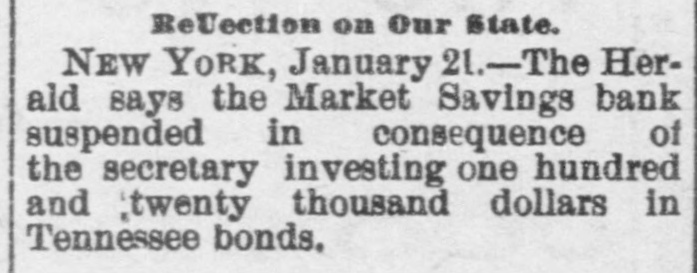
ReUection on Our State. NEW YORK, January 21.-The Herald says the Market Savings bank suspended in consequence of the secretary investing one hundred and ,twenty thousand dollars in Tennessee bonds.


Article from Evening Star, January 22, 1872

Click image to open full size in new tab

Article Text

The Run on the New York Savings Banks. NEW YORK, Jan. 22.-There is a large crow4 in Nassau street, composed of depositors in the Market Savings Bank. Cries of "Swindlers," "Robbers," "Highwaymen," are frequent, but no overt acts are committed. Excitement is visible on all countenances. No one is admitted to the bank but the receiver and officers of the broken institution. The general impression is that the statement will show unparalleled knavery. The retrenchment committee have decided to stay here another week. The run on the Third-avenue Savings Bank ceased to-day. A depositor to-day petitioned that the Bowling Green Savings Bank be declared bankrupt.


Article from The Wheeling Daily Register, January 22, 1872

Click image to open full size in new tab

Article Text

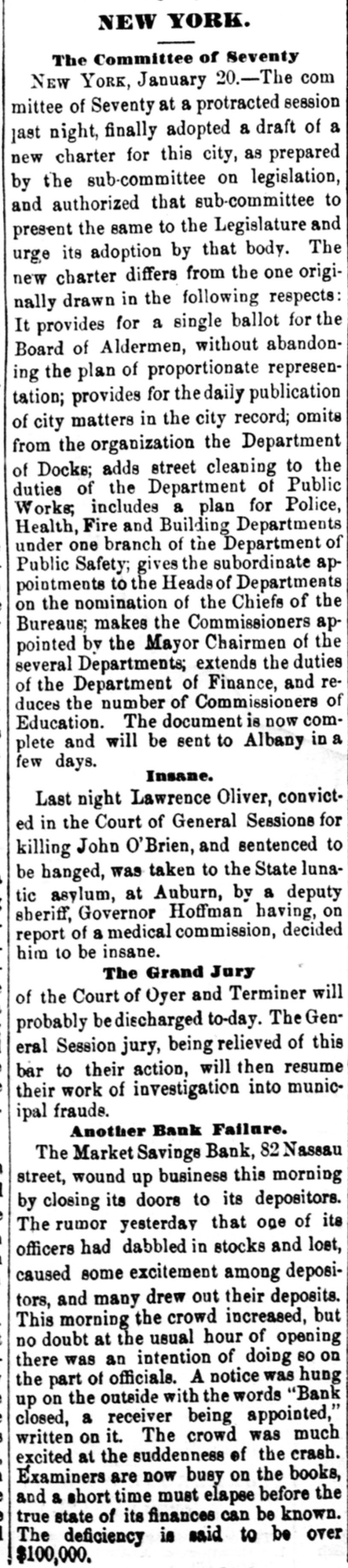
NEW YORK. The Committee of Seventy NEW YORK, January 20.-The com mittee of Seventy at a protracted session last night, finally adopted a draft of a new charter for this city, as prepared by the sub-committee on legislation, and authorized that sub-committee to present the same to the Legislature and urge its adoption by that body. The new charter differs from the one originally drawn in the following respects: It provides for a single ballot for the Board of Aldermen, without abandoning the plan of proportionate representation; provides for the daily publication of city matters in the city record; omits from the organization the Department of Docks; adds street cleaning to the duties of the Department of Public Works; includes a plan for Police, Health, Fire and Building Departments under one branch of the Department of Public Safety; gives the subordinate appointments to the Heads of Departments on the nomination of the Chiefs of the Bureaus; makes the Commissioners appointed by the Mayor Chairmen of the several Departments; extends the duties of the Department of Finance, and reduces the number of Commissioners of Education. The document is now complete and will be sent to Albany in a few days. Insane. Last night Lawrence Oliver, convicted in the Court of General Sessions for killing John O'Brien, and sentenced to be hanged, was taken to the State lunatic asylum, at Auburn, by a deputy sheriff, Governor Hoffman having, on report of a medical commission, decided him to be insane. The Grand Jury of the Court of Oyer and Terminer will probably bedischarged to-day. The General Session jury, being relieved of this bar to their action, will then resume their work of investigation into municipal frauds. Another Bank Failure. The Market Savings Bank, 82 Nassau street, wound up business this morning by closing its doors to its depositors. The rumor yesterday that one of its officers had dabbled in stocks and lost, caused some excitement among depositors, and many drew out their deposits. This morning the crowd increased, but no doubt at the usual hour of opening there was an intention of doing 80 on the part of officials. A notice was hung up on the outside with the words "Bank closed, a receiver being appointed," written on it. The crowd was much excited at the suddenness of the crash. Examiners are now busy on the books, and a short time must elapse before the true state of its finances can be known. The deficiency is said to be over $100,000.


Article from The Charleston Daily News, January 22, 1872

Click image to open full size in new tab

Article Text

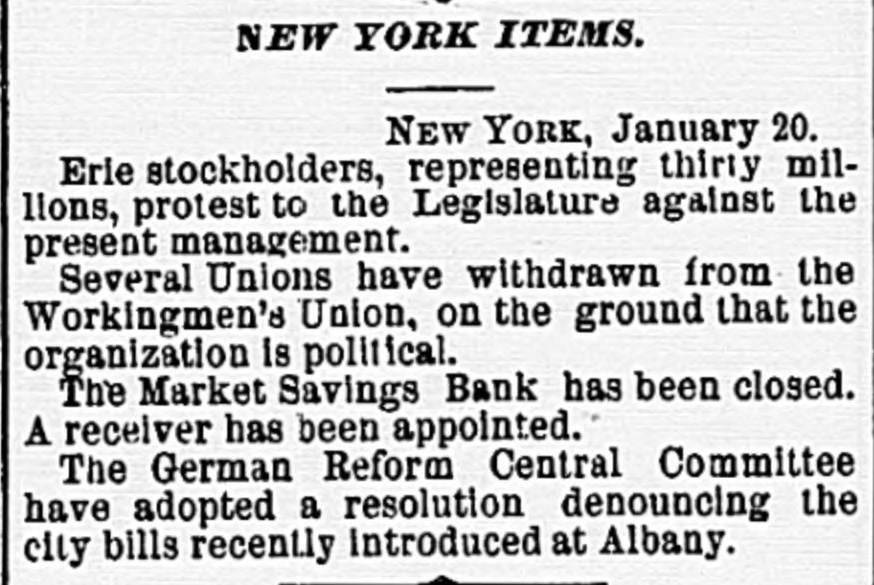
NEW YORK ITEMS. NEW YORK, January 20. Erie stockholders, representing thirty millions, protest to the Legislature against the present management. Several Unions have withdrawn from the Workingmen's Union, on the ground that the organization is political. The Market Savings Bank has been closed. A receiver has been appointed. The German Reform Central Committee have adopted a resolution denouncing the city bills recently Introduced at Albany.


Article from Public Ledger, January 22, 1872

Click image to open full size in new tab

Article Text

NEW YORK. Small-pox-The Runs ou Banks. NEW YORK, January 22. -There were twentyfive deaths from small-pox and ninety-three cases reported during last week in this city. It is understood that the American Atlantic Cable Company intend to begin soon laying the cable from the extremity of Long Island to a point on the English or Dutch coast. B. L. Beekman. receiver of the Union Square national bank. expects to pay a dividend of fifty per cent. about February 10th, and requests all depositors to call and prove claims. It is rumored that the run on the Thirdavenue savings bank still continues. It has now lasted ten days. with but little diminutation since the commencement, and over $2,000,000 have been withdrawn. Tweed, Hall and Connolly, despite conflicting rumors. which have been circulating during the past few days concerning their flight, are still in this city. Connolly's bondsmen will justify to-day. At the Fifth Avenue Hotel last night the subject of discussion was the failure of the Market Savings bank, and it is anticipated that runs on several other savings banks may be made immediately. The cause of the Market Savings bank failure was the inability of the Broad street firm of Heiser & Co. to pay a draft of $120,000 for Tennessee bonds due by them to the bank. The chamber of pammerce received a letter from Augustus Adee. United States charge d'affairs. U. S. legation. Madrid, remitting £314 sterling, being the receipts from the performance at the Royal opera house given under patronage of the king and queen of Spain for the Chicago sufferers.


Article from New-York Tribune, January 23, 1872

Click image to open full size in new tab

Article Text

THE BANK CRISIS. THE MARKET SAVINGS BANK-CONKLIN ALLEGED TO HAVE ABSCONDED. Rumors of the suspension of several savings banks were circulated in Wall-st. yesterday, but happily they proved to be entirely without foundation. About a dozen depositors gathered at the doors of the Market Savings Bank in Nassau-st., in the hope that they would receive intelligence concerning the money which they had deposited there, but the doors were closed, and they were denied admittance. The President, Mr. Van Name, the Receiver, Mr. Dennis, and the bank clerks were engaged in examining the books, accounts, and securities. A TRIBUNE reporter called upon the President in the morning and was frigidly informed that he had no intelligence to impart. It was generally believed, however, that the President knew quite as much about the bank as the Secretary, whose connection with it had proved 80 fatal. Later in the afternoon the reporter again called, and was informed by the porter that Secretary Conklin was not in the bank: he had not been there for some time; he was out of town, and that no one knew where he was. The bank officer states that Conklin admitted, in addition to the abstraction of the Tennessee bonds, that he had been using the securities of the bank in other disastrous stock operations. The officers have beenexamining the books and securities of the bank, and have found them correct as far as they have gone, but they believe that additional defalcations will bediscovered in the collateral security upon which the bank has advanced money, and when these loans are taken up the loss will certainly be discovered. Conklia, it is believed, abstracted these securities, and sold them Messrs. Henry Heiser's Sons of No. 11 Broad-st., through whom Conklin sold the Tennessee bonds. refuse to impart any information on the subject, stating that they are acting by the advice of counsel. They deny, however, the statements made in soma of the newspapers and have issued the following card: To the Editor of The Tribune. SIR: We wish it to be understood that we most emphatically deny the statement made in the different city papers in relation to our connection with the transactions of the officers of the Market Savings Bank. A full expose of all of our transactions with the officers of that bank will necessarily be made public at the proper time. HENRY A. HEISER'S SONS. Office of Henry A. Heiser's Sons, Bankers. No. 11 Broud st., New York, Jan. 22, 1872. A petition in bankruptcy WA8 filed in the United States District Court against the Market Savings Bank by several of its depositors, yesterday. The ground for instituting the proceedings is the appointment of the receiver under the State law. Mr. Alexander Blumensticl is the attorney for the petitioning creditors. OTHER INSTITUTIONS. About 300 of the depositors in the Third Avenue Savings Bank were present at the opening of the bank yesterday. Payments went on as usual, with no unusual excitement. The Trustees of the bank state that the Tarrytown property had been sold, the contract having been signed at $1,500 per acre. The bank has called in all moneys secured by mortgages in Westchester County property where the mort. gages are past due, and its officers state that they are prepared to meet the dewands of all their depositors in full. The city real estate of the Ocean National Bank was sold by order of the receiver, Theodore M. Davis, yesterday, at the Exchange Salesroom. The sales amounted to $225,625, and included the Helmbold store in Broadway, seven lots in the Seventh-ave, Boulevard, and the brown-stone building at Fulton and Greenwich-sts. Walter Roche, Vice-President of the Guardian Savings Bank has given to Jeremiah Quinian, Joseph G. Donolue, Matthew T. Brennan, Francis Higglus, Henry McCadden, jr., Gratz Nathan, and James H. Coleman, a dead of property valued at $317,000 to meet the demands of depositors, securing la the that place, those named in the deed, us giving them the preference, Mr. Denobuc is


Article from The Wheeling Daily Intelligencer, January 23, 1872

Click image to open full size in new tab

Article Text

NEW YORK CITY. I NEW YORK, January 22.-A large crowd of indignant depositors surround the Market Savings Bank on Nassau t street, but no violence has yet been committed. It is stated that the bank exLibit will present evidences of great knavery. Wm. Waix has been sentenced to 1 twenty years imprisonment for rape on a little girl. The Custom House Committee have decided to remain here another week. Tweed's constituents request him to either go to the Senate or resign. It is stated that Tweed only wants to buy two g more members of the Legislature to secure him from expulsion, and that he is waiting 3 to obtain them. The police of this city propose a testimonial to the memory of Fisk. It is rumored that the Manhattan Savings Institution has suspended. The Investigation Committee will leave for New Orleans on Wednesday. The National Labor party expect there will be about 2,200 delegates to the Columbus Convention. ) Representative McKinney, of Ohio, has ) been sick for two weeks. 3 The Ways and Means Committee will soon report on the Syndicate. King's distillery at Williamsburg was damaged $15,000 by fire yesterday. Insured. Rev. Dr. J. D. Bradley delivered a sermon yesterday in the Forty-third Street Church, Episcopal, announcing his seces. sion and his adoption of the Catholic religion. He was educated at Oxford University, England. John Gloss was assaulted and stabbed and cut in seventeen places last night by James Costello for abusing the latter in a vituperative manner. Gloss presented a shocking spectacle when taken to the station, being covered with blood. His face and head were hacked lawfully. The assault was made with a large carving knife which Costello was using in his restaurant, where Gloss had just ordered supper. Gloss will die. The grand jury have had a number of prominent bank officials before them to testify relative to the balance accounts of the officials. A teacher in school No. 25 was committed for trial this morning for rape on two littie girls. Mayor Hall to-day suggested to the Boards of Aldermen the appointment of a committee to draft and propose such amendments to the charter as they may suggest themselves, to be submitted to the Legislature in connection with the proposed new charter. The rumored failure of the Manhattan Savings Bank is untrue.


Article from The Daily Dispatch, January 23, 1872

Click image to open full size in new tab

Article Text

New York Items. NEW YORK, January 22.-Rev. Dr. J. D. Bradley has renounced the Episcopal for the Catholic Church. Three persons-two nich and one woman-are reported killed this morning. Mr. Leet, before the investigation committee, exonerated Generals Porter and Babcock from sharing the profits of the "geneaal order" business. A man recently convicted of rape has been sentenced to twenty years' imprisonment. A large crowd was assembled around the Market Savings Bank to-day. Cries of "swindlers, robbers," &c., were indulged in, but no overt act was committed. The general impression is that the statement willshow unparalleled knavery. A rumor which prevails that the Manhattan Savings Bank has suspended is untrue.


Article from New Orleans Republican, January 23, 1872

Click image to open full size in new tab

Article Text

NEW YORK. Retrenchment Committee Investigationsa of Raper-Twenty Conviction Years' Imprisonment-Indignant Savings Bank Depositors-Arrivals. NEW YORK, January 22.Mr. Leit, before the retrenchment investigating committee, exonerates Generals Porter and Babcock from sharing the profits of the general order of business. A raper, recently convicted, has been sentenced to twenty years' imprisonment. A large crowd around the Market Savings' Bank to-day, greeted that institution with cries of "Swindlers, robbers," etc., but no overt act was committed. The general impression is, the statement will show unparalleled knavery. Rumors prevail that the Manhattan Savings Bank has suspended, but are untrue. The retrenchment committee will remain another week. Arrived out-Steamships Idaho, Queen and Silesia. Monev easy at 6@7 on call loans. Sterling exchange heavy but lower. Gold 109 @ 109 1/s. Loans were made at from 3 to 6 P cent for carrying. State bonds quiet; Tennesses, old, 67, new 67; Virginias, old. 49, new 50: Louisianas, old, 52, new 50; levee sixes 60, eights 70; Alabama eights 90, fives 60; Georgia sixes 70, sevens 84; North Carolinas, old, 35, new 16: South Carolinas 50, new 27. Evening.-Governments steady all day; at the close, sixes of 1881 were off 1/8, and live-twenties of 1864 and 1865 were up 1/8 as compared with Saturday's prices. Closed very strong; 1881s 115%; 1862 1101/4: 1864 1101/2; 1865 1115% new 111: 1867 1121/2; 1868 1121/2; ten-forties 110 %.


Article from The New York Herald, January 25, 1872

Click image to open full size in new tab

Article Text

THE SHAKY SAVINGS BANKS THE MARKET SAVINGS BANK. The Doors Maill Locked Fast-The Trouble Resulting from the Guilt of the Secretary and the Negligence of the Directors-Conk. lin's Disappearance-The Depositors Dis. contented. The Market Savings Bank was still closed yesterday. looking peculiarly gloomy and inhospitable to the throng of depositors that lingered in the hall and about the door during the hours of business. No access could be had to the office of the President without continuous rapping, which was only responded to after the lapse of some time it by one of the clerks, whose business evidently was to get rid of all inquirers as speedily and unceremoniously as possible. He, however, treated the representative of the HERALD as courteously as could be expected, although not so with those anxious and disagreeably persistent Individuals who come to make doleful queries about the savings which they had fondiv trusted to the now defunct institution. THE DEFAULTING SECRETARY. It appears that Mr. Dennis, the Receiver, has discovered that the statement last made by the Secretary (Conkin) to the Directors asentirely false. It was composed of ingeniouslies invented to hide his own ill-doings. he securities which ne represented as in the possession of the bank were ulterly worth. less. Pari of the onus of guit is put upon the directors, as 16 is freely said that they used little, If any surveillance over the transactions of the Secretary. having such blind confidence in ais ability and integrity that they permitted nim to do altogether as he pleased. by this it would appear that these gentlemen were not very faithful in the duties of their position and are moralty responsible for the consequences of such negligence. THE CONDITION OF APPAIRS. Mr. James Dennis is working assiduously in preparing a statement of the affairs of the bank. which be hopes will be completed in a very few days. He has already gone far enough in the investigation to show that the creditors have been sadly wronged. They will recover very little of what is owea them, the liabilities far exceeding its assets. A MEETING OF THE DEPOSIT ORS. There appears to be some dissatisfaction among the depositois regarding the present receiver, and a meeung 18 to be held to-day to make some efforts to secure the appointment of some other person to that office. What are the other objects of the meeting is not known. THE SECRETARX NON EST. It 18 positively stated at the bank that Conklin, the Secretary, has indeed left the city. His defalcation is said to be very large. Several notices posted up on the doors of the building announce that certain firms which have given checks upon this bank will pay them upon their presentation by the holders, which " is presumed very speedily occurs after they are read by the latter. Mr. Conklin, the Secretary or the Market Savings Bank, Confesses to Having Ab. stracted and Lost $125,000 of the Bank's Funds-liis Departure for Parts UnknownWarrant of Attachment Against His Property. The mystery of the suspension of the Market Savings Bank IS beginning to clear itself up. In fact. the cloud of doubt overshadowing the matter was cleared away several days since in the mind of Mr. James Deunis, the receiver, but was not publicly made known until yesterday, through the appearance or this gentleman before Judge Barrett, in the Supreme Court, Chambers. The business bringing him there was quickly made known, having been embodied an amdavit. This affidavit set forth that Henry inin R. Conklin, the late Secretary of the bank, is that debted to the bank in the sum of $125,000, and the indebtedness came about through his abstracting controin the funds of the bank and the same to his own use. But Mr. Dennis went on to say end verting this the amount story. this used that did this Mr. not Consin had confessed that he had had of the bank's monev; that the latter amount him up to Saturday last in overhauiof the bank and he had not been seen in this ing out; been the that assisting affairs straightening of city residence, since: them that he could not be found at nis place and that It was believed ne had absconded. S. Carpenter also made amdavit that had admitted to him that to his own use and lost $125,000 of met verted Mr. Mr. Conklin James Sunday he the had ne bank's confunds. He said further that on last then Conklin at the Grand Hotel, and that Conklin promised he intended to go to Canada, but he told the next day, and, failing to of Monday morning at the called see nim him on brother-in-law residence do so, Richard Carpenter, in Jersey City, a left that Conklin, and was there told that he had morning of for the West, on the Erie Railroad. the above amdavits a warrant of attachment and, of Upon issued against the property of Cooklin, 18 said was If any property can be found-which same will at course, however, to be very doubtful-the Court. now. once be seized under this process of the


Article from The New York Herald, January 26, 1872

Click image to open full size in new tab

Article Text

# THE SHAKY SAVINGS BANKS. Old and New Charters and Their Respective Results. Meetings of the Depositors of the Market Savings Bank-Committee Appointed to Investigate the Affairs of the Institution. # THE RUN ON THE THIRD AVENUE BANK Paying the Ocean Bank Depositors Their First Dividends. The question as to the condition and general management of savings banks has, owing to unfortunate circumstances, become very prominent, and there seems to prevail an earnest desire on the part of the public to thoroughly comprehend the situation as it stands. That a feeling of insecurity has of late prevailed among the poorer classes of depositors has had ample demonstration. Whether the system of doing business is well understood there appears to be considerable doubt. The fact is that a great deal of ignorance prevails as to the mode of operation; and since a few institutions have thrown up the sponge, so to speak, confused ideas naturally take possession of those whose sudden reverses have naturally induced feelings of excitement. But in order to know the real state of affairs it is necessary to consider the laws which govern the institutions in question. A representative of the HERALD visited yesterday many of what are termed the old savings banks, whose charters were passed, in some instances, over twenty years ago. From conversations with several of the officers it would appear that the STRINGENT LAWS ORIGINALLY ENACTED for their guidance are strictly adhered to, and hence their security and comparative prosperity. The case of Conklin, of the Market Savings Bank, furnished the text for some inquiries, and in reply to the question as to whether the investment of money was placed in the hands of an individual, and whether by any dexterity he could mislead the trustees, it was stated generally that no money could be invested except by the affirmative vote of at least seven of the trustees out of a quorum of ten, while some of the banks have rules that no money can be invested where securities are below par without a two-third vote. The old banks were restricted from doing a discount business, which competent judges consider unsafe for savings banks; but recent Legislatures have been much more liberal in granting charters to the new institutions. Discounting, however, seems to be outside their province, as not a little risk was involved by that method of procedure. Although many of the new savings banks in this city are regarded with decided confidence, it appears that all the institutions which have caused so much COMMOTION AND INDIGNATION were doing that description of business. The old charters distinctly prohibited the discount trade, but the Legislatures for the past few years have not been quite so stringent in their requirements. In his annual report on savings banks for last year the Superintendent, among other things, sets forth that, as it is impracticable to apply to savings banks the requirements as to security of invested capital and stock deposits in the Bank Department which are applied to banks of discount and circulation, and in a degree to other financial institutions, the duty of the State becomes the more imperative to provide with jealous care such safeguards for the protection of depositors as are practicable. Again the indiscriminate multiplying of a certain class of savings banks, such as characterized the legislation of the last few years, is considered most IMPOLITIC AND HAZARDOUS. The Superintendent went on to show that the competition for business to which that policy inevitably tends results in diminished security to depositors, growing out of the greater risks incurred in doubtful investments in order to meet the higher rates of interest promised them. The old charters limit the investments of the savings banks to which they were granted, and distinctly define the character of the bonds in which these banks are to invest. They are restricted from investing at a higher figure than ninety per cent of the cash value of such bonds, and providing where such bonds are depreciating that measures be taken to secure the depositors. The bonds in which the old banks are allowed to invest were only those issued by the United States government, State stocks, bonds and mortgages, and county bonds issued under the laws of the State, and city bonds authorized by act of the Legislature. That many of the new savings banks follow that wise provision there is no reason to doubt, but it is THE DISCOUNT BUSINESS that has generally caused unfavorable comment. It is thought that to insure vigilant care the business of a savings bank should be disconnected from all other business. The Superintendent's report says:-"When operated in connection with a bank or insurance company the interests of the savings bank are almost certain to be made subordinate, as at times they are opposed to those of the institution assuming the conduct of its affairs, and the laxity on the part of its proper guardians, engendered by this relation only intensifies the evil." Now, it appears that Legislatures of the past two or three years have been very liberal in their provisions, and some, but not all, of the newer banks are allowed privileges distinctly prohibited to the older institutions. But the recent developments will doubtless cause A WHOLESOME REFORM, and it is expected that the present Legislature will be more stringent than its immediate predecessors. The older banks generally are in favor of careful legislation. In making inquiries yesterday it appears that many of the banks have become so cautious that they have had their mortgage property examined by a special committee, and in cases where the property has decreased in value loans have been called in. A feeling of annoyance is experienced in the older institutions at the recent failures, as they have tended to create uneasiness among depositors generally, although there is no foundation for the slightest apprehension so far as the savings banks whose charters provide almost entirely against loss are concerned. In the old banks the interest generally averages six per cent, which allows them to accumulate a surplus, which is distributed in the form of an extra dividend. Some of the institutions are prohibited from receiving more than $5,000 as a deposit from one person, but others have had their charters managed to allow the receiving of a much larger amount. However disastrous THE RECENT FAILURES have been, it is sincerely hoped that they will prove a warning in the future. Careful and judicial legislation in regard to savings banks is demanded, and the law cannot be too stringent that will protect the hard earnings of the poor. Below will be found meetings of the depositors of the Market Savings Institution and details of the run on the Third Avenue Savings Bank.


Article from Worcester Daily Spy, February 1, 1872

Click image to open full size in new tab

Article Text

# Ring Frauds—Another Suit against Mr. Murphy, etc. NEW YORK, Jan. 31.—Miss Fowler was award- ed $4000 damages against Mr. Martin, for not marrying her, at Kingston, yesterday. The commission of appeals in the case of Rawson against the Pennsylvania railroad com- pany have decided that their limitation of lia- bility to $100 for loss of baggage is not a con- tract, and have awarded the plaintiff $4000 dam- ages for her baggage lost by the defendant. The general sessions grand jury are in doubt whether to refind indictments against the ring men. They have not time to bring witnesses before them, as their term expires Saturday. A petition to the South Carolina legislature to consolidate its debt is being signed by the finan- cial men of the city. A disastrous fire occurred in the armory of the 22d regiment yesterday, caused by the wood- work taking fire from a grate put in by Garvey, the swindling ring plasterer. It is stated that Attorney General Barlow is about to commence suits against Jay Gould and other members of the Erie ring. John V. Gridley, a Tammany republican, has been appointed water purveyor of this city, by Tweed's successor. Many of the persons who are charged with furnishing supplies to the city department, in the account published yesterday, represent that they never received the moneys charged to them. It also appears that many of the articles were never furnished. The disbursement bureau re- pairs, published yesterday, show that a quarter of a million was paid out. Eighty thousand of this ranks as repairs to the police civil courts, though not one-tenth of the amount was actually expended. The coroner's jury last night rendered a ver- dict that Mrs. Fannie Hyde killed Geo. W. Wat- son in Williamsburg. Two jurors considered the shooting justifiable. The republican general committee last evening elected John G. Townsend president, and John J. O'Brien secretary. The congressional committee resumed their sessions to-day. A letter was read from a coal inspector, alleging irregularities on the part of inspectors. He will be subpœned. A letter was also received from Gens. Porter and Bab- cock, asking to be subpœned to testify against the statements made adverse to them. Gens. Porter and Babcock will be heard next Friday. Chas. Billings testified that his brandy was robbed under Grinnell's administration, of five gallons to the cask, and could get no satifaction at the custom house. The case of Thomas Sproul, which came up in the Jefferson Market police court, yesterday afternoon, occasioned much excitement among the spiritualists. It will be recollected by the readers of the Spy that he was charged with the larceny of a watch and chain, he alleging that it was a conspiracy against him on account of his exposing the tricks of a couple of so-called spiritualists, named Elizabeth Fuller and a man named Gordon, who was formerly associated in business with Sproul. The testimony was of a most ludicrous character; that is, when viewed through the glasses of those who are not believ- ers in the mystery. For instance, one of the witnesses, a spiritualist, of course, testified that Gordon, at one of the seances, exhibited the bust of Benjamin Franklin, which was not flesh nor blood, and a child that had been shockingly mu- tilated by a railroad accident, and said that no person had succeeded in unraveling the mys- tery, the "spirits" vanishing when approached. Mr. Sproul's evidence was very attentively list- ened to, and his denunciation of the tricks re- sorted to by the "medium," Gordon, was of a most decided character. He claimed, and made apparent to his own satisfaction, and to that of many in the court room, that Gordon's mani- festations were produced by an elaborate com- bination of wires, strings, pasteboard, pictures, illusion lace and darkness. The Times contains another broadside at the "ring," the frauds in the department of public works while under the direction of "Boss" Tweed coming in for consideration. Among the items is one of $76,217 recorded for repairs on public markets, and investigation fails to sub- stantiate the fact. In other words, the Times says not a dollar was paid by the city for such repairs. Another $82,924 is recorded for re- pairs in police and civil courts, which are in a notoriously bad condition, and upon which prob- ably not a dollar has been expended, as claimed. It also appears that Haggerty, the voucher thief, now in the tombs, was not removed from office until yesterday, and has drawn his salary regularly. Vice President Colfax has been invited to ad- dress the young men's Christian association of Brooklyn. Another suit has been commenced against Collector Murphy, to recover the amount of a political assessment paid by an office holder in the custom house. The Williamsburg coroner's jury in the case of Watson, who was shot on Friday last by the woman whom it was said he had insulted, ren- dered a verdict, last evening, that the deceased came to his death from a pistol shot fired by Mrs. Hyde, with malice aforethought. Two of the jury wished to find a verdict of justifiable homicide. A warrant has been issued for the arrest of Hyde, the husband of Fanny Hyde, as accessory to the murder of Watson. Mr. Patterson, whose name was disagreeably connected with the failure of the Market savings bank, visited the receiver, to-day, and declared that he was able and willing to repay the loan made him. The receiver expresses the belief that the bank is unable to pay depositors over forty per cent. A portion of the Southside railroad track, at Rockaway, L. I., was destroyed by some un- known persons. One of the early trains this morning had a narrow escape from a serious disaster. The principal theme of discussion about city hall yesterday was the audit bill passed by the legislature, and great satisfaction was felt among the employes of the various city departments when the news arrived of the governor's signing the bill, thereby making it a law.

Article from The Portland Daily Press, February 5, 1872

Click image to open full size in new tab

Article Text

THE MARKET SAVINGS BANK of New York, which has just failed through the rascality of its Secretary, largely by bogus investments, is felt with crushing weight by scores of poor people. Had the bank been restricted to a certain class of sound securities and the institution carefully examined, even a rascally officer could not have wrought so wicked a work. The following painful incidents from the Evening Post are commended to our law makers, who will vote on this important matter the present week: One old woman, a laundress, evidently an honest and hard working person, yesterday visited the bank, and asked when she would be able to get some money, as she was greatly in need of it. The Receiver, who is compelled to listen to many such inquiries, asked her the amount of her deposit. "Twelve hundred dollars," she replied. "My good woman," said Mr. Worth, astonished, 'Where on earth did you get such a sum?" "Ah!" said she, bursting into tears, "I have been working for that for ten years, and to-day I am in want." This was bad enough, but something worse was to follow. An elderly gentleman, well dressed, but pale and careworn, and scarcely able to restrain his emotion, addressed the Receiver, saying with forced calmness: "I am a lawyer; my name is , and I have $4000 in your bank." Mr. Worth briefly replied, expressing his regret at the condition of affairs, and the hope that the loss of the money would not seriously inconvenience one so well off as his visitor appeared to be. "It is all I have in the world," replied the other. "I have, besides, one sick daughter entirely dependent upon me for her comforts and necessaries of life, which, up to the present time, I have been able to obtain for her. On Wednesday night I told her, as gently as I could, that I was ruined. Yesterday afternoon I took her to a lunatic asylum." Here the speaker broke down, and after a brief struggle to regain his composure, rushed from the bank, unwilling that his weakness should be observed by the idlers around him. Scenes nearly as painful may be seen almost hourly.


Article from New-York Tribune, February 8, 1872

Click image to open full size in new tab

Article Text

THE MARKET SAVINGS BANK A PROBABILITY THAT CRIMINAL PROCEEDINGS WILL BE BROUGHT AGAINST SEVERAL OFFICERS. The depositors of the Market Savings Bank rehearse their grievances daily in the bank building, and receive assurances that they will not lose quite twothirds of their savings. The petition against the bankruptey proceedings has been signed by 600 depositors, but it is probable that the original application will be granted on Saturday, when the case is argued in the United States Court. Many depositors claim that Conklin, though guilty of large defalcations, should not be made the scapegoat for the offenses, whether sins of omission or commission, of others, and favor the petition for bankruptcy on the ground that it will facilitate a thorough investigation of the manner in which the bank has been mismanaged. Those who signed the pe tition in opposition to the bankruptcy proceedings insist that the Depositors' Committee, with the assistance of the Receiver, will be able to accomplish the same ends, and to institute criminal proceedings against the officers of the bank. if there shall be ground for them. F. W. Worth, the Receiver, in reply to the inquiries of a TRIBUNE reporter yesterday, opened the desk at which he was sitting, thereby disclosing an incongruous mass or check-books and miscellaneous papers in hopeless confusion, and significantly remarked: "This is the President's desk, just as he left it: and the condition of his bank is even more chaotic. I told the depositors on Monday that they might expect 45 cents on a dollar; but I hardly know whether I ought to have promised it. There is great uncertainty in regard to the call loans. When I find a promissory note with no collateral security in the safe, I hesitate to demand collection from the fear that the debtor will claim that be deposited securities against the loan, and that they have been used by the cashier. I referred the other day to the fact that a respectable firm of brokers, which was dissolved two years ago, was charged with $50,000 call loans. It is a most damaging fact. How could the trustees have examined the bank from time to time, and given their signatures to semi-annual statements, without noticing that entry 1 A moment's reflection would have convinced them that 80 reputable a firm would not have left the loan stand so long; and yet the entry appeared for two years after the account had been liquidated and the firm had been dissolved. and was suffered to represent a portion of the assets. I cannot state positively whether any depositors withdrew their balances before the failure with the connivance of the officers. That is a matter which is now under investigation. I find, for instance, that one person drew out $10,000 the day preceding the failure; another $15,000, and others their entire balance; and I am anxious to ascertain whether these persons were friends and associates of the officers. Ido not expect to make a statement of the condition of the bank within veral weeks, inasmuch as time will be required to negotiate the sale of the bonds and to collect the call loans. if they can be collected."


Article from Alexandria Gazette, April 10, 1872

Click image to open full size in new tab

Article Text

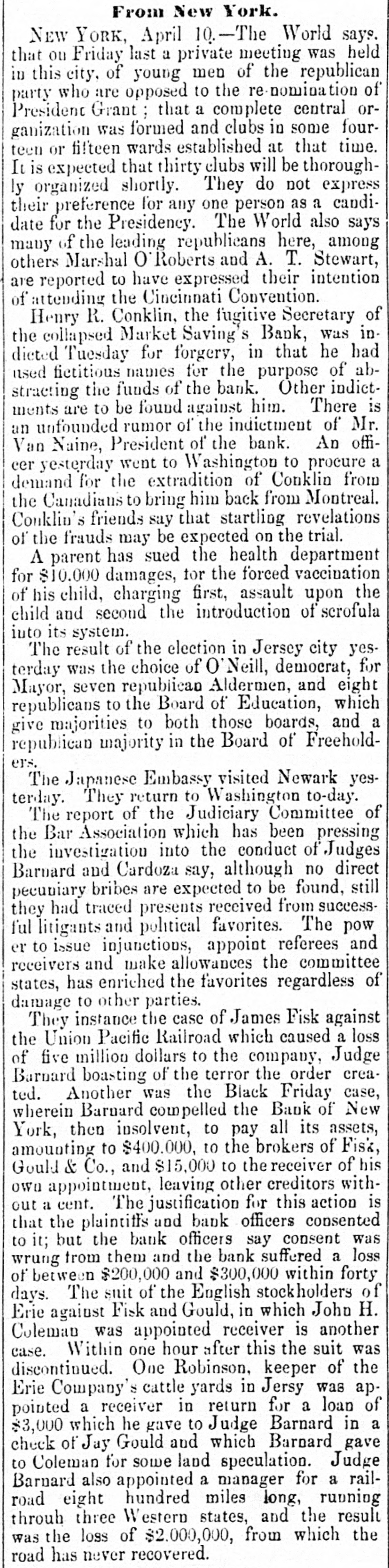
From New York. New YORK, April 10.-The World says. that ou Friday last a private meeting was held in this city, of young men of the republican party who are opposed to the re-nomination of President Grant that a complete central organization was formed and clubs in some fourteen or fifteen wards established at that time. It is expected that thirty clubs will be thoroughly organized shortly. They do not express their preference for any one person as a candidate for the Presidency. The World also says many of the leading republicans here, among others Marshal O Roberts and A. T. Stewart, are reported to have expressed their intention of attending the Cincinnati Convention. Henry R. Conklin, the fugitive Secretary of the collapsed Market Saving's Bank, was indieted Tuesday for forgery, in that he had used fictitious names for the purpose of abstracting the funds of the bank. Other indictments are to be found against him. There is an unfounded rumor of the indictment of Mr. Van Naine, President of the bank. An officer yesterday went to Washington to procure a demand for the extradition of Conklin from the Canadians to bring him back from Montreal. Conklin's friends say that startling revelations of the frauds may be expected on the trial. A parent has sued the health department for $10.000 damages, for the forced vaccination of his child, charging first, assault upon the child and second the introduction of scrofula into its system. The result of the election in Jersey city yesterday was the choice of 0 Neill, democrat, for Mayor, seven republican Aldermen, and eight republicans to the Board of Education, which give majorities to both those boards, and a republican unajority in the Board of Freeholders. The Japanese Embassy visited Newark yesterday. They return to Washington to-day. The report of the Judiciary Committee of the Bar Association which has been pressing the investigation into the conduct of Judges Barnard and Cardoza say, although no direct pecuniary bribes are expected to be found, still they had traced presents received from successful litigants and political favorites. The pow er to issue injunctions, appoint referees and receivers and make allowances the committee states, has enriched the favorites regardless of damage to other parties. They instance the case of James Fisk against the Union Pacific Railroad which caused a loss of five million dollars to the company, Judge Barnard boasting of the terror the order created. Another was the Black Friday case, wherein Barnard compelled the Bank of New York, then insolvent, to pay all its assets, amounting to $400.000, to the brokers of Fisk, Gould & Co., and $15,000 to the receiver of his own appointment, leaving other creditors without a cent. The justification for this action is that the plaintiffs and bank officers consented to it; but the bank officers say consent was wrung from them and the bank suffered a loss of between $200,000 and $300,000 within forty days. The suit of the English stockholders of Erie against Fisk and Gould, in which John H. Coleman was appointed receiver is another case. Within one hour after this the suit was discontinued. One Robinson, keeper of the Erie Company's cattle yards in Jersy was appointed a receiver in return for a loan of $3,000 which he gave to Judge Barnard in a check of Jay Gould and which Barnard gave to Coleman for some land speculation. Judge Barnard also appointed a manager for a railroad eight hundred miles long, running throuh three Western states, and the result was the loss of $2.000,000, from which the road has never recovered.


Article from The Petroleum Centre Daily Record, September 29, 1873

Click image to open full size in new tab

Article Text

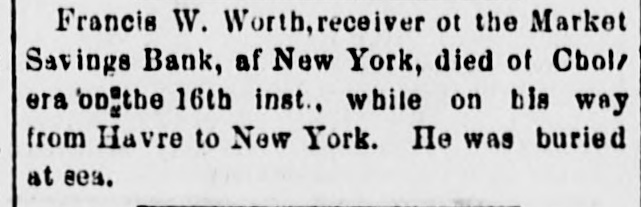
Francis W. Worth, receiver of the Market Savings Bank, of New York, died of Cholera on the 16th inst., while on his way from Havre to New York. He was buried at sea.


Article from The Rutland Daily Globe, September 29, 1873

Click image to open full size in new tab

Article Text

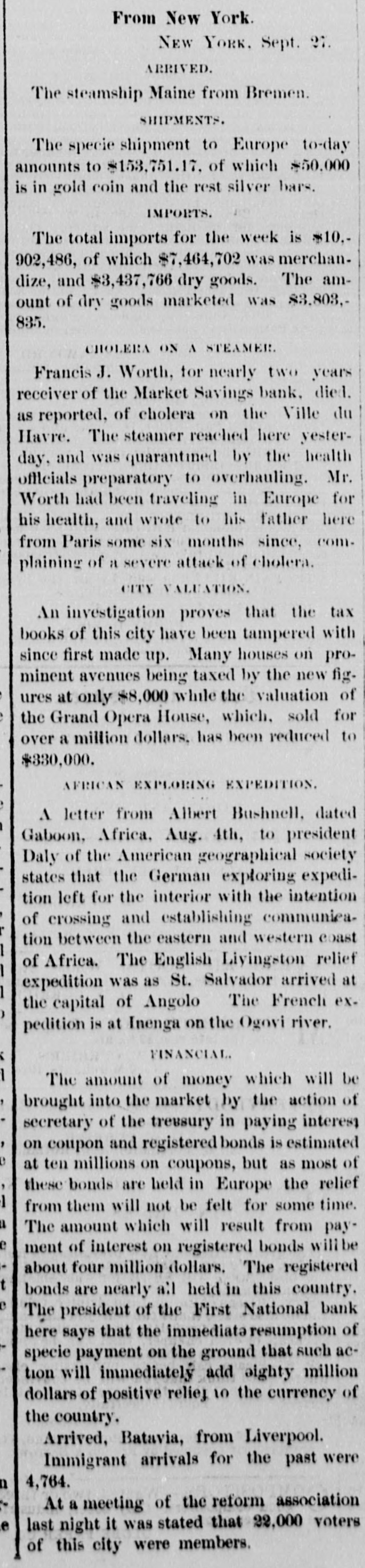
From New York. NEW YORK, Sept. 27. ARRIVED. The steamship Maine from Bremen. SHIPMENTS. The specie shipment to Europe to-day amounts to $153.751.17, of which $50.000 is in gold coin and the rest silver bars. IMPORTS. The total imports for the week is $10,- 902,486, of which $7,464,702 was merchan- dize, and $3,437,766 dry goods. The am- ount of dry goods marketed was $3,803,- 835. # CHOLERA ON A STEAMER. Francis J. Worth, for nearly two years receiver of the Market Savings bank, died. as reported, of cholera on the Ville du Havre. The steamer reached here yester- day, and was quarantined by the health offlcials preparatory to overhauling. Mr. Worth had been traveling in Europe for his health, and wrote to his father here from Paris some six months since, com- plaining of a severe attack of cholera. # CITY VALUATION. An investigation proves that the tax books of this city have been tampered with since first made up. Many houses on pro- minent avenues being taxed by the new fig- ures at only $8,000 while the valuation of the Grand Opera House, which, sold for over a million dollars, has been reduced to $330,000. # AFRICAN EXPLORING EXPEDITION. A letter from Albert Bushnell, dated Gaboon, Africa, Aug. 4th, to president Daly of the American geographical society states that the German exploring expedi- tion left for the interior with the intention of crossing and establishing communica- tion between the eastern and western coast of Africa. The English Liyingston relief expedition was as St. Salvador arrived at the capital of Angolo The French ex- pedition is at Inenga on the Ogovi river. # FINANCIAL. The amount of money which will be brought into the market by the action of secretary of the treasury in paying interesą on coupon and registered bonds is estimated at ten millions on coupons, but as most of these bonds are held in Europe the relief from them will not be felt for some time. The amount which will result from pay- ement of interest on registered bonds will be about four million dollars. The registered bonds are nearly a'l held in this country. The president of the First National bank here says that the immediata resumption of specie payment on the ground that such ac- tion will immediately add aighty million dollars of positive relief to the currency of the country. Arrived, Batavia, from Liverpool. Immigrant arrivals for the past were 4,764. At a meeting of the reform association last night it was stated that 22,000 voters of this city were members.


Article from The Sun, December 4, 1873

Click image to open full size in new tab

Article Text

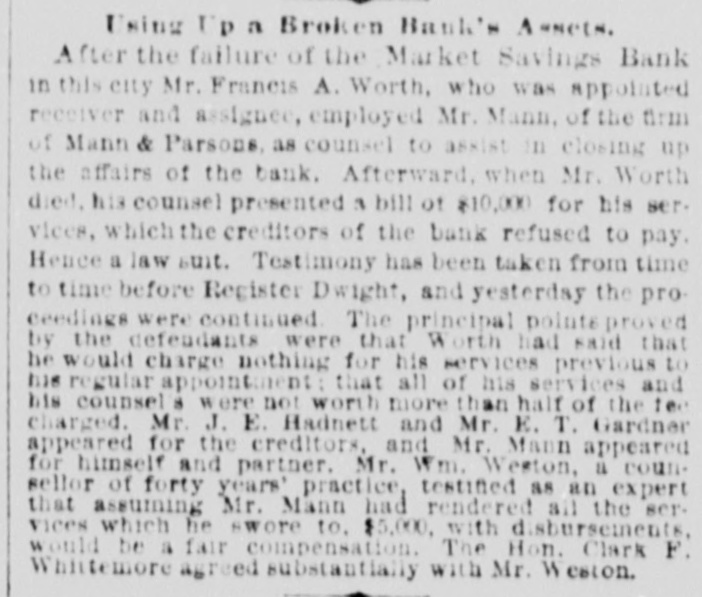
# Using Up a Broken Bank's Assets. After the failure of the Market Savings Bank in this city Mr. Francis A. Worth, who was appointed receiver and assignee, employed Mr. Mann, of the firm of Mann & Parsons, as counsel to assist in closing up the affairs of the bank. Afterward, when Mr. Worth died, his counsel presented a bill of $10,000 for his services, which the creditors of the bank refused to pay. Hence a law suit. Testimony has been taken from time to time before Register Dwight, and yesterday the proceedings were continued. The principal points proved by the defendants were that Worth had said that he would charge nothing for his services previous to his regular appointment; that all of his services and his counsel's were not worth more than half of the fee charged. Mr. J. E. Hadnett and Mr. E. T. Gardner appeared for the creditors, and Mr. Mann appeared for himself and partner. Mr. Wm. Weston, a counsellor of forty years' practice, testified as an expert that assuming Mr. Mann had rendered all the services which he swore to, $5,000, with disbursements, would be a fair compensation. The Hon. Clark F. Whittemore agreed substantially with Mr. Weston.