Articles report the Marine Bank (New York) suspended payments in early May 1884 (news dated May 7–9, 1884) following heavy dealings and large overdrafts connected with the firm Grant & Ward. Examiners/receiver took charge and a receiver is later referenced; president James D. Fish was prosecuted and convicted. Sources consistently describe a suspension that became a permanent failure/receivership. I corrected minor OCR artifacts (e.g., Fish for Fise in some lines).
Events (2)
1.May 7, 1884Suspension
Cause
Bank Specific Adverse Info
Cause Details
Large overdrafts and reckless use of securities by the firm Grant & Ward; certified checks presented exceeded available funds after Grant & Ward failed to make deposits; bank had heavy city deposits which were drawn (e.g., $300,000) precipitating suspension; alleged misapplication of funds by bank officers tied to Grant & Ward dealings.
Newspaper Excerpt
The bank was in a perfectly solvent condition and that business would be resumed in a few days. / it had been decided to drop the Marine bank from the association and cut it off from all further privileges of the clearing house.
Source
newspapers
2.May 9, 1884Receivership
Newspaper Excerpt
A bank examiner is in charge of the suspended bank, and probably the Washington authorities will appoint a receiver at once. / Receiver John H. Morris referenced in later reports (June 1884).
Source
newspapers
Newspaper Articles (25)
1.May 7, 1884The Democratic LeaderCheyenne, WY
Click image to open full size in new tab
Article Text
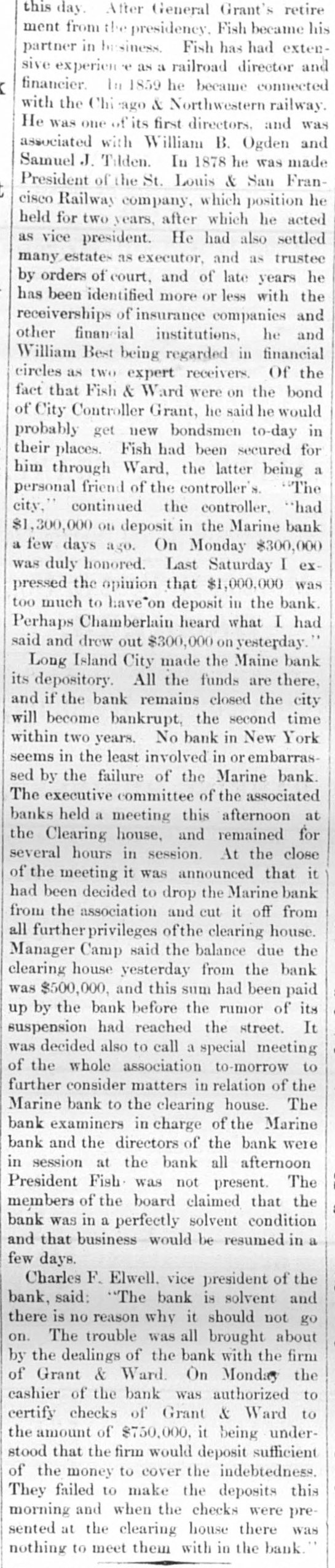
this day. After General Grant's retire ment from the presidency. Fish became his partner in business. Fish has had extensive experien e as a railroad director and financier. In 1859 he became connected with the Chi ago & Northwestern railway. He was one of its first directors, and was associated with William B. Ogden and Samuel J. Tilden. In 1878 he was made President of the St. Louis & San Francisco Railway company, which position he held for two years, after which he acted as vice president. He had also settled many estates as executor, and as trustee by orders of court, and of late years he has been identified more or less with the receiverships of insurance companies and other financial institutions, he and William Best being regarded in financial circles as two expert receivers. Of the fact that Fish & Ward were on the bond of City Controller Grant, he said he would probably get new bondsmen to-day in their places. Fish had been secured for him through Ward, the latter being a personal friend of the controller's. "The city," continued the controller, "had $1,300,000 on deposit in the Marine bank a few days ago. On Monday $300,000 was duly honored. Last Saturday I expressed the opinion that $1,000,000 was too much to have"on deposit in the bank. Perhaps Chamberlain heard what I had said and drow out $300,000 on yesterday.' Long Island City made the Maine bank its depository. All the funds are there, and if the bank remains closed the city will become bankrupt, the second time within two years. No bank in New York seems in the least involved in or embarrassed by the failure of the Marine bank. The executive committee of the associated banks held a meeting this afternoon at the Clearing house, and remained for several hours in session. At the close of the meeting it was announced that it had been decided to drop the Marine bank from the association and cut it off from all further privileges of the clearing house. Manager Camp said the balance due the clearing house yesterday from the bank was $500,000, and this sum had been paid up by the bank before the rumor of its suspension had reached the street. It was decided also to call a special meeting of the whole association to-morrow to further consider matters in relation of the Marine bank to the clearing house. The bank examiners in charge of the Marine bank and the directors of the bank were in session at the bank all afternoon President Fish was not present. The members of the board claimed that the bank was in a perfectly solvent condition and that business would be resumed in a few days. Charles F. Elwell. vice president of the bank, said: "The bank is solvent and there is no reason why it should not go on. The trouble was all brought about by the dealings of the bank with the firm of Grant & Ward. On Monday the cashier of the bank was authorized to certify checks of Grant & Ward to the amount of $750,000, it being understood that the firm would deposit sufficient of the money to cover the indebtedness. They failed to make the deposits this morning and when the checks were presented at the clearing house there was nothing to meet them with in the bank.
2.May 7, 1884New-York TribuneNew York, NY
Click image to open full size in new tab
Article Text
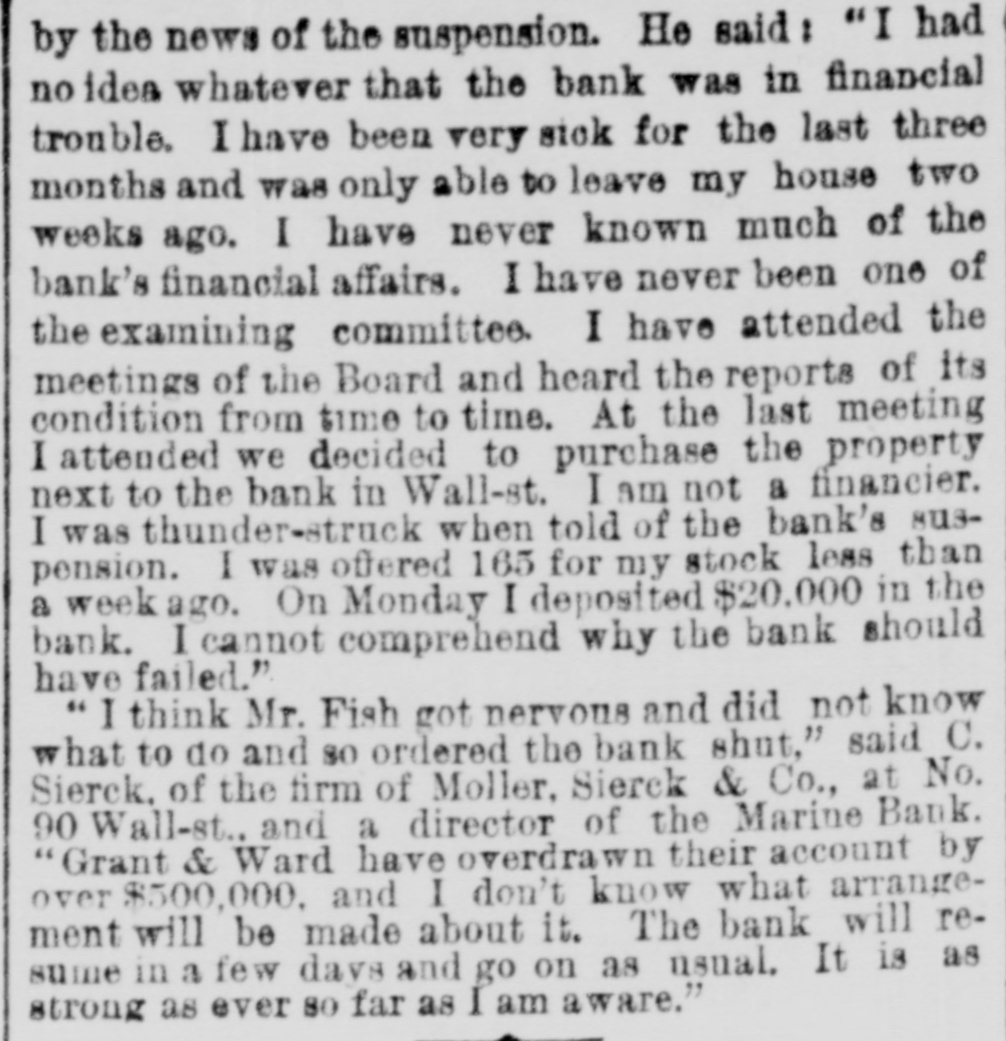
by the news of the suspension. He said: "I had no idea whatever that the bank was in financial trouble. I have been very sick for the last three months and was only able to leave my house two weeks ago. I have never known much of the bank's financial affairs. I have never been one of the examining committee. I have attended the meetings of the Board and heard the reports of its condition from time to time. At the last meeting I attended we decided to purchase the property next to the bank in Wall-st. I am not a financier. I was thunder-struck when told of the bank's suspension. I was offered 165 for my stock less than a week ago. On Monday I deposited $20,000 in the bank. I cannot comprehend why the bank should have failed." "I think Mr. Fish got nervous and did not know what to do and so ordered the bank shut," said C. Sierck. of the firm of Moller, Sierck & Co., at No. 90 Wall-st.. and a director of the Marine Bank. "Grant & Ward have overdrawn their account by over $500,000, and I don't know what arrangement will be made about it. The bank will resume in a few days and go on as usual. It is as strong as ever 80 far as I am aware."
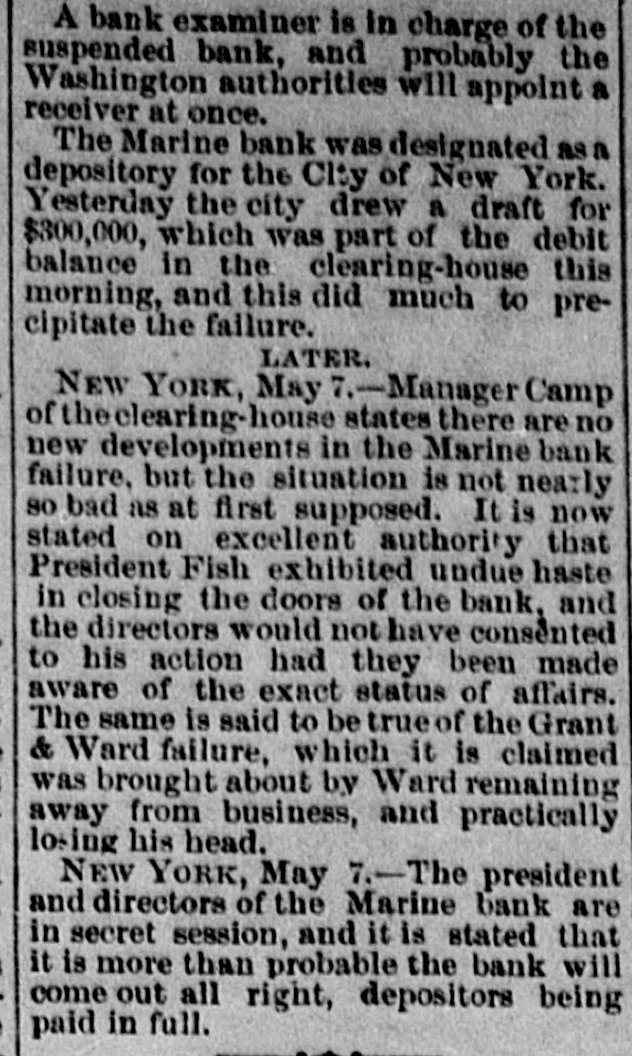
A bank examiner is in charge of the suspended bank, and probably the Washington authorities will appoint a receiver at once. The Marine bank was designated as a depository for the City of New York. Yesterday the city drew a draft for $300,000, which was part of the debit balance in the clearing-house this morning, and this did much to precipitate the failure. LATER. NEW YORK, May 7.-Manager Camp of theclearing-house states there are no new developments in the Marine bank failure, but the situation is not nearly so bad as at first supposed. It is now stated on excellent authority that President Fish exhibited undue haste in closing the doors of the bank, and the directors would not have consented to his action had they been made aware of the exact status of affairs. The same is said to be true of the Grant & Ward failure, which it is claimed was brought about by Ward remaining away from business, and practically losing his head. NEW YORK, May 7.-The president and directors of the Marine bank are in secret session, and it is stated that it is more than probable the bank will come out all right, depositors being paid in full.
4.May 9, 1884Daily Los Angeles HeraldLos Angeles, CA
Click image to open full size in new tab
Article Text
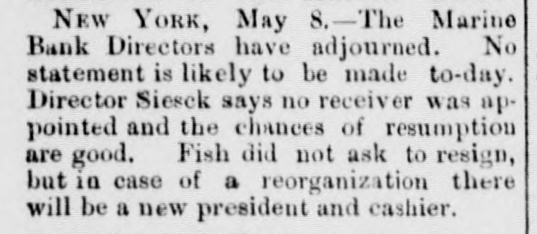
NEW YORK, May 8.-The Marine Bank Directors have adjourned. No statement is likely to be made to-day. Director Siesck says no receiver was appointed and the chances of resumption are good. Fish did not ask to resign, but in case of a reorganization there will be a new president and cashier.
5.May 9, 1884Morning Journal and CourierNew Haven, CT
Click image to open full size in new tab
Article Text
financial The Market Still Feverish - Dame Rumor Takes a Holida y-And In. dulges in a Variety of Unsettling Re. ports-The Coal Shares Raided by the Bears-A Market With a Variable Course. NEW YORK, May 8. The stock market continues in & very fever ish and unsettled state. The failures of the Marine bank and Grant & Ward have about spent their force a regards prices. The mistrust produced by them has not in the least diminished and to-day every unfs" vorable report produces & scramble to sell and & heavy decline in prices. To-day there . ere new infuences at work, having s tendency to unsettle values. Chief among these were a renewal of the reports current late yesterday afternoon to the effect that Mr. Fink has resigned from the pos tion of commissioner 0 0, the trunk lins pool, which step ha is said to have taken to accept the position of general manager of the Gould Southwe system. Inquiry at the office of Mr. Fink failed to confirm or deny the re" ports and all communication` with the gentleman himself was denied. The reports were, however, generally accepted by the street as true and caused a sharp break in the prices of he trunk line stocks, which were heavily sold on the belief that this would end the trunk line combination. Erie was he avily sold on reports that the Marine bank had & large amount of the road's paper. Mr. Jewett, when asked in regard to these reports, stated that if,certain check8 were paid by the bank, the amounts of which he would not give, the company would have only $600,000 of its money in the bank. The coal shares were the main point of attack by the bears, Jersey Central and Reading. Both these stocks were actively raided and sold on numerous unfavorable reports about one or the other of the roads. Reading w&8 sold on reports that the conditions for the discharge of the receiver were never complied with and therefore the legality of the discharge of the receiveᵀ might at any time be called into question. Another report was that the receiver's certificates on Jersey Central property had not been redeemed and that they were being carried by a New York life insurance company. It was also reported from Philadelphia that the net earnings of the road for the fiscal year would show a deficit of over $2,500,000 in the amount for fixed charges and rentals, consequently it wou'd be impossible to pay the dividend guaranteed by it on Jersey Central stock. The report is regard to the dividend was desied later on and it was asserted that the money to pay the dividend on Jersey Central stock was already in the bank and that in any event the obligations of the company would be protected by the Baltimore and Ohio company. This statement was taken with a great deal of allowance. These are but & few of the many reports current regarding the stocks named, and, whether true or false, had the effect of greatly depressing them At the lowest point which was generally touched shortly after midday the decline ranged from ½ to 4½ per cent. Just before 1 o'clock the report reached the street that the Baltimore and Ohio railroad company had expressed a willingness to restore rates. This was accep ted as meaning the withdrawal of Commissioner Fink's re Bignation and had the effect of causing a halt in the declining tendency of the market. Following this announcement came the report from a prominent house in Philadelphia to the effect that under no circumstances would the fifty thousand shares of Jersey Central held by Reading be allowed to come upon the market. The items of news caused considerable alarm among the bears and they scrambled to cover. Under their buying prices took an upward turn and the entire list recorded a sharp recovery. In the first five minutes of business, however, there was renewed weakness caused by a report that the Wabash road would go isto the hands of Mr. Solon Humphreys as receiver to-morrow or Saturday. The sales to-day a ggregated 587,000 shares. The specialties were quiet. Money loaned at 3a3½ per cent. during the greater part of the day, the closing rate being 2½. Exchange closed firm. Posted rates 488a490; actual rates 487a4g7½ for sixty days, 4S9a489¥ for demand. [Closing prices reported over the private wires of BUNNELL & SCRANTON. Bankers and Brokers.] Bid Asked
6.May 10, 1884The Daily Cairo BulletinCairo, IL
Click image to open full size in new tab
Article Text
NEW York, May 9.-President Fish, of the Marine Bank will not be asked to resign until a receiver is appointed, when a new President will doubtless be elected. Fish repeats his statement that the depositors will lose nothing. The bank, according to its own statement, had $1,450,000 in cash last Saturday, and on Tuesday its cash was only $250,000. It is strange how the large difference disappeared in three days, and the matter excites much comment. Grant & Ward are sued by the New York, Chicago & St. Louis Railway Company, and the Supreme Court has granted an order requiring defendants to show cause why a receiver should not be appointed to wind up their affairs. Meantime, they are restrained from interfering with the partnership assets. Vanderbilt alleges that Grant & Ward, upon the receipt of certain notes and securities from the N. Y., C. & St. L. Company, made reckless use of them in borrowing money. U. S. Grant, Jr., has conveyed city property to Jerome Chaffee, his father-in-law, for $300,000. The last effort of Grant & Ward to weather the storm was made ten days before their failure, when they borrowed through an agent $500,000 from a foreign bank. It is not know. what securities were used in negotiating this loan. The members of the firm, by agreement, drew out $3,000 each per month for living expenses. The younger partners lived very extravagantly. Both Jesse and Fred Grant have lost heavily.
7.May 10, 1884Arizona Weekly CitizenTucson, AZ
Click image to open full size in new tab
Article Text
The Marine Bank, NEW York, May 8.-The Marine Bank directors have adjourned. No statement is likely to be made to-day. Director Sieack says no receiver has been appointed and the chances of resumption are good. Fish has been asked to resign. but in case of reorganization there will be a new president and a new cashier.
8.May 15, 1884The Abilene ReflectorAbilene, KS
Click image to open full size in new tab
Article Text
at Pittsburgh and Allegheny was expected. The manufacturers were reported to have made a compact to reduce wages in all shops, so as to bring down the cost of production, and the moulders, who are well organized, have decided to strike rather than accept the reduction. GEORGE BAKER was found lying on the truck of one of the cars of the limited express the other morning when the train reached Enan Station, forty miles west of Pittsburgh, Pa. He was nearly dead, and said he had ridden on the truck from Chicago, a distance of over four hundred miles. ROLAND G. HAZARD, the stockholder upon whose complaint a receiver was appointed for the Credit Mobilier of America, has filed in the United States Circuit Court at Philadelphia, an answer to the petition of the Union Pacific Railway Company for the removal of Oliver Ames from the Re ceivership. PROF. S. D. GROSS, an eminent surgeon, died recently in Philadelphia. He had been elected an honorary member of many of the medical societies of Europe. AT an entertainment the other night in the Brooklyn Academy of Music, in aid of the Home for Confederate Soldiers at Richmond, the house was well filled, and Henry Ward Beecher presided. W. H. MEYER, of Lockport, N. Y., who several years ago was convicted of embezzling a large amount from the Niagara County National Bank, and who served a term in Auburn on a charge of forgery, was recently sued in the Supreme Court for the amount of the deficiency by said bank and a judgment obtained against him for $15,600. JOSEPH P. ASCH'S furniture factory at Norwalk, Conn., burned recently. Loss, $70,000. Sixty hands were thrown out of employment. Ex-ALDERMAN FITZGERALD, champion "go-as-you-please" pedestrian, was wel comed home by 20,000 residents of Long Island. THE steamer City of Portland, plying be. tween Portland, Me., and St. Johns, N. B., struck a ledge near Fisherman's Island, recently and broke up. The passengers and crew were saved. Loss, $125,000. THE remains of Dr. Samuel D. Gross, of Philadelphia, were cremated at Washington, Thursday. THE Alice Oates Opera Troupe was stranded at Pittsburgh, Pa., recently. The company for some time had been playing to exceedingly small houses. PATRICK SHEA, serving a five years' sentence in the western penitentiary of Pennsylvania for burglary, was recently identified as the murderer of Policeman Patrick Duray in St. Louis in 1882. THE belief was general in New York that the condition of the broken Marine Bank was worse than anticipated. It was feared that depositors would come very badly off. Ir was reported that the affairs of Grant & Ward, the firm which went down with the Marine Bank of New York, were in a far worse condition than at first expected. One report said the liabilities reached up to $10,000,000, while the assets would turn out to be small. General Grant was believed to have been sadly victimized, as he was in the habit of giving his notes for worthless paper. Ex-MAYOR SANDERS, of Lawrence, Mass., has been held for trial for ballot-box stuffing. DANIEL C. RITZER and Alexander Burket were crossing the Allegheny River recently at Freeport, Pa., in a sandboat, when it sprung a leak, and the two men were drowned.
9.May 15, 1884Sacramento Daily Record-UnionSacramento, CA
Click image to open full size in new tab
Article Text
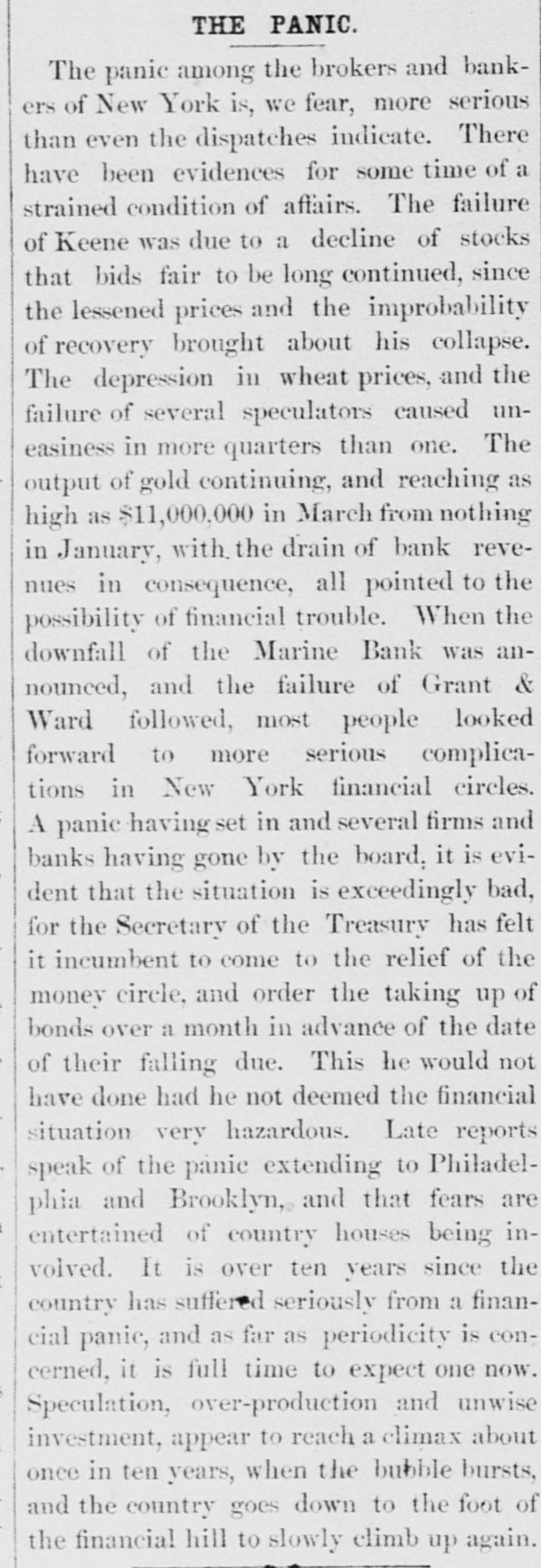
THE PANIC. The panic among the brokers and bankers of New York is, we fear, more serious than even the dispatches indicate. There have been evidences for some time of a strained condition of affairs. The failure of Keene was due to a decline of stocks that bids fair to be long continued, since the lessened prices and the improbability of recovery brought about his collapse. The depression in wheat prices, and the failure of several speculators caused uneasiness in more quarters than one. The output of gold continuing, and reaching as high as $11,000,000 in March from nothing in January, with the drain of bank revenues in consequence, all pointed to the possibility of financial trouble. When the downfall of the Marine Bank was announced, and the failure of Grant & Ward followed, most people looked forward to more serious complications in New York financial circles. A panic having set in and several firms and banks having gone by the board, it is evident that the situation is exceedingly bad, for the Secretary of the Treasury has felt it incumbent to come to the relief of the money circle, and order the taking up of bonds over a month in advance of the date of their falling due. This he would not have done had he not deemed the financial situation very hazardous. Late reports speak of the panie extending to Philadelphia and Brooklyn, and that fears are entertained of country houses being involved. It is over ten years since the country has suffered seriously from a financial panic, and as far as periodicity is concerned, it is full time to expect one now. Speculation, over-production and unwise investment, appear to reach a climax about once in ten years, when the bubble bursts, and the country goes down to the foot of the financial hill to slowly climb up again.
10.May 16, 1884Morning Journal and CourierNew Haven, CT
Click image to open full size in new tab
Article Text
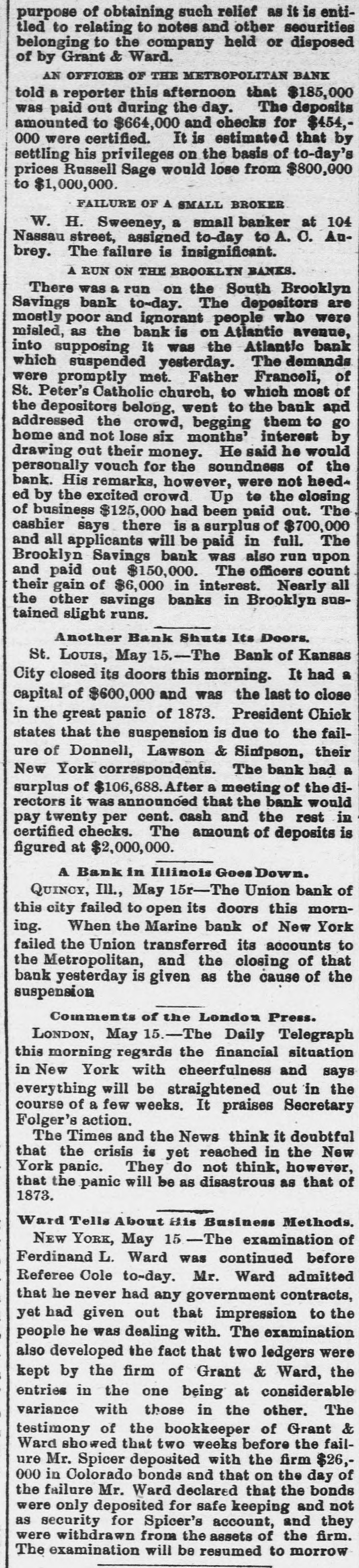
purpose of obtaining such relief as it is entitled to relating to notes and other securities belonging to the company held or disposed of by Grant & Ward. AN OFFICER OF THE METROPOLITAN BANK told a reporter this afternoon that $185,000 was paid out during the day. The deposits amounted to $664,000 and checks for $454,000 were certified. It is estimated that by settling his privileges on the basis of to-day's prices Russell Sage would lose from $800,000 to $1,000,000. FAILURE OF A SMALL BROKER W. H. Sweeney, a small banker at 104 Nassau street, assigned to-day to A. C. Aubrey. The failure is insignificant. A RUN ON THE BROOKLYN BANKS. There was a run on the South Brooklyn Savings bank to-day. The depositors are mostly poor and ignorant people who were misled, as the bank is on Atlantic avenue, into supposing it was the Atlantic bank which suspended yesterday. The demands were promptly met. Father Franceli, of St. Peter's Catholic church, to which most of the depositors belong, went to the bank and addressed the crowd, begging them to go home and not lose six months' interest by drawing out their money. He said he would personally vouch for the soundness of the bank. His remarks, however, were not heed~ ed by the excited crowd Up to the elosing of business $125,000 had been paid out. The cashier says there is a surplus of $700,000 and all applicants will be paid in full. The Brooklyn Savings bank was also run upon and paid out $150,000. The officers count their gain of $6,000 in interest. Nearly all the other savings banks in Brooklyn sustained slight runs. Another Bank Shuts Its Doors. St. LOUIS, May 15.-The Bank of Kansas City closed its doors this morning. It had a capital of $600,000 and was the last to close in the great panic of 1873. President Chick states that the suspension is due to the failure of Donnell, Lawson & Sintpson, their New York correspondents. The bank had a surplus of $106,688.After a meeting of the directors it was announced that the bank would pay twenty per cent. cash and the rest in certified checks. The amount of deposits is figured at $2,000,000. A Bank in Illinois Goes Down. QUINCY, Ill., May 15r-The Union bank of this city failed to open its doors this morning. When the Marine bank of New York failed the Union transferred its accounts to the Metropolitan, and the closing of that bank yesterday is given as the cause of the suspension Comments of the London Press. LONDON, May 15.-The Daily Telegraph this morning regards the financial situation in New York with cheerfulness and says everything will be straightened out in the course of a few weeks. It praises Secretary Folger's action. The Times and the News think it deubtful that the crisis is yet reached in the New York panic. They do not think, however, that the panic will be as disastrous as that of 1873. Ward Tells About His Business Methods. NEW YORK, May 15-The examination of Ferdinand L. Ward was continued before Referee Cole to-day. Mr. Ward admitted that he never had any government contracts, yet had given out that impression to the people he was dealing with. The examination also developed the fact that two ledgers were kept by the firm of Grant & Ward, the entries in the one being at considerable variance with those in the other. The testimony of the bookkeeper of Grant & Ward showed that two weeks before the failure Mr. Spicer deposited with the firm $26,000 in Colorado bonds and that on the day of the failure Mr. Ward declared that the bonds were only deposited for safe keeping and not as security for Spicer's account, and they were withdrawn from the assets of the firm. The examination will be resumed to morrow
11.May 17, 1884Lyon County TimesYerington, Silver City, Dayton, NV
Click image to open full size in new tab
Article Text
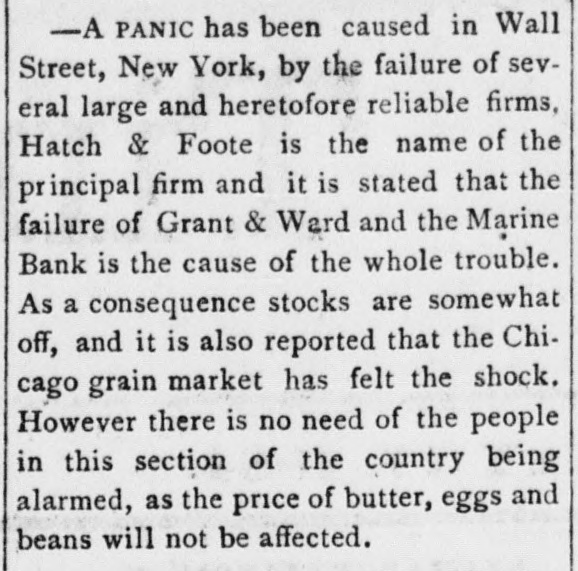
-A PANIC has been caused in Wall Street, New York, by the failure of several large and heretofore reliable firms, Hatch & Foote is the name of the principal firm and it is stated that the failure of Grant & Ward and the Marine Bank is the cause of the whole trouble. As a consequence stocks are somewhat off, and it is also reported that the Chicago grain market has felt the shock. However there is no need of the people in this section of the country being alarmed, as the price of butter, eggs and beans will not be affected.
JIM KEENE'S KERFLUMUX. FAILED FOR THE TRIFLING SUM OF A MILLION OR TWO. Excitement Caused by the Grant & Ward Failure. Reported that they will Pay a Hundred Cents on the Dollar. Special Correspondence of the Sentinel. NEW YORK, May 16.-James R. Keene has failed for a million or two and he will be sent to the rear and forgotten in a few days by the fellowgamblers who beat him at his own A failure in any game. less legitimate business is always more or a public calamity, but the Keene failure is simply one gambler plundered to nakedness by more successful gamblers, and the legitimate channels of industry, trade and commerce are not in any degree affected by it. Mr. Keene acquired a fortune of several millions by lucky ventures on the Pacific coast, and he made the common mistake of supposing that three or five millions could beat fifty or a hundred millions. He came to New York in state in a palace car, and Gould's reputed prophecy that Keene would be sent back in a freight car, now promises to be fulfilled. Keene had conquered in California; he staked all to conquer Wall Street, and he has lost. That is the whole story. The excitement caused by the fail. ures of the Marine Bank and the firm of Grant & Ward, subsided yesterday and the street breathed easier. Men who went home the day before perturbed and fearful came down town with lighter hearts and with more con fidence. As the day progressed and no other banks or firms suspended, and as it became known that the failure of the bank was not so disastrous as at first reported, a buoyant feeling prevailed. On all sides it was said that there was no cause for alarm. The announcement by Clubing-House Manager Camp that other New York t banks were not affected by the failure a and were in a sound condition, the freh quently repeated assertions of the dif rectors that the Marine Bank would I pay 100 cents on the dollar, the return of Mr. Ward to the city and the fact t that the failure of Grant & Ward was e not due 80 much to the financial condition of the company as to peculiar and extravagant methods of doing business all tended to allay the excitement. s The irony of fate can receive no 1, sadder illustration than the sight of a y sister-in-law of John C. Calhoun, the i. great statesman, and a cousin of the s, rich Van Reneselaers, wandering p homeless and penniless, through the streets of New York. The policeman who on a recent afternoon saw an old and feeble lady, whose face was wan d with hunger, and clothes were wet e with the pouring rain, tottering along Greenwitch Street, did not sus;; pect that she was SO closely related to d the distinguished South Carolinian and 1to the family of the old Albany patroon. He watched her until she fell ex hausted to the pavement, when h n hastened to her assistance. When h g asked her where she lived she burs ys into tears and answered that she di is not know. Several times she shook by her head, the hair of which was per r. fectly white, as she tried in vain to re call her last place of residence. Th policeman, suspecting that her min was affected, took her to the Twenty on seventh Precinct Station. At nigh Ice she was taken to Police Headquarter or and remained there all day yesterda in the charge of Matron Webb. ty TARHEEL o-
13.May 30, 1884Wessington Springs HeraldWessington Springs, SD
Click image to open full size in new tab
Article Text
GRANT & WARD FAILURE, Estimated at Nearly $10,000,Grant and Sons Make PerAssignments for the Benefit of YORK, May 9.-Interest in the failof the Marine Bank and of the firm of & Ward was renewed yesterday by announcement that General Grant, James D. Fish, Grant & Ward, the firm members individually, Colonel lerick Grant and Jesse Grant had made gnments, thereby indicating that the have swept away the fortunes of member of the family of General All that the latter possessed outside he income from the Grant fund was he firm which has been wrecked by of Ferdinand Ward. That ColoGrant and Jesse Grant should have been to make assignments of their propoccasioned general surprise, as they not partners in the firm, and were supto be in excellent circumstances fortune being estimated at $400,000. understood that when the General have had his affairs disentangled from of the firm. substantial assistance will endered to him. W. H. Vatiderbilt does that he loaned General Grant a few days ago which went into broken firm. & Ward, in their assignment, gave erences to eleven persons, but no are affixed. Frederick D. Grant preferences for $243,666, including to Mrs. B. L. Honore, of Chicago, $6,000 to his wife. Henry F. Shoeof this city, is preferred for $125,Jesse Grant gives preferences for President Fish followed with his gnment, omitting amounts. far as Grant & Ward are concerned, best opinions agree that they are beyond all hope of recovery. GenGrant was at the office yesterday afterand Roscoe Conkling joined him imiately, and will act as legal adviser to General in this trouble. W. K. Vanderis haunting the firm with legal proin behalf of the Chicago & St. Louis way Company. In his affidavit Vansays that about April 12, 1884, the Chi& St. Louis Railway Company made its nissory note, bearing date on that day, for value received, it promised to to Grant & Ward the sum of $500,000. note will become due January 1, 1885. 23 the railroad company made anothromissory note dated on that day, payto the order of Grant & Ward, for which note will become January 1, 1885. As collateral for the payment of these notes plaintiff deposited with the firm of & Ward 1,400 negotiable bonds of railway company for $1,000 each, the of which was secured by a second tgage upon its railroad. Vanderbilt declares that Grant & Ward rehyrecated these securities for the purpose procuring loans. The assignees will dethe suit, and Mr. Vanderbilt may not back his securities for months, if at all. were few important developments he affairs of the Marine Bank. United Examiner Scheniba continued his intigation, but reported that owing to coninterruption and new developments statement would be delayed. The Comof Investigation appointed by the were at work all day straightening affairs. Strenuous efforts are making the resumption of the bank. These however, are not entertained and some who are pecuniarily interin the deposits said that they feared there had been unpleasant facts discovThe directors,, so ready to speak bewere strangely reticent this afternoon. assignment of Mr. Fish making a pretto the bank is regarded by some as a picious circumstance, inasmuch as if Mr. relations with the bank had been why should he be in debt to it to amount making an assignment neces The belief that the affairs of the are not in as good condition as was ected is strengthened by the fact that the bank should have had in its vaults eserve of $1,300,000 against its deposits $5,200,000, yet its suspension was caused inability to meet the clearing-house
14.June 12, 1884The Dallas Daily HeraldDallas, TX
Click image to open full size in new tab
Article Text
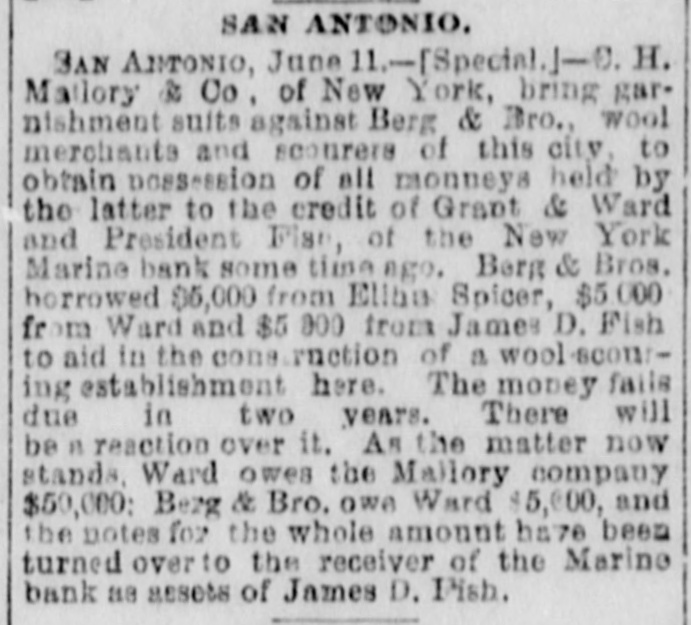
# SAN ANTONIO.
SAN ANTONIO, June 11.-[Special.]-C. H. Mallory & Co, of New York, bring garnishment suits against Berg & Bro., wool merchants and scourers of this city, to obtain possession of all rmonneys held by the latter to the credit of Grant & Ward and President Fise, of the New York Marine bank some time ago. Berg & Bros. borrowed $5,000 from Elihu Spicer, $5.000 from Ward and $5 000 from James D. Fish to aid in the construction of a wool-scouring establishment here. The money fails due in two years. There will be a reaction over it. As the matter now stands, Ward owes the Mallory company $50,000: Berg & Bro, owe Ward $5,000, and the notes for the whole amount have been turned over to the receiver of the Marine bank as assets of James D. Pish.
15.June 13, 1885Savannah Morning NewsSavannah, GA
Click image to open full size in new tab
Article Text
GRANT AND WARD. The Cashier of the Late Firm Tells How Business Was Conducted. NEW YORK, June 12.-Testimony was taken before Referee Hamilton Cole to. day in another suit growing out of the Grant & Ward failure. John H. Morris, receiver of the Marine Bank, charges that James D. Fish conveyed to six relatives on Dec. 21, 1883, property that should go to the creditors of the bank. 8. E. Spencer, cashier for Grant & Ward, testified that the firm's capital was $400,000. Of the cash contributed U. S. Grant put in $92,000; U. 8. Grant, Jr., $30,000, and Ferdinand Ward $30,000. Fish contributed no cash. The balance of the $400,000 was made up of "flour," notes, bonds and stock by all the members of the firm. Spence said that the loans on securities ofteu ran as high as $1,000,000. It was frequently the case that the firm paid more for the use of money than it received on its loans. The witnesssaid Fish sometimes drew on his private account to pay fictitious earnings to depositors. He stated that Grant & Ward did a losing business after Feb. 28, 1882.
16.June 27, 1885The Louisiana DemocratAlexandria, LA
Click image to open full size in new tab
Article Text
-THE receiver of the New York Marine Bank thinks that Ferdinand Ward has hidden away about $1,000,000.
17.July 15, 1885The Abbeville Press and BannerAbbeville, SC
Click image to open full size in new tab
Article Text
NEWS SUMMARY Eastern and middle States. THE annual eight-oared boat-race between Harvard and Yale colleges at New London, Conn., resulted in an easy victory for the former crew. THE remains of Frederick Eversman, of Baltimore, seventy-four years old, were cremated the other day in the crematory at Lancaster, Penn. BUFFALO'S Cremation society is about to erect the finest "crematory temple" in this country. THE condition of General Grant was not so satisfactory on the 27th as it had been. He was suffering from lassitude and debility, and his disease was progressing unfavorably. On the 25th there was no material change in his condition. Those in attendance upon the general stated that there was a gradual falling away of strength. JAMES D. FISH, late president of the suspended Marine bank, of New York, found guilty of misapplying the institution's funds and making false entrios in the bank's books, has been sentenced to ten years' imprisonment at Auburn prison. Fish is sixty-five years old, and had intimate business relations with the bankrupt firm of Grant & Ward. GENERAL LOGAN, at a banquet given in his honor by the Norfolk club, of Boston, replied to Vice-President Hendricks, recent speech in the same city on civil service reform. THE New Hampshire savings banks show deposits amounting to $13,825,356.41. THOMAS J. MULBY, of Boston, has resigned the superintendency of the North End Industrial school, and will go to Newfoundland, and then to England to look after the Churchill estate, as he is one of the nearest living heirs. The estate is supposed to be valued at $35,000,000, and is in money and real estate. There are eight relatives of Nicholas Churchill-the old Newfoundland fisherman who left this vast fortune-in America, and they will be represented abroad by Mulby. EDWARD A. BOYD, a New York glass merchant and millionaire, has just been sentenced to two years' imprisonment for defrauding the government out of customs duties. His son, & partner in the firm, was sentenced to pay a fine of $1,000. MRS. DUDLEY, the English woman who shot and wounded O'Donovan Rossa, the editor of the United Irishmen, in New York, has been acquitted on the ground of insanity. She will probably be sent home to her friends in England.
18.October 22, 1885Evening StarWashington, DC
Click image to open full size in new tab
Article Text
# Mr. Warner Arraigned.
CHARGED BEFORE A U.S. COMMISSIONER WITH
ACTING IN COLLUSION WITH WARD.
NEW YORK, October 22.-Wm. S. Warner
appeared before a U. S. commissioner to-day to
answer a charge of acting in collusion
with Ferdinand Ward to defraud the Marine
bank. Warner was represented by a large
array of counsel, while Assistant District Attor-
neys Foster and Tifft represented the govern-
ment. Receiver Johnston, of the Marine Bank,
was the first witness, The minute book of the
directors' meeting showed that on January 11,
1884, Ward was elected a director of the bank.
The book was admitted in evidence.
19.October 23, 1885Weekly Commercial HeraldVicksburg, MS
Click image to open full size in new tab
Article Text
Relations or City Officials With the Firm of Grant and Ward. NEW YORK, Oct. 15-The senate investigating committee met again today. Comptroller Grant was on the stand. Concerning his connection with Ferdinand Ward, the witness said that he had numerous relations with Ward in a period of ten years, and was indebted for a time covering his firm as comptroller. The witness refused to state the nature of this indebtedness, saying that it was his private business. He said he had business transactions with Grant & Ward in regard to contracts. Ward was a bondsman for him as comptroller, as was also James D. Fish, of the Marine bank. He said that the deposit in the Marine bank might have been an unusual one, still he had nothing to do with it, all the deposits being made by the city chamberlain. His business relations with Ward were still pending. When a large number of city bonds were offered for sale outsiders were not refused the purchase of them, nor were they afterwards secured by Grant & Ward. It was not through the witness' personal influence that Grant & Ward secured these bonds. It was not the custom of the witness to notify the firm of Grant & Ward of the application made by other firms for city bonds. A few days before the failure of the Marine bank witness became alarmed in regard to thesafety of the bank, because Ward had requested him to increase the deposit in that bank. Witness consulted Mayor Grace, and $60,000 was withdrawn. The city chamberlin drew the warrants for this amount and they passed through witness' hands for endorsement. Isaac S. Barret, chief bookkeeper in the comptroller's office, was recalled. He said that on three occasions he called Comptroller Grant's attention to the large amount of money on deposit in the Marine bank. Mr. Grant denied that Barrett spoke to him about deposits. The Governor-Elect of Ohio Tells What Led to the Result in That State. CINCINNATI, Oct. 15-Judge Foraker, governor-elect, being asked what he regarded as the leading motives that lead to the result in Ohio, said: First-The Republicans regarded it important that a decisive expression should be given at the first election after the beginning of a Democratic National administration. Second-A determination to give an expression in favor of a free ballot and a fair count in all our elections. Third-Distrust concerning the free trade tendencies of the Democratic party, coupled with a recognition of the necessity of maintaining the Republican ascendancy in the United States senate. Fourth-Disguest with the Democratic State administration in Ohio, notably the election of the last senator and the extravagance of the last legislature. Fifth-A wish to have the liquor traffic regulated and taxed as a practical method of dealing with the subject, and dissatisfaction with the Democratic portion of license, which is impracticable.
The Warner Examination, NEW YORK, November 6.-The case of William S. Warner, who is charged with having assisted Ferdinand Ward in having robbed the Marine Bank and caused its suspension, was before the United States grand jury this afternoon. The witnesses examined were John E. Carr, formerly teller of the Marine Bank; Samuel D. Cornell, a book-keeper in the First National Bank, and Nathan D. Daboll.
21.November 7, 1885Evening StarWashington, DC
Click image to open full size in new tab
Article Text
# Ferdinand Ward's Partner.
PROCEEDINGS IN NEW YORK YESTERDAY.
The case of William S. Warner, who is charged with having assisted Ferdinand Ward in having robbed the Marine bank and caused its suspension, was before the United States grand jury in New York yesterday. The witnesses examined were John E. Carr, formerly teller of the Marine bank; Samuel D. Cornella, book-keeper in the First National bank, and Nathan D. Daboll.
At a hearing before Referee Cole in the case of Geo. C. Holt, as assignee of Ferdinand Ward, to have set aside the transfers of property made by Ward to Warner, the check books of Ward and the firm were produced. On a check stub, dated January 2, 1883, were the words, "Don't give" in Ward's writing. There were stubs bearing the names of Mr. and Mrs. Green. They were Ward's father and mother-in-law, and in some cases the checks were for division of dividends, and $3,000 and $2,000 were for payment in full of mortgage on property at 37 Monroe place, Brooklyn. Gen. Hubbard, counsel for Holt, said Ward never had any money of his own, and that he was at all times insolvent, and that the firm of Grant & Ward was in the same condition.
22.November 7, 1885Richmond DispatchRichmond, VA
Click image to open full size in new tab
Article Text
Ward's Partner.
NEW YORK, November 6.-The case of William S. Warner, who is charged with having assisted Ferdinand Ward in having robbed the Marine Bank and caused its suspension, was before the United States grand jury this afternoon. The witnesses examined were John E. Carr, formerly teller of the Marine Bank; Samuel D. Cornell, book-keeper in the First National Bank, and Nathan D. Daboll.
23.May 15, 1889New Ulm Weekly ReviewNew Ulm, MN
Click image to open full size in new tab
Article Text
# Crimes and Criminals.
The Iowa supreme court confirms the sen-
tence of Chester Turney, the young burglar,
who must remain in the penitentiary. This
is one of the most noted criminal cases the
state ever had.
Jamee D. Fish, the ex-president of the Ma-
rine Bank, of New York City, who was con-
victed of misapplying the funds of the bank
and causing its failure, will be released from
prison. The old man will not leave the pris-
on broken in health. He is quite spry and
his face indicates that his health is tolerably
good.
Franz Burginger, an old resident of Brown
county, Minn., and former proprietor of the
Sleepy Eye brewery, committed suicide by
taking strychnine. Mr. Burginger died be-
fore medical aid could be summoned. No
cause is assigned. He seemed to be in good
spirits. It is rumored that he was in finan-
cial straits. The deceased was a member of
the Odd Fellows and United Workmen and
carried a policy of $2,000 in each.
Within the past ten days Judge Woods, of
the federal court at Indianapolis, has re-
ceived a number of threatening letters from
all parts of the state, some signed "Regula-
tors" and some "White Caps," and all de-
mands that he change his recent rulings in
the election law violation cases. One writer
threatened to bring 500 regulators to the
city if his commands were not obeyed. It
was couced in the most brutal terms.
There was quite a twitter among the fash-
ionable congregation of St. Paul's church in
Milwaukee when it became known that a
daughter of Bishop Hugh Miller Thompson
had eloped from her father's home at Jack-
son, Miss., with W. T. Howe, a well known
young Chicago lawyer, and that the young
couple had attended the morning service at
St. Paul's, where the brother of the bride,
Rev. Harry Thompson of Kenosha, occupied
the pulpit in the absence of the rector, Mr.
Lester, Miss Thompson and Mr. Howe left
Jackson, Miss., on Friday evening 3d inst.,
and were married at Cairo, Ills., Saturday.
John Boatman of New Madrid, forty-five
miles below Cairo, 111., borrowed a skiff Thurs-
day of Corber brothers. The latter, thinking
that Boatman would steal their property,
foliowed him and shot him dead. The Cor-
bers were arrested by the sheriff and a posse
of citizens from Tiptonville, Ky., and placed
in the jail there. The news caused great ex-
citement and it was determined to lynch the
prisoners. A strong guard was placed
about the jail. When it became known that
Boatman's wi'e had died from the shock oc-
cassioned by her husband's murder the in-
dignant mob could be restrained no longer.
They rushed upon the jail, gained possession
of the prisoners and strung them up on two
trees within a hundred yards of the prison.
At a point in Montana, five miles west of
Stanford, in Fergus county, some highway-
men held up the stage of the Great Falls and
Billings line, and demanded the treasure box.
The driver saw that resistance was useless,
and threw it out. The robbers then disap-
peared, without molesting the passengers.
The stage proceeded on its journey, and met,
about five miles from the scene of the rob-
bery, the eastward bound coach, and report-
ed the robbery. The robbers were evidently
alarmed by the approach of this stage,
which they could see a long way off on the
hill, for they threw away the treasure box,
which was picked up by the eastbound coach.
The scene of the robbery is known as Sur-
prise creek.
24.June 28, 1891New-York TribuneNew York, NY
Click image to open full size in new tab
Article Text
The Marine Bank failure was far more disastrous to depositors and the business community at large than the temporary suspension of the banks wrecked by Simmons, Pell, and their associates, but the operations of the later speculators have been more severely punished. James D. Fish, the president of the Marine Bank, was the only person directly punished for its failure, the conviction of Ferdinand Ward being on an outside transaction. Simmons, Pell and Claassen have all now been tried, convicted and sentenced to long terms of imprisonment. Such examples of sure, if slow, justice should deter bank-wreckers in the future from attempting their operations in this city.
25.October 15, 1893The Morning NewsSavannah, GA
Click image to open full size in new tab
Article Text
# DID NOT RUIN GRANT.
Now, among the many charges against me was that I had ruined the Grant family when in fact when General U. S. Grant went into the firm he did so with $50,000 borrowed from Commodore Garrison for that purpose. This amount, together with all the other sums he obtained from various sources, would not offset the first item of the foregoing schedule.
That General Grant supposed he was speculating in government contracts I most emphatically assert. I can, if necessary will, produce and publish correspondence over autographs that will give undisputed proof of my correctness.
Another charge is that my schemes ruined the Marine Bank and caused great suffering among the depositors of that institution, when in fact the receiver has already paid the depositors of that bank over 80 per cent. and is prepared to pay more. That shows that the customers of that concern were not entirely ruined by me.
# THE CAUSE OF THE FAILURE.
The prime cause of the failure of Grant & Ward was the illness of Nelson J. Tappan, the controller of the city of New York who was interested in the success of some of our speculations. I offered him $5,000 for the use of $100,000 for a certain period, and not having the money he arranged to deposit city funds in the Marine Bank so I could borrow from this institution. This was done, and a few days before the failure of Graut & Ward the Marine Bank had $1,500,000 of the city money.
When illness caused the appointment of Mr. Gilly in Mr. Tappan's place, he (Mr. Gilly) began to draw on the bank, which was not according to my agreement with Mr. Tappan.
I saw Mr. Tappon at his house, and apprised him of this fact (which he, by the way, already knew) that these unexpected drafts meant the ruin of the bank and the firm of Grant & Ward, but he was powerless to avert the disaster, which, had he been in good health, would never have occurred, as he had provided other means to supply the funds needed by the city until we could get in our time loans, then considered as good as gold itself.
I visited several of the directors and did everything possible to avert the crash, but without avail. The second draft,