The Madison Trust Company (formerly Van Norden Trust Co.) was affected by the January 1911 failure of the Carnegie Trust Company. Newspapers report small runs/withdrawals on Jan 9, 1911 that were met promptly; J. P. Morgan & Co. arranged for the Equitable Trust Company to take over Madison and for cash support to reassure depositors. The institution did not suspend and normal operations resumed. Cause attributed to affiliation with the failed Carnegie Trust (runs triggered by distress of related banks). OCR errors in some articles corrected (e.g., 'Madison Trust company' formerly 'Van Norden Trust company' noted in pieces).
Events (1)
1.January 9, 1911Run
Cause
Local Banks
Cause Details
Withdrawals triggered by the failure/suspension of the Carnegie Trust Company and perceived affiliations between Madison and Carnegie Trust (depositors fearful because of association).
Measures
Equitable Trust Company took over Madison; J. P. Morgan & Co. and allied bankers supplied visible cash on counters and replaced questionable securities with cash to reassure depositors; depositors were paid promptly.
Newspaper Excerpt
Normal conditions prevailed at all of the banks today, the slight run on the Nineteenth and Twelfth Ward banks and the Madison Trust Company which prevailed yesterday not being renewed.
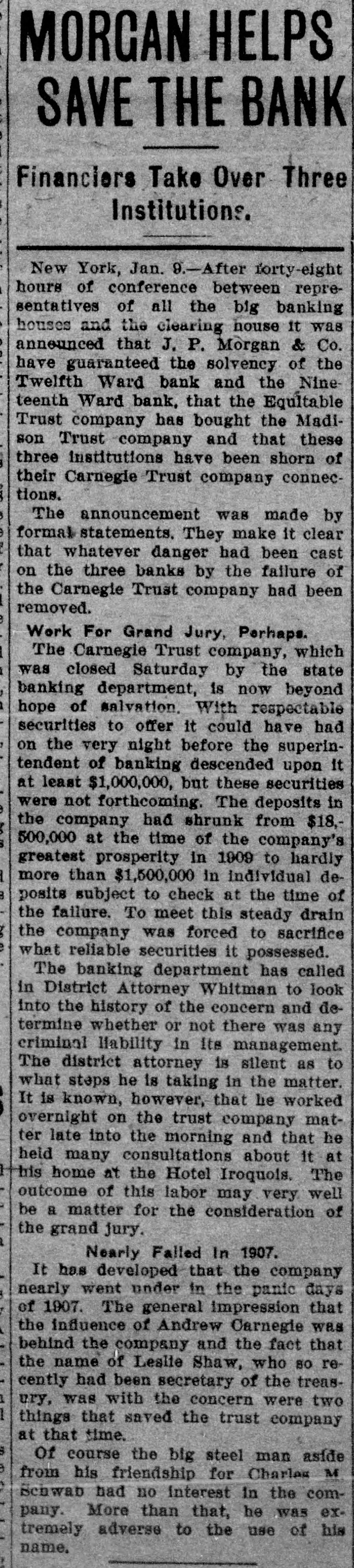
MORGAN HELPS SAVE THE BANK Financiers Take Over Three Institutions. New York, Jan. 9.-After forty-eight hours of conference between representatives of all the big banking houses and the clearing house It was announced that J. P. Morgan & Co. have guaranteed the solvency of the Twelfth Ward bank and the Nineteenth Ward bank, that the Equitable Trust company has bought the Madison Trust company and that these three institutions have been shorn of their Carnegie Trust company connections. The announcement was made by formal statements. They make it clear that whatever danger had been cast on the three banks by the failure of the Carnegie Trust company had been removed. Work For Grand Jury, Perhaps. The Carnegie Trust company, which was closed Saturday by the state banking department, is now beyond hope of salvation. With respectable securities to offer it could have had on the very night before the superintendent of banking descended upon it at least $1,000,000, but these securities were not forthcoming. The deposits in the company had shrunk from $18,500,000 at the time of the company's greatest prosperity in 1909 to hardly more than $1,500,000 in individual deposits subject to check at the time of the failure. To meet this steady drain the company was forced to sacrifice what reliable securities it possessed. The banking department has called in District Attorney Whitman to look into the history of the concern and determine whether or not there was any criminal liability in its management. The district attorney is silent as to what steps he is taking in the matter. It is known, however, that he worked overnight on the trust company matter late into the morning and that he held many consultations about it at his home at the Hotel Iroquois. The outcome of this labor may very well be a matter for the consideration of the grand jury. Nearly Falled In 1907. It has developed that the company nearly went under in the panic days of 1907. The general impression that the influence of Andrew Carnegie was behind the company and the fact that the name of Leslie Shaw, who 80 recently had been secretary of the treasury, was with the concern were two things that saved the trust company at that time. Of course the big steel man asíde from his friendship for Charles M Schwab had no interest In the company. More than that, he was extremely adverse to the use of his name.
2.January 9, 1911Evening JournalWilmington, DE
Click image to open full size in new tab
Article Text
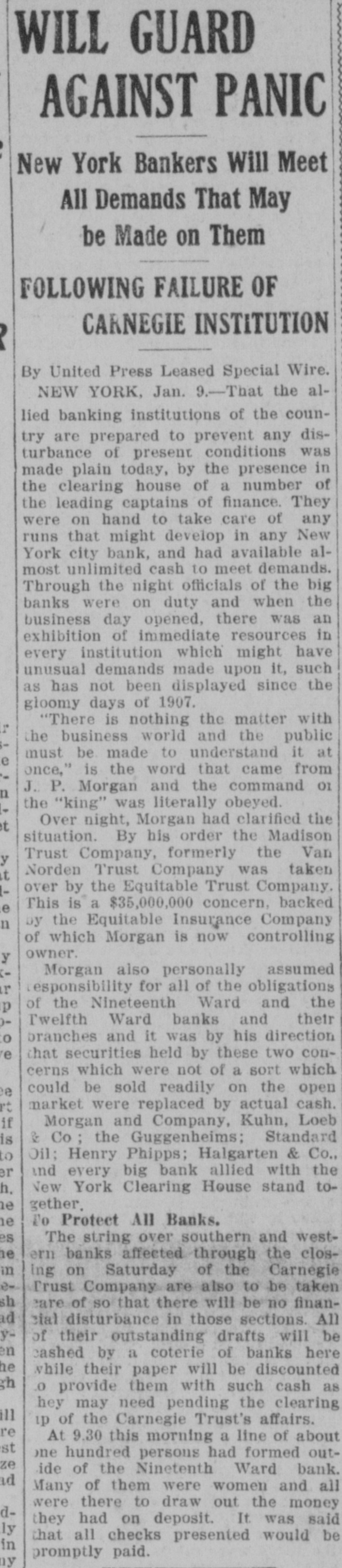
WILL GUARD AGAINST PANIC New York Bankers Will Meet All Demands That May be Made on Them FOLLOWING FAILURE OF CARNEGIE INSTITUTION By United Press Leased Special Wire. NEW YORK, Jan. 9.-That the allied banking institutions of the country are prepared to prevent any disturbance of present conditions was made plain today, by the presence in the clearing house of a number of the leading captains of finance. They were on hand to take care of any runs that might develop in any New York city bank, and had available almost unlimited cash to meet demands. Through the night officials of the big banks were on duty and when the business day opened, there was an exhibition of immediate resources in every institution which might have unusual demands made upon it, such as has not been displayed since the gloomy days of 1907. "There is nothing the matter with 1" the business world and the public must be made to understand it at e once," is the word that came from J. P. Morgan and the command 01 n the "king" was literally obeyed. Over night, Morgan had clarified the t situation. By his order the Madison Trust Company, formerly the Van y Norden Trust Company was taken t over by the Equitable Trust Company. This is a $35,000,000 concern, backed e n by the Equitable Insurance Company of which Morgan is now controlling owner. y Morgan also personally assumed r responsibility for all of the obligations of the Nineteenth Ward and the p 3Twelfth Ward banks and their o branches and it was by his direction e that securities held by these two concerns which were not of a sort which e could be sold readily on the open rt market were replaced by actual cash. if Morgan and Company, Kuhn, Loeb is & Co ; the Guggenheims; Standard to Oil: Henry Phipps; Halgarten & Co., er and every big bank allied with the h. New York Clearing House stand tohe gether. he Do Protect All Banks. es The string over southern and westhe ern banks affected through the closin ing on Saturday of the Carnegie eTrust Company are also to be taken sh care of so that there will be no finanad cial disturbance in those sections. All yof their outstanding drafts will be en cashed by a coterie of banks here he while their paper will be discounted gh .0 provide them with such cash as hey may need pending the clearing ill ip of the Carnegie Trust's affairs. re At 9.30 this morning a line of about st one hundred persons had formed outze ide of the Ninetenth Ward bank. d Many of them were women and all were there to draw out the money dthey had on deposit. It was said ly that all checks presented would be in promptly paid. ny
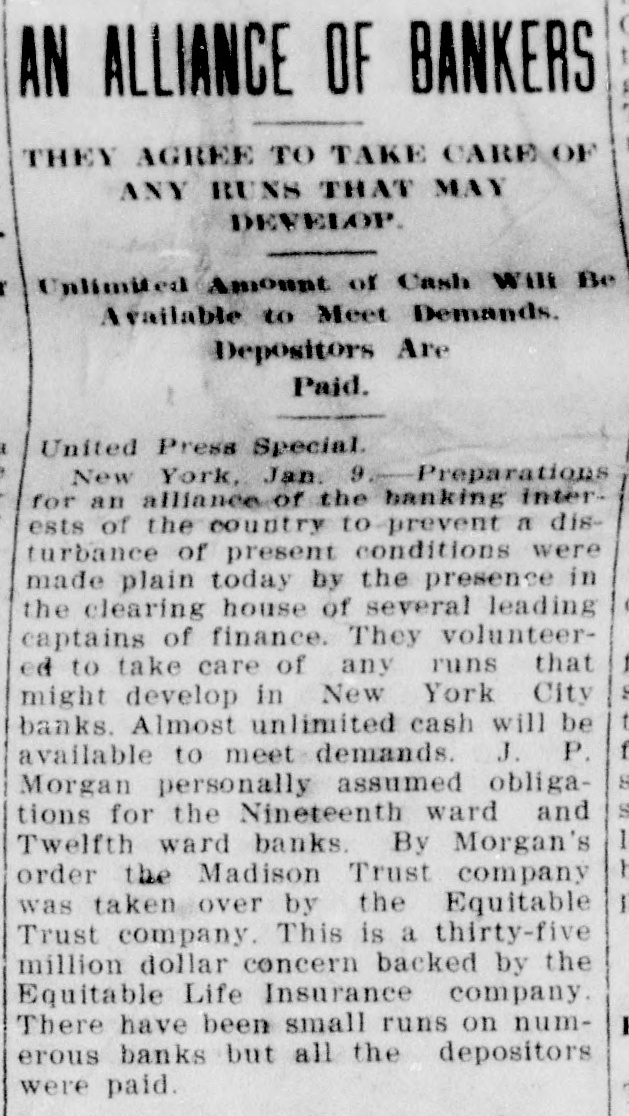
AN ALLIANCE OF BANKERS THEY AGREE TO TAKE CARE OF ANY RUNS THAT MAY DEVELOP. Unlimited Amount of Cash Will Be Available to Meet Demands. Depositors Are Paid. United Press Special. New York, Jan. 9 Preparations for an alliance of the banking interests of the country to-prevent a disturbance of present conditions were made plain today by the presence in the clearing house of several leading captains of finance. They volunteered to take care of any runs that might develop in New York City banks. Almost unlimited cash will be available to meet demands. J. P. Morgan personally assumed obligations for the Nineteenth ward and Twelfth ward banks. By Morgan's order the Madison Trust company was taken over by the Equitable Trust company. This is a thirty-five million dollar concern backed by the Equitable Life Insurance company. There have been small runs on numerous banks but all the depositors were paid.
4.January 9, 1911The Marion Daily MirrorMarion, OH
Click image to open full size in new tab
Article Text
TRUST COMPANY BEYOND RECALL Whitman May Probe Carnegie Concern. TROUBLE DEEP SEATED New Bankers Express Sympathy For Southerner Who Three Months Ago Took Charge of Institution That Nearly Went to Wall In Panic of 1907-J. P. Morgan & Company Come to Rescue of Three Banks Carnegie Objected to Use of Name New York, Jan. 9.-The Carnegie Trust company is now beyond the hope of salvation. With respectable securities to offer, it could have raised on the very night before the superintendent of banking descended upon it at least $1,000,000. but these were not forthcoming. The deposits in the company had shrunk from $18,500,000 at the time of its "greatest prosperity in 1909 to hardly more than $1,500,000 in individual deposits subject to check at the time of the failure. To meet this steady drain the company was forced to sacrifice what reliable securities it possessed. Sympathy for the man who came up from the south to take charge of the precarious affairs of the company three months ago is expressed on all sides. Bankers agreed that whatever blame there might be for the failure could not attach itslf to the new president of the Carnegie, Joseph T. Howell. On the other hand, it was learned that the banking department has called in District Attorney Whitman to look into the past history of the concern and determine whether or not there was any criminal liabil1ty in its management. The district attorney is silent as to what steps he was taking in the matter. It is known that he worked many hours on the trust company matter, and thats hey held many consultations about it at his home. The outcome of his labors may very well be a matter for the consideration of the grand jury. It developed that the company nearly went under in the panic of 1907, The general impression that the influence of Andrew Carnegie was behind the company and the fact that the name of Leslie Shaw, who had SO recently been secretary of the treasury, was with the concern, were two, things that sayed the trust company at that time. Of course the big steel man, aside from his friendship for Charles M. Schwab, had no interest in the company. More than that, he was extremely Nath erse to the use of his name Not only did he issue a statement to the effect that he did not de. sire his name to be connected with the trust company. but he sent his attorney to Albany to see if it were not possible to force the concern to take some other name. The response to this that the company was not calling itself the Andrew Carnegie Trust company, and that there was more than one man in the world named Carnegie. Word was sent out from a conference of bankers at the house of Paul D. Cravath that the three Van Norden institutions, the Madison Trust company, the Twelfth Ward bank and the Nineteenth Ward bank. were safe. "The banks are amply protected," ran the notice, "and everything has been arranged." Later it was announced that J. P. Morgan & Company have guaranteed the solvency of the Twelfth Ward bank and the Nineteenth Ward bank, tnat the Equitable Trust company has bought the Madison Trust company and that these
5.January 9, 1911The Richmond VirginianRichmond, VA
Click image to open full size in new tab
Article Text
MORGAN AT HELM; SITUATION CLEARS Great Captain of Finance Restores Calm to Financial World BANK RUNS IN NEW YORK HEADED OFF Unlimited Supply of Cash Furnished Institutions Jeopardized by Carnegie Trust Failure NEW YORK, Jan, 9.-J. P. Morgan is still the undisputed master of New York finance. This was shown day when every cloud in the financial horizon was dissipated by the simple announce. ment that he had guaranteed the deposits of a number of local banks which were under pressure as the result of the closing of the Carnegie Trust Company on Saturday. There was a slight run on the Nineteenth and Twelfth Ward Banks, but only the foreign ele. ment withdraw its cash, and there were sufficient outside deposits to offset the amount paid out. The Madison Trust Company, taken over by Morgan's Equitable Trust Company, had only a few withdrawals. By Morgan's order all of the institutions for whose future there was any concern piled up gold, silver and bills in enormous quantities on their counters. The resuit was that timid depositors came in, took one look, and then left satisfied that their money was in good hands. The stock market, too, felt the effect of the Morgan "expression of confidence,' and Saturday's weakness was replaced by a strong tone. Morgan is going to Europe on Wednesday for his annual winter vacation, and this fact was urged by the bulls as a reason for the belief that the financial flurry was at an end. "The old man would not go away if everything was not all right," was the word paassed along the line, and it had its effect. All of the officials of the institutions affected by last night's long series of conferences between Morgan and the big financiers of the street and State Superintendent of Banks Cheney issued statements this afternoon that no further troubie was to be feared. NEW YORK. Jan. 9.-That the allied banking institutions of the country are prepared to prevent any disturbance of present conditions was made plain to-day by the presence in the clearing house of a number of the leading captains of finance. They were on hand to take care of any runs that might develop in any New York city bank, and had available almost unlimited cash to meet demands. Through the night officials of the big banks were on duty, and when the business day opened there was an exhibition of immediate resources in ev. ery Institution which might have unusual demands made upon. such as has not been displayed since the gloomy days of 1907. "There is nothing the matter with the business world, and the public must be made to understand it at once." is the word that came from J. P. Morgan and the command of the king was literally obeyed. Morgan Clarified Situation. Over night Morgan had clarified the situation. By his order the Madison Trust Company. formerly the Van Norden Trust Company. was taken over by the Equitable Trust Company. This is a $35,000,000 concern, backed by the Equitable Insurance Company, of which Morgan is now controlling owner Morgan also personally assumed responsibility for all of the ob. ligations.of the Nineteenth ward and the Twelfsh ward banks and their branches. and It was by his direction that securities held by these two concerns, which were not of a sort which could be sold readily in the open market were replaced by actual cash. Not since 1907, when Morgan, atter talking with President Roosevelt over the telephone and personally conferring with Secretary of the Treasury Cortelyou, calmed the financlal storm, has the Morgan influence been SO openly displayed as it was to-day. All Stand Together Morgan & Co., Kuhn, Loeb & So., the Guggenheims. Standard Oil, Hope ry Phipps, Halgarten & Co. and ev. ery big bank allied with the New York clearing house stand together. The string of Southern and Western banks affected through the closing on Saturday of the Carnegie Company are also to be taken care of so that there will be no financial disturbance in those sections. All of their oustanding drafts will be cashed by a coterie of banks here while their paper will be discounted to provide them with such cash as they may need pending the clearing up of the Carnegie Trust's affairs. The cash which was sent out from this city to move the crops in the West and South has started on its way back through the needs of the spring tradé. It was agreed that any trouble in New York banking circles would keep this money in the local institutions which in the nature course. of business would transfer It back to this city. This was a potent reason in getting all of the big bankers here into line for the policy of support that safeguarded the New York banks to-day. The Madison Trust Company early to-day elected new officers having named as president and vice-president respectively. Alvin W. Krech and Lawrence L. Gillespie, who are also president and vice-president of the Equitable Trust Company. Representative business men were also put into the active management of the Nineteenth and Twelfth Ward banks although Bradley Martin, Jr., continued as president of the Nineteenth, The men who were directors in these in-
6.January 9, 1911The Barre Daily TimesBarre, VT
Click image to open full size in new tab
Article Text
BIG FINANCIERS COME TO ASSISTANCE Of New York Banks Which Were Wobbly As Result of Closing of the Carnegie Trust company Saturday. New York, Jan. 9. A meeting of rep. resentatives of several large financial interests, bankers and others, was held last night at the home of Paul D. Gravath, a lawyer, and steps were taken to the of the company prevent (formerly closing the Madison Van Ward Norden Trust bank Trust company), the Twelfth and the Nineteenth Ward bank. which, together with their branches, make nine banks throughout the city. Ample capital was provided to meet all emergencies to which these banks might be subjected. These three institutions had former close with closed as an affiliations Saturday the Carnegie indirect Trust result G. the fallen now Robin, company, of the operations banker, of Joseph in prison. Among the interests represented at the conference were J. Pierpont Morgan & Co., New York Clearing House association and the Equitable Life. Assurance society. C. H. Cheney, state superof was as was Lawrence intendent Phipps, banks, jr., said present. to represent the Standard Oil company. It was announced that a radical change will be made in the Madison Trust company, that institution being taken over by the Equitable Trust company and certain changes in the directorate made. Statement by Cheney. Late last night the following statement out was given at Mr. Cravath's house, authorized by Superintendent Cheney: "I have been in close touch with the situation in the Madison Trust company, Ninteenth Ward bank and Twelfth Ward bank. I have objected to certain of the assets and some of the loans. In my opinion it became necessary to consult prominent bankers so that steps have been taken to allay public apprehension which might arise after the closing of the Carnegie Trust company. As a result of conference with bankers and am announce that in others interested my a judgment I arrangements able to have now been completed that are such as to effect that result. "The assets to which I have objected have been taken out of the two banks and substituted with cash. The Madison Trust company is to be acquired by with the Equitable trust and rearrangements Morgan merger & Co. have In been my made opinion with the J.P. sult of the foregoing arrangements is that these three institutions are in sound condition. "O. H. Cheney." Henry P. Davison, representing Morgan & Co., gave out a statement, in part as follows: 'At the time of the failure of the Carnegie Trust company certain members of the board of directors were also directors of the Madison Trust company, the Nineteenth Ward bank and the Twelfth Ward bank. Fearing that announcement of this fact might lead depositors to withdraw deposits, the superintendent of banks promptly took up the situation with prominent banking interests. After a conference held Saturday and Sunday, J. P. Morgan & Co. authorized the following statement: "Understanding that arrangements have been made for the absorption by merger of the Madison Trust company by the Equitable Trust company, J. P. Morgan & Co. have agreed to provide financial assistance to the Nineteenth Ward bank and the Twelfth Ward bank." "A Barton Hepburn gave out a state. ment similar in tone adding that "A very happy solution of possible complications has been arrived at for which the publie thanks are largely due to the very efficient services of the bank superintendent." Mr. Hepburn concluded with a statement that "after as complete an inE vestigation as We were able to make from the outside. I am of the opinion that the customers of the banks should continue their deposits and can continue their business with safety."
7.January 9, 1911Daily Capital JournalSalem, OR
Click image to open full size in new tab
Article Text
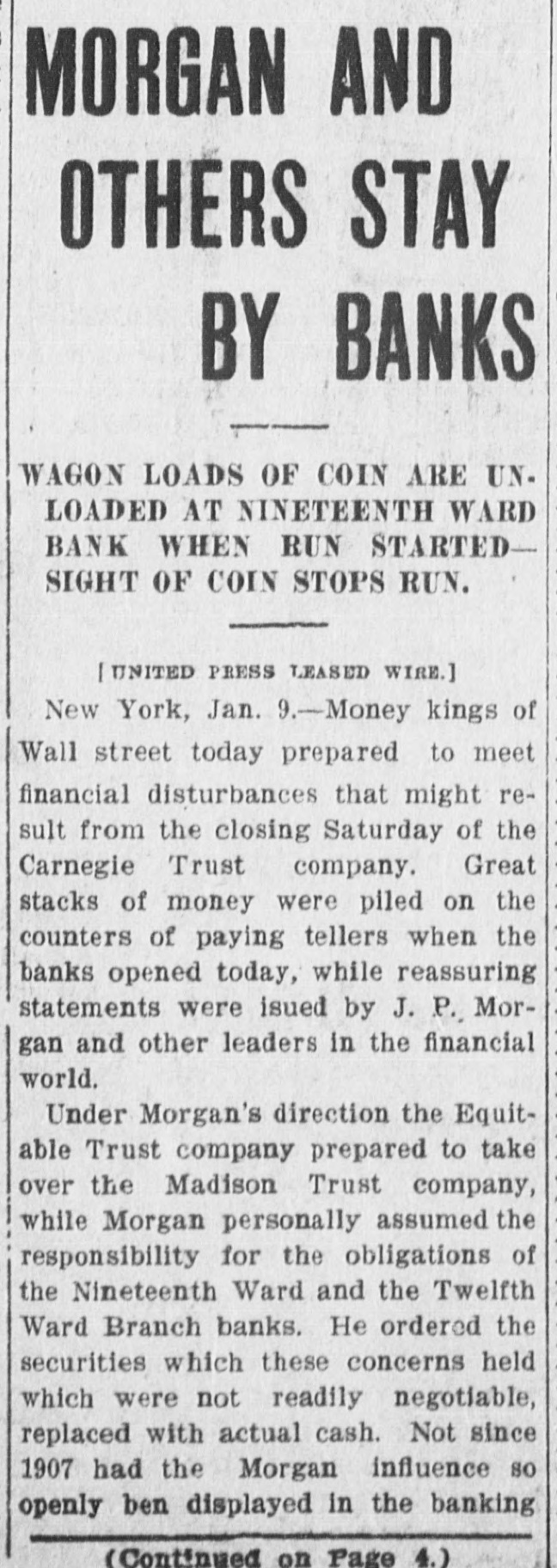
MORGAN AND OTHERS STAY BY BANKS WAGON LOADS OF COIN ARE UNLOADED AT NINETEENTH WARD BANK WHEN RUN STARTEDSIGHT OF COIN STOPS RUN. I UNITED PRESS LEASED WIRE.] New York, Jan. 9.-Money kings of Wall street today prepared to meet financial disturbances that might result from the closing Saturday of the Carnegie Trust company. Great stacks of money were piled on the counters of paying tellers when the banks opened today, while reassuring statements were isued by J. P. Morgan and other leaders in the financial world. Under Morgan's direction the Equitable Trust company prepared to take over the Madison Trust company, while Morgan personally assumed the responsibility for the obligations of the Nineteenth Ward and the Twelfth Ward Branch banks. He ordered the securities which these concerns held which were not readily negotiable, replaced with actual cash. Not since 1907 had the Morgan influence so openly ben displayed in the banking (Continued on Page 4.)
8.January 9, 1911The Detroit TimesDetroit, MI
Click image to open full size in new tab
Article Text
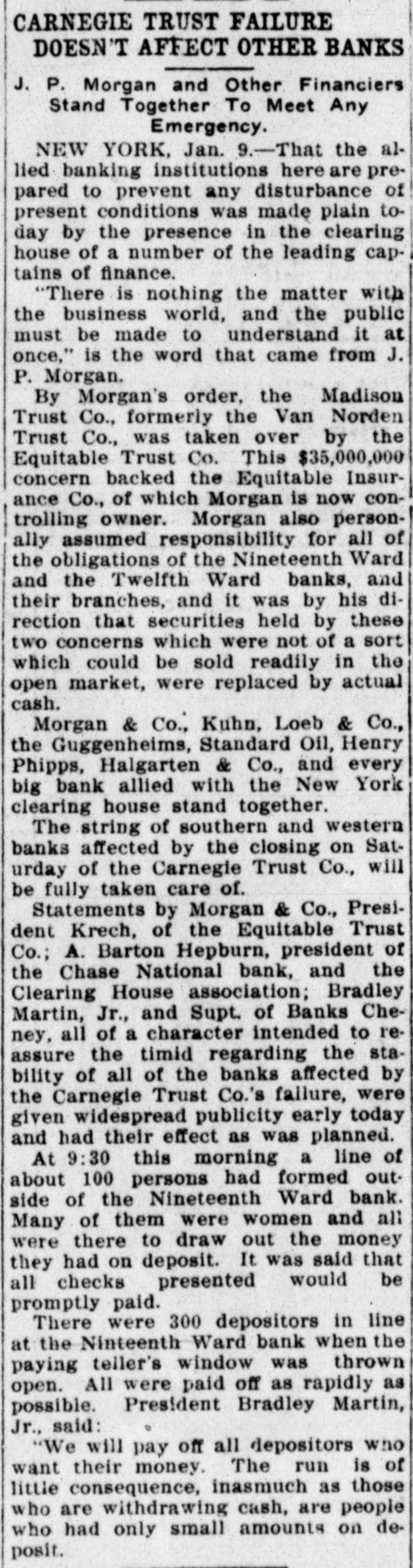
CARNEGIE TRUST FAILURE DOESN'T AFFECT OTHER BANKS J. P. Morgan and Other Financiers Stand Together To Meet Any Emergency. NEW YORK, Jan. 9.-That the allied banking institutions here are prepared to prevent any disturbance of present conditions was made plain today by the presence in the clearing house of a number of the leading captains of finance. "There is nothing the matter with the business world, and the public must be made to understand it at once," is the word that came from J. P. Morgan. By Morgan's order, the Madison Trust Co., formerly the Van Norden Trust Co., was taken over by the Equitable Trust Co. This $35,000,000 concern backed the Equitable Insurance Co., of which Morgan is now controlling owner. Morgan also personally assumed responsibility for all of the obligations of the Nineteenth Ward and the Twelfth Ward banks, and their branches, and it was by his direction that securities held by these two concerns which were not of a sort which could be sold readily in the open market, were replaced by actual cash. Morgan & Co., Kuhn, Loeb & Co., the Guggenheims, Standard Oil, Henry Phipps, Halgarten & Co., and every big bank allied with the New York clearing house stand together. The string of southern and western banks affected by the closing on Saturday of the Carnegie Trust Co., will be fully taken care of. Statements by Morgan & Co., President Krech, of the Equitable Trust Co.; A. Barton Hepburn, president of the Chase National bank, and the Clearing House association; Bradley Martin, Jr., and Supt. of Banks Cheney, all of a character intended to reassure the timid regarding the stability of all of the banks affected by the Carnegie Trust Co.'s failure, were given widespread publicity early today and had their effect as was planned. At 9:30 this morning a line of about 100 persons had formed outside of the Nineteenth Ward bank. Many of them were women and all were there to draw out the money they had on deposit. It was said that all checks presented would be promptly paid. There were 300 depositors in line at the Ninteenth Ward bank when the paying teller's window was thrown open. All were paid off as rapidly as possible. President Bradley Martin, Jr., said: "We will pay off all depositors who want their money. The run is of little consequence, inasmuch as those who are withdrawing cash, are people who had only small amounts on deposit.
9.January 9, 1911The Tacoma TimesTacoma, WA
Click image to open full size in new tab
Article Text
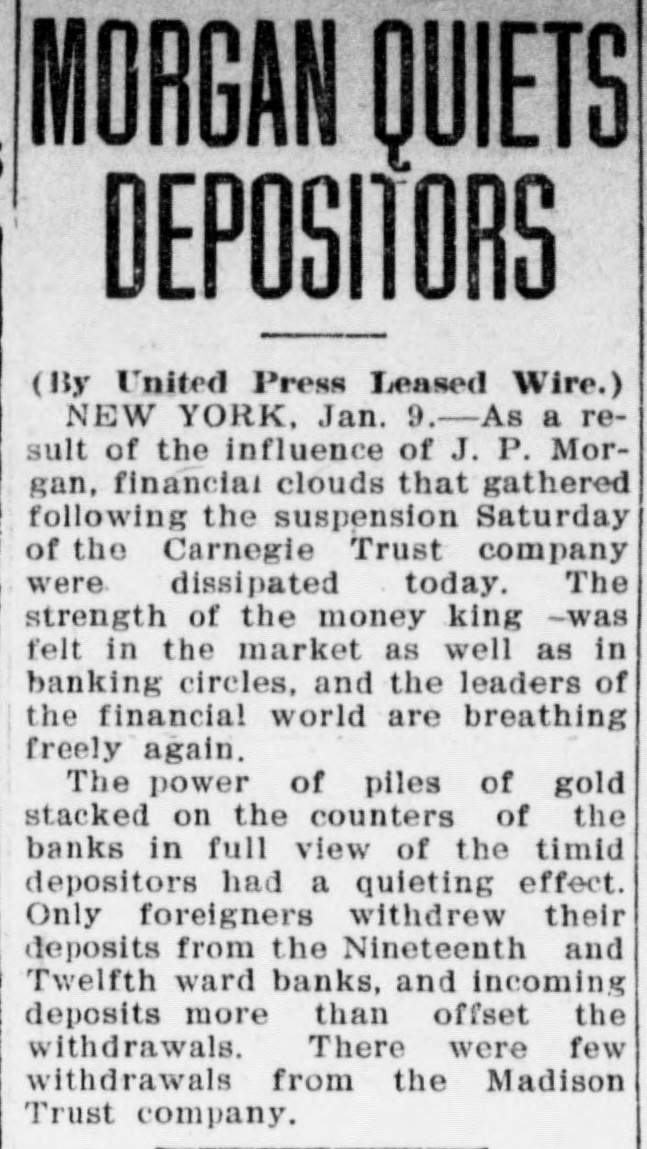
MORGAN QUIETS DEPOSITORS (By United Press Leased Wire.) NEW YORK, Jan. 9.-As a result of the influence of J. P. Morgan, financial clouds that gathered following the suspension Saturday of the Carnegie Trust company were dissipated today. The strength of the money king -was felt in the market as well as in banking circles, and the leaders of the financial world are breathing freely again. The power of piles of gold stacked on the counters of the banks in full view of the timid depositors had a quieting effect. Only foreigners withdrew their deposits from the Nineteenth and Twelfth ward banks, and incoming deposits more than offset the withdrawals. There were few withdrawals from the Madison Trust company.
10.January 10, 1911The Evening WorldNew York, NY
Click image to open full size in new tab
Article Text
Didn't Risk a Cent and His Equitable Trust Absorbs Madison Institution. GOLD IS UNTOUCHED. Big Packages Sent to Avert Run Are Not Even Opened. In saving the Madison Trust Comany, the Nineteenth Ward Bank and be Twelfth Ward Bank from going the wall by the mere lending of his name to these institutions Mr. Morgan has added about $20,000,000 to the ten billions of dollars he already has under his control, and at the same time obtained possession virtually of the Madison Trust Company. It was learned to-day that the house of Morgan did not put up so much as a cent, because after the publication yesterday that Morgan had come to the rescue of the banks and trust company the Institutions threatened were able to meet the demands made on them from their own resources. Although money was sent to all the banks to be on hand in case it was needed, the big packages of gold and currency were not even opened. Bound to Avert Panic. Business men. and the public generally interpreted Morgan's intervention to mean that powerful financial interests had determined there should be no repetition of the monetary panic of 1907, and that any bank which might be in trouble would be supported. That, practically, is the situation, it is said, and although stockholders may have to pay dearly, the depositors will be protected. In addition to being willing to drive a good bargain the Morgan interests, it is asserted, do not desire any finanetal disturbance at this time, causing, as it would, the securities held by the various banks to be thrown on the stock market and reducing the prices there they have been so anxious to maintain. The Carnegie Trust Company synd:cate paid $315 a share for the Van Norden holdings in the Madison Trust Company. Mr. Morgan has agreed to take them over, it is understood at book. or liquidation value, which it is estimated will be about $184 a share. Got a Bargain Rate. According to Wall street information, the Mndison Trust Company was virtually forced into the Morgan arms. It was said that the Morgan interests for a long time had been determined to eliminate the Carnegie Trust Company and obtain control of the Madison, the majority of the stock of which was held by,a syndicate of Carnegie directors. In support of this a remark said to have been made by Joseph T. Howell. President of the Carnegie Company, was quoted. According to this Mr. Howell had said that the sudden closing of his company by the State Banking Department had been an outrage. Whether or not Mr. Howell made this remark, the sentiment attributed 10 him was held by many of his directors. "The company is absolutely solvent and will pay dollar for dollar," said former Judge Keener, one of its directors. Forced to Go to Morgan? "How, then, do you explain the action of the State Banking Department: he was asked. "That is for them say," he replied, with a shrug. To continue the Wall street story the Nineteenth and Twelfth Ward banks were forced by the State Banking Department to go to the Morgans for aid. The Nineteeuth Ward, it was said, had about 35 per cent. of its deposits in actual cash, and about $1,500,000 in commercial paper 50 good that it could have been sold anywhere. The State Banking Department, it was asserted. declined to give the management time to sell this and informed the bank that it would take possession on Monday morning if the institution had not by that time obtained the support of strong banking
11.January 10, 1911The SunNew York, NY
Click image to open full size in new tab
Article Text
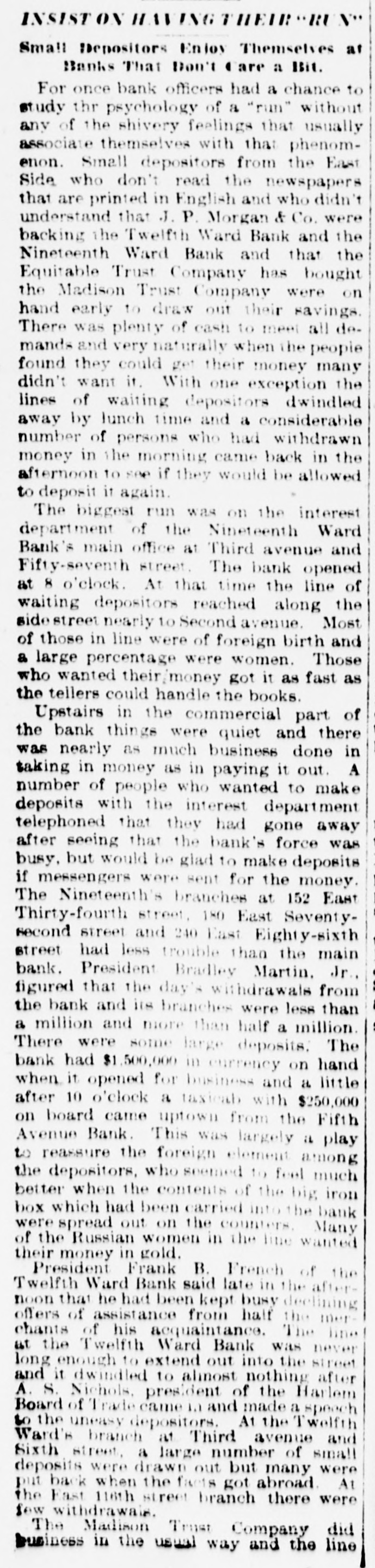
INSIST ON Small Depositors Enjoy Themselves at Banks That Don't care a Bit. once bank officers had a chance to For thr psychology of a "run" without study of the shivery feelings that usually associate any themselves with that phenom- East Small depositors from the Side enon. who don't read the newspapers didn't that are printed in English and who were understand that J. P. Morgan & Co. the backing the Twelfth Ward Bank and the Nineteenth Ward Bank and that Equitable Trust Company has bought on Madison Trust Company were hand the early to draw out their savings deThere was plenty of cash to meet all mands and very naturally when the people found they could get their money many the want it. With one exception didn't lines of waiting depositors dwindled by lunch time and a considerable away number of persons who had withdrawn the in the morning came back allowed in afternoon money to see if they would be to deposit it again. The biggest run was on the interest Ward department of the Nineteenth and Bank's main office at Third avenue Fifty-seventh street. The bank opened of 8 o'clock. At that time the line the at waiting depositors reached along Most side street nearly to Second avenue. and those in line were of foreign birth Those of large percentage were women. who a wanted their/money got it as fast as the tellers could handle the books. Upstairs in the commercial part there of bank things were quiet and in the nearly as much business done A taking was in money as in paying it out. make number of people who wanted to deposits with the interest department telephoned that they had gone away was seeing that the bank's force busy. after but would be glad to make deposits if messengers were sent for the money. East The Nineteenth's branches at 152 Thirty-fourth street, 180 East Seventysecond street and 240 East Eighty-sixth main had less trouble than the Jr. street bank. President Bradley Martin. from figured that the day's withdrawals than bank and its branches were less the million and more than half a million. a were some large deposits. The There bank had $1,500,000 in currency on hand little when it opened for business and a after 10 o'clock a taxicab with $250,000 Fifth board came uptown from the on Avenue Bank This was largely a play reassure the foreign element among to depositors. who seemed to fool much iron the better when the contents of the big which had been carried into the bank box spread out on the counters. wanted Many of were the Russian women in the line their money in Frank gold. B. French of the President Ward Bank said late in the afternoon from half Twelfth that he had been kept busy the declining mer of his Twelfth Ward offers chants the of assistance acquaintance. Bank into was the The street never line at enough to extend out nothing after long it dwindled to almost Harlem and S. Nichols. president of the speech A. of Trade came 1.1 and made a Twelfth Board the uneasy depositors A1 the and to at Third avenue Ward's branch a large number of small Sixth street. were drawn out but abroad many were At deposits when the facts got were the put back East 116th street branch there few withdrawale. Madison Trust Company did usiness The in the usual way and the line
12.January 10, 1911The Washington TimesWashington, DC
Click image to open full size in new tab
Article Text
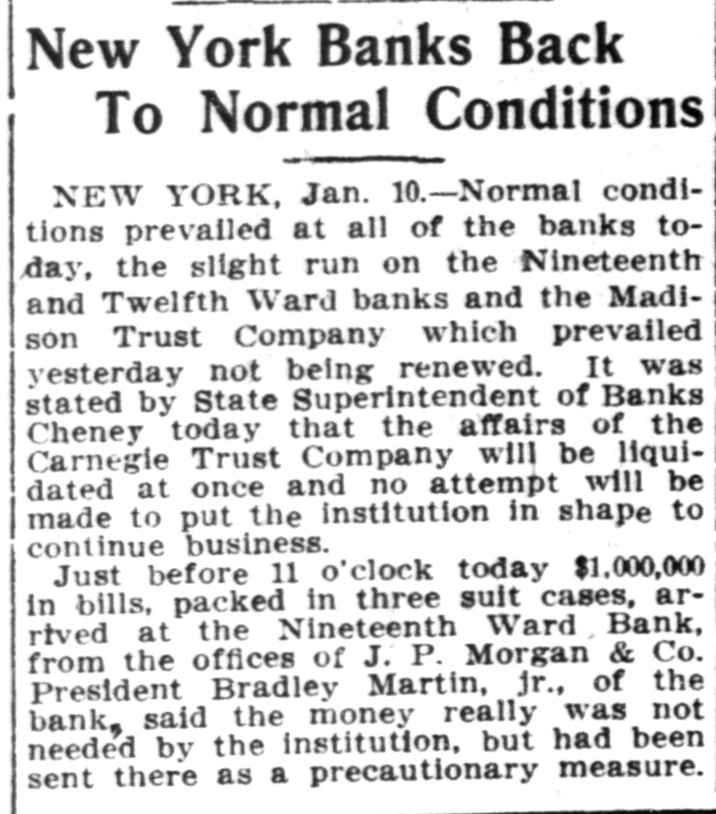
New York Banks Back To Normal Conditions NEW YORK, Jan. 10.-Normal conditions prevailed at all of the banks today, the slight run on the Nineteenth and Twelfth Ward banks and the Madison Trust Company which prevailed yesterday not being renewed. It was stated by State Superintendent of Banks Cheney today that the affairs of the Carnegie Trust Company will be liquidated at once and no attempt will be made to put the institution in shape to continue business. Just before 11 o'clock today $1,000,000 in bills, packed in three suit cases, arrived at the Nineteenth Ward Bank, from the offices of J. P. Morgan & Co. President Bradley Martin, jr., of the bank, said the money really was not needed by the institution, but had been sent there as a precautionary measure.
(By Associated Press.) New York, N. Y., Jan. 9.-Aside from the progressive work of reorganization and reconstruction in the affected institutions which Wl. neces_ sarily extend over the week, New York's banking situation is normal tonight; depositors are reassured and the stock market is optimistic. Joseph G. Robin, whose operations caused the flurry is still in the Tombs. With powerful financial interests behind the Twelfth Ward band and Nineteenth Ward bank and with the absorption of the Madison Trust company by the Equitable Trust company, these three institutions, whose integrity had been questioned because of affiliations directly or indirectly with the Carnegie Trust company, which was closed as a result of Robin's operations, weathered the day SO successfully that there were no runs and almost normal de-
14.January 10, 1911The Fairmont West VirginianFairmont, WV
Click image to open full size in new tab
Article Text
NEW YORK, Jan. 10.-Fifty million dollars available to prevent further bank failures in New York city, and resources aggregating probably a billion, represented by the J. P. Modgan interests, were the controlling features of the situation yesterday when the day was ushered in with runs on the Nineteenth Ward and Twelfth Ward banks. The blight of Joseph G. Robin fell across these banks and also the Madison Trust Company, because they were affiliated with the defunct Carnegle Trust Company, of which he was a former director. "There is nothing the matter with the business world - and the public must be made to understand it at once," was the word that came from J. P. Morgan and the command of the "king" was literally obeyed. Overnight Morgan had clarified the situation. By his order the Madison Trust Company, formerly the Van Norden Trust Company, was taken over by the Equitable Trust Company. This is a $35,000,000 concern, backed by the Equitable Insurance Company, of which Morgan is now the controlling owner. Morgan also personally assumed responsibility for all of the obligations of the Nineteenth Ward and the Twelfth Ward banks and their brances, and it was by his direction that securities held by these two concerns, which were not of a sort which could be sold readily in the open market, were replaced by actual cash. Rung were begun on the Nineteenth Ward and Twelfth Ward banks as soon as these institutions opened yesterday. Trucks carrying gold, silver and paper were drawn up before both banks, but this failed to allay the anxiety of the depositors. At the main establishment of the Twelfth Ward bank, 147 East One Hundred and Twenty-fifth street, stacks of gold and silver were on the counters when the depositors were allowed to enter. The same situation (Continued on Page Eight.)
15.January 10, 1911The Cairo BulletinCairo, IL
Click image to open full size in new tab
Article Text
SITUATION IS AGAIN NORMAL GOOD WORK ACCOMPLISHED IN BANKING SITUATION IN NEW YORK CITY. DEPOSITORS REASSURED Stock Market is Optimistic, and Joseph G. Robin, the Indicted Banker, Remains in the Tombs Prison. New York, Jan. 9.-Aside from progressive work of reorganization and reconstruction in affected institu tions, which will necessary extend over the first few weeks of the new year, the banking situation is normal tonight. Timid depositors are reassured, the stock market is optimistic and Joseph G. Robin, whose operations caused the flurry, remains in the Tombs. With powerful interests behind the Tweltf Ward Bank and the Nineteen th Ward Bank and with the absorp ilon of the Madison Trust Company by the Equity Trust Company, two institutions whose integrity had been questioned because of alleged affiliations with the Caruegle Trust Company, closed as the result of Robin's operations, weathered today, not only successfully, but with suggestiveness that there were no runs and almost normal deposits. Last night's consultation between financiers had laid a strong ground work which proved adequate to avert any serious complications. Another member of the Robin family entered the Tomos today. Dr. Louise Robinovitch, sister of Robin was indicted for perjury and remanded in default of $3,000 bail. She had sworn in an effort to have Robin conmitted to an asylum and his estate taken over by a committee, that she and her brother, Edward, known as Edward Robinson, were his only heirs at law. But Investigation dis closed an aged couple which the prosecution contends are the parents of Robin On this discovery the indictment is based. After Dr. Robinovitch has been indicted she was arraigned in the court of general sessions where she entered a plea of not guilty. Chas. Hyde, the city chamberlain, who was sought as a witness by the legislative graft committee and who is now sought by the city off!cials to look after the city's interests in view of funds deposited in some of the banks involved in the trouble, was still missing tonight. Controller Pendergast sent a spec ial message to the mayor today ask ing for a meeting of the banking commission to consider the matter. In the course of the day Andrew Carnegie issued a statement denying any connection with the Carnegie Trust Company, and reissuing a letter published in 1906 objecting to the use of his name.
16.January 10, 1911The Washington HeraldWashington, DC
Click image to open full size in new tab
Article Text
TROUBLE OF BANKS QUICKLY SUBSIDES Embryonic Runs Cease When Strength Is Displayed. DEPOSITORS PAID IN FULL Extreme Promptness Shown by Madison Trust Company and Other Institutions Formerly Associated with the Carnegie Trust Company. Iron Master Declines to Aid. New York, Jan. 9.-The trouble in banks of this city, which broke out on the failure of the Carnegie Trust Company Saturday morning, subsided to-day as quickly as it started. It was confined entirely to the Madison Trust Company and the Twelfth and Nineteenth Ward Banks, from which there were heavy withdrawals on Saturday because of the knowledge that control of them was lodged in a syndicate of directors of the defunct Carnegie. With the elimination of these interests word comes that the Madison Trust had been taken over by the Equitable Trust Company, and that J. P. Morgan & Co. had agreed to assist the two banks, and the confidence of important depositors were restored. Runs Gradually Subside. Runs on the banks continued this morning, but gradually subsided as the day progressed. Every depositor who wanted his money in whole or in part was paid with extreme promptness, and from the time that the institutions opened there was a line in front of the receiving tellers' windows, as well as in front of the paying tellers. Many depositors who took out their money Saturday brought it back, and in the afternoon the number of depositors going to the receiving teller exceeded those who were making withdrawals. As a result of the day's business, the Madison Trust Company took in more money than it paid out. The Twelfth and Nineteenth Ward banks did not fare quite as well, but each got along without a penny of help from J. P. Morgan & Co. Carnegie Declines to Aid. The only chance that the Carnegie would resume was that Andrew Carnegie would step forward and help it again. That chance. it was learned. was destroyed in the course of the transaction whereby control of the Madison Trust Company was purchased by the Equitable Trust. It was from Mr. Carnegie that the Equitable secured the stock representing control. Mr. Carnegie had got possession of it in the course of one of the loans he made to the clique in control of the Carnegie Trust Company. He was willing enough to sell it when a responsible offer was made. Superintendent Cheney, of the State banking department. said to-day that he and his examiners were going ahead with a view to liquidating the Carnegie Trust Company. He did not believe there was any chance of a reorganization. As in the Northern Bank case, it will be some time before he gives out a statement of the company's condition. Dr. Cook Is Fortunate. Dr. Cook, even though he did not discover the north pole, discovered the trouble in the Carnegie. and drew out his money the day before the failure. At one time the company held all of the money Dr. Cook made as a result of his expedition. Another lucky depositor was the State of Tennessee. It had only $22,000 in the company. but this was secured by a bond of the United States Fidelity and Guaranty Company. The company paid over the money to a representative of the State to-day and it was deposited in the National Reserve Bank.
17.January 10, 1911Alexandria GazetteAlexandria, VA
Click image to open full size in new tab
Article Text
Morgan's Philanthrophy. New York, Jan. 10.-Whether J. P. Morgan, in clearing the local financial skies, cleared up two millions of dollars or lost half a million is the question financiers are trying to solve today. The friends of Morgaa. who say he acted unselfishly to save the financial situation yesterday, insist that he took over the stock in the Madison Trust Company. the Nineteenth Ward Bank and the Twelfth Ward Bank at the market price and that in doing SO he also shouldered obligations which made his stock cost $585,000 additional. Pessimists, however, who seem to question the Morgan brand of philanthrophy, point out that he paid only $3,450,000 for control of three banking institutions whose allied resources are in excess of $20,000,000. Morgan, these people say, will shortly liquidate the three organizations and open in their stead branches of his Equitable Trust Company. The minority stockholders, it is pointed out, will have no say in the matter, as Morgan, as the price of preventing a run by the mere use of his name, secured the control of all of the three concerns. The $20,000,000 of assets of the three concerns which were in danger will add materially to the attractiveness of the Equitable Trust Company's balance sheets hereafter in the opinion of financial experts who have watched the present situation. Normal conditions prevailed at all the banks this morning.
18.January 10, 1911The Richmond VirginianRichmond, VA
Click image to open full size in new tab
Article Text
PESSIMISTS PICK FLAWS IN MORGAN EXPRESS DOUBT AS TO NEW YORK FINANCIERS BRAND OF PHILANTHROPY. MADE PROFITABLE DEAL REPORT THAT HE WILL BE LARGELY "AHEAD OF THE GAME" BY TAKING OVER EMBARRASSED BANKS, NEW YORK, Jan. 10.-Whether J. P. Morgan, in clearing the local financial skies, cleared up some twenty millions of dollars or lost a half a million is the question financiers here are trying to solve to-day. The friends of Mr. Morgan, who say he acted unselfishly to save the financial situation yesterday. insist that he took over the stock in the Madison Trust Company, the Nineteenth Ward Bank and the Twelfth Ward Bank at the market price and that In doing so he also shouldered obligations which made his atock cost $586,000 additional. Pessimists, however, who seem to question the Morgan brand of philanthropy. point out that he paid only $2,450,000 for control of three banking institutions whose allied resources are in excess of $20,000,000. Mr. Morgan, these people say, will shortly liquidate the three organizations and open in their stead branches of his Equitable Trust Company. T he minority stockholders, it is pointed out, will have no say in the matter, as Mr. Morgan, as the price of preventing a run by the mere use of his name, secured the control of all of the three concerns. He paid $700,000 for control of the Nineteenth and Twelfth Ward Banks and $1,750,000 for the Madison Trust Company. The latter was a valuable purchase, as the Morgan interests had been after It ever since it was reorganized from the old Van Norden Trust Company. To pay for the threee institutions it is expected Mr. Morgan will increase the stock of the Equitable Trust Company and exchange it for the outstanding shares of the three companies, making the actual cost to Mr. Morgan personally only about what the engraver's bill will be who furnishes the new stock. The $20,000,000 of assets of the three concerns which were in danger will add materially to the attractiveness of the Equitable Trust Company's balance sheets hereafter, in the opinion of financial exprest who have watched the present situation. Normal condition prevailed at all of the banks to-day, the slight run on the Nineteenth and Tweifth Ward banks and the Madison Trust Company which prevailed yesterday is not being renewed. It was stated by State Superintendent of Banks Cheney to-day that the affairs of the Carnegie Trust Company will be liquidated at once and no attempt will be made to put the institution in shape to continue business.
19.January 10, 1911New-York TribuneNew York, NY
Click image to open full size in new tab
Article Text
THE NEWS THIS MORNING. CONGRESS.-Senate: The fight over the retention of his seat by Senator LoriSenator Beveridge presentreport and mer ing a opened. minority Senator Illinois Gore making a speeche against his by colleague. House: A ruling Speaker Cannon was upheld by a vote of 222 to 53. FOREIGN.-At the inquest in London into the deaths of the two men burned to death in the Sidney street battle, the identity of only one was positively esA strong movement has in Liverpool. tablished been started there. England, against Mormon activity Avalanches of extraordinary extent are reported from the Alps. particularly in the province of Cuneo. Italy. Friends of the thirty-two Camorrists, who are in prison in Viterbo, Italy, awaiting trial for murder, tried to cominunicate with them by characteristic whistles It is said that the Emir of Bokhara, who died on January 5, was a victim of bubonic plague. DOMESTIC.A number of diplomatic and other appointments were announced Taft at and American The by President Canadian Washington reciprocity commissioners held their second session The reargument of suit against was Tobacco the in Washington dissolution corporations the begun American before the United States Supreme Court at Washington The Standard Oil Company paid $23,766 in fines into the federal courts at Buffalo: this was said to be the first fines ever collected by the government under the anti-rebate law. According to an Albany dispatch Governor Dix has been investigating legislative expenses and found that it costs on an average $1,800 to get a bill through A dispatch the General Assembly from Ribany stated that Attorney Genoral Carmody had revoked the designation of Arthur C. Train as special deputy to prosecute the Queens County alleged graft cases and would take charge of the suits himself Judson Harmon was inaugurated Governor of Ohio for the second time: extreme simplicity and the absence of the usual message marked A jury the cerémony at Columbus to try Mrs. Laura Farnsworth Scheack on charges of poisoning her husband a wealthy pork packed was completed at Wheeling W Va. CITY.-Stocks closed heavy after early strength The measures taken on Sunday night served to check embryo runs on the three institutions generally subject to the Carnegie influences regarded Trust Company as and met. no runs of serious character had to be It was learned that the cost of the control of the Madison Trust Company and the Twelfth and Nineteenth Ward The banks was about $2,450,000 United States Circuit Court of Appeals, reversing the decision of the lower court. held that there had been no infringement of the Selden automobile patent Rabinowitch indicted for perin attempting to secure a jury Dr. Louise commisNon for her brother. Joseph G. Robin. committed to the Tombs in default Charges of was bail. filed against with City the Chamberlain Hyde were Mayor by a lawyer who asked for his removal from office. THE WEATHER-Indications for today: Fair The temperature yesterday: Highest 42 degrees: lowest. 28.
20.January 10, 1911Evening JournalWilmington, DE
Click image to open full size in new tab
Article Text
been after it ever since it was reorganized from the old Van Norden Trust Company. How He Will Pay For Them. To pay for the three institutions it is expected Morgan will increase the stock of the Equitable Trust Company and exchange it for the outstanding shares of three companies, making the actual cost to Morgan personally only about what the engravers' bill will be who furnishes the new stock. The $20,000,000 of assets of the three concerns which were in danger will add materially to the attractiveness of the Equitable Trust Company's balance sheets hereafter, in the opinion of financial experts, who have watched the present situation. Normal conditions prevailed at all of the banks today, the slight run on the Nineteenth and Twelfth Ward Banks and the Madison Trust Company, which prevailed yesterday not being renewed. It was stated by State Superintendent of Banks Cheney today that the affairs of the Carnegie Trust Company will be liquidated at once and no attempt will be made to put the institution in shape to continue business.
21.January 11, 1911The Forest RepublicanTionesta, PA
Click image to open full size in new tab
Article Text
RUN ON BANKS CEASE East Side Depositors Return Money After Withdrawing It. Twelfth Ward and Nineteenth Warc Banks Scenes of Great Activity Ir the Morning, but as the News of Morgan's Company Backing the Banks Spread the Line of Withdraw ing Depositors Diminished to Noth ing. New York, Jan. 10.-The trouble it banks of this city, which broke out or the failure of the Carnegie Trust com pany Saturday morning subsided yes terday as quickly as it started. The trouble was confined entirely to the Madison Trust company and the Twelfth and Nineteenth Ward banks. Runs on these banks continued in the morning, but gradually subsided as the day progressed. Every depositor who wanted bis money was paid promptly. Small depositors from the East Side who don't read the papers and who did not understand that J. P. Morgan & Co., was backing the Twelfth Ward bank and the Nineteenth Ward bank and that the Equitable Trust company has bought the Madison Trust compa ny were on hand early to draw oui their savings but there was plenty Oi cash to meet all demands and very naturally when the people found they could get their money. many did not want it and with one exception the line of waiting depositors dwindled away by lunch time and a considerable number of persons who withdrew money in the morning came back ir the afternoon to deposit the same sums again. Biggest Run on 1th Ward Bank. The biggest run on the interest de partment of the Nineteenth Ward Lank's main office at Third avenue and 57 street. When the bank opened the line of waiting depositors covered several blocks. Those who wanted their money got it as fast as the tellers could handle the books. Upstairs ir the commercial part of the bank things were quiet and there was nearly as much business done in taking in mon ey as in paying it out. The Nineteenth's branches at 152 Fif ty-fourth street, 180 East 72nd stree and 140 East 86th street had less trouble than the main bank. President Bradley Martin, Jr., figured that the day's withdrawals from the bank and 02 branches were less than a million and more than half the amount deposited. He said that there had been some large deposits. The bank had $1,500, 000 in currency on hand when 11 1 opened for business and a little after 10 o'clock a taxi cab with $250,000 or board came up from the Fifth Avenue bank. President Frank B. French of the 1 Twelfth Ward bank was on hand ear to ly at the bank's main office at 147 East 125th street. The line at the Twelfth Ward bank was never long 01 enough to extend out into the street and it dwindled almost to nothing af ter A. S. Nichols, president of the Harlem Board of Trade, came in and made a speech to the uneasy deposit ors reminding them of the powerful interests that had come to the aid of the bank and advising them not to draw out money unless they needed it # At the Twelfth Ward's branch at Third avenue and Sixth street a large num ber of small deposits were drawn out Trust Company Did Normal Business. The Madison Trust company at its main office, Fifth avenue and 60th 1 street, did business in the usual way and the line of depositors was always E longer than that made up of those who wished to draw out their money. T1 was said that less than $100,000 was withdrawn. 1 The Madison Bowery branch paid out money to a considerable number 01 small depositors, but there was none in line after 12 o'clock. In all of the banks and their branch es notices of the backing promised to the banks by J. P. Morgan & Co. were posted. It was apparent at most of the branches that the day had seen the
TO STOP RUNS ON NEW YORK'S BANKS Takes Over Trust Company Affected by Carnegie Failure. NOTHING WRONG With Business World, He Says, and Public Must be Made to Know it. RUN ON WARD BANK CHECKED AT NOON. New York City.-The line of depositors in front of the Nineteenth Ward bank withdrawing It money dwindled at noon. was at first thought to be over. At one time $1,300,00 in gold was in sight on the counters. J. P. Morgan & Company guaranteed the depositors to the amount of eight million dollars. New York City.-J. Pierpont Morgan heads a group of big bankers and financiers, including the Standard Oil Company and the big insurance companies, who wil back all the New York Clearing House officials today, in standing behind all city banks to prevent a run. Not since 1907, when he stopped an incipient panic, has Morgan shown his force so strongly "There is nothing the matter with the busines world and the public must be made to know it at once," Morgan declared. Morgan ordered the Madison Trust company taken over by the Equitad ble Trust company. This is a $35,000,000 concern backed by the Equitable Life Insurance company, which Morgan controls. Morgan also has assumed the obligations of the Nineteenth and Twelfth Ward banks in this city. The southern banks injured by the failure of the Carnegie Trust company Saturday are also to be taken care of. d How Others Are Affected. Several of the directors of the Carnegie Trust company are directors of the Nineteenth Ward bank, and Bradley Martin, jr., whose name still appears on the stationery of the trust company as vice president, although he recently resigned, is now president of the Nineteenth Ward bank. He said that there is no connection whatever between the two institutions and that the closing of one would not affect the other. In 1909 when the Carnegie Trust company was under the presidency of the late C.C. Dickinson, who died mysteriouslyy last May, an effort was made to consolidate the Carnegie Trust company, the Nineteenth Ward bank, the Twelfth Ward bank and d the Van Norton Trust company under the management and name of Carnegie. Although Mr. Dickinson had been a state bank examiner, he was non persona grata to the state banking department, which forbade the merger under a ruling that it would be impossible for a trust company to consolidate with state banks. Recently the Van Norden Trust company changed its name to the Madison Trust company, and Bradley Mard tin, jr., was elected to the presidency. d Bank's Collapse No Surprise. The closing of the Carnegie company was no surprise in financial circles and caused little disturbance on the stock exchange. A brief fall in the market Saturday was quickly met by supporting orders and at the a close the tone was firm. On the street the uncertain status of the company had been a matter of comif mon knowledge. In its brief career-it was organd ized in 1901-it had already passed through one serious period of de-
23.January 12, 1911The Dillon HeraldDillon, SC
Click image to open full size in new tab
Article Text
MORGAN A BUCCANEER. Hailed 24 Hours Ago As Saviour of Three Banks-Now Charged That He Wrecked Them Deliberately. New York, Jan. 10.-While J. P. Morgan was hailed 24 hours ago as the saviour of three New York banks, sober reflection on the part of various financial leaders not in the Morgan camp to-day led them to renew his appellation of "financial buccaneer." Following revelations that if the Carnegie Trust Company had been given 24 hours longer it would have been able to continue its financial operations, Wall street dealers declare that Morgan had manipulated cleverly to force a merger of the $20,000,000 Madison Trust Company with his $35,000,000 Equitable Trust Company. According to a report current in the financial district Mr. Morgan had forced the hands of his opponcuts and practically bagged three new banks in so doing; the three being the Madison Trust, the Twelfth and Nineteenth ward banks. The Madison Trust Company is now Morgan's but how far his ascendency goes over the other two institutions has not been made public. It is understood, however, that he torced an agreement to the effect that the Carnegie Trust Company shall not be re-organized. The assertion is made that the house of Morgan did not expend a cent but merely lent its name to avert financial crashes that might have had a national bad effect. The money sent by J. P. Morgan & Co. to the banks in question was not needed and was returned. Much of it war not opened. The Madison Trust Company and the Twelfth ward and Nineteenth ward banks opened their doors at the usual hour to-day. There was a slight run on the savings department of the Nineteenth ward institution. About 50 persons, most of them women, were waiting to make withdrawals when the savings department was opened. They were paid promptly. I In the check department of the Nineteenth ward bank there were more persons waiting to make deposits than withdrawals. , Superintendent of Banks Cheney said to-day that the financial situ: ation had cleared up entirely and added: "I give you my word that not another bank or trust company under the jurisdiction of our department is under the least suspicion." Just before 11 o'clock to-day $1,000.000 in bills, packed in three suit cases, arrived at the Nineteenth ward bank, from the offices of J. P. Morgan & Co. The money was taken there by three men, who rode in a taxicab. President Bradley Martain, Jr., of the bank, said the money really was not needed by the institution, but had been there as a precautionary measure. There was no run on the check department of the bank during the morning. AAA
24.January 12, 1911The Guthrie Daily LeaderGuthrie, OK
Click image to open full size in new tab
Article Text
GOTHAM BANKS SAVED Powerful Financial Interests Come to Aid of Affected Institutions (By Leased Wire) New York, Jan. 11.-Aside from progressive work of reorganization and reconstruction in affected institutions which will necessarily extend over the week, New York's banking situation is normal tonight, timid depositors are reassured. the stock market is optimistic and Joseph G. Robir. whose operations caused the flurry. remains in the Tombs. With powerful financial interests behind the Twelfth Ward Bank and the Ninteenth Ward bank and with the absorption of the Madison Trust company by the Equitable Trust comjary. these institutions whose integrity had been questioned because of alleged affiliations with the Carnegie Trust company, closed as a result of Robin's operations, weathered the day not only successfully, but with such aggressiveness that there were no runs and almost normal deposits. Last uight's consultation between financiers had laid a strong groundwork, not proved adoguate to avert any serious complications.
25.February 3, 1911The Evening WorldNew York, NY
Click image to open full size in new tab
Article Text
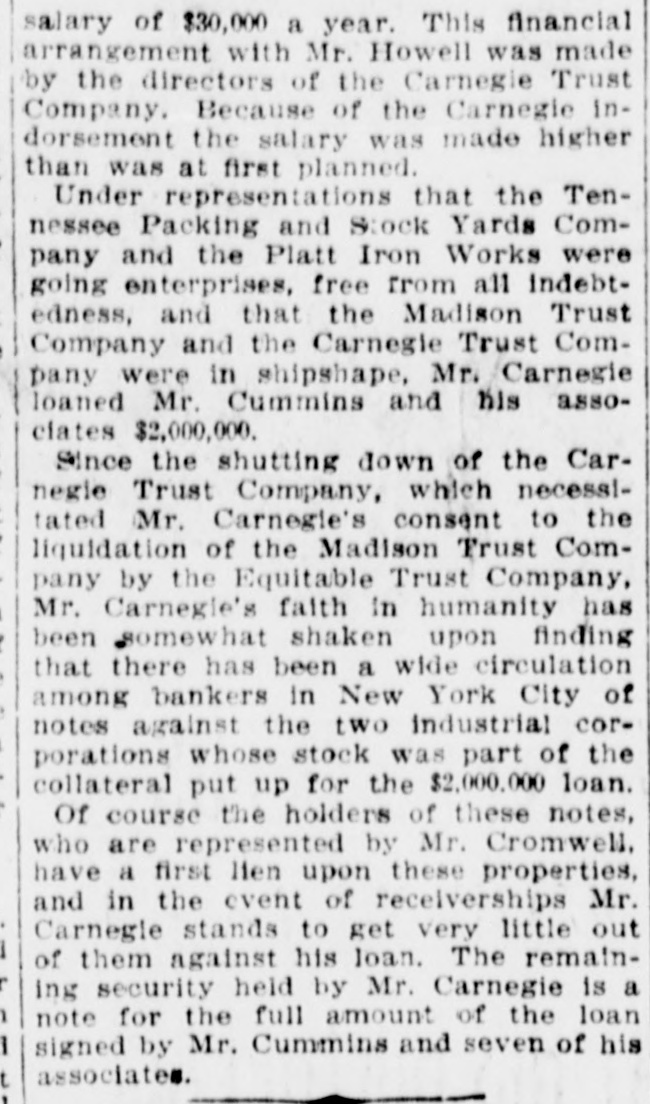
salary of $30,000 a year. This financial arrangement with Mr. Howell was made by the directors of the Carnegie Trust Company. Because of the Carnegie indorsement the salary was made higher than was at first planned. Under representations that the Tennessee Packing and Stock Yards Company and the Platt Iron Works were going enterprises, free from all indebtedness, and that the Madison Trust Company and the Carnegie Trust Company were in shipshape, Mr. Carnegie loaned Mr. Cummins and his assoclates $2,000,000. Since the shutting down of the Carnegle Trust Company, which necessitated Mr. Carnegie's consent to the liquidation of the Madison Trust Company by the Equitable Trust Company, Mr. Carnegie's faith in humanity has been somewhat shaken upon finding that there has been a wide circulation among bankers in New York City of notes against the two industrial corporations whose stock was part of the collateral put up for the $2,000,000 loan. Of course the holders of these notes, who are represented by Mr. Cromwell. have a first Hen upon these properties, and in the event of receiverships Mr. Carnegie stands to get very little out of them against his loan. The remaining security held by Mr. Carnegie is a note for the full amount of the loan signed by Mr. Cummins and seven of his associates.