Article Text
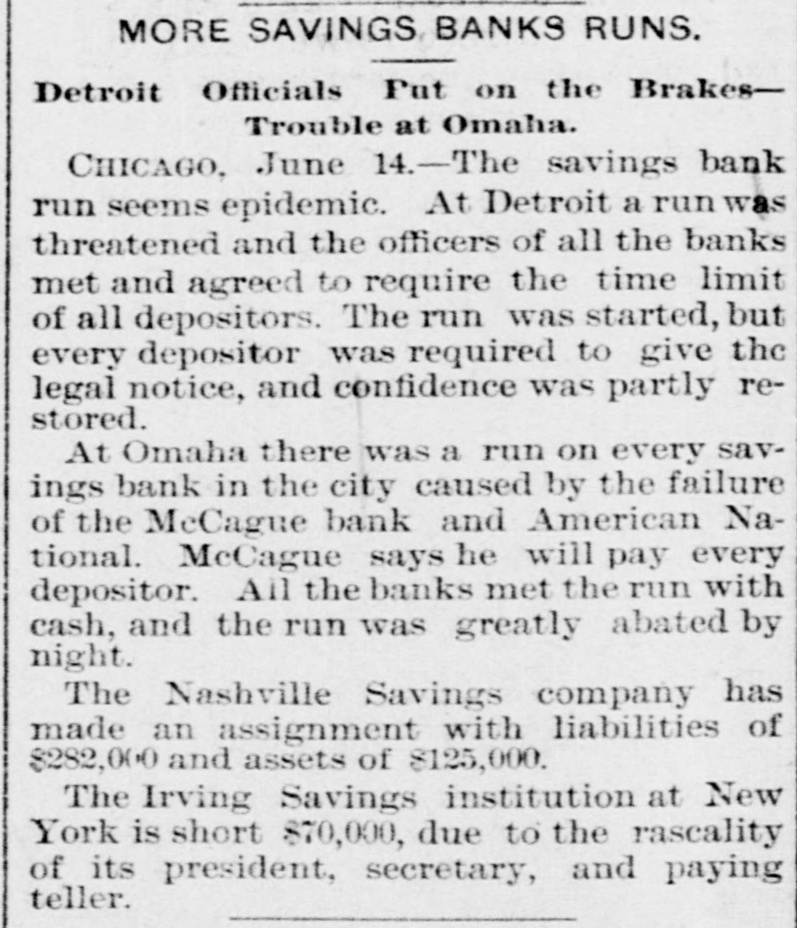
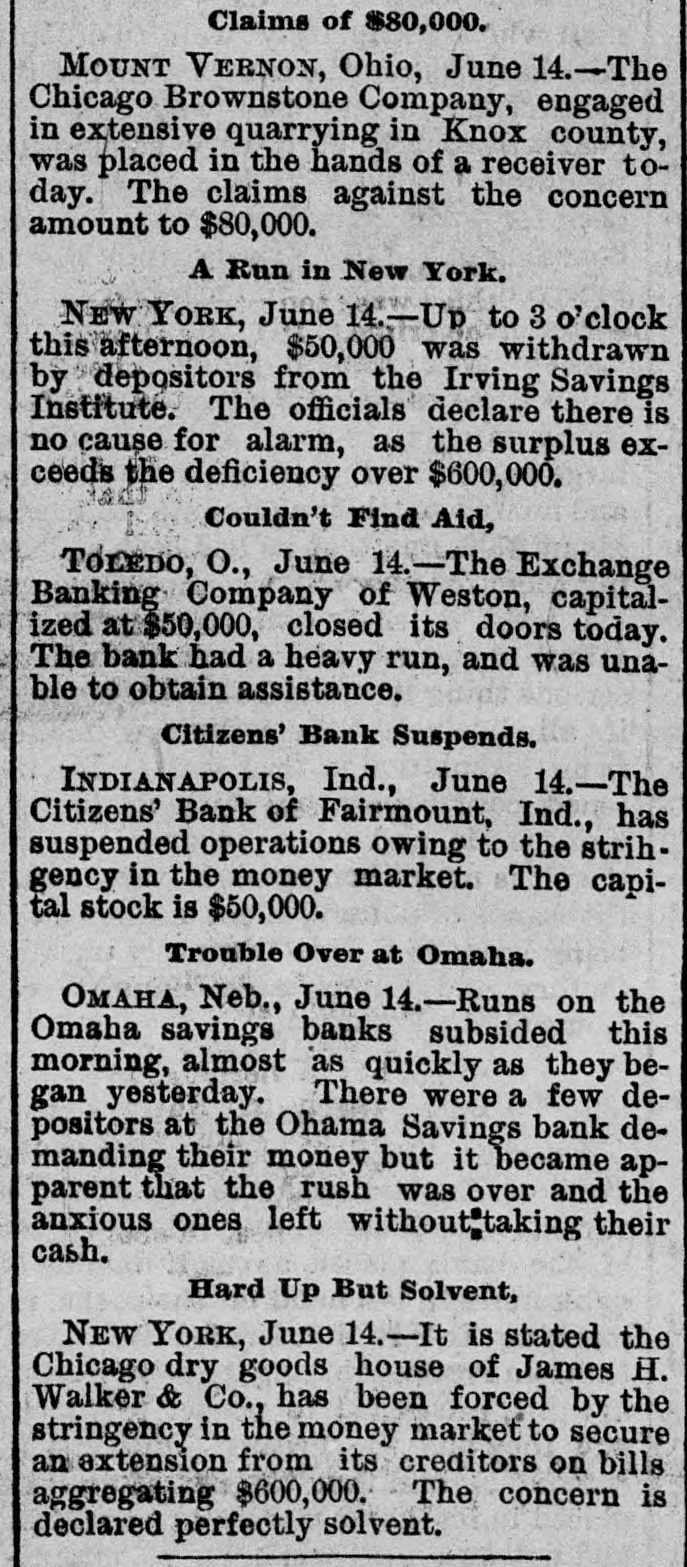
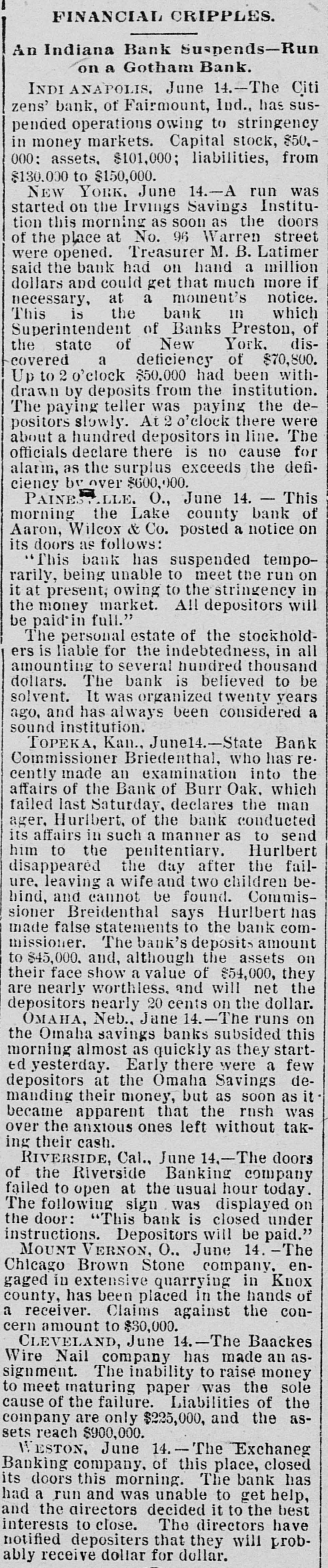
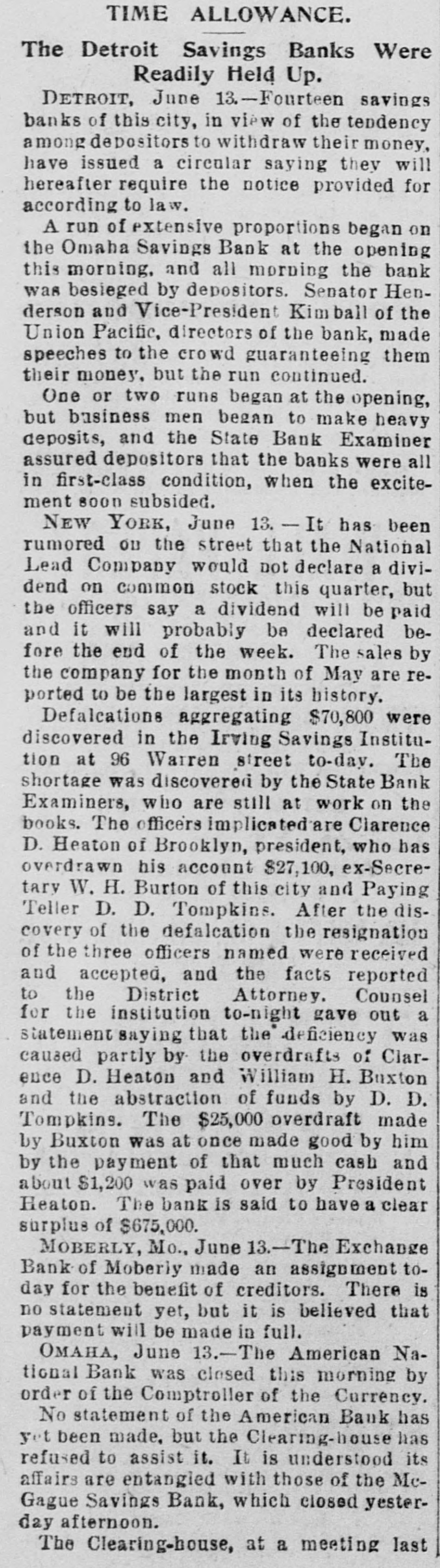
TIME ALLOWANCE. The Detroit Savings Banks Were Readily Held Up. DETROIT, June 13.-Fourteen savings banks of this city, in view of the tendency among depositors to withdraw their money, have issued a circular saying they will hereafter require the notice provided for according to law. A run of extensive proportions began on the Omaha Savings Bank at the opening this morning, and all morning the bank was besieged by depositors. Senator Henderson and Vice-President Kimball of the Union Pacific, directors of the bank, made speeches to the crowd guaranteeing them their money. but the run continued. One or two runs began at the opening, but business men began to make heavy deposits, and the State Bank Examiner assured depositors that the banks were all in first-class condition, when the excitement 8000 subsided. NEW YORK, June 13. - It has been rumored on the street that the National Lead Company would not declare a dividend on common stock this quarter, but the officers say a dividend will be paid and it will probably be declared before the end of the week. The sales by the company for the month of May are reported to be the largest in its history. Defalcations aggregating $70,800 were discovered in the Irving Savings Institution at 96 Warren street to-day. The shortage was discovered by the State Bank Examiners, who are still at work on the books. The officers implicated are Clarence D. Heaton of Brooklyn, president, who has overdrawn his account $27,100, ex-Secretary W. H. Burton of this city and Paying Teller D. D. Tompkins. After the discovery of the defalcation the resignation of the three officers named were received and accepted, and the facts reported to the District Attorney. Counsel for the institution to-night gave out a statement saying that the deficiency was caused partly by the overdrafts of Clarence D. Heaton and William H. Buxton and the abstraction of funds by D. D. Tompkins. The $25,000 overdraft made by Buxton was at once made good by him by the payment of that much cash and about $1,200 was paid over by President Heaton. The bank is said to have a clear surplus of $675,000. MOBERLY, Mo., June 13.-The Exchange Bank of Moberly made an assignment today for the benefit of creditors. There is no statement yet, but it is believed that payment will be made in full. OMAHA, June 13.-The American National Bank was closed this morning by order of the Comptroller of the Currency. No statement of the American Bank has yet been made, but the Clearing-house has refused to assist it. It is understood its affairs are entangled with those of the MeGague Savings Bank, which closed yesterday afternoon. The Clearing-house, at a meeting last