14026. Harlem Savings Bank (New York, NY)

Bank Information

Episode Type
Run Only
Bank Type
savings bank
Start Date
October 25, 1907
Location
New York, New York (40.714, -74.006)

Metadata

Model
gpt-5-mini
Short Digest
9047128e51825e20

Response Measures

None

Description

Multiple articles (Oct 25–30, 1907) describe a run on the Harlem Savings Bank during the 1907 panic. The bank paid depositors, limited large withdrawals by invoking the 30/60-day notice rule, and did not suspend or fail; runs abated and normal business resumed. The immediate trigger included rumor/misinformation (e.g., a careless caption misidentifying a run elsewhere as on a Harlem bank) and general contagion from the Knickerbocker Trust failure.

Events (1)

1. October 25, 1907 Run
Cause
Rumor Or Misinformation
Cause Details
Run driven by contagion from Knickerbocker Trust panic and specific misinformation: a newspaper caption and reports conflated a Bronx/Dollar Bank run with the Harlem Savings Bank, spurring foreign-born depositors to withdraw.
Random Run
Yes
Random Run Snippet
Careless caption misreported Bronx run as on Harlem bank; false report
Measures
Announced enforcement of 30/60-day legal notice for large withdrawals; continued to pay small depositors promptly.
Newspaper Excerpt
An official of the Harlem Savings bank, where a run was begun yesterday, announced ... the company will at once take advantage of the sixty days' notice law ... The bank will continue to honor immediately the demands of small depositors who desire to withdraw funds.

Source
newspapers

Newspaper Articles (11)

Article from The Topeka State Journal, October 25, 1907

Click image to open full size in new tab

Article Text

moved rather narrowly. Individuals securities, however, acted feverishly. Selling of Northern Pacific carried it down 2 points and Reading 11/2. Oregon Short Line funding per cent bonds sold at 75, a decline of 77 from yesterday's price. A few stocks were notably weak, and this kept the tone of the market unsettled, but the general selling was active. The heaviest declines were in Northern Pacific, Reading and Illinois Central. The large loans made by J. Pierpont Morgan & Co., and their associates to stock brokers yesterday when the brokers were demoralized were renewed today at 2 per cent. Upon application of State Attorney General Jackson, temporary receivers were appointed today for the Knickerbocker Trust company, which closed its doors on Tuesday after a run by its depositors. The receivers are Otto T. Bannard, Ernest Thalmann, and Gen. Henry C. Ide, all of New York city. Recovery in Paris. Paris, Oct. 25.-There was a general recovery of the bourse today and prices closed firm, owing to the belief prevalent here that the worst of the financial troubles in New York is over, which resulted in a covering movement in which copper shares were included. More Money From Washington. New York, Oct. 25.-The secretary of the treasury is continuing to give financial assistance in a large way. The department is doing everything possible to allay apprehension. Another large supply of small hills is being rushed to New York from Washington. An associate of the secretary of the treasury said today that the secretary's refusal to make any formal statement this morning might be accepted as an indication of Mr. Cortelyou's belief that the situation generally is showing improvement. A statement issued by the subtreasury today shows that local banks gained $22,705,000 from the subtreasury during the week. This represents in large part the deposits of government funds made with the New York banks. It developed this morning that a considerable number of those in line at the Trust company of America and at the Lincoln Trust company were not depositors, but persons who had taken places in line in the hope of selling favorable positions to depositors who would be willing to pay for a forward place. Wherever possible these persons were removed from the line by the police. Stock Exchange Still Closed. Pittsburg, Pa., Oct. 25.-There was no session of the stock exchange today. The directors having decided to remain closed for the present. A feeling of confidence has overspread the entire situation in Pittsburg and talk with prominent bankers today elicited the information that "affairs are progressing normally and conditions are in good shape." Brooklyn Bank Closes. New York, Oct. 25.-The Borough bank of Brooklyn, a state institution with a capital stock of $200,000 and deposits of about $3,000,000, did not open for business today. Its business was not very large and no prominent financiers were connected with it. One of its principal connections was the Knickerbocker Trust company, which suspended payments on Tuesday. Call Money at 50@60. New York, Oct. 25.-The first quotation of call money on the stock exchange today was made at 12:30 o'clock, when loans were made at 50 and 60 per cent. An official of the Harlem Savings bank, where a run was begun yesterday, announced this afternoon that the company will at once take advantage of the sixty days' notice law in cases of all large depositors. The bank will continue to honor immediately the demands of small depositors who desire to withdraw funds.


Article from Evening Journal, October 25, 1907

Click image to open full size in new tab

Article Text

ANOTHER BIG TRUST BANK SUSPENDED But Financial Sky is Clearing and the Worst Thought to be Over CORTELYOU VERY HOPEFUL By THE JOURNAL'S Special Wire. NEW YORK, Oct. 25-Financial New York is convalescent, but still decidedly shaky on its pins despite the positive assurance of chief Physician, J .P. Morgan and Surgeon Cortelyou. It will be many days before the stock exchange and the many banking institutions are again on a normal basis, and in the meanwhile the suspension of many small concerns can hardly be averted. But still the sky is clearing and it can be consistently asserted the worst is over. The herdes blow of the day was the suspension of Providence Trust Company with individual deposits exceeding $25,000,000. This followed o.run started yesterday, and according to President Studley thea ction was necessary to protect depositors. C.C. Sweetland was appointed receiver and at once qualified. At nine o'clock there was posted on the doors of the United States Exchange Bank, a small institution, at 23 West 125th street, a notice that it would not open to-day. President John Gibbons stated its deposits aggregate $880,000, and it paid up capital is $100,000. He said all depositors would be paid in full. Run on Baltimore From Baltimore comes word that the run on the Eastern branch of the Home Bank continues, but all demands are being met. Here in New York the runs on the Trust Company of America, the Lincoln Trust Company, the Fifth Avenue Trust Company, the Harlem Savings Bank and the Dollar Savings Bank n continue, but are decreasing and deposits now exceed withdrawals and the end is in sight. Secretary of the Treasury Cortelyou said to the United Press at the subTreasury to-day: "I am very hopeful that an trouble is past and regard the situation as much improved. I will continue to render whatever assistance may be advisable during the day. The banks are still feeling the need of small bills and I have ordered more sent from Washington. "The suspension of small banks is not an unfavorable sign. It will permit the banking interests to concentrate their support on the central situation." The monetary situation kept the stock market feverish throughout the day. There was no visible attempt to corner the money market. s In the Stock Market. The improved feeling in the late trading yesterday was continued for a while e this morning. During the first hour's trad. ing there was gains on many stocks at the start ranging 1 to 2 points over yesterday's closing. following by selling and moderate net losses were recorded. The market was at no time demoralized and sentiment prevailed that the market had passed through its worst phase. Arbitrage brokers taking in all between 5,000 and r 10,000 shares. Government bonds unchanged: other bonds-lower


Article from The Lake County Times, October 25, 1907

Click image to open full size in new tab

Article Text

(Special to Lake County Times.) New York, Oct. 25.-The run on the Harlem Savings bank while spectacular does not appear to amount to a great deal financially. There are between 400 and 500 people in line. Depositors do not average more than $50 apiece. Officers of the bank say they have more than a million in cash on hand, and are paying as fast as they can and will continue to do so until the run is over. A number of depositors have been to the bank to make deposits aggregating over $12,000,000 Although no official statement has been made word has been passed in the loan crowd that the Morgan loans made yesterday will be renewed at 20 per cent. There are a large number of brokers in the loan crowd now. First National bank of Brooklyn suspended payment. The Williamsburg Trust company, Broadway and Kent avenue, Williamsburg, has closed its doors. The bank has a capital of $700,000; liabilities estimated at $9,676,464.


Article from Waterbury Evening Democrat, October 25, 1907

Click image to open full size in new tab

Article Text

CRISIS IS AVERTED. Morgan, John D. and Uncle Sam Raise $110,000,000 Relief. HARLEM BANKS CLOSE DOORS $27,000,000 Sent Into New York Stock Exchange and Other Great Sums Distributed Clear Financial Air-Outlook Is Satisfactory, Says Cortelyou. New York. Oct. 25.-Equipped with a relief fund amounting to $60,000,000 in actual cash and with an additional $50,000,000 available J. Pierpont Morgan, co-operating with the Washington administration and John D. Rockefeller, succeeded 'in preventing the collapse of any financial institutions in this city. Had it not been for his appreciation of the situation and his promptness there would undoubtedly have resulted a most serious panic on the stock exchange. For a few tense moments the indications strongly pointed to the of on complete collapse values the exchange. That such a calamity was averted was solely due to the decisive action of Mr. Morgan and his associates who were in command of the financial situation. Three Banks Suspend Payment. Yet there was not a single failure of any financial or business institution. Runs inspired by senseless fear and rumors were on irresponsible started the Lincoln Trust company, the Harlem bank, the Savings Empire Savings bank, the Dollar bank and the Fifth Avenue Trust company. The Empire Savings bank, the Twelfth Ward bank and the Hamilton bank suspended payment for the time being and are in charge of the state department of banks. The Lincoln Trust company and the Harlem bank weathered the storm successfully, and the indications are that they will continue to meet every demand made upon their resources. No better illustration of the feeling of nervous apprehension among depositors in financial institutions could be afforded than the run on the Harlem Savings bank, one of the strongest institutions in the city. There was absolutely no justification for suspicion as the bank's to solvency beyond the anxiety existing among persons having bank accounts as a result of the suspension of the Knickerbocker Trust company and other recent financial scandals. Mr. Morgan and his associates had carefully planned to protect the banks as was and trust companies, shown by the success of the Trust Company of America in withstanding the second day's attack made on its resources by its That was depositors. institution the storm center of the financial disturbance outside of the stock exchange. It met every demand with at prompt payment. and the close the of business President Thorne and other officers of the company were confident that they would get through all right. Trust Company Took In a Million. The run on the trust company continued all day, but toward the close of it the number of persons who demanded their money were not as many as had been expected. The most hopeful feature of the run was that while only $4,000,000 was paid out as against $9,000,000 on the previous day deposits aggregating nearly $1,000,000 were taken in by the receiving tellers.


Article from Waterbury Evening Democrat, October 25, 1907

Click image to open full size in new tab

Article Text

The Lincoln Trust company and the Harlem Savings bank were equally successful in withstanding the demands of their depositors. Other banks and trust companies were not by the spasm of hysterical that induced timid affected frenzy creditors officers re- to demand payment. Their ported that the withdrawal of funds was much less than on any preceding a day during the present week. In word, the run started on the uptown banks and trust companies was entire- of ly due to the unwarranted alarm the people as to the solvency of all institutions. The Dominant Figure. President Roosevelt at Washington, Secretary Cortelyou at the subtreasury, Mr. Morgan at his office across the street from it, Mr. Rockefeller, who treated the financial district to its of him for more than six and the group of together by years, bankers first view brought conservative Mr. Morgan continued their work of relief and to straighten out the tangles and trust did in the much banking dominant company world. Mr. Morgan was the figure in the financial world. It was by his hands that the work of reform and relief was accomplished. He conferred frequently with Secretary Cortelyou, who was in constant communication with the president at Washington. Assisting Mr. Morgan were Mr. Stillman of the City National bank and other prominent financiers, who considered all applications for ready cash, passed upon the character of the collateral offered and proffered relief where it was justified. The situation in the banking world was pronounced by Mr. Morgan to be extremely satisfactory. The committee of trust company presidents to bring institutions of that character within the protection of an association similar to that of the bank clearing house expressed the opinion that the steps taken by them in connection with Mr. Morgan would render them as secure as the banks. Sent $27,000,000 to Stock Exchange. Mr. Morgan found immediate use for the $25,000,000 that Secretary Cortelyou had directed to be deposited with disNew York national banks. He tributed that where it would be the of in an emergency and later in sent $27,000,000 into day use the that stock for ex- a change to relieve a situation moment threatened to bring about an in the speculative world. so he had been actual Before panic doing had deposit- advised that John D. Rockefeller ed with the Union Trust company $10,000,000 to be used in relieving the word situation. Mr. Rockefeller also sent that he had $50,000,000 in cash which t Mr. Morgan could command at a few hours' notice. I The situation on the stock exchange I was undoubtedly of a most serious S character. Money advanced from 6 like to 200 per cent. and stocks tumbled f mountain bowlders in an avalanche. 1 The entire transactions exceeded 1,000,000 shares. Several brokerage houses g conduct a purely speculative were threatened business which with when failure, Mr. but managed to evade it 1 Morgan came to the relief of the market. When business closed for the day the feeling of apprehension that had existed before that modified, and many he 1 a man breathed more freely than had when he got up in the morning. Morgan Busy All Day Long. Mr. Morgan worked overtime. He f conferred with George W. Perkins, J. Edward Simmons, president of the 8 Fourth National bank; Walter Trim- Sav1 ble, president of the Bank for ings; H. B. Davidson, First National Herbert Satterlee and representS of some of the trust atives bank: half companies. hour E. H. Harriman spent an with Mr. Morgan, but didn't appear to


Article from Evening Star, October 26, 1907

Click image to open full size in new tab

Article Text

NOW UNLI Worst of the New York Bank Run Has Subsided. , WITHDRAWALS DECREASE Some Belated But Timid Ones Still Stand in Line. SAVINGS BANK *PRECAUTIONS Criticism of the Managers Is Tempered With Commendation-Restoring Confidence. Special Dispatch to The Star. NEW YORK October 26 With the marked abatement yesterday in the runs on the trust companies, which have been paying out money to timid depositors since Wednesday morning. the officers of the concerns looked today for a continued diminution that would bring the request for withdrawals down to the normal Of course there were the usual though smaller. crowds awaiting the opening of the doors this morning and the same crowds assurance was given that all demands would be paid. At the offices of the Trust Company of America. where only $2,000,000 wa paid out yesterday, as compared with $12,000,000 on Wed esday and $9,000.000 on Thursday, the officers were confident that the flurry, so far as the run was concerned, was about over. The reformation of the line at the company's offices at 37 Wall street began less than two hours after the close of business yesterday. The first man took his stand in front 0° the door at 4:45 and at 6 o'clock he had nineteen to keep him company. Two young women, numb rs 22 and 24 in the line, went on picket duty at 10 o'clock last night. At the Colonial branch of the trust company. as on Thursday night, the number of all-night vigilants was much smaller than at the company's headquarters. Five stuck it out from last evening and two of these spent the night in the corridor within the revolving doors. Both were said to be bankers' representatives. At 6:20 o'clock this morning there were only fifteen in line. At the Lincoln Trust Company's 5th avenue entrance there were several of those who failed to get admitted when the doors swung shut yesterday afternoon who remained in their places all through the afternoon. being joined late in the evening by a few more, while this mornIng at sunrise the line was considerably lengthened "Deposit Brokers." At the Dollar Savings Bank, 147th street and 3d avenue, where a run started several days ago. a line of some length formed early this morning Several men who called themselves "brokers" went down the line offering to take over the accounts of any anxious ones at 90 cents on the dollar, spot cash. but they found few takers At the Harlem Savings Bank, where the officers announced yesterday that they would take advantage of a thirty days notice, "as a protection to the depositors, there were only a few persons collected Following the suspension of some small Brooklyn banks because of the lack of ready cash in the present financial situation. there were depositors at the doors of some of the trust companies and banks there this morning prepared to withdraw their accounts One line formed outside the Union branch of the Mechanics' and Traders' Pank in the Temple Bar building. This bank has ten branches distributed throughout the borough. The line began to form outside the bank at 8:30 o'clock. when between thirty and thirty-five persons took their places before the doors. Another line formed outside the Nassau Trust Company's building at Fulton street and Red Hook lane As early as 7:45 o'clock there were a few persons in front of the doors. The depositors also gathered outside the Brooklyn Savings Bank, at Pierepont and Clinton streets the second largest bank in Brooklyn, There was a rush of depositors to that bank yesterday afternoon. and this morning at o'clock ther were between fifteen and twenty persons outside its door. The executive committee of the clearing house association this morning issued a call for meeting of the full association to be held at 12 o'clock to decide whether or not to issue clearing house certificates James T. Woodward. chairman of the clearing house committee, said that the situation today depended largely upon developments among the Brooklvn banks. Soon after arriving at the subtreasury this morning Secretary Cortelyou had a conference with George W. Perkins of J. P. Morgan & Co. Mr. Perkins subsequently said "The atmosphere is fast clearing up. as any one can see. Mr. Perkins was asked if he thought this would be the last day of the financial difficulty He replied: "I think it is. James Stillman this morning after the conference at the clearing house. said: "The situation has been saved by the of the heroie Treasury action Secretary of the who has been so ab.y assisted by the whole-hearted co-operation of Mr. Morgan.


Article from New-York Tribune, October 26, 1907

Click image to open full size in new tab

Article Text

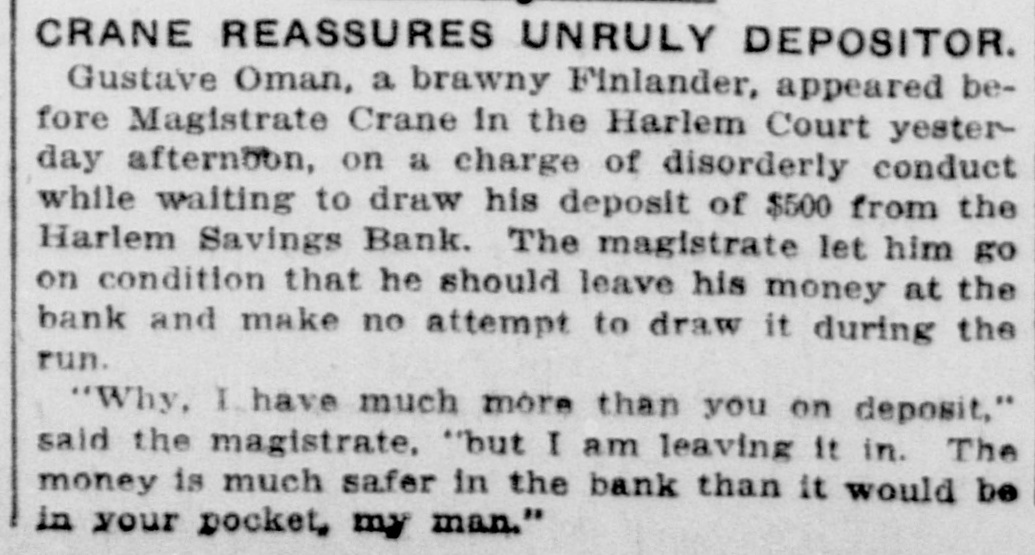
CRANE REASSURES UNRULY DEPOSITOR. Gustave Oman, a brawny Finlander, appeared before Magistrate Crane in the Harlem Court yesterday afternoon, on a charge of disorderly conduct while waiting to draw his deposit of $500 from the Harlem Savings Bank. The magistrate let him go on condition that he should leave his money at the bank and make no attempt to draw it during the run. "Why, I have much more than you on deposit," said the magistrate, "but I am leaving It in. The money is much safer in the bank than it would be in your pocket, my man."


Article from New-York Tribune, October 26, 1907

Click image to open full size in new tab

Article Text

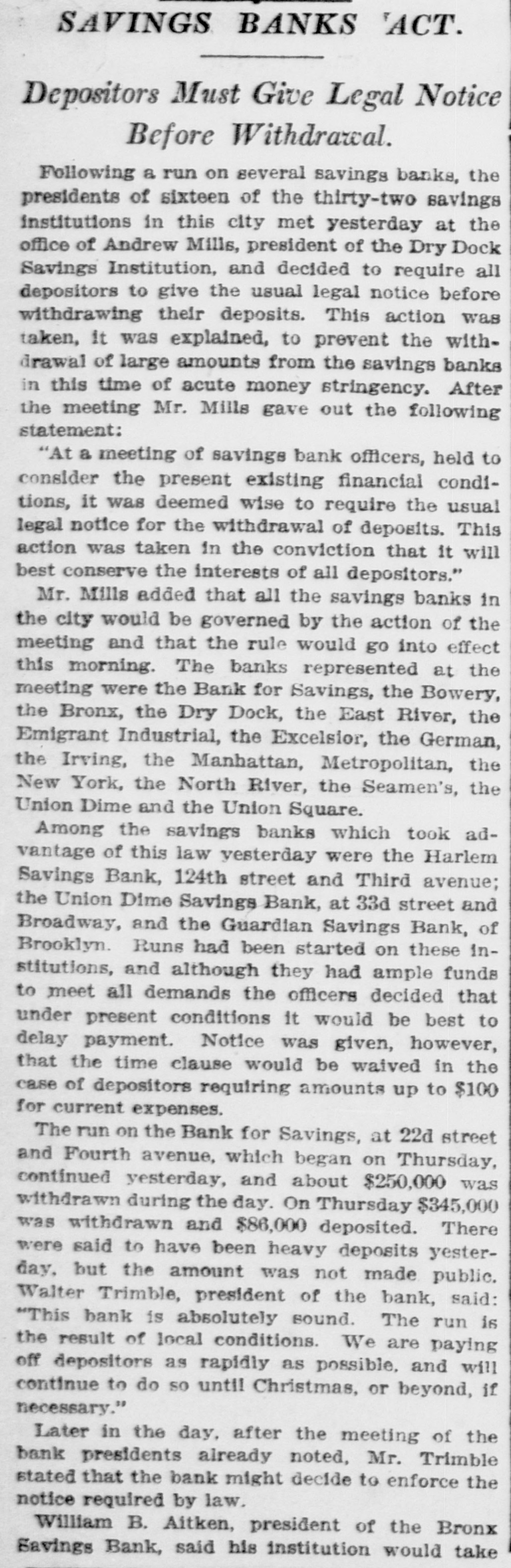
SAVINGS BANKS 'ACT. Depositors Must Give Legal Notice Before Withdrawal. Following a run on several savings banks, the presidents of sixteen of the thirty-two savings institutions in this city met yesterday at the office of Andrew Mills, president of the Dry Dock Savings Institution, and decided to require all depositors to give the usual legal notice before withdrawing their deposits. This action was taken, it was explained, to prevent the withdrawal of large amounts from the savings banks in this time of acute money stringency. After the meeting Mr. Mills gave out the following statement: "At a meeting of savings bank officers, held to consider the present existing financial conditions, it was deemed wise to require the usual legal notice for the withdrawal of deposits. This action was taken in the conviction that it will best conserve the interests of all depositors." Mr. Mills added that all the savings banks in the city would be governed by the action of the meeting and that the rule would go into effect this morning. The banks represented at the meeting were the Bank for Savings, the Bowery, the Bronx, the Dry Dock, the East River, the Emigrant Industrial, the Excelsior, the German, the Irving, the Manhattan, Metropolitan, the New York, the North River, the Seamen's, the Union Dime and the Union Square. Among the savings banks which took advantage of this law yesterday were the Harlem Savings Bank, 124th street and Third avenue; the Union Dime Savings Bank, at 33d street and Broadway, and the Guardian Savings Bank, of Brooklyn. Runs had been started on these institutions, and although they had ample funds to meet all demands the officers decided that under present conditions it would be best to delay payment. Notice was given, however, that the time clause would be waived in the case of depositors requiring amounts up to $100 for current expenses. The run on the Bank for Savings, at 22d street and Fourth avenue, which began on Thursday, continued yesterday, and about $250,000 was withdrawn during the day. On Thursday $345,000 was withdrawn and $86,000 deposited. There were said to have been heavy deposits yesterday, but the amount was not made public. Walter Trimble, president of the bank, said: "This bank is absolutely sound. The run is the result of local conditions. We are paying off depositors as rapidly as possible, and will continue to do so until Christmas, or beyond, if necessary." Later in the day. after the meeting of the bank presidents already noted, Mr. Trimble stated that the bank might decide to enforce the notice required by law. William B. Aitken, president of the Bronx Savings Bank, said his institution would take


Article from New-York Tribune, October 29, 1907

Click image to open full size in new tab

Article Text

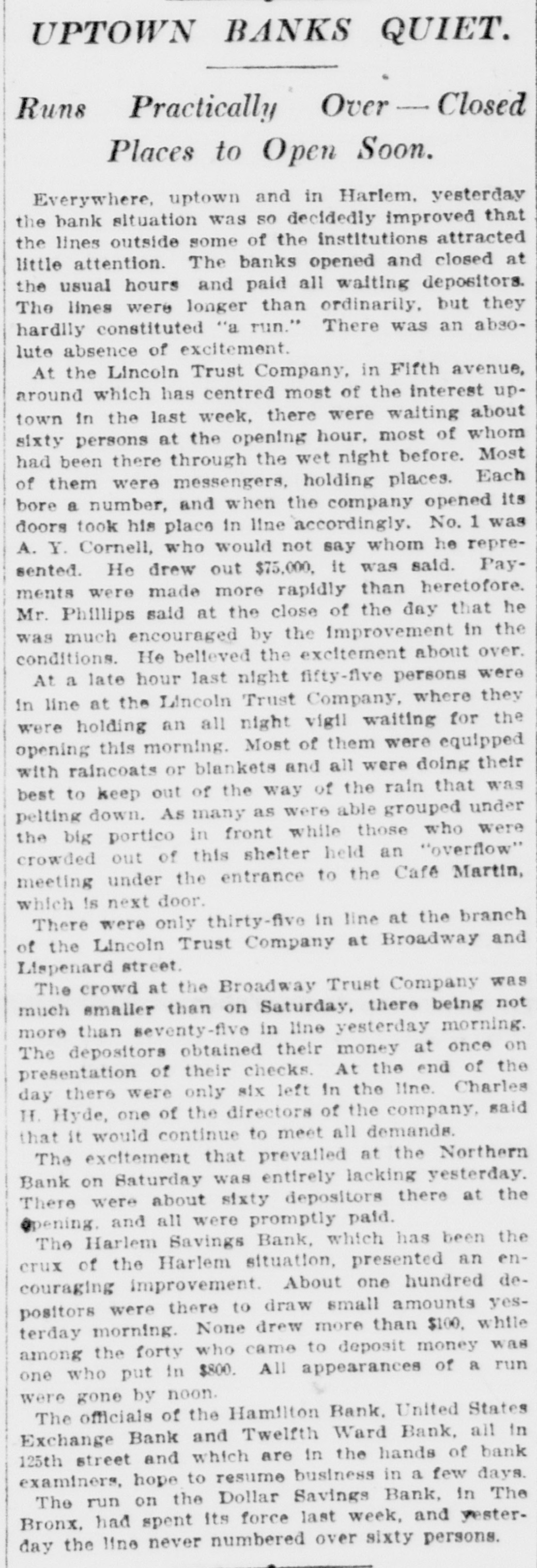
UPTOWN BANKS QUIET. Runs Practically Over - Closed Places to Open Soon. Everywhere, uptown and in Harlem. yesterday the bank situation was so decidedly improved that the lines outside some of the institutions attracted little attention. The banks opened and closed at the usual hours and paid all waiting depositors. The lines were longer than ordinarily, but they hardlly constituted "a run." There was an absolute absence of excitement. At the Lincoln Trust Company, in Fifth avenue, around which has centred most of the interest uptown in the last week, there were waiting about sixty persons at the opening hour, most of whom had been there through the wet night before. Most of them were messengers, holding places. Each bore a number, and when the company opened its doors took his place in line accordingly. No. 1 was A. Y. Cornell, who would not say whom he represented. He drew out $75,000. it was said. Payments were made more rapidly than heretofore. Mr. Phillips said at the close of the day that he was much encouraged by the improvement in the conditions. He believed the excitement about over. At a late hour last night fifty-flve persons were in line at the Lincoln Trust Company, where they were holding an all night vigil waiting for the opening this morning. Most of them were equipped with raincoats or blankets and all were doing their best to keep out of the way of the rain that was pelting down. As many as were able grouped under the big portico in front while those who were crowded out of this shelter held an "overflow" meeting under the entrance to the Cafe Martin, which is next door. There were only thirty-five in line at the branch of the Lincoln Trust Company at Broadway and Lispenard street. The crowd at the Broadway Trust Company was much emailer than on Saturday, there being not more than seventy-five in line yesterday morning. The depositors obtained their money at once on presentation of their checks. At the end of the day there were only six left In the line. Charles H. Hyde, one of the directors of the company, said that it would continue to meet all demands. The excitement that prevailed at the Northern Bank on Saturday was entirely lacking yesterday. There were about sixty depositors there at the pening. and all were promptly paid. The Harlem Savings Bank, which has been the crux of the Harlem situation, presented an encouraging improvement. About one hundred depositors were there to draw small amounts yesterday morning. None drew more than $100. while among the forty who came to deposit money was one who put in $800. All appearances of a run were gone by noon. The officials of the Hamilton Bank. United States Exchange Bank and Twelfth Ward Bank, all in 125th street and which are in the hands of bank examiners, hope to resume business in a few days. The run on the Dollar Savings Bank, in The Bronx. had spent its force last week, and yesterday the line never numbered over sixty persons.


Article from New-York Tribune, October 30, 1907

Click image to open full size in new tab

Article Text

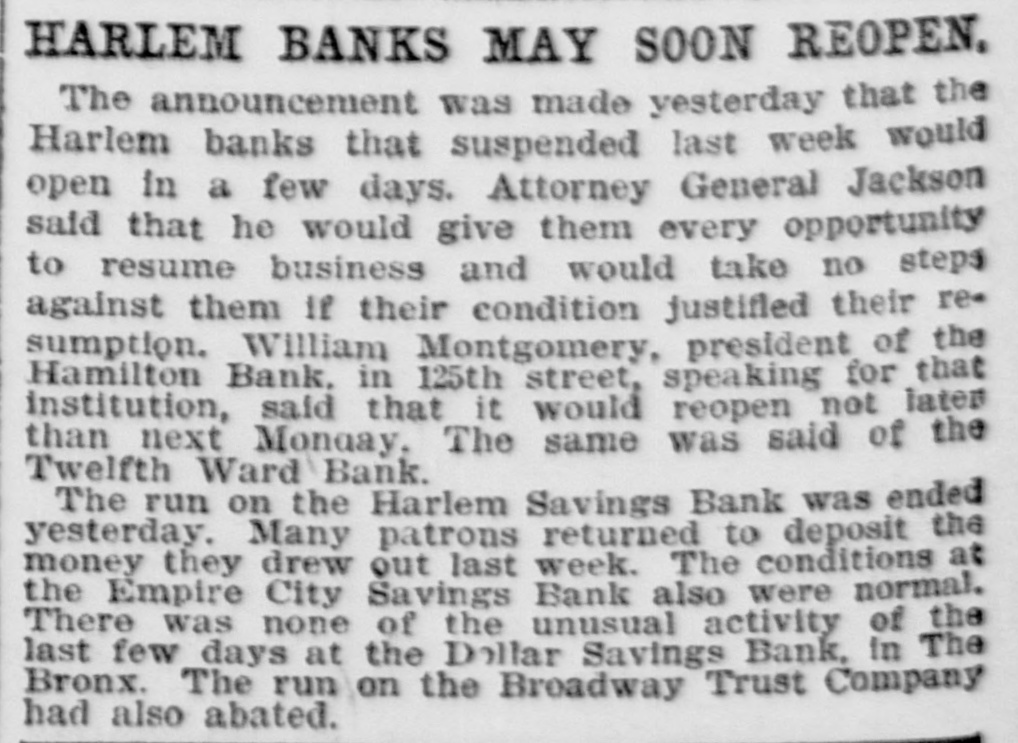
HARLEM BANKS MAY SOON REOPEN. The announcement was made yesterday that the Harlem banks that suspended last week would open in a few days. Attorney General Jackson said that he would give them every opportunity to resume business and would take no steps against them If their condition justifled their resumption. William Montgomery, president of the Hamilton Bank, in 125th street, speaking for that institution, said that it would reopen not later than next Monday, The same was said of the Twelfth Ward Bank. The run on the Harlem Savings Bank was ended yesterday. Many patrons returned to deposit the money they drew out last week. The conditions at the Empire City Savings Bank also were normal. There was none of the unusual activity of the last few days at the Dollar Savings Bank, in The Bronx. The run on the Broadway Trust Company had also abated.


Article from The Washington Herald, November 10, 1907

Click image to open full size in new tab

Article Text

PROPINQUITY STARTS A RUN. Mistake of Caption Writer Also Gives Harlem Bank Trouble. One of the runs of the period that has just gone into history. that on the Dollar Savings Bank, in The Bronx, had a haphazard start. Its banking house was next to the Bronx branch of the Knickerbocker Trust. When that closed its doors the rum spread that the savings bank was in trouble. Propinquity, in this case, says the New York Tribune, caused the Dollar Bank people no end of trouble for five days, but they weathered the storm nobly. This run, with the aid of a careless caption writer on a morning newspaper, caused a vigorous run on the Harlem Savings Bank, one of the oldest and stanchest institutions above One Hundredth street. The newspaper, in describing a photograph of a run on the Dollar Bank, in The Bronx, said that depositors were raiding a Harlem savings bank. That was enough for the foreign born element among the depositors, and they swooped down for their savings. Foreign-born depositors predominate at both these banks, and the runs became lines of all nations. They were more picturesque than those of the trust company depositors. They jabbered their troubles to the housetops. The women cried or laughed altérnately in a money fear hysteria. One and all besought policemen and reporters to slip them into the bank ahead of the rest. Many of this foreign crowd were so excited that they would accept nothing but gold in return for their much fingered passbooks. Some even went SO far as to test each piece by biting it. The sad part of it is that all who withdrew lost four months' interest, and for no reason in the world, for at no time were the savings banks in danger. The overnight runners who kept a long vigil in front of the Lincoln, the Colonial, and the Trust Company of America several nights had various ways of passing the time. Some brought campstools, and all laid in a supply of provisions. A drenching ran came down on them to add to their woe. But almost simultáneous with the storm there drifted into view of the line a vender of second-hand umbrellas. The bank runnérs bought him out,