Article Text
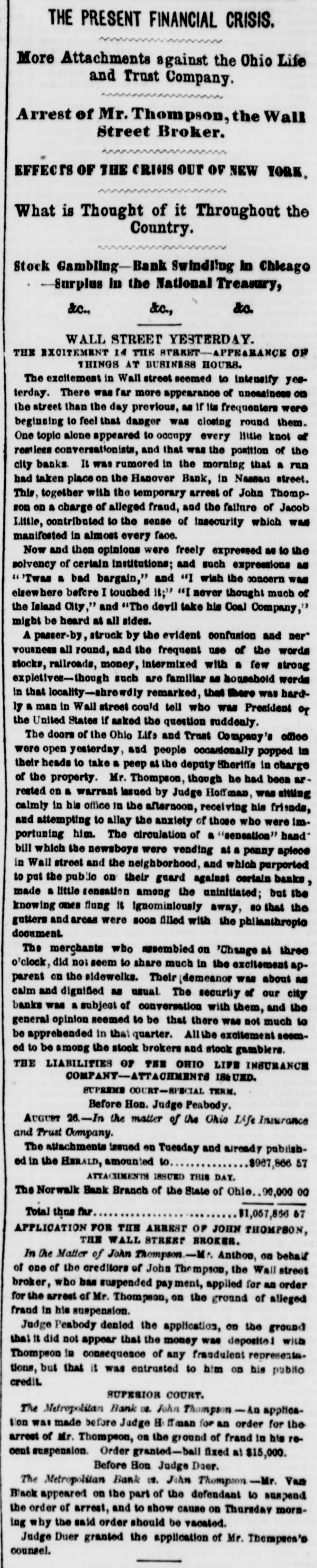
THE PRESENT FINANCIAL CRISIS. More Attachments against the Ohio Life and Trust Company. Arrest of Mr. Thompson, the Wall Street Broker. EFFECTS OF THE CRICIS our OF NEW YORK, What is Thought of it Throughout the Country. Stock Gambling-Bank Swindling in Chieago Surplus in the National Treasury, do. &c., &c., WALL STREET YESTERDAY. THE EXCITEMENT IN THE STREET-APPEARANCE OF THINGS AT BUSINESS HOURS. The excitement in Wall street seemed to intensify yesterday. There was far more appearance of uneasiness on the street than the day previous, as If its frequenters were beginning to feel that danger was closing round them. One topic alone appeared to occupy every little knot of resuless conversationists, and that was the position of the city banks. It was rumored in the morning that a run had taken place on the Hanover Bank, in Nassau street. This, together with the temporary arrest of John Thompson on a charge of alleged fraud, and the failure of Jacob Little, contributed to the sense of insecurity which was manifested in almost every face. Now and then opinions were freely expressed as to the solvency of certain institutions; and such expressions MI 'Twas a bad bargain," and "I wish the concern was elsewhere before I touched it;" "I never thought much of the Island City," and "The devil take his Coal Company," might be heard at all sides. A passer-by, struck by the evident confusion and ner" vousness all round, and the frequent use of the words stocks, railroads, money, intermixed with a few strong expletives-though such are familiar as household words in that locality-shrewdly remarked, that there was hardly a man in Wall street could tell who was President or the United States if asked the question suddenly. The doors of the Ohio Life and Trust Company's office were open yesterday, and people occasionally popped in their heads to take a peep at the deputy Sheriffs in charge of the property. Mr. Thompson, though he had been arrested on a warrant issued by Judge Hoffman, was sitting calmly in his office in the afternoon, receiving his friends, and attempting to allay the anxiety of those who were Importuning him. The circulation of a "sensation" handbill which the newsboys were vending at a penny aplece in Wall street and the neighborhood, and which purported to put the public on their guard against certain banks, made a little sensation among the uninitiated; but the knowing ones flung It Ignominiously away, so that the gutters and areas were soon filled with the philanthropic document. The merchants who assembled on 'Change at three o'clock, did not seem to share much in the excitement apparent on the sidewelks. Their [demeanor was about as calm and dignified as usual. The security of our city banks was a subject of conversation with them, and the general opinion seemed to be that there was not much to be apprehended in that quarter. Allihe excitement seemed to be among the stock brokers and stock gamblers. THE LIABILITIES OF TEE OHIO LIFE INSURANCE COMPANY-ATTACHMENTS IS&UED. SUPREME COURT-SPECIAL TERM. Before Hon. Judge Peabody. AUGUST 26.-In the matter of the Ohio Life Insurance and Trust Company. The attachments issued en Tuesday and already published in the HERALD, amounted to $987,866.57 ATTACHMENTS ISSUED THIS DAY. The Norwalk Bank Branch of the State of Ohio 90,000 00 Total thus far $1,057,866 67 APPLICATION FOR THE ARREST OF JOHN THOMPSON, THE WALL STREET BROKER. In the Matter of John Thompson.-M. Anthon, on behalf of one of the creditors of John Thompson, the Wall street broker, who bas suspended payment, applied for an order for the arrest of Mr. Thompson, on the ground of alleged fraud in his suspension. Judge Peabody denied the application, on the ground that it did not appear that the money was deposite with Thompson in consequence of any fraudulent representstions, but that it was entrusted to him on his public credit. SUPERIOR COURT. The Metropolitan Bank us. John Thompson.-An application was made before Judge H ffman for an order for the arrest of Mr. Thompson, on the ground of frand in his recent suspension. Order granted-ball fixed at $15,000. Before Hon Judge Duer. The Metropolitan Bank US. John Thompson.-Mr. Van Black appeared on the part of the defendant to suspend the order of arrest, and to show cause on Thursday morning why the said order should be vacated. Judge Duer granted the application of Mr. Thempson's counsel.