14007. Hackensack Bank (Hackensack, NJ)

Bank Information

Episode Type
Suspension → Closure
Bank Type
state
Start Date
November 20, 1879
Location
Hackensack, New Jersey (40.886, -74.043)

Metadata

Model
gpt-5-mini
Short Digest
a94bd50b

Response Measures

None

Description

Articles from Nov 20, 1879 report severe impairment of capital under President C.H. Voorhis, stockholders expected to vote to let the institution go into voluntary liquidation and the Comptroller threatening to place it in the hands of a receiver. No run or depositor panic is described; outcome is liquidation/closure.

Events (1)

1. November 20, 1879 Suspension
Cause
Voluntary Liquidation
Cause Details
Stockholders expected to vote to let the bank go into voluntary liquidation because of large losses and impaired capital; Comptroller threatens receiver if not wound up promptly
Newspaper Excerpt
a resolution will probably be adopted, it is said, to let the institution go into voluntary liquidation. The Controller of the Currency insists upon speedy action in the matter, and if the officers and stockholders do not come to some decision Saturday he will appoint a receiver
Source
newspapers

Newspaper Articles (2)

Article from The New York Herald, November 20, 1879

Click image to open full size in new tab

Article Text

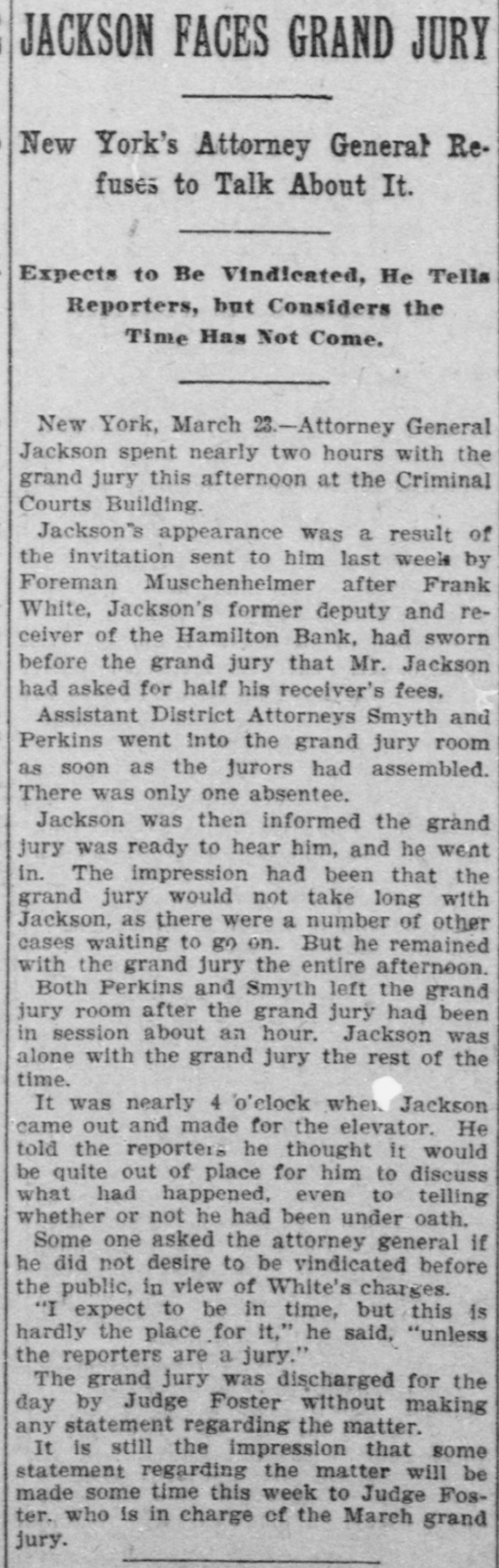
BANKER AND CONGRESSMAN. MR. VOORHIS' MANAGEMENT OF A NEW JERSEY FINANCIAL INSTITUTION-COUNTING THE LOSSES. An adjourned meeting of the stockholders of the Hackensack Bank, of which Congressman Charles H. Voorhis was president, was held in the bank building yesterday. At the last meeting Mr. S. E. De Groote and Mr. John Swinburne, cashier of the First National Bank of Paterson, were appointed as a com. mittee to examine into the affairs of the bank, and it was principally to hear their report that yesterday's meeting was called. Mr. Voorhis' liabilities are now set down at about $250,000, with but few available assets. The committee reported that out of $131,00 loans and discounts made under Voorhis' presidency $81,000 are totally worthless, $30,000 doubtful and the balance available. On the list of liabilities and pad debts are to be found the following:-Charles H. Voorhis, executor of Tallman estate, $11,000, the estate never being considered worth more than $6,000; $10,000 in promissory notes signed by Mr. Voorhis' wife, total loss; Mr. Voorhis' own notes for $9,000, indorsed by himself and secured by stock of the defunet Union Bank, also a total loss; notes of the Hackensack Water Company, which is owned and controlled by Voorhis, amounting to nearly $20,000, and judgment against I. S. Christie, amounting to $9,400. utterly worthless. These and other small debts make up the sum of $80,000. There were also discovered over drafts, made upon the bank by Voor. his' friends amounting to $9,000, which are hopelessly bad; Voorhis' personal overdrafts sum up $6,000; Hackensack Water Company overdrafts, $1,800, and C. H. Voorhis, executor, $500. It is also reported that the Third National Bank of New York holds a note of $10,000 drawn by the Hackensack Water Company, indorsed by C. H. Voorhis as President, and for which the Hackensack Bank is liable. The committee presented three schedules to the stockholders for their consideration. The first exhibited the impairment which would have to be made good if the old capital of $100,000 was retained-viz,, seventy-three per cent or $73,000, Schedule No. 2 represented the amount to be paid in by stockholders in the event of a reduction of capital to $50,000-viz., forty-three per cent. Schedule No. 3. showed the amount to be expected by the stockholders, should the bank go into liquidation-viz,, twenty-five per cent. Of the 534 shares of the bank stock owned originally by Mr. Voorhis all of it has been hypothecated with New York and Jersey City banks, the holders of which refuse to become owners, as by doing so they, under the National Banking law, would be responslble fo: the liabilities of the bank. NO BOND. It was also discovered by the committee that, notwithstanding one of the laws of the Hackensack Bank explicitly states that the president should give a bond in the sum of $10,000, no such document was ever executed. This also reduces the securities from which the stockholders might possibly realize something. Several bank presidents, among others Mr. Jordan, of New York, and Mr. Young, of Jersey City, upon examining the schedules, refused to have anything further to do with the matter and expressed their entire willingness to let the bank go into liquidation. A communication was read at the meeting from the Comptroller of the Currency to the effect that if the affairs of the bank were not speedily wound up he would place it in the hands of a receiver. The Hackensack Savings Bank, which is simply an offshoot of the bank proper will, it it is thought probable, also go into liquidation. The meeting was adjourned until Saturday morning, when it is expected that some conclusive action will be taken by the stockholders. Mr. Voorhis still remains in Hackensack, but is seldom seen outside of his residence and refuses to converse upon the subject of his bankruptcy.


Article from New-York Tribune, November 20, 1879

Click image to open full size in new tab

Article Text

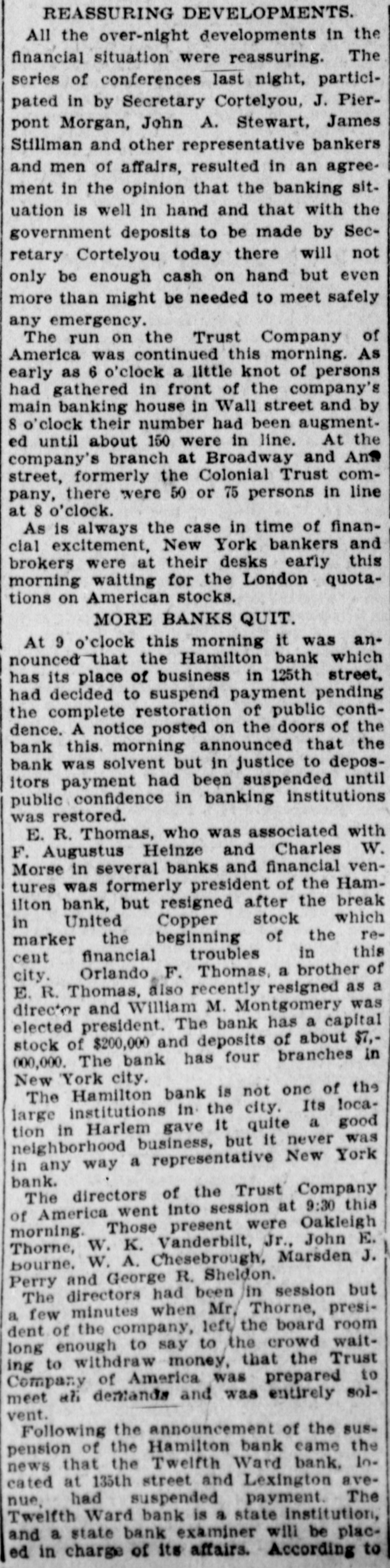
Present Original Item. Value. Amount. $3,000 $11,000 Charles H. Voorhis (executor) None. 10,000 Mrs. Charles H. Voorhis (notes) 1,064 9,000 Charles H. Voorbis (notes) None. 18,853 Hackensack Water Co. (notes) None. 9,400 J.S. Christic (judgment) In addition to these heavy items, there are overdrafts of Mr. Voorhis for $9,000. The committee has been informed by the cashier of the Third National Bank of this city that his bank holds a note of the Hackensack Water Company, the stock of which was almost exclusively owned by Mr. Voorhis, for $10,000, which had been indorsed by Mr. Voorhis as the president of the Hackensack Bank, and that the latter institution is hable for the full amount. The|Hackensack Bank also holds overdrafts of the Hackensack Water Company for $1,800. The committee presented three propositions. As the total impairment of the capital 18 $73,000, and in order to keep the stock at $100,000 the amount of the impairment must be made good at once. C. N. Jordan, the cashier of the Third National Bank of this city E. F. C. Young, the president of the First National Bank of Jersey City, and others who had offered to help reorganize the bank, at once stated that they would not now attempt to build it up, as it was in too bad a condition. The second proposition was to reduce the bank's capital to $50,000. and put in enough money to cover the deficiency below that sum. The third proposition was one to let the institution go into voluntary liquidation. After paying the necessary expenses it was estimated that the stockholders would receive about 25 per cent of their original subscription. Mr. Voorhis held 534 shares of the stock of the bank, and at the time of his suspension this stock was held by banks in this city and Jersey City as security for loans made to him. A meeting of the stockholders of the bank will be held Saturday morning when a resolution will probably be adopted, it is said, to let the institution go into volantary liquidation. The Controller of the Currency insists upon speedy action in the matter, and if the officers and stockholders do not come to some detision Saturday he will appoint a receiver, it is stated, to wind up its affairs, By the rules of the bank the president should give a bond for the sum of $10,000, but this was never done by Mr. Voorbis. The liabilities of Congressman Voorhis will nov. sxceed $250,000 or $260,000. Mr. Voorbis's health has improved, but he remains quietly at his home in the village and only sees his most intimate friends. No further criminal proceedings have been begun against him.