14005. Guardian Savings Institution (New York, NY)

Bank Information

Episode Type
Run β†’ Suspension β†’ Reopening
Bank Type
savings bank
Start Date
November 18, 1871
Location
New York, New York (40.714, -74.006)

Metadata

Model
gpt-5-mini
Short Digest
89d47661f5d20a0c

Response Measures

None

Description

Multiple contemporaneous reports (Nov 18, 1871) describe a crowd, inability to pay a presented $70,000 check, and a run/rumors around Tweed. The bank suspended and a receiver (Quinlan) was appointed. Receiver later arranged to resume payments by Feb 1, 1872 and dividends/payments to depositors were reported, so the episode is best classified as a run leading to suspension with subsequent resumption of payments under receivership. 'Random misinformation' is not flagged: accounts describe rumors and political scandal rather than a clearly described false telegram or corrected misreport.

Events (3)

1. November 18, 1871 Run
Cause
Rumor Or Misinformation
Cause Details
Large unexpected presentation of a $70,000 check combined with rapid circulation of rumors about failure and the bank's association with William M. Tweed triggered heavy withdrawals and a crowd.
Measures
Officials overhauled books; later placed bank in hands of receiver; assurances by trustees and offers of real-estate security to meet demands.
Newspaper Excerpt
About noon yesterday somebody presented a check for $70,000, which could not be honored...a crowd was soon collected...the rumor spreading like wildfire
Source
newspapers
2. November 18, 1871 Suspension
Cause
Rumor Or Misinformation
Cause Details
Suspension occurred the same day as the run/rumors and inability to meet a large check; a receiver was appointed (Jeremiah Quinlan/Quinlan).
Newspaper Excerpt
The Guardian Savings Bank...has suspended and a receiver been appointed. Judge Barnard has appointed Jeremiah Quinian receiver of the Guardian Savings Bank, on Chatham-st.
Source
newspapers
3. February 1, 1872 Reopening
Newspaper Excerpt
The Guardian Savings Bank to resume payments by Feb. 1...Receiver Quinlan ... says they will be able to resume payment by Feb. 1. ...depositors will not lose a dollar, ...pay all the smaller depositors in full; give others a dividend of 50 per cent.
Source
newspapers

Newspaper Articles (24)

Article from New-York Tribune, November 18, 1871

Click image to open full size in new tab

Article Text

SUSPENSION OF PAYMENT BY A SAVINGS BANK. Judge Barnard has appointed Jeremiah Quinian receiver of the Guardian Savings Bank, on Chatham-st., of which William M. Tweed is President. The affairs of the bank will probably have to be wound up, but it has ample securities, and all its depositors will be paid within 60 days.


Article from Public Ledger, November 18, 1871

Click image to open full size in new tab

Article Text

NEW YORK. No Cholera Epidemie Apprehended -Suspension of Tweed's BankBank Robbery. NEW YORK, November 18.-There were two additional deaths from cholera at the quarantine hospital yesterday, the victims being the children of emigrants. There appears at present to be no reason to apprehend the spread of the disease. The majority of those now ill are in a condition favorable to recovery. The Guardian Savings Bank, of which Tweed is President, has suspended and a receiver been appointed. The Bank has ample securities and depositors will be paid. The Union Trust Company, No. 73 Broadway, was robbed last night, just after bank hours, in a most-daring manner. A little after 3 o'clock, just when the clerks were busy, two respectablelooking strangers entered and asked for Mr. Frothingham, the president. They were directed to his room and were admitted by Mr. Frothingham in person. One stated that his name was Edwards, and wished to borrowthree or four thousdollars. While he and the president were engaged in settling the preliminaries of the loan, his companion slipped into an adjoining room and seized one hundred bonds of one thousand dollars each of the Monticello Company, lying on the desk. Shortly after they left suspicion arising, Mr. Frothingham dispatched an officer after the strangers, and the one named Edwards was secured, but the other escaped. The bonds stolen cannot be negotiated, as notice has been given by the president of the company, but ignorant persons might buy them. The Tribune is authority for the statement that it is asserted in well-informed circles that Tweed handed his resignation to Mayor Hall. At a late interview between Tweed and Sweeney, on the 8th inst. Mr. Francis M. Bixby is said to have been chosen by Tweed as his successor. It is announced this morning that District Attorney Garvin has resolved to take part in the prosecution of James Fisk, jr., in the suit instituted by Miss Mansfield. The charge is a criminal one.


Article from The New York Herald, November 18, 1871

Click image to open full size in new tab

Article Text

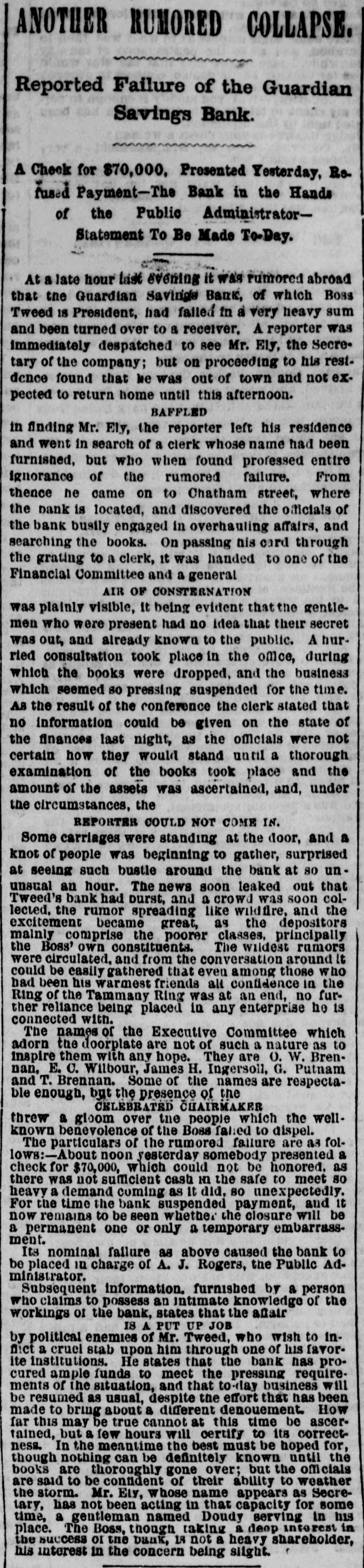
ANOTHER RUMORED COLLAPSE. Reported Failure of the Guardian Savings Bank. A Check for $70,000, Presented Yesterday, Refused Payment-The Bank in the Hands of the Public AdministratorStatement To Be Made To-Day. At late hour last evening it was rumored abroad that the Guardian Savings Bank, of which Boss Tweed IS President, had falled in a very heavy sum and been turned over to a receiver. A reporter was immediately despatched to see Mr. Ely, the Secretary of the company; but on proceeding to his restdence found that we was out of town and not expected to return home until this afternoon. BAFFLED in finding Mr. Ely, the reporter left his residence and went in search of a clerk whose name had been furnished, but who when found professed entire ignorance of the rumored failure. From thence he came on to Chatham street, where the bank is located, and discovered the officials of the bank busily engaged in overhauling affairs, and searching the books. On passing his card through the grating to a clerk, it was handed to one of the Financial Committee and a general AIR OF CONSTERNATION was plainly visible, it being evident that the gentlemen who were present had no idea that their secret was out, and already known to the public. A hurried consultation took place in the ofclce, during which the books were dropped, and the business which seemed so pressing suspended for the time. As the result of the conference the clerk stated that no information could be given on the state of the finances last night, as the officials were not certain how they would stand until a thorough examination of the books took place and the amount of the assets was ascertained, and, under the circumstances, the REPORTER COULD NOT COME IN. Some carriages were standing at the door, and a knot of people was beginning to gather, surprised at seeing such bustle around the bank at so ununsual an hour. The news soon leaked out that Tweed's bank had Durst, and a crowd was soon collected. the rumor spreading like wildfire, and the excitement became great, as the depositors mainly comprise the poorer classes, principally the Boss' own constituents. The wildest ramors were circulated, and from the conversation around it could be easily gathered that even among those who bad been his warmest friends all confidence in the Ring of the Tammany Ring was at an end, no further reliance being placed in any enterprise he is connected with. The names of the Executive Committee which adorn the doorplate are not of such a nature as to inspire them with any hope. They are O. W. Brennan, E. C. Wilbour, James H. Ingersoil, G. Putnam and T. Brennan. Some of the names are respectable enough, but the presence of the CELEBRATED CHAIRMAKER threw a gloom over tne people which the wellknown benevolence of the Boss falled to dispel. The particulars of the rumored failure are as follows:-About noon yesterday somebody presented a check for $70,000, which could not be honored, as there was not sufficient cash in the safe to meet so heavy a demand coming as it did, so unexpectedly. For the time the bank suspended payment, and it now remains to be seen whether the closure will be a permanent one or only a temporary embarrassment. Its nominal failure as above caused the bank to be placed in charge of A. J. Rogers, the Public Administrator. Subsequent information. furnished by a person who claims to possess an intimate knowledge of the workings of the bank. states that the affair IS A PUT UP JOB by political enemies of Mr. Tweed, who wish to innict a cruel stab upon him through one of his favorite institutions. He states that the bank has procured ample funds to meet the pressing requirements of the situation, and that to-day business will be resumed as usual, despite the effort that has been made to bring about a different denouement. How far this may be true cannot at this time be ascertained, but a few hours will certify to its correctness. In the meantime the best must be hoped for, though nothing can be definitely known until the books are thoroughly gone over; but the officials are said to be confident of their ability to weather the storm. Mr. Ety, whose name appears as Secrelary, has not been acting in that capacity for some time, a gentleman named Doudy serving in his place. The Boss. though taking a deep interest in the success or the bank, 18 not a heavy shareholder, his interest in the concern being slight.


Article from Knoxville Daily Chronicle, November 19, 1871

Click image to open full size in new tab

Article Text

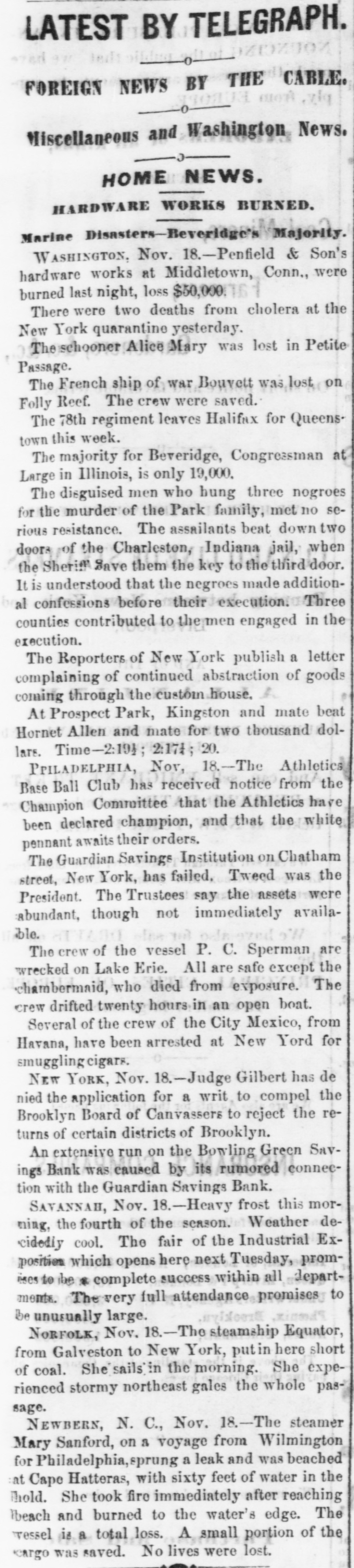
LATEST BY TELEGRAPH. -0 FOREIGN NEWS BY THE CABLE. o Miscellaneous and Washington News. J HOME NEWS. HARDWARE WORKS BURNED. Marine Disasters-Beveridge's Majority. WASHINGTON, Nov. 18.-Penfield & Son's hardware works at Middletown, Conn., were burned last night, loss $50,000. There were two deaths from cholera at the New York quarantine yesterday. The schooner Alice Mary was lost in Petite Passage. The French ship of war Bouvett was lost on Folly Reef. The crew were saved. The 78th regiment leaves Halifax for Queenstown this week. The majority for Beveridge, Congressman at Large in Illinois, is only 19,000. The disguised men who hung three nogroes for the murder of the Park family, met no serious resistance. The assailants beat down two doora of the Charleston, Indiana jail, when the Sheriff Save them the key to the third door. It is understood that the negroes made additional confessions before their execution. Three counties contributed to the men engaged in the execution. The Reporters of New York publish a letter complaining of continued abstraction of goods coming through the custom house, At Prospect Park, Kingston and mate beat Hornet Allen and mate for two thousand dollare. Time-2:19}; 2:17: 20. PPILADELPHIA, Nov, 18.-The Athletics Base Ball Club has received notice from the Champion Committee that the Athletics have been declared champion, and that the white pennant awaits their orders. The Guardian Savings Institution on Chatham street, New York, has failed. Tweed was the President. The Trustees say the assets were abundant, though not immediately available. The crew of the vessel P. C. Sperman are wrecked on Lake Erie. All are safe except the chambermaid, who died from exposure. The crew drifted twenty hours in an open boat. Several of the crew of the City Mexico, from Havana, have been arrested at New Yord for smuggling cigars. NEW YORK, Nov. 18.-Judge Gilbert has de nied the application for a writ to compel the Brooklyn Board of Canvassers to reject the returns of certain districts of Brooklyn. An extensive run on the Bowling Green Savings Bank was caused by its rumored connection with the Guardian Savings Bank. SAVANNAH, Nov. 18.-Heavy frost this morming, the fourth of the season. Weather decidedly cool. The fair of the Industrial Exposition which opens here next Tuesday, promèses the 8 complete success within all departments. The very full attendance promises to be unusually large. NORFOLK, Nov. 18.-The steamship Equator, from Galveston to New York, putin here short of coal. She sails' in the morning. She experienced stormy northeast gales the whole passage. NEWBERN, N. C., Nov. 18.-The steamer Mary Sanford, on a voyage from Wilmington for Philadelphia, sprung a leak and was beached at Cape Hatteras, with sixty feet of water in the hold. She took fire immediately after reaching beach and burned to the water's edge. The vessel is a total loss. A small portion of the cargo was saved. No lives were lost.


Article from Nashville Union and American, November 19, 1871

Click image to open full size in new tab

Article Text

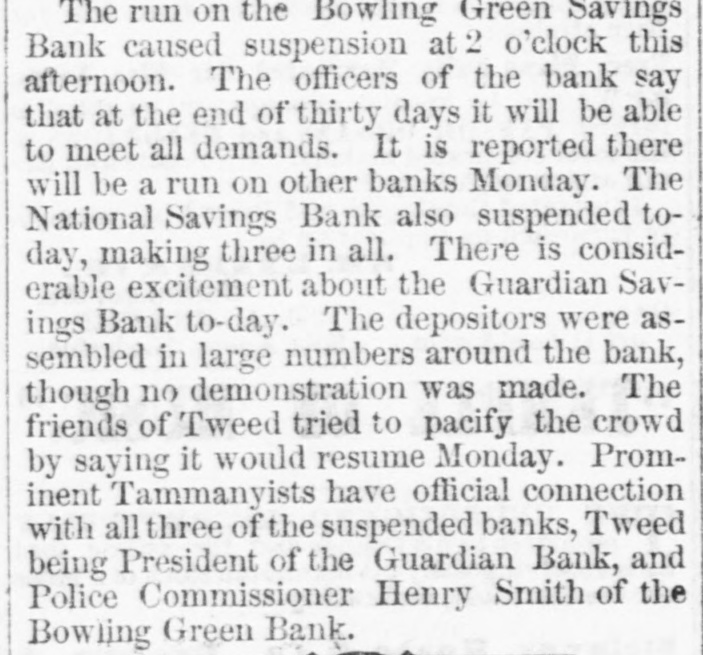
The run on the Bowling Green Savings Bank caused suspension at 2 o'clock this afternoon. The officers of the bank say that at the end of thirty days it will be able to meet all demands. It is reported there will be a run on other banks Monday. The National Savings Bank also suspended today, making three in all. There is considerable excitement about the Guardian Savings Bank to-day. The depositors were assembled in large numbers around the bank, though no demonstration was made. The friends of Tweed tried to pacify the crowd by saying it would resume Monday. Prominent Tammanyists have official connection with all three of the suspended banks, Tweed being President of the Guardian Bank, and Police Commissioner Henry Smith of the Bowling Green Bank.


Article from Evening Star, November 20, 1871

Click image to open full size in new tab

Article Text

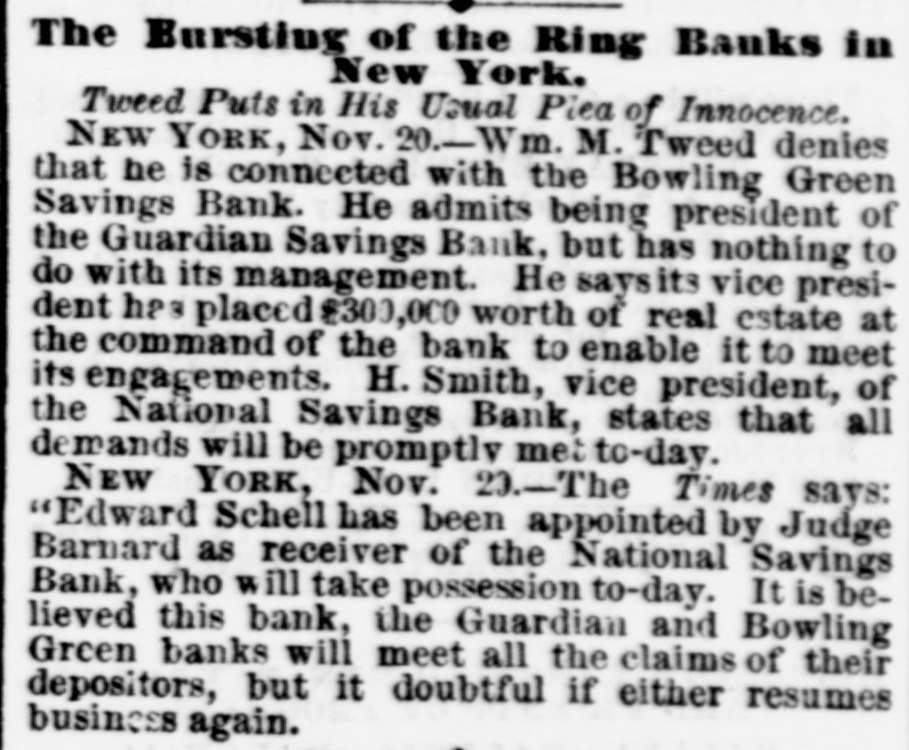
The Bursting of the Ring Banks in New York. Tweed Puts in His Usual Piea of Innocence. NEW YORK, Nov. 20.-Wm. M. Tweed denies that he is connected with the Bowling Green Savings Bank. He admits being president of the Guardian Savings Bank, but has nothing to do with its management. He says its vice president has placed $300,000 worth of real estate at the command of the bank to enable it to meet its engagements. H. Smith, vice president, of the National Savings Bank, states that all demands will be promptly met to-day. NEW YORK, Nov. 23.-The Times says: "Edward Schell has been appointed by Judge Barnard as receiver of the National Savings Bank, who will take possession to-day. It is believed this bank, the Guardian and Bowling Green banks will meet all the claims of their depositors, but it doubtful if either resumes business again.


Article from The Wheeling Daily Intelligencer, November 20, 1871

Click image to open full size in new tab

Article Text

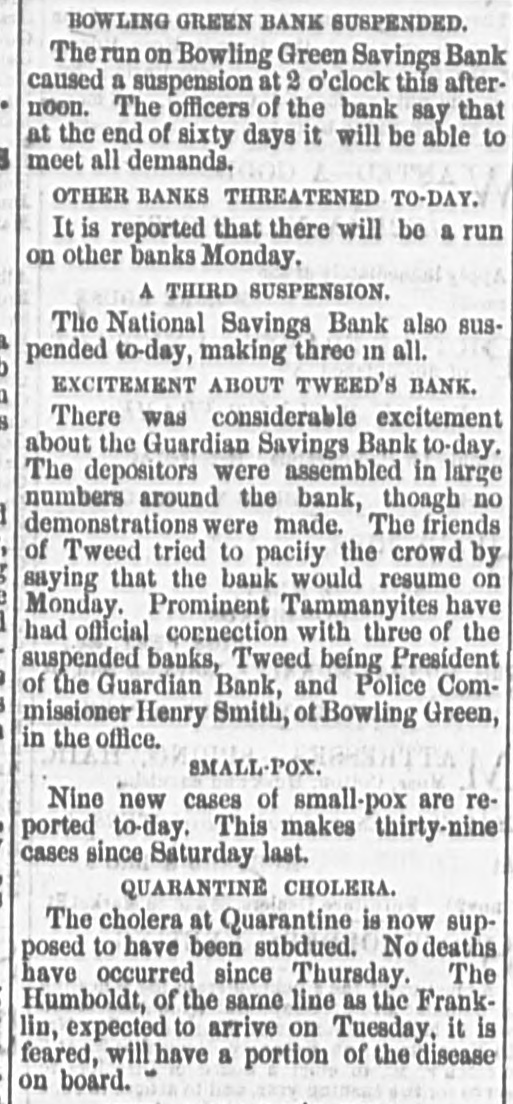
BOWLING GREEN BANK SUSPENDED. Therun on Bowling Green Savings Bank caused a suspension at 2 o'clock this afternoon. The officers of the bank say that at the end of sixty days it will be able to meet all demands. OTHER BANKS THREATENED TO-DAY. It is reported that there will be a run on other banks Monday. A THIRD SUSPENSION. The National Savings Bank also suspended to-day, making three in all. EXCITEMENT ABOUT TWEED'S BANK. There was considerable excitement about the Guardian Savings Bank to-day. The depositors were assembled in large numbers around the bank, though no demonstrations were made. The friends of Tweed tried to pacify the crowd by saying that the bank would resume on Monday. Prominent Tammanyites have had official connection with three of the suspended banks, Tweed being President of the Guardian Bank, and Police Commissioner Henry Smith, of Bowling Green, in the office. SMALL-POX. / Nine new cases of small-pox are reported to-day. This makes thirty-nine cases since Saturday last. QUARANTINE CHOLERA. The cholera at Quarantine is now supposed to have been subdued. No deaths have occurred since Thursday. The Humboldt, of the same line as the Franklin, expected to arrive on Tuesday. it is feared, will have a portion of the disease on board.


Article from The Wheeling Daily Intelligencer, November 20, 1871

Click image to open full size in new tab

Article Text

the late storm, Ten yesterday aircrhood, burying Charles Nelson, a laborer. Loss $15,000. e DIED FROM EATING HERRING. Barry died yesterday eating Patrick brought London, from by herrings from steam d ship Deventer, which had become im with arsenic, part of the The health are preguated cargo. the case. which authorities was investigating Several of the crew of the steamship City of Mexico were arrested for smuggling cigars from Havana. SUSPENSION OF A TWEED BANK. The Guardian Savings Bank has been placed in the hands of A.J. Rogers, Pub lic Administrator. It had long been known as Tweed's Bank, and had as Executive Committee, Owen Brennan, E. C. Wilber, James Ibgersoll, G. Putnam and Brennan. ART SALE FOR CHICAGO. The sale of the works of art for the of Chicago artists, is postponed till and importers in city of Clark benefit next & Monday Schultz, Tuesday attention this Messrs. a letter calling the community to ued of goods publish the mercantile abstraction coming the through contin- New the Custom House at Middletown, York The Superior Court has granted against the Roundout restraining ny from interfering with the Oswego two injunctions Railroad, stock the compa- of of the the road or from disposing in any way property. The charge is that the Directors have been guilty of misconduct. TWEED'S DEMURRER. Charles O'Conor says he has Tweed's very lit tle doubt that the demurrer of suit will be overruled. The German Republican Central Com- the mittee, last night resolved that in future they would throw their support ask the scale of public integrity. They repeal of the present city charter. NEW ELECTION LAW. to to The Committee of Seventy intend law present a draft of a new election the next Legislature for adoption. THE CHOLERA SHIP. The passengers on the cholera ship of Franklin, say that the breaking out disease was due to bad water, The unthe and lack of of coal on the steer cleanliness, insufliciency provisions. steamer the made to use the trunks of into port. age it necessary passengers for fuel, to bring her THE TURF. the Fleetwood Park yesterday, Grace in At for five hundred dollars, wagon, Bertain a match to harness, beat Topsy $500, to time 2:35: secend race for of Ages. was best William, beating 'Rock won by At Prospect Park, yesterday, Kingston 3:07) for $2,000, was won by and mate, match mate, beating Honest Allen time, and 2:19 2:17t, 2:181,2:00. JAY GOULD. the with yet*filed bond. Sheriff Jay Gould his withdrawal has not from Tweed's DEMAND FROM TWEED. Tweed has filed a demand his asking case that be for the trial of York. changed the place, from Albany to New At a meeting of the were Workingmen's given that last night notices withdraw, as Union trades unions would by politiseveral the association was being used cians. TWEED'S BANK COLLAPSED. Bank The WHY collapse owing of the to the Guardian withdrawal and by is Tweed rendering said to money of be a large deposited amount there, of the for city $70,000 the county bank unable to cash checks presented yesterday. EXCITEMENT ON LONG IBLAND. is great exeitement at Hunter's concernthe ing religious Point, V There L I., owing question to differences in the public schools Brooklyn this morning Judge the Gilbert Board In mandamus to compel election refused Canvassers 8 to reject the returns of the Sixth District appointtion Mayor Commissioner Hall has tendered of Public the place Instruc- of ment to of James W. Gerard, The in Mayor deIsaac C. he Bell, has resigned. Tweed's resignation. nies that ANOTHER TAMMANNY BANK Green RUN An extensive ON run on was the Bowling caused by its rumored Savings Bank connection to-day with the Guardian Savings MAYOR Bank HALL PLAYING reported IT about FINE. the It was currently that Henry Stebbins, Hall and Edwards City Pierrepont, today upon by Mayor Horace the Hall Greeley vacan- and were agreed Green for Hall Deputy Comptro Park Commission. Mayor the reformcies in the to ally himself with reform Dem ocrats ers, is seeking and to is accept trying the to get places some recently made vacant. TWEED'S RESIGNATION. The to the CONCERNING News, Ben. Wood's denying paper, that he has Tweed has handed says, in Eeening respect that Tweed's resignation Mayor's was his given resig "We Mr. on reiterate Mayor Hall. This whom of the condition nation to that shall gentlemen be appointed Works." Boss Tweed named of the Public this Department MORE PAPERS DESTROYED. afternoon Peter B. Sweeney process was on behalf with n the said served Miss Mansfield, legal possession, demanding which garrender the are Erie of papers in his and Tweed in has deimplicate him that Sweeney schemes. to It is said alluded to. schooner stroyed the a coffision papers this between morning, a on the North and During some river, canal a pistol boat was fired at the canal


Article from The Daily Dispatch, November 20, 1871

Click image to open full size in new tab

Article Text

Affairs In New York. NEW YORK, November 18.-There was a run on the Nationaland the Bowling Green Savings Banksto-day. The latter, of which Henry Smith, the police commissioner, is president, suspended payment at 2 o'clock P. M., having exhausted its capital of $50,000. Its officers claim that at the end of sixty days the bank will be able to meet all demands. The National Savings Bank is also reported to be unable to stand the pressure and to have closed its doors before the end of business hours. There will be a run on other banks on Monday. The Guardian Savings Bank, previously reported suspended, has its portals barred, and all entrance to the building is denied. Notice has been given that the painters, bricklayers, house-smiths, stair-builders and joiners unions will withdraw from the Workingmen's Union, as the latter is being used mostly to advance the interest of politicians. Judge Gilbert has denied the application to compel the Brooklyn board of canvassers to reject the returns of certain districts in Brooklyn.


Article from The Charleston Daily News, November 21, 1871

Click image to open full size in new tab

Article Text

THE SUSPENDED SAVINGS BANKS. NEW YORK, November 20. Hon. Edward Schell has been appointed recelver of the National Savings Bank. It is believed that the Guardian and Bowling Green Savings Bank will be enabled ultimately to pay in full.


Article from The New York Herald, November 21, 1871

Click image to open full size in new tab

Article Text

The "Poor Boy of the Mohawk," His Banks and Police-A Captain of Detectives on Guard. THE REPORTS TO THE LEGISLATURE. Reports That Never Lie-Condition of the Manhattan, Guardian, National Savings, Bowling Green, Yorkville and Citizens' Banks. Figures and Facts for the People. Few calamities are fraught with more of truly pittable misery than the failure of a savings bank. Other financial concerns when they topple over usually content themselves with burying in their crumbled heaps of ruins LARGE SLICES OF THE PROPERTY of men whose colossal fortunes can easily with stand a considerable and sudden diminution, and whose means were probably accumulated by the misfortunes of a similar character which had previously overtaken their neighbors; but the closing of a savings bank's doors for the last time shuts out every ray of hope and happiness in this life from the hearts of 80 many poor and worthy fellow creatures who so richly deserve a better fortune that no man with human feelings and sympathies can stand the unmoved witness of such a spectacle. It brings before the mind's eye the exquisite agony of the industrious laborer who for many a long year has toiled in the winter's biting frost and under the blazing summer's sun. in humility and hard. ship and danger, and coined his sweat and blood and flesh into few precious dollars, that might save him from hunger and the aimshouse when his supple joints became stiff and his strong muscles weakened and his hair grew gray after a life of weary SUFFERING AND SELF-DENIAL, and who now suddenly awakes to find that his longcherished dreams-of an old age of comparative comfort and independence have changed into the dread reality of inevitable and hopeless beggary. Then think of the indescribable misery of the poor widow whose humble and untiring Industry with her washboard or her needle has enablea her to save little money, on which she depended to bring up her fatherless boy as a worthy and honest member of society, and to preserve her orphaned daughter from life of shame, and who now finds the fruits of her years of toll and patience and privation all withered and blasted in an hour. Only think of the thousands of cases of wretched. ness and suffering, which no pencil can pain: and no pen enumerate brought about by the collapse or one of those instituti ns which are allowed to exist only because they profess to be peculiarly the guardians and rewarders of the industrious poor. and If there be any sentiment in addition to pity for the victims, it is that no punishment can be too severe for the parties who wilfully abuse or negligently mismanage THE AFFAIRS OF SAVINGS BANK. The great excitement in the city caused by the announcement of the failure of several savings banks and the details thereof published in the HERALD on the two following days had duminished very little yesterday. Even among those who were not depostors the interest in the condition of the suspected banks was very intense, and groups of men who congregated under awnings and porchos for shelter from the falling rain discussed the affairs of the sav. ings banks with the safety and tardy arrival of the Grand Duke Alexis. What every speaker seemed to consider most remarkable was the fact that all THE THREATENED FINANCIAL INSTITUTIONS were connected in some nearer or more remote degree with the old Tammany Ring and acknowledged some one or other of its distinguished members as their managers and directors, and the name of WILLIAM M. TWEED was on every tongue. About two o'clock in the afternoon a large group of soaked and dripping citizens stood under an awning on the corner of Fulton street and Broadway, discussing the financial situa. ation, its causes and effects. "Well," said one gentleman, as he shook the rain from his umbrella, "there's sort of poetical justice in all this. Thousands of poor laborers in the city are ruined by the very men they always fought for and voted for and kept in power." "No, sir, no: that's a mistake," replied poor Irishman, who had just been denied admittance to one of the banks where his little savings were deposited: "that's all mistake, sir. 'Twasn't me that voted for 'em at all. nor tought for 'em, alther. 'Tisn't the poor, hard workin' min, that WORK FOR THEIR LIVIN' and save their little airnings for the childher, that do have anything to do with thim politicians one way or another. We did not put our money in their banks because they were Tammany politicians, but because we saw them looked after and associated with by gintlemin that houlds their heads the highest the city. The papers tould every day that they had plinty of property in all the ratlroads and banks of the country, in company with all the great people of the land, and, sure, we naturally thought they were safe enough to hould our little thrifes for us." "Could it be out of revenge for going back on them at the last election that they have done this thing now ." asked another. "I "Begor, may be so." said the Irishman. wouldn't put past thim.' as "I think, said German, "dey be's not so bad als. I b'leef Tweed has pull all his money out of dem banks and leave nothing any more, so dat he can GET AWAY VERY SOON. How much you lose P1-10 the Irishman. "Two hundhert an' forty-six dollars," answered Pat with sigh. "Ah, lose BIX hoondred dollar," and the German walked away sorrowfully. of It would be hard to estimate the amount wretchedness and misery caused by the failure of those banks: it never will and never can be known All the information that could be gleaned, however, by a sharp squad of reporters is here subjoined. The reporters of the HERALD were yesterday despatched in every direction to secure facts regarding the run upon the banks, and the result of their labors is given, as follows. The Banks of the City and County Hard Earnings Are Secured or Protected. D.C. Howell, Superintendent of the Banking De. partment of the State, resides at Albany, and is supposed to exercise general supervision over the banks of the state. From nis report transmitted to the Legislature on the 15th March of this year the following statement of the character of securities in which the banks have invested to secure their depositors is taken. A comparison of the character of the securities in which investments are made within the law will enable any depositor of ordt. pary intelligence to discriminate between Bound institutions and "wild cat" banks, established in the Interest of "ring men" who, by the rounding of banks, hoped to secure political power for an indefaite period. From Mr. Howell's report the followlog facts ascertained:ABINGDON SQUARE SA VINGS BANK. Bonde and mortgages, $20,000; United States securittes, $5,000. ATLANTIC SAVINGS BANK. secuStates United Bonds and mortgages,$808,17 rities. $676,000; bonus o: cities in the State, $307,000;


Article from New-York Tribune, December 6, 1871

Click image to open full size in new tab

Article Text

so WallNo. elected the followi officers: President-Capt Dunean. March and 8. V. WLIN Mecretary and Treasure M thewa. Executive Committee WITH 8. Booth, Removed Dwight and W.I. This bank will go into active operation as soon as new building of the Seatnen's Association is finished, the which will be about the 1st of January next. loestion will be favorable to its success, for it will be and directly among the mailors' boarding-houses, dry-tocks, ship-yand It will have the hearty cooperation of the Paymentor Department of the U. Navy-Yard. There 18 no other savings bank in the Seventh Ward, and there CAR be but little donbt that its very la boring population will gladty avail the insolves of the advantages it will offer them. THE STUYVESANT BANK FAILURE-ONLY 558 IN 118 VAULTS WHEN IT SUSPENDED. A turbalent meeting of the depositors of the pended vesant Bank was held last evening at the Mundair How 111 the chair. It appear that the amount of cash 111 the valus at the time of the suspension was only $53, and that the total Habill ie, $500,000. The liabilities to the Manufacturer," and Merchants' Bank were $71,000. Fifty thousand dollars have be 11 paid to Mr. Arch the Receive I'. The Com mittee appointed a: the previous meeting to love ligate the condition of the bank reported their inability to present a dear statement. The Merchants' and Manufacturers' Bank held a large surplus of collate which PRINT not be examined. Until Feb. 1, 1872 would be to Pender fall report. The Come is bone. Hatalie words be paid a targe recurrant of their deposits the President for 11 electing the (1) serve. Th building now made valuable 1. to down ou are nomin will be deposito with the Unit must Company. When the and en read, Mr. Gillespie, a demanded 101 how the depositor lay upon the them who had DISEASED money The rishier had stated that -100,000 in the vanits of the bank when it suspended. The Receiver on the contra said there was only 853 One of 11 stockholders and directors was a large bor rower, and had given security. and all the SEO khold had reveds inidend recently.to which they had not been entided. He wanted these men to come forward and explain their conduct. and that the matter should be immediately taken man the course A Here discussion followed. nd serious disturbance Mr. Rayner, fishier of the Merchants and Measfacturers Bank. expelled, as being a debtor o! the enjyvesant and an advocate of its cashier, Van Orten. Ultimately, Dr. Win. inelle and Wm. Giller DE were against Committee and the maching was and great disorder, until MADE BY THE GI ARDIN SIVINGS BANK DEPOSITORS ennounced in Tax TRISUNE a few making by the Office of the as ii, affairs Brennen, Commission :** of Charities Correction. visited various depositors and induced them rements to take less than the amounts representing that many of the heaviest creditors of the bank had agreed to do the same thing. H also tated, as a that argument with many of the b depositor that In lead himself placed $3,391 which longo to his children, in the bank and that he intended abaption my right to this money. in order to help the bank our of his troubles. The majority of the persons bad pie ed their money ia the Guard Hau Saving Bank 1001 people, and, when they were assured that 1. could obtain a les. sum more readily, the end ascritten part of their earnings. Delect live Dolan of the Sixth Preduct had deposited $193, and with the accrued interest the amount due him was 6503. Owing to the representations of Mr. Brennan he signed an agreement to receive $50 less. Mr. MeNa. mara of No. 4 Baxter-st. on a deposit not $1,900, was induced to take $300 less. Assistant Alderman Lysaght surrendered his claim to $1,000 out of a depos of 8.000. Oill, a policy-dealer, agreed to take $500 less than the $1,000 to his The Daniel Meehan Club, an which meets of Bayard had SIDE to its ry and agree through its Treasurer and Secret 10 850 less. Solomon Cohen of No. 6 Basic middle it b. Her arrangement them man, of his followdepositors, by securing the promise of the Trustees to give $900 for $1,000. John Byron or No. 21 Moll-st. had $400 to his credit and agreed to take $350. Michael Drammy from 8650 the W all $101. Jacob Cohen of No. 166 Caatham st., for adeposit tonceepts Ross Thompson. from it de posit of 8275, threw ett 895. Jones OR a deposit of 83,930. suggest to take ..... only $1,960. and vowed that unless he I've lived 11 at date me would prosecut 111+ truste and Per imbur... the widow, for whom he depo ii. out of His ova pocket.


Article from Memphis Daily Appeal, December 7, 1871

Click image to open full size in new tab

Article Text

TAMMANY TABLE-TALK. L'ENFANT PERDU. In the Ingersoll case the papers have been returned by the sheriff, and indorsed, "defendant not found." MR BRENNAN'S LITTLE GAME. Sheriff Brennan was closeted with Mayor Hall a short time on Tuesday. The sheriff and Mr. Hall are on very intima's terms, and the former, although he sifects to be opposed to Tammany, has been aiding the friends of the Tammany ring in various ways since the commencement of legal proceedings against them. PICKING OUT THE DRONES. Comptroller Green is delayed in paying off the city employes, by reason of the fact that he finds men who do nething have their names inserted on the payrolls between actual workers. A FLATTERING EXHIBIT. At a meeting of the depositors of Steuyvegant Savings Bank, on: Tuesday evening, it appeared that the bank had only fifty-three dollars in cash at the time of suspension. The liabilities were $590,000. The Guardian Savings Bank is compromising with the depositors for the amount due them. POOR GREELEY! At a meeting of the regular Republican central committee last levening, a resolu tion was adopted that no more propositions of affiliation shall be made to the Greeley league.


Article from New-York Tribune, December 27, 1871

Click image to open full size in new tab

Article Text

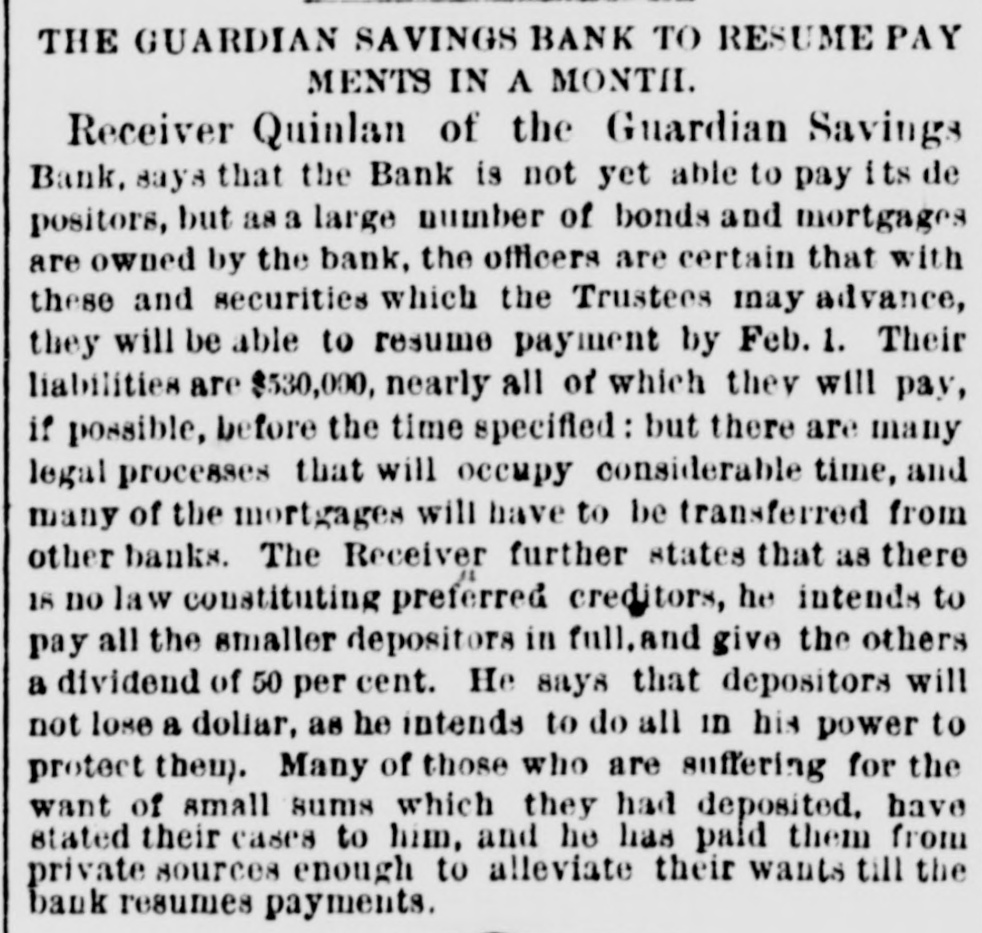
THE GUARDIAN SAVINGS BANK TO RESUME PAY MENTS IN A MONTH. Receiver Quinlan of the Guardian Savings Bank, says that the Bank is not yet able to pay i ts de positors, but as a large number of bonds and mortgages are owned by the bank, the officers are certain that with these and securities which the Trustees may advance, they will be able to resume payment by Feb. 1. Their liabilities are $530,000, nearly all of which they will pay, if possible, before the time specified: but there are many legal processes that will occupy considerable time, and many of the mortgages will have to be transferred from other banks. The Receiver further states that as there 18 no law constituting preferred creditors, he intends to pay all the smaller depositors in full. and give the others a dividend of 50 per cent. He says that depositors will not lose a dollar, as he intends to do all in his power to protect them. Many of those who are suffering for the want of small sums which they had deposited. have stated their cases to him, and he has paid them from private sources enough to alleviate their wants till the bank resumes payments.


Article from Daily Kennebec Journal, February 6, 1872

Click image to open full size in new tab

Article Text

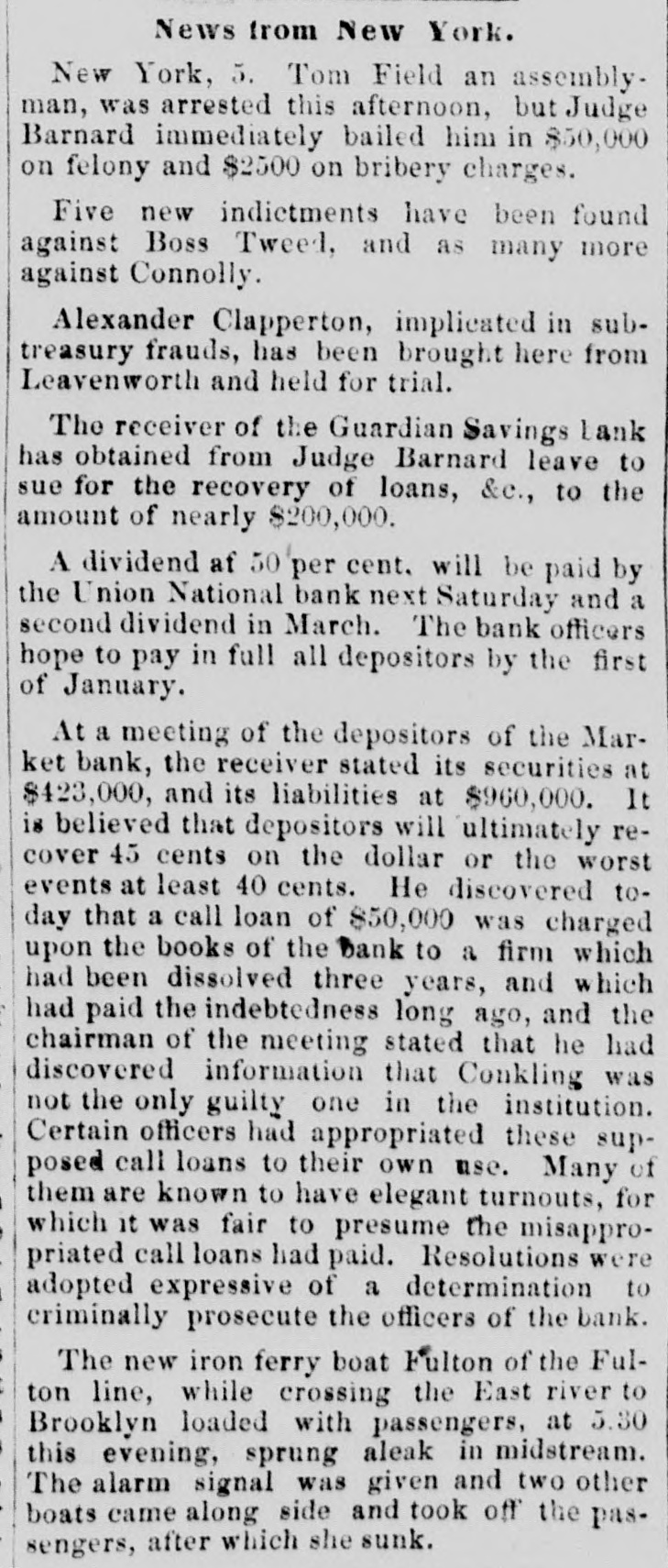
News from New York. New York, 5. Tom Field an assemblyman, was arrested this afternoon, but Judge Barnard immediately bailed him in $50,000 on felony and $2500 on bribery charges. Five new indictments have been found against Boss Tweed, and as many more against Connolly. Alexander Clapperton, implicated in subtreasury frauds, has been brought here from Leavenworth and held for trial. The receiver of the Guardian Savings lank has obtained from Judge Barnard leave to sue for the recovery of loans, &c., to the amount of nearly $200,000. A dividend af 50 per cent. will be paid by the Union National bank next Saturday and a second dividend in March. The bank officers hope to pay in full all depositors by the first of January. At a meeting of the depositors of the Market bank, the receiver stated its securities at $423,000, and its liabilities at $960,000. It is believed that depositors will ultimately recover 45 cents on the dollar or the worst events at least 40 cents. He discovered today that a call loan of $50,000 was charged upon the books of the Bank to a firm which had been dissolved three years, and which had paid the indebtedness long ago, and the chairman of the meeting stated that he had discovered information that Conkling was not the only guilty one in the institution. Certain officers had appropriated these supposed call loans to their own use. Many of them are known to have elegant turnouts, for which it was fair to presume the misappropriated call loans had paid. Resolutions were adopted expressive of a determination to criminally prosecute the officers of the bank. The new iron ferry boat Fulton of the Fulton line, while crossing the East river to Brooklyn loaded with passengers, at 5.30 this evening, sprung aleak in midstream. The alarm signal was given and two other boats came along side and took off the passengers, after which she sunk.


Article from The New York Herald, August 15, 1872

Click image to open full size in new tab

Article Text

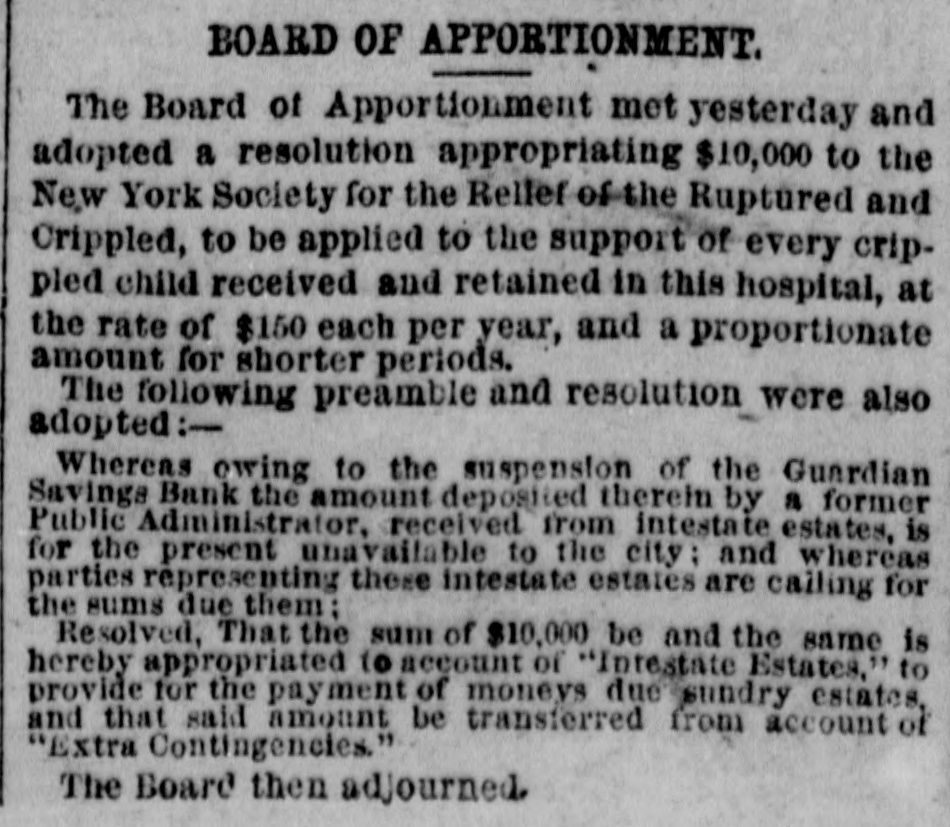
BOARD OF APPORTIONMENT. The Board of Apportionment met yesterday and adopted a resolution appropriating $10,000 to the New York Society for the Reller of the Ruptured and Crippled, to be applied to the support of every crippled child received and retained in this hospital, at the rate of $150 each per year, and a proportionate amount for shorter periods. The following preamble and resolution were also adopted:Whereas owing to the suspension of the Guardian Savings Bank the amount deposited therein by a former Public Administrator. received from intestate estates, is for the present unavailable to the city: and whereas parties rΓ©presenting these intestate estates are calling for the sums due them: Resolved, That the sum of $10,000 be and the same is hereby appropriated to account of "Intestate Estates," to provide for the payment of moneys due sundry estates, and that said amount be transferred from account of "Extra Contingencies." The Board then adjourned.


Article from The New York Herald, January 17, 1873

Click image to open full size in new tab

Article Text

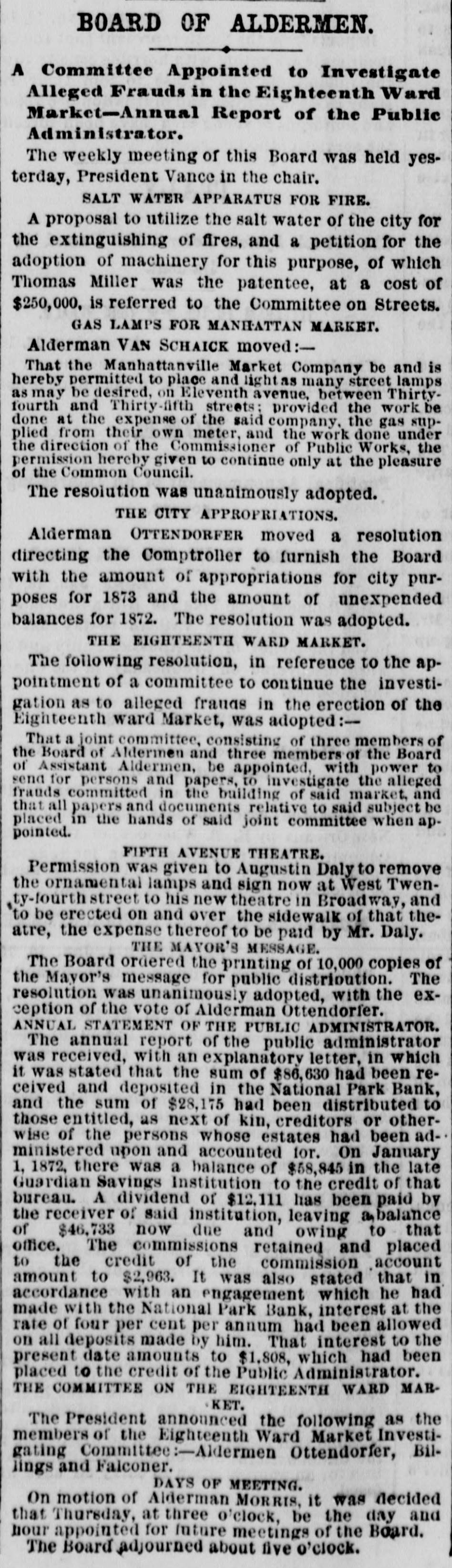
BOARD OF ALDERMEN. A Committee Appointed to Investigate Alleged Frauds in the Eighteenth Ward Market-Annual Report of the Public Administrator. The weekly meeting or this Board was held yesterday, President Vance in the chair. SALT WATER APPARATUS FOR FIRE. A proposal to utilize the salt water of the city for the extinguishing of fires, and a petition for the adoption of machinery for this purpose, of which Thomas Miller was the patentee, at a cost of $250,000. is referred to the Committee on Streets. GAS LAMPS FOR MANHATTAN MARKET. Alderman VAN SCHAICK moved:That the Manhattanville Market Company be and is hereby permitted to place and light as many street lamps as may be desired, on Eleventh avenue, between Thirtyfourth and Thirty-fifth streets: provided the work be done at the expense of the said company, the gas supplied from their own meter, and the work done under the direction of the Commissioner of Public Works, the permission hereby given to continue only at the pleasure of the Common Council. The resolution was unanimously adopted. THE CITY APPROPRIATIONS. Alderman OTTENDORFER moved a resolution directing the Comptroller to furnish the Board with the amount of appropriations for city purposes for 1873 and the amount of unexpended balances for 1872. The resolution was adopted. THE EIGHTEENTH WARD MARKET. The following resolution, in refereuce to the appointment of a committee to continue the investigation as to alleged fraugs in the erection of the Eighteenth ward Market, was adopted:That a joint committee, consisting of three members of the Board of Aldermen and three members of the Board of Assistant Aldermen, be appointed, with power to send for persons and papers, to investigate the alleged frauds committed in the building of said market. and that all papers and documents relative to said subject be placed in the hands of said joint committee when appointed. FIFTH AVENUE THEATRE. Permission was given to Augustin Daly to remove the ornamental lamps and sign now at West Twenty-fourth street to his new theatre in Broadway, and to be erected on and over the sidewalk of that theatre, the expense thereof to be paid by Mr. Daly. THE MAYOR'S MESSAGE. The Board ordered the printing of 10,000 copies of the Mayor's message for public distribution. The resolution was unanimously adopted, with the exception of the vote of Alderman Ottendorfer. ANNUAL STATEMENT OF THE PUBLIC ADMINISTRATOR. The annual report of the public administrator was received, with an explanatory letter, in which it was stated that the sum of $86,630 had been received and deposited in the National Park Bank, and the sum of $28,175 had been distributed to those entitled, as next of kin, creditors or otherwise of the persons whose estates had been administered upon and accounted for. On January 1, 1872, there was a balance of $58,845 in the late Guardian Savings Institution to the credit of that bureau. A dividend of $12,111 has been paid by the receiver of said institution, leaving a.balance of $46,733 now due and owing to that office. The commissions retained and placed to the credit of the commission account amount to $2,963. It was also stated that in accordance with an engagement which he had made with the National Park Bank, interest at the rate of four per cent per annum had been allowed on all deposits made by him. That interest to the present date amounts to $1,808, which had been placed to the credit of the Public Administrator. THE COMMITTEE ON THE EIGHTEENTH WARD MARKET. The President announced the following as the members of the Eighteenth Ward Market Investigating Committee:-Aldermen Ottendorfer, Billings and Falconer. DAYS OF MEETING. On motion of Alderman MORRIS, it was decided that Thursday, at three o'clock, be the day and hour appointed for future meetings of the Board. The Board adjourned about five o'clock.


Article from New-York Tribune, April 9, 1873

Click image to open full size in new tab

Article Text

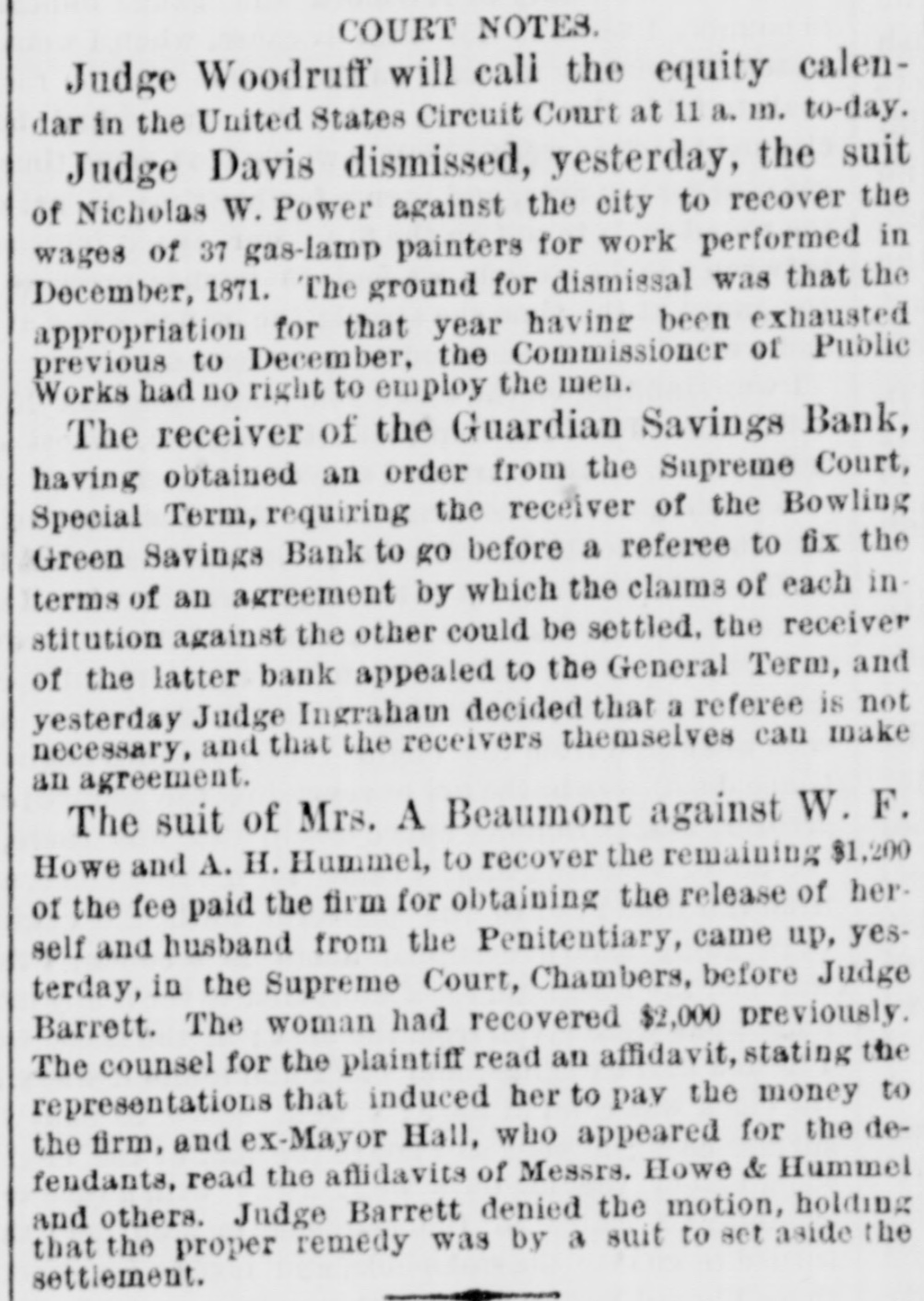
COURT NOTES. Judge Woodruff will call the equity calendar in the United States Circuit Court at 11 a. in. to-day. Judge Davis dismissed, yesterday, the suit of Nicholas W. Power against the city to recover the wages of 37 gas-lamp painters for work performed in December, 1871. The ground for dismissal was that the appropriation for that year having been exhausted previous to December, the Commissioner of Public Works had no right to employ the men. The receiver of the Guardian Savings Bank, having obtained an order from the Supreme Court, Special Term, requiring the receiver of the Bowling Green Savings Bank to go before a referee to fix the terms of an agreement by which the claims of each institution against the other could be settled. the receiver of the latter bank appealed to the General Term, and yesterday Judge Ingraham decided that a referee is not necessary, and that the receivers themselves can make an agreement. The suit of Mrs. A Beaumont against W. F. Howe and A. H. Hummel, to recover the remaining $1,200 of the fee paid the firm for obtaining the release of herself and husband from the Penitentiary, came up, yesterday, in the Supreme Court, Chambers, before Judge Barrett. The woman had recovered $2,000 previously. The counsel for the plaintiff read an affidavit, stating the representations that induced her to pay the money to the firm, and ex-Mayor Hall, who appeared for the defendants. read the affidavits of Messrs. Howe & Hummel and others. Judge Barrett denied the motion, holding that the proper remedy was by a suit to set aside the settlement.


Article from New-York Tribune, May 2, 1874

Click image to open full size in new tab

Article Text

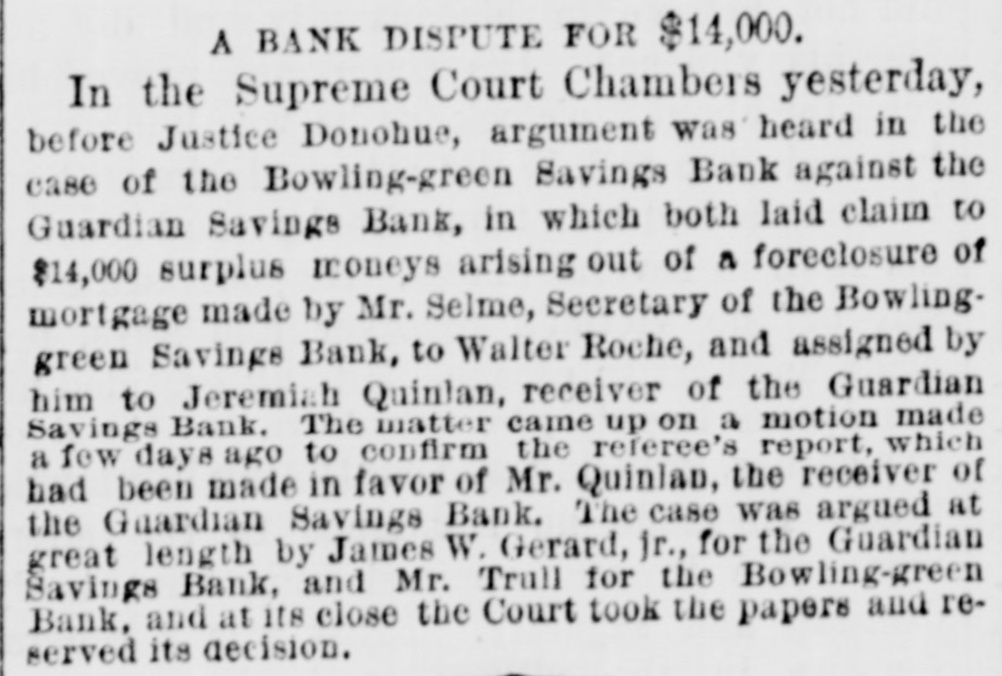
# A BANK DISPUTE FOR $14,000. In the Supreme Court Chambers yesterday, before Justice Donohue, argument was heard in the case of the Bowling-green Savings Bank against the Guardian Savings Bank, in which both laid claim to $14,000 surplus moneys arising out of a foreclosure of mortgage made by Mr. Selme, Secretary of the Bowling-green Savings Bank, to Walter Roche, and assigned by him to Jeremiah Quinlan, receiver of the Guardian Savings Bank. The matter came up on a motion made a few days ago to confirm the referee's report, which had been made in favor of Mr. Quinlan, the receiver of the Guardian Savings Bank. The case was argued at great length by James W. Gerard, jr., for the Guardian Savings Bank, and Mr. Trull for the Bowling-green Bank, and at its close the Court took the papers and reserved its decision.


Article from The New York Herald, March 7, 1876

Click image to open full size in new tab

Article Text

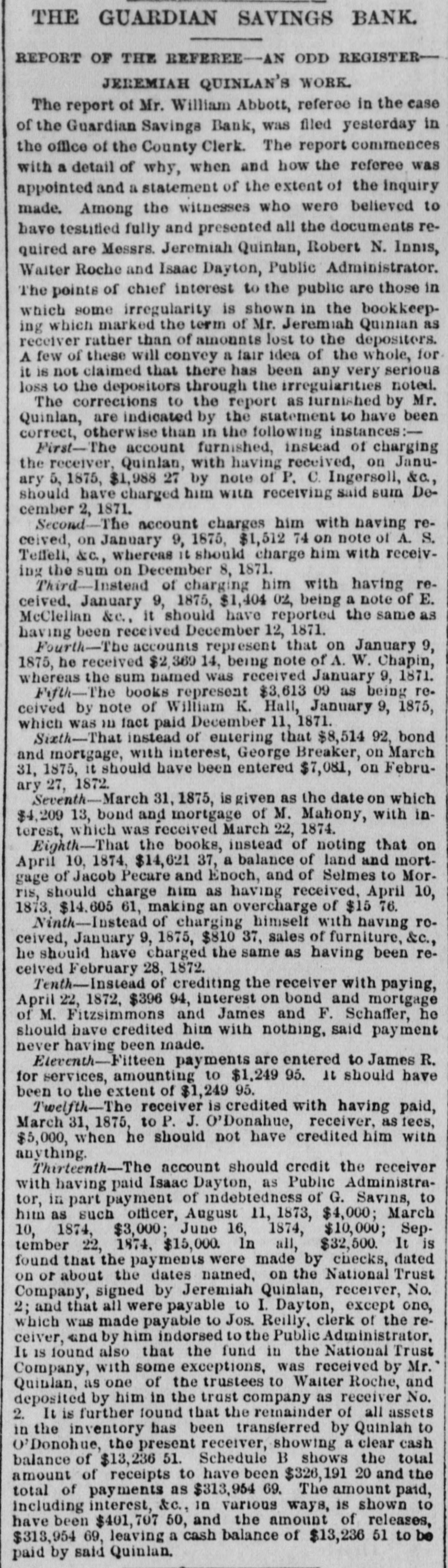
THE GUARDIAN SAVINGS BANK. REPORT OF THE REFEREE-AN ODD REGISTER JEREMIAH QUINLAN'S WORK. The report of Mr. William Abbott, referee in the case of the Guardian Savinga Bank, was filed yesterday in the office of the County Clerk. The report commences with a detail of why, when and how the referee was appointed and a statement of the extent of the inquiry made. Among the witnesses who were believed to have testified fully and presented all the documents required are Messrs. Jeremiah Quintan, Robert N. Innis, Waiter Roche and Isaac Dayton, Public Administrator. The points of chief interest to the public are those in which some irregularity is shown in the bookkeeping which marked the term of Mr. Jeremiah Quintan as receiver rather than of amounts lost to the depositors. A few of these will convey a fair idea of the whole, for it is not claimed that there has been any very serious loss to the depositors through the irregularities noted. The corrections to the report as furnished by Mr. Quinian, are indicated by the statement to have been correct, otherwise than in the following instances:First-The account furnished, instead of charging the receiver, Quinlan, with having received, on January 5, 1875, $1,988 27 by note of P. C. Ingersoll, &c., should have charged him with receiving said sum December 2, 1871. Second-The account charges him with having received, on January 9, 1875, $1,512 74 on note of A. S. Teffell, &c., whereas it should charge him with receiving the sum on December 8, 1871. Third-Instead of charging him with having received, January 9, 1875, $1,404 02, being a note of E. McClellan &c., it should have reported the same as having been received December 12, 1871. Fourth-The accounts represent that on January 9, 1875, he received $2,369 14, being note of A. W. Chapin, whereas the sum named was received January 9, 1871. Fifth-The books represent $3,613 09 as being received by note of William K. Hall, January 9, 1875, which was 111 fact paid December 11, 1871. Sixth-That instead of entering that $8,514 92, bond and mortgage, with interest, George Breaker, on March 31, 1875, it should have been entered $7,081, on February 27, 1872 Seventh-March 31, 1875, is given as the date on which $4,209 13, bond and mortgage of M. Mahony, with interest, which was received March 22, 1874. Eighth-That the books, instead of noting that on April 10, 1874, $14,621 37, a balance of land and mortgage of Jacob Pecare and Enoch, and of Selmes to Morris, should charge him as having received, April 10, 1873, $14.605 61, making an overcharge of $15 76. Ninth-Instead of charging himself with having received, January 9, 1875, $810 37, sales of furniture, &c., he should have charged the same as having been recelved February 28, 1872. Tenth-Instead of crediting the receiver with paying, April 22, 1872, $396 94, interest on bond and mortgage of M. Fitzsimmons and James and F. Schaffer, he should have credited him with nothing, said payment never having been made. Eteventh-Fitteen payments are entered to James R. for services, amounting to $1,249 95. It should have been to the extent of 1,249 95. Twelfth-The receiver is credited with having paid, March 31, 1875, to P. J. 'Donahue, receiver, as tees, $5,000, when he should not have credited him with anything. Thirteenth-The account should credit the receiver with having paid Isaac Dayton, as Public Administrator, in part payment of indebtedness of G. Savins, to him as such officer, August 11, 1873, $4,000; March 10, 1874, $3,000; June 16, 1874, $10,000; September 22, 1874, $15,000. In all, $32,500. It is found that the payments were made by checks, dated on or about the dates named, on the National Trust Company, signed by Jeremiah Quinian, receiver, No. 2; and that all were payable to I. Dayton, except one, which was made payable to Jos. Reilly, clerk of the receiver, and by him indorsed to the Public Administrator, It 18 found also that the fund in the National Trust Company, with some exceptions, was received by Mr. Quinian, as one of the trustees to Waiter Roche, and deposited by him in the trust company as receiver No. 2. It is further found that the remainder of all assets in the inventory has been transferred by Quinlah to O'Donohue, the present receiver, showing a clear cash balance of $13,236 51. Schedule B shows the total amount of receipts to have been $326,191 20 and the total of payments as $313,954 69. The amount paid, including interest, &c., in various ways, is shown to have been $401, 707 50, and the amount of releases, $313,954 69, leaving a cash balance of $13,236 51 to be paid by said Quinian.
Article from The Sun, October 13, 1876

Click image to open full size in new tab

Article Text

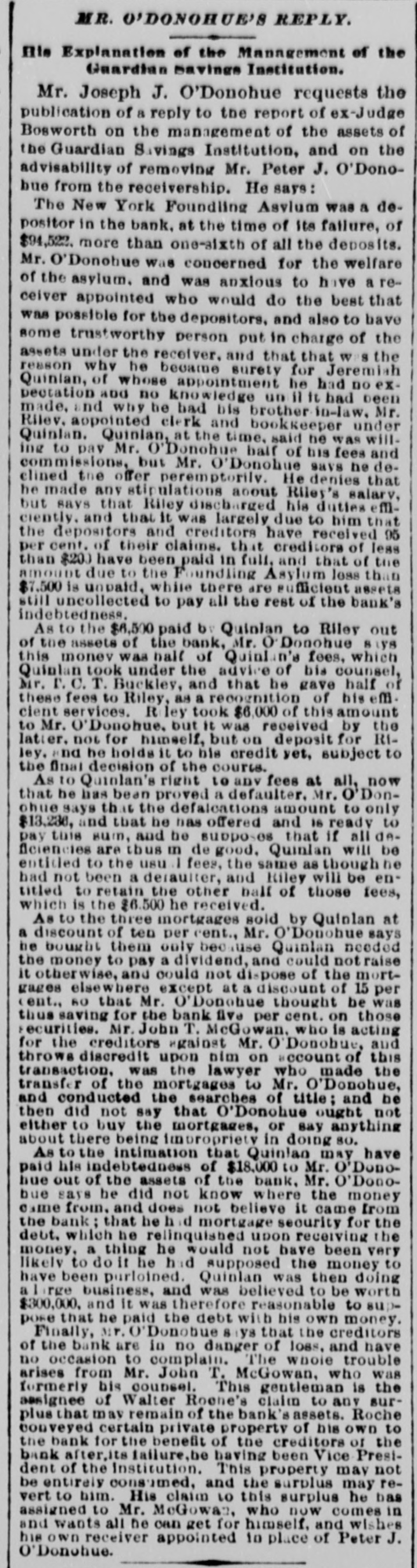
# MR. O'DONOHUE'S REPLY. His Explanation of the Management of the Guardian Savings Institution. Mr. Joseph J. O'Donohue requests the publication of a reply to the report of ex-Judge Bosworth on the management of the assets of the Guardian Savings Institution, and on the advisability of removing Mr. Peter J. O'Donohue from the receivership. He says: The New York Foundling Asylum was a depositor in the bank, at the time of its failure, of $94,522, more than one-sixth of all the deposits. Mr. O'Donohue was concerned for the welfare of the asylum, and was anxious to have a receiver appointed who would do the best that was possible for the depositors, and also to have some trustworthy person put in charge of the assets under the receiver, and that that was the reason why he became surety for Jeremiah Quinian, of whose appointment he had no expectation and no knowledge un il it had been made, and why he had bis brother-in-law, Mr. Riley, appointed clerk and bookkeeper under Quinlan. Quinlan, at the time, said he was willing to pay Mr. O'Donohue baif of his fees and commissions, but Mr. O'Donohue says he declined the offer peremptorily. He denies that he made any stipulations about Riley's salary, but says that Riley discharged his duties efficiently, and that it was largely due to him that the depositors and creditors have received 95 per cent, of their claims. that creditors of less than $20) have been paid in full, and that of the amount due to the Foundling Asylum less than $7,500 is unpaid, white there are sufficient assets still uncollected to pay all the rest of the bank's indebtedness. As to the $6,500 paid by Quinlan to Riley out of the assets of the bank, Mr. O'Donohue says this money was half of Quinlan's fees, which Quinlan took under the advice of bis counsel, Мг. Π“. Π‘. Π’. Buckley, and that he gave half of these fees to Riley, as a recognition of his efficient services. Riley took $6,000 of this amount to Mr. O'Donohue, but it was received by the latter, not for himself, but on deposit for Riley, and be holds it to his credit yet, subject to the final decision of the courts. As to Quinlan's right to any fees at all, now that he has bean proved a defaulter, Mr. O'Donohue says that the defalcations amount to only $13,236, and that he has offered and is ready to pay this sum, and he supposes that if all deficiencies are thus m de good, Quinlan will be entitled to the usu I fees, the same as though he had not been a derauiter, and Kiley will be entitled to retain the other half of those fees, which is the $6.500 he received. As to the three mortgages sold by Quinlan at a discount of ten per cent., Mr. O'Donohue says he bought them only because Quinlan needed the money to pay a dividend, and could not raise it otherwise, and could not dispose of the mortgages elsewhere except at a discount of 15 per cent., so that Mr. O'Donohue thought he was thus saving for the bank five per cent. on those Fecurities. Mr. John T. McGowan, who is acting for the creditors against Mr. O'Donohue, and throws discredit upon him on account of this transaction, was the lawyer who made the transfer of the mortgages to Mr. O'Donohue, and conducted the searches of title; and he then did not say that O'Donohue ought not elther to buy the mortgages, or say anything about there being impropriety in doing s0. As to the intimation that Quinlan may have paid his indebtedness of $18,000 to Mr. O'Donohue out of the assets of the bank, Mr. O'Donohue says he did not know where the money came from, and does not believe it came from the bank; that he had mortgage security for the debt, which he relinquished upon receiving the money, a thing he would not have been very likely to do it he had supposed the money to have been purloined. Quinlan was then doing a lerge business, and was believed to be worth $300,000, and it was therefore reasonable to suppose that he paid the debt with his own money. Finally, Mr. O'Donobue sys that the creditors of the bank are in no danger of loss, and have no occasion to complain. The whole trouble arises from Mr. John T. McGowan, who was formerly his counsel. This gentleman is the assignee of Walter Roene's claim to any surplus that may remain of the bank's assets. Roche conveyed certain private property of his own to the bank for the benefit of the creditors of the bank after, its failure, be having been Vice President of the Institution. This property may not be entirely consumed, and the surplus may revert to him. His claim to this surplus he bas assigned to Mr. McGowan, who now comes in and wants all he can get for himself, and wishes his own receiver appointed in place of Peter J. O'Donohue.


Article from The New York Herald, October 14, 1876

Click image to open full size in new tab

Article Text

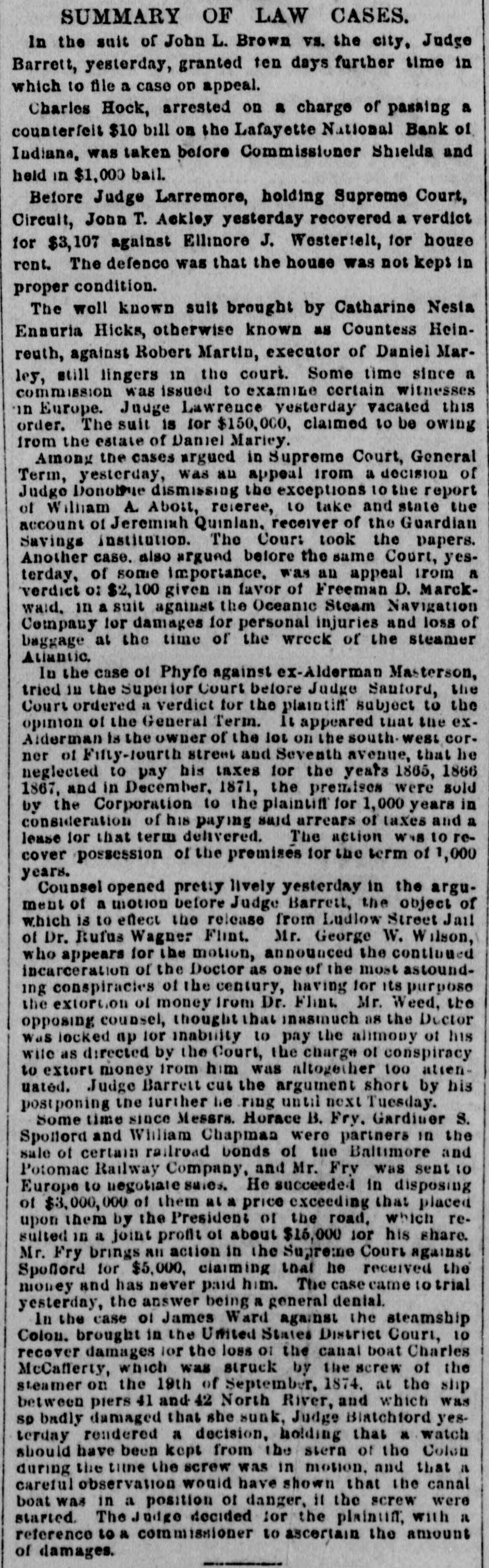
# SUMMARY OF LAW CASES. In the suit of John L. Brown vs. the city, Judge Barrett, yesterday, granted ten days further time in which to file a case on appeal. Charles Hock, arrested on a charge of passing a counterfeit $10 bill on the Lafayette National Bank of Indiana, was taken before Commissioner Shields and held in $1,000 bail. Before Judge Larremore, holding Supreme Court, Circuit, John T. Ackley yesterday recovered a verdict for $3,107 against Ellinore J. Westertelt, for house rent. The defence was that the house was not kept in proper condition. The well known suit brought by Catharine Nesta Ennuria Hicks, otherwise known as Countess Heinreuth, against Robert Martin, executor of Daniel Marley, still lingers in the court. Some time since a commission was issued to examine certain witnesses in Europe. Judge Lawrence yesterday vacated this order. The suit is for $150,000, claimed to be owing from the estate of Daniel Mariey. Among the cases argued in Supreme Court, General Term, yesterday, was an appeal from a decision of Judge Donohue dismissing the exceptions to the report of Wiliam A. Abott, referee, to take and state the account of Jeremiah Quinlan, receiver of the Guardian Savings institution. The Court took the papers. Another case, also argued before the same Court, yesterday, of some importance, was an appeal from a verdict o: $2,100 given in favor of Freeman D. Marckwald, in a suit against the Oceanic Steam Navigation Company for damages for personal injuries and loss of baggage at the time of the wreck of the steamer Atlantic. In the case of Phyfe against ex-Alderman Masterson, tried in the Superior Court before Judge Santord, the Court ordered a verdict for the plaintiff subject to the opinion of the General Term. It appeared that the ex-Alderman is the owner of the lot on the south-west corner of Fifty-fourth street and Seventh avenue, that he neglected to pay his taxes for the years 1865, 1866 1867, and in December, 1871, the premises were sold by the Corporation to the plaintiff for 1,000 years in consideration of his paying said arrears of taxes and a lease for that term delivered. The action was to recover possession of the premises for the term of 1,000 years. Counsel opened pretty lively yesterday in the argument of a motion before Judge Barrett, the object of which is to effect the release from Ludlow Street Jail of Dr. Rufus Wagner Flint. Mr. George W. Wilson, who appears for the motion, announced the continued incarceration of the Doctor as one of the most astounding conspiracies of the century, having for its purpose the extortion of money from Dr. Flint. Mr. Weed, the opposing counsel, thought that inasmuch as the Doctor was locked up for inability to pay the alimony of his wife as directed by the Court, the charge of conspiracy to extort money from him was altogether too attenuated. Judge Barrett cut the argument short by his postponing the further hearing until next Tuesday. Some time since Messrs. Horace B. Fry. Gardiner S. Spotlord and Wiliam Chapman were partners in the sale of certain railroad bonds of the Baltimore and Potomac Railway Company, and Mr. Fry was sent to Europe to negotiate sales. He succeeded in disposing of $3,000,000 of them at a price exceeding that placed upon them by the President of the road, which resulted in a joint profit of about $15,000 or his share. Mr. Fry brings an action in the Supreme Court against Spoflord for $5,000, claiming that he received the money and has never paid him. The case came to trial yesterday, the answer being a general denial. In the case of James Ward against the steamship Colon, brought in the United States District Court, to recover damages for the loss of the canal boat Charles McCafferty, which was struck by the screw of the steamer on the 19th of September, 1874, at the ship between piers 41 and 42 North River, and which was so badly damaged that she sunk, Judge Blatchford yesterday rendered a decision, holding that a watch should have been kept from the stern of the Colon during the time the screw was in motion, and that a careful observation would have shown that the canal boat was in a position of danger, if the screw were started. The Judge decided for the plaintiff, with a reference to a commissioner to ascertain the amount of damages.


Article from Evening Star, August 11, 1877

Click image to open full size in new tab

Article Text

# A RECEIVER WHO RECEIVED FOR HIMSELF J. T. McGowan, receiver of the Guardian Savings Bank, in New York, has obtained leave from Judge Van Brunt to sue J. J. O'Donohue, a former receiver, for $24,000, part of money misappropriated by J. Quinlan, who was first receiver of the bank, and also to sue Jos. Reilly, a brother-in-law to O'Donahue and clerk to Quinlan, for $13,000 misappropriated by Quinlan. O'Donahue was Quinlan's surety and also his successor in the receivership.


Article from Evening Star, August 11, 1877

Click image to open full size in new tab

Article Text

retary of War Major R. N. Batchelder, quar- termaster, has been ordered to report to the quartermaster general for duty. Major H. B. Burnham, judge advocate, U. S. A., has been granted three months' leave of absence, with permission to go beyond the sea. ### "A COOL PROPOSITION." Under this head the New York Times prints a special which says: Much to the surprise of the War de- partment officials, the Baltimore and Ohio Railroad Company has presented a claim for payment for transporting United States troops from Washington to different points along its line to protect the road from the strikers. This seems a little like imperti- nence. Without the aid of the troops the railroad company would have been com- pletely at the mercy of the strikers, for the militia were of no service whatever, and in some cases expressed their sympathy for the rioters in an unmistakable manner. If the military had been sent over the road to pro- tect private or public property, the case would have been different; but no property required protection except that belonging to the railroad company. During the war of the rebellion many precedents were estab- lished under which this claim could be paid, but it is stated at the War department that there was an understanding when the troops were sent that the railroad companies should furnish transportation. If this is the case the matter will probably go to the courts for settlement. No railroad but the Baltimore and Chio has yet presented its bill. and at the Cabinet meeting to-day, when this mat- ter was brought up, it was decided that no action should be taken until all the other railroads should be heard from, when it will be submitted to the Attorney General for an opinion. ### SERENADE TO SENATOR CONKLING His Compriment to Gen. Grant. Senator Conkling, of New York, who returned yesterday from a brief trip to England, as stated in last eve- ning's STAR, was received at Hoboken with speeches, cannon firing and other noisy wel- come. In the evening he had a reception and serenade at the Fifth Avenue hotel. After returning thanks for the cordiality of his re- ception, he said he came back a stronger, if not a better, American than he went away. He never before was so proud of his country or so content with his countrymen as now that he had the opportunities of comparing them with other countries and people. Great Britain had the accumulated results of gen- erations. She had had eight centuries of Par- liaments, power and wealth, but in civiliza- tion, liberty, progress, general intelligence and promise of the future, America need not shrink. He spoke of Paris, its art treasures and monumen's, and paid a tribute to the magnanimity of the Germans, who left them untouched when they had the city in their power. Of Gen. Grant he said that wherever he goes, honors wait upon him, but they do not seem to wean him from things at home. He may remain long abroad, but when he returns you are likely to find that all the dis- tinctions poured upon him have not washed out a jot of his Americanism or made him anything save the same upright, downright republican without cant or palaver. ### POLITICAL CONVENTIONS Calls have been issued for national and state political conventions and conferences as follows: Tuesday, August 14, Maine democratic, in Portland; Wednesday. August 15, New York prohibitionist, in Utica; Wednesday, Aug. 22, Pennsylvania democratic, in Harrisburg; Thursday, August 23, New York greenback, in Rochester; Wednesday, August 29, Iowa democratic, in Marshalltown; Wednesday, September 5. Pennsylvania republican, in Harrisburg; Tuesday, September 11, Wiscon- sin republican, in Madison; Wednesday, September 12, Massachusetts prohibitionist, in Worcester; Pennsylvania prohibitionist, in Harrisburg; Thursday, September 13, Massachusetts democratic, in Worcester; Wednesday, September 19, Massachusetts republican, in Worcester; Thursday, Sept. 20, Maryland republican. in Baltimore; Wed- nesday, September 26, National convention of representative colored men, in Washing- ton; National Conference of prohibitionists at Perry-street M E church, New York city. ### CHANGE OF ADMINISTRATION IN CUBA Lieutenant General Luis Prendergast, chief of staff of the Spanish army in Cuba, has ar- rived in Havana, and a dispatch from that city says: Taking his arrival in connection with that of Martinez Campos, the rumored change of administration of the island is ap- parently well founded General Jovellar in- augurated his administration by laying open the shameless frauds committed by the army purveyors and imprisoning defaulters, implicating thereby indirectly ex-Captain General Valmaseda and others. The efforts of General Jovellar were in vain. The per- emptory orders of Spain obliged him to re- lease the defaulters and army swindlers. General Jovellar's honor almost obliges him to resign. If he resigns it is supposed that Lieutenant General Prendergast will replace him temporarily. ### GEN. FIELD of Fredericksburg, Va., has recently returned home from Egypt, where he held a high position in the army of the Khedive. His withdrawal from that army grew out of the Turko-Russian complica- tions, in which Egypt, through her vassal- age to the Sultan, has been forced to take part. The American officer could not con- scientiously take the field for the Crescent against the Caoss, and so resigned. In fact, it is stated that about all the American offi- cers in the Khedive's service have been got- ten rid of in one way or another. ### FAILURES IN PHILADELPHIA are an- nounced as follows: Newhouse & Rousenan, wholesale clothiers, have failed, but no state- ment has been made of their assets and liabilities. They have two judgments against them for $15,000 and one for $10,000. M. Rosenbach & Co, shirt manufacturers, have suspended and are reported to have indorsed about $18,000 of paper for a broken clothing house. John Clayham, fish and provision dealer, has suspended. He pro- poses to pay 50 per cent. ### A RECEIVER WHO RECEIVED FOR HIMSELF J. T. McGowan, receiver of the Guar- dian Savings Bank, in New York, has ob- tained leave from Judge Van Brunt to sue J. J. O'Donohue, a former receiver, for $24,000, part of money misappropriated by J. Quinlan, who was first receiver of the bank, and also to sue Jos. Reilly, a brother- in-law to O'Donahue and cierk to Quinlan, for $13,000 misappropriated by Quinlan. O'Donahue was Quinian's surety and also his successor in the receivership. REV. AUGUSTINE F. HEWIT, of the order of the Paulists, is now superior of the order and editor of the Catholic World, Father Heck- er's ill health having compelled him to seek release from his duties. Dr. Hewit is an LL. D., his degree having been recently con- ferred by Harvard, which thus supplies the first instance of an American university founded by Protestant sectarians so honor- ing an eminent divine of the Roman Catholic church. ### THE ANNUAL CONVENTION of United States bankers will be held at New York on the 12th, 13th, and 14th of September; 6,152 banks will be represented, of which 2,082 are national banks, 875 state banks, 2,524 private banks, and 671 savings institutions. The convention will take such measures as are necessary to remove the oppressive restric- tions that are said to have recently crippled