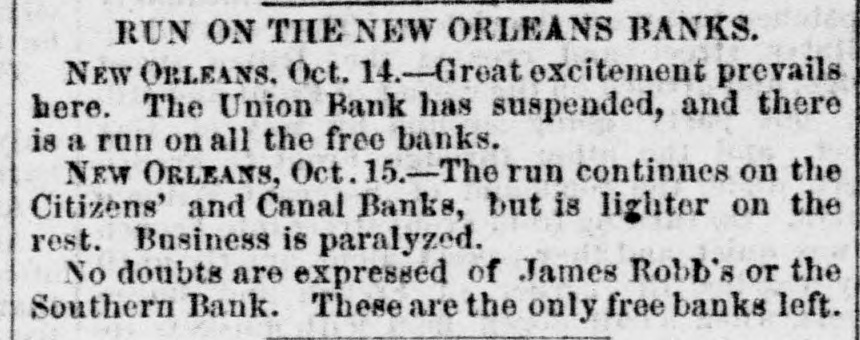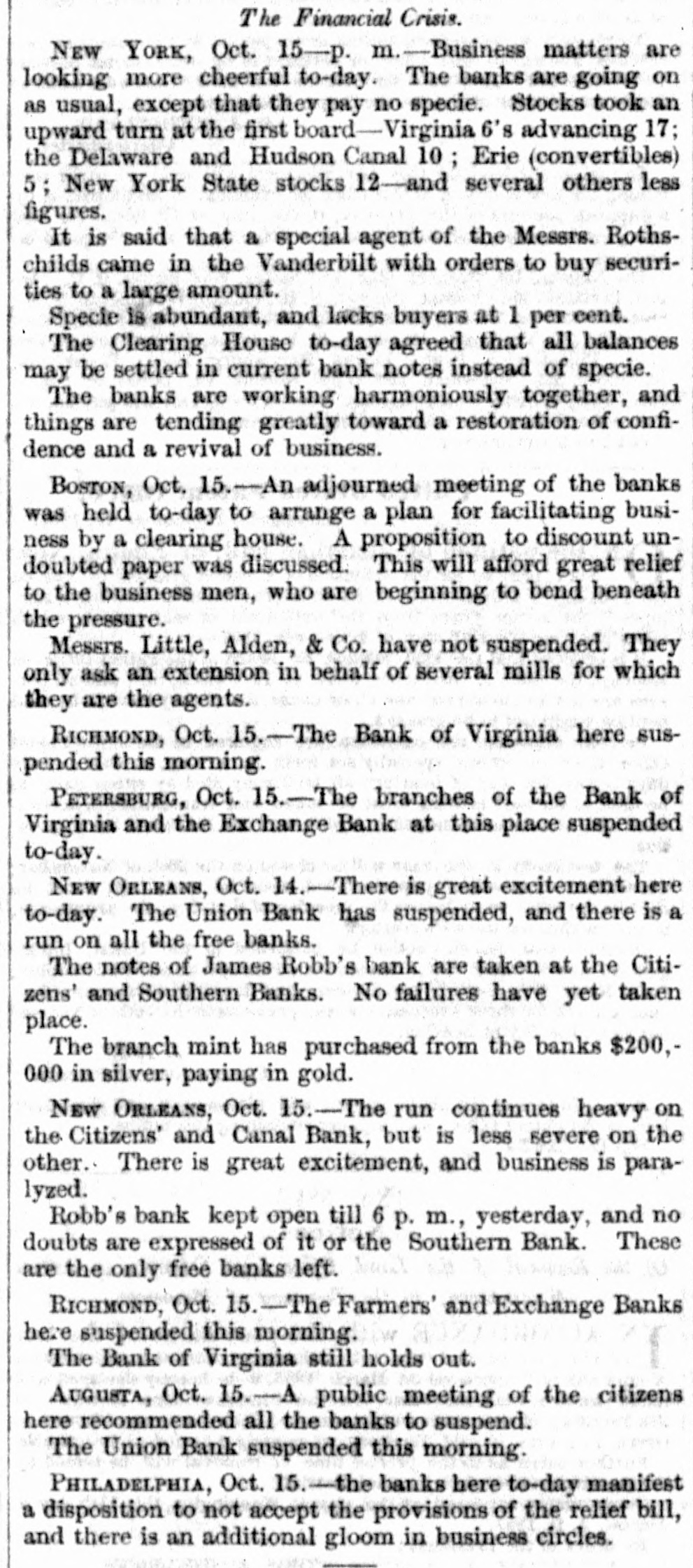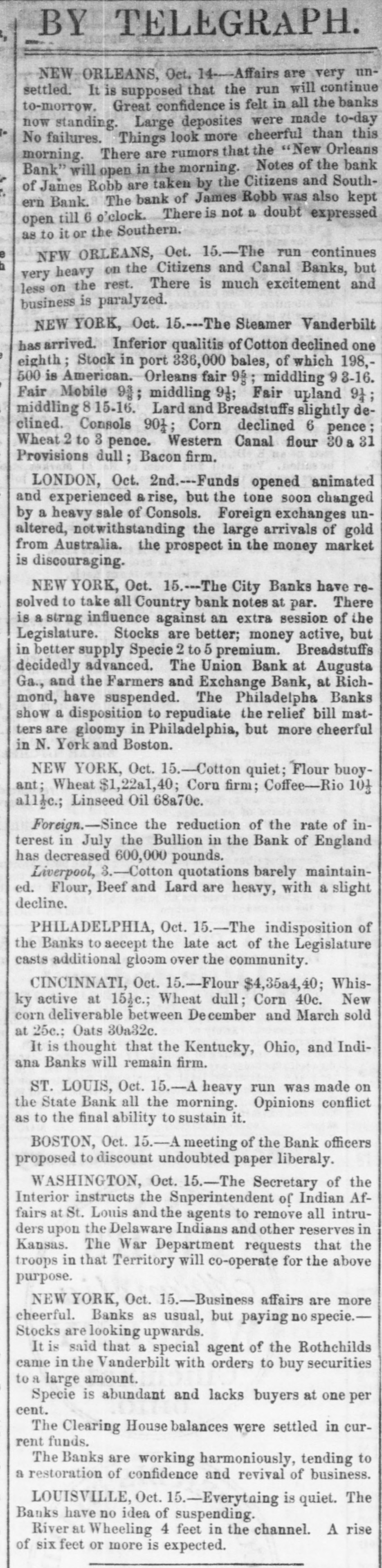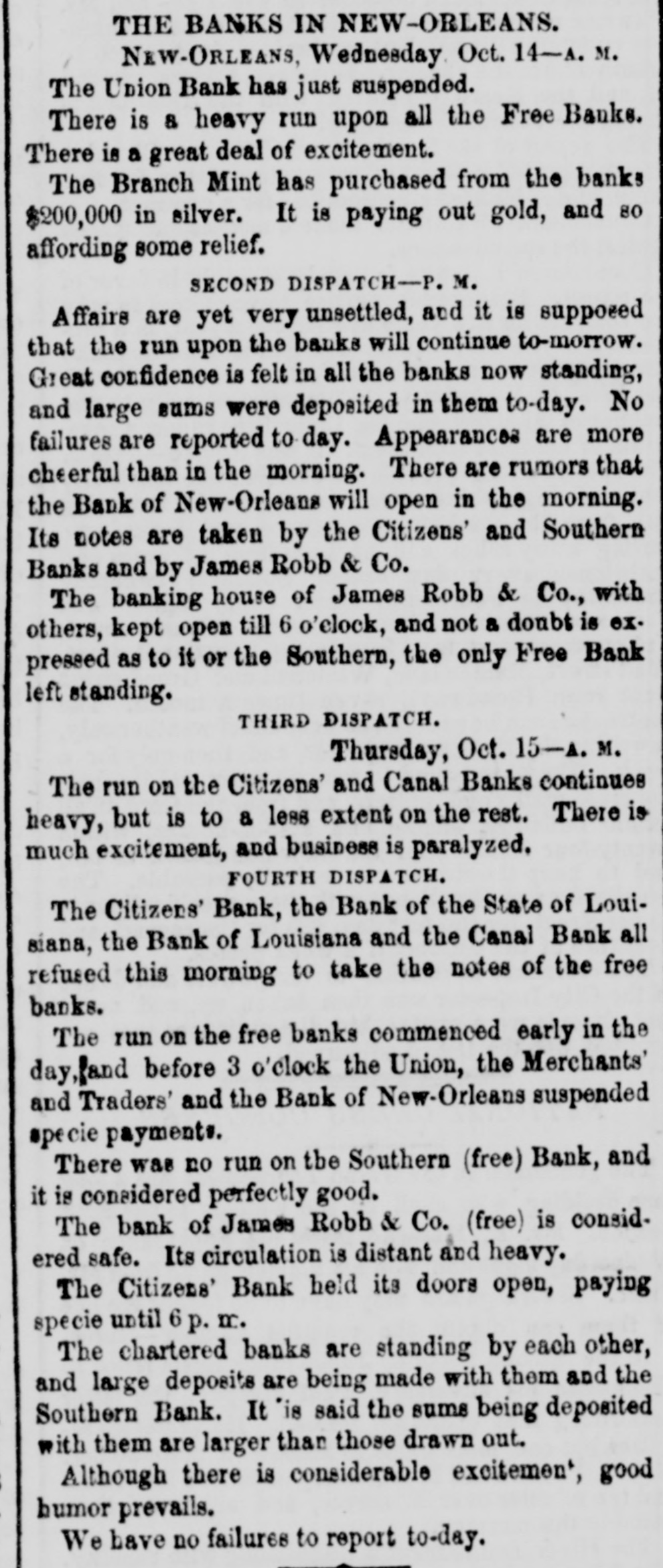
Click image to open full size in new tab
Article Text
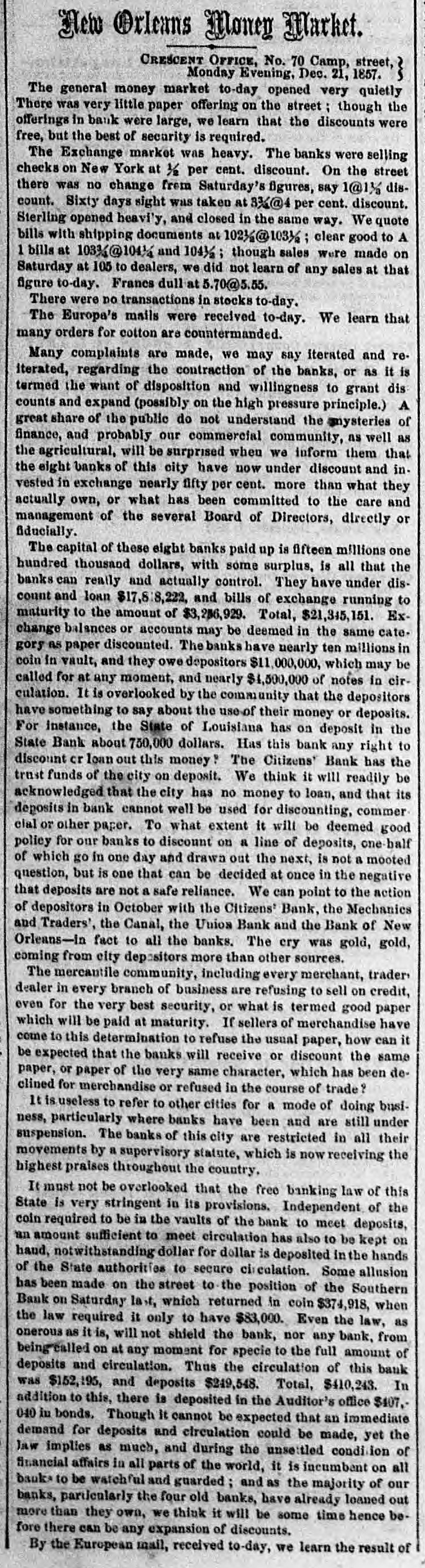
New Orleans Money Market.
CRESCENT OFFICE. No. 70 Camp street, Thursday Evening, Oct. 22, 1857.3 Very little change was observable to-day in general affairs. The Banks were in a much better position (the old Banks) this morning than on any day of the week. We are fully satisfied that if the Banks were to expand their discounts and invest- ments in exchange to the amount of two to three millions of dollars, they would not hold out coin payments for a week. They cannot increase either discounts nor exchange without being called on immediately for coin. We have observed the move- ments of the holders of bank bills for two weeks past-that is, they immediately draw the coin. Now, then, to be explicit and explain the modus operandi, the house of Jones & Co. offers for discount a note for $1,000, more or less. As it might be dis- counted, as soon as it is entered to his credit, a check for the amount is forth with presented demanding the coin, or if Mr. Jones' house does not present the check, some friend does. The coin is drawn and hoarded for ulterior purposes. The discre- pancy in confidence is exhibited by the Bank being willing to take the note of Jones & Co, but Jones & Co. do not feel disposed to trust the Bank by taking its issues so with exchange. The Banks might take exchange to a large amount, but they have not the coin to pay for it, and as for their issues, they might be called on in the same as for discounts. Factors will, of course, have instructions to remit the proceeds of sales in coin where balances are due. We witnessed further calls for coin at all the Banks to day, from $5 up to $500 notes. There will never be any restoration of confidence, so long as this practice is con- tinued. If the public will not trust the Bank issues, it cannot be expected that the Banks can trust the public to an extent that will irretrievably bring ruin on them. The public must restore confidence and faith before they can expect our banking institu- tions to alleviate the present position of affairs. The public can do it in forty-eight hours. From our intercourse with Bank managers, we can assert that a large expansion at this time would be fatal to them. All the public has got to do is to follow our advice as above. We have faith that we shall soon work out of our troubles. Firmness and a short time only are re- quired.
Although financial affairs were regarded as gloomy to-day, we did not discover that they were any worse than yesterday. Peo- ple will do well not to credit the mischievous remarks of croak- ers or street gabbling.
There were some movements in Exchange to-day. Some sight sold on New York at 3 per cent. discount. The Banks (the Canal) was checking at sight and short sight. The State Bank was selling at 1 per cent. discount. There was some talk of of sterling, but we did not learn of a sale. 87½@95 may be called figures, but not sales. Nothing doing in time bills on Northern cities.
The Canal Bank was in line to-day over $100,000, and yester- day $123,000. It, like the other old Banks, cannot discount only in the way of renewals fer the present.
A New York paper, of the 15th, remarks as follows on the position of affairs in that city:
The banks of this city have concluded to receive in deposit in and pay out the bills of the country banks of this State. All the State stock secured bills will be taken at par, and form a part of the general currency of the State, the same as the bills of this city. They will be used in adjusting balances at the Clearing House, the same as so much specie. It looks now as though the trouble and difficulty in regulating accounts would soon be entirely removed. This will let loose a large amount of currency, and give new life to business. It will give a great impetus to the forwarding of crops, and tend much towards a reduction in the price for all kinds of agricultural product. It is to be hoped that the banks will not enlarge their discount line much under this new order of things. It is now pretty well settled that the banks of this city were compelled to suspend specie payments by the combined action of the foreign banking houses located in and about Wall street, aided by the disaffected portion of our own mercantile community. The principal cause was the drain of specie by certain banking houses connected with American bankers abroad. The object was to compel the banks to suspend, so that all obstacles to an expansion of loans would be removed, and that the banks could increase their dis- counts, and give a start to the exportation of produce.
In forcing the banks to do this, these agents of foreign bank- ers calculated to arrest any exportation of specie from London to this country, and thus save their principals or branches in England and on the Continent. The plan was a very shrewd one, and has so far been well carried out. It was to operate in this way: A large private banking house not far from the Custom-house is connected with several banking houses in Eng- land. Any panic or revulsion in the London money market, caused or increased by large shipments of gold to the United States, would seriously endanger the existence of those Euro- pean agencies or branches. The object of the parties here is, therefore, to prevent, if possible, any action on the part of our banks that would force shipments of specie from Liverpool to New York. It is well known to these financiers that a contrac- tion in discounts persisted in would leave no other alternative, but an importation of gold. It is therefore determined, on the part of these private bankers, to force our banks into a suspen- sion of specie payments if possible, knowing full well that there is no other way to prevent the contraction from continu- ing. All their plans were laid to bring about this desirable and important result.
In New York and other Northern cities the drawing of coin from the banks by every bill holder has been met in the follow- ing manner by large manufacturers. We believe the Novelty Works alluded to (iron foundry) employs upwards of twelve hundred operators, requiring the weekly paying out of a large amount of funds. New York is burdened with a small note cur- rency, say of one, two and three dollar notes, issued by nearly two hundred banks in the State. If the banks of this city were to expand their discounts and loans to the extent that relief would ensue, it would prove fallacious in the end, because bill holders would be drawing the coin forthwith. But to the circu- lar in question:
NOVELTY WORKS, New York, Oct. 13, 1857.
We regret to learn that some of our men draw the gold on the bills they get for wages. This course, if continued, will put an end to our getting any bills from the banks, and of course to our inability to employ men, as it is utterly impossible to get coin enough for the purpose.
As the result would be to throw all men out of employment, we feel it to be our duty, (while fully admitting the right of any man to present any bills he holds for redemption,) to take mea- sures to discover who they are who draw the gold after this no- tice, and hereby notify such persons that we shall consider the act as a notice from them that they do not desire further em- ployment from us.
For the further security of those who take the bills, we hereby guaranty, for the next thirty days, the goodness of all bills paid out by us. HORATIO ALLEN, President. HOWARD POTTER, Secretary.