14. Washington Alaska Bank (Fairbanks, AK)

Bank Information

Episode Type
Run → Suspension → Closure
Bank Type
state
Start Date
January 4, 1911
Location
Fairbanks, Alaska (64.838, -147.716)

Metadata

Model
gpt-5-mini
Short Digest
0357a249ea84e767

Response Measures

None

Description

Multiple contemporaneous articles report heavy withdrawals/small depositors started run in early January 1911, the bank suspended payment (Jan 4–5, 1911) and a federal receiver was appointed. Causes cited include failure to realize on Gold Bar Lumber Company stock (bank-specific adverse asset loss), a large overdraft with a Seattle bank, and withdrawals triggered by stampedes to other camps. The bank never reopened and remained in long-term receivership with litigation continuing for years, consistent with closure after suspension. I corrected/merged date references around Jan 4–6, 1911 from the articles.

Events (3)

1. January 4, 1911 Run
Cause
Bank Specific Adverse Info
Cause Details
Depositors made heavy withdrawals after failures to realize on Gold Bar Lumber Company stock by VP Jackson and large overdraft exposure in Seattle; fresh gold discoveries and stampedes to other camps prompted withdrawals.
Measures
None effective to stop withdrawals; receivers later appointed; attempts to stop shipments of cash were made (shipment at Cordova stopped).
Newspaper Excerpt
Small depositors started run that was beginning of end.
Source
newspapers
2. January 5, 1911 Suspension
Cause
Bank Specific Adverse Info
Cause Details
Suspension attributed to inability to raise needed funds after failed realization on investments (Gold Bar Lumber stock) and legal attachments by depositors; also large overdraft with Seattle and heavy withdrawals depleted cash resources.
Newspaper Excerpt
The Washington Alaska bank ... suspended payment last night.
Source
newspapers
3. January 6, 1911 Receivership
Newspaper Excerpt
F. W. Hawkins was appointed receiver by the federal court today.
Source
newspapers

Newspaper Articles (25)

Article from Bismarck Daily Tribune, January 6, 1911

Click image to open full size in new tab

Article Text

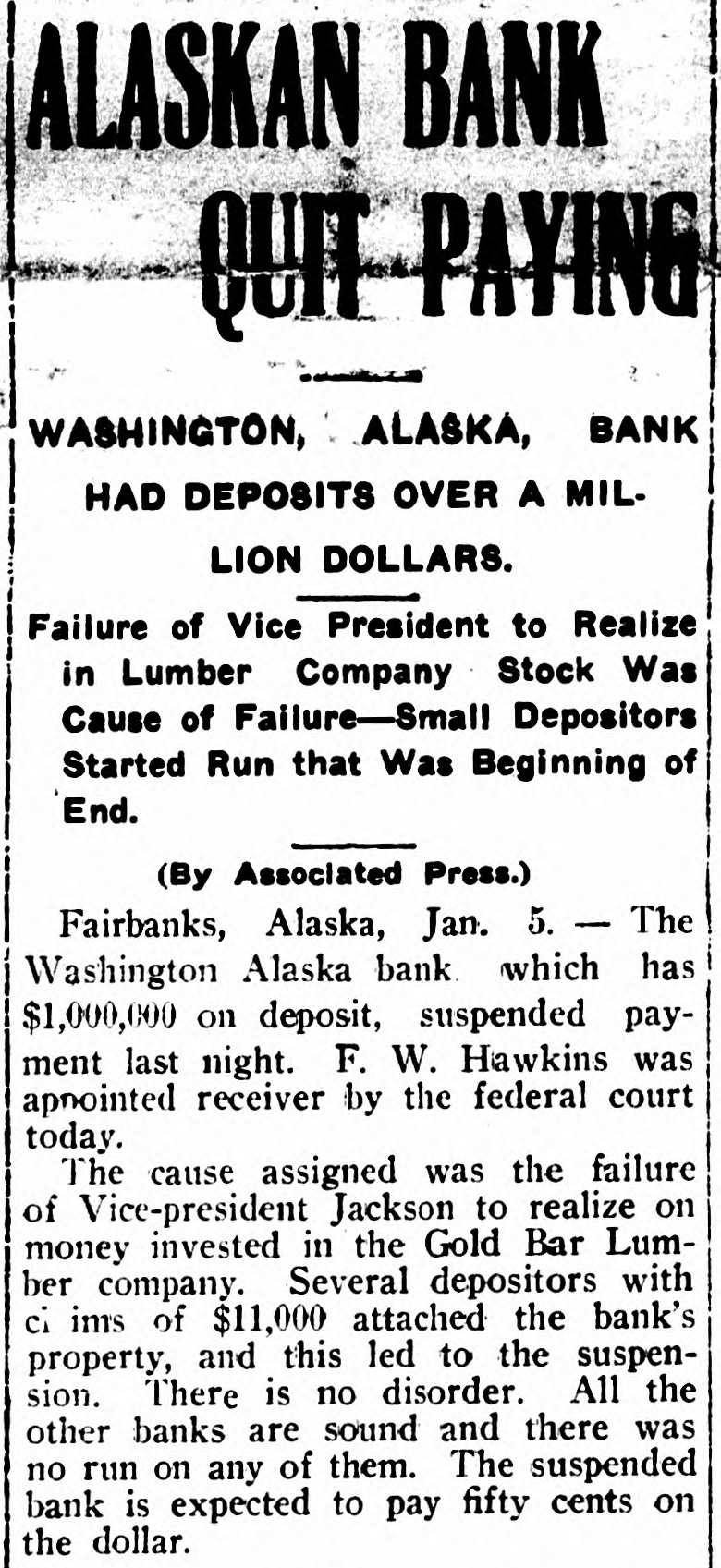
ALASKAN BANK quit PAYING TATING WASHINGTON, ALASKA, BANK HAD DEPOSITS OVER A MILLION DOLLARS. Failure of Vice President to Realize in Lumber Company Stock Was Cause of Failure-Small Depositors Started Run that Was Beginning of End. (By Associated Press.) Fairbanks, Alaska, Jan. 5. - The Washington Alaska bank which has $1,000,000 on deposit, suspended payment last night. F. W. Hawkins was appointed receiver by the federal court today. The cause assigned was the failure of Vice-president Jackson to realize on money invested in the Gold Bar Lumber company. Several depositors with CA ims of $11,000 attached the bank's property, and this led to the suspension. There is no disorder. All the other banks are sound and there was no run on any of them. The suspended bank is expected to pay fifty cents on the dollar.


Article from The Alaska Citizen, January 9, 1911

Click image to open full size in new tab

Article Text

gold GUST. 2010 If this money is seized and reverts it to the credit of the bank here will materially help in the adjust ment of the depositors' claims. but last ner no official news had been received regarding it. As a great deal of pessimism exlisted in regard to the probable basis of settlement of claims the commitfee decided to issue a statement on Saturday evening in regard to the situation as it appears to them at that time This was as follows: "After interviewing the bank re ceivers and getting all information possible it is our opinion that the depositors will receive not less than of 60 per cent ,with a good chance recovering more of their deposits. "By the committee: "ED T. WOLCOTT. "F. S. GORDON "E. W. GRIFFIN. "L" R. PEOPLES "W E ROBERTSON." Working all day yesterday the receivers arrived during the afternoon a stage of their work which enabled at them to forecast the probable outcome. and the statement printed on the front page of this issue tells the story. Both Mr. Mack and Mr. Hawkins state that the estimated payment of 70 per cent. is based on conservative figuring and they entertain hopes of being able to do even much better than this. In the meantime. however. they call on those who owe the bank to come forward and liquidate their liabilities. as in this way the settlement with the depositors will be materially expedited. On Friday morning the Citizen wired its correspondent in Seattle instructing him to obtain interviews with Captain Barnette W. H. Parsons and J. Albert Jackson. In the evening the following dispatch was recrived in reply: Alaska Citizen. Fairbanks. Captain Barnette is in Los Angeles. Vice-President J. Albert Jackson was seen this afternoon and he had the following to say: "The suspension of the Washington-Alaska bank is due to the fact that Captain Barnette and myself were unable to raise the necessary money to carry us over the winter The bank is therefore forced to close temporarily. but it has ample securities to pay off every dollar that it owes and I have no doubt that the necessary arrangements will shortly be made under which the institution will be enabled to resume business "The Alaska banking business is a peculiar one. In order to properly carry on this business it is necessary to borrow from Seattle banks In order to properly carry on business we must loan money to miners to operate their claims during the winter. The loans are repaid in gold dust when the cleanup is made in the spring. Owing to the climatic conditions it is absolutely impossible for miners to harvest their gold before spring. And in that respect the assets of the bank cannot be available before June. "In order to carry on our business it is necessary for us to borrow money from Seattle banks and repay it in June or early in July by gold bullion which is turned into Alaskan banks in return for loans made this year. "However, we were unable to get financial assistance from Seattle or even San Francisco banks. notwiththat Captain Barnette of his personal standing fered to give security in addifor the payment of the loan tion to the securities held by the Naska bank


Article from The Fargo Forum and Daily Republican, January 13, 1911

Click image to open full size in new tab

Article Text

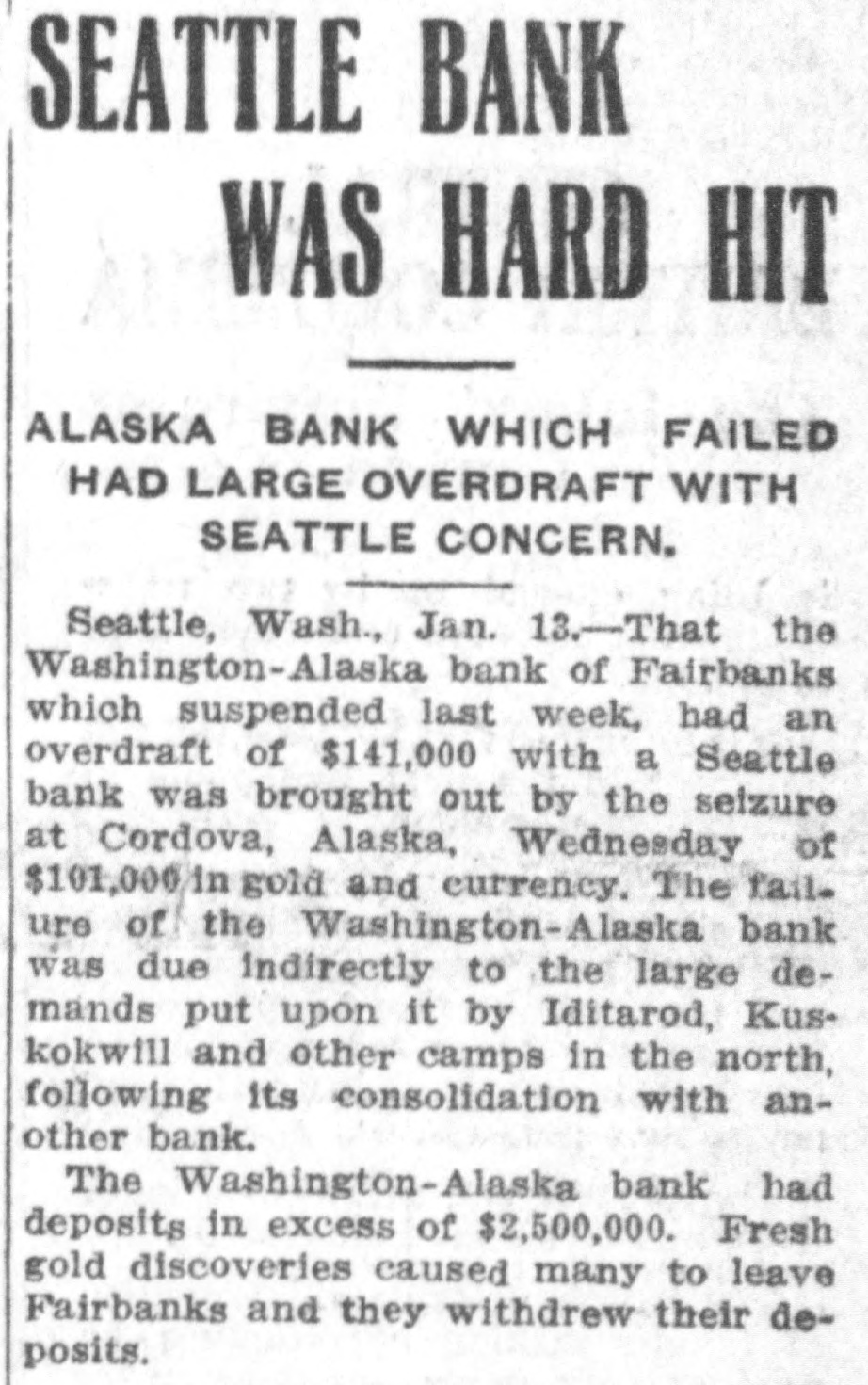
# SEATTLE BANK # WAS HARD HIT ALASKA BANK WHICH FAILED HAD LARGE OVERDRAFT WITH SEATTLE CONCERN. Seattle, Wash., Jan. 13. -That the Washington-Alaska bank of Fairbanks which suspended last week, had an overdraft of $141,000 with a Seattle bank was brought out by the seizure at Cordova, Alaska, Wednesday of $101,000 in gold and currency. The failure of the Washington-Alaska bank was due indirectly to the large demands put upon it by Iditarod, Kuskokwill and other camps in the north, following its consolidation with another bank. The Washington-Alaska bank had deposits in excess of $2,500,000. Fresh gold discoveries caused many to leave Fairbanks and they withdrew their deposits.


Article from The Evening Times, January 13, 1911

Click image to open full size in new tab

Article Text

BANK CARRIED BIG OVERDRAFT Alaskan Institution Victim of Stampede of Depositors to Other Fields Seattle, Jan. 13.-That the Washington-Alaska bank of Fairbanks, which suspended last week, had an overdraft of $141,000 with the Seattle bank was brought out by the seizure at Cordova, Alaska, Wednesday of $101,000 in gold and currency. The failure of the Washington-Alaska bank was due indirectly to the large demands put on it by the stampede to Iditarod, Kuskokwim and other camps in the north, following its consolidation with another bank. The Washington-Alaska bank had deposits in excess of $2,500,000. Fresh gold discoveries caused many to leave Fairbanks and they withdrew their deposits.


Article from The Alaska Citizen, January 30, 1911

Click image to open full size in new tab

Article Text

$101,000 BA CK IN BANK The $101,000 shipped from the Washington-Alaska bank to the Dexter Horton bank, shortly before the failure, and seized by Marshal Brightwell at Cordova, was brought into town on the stage arriving on Friday, and has been turned over to the receivers of the bank. Suit has been entered by the Dexter Horton bank for the recovery of the money and the hearing has not yet been held. The money was sent up under the care of Deputy Marshal G. R. Goshaw and Oscar Webber. It was contained in three express packages and was made up of gold coin, bullion and currency.


Article from Iditarod Pioneer, February 18, 1911

Click image to open full size in new tab

Article Text

Again, the News-Miner takes it as an ominous sign that on January 11 Barnette wired to the bank offering to return $50,000 of his profits in the Gold Bar deal, stating that he does this as a sop to possible prosecution. The same paper goes on to say that the bank offered a 6 per cent. distribution to depositors on January 11, without any adjudication on the part of the court, because Dave Yarnell, Jack Sales the Jessons and other heavy depositors had agreed to waive their right to any share in that distribution of the available cash. It also further alleges that although the DexterHorton bank of Seattle had said that the Gold Bar stock was worth $300,000, they refused to loan $250,000 on it and thus precipitated the bank's failure. Again, on January 13, the News-Miner comes out with a Seattle telegram to the effect that W. H. Parsons, formerly of the Washington Trust Company, lays all the blame for the bank closing on Frank Hawkins, who with E. H. Mack, is now receiver of the Washington-Alaska. He says that if Hawkins had not stopped a shipment of $100,000 at Cordova, that all would have been well. It appears that the W.-A. had an overdraft in Seattle of $141,407. After the shipment of the $100,000 Hawkins found, that owing to heavy withdrawals of de posits in Fairbanks, he was without cash and stopped the shipment. Parsons says this the cause of the failure. Hawkins' reply to thi is that Parsons' voice is less influential in the councils of the Dexter-Horton people, with whom he now is, than it was with the Washington Trust Co , and that the loan he advised to the latter institution might not have appeared advisable to the Dexter Horton management. He suggests further that the action of Mr. Parsons in selling out the W.-A. bank and the interests of the people who had supported him for the previous four years, is open to fully as much criticism as his (Hawkins') reluctance to reduce the cash on hand at his end. In the Alaska Citizen of January 16, it is said that a dividend of 16 2-3 per cent would be paid to depositors that day. It also said that a writ of assistance asked for by the receivers from the court was responsible for stopping the shipment of $100,000 at Cordova, and that it was more than likely that this sum would be available for payment to the depositors, unless the Dexter-Horton bank succeeded in grabbing it before it could be re. turned. Captain Barnette at Los Angeles was heard from on January 12, when he was reported to have said in an interview that he did not understand how it was the bank had failed. After recounting that he had severed


Article from The Alaska Citizen, April 3, 1911

Click image to open full size in new tab

Article Text

matter of the had been dislength by Dr. preBradley, cussed ington-Alaska at a much resolution bank adopted. was This Aline in effect sented and the bank was January looted charges between 4. 1911. that October by the 1. officers the 1910. reand of the bank: that neglect. and owners grand jury refused affairs: or and cent examine into its a fit pered to C. Hawkins is not should son to act It also removed. that E as receiver and urges the ex be call another grand jury: the abilan abiding faith and and fidelity asks for the court ity presses to of and the in court exdistrict appointment attorney. of an accountant to amine the books. called the meeting Dr. Bradley nominated Miner Bruce to order and Miss Cambridge was asked as chairman to act as secretary the details Dr. Brad of ley then went into of the depositors Barnette the transactions with Captain bank's committee her account of the The matter and gave since the consolidation declared history of the dividend and then the in April was called taken attention up to the withthe five preceddoctor drawals made by Barnette months Bar said. "During the purchase." vstematically she draw ing had been the bank nette his money from time were ing out issued during this $13,000; June Checks May $148, March, $45,000; July, $47,000; August or a 000. $69,000; and September, $32,000. total It was of $345,000. during the the month Washington of Sep tember. 1909, was that bought with Fair the Alaska Lank the depositors of money the of money of it had no banks bank. good for part of its capital in own. a been paid stock its never having to October ac 1. Barnette From February, closed 1910, out his down during count. 1910. having drawn In addition. tw $294,890 which that time valued at $43,000. bank gold brio ks go through the Barnette did not to Mrs. $10. all. were shipped time the sum of or Jesson Since has that been raise! by turned over 000 property and the Circle Barnette This makes by Bar a to Mrs. of $731,000 taken out the am un total two years. And even greater. in making than is nette $4,000 in were for listed no checks less up the moneys drawn to Against were Barnette totals." the there credits Banking out by the old Fairbanks the Gold company stock him Bar Lumber by of $200,000, company continual and credits check$341,000. In of stock ing out and had evidence of of the depositors in this unloading them. con the spiracy to defraud securities to were speaker Referring said committee that the these not so much refused by the of a considera account a of on as through of lack Barnette suspicion was play- Bar nette the hope tion She said of blinding securities ing the for grand time jury end. in for And the he accom- of the plished his the receivers the grand were and accepted and bank tendered indict." ney jury failed to then attacked Robarts Attorfor by default, The Pratt doctor case allowing to go the depositors attachment of the the were were paying a allowed the stating attorney dissatisfied that they all to think action that $500 to go be month through, had even though it might the legal. to the condition it as of her that not bank Referring the speaker another stated cent would is belief ever be paid to the the resolution depositors adoptFollowing by the meeting month of SepWhereas in the Washington-Alastember, corporation ka ed bank, 1909, a the of the organized state of in the laws doing business diFairbanks, the Washington, under city of Alaska, was at its Fourth place that of vision of therein, and upon directors the of the month business officers owners and stock their and transferred said thereof thereof company, stock sold to and a the corporation Fairbanks the organ Bank- state ing laws of Barand to who owned nette ized of Nevada, under and his the associates, the one said E. Fairbanks T. controlled consideration Banking is reported and that company sale of The which to $150,000 be the for $250,000, stock of bonus remaining of said sum the was Washington-Alaska of par value $100,000 of the was bank, Washing- a and for the good and was and his the ton-Alaska one bank W. will H. Parsons their appropri- own ated by associates for said sale, the immediate At the time of company was and more Fairbanks use. Banking the Washington-Alas solthan ka insolvent bank was mining no camp, of center, which vent. The of Fairbanks is Fairbanks a company, of the Banking was town declining. at The that $302,602.14, time, had hand the sum the purchase on said sum, the Washington. of which stock of after payment of the and the sum of the From the Washington said Alaska $52,602.14 bonus, bank of left the but said time the of Bankacquisition bank by the its officers, the Ala_ka company and bank Fairbanks continued corporWashington-Alaska its own its business name, but under under of the E. manage- T. Barate direction and dummies, nette, about the time until October, ment on and his or 1910, associates during -Alaska first which bank day save re- of mained Washington-Alain condition have been incurred by whatever the in losses, a solvent if reason any, may of actual

Article from Douglas Island News, November 22, 1911

Click image to open full size in new tab

Article Text

It was 22 below at Whitehorse on November 8th. Mr. Steve Regan, an attorney at law has decided to locate in Haines. An ad in the Skagway paper reads: "If you want to get a skate on, see us." Mass meetings are being held at Ruby City, to protest against the cost of provisions. The City of Vancouver, B. C.. was visited by a ten-inch snow fall early this month, when the mercury stood at 16 above. Samuel H. Graves, president of the White Pass & Yukon Railroad, was found dead in his bed, on the morning of the 13th inst. Fifty thousand dollars' worth of gold nuggets will be a part of the Alaskan exhibit at the Northwest land projects show soon to open at St. Paul. Senator Poindexter says he is satisfied with Secretary Fisher's Alaska policy. That's the first thing he has been satisfied with for some time. Although bids were asked for by the government for carrying the mail to Iditarod over the Seward trail no contract has been given. The bids were too high. John Atkinson. a guest at a White. horse hotel left $130 under his pillow, for safety while he went to breakfast. The Star says there were no identification marks on the money. The first big storm of the winter struck Nome on the 10th. A raging blizzard whipped the roadstead into a fury and the waves undermined the buildings on the water front. A.C. Hastings, a Nome miner, has brought suit against Congressman Sul. zer, of New York. He demands $800, which he claims is due him for services he rendered to Sulzer at Nome in 1907. The Washington Alaska bank, of Fairbanks, which closed its doors Jan. 4th, 1911, paid its third dividend of 16 per cent on the 11th of the month. When the bank failed it had liabilities of $900,000. The steamship Admiral Sampson, of the Alaska Coast company, is on her last voyage this year between Seattle and Alaska points. She will be placed on the Seattle-San Francisco run for the winter. Capt. G. W. Robertson, the well known Vancouver pilot, died on the 10th. He had been a pilot since 1889. Capt. Robertson brought the ill-fated steamer Islander to this Coast from Glasgow in 1888.


Article from Iditarod Pioneer, December 23, 1911

Click image to open full size in new tab

Article Text

BANKER IS CALLED TO FAIRBANKS George B. Wesch, acting manager of the Iditarod branch of the American Bank of Alaska, left for Fairbanks Friday of last week. He has been succeeded by H. F. Yeager, formerly of the Fairbanks Banking Co. and until lately manager for Frank Manley on Willow. Mr. Wesch was in charge of the defunct Washington-Alaska bank at the time it suspended payment, and he has been called to Fairbanks to testify in connection therewith.


Article from The Chitina Leader, January 6, 1912

Click image to open full size in new tab

Article Text

LATEST SENSATIONAL NEWS Washington, January 5.-The report of the geological survey has just been issued. In it the Alaskan coal and mineral resources are largely dealt with. Particular stress is laid upon the high grade of the coal found in the Matanuska fields. The visit last summer of Joseph A. Holmes, director bureau of mines, Alfred H. Brooks, in charge of Alaskan mineral resources, together with their assistants and Snmner Smith, mine inspector of Alaska, has resulted in securing more definite data and a clearer idea of the coal seams of the Matanuska and Bering fields than was ever had before. These men preceded Secretary Fisher to Bering River and made an exami nation before he arrived. They then accompanied the secretary to the Matanuska district and after he left they continued their investigation. They are now well qualified to appear before the proper committees of Congress and to give expert information when the coal question is under discussion. Los Angeles, January 5.-Capt. E. P. Barnette, who has been indicted in connection with the failure of the Washington-Alaska bank at Fairbanks last winter, has received word from his attorney in Fairbanks that his case has been set for trial on April 1st, at Fairbanks. His attorneys went from San Francisco recently to appear before Judge Overfield in an argument for a change of venue to Cordova or some other point in Alaska, claiming that the people of Fairbanks were prejudiced in the matter and that he could not receive a fair trial there. The telegram just received indicates that the motion was denied. Capt. Barnette and others concerned will remain south until March, during which month they will leave for the north. Battle Creek, January 4.-The town is alive with a big sensation. H. M. Deering, cashier of the Albion National Bank, and son of Palmer M. Deering, one of the town's most prominent citizens is a confessed defaulter. He has been living at a high rate of speed for years past. When it was found that there was something wrong in the accounts at the bank experts were put on the books. They soon realized that a shortage of $144,000 existed, and the cashier was placed under arrest for both embezzlement and forgery. He broke down and confessed to the crime. The bank has been SO crippled by the shortage that the directors decided to close it and suspend business. The depositors will all be protected. San Francisco, Jan. 2.-This city is very much in earnest over the effort to secure nedded legislation for Alaska. The commercial bodies and citizens generally are exerting themselves in every way to interest Senators and Congressmen, not only from this state but from other states, to take up the fight for the northland. A delegation has been selected to go to Washington and there to boost for everything that will aid the early development and prosperity of Alaska. This delegation will leave in a few days for the national capitol. It is composed of William M. Bunker, George T. Marye, Jr., Robert A Roose, and Paul T. Carrol. They expect to remain several weeks, or as long as they think their efforts will be of any avail. Columbus, January 2.-After much importuning and after many letters of invitation had been circulated among Republican leaders throughout the state, less than one hundred probressive Republicans were gathered together here yesterday. They succeeded in forming a state organization. An effort was made to endorse the candidacy of Senator Bob Lafollette for the Presidency. But when the vote was taken on the resolution but 32 were in favor of it and 52 opposed, indicating that there was a decided difference of opinion among the progressives. The organization poured oil on the troubled waters by declaring that LaFollette was the embodiment of the principles believed in by the progressives. They also passed a resolution declaring against the renomination of President Taft. Thus the slate remains clean and the organization is in position to later favor the nomination of the man that they believe will prove the Moses to lead the country out from their darkness. Both Mr. Garfield and Mr. Pinchot declare that this man is Teddy Roosevelt. Winnipeg, January 3.-A domestic sensation that has been furnishing food for scandal in the south had its culmination here yesterday. J. B. Snead is a big cattleman of Texas, who counts his herds by the thousands and his dollars by the millions. He has a very attractive wife who, however, was not entirely satisfied with the ranch life. She was thrown in the company of A. G. Boyce, a wealthy clubman, of Fort Worth, and soon they became sooul mates. Their environs were too confined in the lone star state SO they decided that they could no longer endure the enforced separation that for a time would keep them apart for days, when their mutual longing was to be together for ever and a day. So they appointed a rendezvous and skipped out together, taking the limited train north. They safely reached this city and had been here two or three days before Shead's detectives located them. They were both arrested yesterday and when Boyce's affinity was told that her husband was on his way from the sunny south and would reach Minneapolis today she expressed a willingness and a desire to join him. The novelty of the escapade had worn off, and after a few days with the wealthy club man she realized that he was not the attentive lover of the uncertain days before he was sure of her. Boyce seems not to be much concerned and the supposition is that he is willing that the affair be dropped. And in the meantime he says he thinks he will take a trip to Europe. Mrs. Snead has gone to Minneapolis and it is expected that a reconcilliation will take place, as the husband is dazzingly fond of her.


Article from Iditarod Pioneer, February 3, 1912

Click image to open full size in new tab

Article Text

J. ALBERT JACKSON ARRESTED AT PORTLAND Fairbanks, Feb. 2.-Seventeen indictments have been returned against Frank C. Hawkins, cashier and receiver of the Washington-Alaska bank, charging him with converting funds and securities of the bank to his own use and for the benefit of those not entitled to participate therein. Hawkins was arrested but immediately afterwards released on bail of $23,000. The bail was furnished by E. W. Griffin and Dave Cascaden. It is believed that secret indictments are on file against officials of the original Washington Alaska bank. Portland, Ore., Feb. 2.-J. Albert Jackson, accountant, and former cashier of the Fairbanks Banking Company, who was secretly indicted by the grand jury sitting at Fairbanks, was arrested here yesterday charged with embezzlement. After a preliminary hearing he was released on $6,000 bail. Fairbanks, Feb. 2.-A. J. McArthur, brother-i inlaw of E. T. Barnette, and former Fairbanks druggist, was arrested at Munson's roadhouse Wednesday night while on his way Outside. He is charged by the receiver of the Washington-Alaska bank with attempting to evade payment of his obligations. The grand jury adjourned Tuesday.


Article from Iditarod Pioneer, January 25, 1913

Click image to open full size in new tab

Article Text

A-L-A-S-K-A Prof. Herschell Parker has taken options on some ground on Quartz creek, Kenai peninsula. It is a dredging proposition, and is said to prospect well. Bob Henderson is supplying the Dawson market with moose meat from the Pelly-river country. Accidentally kicked by one of the Fairbanks fire-brigade horses while the latter were rushing to a fire, "Ginger," the famous N. C. mascot. died from its injuries last month and was buried in the N. C. plot. All officials of the N. C. attended the funeral. "Ginger" was one of Scotty Allen's team entered in the first sweepstakes race at Nome. From the date of his arrival at Fairbanks he was a pensioner. L. L. James, Fairbanks; Jafet Lindberg, Nome, and F. W. Bradley, Juneau, have been appointed on the Alaska delegation to the California Miners' Association convention to be held in San Francisco for the purpose of planning a mineral exhibit for the PanamaPacific exposition. E. M. Keys, jr., millman at the Rhoads Hall mine at Fairbanks, was badly burned as the result of an explosion which took place during some tha wing operations He was carrying a lighted torch when an accumulation of gas exploded. He was burned about the face. Major Morrow, chairman of the Alaska railroad commission, is pointing out that the only way to stop immigration to Canada, which has been alienating the best class of Americans, is to develop Alaska, and that argument ought to go to the heart of the American people. R. H. Pollard, who has been running a roadhouse on the Fairbanks-Valdez trail, has sold out, and is now looking for a location in Southeastern Alaska. Dundas Yeager, who arrived at Juneau recently from Fairbanks, said that things were looking pretty blue in the Tanana metropolis. "The district has never recovered from the Washington-Alaska bank failure," said Mr. Yeager. "Money is tight and properties are idle because no funds are available for development work. The Rhoads mine is the only one that is paying dividends among the quartz operators; but this does not mean that the values are not there. Placer operations are nearly at an end, and it is almost impossible to get cash advanced for running expenses." The Nome Nugget says that Henry Roden is likely to be the choice for president of the Alaska senate. The same paper quotes Mayor William A. Gilmore, of Nome, as saying the Wickershamites have a majority in the legislature. A canvass of the town of Valdez shows that place to contain 7 saloons, 37 miscellaneous stores, 500 residences, 7 factories, 6 workshops, 11 hotels, 12 lodging houses, 4 churches, 1 brewery, and numerous other establishments. In his annual report to congress, Secretary of Commerce and Labor Nagel places the value of salmon caught in Alaskan waters annually at $14,500,000. The figures have created tremendous surprise at the capital; as very few had any idea that such immense fishing resources existed in the waters of the territory. F. E. Fuller, now judge of the Fourth division, filed suit recently against the Port Clarence Gold Mining Company for the foreclosure of a mortgage given as security for $3,000 secured on a promissory dated October 22, 1906. The residents of Mile 192, Copper River railroad, who have hitherto called their settlement McCarthy's, held a mass meeting December 3 and drew up regulations for the future government of the community. Incidentally the settlement became the town of Blackburn, and as such will be known hereafter. The town has been surveyed into lats, which are being sold for $50 and $75 apiece, the latter being choice corner lots. To show that it is a real town an "addition" has been staked, which is to become the "residential section" when the town grows up. Several applications have been made for "business" lots, and the money obtained from the sale thereof will be spent in improving the city. According to a statement made to the Nome Nugget by a Solomon trader, the natives of Solomon and Spruce creek are in a most wretched state of destitution, and slowly starving to death. They are only kept alive by the charity of the white residents. When the latter give a sack of flour to a particularly helpless native all the others crowd in to eat it up. A true bill has been returned by the Fairbanks grand jury in the case of U. S vs. Charles B. Allen, a Rampart lawyer indicted on charges of obtaining money under false pretenses, and also of embezzlement as bailee.


Article from Iditarod Pioneer, May 3, 1913

Click image to open full size in new tab

Article Text

MAY REALIZE ON GOLD BAR STOCK F. G Noyes, receiver of the detunet Washington Alaska bank of Fairbanks. has received a communcation from Ira D. Horton, who is now in Seattle, stating that there is a possibility of realizing on the Gold Bar Lumber Company's stock, which formed one of the principal assets of the bank at the time of its suspension. The stock is now being held by the Dexter Horton bank of Seattle security for an overdraft, and an option has been taken on it by which the overdratt could be paid off and a balance of $10,000 be left over for distribution amongst the depositors.


Article from The Ketchikan Miner, October 10, 1913

Click image to open full size in new tab

Article Text

development on the Stewart this year has been very satisfactory. The McWhorter silproperty ver quartz there vein has of developed a four foot $400 ore according to late arrivals at Dawson from Mayo. + Editor W. F. Harrison, of Ruby, was admitted to practice law recently by Judge Frederic E. Fuller, of the United States district court. The Seattle assay office received $1,400 of Chisana gold September 18th. It was the first shipment to that office to be converted into money. The depositors of the defunct Washington Alaska bank have petitioned of at the Fairbanks removal Receiver Fred up Noyes, and that the winding of the affairs of the bank as soon as possible. The expenses of the receiver are eating up the collections and have ato more than $50,000 The already. mounted depositors the past received nothing during twelve months and despair of ever getting another payment unless the receivers are changed and the bank's affairs wound up at once. The Cook Inlet cannery fleet was favored by fine weather all summer, but the pack will be very disappointing. The run of salmon was not as great as in former years, and the theory has been advanced that the eruption of Mt. Katmai is responsible. The fall of volcanic ash is belived to have driven the fish in great numbers from the Kodiak island and Cook inlet country. Dispatches from Nome state that the schooner Transit is a total wreck near Point Barrow, and that the Polar Bear, Alaska, North Star, Mary Sachs and Belvridge are imprisoned in the ice. + + An Alaskan stampeder is something very much like a a youthful dog that follows ball at the end of a string held in the hands of a boy, says the Nome Nugget. He only just to wants the gost of an excuse run from one end of the territory to the other. One day there is a strike in the third division and he gets there on the gallop, only to start on the back track when something turns up at the place he left. Any man who boasts nowdays that he passed over a place where a strike was made afterwards proves himself a chechaco, for the real sourdough has passed over so many places that if there is a square mile of territory left that he has not visited it must be blamed far and out of the way. Pack- a and away ing grub blankets. health- on back that is the most ful and pleasant of occupations. Living on beans and bacon is for a month or two straight well caculated to satisfy the most Lucullian, or whatever they call it,taste. The delight of getting up early in the mor- by ning and opening the door a sticking your head out of


Article from The Alaska Citizen, February 16, 1914

Click image to open full size in new tab

Article Text

Phone Phone 262 * :FIFTY DOLLARS REWARD. % : * A reward of $50 will be paid % % the * % by publishers of which this will pa* for information : : to the conviction * % copies lead per person stealing of of The any * % Citizen from the residences of : % subscribers % WHY DOESN'T NOYES EXPLAIN? In its attempt to determine the status of the Washington-Alaska bank receivership. The Citizen has a desire to play fair with F. G. Noyes, the receiver. and for that reason went directly to him for the information that the depositors have a right to know. If Mr. Noyes is acting in good faith. he has no reason for refusing to make clear the status of his work. and to clear up the doubts of his ability that have come into the minds of a large number of the depositors of the bank. His refusal to respond to the questions asked him. is not complimentary to himself, and must strengthen the feeling that he is not the proper man for the posidion he now holds. The explanation made by Mr. Noyes that his report will answer any question, is in error. for the report is nothing but a mass of unintelligible figures, with no detailed information to show the causes of delay or of withholding from the depositors the money legally due them. Mr. Noves answers some of the questions put to him by saying that he is acting under the direction of the court. and thus infers that the court, and not he. is responsible for his actions. Anyone who is familiar with court work, knows that the court is not a business institution and that the judge must necessarily be guided by the advice of the receiver. If Mr. Noyes were hired by a private corporation, he would be required to show what he was accomplishing, or would lose his job. Perhaps Mr. Noyes is doing all in his power closing up to dispatch the work of the affairs of the bank. but if this is true, he should be glad of an opportunity to put before the people who are paying his salary, a comprehensible statement regarding his work. and its outlook. Here are some of the things that Mr. Noyes should explain in such a way that the public could understand: Has he been using the bank. heated. lighted and rented at a cost to the depositors for his own private business? Have the office people, hired at the expense of the depositors to aid Mr. Noyes, been looking after his personal affairs? Did Mr. Noyes realize a personal revenue by purchasing gold dust at the bank office, with his own money. when he could have, in that way, added to the income of the depositors by using their idle money? Why does he not declare a dividend? Now that the receivership business dwindled to ordinary routine, should expensive has why clerks still be retained in the office? The columns of The Citizen are open to Mr. Noyes for any denials or explanations he may care to make.


Article from The Alaska Citizen, May 3, 1915

Click image to open full size in new tab

Article Text

plans. and after he had case took the his interview it trouble presented to various disinterested authorities on the subject. and also to gain the opinions of people directly interested in the bank. The result is that The Citizen is confident that the only safe policy to pursue in this matter is to get a new receiver appointed. and let him and the court work out the problems that still remain Ever since his appointment. Mr. has proved in various Noyes that be ways is not fitted for the position. and it seems that had the former receivers been left to their work the affairs of the bank would have been closed up in a satisfactory way before this time The fact that a few months ago more than 100 depositors of the defunct bank petitioned the court for the removal of Noyes on the ground of his incompetency. proves that he is unpopular. at least. and that the public was no faith in him. But before discussing Mr. Noyes' qualifications further. it may be well to take a look into the plan suggested by him for regaining the bank's lost funds. NOYES' PLAN. In the petition filed by Mr. Noyes a week ago. asking the court to confirm the appointment of Fernand de Journel as attorney for the receivership. it is asserted that the Washington-Alaska bank of Nevada and the Washington-Alaska bank of Washington were not legally merged. Therefore it is claimed that the money paid to the depositors of the latter bank and to its stockholders was done illegally and can be redeemed by process of law. To regain this money. it is proposed to hire Mr. de Journel to take the matter into court. and for this service he wants a salary of $300 a month. his expenses and a contingent fee of 25 per cent of the money thus gained up to $100,000. while for the money recovered beyond this amount he 10 in addition to his cent. wants regular sal- per ary and expenses. This would mean that the affairs of the bank could not be closed until this proposed legal battle. which would probably last several years, is completed. and that for all that time Mr. Noyes would continue to collect at least $500 a month and expenses as receiver and Mr. de Journel would get the salary he for the same there is only a the specifies end chance period. that In the suits would be won, and if the litigation fails. the receiver and the attorney would lose nothing. but the bank depositors would stand I all the cost. BANK WOULD LOSE What chance has the bank to win this money? That is the next question, which has been thrashed out with several disinterested lawyers. I finds that the | merging of the two The of the Citizen legality banks was decided by the court was first receiver appointed. when the At that time some one had suggested that perhaps the merging of the two banks was illegal, and various depositors asked that separate receivers be appointed for them. But the court ruled that the banks were one at that time. and refused to appoint a receiver for more than one. It is explained to The Citizen by good legal authority that of the two banks merging was tech. if the I the court to annul the I nically after be inclined illegal, would contract not it had been accomplished and completed. though it might have done so before the banks failed. Thus it is found that some of Fairbanks' best attorneys are not putting any faith in the plan to sue for the recovery of the money, as outlined by Mr. Noyes. THE BEST WAY. However, The Citizen does not pcse as legal authority, and it does not presume to say that the suits suggested should not be prosecuted. hat it does say, however, is that I Mr. de Journel wants to try to money on a may be well to let him collect ee, it the contingent try t. but it does not believe Noyes should be expenses during the ries nd Mr. and paid that years sal- he hat the matter is being fought out


Article from The Alaska Citizen, May 10, 1915

Click image to open full size in new tab

Article Text

EXPLAINS HIS PLANS TO GET DEPOSITS BACK ATTORNEY DE JOURNEL GIVEN HEARING ON BANK PETITIONS. In a courtroom filled with interested people, Attorney Fernand de Journel made an eloquent plea Tuesday night for the commencement of suits for the recovery of money he says is legally due the depositors of the defunct Washington-Alaska bank from E. L. Webster, John Schram and W. H. Parsons, formerly directors of the Fairbanks banking company. He also made a plea on behalf of the petition of Receiver Noyes to hire Mr. de Journel as attorney for the receivership. The court took the matter under advisement. It was Mr. de Journel's contention that the persons mentioned had obtained through fraud more than $500,000 from the Washington-Alaska bank of Nevada, after it had merged with the Washington-Alaska bank of Washington, formerly the Fairbanks Banking company. The merging of the banks, he asserted, was illegal, and for that reason the money paid to the men mentioned, for stock they had turned in, was illegally paid and can be redeemed through proper process of law. The statement that Mr. de Journel wanted $300 a month while carrying on this suit. in addition to a large contingent fee, he explained was misleading. What he wanted was $300 a month and expenses while he is drawing up the case, which will take only three or four months, and nothing after that time except the contingent fee, which would be divided with a large Seattle law firm that would help him collect it. To substantiate his assertion that the sale of the stock to the merged banks was illegal and that the money could be redeemed, Mr. de Journel read numerous decisions. He asserted that there was but little chance that the suits could fail, in the light of former decisions. At the conclusion of the hearing, Judge Bunnell stated that he would give the matter careful attention and woud render a decision as soon as his other work would allow him to go into the case properly. If the suits are to be started, it will be necessary to file them before September 12, as on that date they will become out-lawed by the statute of limitations.


Article from The Alaska Daily Empire, August 2, 1915

Click image to open full size in new tab

Article Text

Will Ask Receiver. Word of the failure was received at the office of the Territorial Treasurer this morning and owing to the circumstance that Judge Fred- Brown of Valdez is at present with the floating court at the Westward, application for a receiver will be made through Judge Robert Jennings who is at present in Skagway. The matter will be settled as soon as the necessary arrangements can be made with Judge Jennings. The failure is the second in Alaska, the first having been the Washington-Alaska bank in Fairbanks.


Article from The Alaska Daily Empire, September 4, 1915

Click image to open full size in new tab

Article Text

CREDITORS FILE SUIT TO RECOVER ALASKA DEPOSITS SEATTLE, Sept. 4.-Two suits were filed today in the King county superior courts by creditors against the defunct Washington-Alaska bank of Fairbanks. The first was brought by Elizabeth Smart, who asks the restoration of $856.25 in deposits. The second was filed by W. A. Shinkle, who asks $2804.52 and the appointment of a receiver for securities held in this state by the bank and its parent company, the Fairbanks Banking Company.


Article from The Daily Alaskan, November 16, 1915

Click image to open full size in new tab

Article Text

WASHINGTON-ALASKA BANK AFFAIRS CALL WOOD TO CALIFORNIA Seattle, Nov. 9 - Richard C. Wood, president of the First National Bank of Fairbanks, left for San Francisco this morning on business in connection with the affairs of the Washington-Alaska bank of Fairbanks, which has been in the hands of a receiver for several years.


Article from The Cordova Daily Times, August 30, 1917

Click image to open full size in new tab

Article Text

DIRECTORS MUST PUNGLE UP $54,720 FAIRBANKS, Aug. 30. - Not all the judgment rendered by the United States circuit court at San Francisco last week against the directors of the defunct Washington-Alaska Bank of Fairbanks, for the depositors in the institution is collectable now. The full text of the circuit court's decision has been received here by cable. It sustains the judgment pre viously given by the district court of this district. According to judicial decree the directors, on two counts, are held liable for having declared and paid dividends on the stock of the bank after the institution was bankrupt. These illegal dividends amount to $54,720, and it is adjudged that this sum be paid by the directors to the receiver of the bank and that he distribute the sum among the depositors. Of this total $54,720, the amount of $33,720, on one count, is adjudged against R. C. Wood, John L. McGinn. David Yarnell and L. N. Jesson. Of the remaining $21,000 of the judgment, based on another count, only about $5,000 is collectable, as some of the directors named in this second count are without means. There is scarcely any doubt that the case will be appealed from the circuit court to the supreme court of the United States. The belief is entertained here that even if the highest tribuntal affairms the decision of the lower courts, the depositors will get very little, as the expense of the receivership in the meantime will have eaten up the amount of the judgment.


Article from The Cordova Daily Times, February 26, 1919

Click image to open full size in new tab

Article Text

BARNETTESHAD HARD TIMEOFIT IN NORTHLAND The following extracts from the San Francisco Bulletin relates the hardships undergone by the Barnettes during the final days of their residence in Fairbanks: A thrilling story of the frozen fields of Alaska, teeming with terrifying hardship and rugged romance through which a lone family, in constant fear of death, battled against tremendous odds to save their property from the cupidity of a gang of alleged lawless pioneers, was revealed today before Superior Judge James M. Troutt. Mrs. Isabelle Barnette who, with her husband, E. T. Barnette, founded the town of Fairbanks, Alaska, is the heroine of the remarkable narrative unfolded before Judge Troutt today. The case came up on the application of those being sued by Mrs. Barnett for $52,000 damages for a change of jurisdiction in the suit to the federal courts. The defendants include the WellsFargo-Nevada National bank and Fred G. Noyes, receiver of the defunct Washington-Alaska bank. Loses Property. Mrs. Barnette in her complaint avers that she was compelled to part with her property when the Washington-Alaska bank, of which her husband was the president and a director, failed. To satisfy the creditors, all the property of the Barnettes was taken over by the receiver, and her own property, which she claims was not of a community nature, was confiscated and taken away from her under threats against her life. The value of this property she seeks to recover. Mrs. Barnette graphically told of her flight from Fairbanks in the darkness of night, bundled up on a dog sled and carried out of town as merchandise to escape her alleged persecutors. She endured intense suffering during the trip down the Tanana river to the Yukon and down that frozen stream to St. Michael's island, where she was able to secure passage for the States. Underwent Hardships. She was the first white woman in Fairbanks. She was the first woman to traverse the 400 miles of wilderness between Valdez and Fairbanks, and in doing so performed a feat many men wuld have refused to undertake. She underwent the hardships of true pioneer life in the wild trip in the dead of winter. Isabelle Pass, at the summit of the trail between Fairbanks and Valdez is named for her. She was the first woman to cross that pass. Then there was no trail. She and her husband "guessed" the way and broke snow for the 400


Article from East Oregonian : E.O, December 23, 1920

Click image to open full size in new tab

Article Text

# SEIZED FORTUNE MUST # BE RETURNED IS ORDER SAN FRANCISCO, Dec. 23.-(A. P.)-The personal fortune of Mrs. Isabell Barnette, seized for the benefit of creditors of the defunct Washington-Alaska bank of Fairbanks, has been ordered returned to her in a decision by U. S. District Judge Frank S. Dietrich of Boise, Idaho. The property involved approximates $100,000. Mrs. Barnette, with her husband, General E. T. Barnette are credited with founding the town of Fairbanks. General Barnette was president of the bank when it failed. In her petition she charged that angry depositors forced her to turn over to Fred G. Noyes, receiver of the bank, all her personal property, "on pain of bodily injury to her husband and herself and of threats of kidnaping her children," Judge Dietrich's decision ordered Noyes to grant Mrs. Barnette an accounting and to return her property. The case had been in litigation six years, attorneys said.


Article from The Seward Gateway, October 19, 1922

Click image to open full size in new tab

Article Text

Mr. and Mrs. F. G. Noyes, of Fairbanks are numbered among those who are visiting in Seward for the present. Mr. Noyes at one time was receiver for the defunct Washington-Alaska bank, in Fairbanks.


Article from The Nenana News, March 10, 1923

Click image to open full size in new tab

Article Text

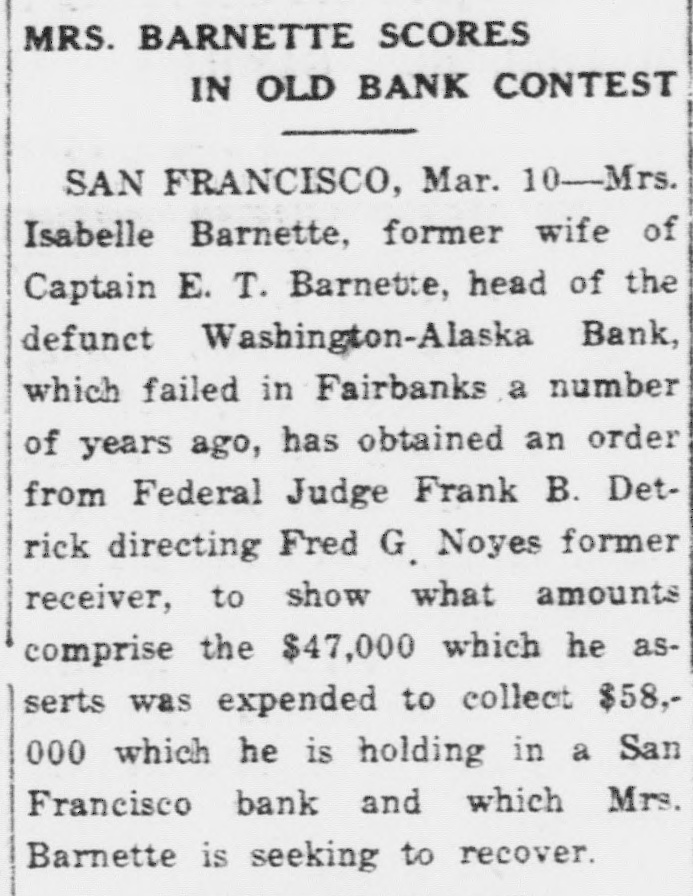
MRS. BARNETTE SCORES IN OLD BANK CONTEST SAN FRANCISCO, Mar. 10-Mrs. Isabelle Barnette, former wife of Captain E. T. Barnette, head of the defunct Washington-Alaska Bank, which failed in Fairbanks a number of years ago, has obtained an order from Federal Judge Frank B. Detrick directing Fred G. Noyes former receiver, to show what amounts comprise the $47,000 which he asserts was expended to collect $58,000 which he is holding in a San Francisco bank and which Mrs. Barnette is seeking to recover.