Barre Savings Bank & Trust Company (Barre, VT)

Episode Information

Episode Type
Run → Suspension → Closure
Start Date
November 1, 1920*
Location
Barre, Vermont (44.197, -72.502)
Bank Type
trust

Metadata

Notes

President pleaded guilty to embezzlement after the run; bank placed in receivership and assets later sold.

Events (5)

1. November 1, 1920* Run
Cause
Rumor Or Misinformation
Cause Details
Unauthenticated rumors about the bank's financial condition led depositors to withdraw funds over several days.
Newspaper Excerpt
the bank had been subjected to a run during the past few days following the spreading of unauthenticated rumors concerning the bank's financial condition.
Source
newspapers
2. November 22, 1920 Suspension
Cause
Government Action
Cause Details
Closed by State Bank Commissioner George P. Carpenter after a hasty examination following a run.
Newspaper Excerpt
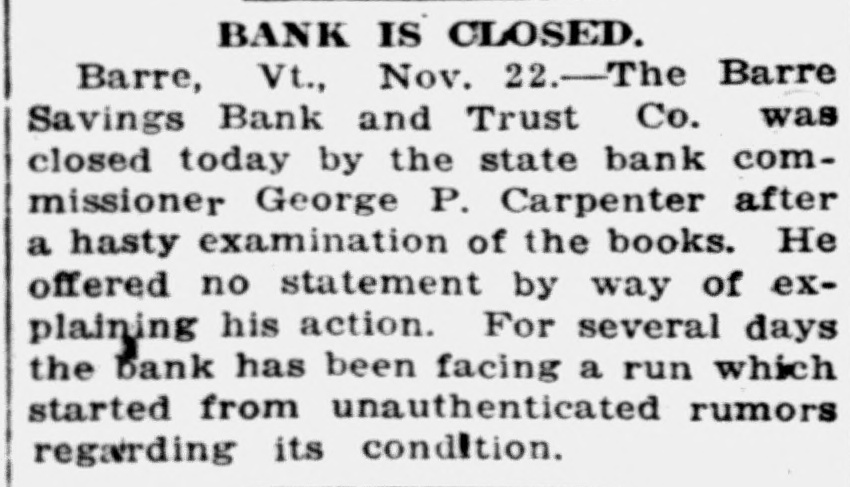
The Barre Savings Bank and Trust Co. was closed today by the state bank commissioner George P. Carpenter after a hasty examination of the books.
Source
newspapers
3. November 23, 1920 Receivership
Newspaper Excerpt
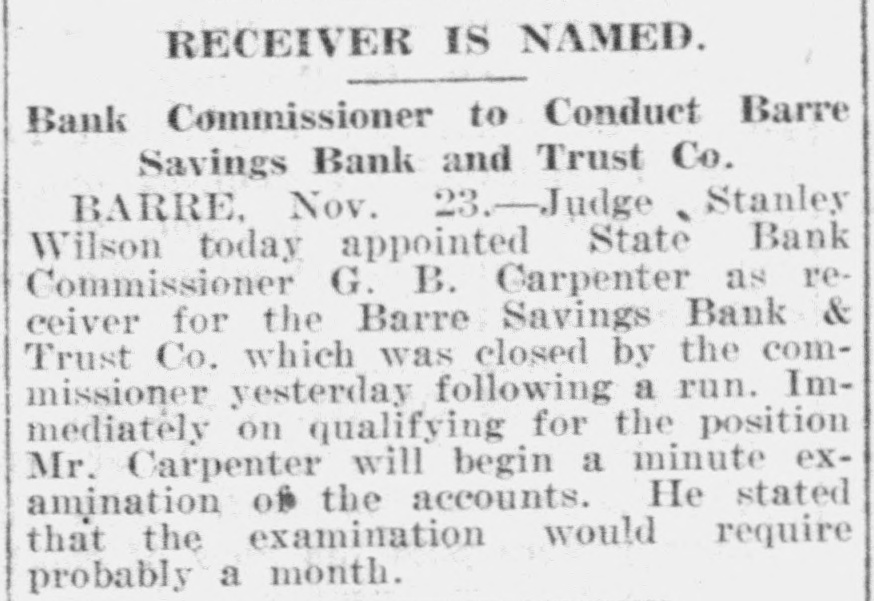
Judge Stanley Wilson today appointed State Bank Commissioner G. B. Carpenter as receiver for the Barre Savings Bank and Trust Co. which was closed by the commissioner yesterday following a run.
Source
newspapers
4. December 28, 1920 Other
Newspaper Excerpt
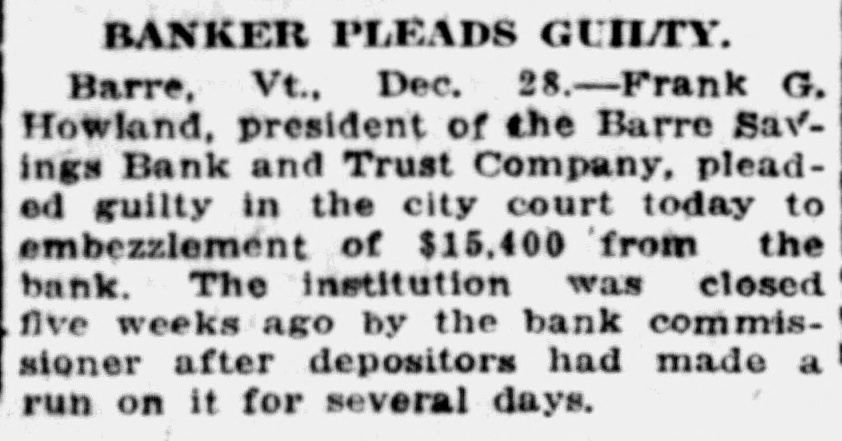
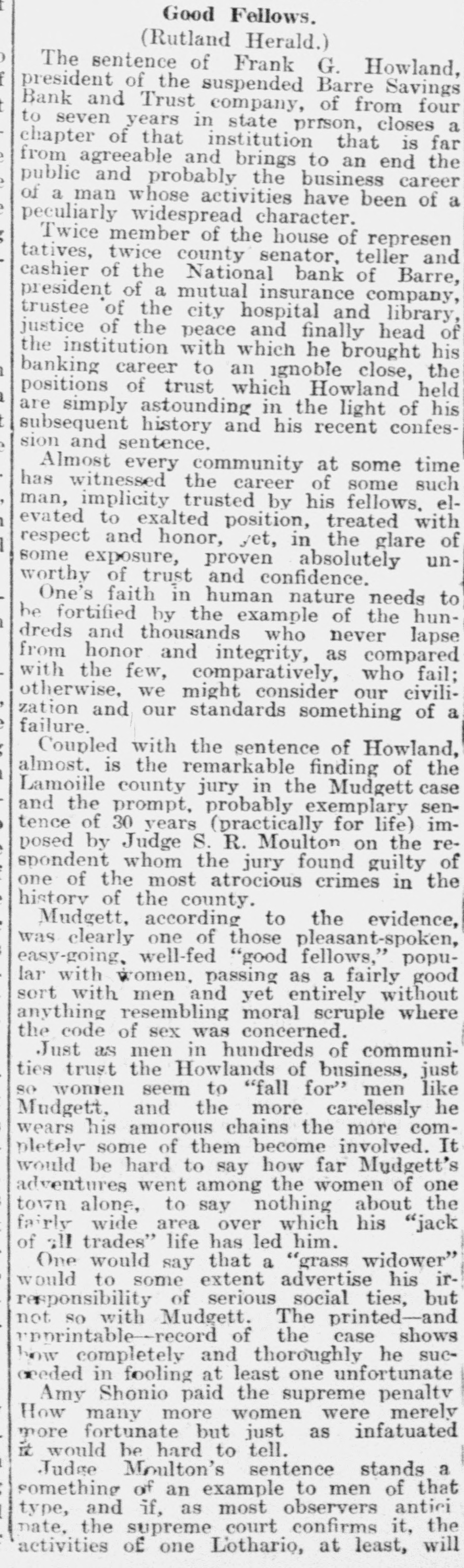
Frank G. Howland, president of the Barre Savings Bank and Trust Company, pleaded guilty in the city court today to embezzlement of $15,400 from the bank.
Source
newspapers
5. April 3, 1922 Other
Newspaper Excerpt
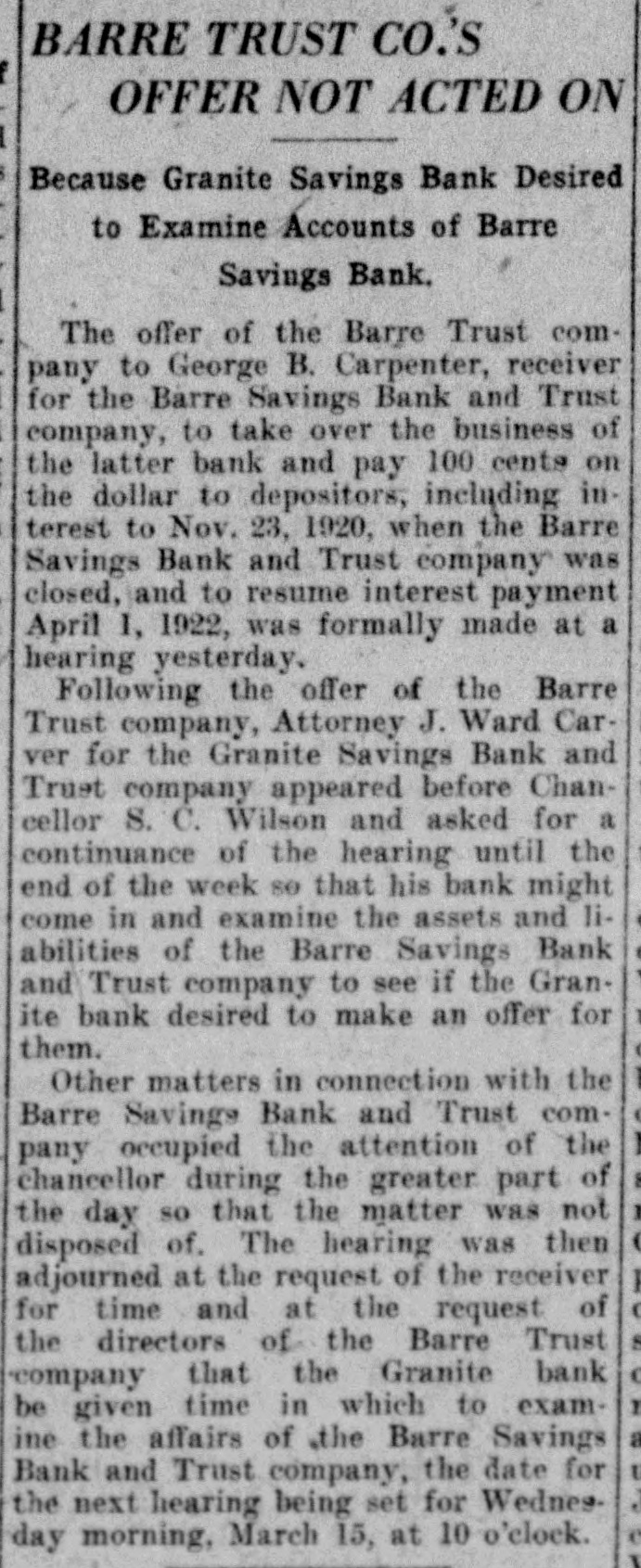
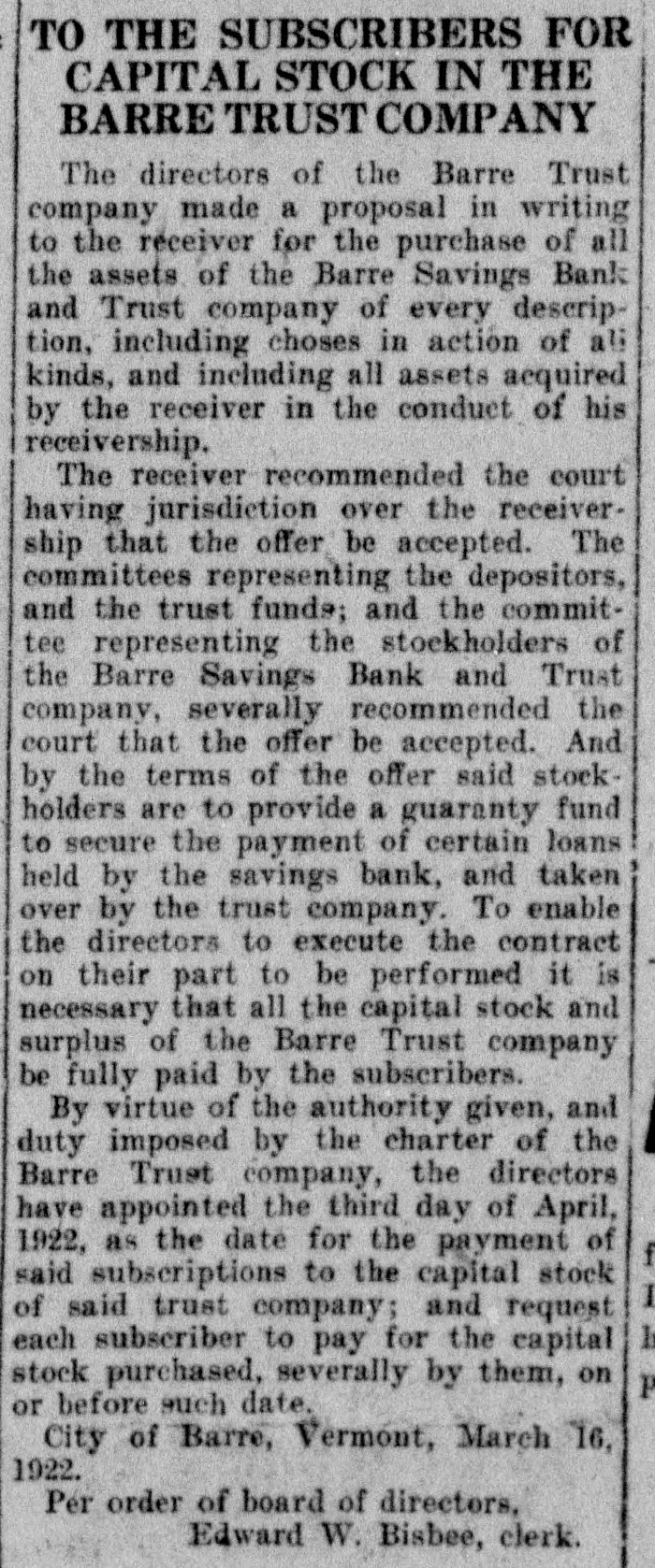
Directors appointed April 3, 1922 as the date for payment of subscriptions to capital stock of Barre Trust company to enable purchase of assets of the Barre Savings Bank and Trust company.
Source
newspapers

Newspaper Articles (18)

Article from New Britain Herald, November 22, 1920

Click image to open full size in new tab

Article Text

BANK IS CLOSED. Barre, Vt., Nov. 22.-The Barre Savings Bank and Trust Co. was closed today by the state bank commissioner George P. Carpenter after a hasty examination of the books. He offered no statement by way of explaining his action. For several days the bank has been facing a run which started from unauthenticated rumors regarding its condition.


Article from The Brattleboro Daily Reformer, November 22, 1920

Click image to open full size in new tab

Article Text

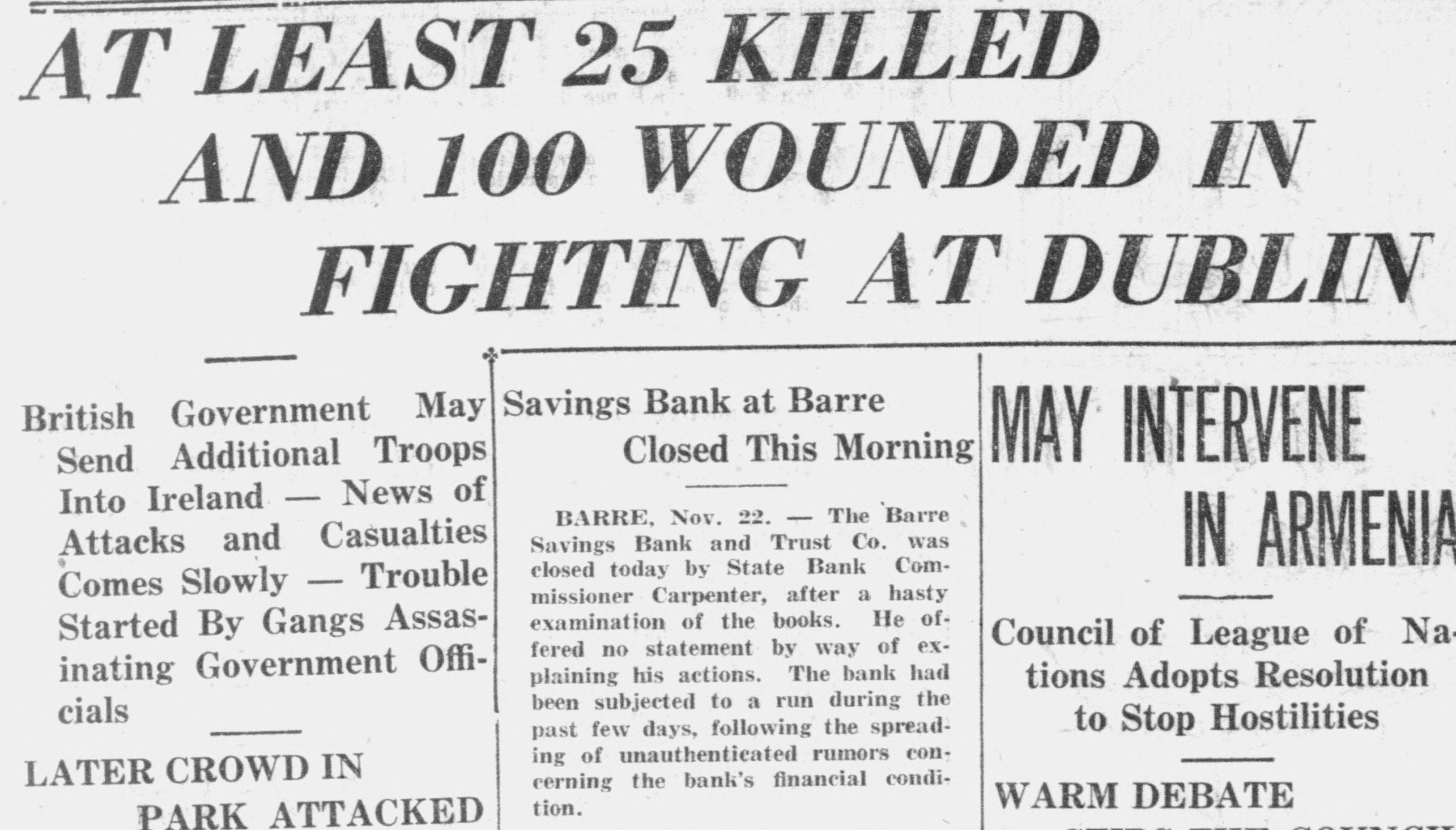
AT LEAST 25 KILLED AND 100 WOUNDED IN FIGHTING AT DUBLIN Savings Bank at Barre British Government May MAY INTERVENE Closed This Morning Send Additional Troops Into Ireland - News of BARRE, Nov. 22. - The Barre Attacks and Casualties Savings Bank and Trust Co. was IN ARMENIA closed today by State Bank ComComes Slowly - Trouble missioner Carpenter, after a hasty examination of the books. He ofStarted By Gangs AssasCouncil of League of Na fered no statement by way of exinating Government Offiplaining his actions. The bank had tions Adopts Resolution been subjected to a run during the cials to Stop Hostilities past few days, following the spreading of unauthenticated rumors conLATER CROWD IN cerning the bank's financial condiWARM DEBATE tion. PARK ATTACKED


Article from The Caledonian-Record, November 22, 1920

Click image to open full size in new tab

Article Text

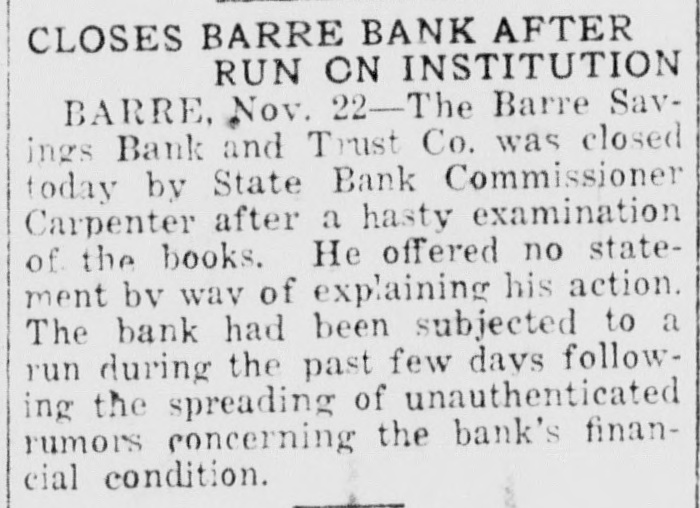
CLOSES BARRE BANK AFTER RUN ON INSTITUTION BARRE. Nov. 22-The Barre Savings Bank and Trust Co. was closed today by State Bank Commissioner Carpenter after a hasty examination of the books. He offered no statement by way of explaining his action. The bank had been subjected to a run during the past few days following the spreading of unauthenticated rumors concerning the bank's financial condition.


Article from The Brattleboro Daily Reformer, November 23, 1920

Click image to open full size in new tab

Article Text

RECEIVER IS NAMED. Bank Commissioner to Conduct Barre Savings Bank and Trust Co. BARRE, Nov. 23.-Judge Stanley Wilson today appointed State Bank Commissioner G. B. Carpenter as receiver for the Barre Savings Bank & Trust Co. which was closed by the commissioner yesterday following a run. Immediately on qualifying for the position Mr. Carpenter will begin a minute examination of the accounts. He stated that the examination would require probably a month.


Article from New-York Tribune, November 27, 1920

Click image to open full size in new tab

Article Text

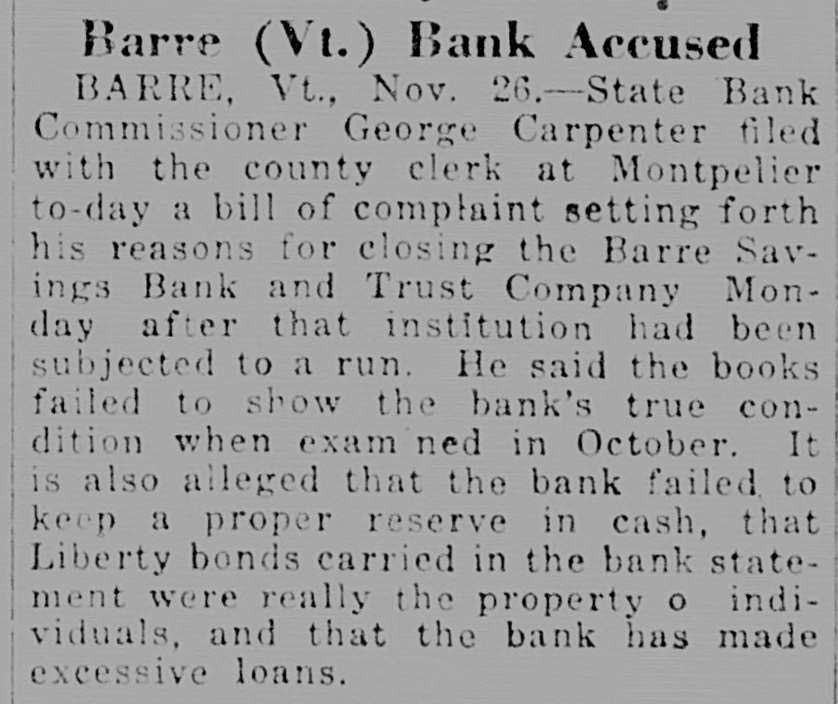
Barre (Vt.) Bank Accused BARRE, Vt., Nov. .--State Bank Commissioner George Carpenter filed with the county clerk at Montpelier to-day a bill of complaint setting forth his reasons for closing the Barre Savings Bank and Trust Company Monday after that institution had been subjected to a run. He said the books failed to show the bank's true condition when exam ned in October. It is also alleged that the bank failed to keep a proper reserve in cash, that Liberty bonds carried in the bank statement were really the property o individuals, and that the bank has made excessive loans.


Article from News and Citizen, December 8, 1920

Click image to open full size in new tab

Article Text

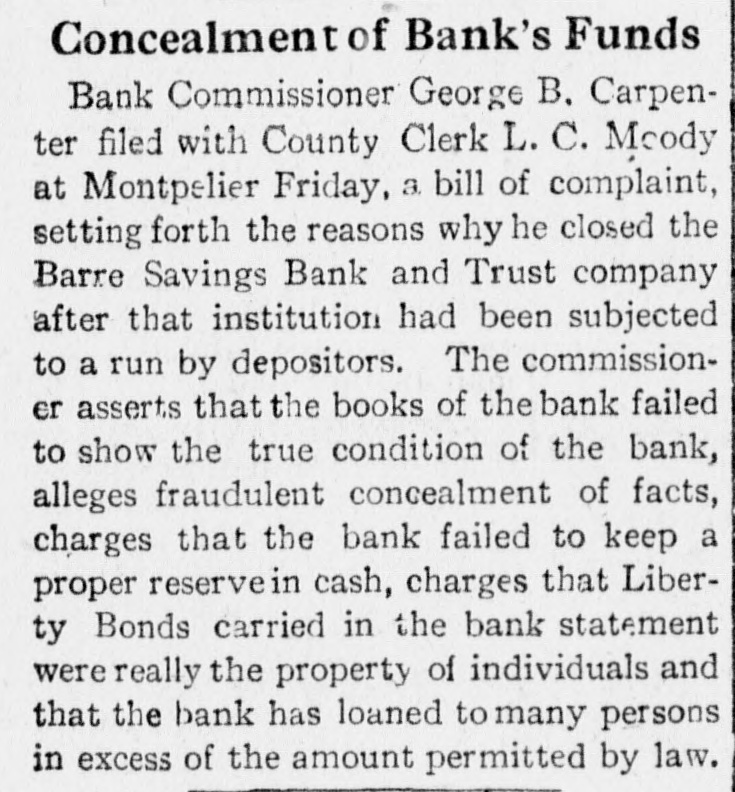
Concealment of Bank's Funds Bank Commissioner George B. Carpenter filed with County Clerk L. C. Meody at Montpelier Friday, a bill of complaint, setting forth the reasons why he closed the Barre Savings Bank and Trust company after that institution had been subjected to a run by depositors. The commissioner asserts that the books of the bank failed to show the true condition of the bank, alleges fraudulent concealment of facts, charges that the bank failed to keep a proper reservein cash, charges that Liberty Bonds carried in the bank statement were really the property of individuals and that the bank has loaned to many persons in excess of the amount permitted by law.


Article from New Britain Herald, December 28, 1920

Click image to open full size in new tab

Article Text

BANKER PLEADS GUILTY. Barre, Vt., Dec. 28.-Frank G. Howland, president of the Barre Savings Bank and Trust Company, pleaded guilty in the city court today to embezzlement of $15,400 'from the bank. The institution was closed five weeks ago by the bank commissioner after depositors had made a run on it for several days.


Article from Every Evening, Wilmington Daily Commercial, December 29, 1920

Click image to open full size in new tab

Article Text

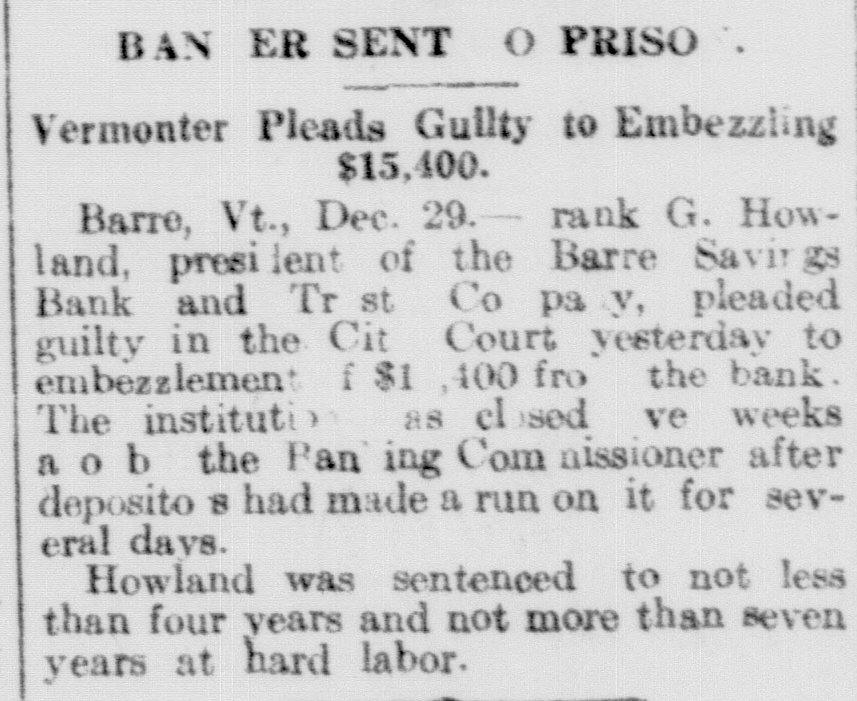
BAN ER SENT o PRISO . . Vermonter Pleads Gullty to Embezzling $15,400. Barre, Vt., Dec. 29.- rank G. Howland, president of the Barre Savings Bank and Tr st Co pa y, pleaded guilty in the Cit Court yesterday to embezzlement f $1 ,400 fro the bank. The instituti) as closed ve weeks a o b the Pan ing Com missioner after deposito 8 had made a run on it for several days. Howland was sentenced to not less than four years and not more than seven years at hard labor.


Article from The Barre Daily Times, December 30, 1920

Click image to open full size in new tab

Article Text

RECEIVER SUES F. G. HOWLAND. Amount Set Up Is $50,000-No Specifications Filed. George B. Carpenter, as receiver of the Barre Savings Bank & Trust Co., has brought a suit of $50,000 against Frank G. Howland, who was sentenced in Barre city court this week. There are no specifications set forth in the bill of complaint.


Article from The Brattleboro Daily Reformer, December 31, 1920

Click image to open full size in new tab

Article Text

RECEIVER SUES F. G. HOWLAND. Amount Set Up Is $50,000-No Specifications Filed. BARRE, Dec. 31.-George B. Carpenter, as receiver of the Barre Savings Bank & Trust Co., has brought a suit for $50,000 against Frank G. Howland, who was sentenced in Barre city court this week. There are no specifications set forth in the bill of complaint.


Article from The Brattleboro Daily Reformer, January 3, 1921

Click image to open full size in new tab

Article Text

# Good Fellows. (Rutland Herald.) The sentence of Frank G. Howland, president of the suspended Barre Savings Bank and Trust company, of from four to seven years in state prison, closes a chapter of that institution that is far from agreeable and brings to an end the public and probably the business career of a man whose activities have been of a peculiarly widespread character. Twice member of the house of representatives, twice county senator, teller and cashier of the National bank of Barre, president of a mutual insurance company, trustee of the city hospital and library, justice of the peace and finally head of the institution with which he brought his banking career to an ignoble close, the positions of trust which Howland held are simply astounding in the light of his subsequent history and his recent confession and sentence. Almost every community at some time has witnessed the career of some such man, implicity trusted by his fellows, elevated to exalted position, treated with respect and honor, yet, in the glare of some exposure, proven absolutely unworthy of trust and confidence. One's faith in human nature needs to be fortified by the example of the hundreds and thousands who never lapse from honor and integrity, as compared with the few, comparatively, who fail; otherwise, we might consider our civilization and our standards something of a failure. Coupled with the sentence of Howland, almost, is the remarkable finding of the Lamoille county jury in the Mudgett case and the prompt, probably exemplary sentence of 30 years (practically for life) imposed by Judge S. R. Moulton on the respondent whom the jury found guilty of one of the most atrocious crimes in the history of the county. Mudgett, according to the evidence, was clearly one of those pleasant-spoken, easy-going, well-fed "good fellows," popular with women, passing as a fairly good sort with men and yet entirely without anything resembling moral scruple where the code of sex was concerned. Just as men in hundreds of communities trust the Howlands of business, just so women seem to "fall for" men like Mudgett, and the more carelessly he wears his amorous chains the more completely some of them become involved. It would be hard to say how far Mudgett's adventures went among the women of one town alone, to say nothing about the fairly wide area over which his "jack of all trades" life has led him. One would say that a "grass widower" would to some extent advertise his irresponsibility of serious social ties, but not so with Mudgett. The printed-and unprintable-record of the case shows how completely and thoroughly he succeeded in fooling at least one unfortunate Amy Shonio paid the supreme penalty. How many more women were merely more fortunate but just as infatuated it would be hard to tell. Judge Moulton's sentence stands a something of an example to men of that type, and if, as most observers anticipate, the supreme court confirms it, the activities of one Lothario, at least, will
Article from Orleans County Monitor, September 28, 1921

Click image to open full size in new tab

Article Text

Receiver Carpenter of the Barre Savings Bank and Trust Co. says there is assets sufficient to pay 100 cents on the dollar if they can be taken over by some going faduciary institution.


Article from The Barre Daily Times, November 3, 1921

Click image to open full size in new tab

Article Text

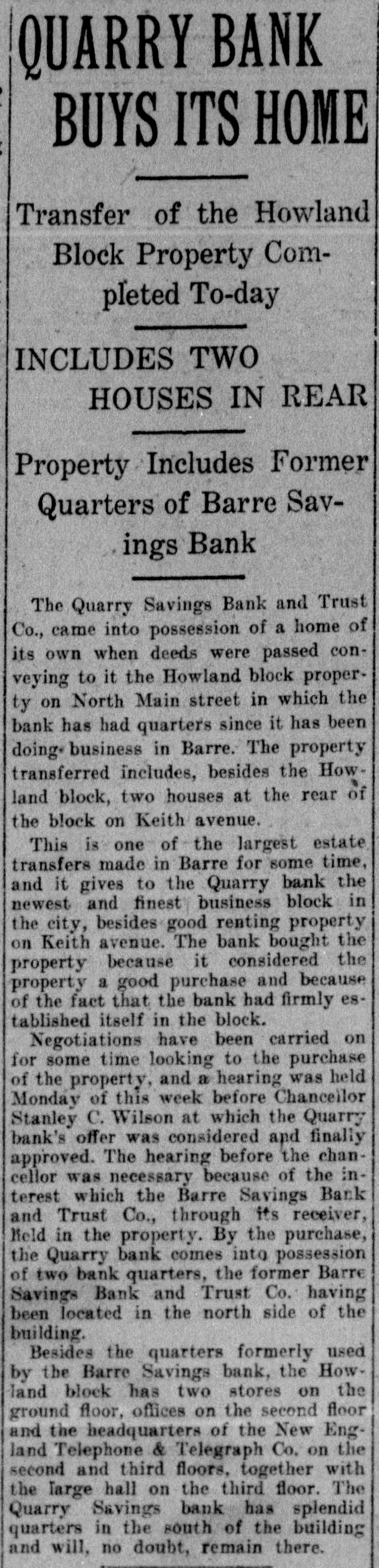
# QUARRY BANK # BUYS ITS HOME Transfer of the Howland Block Property Com- pleted To-day INCLUDES TWO HOUSES IN REAR Property Includes Former Quarters of Barre Sav- ings Bank The Quarry Savings Bank and Trust Co., came into possession of a home of its own when deeds were passed conveying to it the Howland block property on North Main street in which the bank has had quarters since it has been doing business in Barre. The property transferred includes, besides the How-land block, two houses at the rear of the block on Keith avenue. This is one of the largest estate transfers made in Barre for some time, and it gives to the Quarry bank the newest and finest business block in the city, besides good renting property on Keith avenue. The bank bought the property because it considered the property a good purchase and because of the fact that the bank had firmly established itself in the block. Negotiations have been carried on for some time looking to the purchase of the property, and a hearing was held Monday of this week before Chancellor Stanley C. Wilson at which the Quarry bank's offer was considered and finally approved. The hearing before the chancellor was necessary because of the interest which the Barre Savings Bank and Trust Co., through its receiver, held in the property. By the purchase, the Quarry bank comes into possession of two bank quarters, the former Barre Savings Bank and Trust Co. having been located in the north side of the building. Besides the quarters formerly used by the Barre Savings bank, the Howland block has two stores on the ground floor, offices on the second floor and the headquarters of the New England Telephone & Telegraph Co. on the second and third floors, together with the large hall on the third floor. The Quarry Savings bank has splendid quarters in the south of the building and will, no doubt, remain there.


Article from The Barre Daily Times, February 18, 1922

Click image to open full size in new tab

Article Text

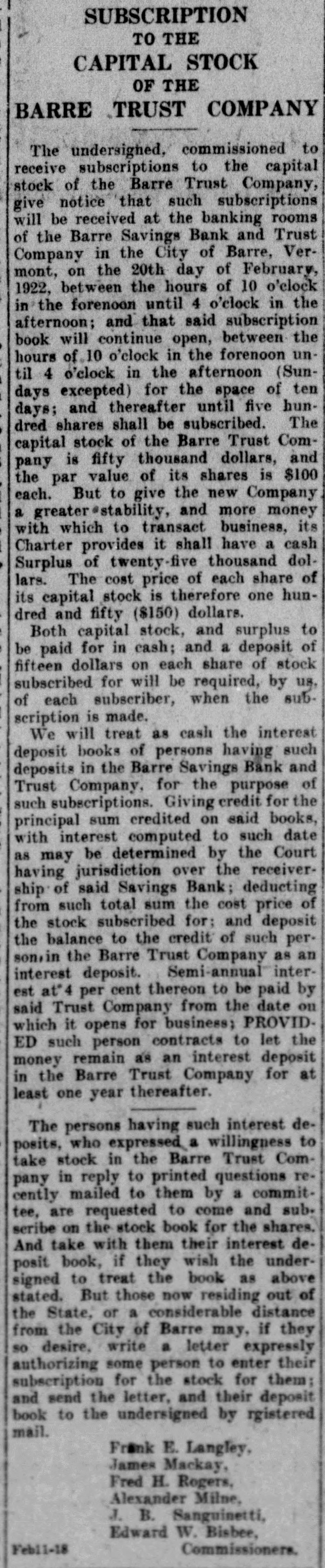
# SUBSCRIPTION # TO THE # CAPITAL STOCK # OF THE # BARRE TRUST COMPANY The undersigned, commissioned to receive subscriptions to the capital stock of the Barre Trust Company, give notice that such subscriptions will be received at the banking rooms of the Barre Savings Bank and Trust Company in the City of Barre, Vermont, on the 20th day of February, 1922, between the hours of 10 o'clock in the forenoon until 4 o'clock in the afternoon; and that said subscription book will continue open, between the hours of 10 o'clock in the forenoon until 4 o'clock in the afternoon (Sundays excepted) for the space of ten days; and thereafter until five hundred shares shall be subscribed. The capital stock of the Barre Trust Company is fifty thousand dollars, and the par value of its shares is $100 each. But to give the new Company a greater stability, and more money with which to transact business, its Charter provides it shall have a cash Surplus of twenty-five thousand dollars. The cost price of each share of its capital stock is therefore one hundred and fifty ($150) dollars. Both capital stock, and surplus to be paid for in cash; and a deposit of fifteen dollars on each share of stock subscribed for will be required, by us, of each subscriber, when the subscription is made. We will treat as cash the interest deposit books of persons having such deposits in the Barre Savings Bank and Trust Company, for the purpose of such subscriptions. Giving credit for the principal sum credited on said books, with interest computed to such date as may be determined by the Court having jurisdiction over the receivership of said Savings Bank; deducting from such total sum the cost price of the stock subscribed for; and deposit the balance to the credit of such person in the Barre Trust Company as an interest deposit. Semi-annual interest at 4 per cent thereon to be paid by said Trust Company from the date on which it opens for business; PROVIDED such person contracts to let the money remain as an interest deposit in the Barre Trust Company for at least one year thereafter. The persons having such interest deposits, who expressed a willingness to take stock in the Barre Trust Company in reply to printed questions recently mailed to them by a committee, are requested to come and subscribe on the stock book for the shares. And take with them their interest deposit book, if they wish the undersigned to treat the book as above stated. But those now residing out of the State, or a considerable distance from the City of Barre may, if they so desire, write a letter expressly authorizing some person to enter their subscription for the stock for them; and send the letter, and their deposit book to the undersigned by registered mail. Frank E. Langley, James Mackay, Fred H. Rogers, Alexander Milne, J. B. Sanguinetti, Edward W. Bisbee, Commissioners. Feb11-18


Article from The Barre Daily Times, February 21, 1922

Click image to open full size in new tab

Article Text

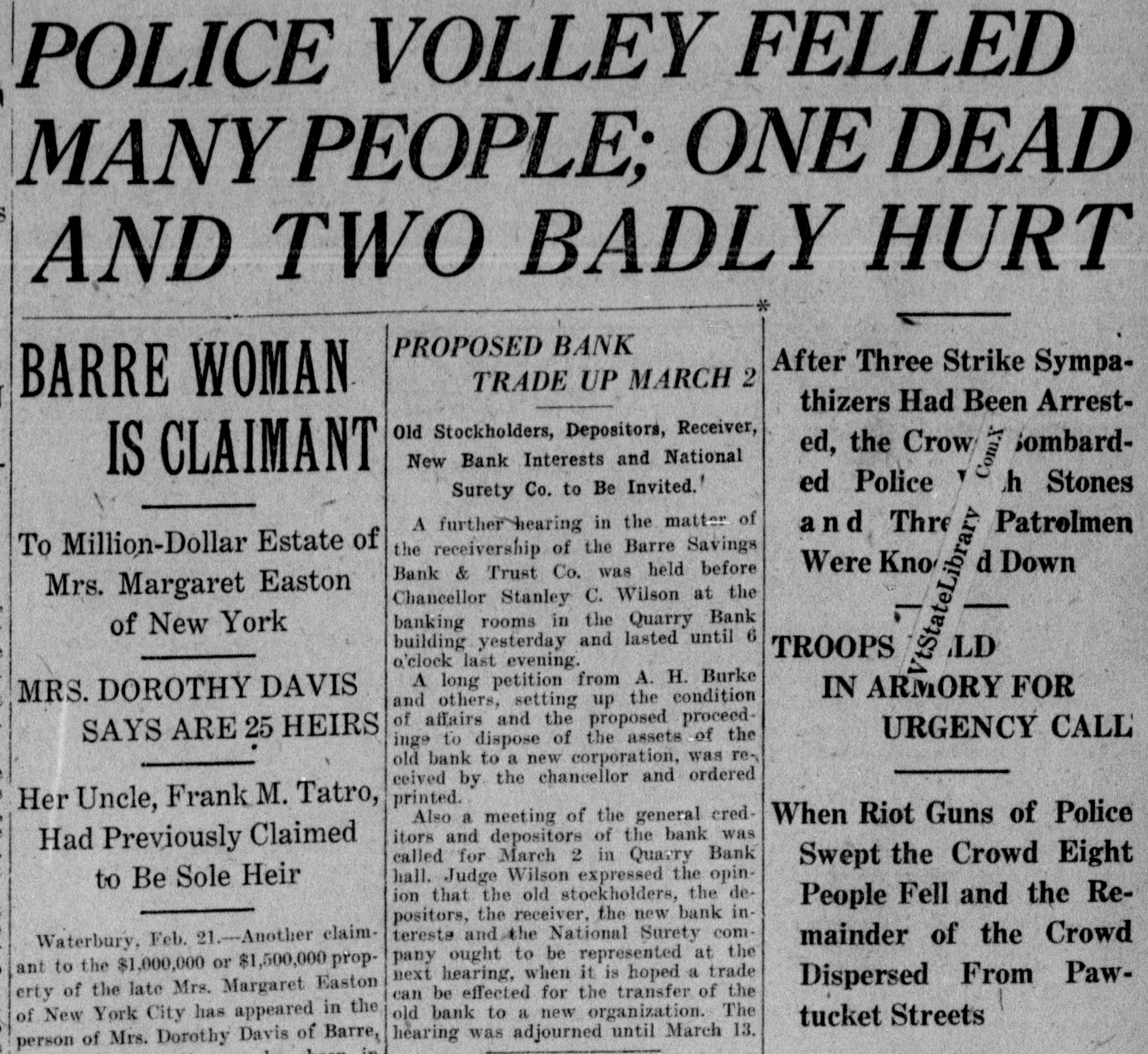
POLICE VOLLEY FELLED MANY PEOPLE; ONE DEAD AND TWO BADLY HURT PROPOSED BANK After Three Strike SympaTRADE UP MARCH 2 BARRE WOMAN thizers Had Been ArrestOld Stockholders, Depositors, Receiver, Bombarded, the Crow New Bank Interests and National IS CLAIMANT , ed Police h Stones Surety Co. to Be Invited. and Thre Patrolmen A further hearing in the matter of To Million-Dollar Estate of the receivership of the Barre Savings d Down Were Kno Bank & Trust Co. was held before Mrs. Margaret Easton Chancellor Stanley C. Wilson at the banking rooms in the Quarry Bank of New York building yesterday and lasted until 6 LD TROOPS o'clock last evening. A long petition from A. H. Burke IN ARMORY FOR MRS. DOROTHY DAVIS and others, setting up the condition of affairs and the proposed proceedURGENCY CALL SAYS ARE 25 HEIRS inge to dispose of the assets of the old bank to a new corporation, was received by the chancellor and ordered printed. Her Uncle, Frank M. Tatro, When Riot Guns of Police Also a meeting of the general creditors and depositors of the bank was Had Previously Claimed called for March 2 in Quarry Bank Swept the Crowd Eight hall. Judge Wilson expressed the opinto Be Sole Heir ion that the old stockholders, the dePeople Fell and the Repositors, the receiver, the new bank interests and the National Surety commainder of the Crowd Waterbury, Feb. 21.-Another claimpany ought to be represented at the ant to the $1,000,000 or $1,500,000 propnext hearing, when it is hoped a trade Dispersed From Pawcan be effected for the transfer of the erty of the late Mrs. Margaret Easton old bank to a new organization. The of New York City has appeared in the tucket Streets hearing was adjourned until March 13. person of Mrs. Dorothy Davis of Barre,


Article from The Barre Daily Times, March 9, 1922

Click image to open full size in new tab

Article Text

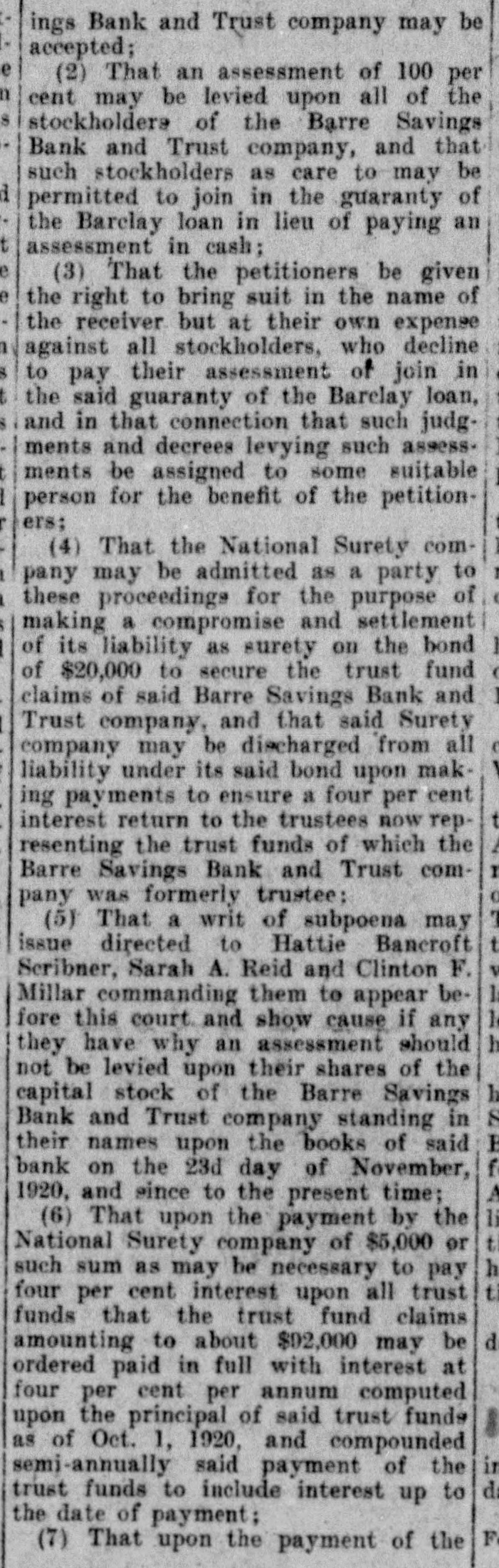
ings Bank and Trust company may be accepted; (2) That an assessment of 100 per cent may be levied upon all of the stockholders of the Barre Savings Bank and Trust company, and that such stockholders as care to may be permitted to join in the guaranty of the Barclay loan in lieu of paying an assessment in cash; (3) That the petitioners be given the right to bring suit in the name of the receiver but at their own expense against all stockholders, who decline to pay their assessment of join in the said guaranty of the Barclay loan, and in that connection that such judgments and decrees levying such assessments be assigned to some suitable person for the benefit of the petitioners; (4) That the National Surety company may be admitted as a party to these proceedings for the purpose of making a compromise and settlement of its liability as surety on the bond of $20,000 to secure the trust fund claims of said Barre Savings Bank and Trust company, and that said Surety company may be discharged from all liability under its said bond upon making payments to ensure a four per cent interest return to the trustees now representing the trust funds of which the Barre Savings Bank and Trust company was formerly trustee: (5) That a writ of subpoena may issue directed to Hattie Bancroft Scribner, Sarah A. Reid and Clinton F. Millar commanding them to appear before this court and show cause if any they have why an assessment should not be levied upon their shares of the capital stock of the Barre Savings Bank and Trust company standing in their names upon the books of said bank on the 23d day of November, 1920, and since to the present time; (6) That upon the payment by the National Surety company of $5,000 or such sum as may be necessary to pay four per cent interest upon all trust funds that the trust fund claims amounting to about $92,000 may be ordered paid in full with interest at four per cent per annum computed upon the principal of said trust funds as of Oct. 1, 1920, and compounded semi-annually said payment of the trust funds to include interest up to the date of payment; (7) That upon the payment of the


Article from The Barre Daily Times, March 14, 1922

Click image to open full size in new tab

Article Text

BARRE TRUST CO.'S OFFER NOT ACTED ON Because Granite Savings Bank Desired to Examine Accounts of Barre Savings Bank. The offer of the Barre Trust company to George B. Carpenter, receiver for the Barre Savings Bank and Trust company, to take over the business of the latter bank and pay 100 cents on the dollar to depositors, including interest to Nov. 23, 1920, when the Barre Savings Bank and Trust company was closed, and to resume interest payment April I, 1922, was formally made at a hearing yesterday. Following the offer of the Barre Trust company, Attorney J. Ward Carver for the Granite Savings Bank and Trust company appeared before Chancellor S. C. Wilson and asked for a continuance of the hearing until the end of the week se that his bank might come in and examine the assets and liabilities of the Barre Savings Bank and Trust company to see if the Granite bank desired to make an offer for them. Other matters in connection with the Barre Savings Bank and Trust company occupied the attention of the chancellor during the greater part of the day so that the matter was not disposed of. The hearing was then adjourned at the request of the receiver for time and at the request of the directors of the Barre Trust company that the Granite bank be given time in which to examine the affairs of the Barre Savings Bank and Trust company, the date for the next hearing being set for Wednesday morning, March 15, at 10 o'clock.


Article from The Barre Daily Times, March 25, 1922

Click image to open full size in new tab

Article Text

# TO THE SUBSCRIBERS FOR CAPITAL STOCK IN THE BARRE TRUST COMPANY The directors of the Barre Trust company made a proposal in writing to the receiver for the purchase of all the assets of the Barre Savings Bank and Trust company of every description, including choses in action of all kinds, and including all assets acquired by the receiver in the conduct of his receivership. The receiver recommended the court having jurisdiction over the receivership that the offer be accepted. The committees representing the depositors, and the trust funds; and the committee representing the stockholders of the Barre Savings Bank and Trust company, severally recommended the court that the offer be accepted. And by the terms of the offer said stockholders are to provide a guaranty fund to secure the payment of certain loans held by the savings bank, and taken over by the trust company. To enable the directors to execute the contract on their part to be performed it is necessary that all the capital stock and surplus of the Barre Trust company be fully paid by the subscribers. By virtue of the authority given, and duty imposed by the charter of the Barre Trust company, the directors have appointed the third day of April, 1922, as the date for the payment of said subscriptions to the capital stock of said trust company; and request each subscriber to pay for the capital stock purchased, severally by them, on or before such date. City of Barre, Vermont, March 16, 1922. Per order of board of directors, Edward W. Bisbee, clerk.