1396. Hartford Bank (Hartford, CT)

Bank Information

Episode Type
Suspension β†’ Reopening
Bank Type
state
Start Date
October 1, 1857
Location
Hartford, Connecticut (41.764, -72.685)

Metadata

Model
gpt-5-mini
Short Digest
dc739c0843aa3c9f

Response Measures

None

Description

Contemporary newspapers report that multiple Hartford banks (Hartford, Phenix, City, State, Farmers' Banks) voted to suspend specie payments on Oct. 14, 1857 as part of the broader panic following the failure of Ohio Life & Trust. There is no article here reporting a depositor run at the Hartford (the Janesville mob attacked a bank that had been paying out Hartford (Conn.) notes, i.e., a remote effect), nor is there evidence in these clippings of a receivership or permanent closure. Given the widespread, short-term suspensions in the 1857 panic and absence of closure/receiver language in these items, I classify the episode as a suspension with likely temporary suspension (reopening).

Events (2)

1. October 1, 1857 Other
Newspaper Excerpt
A bank at Janesville ... had been paying out notes of the Hartford Bank, Connecticut, pretty freely ... when news came that said Hartford Bank had suspended. The farmers flocked to the bank to get their money exchanged ... the officers ... had disappeared, carrying the contents of the vault along with them. (reports of a mob in Janesville over Hartford (Conn.) notes.)
Source
newspapers
2. October 14, 1857 Suspension
Cause
Macro News
Cause Details
Part of the wider financial panic of 1857 triggered by failures such as the Ohio Life and Trust Company, producing pressure on banks and coordinated suspensions of specie payments.
Newspaper Excerpt
At a meeting of bank officers this morning, it was voted that the Hartford, Phenix, City, State and Farmers' Banks suspend specie payments.
Source
newspapers

Newspaper Articles (11)

Article from Richmond Enquirer, August 28, 1857

Click image to open full size in new tab

Article Text

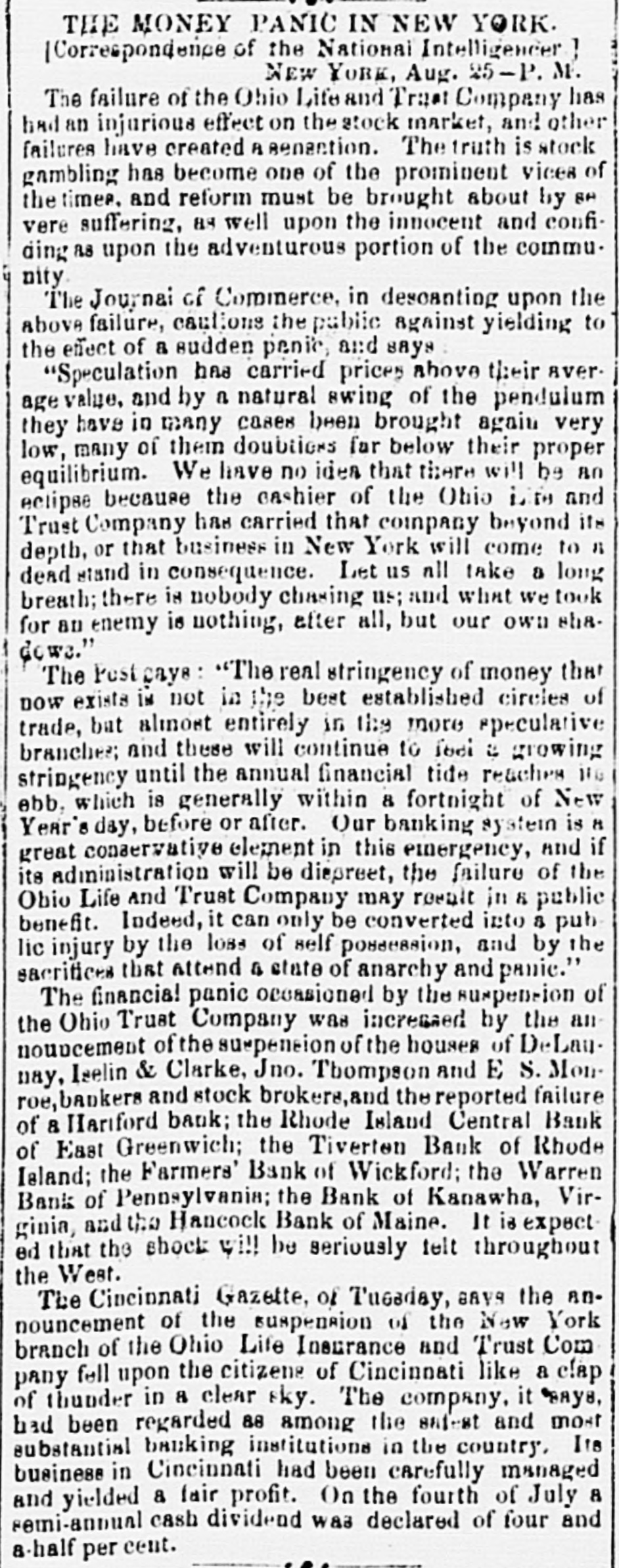
THE MONEY PANIC IN NEW YORK. [Correspondence of the National Intelligencer NEW YORK, Aug. 25-P. M. The failure of the Ohio Life and Trust Company has had an injurious effect on the stock market, and other failures have created A senection. The truth is stock gambling has become one of the prominent vices of the times, and reform must be brought about by 8A vere suffering, as well upon the innocent and confiding as upon the adventurous portion of the community. The Journal of Commerce, in desoanting upon the above failure, cautions the public against yielding to the effect of a sudden penic, and says "Speculation has carried prices above their aver. age value, and by a natural swing of the pendulum they have in many cases been brought again very low, many of them doubtions for below their proper equilibrium. We have no idea that there will be an ectipse because the cashier of the Obio Life and Trust Company has carried that company beyond its depth, or that business in New York will come to n dead stand in consequence. Let us all take a long breath; there is nobody chasing us; and what we took for an enemy is nothing, after all, but our own shadows." The Post cays: "The real stringency of money that now exists is not in the best established circles of trade, but almost entirely in the more speculative branches; and these will continue to fedi is growing stringency until the annual financial tide reaches in ebb, which is generally within 8 fortnight of New Year's day, before or after. Our banking system is H great conservative element in this emergency, And if its administration will be dispreet, the failure of the Obio Life and Trust Company may result in & public benefit. Indeed, it can only be converted into a pub lic injury by the loss of self possession, and by the sacrifices that Attend a state of anarchy and panic." The financial panic occasioned by the suspension of the Ohio Trust Company was increased by the announcement of the surpension of the houses of DeLannay, Iselin & Clarke, Jno. Thompson and E S. Monroe, bankers and stock brokers, and the reported failure of 8 Hariford bank; the Rhode Island Central Bank of East Greenwich; the Tiverten Bank of Rhode Island; the Farmers' Bank of Wickford; the Warren Bank of Pennsylvania; the Bank of Kanawha, Virginia, and the Hancock Bank of Maine. It is expected that the shock will be seriously telt throughout the West. The Cincinnati Gazette, of Tuesday, 8AV9 the announcement of the suspension of the New York branch of the Ohio Life Insurance and Trust Com pany fell upon the citizens of Cincinnati like a clap of thunder in 8 clear sky. The company, it *says, had been regarded 88 among the safest and most substantial banking institutions in the country, Its business in Cincinnati had been carefully managed and yielded 8 fair profit. On the fourth of July 8 semi-annual cash dividend was declared of four and a-half per cent. A


Article from Delaware Democrat, August 29, 1857

Click image to open full size in new tab

Article Text

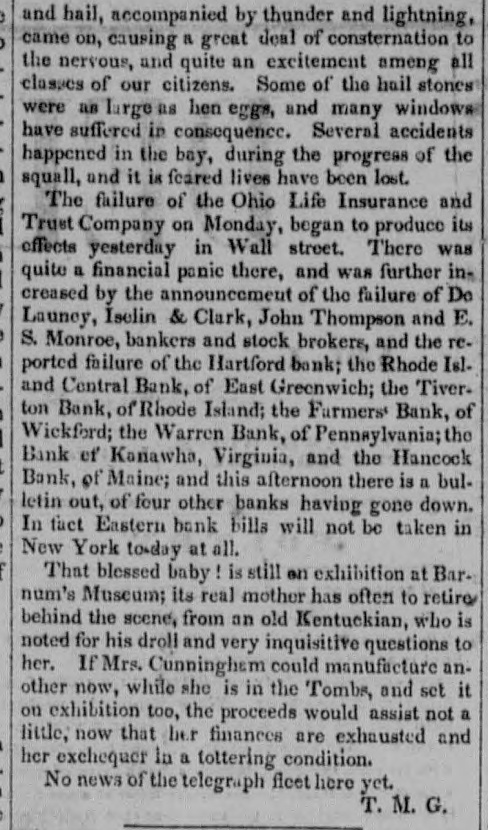
and hail, accompanied by thunder and lightning, came on, causing a great deal of consternation to the nervous, and quite an excitement ameng all classes of our citizens. Some of the hail stones were as large as hen eggs, and many windows have suffered in consequence. Several accidents happened in the bay, during the progress of the squall, and it is feared lives have been lost. THE FAILURE OF THE OHIO LIFE INSURANCE AND TRUST COMPANY The failure of the Ohio Life Insurance and Trust Company on Monday, began to produce its effects yesterday in Wall street. There was quite a financial panic there, and was further increased by the announcement of the failure of De Launcy, Iselin & Clark, John Thompson and E. S. Monroe, bankers and stock brokers, and the reported failure of the Hartford bank; the Rhode Island Central Bank, of East Greenwich; the Tiverton Bank, of Rhode Island; the Farmers' Bank, of Wickford; the Warren Bank, of Pennsylvania; the Bank of Kanawha, Virginia, and the Hancock Bank, of Maine; and this afternoon there is a bulletin out, of four other banks having gone down. In fact Eastern bank bills will not be taken in New York to-day at all. That blessed baby! is still en exhibition at Barnum's Museum; its real mother has often to retire behind the scene, from an old Kentuckian, who is noted for his droll and very inquisitive questions to her. If Mrs. Cunningham could manufacture another now, while she is in the Tombs, and set it on exhibition too, the proceeds would assist not a little; now that her finances are exhausted and her exchequer in a tottering condition. No news of the telegraph fleet here yet. T. M. G.


Article from Preble County Democrat, October 1, 1857

Click image to open full size in new tab

Article Text

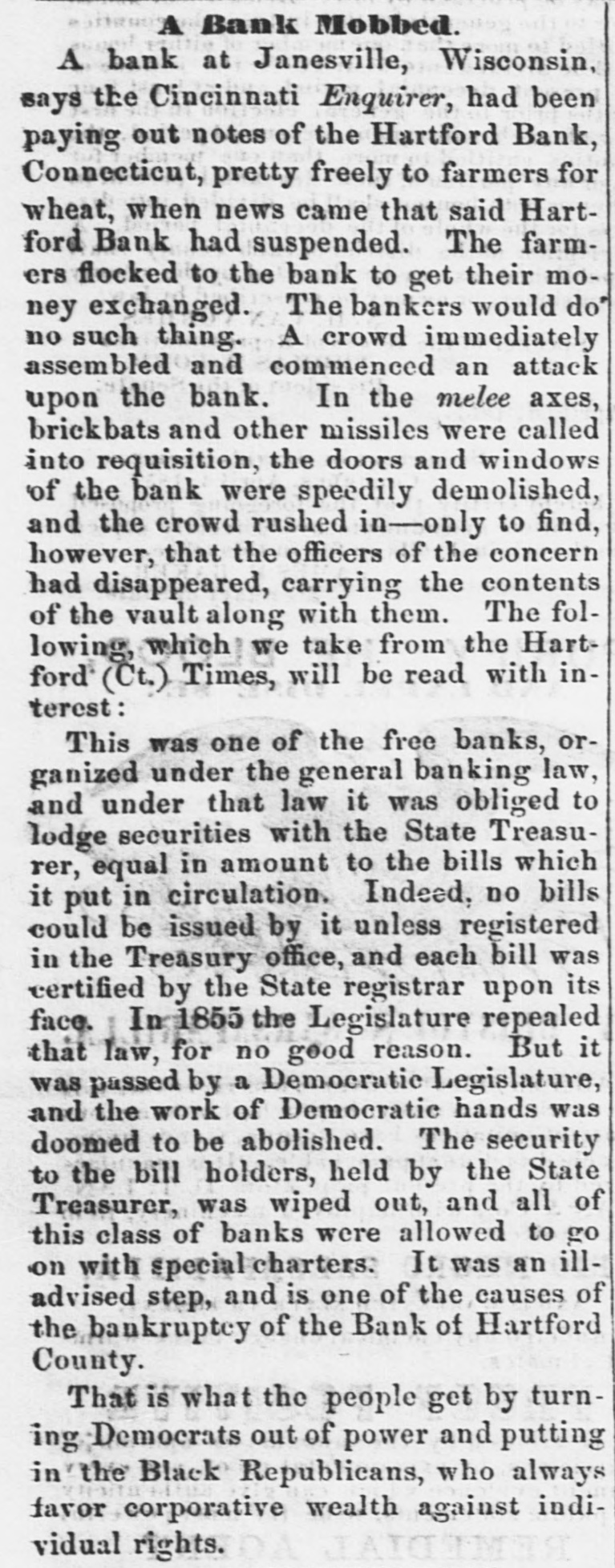
A Bank Mobbed. A bank at Janesville, Wisconsin, says the Cincinnati Enquirer, had been paying out notes of the Hartford Bank, Connecticut, pretty freely to farmers for wheat, when news came that said Hartford Bank had suspended. The farmers flocked to the bank to get their money exchanged. The bankers would do' no such thing. A crowd immediately assembled and commenced an attack upon the bank. In the melee axes, brickbats and other missiles were called into requisition, the doors and windows of the bank were speedily demolished, and the crowd rushed in-only to find, however, that the officers of the concern had disappeared, carrying the contents of the vault along with them. The following, which we take from the Hartford (Ct.) Times, will be read with interest: This was one of the free banks, organized under the general banking law, and under that law it was obliged to lodge securities with the State Treasurer, equal in amount to the bills which it put in circulation. Indeed, no bills could be issued by it unless registered in the Treasury office, and each bill was certified by the State registrar upon its face. In 1855 the Legislature repealed that law, for no good reason. But it was passed by a Democratic Legislature, and the work of Democratic hands was doomed to be abolished. The security to the bill holders, held by the State Treasurer, was wiped out, and all of this class of banks were allowed to go on with special charters. It was an illadvised step, and is one of the causes of the bankruptcy of the Bank of Hartford County. That is what the people get by turning Democrats out of power and putting in the Black Republicans, who always favor corporative wealth against individual rights.


Article from Nashville Union and American, October 3, 1857

Click image to open full size in new tab

Article Text

THE EMPEROR NAPOLEON IN PRIVATE.-Those who have the advantage of personal intercourse with the French Emperor affirm that no one more easily, or indeed more gracefully, unbends from the cares of state or enjoys with more gusto the amusements which relieve the pre-occupation and fatigues of business. It is true those amiable qualities are not expressed very vividly in his countenance, which, even in the most careless hours, retains its austere or pensive caste, and makes the most thoughtless of the courtly circle feel that his Imperial Majesty is among them, but not of them; that his eye, though marking with pleasure the abandon of those whose office, as whose inclination, is to please, is still the eye of the master; and that his voice, though low and sometimes soft, may abruptly countermand the most charming adventure by sea or land ever imagined by an adventurous spirit. How TO MAKE TURTLE SOUP WITHOUT TURTLE. -Take the head of a kid, lamb or calf, that has been carefully cleaned. If they are young, the skin should not be taken off, but the hair removed by scalding in hot ley water. Put one of these into a pot of cold water early in the morning, and start it to boiling. Tie in a clean cloth a teaspoonful of allspice and ten cloves, and drop into the pot. Cut into small pieces one carrot and two medium sized turnips, and drop in. Keep the pot boiling continually, and as the water evaporates, fill up with boiling water. When the head is done 80 well that the bones part easily from the flesh, take it out into a tray, pick the bones carefully out, and chop the meat fine. Strain the liquid through a colander, and turn the chopped meat back into the liquid; now salt and pepper to taste, and thicken with flour that has been parched to a deep coffee color; stir it frequently, that it does not burn, and just before it is taken off, add one gill of good tomato, or any other catsup, and a half pint of pure home-made wine, (such as every housekeeper should make.) Now serve up on table, and if any of your sea-shore readers can tell this from the finny turtle, I will give up that I have any knowledge of house-keeping.--Cor. Cotton Planter and Soil. A BANK MoBBep.-A bank at Janesville, Wisconsin, had been paying out notes of the Hartford Bank, Connecticut, pretty freely to farmers for wheat, when news came that said Hartford Bank had suspended. The farmers flocked to the bank to get their money exchanged. The bankers would do no such thing A crowd immediately assembled and commenced an attack upon the bank. In the melee axes, brickbats and other missiles were called into requisition, the doors and windows of the bank were speedily demolished, and the crowd rushed in -only to find, however, that the officers of the concern had disappeared, carying the contents of the vault along with them. 100 A correspondent of the New York Post sends to that paper a sample of very good brandy made from the sirup of the above-named plant, and says that it costs about 30 cents per gallon to produce it, and it is worth in the market from $1 to $2 per gallon, according to quality. He suggests that the growth of this crop will enable the farmers to manufacture the spirit in the winter season, when they have no other occupation. They can make a gallon of proof spirit for each gallon of fermented syrup, and it will find a ready sale at the rectifiers, who will turn it into alcohol for champhene and other 11000


Article from Fayetteville Observer, October 8, 1857

Click image to open full size in new tab

Article Text

# A BANK MOBBED A bank at Janesville, Wisconsin, had been paying out notes of the Hartford Bank, Connecticut, pretty freely to farmers for wheat, when news came that said Hartford Bank had suspended. The farmers flocked to the bank to get their money exchanged. The bankers would do no such thing. A crowd immediately assembled and commenced an attack upon the banks. In the melee axes, brickbats and other missiles were called into requisition, the doors and windows of the bank were speedily demolished, and the crowd rushed inβ€”only to find, however, that the officers of the concern had disappeared, carrying the contents of the vault along with them.


Article from The New York Herald, October 15, 1857

Click image to open full size in new tab

Article Text

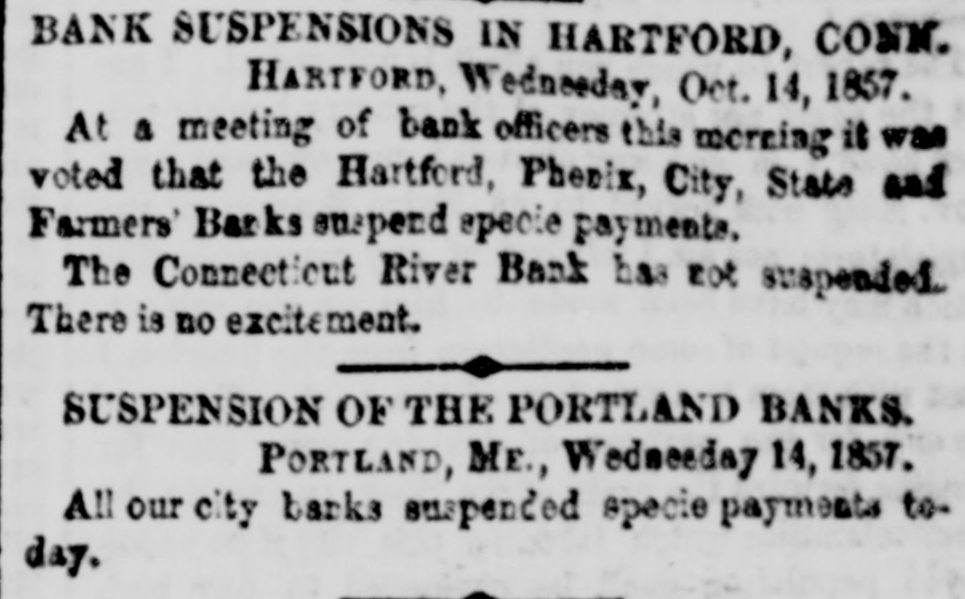
BANK SUSPENSIONS IN HARTFORD, CONN. HARTFORD, Oct. 14, 1857. At a meeting of bank officers this morning, 11 was veled that the Hartford, Phoen'x, City, State and Farmers' Banks suspend specie payments. The Connecticut River Bank has not suspended. There is no excitement.


Article from Marshall County Democrat, October 15, 1857

Click image to open full size in new tab

Article Text

Legalized Privileges. How long will the people, in this intelligent age, submit to partial legislation? How long will they continue to grant charters to moneyed monopolies, which grow and fatten upon the labor and substance of the great producing classes? and, after having grasped the arteries of commerce and exchange, turn upon them, like the poisoned asp, and sting them to the death! Every bank chartered by the Legislature is permitted to do business on three times the amount of the capital actually paid in A bank chartered with a capital of $100,000 is permitted to issue bills to the amount of $300,000. This is unfairthe legislature will not authorize and empower an individual, having a thousand dollars, to transact business on three thousand. It is unfair to assist an association of capital by giving it tripple advantages, when small, individual means, are denied equal favors. It is a great evil to legislate with partiality-to favor the strong and neglect the weak. Equal and exact justice to all should be the basis of legislation. One bank is built upon the paper promises of oth ers. To illustrate: A. has $5,000 on the Bank of Pittsburgh; B. has an equal amount on the State Bank of Ohio; C. has a large amount on the State Bank of Indiana; and others of the stockholders have the paper promises of neighboring banks, which paper they throw together and apply to the Legislature for a charter of a bank with a capital of $100,000, stock all paid in, with privilege to do business on $300,000: Capital, without special favors of legislation, entirely unaided, has an advan tage over labor labor capital, it clears your forests, raises provisions and breadstuff, builds canals and railroads, locomotives and steamboats, delves into the mine and brings forth its riches, it tinds the gold and silver, manufactures the dies and coins the money. It is wrong to cripple that which produces, by any means, but more especially by granting special privileges to a moneyed corporation which produces nothing-save itsirredeemable rags. By favoring capital you rob the producer, and cripple the energy of the laborer. But the banks do not restrict their issues to tripple their capital; they go far beyond this, and to such an extent as to become alarming even to themselves as is evinced by the proceedings of a meeting of bankers in Philadelphia, October 8th, convened to consult upon the present money crisis. They urge upon the extra session of the Pa. Legis lature the necessity for the passage of a law compelling all banks in that Commonwealth to have one specie dollar for every three paper dollars is eued and this in a State where the laws in regard to banks quite as stringent-perhaps more sothan in any other State in the Union. As much as to say: if you have 25 ets. it would be unsafe to put afloat more than 75 cents in shin-plasters! One bank being built upon the promises to pay of other banks, ard flooding the country with its paper issues, inflates the currency, and rise to the wildest and most visionary speculations. The price of labor, of merchandise, of everything, is enhar ced in ratio equal to the over issue of paper money beyond the actual metalic capital and this only to be prostrated below its proper level SO soon as the bank-baloons are tapped for specie. It is a safe estimate to say there is four times as much pa per money afloat as there is gold and silver to re deem it; there is, therefore an unreal value attached to every article of commerce as well as to real estate. To see how easily a crisis or panic may occur, it is no longer necessary to look at the country laid waist by famine, prostrated by postilence, or devastated by war but surrounded by peace, health and abundance, our energies are paralized, our tarde crippled, our credit dishonored and our notes protested, while our pockets may be filled with irredeemable bank paper. See what an effect the banking institutions of one commercial city alone can have upon the currency of the country. In July last, the banks of New York expanded their issue $7,000,000, and in August and September, contracted it $12,000,000-$19,000,000 below the issue of July, and an actual difference in the money market of $38,000,000: This paper money does not go abroad. It is essentially a home currency ; and, notwithstanding the richest mineral as well as agricultural resources, our specie is shipjed abroad whenever the balance of trade is against us, while the rags remain to break in the hands of the million at home. The banking business opens wide the door for defrauding the laboring masses. Who ever heard of a bank breaking whose paper was not scattered among the many and poorer classes? Bankers know the assets and liabilities of almost every bank in the Union. If they do not they are unfit for the business. They study it and learn it just as a mechanic learns his trade. Where there is a distinction legalized in the currency of a country, the least in value will be kept iu circulation, while the more precious will be hoarded. This is natural.Such being the fact, by the ordinary and natural course of trade, the producing and business classes become the sufferers from bank failures But the evil does not stop here; bankers in the west ascer tain that some bank in the east is about to go by the board, and while its money is yet quoted par, bring on large quantities and pay it to the laborers upon railroads and canals, or buy up wheat, flour, and live stock; scarcely has this money been paid into the hands of the many, before the news reachC3. us by telegraph, that the bank has failed! Is not this true ? Look at the bank mob at Janesville, Wis., recently; (to be found in this paper,) it was precisely analogus to the case put. They paid out Hartford, (Conn.) money for wheat, and when the news of its failure arrived-which it speadily did-the Janesville bank refused to exchange the money with the farmers hence the mob. Now the Hartford money is depreciated, the Janesville bank can send out its agents and purchase up the paper at 25 or 50 ets. on the dollar and pay their debt to the Hartford bank in their own money, out of which the Wisconsin bank has realized a very large per centage, and the producing classes been defrauded of their grain and labor. This is legal
Article from Marshall County Democrat, October 15, 1857

Click image to open full size in new tab

Article Text

A BANK MOBBED.-A bank at Janesville, Wisconsin, had been paying out notes of the Hartford Bank, Conn., pretty freely to the farmers for wheat when news came that said Hartford Bank had suspended. The farmers flocked to the bank to get their money exchanged. The bankers would do no such thing. A crowd immediately assembled and commenced an attack upon the bank. In the melee, axes, brickbats, and other missels, were called into requisition, the doors and windows of the bank were speedily demolished, and the crowd rushed in -only to find, however, that the officers had disappeared, carrying the contents of the vault along with them -Clev. Plain Dealer.


Article from New-York Daily Tribune, October 15, 1857

Click image to open full size in new tab

Article Text

BANK SUSPENSIONS IN HARTFORD, CONM. HARTFORD, Wednesday, Oct. 14, 1857. At a meeting of bank officers this merning it was voted that the Hartford, Phenix, City, State and Farmers' Banks suspend specie payments. The Connecticut River Bank has not suspended. There is no excitement. SUSPENSION OF THE PORTLAND BANKS. PORTLAND, ME., Wedneeday 14, 1857. All our city banks suspended specie payments today.


Article from New-York Daily Tribune, October 15, 1857

Click image to open full size in new tab

Article Text

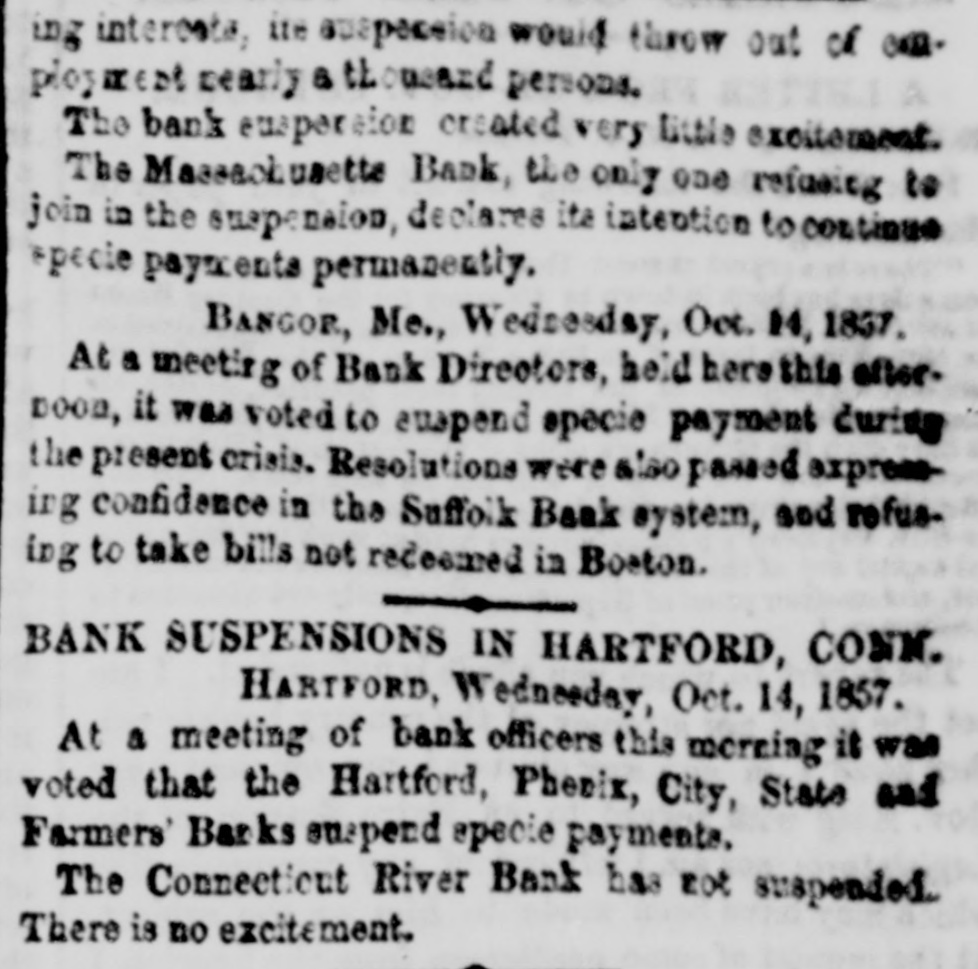
ing interests, ite suspension would throw out of canployment nearly & thousand persons. The bank euspersion created very little excitement. The Massachusetts Bank, the only one refusing to join in the suspension, declares its intention to continue specie payments permanently. BANGOR, Me., Wednesday, Oct. 14, 1857. At a meeting of Bank Directors, held herethis afternoon, it was voted to suspend specie payment during the present crisis. Resolutions were also passed expressing confidence in the Suffolk Bank system, and refusing to take bills not redeemed in Boston. BANK SUSPENSIONS IN HARTFORD, CONM. HARTFORD, Wednesday, Oct. 14, 1857. At a meeting of bank officers this merning it was voted that the Hartford, Phenix, City, State and Farmers' Banks suspend specie payments. The Connecticut River Bank has not suspended. There is no excitement.


Article from Mariposa Democrat, November 12, 1857

Click image to open full size in new tab

Article Text

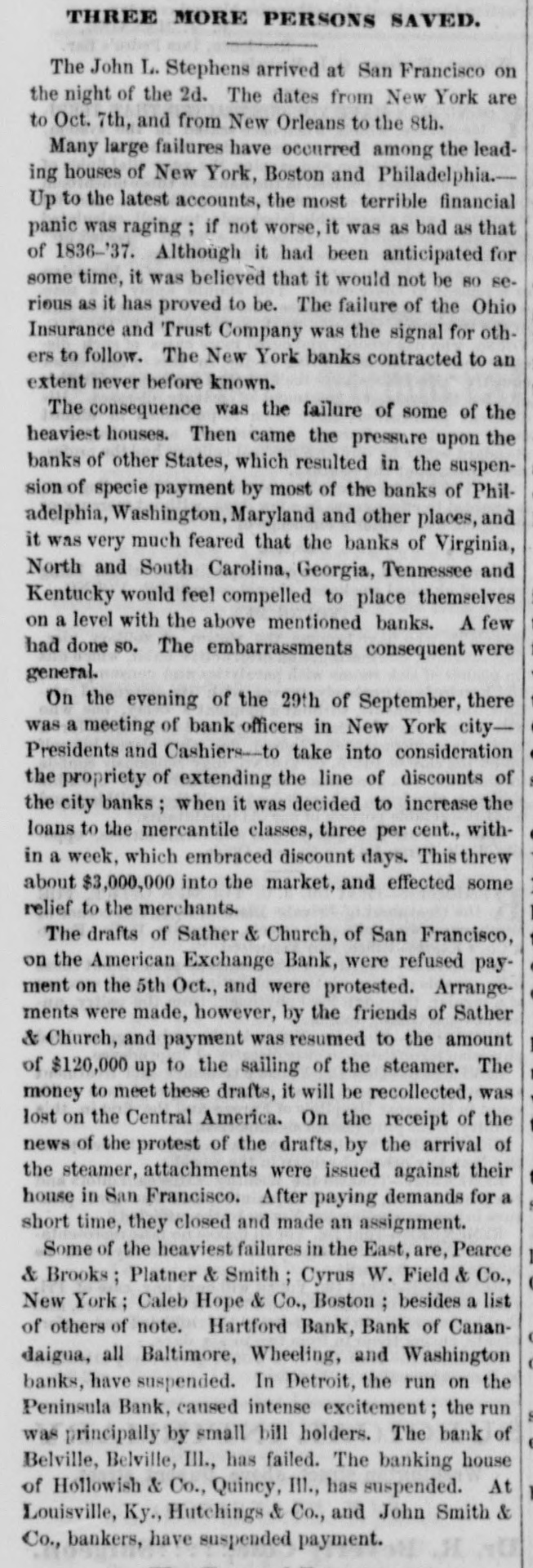
THREE MORE PERSONS SAVED. The John L. Stephens arrived at San Francisco on the night of the 2d. The dates from New York are to Oct. 7th, and from New Orleans to the 8th. Many large failures have occurred among the leading houses of New York, Boston and Philadelphia.Up to the latest accounts, the most terrible financial panic was raging ; if not worse, it was as bad as that of 1836-37. Although it had been anticipated for some time, it was believed that it would not be 80 serious as it has proved to be. The failure of the Ohio Insurance and Trust Company was the signal for others to follow. The New York banks contracted to an extent never before known. The consequence was the failure of some of the heaviest houses. Then came the pressure upon the banks of other States, which resulted in the suspension of specie payment by most of the banks of Philadelphia, Washington, Maryland and other places, and it was very much feared that the banks of Virginia, North and South Carolina, Georgia, Tennessee and Kentucky would feel compelled to place themselves on a level with the above mentioned banks. A few had done so. The embarrassments consequent were general. On the evening of the 29th of September, there was a meeting of bank officers in New York cityPresidents and Cashiers-to take into consideration the propriety of extending the line of discounts of the city banks when it was decided to increase the loans to the mercantile classes, three per cent., within a week, which embraced discount days. This threw about $3,000,000 into the market, and effected some relief to the merchants. The drafts of Sather & Church, of San Francisco, on the American Exchange Bank, were refused payment on the 5th Oct., and were protested. Arrangements were made, however, by the friends of Sather & Church, and payment was resumed to the amount of $120,000 up to the sailing of the steamer. The money to meet these drafts, it will be recollected, was lost on the Central America. On the receipt of the news of the protest of the drafts, by the arrival of the steamer, attachments were issued against their house in San Francisco. After paying demands for a short time, they closed and made an assignment. Some of the heaviest failures in the East, are, Pearce & Brooks Platner & Smith Cyrus W. Field & Co., New York: Caleb Hope & Co., Boston ; besides a list of others of note. Hartford Bank, Bank of Canandaigua, all Baltimore, Wheeling, and Washington banks, have suspended. In Detroit, the run on the Peninsula Bank, caused intense excitement; the run was principally by small bill holders. The bank of Belville, Belville, III., has failed. The banking house of Hollowish & Co., Quincy, III., has suspended. At Louisville, Ky., Hutchings & Co., and John Smith & Co., bankers, have suspended payment.