Article Text
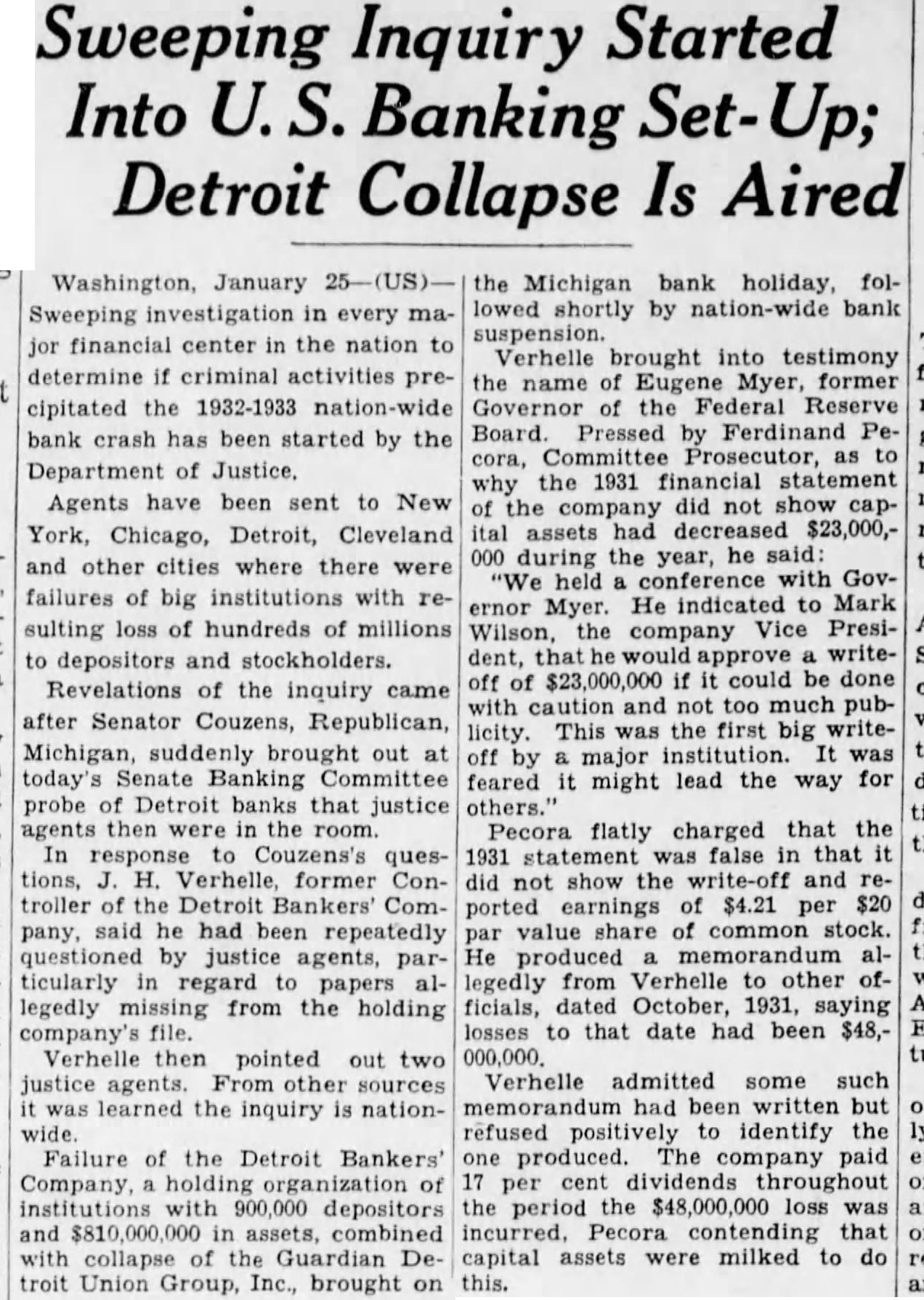
Sweeping Inquiry Started Into U.S. Banking Set-Up; Detroit Collapse Is Aired Washington, January (US) Sweeping investigation in every major financial center in the nation to determine if criminal activities precipitated the 1932-1933 nation-wide bank crash has been started by the Department of Justice. Agents have been sent to New York, Chicago, Detroit, Cleveland and other cities where there were failures of big institutions with resulting loss of hundreds of millions to depositors stockholders. Revelations of the inquiry came after Senator Couzens, Republican, Michigan, suddenly brought out at today's Senate Banking Committee probe of Detroit banks that justice agents then were in the room. In response to Couzens's questions, J. H. Verhelle, former Controller of the Detroit Bankers' Company, said he had been repeatedly questioned by justice agents, particularly regard to papers allegedly missing from the holding company's file. Verhelle then pointed out two justice agents. From other sources was learned the inquiry is nationwide. Failure of the Detroit Bankers' Company, organization of institutions with 900,000 depositors and $810,000,000 assets combined with collapse of the Guardian Detroit Union Group, Inc., brought on this. the Michigan bank holiday, followed shortly by nation-wide bank suspension. Verhelle brought into testimony the name of Eugene Myer, former Governor of the Federal Reserve Board. Pressed by Ferdinand Pecora, Committee Prosecutor, as to why 1931 financial statement of the company did not show capital assets had decreased $23,000,000 during the year, he said: "We held with Governor Myer. He indicated to Mark Wilson, the company Vice President, he would writeoff of $23,000,000 it could be done with caution and not too much publicity. This was the first big writeoff by a major institution. It was feared it might lead the way for others." Pecora flatly charged that the 1931 statement was false that it did not show the write-off and reported earnings of $4.21 per $20 par value share of common stock. He produced memorandum allegedly from Verhelle to other officials, dated October, 1931, saying losses to that date had been $48,000,000. Verhelle admitted some such memorandum had been written but refused positively to identify the one produced. The company paid 17 per the period the $48,000,000 loss was incurred, contending that capital assets were milked to do