13914. Federal Bank (New York, NY)

Bank Information

Episode Type
Suspension โ†’ Closure
Bank Type
state
Start Date
April 15, 1904
Location
New York, New York (40.714, -74.006)

Metadata

Model
gpt-5-mini
Short Digest
83b9dd021e6f0985

Response Measures

None

Description

The articles consistently report the Federal Bank (a New York state institution) was closed by the State Banking Department in mid-April 1904, examiners and police were in charge, a receiver was later appointed and the bank was liquidated. Coverage describes depositors' anger and attempts to force entry but does not clearly describe an initial depositor run prior to the official suspension. Criminal charges against former president David Rothschild and later receiver actions/assessments confirm permanent closure and receivership.

Events (3)

1. April 15, 1904 Receivership
Newspaper Excerpt
Receiver McKeen accepted the money... Receiver McKeen of the Globe Security Company... (articles identify a receiver and later Leo Schlesinger as receiver of the Federal Bank).
Source
newspapers
2. April 15, 1904 Suspension
Cause
Government Action
Cause Details
Closed by the New York State Banking Department; examiners put in charge after discovery of bad assets and suspected misconduct.
Newspaper Excerpt
The Federal bank, a state institution in this city, was closed during the day and officials of the state banking department are in charge.
Source
newspapers
3. April 20, 1904 Other
Newspaper Excerpt
Police reserves were called out this afternoon to protect the property of the suspended Federal Bank at No. 590 Broadway, on account of the efforts made by half a dozen men to break down the outer bars and get inside to see the bank examiners.
Source
newspapers

Newspaper Articles (22)

Article from The Madison Daily Leader, April 15, 1904

Click image to open full size in new tab

Article Text

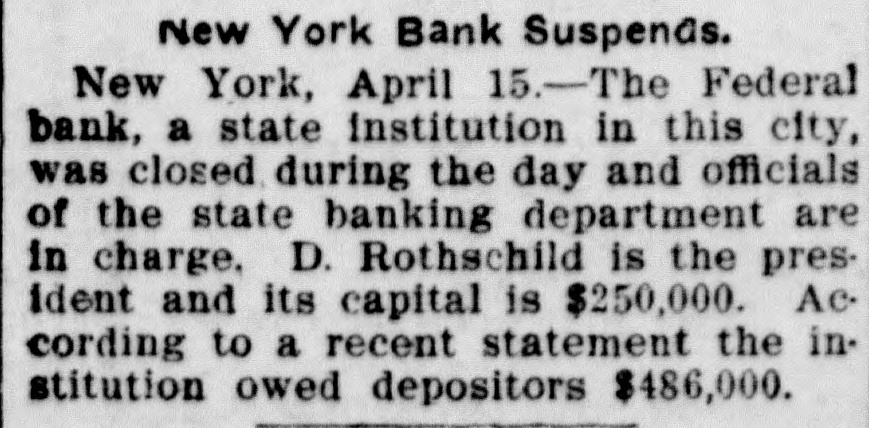
New York Bank Suspends. New York, April 15.-The Federal bank, a state institution in this city, was closed during the day and officials of the state banking department are in charge. D. Rothschild is the presIdent and its capital is $250,000. According to a recent statement the institution owed depositors $486,000.


Article from The Indianapolis Journal, April 15, 1904

Click image to open full size in new tab

Article Text

RECEIVERS FOR TWO EASTERN CONCERNS Federal State Bank, of New York, and Baltimore Equitable Life Insurance Company. BALTIMORE, April 14.-The Baltimore Equitable Life Insurance Company went into the hands of receivers in the Circuit Court to-day on the application of State Insurance Commissioner Lloyd Wilkinson and on an answer filed by the company in which the appointment of receivers was consented to. The receivers were required by the court to give a bond of $20,000, this amount being double the value of the only assets of the company, this asset being the $10,000 deposited with the insurance commissioner, as required by law. NEW YORK, April 14.-The Federal Bank, a state institution in this city, was closed to-day and officials of the State Banking Department are in charge. D. Rothschild is the president and its capital is $250,000 and according to a recent statement owed depositors $486,000. The Federal Bank was organized under the New York laws twelve years ago. A controlling interest in the bank was bought a short time ago by William H. Woods, who intended to reorganize it.


Article from New-York Tribune, April 16, 1904

Click image to open full size in new tab

Article Text

TALK OF ARRESTS. JUDSON STILL 'AT WORK. Angry Crowd About Grand-st. Branch of Federal Bank. The doors of the Federal Bank, at No. 590 Broadway, were kept closed and guarded by a policeman yesterday, while Albert C. Judson, the State bank examiner in charge of the concern, was working on the books. A crowd of depositors remained in front of the doors nearly all day, but there was no notsy demonstration. Around the bank's branch, at Grand and Orchard ets., there was an angry crowd of East Side tradesmen. who were shaking fists at the locked doors there and talking about vengeance If they lost the moLey they had deposited in the bank. Several policemen were on guard there all day. There was e report yesterday that more than one arrest might be expected before night. Assistant District Attorney Kresel, who had charge of the investigation for Mr. Jerome, said late in the afternoon that there would be no arrests in connection with the bank failure before to-day, and possibly not then, as the investigation so far had not disclosed facts which would warrant arrests. David Rothschild, former president of the bank was said not to have been seen at his apartments in the Ansonia since Wednesday, but was believed to be in the city. His wife and daughter. It was said, left the apartments yesterday. but took no baggage with them. Mr. Judson said yesterday that he would not be able to make any statement about the condition of the Federal Bank before Monday. All he could say was that there had been heavy loans to the Globe Security Company, at No. 150 Nassau-st., at the time of Rothschild's presidency of the bank, when Rothschlld was also running the Globe Secuity Company. Mr. Judson declared that the management of the bank, since W. M. Woods succeeded Rothschild as president of the bank, had been good. "Does your investigation show any connection be tween the Federal Bank and the Globe Security Company?" a Tribune reporter asked Mr. Judson. "The company was a heavy borrower. Yes, It does," was Mr. Judson's reply. Several large bundles of papers and some bags of bullion were taken by Mr. Judson and his assistants to the Merchants and Traders' Bank, at Broadway and Prince-st., in the afternoon. Among the notices posted on the dors of the Federal Bank was one that checks drawn on the Globe Security Company, which was connected with the bank, would be paid at the offices at No. 150 Nassau-st. The notice was signed by William Muirhead as treasurer. In explanation of the notice, Muirhead said at the office in Nassau-st.: When the Federal Bank failed. the Globe Security Company had $1,440 out in checks, sent to our customers all over the country. By scraping around last night I managed to get enough money to pay those checks, and I placed it in the Guardian Trust Company. The notice was put up at the Federal Bank 60 25 to inform the holders where they will be paid and thus prevent checks from going to protest. We are desirous of paying our indebtedness, and we have redeemed some of the checks to-day. The Globe Security Company will only settle its own checks. We have $92,000 of hypothecated paper in the Federal Bank, and most of this is good. Besides, there is the cash deposit of $8,000, $0 that the bank will not lose through this concern. I am only an employe of the Globe Security Company, but because I am loyal and because I want to see everybody paid, the blame has all fallen on me, yet I had nothing to do with the finances. Muirhead said he did not nee how the Globe Security Company would be able to continue business. "For five weeks," he added. 'I have tried to pull the concern through, since Rothschild got out, and to-day the Mayor of East Orange was to have taken charge of the presidency of the company. He was elected several days ago, and, had it not been for the failure of the bank, we might have reached firm ground." A VALET WITH A PAST record of good service can be secured by advertising among the "Little Ads. of the People."


Article from The Savannah Morning News, April 19, 1904

Click image to open full size in new tab

Article Text

# Rothschild Is Held. New York, April 18.-Charged with misappropriating $200,000 of the funds of the suspended federal bank, David Rothschild, former president of the institution, was to-day arraigned before a magistrate and held in $25,000 bail for examination April 20. Rothschild was taken back to the Tombs to await bail.


Article from New-York Tribune, April 21, 1904

Click image to open full size in new tab

Article Text

HELD FOR GRAND JURY. ROTHSCHILD'S METHODS. Muirhead Found-Clash Between Globe Receivers Over Papers. Strong intimations that more prominent men and women, including a well known bank president and a Standard Off man, as well as other banking institutions heretofore reputable. were involved in the dual collapse of the Federal Bank and Globe Security Company. were made yesterday. There was a persistent report that David Rothschild speculated and lost heavily in stocks. Rothschild was again arraigned and held for the grand jury at bail aggregating $25,000. A member of the firm of Meyer & Goldsmith, attorneys for the creditors in the bankruptcy proceedings, said last night that a writ of habeas corpus for Rothschild would he asked for this morning, that he might give evidence in the hearing before Commissioner Alexander. Detectives last night had found William Muirhead, the treasurer of the company, who is under $1,000 ball in the Globe usury case, and is also wanted as a witness in the bankruptcy hearing on Saturday. Miss Carrie Adams, of No. 206 West Seventieth-st., who has been seen frequently in the company of Louis Rothschild. a brother of the ex-president, was served with a subpeens ordering her to appear before United States Commissioner Alexander A subpoena has also been issued for Mrs. David Rothschild Receiver McKeen of the Globe Security Company, who was appointed by the Federal Court. learned that Charles C. Black, who had been appointed receiver for the company by the NewJersey Chancery Court. had further qualified as receiver under a New-Jersey federal court commission. the office of neither receiver taking precedence and both applications having been made simultaneously. To confound the confusion Deputy Sheriff John J. Plunkett. who was nominally in charge, refused to leave the office, declaring that he must first have his "poundage" and that there was sufficient money in the office to pay his fee a few hundred dollars. This Receiver McKeen declined to pay. "I find that the trustees." Mr. McKeen told a Tribune reporter. "have transferred the securities to New-Jersey. and I am told on good authority that papers belonging to this office have been taken to that State I have opened several of the safes and found them-empty." Mr. Meyer. of the creditors' counsel. declared that an order had been signed by Justice Holt compelling the trustees to return the papers to the Nassau-st. office. Henry L. Lowds, one of the trustees, has already been subprened by the marshal, and John H. Russell, another trustee, is being sought. Mr. McKeen said that at Saturday's hearing he hoped by the evidence of employees to obtain the keys and combinations of safes he was unable to open. An order is also being sought authorizing Mr. McKeen to continue the business of the company in the Interests of the creditors and sue for loans due, etc. In his application Mr. McKeen states that notes are daily becoming due and must go to protest failing authorization to continue business The fact that Cuthbert the expert accountant who went over the books of Sully & Co., has charge of the accountants who are going over the Globe Security books, was considered part confirmation of the report that Rothschild had lost most of the money in cotton speculation. The only cash asset of the company that was known to exist was $2,840 in the Guardian Trust Company. Just before or immediately after the deputy sheriff took possession of the offices on Saturday, Mr. Muirhead, it is said. went to the trust company and drew out the entire deposit. United States Marshal Henkel has sought for Muirhead in vain. "Compared with the Globe Security Company." said Samuel J. Goldsmith, "the Miller syndicate pales into insignificance." Richard W. Jones, Jr., president of the Oriental Bank, at Broadway and John-st., and expresident of the defunct Seventh National Bank, declared that his institution had asked the Federal to withdraw its accounts because of the many out of town checks that it had deposited and against which it drew immediately after depositing. "Our only dealing with the Federal," said Mr. Jones, "was the carrying of its account. The Federal never owed the Oriental a dollar," Mr. Jones admitted that he had had personal dealings with David Rothschild "Did you ever recommend or indorse Mr. Rothschild?" he was asked. "I don't remember that I ever did," said Mr. Jones. Assistant District Attorney Kresel declared positively that others besides Rothschild had benefited through the Federal Bank's operations. He declined to mention any names He said he had learned that when the bank was being organized it employed ex-Alderman Louis Minski to solicit business and sell stock. According to the agreement he was to get one-half of 1 per cent on the deposits, which netted him about $3,000 a year, and a large percentage on the sale of stock. He had good reason to think it was 25 per cent. The grand jury would be asked to indict Rothschild on several counts of grand larceny. Every time Rothschild discounted an accommodation note he was guilty of grand larceny. On March a statement was issued which represented that the bank was in good condition. If it is learned that this statement was not in accordance with the facts some action would probably be taken against Rothschild on that account, probably in the form of an indictment alleging perjury. Mr. Kresel aserted that he had been informed that Rothschild would plead guilty. Several persons who had borrowed money from the company and do not read the newson fourth page


Article from The Cairo Bulletin, April 21, 1904

Click image to open full size in new tab

Article Text

Special to The Bulletin New York, April 20.-Police reserves were called out this afternoon to protect the property of the suspended federal Bank at No. 590 Broadway, on account of the efforts made by half a dozen men to break do VIII the outer bars and get inside to see the bank examiners. The persons who started the disturbance were poor denizens of the East Side, who had just learned that the bank had collapsed. They spoke Yid Ilish and complained because they could not get inside. When they cried to pull down the iron bar a hurried call was sent to police headquarters and the stalwart fellows who responded dispersed the crowd. Among the heaviest losers in New York through the collapse of the Federal Bank and its sister institution, started and controlled by David Rothchild and the Globe Security com. pany, are Eastsiders, who have been induced to invest in the "eight per cent gold coupon bonds" of the Secur ity company through the Italian bankers in their districts. In several of the Italian banks these bonds were recommended as the best form of money making investment. Persons with meagre savings were persuaded that they could do no better than $75 bonds with a face value of $100, and with a guaranteed 6 and 8 per cent interest. More than $100,000 in these worthless bonds have been sold by Italian bankers. While many persons prominent in politics had information upon which they were able to withdraw their deposits from the Federal Bank just before its collapse, several bookmak ers and poolroom keepers who has been induced to leave their money there have been left about penniless through their inability to get money that they had left in Rothchild's institution. It was declared in Fortysecond street tonight that a dozen sporting men had been left in a po


Article from New-York Tribune, April 21, 1904

Click image to open full size in new tab

Article Text

HELD FOR GRAND JURY. Continued from first page. papers called at the bank yesterday to make their weekly payments. Receiver McKeen accepted the money and gave receipts for it, the deputy sheriff apparently offering no objection. Among the numerous other charges pending against the Federal Bank is one of declaring unearned 5 per cent semi-annual dividends. Many East Side business men called on Mr. Kresel yesterday to tell what they knew of this alleged procedure. ROTHSCHILD'S ARRAIGNMENT. Mr. Kresel, Bank Examiner Judson, Mrs. Mary F. Huckle, of West Orange, and two men whose identity was not disclosed were closeted with Justice Wyatt for some time before Rothschild was arraigned. District Attorney Jerome was in court. Rothschild pleaded not guilty, but refused to. sign the pedigree he had given. Benjamin S. Wise, of No. 117 West Eightyseventh-st., an auctioneer, at Nos. 19-21 West One-hundred-and-twenty-fifth-st., the first witness, who had an account with the Federal Bank, said that on January 16 he asked Rothschild to discount a note for $2,500. At Rothschild's request witness said he made another note for $5,350 as collateral. He had never authorized Rothschild to make any use of the $5,350 note. Rothschild asked for no indorsement. He made out the $5,350 note. Mrs. Huckle, discount clerk and general ledger keeper of the Federal Bank, identified the note for $5,350. She said It was discounted by her and the proceeds deposited to the credit of Rothschlld's account. Bank Examiner Judson testified that the books of the bank showed Rothschild's balance to be $7 75. Mr. Kresel then rested. Mr. Leventritt, counsel for Rothschild, asked for dismissal of the formal complaint of larceny on the grounds that no larceny had been shown; that the note was given by Mr. Wise, that the liability for the note was Mr. Wise's, and that no larceny had been committed. Mr. Jerome in reply said that discounting such an accommodation note with the money of the Federal Bank, of which he was president, and devoting the money to his own use, was undoubtedly lareeny. Justice Wyatt agreed with the District Attorney and held the defendant. Thomas C. Aspland, of No. 201 West Eightyfirst-st., a dealer in hygienic goods and fibre, told of a similar transaction. He and his partner, Isaac Frank, gave Rothschild an accommodation note for $10,000, dated April 15, 1903, and due on April 15, 1904. A typewritten agreement executed by Rothschild said that under certain conditions the note was to go to Frank on April 15, 1904, while on other conditions it was to go to him and Frank jointly. Mrs. Huckle, recalled, said that on September 15 Rothschild used the note as security for a. loan of $10,000, less discount. The loan was made to D. Rothschild and the money was deposited to the credit of his account. Mr. Judson testified that the Federal Bank holds the note as one of its assets. Mr. Kresel asked that ball be fixed at $12,500 on each complaint. Mr. Leventritt protested, and the court fixed ball at $15,000 in the first case. and at $10,000 on the second complaint, thus holding the defendant in $25,000 on the two charges. Rothschild walked fauntily from the courtroom to the Tombs. Mr. Leventritt said he did not believe any attempt would be made to get bail for Rothschild. In speaking of how William M. Woods came to be identified with the bank, Mr. Kresel said that Mr. Woods and Mr. Doolittle, the cashier, jointly purchased the bank and agreed to pay $10,000 a month for it. They discovered about $200,000 of worthless paper and demanded that Rothschild make It good. as It had all been discounted in his name. He agreed to do so, and promised to turn over to Woods and Doolittle 3,760 shares of the Globe Security Company (which Mr. Kresel says are not worth $1 a share), and also a number of mortgages and deeds to property amounting to $130,000 more. The stock in the Globe Security Company was turned over to them, but the securities were not.


Article from Martinsburg Statesman, April 22, 1904

Click image to open full size in new tab

Article Text

MOB AT FEDERAL BANK. Police reserves were called out to protect the property of the suspended Federal Bank at 59ยฐ Broadway, New York on account of the efforts made by half a dozen nien to break down the outer bars and get inside 10 see the bank examiners. The persons who started the disturbance were poor denizens of the East Side who had just learned that the bank had collapsed. They spoke Yiddish and complained because they could net get inside. When they tried to pull down the iron bars a hurry call was sent to police headquarters and the stalwart fellows who respond ed dispersed the crowd.


Article from Morris Tribune, April 23, 1904

Click image to open full size in new tab

Article Text

New York Bank Suspends. New York, April - -The Federal bank, a state institution in this city, was closed during the day and officials of the state banking department are in charge. D. Rothschild is the president and its capital is $250,000. According to a recent statement the institution owed depositors $486,000.


Article from The Bennington Evening Banner, April 25, 1904

Click image to open full size in new tab

Article Text

HIS VAULT OF TIN Rothschild's Federal Bank Safe a Hollow Mockery. FRONTED BY MASSIVE STEEL BARS Receiver Strove For a Week to Obtain Entrance and Finally Went to the Rear and Shoved It In With His Shoulder. NEW YORK April -The most interesting developments in the investigation of the affairs of David Rothschild and of the wrecked Federal Bank and Globe Security company have been that Rothschild's massive and imposing safety vault in the Globe company offices was made of painted tin. The tin vault discovery was a great surprise. For nearly a week Receiver McKeen and his counsel, J. H. Brewster, strove to get into the safety vault of the company, whose offices are on the seventh floor of the Tract Society building." The vault is in the cashier's department and is most impressive looking from the front. When William Muirhead and other officers of the Globe failed to appear and reveal the combination Mr. McKeen and Mr. Brewster did not know what to do. They didn't want to use force to get into the vault, as they thought dynamite would have to be employed. The front of the vault is of heavy glazed brick, with great stone pillars on each side and an immense steel door in the middle, and it looked as solid as a rock. This steel door is fitted with scores of bolts all brightly polished. In frout of the door is a great steel barred gate. Viewed over the marble counters of the cashier's department, the vault looks strong enough to withstand projectiles from a twelve inch gun. Since Mr. Brewster has been in charge of the Globe offices he has found SO many curious things connected with the concern that he decided to attack the redoubtable vault from the rear. To get at the rear wall, supposedly of stone and steel, it was necessary to pass through a labyrinth of passages. partitions and doors. Mr. Brewster threaded this maze and then came up against a massive looking wall apparently of steel and brick forming the rear inclosure of the vault. Wearied. he leaned against it, when to his astonishment it yielded. He rapped on It with his knuckles. It was tin. The appearance of steel and brick was paint. Mr. Brewster put his shoulder against the wall, and a big section of it caved in, throwing him into the vault. Then he found that the strong box, except the front, was really built of the thinnest kind of corrugated iron. Its power of resistance is about equal to cardboard. The front of the vault, with its magnificent appearance of impressive solidIty, was merely built by Rothschild to fool the people doing business with the concern and make them think the company's affairs were of an important financial character which required great safes to hold millions in securities and cash.


Article from Waterbury Evening Democrat, April 25, 1904

Click image to open full size in new tab

Article Text

HIS VAULT OF TIN Rothschild's Federal Bank Safe a Hollow Mockery. FRONTED BY MASSIVE STEEL BARS Receiver Strove For a Week to Obtain Entrance and Finally Went to the Rear and Shoved It In With His Shoulder. NEW YORK, April 25.-The most interesting developments in the investigation of the affairs of David Rothschild and of the wrecked Federal Bank and Globe Security company have been that Rothschild's massive and imposing safety vault in the Globe company offices was made of painted tin. The tin vault discovery was a great surprise. For nearly a week Receiver McKeen and his counsel, J. H. Brewster, strove to get into the safety vault of the company, whose offices are on the seventh floor of the Tract Society building. The vault is in the cashier's department and is most impressive looking from the front. When William Muirhead and other officers of the Globe failed to appear and reveal the combination Mr. McKeen and Mr. Brewster did not know what to do. They didn't want to use force to get into the vault, as they thought dynamite would have to be employed. The front of the vault is of heavy glazed brick. with great stone pillars on each side and an immense steel door in the middle, and it looked as solid as a rock. This steel door is fitted with scores of bolts all brightly polished. In front of the door is a great steel barred gate. Viewed over the marble counters of the cashier's department, the vault looks strong enough to withstand projectiles from a twelve inch gun. Since Mr. Brewster has been in charge of the Globe offices he has found so many curious things connected with the concern that he decided to attack the redoubtable vault from the rear. To get at the rear wall, supposedly of stone and steel, it was necessary to pass through a labyrinth of passages, partitions and doors. Mr. Brewster threaded this maze and then came up against a massive looking wall apparently of steel and brick forming the rear inclosure of the vault. Wearied, he leaned against it. when to his astonishment it yielded. He rapped on it with his knuckles. It was tin. The appearance of steel and brick was paint. Mr. Brewster put his shoulder against the wall, and a big section of it caved in, throwing him into the vault. Then he found that the strong box, except the front, was really built of the thinnest kind of corrugated iron. Its power of resistance is about equal to cardboard. The front of the vault, with its magnificent appearance of impressive solidity, was merely built by Rothschild to fool the people doing business with the concern and make them think the company's affairs were of an important financial character which required great safes to hold millions in securities and cash.


Article from The Manitowoc Pilot, April 28, 1904

Click image to open full size in new tab

Article Text

# TELEGRAPHIC BREVITIES. It is believed in Tokio that the United States ultimately may offer to act as mediator between Russia and Japan. The efforts of Zoltan Doehme, Mme. Nordica's ex-husband, to set aside the divorce decree is said to involve two wealthy men. Emperor William has suddenly abandoned his proposed visit to Corfu. The anarchists at that place may have caused the change in plans. Typewriter girls in New York organized a union under the protection of the American Federation of Labor for more pay and shorter hours. A long freight train on the Lake Erie & Western road went through a bridge near Kokomo, Ind., and was totally wrecked. Engineer Cummins and Fireman McKinzie were badly injured. Senator Nelson, in the heat of an argument urging better roads for Alaska, astonished the senate and himself by using a swear word. He was so embarrassed that his speech ended at that point. Physicians attribute the death of Maj. Hugh C. Dennis, president of the Rialto Grain & Security company at St. Louis, to grief over the conviction of Senator Burton for his connection with the company. Charged with misappropriating $200,000 of the funds of the suspended Federal bank of New York, David Rothschild, former president of the institution, was held in $25,000 bail for examination April 20. Strenuous efforts by men high in church and state failed to obtain for President Loubet an audience with Pope Pius, the pontiff insisting that peace with the quirinal must come without outside intervention.


Article from New-York Tribune, April 28, 1904

Click image to open full size in new tab

Article Text

TO HOLD SURETY COMPANY FEAR FOR ESTATE FUNDS. Lawyer Says Federal Bank Is Soluent-Depositors Angry. of which loss that may fall on an estate there was The Rothschild is administrator, If borne by David of securities, may have to be Cleveland. juggling Bankers' Surety Company. of $100,000. the bonded Rothschild for Bank This company the dual collapse of the Federal their atSince Globe Security Company, with $165,000 and the disclosures, the heirs of the as tendant estate have been making inquiries the exWaissel securities. David Rothschild, administo their president now in the Tombs, recommended is bank of this estate. having been presitrator office by Richard W. Jones, jr., yesfor that of the Oriental Bank. It was reported much less dent that other securities on which been subterday than $165,000 could be realized had stituted for the originals. of this rumor came to the ears of is one said When after Rothschild's arrest, it Tombs the lawyers lawyer visited Rothschild in the givthat challenged the him to deny it. Rothschild received a and evasive answer. Rothschild and ing an yesterday telling him of the reports had any note him if the substitution theory that he foundation asking in fact. He sent out word the had no answer to make. receiver James McKeen, temporary from of the Security Company, had word is said, Globe Attorney's office yesterday. it combinaDistrict office declined to furnish the safes, that the of the company's still unopened banktions the decision as to whether the Commispending hearing before United States for ruptcy Alexander should be discontinued believed to sioner of jurisdiction. The safes are the recontain lack papers of considerable value to celver in his investigation. State Banking Department yesterday Bank. fin- It The its examination of the Federal who ished made a report to the Attorney General, for a has probably apply to the Supreme Court that the permanent will receiver to-day. It is said first supThank is in a better condition than at posed. and that there is a possibility of a payment of 75 per cent to depositors. When the grand jury reported to Judge Cow- noon in the Court of General Sessions, at ing. yesterday, Assistant District Attorney Perkins, that is assigned to that body. announced David who indictment had been found against Rothschild. no It is expected that the grand jury will take the case up to-day. A meeting to denounce Louis Minsky was than held at No. 98 Forsyth-st. last night by more Side three hundred depositors in the East branch of the Federal Bank. Minsky a few days in declared he would place a fund of $50,000 East ago the Bank of America in order that every 50 Side depositor in the branch might receive cent of a deposit whose safety he had per- acper sonally guaranteed. Hundreds of persons cordingly applied to Alfred Bullowa, Minsky's afterattorney, to be told as late as yesterday noon that no money was yet forthcoming. Minsky afterward qualified his statement, say- Side ing his offer was only to apply to the East poor When the question was asked at the meeting to who had been induced to deposit through as Mr. Minsky, in the belief that he was manager of the Grand-st. branch, the hand of nearly every one present was raised. Threats, mutterings and interruptions characterized the entire meeting, but there was no violence. The chairman was authorized to appoint a committee of ten to confer with the District Attorney. and use such methods as would help the depositors receive a portion of their money. Alexander Karst. who asserts that he is counRel for Federal Bank depositors, but is said have been a clerk in the office of David to present counsel, declared that the was solvent. He says cash in hand, $75,000 due Federal has Rothschild's $72,000 Bank the on bank deloans, of which $30,000 is good; $620,000 of which which he says cost in mand and bills fixtures receivable, $298,000 $53,000, total is good, and asat $10,000. These make against $480,000 may sets was of be "due" $400,000. rated depositors. depositors, that he how- said Many that had borrowed from the bank sums ever. exceeded their deposits, and it could be said that the amount actually due depositors was $400,000. T. K. Daniels asked Mr. Karst whether he was Mr. William M. Woods, successor at the the question, but in the face a ignored not Rothschild's representing bank. of Mr. where hurri- Karst questions and challenges as to his information, closed was to hurry away and he cane obtained of permitted unmolested. telling his speech deMr. Bullowa made a short speech, Mr. that he, too, had been "fooled" by fund. positors Minsky promising to deposit a 50 per cent


Article from The McCook Tribune, April 29, 1904

Click image to open full size in new tab

Article Text

# News in Brief Snow slides are reported from almost every point in the interior of British Columbia. The chief source of wealth of Japan is her coal, of which 9,000,000 tons were mined in 1901. The Brooklyn Yacht club has accepted a cup from Sir Thomas Lipton for a race of small racers. Another foreign wrestler has arrived in America ready for business. He is a Spaniard, and is known as Napoleon Pascal. Colonel Thomas Marshall Green, one of the most widely known historians in the south, has just died at his home in Danville, Ky. Senator J. W. Bailey of Texas has resigned as director of the Kentucky Trotting Horse Breeders' association. He gave no reason for his action. Hadji Mohammed Bui Abdullah, the Mad Mullah, against whom the British have been conducting a campaign in Somaliland, has escaped into Italian territory. A great-great grandson of Thomas Jefferson is a candidate for mayor of Richmond, Va. He is Colonel George Wayne Anderson, a member of the state senate. Harry Y. Hill, a veteran theatrical manager, is dead at his home in Saratoga, N. Y., as a result of a stroke of paralysis. He was 68 years old and a native of Troy. Henry Marr of Columbus, Ind., a farmer, lives in a house exactly in the middle of this great country. A stone in his barn lot marks the spot by census officials. Rev. Samuel A. Taggart, for many years state secretary of the Young Men's Christian associations of Pennsylvania, and widely known throughout the country, is dead. Charles A. Robinson, who in partnership with Mr. Peyton of California, made a national reputation as an owner of coursing greyhounds, is dead at his home in St. Louis, Mo. There are more than a dozen business women in Chicago enjoying incomes of from $3,000 to $10,000 a year resulting from their own enterprise prompted and managed by themselves. It is believed that the Rothschild family, as a whole, is worth about $1,500,000,000, the French section being represented by about $350,000,000 and the English branch by considerably more. Charged with misappropriating $200,000 of the funds of the suspended Federal bank at New York City, David Rothschild, former president of the institution, yesterday was held in $25,000 bail for examination April 20. The St. Petersburg correspondent of the Paris Journal says that Grand Duke Cyril was on the bridge of the Petrapavlovsk when the explosion occurred, and was thrown into the sea, which led to the saving of his life. In a volume just published in Germany by Prof. Viereck, he credits Benjamin Smith Barton, of Philadelphia, with being the first American student to visit a German university. Barton studied at Gottingen in 1789. There was a general suspension of business in Danbury, Conn., during the hour of the funeral service over the body of Lieutenant Ernest A. Weichert, who was one of the victims of the explosion on the battleship Missouri. In the hope that one of the eighteen George Millers named in the Chicago city directory may turn out to be the missing son of the late Charles Miller of Brooklyn, who left an estate of $100,000, Chief O'Neill of the Chicago police detailed men to investigate. Former Chief Jail Guard W. F. Huffman is charged in an indictment returned by the grand jury at St. Louis with conspiracy. It is alleged that Hoffman was implicated in the effort to get saws into the city jail to aid George Collins, who was executed March 26 for the murder of Detective Schumacher, to escape. Nearly every day for the past two years the secretary of war has received a letter from a man in Massachusetts who simply gives his address and says nothing else. The letters are supposed to be reminders that the writer is awaiting a reply to some communication to the department on a matter of interest to him. Postmaster General Harris, chief of the naval bureau of supplies and accounts, already has received about $2,500 in subscriptions to the fund for the benefit of the dependent relatives of the men who lost their lives on the battleship Missouri. This does not include the proceeds from the entertainment given Monday at the Lafayette theater, which is estimated to be about $1,600. There is a movement on foot to apply the curfew law to the national capital. About 4,000 cities and towns in the United States, mostly in the west, now have curfew laws to keep children who are unattended off the streets after a stated hour in the evening. The loss of life from accidents and disasters in the United States last

Article from New-York Tribune, April 30, 1904

Click image to open full size in new tab

Article Text

New Tribune SATURDAY, APRIL 30, 1904. THE NEWS THIS MORNING. FOREIGN.-The Vladivostok squadron returned to port, and a fleet of ten Japanese cruisers and six torpedo boats reached Ussuri Bay, which adjoins Vladivostok Harbor. Orders were given in China to equip 72,000 troops owing to a report that the Russians were about to put martial law in force west of the Russia issued a circular to Liao River. her representatives abroad. setting forth that all attempts at mediation would be fruitless. = A great outburst of enthusiasm marked the arrival of the survivors from the Variag and Korletz at St. Petersburg: the officers and onen were the Emperor's guests at dinner. The case of the Russian owners of vessels captured by Japan failed, and Japan will retain the Great crowds witnessed the reprizes. view of the French and Italian fleets at Naples, at which President Loubet and King Victor Emmanuel were present; M. Loubet returned to Mr. France on one of the warships. Kruger, former President of the Transvaal, was reported to be suffering from brain trouble and to be extemely weak. DOMESTIC.-The report that there is to be a new and sweeping investigation of the Postoffice Department was denied in Washington, an inquiry by Holmes Conrad and Charles J. BonaThe parte being already in progress. Louisiana Purchase Exposition at St. Louis will be opened to-day; President Roosevelt at the White House will press the button, setting the Sister machinery of the fair in motion. Mary Alma, of a Catholic community in West Virginia, was murderously assaulted by a tramp: last autumn she was the victim of an assault by three negroes. Governor Odell signed a number of bills, including that of the Senate Committee on Judiciary, providing for the removal from the enrolment lists in NewYork City of names of those out of sympathy with the party, and a home rule measure. It was announced that the two thousand alumni of the Massachusetts Institute of Technology would be asked to sign a petition again, merging the institution with Harvard University. It became known that a man had shot himself and his wife on a train between Portland and both Augusta, Me., at a late hour on Thursday: died soon afterward. The heaviest rainfall recorded in Boston for the month of April ever that was announced by the Weather Bureau in city. CITY.-Stocks were weak and dull. Abraham Gruber was appointed receiver of the N. E. Woodend Company: no trace of the missing Woodend was found; many poor persons Consternation were caught in the crash. reigned among the Federal Bank depositors on learning that they would not get more than 5 Police Commisper cent of their deposits. sioner McAdoo invited directors of the Western Union Telegraph Company to make a tour of poolrooms, promising to show them their wires. THE WEATHER.-Indications for to-day: Fair. preceded by showers in the morning. The temperature yesterday: Highest. 61 degrees; lowest, 48.


Article from New-York Tribune, May 10, 1904

Click image to open full size in new tab

Article Text

FEDERAL BANK DEPOSITORS MEET. At a meeting of depositors of the Federal Bank last evening at No. 334 Grand-st., resolutions were passed that an appeal be made to Governor Odell on behalf of the poor East Side depositors to see that a "responsible and reputable receiver" be appointed. The depositors have to offer for the place the vice-president of the Jefferson Bank, at Canal and Forsyth sts., who will act without compensation, and promises to 00 his utmost to collect any assessments from the stockholders of the Federal Bank.


Article from New-York Tribune, April 2, 1905

Click image to open full size in new tab

Article Text

# BUSINESS TROUBLES. Judgment by default for $6,122 06 was entered yesterday against Louis R. Rothschild in favor of Leo Schlesinger, as receiver of the Federal Bank, on a note made by Roth-schild on February 16, 1904.


Article from New-York Tribune, June 6, 1906

Click image to open full size in new tab

Article Text

in possession of the creditor, together with notes: Harry Katcheim, No. 194 Duane street, amount of debt unknown; similarly secured: the notes given by the Charles F. Lucas Company; the Eastern Refrigerator Company, Jersey City: amount of claim, unknown, and similarly secured; Dora Corte, Bloomfield, N. J., $1,000 for money loaned to Charles F. Lucas Company, unsecured. The assets consist of stock in Charles F. Lucas Company. of par value of $11,000; life insurance policy, $5,000; wearing apparel, $150. An involuntary petition was filed against the S. W. Levey Company, No. 200 Broadway, by three creditors, with claims as follows: L. Folk's Sons, $215; John B. Ellison, $1,000; Bauer & Heineman, $600. The petitioner's creditors allege preferential payments as an act constituting bankruptcy, and that its officers and stockholders were permitted to withdraw sums of money illegally for the purpose of "hindering, delaying the creditors and concealing the money from legitimate creditors." Charles W. H. Jackson was appointed receiver of the business of the S. W. Levey Company, with a bond of $1,500. The receiver is authorized to continue the business of merchant tailoring until June 30, making up such orders as are now on hand. It is further claimed that the president of the S. W. Levey Company is at present ill at his home, and will remain so for an indefinite period. The other two officers of the corporation, brothers of the president, not only claim they are in no way actively connected with the business, but also disclaim any official relationship therewith, or knowledge of the fact that they are officers of the company. McDougall Hawkes was appointed receiver of the business of J. S. Brandt & Co., involuntary bankrupts, with a bond of $7,500. The liabilities of the alleged bankrupt are estimated at $47,000. with assets of about $15,000. A voluntary petition was filed against Daniel J. McCauley, No. 242 East 12th street, liquor dealer, showing liabilities of $16,261 and assets of $50. The principal creditors are the German Exchange Bank, Bowery and Bond street, $2.279: Leo Schlessinger. receiver of the Federal Bank of New York, $2,250; Adolph M. Bendheim, No. 128 Broadway, $1,711; the Eichenwald & McCauley Company, No. 3d street, $1,123; Edward P. Hayes, No. 400 East 59th street, $2,000: George Eichenwald, No. 323 East 10th street. $1,000, and two additional claims of an unknown amount. The assets consist of wearing apparel, valued at $50, and 464 shares of stock in the D. J. McCauley Company. which petitioner declares to be not only worthless, but already hypothecated to secure a creditor. The stock in question is said to have no market valuation.


Article from The Montgomery Advertiser, July 22, 1906

Click image to open full size in new tab

Article Text

JUDGMENT FILED. Depositors and Creditors of Bank to Get Benefit. New York, July 21.-A judgment of $1,250,000 against the stockholders or the failed federal bank and in favor of the depositors and other creditors of the bank was filed in the county clerk's office today by Leo Schlesinger, receiver of the bank This sum represents the bank's total capitalization. The deficiency in the assets was $300,000 but the receiver declared that this would be fully made up, by collections made on doubtful assets and that the claims of the creditors will be paid in full.


Article from The Washington Times, July 23, 1906

Click image to open full size in new tab

Article Text

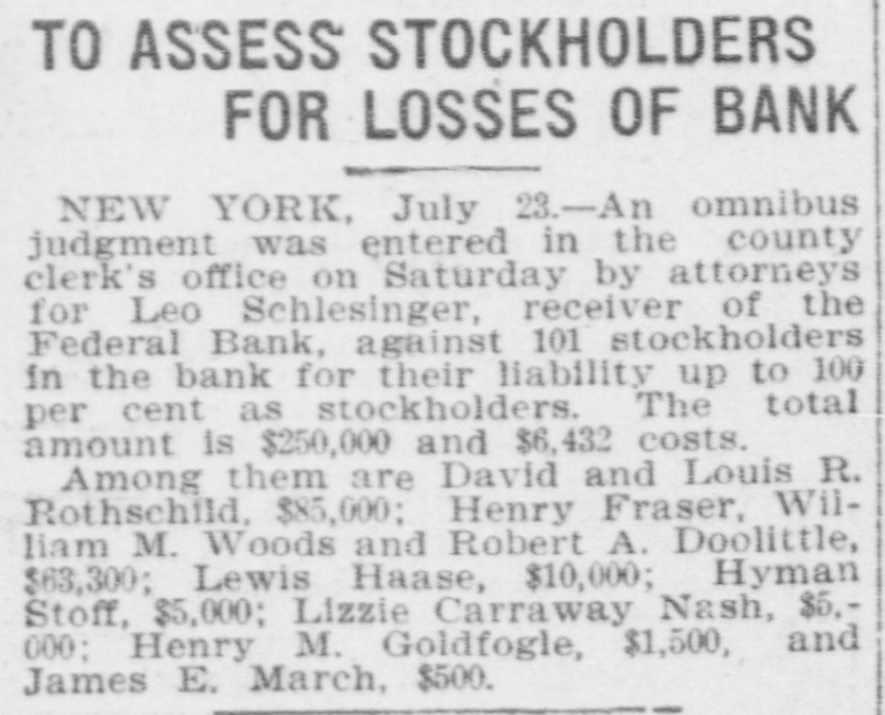
TO ASSESS STOCKHOLDERS FOR LOSSES OF BANK NEW YORK, July 23.-An omnibus judgment was entered in the county clerk's office on Saturday by attorneys for Leo Schlesinger, receiver of the Federal Bank, against 101 stockholders in the bank for their liability up to 100 per cent as stockholders. The total amount is $250,000 and $6,432 costs. Among them are David and Louis R. Rothschild, $85,000; Henry Fraser, William M. Woods and Robert A. Doolittle, $63,300; Lewis Haase, $10,000; Hyman Stoff, $5,000; Lizzie Carraway Nash, $5.000: Henry M. Goldfogle, $1,500, and James E. March, $500.


Article from The Sun, October 20, 1906

Click image to open full size in new tab

Article Text

-MURPHY JUDGES, INC. A FEW CORPORATION LAWYERS ON "CLEAN BENCH" TICKET. M. Warley Platzek, Counsel for Beer Trust Firm, Which Hearst Papers Attacked -Erlanger for Theatrical Combine -Was a Friend of David Rothschild. Mr. Hearst and his newspapers have repeatedly referred to the judiciary ticket put by the Nominators as "a tioket made up entirely of corporation attorneys." He professes to favor a clean, upright bench entirely free from corporation control, but hehas remained silent about the charges brought in this line against some of the candidates running on the ticket which was the result of a bargain between himself and Charles F. Murphy. M. Warley Platzek, who was put on the ticket for Supreme Court Justice by order of Murphy, long has been engaged in defending corporations and he is himself the and director one at the president least, Fidelity Coal in and corporation Iron Comof Tennessee. He was active as counpany Govsel in the criminal proceedings of the ernment against the beef trust in Chicago and was connected in a legal way with the case of the Schwarzschild & Sulzberger Company. which finally entered a plea of guilty, upon which four of its officers were fined $25,000 by Judge Humphrey on Sentember 21 of last year. Mr. Hearst's newspapers have time and again scored the beef trust for its methods of doing business. Mr. Platzek also is said to be counsel for the United Cigar Stores, about whose business methods so many retail tobacco dealers complain. Another corporation lawyer on the Murphy-Hearst ticket is Mitchell L. Erlanger. He is a brother of the theatrical manager and is attorney for the theatrical trust, the Klaw & Erlanger Building and Construction Company and the New York Theatre Company. It was the theatrical trust that barred James Metcalfe, the dramatic critic, from its theatres. Erlanger was a friend of David Rothschild, who wrecked the Federal Bank and the Globe Security Company, in which many people on the East Side lost the savings of their lives. Erlanger was a depositor there personally and he also deposited in the bank some of the funds that he held as Sheriff. But he got the money out before the crash came. When Erlanger was running for Sheriff Rothschild sent out hundreds of personal letters begging his friends to help the Tammany candidate. These letters read: 'As my friend Mitchell L. Erlanger has been nominated by the Democratic party for Sheriff of the county of New York, and as I am greatly interested in the success of his candidacy as well as the success of the entire Democratic ticket, [should esteem it a personal favor if you would contribute something toward the expense of the campaign. "Please draw your check to the order of James W. Gerard, chairman finance com- will mittee, and mail the same to me and I personally attend to its delivery. "DAVID ROTHSCHILD." Erlanger has since denied that he was friend of Rothschild or that he ever got a a cent of campaign money from him. Another candidate on the Murphy-Hearst ticket who had close corporation connections is J. J. Brady. whose nomination was made as a favor to Louis F. Haffen, the Tammany boss of The Bronx. Brady, it is said, has had a finger in every real estate pie that has been cut in The Bronx in the He last ten years and be is now a rich man. is a director and an active worker in the Geiszler-Haa Realty Company. which has put through some big deals recently. He is also interested largely as a stockholder and director in the Sound Realty Company, the Manhattan Mortgage Company and the Bronx Borough Bank Charles L. Guy, another candidate on the Murphy Hearst ticket. is also a corporation man, being director in the Washington Heights Realty Company. And even John the Ford, one of the men who were put on adticket through the demand of Hearst, mitted yesterday that he was a corporation lawyer, too, being counsel for the Queen Accident and Guarantee Corporation of London, which does an accident, burglary and credit insurance business all over the world. He said he was sorry that he did not have more corporations to represent and that he would not draw the line at even the sugar trust. He hastened to add that he was no friend of the predatory corporations such the Ryan-Belmont merger, the beef as trust and the gas combine but said that he believed that corporations when properly conducted were good things.


Article from New-York Tribune, December 12, 1906

Click image to open full size in new tab

Article Text

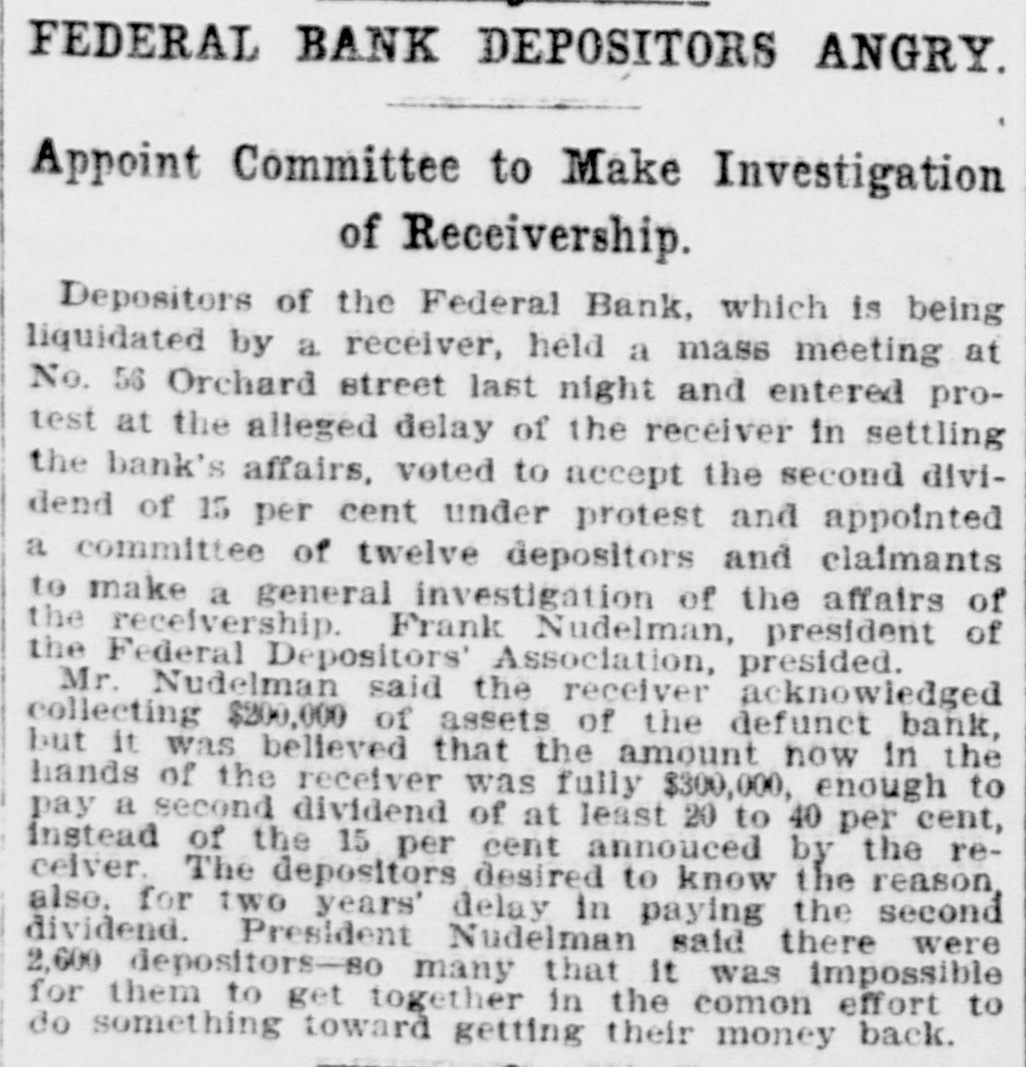
FEDERAL BANK DEPOSITORS ANGRY. Appoint Committee to Make Investigation of Receivership. Depositors of the Federal Bank, which is being liquidated by a receiver, held a mass meeting at No. 56 Orchard street last night and entered protest at the alleged delay of the receiver in settling the bank's affairs, voted to accept the second dividend of 15 per cent under protest and appointed a committee of twelve depositors and claimants to make a general investigation of the affairs of the receivership. Frank Nudelman, president of the Federal Depositors' Association, presided. Mr. Nudelman said the receiver acknowledged collecting $200,000 of assets of the defunct bank, but it was believed that the amount now in the hands of the receiver was fully $300,000, enough to pay a second dividend of at least 20 to 40 per cent, instead of the 15 per cent annouced by the recelver. The depositors desired to know the reason, also. for two years' delay in paying the second dividend. President Nudelman said there were 2,600 depositors-no many that It was impossible for them to get together in the comon effort to do something toward getting their money back.