13850. Duncan, Sherman & Company (New York, NY)

Bank Information

Episode Type
Suspension β†’ Closure
Bank Type
private
Start Date
July 27, 1875
Location
New York, New York (40.714, -74.006)

Metadata

Model
gpt-5-mini
Short Digest
aa0bbb0bbc35ada1

Response Measures

None

Description

The articles uniformly report that Duncan, Sherman & Co. suspended payment and made a general assignment to Wm. D. Shipman on July 27, 1875. Causes cited are heavy losses on cotton and railroad/speculative securities. The firm did not resume normal operations and was later adjudged an involuntary bankrupt (Dec 20, 1875), consistent with permanent closure/insolvency. OCR errors in some articles corrected (e.g., 'Dunean' -> Duncan).

Events (3)

1. July 27, 1875 Other
Newspaper Excerpt
The quietness of Wall street was broken ... by the announcement that the banking house of Duncan, Sherman & Co. had closed their doors and suspended payment. A large crowd of people soon collected ... many contradictory and absurd rumors were in circulation.
Source
newspapers
2. July 27, 1875 Suspension
Cause
Bank Specific Adverse Info
Cause Details
Large losses from heavy cotton transactions and investments in unprofitable railroad securities (Mobile & Ohio, Atlantic & Pacific, Erie, etc.) and other speculative losses accumulated over several years.
Newspaper Excerpt
A careful examination of our business and affairs shows us ... our available assets are so reduced that we are compelled to go into liquidation. ... we have this day made a general assignment to the Hon. Wm. D. Shipman.
Source
newspapers
3. December 20, 1875 Receivership
Newspaper Excerpt
Duncan, Sherman & Co., were adjudged involuntary bankrupts on Saturday ... The acte of bankruptcy were forty days suspension of commercial paper and failure to pay a depositor.
Source
newspapers

Newspaper Articles (24)

Article from Public Ledger, July 27, 1875

Click image to open full size in new tab

Article Text

NEW YORK. Heavy Failure- Fluctuations in Gold. NEW YORK, July 28.-Dunean, Sherman & Co. suspended this morning. There is great excitement in Wall street. Gold jumped to 116} upon the announcement of the suspension of Duncan, Sherman & Co. and the rumored embarrassment of other houses, but it soon fell to 114. The Evening Post has the following in the financial column: "The quietness of Wall street was broken in the second hour of business by the announcement that the banking house of Duncan, Sherman & Co. had closed their doors and suspended payment. A clap of thunder in a clear sky could not have caused more consternation, and at the Stock Exchange, Gold Exchange and Cotton Exchange there was great excitement. The liabilities of the house are given at inside of $6,000,000, and the assets far below this amount. The losses which weakened the house are not of recent making, but cover several years." The following statement to creditors was prepared by Mr. Duncan and read to the Stock Exchange: NEW YORK, July 27, 1875.-A careful examination of our business and affairs shows us, most unexpectedly, that through losses and misfortunes, our available assets are so reduced that we are compelled to go into liquidation. We reach this conclusion with the deepest regret, but the fact that up to the latest moment our most unexampled credit having remained unimpaired would have compelled us, if we continued business, to hazard new obligations and incur new confidences, which we were unwilling to assume. For the protection of all our ereditors, without distinction or preference, we have this day made a general assignment to the Hon. Wm. D. Shipman, of this city, whose address for all matters connected with our affairs will be at our late banking house, No. 11 Nassau street. DUNCAN, SHERMAN & Co. The greatest excitement prevailed in the lower part of the city as soon as the rumor of the suspension began to be circulated. It was at first hardly believed, as no suspicion of the weakness of the house had been entertained. The truth, however, was soon apparent by the closing of the iron doors of the great stone building on Nassau street. A large crowd of people soon collected, the majority of whom were attracted by motives of curiosity rather than interest. The suspension was everywhere the subject of conversation, and most contradictory and absurd rumors were in circulations. Many attempts were made to gain admission to the building, but the doors remained obstinately closed. Inside numerous clerks could be seen at their desks busily engaged with their books. Many absurd stories were set affoat to account for the general excitement. Among them was one to the effect that Commodore Vanderbilt was dead. It is admitted that the house has lost very largely on cotton; in fact, that is its principal loss. Investments with various railroad enterprises, old and new, also entailed losses on the house. The liabilities are understood to be between $5,000,000 and $6,000,000.


Article from New-York Tribune, July 28, 1875

Click image to open full size in new tab

Article Text

ADS SAID TO RE LARGE DEBTOR were put in circulation very as made public regarding the ne assigning heavy speculations as the cause, while others , speculations in unprofitable The firm has long been acting as agents of the Mobile and Ohio the stated SEAL 4! 'ore rear U Ived on account of its transacti posoddns SUM 11 'qoin ently the coupons of the road to $700,000 fell due and the road the payment. Duncan, Sherman e coupons, and it is not known 700,000 has since been paid. at heavy speculations in the suspenison was generally SEM 41 Exphange uoito member that the decline in the the past six months-at most afficient to produce such disastr Superintendent of the Exchan er the present management. sible to trace the transactions Sherman & Co. undoubtedly uring the past year, but whether UMO this uo JO ΡˆΠΎΠ»Ρƒ : own. The price of cotton declir change about 14 of a cent per of the failure was received. f the suspension was followed of 14 of a cent, with an unsett alers. but no failures 1 the firm held a large amount onds, but John D. Manning, at ted to a reporter of THE TRIBU was made with the firm on before the present Governor lected, and that the State , firm nothing. There were nade in Erie stock as collateral, ni at a valuation of about 30, 14. Other rumors pointed to plications with the interests of at Western. The persistent usiness men generally in a ntil this uncertainty is cleared prices of securities cannot be ry general expression of a suspie at the firm had been involved and it was stated that their n selling at a figure considera I for prime discounts. A thought the cause of their signed to any one class of s been, he said, no great depress any kind of goods in which the rested. He was rather disposed lure to a want of funds, which under for months past. inent banker, in a brief intery bon, said that there had been al months as to the financial Sherman & Co. Rumors had reet that members of the firm 1 in mercantile transactions g business, which had locked I had not proved successful. It y that large advances had relatives of a member or etect the credit of the house, possible to save it. There could the ability and willingness the firm to help the heir trouble, to any reasona suspension showed that they ly involved, and were not 1 themselves of proffered aid. aid this gentleman, for bankers : business speculations. The ous result in almost every culations had been entered le only when they kept their I avoided all temptation to nd transactions not in their er of English merchants, country, were in the babit of bank accounts with Duncan, t several of them closed their onths ago, when it became : dealing in cotton. Their bills of London were not SO much in oqm inductions 4q A bills. Yesterday was the day


Article from Alexandria Gazette, July 28, 1875

Click image to open full size in new tab

Article Text

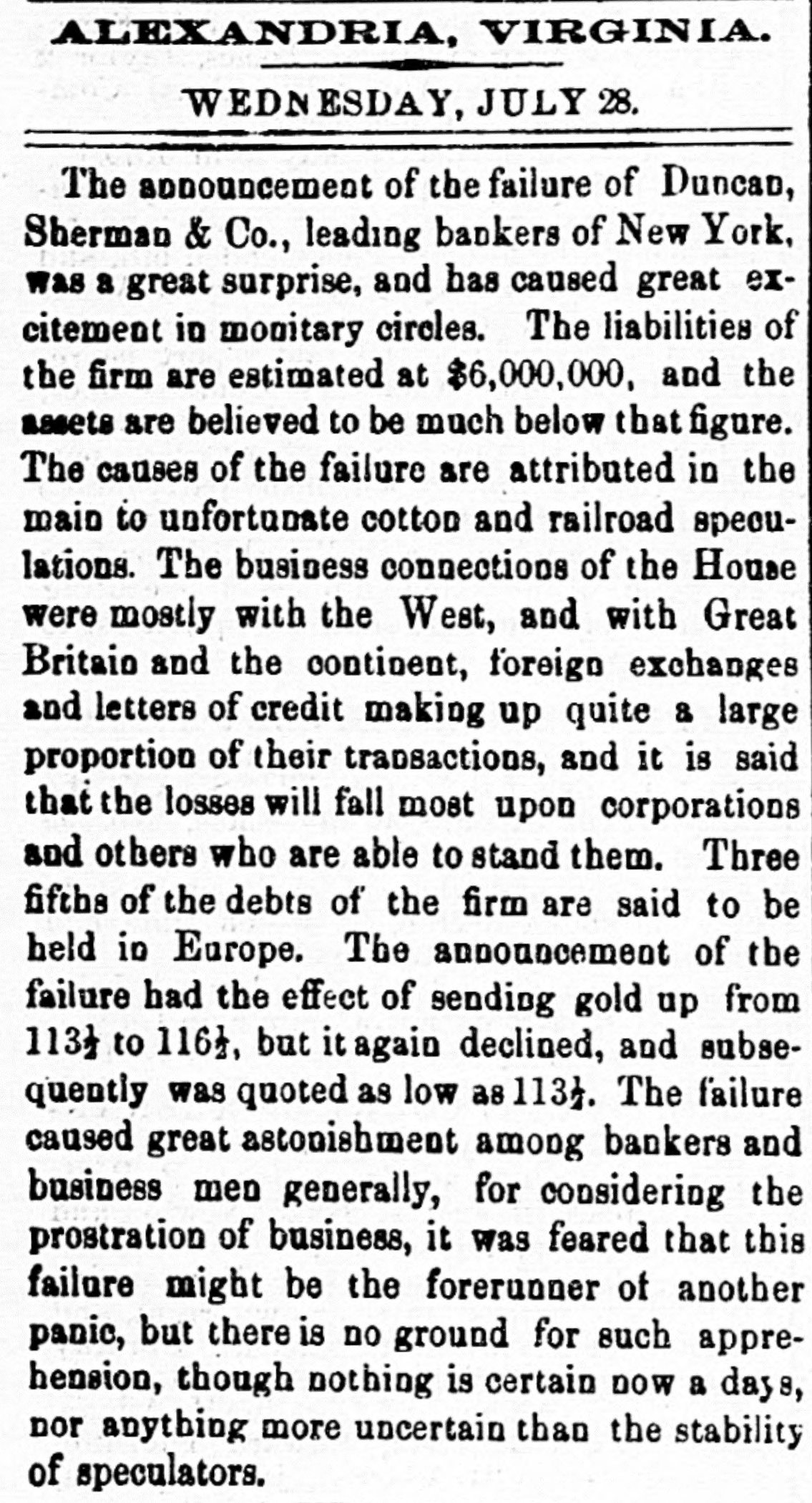
ALEXANDRIA, VIRGINIA. ESDAY, JULY 28. The announcement of the failure of Duncan, Sherman & Co., leading bankers of New York, was a great surprise, and has caused great excitement in monitary circles. The liabilities of the firm are estimated at $6,000,000, and the assets are believed to be much below that figure. The causes of the failure are attributed in the main to unfortunate cotton and railroad speculations. The business connections of the House were mostly with the West, and with Great Britain and the continent, foreign exchanges and letters of credit making up quite & large proportion of their transactions, and it is said that the losses will fall most upon corporations and others who are able to stand them. Three fifths of the debts of the firm are said to be held in Europe. The announcement of the failure had the effect of sending gold up from 113} to 116}, but it again declined, and subsequently was quoted as low as 1131. The failure caused great astonishment among bankers and business men generally, for considering the prostration of business, it was feared that this failure might be the forerunner of another panic, but there is no ground for such apprehension, though nothing is certain now a days, nor anything more uncertain than the stability of speculators.


Article from The New York Herald, July 28, 1875

Click image to open full size in new tab

Article Text

Interviews with Prominent Banking Firms. WHAT THE COTTON BROKERS SAY. Ex-Judge Shipman Appointed Assignee. A Flurry and a Rally on Wall Street. STATEMENT BY MR. W. BUTLER DUNCAN. Shortly before eleven o'clock yesterday mornpus established pio equal 1041 SUM 11 But, well known banking house of Duncan, Sherman & Co., at the corner of Pine and Nassau streets, had 18JU 1V *SJOOD S11 closed pus questity pepuedsns there pus "XBOU 8 se uodn SEM Jowns siq1 Mej V '31 01 credente Aue GARD CUM Mej 1nq 0.10 A minutes, however, put the matter beyond been pay ue JOJ fignop BUILD EXCLUSES ene up read DUB 01 ques notice of the failure. Then, too, it became known Ajensn 0.18 which 'way eur JO checks eus T841 Bank eur 4q Hose Clearing our pessed ase se acted MeN JO State eur 10 for Duncan, Sherman & Co., had been thrown 01 becaeved SUM smea eus the REVE "ino eouo 18 peeple JO DUE 'ent' eq HSSOH ONIENVE HHL HOA 889 POSTED moo. ou there uo 01 SJOOD quoij UOJI heary PUL JOJ user SEM Joop the SEM 05[8 SU closed 0.10 M -111 Grem OUM susw entracted 001 01 terested to the extent of some hundreds or thonΠΈΠ² check 01 dollars JO spuss RECORD UP 01 JOJ 'HEAR mount inq reply ou additional JOJ open attendis pus was returned other than an echo. Each moment, as the news secured wider circula ion, brought fresh additions to the crowd, our at DUE statements eur uo assenble 40144 -Unnits aut Suisenosip there poois new Milose clerks eque 18 up Decreas pus 0013 heads could just be seen above the window sills, beet our 10 registeres books, their 1040 Suid001s and the danger of sunstroke. There were naturally all kinds of reasons stated to account for SUM. 11 1841 PINS Some eus Brate ut 10880 heary 10 100000B no 11 seq1 theory eur Others some usess HOUL 'p102 at SEM peq en your ABS prom 0150 euo sq been peq ΡˆΠ»Ρƒ eur table non too much cotton, while yet again it was laid to connection with certain English houses which have lately failed. What SHI do UNDSR INVERVIVE 3HL was has yet to be ascertained, for no direct or -go eq could respect siq1 ut Postities tained yesterday. The members of the firm anq euo sue 008 01 refused Aep ent their legal adviser and most intimate friends, 0150- persuand SI which Card out puoleq 'pue .01 Aue proje 01 1 their stated they Mhere -xo probable eur 03 S'B present 18 tent of their liabilities or assets. Later on in the evening. however. an interview eur Butter 'M *JW 421M obtained SEM 111 4A persuand 'm.g the JO peed be read with interest, as it contradicts distinctly sweets eur JO 180m pus sucur decladed pus which doated around throughout the day. THE NO PREETNG THE and among bankers generally appeared to be one estable pio us uons Thus 10.180.1 DUE JOJ symptime jo 08., 01 been DABQ pinous esnoy 'pusu Crery uo PIUS SEM SU For "pread ene sq eur Deu STARTS puq OO 'g' Shermanu Incount confidence and esteem of every one in commerAllensa 0.18 OUM 10086 0110169 pus clal the experssed your uo U.S.A. utter inability to account for the failure. With -du 100% the bankers promitient erom eur JO emos some JOI Deed peq ш.Ρƒ 901 1841 prevall 01 persod time meeting with [heavy losses on cotton, both 01 peddius nomeo no put contracts no disajs one JO require R 1841 argund OSIB Leur which Duncan, Sherman & Co. held on cotton been peq epis other eur uo secure pus sesnon eq 01 peu pus predun 1819 returned -dns ene 411M 0101 taken mile 'JOI 100ked peq ΡˆΠ»Ρƒ ag: spunj JO innome pesod NIT crippied os securitions at dn course AJUO eur adops 01 11 comptel 01 88 credit credited SI ΡˆΠ»Ρƒ The *puedsns 01 'ZIA-uedo 1191 the JO spuod our UI being USIM Mobile and Ohio Railroad, which it will be remembered, was lately placed in the hands of a receiver. Then, also, it IS said to have invested heavily in Atlantic and Pacific stock, in Alabama bonds, in Great Western bonds and also in Erie. THOMOTO CORRECT HHL SI HOIHA mug the JO V Drove IIIM emm (sign met 8 stated that the house was not burdened with any outstanding foreign exchanges not yet presented, address at Involved I'm Aue up you SI " sens pus upon cotton, but that the failure is the direct resouth- pus Sonthern 04 SEQUESTS JO This eastern railways, which have never paid. The same gentleman stated that the credits of the eur at pus epis other em no leid mainthy ere esnou eqf Aq Jenns you pinom YOTH MeN sect pue 'yinos suspension. Cotton men, on the other hand, assert that the pus namber. inets 10 AUB stact you U.S.A. attribute the suspension entirely to dealings in railroad securities. They, however, reluctantly u) business . PIP used ehe 1841 limps cotton, but that it has no complications here, and article seq 1843 'Aue JT trouble our Metacher 1841 from this cause was brougst on by the failure of certain houses with which Duncan, Sherman & come- 10 ON business. euop eare Avu 00 Failure SIN1 MOTTOJ 01 percedre 0.18 001100 JO members the Suows Mej emos surnous SI 11 'eq IIIM Phone DATE TITAL OTM sesnou Quiqueq puu bankers Joujus better pue SIUS JO OXEM eur up Tottom 01 08 eq believed SI " 'IITA' Your ang :mag umoux eur 01 contern ou 01 su funous ut state public generally. In fact the STORPACT SIHL 40 appears to have already been discounted. As the afternoon advanced the crowds around there snq :esuep e.com pus Mer bank our was an absence of the scenes which are usually to rusq B JO shoop eq: 10 eys ut eq by reason of failure. In this instance there were eye uo concerned others pus BMopyM pare ou -11801 eus 03 HOOK easering 03 alarm JO punos 1810 tution wherein was their little all, in the hope TOUJ up 'inq '11 01 Demond Bureq JO 01 she pus 'Inger = 411A seem 01 Aluo go wandering around bewailing their lot,


Article from Chicago Daily Tribune, July 28, 1875

Click image to open full size in new tab

Article Text

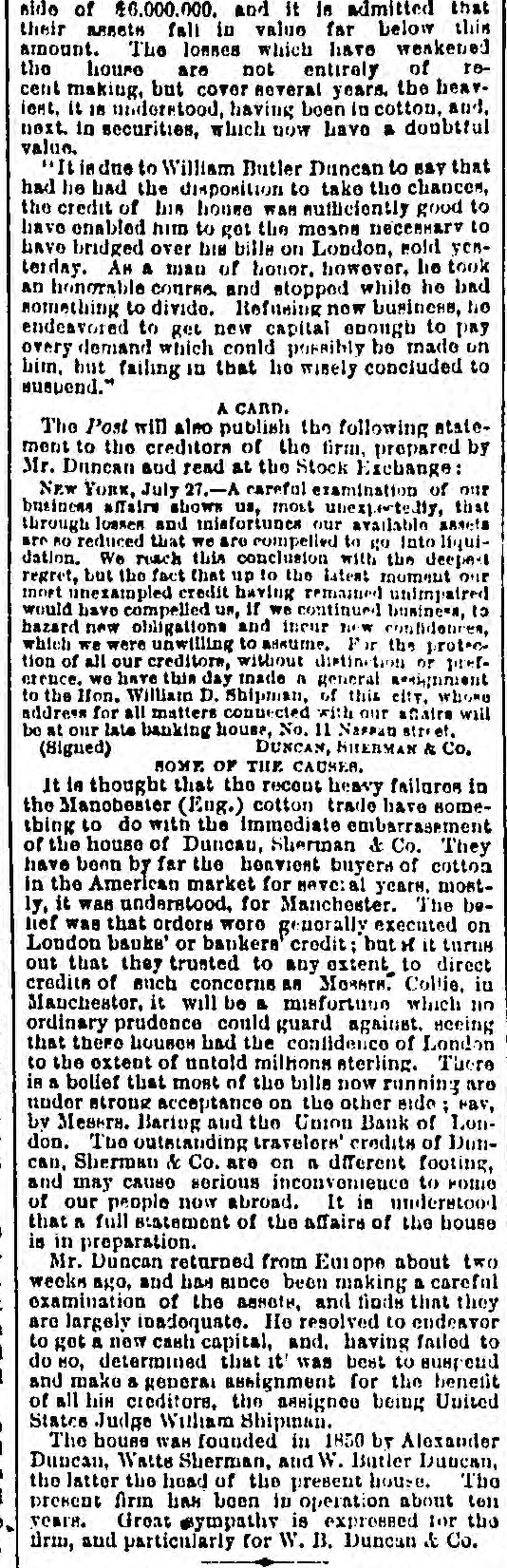
side of $6,000,000. and it in admitted that their assets fall in value far below this amount. The losses which have weakened the house are not entirely of recent making, but cover several years. the heavient. it 18 understood, having been in cotton, and, next. in securities, which now have a doubtful value. "It in due to William Butler Duncan to say that had he had the disposition to take the chances, the credit of bis house was sufficiently good to have enabled him to get the mesns Decemery to have bridged over bis bille on London, mold yenterday. As A man of honor. however, he took an honorable course. and stopped while he bad something to divide. Refusing now business, he endeavored to get new capital enough to pay overy demand which could possibly be made on him, but failing in that he wisely concluded to suspend." A CARD. The Post will also publish the following statement to the creditors of the firm, prepared by Mr. Duncan and read at the Stock Exchange: NEW YORK, July 27.-A careful examination of our business affaire shows us, most unexpectedly, that through loases and inisfortunes our available assets are RO reduced that we are compelled to go Into liquidation. We reach this conclusion with the deepert regret, but the fact that up to the latest moment OUR most unexampled credit having remained unimpaired would have compelled us, If we continued business, to hazard new obligations and incur New confidences, which we were unwilling to assume, For the protection of all our creditors, without distinction or preference. we have this day made A general assignment to the Hon. William D. Shipman, of this city, whome address for all matters connected with our aftaire will be at our late banking house, No. 11 Nassan street. DUNCAN, NUERMAN & Co. (Signed) SOME OF THE CAUSER. It la thought that the recont heavy failures in the Manobester (Eng.) cotton trade have something to do with the Immediate embarrasement of the house of Duncau, Sherman & Co. They have been by far the beaviest buyers of cotton in the American market for NAVE: al years, mostly, it was understood, for Manchester. The belief was that orders were generally executed on London banks' or bankers' credit; but H it turns out that they trusted to any extent to direct credits of such concerns an Mossrs. Coltie, in Manchestor, it will be a misfortune which no ordinary prudence could guard against. seeing that there houses had the confidence of London to the extent of untold milhons sterling. There is a bollef that most of the bills now running are under strong acceptance on the other endo ; Hav, by Mesers. Baring and the Union Bank of London. Tuo outstanding travelors' credits of Duncan, Sherman & Co. are on n different footing, and may cause serious inconvenience to Fome of our people now abroad. It in understood that a full statement of the affairs of the house is in preparation. Mr. Duncan returned from Europe about two weeks ago, and has since been making a careful examination of the assote, and finds that they are largely inadequate. He resolved to endeavor to get a new cash capital, and. having failed to do NO, determined that it' was best to suspend and make & general assignment for the benefit of all hin creditors, the assignee being United States Judge William Shipman. The bouse was founded in 1850 by Alexander Duncan, Waits Sherman, and W. Butler Duncan, the latter the head of the present house. The present firm has been in operation about ten years. Great sympathy is expressed for the firm, and particularly for W. B. Duncan & Co.


Article from Evening Star, July 29, 1875

Click image to open full size in new tab

Article Text

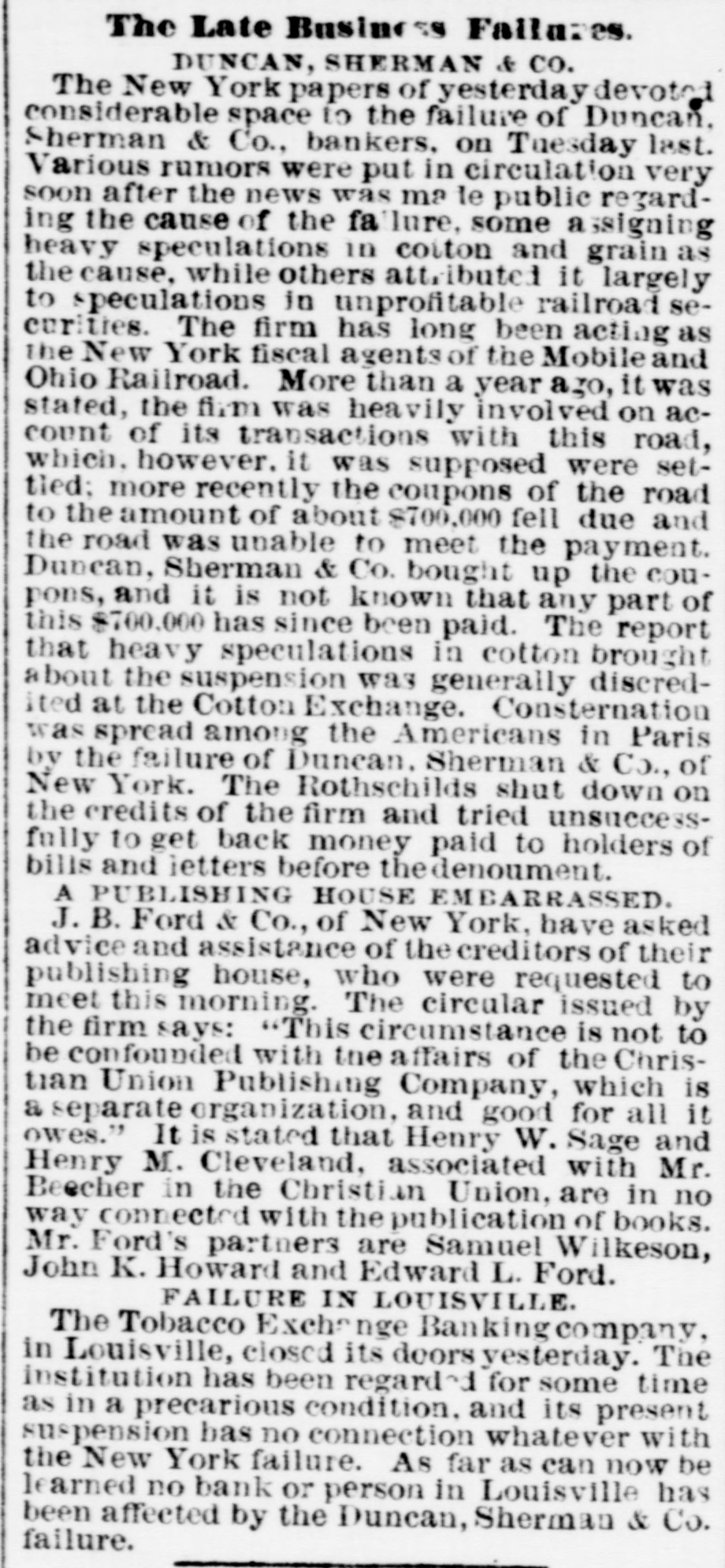
The Late Business Fallares. DUNCAN, SHERMAN & CO. The New York papers of yesterday devoted considerable space to the failure of Duncan, Sherman & Co., bankers, on Tuesday last. Various rumors were put in circulation very soon after the news was ma le public regarding the cause of the failure, some a ssigning heavy speculations in coiton and grain as the cause, while others attributed it largely to speculations in unprofitable railroad securities. The firm has long been acting as the New York fiscal agents of the Mobile and Ohio Railroad. More than a year ago, it was stated, the firm was heavily involved on account of its transactions with this road, which. however. it was supposed were settied: more recently the coupons of the road to the amount of about $700,000 fell due and the road was unable to meet the payment. Duncan, Sherman & Co. bought up the coupons, and it is not known that any part of this $700,000 has since been paid. The report that heavy speculations in cotton brought about the suspension was generally discredited at the Cotton Exchange. Consternation was spread among the Americans in Paris by the failure of Duncan, Sherman & Co., of New York. The Rothschilds shut down on the credits of the firm and tried unsuccessfully to get back money paid to holders of bills and letters before thedenoument. A PUBLISHING HOUSE EMEARRASSED. J. B. Ford & Co., of New York, have asked advice and assistance of the creditors of their publishing house, who were requested to meet this morning. The circular issued by the firm says: "This circumstance is not to be confounded with the affairs of the Christian Union Publishing Company, which is a separate organization, and good for all it owes." It is stated that Henry W. Sage and Henry M. Cleveland, associated with Mr. Beecher in the Christian Union, are in no way connected with the publication of books. Mr. Ford's partners are Samuel Wilkeson, John K. Howard and Edward L. Ford. FAILURE IN LOUISVILLE. The Tobacco Excha nge Banking company, in Louisville, closed its doors yesterday. The institution has been regarded for some time as in a precarious condition. and its present suspension has no connection whatever with the New York failure. As far as can now be learned no bank or person in Louisville has been affected by the Duncan, Sherman & Co. failure.


Article from The New York Herald, July 29, 1875

Click image to open full size in new tab

Article Text

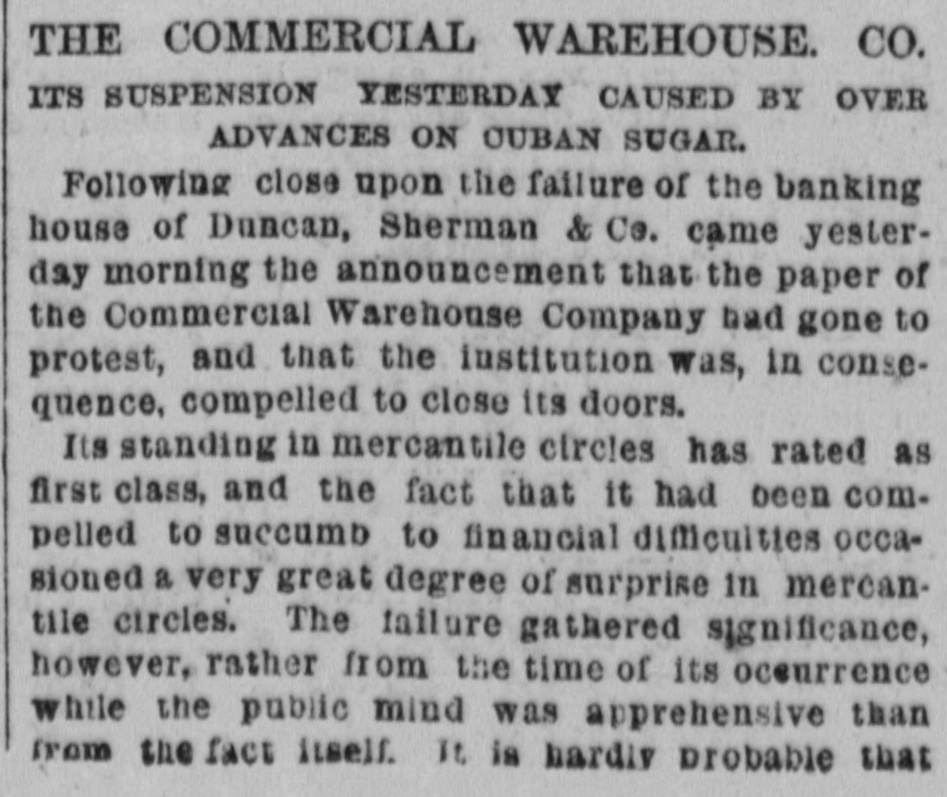
THE COMMERCIAL WAREHOUSE. CO. ITS SUSPENSION YESTERDAY CAUSED BY OVER ADVANCES ON CUBAN SUGAR. Following close upon the failure of the banking house of Duncan, Sherman & Co. came yesterday morning the announcement that the paper of the Commercial Warehouse Company had gone to protest, and that the institution was, in consequence, compelled to close its doors. Its standing in mercantile circles has rated as first class, and the fact that it had been compelled to succumb to financial difficulties occasioned a very great degree of surprise in mercantile circles. The failure gathered significance, however, rather from the time of its occurrence while the public mind was apprehensive than from the fact itself. It, is hardiv probable that


Article from Pioche Daily Record, July 29, 1875

Click image to open full size in new tab

Article Text

Eastern Dispatches. NEW YORK, July 28.-The Herald this morning publishes an interview with W. B. Duncan, who says there is no truth in the report he went to Europe to consult Alex. Duncan for the purpose of securing his aid to negotiate loans; that he applied to Baring Bros. and other European firms, and it was denied, and that the Union Banking Company is no loser by the firm to even the amount of a farthing. Duncan says every arrangement has been made to prevent Americans abroad with their letters of credit from experiencing any trouble. S. M. L. Barlow, counsel for the suspended firm, says the rumors that the failure will affect the Union Bank of London are entirely unfounded as that bank is fully protected, as also the Barrings. Senior Navarror, the Mexican Consul, is a depositor with Duncan, Sherman & Co. to the full amount of his private fortune, $60,000 or $70,000 and all the moneys belonging to the Consulate, but does not seem afraid of the loss. Drexel, Morgan & Co. say Duncan and Sherman will be largely engaged in the cotton transactions, their London agent being Mr. Kitchen, of Colde & Co. Within four weeks wool has fallen three cents per pound; supposing they had 25,000 bales in transit, their loss would be about $375,000, not enough to send them under, but we hear they were largely interested in Mobile and Ohio, Atlantic, Great Western and Erie. The Persi lent of the Shoe & Leather Bank has no fear of the crash having effect on the business of the city. It would effect Connecticut and Rhode Island, especially as it is believed the paper of that house is largely circulated in those States. In the Western States also many houses would more or less suffer. The agents of the Union Bank of London and the Bank of New York say there is no truth in the rumor of its suspension; the only ground therefore is the fact that the cables announce that it refused to honor a draft of Duncan, Sherman & Co. NEW YORK, July 28.-A cable dispatch announces the steamer Adriatic reached Queenstown with ber forward engine disabled; was delayed forty-eight bonrs. Thereby salvage operations on the steamer Schiller are snspended, waiting for better weather. North & Watson and M artin G Bann & Co., wholesale grocers, have suspended. Liabilities of former, Β£60,000; latter, small. The officers of the Secret Service have arrested four counterfeiters at the time of making and passing counterfeit trade dollars, gold five-dollar pieces, silver half dollars, etc. CHICAGO, July 28.-A Washington special says: When Spinner & Bristow quarrelled, it was on account of Spinner wanting to have bis own way in administering the affairs of bis office. Secretary Bristow declined to indulge him, and be finally was thrust aside; now comes J bu S. New, the new treasurer, and he threatens to have either his own way or to resign, and the difference is that Bristow, while declining to give up to Spinner, graciously yields to the Indianapolia banker. It appears that Bristow has b en mak. ing appointments in the Treasurer's office without consulting its head, and likewise on his own authority making dismissals. New stood it as long AS he could; a day or two ago, however, he determined to stop it or throw up bis office. He went to see Bristow. who began to


Article from The New Orleans Bulletin, July 29, 1875

Click image to open full size in new tab

Article Text

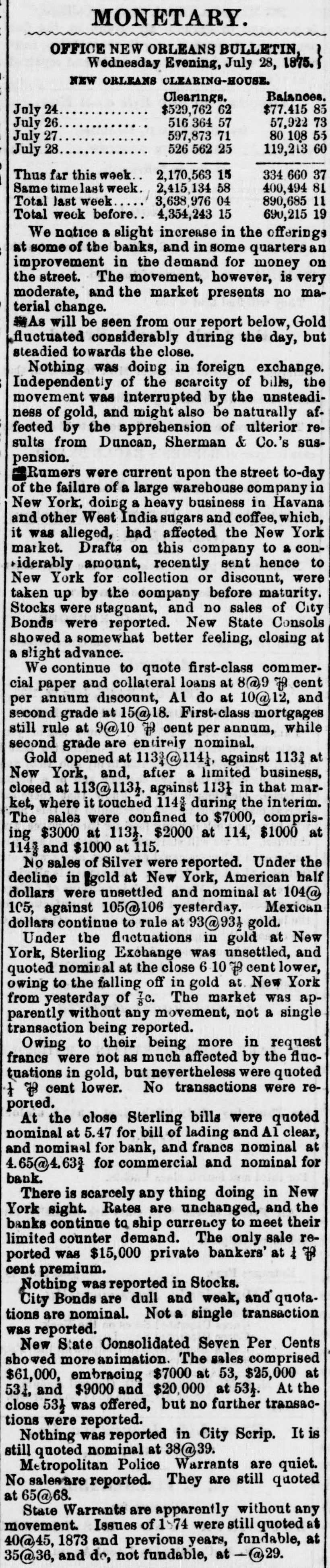
MONETARY. OFFICE NEW ORLEANS BULLETIN, Wednesday Evening, July 28, 1875. NEW ORLEANS CLEARING-HOUSE. Clearings. Balances. July 24. $529,762 62 $77.415 85 July 26. 516 364 57 57,922 73 July 27. 597,873 71 80 108 55 July 28.. 526 562 25 119,213 60 Thus far this week.. 2,170,563 15 334.660 37 Same time last week. 2,415,134 58 400,494 81 Total last week..... 3,638,976 04 890,685 11 Total week before.. 4,354,243 15 690,215 19 We notice a slight increase in the offerings at some of the banks, and in some quarters an improvement in the demand for money on the street. The movement, however, is very moderate, and the market presents no material change. As will be seen from our report below, Gold fluctuated considerably during the day, but steadied towards the close. Nothing was doing in foreign exchange. Independently of the scarcity of bills, the movement was interrupted by the unsteadiness of gold, and might also be naturally affected by the apprehension of ulterior results from Duncan, Sherman & Co.'s suspension. Rumers were current upon the street to-day of the failure of a large warehouse company in New York, doing a heavy business in Havana and other West India sugars and coffee, which, it was alleged, had affected the New York market. Drafts on this company to a considerably amount, recently sent hence to New York for collection or discount, were taken up by the company before maturity. Stocks were stagnant, and no sales of City Bonds were reported. New State Consols showed a somewhat better feeling, closing at a slight advance. We continue to quote first-class commercial paper and collateral loans at 8@9 per annum discount, Al do at 10@12, and second grade at 15@18. First-class mortgages still rule at 9@10 per annum, while second grade are entirely nominal. Gold opened at 113@114], against 113 at New York, and, after a limited business, closed at 113@113, against 113 in that market, where it touched 114 during the interim. The sales were confined to $7000, comprising $3000 at 113, $2000 at 114, $1000 at 114 and $1000 at 115. No sales of Silver were reported. Under the decline in gold at New York, American half dollars were unsettled and nominal at 104@105, against 105@106 yesterday. Mexican dollars continue to rule at 93@93 gold. Under the fluctuations in gold at New York, Sterling Exchange was unsettled, and quoted nominal at the close 6 10 cent lower, owing to the falling off in gold at New York from yesterday of c. The market was apparently without any movement, not a single transaction being reported. Owing to their being more in request francs were not as much affected by the fluctuations in gold, but nevertheless were quoted cent lower. No transactions were reported. At the close Sterling bills were quoted nominal at 5.47 for bill of lading and Al clear, and nominal for bank, and francs nominal at 4.65@4.63 for commercial and nominal for bank. There is scarcely any thing doing in New York sight. Rates are unchanged, and the banks continue to ship currency to meet their limited counter demand. The only sale reported was $15,000 private bankers' at per cent premium. Nothing was reported in Stocks. City Bonds are dull and weak, and quota- tions are nominal. Not a single transaction was reported. New State Consolidated Seven Per Cents showed more animation. The sales comprised $61,000, embracing $7000 at 53, $25,000 at 53, and $9000 and $20,000 at 53. At the close 53 was offered, but no further transactions were reported. Nothing was reported in City Scrip. It is still quoted nominal at 38@39. Metropolitan Police Warrants are quiet. No sales are reported. They are still quoted at 65@68. State Warrants are apparently without any movement. Issues of 1974 were still quoted at 40@45, 1873 and previous years, fundable, at 35@36, and de, not fundable, at -@29.


Article from Vermont Farmer, July 30, 1875

Click image to open full size in new tab

Article Text

Great Failure in New York. The mercantile world was startled Tuesday, by the announcement that Duncan' Sherman & Co., the great New York banking house, had suspended, the surprise being all the greater that there had been no suspension of its weakness. Their credit was perfectly good up to the hour of suspension it is stated that, only a day or two ago, the firm was offered $1,000,000 for four months at 4 per cent on its own paper, while their bills on London sold, Monday, within t per cent of the very best on the market. The liabilities of the house are estimated between $5,000,000 and $6,000,000, scattered throughout the United States and Europe, and the assets full far below these figures. A multiplicity of causes has contributed to bring about the failure, some of which have been operating for years. The firm has lost heavily through extensive operations in cotton, and has invested a good deal of money in unfortunate railway enterprises it has also suffered from bed debts of agents and others through the past two years. The immediate cause of suspension is said to be large advances on cotton made from time to time, and the fact that on Monday, Baring Brothers of London, ascertaining that the firm were embarrased, refused to receive their bills. About three-fifths of the debts of the firm are held abroad, half of the five millions already reported being on the Union bank of London and the bank of the state of New York, both of which are said to be fully protected. The house has always done a large business in letters of credit; unless these are protected, many Americans in Europe will be embarrassed. As to the assets, it is feared that a large part of them will be found to consist of southern secutities, as well as railroads which have a doubtful value in the market. The house formerly had a very large domestic business, but this has been considerably reduced during the past year.


Article from The Daily Dispatch, July 30, 1875

Click image to open full size in new tab

Article Text

a course. "It is certain." said he. that we have bad but little to do with them, but I don't know why. Duscan failed, I believe, twenty years ago, and that may have Influenced the old merchants. Besides, they all knew the speculative nature of his present business." Creditable. The New York Times says that the circumstances of the failure are creditable to Duncan, Sberman & Co. because they could have drawn on a certain house to the extent of $200,000 within a day or two, but they saw by the decline of cotton that they bad to go, and they did the best thing for all their creditors by stopping at once. All the bills accepted in London will be paid, of course, and it is understood that all the bills affoat which they have drawn, and might not be accepted yet. are held by one house, the name of which is withheld for the present, but it is known that the house is abundantly able to stand five times the strain. In regard to the effect on trade, this failure will probably stop rampant speculation, and make merchants and bankers more careful and discriminating in their purchase of bills; and all that is good for trade and good for the country. At Saratoga. The announcement of the failure caused much excitement at Saratoga, where many of New York's business-men are temporarily resident. The excitement at first was intense, and the bulletin-boards were surrounded by anxious crowds eager to learn the contents of each fresh dispatch from Wall street. In and about the corridors and piazzas of the United States and Grand Union Hotels and Congress Hall were seen groups of railroad managers, bankers. brokers, politicians, and journalists, busily discussing the great calamity. Regret was generally expressed even by those who suffered nothing directly by the failure that a firm of such hitherto undoubted strength and integrity, and so large interests, should be compelled to suspend. To the majority of people not intimately acquainted with the ins and outs of Wall street the news of the failure was an immense surprise, and even August Belmont, who heard the tidings at the races, refused at first to give credence to the report. Commodore Vanderbilt, Isaac Sherman, Chester C. Chapin, and others largely interested in banking and stocks, who were busily discussing the failure at the United States Hotel, shook their heads wisely and said that the suspension would not have taken them greatly by surprise had it happened any time ithin the past year. Commodore Vanderbilt said that for some time he had regarded the house as "shaky," and bad taken his account away from it more than a year ago. The gentlemen mentioned did not think that many houses would suffer severely from the failure. What embarrassment resulted from relations with the firm they thought had been pretty equally spread over the last two years; and as far as houses connected with it were concerned, the shock which in the general course of events should have followed to-day's announcement had in fact preceded the formal assignment. It is the general opinion among guests at the hotels that the principal "sufferers from the failure will prove to be Americans who are travelling in Europe, very many of whom have had such confidence in Duncan, Sherman & Co. that they procured credit through that firm when the disastrous results of the Jay Cooke failure bud made them wary of even the best houses. Many of the sojourners at the springs have members of their families or dear friends who are making the tour of England and the Continent. The distressing aspect of the failure as affecting these persons was enough to dispel all idle gossip among the ladies, who showed even more anxiety in their countenances than the men. O3e hears on all sides expressions of deep regret and sympathy for Duocan, Sherman & Co., and those best qualified to know ascribe the failure to old losses arising from disastrous railway enterprises, such as the Mobile and Ohio Company, in which the tirm was largely interested, and to recent losses on heavy cotton transactions.


Article from Daily Kennebec Journal, July 30, 1875

Click image to open full size in new tab

Article Text

Drowned. Boston, July 29. Two boys, named Gould and Howe, 13 and 15 years of age, were drowned at Natick to-day, while bathing. Wm. Hall, aged 77 years, brother of the well known ship-builder, Samuel Hall, fell from the wharf at the foot of Border street, East Boston, pnd was drowned to-day. NEW YORK. The Duncan, Sherman & Co. Failure. New York, July 29. Wm. Butler Duncan gives the following explanation of the recent recorded real estate transfers: The bank building, he said, was sold to his father, Alexander Duncan, on June 6, 1868, for $300,000, subject to a mortgage of $200,000. On May 26, 1874, the property No. 13 Pine street, was sold to Alexander Duncan for $58,824.06, subject to a mortgage of $40,000. The consideration for both of these transfers was paid at the time in cash. The other deeds, etc., Mr. Duncan said, including the deed of the 14th street property now put on record, were long ago lodged with the agent of Alexander Duncan, to secure a certain credit granted to Duncan, Sherman & Co. by parties in London, under the guaranty of Alexander Duncan, for which the firm placed the deeds with the agent to be recorded at the pleasure of Alexander Duncan. In case the credit was not used, the agent was to return the deeds to Duncau, Sherman & Co. Under this credit a certain amount has been drawn, and the agent therefore recorded the security in accordance with Alexander Duncan's instructions. The other deeds made by members of the firm in previous years, a list of which has been published, cover old transactions in real estate which have no connection whatever with the present failure. Railroad Matters. On application of Receiver Jewett of the Erie railroad, Judge Donahue to-day granted an order empowering him to settle the suit of the Jefferson Car Co. to compel the payment of $10,500 per month for the use of rolling stock. The Judge permits the settlement on the following conditions: The Erie company to pay the car company $300,000 in twelve monthly instalments, also the costs of the suit, and to surrender the stock of the car company. The receiver is also allowed to cancel the contract between the Erie Co. and the National Stock Yard Co., the Erie Co. to purchase all the outstanding stock of the Stock Yard Co. in the hands of one Robinson, at the rate of $50,000 worth of first mortgage bonds of the Co. 3623 shares, and buying 1822 shares of stock of the Co., held by Mrs. James Fisk, Jr., for $5000 of first mortgage bonds of that Co. A contract is also to be completed with Robinson, whereby the Erie Co. is to obtain the property at 11th Avenue and 4th street, subject to a rent of $21,370, and paying one-fifth of the profits of the business to Robinson. The petition is on suits against Erie by the Farmers Loan and Trust Co., J. C. Bancroft Davis, and trustees of fifth mortgage. Trade Organization. New York, July 29. The German journeyman upholsterers, last evening revived their old trade organization in view of the better business prospects in the fall. Losses by the Failure. The Trenton banking company of Trenton, New York, which lost $100,000 by Jay Cooke & Co.'s failure, now loses $100,000 by the failure of Duncan, Sherman & Co. Personal. It now appears that District Attorney Nolan received between $75,000 and $100,000 from various steamship companies. Another Loser. It is rumored that Toole, the actor, who recently returned to England, loses $40,000 by the failure of Duncan, Sherman & Co.


Article from Orangeburg News and Times, July 31, 1875

Click image to open full size in new tab

Article Text

Duncan, Sherman & Co. -The great New York banking house of Dunean, Sherman & Co., has failed, with liabilities estimated at $6,000,000 while the assets, it is snid, will full far below this sum, The failure is attributed principally to the depression in cotton, the operations of the house having been very heavy in this staple. The house has also suffered largely from being involved with various railroad enterprises, old and new. When the failure was announced, the greatest excitement prevailed in New York, and the stock market was seriously affected, gold running up at one time to 161, and closing at 141. About three fifths of the debts of the house are held abroad. Much sympathy is felt for the firm, whose standing in the financial world has always been very high.


Article from The Ottawa Free Trader, July 31, 1875

Click image to open full size in new tab

Article Text

BIG FAILURE. Wednesday's despatches from New York somewhat startled financial circles by announcing the failure of the great banking house of Duncan, Sherman & Co., for thirty years regarded as one of the very staunchest banking houses in New York city. Their liabilities are placed at six millions, and considering their almost unlimited credit all over the world, the failure is as notable as that of Jay Cooke & Co., that precipitated the great panic of 1873. Happily, however, this failure is not likely to bring any such wide. spread disaster in its train. The relations of the banking house of Duncan, Sherman & Co. were mainly with Europe, and very few banks of this country find themselves in the least involved in the disaster. The most serious sufferers among our own people, it is said, are those who are traveling in Europe and carry letters of credit from this firm. Many of these, finding their endorser slipped from under them, will doubtless have to encounter many annoying if not serious embarrassments, and may be expected to make tracks homeward by the very first available steamer. The house is said to have made too heavy advances on cotton, and to have been badly scooped in an attempt to bull the gold mar. ket during the recent rapid decline of that metal in Wall street. While, however, the disaster will have no immediate seriously disastrous effect on this side, it must add greatly to the already more than serious financial distress in London.


Article from The Free Citizen, July 31, 1875

Click image to open full size in new tab

Article Text

month. If this weather continues much longer there will be a general stampede for the North. -The most. disastrous fire which has occured in Charleston since the memorable conflagration of 186', orcurred last Saturday. Loss estimalett at $200.000. The fire began in the grocery of Mr. Henry C. Everhardt. Origin not known. The final game of the series hetween the Oranges of this place and the Crescents of Bamberg, was won by the latter last Tuesday. Our hoys have been unfortunate as several of the first nine were prevented by sickness from taking part in the game, We understand that only four of the first nine played in this game. -Duncan, Sherman & Co., one of the largest banking firms of New York has failed. The outlock is very ominous of :4 financial parie this falls Those who have much of the root of all evil should husband it with great care. A financial drougth will folLaw that which 18 new ruining the crops. -Monday is expected to be great any 10 Orangeourg. and we trust the will be sig nized by no exhibitions of lawlessness. Our city au thorities should take measures to have an Meient police force On duty : but we are sure the best thing that could be done would be to close all the barrooms. L ! the love of peace and order triumph over any desire for gate at their expense. --On evening, Mr. John Goodwin, a respected citizen, about 38 years of age, Living about fifteen miles from Branchville on the Walterboro' road, was struck by lightning and almost instantly killed. Mr. Goodwin was standing in his yard under a shed, and his wife standing about ten feet from him when he was struck. She was stuneed, but soon recovered, only to find ner husbands clothing on fire and he in a dying condition. She-exinguished the fi + and called to aid, they being the only (CHB (#) the plece, but their neighbors living close soon came. Dr. B. Black was.immadiately St lit for, but he could render no as-istance -The communication of Hon. A. J R ansier me commend 10 the thoughtful perusal of our readerit WITH received at 80 late an hour that we are unable to comment upon it as freely as we would like Mr. Ransier takes truly sensible view .f the situation. ignoring like


Article from New-York Tribune, August 3, 1875

Click image to open full size in new tab

Article Text

The transactions at the Clearing-house for the past week compare as follows with those of the previous week: $361,304,383 46 Clearings for the week ending July 24 392,741,677 Clearings for the week ending July 31 18 620,976 71 Balances for the week ending July 24 23,134,913 08 Balances for the week ending July 31 The Manhattan Company have declared a dividend of 5 per cent, payable on and after the 10th inst. The Philadelphia stock market is steady : Pennsylvania 6s, third issue, 110; Philadelphia and Erie Railroad, 2118: Reading Railroad, 55; Pennsylvania Railroad, 5178; gold, 11278. The Railway World of Philadelphia treats of the failure of Dunean, Sherman & Co. and its probable effect upon the business interests of the country as follows: The details of this failure have been fully given in the daily papers, and it is vident that, like these lately reported in England, it is a result of past troubles and losses, and not in any sense belonging to the present time. except in its period of development. It is unfortunate, of course, that just at the dawning of more prosperous times such events should transpire to check the hopeful feeling and excite unwarranted alarm; but if, as we assume, this is one of the relies of the panic, It can have but a temporary effect. In point of fact It may be asserted with truth, that the struggles of such houses to bridge over the disasters of the panic and to maintain their standing, have been a potent cause, among others, of the prevalent uncertainty, distrust, and dullness. Duncan, Sherman & Co., it is true, have enjoyed good eredit np to the day of the failure, but while thus strong before the public, it has undoubtedly been known to many that the house had its "skeleton," and that its strength had been seriously impaired. Thus its condition must have created anxiety among those connected with it by pecuniary interests, and studiously as such matters are concealed, they affect sympathetically the movements of all who know or suspect weakness. If people are apprehensive of trouble, even hoping it may be averted. they will guide their operations with the caution inspired by danger in view, and unconsciously influence others to act tumidly and suspiciously. Under this impression, we alluded in our last to the failures in England and Canada as .. remnants of old trouble," and as events not inconsistent with expectations of improvement in business. We may add, that to acquire the proper condition of health in the business community to make our coming prosperity more real and more durable these developments are actually necessary. The wrecks of old disasters must be cleared away, that our progress may not be impeded by unseen, but no less perplexing obstacies, and these trembling. unsound concerns are perpetual sources of hesitation and alarm until they pass the chasta of loss in safety or come crashing to the ground. The latter is a disagrecable alternative, but it is better than suspense, which contributes to distrust and stagnation. Duncan, Sherman & Co. is an old and well-estabhsked house, and prior to 1857 was perhaps considered one of the strongest and best in the country, but there are many who will remember that in the pame of that year they were saved by the aid of George Peabody of London, who in turn was carried through the crisis by the assistance of the Bank of England at the


Article from The Home Journal, August 5, 1875

Click image to open full size in new tab

Article Text

The suspension of Dancan, had banking house many years the man of stood the & high Co., which in because the for estimation of the character of of public, both and its suprosed great wealth, its members naturally creates were d astonishment. surprised that at large at all and it The should public have suspended who were could not not wholly unwhy derstand unprepared the few persons for it the should event have occurred at of this particular time. the published card those and according to speak for the According firm, who are to authorized was to but what recently agents its real weakness as it was known discovered, it, say and as soon it was further aspartners, and that new capital, to pay every it was decided to certained sufficient to the by procared, them debt if demanded, not be to pursue was that to credit could the payment proper and course go open into to liquidation. them was The stop only other way of the firm, which was to pressed, abuse enough, the if properly millions of dollars good commanded business with the and conchance have to co. of tinue making again in profits into a sufficient solvent course, to put the house That the honorable instant dition. these circumstances, was to anybody to under n fords no surprise the firm knew the personal be c taken, ho men jealous members of Wherein their of they will honor be managed and good name. be in that they they did t. blamed will EO loosely that of their true to the fairs until after could not be 11 external o P point their not know where business the they help. they condition had from drifted those rescued per- on r is no to g sons that On the without There who are best intimation the qualified losses of speak the firm very recent warranted li of the tunes trary, the been subjected to of a years, were the subject of has inference date. is series series con- that I f beginning misfor house with during and unfortunate ending a with railroad misN complications, in cotton. c judged could transacti be shown that the the stress firm was of t If it into suspension by that its emp than by rebarrassmen the driven times- that rather were is caused to say, by both its the own condi- in intion of trade of judgment, and its W dividual errors connections would an to its railroad then there unlin transactions suspecting a community, vi be in the failures :ecting gr To de soundness spect reason for in cotton- business more speak general from more the Li same and for general not causes, the fault of and the Great times fir plainly, it is of the Atlantic New York, 80 hat the Erie, railroad Li bo Western, stocks Montreal and the are compa- not be Boston and of the sort, times m at ies, and others Nor can decline the in the in good responsible securities. for the on cotton, or er th Wall street, credited price Transactions eld of cotton. in it, Advances which, have to proved adopt to a errors term bad business, ou W et from of judgment should on and the not be part the of fault are those similar of who the m them, If there they, W V country made at large. for other failures, is not a fair special reasons ensue; but it of Danof vi down ri of nference an, course, Sherman that will the & Company reason suspension for shows the What- any to general of pc of other occur by are no all failures may of this suspension house or ver account The depositof of wealthy od gr susceptible losses ad a large on number calculation, all their eggs serious- into vie put be of col an rs y ne distressed basket, who never and by It who the also can failure had not others of one on der embarrassed 801 ma rs maller heir they bankers. are scale, to lose who will a on considerableravel- deposit. be credit part of 7 their an f what,they holding will the have letters be inconvenienced of troubles ed an e house troubled, the but kind which house, cause we he of had unaccepted hercantile d re not of suspensions. Loutstanding a The comparative bills, Ma sp del stimated 1 re small told, amount at from of Β£50,000 amount to distributed to Β£75,000. be corper ssuming the probably larger be buyers the et, it will a dozen to twenty one of these En mong from certainly no on ac will to be forced With the extenagain incorby night bills, of and his loss. the house to suspend were south the ma wit country de connections ive, ount and that it is the of estimated, larger fall part perhaps there. of the in There losses the ectly, will failures will sta the ay this be no it consequent is possible that are there assured, sio pri outh, The but banks here, which we can make It any is and e. ill lose nothing difference with them. to Europe, pro An can is ppreciable ossible here of it the is that understood debt the of we the losses have firm that seen is the held, within larger may sustained of use of 2 month art trouble, which losses by but incurred the side the and of failure the total It of here here make Co. look small. of cro abilities uncan, Sherman that & the Union were bank both da Fr understood Baring Bros. had scarcely any Au co protected. ondon and with The house stock exchange speculation inter- and st unnection was as free of the its regular or from hich is, and center there had been as if in shipping ha this St ain business manufacture.com therefore, and it of tton Properly understood, to be alarming, an filure ough ht not only by misrepresent to say he been are more ons. in be It made 18 due so to no the suspension house for sincere years of " hich here has has brought sympathy out and regret. fac firms par son xpressions are forty-one by American making better can imported yer ho There are getting " liquors rich and wine than made in Europe.


Article from The Elk County Advocate, August 5, 1875

Click image to open full size in new tab

Article Text

seven priests out of the country, on account of their inciting the Ultramentaue riots in San In the trial of the Mormons for Miguel the Mountain Meadow massacre, Ann Hoag testified that she was at the meeting held to receive the report of Lee in regard to the massacre, and that Brigham Young went into the meeting while Lee was explaining, Thomas P. Willis saw the property of the immigrants in wagons in front of the tithing-house. By an explosion of gas in the Pennsylvania gas coal company's works at Irwin's Station, one man was killed and six others badly burned. Part of a train on the Pacific road went through a bridge over the Mississippi at Brainerd, and four persons were killed and several wounded. Of the one hundred and sixty-two mills at Oldham, England, only six are running. Fifty mills have also been closed at Ashton, throwing eight thousand persons out of employment. Trouble is apprehended Tramps, after having eaten at the farm-house of & Mr. Hill at West Berlin, Vt., demanded money, but were driven away. They returned two days afterward and attempted to fire the premises, and the same afternoon four of them burst open a door and fired at Mrs. Hill, without injuring her. Neighbors went in pursuit The companies holding policies on the life of Jackson, the defaulting revenue officer of Louisville, Ky., had his body exhumed for post mortem examination, and found arsenic in his stomach Reports from Gloucester, Mass, state that the mackerel catch is very light and prices have advanced Prof. Janney, the government geologist, reports that he has discovered gold The in paying quantities in the Black Hills whole draft of the new Spanish constitution Conhas been aprroved by the committee siderable excitement was caused in financial circles in New York city on notico being given of the failure of Duncan, Sherman & Co., the bankers. The liabilities are estimated at 85, r 000,000, and the assets are unknown. The loss falls heaviest on country banks holding paper of the firm's, and on travelers holding letters of credit. The failure was caused by the shrinkage on railroad securities and cotton held by the firm.


Article from New-York Tribune, August 6, 1875

Click image to open full size in new tab

Article Text

DUNCAN, SHERMAN & CO.'S DRAFTS. THEIR PAYMENT STILL SUSPENDED-TOURISTS RENDERED DESTITUTE - THE FIRM TO BE DENOUNCED. LONDON, Thursday, Aug. 5, 1875. The officials of the Union Bank say no arrangements have been made with that institution to redeem the letters of credit of Duncan, Sherman & Co. in the hands of travelers. Negotiations therefor have been pending since the failure of the firm, but have not been completed, and the longer they are postponed the less probability is there of a enceesffil result. Letters received here from Americans in Paris say that over 1,000 persons holding the suspended firm's letters of credit have been heard from in Germany alone. Many of them are utterly destitute of funds, and have been compelled to apply to the local authorities or to the American Consuls for relief. One lady, a teacher from Massachusetts, had but $6 in money when she heard of the failure. The American and English people where she was staying subscribed sufficient funds to pay her expenses to Hamburg, whence she was to take steerage passage home. Appeals for aid from persons holding the dishonored letters of credit come from all directions. A document stating these facts, and denouncing the house, is being prepared for publication.


Article from The Findlay Jeffersonian, August 6, 1875

Click image to open full size in new tab

Article Text

UR NEW YORK LETTER. ex-Financial Troubles-Ford-Reecher-Mirs -Trouble amount the Obscene rature-The Weather and Business. NEW YORK, August 4. 1875. THE GREAT FAILURES. dnesday last the great banking el of Duncan, Sherman & Co., el oldest and, supposed to be, sound1 the city, closed its doors probably er. Its liabilities are a long way to the millions, and its assets a down in the millions. Of vildest excitement prevailed; it pected-in fact, no house in ed States stood better or was ed safer. What was the matter ? Just what is the matter with ting houses that fail. Instead ining themselves to a legitimate busi they went heavily into stocks, not being heavy enough to : they undertook to corner all on in the world, and not being igh, went under. The failure II"M up sepsultion U yous p. has not been witnessed el the Jay Cooke smash. Old clerks Sunos 'uatu po kers, everybody, were rushing lly up and down the street, el besteged for balances, stocks n with a run, and for an hour or tw emed as though all Wall Street y. Finally the excitement #! 1011; discoversip SRM 1! No 11" Joiju = Jo 4 ires was announced that day, 1 slept tolerably well that the next day the Commercial - Company failed for a million if, and the exclument was renewed 11!48 S! !! What the upshot of it all will be ins to be seen. Shrewd men are g in sail and going as close reefed sible. Another weeding-out, such urred after Jay Cooke's failure, red, for the reason that since ry body has been doing business at ; but as money has been easy to / quantity of weak houses have e to conceal their weakness and To such, these heavy failures ke the Street are death. For the nt the strings are tightened, 't get the credit they need, and y go. Whether this is the beginnir such a season or not remains to "II But the failure that makes the : is that of J. B. Ford & Co., blishers of Beecher's books and of 100 THE CHRISTIAN UNION. " Ao d out a kind of vague promise to ne, insisting the while, that the ndal had nothing to do with the ables. All of which is bosh. ment the seandal was made sale of Beecher's books dropped lost nothing, and it has been growit rse since. The firm had an immen ount of money locked up in the ume of "The Life of Christ." and y couldn't get it out, down they Everybody connected with this had trouble except Beecher. serene as a May morning: his been raised to $100,000 per year; lowers accompany him to the droves; big ovations are being 1, and all sorts of pleasant things wered upon him. In the meantim 8. Tilton is about to open a boardin ise, and J. B. Ford & Co. fail. ard ought to come to the relief of them. He ought to buy all of oks that Ford & Co. have on I give them to Mrs. Tilton, who ibtless, dispose of them for ng. That would let them both out trouble he plunged them into. ness he won't do it. Speaking of 'NOJ'ILL 'SHN nething ought to be done for her. echer is innocent of course she is; all that the trial has ruined - has never a penny to bless h. and the scandal has barred in almost every employment she ed for. Theodore is even in she, for he had nothing before il, and now he has the enormous ses attending that to stagger be can't help her if he would. ms to me that Plymouth Chure uld stand by her in her trouble as by its pastor. The church is U шишом spp eats 04 I te support for herself and childre old not be a serious burden. JKVO DISTRICTION THE NI re is trouble of a very serious natur e ruling powers in Tammany uyor uodn JUM ap re the ex pugilist, nt present writin rly down. though faro John is rigorous effort to get up again. It this


Article from The Dallas Daily Herald, August 7, 1875

Click image to open full size in new tab

Article Text

TELEGRAPHIC MIDNIGHT DISPATCHES. NEW YORK. Duncan, Sherman & Co.'s Letters of Credit to be Honored in London and Paris. NEW YORK, August 6.-Lanny & Marshall, dealers in builders and plumbers materials, 47 Warren street, have suspended. Liabilities said to exceed $140,000. James Henry and John Hale, cabin passengers on the steamer Kopstock, from Havre, have Leen arrested and in their possession was found among other things a lot of jewelry, some answering to the description of the family jewels stolen from Countess Dudley, in London, also a diamond scarf pin stolen from a New York lady in Paris. The O'Connell centenary was begun in this city this morning by the celebration in St. Stephen's church of a pontifical high mass by Bishop Corrigan, of Newark. A large number of elergy assisted, and a large congregation was present. Drexel, Morgan & Co. make the following announcement: "Having, at the request of Duncan, Sherman & Co. and Alexander Duncan, made arrangements for the protection of the letters of credit and circular notes, issued by the former on the Union bank of London, in the hands of travelers abroad, we hereby announce that the traveling credits and circular notes, accompanied by letters of presentation, issued by Duncan, Sherman & Co., on the Union bank of London, will be cashed or exchanged for new credits on presentation at the office of J.S. Morgan & Co., London, or Drexel, Hayes & Co., Paris, prior to November 1, 1875."


Article from Chicago Daily Tribune, August 12, 1875

Click image to open full size in new tab

Article Text

Certain developments reported in connection with the failure of DUNCAN, SHERMAN & Co., seem to reflect discreditably upon the integrity of that firm. A runor, prevalent in New York yesterday, was industriously traced by THE TRIDUNE'S correspondent, who ascertained that "accommodation paper" to n large amount was drawn by their clerk and accepted and negotiated by DUNCAN, SHERMAN & Co. n short time previous to their suspension. These acceptances, purporting to be issued ontside of New York, and, it is said, manufactured to order by n confidential clerk, were disposed of among the city banks, where they are now held as claims upon the assets of the insolvent house. The bitten bankers, with the reticence common to their guild, refused yesterday to afford much information upon the subject, but enough WAS developed toindicato that these transactions of DUNCAN, SHERMAN & Co. were desperate expedients, to say the least, and of a character in some degree corresponding with that of the operation for which the COLLIE brothers in London recently suffered the rigors of the English law.


Article from The Cambria Freeman, August 20, 1875

Click image to open full size in new tab

Article Text

JUDGE SHIPMAN, assignee of the well known banking house of Duncan, Shorman & Co., of New York, which recently suspended, has made a states ment of its liabilities and assets, as follows : Liabilities, $4,872,128,65 ; assets, $2,112,740,61. The creditors will receive between 30 and 40 per cent. on their claims, which is a much better showing than Jay Cooke & Co. were able to make. Nevertheless it is one of the most shameless swindles that has been perpetrated in these days of fancy and fraudulent banking.


Article from New Orleans Republican, December 21, 1875

Click image to open full size in new tab

Article Text

NEW YORK. Invointary Bankrupts. NEW YORK. December 20.-Duscan, Sherman & Co., were adjudged involuntary bankrupts on Saturday, on petition filed by Carter & Eaton, attorneys, and signed by over 200 creditors, whose claims aggregate $2,168,000. The acte of bankruptcy were forty days suspersion of commercial paper and failure to pay a depositor. Baring Brothers & Co., the English bankers, were among Duncan. Sherman & Co.'s creditors who petitioned to have the latter firm adjudged involuntary bankrupts. The effect of the proceeding will be to enjoin the numerous suite that have been brought against the suspended firm in the State courts. Death of an Actor. Edward Eddy, the tragedian, is dead. The Bowen Libel Case A jury has been called in the Bowen libel case. The Murdered Jewess. The inquest in the case of Sarah Alexander, the murdered Jewese, was commenced this evening in the Brooklyn Morgue before a large crowd of interested spectators. After the examination of the father of the prisoner, brothers, and a car conductor and passengers, with whom the prisoner and murdered girl rode, all of whose testimony fastened a strong chain of guilt 01 Rubenstein, the inqnest was postponed until Wednesday next.