13763. Chemical National Bank (New York, NY)

Bank Information

Episode Type
Suspension → Reopening
Bank Type
national
Bank ID
1499
Charter Number
1499
Start Date
May 1, 1893*
Location
New York, New York (40.714, -74.006)

Metadata

Model
gpt-5-mini
Short Digest
76094916fcf76310

Response Measures

None

Description

Multiple articles (May–Nov 1893) refer to the Chemical National Bank suspending cash payments during the 1893 money stringency/panic. Sources describe the bank as having reduced gold/currency, refusing a large check for lack of bills, borrowing at the clearing house, and having suspended cash payments for a month or two past. There is no clear contemporaneous description of a depositor run on Chemical in these excerpts nor of a receivership/permanent closure. The context (high rates, clearing-house certificates, widespread money stringency) indicates a systemic/money-market cause and subsequent relief actions, supporting that the bank suspended payments during the panic and later resumed. Date of suspension is inferred to be May 1893 (newspaper mentions suspension in May; other pieces discuss effects through June and afterward).

Events (3)

1. August 1, 1865 Chartered
Source
historical_nic
2. May 1, 1893* Suspension
Cause
Macro News
Cause Details
Systemic money-market stringency and panic in spring 1893 (scarcity of currency, extreme rates, clearing-house stress); clearing-house loans and certificates were issued to relieve the market; Chemical curtailed cash payments/withdrew specie and suspended cash payments during this episode.
Newspaper Excerpt
the suspension of the Chemical
Source
newspapers
3. May 2, 1929 Voluntary Liquidation
Source
historical_nic

Newspaper Articles (9)

Article from Nashville Union and American, March 10, 1870

Click image to open full size in new tab

Article Text

THE GOLD MOVEMENT There was rather a halt in the downmovement in gold in New York yesterday. ward The market was the scene were of wild excitement, and the fluctuations Still rapid and considerable in extent. closed half a cent higher than For several days the it opened. market the and gold the maket has been greatly excited, fully decline since the 1st inst. has been cents. The New York Tribune re- as six the decline in the price of gold indicating gards "the long-wished-for financial of millenium-specie payments." Many the shrewd traders of New York were last week bringing about specie payments, least on their own account, by paying the out at silver change, in regard to which Tribune says: "These acts of small dealers and res- demay be mere shrewd not so taurant-keepers to gain popular ravor, but wealthiest vices with the banks, some of the said, and most prominent of which, it is of earnestly considering the propriety condition are an end of the unsettled of making monetary affairs by boldly proclaiming the It was whispered on resumption. with much of a tone of authority, OC street, in the event that no would reaction next that, the Chemical Bank specie curred, week announce the resumption of however, This institution, payments. as a matter of fact, suspended has never, specie payments; it has no government circulation its own, and when insuspended of it began paying currency formal stead of coin, but without any act announcement of suspension." or "Should it return to specie it must with of make special arrangements course the customers to protect itself from being curmade a mere medium for exchanging into gold at par, which no bank can afford rency to do SO long as there is any pre- it is mium on gold. But their purpose, supposed, is to merely proclaim resump- will as a theoretical practice, which without great influence. banks which have tion other not be circulating preparing Several notes afloat also were mentioned as to resume. Resumption by such institutions their means the subsequent redemption of notes in gold; and when that is proclaimed by a few of the leading banks the whole question is settled." The Tribune showsthat the cost of the necessities of life does not bear its proper relation to the great indicator of values. In the case of such staple productions as coal, cotton, flour, sugar, etc., they stand pretty near in their just relations to gold; but comparing the present wholesale prices of butter, cheese, eggs, beef, mutton, potatoes, etc., with those of December, it 1864, when gold was quoted at 2221, appears that they have not fallen, as a rule, over 30 per cent., and in some cases have not fallen at all. In the retail trade the disparity which should exist between the prices of the different dates is still further lessened, and is less than 20 per cent. against a difference of almost 100 per cent in gold. The New York Express of Friday afternoon states, however, that the gold decline unsettled trade in mercantile circles, and had a very depressing effect in the produce market. It says: "On the produce exchange provisions all kinds were lower; flour declined of to fifteen cents per barrel wheat was ten and almost unsalable, notwithstand- one cable reported an in the dull ing three the pence Liverpool advance depression market. of to the staple of cotton great the In felt, and the marked difference in views was of buyers and sellers brought Prices busivery nearly to a stand still. declined ness fully one-half percent per pound, there was a disposition to speculate The lower prices in the on cotton of late has decline and still in future. holding entailed cotheavy losses on speculators the ton in hopes of a spring rise, and market is in that feverish condition which might result in much lower prices if cotton on the spot was thrown on the market freely. Tha Express of Saturday afternoon, however, says: "Meanwhile trade has been affected the last week by the decline in gold, during have uudergone a shrinkage, the decline although and values generally fall in has prices, not been very marked. The has had the beneficial result of trade and the distributed from chandise however, stimulating amount this point of mer- duweek is larger than for any presince the year. vious ring the week opening been of the delaygenerally, who have in consequences the of gold and declining ing Buyers their purchases tendency and, cotton, of as taken hold more freely, consequence, is on the steadily a have natural increase. business The trade has now fairly openinterest of dry goods, in ed. spring the The department principal has offered centered where by the 'drives in goods generally, to the leading firms, have had a tendency stimulate trade. It is a remarkable feature of the trade thus far that the busi-



Article from New-York Tribune, May 12, 1893

Click image to open full size in new tab

Article Text

bank closed 105 May Another National to-day-the Chicago, Columbia National-and although effort doors the officers say they are all right. or two and is that being fill made. get aid and resume in day that give to are many things about the suspension there suspicion that it is a bad failure. Not circles great rise to was occasioned in financial deal of surprise became known that the bank had suspended. when it had been looked upon with suspicion for some two for it and ramors had been in circulation for time, the Columbia would follow the Chemical days that morning. when President Dwiggins posted a so this that the constant run for several days had for rendered notice it necessary to close for the present protection of all concerned. most of the financiers the nodded knowingly. The bank had a capital merely stock of $1,000,000, and deposits approximating #1 1,500,000. The Columbia was organized in February, 1891, with the United States National as the foundation. The United States began in 1887 with $50,000 capital as the private institution of George Wiggs. the bucket shop man. Later Zimri Dwiggins, an Indiana County banker, came into the bank and the capital was increased to $500,000. It never had deposits equal to the capital stock. and is said to have been a failure, when the idea was conceived of reorganizing under a new name and with increased capital. The services of a Kansas City bank promoter were called in. and the Columbia National was the resuit. Dwiggins, while president of the United States, had organized a chain of little country banks through Indiana and Illinois, and had thereby established of considerable prestige with interior banks. Many them took stock of the Columbia. 1. Everingham, & successful member of the Board of Trade. was in duced to take stock and the presidency of the bank. and he was Instrumental in procuring the business of a number of Board of Trade men. About year Ago the bank applied for admission to the Clearing House. The committee looked into its standing and rejected its application. The books looked all right and its showing was apparently all right. but the committee thought there was a question about its standing and denied the application. President Zimri Dwiggins ascribes the failure of the bank to the quit which was brought against 11 by the Sloux City Loan and Trust Company which failed a few days ago. The Columbia was the Chicago bank with which the Sioux City concern did business, and their deposit in the bank at the time of their collapse amounted to $35,000. A draft was drawn on the Columbia for this amount When the draft was presented by a man from Iowa the bank refused payment. claiming that 11 had loans outstanding against the Sioux City Company which equalled the amount of their deposit. Immediately on this refusal of the bank to honor the draft the company entered suit against the bank The news of the suit spread and caused a run on the bank which they were unable to withstand. The Columbia not being a member of the Clearing House cleared through the Metropolitan. It is stated that it was really in shall low water when the Chemical failed. and borrowed $50,000 from the Metropolitan on good paper to tide over Tuesday. Yesterday it called for help again. but President Keith could not make such an examination into the affairs of the Columbia as would have been necessary. and refused the assistance asked. The Columbia officials then turned to the Bank Clearing House Committee and asked for $3,000,000. They were told to bring around good collaterals in the morning and the necessary relief would be forthcom ing. Twenty minutes before 10 this morning President Dwiggins appeared with a bundle of securities, a large portion of which proved to be stock in country banks. These could not be looked into In the time at command, and Dwiggins went away without his $3,000,000. The only thing left to do was to call in the bank examiner. The latest statement issued by the bank makes this showing: Resources-Loans and discounts. $1,624,932.27 United States and other bonds, $341,257 91: furniture and fixtures, $12.715.93 cash and sight exchange, $615,975 06; total, $2,594,861 19. Liabilities-Capital, $1,000,000; surplus, $50,000; undivided profits. $41,930.95; circulation. $45,000; deposits, $1,457,950.34 total, $2,594,881 19. Bank Examiner Sturges said this evening that he could give no information yet. The principal business of the Columbia was with country banks and they will be the chief sufferers. On account of its lack of local standing local people were bigger bor rowers than depositors. For that reason the failure will have a more far-reaching bad effect than the suspension of the Chemical. The Journal" says that curious and possibly unpleasant complications are likely to grow out of the peculiar dealings of the Columbia National with he United States Loan and Trust Company. an adjunct of the bank having offices in the rookery directly across the street. Washington. May 11.-Controller Eckels has desig nated D. A. Cook, Bank Examiner for Illinois outside of the city of Chicago, to take charge of the Columbia National Bank of Chicago, which failed this morning. The failure of the Columbia National Bank of Chlcago will not seriously affect any of the New York banks. The standing of the institution has been such as 10 lead to extreme conservatism here. A trifling loss may fall upon the National Bank of Deposit, at Broadway and Dey-st. but that is not probable. Hopkins J. Hanford, cashier of the National Bank of Deposit, said yesterday "Up to within two or three months the Columbia carried a good balance with us-from $40,000 to $50,000 For some weeks its balance has been running down. and as it has diminished we curtailed our accommodations. The Columbia had an overdraft this morning of 35,100, but the mails brought us about $4,800 a an offset. The remit tances we expect in to-morrow's mail will probably leave the bank a credit balance of 82,700 In any event our loss could only be trifling. We have no connection with the Columbia other than this, and its people are not interested in the National Bank of Deposit." The announcement of the suspension of the Columbla National, of Chicago, was not unexpected in banking circles here. Its methods have not received the approval of York banking men. Some in teresting stories were told here about the leading men in the institution. The bank was started by Zimri Dwiggins and J. M. Starbuck, of Chicago, who form the so-called banking firm of Dwigghus, Star buck & Co. The firm is not widely known even in the banking world of its own city, although its ploits as a promoter of State banks in the West ex The been followed with interest by Eastern men have to avoid losses in their who wish Columbia banking business. Bank National United States Bank was the result of merger with the originally started of Chicago, concern was by Messrs. Dwiggins and Starbuck created In 1891 with capital But the Dwiggins $1,000,000. starting State bank syndicate has been active in banks in many of the towns of Illinois, Indiana smaller have put about and Michigan It 18 said to in the three fifty branch concerns into business themselves. States. Having thorough confidence Ing Mr. Dwiggins and Mr. Starbuck, in to the story told by rell-informed accord would organize banks in then vesterda to freely lend money different country towns and stocks of their concerns. each other upon the capital of assets worked this Interchange When things boomed when one of the syndicate's admirably and were business the losses banks didn't succeed in else than the Dwiggins pool. found to fall upon some one believed to have But of the manage scattered ment presidency of Mr. branch Dwiggins that bank Columbia concerns is Bank of service Chicago. in his found Under these his Mr. stocks Dwiggins of the or different Mr. readily branch loaned institutions money in on which the cashler Starbuck ingured as sident


Article from The Wheeling Daily Intelligencer, June 30, 1893

Click image to open full size in new tab

Article Text

YORK, June 29.-The rates this for NEW which mounted skyward being money as much as 75 per cont in the morning, quoted in the forenoon, broke midmost unexpected manner about of the the result of the action house loan committee, is been previously clearing day has as pointed commit- out, which, the as same as the clearing house associaonly the chairman of the of the teo, G. G. Williams, president member tion, Chemical Bank, is ex-officio a presiand Frederick D. Tappen, is of it, of the Gallatin National Bank, H. dent chairmrn of it, instead of E. the Perkins, jr., president of the Importers' and Traders' National Bank. morning the committee, or This majority of them, in conjunc. of rather with a Goorgo F. Baker, president virtually tion First National 'bank, to take the a syndicate by agreeing certififormed of clearing house loan out a for the purpose of a cates rates for money to that virtually panic market. Some of for the lot high existed putting National the and in banks, stop the the money Gallatin and the First loan certhe had never taken out need instance, tificates before, and they had no moral now, except for the By takto do to BO be produced thereby; enables effect out certificates, though it of money ing to lend large sums cash in them intrenching upon the their rowithout vaulte, all of them have quired their lawful reserve of twenty-five per cent of their deposits. result of the committee's deliberAs a this morning an issue of $9,000,000 and all ation certificates was authorized, committee of members of the loan availed the themselves of the opportunity proportion to their capital except Tradin the Chemical and Importers and era National Banks. amounts thus taken were as folThe Gallatin National Bank, $500,000; lows: Fourth National Bank, $1,000,000; Chase ExNational Bank, $1,500,000; Corn Bank, $500,000; First National change Bank, $2,500,000. Total, $6,000,000. Immediately after the issue of certifi. was authorized, H. P. Frothingcates representing some of the banks, at ham, lent $3,000,000 on the stock exchange the of 1 per cent and interest, and at. rate 1.8 immediately fell to 6 per cent, and terwards increasing to 12 per cent, then falling at 2 o'clock to 3 per cont. Tappan, president of the Galiatin admitted that of out half a million Bank, had Mr. taken frankly dollars his bank state loan certificates, but declined to had names of the other banks that the 80. In accordance with the rule done of the committee, however, he paid the the committee had to-day authorized of $6,000,000 of certificates, which alto. issue made about $15,000,000 issued gother. of to-day's action, Mr. be "No monoy was Tappen In explanation said price, to and this morning at any time thought it was should be done. beobtained something the committee This bank out $500,000 of citificates, not took we needed them, but to break banks up cause the high rate for money. Other must took out n largo amount, but you get the names from them. Simmons, president of the Fourth said: "This need the certificates or money, National not Mr. Bank, that bank but did it to me necessary soine to be taken to give the demanda of the action seemed pressing should merchants rolief and to stop this unreasonable money This morning our cash on hand panic. and our call loans exceeded 60 per cent of our deposits." The stock market enjoyed a boom in as n result of the clearing house prices committee's action and the relief was general. The condition of nflairs in Philadelbanking circlea in connection with phis their accounts with banks in this these city, to which attention was called in a couple of days ago, is bemore marked. received (rotn advices dispatches coming Philadelphia According in that this to Now York exchange is at a premium of $5 for or cent on the dollar. in this city have large morning, half city banks a Philadelphia Several $1,000, balances large to them by while the luttor are on account of to procure New One bank in this tied up in Philadelphia banks, $750,000 ability to owing or currency. remit York exchange their city in unable that has inanother has $600,000 and another $500,000. way and the question is becoming serious our Unloss the Philadelphia banks remit this week, it is probable to sotno New York bankers discount will be charged on all according that n received from Philadelphia exchange here. One case is known discount was charged for a dealers large transac- where check of n $100,000. it being a special tion. Philadelphin's situation PA June 20 -Six per


Article from St. Paul Daily Globe, June 30, 1893

Click image to open full size in new tab

Article Text

CAME TO THE RESCUE. Action of the Banks Breaks the High Rates for Money. Clearing House Certificates Taken Out by Solid Institutions. General Relief at Once Afforded the Street by This Action. Much New York Money Tied Up in Philadelphia Banks. NEW YORK, June 29.- The rates this for which mounted skyward money, morning, as much as 75 per cent being quoted in the forenoon, broke in anunexpected manner about midday result of the action of the clearing house loan committee, which as had been previously pointed out, is the same a clearing house committee. This morning the committee, or rather majority F. of it, in conjunction with George president of the First National Baker, virtually formed a syndicate clearing by bank, agreeing to take out lot of purpose house loan certificates for the for of putting a stop to the high virtually rates exand the panic that of in isted money the money market. Some Fourth the banks, the Gallatin and the taken National, for instance, had never they certificates before, and for out loan need to do so now. except had the moral no effect to be produced thereby. it taking out certificates, though, of enables By them to lend large sums the money without entrenching upon Cash in Their Vaults of them have more than the re- of All lawful reserve of 25 per cent their quired deposits. As result of the coin- an deliberations this morning mittee's of $9,000,000 of certificates was the issue authorized. and all the members of of committee availed themselves their local the opportunity in proportion Chemical and to Imcapital. except and the Traders National taken Na porters banks. The amounts Gallatin thus were as follows: Fourth National tional bank. $500,000: Chase National bank, bank. $1,000,000 Exchange bank. $500. $1,500,000; Corn National bank, $2 500,000 the 000; First Immediately after total $6,000,000. was authorized issue of certificates represer ting some of P. Frothingham, $3,000,000 on the stock at exchange the banks, lent of per cent and interto 6 fell immediately est, and the rate increasing to per cent per cent, and afterward then falling at o'clock to per cent. Tappen, president of the his Gallatin bank bank. Mr frankly half admitted million that dollars of loan certificates, had taken out but declined to state the names of the Other Banks That Had Done So the accordance with the rule of the In however, he said that the committee, authorized committee 000.000 had today of certificates, which issue of about$15,000,000 $9 Issued altogether Mr. In explanation made of today's action Tappen said: money was to be obtained commit- this morning "No at any price, and time the something tee thought it was This bank took out should be done. not because we $500,000 of certificates. to break up the high needed them. but Other banks took out rate large amount, for money. but you must 83 get cent the morning names from them. We had did not per need reserve this but by taking them without out cash were certificates, enabled to lend $500,000 encroaching upon president our of the Fourth Mr. Simmons, said: This bank did National bank certificates or money, but not need the me necessary that some it seemed to be taken to give relief to action should demands of the merchants stop the pressing this asonable money hand panic. and and our to This call loans morning exceeded our cash 66 per on cent of our deposits. Have Plenty of Cash. H Perkins Jr. president of bank, the F. Traders National had Importers and was not true that he his said the report take out certificates for refused to do not know," he added, not. bank. we shall take any out or withWe whether have plenty of money to lend Mr say out doing so." Williams. president of whether the Chem- his ical bank, declined would to not take out any bank would or It is ieved in banking certificates. that both the Chemical will and take Imcircles and Traders' bank Some of the porters out certificates this week vesterday, but largest banks did modate so their customers simply without to entrenching accommoda upon the cash their vaults. market enjoyed a boom house in prices The stock as a result action and the the clearing relief was committee's The condition of affairs in general. Philadelphia banking circles with in banks connec- in their accounts called tion with which attention was this city, dispatches to couple of days ago, in these more marked. According is becoming received from Philadelphia in this to advices morning New York exchange that city is at Premium of 85 for $1,000, A cent on the dollar Several large or half banks in this city have Philadelphia large bal ances owing to them latter by are unable banks, and account which the of their inability cur- to remit on York exchange or procure New bank in this city has $750. rency. One Philadelpnia in that way 000 tied up in $600,000 and another $500,000, another and has the question Some is becoming of the serious one. charged the sums thus banks here have Philadelphia customers owing for collections by their to the This latter's will reserve make ac counts with them. course, for these Philanecessary, banks of to make their if accounts they delphia in some way here good draw on the other have to the banks have not cities. But in the matter but to use done anything in cashing Philadelextreme caution from their customers. phia exchange Philadelphia banks remit to Unless the probable, according disthis week, it is York bankers, that some count will be New charged received on from all Philadel- dealers phia exchange case known where large of here. One charged for check $100,000, discount it was being special transaction. Enormous Bond Transactions. June 29.- Dealers say that NEW transaction YORK, in government bouds


Article from St. Paul Daily Globe, June 30, 1893

Click image to open full size in new tab

Article Text

CAME TO THE RESCUE. Action of the Banks Breaks the High Rates for Money. Clearing House Certificates Taken Out by Solid Institutions. General Relief at Once Afforded the Street by This Action. Much New York Money Tied Up in Philadelphia Banks. NEW YORK, June The rates for which mounted skyward this morning, money, as much as 75 per cent being quoted in the forenoon, broke in an un- the expected manner about midday as result of the action of the clearing house loan committee, which as had been previously pointed out, is the same as the clearing house committee. This morning the committee, or rather majority F. of it, in conjunction with George Baker, president of the First National virtually formed a syndicate bank, by agreeing to take out lot of clearing purpose house loan certificates for the for of putting stop to the high rates exand the panic that virtually of money isted in the money market. Some Fourth banks, the Gallatin and the National, the for instance, had never taken out loan certificates before, and they for had need to do so now, except the moral no effect to be produced thereby it taking out certificates, though, of enables By them to lend large sums the money without entrenching upon Cash in Their Vaults All of them have more than the re- of quired lawful reserve of 25 per cent their déposits. As result of the coin- an deliberation this morning mittee's $9,000,000 of certificates was issue authorized. of and all the members of the committee availed themselves of local the opportunity in proportion to their ImChemical and and capital, except the Traders National banks. porters The amounts thus taken Nafollows: Gallatin $1,000,000; were tional bank as $500,000; Chase Fourth National National bank, bank, Corn Exchange bank, $500, $1,500,000; $2,500,000 000; First National bank, after the $6,000, 000 Immediately H. total, of certificates was authorized of representing some P. Frothingham, banks, lent $3,000,000 on the stock the at 1/ of 1 per cent and interexchange and the rate immediately fell to 6 est, afterward increasing per cent cent, and then falling at 2 o'clock to per cent. Tappen, president of the Gallatin bank Mr. frankly admitted that his of bank taken out half million dollars loan had certificates, but declined to state the names of the Other Banks That Had Done So accordance with the rule of the the In however, he said that the committee committee, had today authorized of $9,000,000 o certificates, which issue about $15,000,000 issued altogether. made In explanation of today' action Mr Tappen said: "No money was to be obtained this morning at any price, and the commitit was time something tee should thought be done. This bank took out we $500,000 of certificates. not because needed them, but to break up the high out for money. Other banks took the rate large amount, but you must get cent names from them. We had per need reserve this morning, we did not certificates, but by taking them out we cash. were enable to lend $500,000 without encro aching upon president our of the Fourth Mr. Simmons, bank did National bank, said: This but not need the certificates or money, seemed to me necessary that some action should it be taken to give relief to pressing demands of the merchants the stop this unreasonable money and to This morning our cash on hand panic. and out call loans exceeded 66 per cent of our deposits Have Plenty of Cash F H. Perkins Jr., president of the Importers and Traders National bank, said the report was not true that he had his to take out certificates for refused know,' he added, bank. "I do not "whether we shall take any out or not. We have plenty of money to lend without doing Mr. Williams, president of the Chembank, declined to say whether his ical would or would not take out any bank believed in banking circles that certificates. both the Chemical and Importers and Traders bank will take outcertificates this week. Some of the banks did so yesterday, but largest to accommodate their customers simply without entrenching upon the cash their vaults. The stock market enjoyed a boom in prices as a result of the clearing house committee's action and the relief was The condition of affairs in Philadelphia general. banking circles in connecwith their accounts with banks in this tion city, which attention was called titese dispatches a couple of days ago, in is becoming more marked According advices received from Philadelphia to this morning New York exchange in that city is at A Premium of 85 for $1,000, half cent on the dollar. Several or large banks in this city have large balances owing to them by Philadelphia banks, and which the latter are unable to remit on account of their inability to procure New York exchange or currency. One bank in this city has $750,000 tied up in Philadelpnia that way; another has $600,000 and another $500,000, and the question is becoming the serious one. Some a banks here have charged the sums thus owing by their Philadelphia customers for collections to the latter's reserve accounts with them. This will make it necessary, of course, for these Philadelphia banks to make their accounts here good in some way if they to draw on the other cities. have But the banks have not done anything in the matter but to use extreme caution in cashing Philadelexchange from their customers. phia Unless the Philadelphia banks remit this week, it is probable, according to some New York bankers, that discount will be charged on all Philadelphia exchange received from dealers here. One case is known where large discount was charged for check of $100,000, it being a special transaction. Enormous Bond Transactions NEW YORK, June 29.-Dealers say transaction in government bands


Article from New-York Tribune, August 9, 1893

Click image to open full size in new tab

Article Text

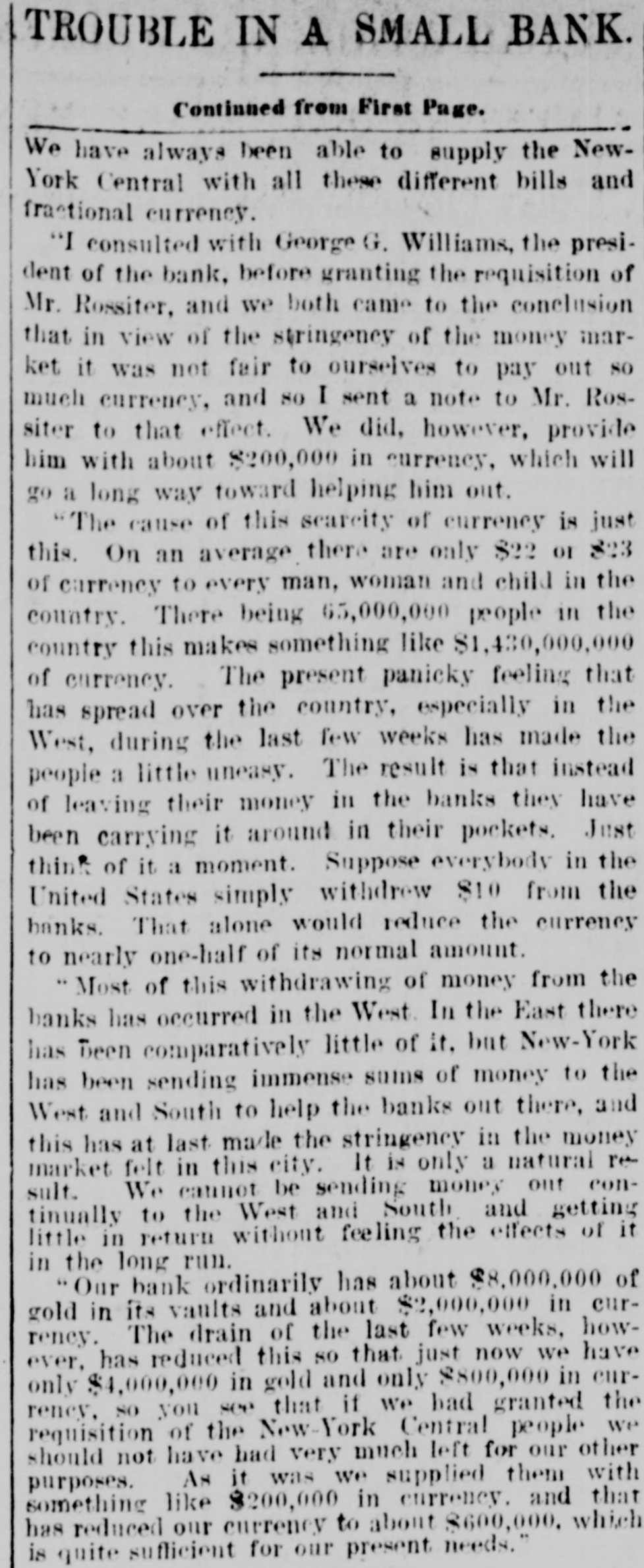
# TROUBLE IN A SMALL BANK. Continued from First Page. We have always been able to supply the New-York Central with all these different bills and fractional currency. "I consulted with George G. Williams, the president of the bank, before granting the requisition of Mr. Rossiter, and we both came to the conclusion that in view of the stringency of the money market it was not fair to ourselves to pay out so much currency, and so I sent a note to Mr. Rossiter to that effect. We did, however, provide him with about $200,000 in currency, which will go a long way toward helping him out. "The cause of this scarcity of currency is just this. On an average there are only $22 or $23 of currency to every man, woman and child in the country. There being 65,000,000 people in the country this makes something like $1,430,000,000 of currency. The present panicky feeling that has spread over the country, especially in the West, during the last few weeks has made the people a little uneasy. The result is that instead of leaving their money in the banks they have been carrying it around in their pockets. Just think of it a moment. Suppose everybody in the United States simply withdrew $10 from the banks. That alone would reduce the currency to nearly one-half of its normal amount. "Most of this withdrawing of money from the banks has occurred in the West. In the East there has been comparatively little of it, but New-York has been sending immense sums of money to the West and South to help the banks out there, and this has at last made the stringency in the money market felt in this city. It is only a natural result. We cannot be sending money out con-tinually to the West and South and getting little in return without feeling the effects of it in the long run. "Our bank ordinarily has about $8,000,000 of gold in its vaults and about $2,000,000 in currency. The drain of the last few weeks, however, has reduced this so that just now we have only $4,000,000 in gold and only $800,000 in currency, so you see that if we had granted the requisition of the New-York Central people we should not have had very much left for our other purposes. As it was we supplied them with something like $200,000 in currency, and that has reduced our currency to about $600,000, which is quite sufficient for our present needs."


Article from La Correspondencia De Puerto Rico, August 14, 1893

Click image to open full size in new tab

Article Text

un tratado de comercio. De Berlín comunican que está listo para ser firmado el convenio mercantil entre Alemania y España.-Dicen de Atenas que el rey Jorge ha inaugurado con gran pomp a el canal de Corinto. -- Según las últimas noticias, ayer han ocurrido en Nápoles 20 invasiones del cólera y 13 defunciones. En Roma ha habido tres casos y un muerto. La epídemia ha atacado la guarnición de Sulina, en las cercanías de Bukarest.-Dicen de Londres que hoy recibi rá la Cámara de los Comunes en pleno el informe de la Cámara en sesión de comité, sobre el articulado del bill para el gobierno de Irlanda. Nueva York, 8. Los pasajeros del "Karma. nia" siguen en la isla Hoffman, observando la cuarentena. No han tenido novedad.—Dicen de Washington que ayer inauguró el Congreso la sesión extraordinaria. Mr. Crisp resultó electo presidente de la Cámara de Representantes. Hoy enviará el presidente Mr. Cleveland el mensaje en que expresa el motivo de la convocatoria.En una de las primeras sesiones del Congreso Socialista, reunido en Zurich, se ha promovido un gran desorden. Los delegados se fueron á las -Según las últimas noticias, la epidemia va en aumento en Rumania y Galitzia. El sig. nor Giolitti ha anunciado en la Cámara italiana que el cólera ha cesado en Alejandría y va dis. minuyendo en Nápoles. El gobierno italiano ha prohibido las peregrinaciones á Roma, como me. dida de precaución. Ha producido gran sensa ción en Berlín la noticia de haber ocurrido en la cludad un caso sospechoso.-Dicen de Roma que el Papa León XIII se ha negado á restablecer el "modus vivendi" con el gobierno de Italia; y que el rey Humberto, por su parte, se ha negado á confirmar el nombramiento del Obispo Sarto para patriarca de Venecia.-Di de Parisque en la causa seguida á M. Ducret, director de "La Co. carde", y a su auxiliar M. Norton, por la falmifi. cación de los documentos en que se acusabs á M. Clemenceau, han sido condenados el primero a un año de prisión, y á tres, el segundo. Madrid, 8. Vitoria ha sido teatro de una manifestación contra el proyecto de supresión de la Gapitanía General, tomando carácter tumultuo. so por la actitud de los manifestantes que daban gritos subversivos, rompiendo además los hilos telegráficos, lo que ocasion6 la incomunicación completa de dicha ciudad con esta Corte durante algunas horas.-Pronto aparecerá en la "Gaceta" una Real Orden destituyendo al general Pando del cargo de capitán general de Galicia.-La Junta de Defensa de la ciudad de Reus, provincia de Tarragona, ha aeordado que los vinicultores ... abstengan de pagar ningún impuesto en sefial de protesta contra las núevas contribuciones del plan Gamazo.-Ayer sali6 para San Sebastián el neral López Demínguez, con el objeto de ultimar ge. la combinación de ascensos al generalato.-Con el nuevo Gebernador General de la Isla de Cuba se embarcará el brigadier señor Luque y el capi. tán don Antonio Páramo. Madrid, 9. Sabiéndose que pasaría por Vi toria el tren en que iba á San Sebastián el minis tro de la Guerra, reprodújose en la primera de dichas ciudades el tumulto que poco antes había ocurrido con motivo de la manifestación llevads á cabo contra los proyectos del general López Domínguez. En los airededores de la estación de Vitoria hubo grandes colisiones, de las resultaron varios heridos. Corre la noticia que de que se ha proclamado el estado de sitio. Cuando llegó el tren, parte de la línea y la estación se ha llaban ocupadas militarmente. El ministro in. tentó hacefse oir del pueblo, pero fué inútil. Se levantó un vocerío inmenso, y el público rrumpi6 en fuertes silbas. El tren siguió Bu mar pro cha, reproduciéndose las colisiones. Por fin, lo. gróse restablecer el orden. Se teme que de nue vo haya trastornos cuando el ministro regrese á Madrid.-Reina una gran agitación fuerista en Pamplona. En las islas Canarias también está agitado el pueblo. Ultimamente se ha realizado una manifestación de protesta contra las reforn mas de guerra y marina.-Se ha firmado el as censo del duque de Ahumada á Teniente Gene & ral. El señor León Cappa ha sido ascendido á general de división, y á generales Brigada los señores Valenzuela, L'ana, Bazán, Cornell, Navarto, Cabello y Makena. El general Lasso (?) a ha sido nombrado capitán general de Valencia. Nueva-York, 9. En el mensaje que ha viado al Congreso, recomienda Mr Cleveland en la abrogación de la Ley Sherman sobre la compra y acufiación de plata por cuenta "del Tesoro na a cional. Extiéndese en consideraciones sobre los males que ha ocasionado a la república la ley de referencia, señalando con especialidad la crisis monetaria, que aflige naturalmente á los Estados Unidos. Mr. Cleveland recomienda también o se discuta la reforma de las actuales tarifas aran. que celarias, pero desea que se prescinda de la políti e ca de partido para el mejor acierto en las resolu ciones que se adopten, porque ante todo hay que e arreglar la situación económica presente, creads por la ley Sherman. Continúan las oscilaciones e en la Bolsa. La situación económica se siente de la falta complets de confianza. Ayer han bajado los valores. Los banqueres Hotiehkies se han presentado en quiebra. Se teme que el "Madi son Bank" suspenda sus pagos. El "Chemica Bank" ha rehusado pagar un cheque de setecien tos mil dollars de la empresa del Ferrocarril Cen to tral, por faltarle billetes; á pesar de estar saneados los valores que tiene en cartera, y muy con siderarse excelente la situación del estableci ce miento.-La impresión producida en el público por el mensaje de Mr. Cleveland al Congreso ha as sido favorable.-Un pasajero del "Karmania" ha a. caido ser del enfermo cólera. on Está la cuarentena, y ha resultad


Article from The Great West, November 3, 1893

Click image to open full size in new tab

Article Text

tax of 10 per cent on state bank circula- tion, and that state banks, under certain "prudent" and "conservative" regula- tions to be enforced by the national gov- ernment, shall be permitted to issue cir- culating notes. The national banks of the country have been sounded on the subject, and their approval has been se- cured almost unanimously in advance. Of course this administration would not entertain any views on the subject of a new monetary policy without first con- sulting the banks. Andrew Jackson held to a different policy, but Grover Cleve- land is built on another plan. The banks agree because the diminishing supply of government bonds admonishes them that their days of issue are numbered. What the "prudent" and "conserva- tive" regulations of the new banks of is- sue are to be has not yet been announced, but it is hinted that the banks are to be granted note issues on their own capital -dismissed on their own recognizances, as it were-turned loose to fill the coun- try with "wild cat" and "red dog" money to the full limit of their own require- ments. In the minds of the splendid financiers who have ruled our monetary policy for 20 years any scheme for bank inflation is most conservative and ad- mirable, while the most insignificant issue of paper money direct from the govern- ment is considered as a device of the devil to destroy the righteous. I will risk blurting out right here an important truth, which is universally known, and almost as universally sup- pressed because business interests are so beholden to the banks through loans se- cured or hoped for, that we have devel- oped a racial habit of speaking and thinking of the banks almost as if each were a sanctuary. This is the truth which everybody knows that the banks are the weakest, unsoundest and rotten- est business enterprises in the world. When "confidence" weakens, they are the first to fail and the last to resume. Their weakness is the prime cause of all our commercial panics. They are un- sound because they owe at all times on call to depositors from three to twenty times as much as they can pay. Their profit is in lending the money of deposit- ors, and the more they lend and the less they keep on hand, the greater are their earnings; hence they are under perpetual temptation to pass the danger line. It is their interest to keep actual money save of their own issue scarce, that they may force the use of bank credits, where- in their profit lies, in the bulk of busi- ness transactions. The circulating notes of the banks based upon their own capital only would be as insecure as their own deposits, which experience even of these very days tells us are out of sight when wanted. Even the pompous and self righteous clearing house banks of New York city- including the famous Chemical bank, whose stock has sold at $4,000 for each $100 share, and which stands as the type of everything substantial in American banking-have suspended cash payments for a month or two past. These are the institutions to which the Cleveland administration would sur- render the profitable and sovereign pow- er of issuing money. But observe that the banks are not to issue circulating notes purely upon their own responsi- bility, in which case their bills would be useless as money, but their issues are to be made sound and current by the in- dorsement of the government. Here is where the "prudent" and "conservative" part of the programme comes in. The note of a broken national bank is good only because the government has guar- anteed it. The new state banks of issue are to pledge their capital or some other form of security, and the government is to indorse their paper. But why should the government pledge its credit for the benefit of the banks and transfer to them the profits of issuing money which should be exercised for the benefit of the whole people? Another proposition advanced with the utmost seriousness in congress is a bill authorizing the government to in- sure the deposits of the banks. This would be a heavy undertaking. Even the fiat of the government, strong as it is, could not make the $1 in cash in a bank's vault pay the $3 to $20 in deposits which the bank owes on call against its cash. The state is not powerful enough to maintain the arbitrary arithmetic of the banks that 1 equals 3 to 20. If the government is to be called on to insure the issues and deposits of the banks, then the next step should be to guarantee their dividends. Is there any one so dull that he cannot see that the banks are working and milking the na- tional treasury while they confuse and bamboozle the people with talk about "prudent and conservative methods," "honest money" and the "evils of in- flation?" ALLAN NORTH. New York, September, 1893. ### What Party Did It? Some time ago the prosperity cranks said the Populist party had caused the closing of a tobacco warehouse at Hen-


Article from The Anaconda Standard, January 1, 1899

Click image to open full size in new tab

Article Text

TRADE AND INDUSTRY. JANUARY. 1-Fall River spinners vote to accept a reduction in wages. 15-The Kentucky Trust company of Louisville assigns; William Reinecke, missing vice president, a confessed defaulter. 17-A cotton mill strike against reduced wages begins at New Bedford and other New England points. 19-Leaders of the English-engineers' strike accept terms. 26-The inter-state coal convention at Chicago adjourns after settling all points in favor of miners. FEBRUARY. 1-Michigan iron mining wages raised. 2-Cashier Quinlan of the Chemical National bank, New York, resigns, having loaned $393,000 on collateral supposed to be worthless. 3-The National Biscuit company organized. 4-New York Central directors authorize the issue of $100,000,000 bonds for the purchase of Lake Shore railroad stock. 8-Three thousand New York trousers makers strike. 17-The Eastern division of the Kansas Pacific railroad sold under foreclosure to the reorganization committee. MARCH. 5-The Rock Island railroad mortgaged for $100,000,000. 15-A Bessemer pig iron pool formed. 18-The wire nail combination perfected. 23-A receivership suit brought against the Guarantors' Finance company, Philadelphia. 25-The People's bank. Philadelphia, closes its doors after the suicide of Cashier Hopkins. 30-Depew resigns the presidency of the New York Central railroad to assume the chairmanship of the entire Vanderbilt system. APRIL. 2-U. S. Judge Taft. at Cincinnati, decides Clover Leaf railroad bonds valid and decrees foreclosure sale. 4-Five thousand Chicago carpenters strike. Two thousand cotton mill operatives at Taftville, Conn., strike. 11-A receiver asked for Dolge & Son at Dolgeville, N. Y. MAY. 1-Steam fitters of the country strike. 9-Robert Lindbolm, Chicago board of trade operator, assigns. JUNE. 7-Arkell and Judge Publishing companies, New York, apply for receivers. 8-The Southern iron agreement collapses. Ernest T. Hooley. the English promoter, declared bankrupt. 15-Joseph Leiter's wheat corner collapses. 22-The Baltimore & Ohio railroad reorganization plan made public. JULY. 1-Chicago stereotypers strike, suspending for several days publication of every morning newspaper in the city. 14-Subscriptions to the government war loan closes. AUGUST. 1-The bankruptcy law takes effect. 3-The United States Spirits association organized. 11-The Westinghouse Electrical and Manufacturing company announces that its floating debt would be funded by the issue of $3,500,000 in gold debenture certificates. 13-Arbuckle sugar refinery begins operations. 17-Charles M. DePauw of New A1bany, Ind., files a petition in bankrutey. 18-The tinware trust fails. SEPTEMBER. 3-Flint glass manufacturers organize a trust. 6-American Indies company organized in New York. 9-The Federal Steel company incorporated. 16-James J. Hill's Chicago syndicate secures control of the Baltimore & Ohio railroad. 23-A receiver appointed for the New England Loan and Trust company, New York. OCTOBER. 4-The Tradesmen's National bank of New York closes its doors.