13729. Carnegie Trust Company (New York, NY)

Bank Information

Episode Type
Run โ†’ Suspension โ†’ Closure
Bank Type
trust
Start Date
January 7, 1911
Location
New York, New York (40.714, -74.006)

Metadata

Model
gpt-5-mini
Short Digest
9a84417342cdc849

Response Measures

None

Description

Contemporary articles report a quiet run of about a week in early January 1911 which exhausted ready resources; State Superintendent O. H. Cheney took possession and closed/suspended the Carnegie Trust Co. (statements dated Jan 7โ€“9, 1911). The company was later placed in receivership (receiver named April 12, 1911) and was to be liquidated rather than reopened. The run appears driven by the bank's unsound condition (large unsecured loans, internal misconduct) and exacerbated by association with other failed banks/officers (Joseph Robin / Northern Bank).

Events (3)

1. January 7, 1911 Run
Cause
Bank Specific Adverse Info
Cause Details
Quiet run of about a week exhausted available ready resources; institution reported unsound condition and excessive/unsecured loans; also pressure from association with failures of other banks/officers (Joseph Robin).
Measures
Called in State Superintendent of Banks O. H. Cheney; asked banking department to take charge to protect depositors; public reassurances by bankers and J.P. Morgan & Co. to back affected affiliated banks.
Newspaper Excerpt
Officials of the closed institution stated that there had been a quiet run on it for more than a week and that this had used up all of the available ready resources.
Source
newspapers
2. January 7, 1911 Suspension
Cause
Government Action
Cause Details
State Superintendent of Banks Cheney closed/took possession after examination found the company in an unsound condition and not safe to continue; suspension ordered to protect depositors.
Newspaper Excerpt
The superintendent of banks has taken possession of the property and business of the Carnegie Trust Company...examination of the affairs of the company has caused the superintendent to conclude that it is in an unsound condition to transact business and that it is not safe for it to continue.
Source
newspapers
3. April 12, 1911 Receivership
Newspaper Excerpt
Payson Merrill was appointed receiver...Three involuntary petitions in bankruptcy...were filed here today against three officers of the failed Carnegie Trust Company, now in the hands of the State superintendent of banks.
Source
newspapers

Newspaper Articles (24)

Article from The Chickasha Daily Express, January 7, 1911

Click image to open full size in new tab

Article Text

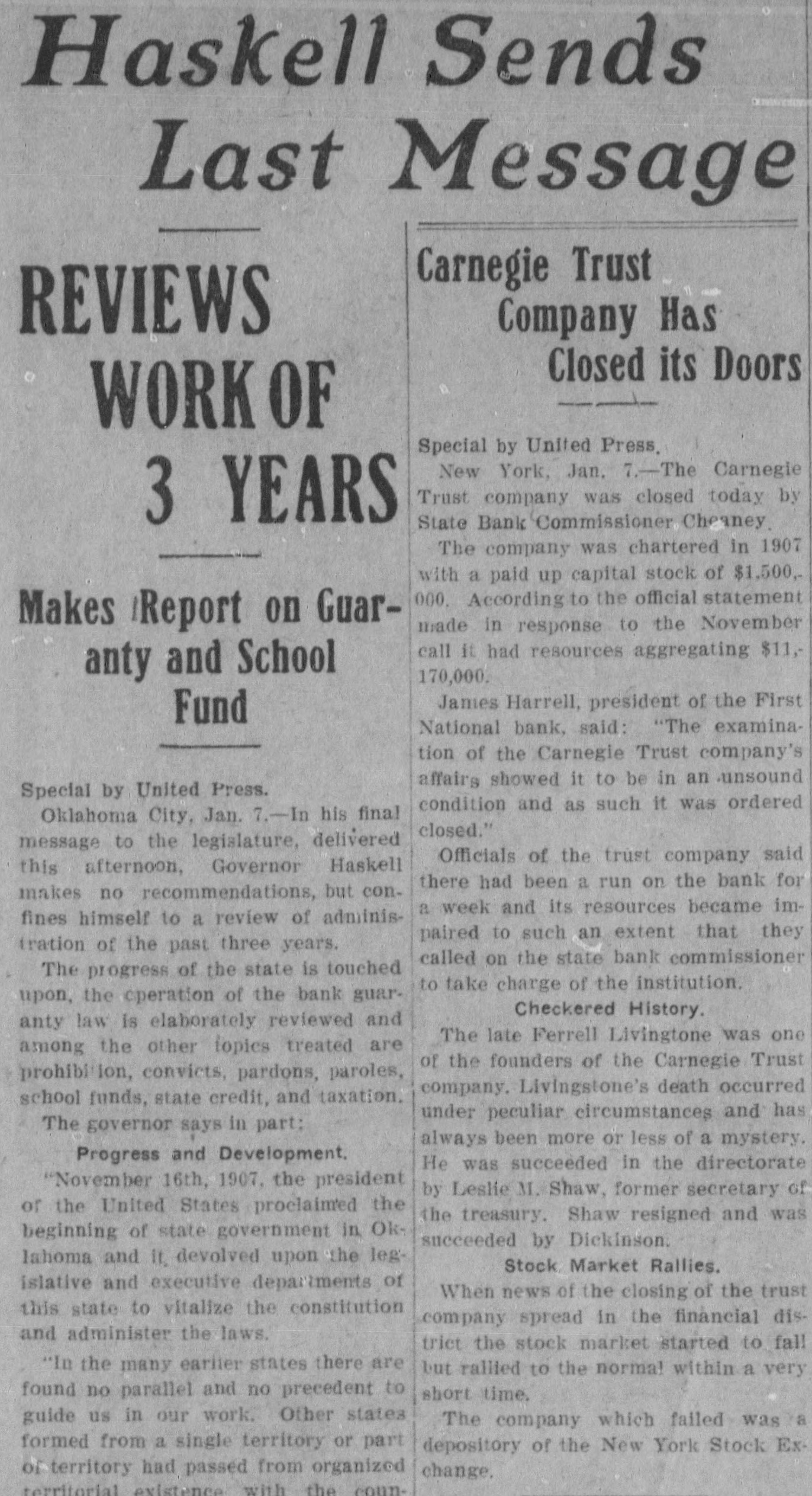
Haskell Sends Last Message Carnegie Trust REVIEWS Company Has Closed its Doors WORK OF Special by United Press. New York, Jan. 7.-The Carnegie Trust company was closed today by 3 YEARS State Bank Commissioner Cheaney The company was chartered in 1907 with a paid up capital stock of $1,500,000. According to the official statement Makes Report on Guarmade in response to the November call it had resources aggregating $11, anty and School 170,000. James Harrell, president of the First Fund National bank, said: "The examination of the Carnegie Trust company's affairs showed it to be in an unsound Special by United Press. condition and as such it was ordered Oklahoma City, Jan. - In his final closed." message to the legislature, delivered Officials of the trust company said this afternoon, Governor Haskell there had been a run on the bank for makes no recommendations, but cona week and its resources became imfines himself to a review of adminispaired to such an extent that they tration of the past three years. called on the state bank commissioner The progress of the state is touched to take charge of the institution. upon, the operation of the bank guarCheckered History. anty law is elaborately reviewed and The late Ferrell Livingtone was one among the other topics treated are of the founders of the Carnegie Trust prohibilion, convicts, pardons, paroles, company. Livingstone's death occurred school funds, state credit, and taxation. under peculiar circumstances and has The governor says in part: always been more or less of a mystery. Progress and Development. He was succeeded in the directorate "November 16th, 1907. the president by Leslie M. Shaw, former secretary of of the United States proclaimed the the treasury. Shaw resigned and was beginning of state government in Oksucceeded by Dickinson. lahoma and it, devolved upon the legStock Market Rallies. islative and executive departments of When news of the closing of the trust this state to vitalize the constitution company spread in the financial disand administer the laws. triet the stock market started to fall "In the many earlier states there are but rallied to the normal within a very found no parallel and no precedent to short time, guide us in our work. Other states The company which failed was formed from a single territory or part depository of the New York Stock Exof territory had passed from organized change. counexistence with territorial


Article from The Richmond Virginian, January 7, 1911

Click image to open full size in new tab

Article Text

LOANS TOO LARGE TRUST CO. CLOSED Carnegie Concern Forced by Bank Examiner to Suspend Business LOOK INTO BOOKS SHOWS IT UNSOUND Institution Forced to Front by Dickinson, Whose Sensational Death in Office of Chemist, is Mystery NEW YORK, January 7.More Jian $11,000,000 is involved in the closing of the Carnegie Trust Company, the tast report of the institution to the State banking department, on November 10, 1910, showing total assets of $11,170,600, The Carnegie Trust Company. was a margin depository of the New York Cotton Exchange, but is said It had not received a large percentage of the business of the exchange lately. NEW YORK, Jan. 7.-The Carnegie Trust Company, one of the large fine ancial institutions in New York, was closed to-day by State Superintendent of Banks Cheney. The company was chartered in 1907 and had a paid-up capital of $1,500,000; surplus and undivided profits of $787,000 and gross deposits of about $8,200,000. j. T. Howell, formerly president of the Fourth National Bank, Nashville, Tenn., was presidene. Officials of the closed institution stated that there had been a quiet run on it for more than a week and that this had used up all of the available ready resources, so the State banking department was called on to interfere to protect the rank and file of the depositors. Condition Not Sound. O. H. Cheney, head of the banking department, issued the following statement: "Superintendent of banks has taken charge of the property and business of the Carnegie Trust Company. The examination of the affairs of this company has caused the superintendent to conclude that it is in an unsound condition to transact business, and that it is not safe for It to continue. "The examination is not yet complete and no further statement can be made at this time." Large Unsecured Loans. The late Charles C. Dickinson, whose mysterious death on May 24, 1910, following gas poisoning while witnessing a chemical demonstration in Seranton, Pa., has never been thoroughly solved. was one of the prime movers in founding the Carnegie Trust Company, which opened for business January 1, 1907. After the company had been doing business for a few months, Dickinson resigned in favor of Leslie M. Shaw, formerly secretary of the treasury. Dickinson remained as a vice-president and vire tually manager of the trust company. Shaw held the president's office only a few months and Dickinson was, res elected. Shaw's resignation was due, it is said, to politics, Dickinson alleging that the former secretary was beset with a "bee to become president of the United States." The Carnegie Trust Company grew under the aggressive policy of Dickinson. His management. however. eventually drew considerable criticism because of certain unsecured loans (Continued on Fourth Page.)


Article from Las Vegas Optic, January 9, 1911

Click image to open full size in new tab

Article Text

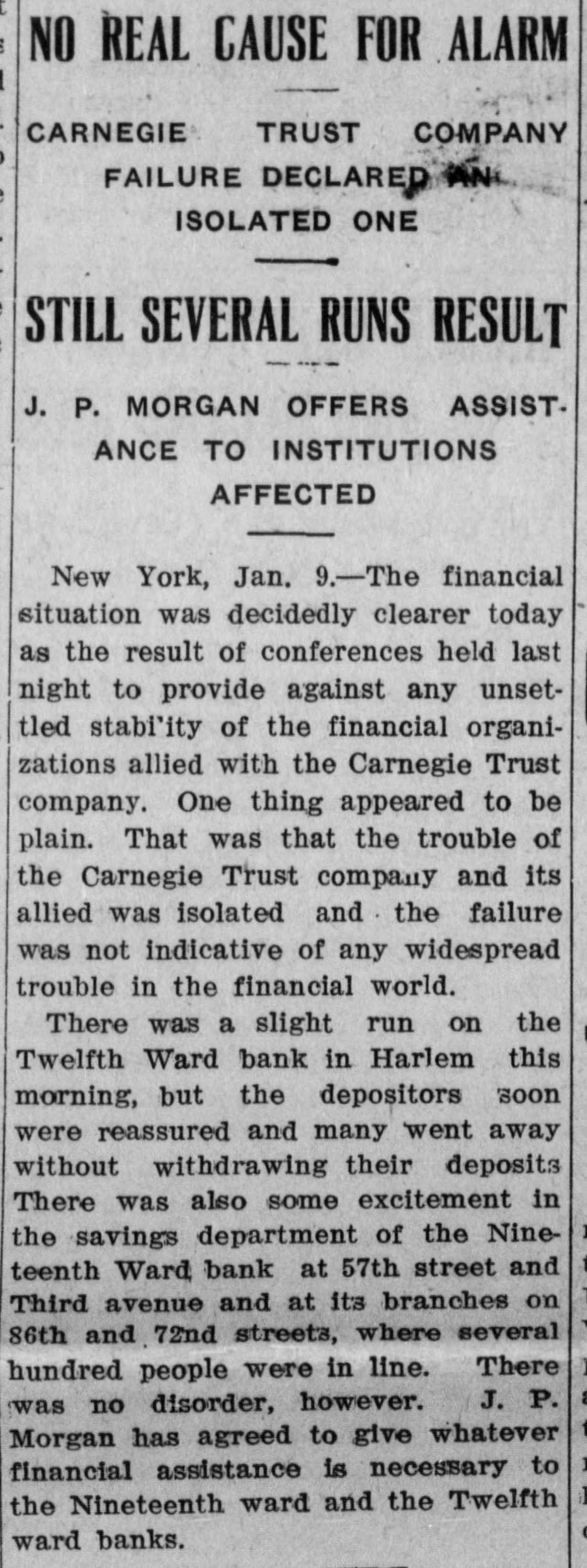
NO REAL CAUSE FOR ALARM TRUST CARNEGIE COMPANY AN FAILURE DECLARED ISOLATED ONE STILL SEVERAL RUNS RESULT J. P. MORGAN OFFERS ASSIST. ANCE TO INSTITUTIONS AFFECTED New York, Jan. 9.-The financial situation was decidedly clearer today as the result of conferences held last night to provide against any unsettled stabi'ity of the financial organizations allied with the Carnegie Trust company. One thing appeared to be plain. That was that the trouble of the Carnegie Trust company and its allied was isolated and . the failure was not indicative of any widespread trouble in the financial world. There was a slight run on the Twelfth Ward bank in Harlem this morning, but the depositors soon were reassured and many went away without withdrawing their deposits There was also some excitement in the savings department of the Nineteenth Ward bank at 57th street and Third avenue and at its branches on 86th and 72nd streets, where several hundred people were in line. There was no disorder, however. J. P. Morgan has agreed to give whatever financial assistance is necessary to the Nineteenth ward and the Twelfth ward banks.


Article from The Madison Daily Leader, January 9, 1911

Click image to open full size in new tab

Article Text

HAD DEPOSITS OF NINE MILLIONS Carnegie Trust Company of New York Suspends. NO BAD RESULTS FOLLOW Institution Was Closed by State Bank Examiner, Who Says "It Is in an Unsound Condition"-Was Organized in 1907 and the Name Carnegie Adopted Without the Ironmaster's Permission or Approval. New York, Jan. 9.-The Carnegie Trust company, one of the largest banking institutions in the city, with deposits of nearly $9,000,000, closed its doors by order of State Superintendent of Banks Cheney. The suspension hardly caused a ripple in the financial district, where the trust company was often reported in a shaky condition. Superintendent Cheney, in an official statement, said an examination of the trust company had caused him to "conclude that it is in an unsound condition to transact business and that It is not safe for it to continue." State banking officers are now probing the company's books. Officials of the trust company have made no statement and the extent of liabilities is unknown. Bankers, however, say depositors will be paid in full. The institution was organized in 1907 and after the retirement of Leslie M. Shaw from the office of secretary of the treasury he become its president. The name of Carnegie as applied to the institution attracted to it a great deal of attention, but the adoption of this name was without Mr. Carnegie's authority or approval. It is understood he was not a stockholdor and not immediately identified with it. Mr. Shaw's connection with the bank ceased after a few months because of differences with the other of ficers of the institution. In Trouble a Year Ago. It is understood that a year ago the institution was in more or less trouble, growing out of the fact that one of its chief officers, in connection with a well known banker of Wall street, had effected a very large loan from it to enable him to buy out and consolidate with it another institution, but this falling through left the Carnegie institution with a large amount of funds locked up. News of the suspension spread rapIdly and hundreds of depositors had assembled about the doors even before the usual hour of opening. The following statement was issued by Superintendent of Banks Cheney relative to the closing of the company: "The superintendent of banks has taken possession of the property and business of the Carnegie Trust company, located at 115 Broadway, Borough of Manhattan. "Examination of the affairs of the company has caused the superintendent to conclude that it is in an unsound condition to transact business and that it is not safe for it to continue. The examination is not yet complete and no further statement can be made at the present time."


Article from Evening Journal, January 10, 1911

Click image to open full size in new tab

Article Text

been after it ever since it was reorganized from the old Van Norden Trust Company. How He Will Pay For Them. To pay for the three institutions it is expected Morgan will increase the stock of the Equitable Trust Company and exchange it for the outstanding shares of three companies, making the actual cost to Morgan personally only about what the engravers' bill will be who furnishes the new stock. The $20,000,000 of assets of the three concerns which were in danger will add materially to the attractiveness of the Equitable Trust Company's balance sheets hereafter, in the opinion of financial experts, who have watched the present situation. Normal conditions prevailed at all of the banks today, the slight run on the Nineteenth and Twelfth Ward Banks and the Madison Trust Company, which prevailed yesterday not being renewed. It was stated by State Superintendent of Banks Cheney today that the affairs of the Carnegie Trust Company will be liquidated at once and no attempt will be made to put the institution in shape to continue business.


Article from Heppner Gazette, January 12, 1911

Click image to open full size in new tab

Article Text

Carnegie Trust Company Closed. New York.-The Carnegie Trust company has been closed by State Bank Commissioner Cheney. The company was chartered in 1907 and had a paid-up capital of a million dollars. Its surplus was $500,000 and its undivided profits aggregated $73,000. Its gross deposits amounted to $8,900,000. The officials of the bank issued a statement saying a quiet run had been in progress for a week and ready available resources had been used up.


Article from Vilas County News, January 18, 1911

Click image to open full size in new tab

Article Text

SUPPORT HALTS BANK TROUBLES Quick Action by Big Interests Prevents Possible Runs. New York.-Owing to the quick and strong support given by J. P. Morgan & Co., Kuhn, Loeb & Co. and other powerful banking interests to a situation that for a short time was delicate, the city of New York was saved from bank runs that might have led to general excitement and temporary financial derangement. When it became known that the interests named had organized themselves into a committee of defense against the probable bad effects of the failure of the Carnegie Trust Co., the apprehended runs on the Madison Trust Co. and its subsidiaries, the Twelfth Ward bank and the Nineteenth Ward bank, with several branches scattered through the city and all affiliated with the unfortunate Carnegie Trust Co. were virtually averted. Although there were steady withdrawals from these banks and their several branches all day, at no time was there a panicky feeling.


Article from Vernon County Censor, January 18, 1911

Click image to open full size in new tab

Article Text

SUPPORT HALTS BANK TROUBLES Quick Action by Big Interests Prevents Possible Runs. New York.-Owing to the quick and strong support given by J. P. Morgan & Co., Kuhn, Loeb & Co. and other powerful banking interests to a situation that for a short time was delicate, the city of New York was saved from bank runs that might have led to general excitement and temporary financial derangement. When it became known that the interests named had organized themselves into a committee of defense against the probable bad effects of the failure of the Carnegie Trust Co., the apprehended runs on the Madison Trust Co. and its subsidiaries, the Twelfth Ward bank and the Nineteenth Ward bank, with several branches scattered through the city and all affiliated with the unfortunate Carnegie Trust Co. were virtually averted. Although there were steady withdrawals from these banks and their several branches all day, at no time was there a panicky feeling.


Article from The Lake County Times, January 20, 1911

Click image to open full size in new tab

Article Text

The failure of the Carnegie Trust Company has caused a slight run on some of the New York City banks, and a curious state of affairs has developed. Depositors in three of the banks whose officers were interested in the Carnegie Trust Company have stood in line waiting to withdraw


Article from New-York Tribune, March 8, 1911

Click image to open full size in new tab

Article Text

# HYDE'S SECRETARY'S LOAN Continued from first page. were left in the hands of the Carnegie when the Fidelity crash came. The makers of these notes were mostly ecclesiastical representatives of churches or church institutions, though some were signed by individuals having no official connection with churches or church activities. The most prominent of these latter during the period mentioned above was Mary Calkins, of Toledo, who made four notes between April 23, 1908, and May 25 of the same year, for a total of $56,000, on which the accrued interest when the Carnegie closed its doors was $4,500. The name of either Keiran or his Fidelity Funding Company appeared on each of these notes, but his representative said yesterday that the Carnegie held additional security in the shape of a mortgage on a large building in Toledo which Mary Calkins erected on the property she owns there. However, it appeared from the State Banking Department's records that indorsement or security was frequently dispensed with, and sums of money running from the $4,000 which "Jack" Smith was able to borrow to an $80,000 loan made to William J. Oliver, likewise without security or indorsement, were freely handed out. Andrew Carnegie's financial agent denied the story printed in morning newspapers other than The Tribune yesterday to the effect that the $2,100,000 loan Mr. Carnegie made to the trust company which bears his name had been reduced by payments to $700,000. "Mr. Cummins and his friends still owe Mr. Carnegie the $2,100,000 which he let them have a year ago," sail the iron-master's agent, "and Mr. Carnegie has not promised to make up any losses which may fall upon the depositors of the trust company." At the annual meeting yesterday of the American Snuff Company, of which Martin J. Condon, of the Cummins Syndicate, is president and a director, the retiring directors were re-elected. The board will to-day elect officers for the coming year.


Article from The Sun, March 27, 1911

Click image to open full size in new tab

Article Text

loan in city bonds obtained from the Northern Bank. The Grand Jury doesn't want to deal harshly with the official in question. Many persons have come forward to speak as to his good character and to say that he was used by others. Furthermore. the District Attorney believes that the official will not be unwilling to clear up certain points that the Grand Jury considers essential. Bank Superintendent O. H. Cheney will return to-morrow from Colorado. While he has been away Receiver Egbert and Lawyer Hartfield. in charge of the collection of money due the Carnegie and of liquidating assets, have made considerable progress. It is understood now that the deficit will be under $2,000,000. The receiver is negotiating for the sale of the South Shore Traction franchise and the Morris Park property held by the Fidelity Development Company.


Article from The Citizen, March 31, 1911

Click image to open full size in new tab

Article Text

by the Grand Jury or falsifying a institution monthly report of dated August 31, 19 He pleaded for trial unnot guilty and was e bond was der $10,000 bail. furnished by a sur company. Like his associa William J. Cummins, Reichma through his attorney, Stephen Baldwin, took ht to withdraw advantage of his the plea of guilty. The date for the final pleading was set for April 10. It is understood that in the meantime a motion will be made to the court for permission to inspect the minutes of the Grand Jury which step will be vigorously contested by District Attorney Whitman. This indictment charges a misdemeanor. In asking that bail be fixed at $10,000 the District Attorney stated in open court that the present charge was but a fore runner of further action that might be expected from the Grand Jury against Reichmann. The Reichmann indictment was only an incident in the day's developments, which now not only involve a high city official and officers of the Carnegie Trust Company, not yet named, but the State Banking Department as well. The name of Andrew Carnegie, the iron master, was again brought into prominent, notice by a formal demand from George L. Dyer for the return of 8,000 shares of the capital stock of the Platt Iron Works, of Dayton, Ohio, a Cummins enterprise, of which Joseph R. Reichmann was President. This stock Mr. Carnegie received from the trust company in January, 1910, for a loan of $2,100,000. The loan was made to save the Carnegie Trust Company after the run that followed the collapse of the Hocking Valley pool. Mr. Dyer claims that Independent Fertilizer stock was substituted for Platt Iron stock. Subsequently the Platt Iron stock was turned over to Mr. Carnegie as collateral for his loan. At a late hour last night Mr. Whitman was in conference with Former Governor Frank Black with a view to making final arrangements for assisting in the prosecution of the Reichmann-Cummins crowd. Up to the time of the conference Mr. Black had not given his consent to enter the case.


Article from New-York Tribune, April 10, 1911

Click image to open full size in new tab

Article Text

Says City Has Lost Nothing. Perhaps the first thing the public would like to know is that, notwithstanding all the talk, not a dollar of the city's money has been lost and not a dollar is in jeopardy. The first of the many statements that have been fed to the public to connect me with alleged improper transactions is a fair sample of all or most of it. In that statement the press bureau which has been busily engaged in endeavoring to poison the public mind spread out far and wide the story that 1 Kent a balance in the Northern Bank of over $1,000,000. From this it was implied or insinuated that there must have been a corrupt understanding with some one. This fairly illustrates the sort of "evidence" upon which I am being assailed. The facts are as follows: The designation of the Northern Bank as a city depository was made long before my term of office began. The selection of the Bronx branch of that bank as the depository to receive Bronx revenues was made at the request of Controller Prendergast, who had been a director of that bank until shortly before he took office. Mr. Wolfe. the chief auditor in the Controller's office. was also vice-president until he took office, Janary 1. 1910. The circumstances of this selection have already been publicly stated and are well known. It is true that on October 31. 1910. late at night, the receiver of taxes (an appointee of the Controller) deposited the tax receipts for that day, amounting to about $887,000. in the Northern Bank, but it is also true that $900,000 was withdrawn by my deputy the next morning, leaving the bank's balance at the normal amount about $188,000. Yet the public is wilfully led to believe that I kent $1,000,000 there. to be loaned to friends. Could anything be any more diabolical? Coming then to a discussion of the relations of his office with the Cummins syndicate, which was in control of the Carnegie Trust Company before that institution went into the hands of the State Banking Department Mr. Hyde says in effect that the only basis for any question was the story of Robin. The coincidence of loans by some nineteen banks and trust companies to the Cummins syndicate at or very near the time when those nineteen institutions received augmented deposits of city money is "suddenly discovered," says Mr. Hyde. and this syndicate was composed of men "who were supposed to have my friendship." His statement continues With Robin's story as a basis, it is suddenly discovered that a syndicate or assoContinued on second Daza.


Article from The Daily Telegram, April 12, 1911

Click image to open full size in new tab

Article Text

According to Petition Filed in Court by Three of the Creditors. ASSETS VERY SMALL Receiver is Appointed for Official's of Failed Trust Company. NEW YORK, April 12-An Involuntary petition in bankruptoy was filed here today against William J. Cummins, president of the failed Carnegie Trust Company, now under indictment. His liabilities are given as $5,000,000 and assets as $400,000. Payson Merrill was appointed receiver with bond at $100,000. Two other petitions in bankruptcy were filed against Charles Arthur Moore, Jr., a director of the Carnegie Trust Company, and Martin J. Condon, also a director. The Nabilities of Moore are give. as $2,000,000 and his assets as $100,000, and Condon's liabilities are $6,500,000. and assets $500,000. The three petitioning creditors allege preferential payments and transfers of property while insolvent. It is said that Cummins is no win Nashville, Tenn. The actions were not brought against the respondents as directors in the Carneie Trust Company, but as individuals. The Carneigie Trust Company and Long and Edge failures were thrust over the precipice by the failure and indictment of Joseph G. Robin.


Article from Newark Evening Star and Newark Advertiser, April 12, 1911

Click image to open full size in new tab

Article Text

NAME RECEIVER FOR THE CARNEGIE TRUST CO. HEAD Bankruptcy Suits Also Brought Against Directors of the Concern. NEW YORK, April 12.-Three involuntary petitions in bankruptcy aggregating $13,500,000 were filed here today against three officers of the failed Carnegie Trust Company, now in the hands of the State superintendent of banks. The respondents are William J. Crimmins, president of the trust company: Charles Arthur Moore, jr., and Martin J. Condon, directors. Their financial status is given in the petitions as: Cummins, liabilities $5,000,000 and assets $400,000; Moore, liabilities of $2,000,000 and assets of $100,000; Condon, liabilities of $6,500,00 and assets of $500,000. Payson Merrill was named receiver for all three, under bonds of $10,000. T' creditors who appear are: Hermann C. Brewster, $30,000; Herbert Hatfield, $9,644, and James S. Watson, $80,000, all for money loaned. They allege against Cummins in their petition that preferential payments have been made since he became insolvent and that there has been transfer and concealmeit of considerable property with intent to hinder delay and defraud creditors. The lawyers for the creditors are Samuel J. Koenig, formerly secretary of State for New York, and Parsons, Closson & McIlvaine. Mr. Koenig said that the actions filed by him and his associates were not brought against the respondents as directors in the Carnegie Trust Company, but as individuals. $6,000,000 in Claims. "These claims have been presented for payment," he continued, "and though not refused, nevertheless they have not been paid. The creditors are numerous, and their claims will aggregate certainly $6,000,000, and probably more. In order to protect themselves fully they have filed in some instances duplicate claims, which accounts for the larger aggregate amount appearing in the papers." The Carnegie Trust Company, long on the edge of failure, was thrust over the precipice by the failure and indictment of Joseph G. Robin, president of the Washington Square Savings Bank and an officer closely connected with the Northern Bank of New York, which also failed. The publication of the proceedings taken by the State Banking Department against these two banks showed that Robin, who had formerly been a director of the Carnegie, had given it his paper for large amounts even after his resignation, and the mere shadow of his name was sufficient to bring on a run which the bank could not withstand.


Article from Evening Star, April 15, 1911

Click image to open full size in new tab

Article Text

# Moore Leaves Rome for North. ROME, April 15.-Charles Arthur Moore, jr., director of the suspended Carnegie Trust Company of New York, and against whom an involuntary petition in bankruptcy was filed recently, left here last Thursday for the north of Italy. It is believed he is on his way to America.


Article from New-York Tribune, April 16, 1911

Click image to open full size in new tab

Article Text

Another overheard snatch-merely a hint-refers to the eighty-six mahogany desks, the million-odd envelopes and the 25,263 lead pencils, which were counted in by the receivers among the assets of the trust company. Figuring on forbearance loans uses up pencils fast. Those "forbearance loans" made an interesting fragment in themselves. A forbearance loan is made in this manner: A man or a concern who is friendly with the officers of a banking institution (if such another banking institution as the Carnegie still exists), makes a draft on some firm or individual in a city at a considerable distance from New York. There is no intention of collecting the draft from the person on whom it is drawn, so there is no need that he should owe any of the parties a cent, and usually, it is said, he does not. The draft goes to the bank and passes through the regular course of all well behaved drafts, until it has been entered on the books of the bank to the credit of the needy firm or individual who made it, so that its amount may be drawn out by check. Then the draft itself-the written paper-is taken in and laid on the desk of one of the friendly officers of the bank. He slips it into an envelope and, instead of sending it West for collection, drops it into a pigeon hole. When the man or the firm who made it is ready to return the money, the need for "forbearance" being safely past, he takes the money to the friendly official, who uses it to pay the draft.


Article from New-York Tribune, April 16, 1911

Click image to open full size in new tab

Article Text

# C. A. MOORE. JR., LEAVES ROME. Rome, April 15. - Charles Arthur Moore, jr., a director of the suspended Carnegie Trust Company, of New York, and against whom an involuntary petition in bankruptcy was filed recently, left here last Thursday for the north of Italy. It is believed he is on his way to America.


Article from Omaha Daily Bee, June 17, 1911

Click image to open full size in new tab

Article Text

# LESSONS IN CROOKED BANKING System by Which a New York Financier Got Away with the Money. The strange ins and outs of high finance as they are displayed in the narrative of the collapse of the Carnegie Trust company of New York are detailed in an article in Hampton's by Frank Parker Stockbridge. Equally interesting are the life stories of some of the men concerned in that huge failure. Of Robin, the immigrant who became a powerful banker, Mr. Stockbridge says: Deposits accumulated in Robin's Northwestern bank, where he was chairman of the executive committee, until more than $8,000,000, mostly the funds of small tradesmen doing business in Harlem and the Bronx, were in its coffers. His Riverside bank was prosperous. People were flocking to put their money into his Washington Savings bank and he began to look around for other ways of getting the money. He got into the Fidelity Development company, a real estate concern which owned the old Morris Park race track, and soon controlled it. He acquired control of the Bankers' Realty and Surety company. To carry out his schemes he needed a title insurance company. The Aetna Indemnity company of Hartford, which had formerly been one of Fritz Heinze's concerns, owned the Title and Guaranty company of Rochester. Robin bought control of the Aetna and from it purchased the Rochester concern. The savings bank could lend money on the real estate owned by the realty companies. The Title and Guaranty company could guarantee the mortgages to satisfy the bank examiners, and the two commercial banks could lend money on the capital stock of any of the other companies or of each other. With all these institutions under his control Robin could take money out as fast as the public put it in. His personal tastes were luxurious, even oriental. He established himself in luxurious apartments, gorgeously furnished, in an expensive house in Gramercy park. Like other players in the big game, he wanted a country place. He built a magnificent mansion at Wading River, Long Island. One of the important details of "Driftwood Manor," as called his place, was its well-stocked wine cellar. Robin entertained house parties of kindred spirits, men and women. The residents of the little village of Wading River talk of the things that went on at these house parties. They tell stories of the "Snow Waltz," in which, after a night of revelry, the dancers would whirl out through the open door and, regardless of low necks and thin slippers, would finish their dance on the snow-covered verandas. Other tales are of a summer sport of a somewhat similar nature in which the pond near the house took the place of the veranda. No matter how fast the money came in, Robin always needed more. There was no end to his schemes and for the most part they were good and perfectly legitimate schemes. He conceived the idea, for example, of running a trolley line across the new Queensborough bridge and through Long Island City to Jamaica. Such a line would tap a large, undeveloped section of Long Island and be of real public service. He obtained a franchise for this line, including the only available route to Jamaica. He organized the South Shore Railroad


Article from Daily Kennebec Journal, June 24, 1911

Click image to open full size in new tab

Article Text

A desposition given by Andrew Carnegie before he sailed for Europe was read Friday in a civil suit at New York in which the iron master declared that he know nothing of the affairs of the suspended Carnegie Trust Co., never gave it any advice and had opposed the use of his name by the company. Mr. Carnegie said he had lent the company $1,000,000 at the request of some of the stockholders to help it out of its troubles.


Article from Evening Star, June 29, 1911

Click image to open full size in new tab

Article Text

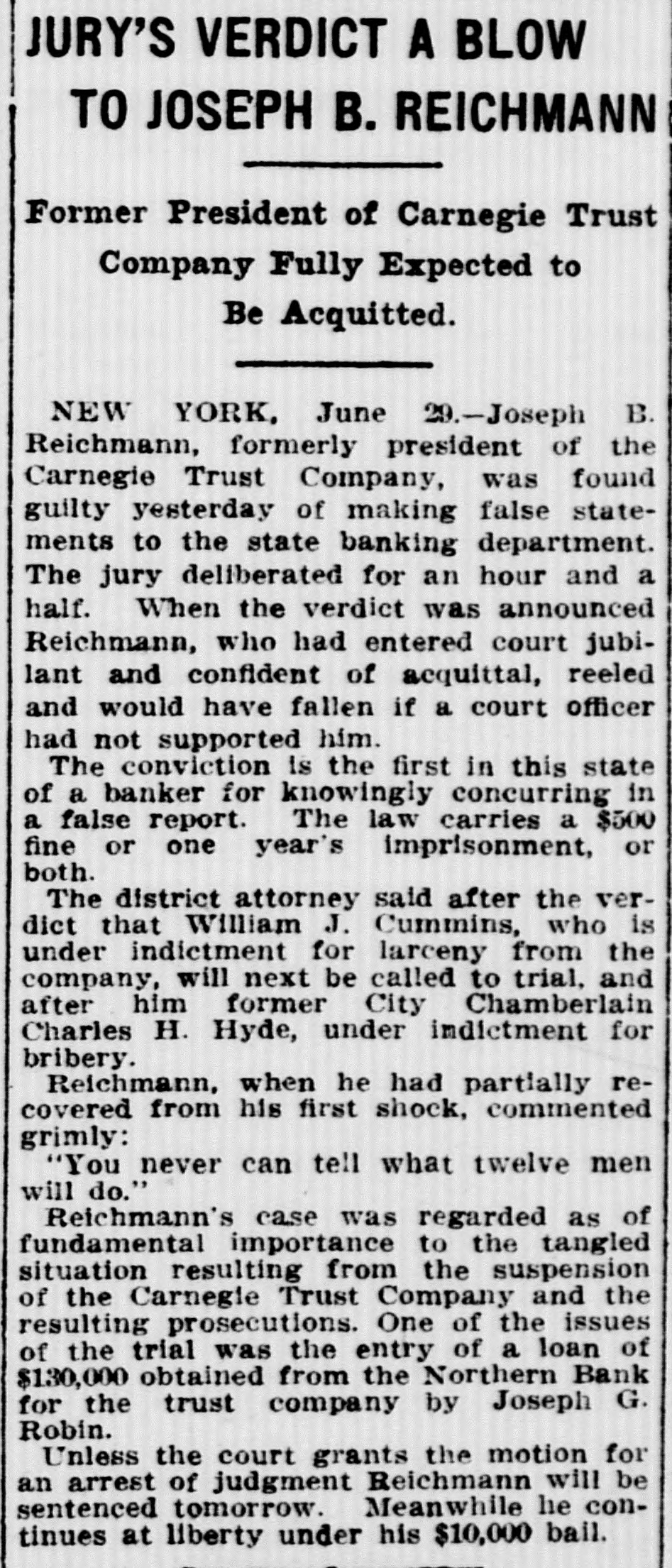
# JURY'S VERDICT A BLOW # TO JOSEPH B. REICHMANN Former President of Carnegie Trust Company Fully Expected to Be Acquitted. NEW YORK, June 29.-Joseph B. Reichmann, formerly president of the Carnegie Trust Company, was found guilty yesterday of making false statements to the state banking department. The jury deliberated for an hour and a half. When the verdict was announced Reichmann, who had entered court jubilant and confident of acquittal, reeled and would have fallen if a court officer had not supported him. The conviction is the first in this state of a banker for knowingly concurring in a false report. The law carries a $500 fine or one year's imprisonment, or both. The district attorney said after the verdict that William J. Cummins, who is under indictment for larceny from the company, will next be called to trial, and after him former City Chamberlain Charles H. Hyde, under indictment for bribery. Reichmann, when he had partially recovered from his first shock, commented grimly: "You never can tell what twelve men will do." Reichmann's case was regarded as of fundamental importance to the tangled situation resulting from the suspension of the Carnegie Trust Company and the resulting prosecutions. One of the issues of the trial was the entry of a loan of $130,000 obtained from the Northern Bank for the trust company by Joseph G. Robin. Unless the court grants the motion for an arrest of judgment Reichmann will be sentenced tomorrow. Meanwhile he continues at liberty under his $10,000 bail.


Article from Tonopah Daily Bonanza, January 10, 1912

Click image to open full size in new tab

Article Text

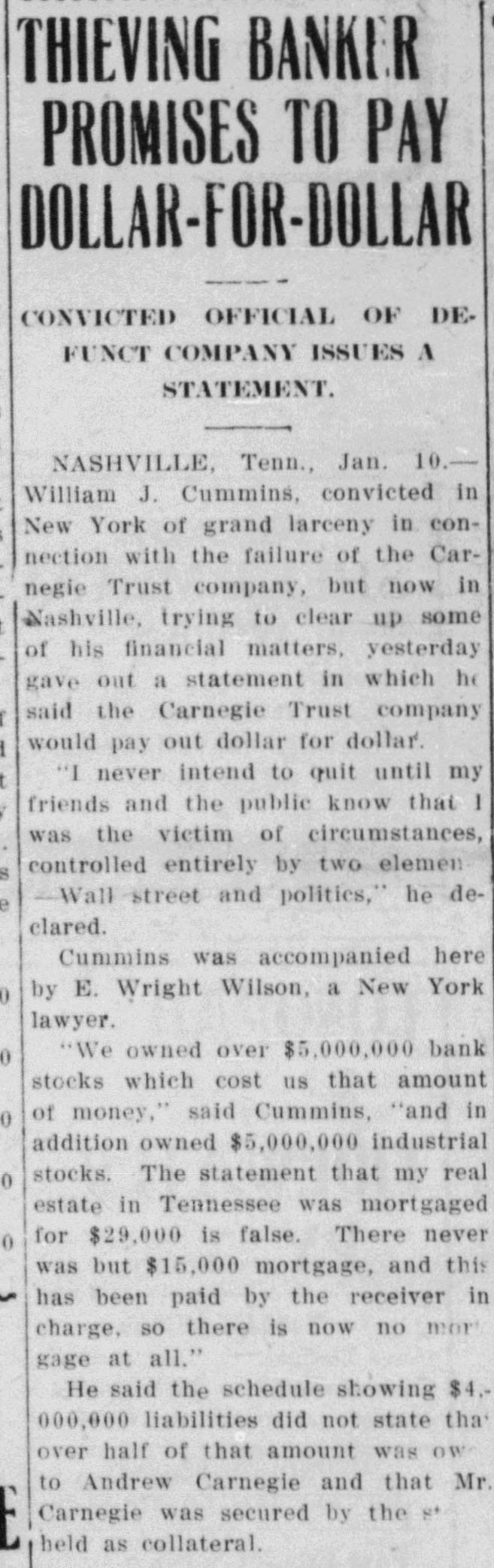
THIEVING BANKER PROMISES TO PAY DOLLAR-FOR-DOLLAR CONVICTED OFFICIAL OF DEFUNCT COMPANY ISSUES A STATEMENT. NASHVILLE, Tenn., Jan. 10.William J. Cummins, convicted in New York of grand larceny in connection with the failure of the Carnegie Trust company, but now in Nashville, trying to clear up some of his financial matters, yesterday gave out a statement in which he said the Carnegie Trust company would pay out dollar for dollar. "I never intend to quit until my friends and the public know that I was the victim of circumstances, controlled entirely by two elemen - Wall street and politics," he declared. Cummins was accompanied here by E. Wright Wilson, a New York lawyer. "We owned over $5,000,000 bank stocks which cost us that amount of money," said Cummins, "and in addition owned $5,000,000 industrial stocks. The statement that my real 0 estate in Tennessee was mortgaged for $29,000 is false. There never was but $15,000 mortgage, and this has been paid by the receiver in charge, so there is now no mor gage at all." He said the schedule showing $4.000,000 liabilities did not state tha over half of that amount was ow to Andrew Carnegie and that Mr. Carnegie was secured by the st held as collateral.


Article from The Bridgeport Evening Farmer, November 20, 1912

Click image to open full size in new tab

Article Text

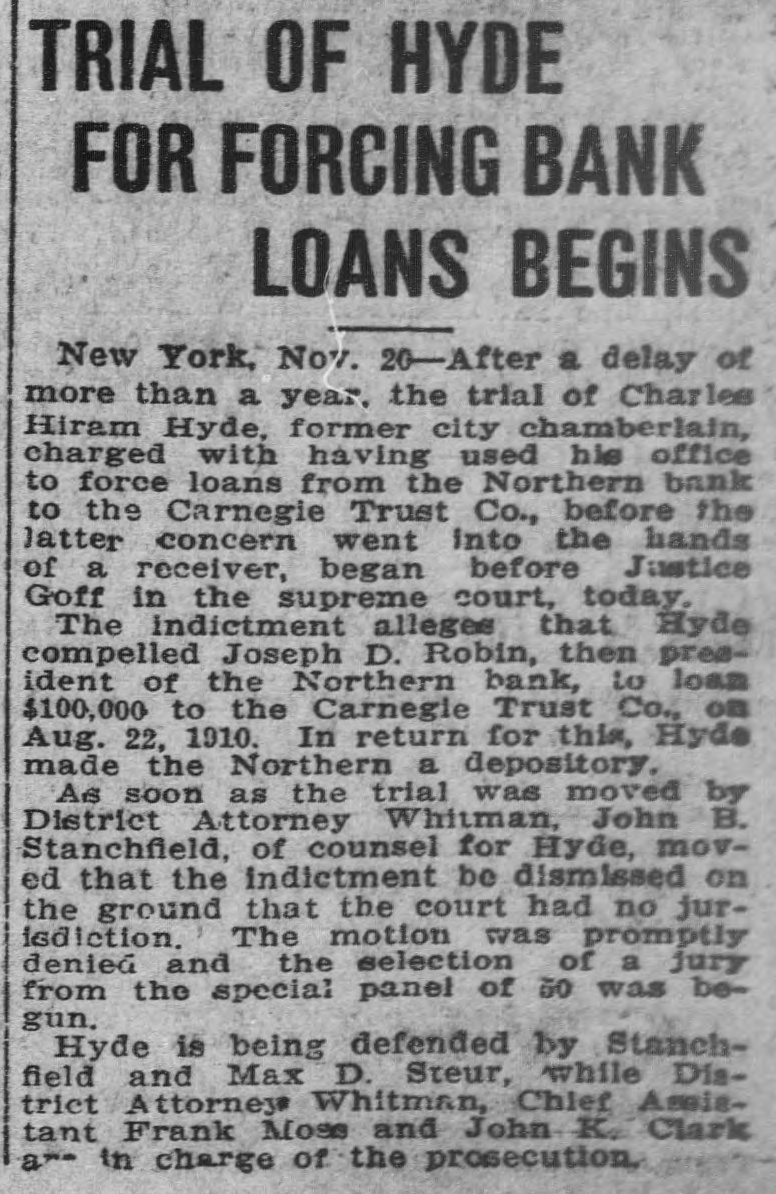
TRIAL OF HYDE FOR FORCING BANK LOANS BEGINS New York, Nov. 20-After a delay of more than a year. the trial of Charles Hiram Hyde, former city chamberlain, charged with having used his office to force loans from the Northern bank to the Carnegie Trust Co., before the latter concern went into the hands of a receiver, began before Jastice Goff in the supreme court, today. The indictment alleges that Hyde compelled Joseph D. Robin, then president of the Northern bank, to loan $100,000 to the Carnegie Trust Co., on Aug. 22, 1910. In return for this, Hyde made the Northern a depository. As soon as the trial was moved by District Attorney Whitman, John B. Stanchfield, of counsel for Hyde, moved that the indictment be dismissed on the ground that the court had no jurisdiction. The motion was promptly deniea and the selection of a jury from the special panel of 30 was begun. Hyde is being defended by Stanchfield and Max D. Steur, while Diatrict Attorney# Whitman, Chief Amistant Frank Moss and John K Clark a in charge of the prosecution,


Article from New-York Tribune, November 7, 1915

Click image to open full size in new tab

Article Text

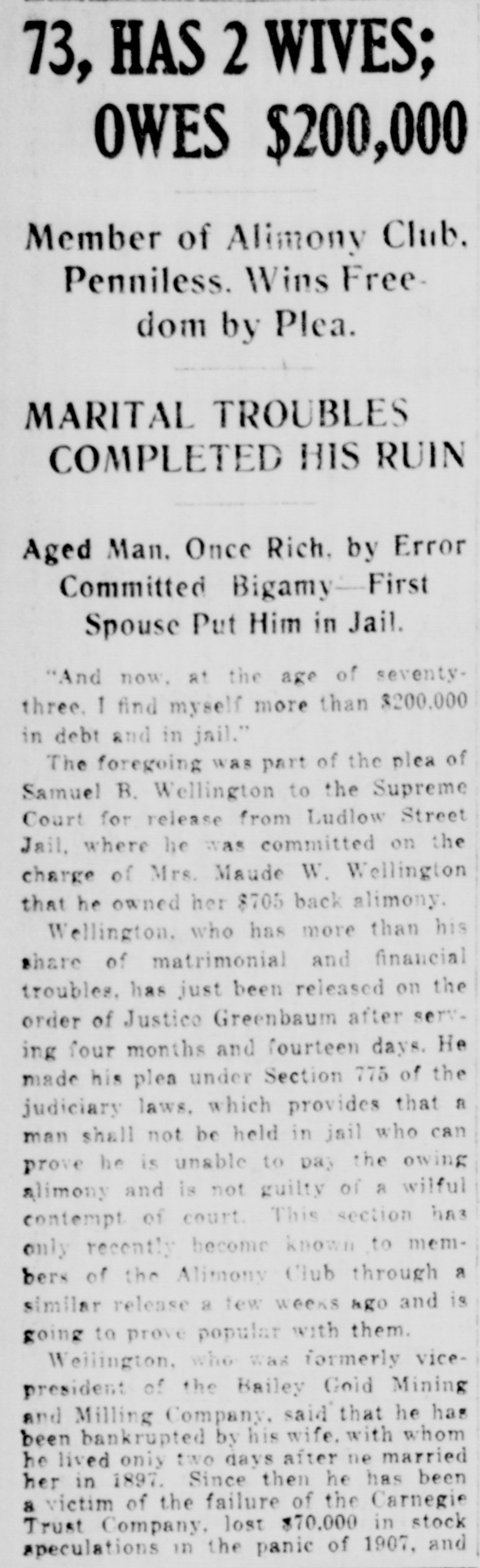
# 73, HAS 2 WIVES; # OWES $200,000 Member of Alimony Club, Penniless. Wins Free- dom by Plea. # MARITAL TROUBLES # COMPLETED HIS RUIN Aged Man. Once Rich, by Error Committed Bigamy-First Spouse Put Him in Jail. "And now, at the age of seventy- three. I find myself more than $200.000 in debt and in jail." The foregoing was part of the plea of Samuel B. Wellington to the Supreme Court for release from Ludlow Street Jail, where he was committed on the charge of Mrs. Maude W. Wellington that he owned her $705 back alimony. Wellington, who has more than his share of matrimonial and financial troubles, has just been released on the order of Justice Greenbaum after serv- ing four months and fourteen days. He made his plea under Section 775 of the judiciary laws, which provides that a man shall not be held in jail who can prove he is unable to pay the owing alimony and is not guilty of a wilful contempt of court. This section has only recently become known to mem- bers of the Alimony Club through a similar release a few weeks ago and is going to prove popular with them. Wellington, who was formerly vice- president of the Bailey Gold Mining and Milling Company, said that he has been bankrupted by his wife, with whom he lived only two days after he married her in 1897. Since then he has been a victim of the failure of the Carnegie Trust Company, lost $70.000 in stock speculations in the panic of 1907, and