13727. Canal Street Bank (New York, NY)

Bank Information

Episode Type
Suspension โ†’ Closure
Bank Type
state
Start Date
March 2, 1895
Location
New York, New York (40.714, -74.006)

Metadata

Model
gpt-5-mini
Short Digest
375d6daa38571baa

Response Measures

None

Description

The articles describe Canal Street Bank as a failed institution in the hands of a receiver (Antonio Rasines) and being wound up in 1895; depositors were being paid in installments and the receiver and counsel accounts are being settled. No run is described in the articles; the bank is in receivership and effectively closed.

Events (4)

1. March 2, 1895 Other
Newspaper Excerpt
On behalf of the receiver of the bank, it was stated that the depositors had already received 80 per cent of their deposits, that the receiver was ready to pay 10 per cent more immediately, and expected to pay the remaining 10 per cent by June 1.
Source
newspapers
2. March 2, 1895 Receivership
Newspaper Excerpt
The affairs of the bank have been in the hands of Antonio Rasines, as receiver, for about fifteen months.
Source
newspapers
3. June 4, 1895 Other
Newspaper Excerpt
Mr. McCurdy said that the receiver had paid the depositors 90 per cent, and that the remaining 10 per cent would soon be paid.
Source
newspapers
4. January 4, 1902 Other
Newspaper Excerpt
The stockholders of the Canal Street, Harlem River and Lockport banks, all of which have failed within the last few years, and against which suits have been brought, are affected by the decision.
Source
newspapers

Newspaper Articles (5)

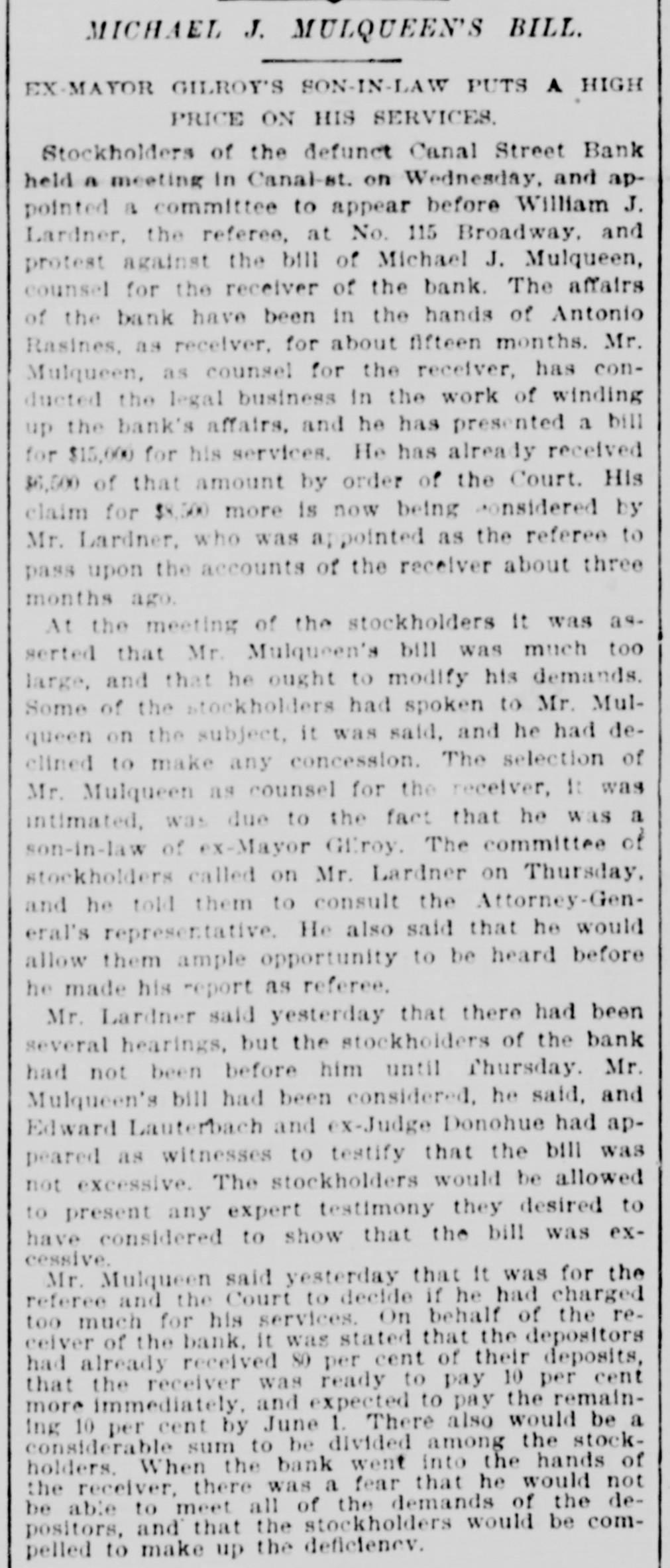
Article from New-York Tribune, March 2, 1895

Click image to open full size in new tab

Article Text

MICHAEL J. MULQUEEN'S BILL. EX-MAYOR GILROY'S SON-IN-LAW PUTS A HIGH PRICE ON HIS SERVICES. Stockholders of the defunct Canal Street Bank held a meeting In Canal-st. on Wednesday, and appointed a committee to appear before William J. Lardner, the referee, at No. 115 Broadway, and protest against the bill of Michael J. Mulqueen, counsel for the receiver of the bank. The affairs of the bank have been in the hands of Antonio Rasines, as receiver, for about fifteen months. Mr. Mulqueen, as counsel for the receiver, has conducted the legal business in the work of winding up the bank's affairs, and he has presented a bill for $15,000 for his services. He has already received $6,500 of that amount by order of the Court. His claim for $8,500 more is now being considered by Mr. Lardner, who was appointed as the referee to pass upon the accounts of the receiver about three months ago. At the meeting of the stockholders it was asserted that Mr. Mulqueen's bill was much too large, and that he ought to modify his demands. Some of the stockholders had spoken to Mr. Mulqueen on the subject, it was said, and he had declined to make any concession. The selection of Mr. Mulqueen as counsel for the receiver, It was intimated, was due to the fact that he was a son-in-law of ex-Mayor Giroy. The committee of stockholders called on Mr. Lardner on Thursday, and he told them to consult the Attorney-General's representative. He also said that he would allow them ample opportunity to be heard before he made his report as referee. Mr. Lardner said yesterday that there had been several hearings, but the stockholders of the bank had not been before him until Thursday. Mr. Mulqueen's bill had been considered, he said, and Edward Lauterbach and ex-Judge Donohue had appeared as witnesses to testify that the bill was not excessive. The stockholders would be allowed to present any expert testimony they desired to have considered to show that the bill was excessive. Mr. Mulqueen said yesterday that It was for the referee and the Court to decide if he had charged too much for his services. On behalf of the recelver of the bank. It was stated that the depositors had already received 80 per cent of their deposits, that the receiver was ready to pay 10 per cent more immediately. and expected to pay the remainIng 10 per cent by June 1. There also would be a considerable sum to be divided among the stockholders. When the bank went into the hands of the receiver, there was a fear that he would not be able to meet all of the demands of the depositors, and that the stockholders would be compelled to make up the deficiency.
Article from New-York Tribune, April 6, 1895

Click image to open full size in new tab

Article Text

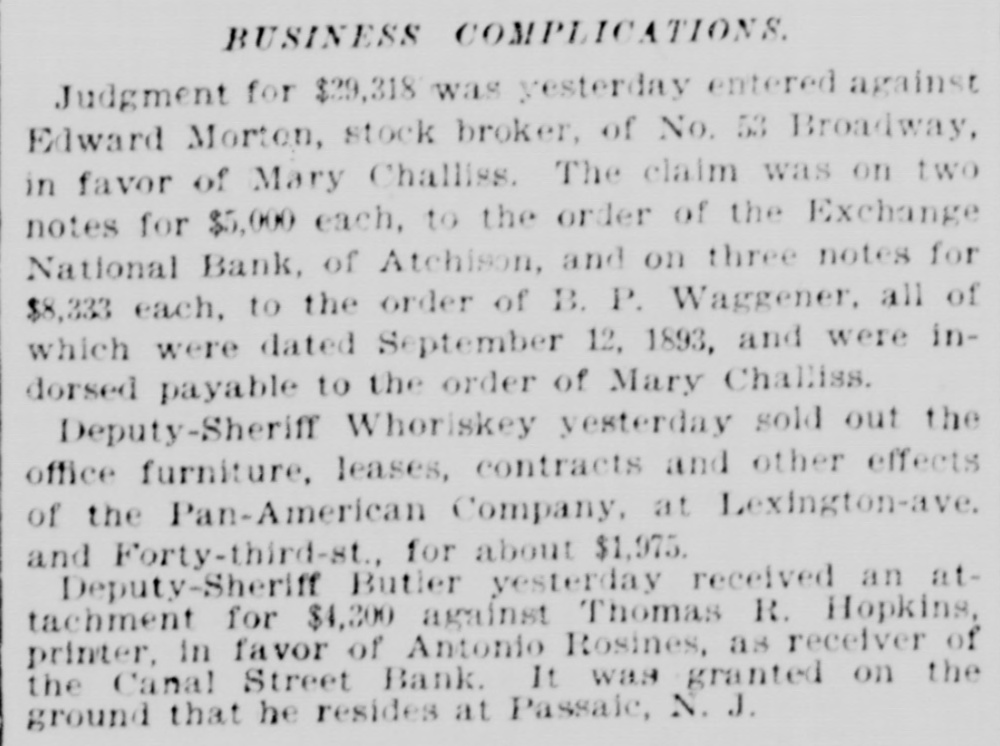
# BUSINESS COMPLICATIONS. Judgment for $29,318 was yesterday entered against Edward Morton, stock broker, of No. 53 Broadway, in favor of Mary Challiss. The claim was on two notes for $5,000 each, to the order of the Exchange National Bank, of Atchison, and on three notes for $8,333 each, to the order of B. P. Waggener, all of which were dated September 12, 1893, and were indorsed payable to the order of Mary Challiss. Deputy-Sheriff Whoriskey yesterday sold out the office furniture, leases, contracts and other effects of the Pan-American Company, at Lexington-ave. and Forty-third-st., for about $1,975. Deputy-Sheriff Butler yesterday received an attachment for $4,300 against Thomas R. Hopkins, printer, in favor of Antonio Rosines, as receiver of the Canal Street Bank. It was granted on the ground that he resides at Passaic, N. J.


Article from New-York Tribune, June 4, 1895

Click image to open full size in new tab

Article Text

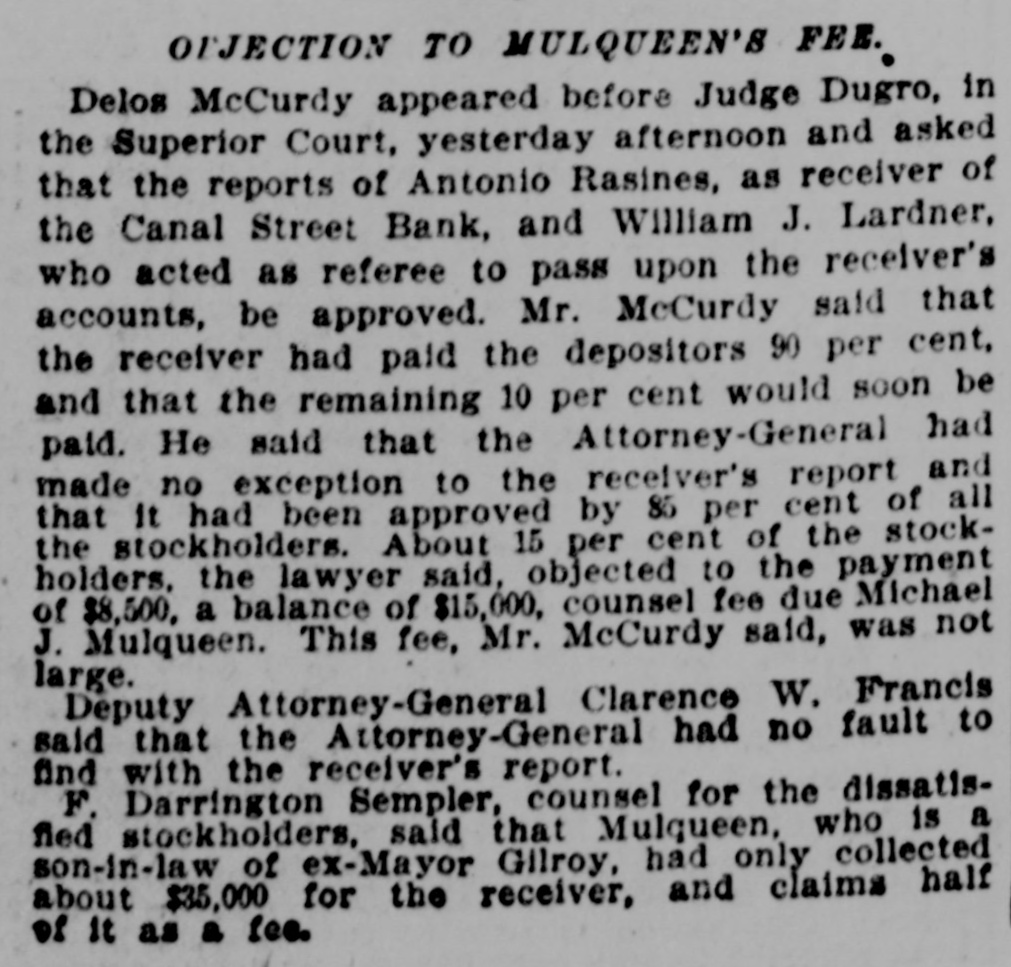
# OFJECTION TO MULQUEEN'S FEE. Delos McCurdy appeared before Judge Dugro, in the Superior Court, yesterday afternoon and asked that the reports of Antonio Rasines, as receiver of the Canal Street Bank, and William J. Lardner, who acted as referee to pass upon the receiver's accounts, be approved. Mr. McCurdy said that the receiver had paid the depositors 90 per cent, and that the remaining 10 per cent would soon be paid. He said that the Attorney-General had made no exception to the receiver's report and that it had been approved by 85 per cent of all the stockholders. About 15 per cent of the stockholders, the lawyer said, objected to the payment of $8,500, a balance of $15,000, counsel fee due Michael J. Mulqueen. This fee, Mr. McCurdy said, was not large. Deputy Attorney-General Clarence W. Francis said that the Attorney-General had no fault to find with the receiver's report. F. Darrington Sempler, counsel for the dissatisfied stockholders, said that Mulqueen, who is a son-in-law of ex-Mayor Gilroy, had only collected about $35,000 for the receiver, and claims half of it as a fee.


Article from New-York Tribune, June 27, 1895

Click image to open full size in new tab

Article Text

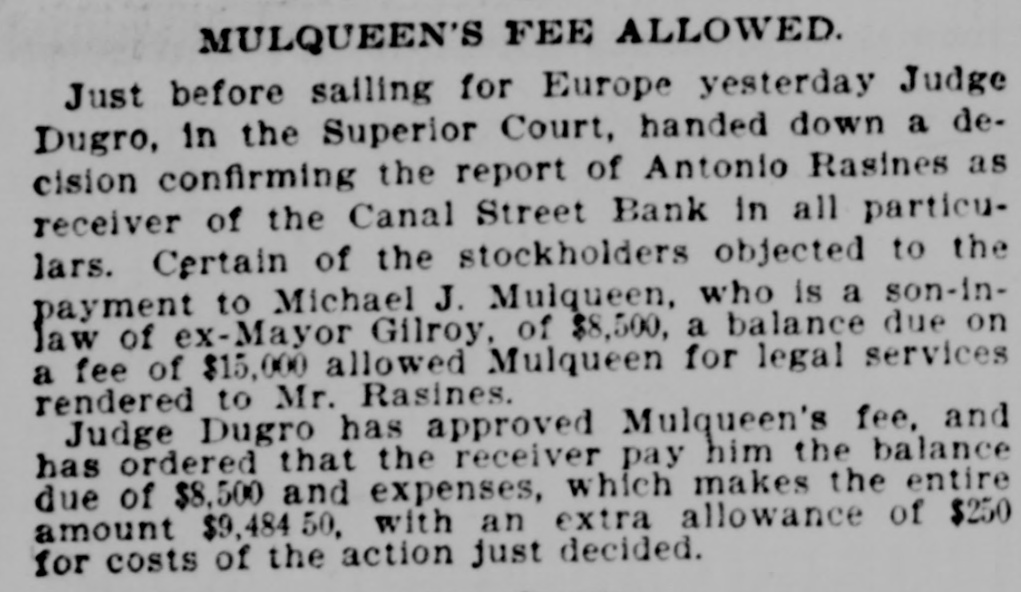
MULQUEEN'S FEE ALLOWED. Just before sailing for Europe yesterday Judge Dugro, in the Superior Court, handed down a decision confirming the report of Antonio Rasines as receiver of the Canal Street Bank in all particulars. Certain of the stockholders objected to the payment to Michael J. Mulqueen, who is a son-inlaw of ex-Mayor Gilroy, of $8,500, a balance due on a fee of $15,000 allowed Mulqueen for legal services rendered to Mr. Rasines. Judge Dugro has approved Mulqueen's fee, and has ordered that the receiver pay him the balance due of $8,500 and expenses, which makes the entire amount $9,484 50, with an extra allowance of $250 for costs of the action just decided.


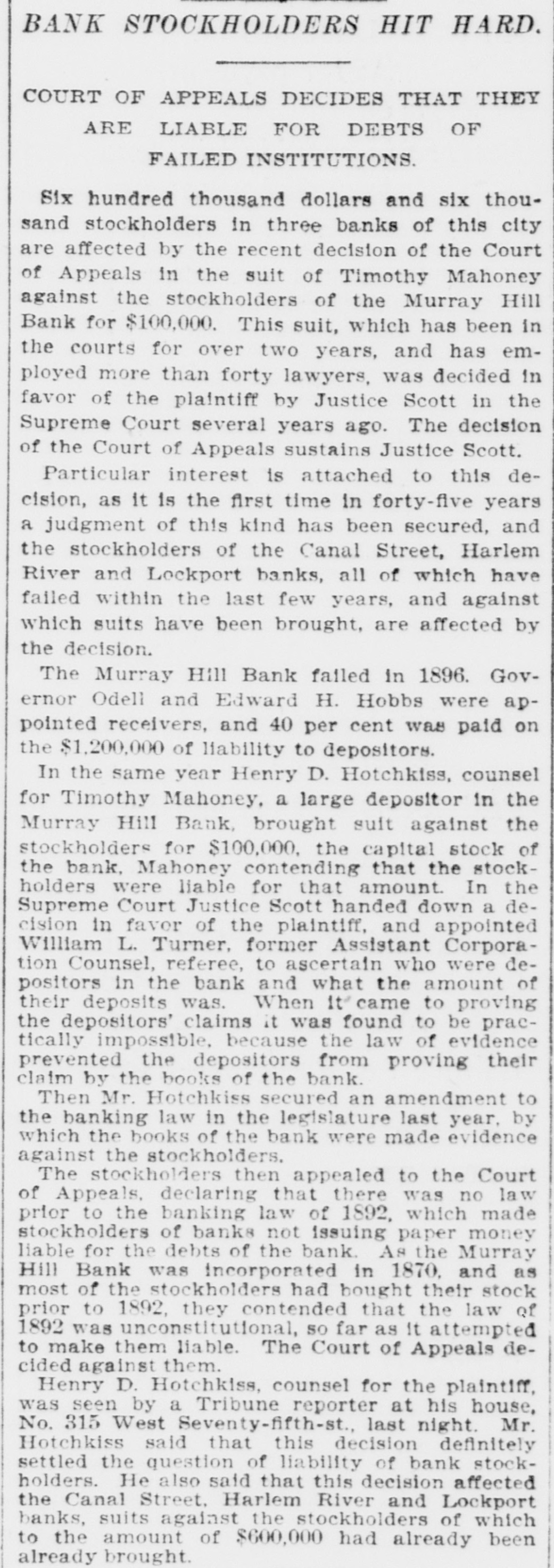
Article from New-York Tribune, January 4, 1902

Click image to open full size in new tab

Article Text

BANK STOCKHOLDERS HIT HARD. COURT OF APPEALS DECIDES THAT THEY ARE LIABLE FOR DEBTS OF FAILED INSTITUTIONS. Six hundred thousand dollars and six thousand stockholders in three banks of this city are affected by the recent decision of the Court of Appeals in the suit of Timothy Mahoney against the stockholders of the Murray Hill Bank for $100,000. This suit, which has been in the courts for over two years, and has employed more than forty lawyers, was decided in favor of the plaintiff by Justice Scott in the Supreme Court several years ago. The decision of the Court of Appeals sustains Justice Scott. Particular interest is attached to this decision, as it is the first time in forty-five years a judgment of this kind has been secured, and the stockholders of the Canal Street, Harlem River and Lockport banks, all of which have failed within the last few years, and against which suits have been brought, are affected by the decision. The Murray Hill Bank failed in 1896. Governor Odell and Edward H. Hobbs were appointed receivers, and 40 per cent was paid on the $1,200,000 of liability to depositors. In the same year Henry D. Hotchkiss, counsel for Timothy Mahoney, a large depositor in the Murray Hill Bank, brought suit against the stockholders for $100,000, the capital stock of the bank, Mahoney contending that the stockholders were liable for that amount. In the Supreme Court Justice Scott handed down a decision in favor of the plaintiff, and appointed William L. Turner, former Assistant Corporation Counsel, referee, to ascertain who were depositors in the bank and what the amount of their deposits was. When it came to proving the depositors' claims it was found to be practically impossible, because the law of evidence prevented the depositors from proving their claim by the books of the bank. Then Mr. Hotchkiss secured an amendment to the banking law in the legislature last year. by which the books of the bank were made evidence against the stockholders. The stockholders then appealed to the Court of Appeals, declaring that there was no law prior to the banking law of 1892, which made stockholders of banks not issuing paper money liable for the debts of the bank. As the Murray Hill Bank was Incorporated in 1870, and as most of the stockholders had bought their stock prior to 1892, they contended that the law of 1892 was unconstitutional, so far as it attempted to make them liable. The Court of Appeals decided against them. Henry D. Hotchkiss, counsel for the plaintiff, was seen by a Tribune reporter at his house, No. 315 West Seventy-fifth-st., last night. Mr. Hotchkiss said that this decision definitely settled the question of liability of bank stockholders. He also said that this decision affected the Canal Street, Harlem River and Lockport banks, suits against the stockholders of which to the amount of $600,000 had already been already brought.