13680. Bond Street Savings Bank (New York, NY)

Bank Information

Episode Type
Suspension โ†’ Closure
Bank Type
savings bank
Start Date
September 20, 1876
Location
New York, New York (40.714, -74.006)

Metadata

Model
gpt-5-mini
Short Digest
3e646d2d90236dbe

Response Measures

None

Description

The Bond Street Savings Bank (New York) was closed/suspended by court order in Sept 1876 and placed in the hands of a receiver (Willis S. Paine). Trustees had determined to give over business because of steady withdrawals; a receiver was appointed and the bank did not resume normal operations. Subsequent items describe receiver actions (asset sales, partial payments to depositors, auction of property). Classified as suspension_closure because the bank suspended and remained in receivership/was wound up rather than reopening.

Events (8)

1. September 20, 1876 Receivership
Newspaper Excerpt
The closing ... was due to an order of Justice Landon ... why a receiver should not be appointed. The order was issued on the application of the Attorney-General, at the request of Superintendent Ellis of the Banking Department. Willis S. Paine named as receiver in later reports.
Source
newspapers
2. September 20, 1876 Suspension
Cause
Government Action
Cause Details
Order of Justice Landon at the request of the State Banking Superintendent/Attorney-General and trustees' resolution to give over business owing to steady withdrawals and lack of confidence.
Newspaper Excerpt
The closing of the Bond Street Savings Bank in New-York to-day was due to an order of Justice Landon of the Supreme Court, to show cause on the 25th inst. why a receiver should not be appointed.
Source
newspapers
3. September 21, 1876 Other
Newspaper Excerpt
The Bond-street Savings Bank suspended yesterday. They will pay depositors in full. During the past year over one-third of the deposits have been withdrawn, owing to recent savings bank failures and general lack of confidence.
Source
newspapers
4. September 29, 1876 Other
Newspaper Excerpt
Savings Bank Panic. The recent suspension of the New Amsterdam and Bond street Savings Bank has produced quite an excitement ... this morning every savings bank in the city was crowded with depositors, demanding their money.
Source
newspapers
5. January 16, 1877 Other
Newspaper Excerpt
Depositors were exceedingly anxious to withdraw the dividend during the first ten days of January... OSCAR EVERITT, Teller. New-York, Jan. 16, 1877.
Source
newspapers
6. March 19, 1877 Other
Newspaper Excerpt
RECEIVER'S SALE of the BOND STREET SAVINGS BANK PROPERTY... UNDER THE DIRECTION OF WILLIS S. PAINE, esq., Receiver: Bowery, No. 330... sale on WEDNESDAY, March 19, 1879 (notice published 1879).
Source
newspapers
7. October 22, 1878 Other
Newspaper Excerpt
The receiver of the Bond street savings bank, New York, which suspended two years ago, yesterday began the payment of five per cent to depositors...
Source
newspapers
8. March 19, 1879 Other
Newspaper Excerpt
RECEIVER'S SALE OF THE BOND STREET SAVINGS BANK PROPERTY... will sell at auction ... under the direction of WILLIS S. PAINE, ESQ, RECEIVER.
Source
newspapers

Newspaper Articles (22)

Article from New-York Tribune, September 21, 1876

Click image to open full size in new tab

Article Text

MISFORTUNES OF THE BANK. ITS LOSSES ON TOWN BONDS-WITHDRAWAL OF DEPOSITORS AND TRUSTEES. ALBANY, N. Y., Sept. 20.-The closing of the Bond Street Savings Bank in New-York to-day was due to an order of Justice Landon of the Supreme Court, to show cause on the 25th inst. why a receiver should not be appointed. The order was issued on the application of the Attorney-General, at the request of Superintendent Ellis of the Banking Department. in the January statement the bank had shown a deflcleney of income for 1875 amounting to $20,000, and this was greatly due to the suspension of interest on certain town bonds during litigation. Recently, however, a


Article from The Cincinnati Daily Star, September 21, 1876

Click image to open full size in new tab

Article Text

unsatisfactory, and leaving the essential facts untouched. The Bond-street Savings Bank suspended yesterday. They will pay depositors in full. During the past year over one-third of the deposits have been withdrawn, owing to recent savings bank failures and general lack of confidence. Murdered by Her Husband. Mrs. Rose Chatterton, 58 North Second street, Williamsburg, was murdered by her idle drunken husband Samuel, last night in the presence of the children. He struck and kicked her until she expired. He was arrested.


Article from New-York Tribune, September 21, 1876

Click image to open full size in new tab

Article Text

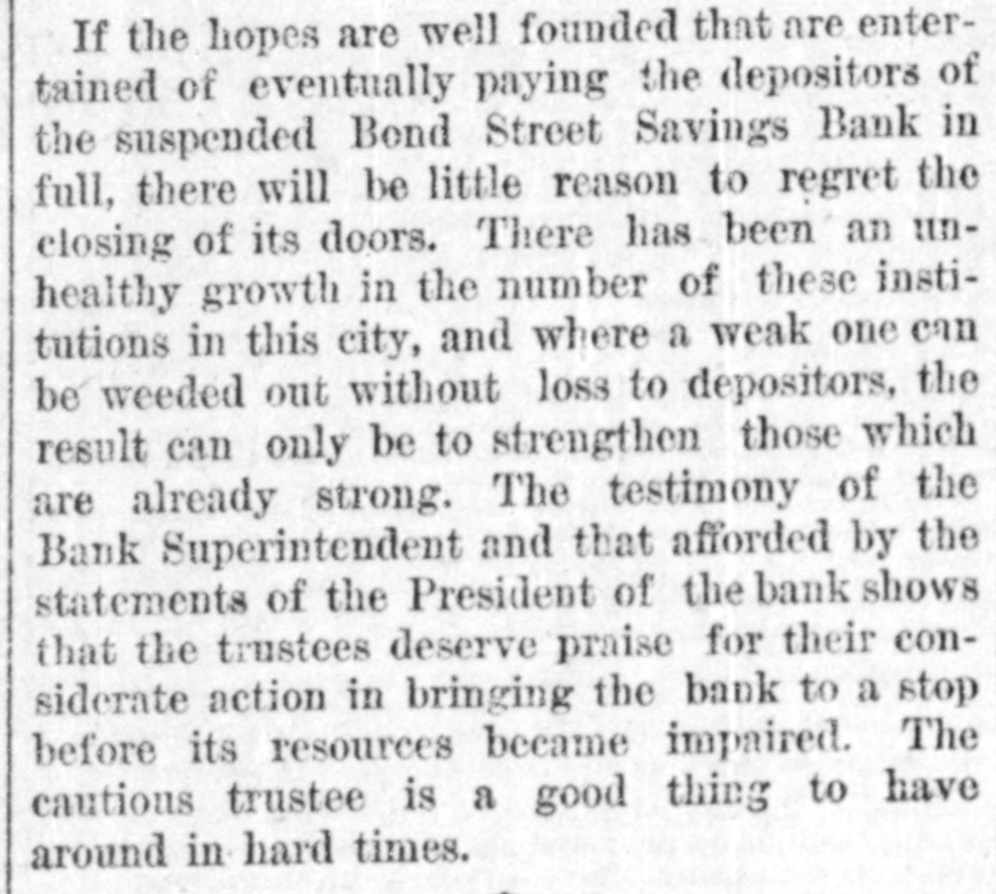
If the hopes are well founded that are entertained of eventually paying the depositors of the suspended Bond Street Savings Bank in full, there will be little reason to regret the closing of its doors. There has been an unhealthy growth in the number of these institutions in this city, and where a weak one can be weeded out without loss to depositors, the result can only be to strengthen those which are already strong. The testimony of the Bank Superintendent and that afforded by the statements of the President of the bank shows that the trustees deserve praise for their considerate action in bringing the bank to a stop before its resources became impaired. The cautious trustee is a good thing to have around in hard times.


Article from The New York Herald, September 21, 1876

Click image to open full size in new tab

Article Text

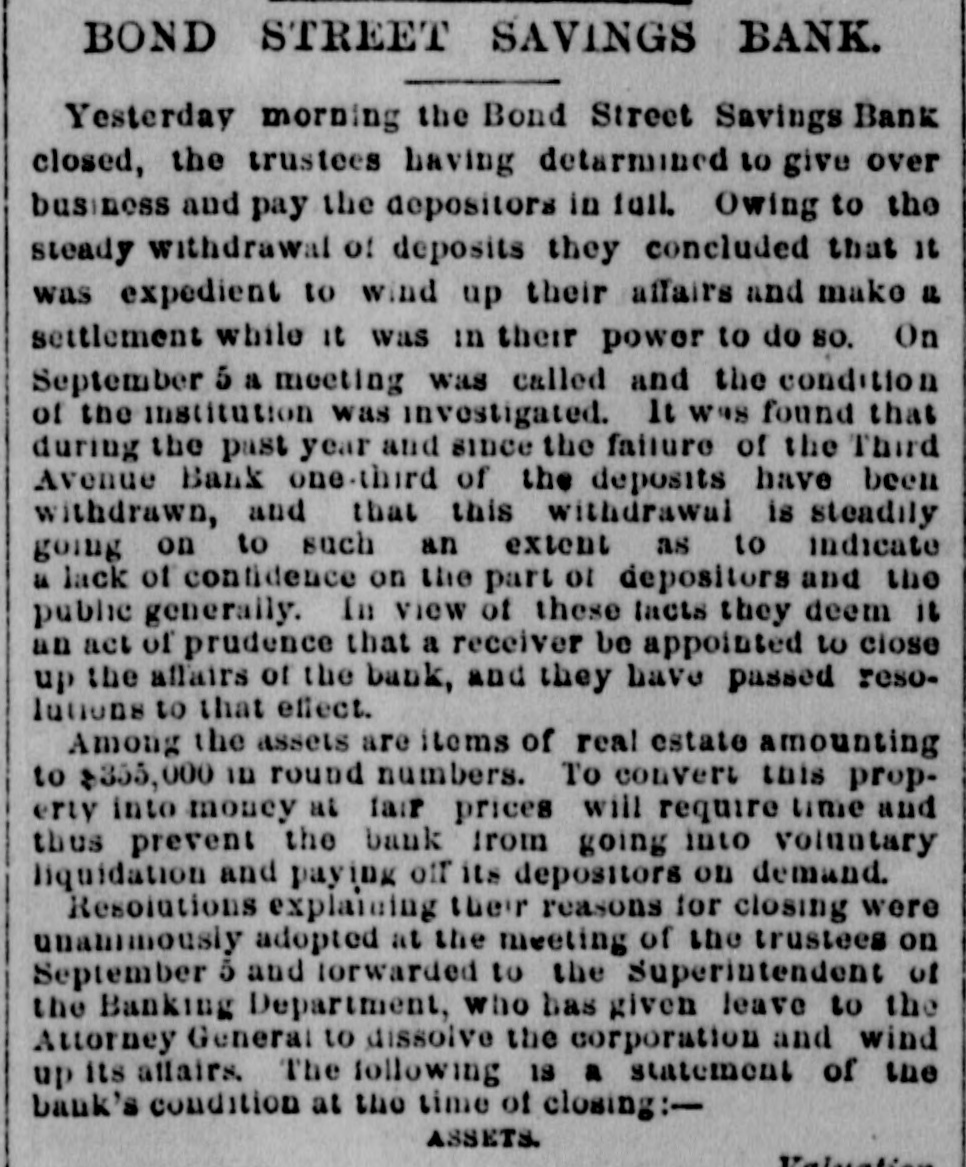
BOND STREET SAVINGS BANK. Yesterday morning the Bond Street Savings Bank closed, the trustees having detarmined 10 give over business and pay the depositors in full. Owing to the steady withdrawal of deposits they concluded that it was expedient to wind up their affairs and make a settlement while it was in their power to do so. On September 5 a meeting was called and the conditio: n of the institution was investigated. It was found that during the past year and since the failure of the Third Avenue Bank one-third of the deposits have been withdrawn, and that this withdrawui is steadily going on to such an extent as to indicate is lack of confidence on the part of depositors and the public generally. In view of these facts they deem it an act of prudence that a receiver be appointed to close up the affairs of the bank, and they have passed resolutions to that effect. Among the assets are items of real estate amounting to $355, in round numbers. To convert this property into money at fair prices will require time and thus prevent the bank from going into voluntary liquidation and paying off its depositors on demand. Resolutions explaining their reasons for closing were unammously adopted at the meeting of the trustees on September 5 and forwarded to the Superintendent of the Banking Department, who has given leave to the Attorney General to dissolve the corporation and wind up its attairs. The following IS a statement of the bank's condition at the time of closing:ASSETS.


Article from The Portland Daily Press, September 22, 1876

Click image to open full size in new tab

Article Text

The Bond street, New York, savings bank has been closed by order of the bank commissioner and a receiver will be appointed.


Article from New-York Tribune, September 28, 1876

Click image to open full size in new tab

Article Text

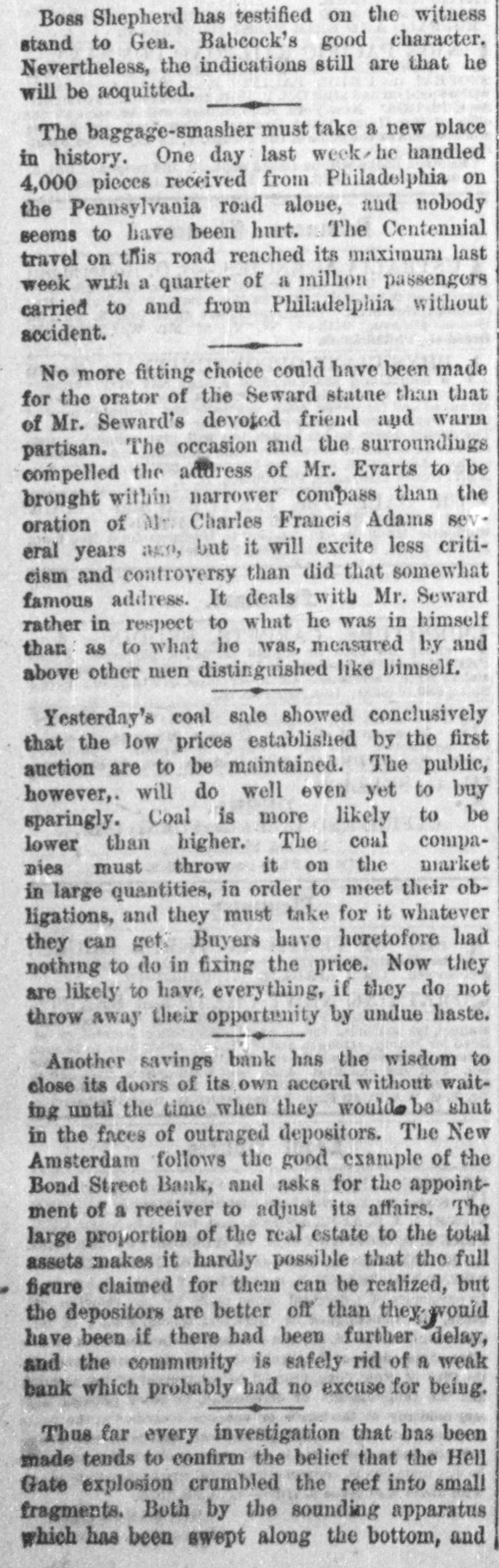
Boss Shepherd has testified on the witness stand to Gen. Babcock's good character. Nevertheless, the indications still are that he will be acquitted. The baggage-smasher must take a new place in history. One day last week/he handled 4,000 pieces received from Philadelphia on the Pennsylvania road alone, and nobody seems to have been hurt. The Centennial travel on this road reached its maximum last week with a quarter of a million passengers carried to and from Philadelphia without accident. No more fitting choice could have been made for the orator of the Seward statne than that of Mr. Seward's devoted friend and warm partisan. The occasion and the surroundings compelled the address of Mr. Evarts to be brought within narrower compass than the oration of Mr. Charles Francis Adams several years age, but it will excite less criticism and controversy than did that somewhat famous address. It deals with Mr. Seward rather in respect to what he was in himself than as to what he was, measured by and above other men distinguished like himself. Yesterday's coal sale showed conclusively that the low prices established by the first auction are to be maintained. The public, however,. will do well even yet to buy sparingly. Coal is more likely to be lower than higher. The coal companies must throw it on the market in large quantities, in order to meet their obligations, and they must take for it whatever they can get. Buyers have heretofore had nothing to do in fixing the price. Now they are likely to have everything, if they do not throw away their opportunity by undue haste. Another savings bank has the wisdom to close its doors of its own accord without waiting until the time when they would be shut in the faces of outraged depositors. The New Amsterdam follows the good example of the Bond Street Bank, and asks for the appointment of a receiver to adjust its affairs. The large proportion of the real estate to the total assets makes it hardly possible that the full figure claimed for them can be realized, but the depositors are better off than they would have been if there had been further delay, and the community is safely rid of a weak bank which probably had no excuse for being. Thus far every investigation that has been made tends to confirm the belief that the Hell Gate explosion crumbled the reef into small fragments. Both by the sounding apparatus which has been swept along the bottom, and


Article from The Sun, September 30, 1876

Click image to open full size in new tab

Article Text

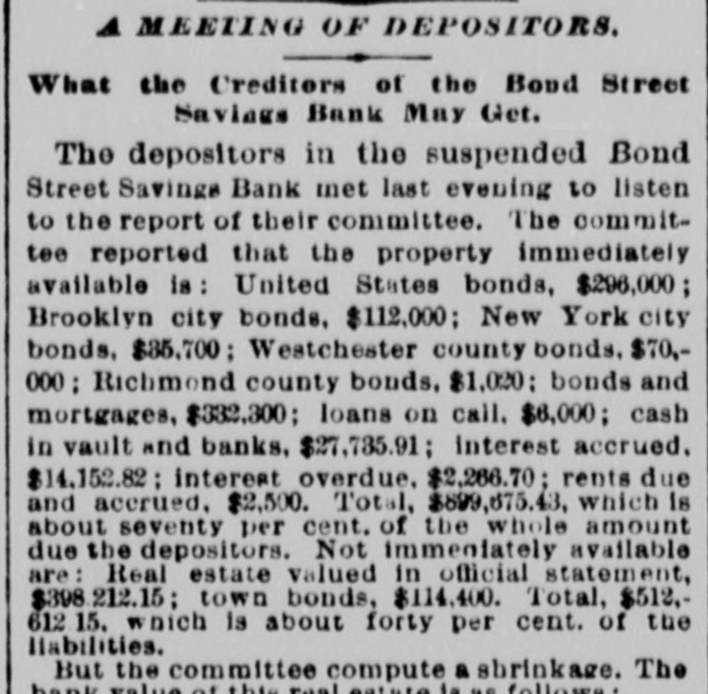
MEETING OF DEPOSITORS. What the Creditors of the Bond Street Savings Bank May Get. The depositors in the suspended Bond Street Savings Bank met last evening to listen to the report of their committee. The committee reported that the property immediately available is: United States bonds, $296,000 Brooklyn city bonds, $112,000; New York city bonds, $85,700 Westchester county bonds. $70,000: Richmond county bonds, $1,020: bonds and mortgages, $332,300; loans on call. $6,000; cash in vault and banks, $27,735.91; interest accrued. $14,152.82 interest overdue. $2,266.70; rents due and accrued. $2,500. Total, $899,675.43, which Is about seventy per cent. of the whole amount due the depositors. Not immentately available are: Real estate valued in official statement, $398.212.15; town bonds, $114,400. Total, $512,612 15. which is about forty per cent. of the liabilities. But the committee compute a sbrinkage. The bank value at this la follower


Article from The Portland Daily Press, September 30, 1876

Click image to open full size in new tab

Article Text

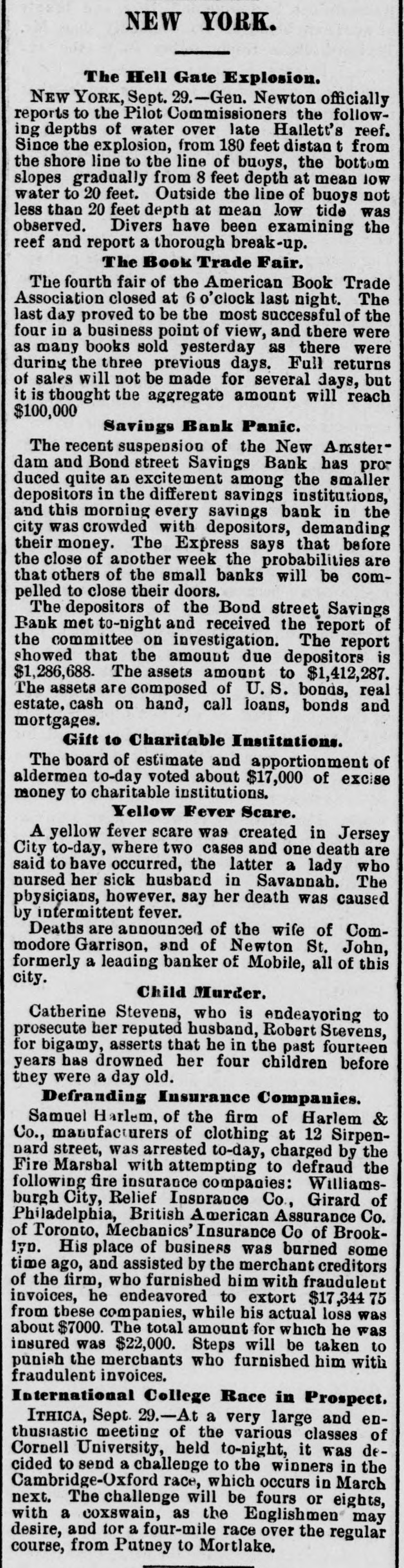
NEW YORK. The Hell Gate Explosion. NEW YORK, Sept. 29.-Gen. Newton officially reports to the Pilot Commissioners the following deptbs of water over late Hallett's reef. Since the explosion, from 180 feet distan from the shore line to the line of buoys, the bottom slopes gradually from 8 feet depth at mean low water to 20 feet. Outside the line of buoys not less than 20 feet depth at mean low tide was observed. Divers have been examining the reef and report a thorough break-up. The Book Trade Fair. The fourth fair of the American Book Trade Association closed at 6 o'clock last night. The last day proved to be the most successful of the four in a business point of view, and there were as many books sold yesterday as there were during the three previous days. Full returns of sales will not be made for several days, but it is thought the aggregate amount will reach $100,000 Savings Bank Panic. The recent suspension of the New Amster dam and Bond street Savings Bank has produced quite an excitement among the smaller depositors in the different savings institutions, and this morning every savings bank in the city was crowded with depositors, demanding their money. The Express says that before the close of another week the probabilities are that others of the small banks will be compelled to close their doors. The depositors of the Bond street Savings Bank met to-night and received the report of the committee on investigation. The report showed that the amount due depositors is $1,286,688. The assets amount to $1,412,287. The assets are composed of U. S. bonds, real estate. cash on hand, call loans, bonds and mortgages. Gift to Charitable Institutions. The board of estimate and apportionment of aldermen to-day voted about $17,000 of excise money to charitable institutions. Yellow Fever Scare. A yellow fever scare was created in Jersey City to-day, where two cases and one death are said to have occurred, the latter a lady who nursed her sick husband in Savannah. The physicians, however. say her death was caused by intermittent fever. Deaths are announced of the wife of Commodore Garrison, and of Newton St. John, formerly a leaging banker of Mobile, all of this city. Child Murder. Catherine Stevens, who is endeavoring to prosecute her reputed husband, Robert Stevens, for bigamy, asserts that he in the past fourteen years has drowned her four children before they were a day old. Defranding Insurance Companies. Samuel Harlem, of the firm of Harlem & Co., manufacturers of clothing at 12 Sirpenpard street, was arrested to-day, charged by the Fire Marshal with attempting to defraud the following fire insurance companies: Williamsburgh City, Relief Insprance Co., Girard of Philadelphia, British American Assurance Co. of Toronto, Mechanics' Insurance Co of Brooklyn. His place of business was burned some time ago, and assisted by the merchant creditors of the firm, who furnished him with fraudulent invoices, he endeavored to extort $17,344 75 from these companies, while his actual loss was about $7000. The total amount for which he was insured was $22,000. Steps will be taken to punish the merchants who furnished him with fraudulent invoices. International College Race in Prospect. ITHICA, Sept. 29.-At a very large and enthusiastic meeting of the various classes of Cornell University, held to-night, it was decided to send a challenge to the winners in the Cambridge-Oxford race, which occurs in March next. The challenge will be fours or eights, with a coxswain, as the Englishmen may desire, and for a four-mile race over the regular course, from Putney to Mortlake.


Article from The New York Herald, October 1, 1876

Click image to open full size in new tab

Article Text

RUN ON THE SAVINGS BANKS. Yesterday morning the excitement among the smaller depositors in the savings banks of the east side, which began to manifest itself on Thursday and culminated in a perfect panic on Friday, in no degree abated, but in the afternoon there was a very perceptible decrease in the number of applicants for a settlement of accounts. The cause of this sudden withdrawal of deposits lies in the suspension of the New Amsterdam and Bond street savings banks. When the trustees of these establishments announced their intention of giving over business, but found themsolves unable to go into voluntary liquidation, a doubt of the security of other kindred institutions became broadcast. The recollection of the Third Avenue Bank's failure and the close of the Mutual, the Germania and the Abingdon Square is yet green in the memory of most depositors, and there was consequently a grand rush to the paying telsers' desks. The Dry Dock Bank, at corner of Bowery and Third street, came in for more than a fair sbare of this run. A large gathering had assembied before it at an early hour, and after dark the employรฉs were still busy handing over money to importuning depositors. it seemed to be generally taken for granted that the bank was going to suspend payment, and the only thought in the minds of all comers was how to most readily reach the counters and withdraw such deposits as they had made. However, it was clear that no one bad a definite notion of what they had to fear. nor could any one give any idea of what their doubts were founded on. It was stated by one or two, though on what authority it would be difficult to determine, that the bank officials were unable to pay the interest on the mortgage which they had been obliged to take out in order to complete the building. and that it was consequently to be sold on account of a foreclosure suit. It was claimed by others that the Dry Dock Bank bad large securities invested in those institutions which have recently suspended and that it had its finances further crippled through that means. In conversation with William V. Webster, the secretary of the bank, a HERALD reporter learned that the securities held by the bank could be realized in a short time, and that even if they were sold at the lowest market rate there would be left a surplus of over $60,000. He said that there was no cause whatever for apprehension among the depositors, but that if they persisted in their intentions of withdrawing their deposits the trustees fancied that, far from damaging the bank's interests, they would only be advancing them. "This run," said Mr. Webster, "will be of benefit to us, because we will not only escspe the ob. ligation of paying interest upon the sums withdrawn, but we will be freed from the payment of the State tax, and that of itself is a matter worth considering." The excitement was not confined to depositors of the Dry Dock Bank alone, but circulated among people who had placed their savings in the Bowery, Bleecker Street and Metronolitan Banks. In these there were fewer amounts drawn and the officers in all cases expressed themselves satisfied of their institutions being able to weather the run. However confident these gentlemen may by of their financial security, there is no doubt but that a wide-spread feeling exists that in this crisis every bank whose finances are not on a solid basis will be sorely pushed. The recent suspensions have inspired a lack of confidence, under which many such institutions may succumb if it be not speedily removed.


Article from The Sun, November 30, 1876

Click image to open full size in new tab

Article Text

The Boad Street vings Bank. ALBANY. Nov. 29.-At a S. ecial Term held by Justice Osborn, Welles S. Palite, receiver of the Bond street Savinga Bank of New I ork, petitioned for leave to apply certain funds in his possession toward the payment of 1 xes on the bank DP perty. On one build. 102, 330 Bowery. $8.880 was due, and on another build Ing. 4811. in aking, with other little expenses, $3,578.05. A are receive r has assets of the bank to the amount of $80,00 Hu! jeet to his order. the WHIS granted leave to pay the amount required therefrom.


Article from New-York Tribune, January 17, 1877

Click image to open full size in new tab

Article Text

LETTERS FROM THE PEOPLE. A BANK RECEIVER'S ECONOMY. CARD OF EXPLANATION FROM THE TELLER OF THE BOND STREET SAVINGS BANK. To the Editor of The Tribune: SIR: A short communication in a recent number of your journal criticising "a bank receiver's extravagance," concludes with a proper appeal provided the premises were true. "The six able-bodied men" were composed of four men and two boys, and two of the men were dismissed last Saturday evening. Depositors were exceedingly anxious to withdraw the dividend during the first ten days of January, in order to deposit in other savings banks and obtain the benefit of the six months' interest accruing from Jan. 1. Previous to last Friday the number of depositors was 80 great each day that despite our most strennous efforts we did not conclude the payments until after 5 o'clock in the afternoon. Upon two occasions we remained in the bank till 10 o'clock in the evening. Furthermore, the " crew were not peid even the lowest sum mentioned in "Depositor's" communication. OSCAR EVERITT, Teller. New-York, Jan. 16, 1877.


Article from The Sun, June 1, 1877

Click image to open full size in new tab

Article Text

The Bond Street Savings Bank. ALBANY, May 31.-In the case of the People ART the Bond Street Savings Bank of New York, Justice Landon has granted an order authorizing Willis S. Paine, receiver, to sell six lots on Willow street and Vanderbill Avenue, Brookly 11. and premises on Chatham street, New York Also an order authorizing the receiver to bid to the extent of $14,000 on certain other property to be sold.


Article from The New York Herald, June 1, 1877

Click image to open full size in new tab

Article Text

BOND STREET SAVINGS BANK. ALBANY. N. Y., May 31, 1877. In the case of The People vs. The Bond Street Savings Bank, of New York, Justice Landon, has granted an order authorizing Willis S. Painc, receiver, to sell six lots on Willow street and Vanderbilt avenue, Brooklyn, and premises on Chatham street, New York ; also an order authorizing the receiver to bid to tne extent of $14,000 on certain other property to be sold. The orders were entered to day.


Article from The New York Herald, April 10, 1878

Click image to open full size in new tab

Article Text

without cause. Feeling aggrieved at his removal be employed Mr. Altred Steckier to bring his case into the courts. Mr. Steckler yesterday obtained from Judge Donohue a writ of certiorart to review Mr. Kennedy's removal before the General Term. Mr. Steckler contends that the Commissioners bad no power to remove Mr. Kennedy without preferring charges of misconduct against him and that he had a legal right to hold office until found guilty of misconduct. In a suit brought by Willis S. Patne, receiver of the Bond Street Savings Bank against Terence Farlev and Robert McCafferty, in which the latter defendant assumed a mortgage not knowing that there was such assumption in the deed, decision was given yesterday by Judge Van Brunt. He holds that the fact of the record of the deed with such assuming clause does not carry with it such liability with the ignorance of such assuming clause. George Hine and others, Commissioners of Highways in Putnam county, recently applied to Judge Donohue for an injunction restraining the city from allowing the water in the new Croton Reservoir to overflow the old roadway between Carmel and Brewsters Station, unless a causeway is built over the reservoir, to be used as a public thoroughfare. It being shown that the city had laid out another road between the two towns named, and that the same was approved by the majority of the residents in that vicinity, Judge Donohue yesterday refused to grant the injunction. Bridget Maher has brought a suit for divorce against her husband, Lawrence Maher, on the charge of adultery. They were married thirty years ago in this city and have four children living, the youngest being eighteen years of age. No answer or demurrer having been made to the complaint Judge Donohue yesterday ordered a reference to John E. Risley. In a suit for divorce brought by Mary A. Dilleber, against Albert M. Dilleber, Judge Donohue, for the same reason yesterday, ordered a reference. The parties were married in Webster, Mass., in December, 1865, and lived together until August, 1876. The suit is on the ground of alleged adultery. A decision was given yesterday by Judge Van Vorst in the suit tried before him at Supreme Court, Special Term, brought by Frederick A. Conckiin against Richard Hamilton, Simon A. Bunce (trustees) and the Secor Sewing Machine Company. Money was borrowed by the company of Concklin, a large amount of its stock being pledged as security. Subsequently the company mortgaged its property in Hartford, Conn., and upon sale was bought in for $2.50 by Conckiin, subject to whatever might be due by virtue of the mortgage. Suit was brought by Hamilton and Bunce in Connecticut to foreciose the mortgage thus held, and the present suit was brought to restrain the proceeding in the Connecticut suit on the ground that the mortgage was void because not authorized by the owners of two-thirds of the stock. Judge Van Vort dismisses the complaint, holding that Concktin knew all about the mortgage when he bought in the property and that the suit as to the validity of the mortgage must be tried in Connecticut Isaac W. England, assignce of Frank Leslie, the publisher, was brought a suit against the New York Publishing Company and another to prevent one of the defendants, sued as Henry Leste, from printing or publishing any periodicals or papers with the name "Frank Lesile, Jr.," upon it as a part of the title, and also to restrain the American News Company from selling Frank Leslie, Jr.'s Sporting and Dramatic News. It is claimed that the true name of the defendant Leslie is Henry Leslie, and that the assumption of the name now used by him, and its use in the publications sought to be restrained, does the plaintiff great injury. The defendant, on the contrary, asserts that it is the name he was married by, and that he is legally entitled to it. The case came before Chief Justice Daly yesterday, in the Court of Common Pleas, on a motion for a preliminary injunction, and was argued at considerable length. The Court reserved its decision.


Article from The Portland Daily Press, October 22, 1878

Click image to open full size in new tab

Article Text

MINOR TELEGRAMS. Ballion gone into the bank of France today, 275,000 pounds. Snow fell at North Troy, Vt., Sunday for two hours. Subscriptions to the 4 per cent loan yesterddy were $111,500. National bank notes received at the Treasury yesterday for redemption $450,000. The Connt de Paris has contributed 1000 francs for the ycllow fever sufferers. The receipts of internal revenue vesterday were $646,174 and from customs $706,877. Brig America from Sligo is ashore on Orleans island, St. Lawrence river. Allan mail steamer Sardinian from Quebec arrived out yesterday morning. The whole story of an Afghan envoy to the Porte is untrue. The villa of Samuel George at Jamaica, L. I, was burned yesterday. Loss $10,000. The Ameer's reply to England is unconciliatory and unsatisfactory. The Sultan has authorized Baker Pasha to employ 21,000 men to complete the defensive lines of Constantinople. Seven illicit distilleries were captured in Yankton and Davie counties, North Carolina, last week. The executor of the will of Miss Danser of New York has paid $320,000 to benevolent and religious societies. John Miller, a baker of Providence, R I., was badly burned yesterday by the explosition of a kerosene lamp. Henry Arlington of New York was accidentally and probably fatally shot while gunning near Portsmouth, N. H, yesterday. Nothing has been heard of Hoxie, the defaulting Brooklyn. asssitant district attorney of The Orangemen have sued the mayor of last. Montreal for false arrest on the 12th of July The Democrats of the sixth Tennesse DisCongress. trict have nominated John T. House for The stock markets are steadier upon the contradiction of rumors afloat regarding the suspension of a large Liverpool firm. The headless skeleton of Aaron Symes, an English emigrant, was found Sunday in the woods near Yonkers. A large illicit distillery with 25,000 gallons of mash whiskey was captured in Cherry street, New York, Sunday. A brick building owned by General Brady and occupied by the Muncie Times and the postoffice, at Muncie, Indiana, has been burned. Loss $10,000. All the collieries in a working condition throughout the Schuylkill region began work Monday morning. to fill the additional quota for October and the full quota for November. In Bostou yesterday Fred Collamore fell from a hotel on the corner of Cclumbia killed. avenue and Berkely street and was instantly At Philadelphia yesterday John O'Neil was sentenced to death for the murder of Coroner Hesser in December, 1874. Peter McManus. his accomplice, was also sentenced to death. Senor Pi Y. Mangall has been arrested by the Spanish government and sent to Leville spiracy. for complicity in the recent Republican conThe London Times Bucharest correspondent telegraphs: "Dr. Smith, the American consul at Galatz, told me that he was the bearer of a letter from President Hayes recognizing the independence of Roumania. Mayor Howell of Brooklyn has vetoed a resolution of the aldermen appropriating $20,000 for street repairs on the ground that it was a shallow and hyprocritical dodge to aid politicians in the forth coming elections. The receiver of the Bond street savings bank, New York, which suspended two years ago, yesterday began the payment of five per cent to depositors, which will aggregate upwards of $6,500. Carthagena, New Granada, has an epidemic in the form of malarial fever, the character of which has not been satisfactorily determined by medical men. Some fatal cases have occurred and many are prostrated. Ship Edith Troop of St. John, from New York for Antwerp, with wheat and rice, arrived at Halifax in distress from the effects of the hurricane on the 12th. The vessel is owned by Troop & Son of St. John. A. C. Larose, the murderer of his father and mother and of Moses Schurz, who has been confined in the lunatic asylum at Harrisburg, escaped therefrom Saturday. The physicians had recently pronounced him sane, and fearing that the sentence of death would be carried into effect, he escaped.
Article from The New York Herald, October 22, 1878

Click image to open full size in new tab

Article Text

BOND STREET SAVINGS BANK. During the widespread financial panic of the fall of 1876, which resulted so disastrously to savings institutions all over the country, and which spread like wildfire along Third avenue in this city, the Bond Street Savings Bank was compelled 10 succumb to the pressure of popular distrust. The bank had the con. fidence of the German residents of the east side of the city, 3,800 of whom deposited their savings there, the total amount of deposits being as the time of the failure $1,286,688 02. Mr. Willis S. Paine was an.


Article from New-York Tribune, March 8, 1879

Click image to open full size in new tab

Article Text

Auction Sales of Real Estate. MORRIS WILKINS, Auctioneer. RECEIVER'S SALE of the BOND STREET SAVINGS BANK PROPERTY. E. H. LUDLOW & CO. will sell at Auction on WEDNES- DAY, March 19, 1879, at 12 o'clock, at the Exchange Sales- room, No. 111 Broadway, UNDER THE DIRECTION OF WILLIS S. PAINE, esq., Receiver: Bowery, No. 330.-The valuable property on the Northwest corner of Bowery and Bond-st., and known as the Bond Street Savings Bank. Maps and full particulars at the Auctioneer's office, or Messrs. BARLOW & OLNEY, Attorneys, No. 206 Broadway. [5257]


Article from The Sun, March 17, 1879

Click image to open full size in new tab

Article Text

Auction Notices. MORRIS WILKINS, Auctioneer. RECEIVER'S SALE OF THE BOND STREET SAVINGS BANK PROPERTY. E. H. LUDLOW & CO. will sell at auction on WEDNESDAY, March 19, 1879, at 12 o'clock, at the EXCHANGE SALESROOM, 111 BROADWAY, UNDER THE DIRECTION OF WILLIS S. PAINE, ESQ, RECEIVER, BOWERY, No. 330. The valuable property on the northwesterly corner of Bowery and Bond st., and known as the Bond Street Savings Bank. Maps and full particu- lars at the Auctioneer's office, or of MESSRS. BARLOW & OLNEY, Attorneys, 206 Broadway.


Article from The New York Herald, October 9, 1879

Click image to open full size in new tab

Article Text

THAT BANK JOLLIFICATION. THE BOND STREET BANK HOUSE WARMING DECLARED NOT TO HAVE BEEN PAID FOR OUT OF THE SURPLUS. In the statement published in yesterday's HERALD from Superintendent Lamb, of the Banking Department, concerning his investigations into the alleged mismanagement of some of the savings banks in the State, Mr. Lamb makes the following criticism upon the officers of a bank for savings in this city:A newspaper reporter has told me recently that he attended a "jollification" at the opening of the now Bond Street bank Building in 1873 or 1874, and that a whole floor was there laid with tables containing lunch and wine, and one of the officers especially requested him to say in his report that not a cent of the depositors' money was expended in the outlay-it was all sarplus. Novertheless, surplus surply is, to is certain extent, depositors' money: from is the dividends to depositors must be made. This same bank failed a few years afterward and has not paid over seventy-one per cent of its indebtedness. When this paragraph was shown to Mr. Charles D. Bailey, late treasurer of the Bond Street Bank, he shook his head and emphatically declared that he did not think that a strict interpretation of the law allowed the directors of a bank to spend its depositors' money in this way. "I regarded the giving of an entertainment at the opening of our new building as a benefit to us in the way of advertising us and making friends, and thereby increasing the business of the bank and giving us an opportunity to rent part of the building. I took a business view of the matter and believe that the affair was a benefit to the bank, and that, therefore, the spending of the money was of advantage. But I agree with Mr. Lamb. The officers have no right to spond any of the surplus of a savings bank for such purposes." HOW IT WAS PAID FOR. "Then why was it permitted?" asked the reporter. "Well," replied Mr. Bailey, hesitating as though he were about to make a very damaging admission, "between you and me, the entertainment was not paid for from the surplus. In fact, I may as well tell you that I paid for it myself." "Oh!" said the reporter. After further questioning Mr. Bailey admitted that the "jollification" cost $980, that he gave his personal check to the secretary of the bank for $1,000 to pay for it, and that that was all there was of the matter. He did not know that the other directors were all of his way of thinking on this question. Mr. Bailey desired to correct another mistake of Mr. Lamb's. The.assertion that the bank has only paid seventy-one per cent of its indebtedness 18 not true, he says. It has paid seventy-five per cont and will pay ninety per cent, in the opinion of Mr. Bailey. The bank was not mismanaged and failed only as eleven other savings institutions in this city did and from the same causes-viz., the financial panic, the great fire and the sudden depression in business. Moreover, when it suspended Mr. Bailey thought the bank was able to pay every cent of its liabilities, and this would have been the case but for the continued depression of real estate. At all events, said the gentleman, the Bond Street Bank dopositors are better off than any of the others.


Article from New-York Tribune, March 29, 1880

Click image to open full size in new tab

Article Text

# SPECULATIONS IN TOWN BONDS. The Township of Belleville, New-Jersey, issued bonds to the amount of $100,000 for the construction of the Montclair Railroad at the time the road was built. Subsequently a part of the township called Woodside was annexed to the City of Newark, and a condition of the transfer was the assumption by Newark of $82,800 in bonds. They were issued for different terms, the last not falling due until 1890. The highest quotation of the bonds for several years has been from 40 to 60 cents on the dollar. Eighteen of the bonds of the par value of $1,000 each became the property of the Bond Street Savings Bank of New-York, and this institution being placed in the hands of a receiver, Mr. Paine, he began suit through Randolph & Talcott, of Jersey City, to recover the full value of the bonds, together with the seven years' interest and coupons. On March 18, Randolph & Talcott collected from the City of Newark $22,557 76 in full settlement of Newark's share of liability on the eighteen bonds held by the receiver. It has been ascertained that Mr. Paine, pending the suit against Newark, sold the bonds to an unknown person at the rate of 120, realizing therefrom $21,000. At 120 the share of Newark on the bonds would have amounted to $17,884 80; and Belleville's share $3,715 20, showing that the sum paid by Newark in settlement was $4,672 96 in excess of that paid to the receiver, leaving also the sum of $4,893 64 to be collected from Belleville by the person holding the bonds, who has made about $6,851 40 by the operation.


Article from New-York Tribune, August 4, 1881

Click image to open full size in new tab

Article Text

COUNSEL FEES ALLOWED. ALBANY, N. Y., Aug. 3.-In the matter of the Bond Street Savings Bank, of New-York, on the petition of Willis H. Paine, receiver, showing that there is now in the hands of the United States Trust Company $19,177 27 of the assets of said bank, Justice Learned to-day, at the Chambers, granted an order allowing the receiver to draw $5,000 of such amount for the payment of counsel fees and incidental expenses.


Article from New-York Tribune, April 26, 1883

Click image to open full size in new tab

Article Text

# SUPERINTENDENT HEPBURN'S SUCCESSOR. ALBANY, April 25.-It is reported that the Governor to-morrow will send in the name of Willis S. Payne for Bank Superintendent in place of A. B. Hepburn. Mr. Payne is a lawyer, and has been receiver of the Bond-st. Savings Bank.