Article Text
Bank Suspended. NEW YORK. March 14. 1 The bank of the State of New York has suspended payment.
ef3070c7718651afNone
Click image to open full size in new tab
Bank Suspended. NEW YORK. March 14. 1 The bank of the State of New York has suspended payment.
Click image to open full size in new tab
Failure of a Bank. NEW YORK, March 14.-The W all street markets were electrified about 0000 by the announcement that the Bank of the State of New York (not the Bank of New York) had closed its doors. Theface are: 00 Saturday last the bank examiner reported to a member of the clearing house committee that the affairs of this bank were in such a condition as to re quire the attention of the clearing house. The clearing house committee were called together late on Saturday, and after discussion decided to call in the conference comm tree. A meeting of thejointcommitteeswas held this worning. and they called before them Mr. Duer, the President, and Mr. Patrick, the Vice President of the bank of the State of New York N receiving from thew a satisfactory explanation they unanimously decided to susp nd the bank frour the privileges of the clearing house until a full meeting of that body could be ob ained. This meeting will be held at 3 o'clock this p. m. The capital of the back is $2,000,000. It is one of the older back- having been organized May 18, 1836 and has hitherto borne a good reputation. 0 J examination of the bank it showed large unsecured over drafts. The capital is impaired about one half. At the clearing house this a. m., the bank was $104,000 in debt, which Was paid in immediately.

Click image to open full size in new tab
DETAILS OF THE FAILURE Like a clap of thunder in a clear sky came the announcement yesterday morning that the old andas it was considered-conservative Bank of the State of New-York, at Exchange-place and William-st., had failed and closed its doors. For a time no one would believe the statement, and it was not until the positive demonetration of the closed doors had Inconfirmed it that people could be convinced. tense excitement followed the confirmation of the story, and the street scenes and rumors lent additional fuel to the flame. The facts of the failure are as follows: For some time past Bank Exammer Meiggs has been watching the condition of the bank. At the his last investigation the bank but not to such an as somewhat time of involved, extent had conrse been of to apprehensions. In the regular nnhe examined it last week, and evidence of the fact that was justify disputable business any the observed bank impaired to the amount of one-half of its capital. He quietly gave this information to one of the of the Clearing-house Committee on and a conference of the but no action was yes Saturday, members held, taken Committee until when the and examined George W. was terday again morning, Committee Duer, the Vice- met the and Richard Patrick, of the Bank, as to its of could explain away or President, President these gentlement condition. Neither modify the Bank Examiner's statement, and the Committee, with they were compelled to do, took counsel as the Conference Committee of the Clearing-house of Association, and formally suspended the Bank the State of New-York from the Clearing House, then this being the extent of their powers. They called a meeting of the Clearing-house Association for the afternoon to take final and more decided action in the matter. In the afternoon the Association confirmed the action of the Committee and finally made permanent the suspension. The causes of the failure for a time were not the No suspicions had been uttered on and the bank up to the hour of The inquiry 28 street, known. excellent reputation. closing to what bore caused an the failure was very earnest and very generally made. The officers of the bank would not the the question, for they caused the doors of be closed and then had a the inside to supplement the answer bank tioued to in policeman strength sta- of the iron doors and arrest the progress of any persons who might forcibly break through. As the excitement subsided, however, the facts began to leak out, not and the old story of collusive mismanagement. if actual fraud, was again repeated. Richard by Patrick, the Vice-President of the bank, means had obtained almost exclusive had some the administration of its affairs. He and discounts in a most according to the statements manner, control made loans of and, remarkable of those the interested in the investigation, had conducted bank if it were his own. Some of his loans were as for a business man, and could be acastounding counted for on no other theory than that he was interested in the loans and discounts thus made. the The securities were absurdly insufficient to meet requirements of honest banking. From the developmade it appears that the bank was run in the at interest ments of a few produce speculators. A glance loans loans and over-drafts shows that enormous its made to a few favored persons. Vice-President Patrick were himself had loans aggregating $230,000. the check of his for $20,000 was found in minor bank A papers and credited as cash. These are The matters, however, compared with other loans. of of Smith & Girvan, hop and malt dealers, $875,000, firm 76 Broad-st., received the large sum of United No. of which was on stock of the $450,000 and New-York Attrition Flour Companies, the States which has no market value, and $425,000 in and of a loan or overdraft secured by hops amount shape said to be worth less than one-half the overdrafts malt, In addition it is reported that to a produce advanced. allowed commission aggregating house dealing were largely in Kentucky, is Besides these loans the bank of understood $250,000. to have suffered to the extent Sherman $100,000 by the failure of Duncan, the about $70,000 worth of protested paper bearing assets. Co., of that firm being among the There signature are also indications of other losses aggregat- to $140,000, protested paper of various persons losses, it ing amount having been discovered. believed The that that be seen, have been great, and it is 50 cent. will stockholders will not receive over per 40 per the think that they will not receive low as 20 per Some while persons others put the amount as secured cent, notes issued by the bank, being be cent. bonds The deposited at Washington, will of course reby paid, and the depositors will probably time ceive promptly their deposits in full, but this will require and patience. stockholders are shocked and indignant at the of The and inquiries as to the responsibility revelations. directors for the extraordinary loans and over- that the are being made. Stockholders declare control drafts directors either allowed the officers to did the bank completely, or they did not. If then they the the the officers to do as they pleased, stockholders allow claim that the directors were culpable did not, account of their remissness; and if they of the OIL must have participated in the making If the loans they and are responsible for them. of the loans, made clandestinely. then it was the caused duty the directors were to have discovered them and money to be returned to the institution. SCENES AT THE BANK. of the State of New-York is situated Wil- at The corner of Exchange the a plain. substantial marble north-west Bank Place of the building. and buildham-st., bank in proper occupies the first story manner. The fitted ap in a plain business-like to ing, Yesterday and is morning the tellers and clerks came
Click image to open full size in new tab
NEW YORK Failure of the Bank of the State of New2 York. NEW YORK. FAILURE OF A PROMINENT BANK. The evening Post says the bank of the state of New York closed its doors to-day by reason of having been thrown out of the clearing house. This action of the clearing house com mittee was taken after all investiga tion suggested by the bank examiner, Mr. Meighs. He found the affairs of the bank in a bad condition, there having been large overdrafts made by speculators in merchandise. The clearing house will have it full meeting at three o'clock to ratily or disapprove the action of the cleaning house committee. The capital of the bank is TWO million dollars. By last Saturday's statement it had loans of $3,980,000; specie $322,000; legal tenders $1,095,000, circulation a quarter million, and deposits $2,855,000. At the cleaning house it was debtor this morning $104,000, which was paid. Depositors and note holders will lose nothing. The stock holders will be the only losers. The capital is impaired one half. Some days ago Meigs fonnd that irregular loanshad been made to produce debtors and that a great many bad debts were the result. Among them acceptances of Duncan, Sherman & Co., to the amount of seventy thousand. The facts were reported to the clearing house committee, and at a meeting this morning it was decided that a receiver ought to be appointed for it and the bank closed. It is thought the failure will not be followed by any other financial disasters. It is stated that the bank permitted one concern to overdraw $168,000, and accepted as security a patent about which little is known, and further lent some other concern $426,000 on time, secured by Malt worth half the loan. Another concern overdrew one quarter million with a book account as security The vice president owes $230,000 secured partly by real estate
Click image to open full size in new tab
the Comptroller of Currency, John D. Knox, for the appointment of a receiver. The result of the investigation of the banks accounts tends to show that its failure will not affect any other banks, and it is thought that the failure will not be followed by any other financial disaster. Mr. Patrick, Vice President, underwent a long examination before the Clearing House Commission this morning. It is stated that the bank of the State of New York permitted one concern to overdraw $447,600 and accepted as secuity for over draft a patent about which little is known, and further lent the same concern $426,500 on time secured by malt to the value of about half the loan. Another concern connected with the southwest trade overdrew $250,000 and the bank accepted as security for the overdraft an assignment of a book account. The Vice President owes the bank about $230,000 secured by real estate; the party not to transfer an individual check for $20,000 drawn by the Vice President was counted as cash. It is understood that the bank has protested paper to the amount of $20,000. The depositors of the bank will lose nothing. The whole loss is estimated at about onehalf the capital, which will fall on the stockholders. It is said that the Vice President of the bank, Mr. Patrick, owes to it the sum of $230,000, secured by real estate which is alleged to be worth only half that amount. It has also been said that a check of Mr. Patrick's for $20,000 has been counted among the bank's cash. Over drafts to the amount of $450,000 have been permitted which are only secured by the patents of the United States Attrition Company and the New York City mills. These patents are for the new process of manufacturing flour, the money value of which has not been established. The company first named has the patent right for sale, while the New York City Mills Company was formed for the purpose of manufacturing by this method. The firm of Smith & Girvon, hop and mault merchants, No. 76 Broad street, are largely interested in the matter. Mr. Smith being the President of one company, and Mr. Girvon, of the other. In addition to this it is said time loans have been made to the amount of $425,000, secured by Smith & Girvon, by malt and hops, which are said to be of but half the value. It is further reported on excellent authority that overdrafts to the extent of about $250,000 were made on the bank by a southwestern produce and commission house, whose business is largely in Kentucky, and that these were secured only by an assignment of book accounts. A prominent member of the Stock Exchange said this afternoon that the tailure would probably cause affairs in Wall street to be unsettled for a few days, but that any excitement occasioned by it would soon die away. He could not see any reason why it should cause any other failures. John Thompson, Vice President of the First National Bank, said: "I look upon it as a failure that will not strike disastrously any persons except the brokers who kept their accounts there and got their checks certified there. In reality the failure is of no commercial or financial importance: The entire effect will not be one-fourth as great as that of Duncan, Sherman & Co. It was found that advances to a considerable amount had been made on grain in transit, some of the bills of lading for which are still.remaining in the bank under dates two years old. It is said that the Vice President had been speculating with parties on the Produce Exchange. The course of the Clearing House Committee in regard to the Bank of the State of New York was unanimously approved at a meeting of the Clearing House to day.

Click image to open full size in new tab
BY TELEGRAPH TO THE WHEELING REGISTER. by Western Report. Associated Union Line, Press office Northweat cor. of Main and 12th Sts. DOMESTIC NEWS. IN.Y. Suspension of the Bank of the State NEW Yo K, March 14.-The State Evening of that the Bank of the of Post says its doors to-day, by reason Clearbeen thrown out of its This action of the an incommittee was taken suggested by affairs of ing House vestigation York having House. closed the bank after the Clearing examMr, Meigs. He found the haviner, bank in a bad condition, there the been a large overdrait by speculators be a full ing merchandize. There will ratity in of the Clearing House, committee. to meeting the action of the or of the bank is had $3,980,000; specie, $1,095,000; At The loans last disprove capital of tenders, Saturday's statement $2,000,000; circulation, $325,900; it By and deposits it was $250,000, legal $2,855,000. house this The the at $104,000, which was in the bank will lose will the note-holders. it depositors debited neither clearing morning, paid. The nothing, and total will fall on the stockholders, loss thought that the capital is impaired affairs one-half. is The enumeration of the the bank was begun by Meigs loans some of He found that irregular and days ago. made to produce dealers, that had a many bad debts were the ac these debts are of Duncan, Sherman of $70,000. are to ceptances sult. amount been Among great There & the Co. other re- to the sums varying from $10,000 were When these Mr. Meiga house to this morning it was ascertained debts $20,000. meeting the clearing in committee asked reported facts and decided and the at it a ought to be In accordance at once telegraphed to of Currency, John D. of a receiver. troller the that bank view appointment a Meigs closed. receiver with Knox book The Comp- this ac- for rethe investigation of the sult to show that its is counts other banks be not that the failure not other financial followed thought of affect tends by any will failure disasters. and under- it will Patrick, Vice President, Mr. an examination before the clearing went house committee this morning. is stated that the Bank of the State It New York permitted one concern se. to of $447,600, and accepted as about for the overdraft a lent little is known, and concern $426,500 on malt to the value curity the overdraw cured which same by of patent turther about time, one- con- sethat sum. Another concern half with the southwest trade over nected $225,000, and the bank accepted as security drew for the overdraft an assignment presitheir book account The vice of owes the bank almost $230,000, sedent by real estate. An individual vice cured for $20,000, drawn by the It is check was counted as cash. understood president, that the bank has protested The to the amount of $20,000. paper of the bank will lose nothing. onedepositors whole loss is estimated ot about The half the capital, and will fall on the stockholders. is further reported on excellent all- of It that over drafts to the extent bank thority $250,000 were made on the about Southwestern produce commision Kenby a whose business is largely in only house, and that these were secured A tucky assignment of book accounts. Exby an member of the Stock failure prominent said this afternoon the Wall change probably cause affairs in but would to be unsettled for a few days, street excitement occasioned could by not it that would any soon die away. He see any reason why it should cause any other failures John Th ompson, Vice President I can of First National Bank, said: that will the look upon it as a failure only strike disastrously any person except and brokers. not who kept accounts there, In their checks certified of there. point got of reality the failure is No commercial or Financial Importance. entire effect will not be one- of The as great as that of the failure found fourth Sherman & Co. It was amount Duncan, advances to a considerable some that had been made on grain in transit, remaining the bills for which are still old. It of bank, bear dates two years of the is said have progulating with parties in the that the Vice President
Click image to open full size in new tab
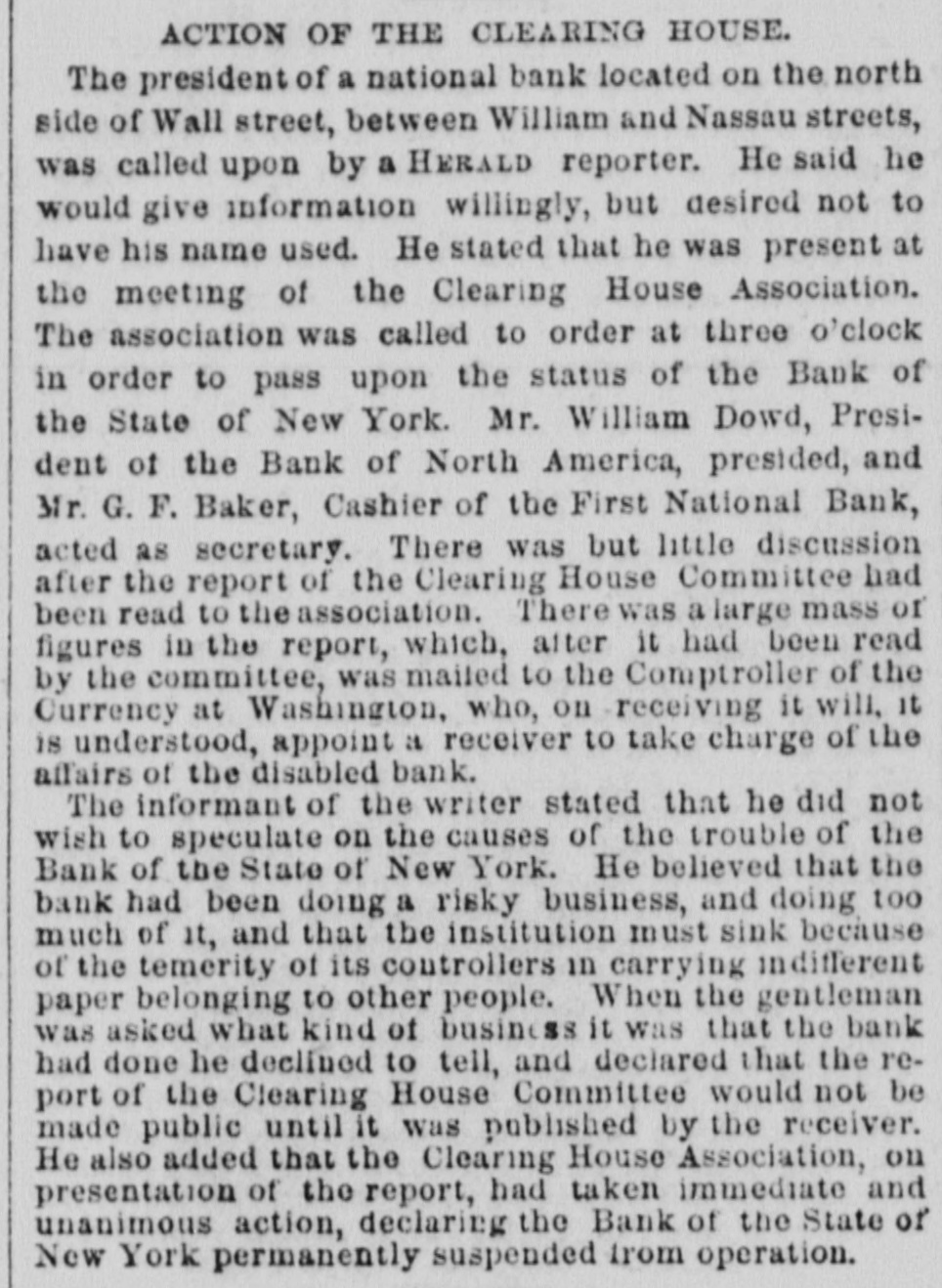
ACTION OF THE CLEARING HOUSE. The president of a national bank located on the north side of Wall street, between William and Nassau streets, was called upon by a HERALD reporter. He said he would give information willingly, but desired not to have his name used. He stated that he was present at the meeting of the Clearing House Association. The association was called to order at three o'clock in order to pass upon the status of the Bank of the State of New York. Mr. William Dowd, President of the Bank of North America, presided, and Mr. G. F. Baker, Cashier of the First National Bank, acted as secretary. There was but little discussion after the report of the Clearing House Committee had been read to the association. There was a large mass or figures in the report, which, after it had been read by the committee, was mailed to the Comptroller of the Currency at Washington, who, on receiving it will, it is understood, appoint a receiver to take charge of the affairs of the disabled bank. The informant of the writer stated that he did not wish to speculate on the causes of the trouble of the Bank of the State of New York. He believed that the bank had been doing a risky business, and doing too much of it, and that the institution must sink because of the temerity of its controllers in carrying indifferent paper belonging to other people. When the gentleman was asked what kind of business it was that the bank had done he declined to tell, and declared that the report of the Clearing House Committee would not be made public until it was published by the receiver. He also added that the Clearing House Association, on presentation of the report, had taken immediate and unanimous action, declaring the Bank of the State of New York permanently suspended from operation.
Click image to open full size in new tab
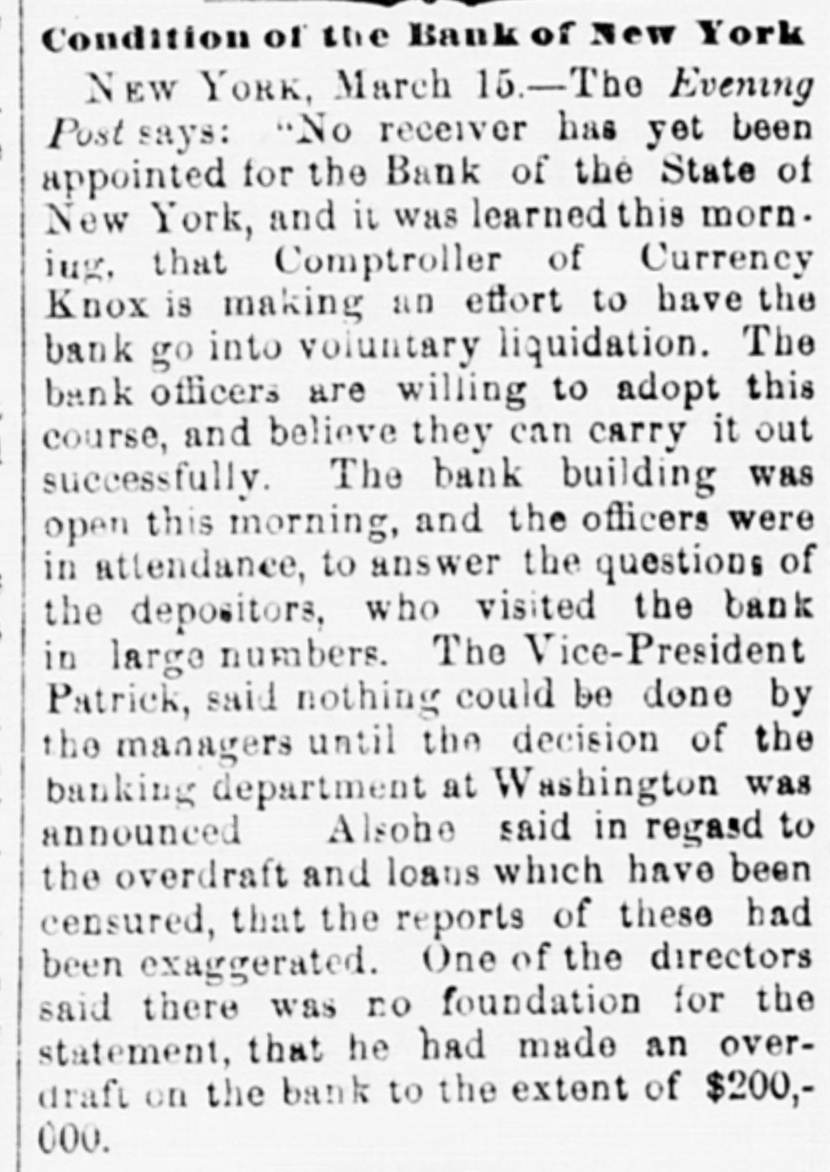
Condition of the Bank of New York NEW YORK, March 15.-The Evening Post says: "No receiver has yet been appointed for the Bank of the State of New York, and it was learned this morn. iug, that Comptroller of Currency Knox is making an effort to have the bank go into voluntary liquidation. The bank officers are willing to adopt this course, and believe they can carry it out successfully. The bank building was open this morning, and the officers were in attendance, to answer the questions of the depositors, who visited the bank in large numbers. The Vice-President Patrick, said nothing could be done by the managers until the decision of the banking department at Washington was announced Alsohe said in regasd to the overdraft and loans which have been censured, that the reports of these had been exaggerated. One of the directors said there was no foundation for the statement, that he had made an overdraft on the bank to the extent of $200,000.

Click image to open full size in new tab
TORS AND CHOICE OF A NEWBOARD-ACGU BELMONT ELECTED PRESIDENT-EFFORTS TO PREVENT THE APPOINTMENT OF A RECEIVERTHE DECISION WHETHER TO RESUME OR LIQUIDATE BE MADE TO-DAY-RICHARD PATRICK STILL DECLINES TO MAKE A STATEMENT. The officers of the Bank of the State of NewYork concluded that it would be advisable to open the loors yesterday, if not for payment, at least for inquiry on the part of stockholders, depositors, and others intersted 111 the affairs of the bank. They were very cautious, however, only one section of the door being opened at a time; but as there was little excitement they decided to extend the aperture until the whole entrance was revealed. Two policement were stationed at the door check any possible demonstration, and to prevent the The entrance of people who had no business there. clerks were at work as usual, making up their accounts for the information of the directors, who were to meet later, to decide upon the proper course to be pursued. All day long there was a stream of inquirers calling to ask questions as to their balances and special deposite of securities, &c. Special deposits, of course, were exempt from any liability by the suspension, but the officers did not wish to give them up until the Banking Department at Washington had decided on some action n the matter. In the bank parlor directors and stockholders held informal conferences to exchange views. Mr. Duer acted RS 2 commitee of one to receive inquirers and lament the catas rophe which had overtaken the bank. In the clerical department of the institution could be seen the actual 55 head of the concern-Riehard Patrick. About r 60 years of age,six feet high, and broad in proportion. with head slightly bald and hair and whiskers tinged with gray, be was a very impressive looking bank officer. Ie attended to all the inquirers who had actual business o transact. He answered all questions that did not reate to the mismanagement of the bank, and he walked about the rooms with a placid, smiling countenance, sceningly acting the part of an adroit and trustworthy friend who had been called in at a critical moment and given complete control. Mr. Patrick, having disposed of a number of persons who were awaiting his attention, W28 asked to furnish the of with his statement of the causes of the failure and to explain theextraordinary pablic he bank, and loans which to himself he had made to Smith & Girvan of Broad st., and others. Mr. Patrick replied that he was too much engaged: that his time was occupted, and therefore he could not be expected to make a statement. Mr. Duer ad new information to give, Mr. Patrick having had of the business of the bank. and Later in the day matters barge knew no nothing. began the dire to grow tora actived, and although Mr. Patrick still had no statement. It was evident that more time was, if smake possible. Institution the August intention Belto rearimate the Bank mont, one of the largest stockholders was present. Meigs was offering the benefit of and President Vermilye of the bank officers also gave advice, and assistance the production of nce, and erial Examiner other upon Merchants proper his offered supported expert securi- Bank ma ies. At the request of the persons interested, y the Bank Examiner, Controller of the Currency Knox the appointment of a receiver in tiler the bank might go into voluntary raminer Meiga had stated that its obligations to 10303 but ad withheld to Hquidate however. depositors the liquidation. bank The and had Bank other Con- the preditors. This was not sufficient roller inviated that he should have a proper written custom tee that the integrity necessary for the applicathe assets to the payment The directors and themselve on paper. Controller that he must have this guarantee, and lebts o traphed ion commit existed of stockholders Knox hesitated the of after- tele the oon was spent in discussing the matter. According to an authoritative statement the obliga ions of the bank are about $3,000,000, in round numers. or this amount depositors representing $1,000, 00 have agreed to wait some time for their Against money. leaves about $2,000,000 be provided for. his there are $1,500,000 cash and the securities neces for the procuring of the deficiency of $500,000. if the necessary guarantee can be of the bank will RO apply all obligations on demand, managers Yow, ry guidate Controller obtained the but assets Knox will that allow as will the to grant the request not to appoint a receiver, be bank to liquidate and reorganize. At the meeting of be directors yesterday these facts were very clearly exrought out. The condition of the bank was also } ined in detail by Mr. Patrick CHANGING THE DIRECTORS. The deliberations long and earnest. and the result 1 their was that the directors concluded that the best them to would be to retire, and enable business sagacity was not Accordingly George W. Duer, Vice-President. Isaac H. hing hour uen whose places. for impaired Reed, President, resigned, to John take A.M. Proudat, and Lloyd Aspiawall dehard steward. Patrick. of the bank 11 dividually and collectively, as directors Board of in their places were installed the following D. ore: August Belmont, George F. Talman, Henry Morgan. R G. Rolston, D. John R Marshall, and Lawrence Turnure. selin, Diree withers, D. offices Smith, August were A. selmont was elected President, and the other eft August vacant Belmont, for the present. as is well known is the ageat of the tothschilds in this country. R. G. Relston is President if the Farmers' Loan and Trust Company, and the other This ew directors are very wellknown business men. have change in control was deemed essential, as It would eep impossible for the bank to get back to the Clearing it even with Mr. Patrick as s manager. Nor could of cause egain popular confidence as long as the same Board Directors remained in office. A meeting of the new directors will be held this decide more to examine the affairs of the bank and to ng whether to resume immediately, or to go into voluntary out liquidation, the deaire being to keep the institution of a receiver. The Controller of the Currency given notice of the facts, and ill August Belmont is one of the of the bank. and in the event of M It receiver. as be olders hands been beaviest permanent largest not losers. appoint stock aue pension would have been one of the . expected that he will take measures to compel Girvan, the im of the loans made to Smith & Mill Companies," Mr. close of the proceedings last evening asked if he had any be t mediate as the Attrition payment statement Patrick, considering for Mr. and publica Patrick others the ion. He said that he had been have matter and Inded that he would let others He now. and then his turn would come. no it understood now, however, director or officer in the $500,000 of the loans which the onger beir ished About "any bank. that bank be Examiner had was out taudin were paid off by the customers. Bank notes of in his official capacity. presented several to : Hggs, the counter for redemption in order the technical point and protest but the tellers, acting on the paid the notes in legal payment; make he he officers, bank over tenders. refuse instructions them for to make non- of Smith & Girvan and their friends still with statement in regard to their connection upon the ny A reporter of THE TRIBUNE called yesterday jr. of that firm, finding him at States Attrition Flour Company. to the report that the stock given as loans granted by the Bank of asked ank. he or 1. C United Smith. as the the security State office When 80 of of to Smith & Girvan was to comply with a requisite represented any monetary the New-York because placed the large it form merely value, and that not he explanations, remarking relined to make any enough already. The United
Click image to open full size in new tab
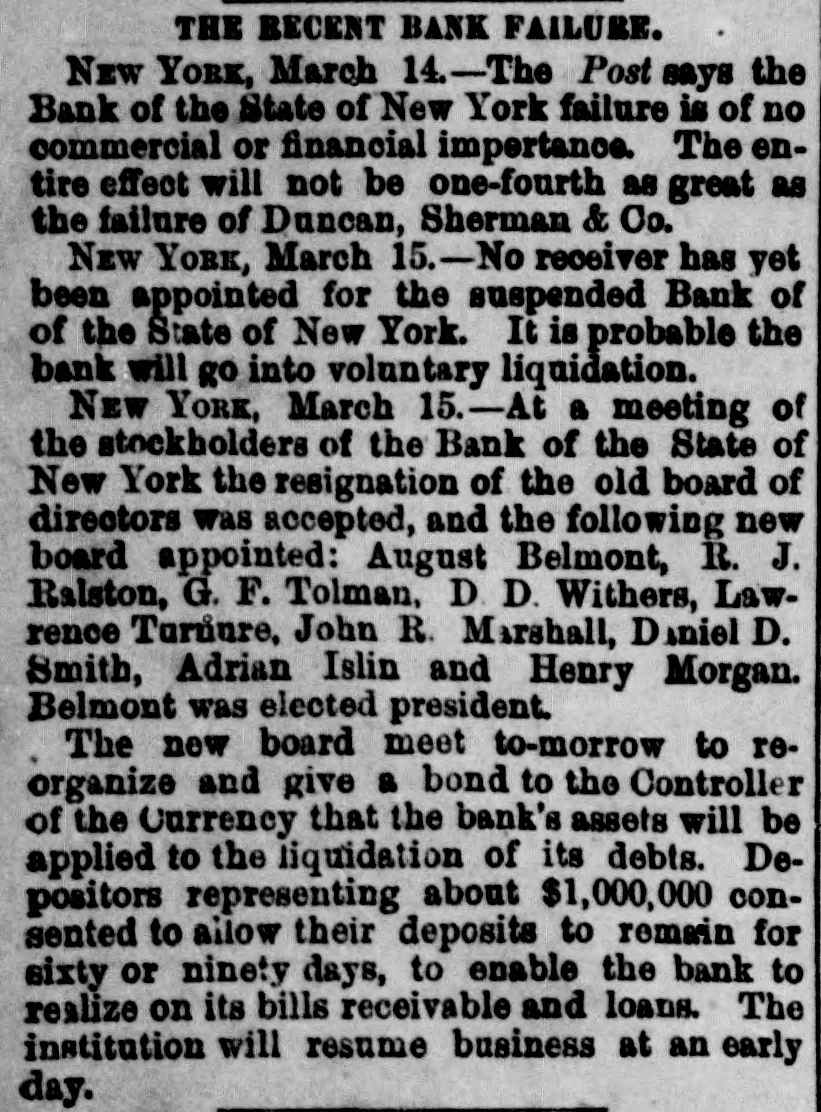
THE RECENT BANK FAILURE. NEW YORK, March 14.-The Post says the Bank of the State of New York failure is of no commercial or financial importance. The entire effect will not be one-fourth as great as the failure of Duncan, Sherman & Co. NEW YORK, March 15.-No receiver has yet been appointed for the suspended Bank of of the State of New York. It is probable the bank will go into voluntary liquidation. NEW YORK, March 15.-At a meeting of the stockholders of the Bank of the State of New York the resignation of the old board of directors was accepted, and the following new board appointed: August Belmont, R. J. Ralston, G. F. Tolman, D. D. Withers, Lawrence Turúure, John R. Marshall, Daniel D. Smith, Adrian Islin and Henry Morgan. Belmont was elected president. The now board meet to-morrow to reorganize and give a bond to the Controller of the Currency that the bank's assets will be applied to the liquidation of its debts. Depositors representing about $1,000,000 consented to allow their deposits to remain for sixty or ninety days, to enable the bank to realize on its bills receivable and loans. The institution will resume business at an early day.

Click image to open full size in new tab
Stocks Firmer-Prospect of an Adjustment of the Affairs of the Bank of the State of New York. GOLD 114 3-8 A 114 1-2. Money on Call 5 and 6 Per Cent-Government Bonds Active-Investments StrongForeign Exchange Steady. WALL STREET, WEDNESDAY, March 15-6P. It was meet and fitting that the vernal season, with its sunshine and shower, should find its reflex in the a stock market of the last two days. There prevailed "winter of discontent" yesterday; "glorious summer" shone brightly to-day. This from the bull point of view. Let bears snarl dissent if they will. The better scale of prices established at the close yesterday prevailed, and though there were some fluetuations they proved of a fractional character only, and quotations at three o'clock were the best of the day. The theory expressed yesterday that Gould had possibly for the time being got upon the long side of the market seems to be proven by the fact that he was a large and general buyer to-day, and prices were marked up responsive to his purchases. Brokers have no leisure to cry over spilt milk, but are sharp to skim the cream that each new day offers; so the bank disaster of yesterday was dismissed from their minds without further consideration. 1 on y lenders apparently fell into the same notion, for they were nimble enough in dismounting from the very high horses which they bestrode yesterday, and were eager to hire out their nags of bank balances at as low a rate as two per cent per annum. All the prognostications to-night point to a change of wind, and a favorable'one for that, to those who are long of the market. How long these gentle gales will prevail or how soon those who havesown the wind will reap the whirlwind is a matter that the stockjobbing Eolus will decide at his pleasure. For despite the pressure of wealth and talent and the pressure of all the fiddle-faddle of the centennial year, Jay Gould, as king of the financial bag of imprisoned winds, elects to blow high or blow low as suits his imperial fancy. There prevailed a stormy northeaster yesterday; there exists a gentle breeze to-day; how it will blow to-morrow nobody knows but the controller of the winds himself, and yet brokers wonder why outsiders 10 not embark on the sea of speculation (treacherous enough in the best or weathers) when a single man holds in his hands the destiny of success or disaster. Still Gould, for his own purposes, supported the market yesterdav, with the result of a decided benefit to vested interests. It is simply a proof that good can comeout of evil, and in this sense it will be accepted. Beyond the narrow fluctuations which we have alluded to and the record of a firm and active market, which closed at about the best prices of the day, there was no fact or rumor prevalent worthy of note. Toward the close of the day it was currently reported that the affairs of the Bank of the State of New York had got into such state as would enable it to speedily renew business. It was stated that the corporation could be set going again, either on the basis of reduction of capital to one-half or on the condition of the present depreciation being made good. In either regard a new management would be placed at the head of affairs, which would be trusted to look less to personal interests than to the good of stockholders at large. It is hoped that the wish may not be solely father to the thought, but that this old and respectable institution may speedily recover its former prestige, THE EMBARRASSED BANK. The affairs of the Bank of the State of New York, although still unsettled, are not in so bad a condition as to make it certain that the institution will pass into the bands of a receiver. A new board of directors was elected, several of its obligations were promptly paid to-day, offers of assistance are under consideration, and a disposition is said to be manifested by several of the wealthy stockholders to advance whatever may be necessary to make good the credit of the institution and give it a fresh start under new influences. The report was circulated in stock circles that the bank would positively resume business to-morrow; but this is, doubtless, premature It is enough that the indications are favorable. The stock was bid for at 30 today and offered at 95. The last sale was at 106. THE SALES TO DAY. The transactions on the Stock Exchange to-day aggregated 208,000 shares, which were distributed among active shares, as follows:-New York Central and Hud son, 550; Erie, 46,750; Lake Shore, 52,500; Northwest ern, 4,900; do. preferred, 1,200; Rock Island, 1,550; Pa. elfic Mail, 28,200; St. Paul, 11,150; do. preferred, 2,900; Dhios, 5,550; Western Union, 39,200; Wabash, 325; Union Pacitic, 1,810; C., C. and I. C., 200; Panama, 100; Michigan Central, 8,175. OPENING, HIGHEST AND LOWEST PRICES. The following table shows the opening, highest and lowest prices of the day:-
Click image to open full size in new tab
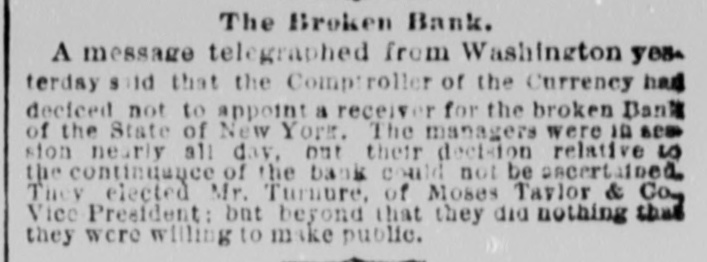
The Broken Bank. A message telegraphed from Washington yes terday said that the Comptroller of the Currency has deciced not to appoint a receiver for the broken Bank of the State of New York. The managers were 10 ser sion nearly all day, out their decision relative is the continuance of the bank could not be oncertained They elected Mr. Turnure, of Moses Taylor & Co. Vice President: but befond that they did nothing thus they were willing to make public.
Click image to open full size in new tab
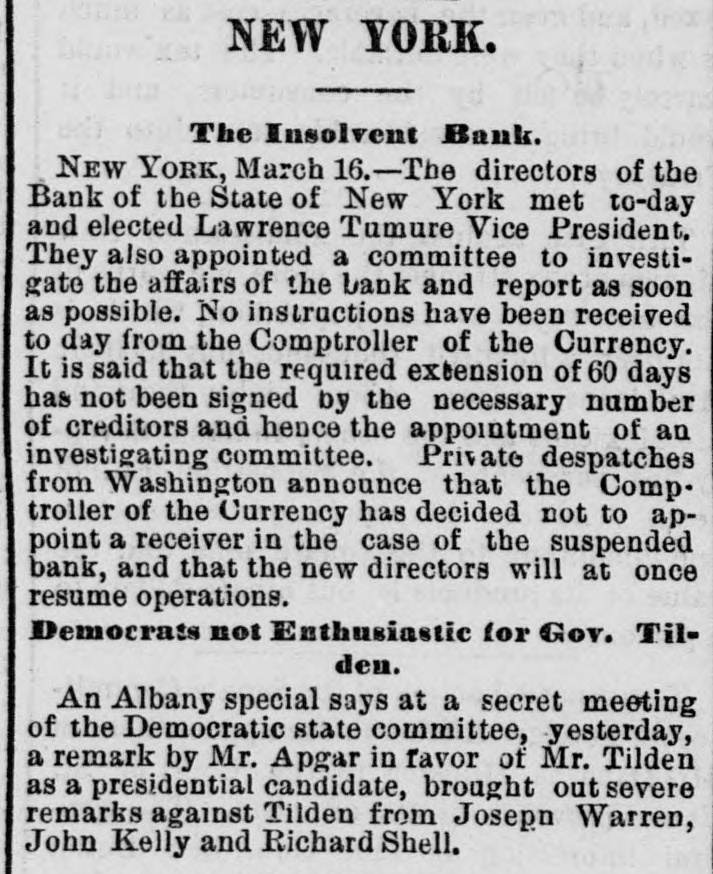
NEW YORK. The Insolvent Bank. NEW YORK, March 16.-The directors of the Bank of the State of New York met to-day and elected Lawrence Tumure Vice President. They also appointed a committee to investigate the affairs of the bank and report as soon as possible. No instructions have been received to day from the Comptroller of the Currency. It is said that the required extension of 60 days has not been signed by the necessary number of creditors and hence the appointment of an investigating committee. Private despatches from Washington announce that the Comp. troller of the Currency has decided not to appoint a receiver in the case of the suspended bank, and that the new directors will at once resume operations. Democrats not Enthusiastic for Gov. Tilden. An Albany special says at a secret meeting of the Democratic state committee, yesterday, a remark by Mr. Apgar in favor of Mr. Tilden as a presidential candidate, brought out severe remarks against Tilden from Josepn Warren, John Kelly and Richard Shell.
Click image to open full size in new tab
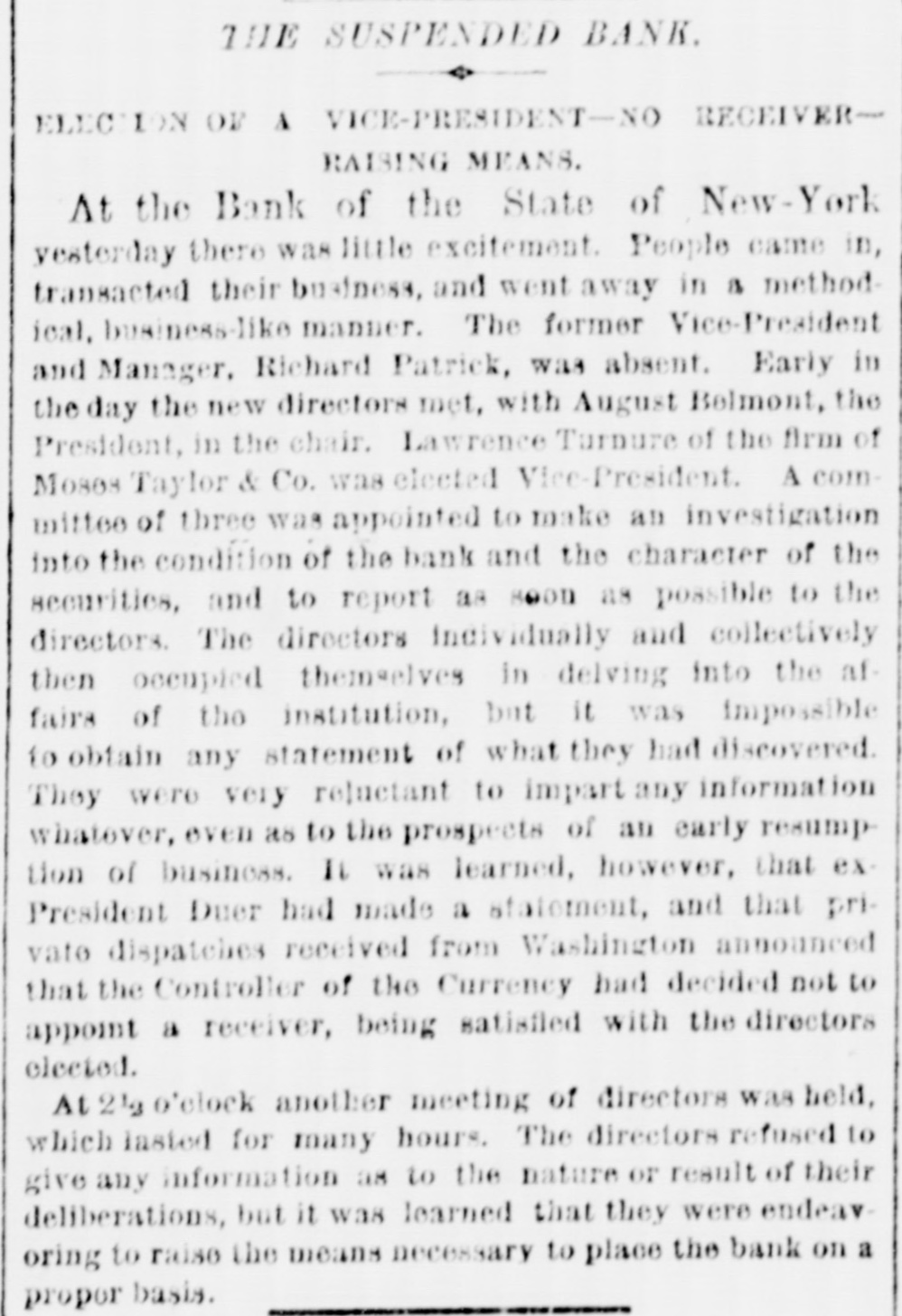
THE SUSPENDED BANK. ELECTION OF A VICE-PRESIDENT-NO RECEIVERRAISING MEANS. At the Bank of the State of New-York yesterday there was little excitement People came in, transacted their business, and went away in a methodical, business-like manner. The former Vice-President and Manager, Richard Patrick, was absent. Early in the day the new directors met, with August Belmont, the President, in the chair. Lawrence Turnure of the firm of Mosor Taylor & Co. was elected Vice-President A committee of three was appointed to make an investigation into the condition of the bank and the character of the securities, and to report as soon as possible to the directors The directors individually and collectively then occupied themselves in delving into the at fairs of the institution, but it was impossible to obtain any statement of what they had discovered They were very rejuctant to impart any information whatever, even as to the prospects of an early resump tion of business. It was learned, however, that ex President Duer had made a statement, and that private dispatches received from Washington announced that the Controller of the Currency had decided not to appoint a receiver, being satisfied with the directors elected. At 21g o'clock another meeting of directors was held, which lasted for many hours. The directors refused to give any information as to the nature or result of their deliberations, but it was learned that they were endeav oring to raise the means necessary to place the bank on a propor basis.

Click image to open full size in new tab
THE BANK OF THE STATE OF NEW YORK The bank of the State of New York has suspended payment and closed up.
Click image to open full size in new tab
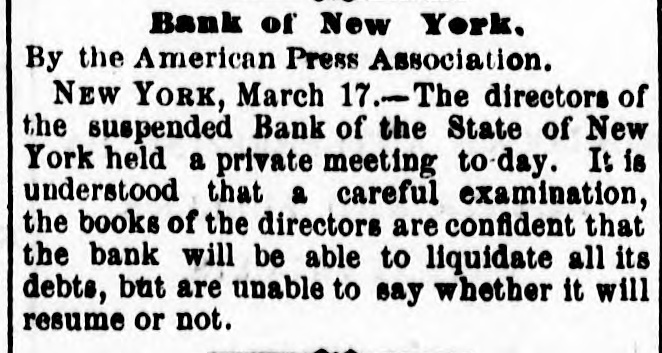
Bank of New York. By the American Press Association. NEW YORK, March 17.-The directors of the suspended Bank of the State of New York held a private meeting today. It is understood that a careful examination, the books of the directors are confident that the bank will be able to liquidate all its debts, but are unable to say whether it will resume or not.
Click image to open full size in new tab
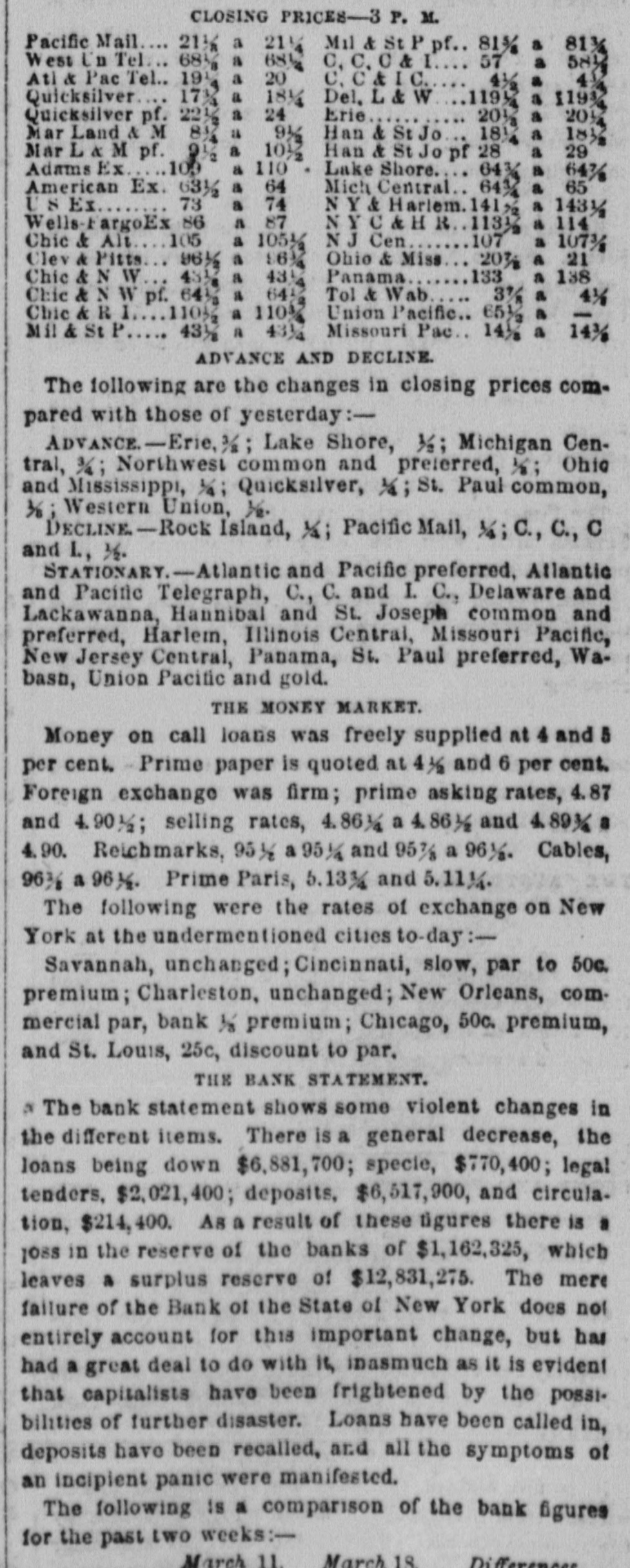
CLOSING PRICES-3 P. M. Pacific Mail 813 211/2 a 21 1/4 Mil & St P pf 81% a a West Un Tel 57 I C. & 681/ C. C, 584 68 a 20 1914 Atl & Pac Tel.. C. C&IC 4 41/2 a 17% 1191 a Quicksilver 1193 Del. L & W 1814 a 24 Erie a 221/2 Quicksilver pf. 201/2017 201 a Han & St Jo Mar Land & M a 91/2 18) 817 18 a 28 a 29 Mar L & M pf. 10% Han & St Jo pf 91/2 Adams Ex a 110 109 Lake Shore. 643 a 643/6 a 64 American Ex. Mich Central 631/2 6434 a 65 a 74 73 Y & Harlem. USEX 141% a 1431/4 a 87 Y C & R a 114 Wells-FargoEx 86 107 105 NJ Cen Chic & Alt a 105% a 1071/2 a Clev & Pitts 961/2 96% Ohio & Miss 20% a 21 133 a Panama a 138 4317 Chic & N W 4314 3% a 41/6 Chic & N W pf. 64% a 64 Tol & Wab Chic & R I 1103 a 110% Union Pacific 651/2 a a a Missouri Pac Mil & St P 43)4 43% 14% 1436 ADVANCE AND DECLINE. The following are the changes in closing prices compared with those of yesterday:ADVANCE-Erie,% Lake Shore, /; Michigan Centrai, 3/4; Northwest common and preferred, % Ohio and Mississippi, 1/4; Quicksilver, 1/4; St. Paul common, 1/6; Western Union, 1/6. DECLINE-Rock Island, Xi Pacific Mail, 1/4; C., C., C and I., 1/2. STATIONARY.-Atlantic and Pacific preferred, Atlantic and Pacific Telegraph, C., C. and I. C., Delaware and Lackawanna, Hannibal and St. Joseph common and preferred, Harlem, Illinois Central, Missouri Pacific, New Jersey Central, Panama, St. Paul preferred, Wabasn, Union Pacific and gold. THE MONEY MARKET. Money on call loans was freely supplied at 4 and 5 per cent. - Prime paper is quoted at 4 1/6 and 6 per cent. Foreign exchange was firm; prime asking rates, 4.87 and 4.90 1/4; selling rates, 4.86 1/4 a 4.86 1/2 and 4.893/4 a 4.90. Reichmarks, 95% a 95 1/4 and 95% a 96% Cables, 96 a 96)4. Prime Paris, 5.13% and 5.1114. The following were the rates of exchange on New York at the undermentioned cities to-day:Savannah, unchanged; Cincinnati, slow, par to 50c. premium; Charleston, unchanged; New Orleans, commercial par, bank 1/6 premium; Chicago, 50c. premium, and St. Louis, 25c, discount to par. THE BANK STATEMENT. a The bank statement shows some violent changes in the different items. There is a general decrease, the loans being down $6,881,700; specie, $770,400; legal tenders, $2,021,400; deposits, $6,517,900, and circulation, $214,400. As a result of these figures there is a loss in the reserve of the banks of $1,162,325, which leaves a surplus reserve of $12,831,275. The mere failure of the Bank ot the State of New York does not entirely account for this important change, but has had a great deal to do with 14 inasmuch as it is evident that capitalists have been frightened by the possibilities of further disaster. Loans have been called in, deposits have been recalled, and all the symptoms of an incipient panic were manifested. The following is a comparison of the bank figures for the past two weeks:March March 18
Click image to open full size in new tab
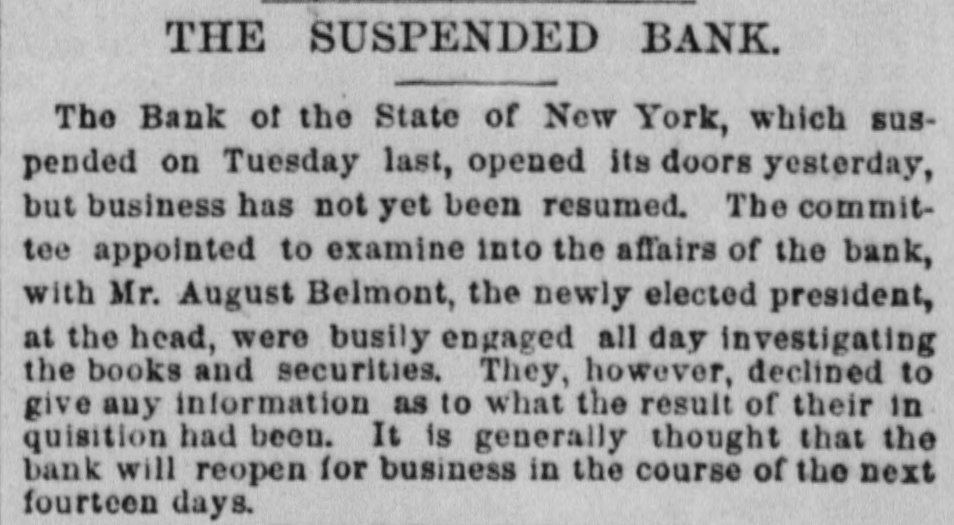
THE SUSPENDED BANK. The Bank of the State of New York, which suspended on Tuesday last, opened its doors yesterday, but business has not yet been resumed. The committee appointed to examine into the affairs of the bank, with Mr. August Belmont, the newly elected president, at the head, were busily engaged all day investigating the books and securities, They, however, declined to give any information as to what the result of their in quisition had been. It is generally thought that the bank will reopen for business in the course of the next fourteen days.
Click image to open full size in new tab
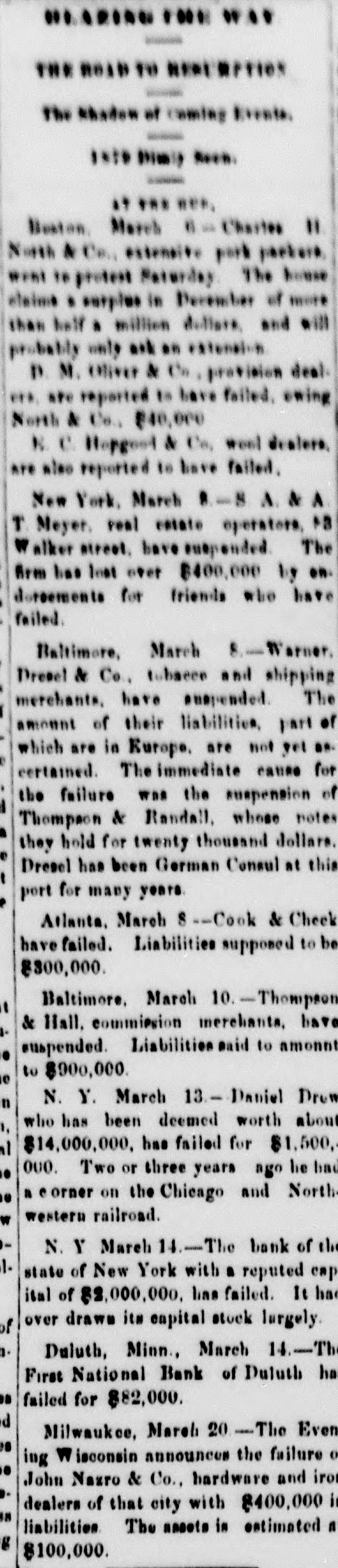
weapona our wee I THE ROSH to RESERVED The shadow of caming Events. 1010 may Rech " *** REF. Beston March Charlee = North & Co., estensite 1 parkers went represent Returned The house claims . surples in December of more than half . million dollars and will probably only ark an extension P. M. Oliver & Co provision deal. era ste reported is have failed, ewing North & Co. $40,000 R e & Co. wool dealers. are also reported to have failed. New York, March R-8AAA T Meyer. real estate operatore. 13 Walker street. have suspended The firm has lost ever $400,000 by on. dorements for friends who have : failed. Baltimore, March B-Warner. Presel & Co., tobacco and shipping merchants, have suspended. The I amount of their liabilities, part or which are in Kurope. are not yet ⑉ e certained. The immediate cause for . the failure was the suspension of I Thompson & Randall, whose notes a they hold for twenty thousand dollars. e Dresel has been German Consul at this I port for many years. p Atlanta. March 8 --Cook & Cheek have failed. Liabilities supposed to be $300,000. Baltimore. March 10. - Thompson I & Hall, commission merchants. have 1. . suspended. Liabilities said to amount to $900,000. le N. Y. March 13. - Daniel Drew n who has been deemed worth about 1, l $14,000,000. has failed for $1,500, our. Two or three years ago he had e o n corner on the Chicago and North western railroad. w N. Y March 14.-The bank of elo 1. state of New York with a reputed cap isul of 82,000,000, has failed. It ha over drawn its capital stock largely. of a Duluth, Minn., March 14.-The First National Bank of Duluth ha as failed for 882,000. d Milwaukee, Mareli 20 -The Even e ing Wisconsin announces the failure o e John Naxro & Co., hardware and iro . dealers of that city with $400,000 i in liabilities The assets is estimated n 8 $100,000.

Click image to open full size in new tab
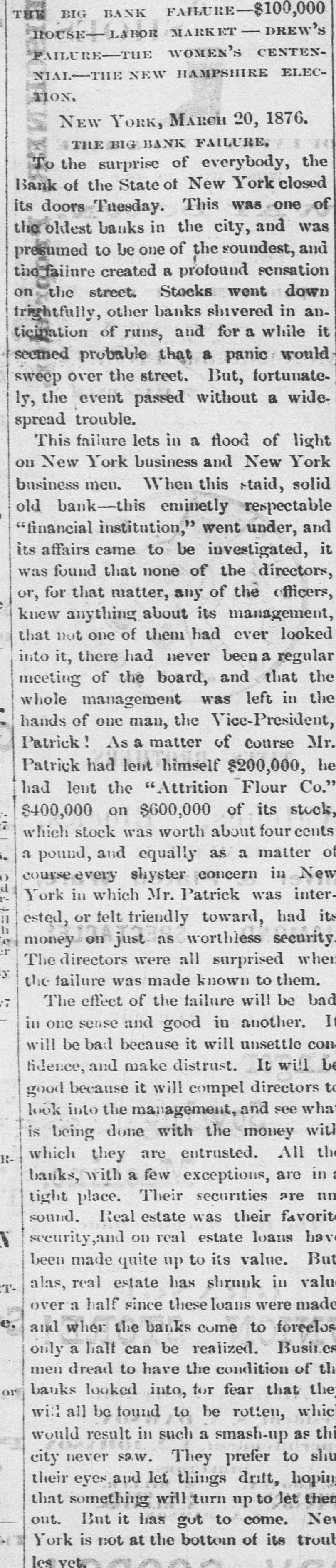
OUR NEW YORK LETTER. The Big Bank Failure-$100,000 House -The Labor Market-Drew's Failure -The New Hampshire Election. # THE BIG BANK FAILURE. To the surprise of everybody, the Bank of the State of New York closed its doors Tuesday. This was one of the oldest banks in the city, and was presumed to be one of the soundest, and the failure created a profound sensation on the street. Stocks went down frightfully, other banks shivered in anticipation of runs, and for a while it seemed probable that a panic would sweep over the street. But, fortunately, the event passed without a widespread trouble. The failure lets in a flood of light on New York business and New York business men. When this staid, solid old bank—this eminently respectable "financial institution," went under, and its affairs came to be investigated, it was found that none of the directors, or, for that matter, any of the officers, knew anything about its management, that not one of them had ever looked into it, there had never been a regular meeting of the board, and that the whole management was left in the hands of one man, the Vice-President, Patrick! As a matter of course Mr. Patrick had lent himself $200,000, he had lent the "Attrition Flour Co." $400,000 on $600,000 of its stock, which stock was worth about four cents a pound, and equally as a matter of course every shyster concern in New York in which Mr. Patrick was interested, or felt friendly toward, had its money on just as worthless security. The directors were all surprised when the failure was made known to them. The effect of the failure will be bad in one sense and good in another. It will be bad because it will unsettle confidence, and make distrust. It will be good because it will compel directors to look into the management, and see what is being done with the money with which they are intrusted. All the banks, with a few exceptions, are in a tight place. Their securities are unsound. Real estate was their favorite security, and on real estate loans have been made quite up to its value. But, alas, real estate has shrunk in value over a half since these loans were made, and when the banks come to foreclose only a half can be realized. Business men dread to have the condition of the banks looked into, for fear that they will all be found to be rotten, which would result in such a smash-up as this city never saw. They prefer to shut their eyes and let things drift, hoping that something will turn up to let them out. But it has got to come. New York is not at the bottom of her troubles yet. # А $100,000 HOUSE. Do you remember the failure of the "eminent" banking-house of Duncan, Sherman & Co.? Of course you do; and you remember also that they didn't pay scarcely anything on the dollar, and that their creditors were fearfully indignant. It is comforting to take up a Newport paper and read that Mr. Watt Sherman, one of the partners, is building a cottage in that "city by the sea," the cost of which is only $100,000! and this for a summer residence only. Failing is not a very bad business, after all. If a ruined man can afford a $100,000 house, what ought one to have who sticks to his legitimate business, and goes on regularly? The Vice-President of the big bank failure of Tuesday will probably build himself a cottage next year. # THE LABOR MARKET Is in a fearful condition. One publishing house has discharged thirty clerks since Jan. 1st, every one of whom are now out of employment, and will be till trade revives. The great metal house of Phelps, Dodge & Co. notified their employees that they should be compelled to dismiss one-half of them, whereupon the men held a meeting and resolved to work for one-half wages, provided the whole force should be kept on. To this the house consented, and the men are doing the best they can until something turns up. One manufacturer in the city who never, till last year, employed less than 1200 men, has but 400 at this time. He discharged 600 last week. These are but sample cases. The whole industry of the city is paralized, and distress is not only wide-spread, but universal. Those who have work, are doing it for the barest and closest possible subsistance, and they are exceedingly fortunate. Where one has work, ten have none at all, and what they are living on, Heaven only knows. I can hire ten thousand women to-morrow for $5 a week, women skilled in the labor they do, and men can be had in droves for a dollar a week more. When will the good times come? # DREW'S FAILUBE. The failure of Daniel Drew, once the king of Wall street, produced no sensation, for the old fellow nearly failed a year ago. He has been uniformly unfortunate for some years, and "the boys," as he was wont to term the younger members of the board, have squeezed him unmercifully. And finally they got him down, and everybody is glad of it. In his day, when he had power, he showed no mercy. He never asked or gave it, and now that his enemies have him, they mete out to him his own medicine. Drew's ca-
Click image to open full size in new tab
THE BIG BANK FAILURE-$100,000 HOUSELABOR MARKET-DREw's FAILURE-TUE WOMEN'S CENTENNIAL-THENEW HAMPSHIRE ELECTION. NEW York, MARCH 20, 1876. THE BIG BANK FAILURE. To the surprise of everybody, the Bank of the State of New York closed its doors Tuesday. This was one of the oldest banks in the city, and was presumed to be one of the soundest, and the failure created a profound sensation on the street. Stocks went down trightfully, other banks shivered in anticination of runs, and for a while it seemed probable that a panic would sweep over the street. But, fortunately, the event passed without a widespread trouble. This failure lets in a flood of light on New York business and New York business men. When this >taid, solid old bank-this eminetly respectable "financial institution," went under, and its affairs came to be investigated, it was found that none of the directors, or, for that matter, any of the officers, knew anything about its management, that not one of them had ever looked into it, there had never been a regular meeting of the board, and that the whole management was left in the hands of one man, the Vice-President, Patrick! As a matter of course Mr. Patrick had lent himself $200,000, he had leut the "Attrition Flour Co." $400,000 on $600,000 of its stock, which stock was worth about four cents a pound, and equally as a matter of course every shyster concern in New d York in which Mr. Patrick was interII ested, or felt friendly toward, had its h e money on just as worthless security r The directors were all surprised when y the failure was made known to them. 7 The effect of the failure will be bad in one sense and good in another. I will be bad because it will unsettle con fidence, and make distrust. It will be good because it will compel directors to look into the management, and see what is being done with the money with which they are entrusted. All th R. banks, with a few exceptions, are in : tight place. Their securities are un sound. Real estate was their favorite security, and on real estate loans hav i been made quite up to its value. But alas, real estate has shrunk in valu Tover a half since these loans were made e. and when the banks come to foreclos only a half can be realized. Busines men dread to have the condition of th or bauks looked into, for fear that the will all be found to be rotten, which would result in such a smash-up as thi city never Saw. They prefer to shu their eyes and let things drift, hoping that something will turn up to let then out. But it has gut to come. Ne York is not at the bottom of its troub les yet.
Click image to open full size in new tab
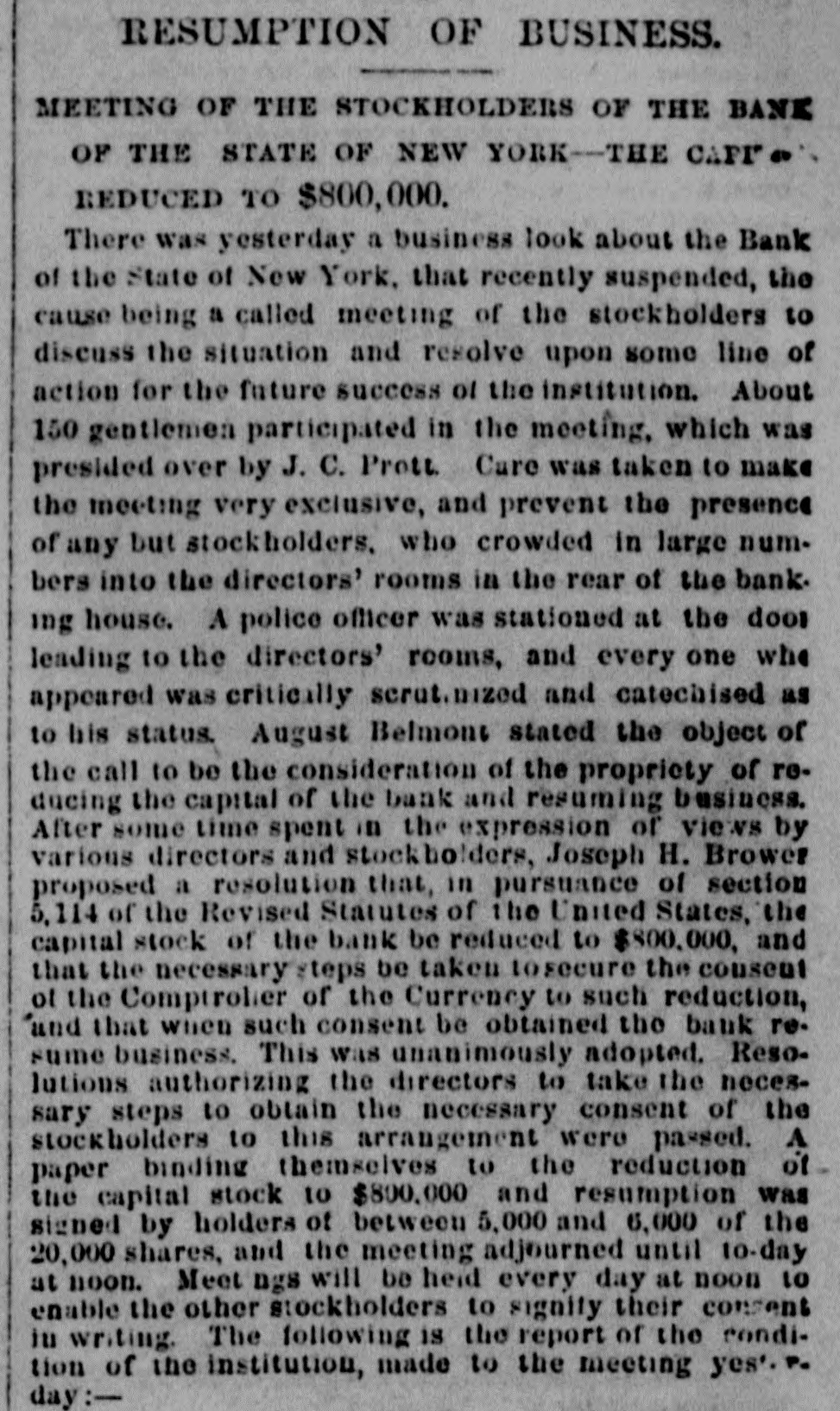
RESUMPTION OF BUSINESS. MEETING OF THE STOCKHOLDERS OF THE BANK OF THE STATE OF NEW YORK--THE CAPI REDUCED TO $800,000. There was yesterday a business look about the Bank of the State of New York, that recently suspended, the cause being a called meeting of the stockholders to discuss the situation and resolve upon some line of action for the future success of the institution. About 150 gentlemen participated in the meeting, which was presided over by J. C. Prott. Care was taken to make the meeting very exclusive, and prevent the presence of any but stockholders, who crowded in large numbers into the directors' rooms in the rear of the bank. ing house. A police officer was stationed at the doos leading to the directors' rooms, and every one who appeared was critically scrut.nized and catechised as to his status. August Belmont stated the object of the call to be the consideration of the propriety of redueing the capital of the bank and resuming business. After some time spent in the expression of views by various directors and stockholders, Joseph H. Brower proposed a resolution that, in pursuance of section 5,114 of the Revised Statutes of the United States, the capital stock of the bank be reduced to $800,000, and that the necessary steps be taken tosecure the couseut of the Comptrolier of the Currency to such reduction, and that when such consent be obtained the bauk re. sume business. This was unanimously adopted. Reso. lutions authorizing the directors to take the necessary steps to obtain the necessary consent of the stockholders to this arrangement were passed. A paper binding themselves to the reduction of the capital stock to $800,000 and resumption was signed by holders of between 5,000 and 6,000 of the 20,000 shares, and the meeting adjourned until 10-day at noon. Meet ngs will be heid every day at noon to enable the other stockholders to signify their consent iu writing. The following is the report of the condition of the institution, made to the meeting yes' P. day -
Click image to open full size in new tab
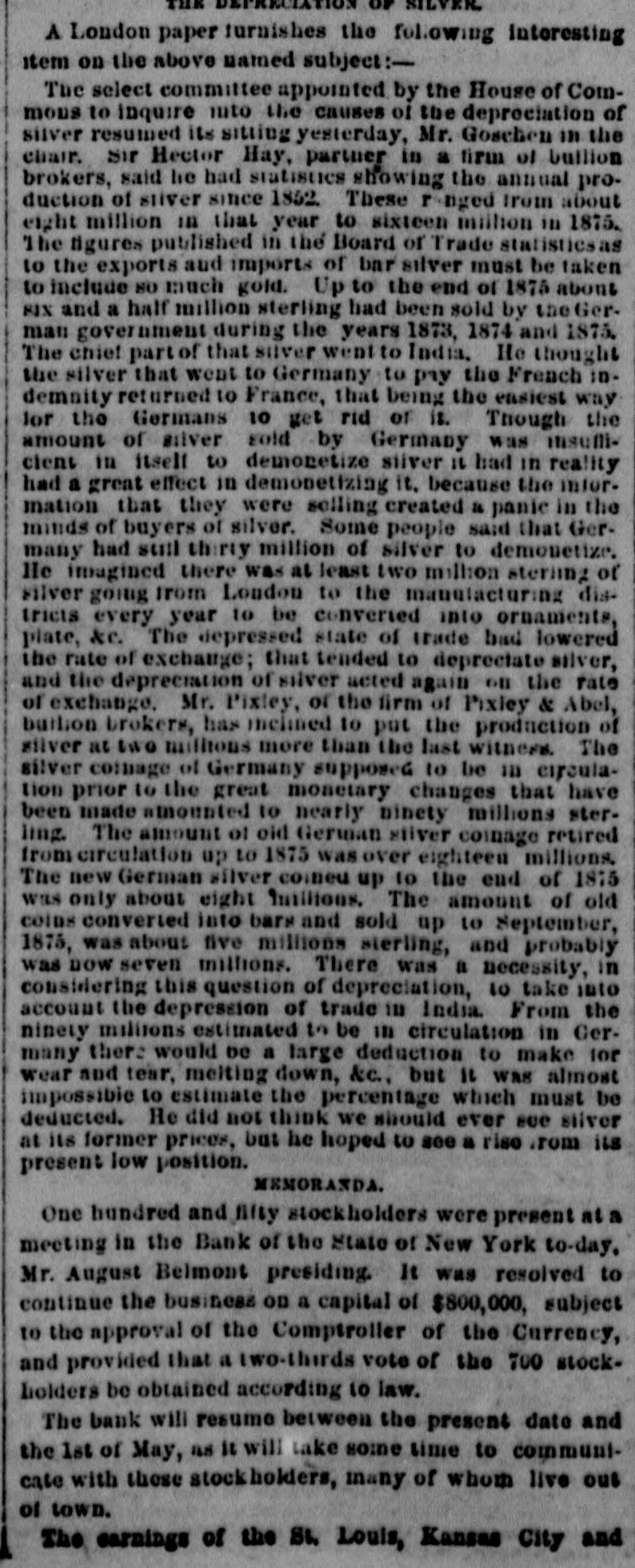
A London paper furnishes the following interesting item on the above named subject:The select committee appointed by the House of Commous to inquire into the causes of the depreciation of silver resumed its sitting yesterday, Mr. Goschen in the chair. Sir Hector Hay, partner in a firm of bullion brokers, said he had statistics showing the annual production of sliver since 1852. These ronged from about eight million in that year to sixteen million in 1875. The figures published in the Board of Trade statistics as to the exports aud imports of bar silver must be taken to include so much gold. Up to the end of 1875 about SIX and a half million sterling had been sold by the German government during the years 1873, 1874 and 1875. The chief part of that silver went to India. He thought the silver that went to Germany to pay the French indemnity returned to France, that being the easiest way for the Germans 10 get rid of is. Though the amount of silver gold by Germany was misullicient in itself to demonetize silver 11 had in reality had a great effect in demonetizing it. because the miormation that they were selling created is panic in the minds of buyers of silver. Some people said that Germany had still thirty million of silver to demonetize. He imagined there was at least two million stering of silver going from London to the manufacturing districts every year to be converted into ornaments, plate, &c. The depressed state of trade had lowered the rate of exchange; that tended to depreciate silver, and the depreciation of silver acted again on the rate of exchange. Mr. Pixley, of the firm of Pixley & Abel, buttion brokers, has included to put the production of silver at two militous more than the last witness The silver comage of Germany supposed to be in circulation prior to the great monetary changes that have been made amounted to nearly ninety millions sterling. The amount of old German silver coinage retired from circulation up to 1875 was over eighteen millions. The new German silver coineu up to the end of 18:5 was only about eight Intilious. The amount of old colus converted into bars and sold up to September, 1875, was about five millions sterling, and probably was now seven millions. There was a necessity, in considering this question of depreciation, to take into account the depression of trade 113 India. From the ninety millions estimated to be in circulation in Germany there would be a large deduction to make for wear and tear, melting down, &c., but It was almost impossible to estimate the percentage which must be deducted. He did not think we should ever see sliver at its former prices, but he hoped to see a riso from its present low position. MEMORANDA. One hundred and filty stockholders were present at a meeting in the Bank of the State of New York to-day. Mr. August Belmont presiding. It was resolved to continue the business on a capital of $800,000, subject to the approval of the Comptroller of the Currency, and provided that a two-thirds vote of the 700 stock. holders be obtained according 10 law. The bank will resume between the present date and the 1st of May, as it will take some time to communicate with those stock holders, many of whom live out of town. The earnings of the St. Louis, Kansas City and